


In many Western countries including The Netherlands, schoolchildren often do not comply with dietary recommendations. Notably, as shown in a recent European study, fruit and vegetable (F&V) intakes are lower than national guidelinesReference Yngve, Wolf, Poortvliet, Elmadfa, Brug and Ehrenblad1, 2.
Epidemiological evidence for an association between eating enough F&V and decreased risk for chronic metabolic diseases like obesity, hypertension and diabetes mellitus type 2 is convincingReference Van Duyn and Pivonka3, Reference Bes-Rastrollo, Martinez-Gonzalez, Sanchez-Villegas, De la Fuente Arrillaga and Martinez4. Therefore, various interventions have been developed aiming to increase F&V intakes among children. Food habits acquired in childhood to a certain extent track into adolescence and adulthoodReference Te Velde, Twisk and Brug5, arguing for the promotion of adequate F&V consumption among schoolchildrenReference Rozin6–Reference Klepp, Pérez-Rodrigo, De Bourdeaudhuij, Due, Elmadfa and Haraldsdóttir8. Moreover, behavioural habits in children may not be as firmly rooted as in adultsReference Birch9.
The Dutch recommendations for F&V intake for 10–12-year-old children are two pieces of fruit (about 200–250 g) and 150–200 g of vegetables per day10. In The Netherlands, a number of interventions have been developed to promote compliance to these recommendationsReference Wind, Van Zadelhoff, Snel, Van der Ham and Brug11. The largest-scale Dutch intervention is ‘Schoolgruiten’, which is a Dutch acronym for ‘school fruits and vegetables’. The Schoolgruiten Project is meant to grow into a nationwide campaign for primary-school children, but started with a pilot phase in which the intervention was tested in a controlled design, to inform further improvement of the intervention or justify further implementation.
In The Netherlands, especially in the major cities in the western part of the country, a growing minority, in some cities up to 50% of the children, has a non-Western background; at least one of their parents was born in a non-Western country, especially Morocco, Turkey, Surinam or the Netherlands Antilles. Evidence suggests that these children have different eating patterns, including different F&V intakes, than children of Dutch ethnicityReference Te Velde, Wind, Van Lenthe, Klepp and Brug12–Reference Brussaard, Brants, Van Erp-Baart and Hulshof16. Furthermore, intervention studies hardly ever look at differential effects according to such factors as ethnicity, while it is important to explore such possible moderators to identify special interest groups. Since the Schoolgruiten Project was not specifically tailored to ethnic minority groups, and because some of these minority groups have higher mean intake levels, it might be expected that the intervention is less effective in these groups.
In summary, the aim of the present study was to evaluate the 1-year follow-up effect of the Schoolgruiten Project regarding F&V consumption and important correlatesReference Bere and Klepp17 of F&V consumption among European schoolchildrenReference Bere and Klepp18–Reference Blanchette and Brug21, i.e. knowledge of recommendations, taste preferences, availability and accessibility. This was done separately for children of Dutch and of non-Western ethnicity. Furthermore, interactions with gender and educational level of the parents were explored, and further stratification was carried out accordingly. We hypothesised that the intervention would have a significant effect on F&V intakes and that the intervention would be less effective among the children of non-Western ethnicity compared with the ethnic Dutch children.
Methods
The Schoolgruiten Project
Since earlier studies and reviews indicate that taste preferences, availability and accessibility are important determinants of F&V consumption among childrenReference Wind, De Bourdeaudhuij, Te Velde, Sandvik, Klepp and Due19, Reference Blanchette and Brug21, and because intakes should be promoted through changes in such presumed mediatorsReference Baranowski, Cullen and Baranowski22, the main strategies within the Schoolgruiten Project targeted these factors. First, availability and accessibility of F&V at school was improved through an F&V scheme. The children in the intervention group received a piece of fruit or ready-to-eat vegetables (cherry tomatoes, baby carrots) for free twice a week at the mid-morning break. The aim of the Schoolgruiten Project was that all children should eat the piece of fruit or vegetable together in their own classroom. Apart from increasing availability and accessibility, this F&V scheme was also supposed to increase the children’s exposure to F&V. Repeated exposure is an important determinant of taste preferencesReference Wardle, Herrera, Cooke and Gibson23.
Additionally, a school curriculum, developed and carefully pre-tested by the Netherlands Nutrition Center Foundation that aimed to increase knowledge and skills related to F&V consumption, was offered to the intervention schools. The intervention schools were not obliged to use this curriculum, but they were encouraged to do so.
Recruitment of schools and study sample
The Schoolgruiten Project was implemented in seven cities of The Netherlands. These seven cities were indicated by the Dutch Ministry of Public Health, Welfare and Sport. Because of time and financial constraints, only two of these cities were included in the evaluation study. These were The Hague, a major city in the west of The Netherlands, and Almelo, a medium-sized city in the east.
The design of the evaluation study was quasi experimental, with a pre- and post-test, and an intervention and a control group. Since the intervention cities were decided upon by the authorities, no randomisation was possible. The Schoolgruiten research group selected three control cities: Zoetermeer and Leidschendam close to The Hague, and Hengelo, which is close to Almelo.
Participating children were from the 4th grade (age 9–10 years)24. All 4th grades from primary schools in the cities were eligible for participation, and schools were randomly approached by telephone and invited to participate in this survey. Recruitment ended when 50 schools had agreed to participate, ensuring a sample of at least 600 children of the 4th grade in the intervention as well as in the control group.
For one city (Hengelo) records were kept to assess school willingness to participate. Sixteen schools were invited to participate in that city of which half agreed immediately, four refused and another four schools had to consult their external school board before confirming participation. Only the eight schools that agreed immediately were included in the study. Similar procedures and rates of agreement were found in the other cities.
The baseline measurement was conducted before the intervention started and the follow-up measurement was conducted exactly one year later. The baseline survey was conducted in The Hague, Zoetermeer and Leidschendam in the spring of 2003 and in Almelo and Hengelo in the autumn of 2003.
For the evaluation study both the children and their parents completed questionnaires about the child’s intake and potential determinants, allowing evaluation based on child as well as parent reports.
Procedure
Children completed the questionnaire within one school hour guided by their own teacher in their classroom, based on a written administration protocol provided by the research staff.
At baseline and follow-up the children brought home a parent questionnaire to be completed preferably by the parent who usually took care of the child’s meals. The children received a small present when they returned the completed parent questionnaire.
All children of the 4th grade who were present on the day and hour of administration completed the questionnaires – 1328 children (100%) and 1070 parents at baseline (response of 81%). Five schools were no longer willing to participate at follow-up, resulting in fewer children at follow up – 1140 children (86%) and 931 parents (response of 70%). Since the study purpose was to evaluate the 1-year follow-up effects of this intervention, only the children who completed the questionnaire at baseline and follow-up were included for analyses. Furthermore, only children who completed all questions on fruit intake or all questions on vegetable intake were included in analyses for fruit or vegetables. The same applied for the parental reports of the child’s F&V intake.
A total of 565 (232 intervention and 333 control) children of Dutch ethnicity and a total of 388 (268 intervention and 120 control) children of non-Western ethnicity were included for analyses. Children with valid self-reported data on fruit and/or vegetable intake at baseline but not at follow-up were considered as dropouts. Dropout was due to the loss of five schools (n = 112), and because children moved to other places or schools, did not graduate to the next grade, were sick on the day of administration at follow-up (n = 194) or had missing F&V reports at follow-up (n = 23). Children of Western ethnicity (n = 46) were not taken into account in all analyses.
Regarding parents, data were available for 458 (195 intervention and 263 control) parents of children of Dutch ethnicity and 247 (160 intervention and 87 control) parents of children of non-Western ethnicity. Parent data of children of Western ethnicity (n = 37) were excluded for this study. Dropout was due to the loss of five schools (n = 86), parents who moved, parents who had a child who did not graduate to the next grade or who were sick on the day of administration, parents who refused to complete the questionnaire at follow-up (n = 240) and missing F&V intake reports (n = 2).
Questionnaires
Separate questionnaires for children and parents were developed, both based on the validated Pro Children questionnairesReference Haraldsdottir, Thorsdottir, de Almeida, Maes, Perez Rodrigo and Elmadfa25, Reference Kristjansdottir, Andersen, Haraldsdottir, De Almeida and Thorsdottir26. By parallel questions in the two questionnaires, the usual intake of F&V among the children was assessed with the Pro Children food frequency questionsReference Haraldsdottir, Thorsdottir, de Almeida, Maes, Perez Rodrigo and Elmadfa25, Reference Kristjansdottir, Andersen, Haraldsdottir, De Almeida and Thorsdottir26. Taste preference, knowledge of recommendations, accessibility and availability of fruit were assessed with questions similar to those used in the Pro Children StudyReference Haraldsdottir, Thorsdottir, de Almeida, Maes, Perez Rodrigo and Elmadfa25, Reference Kristjansdottir, Andersen, Haraldsdottir, De Almeida and Thorsdottir26. The parent questionnaire also included questions on the parent’s country of birth, level of education, age, child’s age and number of siblings. Information on the country of birth of parents was used to make distinctions between children of Dutch, non-Western and non-Dutch Western ethnicity (Europe (excluding Turkey), North America, Oceania, Indonesia or Japan), according to the definition of the Dutch Institute of Statistics27. When at least one of the parents was born in a non-Western country the child was considered as of non-Western ethnicity. Based on the highest educational level of one of the parents, a division into three groups (low, primary school or pre-vocational training; medium, high school or medium-level vocational training; high, high-level vocational training, college or university training) was performed.
A more detailed description of the questions and answer alternatives of the questionnaire has been published previouslyReference Tak, Te Velde, De Vries and Brug28.
Statistical analyses
Since in the present project both child- and parent-report data were available, and it is not clear which data are most valid and sensitive for evaluation of school-based interventionsReference Tak, Te Velde, De Vries and Brug28, all analyses were performed on both datasets.
Selective dropout and selective parent participation were assessed by logistic regression analyses with gender, parent educational level, region of residence of the children (categorical variables) and consumption of fruit or vegetables at baseline (continuous variables) as independent variables. Means, standard deviations (SDs) and percentages were calculated to describe the key variables.
To describe unadjusted outcomes, paired samples t-tests, t-tests for independent samples, paired Wilcoxon tests and χ 2 tests were used. To assess the adjusted effect of the intervention regarding the primary outcomes, multilevel regression analyses were performed to compare fruit or vegetable intakes at follow-up (dependent variable) between the intervention (1) and the control group (0) (dichotomous independent variable). A multilevel analysis takes into account that effects may cluster within schools/classes. Analyses were further adjusted for children’s age, gender, parental education level, region of residence, and baseline intake levels. The estimated regression coefficient reflects the adjusted difference in fruit/vegetable consumption between the intervention and control group. The residuals of the regression analyses were checked for normality and were considered acceptable.
Effect modification by gender and educational level was assessed by including gender × group or educational level × group interaction terms in the model. When these terms approached significance (P < 0.10), analyses were stratified.
As suggested by Twisk and ProperReference Twisk and Proper29, the change between baseline and follow-up in the categorical variables was assessed by means of multilevel multinomial logistic regression analyses. For these analyses the dependent variables were newly constructed categorical variables, with three categories, which were defined by their scores on baseline and follow-up. The categories were: ‘stable high/increased’ (reference group, 0), ‘stable low’ (1) and ‘decreased’ (2). Again, group (intervention = 1, control = 0) was the independent variable and the analyses were adjusted for children’s age, gender, education level of the parents and region of residence. The significance level was set at P < 0.05. The estimated odds ratios (ORs) reflect the odds of being in the specific category for the intervention group compared with being in the reference category (=‘stable high/increased’). The explorative data analyses were done using SPSS 11.0 (SPSS Inc., 1999). The multilevel analyses were conducted using MLwiN software (version 2.01)30.
Results
Dropout and non-participating parents
Children of Dutch ethnicity
Due to the loss of five schools (three control schools and two intervention schools), selective dropout was found for parents in the control group (OR = 1.69, 95% confidence interval (CI) = 1.14–2.51), for those residing in the eastern region (child data: OR = 2.54, 95% CI = 1.45–4.43; parent data: OR = 2.48, 95% CI = 1.58–3.87) and for children who reported lower fruit intake at baseline (OR = 0.79, 95% CI = 0.62–0.99).
At baseline, children of Dutch ethnicity of non-participating parents were more likely to live in the western region (OR = 2.86, 95% CI = 1.17–6.94) and to be a boy (OR = 2.79, 95% CI = 1.23–6.30). At follow-up the gender difference disappeared, while the difference regarding region of residence remained (OR = 2.91, 95% CI = 1.83–4.62). At follow-up, the children from non-participating parents were more likely to be in the control group (OR = 1.70, 95% CI = 1.14–2.55).
Children of non-Western ethnicity
Again, due to the loss of five schools, selective dropout was found in the control group (child data: OR = 2.65, 95% CI = 1.44–4.85; parent data: OR = 1.92, 95% CI = 1.15–3.21), children who reported higher fruit intake at baseline (OR = 1.33, 95% CI = 1.04–1.71) and boys (OR = 1.64, 95% CI = 1.01–2.65).
At baseline, non-participating parents were more likely to be in the control group (OR = 2.75, 95% CI = 1.39–5.45), while at follow-up these parents were more likely to be in the intervention group (OR = 2.75, 95% CI = 1.61–4.67).
Characteristics
Slightly more girls than boys participated (Table 1). The majority of the children were of Dutch ethnicity. At baseline, the age of all children ranged between 8.3 and 12.5 years; for parents this was 25.2–61.0 years.
Characteristics of the study population at baseline (child data)

SD – standard deviation.
* Estimated by χ 2 test (independent categorical data).
F&V intake (primary outcomes)
Children of Dutch ethnicity
At baseline, the total sample of children of Dutch ethnicity (intervention and control children together) reported a mean daily fruit intake of 1.58 (SD = 1.06) pieces and a mean daily vegetable intake of 97.9 (SD = 44.3) g.
At follow-up the unadjusted analyses showed higher F&V intake in the intervention than in the control group, except for the parent-reported fruit intake (Table 2). After adjustments, it appeared that the intervention group had significantly higher fruit intake than the control group according to the child reports (difference = 0.23 pieces day–1, 95% CI = 0.07–0.39) (Table 3). No other significant differences were observed.
Fruit and vegetable intakes in the intervention and the control groups, separately for children of Dutch and of non-Western ethnicity, at baseline and at follow-up

SD – standard deviation.
* Estimated by t-test for paired samples.
† Estimated by t-test for independent samples.
Indicators of effects of the intervention regarding fruit and vegetable intake from multilevel regression analyses conducted on child reports as well as parent reports, separately for children of Dutch and of non-Western ethnicity
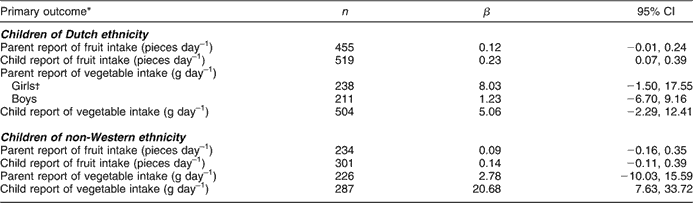
β – difference in primary outcome in the intervention group compared with the control group; CI – confidence interval.
* Analyses are adjusted for children’s age, (gender), education level of the parents, region of residence of the children, and baseline levels of fruit or vegetable consumption.
† A significant interaction for gender between the children of Dutch ethnicity (P = 0.078).
Children of non-Western ethnicity
At baseline, the total sample of children of non-Western ethnicity (intervention and control children together) reported a mean daily fruit intake of 2.02 (SD = 1.17) pieces and a mean daily vegetable intake of 120.6 (SD = 66.3) g.
A significant interaction (P = 0.084) with parental educational level was found for child-reported fruit intake, but after stratification no significant effect sizes were found in either group (data not shown).
At follow-up the children in the intervention group reported a significantly higher unadjusted vegetable intake than the children in the control group (P = 0.013) (Table 2), also after adjustment for the potential confounders (difference = 20.7 g day–1, 95% CI = 7.6–33.7) (Table 3). No interactions or other significant differences were found for this subgroup.
Determinants of fruit intake (secondary outcomes)
Children of Dutch ethnicity
At baseline, 79% of the parents of children of Dutch ethnicity reported that their child liked fruit or liked fruit very much. This proportion did not differ between the intervention and control groups at baseline or follow-up (Table 4). However, when taking potential confounders into account, a significant intervention effect was observed. According to the parent data (but not the child data), boys in the intervention group were less likely to have decreased their liking of fruit between baseline and follow-up (Table 5).
Determinants of fruit intake at baseline and at follow-up in the intervention and the control group conducted on parent- and child-reported data, separately for children of Dutch and of non-Western ethnicity

*Estimated by paired Wilcoxon test (paired categorical data).
† Estimated by χ 2 test (independent categorical data).
Indicators of effects of the intervention regarding determinants of fruit intake from multilevel regression analyses conducted on parent- and child-reported data, separately for children of Dutch and of non-Western ethnicity

OR – odds ratio for comparison with the control group; CI – confidence interval.
Analyses are adjusted for children’s age, gender, region of residence of the children, and educational level of the parents.
* Not adjusted for educational level of the parents, because of empty cells.
† Parent data – for children of Dutch ethnicity, taste → an interaction (–) between intervention × gender (P=0.062) in the ‘decreased’ group; for children of non-Western ethnicity, availability → an interaction (–) between intervention × gender (P = 0.054).
‡ Child data – for children of Dutch ethnicity, accessibility → an interaction between intervention × gender (P=0.009) in the ‘decreased’ group.
The unadjusted analyses showed an increase in knowledge of the recommendations for fruit intake in the intervention group (Table 4), but no effect on knowledge of recommended intake levels was observed in the adjusted analyses (Table 5). No other effects on the determinants were observed (Table 5).
Children of non-Western ethnicity
At baseline, 75% of the parents in this subgroup reported that their child liked fruit or liked fruit very much. According to the parent data no significant differences for the determinants of fruit intake were observed between intervention and control groups (Table 4). We only observed an increased accessibility of fruit in the control group at follow-up.
According the child data, the unadjusted results indicated that the intervention group significantly increased their knowledge of recommendations for fruit intake, were more often allowed to take fruit without asking and also perceived higher fruit availability at home at follow-up (Table 4).
Adjusted analyses on the parent data showed a significant effect for taste preference only. Children in the intervention group were less likely to have decreased their preferences for fruit between baseline and follow-up. In the adjusted child data significant effects were found for perceived accessibility (Table 5).
Discussion
The present study indicates that the Schoolgruiten Project had a significant effect on the fruit intake of children of Dutch ethnicity and on the vegetable intake of children of non-Western ethnicity, but these effects were found only in analyses based on the child-reported data.
A Danish studyReference Eriksen, Haraldsdottir, Pederson and Flyger31 with a follow-up period of 5 weeks also showed positive effects for fruit intake. However, in the Danish study parents had to pay for the daily school F&V. Positive effects of free school F&V delivery were reported by Bere et al.Reference Bere, Veierod and Klepp32 based on a study conducted in Norway; the intervention group reported an increase of approximately 0.9 portions of F&V at 10 months’ follow-up.
The effects of the Schoolgruiten Project fall within that same range. The Schoolgruiten Project was initiated outside an academic centre; it was planned, developed and implemented by a public–private partnership of the Netherlands Nutrition Center Foundation with the promotion office of Dutch F&V producers. This partnership did try to combine intervention strategies that were tailored to important mediators of F&V intake in primary-school children, but because of time constraints was not able to work carefully according to established planning models, as was done, for example, in the similar Pro Children interventionReference Pérez-Rodrigo, Wind, Hildonen, Bjelland, Aranceta and Klepp33.
A disadvantage of the research design applied in the present study is that randomisation was not possible, since the Dutch government had indicated the intervention cities. Although our analyses indicated very few baseline differences between the intervention and control groups, the fact that schools were not randomly allocated may have introduced bias. Another bias may have occurred due to some selective dropout. However loss to follow-up was not a consequence of an autonomous decision of the child, but was primarily caused by dropout of five schools, and in some cases based on parental decisions.
Evaluation of school-based healthful nutrition promotion interventions should be based on accurate and valid assessments of intake levels and mediators of intakesReference Klepp, Pérez-Rodrigo, De Bourdeaudhuij, Due, Elmadfa and Haraldsdóttir8. Collecting accurate intake data based on observations or biomarkers is often possible in smaller-scale, carefully controlled efficacy studies, but not in larger-scale studies in real-life settings. Collecting blood samples in children introduces bias because of low participation ratesReference Livingstone and Robson34, Reference Hammond, Nelson, Chinn and Rona35. Food-frequency questionnaires are therefore generally used. Although these questionnaires rely on participants’ memory and cognition, which may influence the accuracy of the reported intake, this bias is believed to be the same in the control as in the intervention group.
The Schoolgruiten intervention aimed at increasing availability and accessibility of F&V and we indeed found that perceived accessibility was improved in the intervention group at follow-up, according to the data of the children of non-Western ethnicity. We also observed some favourable positive changes in the intervention group for taste preference. Unfortunately, we found no effects on knowledge of recommended intake levels, although the school curriculum did address these recommendations. This may be due to the fact that the curriculum was not adopted and implemented by all intervention schools. The curriculum materials were used at least once by only about 40% of the intervention schools.
Since earlier research had indicated that children from non-Western ethnicity in The Netherlands have higher intake levels and correlates of F&V intakes, we explored differential effects of the intervention according to ethnicity. We hypothesised that children of non-Western ethnicity would profit less from the intervention than the children of Dutch ethnicity. This hypothesis was supported only for fruit intake, while for vegetables the intervention appeared to be somewhat more effective among the children of non-Western ethnicity. Since ethnic differences in The Netherlands are strongly confounded by educational differences, ethic differences often disappear if education is taken into account. Nevertheless, ethnicity is of course much more than education. As a secondary analysis we also conducted a priori stratification according to education, testing effects separately for children from higher and lower educated parents, while adjusting for ethnicity. In these analyses, no differences in effects were found (data not shown), indicating that the observed differences between the children of Dutch ethnicity and the children of non-Western ethnicity were not the result of differences in educational level of the parents.
All effects regarding usual intake levels were found in the child-reported data. These effects were not confirmed in analyses of the parent-report data. This may partly be due to power issues, since parent-report data were available for fewer children. The parent-reported mean F&V intakes at baseline and follow-up for the intervention and control groups (Table 2) do indicate that the mean intake levels between baseline and follow-up were more positive in the intervention group. Parental reports are considered useful because two-thirds of schoolchildren eat at home during the lunch break in The Netherlands36, and parents are responsible for availability and accessibility of foods at home. When the children stay at school, they bring their own lunch and snacks, as no school meals are offered and no food can be obtained from vending machines or otherwise, and children are not allowed to leave the school or schoolyard during school hours. Nevertheless, it must be realised that the parents did not directly observe the main part of the present intervention: the distribution of F&V on two schooldays per week. It may therefore be that the child reports were more sensitive to changes induced by this particular intervention. On the other hand, since the children were much more intensively exposed to intervention activities than the parents, it may also be that the children in the intervention group were more likely to give socially desirable answers, and that this led to higher intake reports compared with the control group.
Conclusion
The present study provides some evidence that the Schoolgruiten intervention was effective in increasing the fruit intake of children of Dutch ethnicity and increasing the vegetable intake of children of non-Western ethnicity (according the child data).
In addition, we observed positive intervention effects for taste preference and increased accessibility among the children of non-Western ethnicity.
Acknowledgements
Sources of funding: Funding for this study was provided by The Dutch Ministry for Health, Welfare and Sport and Holland Produce Promotion in Zoetermeer. The contribution of N.I.T. is funded by The World Cancer Research Fund (grant no. 2004/05). The contribution of S.J.t.V. is funded by The Netherlands Organization for Health Research and Development (ZonMw) Program for Prevention (no. 6200.0003).
Conflict of interest declaration: The authors declare that they have no competing interests.
Authorship responsibilities: N.I.T. collected and analysed the data and drafted the manuscript. S.J.t.V. and J.B. participated in the study design and provided critical revision of the manuscript. All three authors have read and approved the final manuscript.
Acknowledgements: We thank the schools and schoolchildren for participating in this study.



