

Covariation of form and function
The set of competing modal forms for the expression of obligation in English has been the subject of considerable study, with variability between older forms must and should, long standing have to and have got to, and newer need to being reported across the English-speaking world. Shifts in the relative frequencies of modal forms have been tied to a shift in modal function, with a move away from expression of obligation based on social order and general principles to functions that are more personal and “interactive,” as when offering advice or making an emotional appeal (Myhill, Reference Myhill1995:160). Specifically, a decline in must and an increase in need to has been observed and linked to notions such as antiauthoritarianism, subjectivity, and colloquialization (e.g., Collins, Reference Collins2005:260; Fehringer & Corrigan, Reference Fehringer and Corrigan2015:377; Leech, Reference Leech, Marín-Arrese, Carretero, Hita and van der Auwera2013:111; Penry Williams & Korhonen, Reference Williams, Cara and Korhonen2020:280; Tagliamonte & Smith, Reference Tagliamonte and Smith2006:372).
But how can we disentangle change in function from change in form, or talk of different kinds of obligation from use of different modal forms? Change proceeds through the rise of new expressions in conjunction with shifts in the conditioning of existing expressions with which the new forms come to compete (Labov, Reference Labov, Lehmann and Malkiel1982:20; see Poplack & Malvar, Reference Poplack and Malvar2007; Szmrecsanyi, Reference Szmrecsanyi2016; Torres Cacoullos, Reference Rena2012). To examine the covariation of form and function (Labov, Reference Labov2008:2), we probe rates and conditioning not only of competing forms expressing similar meanings but also of functions—the distributions (proportions) of the data according to particular meaning nuances expressed.
Tracking change in function requires a meaning classification that is independent of other linguistic factors that may impact modal choice. Though there has been much discussion of modal meanings, such a replicable classification for actual usage has been lacking. Here, based on close examination of over two thousand tokens in spontaneous speech data, we are able to establish that source of obligation provides a reliable basis for distinguishing modal meanings, and we put forward a three-way classification: Hierarchical authority/norms, General circumstances/conditions, and Personal choice/opinion. This meaning classification allows us to disentangle modal form and function, and thus independently track change in both, for the competing variants must, have to, have got to, should, and need to, illustrated in examples (1), (2), and (3).


We first describe the speech data for the study, which comprises recordings made in Sydney, Australia, at two time points: 1970s-1980s and 2010s-2020s. We then present the meaning classification of Hierarchical, General, and Personal source of obligation and specify the variable context within which modals of obligation compete. As a first overview, we compare the relative frequencies in the two time periods of both the modal forms and functions. This allows us to narrow down the relevant comparisons for the statistical analyses, as not all modals compete equally in the same semantic-structural space. Two sets of regression analyses provide evidence of the covariation between form and function: first, of the linguistic and social conditioning of modal forms over time, for which meaning is one of the set of the predictors, and second, of the conditioning of function over time, for which modal form is a predictor. We confirm the change in form reported in other studies, most recently with the advent of need to. But going beyond previous work, we establish change in function, with an increase in the relative frequency with which speakers express obligation stemming from personal choice, independently of the modal form used.
Data for the study of parallel formal and functional change
The data come from three corpora of Australian English, capturing the speech of 259 Australians, recorded in two time periods separated by some forty years, and compiled for the Sydney Speaks project (Travis, Reference Travis2014-2022) (Table 1). What we will refer to as the 1970s data comprises recordings made in the 1970s and 1980s with three age groups: Elderly Australians (NSW Bicentennial Oral History Project, 1987), Adults, and Teenagers (Sydney Social Dialect Survey; Horvath, Reference Horvath1985), who were born in the 1900s, 1930s, and 1960s respectively. The 2010s data comprises recordings made 2015-2022 with two age groups, Adults born in the 1960s—thus, the same generation as the 1970s Teenagers, recorded forty years on—and Young Adults, born in the 1990s. Based on a composite score calculated from occupation, level of education, and high school type, participants are placed into three social class groups: Middle, Lower Middle, and Working Class.
Distribution of participants

Participants are all speakers of Australian English who were either born in Australia or arrived before the age of six. They reflect the changing ethnic makeup of Australia—Anglo-Celtic (all corpora), Greek and Italian (1970s Teens and 2010s Adults and Young Adults), and Chinese Australians (2010s Young Adults) (see Grama, Travis, & Gonzalez, Reference James, Travis and Gonzalez2020:349–352). We are able to consider the ethnic groups together since, overall, they share conditioning of both modal form and function, though we will make note of some differences that we observe, which relate to social class.
For each participant, approximately thirty minutes of speech (or some five thousand words) were transcribed following the transcription conventions outlined in Du Bois, Schuetze-Coburn, Cumming, and Paolino (Reference Bois, John, Susanna, Paolino, Edwards and Lampert1993; see Appendix), giving a total of some 1.3 million words of spontaneous speech for analysis.
Though rarely commented on, genre differences may arise in cross-corpora comparisons of the kind that are regularly drawn on for the study of change in real time. Here, the primary differences between the data from the two time periods are that, in the 1970s, the participants were generally not known to the interviewers and the interviews were more structured, while in the 2010s, interviewers recorded people in their same social network and the recordings are more conversational. There is a corresponding difference in data distributions (Travis & Lindstrom, Reference Travis and Lindstrom2016). Relevant to modal choice are data distribution differences with respect to tense and subject. A greater occurrence of narratives in the 1970s data results in more past tense, while the denser dialogic interactions in the 2010s gives rise to a higher proportion of present tense. And the topic of childhood games in the earlier data contributes to a higher proportion of generic subjects (75% in the 1970s versus 39% in the 2010s), as such descriptions tend to occur with nonspecific subjects, as in (4). The distribution is, however, similar across the two time periods in the proportion of first-person singular subjects, an indication of their comparability with respect to speaker involvement (Torres Cacoullos & Travis, Reference Rena, Travis, Adamou and Matras2020:260). We deal with data distribution differences by incorporating tense and subject in assessing the linguistic conditioning of the variation, which includes both the variable context—circumscribed to the present tense—and the probabilistic constraints— testing subject as a predictor. (On contextual distributions with respect to rates and conditioning of variant forms, see Torres Cacoullos & Travis, Reference Travis2018:6–9, 148–149, and references therein).

Obligation meanings on the ground
The modal meaning of obligation, sometimes called necessity, expresses the existence of conditions, social or physical, that compel the participant to carry out the action indicated by the predicate (Bybee, Perkins, & Pagliuca, Reference Bybee, Perkins and Pagliuca1994:177). In reviewing studies of English modals of obligation, we are confronted with a plethora of meaning classifications.
Within the broad meaning of obligation, one distinction is according to a gradation of strength, ranging between strong and weak obligation, paraphrasable as “it is imperative” (a demand) and “it is important” (a suggestion), respectively (Coates, Reference Coates1983:31–32, 58). Strong versus weak obligation is commonly associated in English with must versus should. On this basis, should has not been counted in studies of variation between obligation modals (e.g., Tagliamonte & D’Arcy, Reference Tagliamonte and D’Arcy2007:52). However, as seen above in example (3), should exists in competition with need to, and thus excluding it precludes identifying the conditioning of need to and tracking the introduction of this newest form.
A second distinction that has been applied to obligation meaning is speaker involvement along a subjective-objective cline (Lyons, Reference Lyons1977:792–793; Palmer, Reference Palmer1986:16). Subjective instances are those in which “the speaker has authority” as opposed to objective ones in which “the authority comes from no particular source” (Coates, Reference Coates1983:55), as when relaying rules and regulations (Huddleston & Pullum, Reference Huddleston and Pullum2002:183). Have got to and must are considered to span the subjective-objective cline whereas have to is said to occur only with objective necessity, “it is necessary for” (Coates, Reference Coates1983:53). A corresponding proposed contrast is that between participant-oriented modality, which applies to a specific participant, and event‐oriented modality, where the obligation stems from “general rules of conduct” (Hengeveld & MacKenzie, Reference Hengeveld and MacKenzie2008:176). However, neither the subjective-objective nor the strong-weak distinction allows the assessment of modal meaning and subject as independent factors, as the former has been bound to subject specificity and the latter to subject person (Tagliamonte & Smith, Reference Tagliamonte and Smith2006:365).
Cross-linguistically, obligation is often expressed through auxiliaries grammaticalized to greater or lesser degrees from lexical verbs meaning “owe,” “need,” “be fitting,” or from general auxiliaries, as with English have to, in particular constructions (Bybee et al., Reference Bybee, Perkins and Pagliuca1994:181–184). Thus, another proposed distinction considers the source of the compelling conditions as internal versus external to the participant, in a three-way classification between “need” versus “necessity,” with as a subtype of the latter, “deontic necessity,” which may arise from practical circumstances or be imposed by some authority, whether a specific authority figure or social norms and decorum (van der Auwera & Plungian, Reference van der Auwera, Johan and Plungian1998:80–81). In this view, source constructions from “need” yield participant-internal modal meaning as with English need to, those from “have,” general participant-external necessity as with have to, and ones from “owing” and “duty,” deontic necessity as with should (van der Auwera & Plungian, Reference van der Auwera, Johan and Plungian1998:95).
The array of classification schemes, largely supported by cherry-picked or constructed examples, is indicative of the difficulty of implementing them in a replicable and exhaustive way. We introduce here a replicable meaning classification that is independent of both degree of strength and subjectivity understood as speaker authority. The classification is based instead on source of obligation, with a three-way distinction between Hierarchical authority/norms, General circumstances/conditions, and Personal choice/opinion.
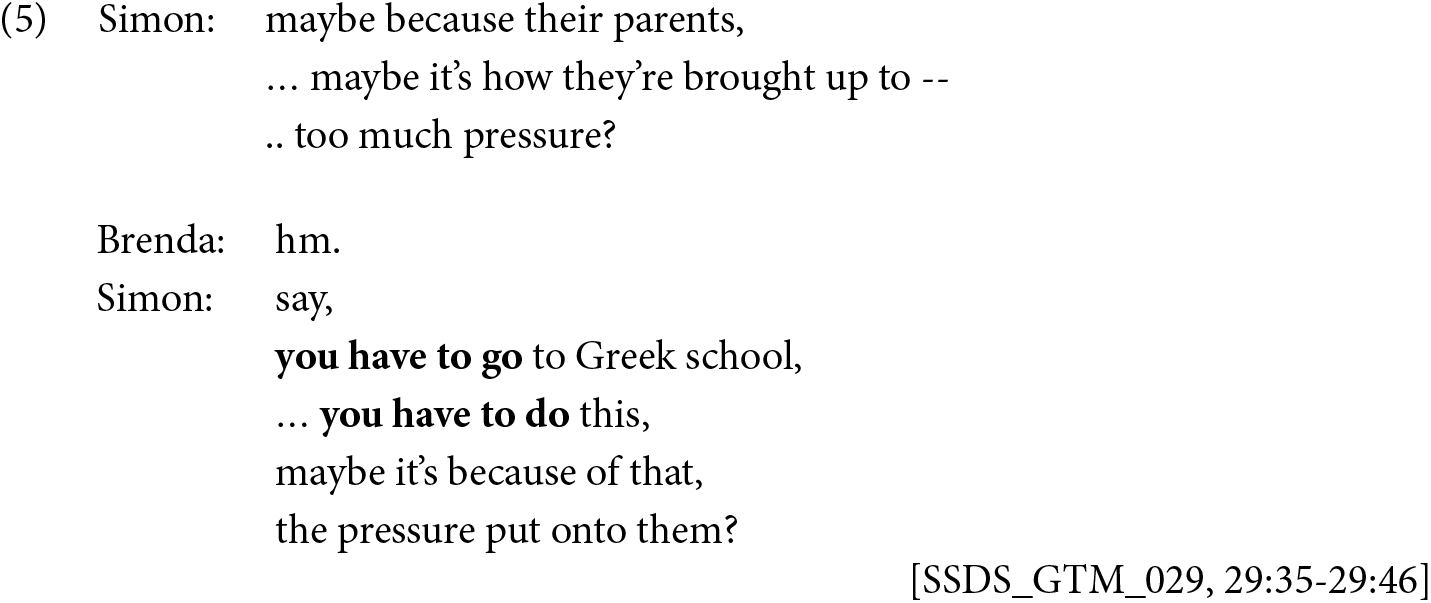
Hierarchical obligation is due to an unequal power relationship, typically between employer and employee, teacher and pupil, or parent and child, where the hierarchical relationship provides the basis with which the superior demands something of the inferior, as in (1) above and (5) below. Included in this category are societal norms that may be due to precepts directed at a particular sector of the population that is minoritized or a minority, as with decorum for women and culture-specific mores, shown in (6). In contrast, obligation related to General circumstances/conditions commonly expresses regulations or conventions that do not target a defined group, but standardly apply to everyone, as in processes followed at work, seen in (7), at school (as in have to go through school till .. they’re eighteen in [2] above), or in play (as with the rules of a game in [4] above). Situations that are rationally attributed to wider circumstances or that come about as logical consequences also belong to this second type, as in (8), where the person has to work in order to support her family. Third, obligation of the Personal choice/opinion type stems from personal preferences, such as a personal desire or wish, as in (9), personal limitations, such as with different learning styles in (10), or opinion or advice, as seen above in (3).


Coding for obligation type is a matter of contextual interpretation of each instance and relies on sociocultural familiarity with the community. There are sometimes congruent co-occurring cues, such as, for General obligation, if clauses, as in (11), or because clauses as in (8), and for Personal obligation, hedges or speaker stance frames such as I think, seen in (12). Mostly, however, we rely on stretches of discourse surrounding the clause of interest, taking account of the broader interaction, including contributions from the interlocutor. In (13), for example, we can establish that Sarah’s comment that her brother “needs to” apply for more jobs is her personal opinion on the basis of her clarifying in previous and following talk that it is not a matter of general job market circumstances (as Simon suggests) but of her brother’s disinterest.


This three-way classification between Hierarchical, General, and Personal obligation recognizes different sources of obligation, corresponding respectively to “some person or institution to whose authority [someone] submits; […] some more or less explicitly formulated body of moral or legal principles; […] no more than some inner compulsion” (Lyons, Reference Lyons1977:824). This classification also fits with a deontic necessity, participant-external, and participant-internal obligation typology (van der Auwera & Plungian, Reference van der Auwera, Johan and Plungian1998:80–81), and the assignment of subfunctions such as “obligation motivated by social norms,” “habitual obligation,” and “obligation motivated by emotion” (Myhill, Reference Myhill1995:163). Above all, the three meaning types are sufficiently broad for replicable coding of large numbers of tokens in actual language use.
Counting modals
To identify the tokens of modals of obligation, we prioritize functional over structural criteria, recognizing that “the forms which enter into contextual, stylistic, or social complementarity of distribution do not generally originate as related syntactic structures” (Sankoff, Reference Sankoff and Newmeyer1988a:156). Thus, we set aside form-based divisions, such as between “core” or “central” and “semi-,” “quasi-,” or “emerging” modals (e.g., Krug, Reference Krug2000; Leech, Reference Leech, Marín-Arrese, Carretero, Hita and van der Auwera2013:95) and instead search the transcripts for modal forms with the broad function of expressing obligation. Extracting all occurrences of these forms yielded a total of 4,299 tokens, made up of the five forms we have noted so far, as well as three minor variants: ought to (n = 2), had better (n = 26), and be supposed to (n = 103).Footnote 2 We set these aside in order to be able to accurately identify usage patterns and study here the five main modals: must, have to, (have) got to, should, need to (n = 4168).Footnote 3 A subset of the total is used to express obligation meanings (n = 3781), and a subset of those (less than one half) occurs in the variable context (n = 1697), as we outline below.
Modality functions
Besides that of expressing obligation, three other functions were identified. Epistemic modality indicates the speaker’s degree of commitment to the truth of the proposition, as with must in (14), where the speaker judges the proposition to be probable (Bybee et al., Reference Bybee, Perkins and Pagliuca1994:179–180; Coates, Reference Coates1983:41–46, 64–65; van der Auwera & Plungian, Reference van der Auwera, Johan and Plungian1998:81). A performative use occurs in several formulaic expressions with a variety of modals, such as I must admit, I have to say, you’ve got to remember, I should imagine (Coates, Reference Coates1983:36; Myhill, Reference Myhill1995:171; Tagliamonte & D’Arcy, Reference Tagliamonte and D’Arcy2007:73–74). And “quasi-subjunctive” uses in some subordinate clauses are also found, specific to should, as in funny you should say that (Bybee et al., Reference Bybee, Perkins and Pagliuca1994:215–216; Coates, Reference Coates1983:67–69).

Figure 1 illustrates the proportion of obligation, epistemic, performative, and subjunctive uses, in the 1970s on the left and the 2010s on the right. Epistemic uses are largely restricted to must, accounting for 68% of all instances of this modal in the 1970s and increasing to 86% in the 2010s (see Fehringer & Corrigan, Reference Fehringer and Corrigan2015:360–361; Tagliamonte & D’Arcy, Reference Tagliamonte and D’Arcy2007:67–69). Performative uses are infrequent overall (and absent with need to), the highest proportion occurring with must (around 10% of must instances). Subjunctive uses of should are also minimal (10% for 1970s and 5% for 2010s). In sum, must stands out from the other forms in its low and shrinking obligation uses (from 20% to 6%), being largely limited to epistemic uses and otherwise surviving in conventionalized performatives as entrenched interactional niches (Bybee & Torres Cacoullos, Reference Bybee, Rena, Cacoullos, Dion and Lapierre2015:144). Overall, these distributions confirm the primacy of obligation uses, which account for a full 90% of all instances (3781/4136).Footnote 4
Distribution of modalities for each form: 1970s (n = 2151) versus 2010s (n = 1985): Obligation versus Epistemic, Performative, Subjunctive.

The variable context for obligation modality
The domain of obligation modality represents the initial broad definition of the linguistic variable, but speakers make choices between forms only within the variable context—where absolute differences between the forms that may exist, whether in meaning or distribution, do not come into play (Labov, Reference Labov1972:72; Reference Labov, Ammon, Dittmar, Mattheier and Trudgill2004:7; Poplack & Torres Cacoullos, Reference Poplack, Rena, MacWhinney and O’Grady2015:268–270). For obligation modals, the variable context is circumscribed by tense, polarity, and sentence type, because only have to occurs robustly in past tense, negative polarity, and interrogative contexts (as noted by, for example, Myhill [Reference Myhill1995:165–166] and Tagliamonte and D’Arcy [Reference Tagliamonte and D’Arcy2007:60–63]). Of non-present instances (almost all simple past), have to makes up 93% (1756/1898), with should (as should have) and need to together making up the remainder. While have to, need to, should, and must all occur with negation (n = 148/1883 of all present tense instances), the scope of the negation with must and should can lie only over the proposition, not the modality (Palmer, Reference Palmer, Facchinetti, Palmer and Krug2003:11), as illustrated in (15), which means that doing favors is a bad thing, not that you are not required to do favors (as would be conveyed by you don’t have to/don’t need to). Lastly, the interrogatives (n = 38/1735 present tense positive polarity instances) are primarily made up of have to and should.

Thus, though speakers may have choices between different variants in defined subcontexts (e.g., need to and have to with negative polarity), the choice between all five modals is limited to simple present, positive polarity declaratives. Barely one half of the instances of these modals expressing obligation occurs within this variable context (1697/3781). Were we to rely on overall frequency counts, we would obtain a skewed distribution of the modals, for example an inflated frequency of have to, which accounts for over two thirds of all obligation modal instances (2557/3781), but just 42% of those in the variable context (707/1697).
These 1,697 tokens in the variable context were coded for meaning, using the three-way classification described above. Following coding by both authors, cases that appeared not to be straightforward were discussed and resolved by further consideration of the broad discourse context and drawing on sociocultural familiarity with the speech community. Only a small number that occurred as part of a repair or were truncated remained unclassified for meaning (n = 18), leaving 1,679 for analysis. Of these, 10% were used to refer to Hierarchical norms, 57% to General circumstances, and 33% to Personal choice.Footnote 5
Modal frequencies and meaning correspondences
To obtain a general picture of the use of obligation modals over time, we first consider relative frequencies of forms and, to assess form-meaning correspondences, relative frequencies of obligation meanings for each modal.
Figure 2 shows the rate of each of the modal forms within the variable context in the two time periods, the 1970s in the darker shade and the 2010s in the lighter shade. We see here the drop in obligation must referred to above (see Figure 1), from a minimal variant in the 1970s to virtually absent in the 2010s. Have to and (have) got to are the main variants in both time periods; have to shows greater reduction in use, from nearly one half down to one third of obligation modal instances, while (have) got to drops only slightly, from one quarter to one third of the total. Should and need to are the two forms on the rise; for should this means that it retains its place within the set, while need to, barely present in the 1970s, accounts for almost one fifth of all instances in the 2010s.
Rate of occurrence of different modals of obligation in the variable context (n = 1679; 1970s: n = 680; 2010s: n = 999).

These trends echo reports from other varieties in the demise of must, though there may be community differences in the relative frequency of the other modals (Collins, Reference Collins2005:253). For the have variants, for example, (have) got to holds up in Tyneside (England) but apparently has been nearly ousted by have to in Toronto (Canada) (Fehringer & Corrigan, Reference Fehringer and Corrigan2015:369; Tagliamonte & D’Arcy, Reference Tagliamonte and D’Arcy2007:72). And should is reported to have increased again after a decline at the end of the nineteenth century in American English (Myhill, Reference Myhill1995:162).
The rapid rise of need to also matches other varieties. Need to was characterized as “relatively rare” in early 1990s British English conversation (Biber, Conrad, & Reppen, Reference Biber, Conrad and Reppen1998:209), and its frequency with respect to competing modals was reported at 8% in Toronto speech recordings of the early 2000s, a rate that is likely to be even lower were should included as a competing variant (Tagliamonte & D’Arcy, Reference Tagliamonte and D’Arcy2007:73–74). Real-time comparisons of the normalized frequency of need to suggest that it increased some two-fold in British and American written texts between 1961 and 1991 (Smith, Reference Smith, Facchinetti, Palmer and Krug2003:248–249). Similarly, its rate in interviews roughly doubled between the early 1990s and late 2000s, from 6% to 16% in Tyneside (Fehringer & Corrigan, Reference Fehringer and Corrigan2015:365) and 9% to 16% in Australian English (Penry Williams & Korhonen, Reference Williams, Cara and Korhonen2020:272, 279).
We now turn to form-meaning correspondences over time. Figure 3 depicts the proportions of the three obligation meaning types (in different shades), for each of the five modals, in pairs of columns, with the 1970s on the left and the 2010s on the right (with must in the 2010s and need to in the 1970s lighter, due to sparse token counts). It is evident that there is no singular form-meaning correspondence, as each form hosts all meaning types. However, it is also the case that the modals have different foci and that these are stable over time: must is most associated with Hierarchical norms, have to and (have) got to with General circumstances, and should and need to with Personal choice. These foci may be explicable by cross-linguistic patterns of the source constructions (see Bybee et al., Reference Bybee, Perkins and Pagliuca1994:177–179; van der Auwera & Plungian, Reference van der Auwera, Johan and Plungian1998:81).
Distribution of obligation meanings (Hierarchical norms, General circumstances, Personal choice) according to modal form in 1970s (n = 680) versus 2010s (n = 999).

Though the meaning foci are stable, there has been an overall increase in the expression of Personal obligation from the 1970s to the 2010s (20% versus 42%, p < 0.0001, Fisher’s exact test). To determine whether such an increase is attributable to the rise in need to and should, or whether there is a broader, genuine change in the kind of obligation people talk about, we now turn to consider the conditioning, both of modal form and of obligation meaning.
Conditioning of modal forms
For the conditioning of modal form, we conduct regression analyses, including Modal Meaning as a predictor. Another linguistic predictor is Subject person-specificity, a feature that affects obligation meanings (Coates, Reference Coates1983:36; Nokkonen, Reference Nokkonen2006:59–60; Tagliamonte & D’Arcy, Reference Tagliamonte and D’Arcy2007:66). We consider first and second person together as speech act participants and contrast these with third person and with nonspecific referents, which refer to any member of a class of entities (Torres Cacoullos & Aaron, Reference Aaron2003:306–308, and references therein). Social variables are Time Period, Social Class, and Gender, and, for the 2010s analyses, Age.
Logistic mixed-effects regression analyses were conducted using the lme4 package (Bates, Mächler, Bolker et al., Reference Bates, Mächler, Bolker, Walker, Christensen, Singmann, Dai, Scheipl, Grothendieck, Green and Fox2019) in R (version 1.1-28, R Core Team, 2019) with random intercepts for Speaker and (main) Verb (pooling into a single level verb types that occur only once, or hapax legomena—approximately one half of all verb types [Travis & Torres Cacoullos, Reference Travis and Rena2021:5]). We tested for interactions between the predictors and removed interactions and main effects that did not improve model fit, reporting here the final models.
Rather than comparing all modals in a single model, we conduct independent analyses in defined subcontexts where the variability is most robust. We thus examine the conditioning of the long-term majority variant have to, first in relation to its main competitor, (have) got to, in both time periods, and second in relation to the newest form, need to, for the 2010s data only. A third analysis tests further the place of need to in the 2010s data, comparing it with should, as the two main expressions of Personal obligation.
Numbers of tokens and of speakers vary for the different analyses due to the particular variable context and the portion of data under study (whether both time periods or only the 2010s). Participants produce an average of 6.5 tokens, ranging from none (nineteen speakers) to a maximum of thirty-one (one speaker) (SD = 5.4). This means that, in each particular variable context, a different number of speakers produce no tokens and therefore do not feature in that analysis. Although this is insufficient data for comparison of individuals, it does provide a large enough sample for identifying patterns across social groups, as we shall see.
(have) got to versus have to
To understand the variation between (have) got to and have to, we consider together the two forms of have got to: with the auxiliary (have got to, n = 213, virtually always contracted as ’ve got to or ’s got to, 206/213) and without (which we represent as gotta, n = 297). In these data, gotta does not occur with third-person singular subjects. In the variable context specific to have got to and gotta (that is, setting aside third-person singular subjects), the two forms share similar obligation meaning distributions, justifying treating them as a single variant (Hierarchical obligation accounts for 8% of have got to and 9% of gotta; General, 60% and 65%, and Personal 31% and 25%). Have got to and gotta do, however, differ socially, with gotta favored by men, regardless of Social Class, and by Working Class women.Footnote 6
Now comparing (have) got to versus have to, we find both social and linguistic conditioning, as summarized in Table 2. Socially, (have) got to is favored by Working Class speakers and by men. Though a significant interaction with Time Period suggested that the Social Class effect applies to the 2010s only, closer examination revealed these same class differences also operate in the 1970s for the Anglo Australians, but not the Italian and Greek Australians, consistent with different social conditioning for these groups with vocalic variables (Horvath, Reference Horvath1985:93). This social conditioning of (have) got to is not solely due to gotta, as comparisons between have got to and have to indicate a similar favoring by men, though little social stratification.Footnote 7 (Have) got to is said to have originated as a “colloquial” or “nonstandard” variant in nineteenth century English literature but to have quickly reached the upper class (Krug, Reference Krug2000:61–63). An association of (have) got to with (less educated) men has been observed in Toronto (Canada), Wheatley Hill (Northern Ireland), and York (England) (Tagliamonte & D’Arcy, Reference Tagliamonte and D’Arcy2007:78–79; Tagliamonte & Smith, Reference Tagliamonte and Smith2006:369), though not most recently in Tyneside (England) (Fehringer & Corrigan, Reference Fehringer and Corrigan2015:374).
Output of logistic mixed effect model predicting (have) got to (versus have to)

Overall rate of (have) got to = 42% (510/1212)
225 speakers, variance = 2.72 (SD = 1.65); 159 verb types, variance = 0.09 (SD = 0.29)
Log likelihood: -648.6; AIC: 1323.1; BIC: 1389.4
As to the linguistic conditioning, there is a significant effect for Subject, such that (have) got to is disfavored in the third person (due to the absence of gotta with third-person singular subjects), and favored with first and second person subjects and nonspecific referents. Nonspecific referents (primarily, you: 76%, 591/774) make up approximately two-thirds of the subjects in this analysis. In particular, there is a preponderance of nonspecific you with gotta, seen in (16)—and in (4), (6), and (11) above. Nonspecific you accounts for 70% (207/297) of all tokens of gotta, compared with 32% (69/213) of have got to, and 40% (667/1679) for the data overall. Thus, nonspecific you gotta is a candidate chunk, a complex unit of memory representation, which contributes to distribution patterns according to Subject person-specificity (Bybee, Reference Bybee2010:33–56).

Of particular interest to us here is the effect for Meaning, which exists in interaction with Time Period, as depicted in Figure 4. It has been stated that (have) got to and have to differ according to aspect, whereby both occur in a future context—as in the constructed example I have to/I’ve got to get up at 7 a.m. tomorrow—but only have to in a habitual context—as in I have to get up at 7 a.m. every day (Coates, Reference Coates1983:54; see Myhill, Reference Myhill1995:172). This would predict a favoring of have to with General obligation, the meaning type most compatible with habitual aspect, since conditions that apply to people in general are habitual occurrences, customarily repeated and holding for extensive periods of time (Comrie, Reference Comrie1976:27–28). There is no such favoring effect, however, and instead the meaning difference is that (have) got to is favored for Personal obligation in the 1970s (as in the opinion they’ve got to be treated like young adults in [2]), consistent with earlier attribution of “obligation motivated by emotion” to this form (Myhill, Reference Myhill1995:175, 178). This favoring of (have) got to over have to for Personal obligation no longer applies in the 2010s, attributable to to the rise of need to and to an overarching shift in obligation meanings, to which we will return.
Predicted rate of (have) got to (versus have to) for Meaning by Time Period (from model in Table 2).

Need to versus have to: 2010s
Let us now turn to the incoming form. Need to is virtually absent in the 1970s (eight tokens in the variable context, Figure 2), and therefore we compare need to with have to just for the 2010s data. Though need to remains restricted by tense and sentence type (with rates of need to [versus have to] of 8% [51/620] in non-present tense contexts and 6% [1/16] in interrogatives), there is variability under negation (28%, 21/74). Polarity turns out not to be significant in the model (Table 3), suggesting some generalization of need to, as negative polarity contexts are usually conservative (Torres Cacoullos, Reference Rena2012:106).
Output of logistic mixed effect model predicting need to (versus have to), 2010s

Overall rate of need to = 33% (203/618)
122 speakers, variance = 1.13 (SD = 1.06); 109 verb types, variance = 0.95 (SD = 0.97)
Log likelihood: -339.0; AIC: 693.9; BIC: 729.3
(No significant effect for Gender, Social Class, Age, Negation)
Unlike (have) got to, need to shows no social conditioning in variation with have to, as neither Gender nor Social Class has a significant effect (see Fehringer & Corrigan, Reference Fehringer and Corrigan2015:374, on a congruent finding in Tyneside). It is notable that neither is Age significant, with only a small increase in the rate of need to versus have to from the 2010s Adults to the Young Adults (Adults: 28%, 59/209; Young Adults: 35%, 144/409). Considering need to as a proportion of all modals, the evident real time difference (1970s: 1%, 2010s: 18%, Figure 2) and smaller apparent time difference (Adults: 13%, 57/435; Young Adults; 22%, 125/564) indicates that the 2010s Adults are less like their same birth year 1970s counterparts and more like their time period counterparts, the Young Adults. This suggests that need to may be a case of “communal change,” with uniform adoption in the community (Labov, Reference Labov1994:84), or a “Zeitgeist” effect characterizing change during a specific period of time (Fruehwald, Reference Fruehwald2017:22).
Subject is configured here by collapsing third-person and nonspecific subjects since there was no difference between these (unlike for have to versus [have] got to). “Generic” subjects with need to have been previously considered to have “not very subjective” meaning as opposed to an “internal compulsion” meaning with first-person singular subjects (Nokkonen, Reference Nokkonen2006:59–61), or more generally have been taken to “preclude subjective readings” (Tagliamonte & D’Arcy, Reference Tagliamonte and D’Arcy2007:65–66). Here, however, though nonspecific subjects are heavily used with General obligation (71%, 668/937), there is no categorical overlap between specificity and obligation meaning (see Sankoff, Reference Sankoff, Ammon, Dittmar and Mattheier1988b:986 on dependence among predictors). For example, (17) illustrates a nonspecific subject with Personal obligation, as an opinion is expressed, and (18) a nonspecific subject under Hierarchical obligation (also [6] above).
Importantly, there is a significant interaction between Meaning and Subject, visualized in Figure 5, where we see that the newer modal need to is most favored in Personal obligation contexts with first and second person, expressing preference and giving advice (as in [9] and [3] above respectively).
Predicted rate of need to (versus have to) for Meaning by Subject (from model in Table 3).


Need to versus should: 2010s, Personal obligation
Long-standing should is reported to have shifted in meaning between the nineteenth and twentieth century in American English, from “general principles applying to generic subjects,” as in a girl should be a lady in (21) below, to “future good idea” (what we code as Personal), as in you should drink more water in (3) above (Myhill, Reference Myhill1995:175, 178). In the data examined here, should is the major expression of Personal obligation in the 1970s and continues in the 2010s as the modal with the greatest proportion of Personal meaning (82%, 140/171 of should tokens; Figure 3). In this, it is similar to need to, which we have seen differs from have to mainly by being favored in Personal obligation contexts. We can therefore discover what conditions the use of need to when expressing Personal obligation by comparing it with should (which has been previously placed outside the variable context due to its categorization as a modal of “weak” obligation). We thus analyze these two modals in the 2010s in Personal obligation contexts only (Table 4).
Output of logistic mixed effect model predicting need to (versus should), 2010s, Personal meaning only

Overall rate of need to = 43% (104/244)
87 speakers, variance = 3.77 (SD = 1.942)Footnote 8
Log likelihood: -138.6; AIC: 295.3; BIC: 326.8
(No significant effect for Age)
Need to in variation with should in Personal contexts displays no significant effect for Age (with only a small difference between the Adults and the Young Adults, 37% versus 45%), as was also the case for need to versus have to. Here, though, there is an effect for Gender in interaction with Social Class. This is depicted in Figure 6, which shows a lack of social stratification by women, but a favoring of need to by Middle over Lower Middle and Working Class men. Need to is thus most favored by women and by Middle Class men. There is also a compatible ethnic difference here, in that Chinese Australians favor need to over should, which is consistent with a general adoption by this group of variants favored by the Middle Class and women; they similarly favor have to over (have) got to (see Grama, Travis, & Gonzalez, Reference Catherine, Gonzalez, Van de Velde, Hilton and Knooihuizen2021:307–309; Travis, Grama, & Purser, Reference Travis, Grama and Purser2023:450–451).
Predicted rate of need to (versus should) 2010s Personal meaning for Social Class by Gender (from model in Table 4).

Linguistically, there is an effect for subject corresponding with that seen in variation with have to, confirming that need to is favored with first- and second-person subjects—as in (19). The bulk of first- and second-person subjects is first-person singular (74%, 105/142) (which is the case in the data overall; 78%, 412/528). As first-person singular subjects mark linguistic subjectivity, co-occurrence of need to with first-person singular would be a measure of the expression of speaker involvement, in accordance with a source meaning of internal need (Aaron & Torres Cacoullos, Reference Aaron and Rena2005:616). Nonspecific subject referents (as in [17] above) are not significantly different from first and second person, favoring need to, and therefore disfavoring should. This is consistent with the earlier meaning shift away from general principles (associated with generic subjects, as in a girl should be a lady) that has been conjectured for should.

Should is favored by third-person subjects. Third-person singular subjects with should are mostly inanimate and often co-occur with a first-person singular speaker stance frame (Thompson, Reference Thompson2002), such as I think (20). The regular co-occurrence of third person should with such discourse formulas suggests the availability of a construction of the form [I think/feel like + third person should] and a meaning of personal opinion (see Myhill, Reference Myhill1995:178 on co-occurrence of should with hedging devices).

Conditioning of modal functions
In the overview of modal frequencies and meaning correspondences, we saw that obligation modals have distinct meaning foci and that the modal most associated with Hierarchical obligation, must, has virtually disappeared, while those that most express Personal obligation—need to and should—have grown in relative frequency. This does not tell us, however, whether there has been a genuine shift in meaning across the obligation modal system or whether an increase in Personal obligation is simply due to the increase in need to and should. To answer this, we conduct an analysis with obligation Meaning as the dependent variable (predicting Personal, in contrast to General and Hierarchical obligation) and incorporate Modal form as a predictor.Footnote 9 Also included are Subject and the extralinguistic variables of Social Class, Gender, and Time Period. Results are given in Table 5.
Output of logistic mixed effect model predicting Personal versus General and Hierarchical meaning

Overall rate of Personal Obligation versus General and Hierarchical = 33% (555/1679)
240 speakers, variance = 1.29 (SD = 1.13); 173 verb types, variance = 0.292 (SD = 0.54)
Log likelihood: -754.5; AIC: 1535.1; BIC: 1605.6
(No significant effect for Gender, Social Class)
Personal obligation is favored with first- and second-person subjects, the modals should and need to, and in the 2010s. Though the model returns a significant interaction between Modal and Time Period, this is due specifically to the behavior of should. As depicted in the visualization of this interaction in Figure 7, the greater expression of Personal obligation in the 2010s than in the 1970s applies to all modal forms, including the main modal forms have to and (have) got to. It does not apply to should because this form was already used to express Personal obligation at a very high rate in the 1970s. We should not be misled by the lack of a main effect for need to, which is due to the low token numbers in the 1970s (n = 8, Figure 3), and represented in the large error bars in Figure 7 (as is also the case for must in the 2010s).
Predicted rate of Personal obligation (versus General and Hierarchical) for Time Period by Modal form (from model in Table 5).

This across-the-board rise is evidence that the increased talk of Personal obligation is independent of the decline in must and upsurge of need to. Here, then, is a case of “language change […] affected by changes in the relative frequencies with which certain functions are expressed” (Myhill, Reference Myhill1995:206), or a genuine change in discourse.
As to social differences in modal meaning, there may be a tendency toward greater expression of Personal obligation by women relative to men in the 2010s only (2010s women 46%, 244/536; men 38%, 176/463, p < 0.05 by Fisher’s exact test; 1970s: women 20%, 60/294; men 19%, 75/386, p = 0.771). Remember that we saw a Gender difference in interaction with Social Class in the regression analysis for need to versus should, where need to is favored by women (but for men, Middle Class only; Table 4 and Figure 6). Though not achieving significance in the regression analysis here, such a tendency would indicate that the change toward more talk of Personal than other types of obligation has been led by women. This would be expected from reports of other grammatical changes related to interpersonal relations. For example, such a gender asymmetry has been invoked for changes in Dutch causatives between the eighteenth and twentieth centuries, which have been linked to a decrease in the social role of interpersonal authority (Verhagen, Reference Verhagen, Barlow and Kemmer2000:276). Gender differences have also appeared with the rise of the English progressive in the nineteenth century, which has been correlated with the psychosociological factor of interlocutor intimacy (Arnaud, Reference Arnaud1998:142).
A leading role for women in both the formal change (using need to) and functional change (expressing Personal choice/opinion) in English modals of obligation would also be consistent with events of the second half of the twentieth century such as the civil rights and women’s movements. Asymmetries in the role of authority according to gender was a topic raised by some speakers, as in (21), from an 88-year-old woman born in 1900, talking about her father’s “austere outlook” toward women. Data from disciplines other than linguistics would be needed to demonstrate that social changes or movements have impacted interpersonal relations. On that foundation, linguists could then probe systematic correlations between such language-external change and linguistic factors or features of the interaction between speakers (Myhill, Reference Myhill1995:201).

Conclusion
Variability among English modals of obligation is longstanding, with renewal of forms over the centuries via grammaticalization. The newest form, need to, appears to have been incorporated into the system of modals of obligation very rapidly, within one generation in Australia, as a communal change adopted uniformly (Labov, Reference Labov1994:84). Thus, while it is possible that the rise of need to is a language-internal change, it could also be a change from above, originating outside of the community, as with widely discussed changes in English quotatives and intensifiers (Lee, Reference Lee2020; Plehwe & Travis, Reference Plehwe and Travis2020; Tagliamonte, D’Arcy, & Rodríguez Louro, Reference Tagliamonte, D’Arcy and Celeste2016). Determining the mechanism and source of the change, whether internal or diffusion from one community into another or both (Arnaud, Reference Arnaud1998:144), calls for real- and apparent-time studies and identification of the leaders of change within the community (Labov, Reference Labov2018). Comparisons of the social and linguistic conditioning of obligation modals across communities can advance this work by attending to motivated variable contexts and to obligation meanings expressed. This would involve taking into consideration the distinct subcontexts in which different modals compete; including should as a competing variant; and classifying obligation meaning in a way that is replicable and independent of subject person-specificity. Now is the ideal time to conduct such studies, while this change is still recent or unfolding.
English modals of obligation provide a good demonstration of form-function covariation: shifts in function—the relative frequency of obligation meanings expressed—and shifts in form—the relative frequency of the modals expressing them. The changing of the guard of modals has been widely observed; what we have additionally shown is change in the nature of the obligation expressed, or the types of obligation speakers spend more time talking about. Whether this is connected to changes in interpersonal relations remains to be investigated, but the variation patterns discovered here demonstrate increased talk of obligation stemming from personal preferences, not solely attributable to the rise of need to. Change in modal function is concomitant with, but independent of, change in modal form.
Acknowledgments
We thank three anonymous reviewers and editor James Stanford for helpful comments; the Sydney Speaks team for data collection and transcription; 2018 ANU Summer Scholars Renate Plehwe and Caroline Chang for initiating the study of obligation modals, and Renate for assistance with coding. This research was supported by the ARC Centre of Excellence for the Dynamics of Language (CE140100041).
Competing interests
The authors declare none.
Appendix: Transcription Conventions (Du Bois et al., Reference Bois, John, Susanna, Paolino, Edwards and Lampert1993)
- Carriage return
new Intonation Unit
- .
final intonation contour
- ,
continuing intonation contour
- --
truncated intonation contour
- -
truncated word
- ..
short pause (≈ 0.2 secs)
- …
medium pause (≈ 0.7 secs)
- …(N.0)
timed pause (1 sec or longer)
- [ ]
overlapped speech
- @word
word uttered while laughing
- <@ @>
speech uttered while laughing
- Capital initial letter
higher initial pitch level


 Open access

