




Introduction
This article looks at how human characters—real and fictive—become portrayed in a Helsinki-based inclusive theater project. In the project, a multiethnic group of young adults, with little or no previous background in theater, were hired as salaried employees to work with professional artists during a six-week summer job project. Each summer, the collaborations resulted in a stage performance based on the group's experiences, representing their ‘joint voice’ (yhteinen ääni) in society (see also Visakko Reference Visakko2020a,Reference Visakkob). The participants contributed to the scripting of the performances through a variety of tasks (e.g. writing, photography, and videography) that dealt with their own identities, opinions, and life stories, including experiences of racism, inequality, or (not) belonging. Moreover, the participants studied techniques of acting and played the onstage roles themselves in the final piece. From day one, then, the group's activities were oriented towards the onstage characters. This article examines the characterological metadiscourses (see Agha Reference Agha2007:165‒77) through which characters become modeled during the project. In particular, the aim is to understand the construction of an ‘alternative’ space of social interaction in which the group's multiethnic encounters seek to depart from, to reflect on, and to experiment with ‘everyday’ characterological interpretations (Goffman Reference Goffman1974:40‒82, 560‒76). Thus, the article aims to illuminate the dynamics between language use and ethnicization in a specific Finnish context (cf. Ennser-Kananen, Jäntti, & Leppänen Reference Ennser-Kananen, Jäntti and Leppänen2017).
Ethnicity—understood here as a discursively projected category of identity, rather than a simple fact of group belonging (e.g. Brubaker Reference Brubaker2004)—is a particularly interesting category in the context of the theater project, as it is rarely explicitly foregrounded as a key focus of the project but always imminent in the background. For instance, the promotional materials for the group's performances emphasized the young age of the participants and the summer job aspect of the project, rather than the multiethnicity of the group. Multiethnicity was neither the purpose nor the theme of the project, but it was a constant lived reality. In the activities examined in the analyses, ethnicity is potentially manifest at all times, and ethnicizing interpretations are an ever-present possibility when the group's phenomenological reality becomes discursively represented and entextualized in different activity types (see Harkness Reference Harkness2015).
The project space differs from many other kinds of multiethnic encounters in the participants’ lives by its organized, institutional methods and in terms of its orientation to orders of indexicality (see Blommaert Reference Blommaert2004, Reference Blommaert2007). The project takes grassroots discursive practices, attitudes, and identities as its starting point and reflectively recontextualizes and re-scales them into a ‘joint voice’ that becomes addressed to the general public as the group's common stance, transcending the positionalities within the group. The aim of the theater project is simultaneously to provide a space in which questions of ethnicity can be approached in a reflective and critical manner—while offering a space of equality and mutual respect. In some exercises, ethnicity as a category of identity becomes focal and the participants work with their experiences of ethnicization—sometimes aiming to deconstruct underlying essentializing stereotypes of ethnicity (see Irvine & Gal Reference Irvine and Gal2000). In acting exercises, in contrast, the participants as embodied figures become the focus of joint observation and ethnicizing interpretations of personhood remain distinctly omitted. Each participant is modelled as a performer with equal capacities. It is argued that the juxtaposition of these two modes of characteological metadiscourse is a defining feature of the group's discursive space and crucial to the production of the joint voice. Therefore, the two modes are fruitfully examined as a whole. The analyses in the article, thus, aim to give a concrete picture of local, real-life strategies of managing multiethnic relations (cf. Urciuoli Reference Urciuoli, Alim, Reyes and Kroskrity2020), constructing an egalitarian space, and recontextualizing experiences of inequality (cf. Chun Reference Chun, Alim, Rickford and Ball2016).
Background and framework of the study
The theater project was organized in the summers of 2011–2016 by the Kiasma Theater (part of Kiasma Museum of Contemporary Art, which in itself is part of The Finnish National Gallery, a partially state-funded public foundation). The leader of the group was theater-maker Elina Izarra Ollikainen, who worked with different partners representing different art fields. In the summer of 2015, on which this article focuses, her co-leaders were visual artists Sauli Sirviö and Sara Pathirane. In 2015, the project was jointly funded by the city of Helsinki (participants’ salaries) and the private Kone Foundation (leaders’ fees). The Kone Foundation also funded the research project ‘Art as work and as a working tool’ that studied ‘art’ as a form of institutional interaction. The six researchers, myself included, were present in 2014–2016, observing and occasionally participating in the exercises. The thirty-minute stage performances produced by the group were included in the program of URB Urban Arts Festival, organized by the Kiasma Theater. For the Kiasma Theater the project served as a way of complementing the festival program and as a part of its community outreach ideals (see also Visakko Reference Visakko2020a). For the representatives of the city of Helsinki, who referred the applicants to the project, the project represented one avenue of providing employment opportunities and labor market awareness for young adults. The leaders, in turn, were determined to produce an interesting work of art and were mainly looking for motivated participants. Different—and sometimes divergent—institutional interests and efforts were, thus, required for the project to take place and for the ‘alternative’ space to emerge.
Characterological metadiscourses in alternative discursive spaces
This article focuses on a specific aspect of the group's interactions, namely, how characterological interpretations emerge. The term characterological metadiscourse, as it is understood here, covers both the sociohistorically accumulated lexicogrammatical patterns of describing human characteristics and the indexical (co-textual and contextual) embedding of such descriptions in the various genres and activity types in which characters, or figures of personhood, become modeled, evaluated, and enacted (see Agha Reference Agha2007:165‒77, 196‒99).
The different role-mediated interactions between the participants of the group constitute as a specific discursive space with its own resources, practices, norms, ideals, and interdiscursive relations that give rise to the joint voice of the group (see Blommaert Reference Blommaert2004:69‒78, 169, 171‒75; Lillis Reference Lillis2013:136‒46; Bhatia Reference Bhatia2017:30‒32, 50, 61‒65). Simultaneously, the discursive space inhabited by the group is part of a larger ‘order of indexicality’ (Blommaert Reference Blommaert2007) or a ‘metadiscursive regime’ (Bauman & Briggs Reference Bauman and Briggs2003), that is, a complex field of sociopolitically and historically organized relations between discourses circulating and operating in society. In particular, the theater project is marked by the aim to provide an alternative space for the participants, in which (i) ‘everyday’ discourses can be selectively and critically recontextualized and (ii) new discursive resources and characterological interpretations become available. In terms of ethnicity, the project offers specific methods of both dealing with ethnicizing (e.g. nationalist, racist) discourses and of obviating ethnicizing discourses.
Importantly, in the institutional context of the theater project, the leaders function as brokers (Lillis Reference Lillis2013:111–12) that give the participants access to professional repertoires and exemplify how such repertoires can be used to subvert or obviate conventional patterns of interpretation. Another point of interest in the analyses, then, are the interdiscursive sources and the emerging hybrids of characterological metadiscourses as well as the effect of global versus local contexts on the experience of ethnicity (e.g. Blommaert Reference Blommaert2004:68–97; Reference Blommaert2007; Reference Blommaert2008). The circulation of, and the participants’ access to, alternative metadiscourses forms the preconditions behind choices between ethnicizing and non-ethnicizing discursive practices in particular interactional events.
Exercises and characterological experimentation
An important part of the socialization process that turns the participants into artists and performers is learning a specific set of skills that are needed to use one's body and one's experiences as ingredients of artworks. Such skills are trained in a variety of exercises, many of which involve professional traditions or well-established cultural technologies, such as Chekhovian methods of acting. The activities in the data of this study can be approached as ‘exercises’ also in the more specific Foucauldian (Reference Foucault1975/1995:135–94) sense, that is, as organized patterns of behavior that aim to instill a cognitive and embodied ‘discipline’ in an individual. In other words, an exercise is a repeated and structured activity that aims to transform individual bodies and identities according to some social purpose (producing loyal subjects or trained soldiers, clerics—or performers). An exercise consists of an analysis and manipulation of the individual's actions across repetitions, a step-by-step progression towards a set goal. Such analysis and manipulation—or reflection and experimentation in Dewey's (Reference Dewey1934/2005) terms—can be seen as a ‘stochastic’ or evolutionary process that combines variation and randomness with increasing order (Bateson Reference Bateson1972:255). The modification of the details of the exercise according to outcomes of different repetitions, if successful, gradually give rise to a solidified and standardized skill in the individual.
The first analytical section below examines writing tasks and group conversations in which the participants (as artists) reflect on their experiences of ethnicity producing narratives that incorporate and recontextualize their own self-conceptions, ideological stances as wells as others’ voices (including ethnonyms, racial slurs). The exercises in these cases are cognitive efforts, the repetition of which develops skills of self-reflection and written self-expression. The perception involved in them tends to be introspective, often combined with a first-person orientation (i.e. the participants use 1sg forms that point to more or less ‘real’ or ‘autofictive’ versions of themselves). The second analytical section, in contrast, looks at acting techniques. In such exercises, the participants (as performers) undertake a creative manipulation of expressive action and aim to develop an embodied discipline that allows them to enact ‘fictive’ figures of personhood on stage. In such exercises, the participants as bodily figures are at the center of group's joint immediate perception and the jointly produced characterological metadiscourses draw attention to the perceivable qualia, or sensuous qualities, exhibited by the human body as well as the characterological effects of such qualia. The exercises, thus, also explore the different possibilities of entextualizing the qualia that materialize in human activities (Wilf Reference Wilf2013; Harkness Reference Harkness2015:583).
Importantly, both types of exercises draw the participants’ critical attention to the semiotic processes that give rise to ethnicizing or non-ethnicizing interpretations. As Irvine & Gal (Reference Irvine and Gal2000) show, specific sign configurations (e.g. speech patterns, actions, physical traits) may become ‘naturally’ associated with stereotypes of personhood concerning, for instance, ethnicity, race, class, or gender, in ideologically biased semiotic processes. Naturalized or ‘rhematized’ interpretations (Gal Reference Gal2013) turn the signs exhibited by an actual person into an iconic likeness with cultural imagery (e.g. when a skin tone leads to the automatic projection of an entire racist characterological stereotype on the individual). Ball (Reference Ball2014:156), in contrast, focuses on a type of process called ‘dicentization’, which turns iconic imagery into actual, indexically present existants in ‘situations in which images are perceived to come alive’. Theater, in a sense, is specifically that kind of situation: it aims to turn fictive iconic portrayals into actual, living personages. As we see below, both processes nevertheless contribute in their own ways to the deconstruction or ‘denaturalization’ of conventional or stereotypic interpretations (Parmentier Reference Parmentier1994).
Ethnicity
In this article, ethnicity functions as an umbrella term for discursively constructed figures of personhood that relate to family roots or place of birth, cultural customs and styles, or ensuing physical characteristics. Such constructs position the participants differentially in terms of their backgrounds and in relation to categories such as Finnishness or Finnish nationality. Ethnicity, in other words, refers to a process of social differentiation, a specific subset of ‘signs of difference’ (Gal & Irvine Reference Gal and Irvine2019), the significance of which depends on the situational context (Brubaker Reference Brubaker2004:17−18; Galal Reference Galal and Chapelle2013:4−5). Importantly, ethnicity as a category of social differentiation does not exist independently of specific ideological and epistemological constructs that motivate and give rise to ethnicizing discursive practices. Such constructs and the resulting discursive practices often have long sociohistorical trajectories and emanate from hierarchical and unequal structures of sociopolitical positioning, such as colonial ones (see e.g. Makoni & Kamwangamalu Reference Makoni and Kamwangamalu2006; Alim Reference Alim, Alim, Rickford and Ball2016).
Urciuoli (Reference Urciuoli, Alim, Reyes and Kroskrity2020) differentiates ‘racializing’, ‘ethnicizing’, and ‘diversity’ discourse in the US according to their historical origins, political functions, and economic motivations. Each archetype of discourse taps into signs of difference differently. Racializing discourses, originally levelled against indigenous and enslaved people, formulate non-white traits as natural—or ‘biologized’ (Bucholtz Reference Bucholtz2011:5–6; Zavala & Back Reference Zavala, Back, Fina and Georgakopoulou2020)—and as a potential threat to the nation. Ethnicizing discourses, in contrast, foreground cultural traits shared by groups (such as descendants of immigrant laborers) and aim to mark them as valuable contributions to the nation-state. Ethnicization, thus, ‘points away from racialization toward belonging’ (Urciuoli Reference Urciuoli, Alim, Reyes and Kroskrity2020:113). Finally, diversity discourses, typical of modern neoliberal structures, conceptualize non-whiteness in terms of individual characteristics. ‘Diverse’ individuals can turn their signs of difference into valuable contributions in the labor market, insofar as collateral (e.g. class-related) criteria are met.
Unlike in the US, ‘race’ (rotu) is not used as an official demographic designator in Finland. Accordingly, discourses of ‘race’ have an altogether different status in Finnish orders of indexicality and, for instance, in public mass media, they would most typically be considered appropriate in history-related or critical contexts. This, of course, does not mean that racialization as a phenomenon does not exist in Finnish society. In some of the following examples, the participants deal precisely with everyday experiences of racialization. Moreover, ‘race’ as defined by Urciuoli—as biologized difference used for sociopolitical exclusion—probably acts as an implicit or covert category in some Finnish discourses of ethnicity, not to mention those of ‘anti-multiculturalism’ or ‘anti-immigration’.
In the local context of the theater project, past experiences of racialization—as well as experiences of lacking or having to prove one's labor market value—function as a backdrop for the group's ‘alternative’ space and its understandings of diversity and unity. The group's own ‘diversity discourses’ certainly do treat diverse backgrounds as resources that can be utilized in the joint artistic process. However, what prevails within the project space is an ethos of equality anchored in the arts and humanities backgrounds of the leaders and the research group, reinforced by the social democratic principles of the institutions behind the project. Within the group's space, non-white traits are framed in terms of sociocultural difference. They are viewed as one dimension of personal identity that a participant can choose to draw from in some activity types. The terms ‘ethnicizing’ and ‘non-ethnicizing’ are thus used here to describe two broad discursive orientations in the group's activities.
Data and methods
The following analyses draw from ethnographic data from a six-week period in the summer of 2015. The data consists of video recordings of selected days (about seventy hours), fieldnotes and photographs from the entire period, the participants’ initial and final interviews, all the materials (writings, photographs, videos) produced by the participants during the project, as well as other kinds of contextualizing materials (e.g. information on the history of the project and the institutions involved; biographical notes on the leaders). The following analyses lay out a selection of the kinds of exercises that are representative of the modus operandi of the theater project. The analyses center on events in which lexicogrammatically explicit designators (Agha Reference Agha2007:246‒50) denote different aspects of the semiotic processes in which characterological interpretations emerge. In such cases, characterological interpretations receive emblematic (i.e. maximally perceivable and unambiguous) forms that also make the users publicly accountable for their interpretations (Agha Reference Agha2007:254‒59; Kockelman Reference Kockelman2013:71–81).
The analyses rely on Kockelman's (Reference Kockelman2013) semiotic framework. The term index in the analyses refers to any set of perceivable qualities that an individual can exhibit either inadvertently or through controlled behavior. Such indices include mere phenomenological qualia (e.g. skin color, voice qualities), instruments or appurtenances (e.g. props, items of clothing), or more complex sign patterns, such as actions, discursive utterances, or role relations. A kind is the effect of the indices, that is, an interpretation projected on the individual. A set of indices may give rise to interpretations in terms of, for instance, mental states or intentional statuses (e.g. being sad, fierce, curious, or deceptive), social statuses (e.g. being of lower/higher class, masculine, feminine, foreign), or physical attributes (e.g. frail, sprightly, phlegmatic). An agent is any interpreter who is able to make an inference between indices and kinds and to respond accordingly with their attitude (Kockelman Reference Kockelman2013:68–75). Identities, in turn, organize role relations and sets of characteristics into more or less coherent wholes. Identities, thus, involve a complex ensemble of interactional manifestations, although they may sometimes be labeled under a single noun phrase (see De Fina Reference De Fina, Fina, Schiffrin and Bamberg2006). Finally, interpretations are based on a variety of ontological assumptions, such as stereotypes, ideologies, and epistemologies, whether socially transmitted cultural models or experience-bound inductive models. Interpretation of ethnicity, then, is layered and dialectical, and each step is open to competing interpretations and ideological contestation.
The following cases have been located and selected based on designators that explicitly foreground indices (qualities, actions, utterances, roles), kinds (purposes or intentions, mental states or dispositions, social statuses, categories of identity), responses (attitudes; affective, physical, or verbal reactions), agents (participants, narrated figures, imagined spectators), or more abstract relations, such as particular index-kind inferences, or some of the underlying assumptions. Using a variety of discourse analytical tools, such designators are then analyzed in terms of their interdiscursive origins and functions in specific activity types and frames of participation.
Processing experiences of ethnicity in writing and conversations
The group observed in the following analyses consists of seven participants: Nimo and Amina, sisters with a Somali background (both parents of Somali origin), Henry of Finnish-Thai descent, Carlos of Finnish-South American descent, Razan of Syrian origin, and Sami and Elisa, both of Finnish origin. Although the main focus here is on the participants, it is worth noting that two of the three leaders, Elina and Sara, also have Finnish-South American and Finnish-South Asian roots, respectively. Only three participants (Sami, Elisa, and the third leader Sauli) represent a relatively ‘monoethnic’ background—as well as the entire team of researchers.Footnote 1
All but Razan are proficient speakers of Finnish. Razan, who sometimes struggles with Finnish, is allowed to write some of her texts, and to read them out loud, in Arabic, and the relationship between language and self-expression is sometimes discussed by the group. Nimo and Amina, who also speak Arabic, occasionally explain difficult topics or expressions to Razan in Arabic. Ethnicity also becomes manifest in the group's everyday working, for instance, through the observance of Eid by some of the participants, which is also turned into a group discussion so that the participants may learn more about each other and each other's customs.Footnote 2 Most explicitly, however, ethnicity becomes discussed in a variety of tasks that deal with religion, nationality, and racism. The following two sections compare two different kinds of tasks that allow, or even call for, the explicit thematization of ethnicity.
Writing about nationalism
The general theme of summer 2015 was ‘belonging’, a globally trending concept both in the arts and in different fields of scholarly studies (e.g. Lähdesmäki, Saresma, Hiltunen, Jäntti, Sääskilahti, Vallius, & Ahvenjärvi Reference Lähdesmäki, Saresma, Hiltunen, Jäntti, Sääskilahti, Vallius and Ahvenjärvi2016). The first example is a writing task dealing with ‘nationalism’, a theme discussed by the group over several days. The specific assignment here was to write from the standpoint of a ‘nationalist’. The task, thus, reflects a particular perspective on ‘belonging’, foregrounding the criteria of belonging to Finland as a nation and the related ideological stances and political tensions. The theme, while obviously present in many of the participants’ everyday lives, also came physically close to the group in the summer of 2015, as a number of manifestations by nationalist groups took place near the group's training place in East Helsinki in the wake of the Syrian refugee crisis.
This section examines Henry's writing, which describes a racist scenario from two perspectives, that of Henry himself and that of the ‘nationalist’. The scenario itself is based on actual experiences but modified and fictionalized (for details on the writing technique, see Visakko Reference Visakko2020b).
(1) Perkele, kaljatki loppu. Heittivät jumalauta Alkostakin ulos minut, kansanveljen, eikö meidän kaikkien pitäisi pitää yhtä ja auttaa toisiamme, häh? Mitä tuokin mustahipiäinen vilkuilee tuolla, painuisi takaisin hiekkalaatikollensa, mokomat vievät minulta vielä työtkin, mitä vielä? Saatanan chingchongitkin, matkatuliaiset, painukaa tekin helvettiin kommunistimaahanne. Vittu missä minun kaljani, tyä mies kutsuu, kuulkaa minua veljet. Suomi suomalaisille kun nuo maahanmuuttajat eivät osaa olla maassa maan tavalla.
‘Damn, all out of beer too. Goddammit, they threw me out of the liquor store, me, a brother of the people, shouldn't we all stick together and help each other, eh? What is that black-skinned [one] over there glancing at, why doesn't [he/she] go back to [his/her] sandbox, taking my job too, what else? Damn chingchongs too, souvenirs, you too go to hell to your communist country. Fuck where is my beer, working man calling, hear me brothers. Finland to Finns since those immigrants don't know how to behave.’
Let us first look at the identity designator chingchong(it) (noun, plural) and its pattern of entextualization in example (1) above. In American English, a similar ‘word’, an imitative expression mocking the perceived sound of Chinese speech, is used as an ethnic slur targeting Asian people (Chun Reference Chun, Alim, Rickford and Ball2016). Its occurrence in Finnish, however, has not been documented in dictionaries and searches on the internet or in newspaper databases indicate that public occurrences of the word seem to be rare, centering on internet forums and comment sections. One of the more saliently mediatized occurrences comes from a magazine article from 2016 written by a Finnish-Chinese author, who, similarly to the example, uses is it in an anecdote about the kinds of slurs she has experienced in everyday life. This suggests that the word is, to some degree, in established everyday use and recognized by those to whom it may be applied, but rarely comes up in more public contexts or corpora based on them—which emphasizes the value of ethnographic data collection in the study of discriminating discourses. It is also noteworthy that the word is associated in this example with a particular form of political order (‘your communist country’). Stereotypically, these elements seem to point to China but are used in this example to target a Finnish-Thai individual. In fact, part of the pejorative meaning of the designator derives from the fact that it can be used indiscriminately for any perceived Asian ethnicity, as an explicit, racist act of refusing to acknowledge diversity within the category it constructs.
In this specific pattern of entextualization, the word chingchong co-occurs with another pejorative expression matkatuliainen (lit. ‘souvenir from a trip’). The two designators occur in an appositive relation, used as complementary terms of address. In other words, they share an intensional core so that both can be used to target a Finnish-Thai individual. Similar uses of matkatuliainen in which the referent is clearly human do not seem to be particularly frequent based on a sample of internet occurrences. However, the term seems to be relatively widely used to refer to diseases (e.g. STDs) or parasites contracted by tourists. Moreover, some occurrences are linked to topics often centering on Thailand and the Philippines, such as mail order brides and sex tourism. Based on these interdiscursive tendencies, it is not impossible to see how the term might be used to refer to, first, a Finnish person's partner who has moved to Finland from one of these countries and, by extension, to their offspring. This suggests that, in comparison to chingchong, the designator matkatuliainen targets people from a more specific geographical region, that is, Southeast Asia. In any case, the two designators share the pragmatic function of othering their Finnish-Thai target: one foregrounds a supposedly ‘Asian’ appearance, the other a parent's alien provenance with possible connotations of immorality and disease (for the popularity of such topoi, see e.g. Hart Reference Hart2010:67; Baider, Constantinou, & Petrou Reference Baider, Constantinou, Petrou, Assimakopoulos, Baider and Millar2017; Kopytowska, Woźniak, & Grabowski Reference Kopytowska, Woźniak, Grabowski, Assimakopoulos, Baider and Millar2017).
Furthermore, in the parallel segments, Asian-looking people are grouped with other ethnicized ‘immigrants’ in contrast to white ‘brothers of the people’. In the first one, the antagonist grumbles about the lack of intraethnic solidarity (i.e. a white liquor store clerk not favoring white people; non-whites stealing his jobs). In the second one, the antagonist lashes at another narrated figure using a quality-centric designator mustahipiäinen ‘black-skinned’. It is interesting to compare the previous example to Henry's other writings from related tasks. For instance, another writing on the ‘lack of belonging’ (kuulumattomuus) describes the following scenario of bullying and abuse in school.
(2) Iskuja, kipua, sattuu. Onneksi tämä vessa on mukava. Tunnen kuinka kyyneleet valuvat pitkin poskiani. … Olen niin mukava kaikille, mutta miksi kukaan ei pidä minusta? Samaa on jatkunut ekasta luokasta lähtien. Sanat, jotka kuulen päivittäin ovat paska, homo ja [n -sana]. En halua, en jaksa, en kykene enää jatkamaan.
‘Punches, pain, hurting. Luckily this toilet booth is nice. I feel how tears run down my cheeks. … I'm so nice to everyone, but why doesn't anyone like me? The same has been going on since the first grade. The words that I hear daily are shit, gay and [the n-word]. I don't want to, I don't have the strength to, I can't go on anymore.’
In the latter example, the n-word is used for a Finnish-Thai individual. Evidently, the word can be used to mark a variety of ethnic types as ‘non-white’. The designator chingchong, in turn, marks the target as ‘Asian’ in a pejorative sense, with politicized associations, and, finally, the designator matkatuliainen marks the target specifically as ’Thai’ in a pejorative sense with the connotations discussed above. We see a hierarchy of designators: different kinds of hateful, othering characterological metadiscourses can simultaneously be levelled against the same individual to produce a multilayered conceptualization of ‘non-Finnishness’.
In the alternative space created by the project, such experiences can be reflected on in a controlled manner. The above focalization allows for a satirical ventriloquation of the antagonist as well as his background motives and assumptions. The second part of Henry's writing similarly includes a class-based counterstrike, describing the insulter as a ‘working class alcoholic’ (tyä mies spurgu). In the second, Henry is also able to formulate a response and a counter-argument through a controlled voicing of the (fictionalized) self's point of view. Such tasks may also be viewed as strategies of dealing with experiences of racist ethnicization, as they enable the writer to recontextualize and to re-narrate past experiences in their own terms and to share them with the group (see Chun Reference Chun, Alim, Rickford and Ball2016:91–94).
Group discussions on Finnishness
This section examines a group discussion that turns on ethnicity. Whereas the writing tasks tend to draw attention to particular past personal experiences, the group discussions as tasks guide the participants towards mutual dialogue and co-constructed stances on ethnicity in Finland. The following excerpts are from a conversation between Carlos, Nimo, and Razan. Much of the group discussion focuses on experiences of not being Finnish or belonging to Finland, and Nimo is often the one who leads the conversation.
As a backdrop for the following discussion, we may first take a look at Nimo's writing in the task examined in the previous section. Whereas Henry's writing shed light on perhaps less predictable racist formulations, Nimo's writing from the same task, in contrast, echoes typical scenarios of ethnicity-based discrimination, describing a scenario where a fifty-five-year-old white man rages at a Somali-background customer at a cash desk of a store. The text replicates such widely recognized designators, as rättipää ‘rag head’, mamu (abbreviation of maahanmuuttaja, ‘immigrant’ [derogatory]). The raging character also repeats the self-victimizing mantra of the stereotypic opponent of immigration (‘They come here and take our jobs’). Variants of the ethnonationalist slogan ‘Finland (belongs) to the Finnish’, based on a globally circulating model, also appear in both texts.
Early in the conversation, Nimo admits that she finds it practically impossible to consider herself ‘Finnish’. Next, the subject of military service comes up. Nimo tells the others about her contradictory feelings on her brothers’ and her husband's military service. Nimo describes a scenario in which even those whose ‘origins’ (alkuperä) are not in Finland would have to fight for Finland.
(3) Nimo: nii s(e) tuntuu kauheelt jos Suameen tulis sota ↑ni sitte et niinku meiän kaikkien alkuperä ei oo niinku Suamessa et meil on juuret muualla et sit joutus niinku sotimaa Suamen puolesta vaikka on asunukki täällä ties kuin monta vuotta mut se tuntuu se on jotenkin niinku aika ristiriitasta
‘so it feels terrible if Finland had to go to war ↑so then like not all of us have our origins in like Finland like we have roots elsewhere like then [one] would have to fight for Finland even if [one] has lived here for who knows how many years but if feels like it is somehow like contradictory’
Nimo's stance relies on a distinction between citizenship and ethnicity, implying that wars are related to ethnicity rather than citizenship. She does concede that the time one has lived in a country matters, but the feeling of contradiction remains. Razan's follow-up temporalizes the feeling of belonging even further (‘you have lived here in Finland for a long time, do you already feel like you belong here or’). Her question treats belonging as a goal achievable through time. The two participants, then, conceptualize the links between ethnicity, belonging, and time quite differently.
Nimo subsequently takes up another conceptual distinction, namely that of place or location. She admits that she occasionally missed Finland, while she was living abroad, explaining that Finland was ‘sort of’ her homeland because she had never been to what she emphatically calls ‘my own homeland’ (mun omassa kotimaassa). She later describes her first ten-day visit to Somalia and the instant feeling of belonging (‘this is my home’). In terms of identification, we see a clear contrast to Henry's writing above in which such deictic-possessive positioning appeared as a form of discrimination (‘[go] to your communist country’).
Throughout the conversation, Nimo operates with distinctions between ostensible and real, signaling that her true feelings of ‘belonging’ are ethnicity-based rather than citizenship-based. She clarifies that she is Finnish ‘in principle’ (in terms of citizenship) but that ‘in practice’ she is not Finnish. There is always some factor that undermines the feeling of belonging, suggesting that sometimes the problem is not her unwillingness to belong but the lack of others’ recognition.
(4) Nimo: siin on joku pikku tekijä aina et niin ku et sä et niinku kuulukaa tänne siitä huolimatta et mulla on £Suomen (.) k(h)ansalaisuus£ ja mä oon niinku (.) ↑periaatteessa suamalainen (1.0) mut mä en oo suomalainen.
‘there is some small factor always like you don't belong here despite the fact that I have £Finnish (.) citizenship£ and I'm like (.) ↑in principle Finnish (1.0) but I am not Finnish’
Carlos: sit käytännössä ei
‘then in practice not’
Nimo: joo. mä en oo suomalainen
’yeah. I am not Finnish’
Razan, once again, foregrounds an alternative viewpoint. She raises the question of whether your ‘home(land)’ is, in fact, the one where your roots are or the one where you ‘feel safe’. She, in other words, introduces another rationale for what a ‘true’ feeling of belonging to a place can be based on, possibly reflecting her own experiences as a Syrian refugee.
As can be seen in example (4), the shared sociospatial origo (tänne [locative] ‘to this place’) in the conversation is Finland both as a geographical location and as a sociopolitical structure. Nimo contrastively points out that ‘in England they're all Brits’ and similarly ‘in the US they're all American’, adding: ‘but in Finland I am not Finnish’ (mut Suames mä en oo suamalainen). Her comment implies, first, that the conception of minority ethnicities in relation to nationality is different in said countries and, second, that in foreign contexts it might be easier for her, too, to pass as Finnish and to accept that categorization. In other words, she seems to feel most comfortable with the designator ‘Finnish’ (qua citizenship) when outside Finland and in the presence of people other than ‘Finnish’ (qua ethnicity). The indexical orders and normative centers of categorization, thus, shift according to the global context (see Blommaert Reference Blommaert2007:126–28, Reference Blommaert2015:112). The use of the status designator ‘Finnish’ depends on the indexical origo both in terms of the frame of participation and the geographical location as well as the participants’ interpretations thereof.
These observations echo the well-known situation that not all inhabitants of Finland are able to identify as Finnish. Muslims, for instance, are categorized as non-legitimate citizens in racist, nativist, and populist discourses (e.g. Määttä, Suomalainen, & Tuomarla Reference Määttä, Suomalainen and Tuomarla2021). By contrast, some ethnicized sociodemographic segments themselves often do not experience national belonging and, willingly, do not identify as ‘Finnish’ (e.g. Haikkola Reference Haikkola, Martikainen and Haikkola2010; Oksanen Reference Oksanen, Martikainen and Haikkola2010:245–50). This reflects a complex structural problem that undermines the legitimacy and cohesion of society. What makes the context of the art project noteworthy is that its alternative discursive space enables—or, in fact, requires—the group to process their individual stances into a ‘joint voice’ and to perform it publicly on stage. That voice, in some sense, succeeds in transcending the categories discussed here and represents the group's collective subjectivity—although it might be argued that, with the help of the brokers, the voice is brought closer to an ‘unmarked’ mainstream Finnish kind, which can be seen to add an overlay of ‘white’ subjectivity (see Fought Reference Fought2006). That is, individual linguistic styles and markers (see Lehtonen Reference Lehtonen and Pérez-Milans2016) become evened out, as the joint voice is co-authored and edited by the leaders so that it is acceptable for the intended audience and the surrounding institutional norms.
Enacting onstage characters
In the previous examples, the participants drew on their personal experiences related to ethnicity both in group conversations and in ‘autofictive’ written performances, some of which were used in the scripting process. We now turn to exercises that train the participants in techniques of acting and stage presence. Such exercises strengthen the physical and expressive basis of the participants’ voice and equip the participants to portray the onstage characters and the group's joint voice in the final piece.
The following sections examine a typical non-ethnicizing mode of characterological metadiscourse, in which the focus turns to the unity of the group instead of sociocultural differences. The other side of the constructionist premise is that any lack of ethnicization or racialization also depends on specific discursive and interactional configurations. Arguably, then, ‘non-ethnicizing’ here does not mean implicitly ethnizing forms of discourse, as, for instance, in the cases of ‘deracialization’ discussed in Zavala & Back (Reference Zavala, Back, Fina and Georgakopoulou2020:530–32) as ‘racial rhetoric without alluding to race’ (see also Bonilla-Silva Reference Bonilla-Silva2003 on ‘color-blind’ racism). Rather, the joint artistic process entails a serious study of the individual expression of supposedly universal human characteristics.
What is common to the exercises in the previous analytical section and this one is that they presuppose everyday practices and experiences as a backdrop but aim to depart from or take a reflective stance towards everyday characterological interpretations. Both types of exercises, thus, illuminate how the group's ‘alternative’ space is conjured up and what resources it relies on.
Standardized grading of bodily extension
This section focuses on so-called ‘status’ exercises that teach the participants to control the spatiotemporal extension of their bodies in order to enact incrementally ‘bigger’ or ‘smaller’ characterological figures. The physical figure thus portrayed functions as a backdrop for the character's verbal voice. The aim of such exercises is to map each performer's individual range on a standardized scale of 1 to 10 so that when the director (the leader of the project, Elina) asks a performer to assume, say, a low status of 2 or to change from 6 to 8, they know what that means in terms of posture, movements, and bodily orientation. In the exercises, the scale is studied in terms of the characterological effects of each status. For instance, a small status might signal a lack of confidence, insecurity, or timidity. It is noteworthy that early exercises start with a reflection on the stereotypical demeanors of different social types, such as presidents, thieves, or cleaning ladies. Although the starting point is a set of salient and emblematic contrasts within a cultural repository of characterological stereotypes, such approaches merely function as pedagogical aids, as the ultimate aim is precisely to avoid imitating stereotypic characters. The characterological metadiscourse gradually turns more abstract and is ultimately reduced to a mere numerical scale. At the same time, the status differences become separated from macro-social categories and usable with any type of character. Unlike the examples in the previous sections, such metadiscourses draw attention to ‘universal’ characteristics and foreground embodied indices that can be controlled in one's characterological performance in any given role.
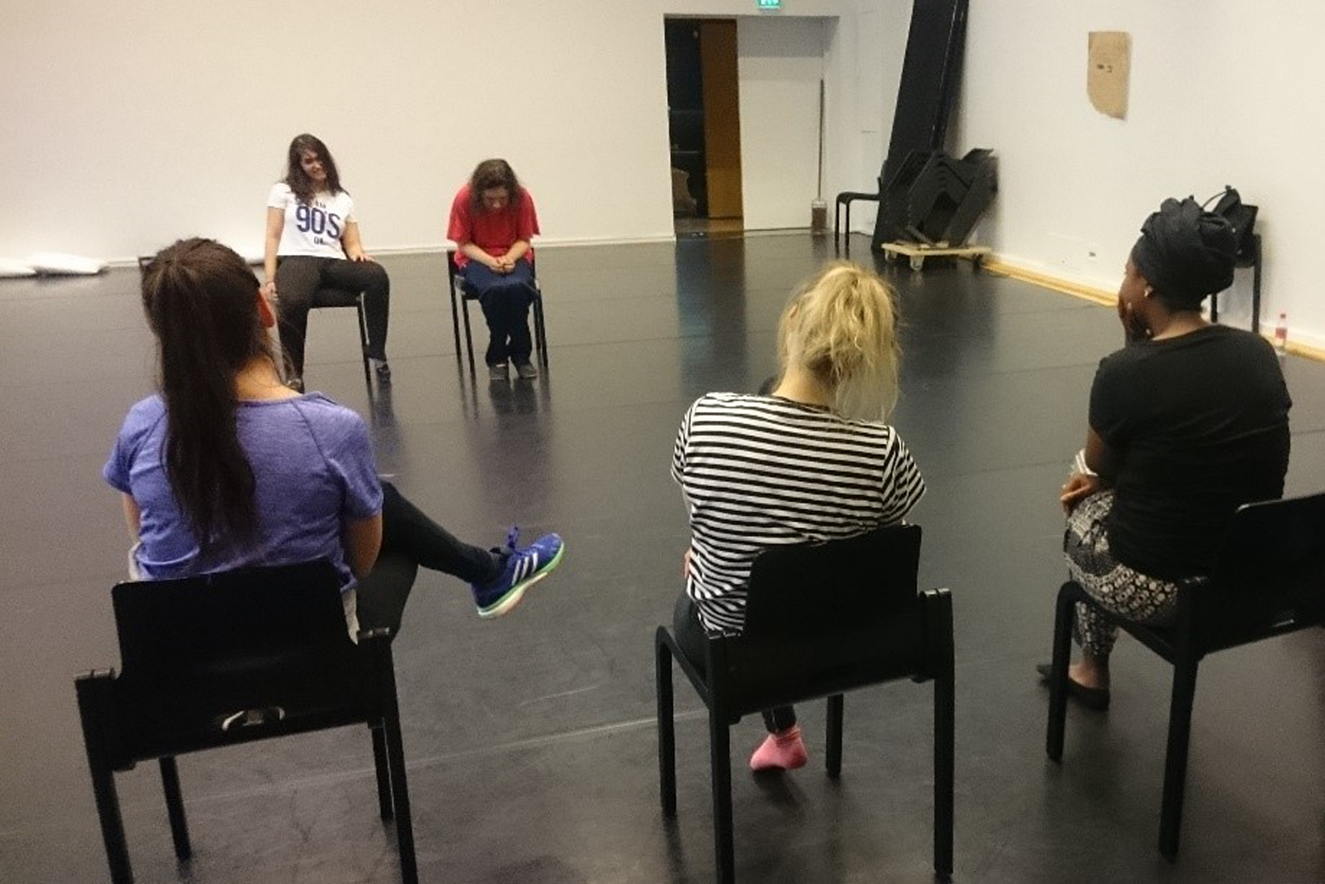
In all of the techniques examined here, two levels of characterological metadiscourse are involved. First, the exercise itself needs to be modeled discursively. This mode of characterological metadiscourse sets the general rules and guidelines for the activity type, opening up an interactional space for characterological experimentation, sometimes explicitly contrasting it with ‘everyday’ modes of behavior (see also Visakko Reference Visakko2020b). Second, in successive repetitions of the exercise, the performers experiment with different variations and the spectators observe and evaluate them (see Figure 1). In the evaluation phase, consequently, perceivable embodied indices become linked to characterological designators. In this phase, too, the leader's questions model the process of evaluation. Some questions tend to mobilize status or identity designators (‘who this guy might be’) or action designators (‘what is he doing’). The demonstrative (tää ‘this’) anchors the questions in the speaker's point of view (‘the one in my current focus of attention, on the stage’), inviting the group to join in the evaluation of the emerging character. In other questions, such as ‘what emerges here’ (mitä täs syntyy), however, the deictic grounding (adverbial täs, ‘here’, in conjunction with the verb syntyä, lit. ‘be born’) points to the here-and-now of the exercise, rather than the fictive situation of the character. It foregrounds the unfolding performance and its effects in total and more readily allows for purely attitude-centric designators that describe the spectator's reactions (‘frightening’, ‘oh noooo that's terrible’) or even technical evaluation of the performance (‘bravo’).
Evaluating status-based characters (July 21, 2015).

The following segment illustrates how the participants become introduced to the ‘status’ technique. In this excerpt, the others explain what is meant by ‘statuses’ to a participant who had been absent the day before, giving Elina the opportunity to check whether the first lesson had been understood.

Henry's initial explanation (‘what you are like’) becomes rectified by both Elisa (‘how you come across to others’, ‘what kind of impression you give’) and Elina (‘what you signal with your physical appearance’). It is noteworthy that all three use a 2sg pronoun to refer to a performer in a generic sense, while the character, the result of the performer's actions, is referred to using a 3sg pronoun (se ‘he/she’ [colloquial]), as in Henry's following turn (‘he/she is really timid’). Such pattern foregrounds the dynamic performer-character role relation and introduces the fictive character as a narrated figure in the conversation, while backgrounding the individual self (‘I’) who inhabits the role of the performer. (See also Raevaara Reference Raevaara2020:261–63.)
Next, the group reviews some of the most important ways of performing different statuses. Elina chooses ‘unconfident’ and ‘confident’ as examples of desired characterological effects. The participants both demonstrate and verbalize their responses. The group starts from ‘unconfident’, progressing one bodily dimension at a time: feet (shrinking themselves and pulling their legs together), hands (hands close to their body, protecting themselves), eyes (gaze downwards, wandering from one place to another, no long eye contacts), voice (a whiny faint voice). The different bodily indices that become linked to the statuses during the exercises include: taking up space (shrinking vs. spreading), locating oneself in space (centrally vs. peripherally), posture (opening/closing, upwards/downwards orientation, inclination, convexity/concavity), gaze (fast/slow moving, jumping, or fixed; eye contact), facial expressions and movements of the head (intense/relaxed, determinate, position of the chin), gait (speed, balance, length of steps, shape of trajectory), gestures and their qualities (liveliness, steadiness, prominence, determination, focus, tempo), and voice (softness, loudness). The discussions also often take into account differences in cultural expectations (e.g. what taking up more or less space implies for different genders).
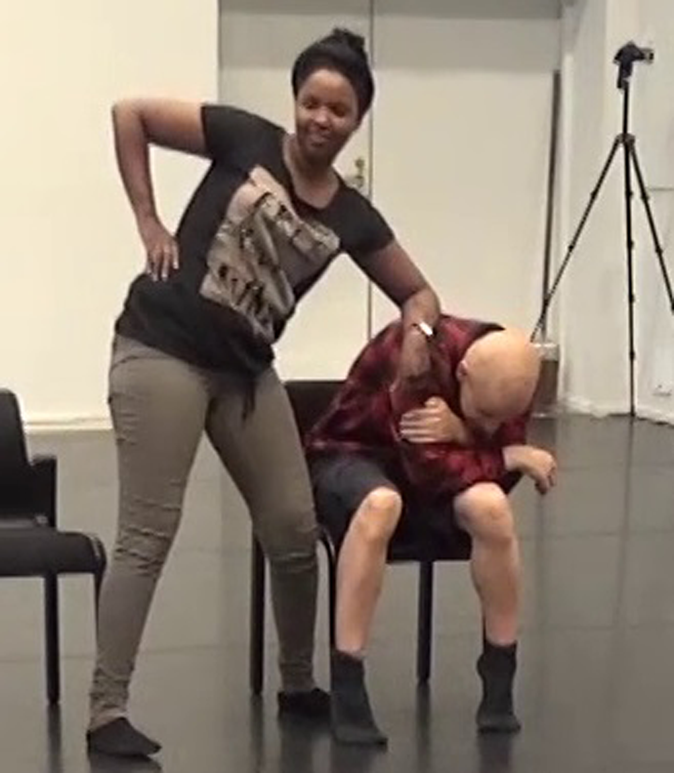
Finally, let us look at an example of the technique in practice. In this non-verbal, improvised interaction, one participant's status gradually increases, while the other's decreases, and vice versa. Afterwards, the group comments on the exercise, noting, in particular, the ‘menacing’ effect of Sami's performance. Elina draws attention to a particular change in status (see Figure 2), which she perceived as slightly incoherent or ambiguous, both increasing and decreasing the status. According to Elina, standing up contributes to an increase in status, but putting one's hands in one's pockets (i.e. reverting to a habitual mannerism), which also causes one's shoulders to drop, has the opposite effect, as the space taken up in relation to the other participant decreases. Alternatives suggested by the group include stepping forward with one foot or raising one's arm—or hugging as later suggested by Razan. What is noteworthy is that the ‘menacing’ effect is treated in terms of very specific embodied indices and any macrosocial categories that might be calibrated to the performance are obviated. Moreover, in the subsequent phase of the exercise the asymmetry is reversed, Nimo dominating Sami (see Figure 3).
An ambivalent change in status.

Statuses reversed.

Status exercises are complemented by many other exercises that train the participants’ control of the spatiotemporal aspects of their onstage behavior. For instance, another important skill relates to the rhythmic punctuation of one's onstage activities. Some exercises, thus, focus on a controlled variation of the duration and tempo of specific phased onstage activities and on the dramatic effects of rhythmic punctuation on characterological interpretation.Footnote 3 When evaluated as successful, such exercises make relatively private (cognitive, affective) processes perceivable through embodied and aestheticized indices. They foreground and develop the participants’ control of an aspect of personhood that is independent of ethnicized or macro-social interpretations. By subtly modifying the qualities of actions in terms of phasing, tempo, and rhythm, the qualities become transformed into indices of particular social footings, changes of affective state, value hierarchies, or motivations behind visible actions.
Personalized experimentation with embodied qualia
The last analytical section looks at a central training method in the project, a technique known by the group as ‘inner movement’ (sisäinen liike). The technique has its roots in the Chekhovian school of acting (e.g. Chekhov Reference Chekhov1953/2002) and was influenced by Steiner's (1921–1924/Reference Steiner1959) anthroposophical views on the power of language and its connection to the invisible realm of human spirituality (e.g. Anderson Reference Anderson2011). The idea of the technique is to come up with physical movements, such as ‘opening up explosively’ or ‘hugging fragilely’, that induce a change of state, which, in turn, becomes reflected in the qualities of the performer's voice and onstage activities in aesthetically useful ways. The outer movement, in other words, becomes gradually internalized into an inner movement—performed by the ‘inner’ or ‘imaginary’ body—so that only the aesthetic qualities remain (see (6), phases (iii)b and (v) below). The exercise, thus, ‘isolates’ or draws attention to a dimension of personal expression and characterological flexibility that is independent of macro-social descriptions and enables a space of nuanced, personalized experimentation with the relationship between performable indices and characterological effects.
In the following early-stage example, the group experiments with ‘hugging’ as an inner movement. Throughout the exercise, the participants perform repetitions on their own, while Elina observes, instructs (see Harjunpää, Deppermann, & Sorjonen Reference Harjunpää, Deppermann and Sorjonen2021), and demonstrates (see Raevaara Reference Raevaara2020:264). The rough segmentation below in (6) shows the first phases of the exercise.
(6) First phases of the exercise
(i) Instructions
Elina instructs the group to start exploring their repertoire for different types of ‘hugging’. She instructs the group to pay attention to details and adds a quality designator: the group should hug ‘as warmly as possible’, taking their own time and space.
(ii) Specification
a. After some repetitions, Elina instructs the group to pay particular attention to their hands (leaving their palms open and air between their hands and torso) so that ‘the energy of the movement can radiate [säteillä, technical term within the exercise] further’.
b. Elina emphasizes that the participants should gaze at the object of hugging. Some argue that when you hug someone, your position prevents you from looking at their face. Elina admits that that type of hug exists, particularly as a casual greeting among friends, but offers as an alternative visualization: hugging one's sick, old grandmother or a five-year-old child. These alternatives require a different kind of ‘focus’ and ‘concentration’.
c. Elina encourages the group to study where the movement ends and to make sure it has a clear beginning, middle, and end.
(iii) Re-instruction: Transferring the qualities to speech
a. The group is instructed to ‘hug warmly’ and, after the movement has ended, to utter one of the lines from the scene they are working on: ‘s/he is gone’ (hän on poissa), based on Razan's account of a friend who died in the Syrian war.
b. Instead of uttering the scripted line, the participants are instructed to walk around in the space greeting others with ‘hey’, as this allows them to listen to the effects of the outer movement.
(iv) Reinstruction
Elina changes the quality designator to ‘beautifully’, also explaining to the group why they experiment with different variants. Next, the quality is changed to ‘begging’ (pyytävä), which is rejected as too difficult, and, finally, to ‘fragilely’ (hauraasti). The group returns to reciting the line, ‘s/he is gone’, still walking around in the space.
(v) Technical advice
When they feel confident, the participants can omit ‘the gesture’ [ele, technical term referring to the outer movement], while maintaining the quality in their lines and actions. However, whenever necessary, they can repeat the movement for a while: ‘you can always return to it and ((demonstrates ‘hugging fragilely’)) °listen listen listen° what it means […] it is quite different from ((demonstrates ‘hugging explosively’)) like explosively’.
As seen in (6) above, usually the starting point is a verb, an action designator, which is subsequently complemented and modified. The technique, thus, initially relies on the ‘everyday’ properties of language, such as substitutional and combinatorial relations. The bodily actions are initially modeled with combinations of different classes of lexemes with mutually substitutable items in each class.

There is, then, a projected equivalence between the symbolic description and the perceivable qualities iconically embodied in the action (a denoted Action vs. a perceivable action; denoted or implied Qualities vs. perceivable qualities). The verbal elements serve as a heuristic and communicative tool. Therefore, the starting point in the exercises is often a stark semantic contrast between Actions (e.g. ‘opening’ vs. ‘closing’ (see also Harjunpää et al. Reference Harjunpää, Deppermann and Sorjonen2021:168), ‘hugging’ vs. ‘shredding’), Qualities (e.g. ‘fragilely’ vs. ‘explosively’) or Targets (e.g. grandmother vs. friend). The ultimate goal—and the measure of success or failure of the technique—are the resulting embodied phenomenological qualities. Importantly, in contrast to the previous exercises, the resulting qualities need not necessarily be specifically verbalized. Rather, the aim is to find unique, subtle, personalized nuances.
Although the technique relies on denotational stereotypes and sense-relational properties of linguistic descriptions, the described action, such as ‘hugging’, is divested of its stereotypic purposes (e.g. expressing affect or maintaining a social relation) and responses (e.g. hugging back), and the focus is solely on the embodied qualities of an individual participant (e.g. inclining posture, firmness of balance, enclosing movement of arms and torso, palm position, speed and intensity of muscular effort, focus and fixity of gaze). The technique, thus, draws from the participants’ cultural and personal experiences but aims to isolate a mere form of controlled behavior (the sign-component of the action; see Kockelman Reference Kockelman2013:124) in pursuit of useful onstage qualities.
Two types of observation are required. The first one involves the observation of the effects of a specific variant by the performers themselves (see (6), phases (iii)b and (v)). This involves interoception (perception of one's bodily states and impulses), introspection (examining one's mental processes), and self-perception of one's uttered lines and accompanying gestures in terms of their aesthetic effect. Second, the director evaluates the effects of the exercise from a spectator's standpoint (‘let's see what comes out of this’) and specifies the instructions accordingly. This constitutes another loop of observation and intervention that involves evaluation of the repetitions in light of expert knowledge and professional vision (see Goodwin Reference Goodwin1994; also Visakko Reference Visakko2020a). The two interlinked loops lead to modification of the repetitions. When the perspectives of the director and the performer overlap consistently, the inner movement designator becomes a portable instrument that can be wielded across frames of participation and with different kinds of characters during the project. From the standpoint of the performer, then, the inner movement description becomes a definite designator for a specific set of qualities that can be reproduced for the director, and, from the standpoint of the director, it becomes a definite designator for a set of aesthetic qualities that can be solicited from an individual performer.
As in the two previous techniques, the inner movement exercises foreground and problematize the relationship between performable embodied qualities and their discursive descriptions. Moreover, the exercises show that characterological metadiscourses have a constructive dimension. That is, they do not merely represent or interpret characterological indices but also, by modeling a continuous process of repetition and modification, aim to create and instill new characterological capacities in the participants (see also Harjunpää et al. Reference Harjunpää, Deppermann and Sorjonen2021:171). The exercises systematically explore, broaden, and solidify the participants’ flexibility of expression and potential of characterological diversity—thus enabling each participant to take part in the joint voice as an equal, yet individual performer.
Conclusion
This article has illuminated the construction of an alternative space of encounter within a multiethnic group. The ‘alternativity’ of the space turns on two modes of characterological metadiscourse that depart from everyday practices and habits, while reflectively presupposing them as a backdrop. The first analytical section illustrated how past personal experiences of inequality, racialization, and ethnicization are dealt with collectively by the group in the group's own terms. The second analytical section, in turn, illustrated a mode of social interaction that obviates ethnicity and focuses on universal and individual characterological traits. This ‘non-ethnicizing’ mode of characterological metadiscourse gives each participant an equal status as an onstage performer. The first mode, thus, reflects on the diversity of the group, whereas the second foregrounds the unity of the group and the equal expressive potential of each participant. Both modes are required to give rise to the group's ‘joint voice’ on stage and in society.
The data, thus, offers a view on a specific strategy of managing diversity and committing to unity with the purpose of collective social action. One way of interpreting the analyses is to see them as an example of how, in different real-life encounters, it becomes possible to move from difference towards belonging and how, in Urciuoli's (Reference Urciuoli, Alim, Reyes and Kroskrity2020:121) words, people can ‘guide the interpretation of their own markedness’ on different social scales. Moreover, the analyses illustrate how ideals of solidarity and egalitarianism are striven for in practice, that is, in situated encounters under specific institutional, political, economic, and sociodemographic circumstances within the global system (cf. Urciuoli Reference Urciuoli, Alim, Reyes and Kroskrity2020:114). Here, a publicly funded artistic project with its exploration of different dimension of personhood enables the participants to belong to a group and, as a group, to claim its right to a voice in society.
The analyses have illuminated some of the key resources of the characterological metadiscourses found in the data (e.g. deictic grounding, grammatical patterns, lexical designators, textual and interactional organization). The analyses have also illustrated some of the interdiscursive origins of such resources, such as professional discourses of the global art world adapted to the Finnish context, widely recognized and mass-mediated everyday discourses circulating in the Finnish society, and marginalized discourses recontextualized from the participants’ everyday environments. The latter include characterological designators that may be rare in other types of Finnish-language data but which may have a clearly global pattern of circulation, such as chingchongit, and may have been disseminated, for instance, by social media. The resulting characterological models are often novel hybrids combining local and global ingredients, which in and of themselves offer new semiotic viewpoints on ethnicity for the participants. The exercises may, thus, be approached as recontextualization strategies (Chun Reference Chun, Alim, Rickford and Ball2016) that can be used to restructure and transform experiences of ethnicization.
As was seen in the analyses, many of the exercises serve to deconstruct characterological stereotypes. They explicitly foreground the question of how embodied indices and perceivable qualia lead to characterological interpretations. They also draw attention to relatively fine-grained, non-emblematic details of social interaction as indices of social or mental characteristics. In doing so, they call into question ‘rhematized’ interpretations, or naturalized links between the qualia exhibited by persons and ethnicized cultural imagery. The experimentation involved in the different exercises illustrates, by its very nature, a range of alternative characterological interpretations. Simultaneously, the theatrical ‘dicentization’, or the attempt to turn images into living characters, makes the whole process of characterological fabrication visible to the participants. Since the exercises experiment with the relationship between indices (perceivable human qualia) and kinds (characterological projections), they make the value-bound and discourse-mediated nature of characterological interpretation clearly visible, allowing for a critical understanding of such processes and potentially denaturalizing conventional stereotypes (see Parmentier Reference Parmentier1994). Tentatively, such processes could be viewed as something like ‘argumentization’, where the emerging interpretations reflexively reveal the assumptions behind such interpretations.Footnote 4
The different exercises build a basis of mutual understanding and help shape the group's ‘joint voice’. Although a specific scene in the final piece may be focalized on one performer (e.g. a condemnation of the Charlie Hebdo attack from the standpoint of Amina, a Finnish-Somali Muslim), each scene is based on the group's joint work and performed jointly onstage (e.g. different performers alternating lines). The ‘joint voice’ reflects the emergent social cohesion of the group in relation to the surrounding social and political structures. In a sense, the group succeeds in imagining and legitimizing itself as a new kind of social grouping with shared interests that can find and articulate their common stance in society despite differences in national or ethnic identification. Moreover, the characterological metadiscourses of the project aim to expand individual participants’ skills of self-presentation—a benefit that can be transported to many contexts in society. The combination of characterological metadiscourses in this alternative discursive space, consequently, offers the participants a concrete view of what it means to be a character in the ‘theater of social life’ (Silverstein Reference Silverstein2023:20) and how, through one's own agency, that character can be shaped and styled.
Appendix: Transcription conventions
- bold
focal item (in examples) (1st)
- underline
focal item (in examples) (2nd)
- italics
focal item (in examples) (3rd)
- .
falling intonation in talk
- ↑
rise in pitch
- word
emphasis in talk
- wor-
word cut off
- °words°
quiet talk
- £words£
smiley voice
- [
beginning of overlap in talk
- (.)
micropause (less than 0.2 seconds)
- (0.6)
pause in seconds
- (?)
item not heard or in doubt
- (())
comment by transcriber describing bodily behavior


 Open access

