




Introduction
From the outset of the COVID-19 pandemic in early 2020, Canadian public health messaging outlined actionable guidelines to reduce the spread and exposure risk associated with the virus. Older age (i.e., over 60 years) was centred in these briefings as an important COVID-19 risk factor associated with an increased likelihood for illness severity, hospitalization, and mortality in much of this early messaging (CDC, 2021). Canadian public health data from the time showed that by December 26, 2020, roughly 94% of the deaths attributed to the virus were reported in individuals over the age of 60 years (Government of Canada, 2024). The details shared in these public health briefings were logically expanded upon – through investigative and more opinion-focused stories –other forms of media (e.g., radio, print, and televised media; social media) that were consumed, to varying degrees, by the Canadian public.
Evidence suggests that exposure to public health messaging discussing COVID-19 risks associated with age, however, may have contributed to feelings of fear, discomfort, and/or anxiety among some older people in the pandemic’s early stages (Addison & Horan, Reference Addison and Horan2022; Brown et al., Reference Brown, Mossabir, Harrison, Brundle, Smith and Clegg2021; Dong & Yang, Reference Dong and Yang2023; Fiocco et al, Reference Fiocco, Gryspeerdt and Franco2021; Herron et al., Reference Herron, Lawrence, Newall, Ramsey, Waddell-Henowitch and Dauphinais2022). Periods of lockdown, when COVID-19-related messaging focused on the specifics of public health restrictions, as well as rising case, hospitalization, and death counts, appeared to have also amplified feelings of concern for many older people (Brown et al., Reference Brown, Mossabir, Harrison, Brundle, Smith and Clegg2021; Falvo et al., Reference Falvo, Zufferey, Albanese and Fadda2021).
Within COVID-19-related public health and more mainstream media messaging, the emphasis placed on older adults being more susceptible to severe outcomes (and, arguably, frequent undertones of this group’s helplessness to alter this reality) has been suggested to have helped perpetuate a ‘vulnerability narrative’ in North America and Europe, particularly during the early phases of the pandemic (Jen et al., Reference Jen, Jeong, Kang and Riquino2021; Meisner, Reference Meisner2021; Swift & Chasteen, Reference Swift and Chasteen2021, p. 246; Vervaecke & Meisner, Reference Vervaecke and Meisner2021). Within this vulnerability narrative, which scholars agree predates the pandemic (Brown et al., Reference Brown, Ecclestone and Emmel2017; Jen et al, Reference Jen, Jeong, Kang and Riquino2021; Meisner, Reference Meisner2021; Swift & Chasteen, Reference Swift and Chasteen2021), harmful ageist stereotypes coalesce to generate a homogenous picture of older age as an experience largely of ‘institutionalization, illness or death, and a lack of agency’ (Jen et al., Reference Jen, Jeong, Kang and Riquino2021, p. 3). Investigations of COVID-19-related media messaging (e.g., social media, newspapers articles, ‘in-depth media reports’ [Fraser et al., Reference Fraser, Lagacé, Bongué, Ndeye, Guyot, Bechard, Garcia, Taler, Adam, Beaulieu, Bergeron, Boudjemadi, Desmette, Donizzetti, Éthier, Garon, Gillis, Levasseur and Tougas2020, p. 693], and more generalized political and health messaging from a variety of sources) during the first two waves of COVID-19, including Canadian sources, found terms such as ‘vulnerable’, ‘dependent’, ‘at risk’, ‘frail’, ‘helpless’, ‘sitting ducks’, ‘isolated’, ‘alone’, and ‘death’ commonly appearing in stories involving older people (Addison & Horan, Reference Addison and Horan2022; Fraser et al., Reference Fraser, Lagacé, Bongué, Ndeye, Guyot, Bechard, Garcia, Taler, Adam, Beaulieu, Bergeron, Boudjemadi, Desmette, Donizzetti, Éthier, Garon, Gillis, Levasseur and Tougas2020, p. 694; Legacé et al., Reference Lagacé, Doucet, Dangoisse and Bergeron2021). These associations were found to be particularly strong within stories describing COVID-19-related outbreaks in Canadian long-term care homes (Archambault et al., Reference Archambault, Lagacé and Fraser2022; Dunsmore, Reference Dunsmore2021).While such terms may have been appropriate when describing long-term care residents who frequently experience more complex medical needs and live in higher risk congregate settings, they may not necessarily capture the felt experience of all people who might fall under the category of ‘older’. Thus, it could be argued that associating ‘vulnerability’ with ‘older age’ more generally might perpetuate ageist stereotypes.
Ageism against older individuals in society has been suggested to be rampant globally (Officer et al., Reference Officer, Thiyagarajan, Schneiders, Nash and de la Fuente-Núñez2020). It is no wonder that continual exposure to negative portrayals of aging and older people leads individuals to internalize ageist thinking (Levy, Reference Levy2001). Negative consequences of internalized ageism can include suicidal ideation (Gendron et al., Reference Gendron, Camp, Amateau and Iwanaga2023) and an increased risk of experiencing elder abuse (Pillemer et al., Reference Pillemer, Burnes and MacNeil2021). In contrast, individuals with positive self-perceptions of aging have been shown to live substantially longer (7.5 years) than those with negative perceptions (Levy, Reference Levy2022; Levy et al., Reference Levy, Slade, Kunkel and Kasl2002). Media messaging has been suggested to play an important role in helping to perpetuate more positive portrayals of aging, both through the language and images that they choose to incorporate (Frameworks Institute, 2018).
Indeed, Addison and Horan (Reference Addison and Horan2022) and (Legacé et al., Reference Lagacé, Doucet, Dangoisse and Bergeron2021) have argued that frequently absent from media messaging about COVID-19 are examples of ways that older people may have sought to counter – either intentionally or unintentionally – the presence of a vulnerability narrative, particularly through the demonstration of personal agency in the context of the pandemic. Canadian psychologist Albert Bandura (Reference Bandura2006) has suggested that human personal agency involves an individual’s ability to ‘influence intentionally one’s functioning and life circumstances’ and involves a willingness to be ‘contributors to their life circumstances, not just products of them’ (p. 164).
Research gaps and study objective
While there have been a few studies that have explored older adult personal agency in the context of the COVID-19 pandemic (Addison & Horan, Reference Addison and Horan2022, Flores-Flores et al., Reference Flores-Flores, Otero-Oyague, Rey-Evangelista, Zevallos-Morales, Ramos-Bonilla, Carrión and Reynolds2023; Wenning et al., Reference Wenning, Polidano, Mallen and Dikomitis2022), these works have typically been focused on populations located outside Canada (i.e., New Zealand, Peru, and England, respectively), with one exception being a 2023, Ontario-based study by Dong and Yang. Many of studies have, unfortunately, also not normally parsed the specific link between feelings of vulnerability and personal agency among older people. This article intends to help address this knowledge gap by exploring how community-dwelling older adults experienced COVID-19 messaging and how this may have impacted their thinking about vulnerability and personal agency. Finally, given the differences that exist between provincial health systems within Canada – which had the ability to impact COVID-19 public health communication – we feel it is important to ensure that the perspectives of older Canadians across the country during the COVID-19 pandemic are accessible within the literature. Therefore, this study will add the, arguably, often overlooked perspectives of older Manitobans to the literature about COVID-19 experiences.
Methods
Theoretical approach
Social constructionism was used as a guiding epistemological framework in this study. This framework theorizes that interactions between people and how they use language constructs both their objective and subjective realities (Andrews, Reference Andrews2012). In the context of this study, public health and more mainstream media messaging may have shaped participants’ understanding of reality within notions of vulnerability and, thus, may have influenced their thinking and/or actions about personal agency within the context of the early pandemic.
Study context
This article examines data from a larger, longitudinal study about the impacts of media messaging and public discourse on older adults’ experiences of internalized ageism. As described in a previous publication related to this project (Sangrar et al., Reference Sangrar, Porter and Chesser2021), 33 older adults each completed a demographic questionnaire and a series of three, semi-structured interviews at two-month intervals between July 2020 and January 2021. The analysis presented in this article focuses on the second study interview, which occurred between October 15 and December 8, 2020.
Study data were collected in Manitoba, Canada’s fifth most populous province, through the second wave of the COVID-19 pandemic in Canada (Statistics Canada, 2025). During this time, the province reported an increase from 1,527 active COVID-19 cases and 38 deaths on October 15, 2020 to 5,379 active cases and 420 deaths on December 8, 2020 (Manitoba Health and Seniors Care, 2022). A disproportionate number of these COVID-19 cases (61.7%) were reported to have occurred in long-term care homes within the province’s urban centres (Manitoba Health and Seniors Care, 2022). In response to this sharp rise in cases, a movement to a ‘critical level (red)’ state on the province’s COVID-19 response system was declared on November 10, 2020 (Manitoba Health and Seniors Care, 2022). Under critical level (red) conditions, social contacts were limited to one’s household, critical businesses (e.g., grocery stores, pharmacies) could only operate at 25% capacity, all in-person recreation venues (e.g., sports facilities, libraries, gyms) were required to close, and religious services could only occur virtually (Manitoba Health and Seniors Care, 2022).
It is also important to note that during the time when many of our second study interviews were taking place, Manitoba news organizations were reporting on a devastating COVID-19 outbreak in the Maples Personal Care Home that claimed the lives of over one quarter of the home’s 200 residents (Stevenson, Reference Stevenson2021). The measures put in place in Manitoba’s long-term care homes to help limit the spread of the virus were also being publicly reported at the time of the study interviews (Chesser et al., Reference Chesser, Steele-Mitchell and Porter2022).
Participants and recruitment
Ethics approval (E2020:034) was obtained from the Education and Nursing Research Ethics Board at the University of Manitoba prior to beginning participant recruitment. This study used a purposive convenience sampling approach that sought to recruit Manitoba residents 60 years of age or older that were proficient in English, not presently living in a long-term care home, and able to provide informed consent. The decision to exclude individuals who did not speak English was made as all study personnel who would conduct interviews were English speakers. Recruitment for this study occurred entirely online via advertisements through the University of Manitoba’s Centre on Aging’s biweekly online newsletter and e-mail advertising through local community support services and organizations targeting older adults that the researchers already had established relationships with (e.g., Manitoba Association of Senior Centres, Manitoba Men’s Sheds, Manitoba Retired Teachers Association).
At the start of the study, participants completed a demographic survey that asked questions about their age, sex, geographic location, relationship status and living arrangements, self-reported health status, current volunteerism and community program participation, and the frequency of their present social interactions with friends and family. Each participant received a $25 gift certificate to a local grocery store after completing each of the three study interviews. All interviews were carried out via Zoom or over the phone by Author #2, with each lasting approximately 90 min. Interviews were audio-recorded, transcribed (via the automated transcription service Transcribe™), checked for accuracy, and de-identified by three research assistants not involved in the data collection process. Pseudonyms have been used within this article when referring to specific interview quotes to protect the identities of all the participants.
The interview guide for the second study interview can be found in Table 1. All questions were developed in collaboration with a study advisory group consisting of four older adults who were not participants in the study. Within the guide, participants were asked questions about the media that they were consuming related to COVID-19, as well as whether/how this consumption was impacting their thoughts about older age, being an older person, and their general mental health. While we did not include a specific question about the presence of a ‘vulnerability narrative’ within the interviews, we did ask the participant to explain their thinking if this topic was brought up within an interview.
Semi-structured interview guide

The questions developed for the interview guide were designed to address the broader study aims associated with the topic of internalized ageism and its influences. These aims included exploration of (a) how older people were interpreting COVID-19 public health and media messaging during the early stages of the COVID-19 pandemic, (b) whether COVID-19 public health and media messaging was influencing the social and/or community engagement behaviours of older people, and (c) potential recommendations about how to counter any negative impacts of COVID-19-related messaging on older people’s experiences of internalized ageism. While questions pertaining to personal agency were not explicitly included in the interview guide, our advisory group (which comprised mainly age-friendly community advocates) often stressed the importance of the concept within the lives of older people and, by extension, encouraged us to consider these concepts in any potential recommendations that might come from this work.
Data analysis
The analysis presented in this article was carried out using unpublished data from 15 of the original 33 participants who completed interview two in the longitudinal study. This subgroup included all participants who completed their second study interview after Manitoba moved to the critical level (red) on the province’s COVID-19 response system on November 11, 2020. Our rationale for including this subgroup was that these ‘critical level (red)’ restrictions and their associated public messaging had the potential to influence the thinking and behaviours of participants when compared to those who had completed their interviews prior to the announcement.
Our research notes suggest that we were able to achieve both information redundancy and thematic saturation within our analysis at around 10–12 participants. We suspect that this may have had something to do with the relative homogeneity of the participant group from a demographic perspective (e.g., socioeconomic status, economic status, relative self-reported health status) and the social realities of the time period during which these interviews were occurring (e.g., during a period of lockdown when movement around one’s community and interactions with others were more limited).
Full interview transcripts were inductively analysed using thematic analysis (Bruan & Clarke, Reference Braun and Clarke2006). This process began with authors #3 and #4 familiarizing themselves with the 15 applicable interview transcripts. They then collaboratively generated initial codes from five of these transcripts, organizing them into a hierarchical coding structure of ‘parent’ codes (defined as the main code to describe a set of codes) and ‘child’ codes stemming from the parent codes. The preliminary codebook created through this process was then used to code the 10 remaining transcripts, with authors #3 and #4 each independently coding five transcripts each. Parent and child codes were iteratively analysed, combined, and sorted by authors #3 and #4 together to inform emerging themes and subthemes via thematic mapping (Bruan & Clarke, Reference Braun and Clarke2006). Authors #1 and #2 helped to triangulate the identified themes/subthemes and an author not involved in data collection (#5) reviewed the overall analytic process. The rigour of the data analysis was strengthened by verbatim interview transcripts, engagement in iterative review of the coding framework, and the documentation of the data analysis process in a reflective journal.
Findings
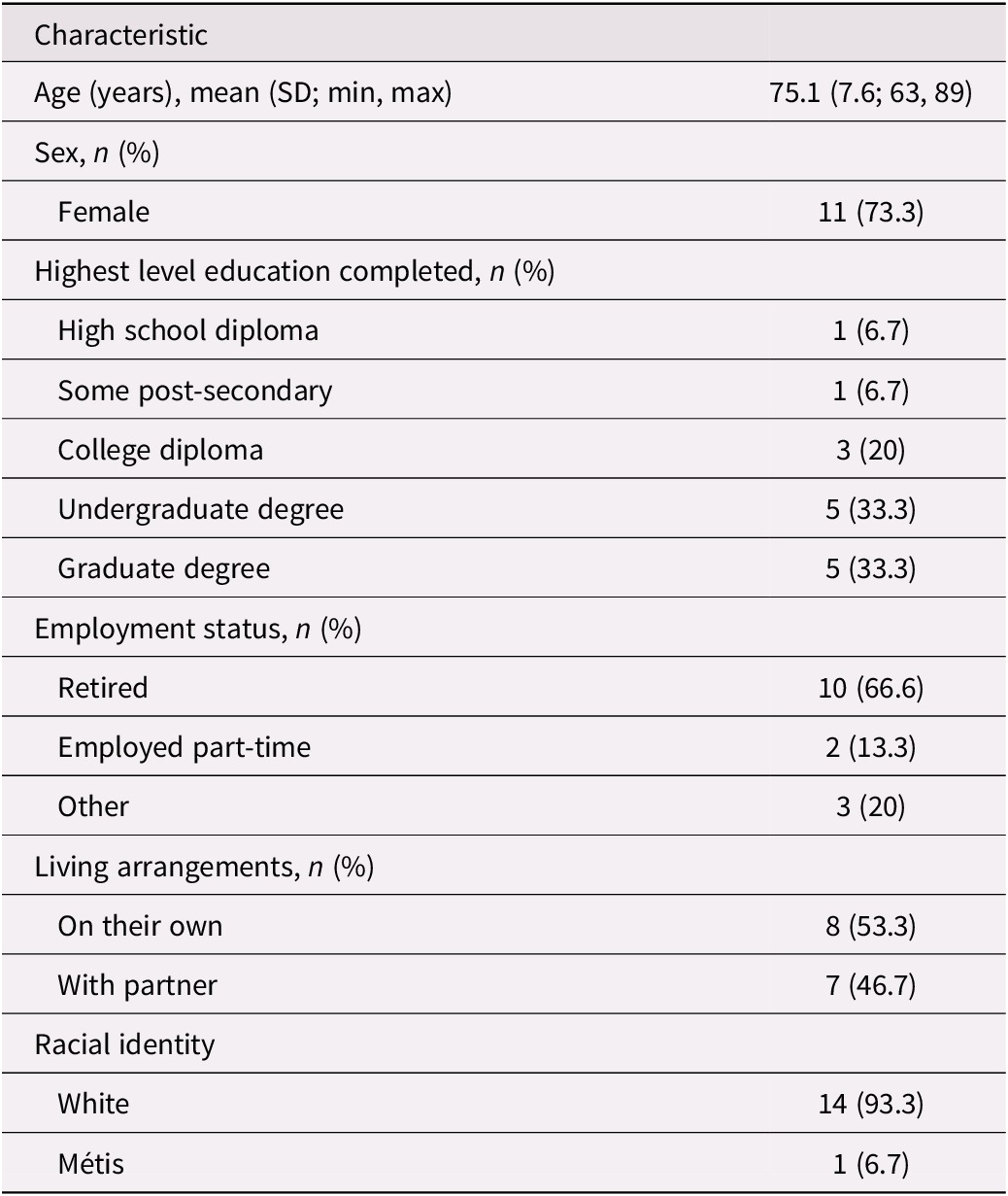
A summary of demographic information about the study participants, which include 11 women and 4 men between the ages of 63 and 89 years, can be found in Table 2. Nine participants were from the Winnipeg health region and 10 of the 15 reported having completed at least an undergraduate degree. In terms of self-reported health status, three participants rated their health as ‘excellent’, five as ‘very good’, four as ‘good’ and three as ‘fair’. The participants reported consuming different forms of media related to COVID-19 within the context of this study. This media included daily public health briefings on television, watching and/or listening to news on television or via radio, reading the newspaper, online via government and public health organization websites, as well as through social media. Several participants also reported hearing about media stories about the pandemic second-hand through family, friends, and neighbours.
Participants demographic data (n = 15)
Four themes were identified in this study related to the impact COVID-19 public messaging on older adults’ experiences of vulnerability and personal agency. These included: (a) associating vulnerability and older age in response to COVID-19 messaging; (b) personal agency as a response to COVID-19 public messaging; (c) public health rule following as a form of personal agency, and (d) coping with COVID-19 public messaging as a form of personal agency. These identified themes address not only the objective of this article (how older adults experienced early COVID-19 public messaging and how it impacted their thinking about vulnerability and personal agency), but also the larger objectives of the longitudinal study that this interview data were a part of (i.e., understanding how older people are interpreting messaging about COVID-19; how it might be impacting their social and community engagement and behaviours; and recommendations for countering the negative impacts of COVID-19 messaging on older adults experiences of internalized ageism). A breakdown of each theme, subtheme, and their related codes can be found in Table S3 in the supplementary material associated with this article.
Theme 1: Associating vulnerability and older age in response to COVID-19 messaging
Most of the participants in this study expressed an awareness of how older adults were being highlighted in COVID-19-related messaging as a group that was potentially more vulnerable to the virus. William, a 76-year-old man who reported ‘excellent health’ (age 76), for example, stated, ‘…I’m aware of the risks associated with seniors and more elderly people, that the impact of COVID can be more severe on them, perhaps, than somebody that is younger and in strong health’. Abigail (age 72) who reported being in ‘very good health’ conveyed, ‘…we’re all, you know, in this category [‘older’] that makes us all very vulnerable’. Other participants mentioned that COVID-19 messaging had increased their awareness of their own mortality, with Nicholas (age 87) stating ‘…if [COVID-19] did hit me, it basically would be probably the end for me’. In the demographic questionnaire for the study, Nicholas had reported his health as ‘good’. Overall, the sentiments shared by the participants might arguably be best captured in the following quote from Abigail (age 72), ‘I think it’s very risky to be an older person living in this province and I’m very sorry to have to say that’.
1.1. Long-term care home conditions
During their interviews, several participants discussed news stories that highlighted an arguably more palpable perceived vulnerability of older residents within long-term care homes, as well as the impacts of stringent lockdown measures and living conditions on these individuals. Nicholas (age 87), for instance, made comparisons between long-term care homes, prisons, and caged animals, ‘like the sister-in-law of mine [in a long-term care home], she was saying she’s now locked up in her room like in a jail…she’s like a rabbit in a cage’. Susan (age 65) echoed these sentiments and described disdain for those who operate long-term care homes, ‘…it’s like…jails in the U.S., you know, they’re not good for anybody except the person getting the money’. Abigail (age 72) stated that she had a ‘real serious concern about how our province has neglected the care homes, has not evaluated and monitored, and made sure that things were done in a healthy way. That is very disturbing to me’.
Exposure to COVID-19 messaging about the impacts the pandemic was having on long-term care homes led several participants to express their concerns about potentially ending up as a resident in one. As Sophia (age 70) suggested: ‘…the issues associated with COVID spread within…[long-term] care homes, that’s been pretty high in the news cycle. And tragic, right, like those of us that are in an age group where we could be in those places are just glad we’re not in one’. Annabelle, a 74-year-old woman in ‘fair’ health, took this idea further when she articulated the idea that older people were fearful of long-term care, ‘these [long-term care] homes are the fright, I believe, of all elderly. They are terrified of going into a home…and being overlooked…I told my kids, shoot me before you put me into a home’.
Theme 2: Personal agency as a response to early COVID-19 public messaging
While the participants discussed vulnerability in their interviews, they also described ways that they were actively making choices that might allow them to feel more in control of their own health and well-being during the pandemic. Janet (age 89) relayed actions she was engaging in to help maintain her health, ‘because I am in good health and, you know, I make sure that I continue to eat healthy, get a reasonable amount of sleep, exercise. I make a point of going for a walk every day to be outside’. Jeffery (age 82 and in ‘good health’) recognized that he could not rely on other people to take care of his health for him, ‘…you have to look after yourself. Nobody’s going to look after you’. In relation to mental health specifically, Abigail (age 72) explained, ‘…I am responsible for, for taking care of myself…in the same way that I’m responsible for my physical health…I also really need to take care of my own mental and emotional health’. Abigail also suggested that she was proactively considering what she wanted for her health in the future: ‘…I really would like to remain strong and independent and healthy. I would really like to have the freedom of living in my own place and kind of having, I know this is wishful thinking to a certain extent, but control over my own life’. Finally, Jennifer, a 67-year-old woman in self-reported ‘fair’ health took this future health planning a step further to include end-of-life care, ‘…I wish there was something like [MAiD] for COVID because, you know what, it would really ease my mind. It would really, really ease my mind. I don’t want to suffer. No, I want to pull the plug’.
Theme 3: Public health rule-following as a form of personal agency
At the time of their interviews, all the participants explained that they had made the decision to abide by the COVID-19 public health restrictions that were in place within Manitoba to stop the spread of the virus. Some participants, like Joanne (age 72), described belonging to a lineage of rule followers as a motivating factor for such actions, ‘…I follow the rules, we keep safe, we do what we need to do…I guess it comes down to if you’re a rule-follower…and our kids are, our grandchildren are, we are, our parents were’. For one participant, Sophia (age 70, who reported herself to be in ‘very good’ health), this desire to adhere to public health restrictions – and decrease her likelihood of coming into contact with the virus – necessitated switching stores for grocery shopping:
‘…knowing that my [grocery store] has been fined at least once if not twice for not following the distancing rules…I’m avoiding it like the plague. And I’ll go to [a different grocery store]…you don’t have to feel like you’re crowded in there’.
Despite most of the participants in this study relating a general desire to follow the current COVID-19 restrictions, their motivations for doing were different. For some, concerns about the safety of others served as a factor in their decision to follow provincial COVID-19 restrictions. As Andrea (age 73) suggested, ‘…sure, [masks are] uncomfortable. I do not like wearing one…but it’s not taking away your freedom…you’re not doing this only for yourself. You’re doing it for those you love’. Other participants mentioned how past experiences served as an important factor in their decision to follow the rules surrounding COVID-19 restrictions. Susan (age 65), for instance, communicated how living through important historical periods could act as a behavioural influencer: ‘I think a lot of [people], especially people who’ve lived through things, [the Great] Depression and World War [II], … it makes sense to them to follow the regulations’. Additionally, Sophia (age 70) described how societal norms during her younger years impacted her rule following with regard to COVID-19 restrictions: ‘we were also brought up in an age when you, you had to follow the rules at school.…you might push the boundaries a little bit with your parents, but never just totally ignore what the rules were’. Finally, some expressed that they had trust in Canadian health authorities at the time of their interviews, thus leading them to want to abide by the COVID restrictions that had been put in place. As Robert (age 81) expressed, ‘I think most Canadians, we trust our healthcare system. We respect it…and we listen to our healthcare people, and we believe them’.
Theme 4: Coping with COVID-19 public messaging as a form of personal agency
The consistent reporting of recently rising COVID-19 case counts and outbreaks appeared to have a negative impact on the psychological and emotional health of several of the participants in this study. Janet (89 years) expressed, ‘And then suddenly there were four times [as many cases], and then it just kept going up and up and up and it, like I said, is distressing and discouraging and yes, very unsettling’. Indeed, some participants expressed how COVID-19 messaging was contributing to disrupted sleep patterns, anxiety, and heightened depressive and distressing thoughts. In response, several participants described employing specific strategies for coping with COVID public messaging to help manage these feelings and experiences. These included altering news consumption, seeking out social connection, and keeping busy.
4.1 Altering news consumption
While all the participants mentioned that they had sought out news and/or public health reporting to remain abreast of pandemic developments, some appeared to have altered how the engaged with this public messaging to help deal with the emotional effects. Robert (age 81), for example, described avoiding the news (‘They’re only giving us a fear….I don’t even turn the news on anymore’). Sophia (age 70), conversely, opted for more uplifting programming, ‘I think [COVID-19 news] is overdone a bit and maybe that’s just what my husband has on TV. I avoid it [laughs] and I go upstairs and I put on a holiday movie’.
4.2 Social connection
A few participants mentioned actively seeking out opportunities to connect with others to cope with the impacts of COVID-19 public messaging. For instance, Susan (age 65), described engaging in conversations with a trusted group to help process COVID-19 information: ‘I talk to people. I went to the University of Manitoba [and] I’m fairly well-educated. We discuss things. We discuss what makes sense and what’s sensible’. Other participants mentioned seeking out social connection opportunities with others that did not involve mention of COVID-19, ‘And so in our e-mails and texting…I’ve got 69 contacts. And I call them up. It’s always – we do upbeat things. We don’t mention the virus’. (Robert, age 81).
4.3 Keeping busy
Finally, some of the participants expressed that keeping busy enabled them to take their mind, even temporarily, off COVID-19. For participants who were not yet fully retired, paid work served as a source of distraction from the pandemic: ‘I’m technically working and that’s a very, very, very positive event that’s happening because it takes my mind off of it. It keeps me busy. And I can do other things instead of thinking about COVID’ (Jennifer, age 67). For participants who were already retired, engagement in household chores served as a similar source of distraction. As Susan (age 65) stated, ‘And I don’t have time to sit and complain because you know, I’m trying to get things done around my home trying to fix it up… been trying to paint for weeks now’.
Discussion
The findings from this study suggest that the participants felt a degree of vulnerability connected to their age within the context of the early stages of the COVID-19 pandemic – a feeling that appeared to be connected to the public health messaging and media they were consuming at the time. Words and phrases such as ‘vulnerable’, ‘risky’, ‘loss of autonomy’, ‘rabbit in a cage’ and ‘end of me’ were specifically mentioned by participants – sometimes in reference to their own age, and sometimes in reference to other older people they knew or about older age more generally. Such findings are consistent with those of Addison and Horan (Reference Addison and Horan2022) who conducted interviews with older adults in New Zealand during a similar period to this study (October 2020–January 2021). They found older participants’ describing feelings of vulnerability and a sensed notion that they, as older people, needed to ‘live carefully’ to protect themselves from COVID-19 (p. 290).
Several participants in our study also described feelings of fear, distrust, anger, and frustration at the treatment of certain older people as being outcomes from the consumption of early COVID-19 messaging. These perspectives were particularly palpable in discussions about the perceived loss of certain freedoms/autonomy being experienced by residents in long-term care (e.g., ‘she was saying she’s now locked up in her room like in a jail’), as well as apparent care-related negligence on the part of certain long-term care home operators (‘our province has neglected the care homes, has not evaluated and monitored, and made sure that things were done in a healthy way’). One participant appeared to make efforts to clearly differentiate herself, as an older person, from those residing in long-term care in their interview language (e.g., Sophia’s comment ‘makes you glad you’re not in a [long-term care home])’. This could be viewed as an attempt, either consciously or unconsciously, to differentiate her current experience of older age from concepts such as institutionalization, infirmity, and a loss of control over one’s life (Jen et al., Reference Jen, Jeong, Kang and Riquino2021; Legacé et al., Reference Lagacé, Doucet, Dangoisse and Bergeron2021). For Annabelle, however, who self-reported her health as ‘fair’ her comment ‘shoot me before you put me in a home’, could be argued to convey a worry that the worsening of her current health could necessitate a move into more institutionalized forms of care – a reality for many older people both before and during the pandemic.
Much like the participants in Addison and Horan’s (Reference Addison and Horan2022) work, several of the participants in this study conveyed the belief that their older age potentially made them more vulnerable to the virus. However, not every participant appeared to experience this vulnerability in the same way or to the same extent. For example, while Nicholas (age 87) feared that catching the virus could be ‘the end of me’ (while self-reporting his overall health status as ‘good’), other participants like Abagail (age 72) who was in ‘very good’ health described a more generalized risk that COVID-19 posed to all older people (‘…I think it’s very risky to be an older person living in this province’). Addison and Horan (Reference Addison and Horan2022) have suggested that the diversity of feelings of vulnerability experienced by many older people during the early waves of the pandemic were likely impacted by additional personal risk contexts beyond mere chronological age (e.g., pre-existing health conditions, ability to socially distance).
Personal agency as a potential response to feelings of vulnerability
Bandura (Reference Bandura2006) states that personal agency involves an individual desire to be actively steering the circumstances of one’s life, rather than a passive observer or more output of said circumstances. In their interviews, the participants in this study described multiple ways that they were demonstrating personal agency as a response to the unfolding COVID-19 emergency and tightening public health restrictions. Whether it be through their thinking and/or actions, the participants in our study found ways to make active decisions in the face of an unfolding health emergency that they felt would benefit their health and/or well-being (e.g., following public health guidelines, wearing a mask). In many cases, these decisions were likely motivated by their own values (e.g., following rules, trusting healthcare authorities) and potentially previous experiences of hardship that provided a sense of perspective and larger context (Fiocco et al., Reference Fiocco, Gryspeerdt and Franco2021). Through these intentional choices, the participants were finding an outlet for themselves (and, arguably other older people), to be regarded not as mere ‘objects of care and protect[ion]’ but also ‘subjects who care[d] (in both the emotional and practical sense) and participa[nts] in public health measures’, whether it be for themselves or for others (Addison & Horan, Reference Addison and Horan2022, p.302; Mould et al., Reference Mould, Cole, Badger and Brown2022; Naughton et al., Reference Naughton, Padeiro and Bueno-Larraz2023; Vervaecke & Meisner, Reference Vervaecke and Meisner2021). We feel that this desire to intentionally attempt to influence one’s circumstances and serve as an actor – and not merely a bystander – within the context of one’s life fit Bandura’s definition of personal agency well (2006).
Aspects of vulnerability in the context of COVID-19 may have also motivated the participants in this study to demonstrate personal agency regarding choices and thinking about their own health and well-being. For some, this process appeared to involve making intentional choices to hopefully preserve good health (e.g., eating healthy, getting enough sleep, exercise). For others, such choices involved considering their desires around their own health directives if they were to become seriously ill from the virus (e.g., Jennifer’s statement: ‘I wish there was something like [MAiD] for COVID because, you know what, it would really ease my mind… I don’t want to suffer. No, I want to pull the plug’). It could be argued that such demonstrations of personal agency were inspired by a desire among the participants to feel as though they were actively engaged in taking care of themselves (or, at the very least, making their wishes known) amid the pandemic, rather than solely relying on others to care for them.
Various coping mechanisms to deal with COVID-19 public messaging and its effects appeared to serve as another potential way for some of the participants in this study to demonstrate a degree of personal agency. For example, the intentional decision to cease their COVID-19 news consumption (or to watch a happy holiday movie instead) may have been avenues for some participants to increase feelings of control, as well as manage feelings of disturbance in the context of the early pandemic. A similar strategy of limiting one’s consumption of COVID-19 news to reduce feelings of distress has also been described by Fiocco et al. (Reference Fiocco, Gryspeerdt and Franco2021) in their Toronto-based study of older adults’ adjustment to the COVID-19 pandemic in the spring/summer of 2020.
Connecting with friends and family (to talk about, or purposely not talk about, pandemic information) was another method of coping that was mentioned by the participants in this study and elsewhere (Addison & Horan, Reference Addison and Horan2022; Fuller & Huseth-Zosel, Reference Fuller and Huseth-Zosel2021; Herron et al., Reference Herron, Lawrence, Newall, Ramsey, Waddell-Henowitch and Dauphinais2022). This action also had the potential effect of helping to build solidarity and understanding with others during an unfolding public health emergency and had the potential to further strengthen one’s personal agency and resolve. Finally, the intentional act of staying busy, whether this be through paid work or completing tasks around the home, was a mechanism for coping with COVID-19 messaging mentioned by a few participants in this study to preserve their mental/emotional well-being. Such a strategy has also been described in other studies exploring older adult experiences navigating the stress and uncertainty of the pandemic (Addison & Horan, Reference Addison and Horan2022; Fiocco et al, Reference Fiocco, Gryspeerdt and Franco2021; Fuller & Huseth-Zosel, Reference Fuller and Huseth-Zosel2021; Herron et al., Reference Herron, Lawrence, Newall, Ramsey, Waddell-Henowitch and Dauphinais2022).
Acknowledging and strengthening personal agency for older people
Authors such as Mould et al. (Reference Mould, Cole, Badger and Brown2022) and Naughton et al. (Reference Naughton, Padeiro and Bueno-Larraz2023) suggest that public health messaging that leads with concepts of societal solidarity against a common enemy (e.g., COVID-19 virus), while concurrently outlining specific contributions that all individuals within society can make to the collective ‘fight’, can help build opportunities for action for all individuals. Such a strategy can also grant those individuals who might traditionally fall within the category of ‘vulnerable’ potential avenues to demonstrate personal agency. Vervaecke and Meisner (Reference Vervaecke and Meisner2021) have also suggested that messaging that does not assume that all older people need or want assistance can help to honour the space necessary for personal agency.
Finally, public programs that provide older individuals with an opportunity to discover their own value – and opportunities for agency – can help to counter elements of any age-related vulnerability associations present within societal public messaging. For example, the Reimagine Aging program through the University of Manitoba’s Centre on Aging provides older individuals with an opportunity to recognize ageist messages when they see or hear them and actively work against their internalization (Murphy et al., Reference Murphy, Porter, Mackenzie and Chipperfield2024a; Murphy et al., Reference Murphy, Mackenzie, Porter and Chipperfield2024b). In addition, the Reimaging Aging program provides individuals with education, acceptance and commitment therapy techniques, and attributional retraining to chart a course for their own values-based aging free from society’s ageist thinking.
Limitations
In reflecting on this study, there are limitations that we would like to acknowledge – several connected to the difficult reality of trying to carry out an interview-based study in the early stages of the COVID-19 pandemic. Our recruitment efforts focused primarily on senior’s organizations with whom we already had established connections, mainly in the interests of time. However, the membership that would have received one of our recruitment e-mails through these organizations was almost certainly more educated, more socially engaged, and less likely to be as racially diverse as the general older population within Manitoba. We feel that this likely contributed to much of the homogeneity seen within our participant group. As mentioned previously, expanding our recruitment partners to include Manitoba-based organizations that work with more racially/ethnically diverse older populations, Indigenous and/or 2SLGBTQIA individuals, as well as those that serve more economically disadvantaged or socially isolated older people would have potentially added more diverse vantage points to our study. While we would have also loved to have included the perspectives of older people living in long-term care in this study, understaffing within these spaces as well as the COVID-19 public health restrictions in place at the time of recruitment made this possibility unrealistic.
Conclusions
This study provides largely missing accounts of the ways older Manitobans may have demonstrated personal agency as a response to early COVID-19 public health messaging. Specifically, our findings support the idea that this early COVID messaging led older people to associate vulnerability with older age, often in ways that negatively impacted their overall well-being. We propose that public health messaging, as well as community-based opportunities for older people to demonstrate personal agency – via the following of public health regulations and protocols, engaging in activities to help maintain their health, and coping mechanisms for dealing with disturbing or overwhelming COVID messaging – may help to counter these harmful impacts. The findings from this study also suggest that public messaging must be mindful of the ways that it could contribute to the perpetuation of a vulnerability narrative for older adults. In instances where the risks posed to older people by a serious situation/emergency must be conveyed, we would suggest such messaging must also outline, to older people, ways that they can meaningfully contribute to the protection of themselves and others through specific thinking and actions.
Supplementary material
The supplementary material for this article can be found at http://doi.org/10.1017/S0714980825000108.
Acknowledgements
We thank the members of this study’s advisory group: Don Fletcher, Doug Mackie, Meryl Orth, and May Wady. Heather Hughes, Dallas Murphy, and Samantha Steele-Mitchell provided valuable data management support. The authors gratefully acknowledge the research support provided by our research partner, the Manitoba Association of Senior Communities. Finally, we wish to extend our sincere gratitude to all of the study participants who generously contributed their time, thoughts, and experiences during a period of great uncertainty and stress.
Financial support
This research was funded by an Individual Partnership Engage COVID-19 Special Initiative grant (#1008-2020-0002) through the Social Sciences and Humanities Research Council. It was also supported by internal funding through the University of Manitoba’s Centre on Aging. A small amount of personnel support was provided by the Manitoba Association of Senior Communities.



 Open access

