





Introduction
Obesity has been recognised as a public health crisis in the United States affecting nearly 40% of Americans and contributing to increased healthcare cost and risk of type 2 diabetes, cardiovascular disease and certain cancers.(1,Reference Hales, Carroll and Fryar2) Although individual knowledge, attitudes and beliefs are important contributors to food choice and obesity risk, researchers have proposed that one’s food environment is also related to their risk of developing obesity.(Reference Briggs, Black and Lucas3–Reference Mattes and Foster6) Federally funded nutrition education programmes such as the Supplemental Nutrition Assistance Program Education (SNAP-Ed) and the Expanded Food and Nutrition Education Program (EFNEP) provide education aimed at encouraging healthy food choices to prevent obesity. These programmes are also encouraged by their respective funding agencies to implement policy, systems and environmental (PSE) changes which modify individuals’ surroundings to better support healthful eating, acknowledging the influences on health behaviours that go beyond individual-level knowledge and motivation.(Reference Story, Kaphingst and Robinson-O’Brien7) EFNEP outlined this guidance in a 2019 document which encouraged implementers of EFNEP to conduct and report PSE changes,(Reference Galdamez8) though there are no available published data on the proportion of EFNEP implementers actually implementing PSE change work. The SNAP-Ed programme currently requires that states implement PSE changes, and the most recent published data indicate that the percentage of SNAP-Ed programmes planning to implement PSE change work increased from 56% in 2014 to 98% in 2016.(Reference Burke, Gleason and Singh9) Regardless of the programme implementing them, both nutrition education and PSE changes will be necessary to combat obesity, and they are most effective when paired together in multi-component, multi-level interventions.(Reference Ewart-Pierce, Ruiz and Gittelsohn10)
African Americans in the United States experience a higher rate of obesity compared with white residents of the United States,(Reference Hales, Carroll and Fryar2) which may be due in part to differences in their food environment. African American neighbourhoods are more likely to have a high density of fast food restaurants, also known as “food swamps”,(Reference Hager, Black and Cockerham11–Reference Cooksey Stowers, Jiang and Atoloye15) and less likely to have access to a full-service grocery store.(Reference Hager, Black and Cockerham11,Reference Barker, Francois and Goodman16–Reference Bell, Kerr and Young18) While grocery stores do stock some less healthful foods, they sell a higher proportion of healthful items than other retail food outlets such as corner stores.(Reference Cantor, Beckman and Collins19) Nutrition researchers have recently acknowledged the need for a renewed focus on institutional factors and structural racism that contribute to racial inequities in nutritional and health status.(Reference Barker, Francois and Goodman16,Reference Bailey, Krieger and Agénor20–Reference Singleton, Uy and Landry23) An important part of work that attempts to address these barriers and reduce racial health disparities is to uplift and learn from the voices and experiences of those who are intended to benefit from an intervention.(Reference Mertens24) Participant input in the design, delivery and evaluation of interventions has the potential to improve the recruitment and retention of participants, the appropriateness of information provided and the sustainability of interventions.(Reference Harris, Cook and Gibbs25,Reference Rifkin26) Nutrition educators and public health professionals implementing educational or PSE interventions among marginalised populations such as African Americans should therefore assess whether they meet the needs of participants, through quantitative and/or qualitative feedback.
It may be particularly important to solicit feedback from members of marginalised populations participating in health-focused interventions because research has shown that healthcare providers may unintentionally contribute to racial health disparities if they are not providing culturally competent care.(Reference Amutah, Greenidge and Mante27–Reference Giger and Davidhizar29) This feedback may include participant ratings of satisfaction, which provide information about subjective experience with an intervention that goes beyond what can be collected through observation.(Reference Ware, Snyder and Wright30) In addition to feedback obtained through quantitative satisfaction ratings, it is also important to explore participant experiences using qualitative research methods. Quantitative measures of satisfaction with an intervention may not truly represent the nature of service provided or hide negative participant experiences.(Reference Gill and White31,Reference Williams, Coyle and Healy32) Regardless of the method used, nutrition PSE and education interventions conducted to benefit African Americans should collect feedback from participants regarding their attitudes towards, beliefs about and perceptions of the intervention to ensure that they are maximally beneficial to those participants.
There is a lack of literature reviews which have examined African Americans’ feedback regarding, perceptions of and/or experiences participating in nutrition interventions. Previous reviews have examined public health interventions tailored to African Americans, including nutrition education,(Reference Lemacks, Wells and Ilich33,Reference Di Noia, Furst and Park34) weight loss programmes(Reference Fitzgibbon, Tussing-Humphreys and Porter35,Reference Burton, White and Knowlden36) and physical activity,(Reference Whitt-Glover and Kumanyika37) but these reviews have not included information regarding participant feedback or perceptions of the interventions. A review by Coughlin et al. conducted in 2017 examined nutrition interventions implementing community-based participatory research (CBPR) in African American populations but also did not include any information related to participants’ perceptions of the interventions.(Reference Coughlin and Smith38) In order for interventions to improve the nutritional status of African Americans to be effective, culturally relevant and sustainable, implementers should assess participants’ attitudes towards, perceptions of and experiences participating in those interventions.(Reference Di Noia, Furst and Park34,Reference Kumanyika39,Reference Aaron and Stanford40) A review encompassing this literature is needed. The primary aim of this scoping review is therefore to summarise the available literature that describes African Americans’ attitudes, beliefs and perceptions of nutrition education and PSE interventions.
Methods
The protocol for this review was registered in advance at Open Science Framework (osf.io/taj5c/) and was conducted using guidance for scoping reviews provided by the Joanna Briggs Institute (JBI).(Reference Peters, Godfrey and McInerney41,Reference Greene, Houghtaling and De Marco42) Our findings are reported according to the Preferred Reporting Items for Systematic Reviews and Meta-Analyses checklist for scoping reviews (PRISMA-ScR).(Reference Tricco, Lillie and Zarin43) The scoping review was guided by this research question: What is the availability of literature describing African Americans’ experiences participating in, and/or their satisfaction with, nutrition education programmes and PSE change interventions?
Search strategy
We developed our search strategy in partnership with a research librarian (R.L.M.) and registered the review protocol on 31 October 2020. The search was performed in November 2020 with a repeat search in May 2021 to identify any additional sources published since the initial search. An example of the search is available in Figure 1. We also included a search of the ProQuest Dissertations & Theses database, to identify relevant grey literature. The same inclusion and exclusion criteria were used to search websites and online resources pertaining to nutrition education, such as the National Association of Family and Consumer Science Agents (neafcs.org) and the Regional Nutrition Education and Obesity Prevention Centers of Excellence (psechange.org), which are no longer receiving funding. Separate search terms were used for the grey literature search to narrow results to those most relevant to the inclusion criteria (Figure 1). According to the recommendations of the JBI guidance for scoping reviews, we searched the reference lists of identified reports and articles for additional sources, and then the reference lists of any additional articles identified in this manner.
Search strategies for the scoping review of African Americans’ satisfaction with nutrition interventions.

Eligibility criteria
Our research question and inclusion criteria were guided by the PCC (population, concept, context) mnemonic recommended by the JBI Reviewer’s Manual for Scoping Reviews.(Reference Peters, Godfrey and McInerney41). Studies were included only if the populations were majority (>50%) African American, either children or adults. Both adult and youth populations were included to obtain the maximum amount of literature for review. Though gathering feedback and input from adults and children entails different methodologies and skillsets, this review aimed to describe all available literature on this topic and to explore whether soliciting feedback occurred more in youth or adult populations. Included studies were also limited to the context of the United States in the English language, conducted after 1991. The concept portion of our research question aimed to include publications implementing research or programme evaluation methods which captured African Americans’ experiences while participating in nutrition education programs and PSE interventions, or that captured satisfaction with or perceptions of those interventions. This investigation focused exclusively on African Americans in the United States because of their unique historical experience of enslavement, Jim Crow discrimination and the current discriminatory effects of ostensibly colour-blind policies in the food environment in the United States.(Reference Cooksey Stowers, Jiang and Atoloye15,Reference Bailey, Krieger and Agénor20,Reference Bonilla-Silva44–Reference Mackey, Burton and Cadieux46)
Data extraction and evidence mapping
Searches were conducted according to the strategy outlined above. The grey literature search was conducted by the first author (M.G.). All search results were exported to Zotero software, where duplicates were removed. Results were then exported to Excel (Office 365, v16.0; Microsoft Inc. Redmond, Washington). M.G. and D.H independently reviewed titles and abstract, then independently reviewed articles for inclusion. Any disagreement regarding which articles to include were resolved through consensus or a third reviewer (B.H.) if needed.
Standardised data extraction tools were designed by M.G. using Excel to address the relevant data for each research question. Descriptive information extracted from all articles included authors, publication year, study design, study objectives, setting, population and an intervention description. Additional information extracted from articles included the methods used to evaluate perceptions of and/or satisfaction with the intervention, quantitative results of those investigations and any qualitative themes that emerged from those investigations.
M.G. extracted data from all articles and distributed an equal number of articles selected for inclusion to B.H., D.B., M.D. and C.S. for data extraction, such that data were extracted from all articles by the first author and one co-author. Any disagreement in data extraction was resolved through consensus, and by a third reviewer (D.H.) if necessary.
Results
The literature search resulted in 1180 title and abstract records (Figure 2). Titles and abstracts were largely excluded from full-text review because they were not conducted in the United States, were not conducted in a majority African American population or described an observational study in which authors did not conduct an intervention. Of the sixty-eight full-text articles screened, thirty-five articles met the inclusion criteria.(Reference Pierce, Bowden and McCullagh47–Reference Locher, Waselewski and Sonneville80) Full-text articles were mostly excluded owing to study populations that were not majority African American (n = 18, 54%) or because the studies did not collect participants’ satisfaction with or perceptions of interventions (n = 12, 36%). A small number (n = 3, 10%) were excluded because the studies were observational and lacked an intervention. Following our initial search which resulted in twenty-nine articles, an additional four articles were identified through searching of reference lists,(Reference Story, Sherwood and Himes73,Reference Suarez-Balcazar, Martinez and Cox74,Reference Baker, Motton and Seiler78,Reference Williams, Auslander and de Groot81) and two additional articles were identified in the repeated search in May 2021.(Reference Haynes-Maslow, Jones and Morris79,Reference Locher, Waselewski and Sonneville80) The articles identified in the repeated search included a combined cooking skills and nutrition education programme,(Reference Haynes-Maslow, Jones and Morris79) and a meal delivery programme designed to supplement WIC.(Reference Locher, Waselewski and Sonneville80)
PRISMA 2009 flow diagram.

Of the thirty-five articles which met our inclusion criteria (Table 1), nearly all (n = 29, 83%) were conducted in urban settings. A minority were conducted in rural settings (n = 3, 8.5%) or settings that were not identified as rural or urban (n = 3, 8.5%). Most studies were conducted with adults (n = 26, 74%), and a smaller number were conducted with youth (n = 6, 17%) or both adults and youth (n = 3, 9%). Most sources included in our review were peer-reviewed journal articles (n = 27, 77%), though some (n = 8, 23%) were dissertations or theses identified through the search of grey literature. No results from the search of webpages met the inclusion criteria.
Descriptive characteristics of included studies (n = 30)

A large majority of the included studies examined interventions which consisted of nutrition education alone (n = 22, 63%) (Table 2). For example, several studies assessed participants’ perceptions of nutrition education for school-aged children,(Reference Pierce, Bowden and McCullagh47,Reference Shaw53,Reference Baskin, Zunker and Worley55,Reference Blom-Hoffman61) while others assessed perceptions of educational programs for adults,(Reference Ingram49,Reference Davis52,Reference Downes, Buchholz and Bruster54,Reference Jones66,Reference Sheppard, Hicks and Makambi67,Reference Senior Angulo70,Reference Kolavalli71,Reference Conlon, Kahan and Martinez76,Reference Haynes-Maslow, Jones and Morris79,Reference Williams, Auslander and de Groot81) and some assessed perceptions of education provided by the WIC programme.(Reference Joseph63,Reference Cricco-Lizza68,Reference Jackson69) Five (14.5%) of the studies examined perceptions of combined nutrition education and PSE changes, such as programmes combining a community garden with education.(Reference Woodson, Braxton-Calhoun and Benedict58,Reference Grier, Bennette and Covington75) Another five (14.5%) studies addressed perceptions of environmental interventions alone or in combination with a system intervention (n = 5, 15%), such as the installation of salad bars in majority African American schools.(Reference Bean, Spalding and Theriault64) Finally, several studies evaluated participants’ perceptions of system interventions alone or in combination with a policy intervention (n = 3, 8%), such as an intervention to assess nutritional risk of WIC participants,(Reference Dunlop, Dretler and Badal50) a grocery delivery programme(Reference Locher, Waselewski and Sonneville80) and labelling of calories on restaurant menus.(Reference Auchincloss, Chilton and Davis51)
Details of sources addressing African Americans’ perceptions of and/or satisfaction with nutrition interventions
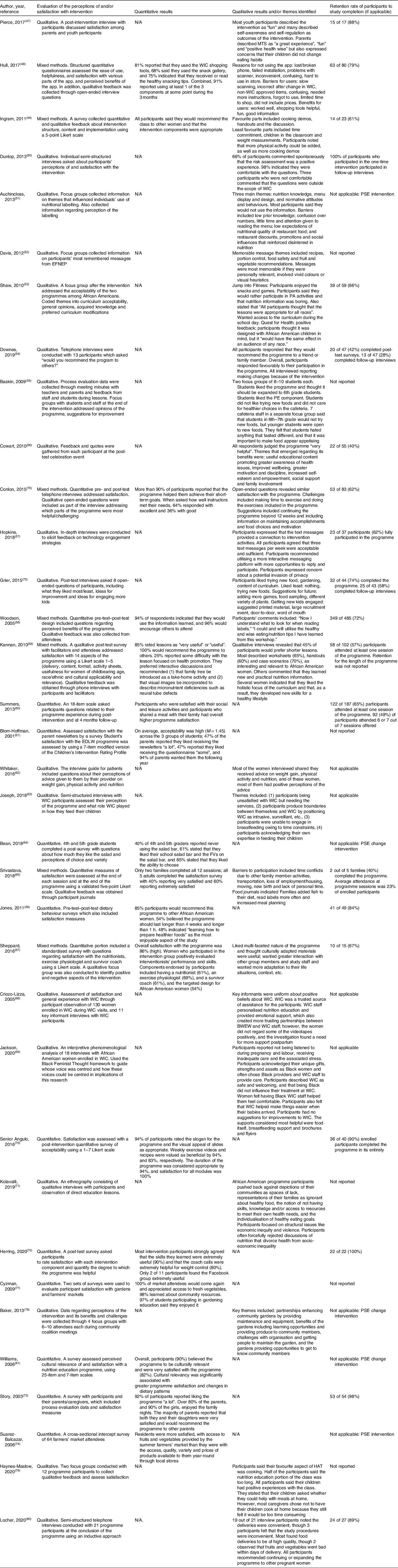
Across all included studies, many collected data regarding attitudes towards or perceptions of an intervention via quantitative surveys alone (n = 10, 28%). In most cases, these quantitative surveys asked participants whether they would attend programmes again or recommend them to a friend. Surveys also asked about specific components of the interventions to assess which portions were most enjoyed and/or accepted by participants. Other studies implemented mixed-methods evaluations, either using quantitative surveys that included open-ended questions or conducting qualitative interviews or focus groups separate from a quantitative survey (n = 7, 20%). Open-ended survey questions tended to focus on suggestions for improvement to the programme and asking which portions of the intervention were preferred by participants. Several studies implemented qualitative methods alone (n = 18, 48%), either through focus group discussions or semi-structured interviews. These qualitative-only studies largely focused on collecting information about participant satisfaction,(Reference Pierce, Bowden and McCullagh47,Reference Downes, Buchholz and Bruster54,Reference Cricco-Lizza68,Reference Haynes-Maslow, Jones and Morris79,Reference Locher, Waselewski and Sonneville80) feedback or suggestions for improvement,(Reference Shaw53,Reference Baskin, Zunker and Worley55–Reference Hopkins, Fristad and Goodway57,Reference Grier, Bennette and Covington75) or individuals’ general perceptions of the intervention.(Reference Dunlop, Dretler and Badal50,Reference Auchincloss, Chilton and Davis51,Reference Whitaker, Wilcox and Liu62,Reference Joseph63,Reference Baker, Motton and Seiler78)
Among studies implementing quantitative methods alone or in combination with other methods (n = 17), twelve evaluated nutrition education interventions alone, two evaluated direct education along with a PSE change and three evaluated PSE changes alone. Among studies implementing qualitative methods alone or in combination (n = 23), fifteen evaluated nutrition education interventions alone, four evaluated direct educations along with a PSE change and four evaluated PSE changes alone. Two studies implemented either phenomenology or ethnography,(Reference Jackson69,Reference Kolavalli71) qualitative methods rarely used to evaluate public health interventions.
Nearly all included publications, whether implementing qualitative or quantitative methods, found that participants had positive experiences with the interventions studied. In general, the included studies found that school children expressed satisfaction with interventions that were perceived as ‘fun’ and had interactive or physical activity components,(Reference Pierce, Bowden and McCullagh47,Reference Shaw53) but found less satisfaction among children with interventions that encouraged them to try new foods,(Reference Baskin, Zunker and Worley55,Reference Grier, Bennette and Covington75) or made changes to the lunchroom.(Reference Bean, Spalding and Theriault64) Studies of educational interventions conducted with adults found that they were perceived to be helpful or useful,(Reference Hull, Emerson and Quirk48,Reference Cowart, Biro and Wasserman56,Reference Kannan, Sparks and DeWitt Webster59,Reference Herring, Bersani and Santoro72) but some participants felt that the interventions were too lengthy or too much of a time commitment.(Reference Ingram49,Reference Kannan, Sparks and DeWitt Webster59) Quantitative surveys found that many participants would recommend the intervention to others,(Reference Woodson, Braxton-Calhoun and Benedict58,Reference Kannan, Sparks and DeWitt Webster59,Reference Jones66,Reference Story, Sherwood and Himes73) found interventions appropriate or acceptable(Reference Ingram49,Reference Blom-Hoffman61,Reference Senior Angulo70) and were satisfied with interventions.(Reference Summers and Klassen60,Reference Sheppard, Hicks and Makambi67,Reference Story, Sherwood and Himes73,Reference Suarez-Balcazar, Martinez and Cox74,Reference Williams, Auslander and de Groot81) Qualitative studies identified participant suggestions for improving interventions, such as shortening lessons,(Reference Kannan, Sparks and DeWitt Webster59) including tips for maintaining success after the programme,(Reference Conlon, Kahan and Martinez76) adding games and food tastings,(Reference Grier, Bennette and Covington75) and increasing interaction among participants.(Reference Sheppard, Hicks and Makambi67) Qualitative studies also identified participants’ perceived benefits of interventions, such as making behaviour changes,(Reference Downes, Buchholz and Bruster54) having greater awareness of health issues(Reference Cowart, Biro and Wasserman56) and using the information learned in lessons in their daily lives.(Reference Woodson, Braxton-Calhoun and Benedict58,Reference Kannan, Sparks and DeWitt Webster59)
Studies examining nutrition education provided through WIC found mixed results regarding satisfaction with the programme. Two qualitative studies found that participants were satisfied with WIC, especially when served by African American WIC staff.(Reference Cricco-Lizza68,Reference Jackson69) In contrast, WIC participants in another publication were dissatisfied with WIC services and saw the programme as intrusive and surveillant.(Reference Joseph63) Only one other study of an educational intervention found that participants were dissatisfied and asserted their own knowledge and expertise related to the intervention topic.(Reference Kolavalli71) All of the studies which found that participants were dissatisfied with interventions implemented qualitative research methods.
Retention rates in intervention studies ranged from 40% to 100% of enrolled participants, and all studies included in the review only solicited feedback from participants who completed the intervention. No studies reported satisfaction or feedback from participants who left the intervention or were lost to follow-up. Few (n = 3) studies reported reasons for participant dropout: one study reported this was due to behavioural or family reasons,(Reference Pierce, Bowden and McCullagh47) and two due to scheduling conflicts.(Reference Ingram49,Reference Srivastava, Palmer and Ireland65)
Discussion
The purpose of this review was to identify and describe the available literature describing African Americans’ perceptions of and satisfaction with nutrition education and PSE interventions. Compared with white Americans, African Americans are disproportionately likely to face food insecurity, poverty and obesity,(Reference Hales, Carroll and Fryar2,Reference Coleman-Jensen, Rabbitt and Gregory82,Reference Semega, Kollar and Creamer83) and to encounter barriers to healthful eating in their food environment which are imposed by structural racism, such as an increased presence of fast food outlets and targeted advertising for unhealthy food.(Reference Cooksey-Stowers, Schwartz and Brownell14,Reference Cooksey Stowers, Jiang and Atoloye15,Reference Grier and Kumanyika84) Nutrition education and PSE change interventions may be able to play a role in reducing racial disparities in nutrition status and food security, but they should also assess whether the interventions are meeting the needs of participants by collecting participant feedback. Research has demonstrated that participant involvement in the design, implementation and evaluation of interventions improves the sustainability of projects, retention of participants and appropriateness of information provided.(Reference Harris, Cook and Gibbs25,Reference Skelton, Irby and Geiger85)
Our results demonstrated that the majority of articles meeting our inclusion criteria assessed African Americans’ satisfaction with interventions consisting of nutrition education alone. Though nutrition education such as that provided by SNAP-Ed and EFNEP has been shown to improve reported food insecurity and overall quality of life,(Reference Rivera, Maulding and Eicher-Miller86–Reference Auld, Yerxa and Infante88) education alone is less likely to result in long-term positive health behaviours compared with PSE change interventions and will not be sufficient to address structural racism in African Americans’ food environment. Sociologists have identified differences in social and economic resources, such as wealth, income, education and occupational status, as a “fundamental cause” of health disparities.(Reference Link and Phelan89,Reference Harrell, Burford and Cage90) Nutrition education which focuses on individual choice and motivation as the only determinants of one’s diet may therefore be perceived as unhelpful or patronising in the face of these larger barriers.(Reference Kolavalli71) For example, focus groups with SNAP-Ed-eligible parents in California found that they generally understood how best to feed their families a nutritional diet, but were constrained by their circumstances and environment.(Reference Gosliner and Shah91) Among our results, the only studies which found participants to be dissatisfied with interventions were those implementing nutrition education alone.(Reference Joseph63,Reference Kolavalli71) Given the potential for PSE change interventions to better address racial disparities in nutritional status than education alone, future work will need to assess participant satisfaction with and perceptions of nutrition-focused PSE change interventions.
About half of the articles included in our results implemented qualitative methods to assess experiences with a nutrition intervention. Qualitative methods may be best suited to obtain an in-depth understanding of experiences with the interventions, because qualitative methods seek to better understand participants’ lived experiences. Researchers have been critical of quantitative surveys of satisfaction because they may not be able to differentiate which part of a service or intervention participants are satisfied with.(Reference Gill and White31) Participants may also tend to consistently rate satisfaction as high on quantitative surveys, which may obscure dissatisfaction or problems with some aspects of interventions that are revealed in qualitative exploration.(Reference Nguyen, Attkisson and Stegner92) Future investigations of satisfaction with nutrition education and PSE interventions should therefore implement qualitative methods to obtain an in-depth understanding of participant experiences.
This review identified a wide range of retention rates for intervention studies and no articles which solicited feedback or perceptions of the intervention from participants who left the intervention. Though studies generally observed positive perceptions of the interventions, bias is introduced when only those who complete the intervention are asked about their perceptions of that intervention.(Reference Compton, Glass and Fowler93) Those who left the intervention are likely to have more comments for improvement of the interventions, and may be more likely to report that they were unsatisfied with the intervention. The lack of input from these participants is a significant limitation of any study reporting that participants were satisfied with the intervention. Future work should seek to collect feedback from those participants who did not participate in an intervention in its entirety or who dropped out from the programme.
An additional notable finding of this review was a lack of relevant grey literature on any SNAP-Ed, EFNEP or nutrition-education-focused websites. The lack of guidance or publications from these agencies which describe and address structural racism may be a limitation to progress in this area. These agencies and other funders of nutrition education and PSE change programmes should specifically name health equity and addressing structural racism as a goal of the programme, which may promote more nutrition interventions aimed at addressing the issue among African Americans. Additionally, standards for federally funded nutrition education programmes set by the Child Nutrition Reauthorization and Farm Bill, released every 5 years, should do more to emphasise PSE change work as part of those programmes. PSE change work would be better suited to address the challenge of structural racism experienced by African Americans.
Other marginalised populations in the United States, such as Native Americans and Hispanic Americans, also experience increased rates of poverty, food insecurity and obesity, and researchers have called for efforts to address these disparities.(Reference Odoms-Young22,Reference Singleton, Uy and Landry23,Reference Dougherty, Golden and Gross94) Nutrition interventions in these populations should also assess participants’ experiences in the intervention and whether participants are satisfied. However, no other scoping reviews have been published to date which examine the satisfaction with nutrition education and/or PSE interventions among these populations in the United States. Reviews have examined ‘culturally adapted’ or ‘culturally tailored’ nutrition education and health promotion interventions in Hispanic and Indigenous populations,(Reference Joo and Liu95–Reference Vincze, Barnes and Somerville97) but did not include measures of whether the participants were satisfied with the interventions or their feedback about the interventions. Additional literature reviews are therefore warranted to describe participant satisfaction with nutrition education and PSE interventions in other marginalised populations.
Limitations
While our search was guided by a research librarian (R.L.M.), it was limited to five databases of peer-reviewed literature. These databases were selected on the basis of the interdisciplinary nature of this investigation, but there may have been additional articles available in other databases that were not included in this review. Additionally, the grey literature search was limited to a search of one database of dissertation and theses. There may be additional dissertations and theses related to the subject that were not available in this database.
Our inclusion criteria for this review included only interventions in the implementation stage, not formative research conducted to develop interventions. This excluded studies which addressed African Americans’ perceptions of interventions while those interventions were being developed. A future review could address findings of formative research conducted among African Americans to develop nutrition education and nutrition-focused PSE change interventions.
There are numerous issues with the measurement of satisfaction, especially when measured with a quantitative survey.(Reference Gill and White31,Reference Williams, Coyle and Healy32) The results of quantitative studies included in this review may therefore inaccurately reflect participants’ true perceptions of nutrition interventions. Additionally, results obtained by qualitative studies may also be impacted by circumstances such as interviewees’ relationship with interviewers and the setting in which interviews were conducted, which may have affected the results obtained by studies included in this scoping review. Another issue is the variation in retention rates and the lack of any studies which assessed the satisfaction of people who dropped out of the intervention. This limits the ability of studies to conclude that participants were satisfied and also precludes the collection of valuable information from the participants who left the intervention that could improve those interventions. The findings of this scoping review are therefore seriously limited by the information provided in the included studies, their measurements of satisfaction and the populations from which this information was solicited.
Conclusion
To best address the increased rates of obesity and food insecurity experienced by African Americans, nutrition education and PSE interventions should determine whether participants are satisfied with the intervention and obtain an in-depth understanding of participant experiences with the intervention. This scoping review has described the available literature reporting African Americans’ satisfaction with and/or perceptions of nutrition interventions. Few studies meeting our inclusion criteria examined PSE interventions, and future work should address this gap in the literature. Qualitative methods may prove particularly useful in obtaining an in-depth understanding of participants’ experience with nutrition interventions, given that the studies included in our review which found that participants were not satisfied with interventions were all conducted using qualitative methods. Because African Americans experience high rates of obesity and food insecurity and encounter structural barriers to healthy eating in their food environment, researchers should address the identified gaps in the literature if they seek to serve this population adequately.
Financial Support
This research received no specific grant from any funding agency, commercial or not-for-profit sectors.
Conflict of Interest
None.
Authorship
M.G., D.H. and R.M. conceptualised the review. M.G. and R.M. designed the search strategy. M.G. and D.H. independently performed the initial title and abstract screen and the full-text screen for inclusion. M.G., B.H., C.S., M.D.M. and D.B. performed data extraction. M.G. wrote the first draft of the manuscript with contributions from R.M. All authors contributed to, reviewed, edited and commented on subsequent drafts of the manuscript.


 Open access

