

INTRODUCTION
Many authoritarian regimes originating in violent rebellion are highly durable. Communist regimes in the USSR, China, Vietnam, and Cuba survived at least six decades. Rebel autocracies in countries as diverse as Uganda, Tunisia, Spain, and Saudi Arabia lasted for three decades or more. Levitsky and Way (Reference Levitsky and Way2022) argue that social revolutionary regimes are more durable than their authoritarian peers, and Meng and Paine (Reference Meng and Paine2022) show that, within Africa, regimes emerging from violent rebellion last longer than other autocracies. Similarly, Clarke (Reference Clarke2023; Reference Clarke2025) argues that violent revolutions generate regimes more resistant to counterrevolutionary restorations. These studies build on long-standing arguments about how violent revolutions and interstate wars often establish durable political order (Huntington Reference Huntington1968; Skocpol Reference Skocpol1979; Tilly Reference Tilly1992).
But in many other cases, rebel takeovers are quickly followed by renewed fighting, which collapses the regime (or the entire state apparatus). The Xinhai and Anti-Monarchy revolutions in China precipitated the tumultuous Warlord Era. Rebel regimes in Chad, Afghanistan, and Yemen lasted fewer than three years before succumbing to subsequent rebellions. And in places like Libya, Somalia, and the Central African Republic, successful rebellions destroyed the state entirely. These trajectories align with scholarship on civil war, which shows that these conflicts routinely deplete already weak states, producing periods of warlord politics (Driscoll Reference Driscoll2015; Lynch Reference Lynch1992; Reno Reference Reno1998) and state failure (Goldstone Reference Goldstone2008; Perkoski Reference Perkoski2022; Rotberg Reference Rotberg2010).
These divergent trajectories following successful armed rebellion are puzzling. Do successful rebellions produce durable authoritarian order? Or do they breed regime weakness and state failure? And if both trajectories are possible, why do some rebel regimes follow one or the other?
To address these questions, we compiled an original global dataset of all regimes founded by a successful rebellion between 1900 and 2020, drawing from nine existing datasets on conflict, revolution, and regimes. This dataset addresses an important selection issue that may help to explain the contrasting findings on rebel regimes. We include very short-lived and unstable regimes, rebels that take power amid state failure, and states with limited international recognition. These cases are largely omitted from existing regime datasets, which include only rebel regimes that fully consolidate their rule—and, in doing so, inflate estimations of their durability.
The overwhelming majority of rebel regimes were authoritarian (74 of 84), our focus in this article. We first document empirically that rebel regimes do indeed follow divergent trajectories. Whereas 41% endure at least 20 years (including many still in power today), nearly as many (37%) collapse within five years, and some last only a few months. The relative rarity (22%) of intermediate spells (5–19 years) contrasts with outcomes for non-rebel autocracies, which predominantly fall into the intermediate category. A compelling theory of rebel regimes must identify distinct mechanisms that produce either of these divergent outcomes and specify the conditions under which each set of mechanisms should dominate.
We argue that the divergent trajectories of rebel regimes are best explained by the structure of the founding rebellion: whether it was unified or fractured. The rebellion’s structure shapes power-sharing dynamics in the postwar regime and influences the likelihood of conflict recurrence. In a unified rebellion, a single armed group overthrows the incumbent. After taking power, its political and military elites share authority within the same organization. This mitigates the canonical guardianship dilemma because new leaders typically replace the state military with their own rebel army. Rebel leaders gained valuable experience delegating authority, collaborating, and establishing coordination mechanisms with generals during the rebellion. This minimizes the risk that military officers rewarded with high-level positions will turn on the regime leaders and attempt to seize power themselves. As a result, power-sharing arrangements within regimes founded by unified rebellions tend to be stable.
By contrast, in a fractured rebellion, two or more armed groups fight to oust the incumbent. Regimes founded by fractured rebellions face significant challenges to consolidating their rule because they usually need to share power across disparate armed organizations. Even if these groups collaborated on tactical matters during the war, their leaders lack the shared experiences and strong relationships that exist between elites within a single rebel group. Upon vanquishing their mutual enemy, they often attempt to form coalition governments out of necessity. But their commitments to perpetually share power lack credibility. As a result, disaffected rebel groups often defect from the coalition and return to armed rebellion. These defector rebellions present a grave threat to the nascent regime.
Analyzing our original data on rebel regimes provides empirical support for these theoretical arguments. The average annual failure rate for regimes founded by fractured rebellions is three times higher than for those founded by unified rebellions (10.2% vs. 3.4%). This difference is statistically significant and, as we establish in extensive robustness checks, cannot be explained away by alternative rebellion characteristics (like social revolution or leftist ideology), country-level characteristics, or other factors stemming from concerns over endogeneity or sample selection.
We empirically support our proposed mechanisms by analyzing originally collected data on power-sharing dynamics and conflict recurrence. In the overwhelming majority of regimes founded by fractured rebellion, an initial ruling coalition was formed in which the leader of one group held the presidency while members of other groups held high-ranking cabinet positions like Vice President, Prime Minister, or Minister of Defense. But most of these power-sharing efforts failed, breaking down into renewed fighting among previous coalition partners. These defector rebellions occurred in 83% of regimes founded by fractured rebellion, compared to only 21% among regimes founded by unified rebellion. These defector rebellions also explain why more than half of fractured cases fell to subsequent rebellions. In short, renewed fighting is the Achilles’ heel for regimes founded by fractured rebellion.
This article speaks to the foundational question of why some authoritarian regimes survive longer than others. The predominant focus in the literature is on authoritarian institutions, such as parties, legislatures, and elections (Blaydes Reference Blaydes2010; Brownlee Reference Brownlee2009; Gandhi Reference Gandhi2008; Geddes Reference Geddes1999; Lust-Okar Reference Lust-Okar2006; Malesky and Schuler Reference Malesky and Schuler2010). Our focus on regime-founding rebellions instead aligns with a smaller strand of research on regime origins, which may shape both the formation of institutions and subsequent durability (Brownlee Reference Brownlee2007; Geddes, Wright, and Frantz Reference Geddes, Wright and Frantz2018; Levitsky and Way Reference Levitsky and Way2022; Pepinsky Reference Pepinsky2014; Slater Reference Slater2010; Smith Reference Smith2005).
We identify and theorize an important mechanism connecting regime origins to durability: authoritarian power sharing. Prior work emphasizes the challenges dictators face in sharing power with their erstwhile allies, particularly military leaders (Carter and Hassan Reference Carter and Hassan2021; De Bruin Reference De Bruin2020; Greitens Reference Greitens2016; Harkness Reference Harkness2018; Mattingly Reference Mattingly2024; Meng, Paine, and Powell Reference Meng, Paine and Powell2023; Paine Reference Paine2021; Reference Paine2022b; Roessler Reference Roessler2011; Svolik Reference Svolik2012; Woldense Reference Woldense2022). Whereas these studies posit various strategies and institutions that leaders can leverage to mitigate these challenges, we explain how a regime’s origins shape the feasibility of these strategies in its early days. In fact, as we show, autocracies with a particular founding event—fractured rebellion—face conditions in which successful power sharing is nearly impossible.
Finally, we provide new insight into the diversity of autocracies with origins in armed rebellion. Existing work on rebel regimes emphasizes their durability, particularly when founded by social revolution (Huntington Reference Huntington1968; Lachapelle et al. Reference Lachapelle, Levitsky, Way and Casey2020; Levitsky and Way Reference Levitsky and Way2022). We instead trace durable order to a distinct origin—unified rebellion—which encompasses almost all cases of social revolution but also many others. We show that unified rebellions breed durable regimes even when they do not constitute full-blown social revolutions (e.g., attempting radical socioeconomic or cultural changes). At the same time, we also explain why so many rebel regimes fail quickly: birth in fractured rebellion. Existing research has not documented, let alone explained, these divergent trajectories of rebel regimes. We hope that this article will spur further comparative research on autocracies with different types of origins; in a final empirical section, we demonstrate the potential for further work in this vein by comparing rebel regimes to autocracies with non-rebel origins.
MOTIVATING PATTERN: DIVERGENT TRAJECTORIES AFTER SUCCESSFUL REBELLIONS
New Global Dataset
We compiled an original dataset of political regimes founded by successful rebellions between 1900 and 2020, drawing from existing civil war and regime datasets and numerous secondary sources. A rebel regime is a regime founded by a successful rebellion, which we define as an organized armed campaign involving at least 25 battle deaths carried out by a challenger group outside the state that directly contributes to either (1) displacing an incumbent government from a country’s capital city or (2) establishing an autonomous government over a delimited territory or region.
This definition encompasses successful center-seeking rebellions, independence rebellions that displace a colonizing or occupying foreign power, and secessionist rebellions that establish a newly autonomous government over territory that formerly belonged to an existing state. Importantly, we do not require the successful rebel group to establish full control over the country or to consolidate its rule for any minimum period of time. We simply require that the rebel group takes power after displacing the incumbent from the capital (for center-seeking or independence campaigns) or establishes a sovereign government over a delimited region (for secessionist campaigns). Consequently, we include cases in which a rebellion creates a new government even amid periods of ongoing conflict and instability (e.g., Somalia in 1991, China between 1916 and 1928, and Finland in 1918). We also include cases in which rebels established a new government with de facto independence from their parent state despite lacking full (or even any) international recognition (e.g., Kosovo and Somaliland).
Our definition also excludes certain violent campaigns that result in the displacement of an incumbent government. The criterion that participants are based outside the state excludes almost all coups by the military, except rare cases in which a failed coup devolved into a broader civil war with substantial participation by individuals or groups who never belonged to the state military (e.g., the Spanish Civil War). We also exclude cases in which success could not be clearly attributed to the rebellion itself, for example, where a colonial power granted independence to an overseas colony after defeating a rebellion and handing over power to a domestic faction unrelated to the rebel group (e.g., Cameroon, Morocco, Laos, and Cambodia). Finally, in some cases, a rebellion “succeeds” in the sense of destroying the state (which ends the prior regime) but no rebel group forms a government or takes power. For example, the Somali rebel regime founded in January 1991 ended months later in September when renewed fighting split Mogadishu in half. However, no new rebel faction established a government, and therefore, we do not code a new rebel regime as emerging.
To compile our list of rebel regimes, we consulted nine existing datasets on conflict, revolution, and regimes.Footnote 1 In each dataset, we focused on campaigns in which the outcome was coded as a “rebel victory” or a challenger “success.” Collectively, these datasets yielded a list of approximately 120 campaigns. We removed cases that were overlapping or duplicates, that did not meet our definition, or that were not clearly rebel successes. Most rebel regimes were founded following outright rebel victory, although some involved negotiated settlements with the government in which rebels gained the executive position as a direct result of the negotiations (e.g., Zimbabwe).
This process yielded 84 rebel regimes, most of which are authoritarian (74). These autocracies comprise our core sample, which includes six partially recognized territories established following secessionist wars.Footnote 2
We propose two primary justifications for the importance of our new, comprehensive list of rebel regimes. First, none of our source datasets come close to covering our entire list. Only two of the source datasets contain even half our cases (Beissinger with 59% and NAVCO with 55%), as we show in Tables A.1 and A.2 in the Supplementary Material.
Second, we address an important selection issue that may help to explain why scholars have reached contrasting conclusions about the consequences of successful rebellions. Studies of authoritarian durability typically start with a list of authoritarian regimes and then trace backwards to analyze their origins. For example, regimes in the widely used Geddes, Wright, and Frantz (Reference Geddes, Wright and Frantz2014) dataset must hold power on January 1 of a calendar year, not emerge during a period of state failure, and exist in a fully recognized state. This approach selects out many unstable cases from the sample and thereby inflates the durability of rebel regimes. Our approach begins with a list of conflicts and then traces forward to identify the regimes established by rebel victory, which eliminates concerns about conditioning on regime survival or strength. One-third of our cases do not appear in the Geddes, Wright, and Frantz (Reference Geddes, Wright and Frantz2014) dataset or extensions that cover our entire time period from 1900 to 2020. Moreover, the rebel regimes excluded from their data are indeed different—in a given year, these regimes are twice as likely to fail.Footnote 3
Descriptive Patterns of Regime Durability
Using our new data, we document a previously overlooked pattern in Figure 1. Rebel regimes, in comparison to non-rebel autocracies, are relatively more likely to survive for either very long or very short periods.
Comparing Regime Durability: Rebel versus Non-Rebel Autocracies
Note: Appendix A.1 of the Supplementary Material describes the sample of non-rebel autocracies.

Whereas 41% of rebel autocracies last at least 20 years, only 26% of non-rebel regimes survive that long. This difference aligns with existing research on the durability of regimes founded in violent rebellion. But even though many rebel regimes survive for long periods, they are not better at avoiding quick death. Within five years of taking power, 37% of rebel regimes collapse. This rate is comparable to, and in fact slightly higher, than that for non-rebel autocracies (34%). Although research on conflict acknowledges the destructive consequences of civil wars, we are the first to quantitatively document the high frequency of short-lived rebel regimes across a comprehensive sample.
THEORY: FOUNDING REBELLIONS AND POSTWAR STABILITY
What explains these divergent regime trajectories following successful rebellions? Why do some rebel regimes survive for very long periods whereas others die quickly? We argue that the structure of the founding rebellion determines the nature of political order by shaping power-sharing dynamics within the postwar regime and the types of conflict that generally recur. Our theory distinguishes regimes founded by unified rebellions from those founded by fractured rebellions. A unified rebellion, by our definition, involves a single armed group fighting the incumbent regime just prior to the end of the war, even if that group has significant internal fractures. Conversely, fractured rebellions involve two or more distinct rebel groups, even if these groups have close ideological affinity and shared aims.Footnote 4
Unified rebellions establish regimes that are well-positioned to survive for long periods. In these regimes, political and military leaders share power within the same rebel organization. These elites benefit from their history of collaborating and delegating authority during the war. These wartime experiences mitigate the commitment problems that plague attempts to share power in many authoritarian regimes. By contrast, in regimes established by fractured rebellions, the various armed actors that had participated in the rebellion must attempt to forge a workable power-sharing arrangement across groups. But elites in these disparate groups lack the same kind of ties and wartime experiences. These tenuous postwar coalitions therefore frequently fall apart, as defectors return to violent conflict and ultimately bring down the new regime.
Authoritarian Power Sharing and the Guardianship Dilemma
All autocrats must share power with a coalition of elites in order to survive. Maintaining such a winning coalition requires co-opting powerful elites, often by distributing governmental positions that confer monetary perks, prestige, and access to high-level officials (Arriola Reference Arriola2009; Arriola, DeVaro, and Meng Reference Arriola, DeVaro and Meng2021; Blaydes Reference Blaydes2011). Access to powerful positions enables actors to influence policy decisions and to credibly sanction the leader if he attempts to renege (Meng Reference Meng2020).
However, sharing power is a double-edged sword: giving elites access to the state also elevates their ability to successfully overthrow the leader (Paine Reference Paine2021; Reference Paine2022b; Roessler Reference Roessler2011). After all, most autocrats are overthrown by their own regime insiders (Svolik Reference Svolik2012). Leaders must therefore carefully consider how they share power and with whom. Otherwise, their efforts to co-opt potential challengers and keep their coalitions intact will backfire, empowering rivals to seize power for themselves (Meng, Paine, and Powell Reference Meng, Paine and Powell2023). The threat from potential usurpers is particularly acute when military officials are key actors in the ruling coalition, as is true in many dictatorships. High-ranking generals almost always have the coercive means to threaten the ruler, a problem that many scholars call the “guardianship dilemma” (Mattingly Reference Mattingly2024; McMahon and Slantchev Reference McMahon and Slantchev2015; Paine Reference Paine2022a).
How regimes come to power shapes their ability to solve this guardianship dilemma by determining the structure of relations and relative power between the members of the founding coalition, or what Geddes, Wright, and Frantz (Reference Geddes, Wright and Frantz2018) call the “seizure group.” Non-rebel rulers, who typically take power via coups, colonial handoffs, or power-grabs, tend to have complicated relations with their military allies, as they inherit their armed forces from a colonial power or a prior regime (Casey, Lachapelle, and Slater Reference Casey, Lachapelle and Slater2022; Harkness Reference Harkness2018). They must therefore rely on a range of ad hoc coup-proofing measures to preserve military loyalty as best they can.
Rebel regimes are distinct because their violent campaigns usually destroy or seriously deplete the incumbent’s military (Clarke Reference Clarke2025; Lachapelle et al. Reference Lachapelle, Levitsky, Way and Casey2020; Meng and Paine Reference Meng and Paine2022; Slater et al. Reference Slater, Way, Lachapelle and Casey2023). They can therefore mitigate the guardianship dilemma by elevating their own commanders to high-ranking positions. But military elites within rebel regimes present markedly different levels of threat depending on whether the structure of the founding rebellion was unified or fractured.
Effective Power Sharing and Stability Following Unified Rebellion
The primary threat to the survival of regimes founded by unified rebellion comes from their own military, which is a pivotal actor in the regime’s founding coalition. However, these regimes are well-positioned to mitigate this threat and solve the guardianship dilemma.
After winning, the leaders of unified rebellions can replace the existing state military with their own. Their senior officers therefore typically come from their own rebel army.Footnote 5 These officers pose a latent threat given their command of troops and battlefield credentials. However, rewarding leading officers with high-ranking positions (e.g., Minister of Defense and Army Chief of Staff) usually constitutes a credible give-away that mitigates the guardianship dilemma. In the process of waging armed rebellion, political leaders gain valuable experiences credibly sharing power with these military leaders, and these experiences help them to make similarly credible commitments after the war ends (Meng and Paine Reference Meng and Paine2022). Winning an intense armed struggle requires collaboration and coordination, and political leaders must delegate decision-making power to their subordinates at the front lines. Sometimes rebel leaders themselves serve in these front-line positions, allowing them to build especially close relations with fellow commanders (Ashley Reference Ashley2024). These battlefield experiences can also spur the creation of inclusive organizational bodies or decentralized structures that facilitate information-sharing and decision-making (Martin Reference Martin2022). Furthermore, the war gives political leaders the opportunity to identify and purge disloyal or unreliable commanders. As a result, when the war ends, political and military leaders from the same rebel group have a wealth of prior experiences on which they can draw to stabilize expectations and credibly commit to agreements.
Stable power-sharing arrangements with battle-tested officers also favorably position the regime to defeat armed challengers who emerge from other quarters. Former incumbents, who harbor deep grievances against victorious insurgents, sometimes launch counterrevolutionary rebellions. However, as Clarke argues (Reference Clarke2023; Reference Clarke2025), counterrevolutions following successful armed rebellions almost never succeed. Former incumbents who failed to withstand the pressure of an armed rebellion rarely have the capacity to force their way back into office after they are ousted. For this reason, even when armed conflict recurs after a successful unified rebellion, it generally does not emerge from within the ruling coalition nor does it represent an existential threat to the new regime.
Many rebel regimes at the core of recent theorizing on revolutionary durability exhibit these dynamics, including well-known cases like Cuba, China, and Vietnam. In Mozambique, after rebels liberated their country from Portuguese colonial occupation, the executive commanders of FRELIMO who directed operations in guerrilla regions during the war were brought into high-level positions in the new regime. Though the FRELIMO regime faced a fierce, decades-long counterrevolution, it suffered no defections from within its own coalition. Similarly, the Taliban in Afghanistan has remained remarkably cohesive with few defections and little public infighting, both during the 1990s and following their renewed seizure of power in 2021.
Regimes established by unified rebellions that are not social revolutions exhibit similar patterns of durability. The modern Turkish state was built on the back of the Turkish Independence War, with Mustafa Kemal Atatük’s National Army and Republican People’s Party forming the core of the new regime. Atatürk established a cohesive one-party dictatorship which passed modernizing reforms and ruled for a quarter century. Its army also successfully put down multiple Kurdish rebellions. In Uganda, Yoweri Museveni transformed his National Resistance Army into the new state military (UPDF), various police forces, and a presidential guard. The UPDF has never attempted a coup and has combated long-running insurgencies in northern Uganda. Similarly, the Namibian government under SWAPO transformed its armed wing, the People’s Liberation Army of Namibia, into the Namibian Defense Force, which has guarded the regime without ever attempting a coup.
Though regimes founded by unified rebellions have a comparative advantage with regard to power sharing, their survival is still neither automatic nor easy. Even within a single rebel organization, there are often fissures, factions, and disagreements between leaders, and sharing power across these divisions poses challenges. Internal fractures can rupture into defector rebellions, as occurred in the Irish Civil War when factions within the IRA defected over the group’s decision to sign a treaty with the United Kingdom. In other cases, a single group waged the rebellion but nevertheless shared power with elites from other groups upon assuming power. In Chad in 1990, following a short and low-casualty rebellion, the new leaders immediately named as prime minister a leading member of the former regime. The Central African Republic in 2003 was similar except the new prime minister was an unaffiliated, long-standing civilian opposition leader. In order to shore up support among the peasants, the Bolsheviks in Russia initially formed a government that included the Left Social Revolutionaries (SR). But despite the early weakness of these regimes, their leaders still held a crucial advantage relative to leaders of fractured rebellion: they did not need to establish a regime with a coalition of diverse armed groups, who could always defect and return to war.
Unstable Power Sharing and Conflict Recurrence Following Fractured Rebellion
For the leaders of regimes founded by fractured rebellions, the primary threat to their rule is military elites from other armed organizations. This creates highly inauspicious conditions for successful power sharing. As with all rebel regimes, the coercive actors in these ruling coalitions are rebel militias forged and hardened during the war. But, crucially, fractured rebellions feature multiple, independent armed groups. The leaders of these distinct organizations do not have the same shared experiences or strong relationships that exist between leaders who emerged from unified rebellions. Absent these relations, they struggle to delegate authority and commit to promises, and their efforts to share power frequently founder.
During fractured rebellions, disparate groups resolve their collective action problem by forming a “negative coalition” (Beissinger Reference Beissinger2022), which unites them around the least-common-denominator goal of ousting a widely reviled incumbent. They may form expedient agreements or coordinate on tactics to achieve this shared goal, but these limited alliances are often fluid and susceptible to rupture or defection (Christia Reference Christia2012; Pischedda Reference Pischedda2020; Staniland Reference Staniland2014). Moreover, because their collaboration is superficial and tactical, they rarely form inclusive coordinating bodies or procedures to share information or make decisions. Sometimes they have divergent ideological visions or programmatic goals. They also do not delineate how they would allocate executive, legislative, and military positions upon winning, which prevents them from forming the types of explicit power-sharing provisions that can foster stability after civil war (Hartzell and Hoddie Reference Hartzell and Hoddie2007).
As a result, when these fractured movements emerge victorious and must attempt to form a government, they are poorly positioned to establish stable power-sharing arrangements. As with unified rebellions, the process of defeating the incumbent government usually destroys the existing state military. But leaders in fractured rebellions face a distinct and more difficult task in building a new state military: integrating disparate militias into a single military organization. Though these leaders may have been able to solve the collective action problem when facing a common enemy, the basis for that tentative unity disappears once the incumbent has been ousted (Roessler and Verhoeven Reference Roessler and Verhoeven2016).
Ruling coalitions in regimes founded by fractured rebellion frequently break down because they lack the experiences necessary to stabilize expectations and credibly share power. The same violence specialists who founded the regime defect and return to combat. The consequent defector rebellions are particularly perilous for regime survival because they are waged by hardened fighters who have recently proven themselves on the battlefield, as opposed to counterrevolutionary rebellions fought by the ousted and broken forces of the old regime. Regimes formed by unified rebellions are not immune to defector rebellions, which can occur if the founding coalition splits. However, we would expect defector rebellions to occur more frequently following fractured rebellions, given the difficulty of peacefully sharing power across disparate armed groups. For this reason, regimes founded by fractured rebellion should be more prone to overthrow via rebellion or wholesale state failure.
Many regimes established by fractured rebellions exemplify the pattern of failed power sharing and recurrent conflict. In Uganda, the dictator Idi Amin was ousted in 1979 by a coalition of multiple armed groups. These groups subsequently formed a unity government and organized a multiparty general election. But the most powerful faction, led by ex-ruler Milton Obote, successfully rigged the election. This caused various factions to return to combat, including the NRM led by Yoweri Museveni—who seized power in 1986. In Somalia, the three main rebel groups fighting the regime of Siad Barre signed an agreement to pursue a common military strategy during the campaign. But this agreement proved a weak foundation for shared rule. After Barre was ousted, these militias quickly turned their arms on each other, dividing the country and destroying what was left of the Somali state. Libya after 2011 exhibits a similar pattern: the same militias that had banded together to oust Muammar Ghaddafi turned on each other and plunged the country back into civil war.
Summary of Theoretical Claims
This theoretical discussion yields clear implications for which types of successful rebellions are more likely to produce durable authoritarian order, as opposed to protracted instability (summarized in Figure 2). In regimes established by unified rebellions, members of a single rebel organization share power with each other. Political and military elites have a history of collaborating and delegating authority built through their shared experience of waging rebellion. These strong wartime ties make defections by armed actors unlikely. By contrast, regimes founded by fractured rebellions must share power across multiple groups who came together solely to oust the incumbent. They lack the shared experiences of their more unified peers, and consequently, their power-sharing efforts often end in failure; disgruntled groups defect from the government and turn their arms against their former allies. These defector rebellions are particularly threatening because they pit one victor against another, often resulting in the destruction of the regime or the state itself.
Ideal-Type Trajectories in Rebel Regimes

Several important points about the nature of these theoretical claims are worth emphasizing. Crucially, the terms “unified” and “fractured” refer solely to the number of rebel groups in the founding rebellion, and not the structure of the postwar regime. It would, of course, be nearly tautological to claim that regimes in which the ruling coalition is unified survive longer than regimes in which the ruling coalition is fractured. Instead, we highlight a crucial antecedent condition that helps to explain why, after a rebellion succeeds, new regime elites are sometimes able to share power and consolidate rule, whereas others are not.
Moreover, the number of armed groups in the founding rebellion affects but does not predetermine the subsequent regime trajectory. Sometimes after winning, elites within a single rebel group defect and fight each other (e.g., the IRA in Ireland). Alternatively, the single group may choose to share power outside its organization after gaining power. This makes the ruling coalition in the new regime heterogeneous, but does not change the fact that the founding rebellion was unified. Conversely, sometimes following a fractured rebellion, a single group quickly displaces the others and consolidates power (e.g., ZANU in Zimbabwe). These postwar dynamics are part of the outcome we seek to explain and do not figure into our evaluation of whether the founding rebellion itself was unified or fractured.
MAIN STATISTICAL RESULTS
We statistically analyze correlates of regime breakdown using an annual panel of the 74 rebel-founded autocracies between 1900 and 2020. Our core sample includes 1,498 country-year observations. Table A.3 in the Supplementary Material presents summary statistics for the variables (for replication data, see Clarke, Meng, and Paine Reference Clarke, Meng and Paine2026).
Dependent Variable
We operationalize our dependent variable as follows:
-
• regime breakdown: dummy variable that equals 1 in any year the rebel regime fails, and 0 otherwise.
The typical way in which a rebel (or any authoritarian) regime fails is that the ruling faction loses power. To measure this aspect of regime failure, we consulted the Geddes, Wright, and Frantz (Reference Geddes, Wright and Frantz2014) and Lachapelle et al. (Reference Lachapelle, Levitsky, Way and Casey2020) datasets. For cases excluded from their datasets, we coded the variable ourselves. There were also a small number of cases for which we disagreed with the regime spell; our codebook provides details and justifications for these coding decisions.
Consistent with our focus on authoritarian order, we also consider a regime to fail if the state fails. If the ruling faction loses control of much of the country and barely clings to power in the capital, the authoritarian order has failed even if the ruling faction nominally survives. Order requires the governing faction to impose its rule across the territory it is supposed to control. We therefore code new state-failure episodes (i.e., those beginning after the regime is formed) as instances of authoritarian regime failure. In Appendix A.4.4 of the Supplementary Material, we detail our measure of state failure, which occurred in 19 of our cases. In most such instances, the ruling faction lost power near the time of state failure, and we code the regime end based on the replacement of the ruling faction. Moreover, in that appendix, we also show that our main findings are robust to recoding certain cases with state failure but persistence among the ruling faction.
Explanatory Variable: Unified/Fractured Rebellions
Our main explanatory variable captures the structure of the founding rebellion—unified or fractured. In a unified rebellion, only one armed group was fighting the incumbent at the end of the war. By contrast, in a fractured rebellion, two or more distinct armed groups were fighting the incumbent at the end of the war.Footnote 6 Examples of unified rebellions include the Chinese Revolution waged by the CCP, the Taliban rebellion in Afghanistan, Turkey’s independence war waged by Atatürk’s National Army, Namibia’s war of independence fought by SWAPO, and the Ugandan Bush War waged by the NRA. Examples of fractured rebellions include Angola’s liberation war against Portugal fought by the MPLA, UNITA, and FNLA; the Somali revolution waged by the SNM, USC, and SPM; and Indonesia’s independence war fought by the Indonesian National Army, leftist groups, such as the Communists and the Socialists, and Islamist groups such as Darul Islam. We operationalize our main explanatory variable as follows:
-
• unified rebellion: dummy variable that equals 1 if only one major rebel group was fighting the incumbent at the end of the war, and 0 otherwise.
Table 1 lists our full sample of 84 rebel regimes—the core sample of 74 autocracies plus the 10 democracies. In total, 43 rebel regimes were founded by unified rebellions (left column), and 41 were founded by fractured rebellions (right column). For our core sample of rebel autocracies, 39 originated from unified rebellions and 35 from fractured rebellions.Footnote 7 The table also indicates which regimes were founded by social revolutions and/or leftist rebellions, demonstrating that the distinction between unified and fractured rebellions is not a simple relabeling of these categories. Though nearly all social revolutions take the form of unified rebellion, most autocracies founded by unified rebellion did not attempt social revolution (63%). Similarly, in 60% of autocracies founded by unified rebellion, the rebels did not embrace a leftist ideology.
Full Sample of Regimes Founded by Rebellion

Table 1. Long description
The table is organized into two main columns: Unified rebellion and Fractured rebellion, each further divided into sub-columns. The rows are categorized into Social revolution and Non-social revolution.
* Social revolution under Unified rebellion includes: Afghanistan 1996 to 2001, Albania 1944 to 1991, Algeria 1962 to 1992, Bolivia 1952 to 1964, Cambodia 1975 to 1979, China 1949 to present, Cuba 1959 to present, Eritrea 1993 to present, Finland 1918 to 1918, Guinea-Bissau 1974 to 1999, Mozambique 1975 to present, Nicaragua 1979 to 1990, Russia 1917 to 1991, Rwanda 1994 to present, Vietnam 1954 to present, and Yugoslavia 1945 to 1990.
* Social revolution under Fractured rebellion includes: Angola 1975 to 1992, Mexico 1911 to 1913, and Mexico 1914 to 1920.
* Non-social revolution under Unified rebellion includes: Abkhazia 1993 to present dagger, Afghanistan 1919 to 1929, Afghanistan 1929 to 1973, C A R 2003 to 2013, Chad 1982 to 1990, Chad 1990 to present, China 1922 to 1924, Congo 1997 to present, Costa Rica 1948 to present asterisk, Croatia 1992 to present asterisk, East Timor 2002 to present asterisk, Guatemala 1954 to 1957, Ireland 1922 to present asterisk, Ivory Coast 2011 to present, Kosovo 1999 to present dagger, Laos 1975 to present, Liberia 1997 to 2003, Nagorno-Karabakh 1994 to 2024 dagger, Namibia 1990 to present, Paraguay 1912 to 1936, Saudi Arabia 1916 to 1925, Saudi Arabia 1925 to present, Somaliland 1991 to present dagger, Spain 1939 to 1976, Transnistria 1992 to present dagger, Turkey 1923 to 1950, and Uganda 1986 to present.
* Non-social revolution under Fractured rebellion includes: Afghanistan 1929 to 1929, Afghanistan 1992 to 1996, Bangladesh 1971 to 1975, Burundi 2005 to 2010 asterisk, C A R 2013 to 2014, Chad 1979 to 1982, Chechnya 1996 to 2000 dagger, China 1912 to 1913, China 1916 to 1920, China 1920 to 1922, China 1924 to 1928, China 1928 to 1937, Cyprus 1960 to 1963, D R C 1997 to 1998, Ethiopia 1991 to 2019, Georgia 1992 to 2003, Honduras 1924 to 1933, Hungary 1919 to 1944, Indonesia 1949 to 1966, Iran 1908 to 1909, Iran 1909 to 1911, Israel 1948 to present asterisk, Lebanon 1978 to 1982, Liberia 2005 to present asterisk, Libya 2011 to 2014, Morocco 1908 to 1912, Nicaragua 1910 to 1911, Poland 1921 to 1926 asterisk, Sierra Leone 1998 to present asterisk, Somalia 1991, South Africa 1994 to present asterisk, South Sudan 2011 to 2013, South Yemen 1967 to 1990, Tunisia 1956 to 2011, Uganda 1979 to 1986, Yemen 2011 to 2015, Yemen 2015 to present, and Zimbabwe 1980 to present.
Note: Leftist regimes are in italics. Asterisk indicates a democratic regime excluded from the core sample. Dagger indicates a state with limited international recognition included in the core sample.
Note: Years indicate when the regime was in power. Leftist regimes are in italics.
$ {}^{*} $
 Democratic regime, excluded from core sample.
$ {}^{\dagger } $
Democratic regime, excluded from core sample.
$ {}^{\dagger } $
 State with limited international recognition, included in core sample.
We follow several rules to code rebellions as either unified or fractured. In our codebook, we elaborate on these rules and also provide detailed notes explaining how we applied these rules to each case. We later discuss robustness to alternative measures of unified/fractured, specifically by adjusting some of the rules below and relaxing the binary distinction between unified and fractured rebellions.
First, our coding decision is based on a simple inventory of the number of distinct armed organizations—distinguished by their organizational names and leadership structures—involved in the campaign. We do not assess internal characteristics or qualities of the armed organizations, such as the degree of cohesion, factionalism, or ethnic heterogeneity. A rebel group that is weak or personalist may nonetheless be the only armed opposition in the field, which means we would code it as unified. Examples include the National Liberation Army that toppled the regime in Costa Rica in 1948 and the Cobra militia led by Denis Sassou Nguesso in Congo’s 1997 civil war. Similarly, some rebel groups drew from multiple ethnic groups, such as the Yugoslav Partisans and the EPLF in Eritrea—but their rebellions are coded unified because there was only a single armed organization. Like any political organization, rebel groups have internal factions, disagreements, and rivalries. However, such internal fissures do not factor into our coding unless they result in a formal split and the emergence of a distinct rebel organization with its own name and leader.
Second, we only consider armed organizations. We do not count unarmed political groups that oppose the incumbent regime, such as parties, labor unions, or social movements. For example, in the Bolshevik Revolution, the Bolsheviks had formed a loose alliance with the Left SR in Fall 1917. But the Left SR had no armed wing of their own and did not participate in the Bolsheviks’ seizure of the Winter Palace. Consequently, we code this rebellion as unified.
Third, we assess the number of armed groups at the end of the war. According to our theory, the structure of the rebellion at the end of the war anticipates which groups will matter in the subsequent regime, which, in turn, affects prospects for successful power sharing and conflict recurrence. For the vast majority of cases (81%), the structure of the rebellion is unchanged throughout the war—that is, beginning and ending as either unified or fractured. For example, the Rwandan Civil War was always unified under the RPF, whereas the Afghan Civil War (which yielded a new rebel regime in 1992) was always fractured between multiple mujahideen rebel groups.
But in some cases, the structure of the rebellion changed over time. In 6% of cases, a single rebel group initiated the war but the rebellion was fractured by the end, either because the original rebel group split or a new group entered. In Tunisia, for example, the National Army of Liberation under Habib Bourguiba’s Neo Destour initially led the independence struggle, but a more militant faction under Salah Ben Youssef later split off. Thus, we code this rebellion as fractured. Conversely, in 13% of cases, the rebellion started off fractured and ended as unified. In Cuba, for example, multiple armed organizations initially resisted the Fulgencio Batista dictatorship. However, only Fidel Castro’s Rebel Army remained in the field after two of these organizations were crushed in 1958. In certain other fractured-to-unified rebellions, the coding was more ambiguous because one armed group oversaw a merger of distinct groups, as with the FLN in the Algerian Revolution and FET y de las JONS in the Spanish Civil War. We still code these cases as unified because the original groups embraced the leadership structure of the newly unified group and dropped their earlier organizational labels. Nonetheless, because these other armed groups were merged without decisive defeat, we run a robustness check in which we code the handful of merger cases as fractured rebellions.Footnote 8
Fourth, we consider a rebellion to be unified if a single major armed group was involved in the rebellion. Here, “major” encompasses rebellions dominated by a single group, even if other, very small groups were involved. The small size of these minor groups means they are unlikely to be meaningful players in the postwar regime, and thus we code the rebellion as unified. To set a high threshold for coding groups as too minor to matter, we require a “major” group to have at least 90% of the troops on the rebel side. In practice, this rule leads us to code only a single case with more than one rebel group as unified. In the Second Côte d’Ivoire Civil War of 2011, the Republican Forces of Côte d’Ivoire commanded 97% of rebel troops at the end of the war.Footnote 9
Fifth, we only consider armed organizations fighting against the incumbent regime at the end of the war, not groups fighting on behalf of the incumbent (e.g., pro-government militias). For example, in the Yugoslav Partisan War, a second armed group (the Chetniks) initially fought the Axis occupation alongside the Partisans. However, the Chetniks later switched sides and allied with the Axis powers against the Partisans. Only a single armed group fought the government by the end of the war, so we code this rebellion as unified.
Control Variables
We include country-level controls standard in analyses of regime durability and civil wars: population, gdp per capita, oil and gas production per capita, urban population, ethnic fractionalization, mountainous terrain, early civil registry (a measure of state capacity), world region, pre/post cold war, and temporal dependence controls (years since the last regime change and cubic splines).
We also control for numerous rebellion-level characteristics that, according to related research, could affect rebel regime durability:
-
• social revolution equals 1 if the rebellion was a social revolution, and 0 otherwise. Levitsky and Way (Reference Levitsky and Way2012; Reference Levitsky and Way2013; Reference Levitsky and Way2022) and Lachapelle et al. (Reference Lachapelle, Levitsky, Way and Casey2020) argue that social revolutions, in which rebel groups seek to transform the state and attempt radical social or economic policies (Skocpol Reference Skocpol1979), produce uniquely long-lasting autocracies.
-
• leftist rebels equals 1 if the rebellion’s primary ideology and political goals were leftist (socialist, communist, Marxist, Leninist, or Maoist), and 0 otherwise. Balcells and Kalyvas (Reference Balcells and Kalyvas2026) and Thaler (Reference Thaler2025) link leftist rebel groups to high-capacity insurgencies and robust state-building programs, which could yield stronger post-victory regimes.
-
• foreign support equals 1 if the rebel group was supported either financially or militarily by a foreign power, and 0 otherwise. Rebel groups who gain backing from a major power are also likely to receive help in consolidating their rule (Clarke Reference Clarke2025), and foreign backing correlates with authoritarian stability (Casey Reference Casey2020).
-
• center/separatist/independence is a categorical variable that expresses the primary aims of the rebel campaign. The regressions include indicators for separatist and independence wars, leaving center-seeking as the reference category. Liberation wars can generate broad coalitions against a common enemy that are prone to fracturing afterwards (Roessler and Verhoeven Reference Roessler and Verhoeven2016), and secessionist rebels can promote either unification (Stewart Reference Stewart2018) or fractionalization (Lacina Reference Lacina2015).
-
• The ordinal variable war deaths (log) measures the logged number of wartime deaths during the rebellion. More intense rebellions may yield regimes with stronger, more loyal militaries, which can help put down threats to their rule (Clarke Reference Clarke2023; Martin Reference Martin2022).
-
• length of rebellion counts the number of years the rebellion lasted. Long wars may provide rebels with greater opportunities to build wartime governance institutions and to subsequently consolidate their rule (Ashley Reference Ashley2023; Beissinger Reference Beissinger2022; Liu Reference Liu2022; Stewart Reference Stewart2021).Footnote 10
Regression Results
Examining simple averages reveals striking differences in regime survival. As shown in Figure 3, regimes established by fractured rebellion are, on average, three times more likely to fall in a particular year compared to those founded by unified rebellion (10.2% of years compared to 3.4%). Moreover, these differences are preserved within natural comparison groups. Within all five world regions in the sample, the differences are at least twofold. Within each historical time period, the differences are at least threefold. And the discrepancies are huge when comparing within the set of center-seeking and separatist rebellions, although somewhat smaller for decolonization wars.
Comparing Rebel Regime Breakdown
Note: Black indicates regimes founded by fractured rebellions. White indicates regimes founded by unified rebellions.

Figure 3. Long description
The figure consists of three panels, each with an x-axis representing the percentage of years with regime failure from 0 to 25. Black bars represent fractured rebellions and white bars represent unified rebellions.
Panel 1: Time period.
* Full sample: Black 10.2, White 3.4.
* Pre-Cold War: Black 16.5, White 2.8.
* Cold War: Black 4.9, White 1.4.
* Post-Cold War: Black 14.9, White 4.6.
Panel 2: Region.
* L. America: Black 17.4, White 4.3.
* Europe: Black 8.5, White 3.0.
* S S A: Black 8.3, White 4.1.
* M E N A: Black 8.2, White 2.4.
* Asia/Pac.: Black 16.7, White 3.1.
Panel 3: War experience.
* Center: Black 15.3, White 3.5.
* Separatist: Black 20.0, White 4.1.
* Decol.: Black 4.7, White 3.0.
Across all categories, regimes founded by fractured rebellions consistently show significantly higher percentages of failure compared to those founded by unified rebellions.
Next, using annual observations for each rebel regime, we estimate linear probability models

where
$ {Y}_{it} $
 is regime breakdown,
$ {X}_{it} $
is regime breakdown,
$ {X}_{it} $
 is regimes founded by unified rebellion (leaving fractured cases as the omitted reference category),
$ {Z}_{it}^{\prime } $
is regimes founded by unified rebellion (leaving fractured cases as the omitted reference category),
$ {Z}_{it}^{\prime } $
 is a vector of covariates,
$ {T}_{it}^{\prime } $
is a vector of covariates,
$ {T}_{it}^{\prime } $
 is standard temporal dependence controls (years since last regime change and cubic splines), and
$ {\epsilon}_{it} $
is standard temporal dependence controls (years since last regime change and cubic splines), and
$ {\epsilon}_{it} $
 is a random error term.Footnote
11 Every model clusters standard errors by regime.
is a random error term.Footnote
11 Every model clusters standard errors by regime.
Table 2 presents the estimates. In Columns 1–4, we use our core sample of 74 authoritarian rebel regimes. Column 1 presents a baseline specification with the indicator for unified rebellion and temporal dependence controls. Column 2 controls for alternative characteristics of rebellions, Column 3 controls for country-level characteristics, and Column 4 includes all these controls. Column 5 restricts the sample to states with full or broad international recognition, hence excluding states like Kosovo and Somaliland; and Column 6 expands the sample to all rebel regimes including the 10 democratic regimes.
Determinants of Rebel Regime Breakdown

Table 2. Long description
The table presents O L S regression results for the dependent variable D V: Regime failure across six numbered columns representing different model specifications.
* Unified rebellion: Coefficients range from -0.0689 to -0.112, all significant at p < 0.001.
* Social revolution: Positive coefficients in models 2, 4, and 5 (0.0463 to 0.0851), significant at p < 0.01 in models 4 and 5.
* Leftist rebels: Negative coefficients in all models, significant in models 2, 4, and 5.
* Independence war: Negative coefficients across all models, ranging from -0.00866 to -0.0267, none significant.
* Separatist war: Positive coefficients in models 4, 5, and 6, significant at p < 0.01 in model 5 (0.141).
* Length of rebellion (log): Consistently negative coefficients, none significant.
* War deaths (log): Consistently positive coefficients, none significant.
* Foreign support: Positive in models 2, 4, and 5; negative in model 6.
* Population (log): Consistently negative coefficients.
* G D P (pc, log): Mixed results; positive in models 4 and 5, negative in others.
* Oil/gas production (pc, log): Negative and significant at p < 0.05 in models 4 and 5.
* Urban population (%): Mixed results; negative in model 6.
* Ethnic frac: Positive and significant across models 3 through 6.
* Early civil registry: Consistently negative coefficients.
* Mountains (log): Mixed results; positive in models 3, 4, and 6.
Summary Statistics:
* Regime-years: 1,498 for models 1-4; 1,366 for model 5; 1,872 for model 6.
* Regimes: 74 for models 1-4; 68 for model 5; 84 for model 6.
* R-squared: Ranges from 0.020 to 0.058.
* Sample: Core for models 1-4; Recognized for model 5; Full for model 6.
* Region/period F E and Duration/splines are indicated as included with checkmarks for most models.
Note: Columns 1–4 include our core sample of 74 autocracies. Column 5 excludes the six autocracies with limited international recognition. Column 6 includes all 84 rebel regimes, including democracies. Our region and period FE consist of the same categories as shown in Figure 3. All models are estimated using OLS with robust standard errors clustered by regime. ***
$ p< $
 0.001, **
$ p< $
0.001, **
$ p< $
 0.01, and *
$ p< $
0.01, and *
$ p< $
 0.05.
0.05.
Column 1 of Table 2 recovers the same finding as in the cross-tabs. The predicted annual failure rate for regimes founded by unified rebellion is nearly 7 percentage points lower than for those founded by fractured rebellions. After adding covariates, this coefficient estimate increases in magnitude. Its magnitude is also large in the samples that either exclude states with limited international recognition or add the rebel democracies.
The increase in coefficient magnitude when adding covariates provides a hint about the robustness of our results to potential unobserved confounders. In the standard metrics proposed by Altonji, Elder, and Taber (Reference Altonji, Elder and Taber2005) and Oster (Reference Oster2019) to assess the sensitivity of coefficient estimates to unobserved covariates, a smaller decline in the magnitude of the coefficient estimate when adding observed covariates indicates a relationship less sensitive to possible unobserved covariates. But this heuristic applies to cases in which the coefficient estimates decline in magnitude when adding covariates. Here, because the magnitude of the coefficient estimate for unified rebellion increases when adding covariates, explaining away our relationship would require that the bias from unobserved covariates go in the opposite direction as the bias from omitting observed covariates (and would need to be large in magnitude). This suggests a highly robust correlation. Nevertheless, in a later section on robustness tests, we review a battery of additional analyses that we conduct to assess the robustness of our results to alternative measures of rebellion structure, different modeling specifications, alternative samples of rebel regimes, and potential biases emerging from endogeneity or sample selection.
MECHANISMS: FAILED POWER SHARING AND CONFLICT RECURRENCE
The statistical analyses demonstrate that regimes established by unified rebellions are far less likely to break down than those established by fractured rebellions. Our theory posits two mechanisms to explain these differences: power-sharing dynamics in the new regime and the nature of conflict recurrence. We now provide evidence to support these two mechanisms. The leaders of different rebel groups in fractured rebellions usually try to share power, but these attempts typically break down into renewed conflict as disaffected elites defect from the coalition. These defector rebellions often topple the regime. By contrast, following unified rebellions, leaders typically have much less need to share power outside their own organization and can usually prevent defector rebellions from emerging.
Data
For each rebel regime, we collected original data on power sharing and conflict recurrence. We examined the first decade of rule, which is the crucial consolidation period during which we expect unified versus fractured origins to matter most.Footnote 12 The first variable is power sharing across groups, which we operationalize by assessing whether the group in control of the executive branch granted a high-ranking cabinet position—usually the Vice President, Prime Minister, or Minister of Defense—to a member of any other political organization, whether another rebel group, a non-armed party, or remnants of the former regime.Footnote 13 We also count cases in which a party other than the ruling party gained a majority of seats in a national legislature, though these instances are unusual.
We categorized each case into one of four power-sharing trajectories. (1) Not attempted across groups: the ruling group never gave high-ranking positions to members of other groups. (2) Failed-conflict: power sharing was attempted, but collapsed into renewed armed conflict by members of the original coalition. (3) Failed-consolidation: power sharing was attempted, but the ruling group subsequently consolidated power and pushed other groups out of the coalition (without confronting a rebellion by a member of the original coalition). (4) Successful: power sharing was attempted and lasted for at least 10 years without either armed conflict or consolidation.
The second variable assesses armed conflict recurrence after regime formation. Specifically, we identified every rebellion seeking to displace the new rebel regime that occurred within the first decade of rule. To link these rebellions to our theory, we classified them into one of three categories. (1) Defector rebellions: launched by groups who fought in the regime-founding rebellion and subsequently defected from the rebel government. (2) Counterrevolutionary rebellions: fought by members or supporters of the former incumbent regime and who sought to restore a version of the old regime. (3) Other rebellions: a residual category comprising armed groups that emerged after the regime took power and that lacked explicitly counterrevolutionary goals.
Patterns of Power Sharing and Conflict Recurrence
Patterns of power sharing differ starkly between the two types of rebel autocracies, as we show in Figure 4. Leaders after fractured rebellions usually attempted to share power across organizations (77% of cases). But these attempts rarely succeeded. Most regimes founded by fractured rebellion (63%) saw power-sharing attempts that collapsed into conflict, and another 11% saw one group consolidate power following a failed power-sharing agreement. By contrast, following unified rebellions, leaders rarely shared power outside their own group (23% of cases). In the exceptions, leaders almost never shared power with rivals who commanded their own armed organization. Instead, it was typically with non-military officials of the former regime or with opposition parties that did not participate in the founding rebellion.
Power-Sharing Trajectories
Note: The sample consists of the 74 rebel-founded autocracies (see Appendix A.7 of the Supplementary Material for distributions that include democracies).

Figure 4. Long description
The figure consists of two panels and a legend.
Legend categories from top to bottom are:
* White: Not attempted across groups.
* Light gray: Success.
* Medium gray: Failed: Consolidation.
* Black: Failed: Conflict.
Left Panel: Unified rebellion.
* Not attempted across groups: 77 percent.
* Success: 10 percent.
* Failed: Consolidation: 8 percent.
* Failed: Conflict: 5 percent.
Right Panel: Fractured rebellion.
* Failed: Conflict: 63 percent.
* Not attempted across groups: 23 percent.
* Failed: Consolidation: 11 percent.
* Success: 3 percent.
Regimes founded by unified versus fractured rebellion also differ in patterns of conflict recurrence, as shown in Table 3. Though conflict recurrence is high across the board following successful rebellion, victorious fractured rebellions experience it at a higher rate: 94% versus 72%. But the more notable distinction is the type of rebellions faced by each type of regime. Defector rebellions occur very frequently against regimes founded by fractured rebellion (83%) and much less often against regimes founded by unified rebellion (21%). Given the higher rate of success of defector rebellions, regimes founded by fractured rebellion are more likely to fall to a subsequent rebellion: more than half (51%), compared to 23% for regimes founded by unified rebellions.
Recurrent Rebellions

Table 3. Long description
The table is divided into two main vertical sections.
Section 1: Conflict recurrence. This section lists the percentage of regimes experiencing conflict within 10 years.
- All rebel regimes: Any rebellion 82 percent, Defector rebellion 50 percent, Counterrevolution 45 percent, Other rebellion 23 percent.
- Unified regimes: Any rebellion 72 percent, Defector rebellion 21 percent, Counterrevolution 49 percent, Other rebellion 26 percent.
- Fractured regimes: Any rebellion 94 percent, Defector rebellion 83 percent, Counterrevolution 40 percent, Other rebellion 20 percent.
Section 2: Recurrent conflict ends regime. This section lists the percentage of cases where the rebellion resulted in the end of the regime.
- All rebel regimes: Any rebellion 37 percent, Defector rebellion 24 percent, Counterrevolution 12 percent, Other rebellion 7 percent.
- Unified regimes: Any rebellion 23 percent, Defector rebellion 8 percent, Counterrevolution 13 percent, Other rebellion 5 percent.
- Fractured regimes: Any rebellion 51 percent, Defector rebellion 43 percent, Counterrevolution 11 percent, Other rebellion 9 percent.
Note: The sample of rebel regimes is the 74 rebel autocracies in our dataset. The top panel reports the percentage of rebel regimes that experienced at least one conflict of the specified type within 10 years of the regime’s founding. The percentages associated with each type of rebellion do not sum to the percentages for “All rebellions” because (a) some regimes experienced multiple types of conflict and (b) we classified a small number of rebellions as hybrid defector/counterrevolutionary rebellions. The bottom panel reports the percentage of cases for which a rebellion of the specified type ended the regime.
Defector rebellions succeed at higher rates than other types of rebellions because defectors have recent experience participating in an insurgency that overthrew the former incumbent. Especially in cases where former combatants were never disarmed or integrated into the state military, they can leverage their recent experiences as insurgents to oust the nascent rebel government. These advantages contrast with the typically weak positions of recently ousted officials who participate in counterrevolutions (Clarke Reference Clarke2025), or the out-of-power actors who lead other rebellions. Empirically, defector rebellions do indeed account for the susceptibility of fractured cases to overthrow by subsequent rebellions: 43% of regimes founded by fractured rebellion were ousted by a defector rebellion versus 8% of regimes founded by unified rebellion. By contrast, both types of regimes fall to the other two types of rebellions at roughly similar rates.Footnote 14
Examples from Regimes Founded by Fractured Rebellion
Leaders of regimes founded by fractured rebellion have the greatest need to share power across groups, yet they do so in the circumstances most difficult to achieve stability. In such regimes, attempted power-sharing deals often collapse and breed defector rebellions. Numerous cases in sub-Saharan Africa fit this pattern. By the end of Chad’s first civil war in 1979, two main rebel groups were fighting the government, FAN and FAP. In the settlement to end the war, the leader of FAP gained the presidency, an official from the previous government assumed the vice presidency, and the leader of FAN held the Defense portfolio. The sides discussed integrating the three militaries, but never implemented this plan. Instead, mutual distrust prompted fighting between FAN and the FAP-headed government shortly after the regime was established. FAN emerged victorious in 1982 and founded a new rebel regime. Rebellions that founded regimes in South Sudan (2011), the Central African Republic (2013), Uganda (1979), the Democratic Republic of Congo (1997), and Angola (1975) evince similar dynamics. A shallow negative coalition of armed groups failed to share power after the war and quickly turned their guns against each other. The subsequent defector rebellions yielded either rebel victory or state failure.
Regimes established by fractured rebellions during the 2011 Arab Spring followed a similar trajectory. Muammar Ghaddafi of Libya was ousted by a hodgepodge of rapidly formed militias and insurgent groups, aided by a NATO air campaign. A transitional government managed to organize elections, but the country quickly became divided between two rival factions. Each was backed by a coalition of tribes and militias, whose battles ultimately split the country in two. In Yemen, the initial coalition government that emerged after the 2011 revolution was ousted three years later by one of its armed members, the Houthis.
China illustrates these dynamics over an extended period with successive rebel regimes founded between 1912 (the Xinhai Revolution that ended the Qing Dynasty) and 1949 (CCP victory). For some of this period, three main warlord armies dominated northern China and politics in Beijing. In 1920, the Zhili and Fengtien factions allied to defeat the Anhui faction, whose army had controlled Beijing. But rather than build a durable coalition, the leaders of the victorious factions tried to manipulate control over cabinet positions to gain an advantage over each other. Shortly after the Fengtien military became ascendant, the Zhili faction launched a successful rebellion, thus founding a new rebel regime in 1922. But they were again overthrown by the Fengtien army and Zhili defectors in 1924. Chiang Kaishek’s KMT, which gained power in 1928 after the successful Northern Expedition, held power for longer. However, the founding rebellion for this regime also comprised an expedient coalition of warlords, who in this case had allied to defeat Fengtien. The falling-out between Chiang and allies such as Feng Yuxiang of the Guominjun triggered the high-casualty Central Plains War of 1929–30. Although this defector rebellion failed, the KMT was eventually overthrown by its former allies, the Communists, in 1949—a unified rebellion that ended decades of regime cycling by establishing a long-lasting rebel dictatorship.
Not all regimes following fractured rebellions fit this pattern. There is one autocratic case—Ethiopia—where power sharing succeeded. The distinct parties within the EPRDF alliance rotated power for nearly three decades until one faction attempted to consolidate power.Footnote 15 In a small number of other cases, like Zimbabwe and Burundi, initial power-sharing deals broke down more quickly into consolidation via single-party dominance. And in a handful of other cases, the victorious groups never sought to share power with each other at all. Following rebel victory in Afghanistan in 1929 and Somalia in 1991, the victorious groups immediately turned their arms on each other, and thus essentially perpetuated the prior civil war. In other cases, a significant power imbalance existed between the groups at the end of the war, and the dominant group quickly seized the government and either crushed or demobilized the rival groups: in South Yemen, the NLF defeated FLOSY; in Tunisia, the Bourguibists/Neo Doustour crushed the Youssefists; in Morocco following the Hafiziyya Uprising, Abdel Hafid’s forces displaced Bou Himara’s; and in Hungary following the White Terror, the National Army demobilized the White militias. Similar to Zimbabwe and Burundi, the subsequent regime trajectories in these cases more closely resembled those of regimes founded by unified rebellion.
Examples from Regimes Founded by Unified Rebellion
In regimes founded by unified rebellion, leaders generally did not need to share power outside their core group. Instead, they shared power only among members of their own organization.Footnote 16 These power-sharing arrangements were often complicated—particularly in rebel organizations with deep divisions or fissures—but leaders of these groups had a crucial advantage: they relied on relationships built up during the war to effectively delegate power. For example, in Eritrea and Mozambique, a single party has dominated politics since independence. In both cases, the victorious rebels unilaterally formed the new state military. But their presidents have not ruled alone, as their Ministers of Defense have always been important figures from the founding rebellion. In Mozambique, Alberto Joachim Chipande served as Minister of Defense for nearly two decades after independence after having served on the Political Bureau and Central Committee of FRELIMO during the war. Sebhat Ephrem served an even longer spell in Eritrea after stints on the rebel’s Political Committee, Department of Public Administration, and General Staff, in which he was in charge of leading strategy for the war. By the end of the war, he had become Eritrea’s first full general. In Namibia, every Minister of Defense for the first two decades of the regime was a rebel leader during the founding rebellion.
The Cuban revolution also demonstrates the value that rebels place on sharing power with leaders with whom they have shared combat experience. By the end of the revolution, Fidel Castro’s 26th of July Movement was the only major rebel group. Nevertheless, Castro established a fairly broad government when he first seized power and included representatives from various leftist and liberal parties. But he soon perceived this coalition as unworkable and rapidly narrowed the government, replacing three-quarters of ministers within the regime’s first year. Ultimately, the key positions were granted to prominent commanders from the small and tight-knit Rebel Army that had launched the revolution in 1956. Castro’s brother, Raul, became Minister of Defense; Camilo Cienfeguos, who had commanded a crucial column during the rebellion, was appointed commander-in-chief of the armed forces; Juan Almeida Bosque, another key column commander, became Vice President of the Council of State; and Che Guevera became head of the central bank and Minister of Finance. Each of these leaders had led autonomous units and was responsible for key fronts during the war, and Castro’s experience delegating power to them during the campaign generated shared expectations that facilitated more credible commitments in the new regime. Members of Castro’s rebel group continued to hold key government positions even decades after the revolution had ended.
A small number of regimes established by unified rebellion followed a different trajectory. These regimes endured higher levels of conflict or instability, either because the ruling coalition split or new armed challengers arose. In the Soviet Union, Ireland, and Algeria, early attempts at sharing power (either among distinct factions of the ruling party or with non-rebel parties) collapsed into defector rebellions. In other cases, like Finland in 1918, Afghanistan in the 1920s, and Liberia in the 1990s, attempts to monopolize power failed and the regime fell to a recurrent rebellion. But these cases are unusual. Most unified rebellions rapidly established durable regimes grounded in power-sharing arrangements that encompassed only their own rebel organizations.
ROBUSTNESS TESTS FOR REGRESSION RESULTS
In this section, we summarize a battery of robustness checks for the regression results presented earlier (see Table 2). Appendix A of the Supplementary Material provides supporting details.
Alternative Measurement of Unified/Fractured Rebellions
Earlier, we laid out specific rules for distinguishing rebellions as unified or fractured. To demonstrate that our findings are robust to adjusting these rules, in Appendix A.3.1 of the Supplementary Material, we consider four alternative approaches to distinguishing between unified and fractured rebellions: (1) lowering the threshold for “major” groups, such that a rebellion is coded as unified if one armed group has at least 75% of troops on the rebel side; (2) recoding named alliances as a single armed group, even if the constituent rebel groups retained their names and leaders; (3) recoding as fractured any rebellion involving mergers of previously distinct (and not defeated) armed groups; and (4) recoding rebellions that involved changes in structure (either unified-to-fractured or fractured-to-unified) within one calendar year of the war ending.
Next, in Appendix A.3.2 of the Supplementary Material, we assess robustness to the binary distinction between unified and fractured. We favor the binary distinction because our theoretical expectation is that even two armed groups at the end of the war should suffice to create problems of postwar power sharing. However, fractured rebellions are heterogeneous in important ways, with some having only two or three groups, whereas others have many. Moreover, in some fractured rebellions, the largest group dominates by controlling the majority of all troops, whereas in other cases, there may be many equally-sized small groups. Our theory would suggest that these distinctions should matter: a regime founded by a fractured rebellion with many armed groups or that lacks one dominant group is likely to have more acute problems with managing power-sharing coalitions than following a rebellion with fewer armed groups or one dominant group.
To assess these possibilities, we (a) explicitly count the number of armed groups in each case and (b) measure the relative troop size of each group (subject to data availability). We then run three robustness tests using: a categorical variable that splits fractured rebellions into moderately fractured (2–3 groups) and very fractured (4+ groups); a categorical variable that splits fractured rebellions into those with a dominant group (at least half of all rebel troops) and those without; and an ordinal count measure of the number of rebel groups. Results from these analyses show that regimes with more fractured founding rebellions do indeed have higher failure rates.
Additional Robustness Checks
Alternative Models
In Appendix A.4.1 of the Supplementary Material, we demonstrate the robustness of our findings to alternative models. We prefer a linear probability model for ease of interpretation; coupled with the temporal dependence controls, the model mimics the structure of a survival model. But our findings are qualitatively unaltered when using a logit model, Cox proportional hazard model, or a cross-section of regimes.
Alternative Samples
In Appendix A.4.2 of the Supplementary Material, we alter our sample of rebel regimes by removing different types of borderline cases of successful rebellions. A case can be considered a borderline successful rebellion based on: low death tolls, extensive foreign support in winning the rebellion, extensive participation by regime insiders, and ambiguities in the extent of rebel success. Separately, to mitigate concerns that a single country drives our results, we run robustness checks in which we drop all regime-years from either of the two countries with the largest number of distinct rebel regimes: China (seven) and Afghanistan (five).
Within-Country Comparisons
In Appendix A.4.3 of the Supplementary Material, we analyze a subsample of rebel regimes drawn from six countries that have experienced both types of rebellion. For example, in Uganda, the 1979–86 regime was founded by a fractured rebellion and the 1986–NA regime was founded by a unified rebellion. Comparing regimes founded by unified versus fractured rebellions in countries like Uganda allows us to isolate the effects of rebellion structure while fixing all time-invariant country-level characteristics. Regression analysis on this subsample with country fixed effects reaffirms our main findings.
Discussion of Endogeneity
Rebel leaders do not randomly decide whether to unify or fracture. The covariates in our regression models account for bias arising from factors that could be correlated with both rebellion structure and the longevity of the subsequent regime. Here, we provide a detailed discussion and additional assessments of the most pressing endogeneity concerns, all of which we control for in Table 2: (1) social revolutions and/or leftist campaigns, (2) foreign sponsorship, (3) ethnicity, (4) geography, and (5) state capacity. We identified these factors by qualitatively examining the cases in our dataset, drawing from existing research on civil wars,Footnote 17 and running probative regressions that model the predictors of unified versus fractured rebellion (see Appendix A.5.1 of the Supplementary Material). Table 4 presents the differences in means for these variables between regimes founded by unified versus fractured rebellions.
Differences in Means on Key Covariates

Table 4. Long description
The table consists of four columns: Variable, Unified, Fractured, and P-value for t-test.
* Social revolution: Unified 0.41, Fractured 0.09, P-value 0.001.
* Leftist: Unified 0.38, Fractured 0.20, P-value 0.085.
* Foreign support: Unified 0.72, Fractured 0.69, P-value 0.766.
* Ethnic fractionalization: Unified 0.52, Fractured 0.48, P-value 0.523.
* Mountainous terrain log: Unified 2.89, Fractured 2.47, P-value 0.157.
* Early civil registry: Unified 0.14, Fractured 0.15, P-value 0.896.
Social Revolution and Leftist Ideology
Two commonly discussed rebellion-level characteristics are positively correlated with unified rebellions: social revolutions and leftist rebellions. Levitsky and Way (Reference Levitsky and Way2012; Reference Levitsky and Way2013; Reference Levitsky and Way2022) and Lachapelle et al. (Reference Lachapelle, Levitsky, Way and Casey2020) argue that social revolutions produce highly durable autocracies. And Balcells and Kalyvas (Reference Balcells and Kalyvas2026) and Thaler (Reference Thaler2025) link leftist rebel groups to high-capacity insurgencies and robust state-building programs, which could yield stronger regimes. These arguments raise the concern that unified rebellion simply proxies for these alternative rebellion characteristics—which are also highly correlated with each other. As we have seen in the regressions, however, the correlation with regime longevity is robust and statistically significant for unified rebellions, but not for social revolutions and leftist rebellions.
Appendix A.5.2 of the Supplementary Material provides additional assessments. Social revolutions are nearly a perfect subset of unified rebellions, as we saw in Table 1. In supplementary regressions, we show that social revolutions are significantly correlated with regime longevity when entered alone into the regression. However, if we separate out fractured rebellions, thereby comparing social-revolutionary regimes directly to other regimes founded by unified rebellion, we find no systematic difference in longevity. The average annual failure rate is 3.2% for social revolutionary regimes, 3.9% for other regimes founded by unified rebellion, and 10.3% for regimes founded by fractured rebellion. Thus, we do not find evidence that radical social transformation adds much explanatory power relative to a unified rebellion structure. Our findings for leftist rebellions are very similar.
In Appendix A.5.2 of the Supplementary Material, we also present tables in which we control for alternative aspects of rebel ideology: Islamist, right-wing, democratic, nationalist, and multiple ideologies; as well as rebellion location (primarily urban vs. rural).
Ethnicity
Various country-level characteristics also raise potential confounding issues. One concern is that ethnically diverse societies foster ethnically oriented rebel groups, which are prone to fracture (Lewis Reference Lewis2020; Pischedda Reference Pischedda2020). Ethnically diverse societies may also be more difficult to govern, yielding weaker regimes. However, ethnic fractionalization is actually slightly higher in countries with unified rebellions (see Table 4) and, as we have seen, controlling for ethnic fractionalization does not affect the relationship between unified rebellions and regime durability.
Ethnic fractionalization, though, is not the only aspect of ethnicity that could matter. In Appendix A.5.3 of the Supplementary Material, we add controls for ethnic rebellions (i.e., whether the rebels made specific claims for or recruited explicitly from particular ethnic groups), whether the founding rebellion involved members of multiple ethnic groups, and whether the country had multiple large ethnic groups.
Finally, ethnicity is not the only social cleavage that matters. Societies can be divided along numerous possible lines that could affect the structure of rebellions and the possibilities for consolidating order after conflict. Although it is not possible to account for every such division, in Appendix A.5.3 of the Supplementary Material, we add controls for a range of social cleavages examined and measured in existing work. These include language fractionalization,Footnote 18 religion fractionalization, area of the country, Muslim percentage of the population, and political polarization in society.
Foreign Support
Whether rebels receive foreign support could be another confounder, as this variable may correlate with both rebellion structure and regime durability. Existing research shows that foreign support stabilizes autocratic regimes (Casey Reference Casey2020). However, the effects of foreign support on unified/fractured rebellion are ambiguous. Sometimes different powers promote distinct rebel groups to fight proxy wars, as when the United States and the Soviet Union backed different groups in Angola and Zimbabwe. Alternatively, a single foreign power may seek to bolster its influence by pursuing divide-and-rule tactics and supporting multiple armed actors, as Tanzania did in Uganda in 1979. On the flip side, external observers sometimes pressure rebels to form a unified front in return for support, as occurred in Mozambique and Namibia. Empirically, in our data, unified and fractured rebellions were nearly equally likely to receive foreign support (see Table 4). Finally, to the extent that unmeasured forms of foreign support varied across time periods, our fixed effects for the historical era should account for this form of heterogeneity.
Mountainous Terrain
Mountainous or rough terrain could potentially drive rebellion fragmentation, and these types of countries are also more difficult to govern. Existing research finds that rebel defection and group splintering, as well as ethnic fractionalization, are common in geographically remote areas or countries with mountainous terrain (Carter, Shaver, and Wright Reference Carter, Shaver and Wright2019; Christia Reference Christia2012; Perkoski Reference Perkoski2022). For example, Afghanistan is heavily mountainous and has repeatedly been afflicted by fractured rebellions and unstable regimes. However, within our sample, unified rebellions tend to occur in countries with more mountainous terrain (17% of their landmass) than fractured rebellions (11%). Nor, as shown in Table 2, does controlling for this variable affect our main finding. Even in Afghanistan, mountains cannot explain why regimes founded by unified rebellion have tended to survive longer than those founded by fractured rebellion (see the within-case comparison in Appendix A.4.3 of the Supplementary Material).
State Capacity
Another potential confounder is state capacity. Countries with weak state capacity could provide more space for militias and rebel groups to form and survive (Driscoll Reference Driscoll2015; Reno Reference Reno1998). The military strength (or weakness) of the incumbent regime may also affect the cohesion or splintering of movements (Christia Reference Christia2012; Perkoski Reference Perkoski2022). State capacity is inherently difficult to operationalize, and hence we assess numerous possible measures. In the main regressions, we use early civil registry, which has full coverage for our sample. This variable measures the early development of modern state information gathering, capturing whether the country maintained a civil registry (births, deaths, and marriages) prior to 1900 (Brambor et al. Reference Brambor, Goenaga, Lindvall and Teorell2020). Unified and fractured rebellions do not significantly differ on this variable (Table 4), and controlling for it does not change our findings. In Appendix A.5.4 of the Supplementary Material, we run robustness tests using four alternative measures of state capacity, none of which alter our main finding.
Various cases in our dataset also suggest that low state capacity is not an immutable trait. A number of unified rebellions gained power under conditions of extreme state weakness and subsequently built strong regimes. In fact, in many of these cases, regime-building and state-building occurred hand in hand. Mustafa Kemal Atatürk built a powerful modern state out of the crumbling Ottoman Empire following the 1923 Independence War. Ethnic infighting greatly hindered an already-weak Ugandan state after independence, including Idi Amin’s policies of extreme ethnic narrowing and a short-lived regime founded by fractured rebellion in 1979. However, despite lingering rebellions in the north, Yoweri Museveni’s NRM established a strong regime from 1986 onward. In China, the immediate predecessors to the highly durable Communist regime were several short-lived regimes founded by fractured rebellions, which formed during a warlord period that lasted over a decade. The CCP built state capacity in numerous respects, including the implementation of the country’s first civil registry shortly after coming to power (this was also true of the al-Saud regime in Saudi Arabia formed by unified rebellion).
Discussion of Sample Selection
Issues of sample selection—because our sample consists only of victorious rebellions—create another potential threat to inference.Footnote 19 One possibility is that fractured rebellions are generally weaker than unified rebellions, and therefore less likely to win. If so, then only unusually strong fractured rebellions would succeed and enter our sample as rebel regimes. However, if true, then we would in fact underestimate the impact of unified rebellions by comparing them to an unusually strong set of fractured rebellions.
Other factors could create bias in the opposite direction. Perhaps fractured rebellions only succeed against weak states, which may then undermine the durability of the subsequent regime. Nonetheless, as discussed above, our results are not sensitive to controlling for numerous indicators of state capacity, nor do unified versus fractured rebellions differ significantly on our main measure of state capacity (Table 4).
We also examine the correlates of rebel victory more systematically in Appendix A.6 of the Supplementary Material. Other than separatist aims in war, no covariates significantly predict rebellion success. This suggests that unified and fractured rebellions do not tend to enter our sample under different conditions.
COMPARISONS TO ALL AUTHORITARIAN REGIMES
Our primary focus in this article is on the difference between regimes established by unified versus fractured rebellions. However, the conditions that set these two types of rebel regimes apart should also distinguish them from non-rebel autocracies. Leaders in non-rebel autocracies typically take power via coups, colonial handoffs, or power-grabs following democratic elections. They cannot easily replace military leaders with their close allies and must therefore devise alternative strategies to share power with these leaders. These circumstances are generally less propitious for regime durability than those facing leaders of unified rebellions, who can replace the state military with cadres from their own rebel militia. But they are also less perilous than the fraught situation confronting leaders of fractured rebellions, who must share power with armed actors from rival rebel groups.
The distributions we presented in Figure 1 provide preliminary support for these ideas, showing that a higher proportion of non-rebel regimes last for medium lengths of time than do rebel regimes. In Appendix A.8 of the Supplementary Material, we provide further analyses and discussion to support these points, showing how rebel regimes compare to other autocracies in both their longevity and modes of breakdown. We find that the annual failure rate for non-rebel autocracies is 6.0%, which lies between the failure rates for regimes established by unified rebellions (3.4%) and fractured rebellions (10.2%). These differences are statistically significant in most specifications, and after accounting for covariates. We also show that forms of breakdown differ across these regimes in ways that align with our theory. Rebel regimes are much more likely than non-rebel autocracies to fall to rebellions (39% vs. 5%), but they are also twice as likely to be in power today (28% vs. 14%). By contrast, non-rebel autocracies are more than three times more likely to succumb to coups (35% vs. 11%), which reflects the serious threats they face from their own military leaders.
CONCLUSION
In this article, we examine two divergent trajectories of authoritarian order for regimes founded by successful rebellions. Some autocracies born in violence are highly durable, whereas others fail to reestablish order after civil war. We explain which characteristics of successful rebellions facilitate one trajectory or the other.
Unified rebellion provides a path to durable order. When a single rebel group seizes power, it can establish an army from its own loyal rebel militia and staff the new regime entirely with its own members. These leaders have extensive experience sharing power within their organization during the grinding civil war. As a result, they are well-positioned to solve the guardianship dilemma in their new regime, which mitigates the threat of defector rebellions and regime collapse.
By contrast, when fractured rebellions manage to topple an incumbent, the new leaders face grave impediments to consolidating their rule. In these campaigns, multiple rebel groups form short-lived alliances or tacitly cooperate to oust their shared enemy. When the war ends, these disparate armed groups have few meaningful shared experiences or strong ties on which to draw. At the outset, they may manage to form a fragile coalition government. But power-sharing deals lack credibility, leading to the rapid dissolution of the coalition and a return to armed conflict. As a result, these regimes frequently fall to a subsequent defector rebellion.
In making this argument, we bridge scholarship on authoritarianism and civil conflict, which are too rarely brought into conversation. Moreover, we offer important insights for both fields. For scholars of authoritarianism, the article reinforces the importance of regime origins for explaining outcomes like durability. Much research on authoritarian politics emphasizes institutions (Gandhi Reference Gandhi2008); for example, party-based regimes are found to be especially long lasting (Brownlee Reference Brownlee2009; Geddes Reference Geddes1999). But recent scholarship notes that authoritarian parties vary greatly in their cohesion and strength, and may be epiphenomenal of deeper causes (Meng Reference Meng2021; Miller Reference Miller2020; Pepinsky Reference Pepinsky2014). This has prompted a return to an older tradition of studying regime origins as an explanation for both the existence of parties and regime longevity (Brownlee Reference Brownlee2007; Huntington Reference Huntington1968; Skocpol Reference Skocpol1979; Slater Reference Slater2010; Smith Reference Smith2005), with recent interventions emphasizing violent rebellion (Meng and Paine Reference Meng and Paine2022), social revolution (Lachapelle et al. Reference Lachapelle, Levitsky, Way and Casey2020; Levitsky and Way Reference Levitsky and Way2022), and counterrevolution (Eibl, Hertog, and Slater Reference Eibl, Hertog and Slater2021; Slater and Smith Reference Slater and Smith2016). Indeed, in Appendix A.9 of the Supplementary Material, we demonstrate that regime institutions like parties cannot explain our main finding, as they are only weakly correlated with rebel regime durability.
Our article aligns with this recent turn in authoritarianism research. However, it also adds a new perspective to arguments about rebel origins and authoritarian durability. We find that violent conflict has a more complex relationship with political stability, which emerges not from violence writ large but from a particular pattern of armed resistance: unified rebellion. We also speak to debates about the uniqueness of social revolutionary regimes. Although we confirm that these regimes are highly durable, we trace this durability to the unified structure of their rebellions rather than their efforts to transform society. Finally, we offered some preliminary findings on how rebel regimes compare to the broader universe of autocracies. We hope that highlighting these patterns will spur further research comparing autocracies with different origins.
Our article also offers insights for how scholarship on civil wars might inform the study of political regimes. Conflict scholars have long lamented that the outcomes of civil wars are studied less systematically than their origins and internal dynamics. Research on conflict outcomes addresses questions of how to rebuild institutions (Hartzell and Hoddie Reference Hartzell and Hoddie2007; Lake Reference Lake2017; Reference Lake2022; Martin Reference Martin2025); prevent conflict recurrence (Toft Reference Toft2009; Walter Reference Walter2004); and establish democracy (Bermeo Reference Bermeoforthcoming; Wantchekon Reference Wantchekon2004; Wood Reference Wood2000), often in cases where the war ended in a negotiated settlement (Fortna and Huang Reference Fortna and Huang2012; Hartzell and Hoddie Reference Hartzell and Hoddie2020; Huang Reference Huang2016). But this scholarship focuses much less on what happens after rebel victory, which, as we have shown, rarely produces democracy. Future research may build on this article, as well as other recent studies (Ashley Reference Ashley2023; Liu Reference Liu2022; Lü Reference Lü2025; Martin Reference Martin2022; Sharif, Murtazashvili, and Murtazashvili Reference Sharif, Murtazashvili and Murtazashvili2026; Staniland Reference Staniland2014), to examine how different dynamics of armed conflict shape post-conflict authoritarian order.
SUPPLEMENTARY MATERIAL
To view supplementary material for this article, please visit https://doi.org/10.1017/S0003055426101737.
DATA AVAILABILITY STATEMENT
Research documentation and data that support the findings of this study are openly available at the American Political Science Review Dataverse: https://doi.org/10.7910/DVN/XKESGI.
ACKNOWLEDGEMENTS
For helpful feedback, we thank Quintin Beazer, Caroline Brandt, Erin Baggott Carter, Adam Casey, Jesse Driscoll, Nguyen Ha, Stathis Kalyvas, Holger Kern, Shelley Liu, Will Nomikos, Phil Potter, Will Reno, Joan Ricart-Huguet, Miguel Rueda, Dan Slater, Paul Staniland, Megan Stewart, and Joseph Wright; the editor and three anonymous reviewers for APSR; and participants at the APSA and ISA annual meetings, the Aspen Political Economy conference, the Empirical Studies of Conflict lab, the Virtual Workshop on Authoritarian Regimes, and workshops at Emory, IE, MIT, RAND, Virginia, Vanderbilt, and Yale. Salmah Elmasry, Griffin O’Gorman, and Andi Wood provided excellent research assistance.
CONFLICT OF INTEREST
The authors declare no ethical issues or conflicts of interest in this research.
ETHICAL STANDARDS
The authors affirm this research did not involve human participants.
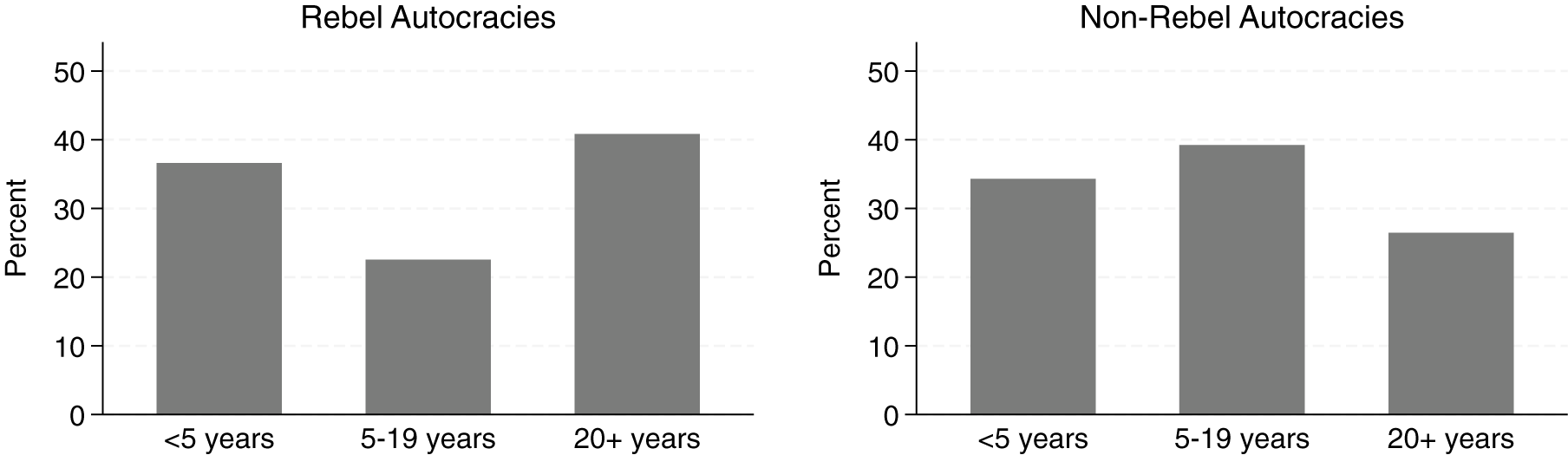
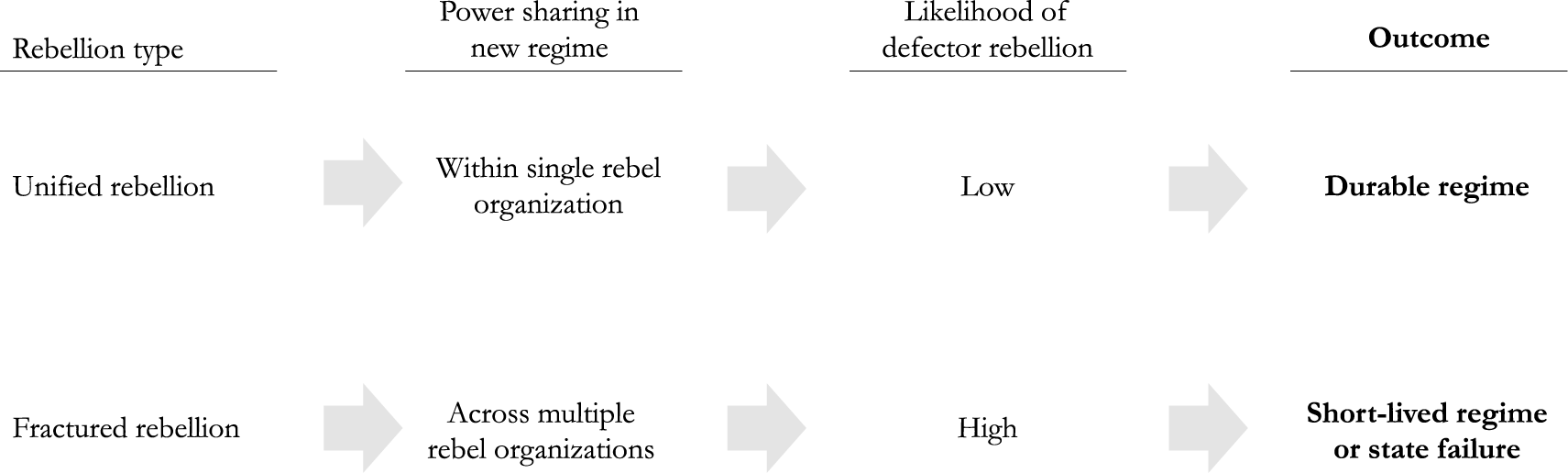
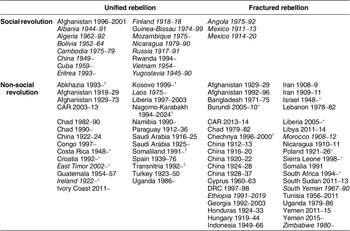
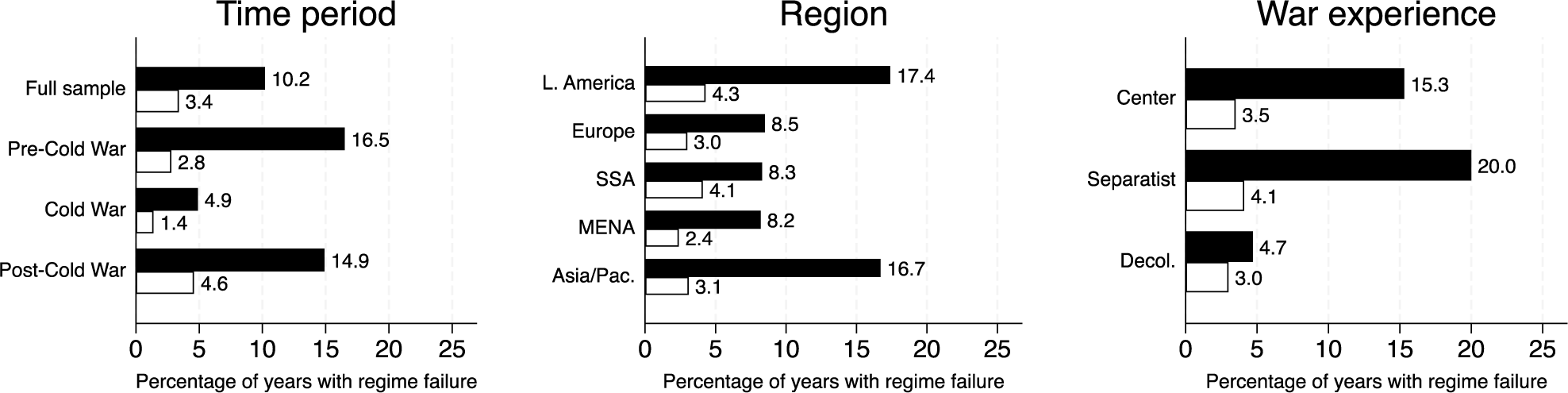
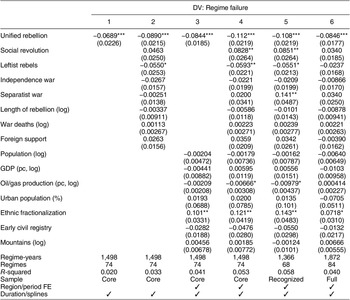
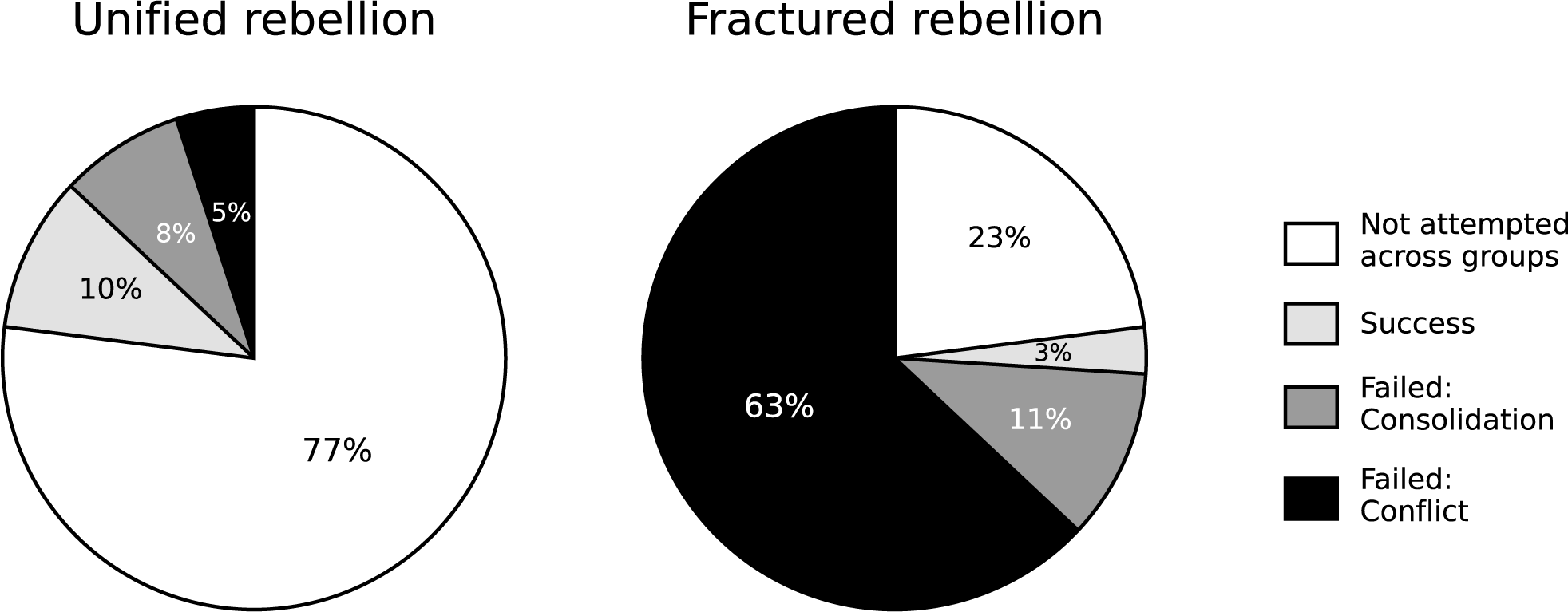
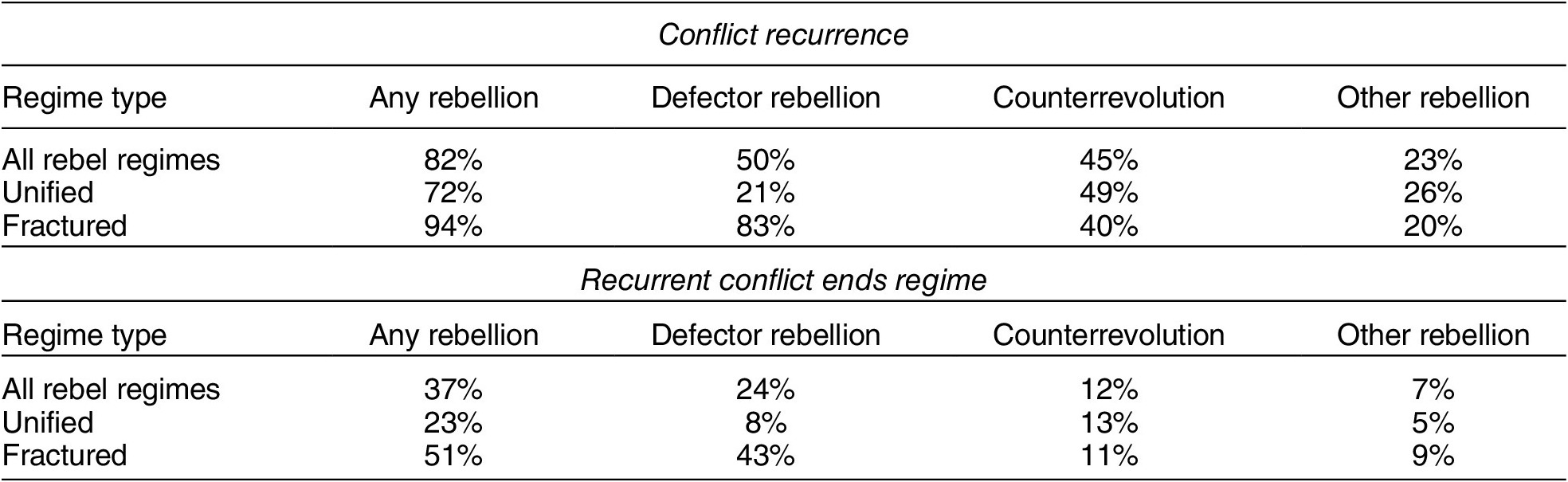
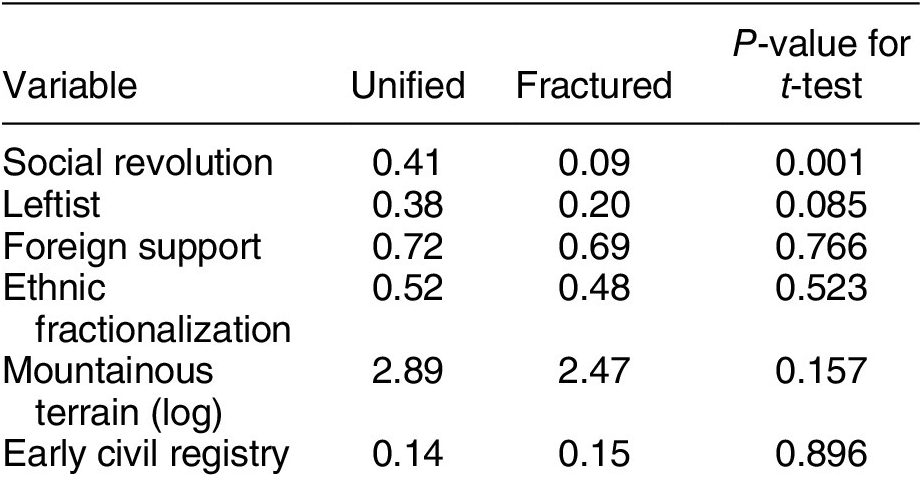


 Open access


Comments
No Comments have been published for this article.