




Introduction
Writing in an additional language is one of the most challenging tasks for second language (L2) users. Composing is a complex process that requires the skilful use of a variety of cognitive and linguistic processes and resources, conscious problem solving, and efficient self-regulation strategies. In her position paper, Kormos (Reference Kormos2012) argued that “individuals with different cognitive abilities can be expected to execute and orchestrate these processes with varying degrees of efficiency and differ in how they learn to write in another language” (p. 390). The key cognitive abilities that account for differential outcomes and influence L2 processing and development are working memory capacity and language learning aptitude (for a recent overview see Wen and Skehan, Reference Wen and Skehan2021). These two factors are interrelated yet separate constructs (e.g., Sáfár & Kormos, Reference Sáfár and Kormos2008; Çeçen & Erçetin, Reference Çeçen and Erçetin2016). As L2 writing is a cognitively demanding task that draws on existing L2 knowledge and skills, working memory (WM) resources and aptitude can exert a substantial impact on L2 writing processes and the quality of the written product (Kormos, Reference Kormos2012). Developing L2 knowledge and skills often requires controlled attentional processing and the orchestration of cognitive processes, which is assumed to be influenced by WM storage and processing capacity and aptitude (cf. Wen & Skehan, Reference Wen and Skehan2021). L2 learners with different cognitive abilities might also benefit from differential instructional conditions (Robinson, Reference Robinson and Pawlak2012) and, hence, it is important to investigate how L2 writing pedagogy can cater for the needs of students with different cognitive abilities so that those who might be disadvantaged by their lower WM capacity or language aptitude can be successfully supported to develop the required level of L2 writing expertise. Furthermore, it is also important to consider WM and aptitude to find instructional conditions that are beneficial for all L2 learners, regardless of their cognitive abilities. The potential effect of cognitive individual differences in interaction with task characteristics and task administration conditions can also create an unfair bias in assessment contexts. For this reason, it is also important to consider how the interference of cognitive abilities with writing test scores can be avoided to ensure that assessment tasks give a fair chance to everyone to demonstrate their abilities.
This article is an extension of Kormos’s (Reference Kormos2012) earlier discussion of the role of individual differences in L2 writing and offers a more detailed analysis of the impact of cognitive factors, with a specific focus on WM and aptitude, on L2 writing, based on extensive research that has been conducted in the past 10 years. The article first gives an overview of writing models and processes of L2 writing, as well as the constructs of WM and aptitude. Next, it presents models of the role of WM in L1 writing, including some recent theorizations, and discusses their relevance and application to L2 writing. This is followed by a detailed exploration of the role of WM in L2 spelling, accuracy, complexity and fluency, and overall writing quality, and an elaboration of the complex links between WM, writing quality, and L2 proficiency. The following section reviews available studies on the role of aptitude in L2 writing. Subsequently, the role of WM and aptitude in writing to learn is discussed. The article concludes by proposing a Task-Mediated Cognitive Model of L2 Writing and Writing to Learn that describes the role of cognitive factors in L2 writing processes and in learning through writing, and an outline of a research agenda for future studies.
Models of L1 writing and processes of L2 writing
One of the early L1 writing models which is particularly relevant for the analysis of the complex interaction of individual differences, L2 proficiency, writing task type, and writing processes is the comprehensive model originally proposed by Flower and Hayes (Reference Flower and Hayes1981), and further revised by Hayes in 1996 and 2012. Hayes’s (Reference Hayes, Levy and Ransdell1996) model consists of two key components: the task environment and the individual. The task environment is subdivided into two categories: the social (the audience and collaborators) and the physical (the text produced so far and the composing medium) environments. The addition of composing medium to the original model by Hayes and Flower (Reference Flower and Hayes1981) recognizes the different affordances provided by digital writing tools as opposed to handwriting. At the level of the individual writer, Hayes (Reference Hayes, Levy and Ransdell1996) postulates that WM, motivation, and affective factors (e.g., the writer’s goals, predispositions, and beliefs) play a role in the implementation of writing processes. Thus, in the model, each writing process that is not fully automatized draws on cognitive resources in WM. Hayes also assumes that writing processes are influenced by affective factors, such as self-perceived writing competence, and hypothesizes that motivation impacts on writers’ goals as well as on the strategies they use to achieve these goals.
In Hayes and Flower’s (Reference Flower and Hayes1981) original model, the writing process is comprised of cyclically recursive phases of planning, translating, and reviewing. In planning their text, writers retrieve relevant information from long-term memory (LTM) and use information from the task environment to establish writing goals and design a writing plan. The writing plan is realized in the process called translation. Reviewing, which incvolves both reading and editing, serves the function of improving the quality of the text produced. When editing their texts, writers assess whether they have successfully achieved their writing goals, identify language and content-related issues in need of attention, and carry out textual changes to enhance the quality of their text. Hayes and Flower (Reference Flower and Hayes1981) distinguish between editing, which can occur any time during writing, and reviewing, which is a deliberate attempt to improve the text after the translation process has finished. In Hayes’s (Reference Hayes, Levy and Ransdell1996) revised model, the three key phases of writing are reconceptualized, and planning is replaced by reflection, which includes processes of problem solving, inferencing, and decision making. The process of text production, which involves generating textual and graphic output, takes the place of translation in the original model. Hayes (Reference Hayes, Levy and Ransdell1996) also substituted the revision phase with a broader concept of text interpretation, which generates internal representations of the graphic and linguistic input and also encompasses the process of critical reading.
Hayes’s (Reference Hayes2012) model is based on a more detailed cognitive conceptualization of the writing process originally proposed by Chenoweth and Hayes (Reference Chenoweth and Hayes2001), which views writing as consisting of three levels: control, resource, and process. The control level includes the task schema, which is a mental representation of information used by the writer to regulate the interaction between writing processes, motivation and goals for planning, and writing and revising. The process level is subdivided into writing processes and the task environment; the latter comprises collaborators and critics, transcribing technology, task materials, written plans, and the text written so far. The writing process is overseen by the evaluator, which is responsible for monitoring the products of the other three processors: the proposer, the translator, and the transcriber. The proposer generates ideas and conceptualizes prelinguistic input for writing. The translator gives ideas linguistic form, and this linguistic output is kept active in WM for the evaluator. If the language output is found to be appropriate by the evaluator, it moves on to the transcriber, which transcribes it into textual form. If the output of the translator is judged inappropriate or inaccurate, the proposer and/or translator is reactivated. In comparison with the earlier model from Chenoweth and Hayes (Reference Chenoweth and Hayes2001), the resource level includes not only long-term memory, WM, and the process of reading but also attention.
As can be seen in the previous description of the writing models proposed by Hayes and colleagues, WM has been given a prominent role as an important cognitive factor in and resource for composing processes. Kellogg (Reference Kellogg, Levy and Ransdell1996), whose model is often taken as the basis for studies examining the role of WM in L2 writing, gives a detailed account of how WM influences various stages of writing. This model will be discussed in depth later, and thus in this section only the main phases of writing outlined in Kellogg’s (Reference Kellogg, Levy and Ransdell1996) model are briefly presented.
In Kellogg’s (Reference Kellogg, Levy and Ransdell1996) model, writing is assumed to consist of four interactive and recursive processes: planning, translating, execution, and monitoring. Translating includes the conceptual planning of the text as well as the linguistic encoding of the conceptual plan, which entails the processes of lexical retrieval, syntactic encoding, and the expression of cohesive relationships. At the execution stage, actual motor movements (using either handwriting or typing) transform the linguistic plan into written output. Monitoring, comprised of revision and editing, oversees that the composed text matches the conceptual plan of the writer.
L2 writing research has been informed by models of L1 writing, particularly that of Hayes and Flower (Reference Flower and Hayes1981). Based on the models described above that view writing as a reflective problem-solving process, L2 writing has been assumed to entail the use of similar cognitive mechanisms and to draw on the same knowledge-based resources as writing in one’s L1. Similar to L1 writers, L2 writers have been found to engage in cyclically recursive phases of planning, translating and reviewing, and monitoring their output (for a review see Roca de Larios et al., Reference Nicolás- Conesa, Coyle, Manchón and Matsuda2016). However, as linguistic encoding processes tend to be less automatic and more effortful in L2 than in L1, lexical retrieval, syntactic encoding, and, in some cases, orthographic transcription might be slower, require more attentional resources, exceed the capacity and processing limits of WM, and be more prone to breakdowns resulting in errors (cf. ibid.). L2 writers who have already developed literacy skills in their L1 need to acquire the necessary L2 linguistic and genre-based knowledge that complements their existing L1 knowledge base in LTM. Although a considerable proportion of knowledge about cohesion, textual organization, genres, task schemas, and the audience can be transferred from L1 to L2 in these cases (cf. Cummins’s [Reference Cummins1981] Interdependence Hypothesis), some L2 proficiency threshold is required for this type of transfer to be possible (cf. Cummins’s [Reference Cummins1981] Threshold Hypothesis). With the development of L2 writing competence, L1 and L2 knowledge stores relevant for writing are likely to become integrated, and this unified and multidimensional knowledge base can support L2 writers in conceptual and linguistic formulation and monitoring (Kobayashi & Rinnert, Reference Kobayashi and Rinnert1992).
One of the consequences of limitations in L2 knowledge and the lower level of automaticity of L2 linguistic encoding processes is that linguistic formulation might consume larger amounts of L2 writers’ attention, and fewer cognitive resources might be available for higher-level writing processes such as conceptual planning and text-level revision (cf. Stevenson et al.’s [Reference Stevenson, Schoonen and De Glopper2007] Inhibition Hypothesis). Empirical research has provided evidence that translating ideas into linguistic form takes longer in L2 than in L1 writing (e.g., Manchón & Roca de Larios, Reference Manchón and de Larios2007, Reference Manchón, Roca de Larios, Soler and Jordá2008), and the overload of attentional resources at the text generation stage often results in a reduction of higher-level writing goals (Chenoweth & Hayes, Reference Chenoweth and Hayes2001). The challenging nature of L2 writing is also observable in decreased L2 writing fluency (Chukharev-Hudilainen et al., Reference Chukharev-Hudilainen, Saricaoglu, Torrance and Feng2019; Manchón et al., Reference Manchón, McBride, Mellado Martínez and Vasylets2023, in this issue), the high frequency of online revisions (Lindgren et al., Reference Lindgren, Miller and Sullivan2008), and the fragmentary nature of formulation processes (Chenoweth & Hayes, Reference Chenoweth and Hayes2001).
Cognitive factors: Working memory and aptitude
Working memory
WM is a cognitive processing component of the human mind that activates and maintains short-lived memory items active for further processing in complex cognitive operations (Barrouillet et al., Reference Barrouillet, Bernardin, Portrat, Vergauwe and Camos2007). The key model of WM in both L1 and L2 writing research is that of Baddeley (Reference Baddeley, Wen, Mota and McNeill2015). The fact that a large body of research in this field uses Baddeley’s model as a theoretical basis and adapts instruments that assess components of the WM outlined by him is due to the detailed conceptualization and empirically testable hypotheses of the role of WM proposed in Kellogg’s (Reference Kellogg, Levy and Ransdell1996) Componential Model of Working Memory in Writing. Baddeley’s model consists of four main processing components, namely, a central executive (CE) and two slave systems: the phonological loop and the visuospatial sketchpad, while the fourth component, the episodic buffer, merges smaller pieces of information into episodes. The phonological loop processes verbal information, while the visuospatial sketchpad handles information related to visuospatial imagery. The CE is responsible for attention control and coordinates the subsidiary phonological and visuospatial memory systems. The CE also regulates the switching of attention between multiple tasks and controls encoding and retrieval strategies (Baddeley, Reference Baddeley, Wen, Mota and McNeill2015). Some other functions are also assumed to be controlled by the CE, such as the inhibition of irrelevant information, monitoring and updating the content of WM, temporal tagging and contextual coding of incoming information, and planning and sequencing intended actions (Miyake et al., Reference Miyake, Friedman, Emerson, Witzki, Howerter and Wager2000).
Although Baddeley’s (Reference Baddeley, Wen, Mota and McNeill2015) WM model constitutes the most frequent theoretical basis of SLA research on the role of WM in L2 learning, it is also important to review additional models of WM briefly as they are highly relevant if one wants to understand the role of individual differences in the efficiency of activation of long-term knowledge in L2 writing
While Baddeley’s model (Reference Baddeley, Wen, Mota and McNeill2015) is modular and has two domain-specific storage systems (verbal and visual), other models conceptualize WM as an activated part of an intricate network of LTM that maintains information accessible for further processing (Cowan, Reference Cowan2005). In these models, capacity limitations are assumed to result from a competition between processing resources and storage. Thus, in Cowan’s (Reference Cowan2005) model, the initial activation of information in LTM is short-lived, and if it is not kept active by verbal rehearsal or sustained attention, it fades. With the help of focused attention (which in Cowan’s theorization is also regulated by the CE), a subset of information in LTM can be activated for a longer period, although the focus of attention generally extends to approximately four chunks only. Engle and Kane’s (Reference Engle, Kane and Ross2004) attention control model views WM as domain-general executive attention and postulates that the underlying reason for individual differences in WM capacity relate to the variable functioning of the CE.
Ericsson and Kintsch’s (Reference Ericsson and Kintsch1995) long-term working memory (LT-WM) model, which was originally developed to account for variability in the efficiency of L1 text comprehension, shares some similarities with Cowan’s (Reference Cowan2005) and Engle and Kane’s (Reference Engle, Kane and Ross2004) model. Ericsson and Kintsch propose that LT-WM holds units of information activated in short-term WM and contains retrieval structures that support accessing relevant information in LTM. Therefore, some task or processing relevant elements are immediately available in LT-WM, and others can be easily accessed using retrieval structures. Ericsson and Kintsch emphasize the importance of effective retrieval structures that essentially embody procedural knowledge that is automatic, robust, and stable. These retrieval structures are domain specific and build on a solid knowledge base as well as efficient processing mechanisms. As I will discuss in the following text, one of the most detailed accounts of the role of WM in L1 writing, by McCutchen (Reference McCutchen2011), is based on Ericsson and Kintsch’s LT-WM model.
Aptitude
The cognitive abilities subsumed under the concept of language learning aptitude are associated with WM, yet WM and aptitude are independent constructs (Sáfár & Kormos, Reference Sáfár and Kormos2008; Yalçın et al., 2016). Understandably, aptitude (which in Carroll’s [1981] original conceptualization is hypothesized to be a predictor of the rate of learning and not the actual success or outcome of second language acquisition) is not part of L1 writing models. Yet, based on Carroll’s (Reference Carroll and Diller1981) argument that aptitude plays a role in formal classroom instruction contexts where most learning is conscious and intentional, and that it is particularly relevant in the early stages of the learning process, it is also important to consider the role of aptitude in L2 writing processes and development (see also contributions by Granena, Reference Granena2023 and Li, Reference Li2023, in this issue). Carroll (Reference Carroll and Diller1981) identified four components of language aptitude: (1) Phonetic coding ability, which is “the ability to identify distinct sounds, to form association between those sounds and symbols representing them, and to retain these associations”; (2) grammatical sensitivity, which is defined as the ability “to recognize the grammatical functions of words (or other linguistic entities) in sentence structures”; (3) rote learning ability, which is seen as “the ability to learn associations between sounds and meanings rapidly and efficiently, and to retain these associations”; and (4) inductive language learning, that is, the ability “to infer or induce the rules governing a set of language materials, given sample language materials that permit such inferences” (p. 105). Later, Skehan (Reference Skehan and Robinson2002) combined grammatical sensitivity and inductive learning ability into a single component called language analytic ability. In his early research, Carroll (Reference Carroll1969) established that aptitude is one of the most important predictors of language learning outcomes. More recently, a meta-analysis of previous studies by Li (Reference Li2015) also established a large effect of the traditional components of aptitude on various aspects of language proficiency, although, as I will discuss later, his meta-analysis suggested that aptitude plays a limited explanatory role in L2 writing outcomes.
Further researchers have proposed a reconceptualization of the predictive role of aptitude and examined how aptitude might be implicated in processes of L2 learning. This research direction followed Snow’s (Reference Snow1992) conceptualization of aptitude complexes that highlights that aptitude involves readiness, suitability, susceptibility, and proneness for learning in particular situations. Snow also argued that aptitude is a conglomerate of individual characteristics that dynamically interact with the situation in which learning takes place. It follows from this view of aptitude that different sets of abilities can enhance learning under various learning conditions.
Different cognitive aptitudes have been proposed as being beneficial in explicit learning contexts, where students are provided with explicit rule explanation, and in implicit learning contexts, in which learning mostly happens incidentally (Granena, Reference Granena2013). From the traditional components of language aptitude (Carroll, Reference Carroll and Diller1981), explicit aptitude components include rote learning ability, explicit inductive learning ability, and grammatical sensitivity, and WM is also assumed to be a cognitive factor that aids explicit learning (Granena, Reference Granena2013). Implicit learning is assumed to be assisted by implicit inductive learning abilities and implicit memory (e.g., sequence learning in procedural memory) (Granena, Reference Granena2013; Yilmaz & Granena, Reference Yilmaz and Granena2021). Li and DeKeyser (Reference Li and DeKeyser2021) define implicit language aptitude as cognitive abilities that “enable learners to conduct unconscious computation of the distributional and transitional probabilities of linguistic input” (p. 474). Granena and Yilmaz’s (Reference Granena and Yilmaz2018) review provides evidence for the relatively strong association between explicit aptitude and learning outcomes under explicit learning conditions. The review also shows that implicit aptitude has limited relevance when learning is intentional, memory driven, and requires deliberate hypothesis testing. Research evidence available to date suggests that implicit language aptitude might assist higher-level L2 learners, particularly in incidental learning conditions that involve exemplar-based, associative learning processes (cf. Morgan-Short et al., Reference Morgan-Short, Faretta-Stutenberg, Brill-Schuetz, Carpenter and Wong2014). Implicit language aptitude might support the acquisition of more complex syntactic structures, whereas explicit aptitude might play a stronger role in the learning of simple structures (DeKeyser, Reference DeKeyser, Van Patten and Williams2015). As L2 development can arise both as a result of conscious and intentional learning outcome and as an incidental by-product of composing in the L2, it is important to explore the role of different aptitude components in L2 writing.
Models of the role of WM in L1 writing and their relevance and application to L2 writing
As mentioned earlier, in the fields of both L1 and L2 writing, Kellogg’s (Reference Kellogg, Levy and Ransdell1996) Componential Model of Working Memory in Writing has been highly influential. Based on Baddeley and Hitch’s (Reference Baddeley and Hitch1974) componential model of WM, Kellogg argued that because writing is a conscious and effortful cognitive activity, the CE, which is responsible for the regulation of attention, is involved in every stage of writing. He hypothesized that capacity limitations of the visuo-spatial sketchpad could play a role in the planning phase, as writers often apply visualizations such as diagrams or images for content generation and structuring their text. In his view, translating ideas into linguistic form, monitoring, and reviewing could be constrained by the capacity limitations of the phonological loop. Although the differential roles of the visuo-spatial sketchpad and phonological loop in these stages have been empirically supported by a number of L1 writing studies (e.g., Olive, Reference Olive and Berninger2012), some studies also show that processing constraints in the phonological loop can equally influence editing (Hayes & Chenoweth, Reference Hayes and Chenoweth2006) and planning processes (Kellogg et al., Reference Kellogg, Turner, Whiteford and Mertens2016). An interesting finding in this regard was provided by Olive et al. (Reference Olive, Kellogg and Piolat2008), who found that planning with a diagram required higher spatial WM capacity and resulted in richer ideas than textual outlining, which might also have relevant implications for L2 writing instruction. Although the result shows that visual planning strategies can be beneficial for idea generation, those with lower visuo-spatial WM abilities might not be able to exploit their advantages. Therefore, giving L2 writers autonomy over the choice of visual and textual planning strategies might be recommended. Kellogg also argued that if handwriting and typing are automatized, the execution stage would not draw on WM resources. Hayes’s (Reference Hayes, Levy and Ransdell1996) model of writing also adapted Kellogg’s (Reference Kellogg, Levy and Ransdell1996) conceptualizations in his model and attributed a central role to WM.
Another influential model of the impact of WM on writing processes and outcomes was proposed by McCutchen (Reference McCutchen2011), who built on Daneman and Carpenter’s (Reference Daneman and Carpenter1980) capacity theory of WM. Based on research that compared high- and low-skilled L1 writers, she argued that WM regulates the efficient interaction of writing processes, and until low-level writing skills (such as handwriting) are sufficiently automatized, high-level writing processes (planning, translating, and revising) cannot be used in parallel with low-level processes. Research findings seem to support her assumptions as unskilled L1 writers have been found to produce text in sequential bursts of handwriting between planning phases (see e.g., Olive & Kellogg, Reference Olive and Kellogg2002).
Berninger and Swanson’s (Reference Berninger, Swanson, Carlson and Butterfield1994) work extended McCutchen’s model, and showed that beginner L1 writers’ WM resources are not only depleted because of lack of automaticity in handwriting but also due to effortful spelling. This can result in difficulties in paying attention to other aspects of writing, such as rhetorical structure and the use of complex and sophisticated language. This work led to the development of the Not-so-Simple View of Writing (Berninger & Winn, Reference Berninger, Winn, MacArthur, Graham and Fitzgerald2006) that further refined the role of the CE in writing processes and the development of writing skills. The key components of CE, inhibition, attention shifting, and updating have been found to influence not only lower-level transcription processes but also higher-level writing processes such as keeping strategic goals and multiple ideas active while writing, the retrieval and application of relevant linguistic knowledge and encoding procedures, as well as revising and editing (e.g., Bourdin & Fayol, Reference Bourdin and Fayol1994; Berninger & Swanson, Reference Berninger, Swanson, Carlson and Butterfield1994). Torres’ study (Reference Torres2023, in this issue) also demonstrates that, regardless of whether they write in their L1 or L2, individuals with higher scores on the Ospan test (which taps into the updating function of CE) spend more time pausing within words to resolve linguistic encoding problems. The impact of individual differences in the functioning of the CE can also be observed in L1 writing quality and fluency and can potentially account for the writing difficulties of children who have learning disabilities in the writing and reading domains (Costa et al., Reference Costa, Edwards and Hooper2016). The Not-so-Simple View of Writing not only includes the cognitive construct of CE that is responsible for attention regulation but also postulates a broader role for CE functions that are additionally comprised of goal setting, self-monitoring, and regulation (Berninger & Winn, Reference Berninger, Winn, MacArthur, Graham and Fitzgerald2006). In this model, the extended construct of CE functions has a direct effect on lower-level writing skills (spelling and handwriting), as well as on planning, editing, and revision. A recent study by Ahmed et al. (Reference Ahmed, Kent, Cirino and Keller-Margulis2022) on struggling young L1 readers and writers, however, only verified a direct link between CE and spelling, but found an indirect effect of CE on editing and revision with the mediation of spelling skills. In the field of L2 writing, the role of CE functions has only been recently considered (e.g., Mavrou, Reference Mavrou2020; Michel et al., Reference Michel, Kormos, Brunfaut and Ratajczak2019; Peng et al., Reference Peng, Orosco, Wang, Swanson and Reed2021; Révész et al., Reference Révész, Michel and Lee2023, in this issue), and very few studies have assessed all three functions (inhibition, updating, and attention shifting) (Miyake et al., Reference Miyake, Friedman, Emerson, Witzki, Howerter and Wager2000).
Kim and Schatschneider (Reference Kim and Schatschneider2017) extended the Not-so-Simple View of Writing to develop the Direct and Indirect Effects Model of Writing. As its name suggests, the model proposes that foundational language (vocabulary and grammar) and cognitive skills (WM, attention control) have a direct impact, as well as an indirect effect, with the mediation of higher-order cognitive skills (inferencing, comprehension monitoring, perspective taking) on text production. In their empirical validation of the model with young L1 writers, WM was found to be directly related to children’s vocabulary and grammar knowledge (foundational language skills) and also strongly linked to performance on tasks assessing inferencing and perspective taking (higher-order cognitive skills), as well as handwriting fluency and spelling. An additional novel feature of Kim and Schatschneider’s model is that it acknowledges the relevance of oral discourse production abilities in the development of writing skills and acknowledges the important role that WM plays in children’s ability to retell narrative and informative texts coherently and accurately. The structural equation modeling of their data also revealed that WM did not have a direct effect on writing quality; rather, its indirect effect was mediated by oral discourse production abilities and transcription skills (handwriting fluency and spelling).
Kim and Schatschneider’s (Reference Kim and Schatschneider2017) model has important implications for L2 writing research as well. First of all, it highlights that, particularly for younger L2 writers, the role of other higher-order cognitive factors that are rarely examined in the field of SLA, such as perspective taking and inferencing (Kendeou et al., Reference Kendeou, Bohn-Gettler, White and den Broek2008), should also be considered. These higher-order factors should be given more consideration, especially in bi- and multilingual contexts where children might be developing writing skills in an L2 without being fully literate in their L1. Similarly, the role of oral language abilities in L2 writing in multilingual contexts should be acknowledged and attention should be paid to developing children’s and older learners’ oral discourse construction skills to support them becoming effective L2 writers.
The concept of LT-WM (cf. Ericsson & Kintsch, Reference Ericsson and Kintsch1995) has also been attributed an important role in Kellogg’s (Reference Kellogg2001) and McCutchen’s (Reference McCutchen2011) later work. Research findings suggest that if L1 writers have relevant domain-specific knowledge (e.g., genre-based knowledge, writing schema), they can efficiently activate it and keep it accessible for processing during writing. This has been found to decrease the limitations of short-term WM, and to allow writers not just to retell but also to transform knowledge as they write (Kellogg, Reference Kellogg2001). McCutchen (Reference McCutchen2011) also argues that to easily access relevant knowledge in LT-WM writers need to have developed efficient linguistic encoding and transcription processes, as well as rich linguistic and genre-based knowledge.
As the preceding review illustrates, Kellogg’s (Reference Kellogg, Levy and Ransdell1996) original model of the role of WM in writing processes has been substantially extended and refined in the field of L1 writing. Therefore, it is important to incorporate these new models into research on the role of cognitive factors in L2 writing. Other advances in L1 writing research on the role of WM also have high relevance for L2 writing research and pedagogy. One such area is the role of social regulation of cognition and the effect of cognitive dissonance (i.e., when one has to argue for a position with which they do not agree), which can be influential factors in argumentative essays, particularly in assessment contexts when students cannot choose what stance they take on a debated issue. For example, Martinie et al. (Reference Martinie, Olive and Milland2010) found that composing a cognitively dissonant text was more taxing on WM resources than writing from a standpoint with which the participants agreed. A further area that is important to investigate in research and consider in L2 writing pedagogy is the interaction of anxiety and WM and the combined role of these factors in influencing writing processes and text quality. This is so because anxiety is known to deplete WM resources by means of intrusive thoughts that are irrelevant to the task at hand (Derakshan & Eysenck, Reference Derakshan and Eysenck2010), and thus can exert a substantial effect on the quality of written output.
The role of WM in L2 writing
In her conceptual review paper, Kormos (Reference Kormos2012) argued that WM resources are involved in every stage of the L2 writing process given the effortful and conscious nature of writing processes in L2 and hypothesized that there is a strong link between individual writers’ cognitive abilities and the quality of the written product. At that point there was limited research evidence to support these hypotheses but a number of studies have been conducted since the publication of that paper. However, the overall results have been somewhat contradictory due to key methodological differences, such as sample characteristics, the writing task, and measures of WM and writing quality. In this section, I discuss the relevant literature on the role of WM in L2 spelling, accuracy, complexity, fluency, and overall writing quality. I also describe the intricate relationship between WM, writing processes, and L2 proficiency.
Working memory, L2 spelling, and accuracy
An early study by Adams and Guillot (Reference Adams and Guillot2008) found that there was a significant association between L2 spelling and phonological short-term memory (PSTM) among English and French speaking bilingual children. Interestingly, spelling errors have been excluded from analyses of accuracy in almost all subsequent studies that have examined the impact of WM and aptitude on L2 writing despite the fact that spelling can be conceptualized as orthographic accuracy. A notable recent exception is the study by Peng et al. (Reference Peng, Orosco, Wang, Swanson and Reed2021), who used a structural equation modeling approach to examine the mediating role of WM, phonological awareness (a construct similar to the phonetic coding ability component of L2 aptitude), and oral language abilities in the writing skills of Spanish–English bilingual children in the United States. This study will be discussed in more detail later, but with regard to L2 spelling, punctuation, and capitalization skills, the results show an important role of WM measured with listening-span (Listening Sentence Span) and updating tasks, and a limited impact of visual WM (Visual Matrix, Mapping, and Directions tasks).
A number of studies investigating the role of WM in L2 writing have explored whether writers with higher WM capacity produce more accurate writing than those with lower-level WM abilities. Most of the findings indicate that when WM is assessed with complex tasks (e.g., operation span or reading span), those with higher WM capacity make statistically significantly fewer errors in writing (e.g., Bergsleithner, Reference Bergsleithner2010; Mavrou, Reference Mavrou2020). Adding to these findings, Vasylets and Marín’s (Reference Vasylets and Marín2021) study found that at lower levels of proficiency, L2 writers with higher WM capacity produced fewer errors, but at more advanced levels there was no significant relationship between accuracy and WM. In a follow-up study with upper-intermediate and advanced writers, Manchón et al. (Reference Manchón, McBride, Mellado Martínez and Vasylets2023, in this issue) did not detect a significant relationship between WM and L2 grammatical accuracy either. This might partly be due to the higher proficiency of the participants (cf. Serafini & Sanz, Reference Serafini and Sanz2016) and to the fact that participants were given ample time to complete the task, and hence might have been under less attentional pressure. Interestingly, Zabihi (Reference Zabihi2018) established a negative link between WMC and writing accuracy, but the time frame for the writing task in this study was very short (11 minutes), and the results for syntactic complexity and fluency suggest that high WM writers might have prioritized productivity and syntactically more complex language over accuracy. Zabihi’s (Reference Zabihi2018) results highlight the importance of the time assigned to completing a L2 writing task and the potentially negative effects of time pressure on accuracy, even for upper-intermediate learners with high WM capacity.
Overall, the previously mentioned research findings indicate that, in time-constrained writing conditions and for certain L2 writers, WM abilities might play a potentially significant role in regulating L2 writers’ attention to grammatical accuracy in the composing process. L2 writers with high WM might have more attentional resources that can be shared between content generation and accurate linguistic encoding. Mavrou’s (Reference Mavrou2020) study found that the attention-shifting component of the CE was significantly associated with accuracy. It is also possible that high WM capacity allows L2 writers to monitor their written output more efficiently, particularly in time-constrained conditions and, as a result, they not only make fewer errors but are also more efficient in noticing and correcting them. Révész et al.’s (Reference Révész, Michel and Lee2023, in this issue) finding that writers with larger verbal WM capacity paused more frequently between words toward later stages of writing (i.e., when editing tends to take place) than participants with lower nonword repetition scores seems to support this assumption. Michel et al.’s (2019) study also found a significant link between WM functions (a composite of scores on the forward and backward digit span and the symmetry span task) and performance in an editing task that asked lower-to upper-intermediate level students to find and correct errors in a text. The significant link between WM and L2 writing accuracy might also be explained with reference to the observation that at lower levels of proficiency, individuals with higher WM capacity might have more developed underlying declarative and procedural knowledge (see e.g., Mavrou, Reference Mavrou2020; Serafini & Sanz, Reference Serafini and Sanz2016). This would be consistent with Ericsson and Kintsch’s (1996) model of LT-WM that highlights the important role of automatic and robust retrieval structures, and McCutchen’s (2000) application of their WM model to L1 writing. Kim et al.’s (Reference Kim, Tian and Crossley2021) recent study also demonstrates the important indirect impact of verbal WM on L2 literacy resources that writers draw on during composing. Furthermore, one can also hypothesize that the inhibition function of the CE might help L2 writers to suppress their L1 and avoid transfer errors, and that larger WM capacity might allow L2 learners to search for alternative ways to linguistically express their ideas if they are uncertain of the accuracy of their original formulation (Vasylets & Marín, Reference Vasylets and Marín2021). However, empirical research by Mavrou (Reference Mavrou2020) failed to establish a significant link between accuracy and the inhibition function of the CE.
Working memory and the syntactic complexity of L2 writing
Studies on the role of WM in the syntactic complexity of L2 writing largely mirror those on accuracy and tend to suggest that L2 users with higher WM abilities produce more subordinate clauses in their writing (e.g., Bergsleithner, Reference Bergsleithner2010; Mavrou, Reference Mavrou2020; Yi and Ni, Reference Yi and Ni2015; Zabihi, Reference Zabihi2018). Producing longer and syntactically complex clauses requires that writers keep longer units of linguistic formulation active in WM and manipulate several grammatical encoding processes in parallel (cf. Mavrou, Reference Mavrou2020). L2 writers with higher WM capacity might be more effective in these complex linguistic encoding processes as they have larger short-term storage and processing capacity available. Nonetheless, it is important to note that Zalbidea’s (Reference Zalbidea2017), Vasylets and Marín’s (Reference Vasylets and Marín2021), and Manchón et al.’s (Reference Manchón, McBride, Mellado Martínez and Vasylets2023, in this issue) studies found no significant link between subordination and noun-phrase complexity and WM abilities. Differences across studies might be due to the different types of WM tests and writing tasks used. In further research, it is important to examine the association between WM functions and a wider variety of syntactic complexity measures that are less influenced by task characteristics and are relevant determinants of a high level of L2 writing competence. In addition, more research on the role of WM capacity in the lexical quality of L2 written output is needed. Research evidence to date seems to suggest an existence of significant link between PSTM and lexical sophistication (Révész et al., Reference Révész, Michel and Lee2017), and between complex WM (operationalized with a complex verbal span task) and lexical sophistication at advanced level of proficiency (Vasylets & Marín, Reference Vasylets and Marín2021), but no relationship between lexical diversity and WM capacity (Manchón et al., Reference Manchón, McBride, Mellado Martínez and Vasylets2023, in this issue; Mavrou, Reference Mavrou2020; Vasylets & Marín, Reference Vasylets and Marín2021).
Working memory, L2 writing fluency, and writing processes
The role of WM abilities in L2 writing fluency has also been examined in a number of studies. As pointed out earlier, fluency is a construct that reflects the overall efficiency and speed of writing processes, and in the field of L2 speech production it is generally conceptualized as being comprised of three subconstructs: speed, breakdown, and repair fluency (Tavakoli & Skehan, Reference Tavakoli, Skehan and Ellis2005). However, L2 writing research on the role of cognitive individual differences has tended to focus on speed fluency assessed by the number of words written per minute. Using this measure, Yi and Ni (Reference Yi and Ni2015) found a significant link between WM capacity and writing fluency. Kim et al. (Reference Kim, Tian and Crossley2021), who operationalized writing fluency with the length of P-bursts (i.e., mean number of characters produced between pauses), established no significant relationship between this measure and scores on a running-span task either. Likewise, other studies that have used productivity measures, such as the overall number of language units of various lengths, found no relationship between writing fluency and WM abilities (e.g., Kim et al., Reference Kim, Tian and Crossley2021; Mavrou, Reference Mavrou2020). Research by Vasylets and Marín (Reference Vasylets and Marín2021) and Zabihi (Reference Zabihi2018) measured writing fluency with the length of T-units (Wolfe-Quintero et al., Reference Wolfe-Quintero, Inagaki and Kim1998), which in other areas of L2 research is generally considered a measure of syntactic complexity (Bulté & Housen, Reference Bulté, Housen, Housen, Kuiken and Vedder2012). Using this measure, Zabihi (Reference Zabihi2018) found a large effect of WM, while Vasylets and Marín (Reference Vasylets and Marín2021) observed no significant effect. In future studies, a more detailed and more strongly conceptually grounded operationalization of writing fluency (e.g., P-bursts as in Kim et al.’s [Reference Kim, Tian and Crossley2021] study) should be used to better understand the role of specific WM subcomponents in the overall efficiency of writing processes and corresponding text characteristics.
From the perspective of writing processes, in the first study that examined the association of speed and breakdown fluency of L2 writing with WM abilities, Révész et al. (Reference Révész, Michel and Lee2017) found that L2 writers with better CE functions paused less frequently between paragraphs, suggesting that they were efficient in maintaining and updating the propositional content of their essays in WM. In Révész et al.’s (Reference Révész, Michel and Lee2017) study, efficient task-switching abilities were also associated with shorter pauses between sentences. Révész et al.’s (Reference Révész, Michel and Lee2017) result would suggest that those L2 writers who can shift their focus from one task to another more easily are faster at local planning, and more effective in the linguistic formulation of the next idea unit. Révész et al.’s (Reference Révész, Michel and Lee2023) findings reported in this issue also show that in earlier phases of composing when content planning is taking place, L2 writers with higher nonword and operation span scores pause longer between sentences. Therefore, there seems to be converging evidence that high WM L2 writers tend to devote more cognitive and attentional resources to idea generation and planning than their low WM peers.
The role of WM in other stages of L2 writing seems to be more complex. Révész et al. (Reference Révész, Michel and Lee2023, in this issue) found that visuo-spatial WM influenced pausing between words that might be indicative of lexical and grammatical encoding processes as well as rereading. Révész et al.’s findings reveal that in the initial stages of writing, high visuo-spatial WM capacity is associated with a reduction in pause length between words but at later stages an opposite trend is apparent. With regard to verbal WM capacity, a similar pattern of links could be observed in their study. A tentative explanation for these results might be that L2 writers with high WM capacity might experience fewer linguistic encoding challenges (cf. Kim et al., Reference Kim, Tian and Crossley2021) and can resolve these more quickly during composing. In the final editing stage, high WM capacity writers might also be more thorough and devote more attentional resources to monitoring the linguistic accuracy of their writing.
Within word pauses were found to reflect translation processes in Torres’s (Reference Torres2023, in this issue) study whose participants reported that they stopped writing in the middle of words when they lacked automatized access to relevant linguistic knowledge. L2 writers might also pause while typing a word if they are unsure of the orthographic form. Torres’s (Reference Torres2023, in this issue) participants with higher WM scores stopped longer in these mid-points in both their L1 and L2. Révész et al.’s research (Reference Révész, Michel and Lee2023, in this issue) complements this finding and shows that higher visual WM capacity is related to shorter pauses between words in the initial writing stages but longer pauses toward the end of the composing process. The overall pattern that seems to be emerging from these studies is that L2 writers with high visual and verbal WM capacity might allocate their attentional resources strategically to different aspects of composing during the different phases of the writing process. This might explain why Kim et al. (Reference Kim, Tian and Crossley2021) found no link between overall pause time and verbal WM capacity. High WM storage and processing capacity might also give L2 writers an advantage in terms of relevant L2 literacy knowledge (cf. Kim et al., Reference Kim, Tian and Crossley2021) which might free up further cognitive resources for addressing content and organizational issues as well as monitoring and editing.
Working memory, overall writing quality, and L2 proficiency
The discussion so far has focused on the role of WM abilities in specific subprocesses of L2 writing (e.g., pausing behaviour) and some linguistic characteristics of the written product (especially fluency, accuracy, and syntactic complexity). Although empirical research evidence is sometimes contradictory, existing studies seem to suggest that WM processing and storage capacity and CE functions can potentially influence both L2 writing processes as originally hypothesized in Kormos (Reference Kormos2012). However, it is also important to empirically examine whether L2 writers with different WM capacity differ in the overall quality of their written output as expressed in raters’ scores.
Most studies in instructed foreign language classroom settings have found no such effect, including research by Lu (Reference Lu, Wen, Mota and McNeill2015), Michel et al. (Reference Michel, Kormos, Brunfaut and Ratajczak2019), Kim et al. (Reference Kim, Tian and Crossley2021), and Vasylets and Marín (Reference Vasylets and Marín2021). In contrast, a recent study by Mujtaba et al. (Reference Mujtaba, Kamyabi Gol and Parkash2021) observed a significant and moderately strong correlation between WM and the ratings of two picture-prompt writing tasks produced by beginner learners. An early study by Kormos and Sáfár (Reference Kormos and Sáfár2008) that examined the role of PSTM and complex WM in an end-of-year writing test of an intensive English language teaching program established a significant link between PSTM and writing test scores for those learners who started the program with preexisting knowledge of English. However, for those students who did not have prior knowledge of English at the beginning of the intensive language teaching year, complex WM did not play a substantial role in writing outcomes. A significant effect of a composite measure of WM abilities on the scores of a test of narrative writing abilities was also found in Peng et al.’s (Reference Peng, Orosco, Wang, Swanson and Reed2021) study conducted with Grade 3 Spanish-dominant bilingual children in the United States. These results suggest that proficiency, bilingual status, and literacy experience might be important mediating factors in the effects of WM on overall L2 writing quality. Based on Kellogg’s (Reference Kellogg2001) and McCutchen’s (2000) model of WM in writing, one can hypothesize that with increasing L2 proficiency and writing expertise, capacity and storage limitations of WM exert smaller influence on writing processes and, as a result, on the characteristics of the text produced (as was also found by Serafini and Sanz [Reference Serafini and Sanz2016] for L2 grammar development). Support for this assumption can be found in Vasylets and Marín’s (Reference Vasylets and Marín2021) study that showed that WM was not associated with higher linguistic accuracy among more proficient writers. However, it is also possible that higher levels of expertise and L2 proficiency might allow writers with better WM abilities to access relevant procedural knowledge in LT-WM more efficiently, and this may support them in producing high-quality written output. This potential advantage would support Hambrick and Engle’s (Reference Hambrick and Engle2002) rich-get-richer hypothesis that proposes a stronger role for WM abilities at higher levels of expertise. Vasylets and Marín’s (Reference Vasylets and Marín2021) finding that at more advanced levels of proficiency, lexical sophistication was positively related to WM capacity, but no such link was observed among writers with lower levels of L2 competence, might provide evidence for this hypothesis.
Based on the Direct and Indirect Effects Model of Writing (Kim & Schatschneider, Reference Kim and Schatschneider2017), and Kim et al.’s (Reference Kim, Tian and Crossley2021) and Manchón et al.’s (Reference Manchón, McBride, Mellado Martínez and Vasylets2023, in this issue) studies, it is also possible that WM effects on L2 writing quality are mediated by L2 vocabulary and grammar knowledge. Peng et al.’s (Reference Peng, Orosco, Wang, Swanson and Reed2021) study with bilingual children, however, demonstrated that WM was directly as well as indirectly related to L2 writing scores. This indirect link was mediated by phonological awareness and oral language abilities in L2 English, which were assessed using a morphological awareness and a productive vocabulary test that can be considered measures of L2 grammatical and vocabulary knowledge. These findings suggest that high WM capacity might assist L2 learners in acquiring a stronger basis for L2 linguistic skills (see also Linck et al., Reference Linck, Osthus, Koeth and Bunting2014 and Kim et al., Reference Kim, Tian and Crossley2021) that they can draw on for writing and managing their attentional resources and cognitive writing processes.
The role of aptitude in L2 writing
Aptitude components, such as rote learning, phonetic coding, and language analytic ability, can also influence L2 writing processes and the quality of the writing product. In an earlier discussion of the role of aptitude in L2 writing, Kormos (Reference Kormos2012) proposed a number of hypotheses about how various aptitude components might impact on L2 writing. She argued that high levels of aptitude support the translation stage of writing and revision processes (cf. Hayes’s [Reference Hayes2012] model). In particular, language analytic ability might assist in the syntactic and morphological encoding of the conceptual writing plan, which might be manifested in higher syntactic complexity and accuracy of the written product. Furthermore, L2 writers with high levels of metalinguistic awareness might be better at noticing and correcting their errors and might devote more attention to monitoring linguistic accuracy. Evidence for these assumptions was found in Kormos and Trebits’s (Reference Kormos and Trebits2012) study, which showed that grammatical sensitivity was positively related to clause length in a written cartoon description task, and in Kormos and Sáfár’s (Reference Kormos and Sáfár2008) study, in which metalinguistic awareness was associated with teacher ratings of L2 writing tasks. Kormos (Reference Kormos2012) also hypothesized that L2 learners with higher rote learning ability might have more vocabulary knowledge, which can lead to greater lexical variety and complexity in their written production. This hypothesis is partially supported by Yang et al.’s (Reference Yang, Sun, Chang and Li2019) and Mujtaba et al.’s (Reference Mujtaba, Kamyabi Gol and Parkash2021) findings that scores on a LLAMA E test (Meara, Reference Meara2005), which assesses associative learning ability combined with analytic learning ability (Granena, Reference Granena2013), are a significant predictor of overall writing quality. In Mujtaba et al.’s study, however, none of the aptitude components correlated with participants’ receptive or productive vocabulary size. In contrast, in a recent large-scale study conducted with bilingual children, Peng et al. (Reference Peng, Orosco, Wang, Swanson and Reed2021) found that scores on a test of morphological awareness and a productive vocabulary knowledge were related to linguistic quality, spelling and punctuation accuracy, and story composition scores in L2 narrative writing.
Another important aptitude component is phonetic coding ability, which can be seen to be very similar to the construct of phonological awareness in the field of cognitive psychology and L1 literacy research. Phonological awareness is a key ability underlying spelling as it assists individuals in converting phonemes into graphemes (Grigorenko, Reference Grigorenko2001). Many students with specific learning difficulties (SpLDs) experience difficulties with phonological awareness, which is also manifested in their spelling performance. Helland and Kaasa’s (Reference Helland and Kaasa2005) research in Norway, Palladino et al.’s (Reference Palladino, Cismondo, Ferrari, Ballagamba and Cornoldi2016), and Fazio et al.’s (Reference Fazio, Ferrari, Testa, Tamburrelli, Marra, Biancardi and Marzocchi2021) studies in Italy, Łockiewicz and Jaskulska’s (Reference Łockiewicz and Jaskulska2016) project in Poland, and van Setten et al.’s work (Reference van Setten, Tops, Hakvoort, van der Leij, Maurits and Maassen2017) in the Netherlands have demonstrated that L2 learners with an official dyslexia identification make significantly more spelling errors than their nondyslexic peers. Ndlovu and Geva (Reference Ndlovu, Geva, Kormos and Kontra2008) also found that bilingual children with reading difficulties have poorer spelling skills than typical readers. However, spelling difficulties might not always be observable in free writing as students might avoid words they do not know how to spell (Łockiewicz et al., Reference Łockiewicz, Jaskulska and Fawcett2019). Writing difficulties of L2 learners with SpLDs, who also often score lower on tests of language aptitude (Downey et al., Reference Downey, Snyder and Hill2000), are not constrained to spelling. Łockiewicz et al. (Reference Łockiewicz, Jaskulska and Fawcett2019) found that Polish dyslexic students made more grammar errors in their freewriting than their nondyslexic peers. Ndlovu and Geva (Reference Ndlovu, Geva, Kormos and Kontra2008) observed that both multi- and monolingual children with SpLDs in Canada had difficulty with spelling, punctuation, the monitoring of syntax, and the coherent and cohesive organization of their writing. The important role of phonological awareness has also been demonstrated by Peng et al.’s (Reference Peng, Orosco, Wang, Swanson and Reed2021) study, as phonological awareness was found to be a very strong predictor of linguistic quality, spelling and punctuation accuracy, and story composition scores.
The role of working memory and aptitude in writing to learn
Although the importance of the role of writers’ implicit understanding of the writing task and the implicit organization of ideas and information in semantic memory (Galbraith & Al Saadi, Reference Galbraith, Al-Saadi and Manchón2020) should not be underestimated, a majority of the writing processes of L2 users rely on conscious and effortful processes in a “problem space” (Byrnes & Manchón, Reference Byrnes, Manchón, Byrnes and Manchón2014). As originally observed by Cumming (Reference Cumming1990) and later elaborated by Williams (Reference Williams2012), the less time-constrained and more permanent nature of written modality and corrective feedback allows L2 users not only to focus on creating meaning and conveying their thoughts effectively but also to reflect on and potentially improve their L2 knowledge. Therefore, writing in an additional language offers not only opportunities for the development of writing skills but can also be an effective way to enhance L2 skills and consolidate existing and acquire novel L2 linguistic knowledge (Cumming, Reference Cumming1990; Manchón & Williams, Reference Manchón, Williams, Manchón and Matsuda2016).
In her 2012 paper, Kormos suggested that individual difference factors could potentially influence a number of cognitive processes that occur as L2 learners acquire novel L2 knowledge through writing. These cognitive processes include noticing gaps in one’s knowledge, testing hypotheses about L2, solving L2-related problems, and internalizing and consolidating L2 knowledge through writing. Since the publication of that paper, the language learning potential of writing has been investigated in much more detail and depth, and from different theoretical perspectives (e.g., Manchón, Reference Manchón2020). However, empirical studies on the role of cognitive individual differences in writing to learn L2 are still scarce and have mostly focused on the development that takes place in response to written corrective feedback (WCF) (e.g., Shintani & Ellis, Reference Shintani and Ellis2015).
From the perspective of Skill Acquisition Theory (DeKeyser, Reference DeKeyser, Van Patten and Williams2015), writing can be considered a meaningful and contextualized practice activity that can consolidate L2 knowledge and support the proceduralization of explicit L2 knowledge (e.g., Nitta & Baba, Reference Nitta, Baba, Byrnes and Manchón2014), particularly if task repetition is accompanied by WCF (Sánchéz et al., Reference Sánchez, Manchón, Gilabert and Manchón2020). Manchón and Williams (Reference Manchón, Williams, Manchón and Matsuda2016) also hypothesize that writing and WCF might contribute to the restructuring of L2 knowledge through the reanalysis of implicit knowledge and engagement in meta-linguistic reflection. In this sense, writing can be viewed as the kind of “pushed output” (Swain, Reference Swain and Hinkel2005) that drives L2 users to set writing goals that exceed their current linguistic repertoire, and thereby test hypotheses about language use and seek feedback on these hypotheses (Williams, Reference Williams2012). This is demonstrated by L2 writers’ production of language-related episodes in López-Serrano et al.’s (Reference López-Serrano, de Larios and Manchón2020) study, which found that even preintermediate L2 users activated various problem-solving strategies that could be characterized by increased depth of processing (cf. Leow, Reference Leow2015). L2 writers’ attentional processes can also be guided toward noticing gaps and inaccuracies in their written product through WCF, which can then lead to further processing (Bitchener, Reference Bitchener, Hyland and Hyland2019; Kang & Han, Reference Kang and Han2015, Reference Kang, Han, Manchón and Polio2022).
However, writing processes are taxing on WM and attentional resources and, as a result, the processing and storage limitations of WM might constrain opportunities for L2 development. As described, L2 learning during writing can be explicit and occur through meta-linguistic reflection, hypothesis testing, and conscious problem solving, and it can also be implicit and exemplar based. Based on aptitude-treatment interaction research (e.g., Granena & Yilmaz, Reference Granena and Yilmaz2018; Yilmaz & Granena, Reference Yilmaz and Granena2021) one would presume that efficient WM storage and processing capacity, high levels of rote learning and inductive learning ability, and grammatical sensitivity, which are assumed to be part of explicit cognitive aptitude, would assist L2 writers in the acquisition of new L2 knowledge using conscious, controlled and explicit learning mechanisms, such as problem solving, hypothesis testing, and meta-linguistic reflection. In contrast, implicit inductive learning abilities and implicit memory might influence the extent to which L2 writers are able exploit the learning potentials of writing using implicit learning mechanisms. Yilmaz and Granena’s (Reference Yilmaz and Granena2021) study on corrective feedback on oral task performance indicates that explicit aptitude components are associated with learning gains from explicit feedback, while learners with high implicit aptitude benefited more from implicit feedback. Examining L2 learning as it happens during writing is methodologically challenging because it requires the use of introspective methods or an experimental pre- and posttest design. Furthermore, implicit learning mechanisms are particularly difficult to observe. Studies examining the impact of individual differences also require a larger sample size to have sufficient statistical power. This may explain why only a handful of studies have examined the role of cognitive factors in learning through L2 writing and why evidence for the differential role of explicit and implicit aptitude in writing to learn is not yet available.
Existing studies to date have focused on the mediating role of cognitive individual differences in the effectiveness of WCF. In all these studies, WCF was explicit and participants were provided with either direct corrective feedback or direct corrective feedback accompanied by meta-linguistic explanations of erroneous target constructions. Research by Sheen (Reference Sheen2007), Stefanou and Révész (Reference Stefanou and Révész2015), Shintani and Ellis (Reference Shintani and Ellis2015), and Benson and DeKeyser (Reference Benson and DeKeyser2019) suggests that language analytic ability and grammatical sensitivity support learning from direct corrective feedback. Therefore, it seems that these explicit aptitude components can assist L2 learners to consciously reflect on their errors, engage in problem solving, and induce linguistic regularities in the absence of explicit explanations of sources of errors. Some studies indicate that metalinguistic explanations mitigate the impact of explicit aptitude components (e.g., Benson & DeKeyser, Reference Benson and DeKeyser2019; Stefanou & Révész, Reference Stefanou and Révész2015), whereas others have found that high language analytic ability and grammatical sensitivity are still an advantage when WCF includes metalinguistic explanation (Sheen, Reference Sheen2007; Shintani & Ellis, Reference Shintani and Ellis2015). In Sheen’s (Reference Sheen2007) study, metalinguistic explanations were provided in the participants’ L2 on a large variety of article-use errors, and one of the posttests included an error-correction task. Therefore, participants with high language analytic ability might have understood the explanations better and been more efficient in applying this newly acquired knowledge in posttests. Shintani and Ellis’ (Reference Shintani and Ellis2015) study examined learning gains on two different syntactic constructions (past hypothetical conditionals and indefinite articles) and gave the participants a handout explaining these constructions in their L1. Their research demonstrates that language analytic ability supports the understanding of metalinguistic explanations of more complex constructions of the past hypothetical but is not implicated in comprehending the description of indefinite article use, which is less complex. In their research, they also asked a group of participants to revise their essays after they received WCF with metalinguistic explanations. In this group, students with higher language analytic ability used the conditional construction, which was essential for conveying the intended message in the task more accurately. Shintani and Ellis (Reference Shintani and Ellis2015) argued that the greater depth of processing required in this condition was assisted by learners’ language analytic ability. These research findings suggest that explicit aptitude components play a differential role depending on the type of feedback and the kind of metalinguistic explanation provided on L2 writing. Explicit aptitude components may also be differentially supportive of further L2 development depending on how learners are asked to apply feedback.
The role of WM in processing WCF has so far been examined in only one study by Li and Roshan (Reference Li and Roshan2019). Research on the impact of WM resources is important because while processing WCF, L2 writers need to process and actively maintain feedback in their WM concurrently with retrieving their existing knowledge of the construction on which the feedback was given and apply the feedback to refine or construct novel knowledge representations (Nowbakht & Olive, Reference Nowbakht and Olive2021). Li and Roshan (Reference Li and Roshan2019) hypothesized that phonological short-term memory (PSTM) that temporarily stores verbal information may support item-based learning through direct corrective feedback, whereas complex WM, measured with a reading span test, may assist L2 learners in processing metalinguistic information with no corrective feedback. In their study students revised their writing after receiving feedback on their use of the passive construction. Their hypotheses about the differential role of PSTM and the processing and storage capacity of WM, which they call complex WM, in different conditions were only partially confirmed. Score on the complex WM test was associated with accuracy gains through metalinguistic explanation, but the capacity of PSTM was not a predictor of improvement in the use of the target passive construction in the direct feedback condition. When students were asked to revise their essays after receiving direct feedback, complex WM scores predicted improved accuracy in the use of the passive construction, but when revision followed metalinguistic explanation, complex WM scores had no relationship with gains in the accurate use of the target structure. Interestingly, participants with high PSTM scores performed worse in the direct corrective feedback with revision condition than those with low PSTM. The findings regarding PSTM need to be interpreted with caution as PSTM was assessed in the participants’ L2 and hence it might have been influenced by their proficiency. However, Li and Roshan (Reference Li and Roshan2019) offer a feasible explanation for their finding when they argue that participants with high PSTM might have relied on the memorization of instances of corrected structures without engaging in an analysis of their errors, which then resulted in more erroneous performance in the posttest. In this study, two conditions were particularly taxing for WM resources: (a) when direct correction was followed by revision of the originally written text and L2 learners had to maintain the content and linguistic constructions of their previous text as well as corrected forms active in their WM, and (b) when L2 learners received metalinguistic explanation without WCF and revision. In the latter case, high WM learners might have been supported in storing the rule explanation in their WM and applying it in their next piece of writing. Li and Roshan explain that metalinguistic explanation with revision diminished the effect of WM as the revision served as a production practice activity. These findings suggest that the processing and storage components of WM might play a differential role in the uptake of WCF under different contexts.
Conclusion
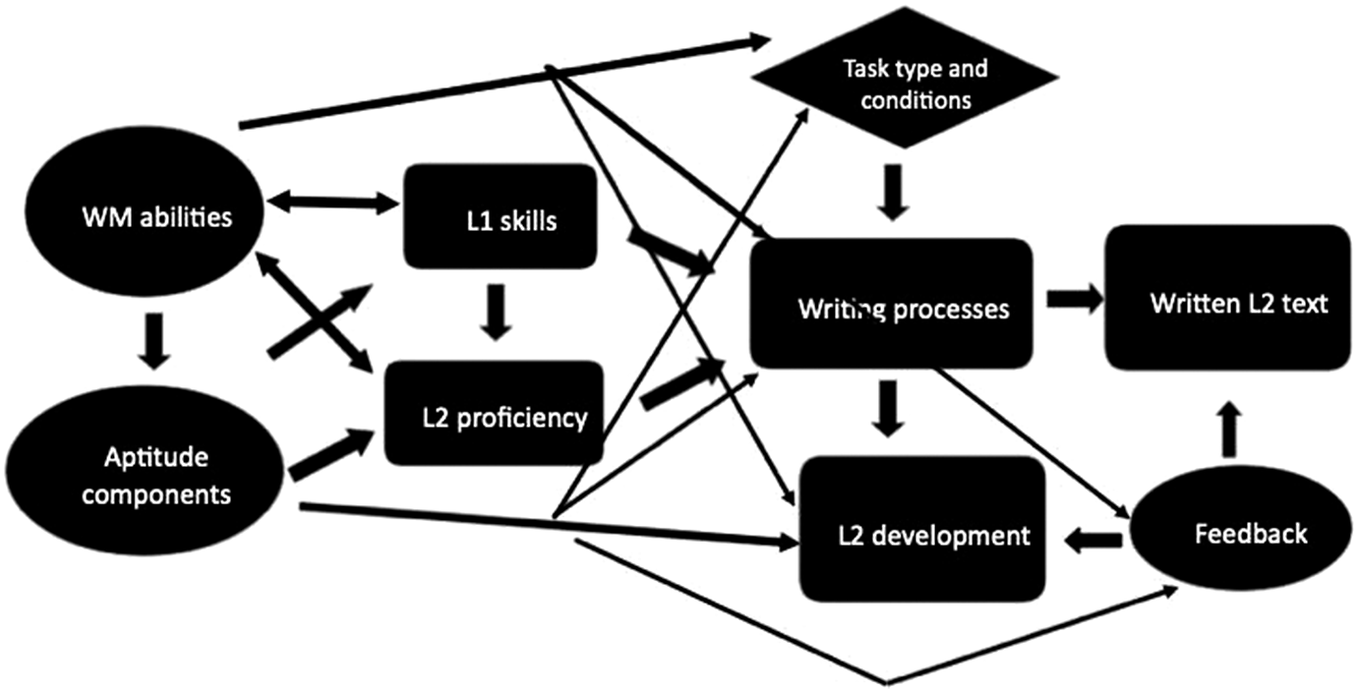
This article has explored the complex role of cognitive factors in L2 writing processes, the quality of the writing product, and the potential language development that can place during L2 writing. Inspired by the Direct and Indirect Effects Model of Writing (Kim & Schatschneider, Reference Kim and Schatschneider2017), Figure 1 summarizes the complex interplay of L2 proficiency, L1 skills, cognitive abilities, writing tasks, the L2 writing process, and writing to learn the L2. This schematic representation, which I call the Task-Mediated Cognitive Model of L2 Writing and Writing to Learn, highlights that the foundational role of cognitive factors in writing might vary as a function of L2 proficiency and relevant L1 literacy skills. It also shows that the task environment (Hayes, Reference Hayes, Levy and Ransdell1996, Reference Hayes2012), such as the cognitive, linguistic, and genre-based demands of the task, the time allotted for writing, and the transcribing technology (handwritten vs. typed), may also mediate the effect of WM capacity and aptitude on L2 writing processes and outcomes. Cognitive processing demands and their burden on WM resources may depend on the intrinsic cognitive load of a task, which, according to Cognitive Load Theory, is jointly determined by the complexity of the information to be processed and the knowledge base of the learner (for a recent overview see Sweller et al., Reference Sweller, van Merriënboer and Paas2019). The existence of relevant declarative knowledge and automatized and highly proceduralized knowledge stored in LTM may allow students to complete tasks that require handling complex information and procedures in parallel with fewer WM resources. In contrast, the same task might be more demanding in terms of attentional and WM capacity for students with less expert knowledge. A writing task also imposes extraneous cognitive load, which is set by the instructional procedure, in other words, the task-administration conditions such as the time allotted for writing or the complexity of the task instructions. Prior knowledge of the topic and language skills can also interact with extraneous cognitive load, as expert writers might be less prone to the negative effects of certain writing conditions, such as a lack of planning time. Based on Cognitive Load Theory (Sweller et al., Reference Sweller, van Merriënboer and Paas2019) as well as Kellogg’s (Reference Kellogg2001) and McCutchen’s (Reference McCutchen2011) models of WM in writing, it is essential that future L2 writing research considers the role of WM in writing processes and the quality of written output in conjunction with task demands (cf. Manchón et al., Reference Manchón, McBride, Mellado Martínez and Vasylets2023, in this issue) and the existing linguistic and genre-based knowledge of L2 learners. More systematic investigation is also needed to understand how specific aptitude components might support L2 writers at different levels of proficiency and in different types of tasks. Further studies are also needed to ascertain to what extent task characteristics and the content and semantic requirements of the task might mediate the effects of cognitive factors on lexical selection and the efficiency of lexical retrieval during writing, as current research has mostly focused on the effects of WM and aptitude on accuracy, syntactic complexity, and fluency. Studying the contribution that different WM and aptitude subcomponents make, both together as they interact and separately, should also be undertaken.
Task-mediated cognitive model of L2 writing and writing to learn.
Given the substantial role of WM resources and CE functions in transcription skills among L1 writers (e.g., Ahmed et al., Reference Ahmed, Kent, Cirino and Keller-Margulis2022; Kim & Schatschneider, Reference Kim and Schatschneider2017), and the fact that underdeveloped low-level writing skills can create a barrier to the application of effective higher-order writing skills, it is important to investigate the influence of WM and CE on the orthographic accuracy of L2 writing, not just in bilingual contexts but also in instructed classroom settings. Further research would be particularly relevant in contexts where the writing systems of the target language and the L1 of the students are different, as in this case both verbal and visual WM and CE functioning might constrain the development of handwriting and spelling skills. In general, more research on the role of cognitive factors in writing in languages other than English is needed as current studies have mostly included L2 learners of English (for a study with Spanish heritage learners, see Torres’ Reference Torres2023 study in this issue).
The Task-Mediated Cognitive Model of L2 Writing and Writing to Learn in Figure 1 also illustrates that the potential role of L1 skills (such as vocabulary size, morphological awareness, and reading and writing skills) should also be considered in L2 writing research. L2 writers with lower WM might have several layers of disadvantages because they might lack the necessary L1 foundational skills, and might have lower L2 skills and knowledge that they can utilize to express their ideas in L2 writing (cf. Kim et al., Reference Kim, Tian and Crossley2021; Peng et al., Reference Peng, Orosco, Wang, Swanson and Reed2021). Further research in bi- and multilingual and instructed foreign language settings is needed to explore these direct and indirect effects of WM and aptitude on L2 writing processes and outcomes. This would allow developing more effective support programs for L2 writers who experience difficulties due to WM limitations and lower aptitude profiles. The writing challenges of L2 learners with SpLDs also deserve more attention as these learners need additional support to become more effective writers. Early phonological awareness interventions, boosting vocabulary, morphological and syntactic knowledge as well as systematic instruction on self-regulated writing strategies (Harris et al., Reference Harris, Graham and Mason2006) might be useful means to assist L2 learners at risk of literacy difficulties.
As can be seen in the Task-Mediated Cognitive Model of L2 Writing and Writing to Learn in Figure 1, aptitude and WM can also influence to what extent L2 writers can exploit language learning opportunities that arise during writing with and without access to feedback. Due to methodological challenges (such as the need for carefully controlled experimental design and longitudinal observations), research in this area is scarce. Hence, further research is needed to understand what kinds of writing tasks and conditions, and what types of feedback might be beneficial for developing the writing and L2 skills of all learners regardless of their WM capacity and aptitude and how feedback can drive the development of L2 writers with different cognitive profiles. It is also important to examine whether different aptitude components and WM storage and processing abilities might be implicated in the learning of linguistic constructions of varying levels of complexity and at different levels of proficiency to tailor tasks and instruction to the needs and developmental levels of learners. Furthermore, it would be useful to explore the cognitive processing demands of different feedback conditions in more detail to ensure that WM processing and storage limitations do not impede learning opportunities that arise while writing in L2. Recent research in the field of L1 writing by Nowbakht and Olive (Reference Nowbakht and Olive2021) also highlights that WM abilities have differential impacts on the correction of different types of errors depending on the type of feedback. Their study with L1 writers showed that the correction of semantic errors is particularly prone to WM limitations. In L2 writing research the focus to date has been mostly on the interaction of cognitive abilities and feedback type with regard to grammatical errors and syntactic development. Future research should also examine how cognitive abilities mediate immediate uptake and longer-term learning from different types of feedback in other areas of language, such as spelling, morphology, lexis, and cohesion.
Competing interests
There are no competing interests to declare.


 Open access

