





Introduction
In the past 30 years, global migration has risen drastically, and today an estimated 3.6% of the world’s population (i.e., 1 in 30 individuals) are international migrants (World Migration Report, 2024). As a consequence, plurilingualism and pluriculturalism are becoming increasingly important features of the modern world (e.g., Nunez et al., Reference Nunez, Nunez Mahdi and Popma2017), and this trend has inevitably led to a growing number of multilingual romantic relationships. While the issue of love being a facilitative factor for language learning has, in the past, “been the cause of smiles rather than the subject of serious investigation” (Pfenninger et al., Reference Pfenninger, Festman and Singleton2023, p. 82), recent years have seen a surge of analyses attesting the potent effect that falling in love with a speaker of another tongue can have on (second) language use and proficiency (e.g., Kinsella & Singleton, Reference Kinsella and Singleton2014; Marinova-Todd, Reference Marinova-Todd2003; Muñoz & Singleton, Reference Muñoz and Singleton2007; Singleton & Pfenninger, Reference Singleton and Pfenninger2018). In the words of Singleton and Pfenninger (Reference Singleton and Pfenninger2018), second language acquisition (SLA) research “is now taking the love issue and its consequences very seriously” (p. 10).
There remain several pervasive issues concerning our understanding of the association between love and language development, however. First, while much of the previous literature on the love factor in SLA highlights a relationship between highly successful (late) second language (L2)Footnote 1 learning and romantic connections with target-language (TL) speakers (e.g., Kinsella & Singleton, Reference Kinsella and Singleton2014; Muñoz & Singleton, Reference Muñoz and Singleton2007; Singleton & Pfenninger, Reference Singleton and Pfenninger2018), L2 learners may approach, experience, and adapt to romantic relationships with TL speakers in very different ways, leading them to change differently (e.g., Pfenninger et al., Reference Pfenninger, Festman and Singleton2023). Second, romantic connections with a TL speaker are likely to, at least for some individuals, incite increased exposure to the L2 across a variety of informal and intimate social contexts in which nonstandard language varieties are especially prevalent. This emphasizes the utility of variationist approaches to SLA, as they prioritize the acquisition of sociolinguistic variation (i.e., L2 sociolinguistic development), which refers to learners’ ability to understand and produce variable linguistic forms in contextually sensitive ways (e.g., Geeslin, Reference Geeslin, Malovrh and Benati2018; Kanwit & Solon, Reference Kanwit and Solon2023), and can thus help shed light on the types of L2 development (e.g., acquisition of nonstandard in addition to standard language varietiesFootnote 2) that occur in relation to multilingual coupledom. Third, while it is generally agreed upon among variationist SLA scholars that L2 sociolinguistic development is sensitive to differences in the intensity of exposure and the diversity in types and the depth of social interactions in the TL context (e.g., Bardovi-Harlig & Bastos, Reference Bardovi-Harlig and Bastos2011; Gautier & Chevrot, Reference Gautier, Chevrot, Mitchell, Tracy-Ventura and McManus2015; Wirtz & Pfenninger, Reference Wirtz and Pfenninger2024), the extent to which psychological variables (e.g., personality traits, psychobehavioral adaptability) are associated with the acquisition of sociolinguistic variation remains comparatively underexplored.
The present study adapts the “Life Event Survey” (Schwaba et al., Reference Schwaba, Denissen, Luhmann, Hopwood and Bleidorn2023) in order to explore retrospective perceptions (i.e., self-reports) of linguistic change as a function of multilingual coupledom among learners of L2 German living in Austria. We focus specifically on self-reported changes in L2 learners’ use of, attitudes toward, and proficiency in both standard German (i.e., the standard language typically taught in instructional contexts) and the Bavarian dialect variety in Austria (i.e., a nonstandard language variety socially constrained to informal, everyday settings). Combining quantitative and qualitative data, we seek to uncover (a) whether, how, and why romantic connections with a TL speaker affect L2 sociolinguistic development and first language (L1) maintenance, and (b) what individual differences in social and psychological variables may moderate the potential L2 learning effects of multilingual coupledom.
Background
Setting the sociolinguistic stage
The Bavarian dialect regions in Austria are traditionally described in terms of a dialect-standard continuum in which one can observe a range of linguistic forms between the poles standard German and the local dialect (Fanta-Jende, Reference Fanta-Jende2023). In line with the tradition of German-speaking sociolinguistics, the term “dialect” is used here to refer to traditional local vernaculars or regional varieties and is not synonymous with “any language variety.” Dialect varieties play a major role in everyday life in Austria, and survey data exemplify that the majority of Austrians report using dialect at least occasionally on a daily basis (Ender & Kaiser, Reference Ender and Kaiser2009). It is thus no surprise that L2 learners report regular contact with non-standard varieties in everyday interactions (Wirtz, Reference Wirtz2025). Structurally, Bavarian dialects are distinct from standard German in terms of phonology, (morpho)syntax, and lexis, and the use of dialect varieties is constrained both by macrosociological and microsituational factors such as age, gender, (in)formality, subject matter knowledge, interlocutor, and so forth (Ender & Kaiser, Reference Ender and Kaiser2009). Importantly for the present study, L2 learners in Austria are adept at discriminating dialect from standard German varieties (Kaiser et al., Reference Kaiser, Ender, Kasberger, Bülow, Fischer and Herbert2019), and much in the way L1 speakers do, L2 learners demonstrate relatively dichotomous, overt distinctions between, as well as a pronounced meta-awareness of adequate usage contexts of, the two varieties, even during early stages of residence in the TL community (e.g., Wirtz, Reference Wirtz2025).
Multilingual coupledom and language development
The chosen language spoken in multilingual couples has been described as the glue binding the relationship together—the foundation upon which a partnership is built (e.g., Piller, Reference Piller2002). Indeed, Dewaele and Salomidou (Reference Dewaele and Salomidou2017) attest via a large-scale survey that love in a L2 is perfectly possible, but the multilingual component may “add an extra obstacle” (p. 117). This is, in part, because the abdication of L1 use in a relationship could be a destabilizing component of individual identity for some, opening the grounds for increased conflict and relationship distress (e.g., Yodanis et al., Reference Yodanis, Boeckmann and Sieber2007), difficulty in expressing emotions in the L2 (e.g., Dewaele, Reference Dewaele2010), and so forth. In fact, Panicacci and Dewaele (Reference Panicacci and Dewaele2018) report that some migrants experience a sense of emotional constraint when using the L2, leading them to believe they are “conveying a distorted image of themselves to their interlocutors,” which may prevent them from developing a higher emotional attachment to the TL (see also Panicacci & Dewaele, Reference Panicacci and Dewaele2017). For others, especially those who are “open to disruptive novelty in terms of developing identity” (Skrzypek & Singleton, Reference Skrzypek, Singleton, Regan, Diskin and Martyn2016, p. 89), use of the partner’s L1 may be a facilitative factor for L2 development, and romantic love “seems to have the capacity to take the threat out of threats to identity” (Singleton & Pfenninger, Reference Singleton and Pfenninger2018, p. 8).
The issue of love in L2 development repeatedly comes up in relation to ultimate L2 attainment for the partner who opts to use the language of their significant other. For example, Kinsella and Singleton (Reference Kinsella and Singleton2014) observed that, among 20 Anglophone late learners of French, three individuals who scored within a L1-speaker range had TL life-partners, as well as bilingual or French-speaking children. Moreover, all three had strong links to the French community and French was the language spoken at home and in a majority of their interactions; other participants had been residents as long as these three, “but may not have had a French partner, or possibly their primary social contacts may have been from outside the French-speaking community” (Kinsella & Singleton, Reference Kinsella and Singleton2014, p. 453). These findings are reflected in earlier work, as well. Marinova-Todd (Reference Marinova-Todd2003), for instance, established a positive link between L2 proficiency and cohabitation with TL speakers, and Muñoz and Singleton (Reference Muñoz and Singleton2007) reported that the highly successful late L2 speakers of English (L1 Spanish) were in a romantic relationship with a TL speaker. Singleton and Pfenninger (Reference Singleton and Pfenninger2018) also illustrated in their qualitative study of three couples that identity construction may be moved in a particular direction depending on the language(s) used in partnership communication. We know that L2 learning is influenced by the affective context in which it occurs (e.g., Dörnyei & Ryan, Reference Dörnyei and Ryan2015; Pfenninger et al., Reference Pfenninger, Festman and Singleton2023), and so it is unsurprising that multilingual coupledom can have dramatic effects on changes in language proficiency, use, attitudes, and on individuals’ linguistic and cultural affiliation more generally (Ożańska-Ponikwia, Reference Ożańska-Ponikwia2019; Singleton & Pfenninger, Reference Singleton and Pfenninger2018).
There are, however, numerous other psychosocial variables to which L2 attainment possibilities and usage patterns, particularly in immersion settings, are sensitive, and these may modulate the L2 learning and usage effects associated with multilingual coupledom:
-
1. Across the lifespan, individuals continuously experience events of change and uncertainty of varying magnitude (e.g., Haehner et al., Reference Haehner, Rakhshani, Fassbender, Lucas, Donnellan and Luhmann2023), for instance, relationship-related milestones (new romantic relationships, moving in with a partner, marriage, etc.), and such events shape new circumstances to which individuals (must) adapt. Continuously adapting to novel and uncertain conditions requires significant personal agency and regulation (e.g., Brandtstädter, Reference Brandtstädter, Silbereisen and Chen2010). Accordingly, an individual’s perceived adaptability (e.g., Martin et al., Reference Martin, Nejad, Colmar and Liem2012), which refers to the capacity to effectively regulate one’s psychobehavioral responses to novel situations and challenges, has been posited as a crucial ability in immersion settings (e.g., Zalbidea et al., Reference Zalbidea, Issa and Faretta–Stutenberg2022) where learners are challenged to adjust to culturally relevant behaviors in the TL community, settle into different daily routines, interact and build new social networks, etc. (e.g., Geeslin, Reference Geeslin, Malovrh and Benati2018).
-
2. As a result of the global increase of multiculturalism, individuals are challenged to effectively deal with cultural differences, and personality seems to influence the extent to which individuals are capable of constructive behavioral reactions to intercultural situations (Connor-Smith & Flachsbart, Reference Connor-Smith and Flachsbart2007). What is more, personality traits relating to multicultural effectiveness have been argued to relate to L2 development, in that they may predict, e.g., affective socialization in the local language and cognitive embracement of the language (e.g., Panicacci, Reference Panicacci2019; see also Forsberg-Lundell et al., Reference Forsberg Lundell, Arvidsson and Jemstedt2023a). For example, Open-mindedness (i.e., unprejudiced attitude toward cultural differences) has been positively correlated with collocational production (Forsberg Lundell & Sandgren, Reference Forsberg Lundell, Sandgren, Granena and Long2013) and phrasal knowledge (Forsberg Lundell et al., Reference Forsberg Lundell, Eyckmans, Rosiers and Arvidsson2018), and Social Initiative (i.e., actively approaching and demonstrating initiative in social interactions) has been linked to a higher likelihood of adopting the partner’s language as “the language of the heart” (Dewaele & Salomidou, Reference Dewaele and Salomidou2017, p. 121).
-
3. Finally, individuals who reside abroad, according to Forsberg Lundell (Reference Forsberg Lundell and Howard2019), constitute a heterogeneous group. SLA and migration scholars agree that differences in individual migratory experience, in particular the rationales for migration to a new country, have a substantial impact on an individual’s social and psychological circumstances in the host community (e.g., Diskin & Regan, Reference Diskin, Regan, Lundell and Bartning2015; Forsberg Lundell & Bartning, Reference Forsberg Lundell, Bartning, Lundell and Bartning2015; Niemann & Hertel, Reference Niemann and Hertel2022), and differences in socio-affective profiles are likely to affect L2 learning (e.g., Dörnyei & Ryan, Reference Dörnyei and Ryan2015). For instance, individuals who migrate to a specific host community because they appreciate the culture and language of that community (i.e., “cultural migrants”; Forsberg Lundell & Bartning, Reference Forsberg Lundell, Bartning, Lundell and Bartning2015, p. 3) are often well-educated, well-integrated, socioeconomically relatively stable and thus have optimal prerequisites for high L2 attainment. In contrast, unfavorable socio-economic and socioaffective circumstances may disadvantage learning opportunities and, by extension, late L2 attainment possibilities (e.g., Forsberg Lundell & Bartning, Reference Forsberg Lundell, Bartning, Lundell and Bartning2015; Pfenninger et al., Reference Pfenninger, Festman and Singleton2023).
L2 sociolinguistic development
Variationist SLA work focuses on the acquisition of sociolinguistic variation (i.e., L2 sociolinguistic development), that is, the acquisition of linguistic structures which are variable among TL speakers, and on the linguistic and extralinguistic (e.g., social) factors that affect learners’ use of these variable structures (for overviews, see Geeslin & Hanson, Reference Geeslin, Hanson, Kanwit and Solon2023; Kanwit, Reference Kanwit and Geeslin2022). Among the most fiercely researched extralinguistic predictors of L2 sociolinguistic development, exposure to TL speakers is considered a key prerequisite to the acquisition of stylistic and regional variation. For example, in study abroad contexts, the differential constellation of L2 learners’ social networks has been found to reliably predict the acquisition of sociolinguistic variation (e.g., Kennedy Terry, Reference Kennedy Terry2022), where dense networks with speakers of the same L1 favor the retention of high rates of formal variants, and networks containing a higher number of TL speakers positively correlate with the acquisition of informal variants and stylistic variation (e.g., Gautier & Chevrot, Reference Gautier, Chevrot, Mitchell, Tracy-Ventura and McManus2015).
Recent variationist work in the Austrian context has investigated learners’ contextually sensitive use of standard language vs. local dialect varieties in German and demonstrated that especially socio-affective profiles (e.g., Wirtz et al., Reference Wirtz, Pfenninger, Kaiser and Ender2024) and length, intensity, and quality (e.g., as regards the authenticity and contextual diversity) of exposure (Wirtz, Reference Wirtz2025; Wirtz & Pfenninger, Reference Wirtz and Pfenninger2024) affect learners’ differential sociolinguistic behavior. Relatedly, it has been asserted that (a) among L2 speakers of German, proficiency in the dialect variety develops in tandem with proficiency in the standard language (Ender & Wirtz, Reference Ender, Wirtz, Rosseel and Zennerin press), and (b) among both L1 and L2 speakers of German, attitudes toward (non-)standard language are sensitive to differences in an individual’s proficiency in and the use of the respective (non-)standard variety, and vice versa (Ender, Reference Ender, Hundt, Kleene, Plewnia and Sauer2020). These findings raise the question as to how changes in L2 learners’ use of, proficiency in, and attitudes toward standard and nonstandard varieties are (dis-)similarly affected by potentially substantial shifts in an individual’s exposure setting, e.g., via partnership with a TL speaker.
A few select studies have scrutinized the potential relationship between multilingual romantic connections and the acquisition of sociolinguistic variation. Ender (Reference Ender2022), for instance, in her mixed-methods variationist study on sociolinguistic development among L2 speakers of Swiss German, concluded that more intensive contact arising through family connections—in particular through partnership—did not automatically give rise to a high frequency of use of the local dialect variety. Similarly, Gonçalves (Reference Gonçalves2013) found on the basis of her three-year ethnographic study of nine global hybrid couples that one couple spoke the local Bernese dialect together and three reported using a mix between English and the local dialect depending on the context. These findings may remind us of Geeslin (Reference Geeslin, Malovrh and Benati2018), who pointed out that, while the quality and intensity of exposure may be a crucial prerequisite for the use of regional variation, this relationship is “neither causal nor categorical across all learners” (p. 557). Rather, issues of identity are connected to one’s investment in the acquisition process (Norton & McKinney, Reference Norton, McKinney and Atkinson2011) and, by extension, to the degree to which individuals choose to engage with sociolinguistic variation in the TL context (e.g., van Compernolle & Williams, Reference van Compernolle and Williams2012).
The current study
Research questions and research design
In this study, we pursue three exploratory research questions (RQs) relating to whether, how, and why multilingual coupledom affects perceived changes in the use of, proficiency in, and attitudes toward standard German, the Austrian dialect variety, and the L1 among speakers of L2 German living in Austria. Note that in the following RQs, we refer to these three dimensions collectively as the ‘linguistic repertoire’.
-
1. RQ1: To what extent is multilingual coupledom associated with perceived changes in the linguistic repertoire?
-
2. RQ2: To what extent are psychosocial variables (i.e., perceived adaptability, Social Initiative, Open-mindedness, push-pull factors for migration, and length of residence [LoR]) associated with perceived relationship-related changes in the linguistic repertoire?
-
3. RQ3: Which additional factors do L2 learners identify as substantial drivers for relationship-related changes in their linguistic repertoire?
To address these research questions, we deploy an equal-status concurrent mixed-methods design, guided by the principles of expansion, i.e., “seeking to expand the breadth and range of research by using different methods for different inquiry components” (Johnson & Onwuegbuzie, Reference Johnson and Onwuegbuzie2004, p. 22). In line with this approach, we place equal weight on insights gathered via quantitative and qualitative data. While the quantitative approach allows us to identify systematic sources of variation for differential patterns of perceived change (RQs 1 and 2), the qualitative data give a richer insight into the feelings, emotions, strategies, etc. that would not otherwise figure in a purely numerical analysis (RQ3). Given the exploratory nature of these RQs, we have abstained from any a priori hypotheses.
Participants
The present sample comprises 76 learners of L2 German living in Bavarian dialect-speaking regions of Austria (men: 18, women: 57, gender diverse: 1; 74 heterosexual relationships, 2 same-gender relationships). Recruitment relied on convenience sampling, and participation requirements included that the participants (a) were 18 years of age or older, (b) were not raised in a German-speaking country and did not speak German as a L1, (c) were currently living in Austria, and, finally, (d) were currently in a romantic relationship with an Austrian partner who is a L1 speaker of German and who was (primarily) raised in Austria. Participants who began learning German at an early age were not excluded as long as they fulfilled the aforementioned requirements (three participants reported an age of onset of acquisition (AO) of standard German of 10 years or earlier; exclusion of these participants did not change any fundamental conclusions drawn here).
The sample comprised adult participants (Mage = 39.50 years, SD = 12.60, range = 23.00–73.00) who varied in terms of LoR in Austria (M = 9.00 years, SD = 10.20, range = 0.08–45.30) and length of their romantic relationship with a TL speaker (M = 11.20 years, SD = 7.29, range = 0.17–45.50). We also asked participants at what age they began learning standard German (M = 24.00 years, SD = 11.7, range = 1–59) and an Austrian dialect variety (M = 29.70 years, SD = 10.00, range = 18–60). A majority of the participants spoke English as a L1 (n = 44), followed by Spanish (n = 9), Italian (n = 4), French (n = 3), Ukrainian, Tagalog, and Dutch (n = 2 each), and other L1s (all n = 1) included, e.g., Chinese, Japanese, Russian, etc. Sixteen participants reported speaking more than one L1, and no data on participants’ ethnic background was collected. All but five respondents had attained a higher education degree. Participants practiced diverse occupations, including, e.g., zookeeper, teacher, software developer, researcher, medical doctor, lawyer, etc. The majority of the participants lived in the Austrian provinces of Salzburg (n = 25), Vienna (n = 19), and Upper Austria (n = 15); the minority in Lower Austria (n = 7), Styria (n = 6), Tyrol (n = 2), and Carinthia and Burgenland (n = 1 respectively).
No power analysis was conducted before recruiting participants. Instead, the aim was to recruit as many participants as possible who fit the—very specific—criteria described previously.
Procedure and tasks
All quantitative analyses and survey material can be found on the Open Science Framework (OSF; https://osf.io/ekz8y/). The tasks presented in this section were administered via an online survey coded in Limesurvey. Completion of the survey took approximately 10 to 20 minutes. The survey was administered in English; while this likely induced a certain sampling bias (i.e., individuals with intermediate to advanced English proficiency), personal experience has shown that many L2 users in Austria are often less eager to participate in a survey in German than in English.
Perceptions of linguistic change
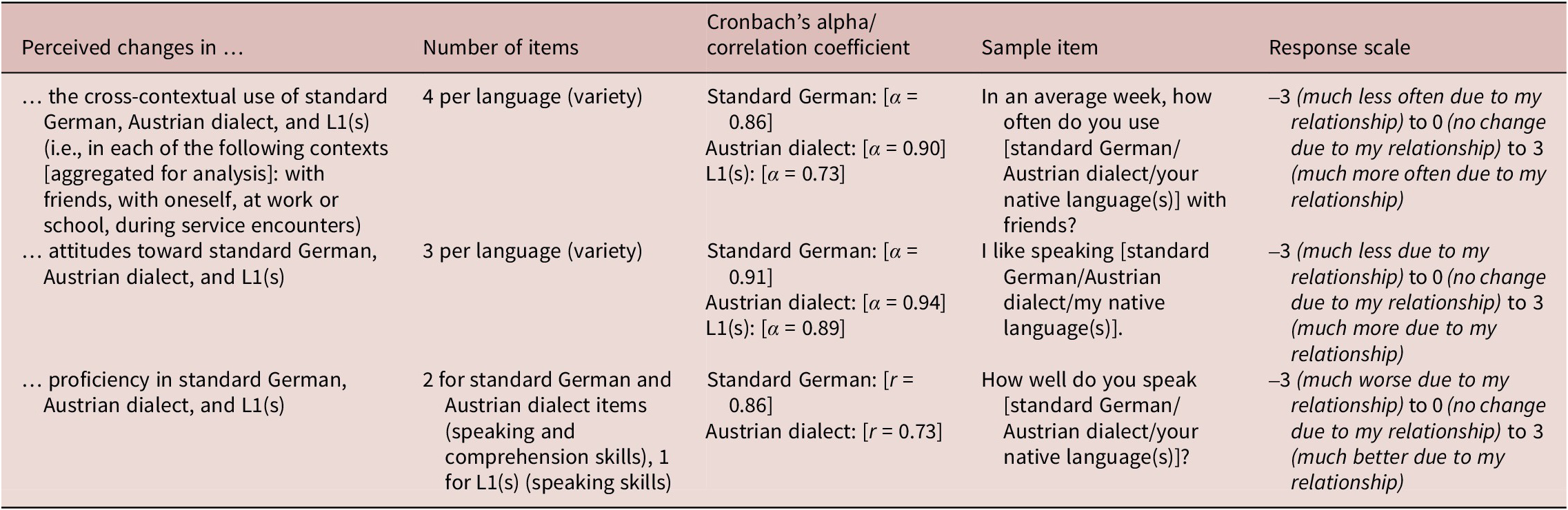
We employed a modified version of the approach used in the Life Event Study (Schwaba et al., Reference Schwaba, Denissen, Luhmann, Hopwood and Bleidorn2023). Participants were asked about the extent to which their (socio-)linguistic repertoire changed from being in a romantic relationship, and the survey items gauged linguistic changes in the areas outlined in Table 1 (see the Supplementary Material on OSF for all items)
Measuring retrospectively perceived change

.
These scales were adapted from previous self-report questionnaires in sociolinguistics and SLA, for example, the dialect-standard profile (Steiner et al., Reference Steiner, Jeszenszky, Stebler and Leemann2023), the Bilingual Language Profile (Birdsong et al., Reference Birdsong, Gertken and Amengual2012), and from Wirtz and Pickl’s (Reference Wirtz and Pickl2025) test battery of items gauging perceived change in the sociolinguistic repertoire in relation to major life events. Importantly, while self-reports may be subject to drawbacks such as individual cases of over- or underestimation of proficiency, they have generally been found to be a reliable measure of language proficiency and use (e.g., Gertken et al., Reference Gertken, Amengual, Birdsong, Leclercq, Edmonds and Hilton2014). What is more, Schwaba et al. (Reference Schwaba, Denissen, Luhmann, Hopwood and Bleidorn2023), from whom the present survey design was adapted, found that retrospective perceptions of change and longitudinally measured change in event-related personality development correlated moderately to strongly.
Following the closed-ended items, participants could optionally provide qualitative narratives in an open-ended item (“Would you like to tell us anything else about how your relationship has influenced you and your use of languages?”).
Individual differences in (psycho-)social and language usage variables
Perceived adaptability
Adaptability, that is “individuals’ capacity to constructively regulate psycho-behavioral functions in response to new, changing, and/or uncertain circumstances, conditions and situations” (Martin et al., Reference Martin, Nejad, Colmar and Liem2012, p. 59), was measured via nine items (e.g., “I am able to think through a number of possible options to assist me in a new situation”) from the Adaptability Scale (Martin et al., Reference Martin, Nejad, Colmar and Liem2012), rated on seven-point scales from 1 = strongly disagree to 7 = strongly agree (α = 0.91, M = 5.40, SD = 1.07, range = 3.22–7.00; see Supplementary Figure 1 on OSF for the visual descriptive overview).
Multicultural Personality Questionnaire—subscales for Social Initiative and Open-mindedness
We employed the Multicultural Personality Questionnaire (MPQ; see van der Zee et al., Reference van der Zee, van Oudenhoven, Ponterotto and Fietzer2013) to measure two personality dimensions: Social Initiative, i.e., “actively approaching social situations and demonstrating initiative in these interactions” and Open-mindedness, i.e., “an open and unprejudiced attitude toward cultural differences” (van der Zee et al., Reference van der Zee, van Oudenhoven, Ponterotto and Fietzer2013, p. 118). Social Initiative was measured via four itemsFootnote 3 (e.g., “Takes the lead”), and Open-mindedness via eight items (e.g., “Is looking for new ways to attain his or her goal”), and responses were provided on five-point scales from 1 = totally not applicable to 5 = totally applicable (Social Initiative: α = 0.72, M = 3.51, SD = 0.75, range = 1.75–5.00; Open-mindedness: α = 0.73, M = 3.91, SD = 0.50, range = 2.00–5.00; see Supplementary Figure 1 on OSF for the visual descriptive overview). Because of the already lengthy survey, we opted out of deference to participants to collect data on only the two aforementioned personality traits of the five in the MPQ, as these two (a) have repeatedly been found to correlate with L2 skills (e.g., Forsberg Lundell & Sandgren, Reference Forsberg Lundell, Sandgren, Granena and Long2013; Forsberg Lundell et al., Reference Forsberg Lundell, Eyckmans, Rosiers and Arvidsson2018, Reference Forsberg Lundell, Arvidsson and Jemstedt2023a, Reference Forsberg Lundell, Arvidsson and Jemstedt2023b), (b) correlate with relationship-related language usage (Dewaele & Salomidou, Reference Dewaele and Salomidou2017), and (c) most closely reflect qualitative rationales from previous variationist SLA work in Austria concerning why some individuals choose to acquire dialect varieties while others do not (e.g., Wirtz et al., Reference Wirtz, Pfenninger, Kaiser and Ender2024).
Push-pull factors for migration
While previous SLA research has often focused on different types of migrants, such as lifestyle migrants, transnational migrants, or cultural migrants (e.g., Diskin & Regan, Reference Diskin, Regan, Lundell and Bartning2015; Forsberg Lundell, Reference Forsberg Lundell and Howard2019), we abstain from such categorization in lieu of employing a more continuous account of the fluid and shifting driver complexes that shape migration. Urbański (Reference Urbański2022) clarifies that there are various push and pull factors that affect migration, i.e., factors which may drive individuals to move away from their home country (e.g., economic instability, lack of employment, etc.) alongside those which pull individuals to the respective host country (e.g., education or employment opportunities, interest in the culture or language, etc.). Participants reported on five items concerning potential pull factors (e.g., “I came to Austria because I wanted to learn the German language and about the Austrian culture”) and four items concerning potential push factors (e.g., “I came to Austria because I was forced to leave my home country”). Responses were recorded on seven-point scales from 0 = not true at all to 6 = very true. We then computed a Push-Pull profile, such that higher values indicate a stronger pull to Austria and negative values a stronger push away from an individual’s home country (M = 0.89, SD = 1.41, range = –6.00 to 4.30; see Supplementary Figure 2 on OSF for the visual descriptive overview of the individual rationales for migration and of the push-pull profile).
Current self-reported language usage and proficiency
Based on the principles of the Bilingual Language Profile (Birdsong et al., Reference Birdsong, Gertken and Amengual2012), participants reported on their current language usage practices—specifically on their use of their L1(s), standard German, Austrian dialect, and other language(s)—with their partner, family, friends, with themselves, at school or work, and during service encounters, respectively. Responses within each of the six communicative contexts respectively had to sum up to 100%. Figure 1 displays radar plots summarizing both the aggregate usage patterns across the six contexts as well as the individual responses, both of which illustrate that a majority of participants employs their L1 at comparatively high rates, followed by standard German, Austrian dialect, and, finally, additional languages. To simultaneously account for participants’ current language proficiency, they were asked about their current speaking and comprehension skills in standard German and Austrian dialect on a scale from 0 to 6 (standard German: M = 4.19, SD = 1.53, range = 0.50–6.00; Austrian dialect: M = 2.57, SD = 1.92, range = 0.00–6.00; see Supplementary Figure 3 on OSF for the visual descriptive overview). We then computed a dialect-standard profile (DSP) for each participant (Steiner et al., Reference Steiner, Jeszenszky, Stebler and Leemann2023), such that positive values indicate a higher dominance of the Austrian dialect in terms of everyday language usage and proficiency, and negative values a higher dominance of standard German (M = –1.75, SD = 2.44, range = –5.92 to 3.75; see Supplementary Figure 4 on OSF for the visual descriptive overview).
Aggregate (Left) and Individual (Right) Usage Patterns Across the Six Contexts.

Data analysis
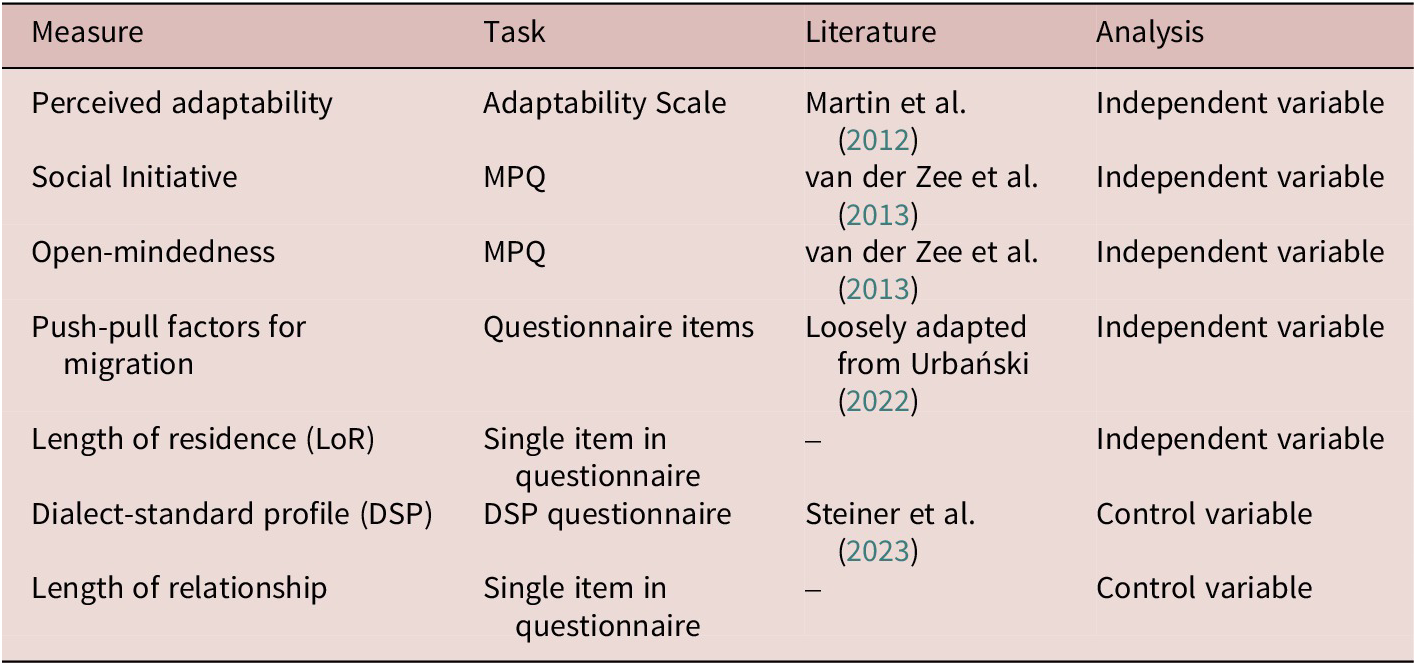
RQ1 assessing the degree of perceived relationship-related linguistic change was addressed via visualization of descriptive data. For RQ2, which explores the link between psychosocial variables (i.e., perceived adaptability, Social Initiative, Open-mindedness, push-pull factors for migration, and LoR) and perceived relationship-related changes in the linguistic repertoire, we employed regression modeling in R (R Core Team, 2020). Each change domain, apart from perceived change in attitudes toward and proficiency in the L1, given the low degree of variation here (see the next section), was modeled separately, resulting in a total of seven models. In line with the previous discussions about factors that may feasibly affect the strength or directionality of linguistic change in relation to multilingual coupledom, we included five independent variables: perceived adaptability, Social Initiative, Open-mindedness, push-pull factors of migration, and LoR (all of which were numeric and z-scored for modeling). Note that, because of the extreme diversity in LoR values over 15 years, LoR values of 15 and above were recoded to 15 to facilitate statistical modeling (n = 10), resulting in a new mean LoR of 6.76. Length of relationship (z-scored) was included as a control variable (a) because it seemed plausible that individuals who had been in a relationship longer may report a higher magnitude of change and (b) so that the resultant model estimates would reflect predictions based on the mean relationship length. The DSP (z-scored) was also included as a control variable (a) because differences in current language usage practices and proficiency levels may affect the magnitude of change participants report and (b) so that the resultant model estimates would reflect predictions for an individual with an average language usage frequency and proficiency. Due to the substantially uneven distribution between men and women participants as indicated by the descriptive data, gender was not considered in the models (but see the Supplementary Material on OSF for visualizations of the independent variables facetted by gender, which show minimal differences). Since linear models are susceptible to outliers, we visually inspected scatter plots to identify clear outliers in the predictor variables, and two points (3.86 SD and 4.89 SD below the sample mean) were subsequently removed. Finally, a numerical check revealed that the degree of multicollinearity in this particular set of predictors is negligible (k = 2.11; k values between 0 and 6 indicate a negligible degree of collinearity). Table 2 provides an overview of the independent and control variables entered into the regression analyses.
Overview of the independent and control variables used in the regression analyses

As for the qualitative data for RQ3 (i.e., beliefs about why multilingual coupledom has, or has not, affected the linguistic repertoire), we conducted a bottom-up qualitative analysis of all responses to the open-ended item (3,487 words from 53 of the participants). We began by familiarizing ourselves with the data and generated initial codes (e.g., single words, short phrases) of reoccurring topics. We subsequently searched for interactions between the codes from the first phase, focusing on identifying patterns and relationships between the coded elements, and finally, the codes were collated into overarching themes. Approximately two weeks later, all responses were read again to check theme accuracy and to ensure that they reflected participants’ key appraisals. Finally, since “frequency does not simply correspond to importance” (Braun & Clarke, Reference Braun and Clarke2019, p. 720) in qualitative data, we present a range of extracts for each theme to show both the diversity and similarities in participants’ views on the linguistic ramifications of the love factor.
Results
RQ1: Impact of multilingual coupledom on interindividual perceived change
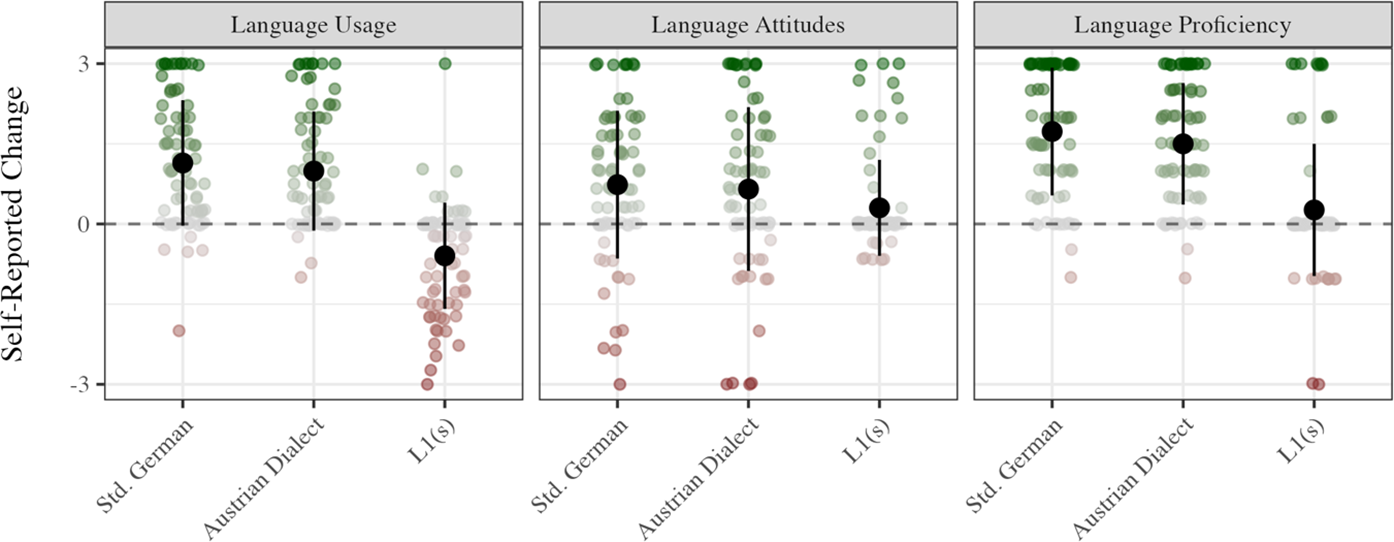
In this section, we turn to RQ1 inquiring about the degree of linguistic change participants reported in relation to multilingual coupledom. Figure 2 presents a visual overview of respondents’ perceived change in language use, attitudes, and proficiency.
Perceived linguistic changes in relation to multilingual coupledom.
Note: Each dot represents a participant; the black dot and whiskers show the mean and standard deviation, respectively.

In relation to multilingual coupledom, participants believed that their usage frequency of standard German and Austrian dialect increased, while they reported less frequent use of their L1(s).
The reports concerning changes in attitudes toward standard language and Austrian dialect were relatively diverse, with a majority of participants reporting increases, but a sizable number also indicating more negative attitudes toward the standard and dialect varieties (i.e., 17% and 21%, respectively). In contrast, attitudes toward the L1(s) remained, according to participants, relatively unaffected by multilingual coupledom.
Mean reports of perceived change were highest with respect to proficiency in standard German and Austrian dialect. Only a small minority of participants indicated either positive or negative changes in their L1 proficiency in relation to multilingual coupledom.
RQ2: Psychosocial predictors of perceived linguistic change
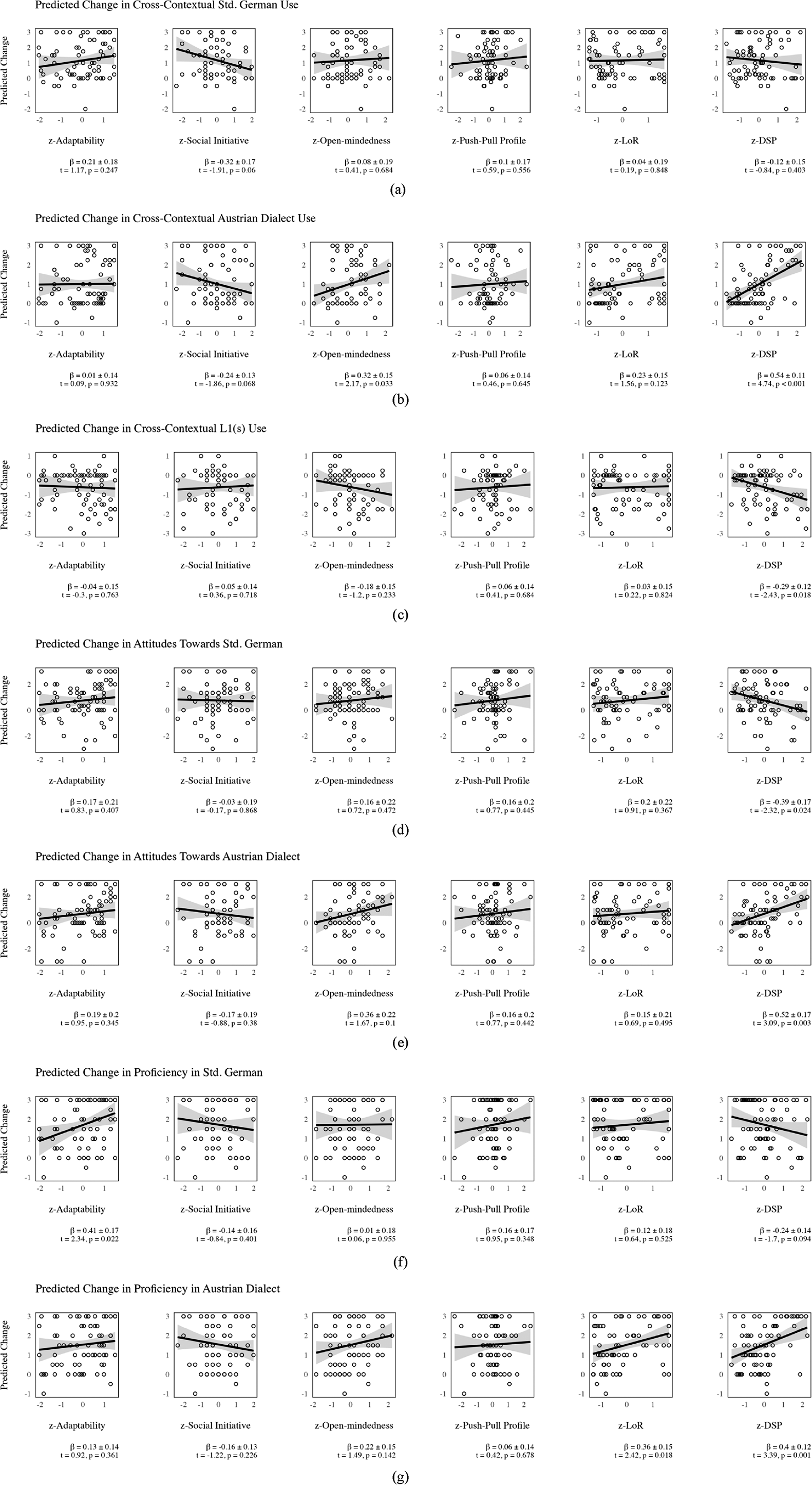
In this section, we address RQ2 regarding the psychosocial predictors of perceived linguistic change in relation to multilingual coupledom. Figures 3a–3g illustrate the conditional effects of the seven regression models assessing perceived relationship-related linguistic change as a function of the predictor and control variables (see Table 2). Note that only the five focal predictors and significant control variables are visualized—the control variable length of relationship was not significant in any of the models.
Conditional effects plots.
Note. The lines and shading represent the predicted conditional effects and the confidence bands, respectively, computed from the regression models. Additionally, we superimposed the raw data onto the conditional effects plots, with each point representing a participant.

Perceived adaptability was a significant positive predictor only for self-reported changes in standard German proficiency (β = 0.41 ± 0.17, p = 0.022), though we found a comparatively high positive effect size—albeit nonsignificant—in relation to perceived changes in the use of the standard language as well (β = 0.21 ± 0.18, p = 0.247).
We identified a marginally significant negative relationship between Social Initiative and reported changes in individuals’ use of both the standard language (β = –0.32 ± 0.17, p = 0.060) and Austrian dialect (β = –0.24 ± 0.13, p = 0.068), where low scorers on Social Initiative reported the most pronounced change, as Figures 3a and 3b illustrate.
Open-mindedness, by contrast, was a positive predictor of reported changes in the use of the dialect variety (β = 0.32 ± 0.15, p = 0.033). Notable effect sizes were also observed in this variable’s positive, albeit nonsignificant, relationship to perceived changes in attitudes toward the dialect variety (β = 0.36 ± 0.22, p = 0.100) and proficiency therein (β = 0.22 ± 0.15, p = 0.142).
Interestingly, migratory experience (i.e., an individual’s push-pull profile) was not a significant predictor of any of the measures of change. The directionality of the effect was always positive, however, which means that individuals who were more strongly ‘pulled’ to Austria (e.g., for cultural, educational, relationship-related, or professional reasons) reported slightly higher rates of change.
LoR was a positive predictor of reported changes in individuals’ proficiency in the Austrian dialect variety (β = 0.36 ± 0.15, p = 0.018), but, interestingly, was less strongly associated with participants’ reported changes in the use of the dialect variety (β = 0.23 ± 0.15, p = 0.123).
Finally, the DSP—that is, an individual’s affinity for the local dialect variety, operationalized via participants’ current everyday language use and proficiency—was included as a control variable and was significant in all but two cases (in relation to perceived changes in the use of and proficiency in standard German), as Figure 3 shows. In other words, the magnitude of participants’ perceived relationship-related linguistic change was sensitive to differences in their current self-reported usage patterns and proficiency.
RQ3: Participants’ stories: What mechanisms lie behind the patterns of perceived linguistic change?
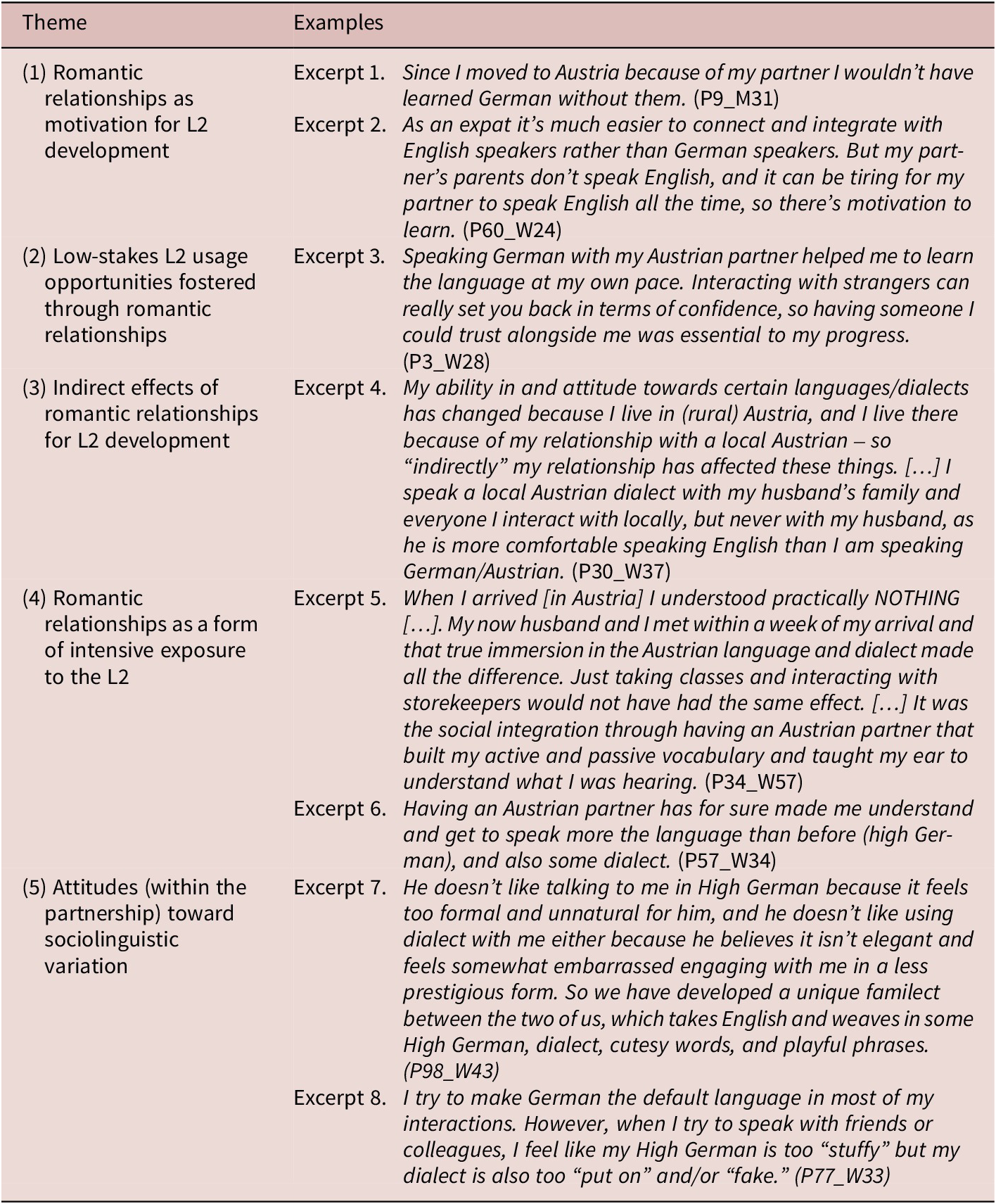
In line with our mixed-methods approach drawing on the principles of expansion (i.e., expanding the breadth and range of inquiry by using different methods for different inquiry components), we now turn to our third and final RQ addressing which additional factors (i.e., beyond those identified in the quantitative analysis) learners believe have played a role in shaping their language use, attitudes, and proficiency in relation to multilingual coupledom. Specifically, we scrutinize the individual narratives collected via the open-ended item “Would you like to tell us anything else about how your relationship has influenced you and your use of languages?”. During the qualitative analysis, we identified five overarching themes as presented in Table 3. Additional examples of each theme can be found in the Supplementary Material on OSF. Note that participants’ self-reported gender and age appear after the underscore in their respective participant ID.
Beliefs about the effects of multilingual coupledom on L2 development

Theme (1) relates to romantic relationships as a motivational device for L2 development. Particularly among individuals who migrated to Austria to join their partner, partnership was reported as a main reason for acquiring German (Excerpt 1). Motivation to continuously improve one’s language proficiency also appeared driven by the relationship, for instance, to effectively interact with the partner’s family and to reduce stress on the partner by lessening the need to use the learner’s L1 in partnership communication (Excerpt 2). This motivated learning behavior contributes to explaining the substantial increase in use of and proficiency in standard German and the dialect variety, as demonstrated by the descriptive data.
As for (2), the opportunity to practice the L2 with one’s partner, especially without the risk of social ridicule, was noted as a driver for increased L2 use and proficiency.
As the example in (3) illustrates, multilingual partnerdom itself need not, and likely will not, causally relate to changes in language use, attitudes, and proficiency—rather, it is the social and affective changes (e.g., changes in social networks, residential mobility and the urban-rural differences in language contact, language learning motivation, etc.) brought about by the partnership which are likely to drive linguistic change.
As concerns the acquisition of dialect varieties (i.e., nonstandard language), participants attested in the examples from (4) that the increased exposure to sociolinguistic variation through their partner (either directly or indirectly, e.g., by way of expanded social networks with TL speakers) was crucial in improving their ability to navigate the dialect landscape in Austria. This finding also resonates with the positive effects of LoR and the DSP identified in the quantitative analysis.
Regarding (5), we found that learners’ attitudes toward (non-)standard varieties were often dependent on the status the varieties held in the respective partnership. For instance, some participants who registered more negative attitudes toward (non-)standard varieties cited their TL partner’s negative stance toward using German in the relationship (Excerpt 7). Others referenced anxiety regarding their own German proficiency, and how this affects how they are perceived by their interlocutors (Excerpt 8).
Discussion
RQ 1: Perceived linguistic ramifications of multilingual coupledom
The aim of this study was to investigate the perceived changes in the (socio-)linguistic repertoire in relation to multilingual coupledom among users of L2 German. Answering RQ1, we found that learners reported positive effects of multilingual coupledom on their use of, attitudes toward, and proficiency in standard German and dialect varieties, which supports the accumulating empirical findings hitherto concerning the potentially beneficial effects that falling in love with a speaker of another tongue can have on L2 development (e.g., Kinsella & Singleton, Reference Kinsella and Singleton2014; Marinova-Todd, Reference Marinova-Todd2003; Muñoz & Singleton, Reference Muñoz and Singleton2007; Singleton & Pfenninger, Reference Singleton and Pfenninger2018). That said, Bühler et al. (Reference Bühler, Orth, Bleidorn, Weber, Kretzschmar, Scheling and Hopwood2023) maintain that “it should not be surprising […] that people do not change in the same ways […] or that people may react differently to the same life event” (p. 19), and alongside this, L2 acquisition, especially in adulthood, is an exceedingly individual endeavor characterized by pronounced inter- and intraindividual variation (e.g., Forsberg Lundell et al., Reference Forsberg Lundell, Arvidsson and Jemstedt2023b; Pfenninger et al., Reference Pfenninger, Festman and Singleton2023). Given this, we investigated whether individual differences in social and psychological factors may moderate the potential L2 learning effects of a romantic partnership with a TL speaker.
RQ2: Psychosocial predictors of perceived linguistic change
The negative relationship observed between the personality trait Social Initiative and perceived changes in both standard German and dialect use is perhaps surprising at first glance. Indeed, this finding stands in some contrast with Dewaele and Salomidou (Reference Dewaele and Salomidou2017), who found that Social Initiative was positively correlated with the statement about the partner’s language having become the participant’s “language of the heart.” Notably, however, there is likely a fundamental difference between language use more broadly and language use with a partner, which may explain the differences between our results and those reported by Dewaele and Salomidou (Reference Dewaele and Salomidou2017). That said, negative relationships between Social Initiative and L2 outcomes are not unheard of: Forsberg Lundell et al. (Reference Forsberg Lundell, Arvidsson and Jemstedt2023b), for example, identified a negative correlation between Social Initiative and perceived nativelikeness among L2 learners of French. Recall that the construct Social Initiative reflects an individual’s tendency to actively approach social situations and to take the initiative (e.g., “Is inclined to speak out,” “Takes the lead”), and thus high scores identify individuals who easily build up social networks and lead social action (van der Zee et al., Reference van der Zee, van Oudenhoven, Ponterotto and Fietzer2013). Individuals scoring low on Social Initiative, i.e., those who are less outspoken and who aim not to stand out in social settings, may be more prone to accommodate to the German-speaking environment, i.e., adopting (non-)standard forms of speech in order to blend in and interface with the host community. What is more, Social Initiative is based on the dimension Extraversion in the Big Five Model of personality traits (McCrae & Costa, Reference McCrae and Costa1987), and Forsberg Lundell et al. (Reference Forsberg Lundell, Arvidsson and Jemstedt2023b) put forward that “a more introverted, less socially active personality type, would be more prone to observe and listen to others attentively” (p. 617), which may give rise to a more pronounced adoption of the varieties used among TL speakers.
We found a significant effect of Open-mindedness on changes in the use of the dialect variety, as well as notable effect sizes in relation to changes in attitudes toward, and—though to a lesser extent—proficiency in the local dialect variety. High scorers on Open-mindedness are disposed to adopt other individuals’ perspectives easily, to be tolerant, and not prejudiced (van der Zee et al, Reference van der Zee, van Oudenhoven, Ponterotto and Fietzer2013), which may explain their tendency to adopt local forms of speech. This finding may remind us of Forsberg Lundell and Sandgren’s (Reference Forsberg Lundell, Sandgren, Granena and Long2013) insights on the association between Open-mindedness and collocational production among late French L2 learners; the authors maintain that individuals “who had an open mind and were able to empathize with others that led to their engagement with successful learning strategies (including exposing themselves to the L2 community), in order to integrate well professionally and socially” (p. 249).
Adaptability, that is, the ability to modify or adjust one’s behavior to navigate novel and challenging circumstances, has been deemed an important marker of flexibility and a predictor of effective learning (Collie et al., Reference Collie, Holliman and Martin2017; Martin et al., Reference Martin, Nejad, Colmar and Liem2013). Given the idea that differences in perceived adaptability may be associated with the differential ability to effectively manage new linguistic, social, and cultural demands characteristic of immersion settings (e.g., Zalbidea et al., Reference Zalbidea, Issa and Faretta–Stutenberg2022), it stands to reason that L2 learning may also be moderated by this psychobehavioral factor. We found the strongest correlation between perceived adaptability and perceived changes in proficiency in standard German, but also a correlation between adaptability and self-reported changes in the use of standard German, albeit a weaker and nonsignificant one. The fact that we did not find any notable relationships between adaptability and perceived change in the use of, attitudes toward, or proficiency in the dialect variety is perhaps less surprising when considering the findings from psychology research that adaptability resources have a pronounced impact on success in academic outcomes (e.g., Martin et al., Reference Martin, Nejad, Colmar and Liem2013)—that is, in contexts which are most strongly associated with the standard German variety.
LoR was a significant predictor of perceived relationship-related changes in learners’ proficiency in the dialect variety, a finding which holds up well with the robust evidence in variationist SLA work that significant exposure to the TL community is critical before changes in the sociolinguistic repertoire may manifest (e.g., Bardovi-Harlig & Bastos, Reference Bardovi-Harlig and Bastos2011; Gautier & Chevrot, Reference Gautier, Chevrot, Mitchell, Tracy-Ventura and McManus2015; Kennedy Terry, Reference Kennedy Terry2022; Wirtz & Pfenninger, Reference Wirtz and Pfenninger2024). What is more, the finding that LoR correlated less strongly with perceived changes in learners’ use of the dialect variety underscores Vergeiner’s (Reference Vergeiner2019) claim from the field of variationist sociolinguistics, the recurring theme in variationist SLA work (e.g., Geeslin & Gudmestad, Reference Geeslin, Gudmestad, de Garavito and Valenzuela2008), and findings from the field of multilingualism (e.g., Panicacci & Dewaele, Reference Panicacci and Dewaele2018; Panicacci, Reference Panicacci2020) that competence need not determine performance—in other words, multilingual coupledom may benefit the development of proficiency in the dialect variety, but this does not necessarily give rise to a higher frequency of usage of the dialect variety. These findings emphasize that the relationship between proficiency and use is not shaped exclusively by intensity of exposure but also by issues of identity (e.g., Regan, Reference Regan, Singleton, Regan and Debaene2013, Reference Regan, Bayley, Preston and Li2022): For example, TL conventions such as the use of the Austro-Bavarian vernacular (despite proficiency therein) may not align with “learners’ own social identities and orientations to language learning” (van Compernolle & Williams, Reference van Compernolle and Williams2012, p. 246; see also e.g. Ender, Reference Ender2022; Wirtz et al., Reference Wirtz, Pfenninger, Kaiser and Ender2024), or other languages might simply have a more prominent emotional force for the L2 learner (e.g., Panicacci & Dewaele, Reference Panicacci and Dewaele2018, Panicacci, Reference Panicacci2019).
The dialect-standard profile (DSP) captures an individual’s affinity for the Austrian dialect variety in terms of their current self-reported frequency of use of and proficiency in an Austrian dialect. We found that the magnitude of learners’ perceptions of relationship-related linguistic change was sensitive to differences in participants’ current linguistic usage and proficiency profile, which substantiates our rationale for including the DSP as a control variable.
RQ3: Beliefs about why multilingual coupledom affects the linguistic repertoire
The qualitative analysis provided richer insights into participants’ backgrounds and their perceptions about why and how their linguistic behavior has been affected by multilingual coupledom. The reported changes in a learner’s sociolinguistic repertoire are intricately intertwined with exposure-related and emotional variables, as voiced by the participants. Scholars as early as Arnold and Brown (Reference Arnold, Brown and Arnold1999, p. 8) noted that “anxiety is quite possibly the affective factor that most pervasively obstructs the learning process” (for a recent overview, see also MacIntyre & Wang, Reference MacIntyre, Wang, Li, Hiver and Papi2022), and the notion that select learners reported feeling nervous about using the TL (including the dialect variety) in public demonstrates that anxiety can disrupt sociolinguistic development (see also Wirtz, Reference Wirtz2025). Low-stakes usage opportunities in the comfort of a partnership, however, appear to alleviate some of these negative effects—specifically by way of mitigating the risk of L2-related shame and/or social ridicule (which may facilitate fatigue, negative mood states, poor well-being, general anxiety, etc., and thus impair L2 learning)—and ultimately promote L2 use and proficiency.
Furthermore, as previously noted, variationist SLA emphasizes that, while sufficient exposure to the TL community is a necessary prerequisite to sociolinguistic development, active employment of local forms of speech (or avoidance thereof) is a matter of sociolinguistic agency (e.g., Grammon, Reference Grammon2024; van Compernolle & Williams, Reference van Compernolle and Williams2012), influenced by, e.g., a learner’s past, present, and future goals and whether or not L1 conventions align with learners’ own social identities and orientations to language learning (Ender, Reference Ender2022; Wirtz et al., Reference Wirtz, Pfenninger, Kaiser and Ender2024). As voiced by the participants, more active engagement with the Austrian dialect was motivated by aspirations to accommodate the partner’s linguistic and cultural affiliation, to more effectively interact with the TL community, and also to more consciously assert identity and belonging—findings which also bear parallels to several of the themes Regan (Reference Regan, Bayley, Preston and Li2022) identified concerning learners’ motivation to acclimate in L2 French. At the same time, learners’ attitudes toward (non-)standard language were closely related to the status the varieties held in the partnership, and in learners’ social circles more generally. These findings are reminiscent of sociolinguistic research arguing that “networks do not affect linguistic variation simply by determining a speaker’s level of exposure to a given style of speaking; rather, any such influence is filtered through an evaluative process” (Sharma & Dodsworth, Reference Sharma and Dodsworth2020, p. 355). In other words, an individual’s affective stance toward the dialect variety or the standard language will depend “at least in part on the expectations of those with whom one habitually interacts” (Gal, Reference Gal1979, p. 141).
Importantly, linguistic behavior and development are shaped by a multitude of forces; among these are affective and cognitive resources as well as day-to-day experiences (e.g., Pfenninger & Kliesch, Reference Pfenninger and Kliesch2023). Thus, perceived effects of a single life event—namely, linguistic changes in relation to multilingual coupledom—may be overshadowed by the cumulative effects of other forces. Indeed, participants noted that it was not always the relationship per se which influenced perceived change in the sociolinguistic repertoire, but rather the wealth of social and affective changes brought about via coupledom. Disentangling and ascertaining the differential effects of these relationship-related changes on L2 acquisition represents a crucial next step in our goal to better understand the relationship between love and language development.
Limitations and future directions
There are several (methodological) limitations which warrant consideration. First, our measure of perceived linguistic change inherently conflates frequency with self-perceived causation. While useful for the current research questions (i.e., participants only reported on the degree of change which they believed was caused by this respective life event), one may consider juxtaposing this type of questioning with a two-pronged pair of questions which first addresses frequency and next inquires as to how much the participant attributes this to the relationship. Second, qualitative inquiries into related research questions may consider adding open-ended items before the closed-ended items to avoid prompting certain types of responses. Third, to avoid excessive participant attrition, we were unable to collect a satisfactory amount of data on partner characteristics, for example, the partner’s patterns of language use, their previous mobility, or the partner’s experiences in navigating multilingual coupledom—all of which are factors that future research may consider addressing. Fourth, this article necessarily addressed the macrolevel of language use, proficiency, and attitudes in relation to multilingual coupledom while neglecting issues at the microlevel, for instance, within-interaction code-switching and how this is affected by (the length of) romantic relationships; observational studies on (changes in) the linguistic repertoire will inevitably shed light on this matter. Fifth, a majority of participants in this sample (44/76) spoke L1 English, and its status as a lingua franca is likely to affect both partnership communication and everyday interactions more generally. For example, individuals with L1 English are in a privileged position to be able to draw on their L1 in everyday communicative interactions. We thus agree with Long (Reference Long and Geeslin2022) that future research will do well to explore learner samples which “reflect a broad diversity of linguistic, cultural, and social backgrounds” (p. 430). Sixth and last, given the constraints of the current exploratory survey, we were unable to collect data on select demographic and psychological variables which may be of interest in the future. Regarding the former, mobility patterns and place of residence must take center stage, specifically because the qualitative analysis illustrated that the urban-rural divide likely influences L2 sociolinguistic development. Concerning the latter point, psychological variables such as relationship satisfaction will offer deeper insights into how relationship-specific characteristics impact the acquisition of sociolinguistic variation.
Finally, we believe this study is methodologically noteworthy in the field of applied linguistics in that we focus not only on self-reports of current language use but also on retrospective perceptions of linguistic change in relation to a major life event—namely, multilingual coupledom. Indeed, previous work in applied linguistics has employed methods to gauge the degree of linguistic change among individuals, for example, retrodictive qualitative modeling (e.g., Dörnyei, Reference Dörnyei2014), which entails tracing backward from a present state to a past state, or ecological-historical approaches, which involve retrocasting and analyzing change and the manifestation of learner agency over time (e.g., Sasaki et al., Reference Sasaki, Mizumoto and Murakami2024). These methods, while useful for investigating perceived trajectories of change and the rationales thereof, were not designed to tap into participants’ perceptions of linguistic change in relation to a select event experience. The ‘Life Event Survey’ (Schwaba et al., Reference Schwaba, Denissen, Luhmann, Hopwood and Bleidorn2023), by contrast, presents a useful approach to estimate the linguistic relevance of life events, especially of events for which collecting group-level, carefully controlled longitudinal data is simply unfeasible. It is clear that retrospective judgements of change are no substitute for longitudinally measured change; however, life-event researchers in the field of developmental psychology have argued that “meaning-making takes place over time […] and so understanding the effect of a past event on subsequent […] change may best be done retrospectively, allowing participants time to integrate event-related changes into their self-perception” (Schwaba et al., Reference Schwaba, Denissen, Luhmann, Hopwood and Bleidorn2023, p. 1153). A promising way forward, as we see it, may be to employ a mix of retrospective and retrodictive methods, e.g., using the life event survey method to home in on the linguistic consequences of select experiences while utilizing retrodictive modeling to buttress this restricted focus and identify additional moderators of perceived linguistic change.
Conclusion
Finding love in a foreign country, or moving to a foreign country because of love, can be an exhilarating experience, and this significant life-course transition will undoubtedly bring with it a host of linguistic and cultural changes. Even among same-language couples, accommodating to the partner’s linguistic cues (e.g., linguistic alignment) is expectable during relationship formation (e.g., Brinberg & Ram, Reference Brinberg and Ram2021), and attending to the partner’s, in addition to one’s own, linguistic and cultural affiliation represents a crucial component in achieving effective communication (e.g., Piller, Reference Piller, Pavlenko, Blackledge, Piller and Teutsch-Dwyer2001). To again quote Dewaele and Salomidou (Reference Dewaele and Salomidou2017), “love in an LX [i.e., additional language beyond the L1(s)] is perfectly possible but it adds some extra challenges” (p. 129), not the least of which may include the acquisition, or further refinement, of the partner’s L1. At the same time, romantic connections may function as a facilitative force for L2 motivation and development, as we have seen here and elsewhere (e.g., Singleton & Pfenninger, Reference Singleton and Pfenninger2018; see also Kinsella & Singleton, Reference Kinsella and Singleton2014; Muñoz & Singleton, Reference Muñoz and Singleton2007), though a number of social, psychological, experiential (including gender and sexuality, see Akiyama & Ortega, Reference Akiyama and Ortega2024), and contextual variables will moderate the actual magnitude of relationship-related change in the (socio-)linguistic repertoire. Given the potent effects that falling in love with a speaker of another tongue can have on (second) language development, we must agree with our predecessors (e.g., Dewaele & Salomidou; Pfenninger et al., Reference Pfenninger, Festman and Singleton2023; Piller, Reference Piller2002; Singleton & Pfenninger, Reference Singleton and Pfenninger2018) on the claim that the love factor and its consequences for language learning have earned a brighter spotlight in SLA moving forward.
Data availability statement
Data and R scripts for the quantitative analyses, as well as all materials used for this study, are available via the following link https://osf.io/ekz8y/.
Acknowledgments
I would like to express my gratitude to all of the participants for taking the time to provide such rich data. I also thank the anonymous reviewers and the editor for their helpful comments on an earlier version of this manuscript. Any errors are, of course, my own.
Competing interests
The author declares none.


 Open access

