





In 2019, nearly 8 million deaths were attributable to dietary risk factors including low intake of fruit and vegetables, whole grains, legumes and nuts and seeds and high intakes of red meat and processed meats(Reference Qiao, Lin and Wu1). In addition to health impacts, the production of food along with the associated transport, storage, cooking and wastage produce substantial amounts of greenhouse gas emissions; taking these various life stages into consideration, food systems are estimated to account for between a quarter to a third of total global greenhouse gas emissions (GHGE)(Reference Vermeulen, Campbell and Ingram2,Reference Crippa, Solazzo and Guizzardi3) . These GHGE include methane (a by-product of the digestion of plant matter in ruminant livestock), carbon dioxide (from fossil fuels used to power farm machinery and to transport, store and cook foods) and nitrous oxide (from nitrogen fertilisers and the urine of grazing livestock)(Reference Crippa, Solazzo and Guizzardi3). For further details on the methods most commonly used to measure GHGE arising from the production, distribution and storage of food, see section titled, ‘Environmental Impact Assessments’.
Generally, the production of animal-sourced foods results in greater amounts of GHGE compared to plant-sourced food products (by weight)(Reference Hallström, Carlsson-Kanyama and Börjesson4), and a previous study estimated that the GHGE associated with meat eaters’ diets are approximately twice as high as those of vegans(Reference Scarborough, Appleby and Mizdrak5). Thus, dietary changes could reduce GHGE, and Hallström et al. (2015) estimated that dietary shifts only within affluent countries could result in a 50 % reduction in global food-related GHGE(Reference Hallström, Carlsson-Kanyama and Börjesson4). The EAT-Lancet Commission proposes a healthy diet predominantly consisting of fruits, vegetables, whole grains, legumes and nuts and unsaturated oils, with modest amounts of seafood and poultry and low amounts of red meat, added sugar, refined grains and starchy vegetables(Reference Willett, Rockström and Loken6). This diet was designed to provide healthy nutrition for an estimated global population of roughly 10 billion people by 2050 while keeping the global food system within planetary boundaries(Reference Willett, Rockström and Loken6).
To facilitate global shifts towards diets that are both sustainable and healthy, understanding the relationship between demographic characteristics and the environmental impact of diets is important. Many modelling studies have been carried out to estimate theoretical benefits (both in terms of impacts on health and the environment) from population shifts from a diet with relatively high amounts of animal-source food to a diet lower in animal-source foods(Reference Drew, Cleghorn and Macmillan7,Reference Springmann, Godfray and Rayner8) . This review summarises studies carried out in high-income countries that have estimated GHGE from self-selected diets in free-living people (at an individual or household level) and considers associations with various demographic variables such as age, gender or sex, income level and education level. As such, the review focuses on studies undertaken in high-income countries with relatively westernised diets such as the US, European countries, Canada, Australia and New Zealand.
General characteristics of studies examining the relationships between demographic characteristics and dietary GHGE
Studies that have investigated the associations between demographic characteristics and dietary GHGE are summarised in Table 1. Studies either investigate individuals or households as the sampling unit; or occasionally studies collect data on both individuals and households(Reference Lund, Watson and Smed14). Research in this area has been conducted in various high-income countries within Europe, for example in Sweden(Reference Nordström, Shogren and Thunström11,Reference Strid, Hallström and Hjorth22,Reference Bälter, Sjörs and Sjölander23) , Denmark(Reference Lund, Watson and Smed14,Reference Mertens, Kuijsten and van Zanten20) , Germany(Reference Koelman, Huybrechts and Biesbroek17,Reference Meier and Christen26) , Ireland(Reference Kirwan, Walton and Flynn16,Reference Hyland, Henchion and McCarthy24) , the United Kingdom(Reference Reynolds, Horgan and Whybrow12,Reference Rippin, Cade and Berrang-Ford19) , the Czech Republic(Reference Mertens, Kuijsten and van Zanten20), Finland(Reference Salo, Savolainen and Karhinen10), France(Reference Mertens, Kuijsten and van Zanten20), Italy(Reference Mertens, Kuijsten and van Zanten20), the Netherlands(Reference Temme, Toxopeus and Kramer25) and Switzerland(Reference Frehner, Zanten and Schader18). Outside of Europe, some studies have been conducted in the United States(Reference Boehm, Wilde and Ver Ploeg13,Reference Rose, Heller and Willits-Smith21) , Australia(Reference Reynolds, Piantadosi and Buckley15) and New Zealand(Reference Kliejunas, Cavadino and Kidd9).
Summary of studies undertaken in high-income countries with relatively westernised diets that consider associations between demographic characteristics and dietary GHGE
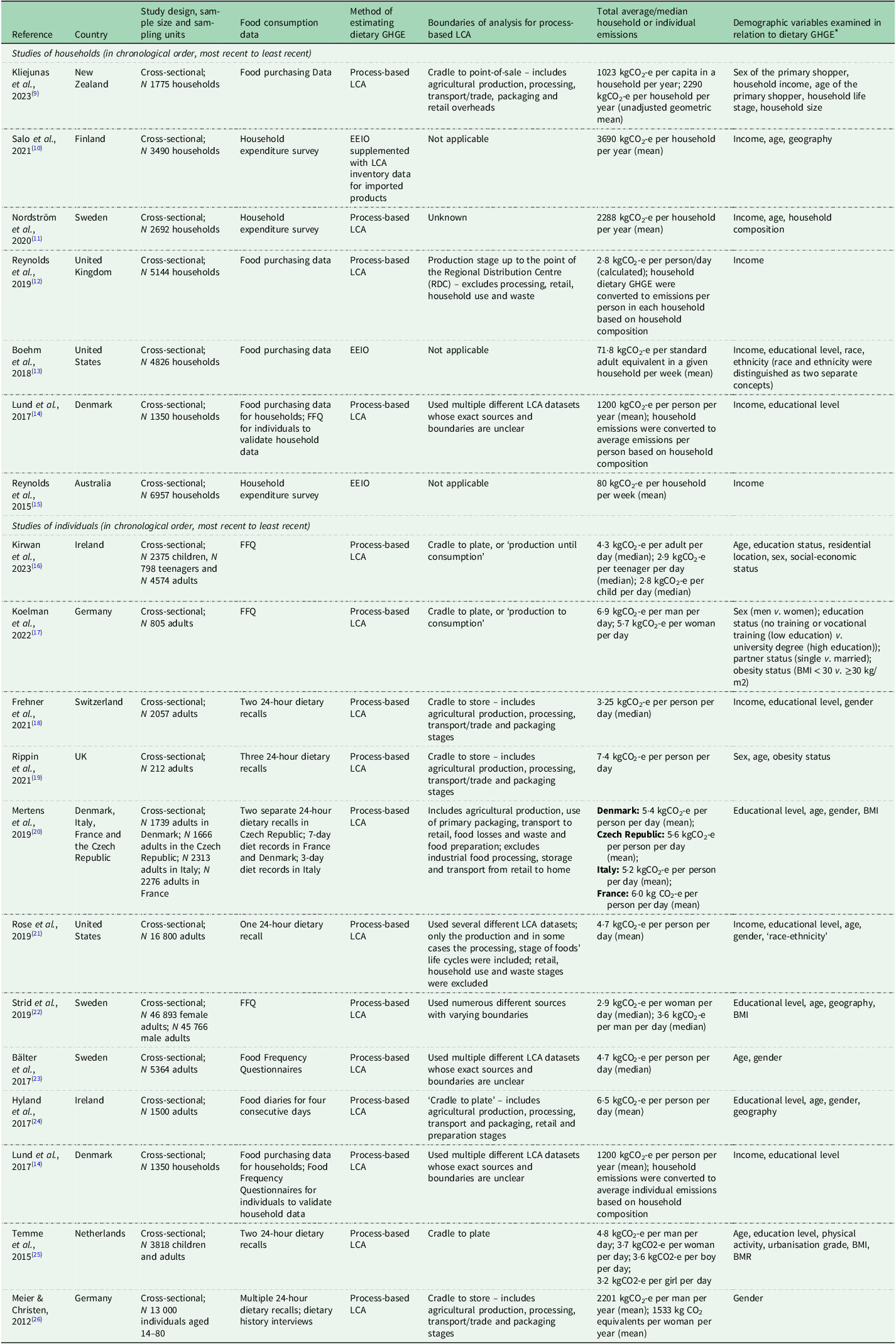
EEIO, Environmentally Extended Input Output (model); kgCO2-e, kilograms per carbon dioxide equivalents; LCA, life cycle assessment.
* Reported demographic characteristics most commonly included age, gender or sex, income level and education level.
Studies examining the possible associations between dietary GHGE and demographic variables have used observational, cross-sectional research designs(Reference Kliejunas, Cavadino and Kidd9–Reference Meier and Christen26). In order to estimate participants’ dietary GHGE, each study collected food consumption or purchasing data for its sample and then assigned emissions values to the food products before comparing total dietary GHGE by various demographic variables. For each of these steps, researchers have used a variety of methods and data sources which are described in detail below.
Food purchasing and consumption data
Studies that have estimated dietary GHGE have either used food purchasing data of households(Reference Kliejunas, Cavadino and Kidd9–Reference Reynolds, Piantadosi and Buckley15) or food consumption data of individuals(Reference Lund, Watson and Smed14,Reference Kirwan, Walton and Flynn16–Reference Meier and Christen26) or occasionally collected food consumption data for both households and individuals within each household in order to corroborate the accuracy of both sets of data(Reference Lund, Watson and Smed14).
For households, some studies used food purchasing data recorded by participants(Reference Kliejunas, Cavadino and Kidd9,Reference Reynolds, Horgan and Whybrow12–Reference Lund, Watson and Smed14) , measured over a single 7-day period(Reference Boehm, Wilde and Ver Ploeg13), a single 14-day period(Reference Reynolds, Horgan and Whybrow12) or an entire year(Reference Kliejunas, Cavadino and Kidd9,Reference Lund, Watson and Smed14) . Others have used data collected from expenditure surveys(Reference Salo, Savolainen and Karhinen10,Reference Nordström, Shogren and Thunström11,Reference Reynolds, Piantadosi and Buckley15) , measuring household spending over the course of a week(Reference Reynolds, Piantadosi and Buckley15) or an entire year(Reference Nordström, Shogren and Thunström11). Regarding studies that assessed individuals’ food intake, methods of data collection include a single 24-hour dietary recall(Reference Rose, Heller and Willits-Smith21) or multiple 24-hour dietary recalls(Reference Frehner, Zanten and Schader18,Reference Mertens, Kuijsten and van Zanten20,Reference Temme, Toxopeus and Kramer25,Reference Meier and Christen26) ; food diaries and other forms of dietary records generated over the course of three(Reference Mertens, Kuijsten and van Zanten20), four(Reference Kirwan, Walton and Flynn16,Reference Hyland, Henchion and McCarthy24) or seven consecutive days(Reference Mertens, Kuijsten and van Zanten20); FFQ(Reference Lund, Watson and Smed14,Reference Koelman, Huybrechts and Biesbroek17,Reference Strid, Hallström and Hjorth22,Reference Bälter, Sjörs and Sjölander23) ; and dietary history interviews(Reference Meier and Christen26).
Accurately identifying usual food purchases for a household or food consumption for an individual is challenging, and all of the aforementioned methods of collecting usual dietary data have well-known limitations. In studies using food purchasing data, the failure of participants to reliably or correctly record every purchase may introduce measurement error. For example, nonresponses and underreporting of food acquisitions have been found to increase as the time period of data collection increases(Reference Hu, Gremel and Kirlin27). In addition, not all food purchases may be included in studies; for example, some studies may not capture foods purchased and consumed away from the home (e.g. at restaurants and cafes)(Reference Kliejunas, Cavadino and Kidd9). Furthermore, studies using household expenditure data may be susceptible to measurement errors depending on the extent to which they rely on individuals’ estimates and are not corroborated with actual purchasing records(Reference Naeem, Brzozowski and Crossley28). In studies using self-reported dietary intake, under-reporting is typical(Reference Gemming, Jiang and Swinburn29), most likely due to a combination of factors such as recall error and social-desirability bias. One study in this field minimised this risk by combining multiple types of consumption data to validate self-reported dietary intake(Reference Lund, Watson and Smed14).
Environmental impact assessments
Process-based LCA
To measure the GHGE resulting from households’ and individuals dietary consumption, studies primarily employ the process-based life cycle assessment (LCA) methodology. Process-based LCA constitute a ‘bottom up’ approach to quantifying GHGE, compiling estimates for the emissions incurred both directly and indirectly (also known as ‘embodied emissions’) at each individual step in a food’s life cycle within a given country or region. This method can be applied to all stages of a food’s life cycle – agricultural production, processing, packaging, transport, storage, preparation and waste – and requires thorough analysis of the materials and resources expended (inputs) as well as the emissions and wastes (outputs) generated. For example, to quantify the GHGE generated from dairy production, a process-based LCA approach considers the nitrous oxide emitted in the production of nitrogen fertilisers for livestock feed in addition to the methane produced by cattle, the nitrous oxide released in cattle urine and the carbon dioxide emitted in the transport of the dairy outputs(Reference Singaravadivelan, Sachin and Harikumar30). Process-based LCA typically express greenhouse gas emissions over a 100-year time horizon, in terms of carbon dioxide equivalents (kgCO2-e). According to the most recent guidance from the Intergovernmental Panel for Climate Change (IPCC), 1 kilogram of carbon dioxide is weighted as 1 kgCO2-e, 1 kilogram of biogenic methane (non-fossil fuel origin, such as from ruminant animals) is weighted as 27 kgCO2-e and 1 kilogram of nitrous oxide is weighted as 273 kgCO2-e to reflect their respective global warming potential over a 100-year time frame(31).
The accounting of each stage in a food product’s life cycle yields comprehensive emissions estimates. However, the considerable level of detail that this ‘bottom-up’ approach requires makes it difficult to undertake. Scientists conducting process-based LCA must set boundaries for their analyses (i.e. decide which life stages will be included and excluded). Consequently, researchers using LCA data are constrained by the data that is available and relevant to the country where dietary emissions are being examined. As a result, most studies combine numerous LCA datasets in order to expand the scope of the research, and the boundaries of LCA data vary between studies. For example, Rose et al. (Reference Rose, Heller and Willits-Smith21) measured dietary emissions only ‘from cradle to farm gate’ (including only the agricultural production stage)(Reference Rose, Heller and Willits-Smith21) whereas Reynolds et al. (Reference Reynolds, Horgan and Whybrow12) incorporated the agricultural and transport stages up to the point of the regional distribution centre (RDC), thus excluding the processing, retail, preparation and waste stages(Reference Reynolds, Horgan and Whybrow12). Previous research has often used LCA with the boundaries of ‘cradle to store’ (including agricultural production, processing, transport and packaging)(Reference Frehner, Zanten and Schader18,Reference Rippin, Cade and Berrang-Ford19,Reference Meier and Christen26) , ‘cradle to point-of-sale’ (including agricultural production, processing, transport, packaging and retail overheads)(Reference Kliejunas, Cavadino and Kidd9) or even ‘cradle to plate’ (including agricultural production, processing, transport, packaging, retail overheads and preparation)(Reference Kirwan, Walton and Flynn16,Reference Koelman, Huybrechts and Biesbroek17,Reference Hyland, Henchion and McCarthy24,Reference Temme, Toxopeus and Kramer25) .
Process-based LCA that do not account for every stage of a food product’s life cycle often leave notable gaps in their estimates of foods’ emissions, and this is referred to as a truncation error. While the production phase of a food’s life cycle generates the largest proportion of GHGE in the food-system, the other life cycle stages (transportation, processing, packaging, retail, consumption and waster) also contribute meaningful amounts of GHGE. Unfortunately, due to insufficient LCA data being available in many instances, it is not always feasible to include all stages of a food product’s life cycle within reported LCA data. For example, Crippa et al. (Reference Crippa, Solazzo and Guizzardi3) estimated that primary production of foods and land use/land-use change emissions account for 39 % and 32 % respectively (71 % total) of total food-system GHGE in 2015, leaving 29 % accounted for by transportation, processing, packaging, retail, consumption and waste(Reference Crippa, Solazzo and Guizzardi3).
Furthermore, process-based LCA are unable to comprehensively account for the complex interdependencies of all products in modern economies. For instance, beyond the emissions generated on farms during food production, one must also consider the emissions generated by the trucks that transport food to retail markets. Food transport trucks not only emit carbon from fossil fuel usage (which many process-based LCA do account for), they are also made from steel (as well as countless other materials), which requires inputs of energy and material resources and generates outputs in the process of their production. The materials and resources used in the production of steel have their own requisite components – including machines made from more steel, which produces circularity effects – and the analysis can go on indefinitely. Most process-based LCA do not account for these indirect emissions arising from food production.
Environmentally extended input output (EEIO) modelling
In light of these limitations of the ‘bottom-up’ process-based LCA methodology, some studies(Reference Salo, Savolainen and Karhinen10,Reference Boehm, Wilde and Ver Ploeg13,Reference Reynolds, Piantadosi and Buckley15) have instead employed a ‘top-down’ approach called Environmentally Extended Input Output (EEIO) modelling to quantify the GHGE generated in the process of producing, distributing and consuming foods. Economic Input Output (EIO) models are macroeconomic representations of the monetary flows (i.e. transactions) between the various sectors within an economy. Accordingly, they measure what products or services (outputs) are consumed by other industries as inputs, thus quantifying the interdependence of products within complex economies. These datasets are extended into Environmentally-Extended Input Output models by applying emissions ‘factors’ (i.e. multipliers) to the monetary value of economic activities. Multiplying monetary transaction data by an emissions intensity factor (measured in kilograms of carbon dioxide equivalents (kgCO2-e) per unit of monetary output) enables researchers to estimate the GHGE – as well as other environmental costs such as energy and water(Reference Reynolds, Piantadosi and Buckley15) – associated with a given amount of money spent on a food product(Reference Reynolds, Piantadosi and Buckley15). For example, Reynolds et al. (Reference Reynolds, Piantadosi and Buckley15) took raw spending on various foods and simply multiplied these numbers by assigned values for each food item’s GHGE generated per unit of currency output. EEIO models can also be extended to include international transactions between economies (known as Environmentally Extended Multi-Regional Input-Output, or EE-MRIO, models) to account for the varying inputs and outputs associated with domestic v. imported products(Reference Aylmer, Aylmer and Dias32). Salo et al. (Reference Salo, Savolainen and Karhinen10) utilised an EEIO model that did not incorporate data on multi-regional inputs and outputs; instead, to estimate the embodied emissions of imported foods, they supplemented their EEIO with LCA data.
Utilising an EEIO approach in research on dietary emissions helps to minimise truncation error as well as circularity effects. Also known as self-sector transactions, circularity effects refer to when an industry uses its own good as an input to produce more of that good. EEIO models account for this phenomenon, thus enabling comprehensive estimations of climate impacts (both direct and indirect) generated across an entire economy. However, much like with process-based LCA, the primary strength of EEIO models – their broad scope in linking products within an economy – is also their most significant limitation, as it is dependent upon a high level of aggregation. With regards to food, diverse products with significantly different environmental implications are often combined. For example, Salo et al. (Reference Salo, Savolainen and Karhinen10) used an EEIO approach which grouped all food products into 15 categories(Reference Salo, Savolainen and Karhinen10) whereas Boehm et al. (Reference Boehm, Wilde and Ver Ploeg13) aggregated food products into 26 categories(Reference Boehm, Wilde and Ver Ploeg13). This level of aggregation does not account for notable differences in GHGE generated by the distinct food items belonging to the same category. Consequently, it constrains researchers’ ability to detect differences in dietary emissions between households or individuals stemming from variations in diet composition or food purchasing, as opposed to the quantity consumed. Therefore, the detail-intensive process-based LCA are better suited to capture differences between households or individuals in GHGE resulting from disparate dietary patterns, though they are less effective in accounting for far-reaching indirect and direct environmental impacts of food production across an entire economy.
Finally, for both process-based LCA and EEIO approaches, the standard time frame for quantifying carbon emissions in the reviewed literature was 100-years. Though global warming potential (GWP) can also be measured in a 20-year time frame to better account for greenhouse gases with shorter lifespans (such as methane), or even a 500-year time frame for a longer-term view, the 100-year horizon is most commonly used(Reference Minx, Toth and Lamb33).
Total average household or individual dietary emissions
The lack of methodological uniformity in the literature makes it difficult to compare the studies’ findings with regards to averages of total household or individual dietary emissions. Past research has employed differing sampling units, units of measurement, environmental assessment approaches and boundaries of analysis for such approaches. Even when multiple studies utilise the same sampling unit (i.e. households or individuals) and measurement unit (e.g. kg CO2 equivalents per person per day), like-for-like comparisons of results derived from process-based LCA are complicated by important differences in studies’ boundaries of analysis. These disparities arise due to the immense challenge of gathering comprehensive, country-specific and up-to-date emissions data for every stage of a food product’s life cycle.
Studies undertaken at the household-level reported their estimates of average dietary emissions GHGE using various measurement units, including per household per year (for example, 2290 kgCO2-e in New Zealand(Reference Kliejunas, Cavadino and Kidd9), 2288 kgCO2-e in Sweden(Reference Nordström, Shogren and Thunström11) and 3690 kgCO2-e in Finland(Reference Salo, Savolainen and Karhinen10)); per person in a household per year (1023 kgCO2-e in New Zealand(Reference Kliejunas, Cavadino and Kidd9)); per household per week (80 kgCO2-e in Australia(Reference Reynolds, Piantadosi and Buckley15)); per standard adult equivalent in a given household per week (71·8 kgCO2-e in the USA(Reference Boehm, Wilde and Ver Ploeg13)); or per person in a given household per day (2·8 kgCO2-e in the UK(Reference Reynolds, Horgan and Whybrow12)).
Studies undertaken at the individual-level were largely estimated as GHGE per person averages for women only (2·9 kgCO2-e per person per day in Sweden(Reference Strid, Hallström and Hjorth22), 3·7 kgCO2-e per person per day in the Netherlands(Reference Temme, Toxopeus and Kramer25), 5·7 kgCO2-e per person per day in Germany(Reference Koelman, Huybrechts and Biesbroek17) and 1533 kgCO2-e per person per year in Germany(Reference Meier and Christen26)); men only (3·6 kgCO2-e per person per day in Sweden(Reference Strid, Hallström and Hjorth22), 4·8 kgCO2-e per person per day in the Netherlands(Reference Temme, Toxopeus and Kramer25), 6·9 kgCO2-e per person per day in Germany(Reference Koelman, Huybrechts and Biesbroek17) and 2201 kgCO2-e per person per year in Germany(Reference Meier and Christen26)); or both men and women (4·3 kgCO2-e per person per day in Ireland(Reference Kirwan, Walton and Flynn16), 4·7 kgCO2-e per person per day in the US(Reference Rose, Heller and Willits-Smith21) and in Sweden(Reference Bälter, Sjörs and Sjölander23), 5·2 kgCO2-e per person per day in Italy(Reference Mertens, Kuijsten and van Zanten20), 5·4 kgCO2-e per person per day in Denmark(Reference Mertens, Kuijsten and van Zanten20), 5·6 kgCO2-e per person per day in the Czech Republic(Reference Mertens, Kuijsten and van Zanten20), 6·0 kgCO2-e per person per day in France(Reference Mertens, Kuijsten and van Zanten20), 6·5 kgCO2-e per person per day in Ireland(Reference Hyland, Henchion and McCarthy24), 7·4 kgCO2-e per day in the UK(Reference Rippin, Cade and Berrang-Ford19) and 1200 per person per year in Denmark(Reference Lund, Watson and Smed14)).
Relationships between demographic variables and dietary emissions
Previous research has examined the relationships between dietary emissions and a variety of demographic variables including income, educational level, age and sex or gender.
Age
Most studies report a positive relationship between age of the respondent (for studies of individuals) or primary shopper (for studies of households) – or, in the case of Nordström et al. (Reference Nordström, Shogren and Thunström11), the age of the oldest member of households that do not include any retirees(Reference Nordström, Shogren and Thunström11) – and dietary emissions(Reference Kliejunas, Cavadino and Kidd9–Reference Nordström, Shogren and Thunström11,Reference Mertens, Kuijsten and van Zanten20,Reference Rose, Heller and Willits-Smith21) . However, Mertens et al. (Reference Mertens, Kuijsten and van Zanten20) only observed this association within Denmark and France, and not within the Czech Republic or Italy, where no association was observed(Reference Mertens, Kuijsten and van Zanten20). Similarly, Temme et al. (Reference Temme, Toxopeus and Kramer25) found a positive association between age and dietary emissions for girls, boys and women in the Netherlands, but not for men.
On the other hand, Balter et al. (Reference Bälter, Sjörs and Sjölander23) found no significant relationship between the two variables, and several studies found a negative association between age and dietary emissions(Reference Kirwan, Walton and Flynn16,Reference Strid, Hallström and Hjorth22,Reference Hyland, Henchion and McCarthy24) . However, one of these studies only observed this negative relationship amongst adults, not children and teenagers(Reference Kirwan, Walton and Flynn16). Another study did not adjust for energy intake – the youngest age group (18–35 year olds) had significantly higher dietary emissions than the older age groups, which was attributed to the younger participants’ consumption of greater quantities of foods(Reference Hyland, Henchion and McCarthy24).
Gender or sex
The comparison of dietary emissions between men and women can be complicated by greater consumption of quantities of food by men, on average, compared with women. A number of studies have examined differences between genders adjusted for energy intake(Reference Mertens, Kuijsten and van Zanten20,Reference Rose, Heller and Willits-Smith21,Reference Hyland, Henchion and McCarthy24,Reference Meier and Christen26) . Studies that compared dietary GHGE adjusted by energy intake for men v. women generally found that men’s dietary GHGE were still significantly higher than women’s(Reference Rose, Heller and Willits-Smith21,Reference Hyland, Henchion and McCarthy24,Reference Meier and Christen26) . These differences are at least partially explained by the fact that men appear to eat more meat than women(Reference Hyland, Henchion and McCarthy24,Reference Meier and Christen26) ; Meier & Christen(Reference Meier and Christen26) found that meat and processed meat products constituted 52 % of men’s dietary GHGE profiles, compared to 39 % for women(Reference Meier and Christen26). Similarly, though differences in meat intake specifically between men and women were not measured by Rose et al. (Reference Rose, Heller and Willits-Smith21), this study from the US found that the highest quintile GHGE diet consisted of a higher proportion of animal protein foods compared to the lowest quintile GHGE diet(Reference Rose, Heller and Willits-Smith21). Bälter et al. (Reference Bälter, Sjörs and Sjölander23) and Kirwan et al. (Reference Kirwan, Walton and Flynn16) observed the same association between male gender and high dietary GHGE, though they did not use energy-adjusted dietary GHGE(Reference Kirwan, Walton and Flynn16,Reference Bälter, Sjörs and Sjölander23) . However, Kirwan et al. (Reference Kirwan, Walton and Flynn16) did not observe the same association amongst children. Balter et al. (Reference Bälter, Sjörs and Sjölander23) also attributed men’s higher dietary GHGE to higher meat intake (as well as higher energy intake overall).
Income level
Findings in the literature in relation to the association between income level and dietary GHGE are mixed. For example, several studies found a positive relationship between household income and dietary emissions(Reference Nordström, Shogren and Thunström11,Reference Boehm, Wilde and Ver Ploeg13,Reference Lund, Watson and Smed14) , and higher income levels appeared to have higher GHGE in Australia(Reference Reynolds, Piantadosi and Buckley15). In contrast, Boehm et al. (Reference Boehm, Wilde and Ver Ploeg13) found no relationship between participation in SNAP (Supplemental Nutritional Assistance Program) – an indicator of low income – and dietary GHGE(Reference Boehm, Wilde and Ver Ploeg13), and several other studies have also reported no clear association between income and dietary emissions(Reference Kliejunas, Cavadino and Kidd9,Reference Salo, Savolainen and Karhinen10,Reference Reynolds, Horgan and Whybrow12,Reference Kirwan, Walton and Flynn16,Reference Frehner, Zanten and Schader18,Reference Rose, Heller and Willits-Smith21) .
Education level
The literature also reports mixed findings with regards to the association between education level and dietary GHGE. Several studies found a positive association between the two variables(Reference Boehm, Wilde and Ver Ploeg13,Reference Lund, Watson and Smed14,Reference Strid, Hallström and Hjorth22) . Mertens et al. (Reference Mertens, Kuijsten and van Zanten20) examined data collected in four different European countries; their results showed a positive association between ‘GHGE density’ (referring to energy-standardised dietary emissions) and educational levels in the Czech Republic, a negative correlation in France and no correlation in Italy or Denmark(Reference Mertens, Kuijsten and van Zanten20). Most frequently, though, no clear association was observed between dietary emissions and educational levels(Reference Kirwan, Walton and Flynn16–Reference Frehner, Zanten and Schader18,Reference Rose, Heller and Willits-Smith21,Reference Hyland, Henchion and McCarthy24,Reference Temme, Toxopeus and Kramer25) .
Socio-demographic variables
In addition to age, gender, income and education, previous research has examined the relationship between dietary emissions and various socio-demographic variables. Regarding population density, a study in Sweden found that living in an urban area was strongly associated with higher dietary emissions for individuals(Reference Strid, Hallström and Hjorth22). Similarly, Salo et al. (Reference Salo, Savolainen and Karhinen10) observed that households in certain ‘dense rural’ areas of Finland exhibited significantly lower carbon footprints from food consumption compared to the ‘inner urban’ reference group. Studies in Ireland(Reference Hyland, Henchion and McCarthy24) and the Netherlands(Reference Temme, Toxopeus and Kramer25), on the other hand, found no such differences in dietary emissions amongst people living in urban vs. rural areas.
Differences in dietary emissions were also examined between ethnicities in the United States(Reference Boehm, Wilde and Ver Ploeg13,Reference Rose, Heller and Willits-Smith21) , as well as between nationalities in Switzerland(Reference Frehner, Zanten and Schader18). The results of studies in the United States indicated that African-American individuals were more likely to consume ‘low-emitting diets’ than individuals of white, Latino or ‘other’ race-ethnicities(Reference Rose, Heller and Willits-Smith21); white households were more likely to be in higher dietary GHGE quintiles than black or Asian households(Reference Boehm, Wilde and Ver Ploeg13); and ‘non-Hispanic’ households were more likely to be in a higher dietary GHGE quintile than Hispanic households(Reference Boehm, Wilde and Ver Ploeg13). In Switzerland, participants of the ‘African/Eastern Mediterranean’ nationality had significantly higher dietary GHGE than the reference group (Swiss)(Reference Frehner, Zanten and Schader18).
As for other less commonly examined predictor variables, married participants showed significantly higher dietary GHGE than divorced participants or those with ‘other’ civil statuses in Switzerland(Reference Frehner, Zanten and Schader18). A study in Sweden observed a relationship between household composition (i.e. the number of adults and children in the household) and dietary emissions such that adults with children accounted for 42 % higher dietary emissions than childless adults(Reference Nordström, Shogren and Thunström11). In New Zealand, larger households were found to have lower dietary emissions per capita(Reference Kliejunas, Cavadino and Kidd9).
Environmental impact metrics other than GHGE
While the focus of this review was on the relationships between demographic characteristics and dietary GHGE, the relationships between demographic variables and other environmental indicators have been considered by some researchers: for example, land use (LU)(Reference Mertens, Kuijsten and van Zanten20,Reference Meier and Christen26) ; cropland occupation (CLO)(Reference Kirwan, Walton and Flynn16,Reference Frehner, Zanten and Schader18) , referring to the use of land suitable for cultivating crops; grassland occupation (GLO)(Reference Frehner, Zanten and Schader18), referring to the use of land primarily used for grazing livestock; blue water use, meaning water from surface (e.g. lakes, rivers, reservoirs) and groundwater (e.g. aquifers) sources(Reference Kirwan, Walton and Flynn16,Reference Meier and Christen26) and overall water use(Reference Reynolds, Piantadosi and Buckley15); nitrogen and phosphorous use(Reference Kirwan, Walton and Flynn16); energy use(Reference Reynolds, Piantadosi and Buckley15); and ammonia emissions (measured in grams of ammonia (NH3)(Reference Meier and Christen26). Findings for each of these will be briefly considered.
Even after adjusting for the weight of foods consumed, men’s diets accounted for 24 % higher LU (measured in meters squared per person per year) than women’s diets in Germany(Reference Meier and Christen26); this relationship between gender and land use (as well as ammonia emissions) was caused primarily by higher consumption of meat and lower consumption of fruit and vegetables in men compared with women(Reference Meier and Christen26). Men’s diets were also associated with higher CLO (measured in meters squared) than women’s diets in Ireland(Reference Kirwan, Walton and Flynn16) and Switzerland(Reference Frehner, Zanten and Schader18), as well as higher land use density (m2/y per kg) in Denmark and the Czech Republic (but not France and Italy)(Reference Mertens, Kuijsten and van Zanten20). The same pattern has been observed with blue water use; men’s diets were associated with higher blue water use in Ireland(Reference Kirwan, Walton and Flynn16).
Regarding age, the diets of older age groups were associated with higher land use in Denmark(Reference Mertens, Kuijsten and van Zanten20) and Switzerland(Reference Frehner, Zanten and Schader18), but not in France, Italy or the Czech Republic(Reference Mertens, Kuijsten and van Zanten20). On the other hand, in Ireland, being younger has been associated with higher CLO (in addition to higher nitrogen and phosphorous use), though older age groups were associated with higher blue water use(Reference Kirwan, Walton and Flynn16). Education level has also been positively associated with blue water use in Ireland(Reference Kirwan, Walton and Flynn16) whereas in Denmark and the Czech Republic, lower educated participants’ diets accounted for higher land use densities(Reference Mertens, Kuijsten and van Zanten20). In contrast, no association was observed between education level and CLO or GLO for participants’ diets in Switzerland, although the highest income group’s diets showed higher GLO than the lowest income group’s diets(Reference Frehner, Zanten and Schader18).
Alignment with pre-defined dietary patterns
The focus of this review was on studies that had estimated dietary greenhouse gas emissions associated with free living adults consuming self-selected diets. Several studies have also been undertaken that have measured participant alignment to pre-defined dietary patterns and estimated associated dietary greenhouse gas emissions. These studies have generally found that people whose diets more closely align with Mediterranean diet(Reference Grosso, Fresán and Bes-Rastrollo34,Reference García, Bouzas and Mateos35) , a Nordic diet(Reference Grosso, Fresán and Bes-Rastrollo34), the EAT-Lancet diet(Reference Tepper, Kissinger and Avital36) or a healthy diet (measured using the Alternate Healthy Eating Index)(Reference Grosso, Fresán and Bes-Rastrollo34) have relatively lower dietary GHGE than those whose consumption patterns align less with the respective diets.
Studies from other countries
This review focused on findings reported in studies undertaken in high-income countries with Western diets; however, several similar studies have been carried out in other countries, including Brazil, Argentina, Mexico and China. Studies in Brazil(Reference Silva, Contreras and Koide37–Reference Travassos, da Cunha and Coelho39) and China(Reference Song, Li and Fullana-I-Palmer40) have shown that males have higher dietary GHGE than females; according to Travassos et al. (Reference Travassos, da Cunha and Coelho39), men’s diets had higher water and ecological footprints than women’s diets as well(Reference Travassos, da Cunha and Coelho39). Interestingly, in Mexico, men had higher dietary GHGE than women without adjusting for energy intake, but women had higher dietary GHGE per 1000 kcal than men(Reference López-Olmedo, Stern and Bakhtsiyarava41).
Two Brazilian studies also showed that the oldest age group (60+ years in one study(Reference Travassos, da Cunha and Coelho39), >65 years in the other(Reference Silva, Contreras and Koide37)) had significantly lower dietary emissions GHGE than younger adults (18–30, 31–45 and 46–59 years(Reference Travassos, da Cunha and Coelho39); 45–54 and 55–64 years(Reference Silva, Contreras and Koide37)); however, as the results of both these studies were not adjusted for energy intake(Reference Silva, Contreras and Koide37,Reference Travassos, da Cunha and Coelho39) it is possible that these findings could be explained by lower energy intakes in older adults compared with younger adults. Similar results were shown in Mexico, where older adults had lower dietary GHGE than younger adults without adjusting for energy intake, though adults over 60-years old showed the highest GHGE per 1000 kcal(Reference López-Olmedo, Stern and Bakhtsiyarava41).
In Mexico, the diets of socially advantaged groups and regions (i.e. those who did not speak an indigenous language, had higher education and socio-economic status and lived in an urban environment) accounted for higher GHGE than socially disadvantaged groups and regions(Reference López-Olmedo, Stern and Bakhtsiyarava41). Similarly, in Brazil, one study found that those with higher family incomes, schooling or white race had higher dietary GHGE(Reference Hatjiathanassiadou, de Souza and Vale38). Another study in Brazil observed that those with tertiary education had the lowest carbon, water and ecological footprints compared with those with less education(Reference Travassos, da Cunha and Coelho39). On the other hand, another Brazilian study found no association between household income and dietary GHGE(Reference Silva, Contreras and Koide37).
Conclusions
In summary, a range of methodological approaches have been taken to examine dietary GHGE and their associations with demographic variables. The majority of studies investigate individuals(Reference Lund, Watson and Smed14,Reference Kirwan, Walton and Flynn16–Reference Meier and Christen26) or utilise households as the sampling unit(Reference Kliejunas, Cavadino and Kidd9–Reference Reynolds, Piantadosi and Buckley15). Studies investigating households estimated household dietary intake primarily using food purchasing data and expenditure surveys. On the other hand, studies of individuals’ food consumption relied on 24-hour dietary recalls, food diaries and other dietary records, FFQ and dietary history interviews. With regards to the calculation of dietary GHGE, the vast majority of studies employ process-based LCA(Reference Kliejunas, Cavadino and Kidd9,Reference Nordström, Shogren and Thunström11–Reference Lund, Watson and Smed14,Reference Kirwan, Walton and Flynn16–Reference Meier and Christen26) , although a few studies use EEIO instead(Reference Salo, Savolainen and Karhinen10,Reference Boehm, Wilde and Ver Ploeg13,Reference Reynolds, Piantadosi and Buckley15) . Total average household or individual emissions are often calculated and reported, yet direct comparisons of these values are hindered by varying sampling units, measurement units and boundaries of analysis (for those studies which employed process-based LCA). More often than not, increasing age has been reported as a predictor of higher dietary GHGE. Male gender has been fairly consistently associated with higher dietary GHGE, and this trend was evident even in several studies which standardised GHGE for total energy intake. The relationship between gender and dietary GHGE appears at least partially mediated by meat intake: several studies found that men eat more meat than women, and another study found that high GHGE diets feature greater proportions of meat than low GHGE diets. A study spanning four countries across Europe (Denmark, Czech Republic, Italy and France) found that, ‘intake of energy, total meat and the proportion of ruminant meat explained most of the variation in GHGE and land use of European diets.’(Reference Mertens, Kuijsten and van Zanten20)
The lack of consistent associations between demographic variables’ and dietary GHGE is perhaps indicative of country-specific mediating factors such as distinctive culinary traditions.
This review provides insights which may be useful in targeting policies and interventions to reduce the GHGE associated with dietary intake. Considering the sizeable GHGE footprint that human diets have on anthropogenic GHGE, it is incumbent upon researchers and policy makers to devise interventions to lower dietary GHGE via population-wide consumption shifts towards lower-emitting, plant-based diets.
Acknowledgements
The authors declare none.
Author contributions
E Kliejunas: Conceptualisation, methodology, writing – original draft, writing – review and editing. C. Cleghorn: Conceptualisation, methodology and writing –- review and editing. J. Drew: Conceptualisation, methodology, writing – review and editing. C Ni Mhurchu: Conceptualisation, methodology, writing – review and editing and supervision. K E Bradbury: Conceptualisation, methodology, writing – original draft, writing –- review and editing, supervision and funding acquisition.
Financial support
KEB was supported by a Sir Charles Hercus Health Research Fellowship from the Health Research Council of New Zealand (grant number 19/110).
Competing interests
There are no conflicts of interest.


 Open access

