



The WHO estimates that obesity has more than doubled since 1980. In 2014 more than 1·9 billion adults were overweight, of whom over 600 million were obese. In other words, 39 % of people aged 18 years or over were overweight and 13 % were obese( 1 ). These figures are particularly worrying in light of the significant costs associated with overweight and obesity. In its Global Action Plan for the Prevention and Control of Non-communicable Diseases, which 194 Member States unanimously approved at the sixty-sixth World Health Assembly in May 2013, the WHO highlighted the importance of promoting nutrition labelling on all pre-packaged foods as part of effective obesity prevention strategies, among other measures (see paragraph 39(j) in particular)( 2 ).
The requirement for specific food information to be provided to consumers is a regulatory technique that has enjoyed considerable popularity in Europe and beyond. This approach relies on the assumption that if consumers are aware of the contents of each foodstuff, they should be trusted to apply their nutrition knowledge and make appropriate choices for themselves and their families. However, the ‘information paradigm’ presupposes that the information made available to consumers is sufficient, clear and trustworthy. This is why the European Union has adopted a range of legislative instruments harmonizing the food labelling laws of its Member States since the late 1970s. Regulation 1169/2011( 3 ) on consumer food information and Regulation 1924/2006( 4 ) on nutrition and health claims made on foods are two major components of the European Union’s nutrition strategy in this respect( Reference Friant Perrot and Garde 5 ). Following a literature review on perception, understanding, assessment and use of nutritional information by consumers in Europe, Grunert and Wills highlighted and heavily criticized the almost complete lack of academic studies made at the point of purchase: ‘There is, however, virtually no insight into how labelling information is, or will be, used in a real-world shopping situation (...). There is an urgent need for more research studying consumer use of nutritional information on food labels in a real-world setting’ (p. 385)( Reference Grunert and Wills 6 ). Thus, the objective of the present research was to study the level of legibility of food labelling for products in a French hypermarket.
Typology of food label information
Food business operators are subject to regulatory constraints for packaging labels, according to the type of information involved( 7 ). Three types of information are displayed on food labels (see Table 1):
-
1. Non-mandatory information, which is voluntary information that public authorities do not consider essential, but which is included by food business operators for its promotional value on the assumption that it may help entice consumers into buying their goods and thus gain an advantage over their competitors. European Union food law allows the use of voluntary information provided that it is neither false nor otherwise misleading.
-
2. Mandatory information, which is primarily intended to enable consumers to identify and make appropriate use of foods and to make choices that suit their individual dietary needs. Regulation 1169/2011( 3 ) on the provision of food information to consumers establishes a list of mandatory information that is applicable in all European Union Member States.
-
3. Nutritional information. Regulation 1169/2011 introduces a compulsory nutrition declaration. However, whereas its other provisions entered into force in December 2014, a transition measure was put in place regarding the inclusion of a mandatory nutrition declaration, extending the deadline for food operators to comply with their obligation to December 2016. Thus, at present, nutritional information is not yet mandatory except in the case that a nutrition claim or a health claim is made on the food.
Types of information displayed on food labels

Adapted from French Institute for Nutrition and National Association of Food Industries( 24 ).
Legibility of information on food labels: conceptualizing and measuring
Legibility is the ability to clearly define letter or overall word form in order to read quickly and precisely the characters of continuous text( Reference Pyke 8 ). A customary distinction is made between legibility (typographical) and readability (linguistic), but both work towards the comprehensibility of a text. The present paper deals with typographic legibility.
The issue of the legibility of texts was initially addressed from a medical perspective and the first observations and recommendations were made by the French ophthalmologist Émile Javal( Reference Javal 9 ). Psychologists then took up this research subject, in particular Tinker, who spent nearly 40 years exploring how typography influenced the legibility of texts( Reference Tinker 10 , Reference Tinker 11 ). These studies were synthesized by Richaudeau who identified eight legibility factors of a text: type size, design and style, whether lines are justified or not, their length and spacing, print colour and type of paper used( Reference Richaudeau 12 – Reference Renonciat 14 ).
Although there is a consensus among all of these authors that text legibility affects reading performance (e.g. reading speed or level of accuracy), there are different methods for measuring its impact. Tinker proposed an inventory and distinguished between the following: (i) the distance method, which is based on assessing the distance from which the subject accurately perceives the text; (ii) the rate of involuntary blinking, which is assumed to be inversely proportional to legibility; (iii) the rate of work, which is based on the amount of work accomplished in a given time, e.g. the number of words read; (iv) reading speed, which measures the time taken to read a text; and (v) reading accuracy, which measures the amount of read data correctly( Reference Tinker 11 ). Tinker considered the last three methods to be the most used, valid and feasible; out of these three, the reading accuracy method was chosen for the present study.
To understand the meaning of a text, it must first be read. Many studies have been conducted on the comprehension of information, especially nutritional information, but surprisingly text legibility appears to have attracted less attention, even though it is the first step in the process. Several reviews about nutritional labels have highlighted the fact that nutritional information seems to be difficult to access and to read and have suggested some possible explanations (e.g. ‘one of the reasons for not reading nutrition labels included the size of print on packages’( Reference Cowburn and Stockley 15 )). However, there is a lack of studies dealing specifically with the legibility of nutritional information. Using well-educated resourceful readers in consumer focus groups in Canada, Mackey and Metz( Reference Alton Mackey and Metz 16 ) showed that from a sample of 100 food labels, 26 % of the ingredient lists were difficult to read and 67 % were very difficult to read. In addition, the results of a survey conducted by Hampshire and Freytag-Leyer( Reference Hampshire and Freytag-Leyer 17 ) among sixty-nine elderly people (including fifty-eight over 70 years of age) showed that 86·9 % stated that nutritional information was important for them, but their main problem when reading packaging information was with the small writing. This is an important issue as older consumers are usually advised to pay attention to their diet: on the one hand, they are told to maintain or increase their daily amount of some elements (e.g. calcium to avoid bone fractures) and, on the other, to monitor or lower other elements (e.g. salt, as these consumers are more vulnerable to hypertension). Although consumers complain about the lack of legible food labelling information displayed on packaging, it would appear that, to date, no research has objectively measured its legibility. Therefore, the aim of the present study was to assess the legibility of this information via the reading accuracy method( Reference Tinker 11 ), i.e. measuring how many words consumers were able to read on the packaging.
The present study extends previous research in the field for three main reasons. First, it is an in situ study (carried out at the point of purchase). Second, it distinguishes between several types of information: non-mandatory, mandatory and nutritional. Third, it was conducted on adults of different age ranges to study the impact of age on the legibility of these different types of information.
Methods
Study design
The in situ study method was chosen as this allowed us to examine the ability of both younger and older consumers to process packaging information by studying its formal legibility at the point of purchase. The study was conducted in a French hypermarket and four general food products likely to be consumed by people of all ages were selected: an ‘aperitif’ cheese, a can of diet soda, a packet of crisps and a bar of Fair Trade chocolate.Footnote * Taking into account the constraints of an in situ study, the legibility of packaging information was assessed through an approach based on the reading accuracy method( Reference Tinker 11 ), which enabled the number of words read out to be measured.
Respondents were asked to read three different types of information for each package: (i) non-mandatory, comprising brand name and commercial texts specific to each product (e.g. origin of the cocoa and a short introductory text for the chocolate bar; slogan and flavour for the ‘aperitif’ cheese), which gives us a total of fifty-three information units for the four products; (ii) mandatory information, comprising sales description, the first five items on the ingredients list and the ‘use by’ date, which gives us a total of fifty-five information units for the four products; and (iii) nutritional information, comprising calorie, carbohydrate and fat content (the first three lines of the nutrition information, with the exception of the chocolate bar that did not display any nutritional labelling), which gives us a total of twenty-nine information units for the four products.
Setting
Data were collected from consumers when they were food shopping in a hypermarket located in a medium-sized city in Brittany (France). Individuals were approached at the point of purchase from Monday to Friday, throughout the day. The study objective was clearly explained to the consumers and once consent had been obtained, they were asked to read the information designated by the researcher on the four packages. Respondents were given the product to hold and chose the most suitable reading distance; they were allowed to use reading glasses if needed. Fifty-one individuals declined to participate (refusal rate: 20·65 %). The researcher wrote down the words read out by the participants and calculated the number of errors. Each word (or number, in the case of ‘use by’ dates) was recorded as a unit of information in order to finally identify the number of units that were read correctly.
Participants
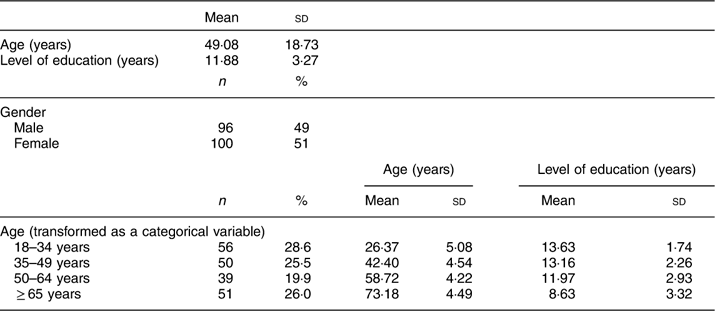
The sample population was composed of 196 men and women aged 18–82 years (see Table 2). Other sociodemographic factors included gender and level of education. To measure the latter, participants were asked the following question: ‘How many years of education have you completed?’ For instance, the French baccalaureate corresponds to 12 years of education (from the age of 6 to 18 years).
Details of the sample of consumers aged 18–82 years, Brittany, France (n 196)
Statistical analysis
First, to assess the level of legibility, descriptive statistics were conducted. Then, for the question of whether age has an influence on the legibility of packaging information, a series of ANOVA was carried out. The influence of age on the level of legibility of non-mandatory, mandatory and nutritional information was studied by distinguishing four age groups: 18–34, 35–49, 50–64 and ≥65 years. As complementary results, the interaction effect between age (categorical variable) and level of education (continuous variable) was examined. Regression analyses and univariate general models were used by including age as a fixed factor and level of education as a covariable. The statistical software package IBM SPSS Statistics 20 was used to conduct the analyses.
Results
Legibility of non-mandatory information
Out of a total of fifty-three legible units of information, consumers correctly read out fifty-two units on average, which corresponds to a legibility rate of 98 %. Furthermore, all individuals were able to read the brand name (see Table 3).
Impact of age on the legibility of information displayed on food labels (means of the ‘units of information’ read), according to information type, among a sample of consumers aged 18–82 years, Brittany, France

For this category of information, the impact of consumer age was not significant (P=0·644; see Table 4).
Impact of age on the legibility of information displayed on food labels (post hoc multiple comparison tests), according to information type, among a sample of consumers aged 18–82 years, Brittany, France (n 196)
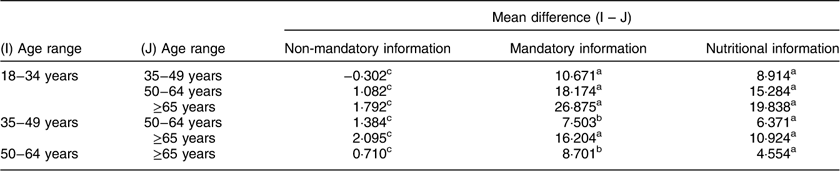
a P<0·001, b P<0·05, c P>0·05 (NS); Games–Howell post hoc test.
Legibility of mandatory information
Out of a total of fifty-five legible units of information, consumers correctly read out 37·5 units on average, which corresponds to a legibility rate of 68 % (see Table 3).
Moreover, it was observed that older age negatively influenced the legibility of the mandatory information. For example, the legibility rate for the youngest respondents was 93 %, whereas respondents aged ≥65 years only managed to read on average 44 % of the information (P<0·001; Table 4 presents all the significant differences between observed means).
Legibility of nutritional information
Out of a total of twenty-nine legible units of information, consumers correctly read out 10·5 units on average, which corresponds to a legibility rate of 36 % (see Table 3).
Moreover, it was observed that older age had a very strong and negative influence on the legibility of nutritional information. While the legibility rate for the youngest respondents was 72·5 %, for the 50–64 years age group it was only 20 % and this percentage fell drastically to 4 % for those aged ≥65 years, who only managed to read an average of one information unit (see Tables 3 and 4 for the significance levels).
Complementary results: interaction between age and level of education on level of legibility
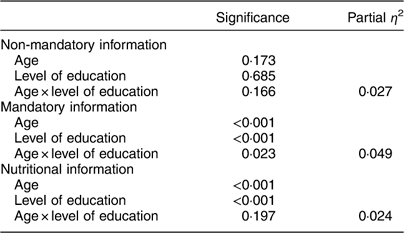
No significant effect was found for the influence of level of education on legibility of non-mandatory information. The interaction between age and education was also not significant.
For mandatory information, level of education had a positive and significant influence. Moreover, the interaction effect between level of education and age was significant (P=0·023; partial η 2=0·049, corresponding to moderate effect size). This effect was significant and positive for those aged ≥65 years. Among this age group, when individuals also had a high level of education, they were able to read more units of the mandatory information correctly: an individual with a 17-year education read on average thirty-one units of mandatory information correctly, whereas an individual with a 7-year education read on average 21·7 units of mandatory information correctly.
Finally, when considered alone, the influence of level of education on the legibility of nutritional information was positive and significant, but the interaction with age was not significant (P=0·197; see Table 5).
Complementary results: the interaction effect between age and level of education on the legibility of information displayed on food labels (regression analyses and univariate general models), according to information type, among a sample of consumers aged 18–82 years, Brittany, France (n 196)
Discussion
Results showed that the legibility of non-mandatory, mandatory and nutritional information was excellent, low and very low, respectively. Moreover, a highly significant effect of ageing was observed on the ability to read mandatory and nutritional information: at point of purchase, most of the older consumers were unable to read these two types of information. Furthermore, among these older consumers, results indicated an interaction effect between age and level of education on legibility.
Access to information is a fundamental consumer right. Article L121 of the French Consumer Act (Code de la consommation) clearly states that a commercial practice is misleading ‘if, taking into account the intrinsic limitations of the communication medium used and the circumstances surrounding it, it omits, conceals or supplies in an unintelligible, ambiguous or untimely manner any substantial information (…) the following pieces of information shall be regarded as substantial: 1. the main characteristics of the good or service …’ (translation ours).
Moreover, all public bodies recognize that consumer information is central to any public health prevention campaign. For instance, once consumers are made aware of the problems involved in maintaining a balanced diet following a nutritional information campaign (such as the French Bien dans ton assiette healthy diet and lifestyle campaign aimed at students) they will be more motivated to find out about mandatory (e.g. ingredients) and nutritional (e.g. calorie content) information, both of which should provide an objective description of a product’s main characteristics. In their review article on consumer response to nutritional information on food labels, Grunert and Wills( Reference Grunert and Wills 6 ) highlighted a high degree of consistency in consumer interest in nutritional information and in obtaining this information from nutrition labels on food products. If consumer information on foodstuff characteristics is both a right and an accountability tool, then it goes without saying that this information must, at the very least, be legible.
The present study showed that 95 % or more of the commercial information was read by all consumers questioned. Conversely, the type of information aimed at informing consumers about the content of a food product and warning them of any potential harmful health effects (mandatory and nutritional information) was less well read by all respondents and nearly illegible for the oldest ones, especially those with a low level of education. In the Elaboration Likelihood Model developed by Petty and Cacioppo( Reference Petty and Cacioppo 18 ), optimal information processing is achieved when the two conditions of motivation and ability are met. Although previous studies( Reference Grunert and Wills 6 ) have found that consumers are motivated to process food package information (e.g. nutritional information), the results of the present study reveal that even when the condition of motivation is fulfilled, lack of legibility prevents consumers from processing the information. In other words, the second condition of the above model, ability, cannot be fulfilled.
When the legibility rates of non-mandatory information (bearing in mind that all respondents were able to read the brand name) and mandatory and nutritional information are compared, it can be seen that the poor legibility of the last two information categories was due to the unsuitable typography selected for the food packages. Non-observance of basic typographic rules, e.g. the use of small print, seriously impairs, or sometimes even prevents, the legibility of some packaging information. More worrisome still is the choice of inadequately contrasting colours: this was observed several times during the study (e.g. red on a yellow or green background) and these combinations seemed to have been intentionally selected to impair legibility (for a classification of the legibility of colour combinations, see Fabre and November( Reference Fabre and November 19 )). The present study’s recognition of this lack of legibility of information – that is nevertheless essential for the consumer – supports the results of earlier studies carried out by Voordouw et al. that highlighted this lack of legibility in the case of allergens (which were sometimes also referred to by vague names)( Reference Voordouw, Cornelisse-Vermaat and Yiakoumaki 20 ).
Furthermore, the present study showed that the most vulnerable individuals, e.g. the elderly, for whom this nutritional information could be particularly useful due to the high rates of diet-related diseases (e.g. high cholesterol, diabetes, high blood pressure) in this age group, are almost all incapable of reading this information, regardless of their level of education. For example, among the older consumers, only one respondent aged 50 years or over managed to read the nutritional information on a packet of crisps and only three were able to read all of the ingredients. A considerable difference in legibility was observed between the three types of information and this is clearly a result of the disparate ways in which basic typography rules are implemented, according to the information to be communicated to the consumer. For example, for non-mandatory (commercial) information, the typography used is up to twenty times larger than for nutritional information and, in general, legibility-enhancing colour contrasts are used. These results are unprecedented because, as far as the authors are aware, no research on the legibility of food packages has yet been carried out with both young and old consumers.
As the European Union institutions have explicitly recognized, ‘food labels should be clear and understandable in order to assist consumers who want to make better-informed food and dietary choices. Studies show that easy legibility is an important element in maximising the possibility for labelled information to influence its audience and that illegible product information is one of the main causes of consumer dissatisfaction with food labels. Therefore, a comprehensive approach should be developed in order to take into account all aspects related to legibility, including font, colour and contrast’ (Recital 26 of the Preamble to Regulation 1169/2011( 3 )). The Regulation sets out that mandatory information shall be printed on the package or on the label ‘in such a way as to ensure clear legibility, in characters using a font size where the x-height is equal to or greater than 1·2 mm’. An exception is made for packaging or containers of less than 80 cm2, for which the x-height of the font size must be equal or greater than 0·9 mm. Furthermore, under the Regulation, ‘voluntary information shall not be displayed to the detriment of the space available for mandatory information’. In other words, food business operators must ensure that the mandatory information required to ‘empower’ consumers and to assist them in making healthier food choices is not hidden or otherwise made less prominent because of the presence of non-mandatory information on the package. Overall, the Regulation recognizes the importance of ensuring that food information is legible if it is to guide consumer food purchases. It should therefore help to address the shortcomings identified in the present study.
The current research also highlights the importance of an in situ study carried out at the point of purchase to help assess food business operators’ typographical packaging choices in a real-world purchasing context and to identify problems stemming from the physical environment. For example, it was found that when packaging information appeared in a metallic colour that was more or less legible in natural light during a pre-test, it became difficult to read under store lighting (this difference in legibility is linked to the phenomenon of metamerism in which the same colour changes when viewed under different light sources).
Studies in this field are scarce and there is still insufficient evidence to provide recommendations on the presentation of information. Nevertheless, based on both the founding work carried out by Tinker( Reference Tinker 11 , Reference Tinker 21 , Reference Paterson and Tinker 22 ) and the results of the present study, four recommendations can be made to optimize the legibility of packaging information. As previously mentioned, it is important to bear in mind that these recommendations are only likely to influence legibility of information if they are considered as a whole (e.g. any positive impact on legibility through increased font size could be cancelled out by the choice of an inappropriate contrasting colour). The recommendations are as follows:
-
1. use of a sufficiently large type (8 point minimum);
-
2. choice of text and background colour combinations that enhance legibility (e.g. black text on a white or yellow background)( Reference Fabre and November 19 );
-
3. spacing out of information to avoid regressions (backward-directed eye movements) and reading mistakes; and
-
4. avoidance of metallic colours that may severely impair the legibility of a text when read under artificial light.
The information provided on food packages that is deemed important by legislating bodies and which has subsequently become mandatory, is clearly unsatisfactory in terms of legibility. There appears to be a hierarchy between important (but non-mandatory) company information, such as brand name and slogan, that is legitimately promoted on food packages, and mandatory and nutritional information that is all but concealed to older and less educated consumers at the point of purchase.
Conclusions
The current research is the first in-store study to measure objectively the legibility of the information provided on food product labels. The originality of this research lies in the distinction of non-mandatory, mandatory and nutritional information and in the comparison of the level of legibility among younger and older adults. Results show a significant difference of legibility between young and older people for mandatory and nutritional information. However, there is no significant difference for non-mandatory information, as brand names were read by all individuals. In addition, an interaction effect was identified between age and level of education on the legibility of mandatory information. Individuals who are most vulnerable to health issues (the elderly with the lowest level of education) are impacted by low degrees of package information legibility. This can lead people to buy food products that are unhealthy or unsuitable for their diet.
The research had some limitations. First, further research is needed to gain a more in-depth understanding of the level of legibility of other food product labels. Second, studying consumers at the point of purchase is sometimes problematic due to customer constraints (time, presence of children, etc.) that could reduce their motivation to process the information. Third, it is possible that the performance of the older participants was affected by stereotype threat which created performance anxiety. Additional research should also include other individual variables such as reading habits (light v. heavy readers). Finally, as previous studies have highlighted, there is insufficient research on appropriate label size( Reference Hawley, Roberto and Bragg 23 ). Another avenue of research would be to conduct an experimental study using different packaging label designs to assess the optimal level of legibility.
Acknowledgements
Acknowledgements: The authors would like to thank the journal’s editor and reviewers for their constructive input during the review process and for the various areas of improvement they suggested. They further thank their colleague Amandine Garde for her very helpful comments. Financial support: This research received no specific grant from any funding agency in the public, commercial or not-for-profit sectors. Conflict of interest: None. Authorship: Both authors contributed equally to this work. Ethics of human subject participation: Approval by a medical ethics committee was not required. However, the individuals were informed about the purpose of the study and agreed to participate in the study.



