

Nubian dress: context and authority
Clothing can serve as a powerful tool to signify identity and position within society, extending from individual status to institutional authority, where costumes function as uniforms for secular and religious hierarchies. In medieval Christian Nubia, the Church and state were inextricably linked, and the authority of bishops and the monarchy was prominently displayed in church murals, notably from sites such as the cathedral of Faras (Jakobielski et al. Reference Jakobielski2017) and Sonqi Tino (Pasi Reference Pasi2013). The University of Warsaw’s ‘Costumes of Authority’ project analysed these depictions, alongside textual and material sources, with the aim of elucidating the complex relationship between Church and state in the Makurian kingdom (ninth–fourteenth centuries CE). Specifically, the project aims to decipher the non-verbal communication of these costumes, revealing insights into Church–state relations and external influences from Byzantium, Ethiopia and Muslim Egypt.
The Christianisation of Nubia (mid-sixth century CE) was a top-down process initiated by the Byzantine imperial court. While the exact details of conversion remain debated, the narrative (as given by John of Ephesos and other contemporaneous sources) suggests a strategic alliance where Nubian rulers received a new religion, assumed roles as religious leaders and gained a powerful northern ally. The ease of conversion may be explained by the pre-existing intertwining of religion and kingship in the earlier Meroitic Empire (c. 590 BCE–early fourth century CE), where kings were considered divine high priests (Török Reference Török1997: 234, 255–326). This precedent likely made the ‘package offer’ from Constantinople attractive to Nubian courts seeking to consolidate power in the post-Meroitic period (Obłuski Reference Obłuski2014: 175; Łajtar & Ochała Reference Łajtar, Ochała, Emberling and Williams2021: 788–89).
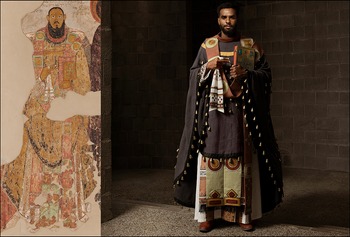
Despite Makuria’s eventual adherence to the anti-Chalcedonian Patriarchate of Alexandria following the unification with Nobadia in the early seventh century, a surprising visual trend is evident in episcopal dress. Nubian bishops, as depicted in the Faras Cathedral murals and other archaeological contexts, wore vestments that largely followed Byzantine liturgical tradition (Figure 1). This suggests that, while formal ecclesiastical authority stemmed from Alexandria, the visual language of power in the Church was strongly influenced by Constantinople or perhaps reflected the aesthetic preferences of the royal court. This observation raises questions about the dynamic behind the sartorial choices of dignitaries—whether driven by clergy, diplomatic ties or the self-representation of the monarchy.
Comparison of historical painting (eleventh century, Faras Cathedral; image courtesy of the National Museum, Warsaw) and reconstructed costume of Bishop Marianos (photograph by Paulina Matusiak & Eddy Wenting).

Royal attire and identity
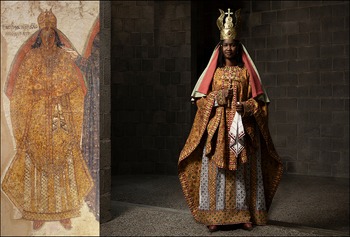
Similarly, royal court costumes provide crucial insights into the evolving relationship between Nubia and Byzantium. The earliest portrait of a Nubian king from the ninth century (Jakobielski et al. Reference Jakobielski2017: 188) shows similarities to early Byzantine imperial attire, particularly under Justinian I (reigned 527–565 CE), with features such as a chlamys (a woollen cloak) with a tablion (embroidered panel) and a Byzantine-like crown (Figure 2). However, a significant shift occurs in Nubian paintings from the eleventh century onwards as Byzantine characteristics gradually give way to more indigenous elements (Figure 3). This trend signifies a growing cultural self-awareness and a deliberate return to distinctly Nubian concepts within the Makurian monarchy. Within this same period, archaeological and textual evidence highlights the elevated status of the royal mother, typically the ruling king’s sister, who was destined to be the mother of his successor. For example, the portrait of the Royal Mother Martha (Figures 4 & 5) visually parallels divine motherhood with royal motherhood, emphasising the profound connection between royal and divine authority (Zielińska Reference Zielińska, Anderson and Welsby2014: 946–48; Jakobielski et al. Reference Jakobielski2017: 248–52).
Comparison of historical painting (tenth century, apse of Faras Cathedral; image courtesy of the National Museum, Warsaw) and reconstructed costume of an anonymous king (photograph by Paulina Matusiak & Eddy Wenting).

Comparison of historical painting (twelfth–thirteenth centuries, Faras Cathedral; image courtesy of the National Museum, Warsaw) and reconstructed costume of an anonymous king (photograph by Paulina Matusiak & Eddy Wenting).

Comparison of historical painting (tenth century, Faras Cathedral; photograph by C. Calaforra-Rzepka, courtesy of the Sudan National Museum, Khartoum) and reconstructed costume of the Royal Mother Martha (photograph by Paulina Matusiak & Eddy Wenting).

Comparison of historical painting (twelfth–thirteenth centuries, Faras Cathedral; photograph by C. Calaforra-Rzepka, courtesy of the Sudan National Museum, Khartoum) and reconstructed costume of an anonymous royal mother (photograph by Paulina Matusiak & Eddy Wenting).

Experimental reconstruction
A key innovative aspect of the project involved the experimental reconstruction of five representative costumes: two kings, two royal mothers and a bishop (Figures 1, 2, 3, 4 & 5). This process was based on archaeological evidence, particularly the analysis of archaeological textiles found in Nubia, which provided crucial data on fibres, dyes and decorative patterns (weave, embroidery, stamps) (Wozniak et al. Reference Wozniak2021). Chemical analysis identified specific plant-based dyes, which were then used in these experimental dyeing processes by Katarzyna Schmidt-Przewoźna (SWPS University) (Figure 6). Based on these findings, fabrics were produced and fashioned into the five costumes by Dorothée Roqueplo (SWPS University).
Samples of contemporary linen, silk and wool dyed using natural plants and mordants (substances used to fix colours) (figure by authors).

The primary goal of this experimental archaeological phase was to understand the embodied experience of these costumes—how they influenced the wearers’ movements and their visual effect on observers. Models wearing the reconstructions adopted a more dignified bearing and public audiences of the shows in the Louvre (Paris), the Bode-Museum (Berlin) and SOAS (London) were visibly impressed by the authority conveyed. This innovative method deepens academic understanding of costume as a medium of power and effectively translates complex archaeological research into an accessible experience for both scholarly and broader audiences. The nuances reflected in costume developments are, in a sense, a visual chronicle of the aspirations of Nubian authorities and of the relationship between the kingdom’s leaders and the Church. In the absence of extensive written sources, these observations enrich our understanding of Christian Nubia. Both the immaterial aspects of image and the reconstructions provide insights into this historical context.
Conclusion
An analysis of the development of the Nubian costumes shows that, initially (until about 1000 CE), there was a strong influence from Byzantine dress, indicating that the relationships between Church and state in the Byzantine empire were considered an example for Nubia. After that, the costumes of the court elite, in contrast to the ecclesiastical hierarchy, show more Indigenous characteristics, a sign of growing cultural self-confidence. Divine kingship was an important element in the pre-Christian cultures of the Nile Valley, and in Christian Nubia a certain dominance of the royal court over ecclesiastical matters must have been maintained. This is evident from the prominent places that royal portraits occupy in church interiors, as well as from royal influence on liturgical dress. Although the Nubian Church was under the authority of the Coptic Patriarchate of Alexandria, the priests and bishops were dressed according to Byzantine tradition, probably influenced by the kings, for whom Byzantium was an initial role model.
Funding statement
NCN-Polonez project No. 2021/43/P/HS3/00764, co-funded by the National Science Centre, European Union’s Horizon 2020 research and innovation programme under the Marie Skłodowska-Curie grant agreement no. 945339.