
Hostname: page-component-77c78cf97d-lmk9j Total loading time: 0 Render date: 2026-04-24T02:54:14.292Z Has data issue: false hasContentIssue false

Highly efficient phase transfer catalyst supported on Janus composite particles: Synthesis, characterization, and applications

Published online by Cambridge University Press:  20 June 2014

Qinhui Chen*
Affiliation:
College of Material Science and Engineering, Fujian Normal University, Fuzhou 350007, China; and Fujian Key Laboratory of Polymer Materials, Fuzhou 350007, China
Longhui Zheng
Affiliation:
College of Material Science and Engineering, Fujian Normal University, Fuzhou 350007, China
Baoling Chen*
Affiliation:
College of Material Science and Engineering, Fujian Normal University, Fuzhou 350007, China
Junhui He*
Affiliation:
College of Material Science and Engineering, Fujian Normal University, Fuzhou 350007, China
Haibin Huang
Affiliation:
College of Material Science and Engineering, Fujian Normal University, Fuzhou 350007, China
Jinhuo Lin
Affiliation:
College of Material Science and Engineering, Fujian Normal University, Fuzhou 350007, China; and Fujian Key Laboratory of Polymer Materials, Fuzhou 350007, China
*
a) Address all correspondence to this author. e-mail: chenqh@fjnu.edu.cn
Get access

Abstract

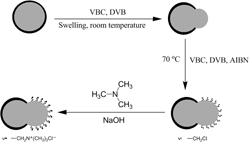
Groups of chloromethyl were randomly grafted to Janus composite particles and quaternization was carried out on the particles. The Janus material of titania–quaternary ammoniated poly(vinylbenzyl chloride–divinylbenzene) (TiO2–QApoly(VBC–DVB)) was investigated in detail. Results revealed that the anisotropic Janus material containing quaternary ammonium groups was synthesized successfully. The Janus material could be used as the phase transfer catalyst. The catalytic activity of the Janus material was confirmed by the esterification reaction of benzyl chloride and sodium acetate. In the presence of 0.5 wt.% (relative to benzyl chloride) of TiO2–QApoly(VBC–DVB), the esterification yield of benzyl acetate reached 87.6% when the molar ratio of sodium acetate anhydrous to benzyl chloride was 1.2. The catalyst exhibited a high activity and had no obvious loss of activity when recycled three times. Moreover, the Janus material was easily recovered by centrifugation and washed with ethanol and water.

Information

Type
Articles
Copyright
Copyright © Materials Research Society 2014 

Access options

Get access to the full version of this content by using one of the access options below. (Log in options will check for institutional or personal access. Content may require purchase if you do not have access.)

Article purchase

Temporarily unavailable