


1. Introduction
Tackling the complex challenges of sustainable engineering design requires more than individual expertise—it demands a collaborative, multidisciplinary approach (Reference D’Escoffier, Guerra and BragaD’Escoffier et al., 2024). To prepare the next generation of engineers for this reality, higher education must not only teach technical skills but also foster the ability to work effectively within diverse teams, ensuring future engineers to be equipped to create sustainable solutions that address societal and environmental needs.
The importance of sustainability in product development has reshaped priorities across industries, driven by a rising awareness of environmental and social responsibility. As companies face pressure to adopt sustainable practices, there is an urgent need for engineers educated in the principles of sustainable product design. Sustainable Product Development (SPD) is a comprehensive approach that integrates environmental considerations in the early phase of product development, addressing economic, social, and environmental dimensions. The presented ‘Sustainable Product Development’ module for Master’s students aims to bridge these concepts into higher education, equipping future engineers with the skills to implement them effectively in their professional practice.
The complexity and interdisciplinary nature of sustainability in engineering design cannot be adequately addressed by traditional lectures alone (Reference Wiek, Withycombe and RedmanWiek et al., 2011). The field is facing many challenges in practice and science and needs alternative teaching methods to provide a comprehensive picture of sustainability in engineering design. In the proposed educational concept, lectures are accompanied and integrated with practical exercises and interactive learning activities that encourage student participation and engagement, promoting a deeper understanding of concepts.
The paper explores how sustainability aspects can be effectively integrated into product design education at the master’s level through a structured teaching approach. Specifically, it examines whether combining traditional teaching methods (frontal lectures) with interactive approaches (flipped classroom, exercises, and guest lectures) ensure the learning experience and fosters sustainability competencies in engineering students. The proposed educational module is designed to offer an innovative framework that balances theoretical foundations with practical applications.
By engaging in a mix of lectures and hands-on activities, students develop the ability to critically assess product sustainability across the life cycle, identify strategies to minimize environmental impact, and navigate trade-offs between sustainability and traditional engineering requirements. Through this approach, the course aims to not only provide theoretical knowledge but also equip students with practical skills essential for real-world engineering challenges.
2. State of the art
The industrial progress has brought a multitude of benefits, yet it has also given rise to problems pertaining to the environment, society, and economics. These interrelated issues can be understood within the broader concept of sustainability and are considered as the three fundamental pillars (Reference BasiagoBasiago, 1999). Consequently, the adoption of sustainable practices represents a crucial strategy for effectively addressing and mitigating these issues (Reference Purvis, Mao and RobinsonPurvis et al., 2019b). The most effective methodology for the implementation of sustainable practices is the incorporation of these principles in the product development phase (Reference Liu, Li, Li, Huang and TangLiu et al., 2019). This allows the consideration of environmental, social, and economic aspects starting from the design phase, facilitating the integration of sustainable principles throughout the entire lifecycle of the product. The most significant potential to influence the product’s environmental impact lies in fact in the early stages of development, particularly during the design phase becoming evident in the subsequent stages of the product life-cycle (Reference Rebitzer, Ekvall, Frischknecht, Hunkeler, Norris, Rydberg, Schmidt, Suh, Weidema and PenningtonRebitzer et al., 2004).
It is therefore of paramount importance to embed these sustainability concepts into higher engineering education, providing future engineers and designers with the skills needed. Traditional teaching methods, often centered on frontal lectures, are insufficient for addressing the complexity and interdisciplinary nature of sustainability. Instead, there is a need to adopt more interactive and practical approaches for active participation and critical thinking. Anderson’s revised learning taxonomy provides a fitting framework for this, emphasizing activities that move beyond knowledge acquisition to application, analysis, and creation.
2.1. Sustainability in product development
SPD integrates environmental, social, and economic perspectives into the design and development of products to reduce negative impacts throughout their lifecycle (Reference Delaney, Liu, Zhu, Xu and DaiDelaney et al., 2022). It emphasizes the need for holistic thinking in product design and development, integrating sustainability requirements while maintaining functionality, cost-effectiveness, and quality (Reference VezzoliVezzoli, 2018). These key considerations have led to the development of Design for X strategies (Reference MesaMesa, 2023). Each of these strategies targets specific features that enhance a product’s sustainability and promote its alignment with circular economy.
Recent advancements in SPD highlighted the importance of proactive strategies in the early design phase, where decisions on materials, production methods, and end-of-life management have the most significant influence on a product’s overall sustainability performance. A research by Vilochani et al. emphasizes that the integration of sustainability requires alignment across technical, organizational, and strategic levels within companies, enabling the transition from traditional product development to sustainability-driven processes (Reference Vilochani, McAloone and PigossoVilochani et al., 2024). Recent research efforts include integrating and managing sustainability assessment in development processes, fueled by new possibilities of digitalization (Reference Arnemann, Winter, Quernheim and SchleichArnemann et al., 2023; Reference Winter, Osterod and SchleichWinter et al., 2024). Hallstedt et al. further underline the importance of integrating sustainability considerations into product innovation processes, particularly in industries facing stringent environmental regulations and market pressures to adopt sustainable practices, enabling designers and engineers to create products that are both sustainable and competitive in the market (Reference Hallstedt and NylanderHallstedt & Nylander, 2019).
2.2. Sustainable development in higher education
Higher education plays a pivotal role in fostering sustainability competencies among future professionals. A study by Kattwinkel et al. emphasizes the growing focus on incorporating sustainability into higher education (Reference Kattwinkel, Song and BenderKattwinkel et al., 2018). Their analysis examines the extent to which current engineering curricula address ecodesign and sustainable design, revealing significant gaps and stressing the need for comprehensive integration of sustainability topics.
The Blue Engineering course at TU Berlin, foregrounds an interdisciplinary and student-led approach to sustainability education (Reference NeefNeef, 2018). Its modular structure allows participants to critically engage with the interplay of technology, nature, society, and individual responsibility through interactive learning units, fostering key competencies for sustainable engineering practice. They also compared various approaches to integrate sustainability in engineering education, showcasing innovative teaching concepts and encouraging other universities to adopt similar strategies (Reference Kattwinkel, Heide, Syré, Grahle, Bender and GöhlichKattwinkel et al., 2021b).
McAloone & Pigosso emphasize the importance of integrating sustainability into product development education, highlighting its role in transitioning from ecodesign to more systemic sustainable product/service-systems (Reference McAloone, Pigosso, Stark, Seliger and BonvoisinMcAloone & Pigosso, 2017).
Furthermore, Hallstedt et al. developed the “Sustainability Fingerprint” methodology, guiding companies in anticipating sustainability directions during early design phases (Reference Hallstedt and NylanderHallstedt et al., 2023). This approach exemplifies how integrating sustainability considerations at the educational level can prepare future engineers to implement such methodologies in their professional practice.
2.3. From Bloom´s learning taxonomy to Anderson´s revised taxonomy
The evolution from Bloom’s original taxonomy (Bloom, 1956) to Anderson’s revised taxonomy (Reference Anderson and AbridgedAnderson, 2001) marks a significant shift in defining educational objectives. The updated taxonomy emphasizes a more dynamic learning process, where active categories replace static ones, with “Synthesis” replaced by “Create” and elevated to the top of the hierarchy, emphasizing creative thinking as the highest cognitive skill.
This shift matches with the concept of constructive alignment, first introduced by Biggs et al. in 1982, which emphasizes structuring learning outcomes to promote deeper cognitive engagement. By aligning teaching activities and assessment methods with intended learning outcomes, this approach creates a coherent and effective learning environment (Reference Biggs and CollisBiggs & Collis, 1982). The implementation of constructive alignment principles in higher education was further developed in Biggs’ later work which highlights the role of active and interactive learning tasks, such as hands-on exercises and flipped classroom approaches, in fostering deeper understanding and critical thinking (Reference BiggsBiggs, 2003 (2nd edition)).
Anderson´s revised taxonomy

2.4. Interactive education methods
Interactive and experiential education methods are essential to integrate sustainability into product development in higher education. Active learning techniques, such as software-oriented exercises, enable students to apply theoretical concepts to practical problems, bridging the gap between knowledge acquisition and real-world application (Reference LovettLovett, 2020).
The flipped classroom approach represents another innovative method, where students prepare independently by engaging with current scientific literature and then participate in class discussions and collaborative activities. This approach has shown significant benefits in disciplines like engineering, where complex problem-solving is critical (Reference Baig and YadegaridehkordiBaig & Yadegaridehkordi, 2023). Zhang et al. demonstrate the growing adoption of FC in STEM fields (Science, Technology, Engineering, and Mathematics), highlighting its potential for integration into sustainability-related curricula (Reference Zhang, Wang, Zhang, Sun, Heide, Kattwinkel, Mulhern, Plakantonaki, Purvis and ZhangZhang et al., 2024).
In sustainability education, affective learning goals are crucial for shaping students’ attitudes, values, and motivations, fostering long-term commitment to sustainable practices. (Reference Heide, Syré, Grahle, Göhlich, Kattwinkel and BenderHeide et al., 2023a) Designing learning outcomes that combine cognitive, affective, and psychomotor objectives ensures a holistic educational experience that equips students with both the technical and ethical foundations.
Additionally, the industry survey conducted by Vilochani reveals the current state of sustainability integration in product development (Reference Vilochani, McAloone and PigossoVilochani et al., 2024). Their findings highlight the importance of interactive education methods in bridging the gap between academic knowledge and industry practices.
3. Module design - sustainable product development
3.1. Learning objectives
Following Anderson’s learning taxonomy and the principles of constructive alignment, the goals of the module ensure harmony between intended outcomes, teaching methods, and assessment tasks. This approach aligns all course elements to support the development of the skills and knowledge students need to achieve the desired outcomes (Reference Biggs and CollisBiggs & Collis, 1982).
To define these objectives, a structured approach was taken. First, an extensive literature research was conducted, particularly drawing from the review by Reference Kattwinkel, Heide, Syré, Grahle, Bender and GöhlichKattwinkel et al. (2021), which examines the integration of sustainability in engineering education and highlights key competencies required in this field. Consultation with academic experts was also carried out, including interviews and workshops with Academics who have experience in teaching sustainability-related courses at the master’s level. These discussions helped to identify the most essential skills and knowledge areas that students should acquire.
Finally, the Guidelines from the Center for Competence for Adults and Trainers (wb-web.de) were followed to ensure that learning objectives were clearly structured and addressed different cognitive levels of Anderson’s revised learning taxonomy (Reference Kahle and ReginaKahle & Regina, 2016). Every verb addresses one of the six different cognitive levels of Anderson’s revised learning taxonomy.
In particular, on successful completion of this module, students should be able to:
-
Explain (2) the concept of sustainability.
-
Explain (2) sustainability in product development and creation.
-
Describe (2) the most important tools and methods of product development.
-
Explain (2) the significance of Ecolabels and classify (4) key sustainability standards and laws.
-
Analyze (4) material and energy flows and apply (3) methods for their calculation.
-
Apply (3) sustainability assessment tools to quantify and evaluate (5) the environmental impact of products or processes over their entire life cycle.
-
Collect (3) the data relevant for a life cycle assessment (LCA) and classify (4) it in terms of quality.
-
Make (6) informed decisions when balancing competing requirements related to sustainability.
-
Classify (4) business models and evaluate (5) their role in marketing and financing sustainable products.
3.2. Course structure and content
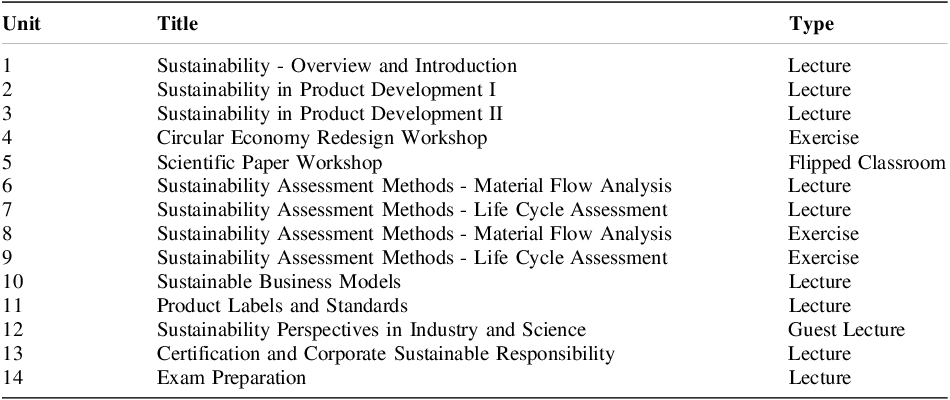
The course is structured into 14 units, each devoted to a single field but interrelated with the other units within the complex and interdisciplinary domain of sustainability. The teaching method employs a multifaceted approach, integrating interactive elements, flipped classroom techniques and practical exercises to theoretical frontal lectures. In addition, the student engagement and involvement is further stimulated by the inclusion of brief, pertinent questions at regular intervals.
Figure 2 illustrates the conceptual structure of the course, underscoring the interplay between key topics and methodologies. The “Sustainability Definition” represents the core of the module, ensuring students understand the fundamental principles of sustainability. This teaching is complemented by practical exercises and interactive learning approaches, represented by the arrows, which emphasize the active engagement of students in the learning process. The concentric circles embracing “Sustainability Definition,” represent the progression of topics and how they build upon each other.
Conceptual structure of the course: key topics and their interconnections

The “Sustainability Definition” serves as the foundational principle of the course, offering a comprehensive exploration of the concept of sustainability. The module starts with the focus on delineating the concept of sustainability and undertakes an examination of its core dimensions with an overview of the main theoretic models, such as the three-pillar model (Reference BasiagoBasiago, 1999). Moreover, the Sustainable Development Goals (SDGs) ( THE 17 GOALS | Sustainable Development, 2024) and various European initiatives are also introduced to illustrate their transition into the process of policymaking. The course then shifts from sustainability theory to its practical application in product development. The product development phase is identified as the most critical for sustainability (Reference Liu, Li, Li, Huang and TangLiu et al., 2019), with a shift from a linear to a circular economy through various R-strategies (Reference TambovcevaTambovceva, 2020). Design for X (DfX) is introduced as a foundation for sustainable design, emphasizing Design for Sustainability (DfS) (Reference Ceschin and GaziulusoyCeschin & Gaziulusoy, 2016).
The next part of the module focuses on methodologies to understand and quantify the environmental impacts of products and processes. With the help of practical applications, students are introduced to key sustainability assessment methods and tools including Material Flow Analysis (MFA) (Reference Bartelmus and SeifertBartelmus & Seifert, 2018), Carbon footprint and the most comprehensive Life Cycle Assessment (LCA).
Building on the tools and methods, the course transitions to examining how sustainability principles can be integrated into business practices, covering circular economy models (Reference Bocken, Short, Rana and EvansBocken et al., 2014), product-as-a-service and sustainable value creation to illustrate the intersection of engineering decisions with business strategies.
The course builds upon the foundation of sustainable business models, exploring the role and purpose of sustainability labels and standards for products. The course also examines how sustainability labels, standards, and certifications contribute to transparency and accountability in sustainable business practices, as represented in the outermost circle of Figure 2. Moreover, a guest lecture by an industry expert offers practical insights into sustainable business practices, complementing the theoretical concepts covered in class.
3.3. Exercises and flipped classroom
The module incorporates various interactive learning elements, including hands-on exercises and a flipped classroom, to actively engage students and deepen their understanding of sustainability concepts. Unit 4 (Redesign Exercise) and Unit 9 (LCA Exercise) are both based on the same exemplary product: the pneumatic cylinder. This component was chosen as an overarching example due to its relevance in industrial applications, ensuring students engage with a highly industry-relevant mechanical product while addressing sustainability challenges in design and lifecycle analysis.
3.3.1. Circular economy redesign exercise
In this exercise, students are tasked with applying Design for X (DfX) and circular economy redesign strategies to enhance the sustainability of a mechanical product. For the first iteration of the course, a pneumatic cylinder was selected due to its balanced complexity and relevance to industrial applications. This exercise builds directly on the concepts and strategies introduced in earlier lectures, particularly Lectures 2 and 3.
To support the redesign process, students are provided with a detailed technical drawing of the pneumatic cylinder. This serves as the primary design reference, guiding students in analyzing the existing product architecture and identifying opportunities for sustainability improvements.
The pneumatic cylinder exercise requires students to critically assess key components, such as the aluminium housing, steel piston rod, and polyurethane seals, with the objective of enhancing sustainability. Using the technical drawing as a reference, they explore modifications that lower the material-related carbon footprint, improve modularity to facilitate disassembly, and enhance recyclability. The structured nature of the task encourages a lifecycle-oriented approach, prompting students to evaluate environmental impacts from resource extraction and manufacturing to usage and end-of-life handling. Through this hands-on activity, students engage with real-world engineering products, balancing sustainability objectives with traditional design requirements such as performance and cost. By working directly with the provided technical drawing, they gain practical experience in interpreting engineering documentation while integrating circular economy principles into the redesign process.
3.3.2. Material flow analysis exercise
The second key exercise focuses on the practical application of Material Flow Analysis (MFA) to a relatable and familiar context: the coffee-brewing process with a filter coffee-machine. This exercise builds on the principles of MFA and Life Cycle Assessment (LCA) introduced in earlier lectures. Acting as sustainability managers for a brewing company, students work in groups of four to five during a 90-minute session to model material flows within a single brewing cycle.
Students begin by collecting data on material inputs, outputs, and waste production, followed by constructing a process flow diagram to define system boundaries and analyze key sub-processes: grinding, heating water, and brewing coffee. Using tools such as Sankey diagrams, students visually represent their findings to highlight areas of resource loss and identify opportunities for optimization.
The exercise reinforces MFA principles and challenges students to propose design improvements while developing essential skills in material tracking, visualization, and efficiency analysis.
3.3.3. Life cycle assessment exercise
In a complementary exercise, students apply LCA principles to the pneumatic cylinder from the earlier redesign task (3.3.1). Students use a simplified database to compile the Life Cycle Inventory (LCI) and calculate the carbon footprint of the cylinder across its lifecycle. This exercise quantifies the overall environmental impact of the product while reinforcing theoretical concepts and demonstrating the practical applications of LCA. Students conclude by presenting their findings, further developing their ability to communicate insights derived from sustainability assessment tools effectively.
3.3.4. Flipped classroom
In this session, students work in groups of four or five, analysing scientific articles on topics such as DfX, sustainability assessment methods and circular economy concepts like Product-as-a-Service. These articles, provided a week in advance, are accompanied by a task sheet containing comprehension questions to guide their critical reading.
During the session, each group presents its findings and critical reflections, addressing the main messages, strengths, and weaknesses of the assigned article. These presentations serve as the foundation for broader discussions moderated by the professor and teaching assistants, with work sheet encouraging connections to the overarching themes of the module. By exchanging perspectives, students gain a deeper understanding of complex sustainability topics, enriching their overall learning experience and equipping them with essential skills for their professional development.
3.4. Module conclusion ‐ exam and overview
The module concludes with a lecture summarizing the key concepts and methodologies discussed throughout the course, consolidating students’ understanding and preparing them to demonstrate their acquired knowledge and skills in the final assessment. The 90-minute written examination evaluates both theoretical knowledge and practical application, with 50% of the questions focused on knowledge recall and 50% on transfer and application tasks. Open-ended questions and computational tasks derived from the hands-on exercises provide students with opportunities to demonstrate their ability to apply concepts such as Material Flow Analysis (MFA) and Life Cycle Assessment (LCA). This format encourages critical thinking and the ability to integrate sustainability principles into real-world contexts.
The table below provides an overview of the SPD module.
Overview of the SPD module units

4. Evaluation
After concluding the module, an assessment was conducted via the internal evaluation system to evaluate the content and efficacy. The objective of the evaluation was to assess the students’ ability to comprehend and apply sustainability concepts in the context of sustainable product development. The evaluation of the module revealed that it attracted participants from 12 different nationalities, thereby fostering a diverse and intercultural learning environment.
The evaluation was based on a comprehensive grading system employing a Likert scale ranging from 1 to 5, where higher values indicate a lower level of agreement with the statements, while lower values reflect stronger agreement (Reference MichalosMichalos, 2014). A rating of 5 indicates that the statement does not apply or is strongly disagreed with, whereas a rating of 1 signifies full applicability or strong agreement. Intermediate values represent varying degrees of agreement or applicability. The section concerning course requirements and workload features a slightly different scale. The mean values offer insights into students’ perceptions of various aspects of the course, including the clarity of course content, the effectiveness of digital teaching methods, students’ learning outcomes, and the perceived difficulty and workload of the course.
The results of the course evaluation suggest that the materials provided for the course were well adapted to it, and that the examples used were meaningful in illustrating key concepts. While the explanations of complex topics were generally clear, there is some room for improvement in making certain challenging areas more accessible. The examination-relevant topics were well identified, and the participants found the course structure and learning objectives to be well-organized and clearly defined. The digital teaching format was regarded as suitable for conveying learning objectives, and participants expressed satisfaction with their learning outcomes from digital participation. Overall, the course was positively evaluated, with participants demonstrating confidence in answering subject-related questions and a solid understanding of the course content. The results indicate that, subsequent to participation in the course, a significant number of participants expressed the belief that they had acquired the capacity to effectively summarize the course’s key topics, indicative of a comprehensive understanding of the material. The course’s pace was perceived as somewhat demanding; however, the level of difficulty was generally aligned with the subject matter, providing an appropriate balance of challenge for learners.
5. Discussion
The newly developed module on SPD introduces innovative approaches to preparing students for addressing sustainability challenges. While its first implementation is ongoing and formal evaluation is pending, initial observations highlight its potential and indicates areas for improvement.
Modern teaching methods, such as the flipped classroom and interactive exercises, have shown promise in fostering engagement and active learning. However, challenges like varying student preparedness and resource demands indicate the need for further refinement. Student feedback suggests that the course materials and content delivery were well-structured and aligned with the intended learning objectives, reinforcing the effectiveness of the teaching approach. Additionally, the incorporation of digital teaching elements, including live streams and recordings, was positively received, further supporting the alignment between intended learning objectives and teaching methods.
The guest lecture, while adding valuable real-world perspectives and sparking innovative discussions, presents some challenges. Although it offers students a unique opportunity to engage with industry practices, the limited control over the quality and alignment of the lecture content with the course objectives may impact its effectiveness. The integration of sustainable business models and the independent guest lecture encourage critical thinking by linking engineering decisions to economic and environmental outcomes and providing real-world perspectives on sustainability practices. Early activities suggest these topics spark innovative ideas and deepen understanding of future challenges. Student feedback on their learning experience suggests a generally positive reception; however, the absence of direct assessment results from the written exam limits a full validation of learning outcomes. The analysis of exam results will provide additional insights into the extent to which students have achieved the intended learning objectives, complementing the positive student feedback received so far.
Collaboration is a cornerstone of the module, aligning with the principle that design is a team sport. Team-based exercises promote interdisciplinary exchange, though managing diverse student expertise remains an ongoing challenge.
Future directions include scaling the module for broader use, incorporating advanced tools like software and databases, and fostering cross-institutional collaboration. Formal evaluations will provide critical feedback to refine the course and ensure that it continues to equip students with the skills, knowledge, and mindset needed to address complex sustainability challenges in engineering design.
6. Conclusion
The SPD module was designed to provide a comprehensive education on integrating sustainability into product development by combining theoretical knowledge, practical exercises, and interactive learning methods. A review of the course content and structure confirms that all the defined learning objectives are thoroughly addressed. Students can explain sustainability concepts, apply tools like LCA and MFA, analyze material flows, and evaluate business models, ensuring alignment between the learning outcomes and the course design. The balanced approach of theory and practice supports students in developing the competencies required to tackle real-world sustainability challenges in their professional careers. Based on the course evaluation results, we can conclude that constructive alignment has been partially demonstrated.
The evaluation supports the alignment between Intended Learning Objectives (ILOs) and Teaching & Learning Activities (TLAs), as students positively rated the clarity of objectives, course structure, and interactive learning methods. While the evaluation supports alignment between Intended Learning Objectives (ILOs) and Teaching & Learning Activities (TLAs), further validation through exam performance analysis will provide a more comprehensive assessment of learning outcomes. Future work will involve assessing the exam performance to confirm whether students have successfully met the learning objectives, thereby completing the validation of constructive alignment in the SPD module.



 Open access

