







1. Introduction
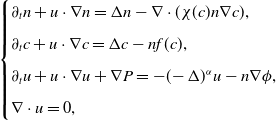
We investigate the evolution of cells (e.g. bacteria) with chemical signals in viscous incompressible fluids, which can be described by the chemotaxis-Navier–Stokes system with generalised fluid dissipation:
 \begin{equation} \begin{cases} \partial _t n+u\cdot \nabla n=\Delta n- \nabla \cdot (\chi (c)n \nabla c),\\[5pt] \partial _t c+u \cdot \nabla c=\Delta c-nf(c),\\[5pt] \partial _t u +u \cdot \nabla u+\nabla P=-(\!-\Delta )^\alpha u-n\nabla \phi, \\[5pt] \nabla \cdot u=0, \end{cases} \end{equation}
supplemented with the initial condition
 \begin{equation} \left (n(t,x), c(t,x), u(t,x)\right )|_{t=0}=\left (n_0(x), c_0(x), u_0(x)\right ), \quad x\in \mathbb{R}^3. \end{equation}
Here $n=n(t,x)\;:\; \mathbb{R}^{+}\times \mathbb{R}^3\rightarrow \mathbb{R}^{+}$
,
$n=n(t,x)\;:\; \mathbb{R}^{+}\times \mathbb{R}^3\rightarrow \mathbb{R}^{+}$
, $c=c(t,x)\;:\;\mathbb{R}^{+}\times \mathbb{R}^3\rightarrow \mathbb{R}^+,$ $u=u(t,x)\;:\;\mathbb{R}^{+}\times \mathbb{R}^3\rightarrow \mathbb{R}^3$
and
$u=u(t,x)\;:\;\mathbb{R}^{+}\times \mathbb{R}^3\rightarrow \mathbb{R}^3$
and $P=P(t,x)\;:\;\mathbb{R}^{+}\times \mathbb{R}^3\rightarrow \mathbb{R}$
denote the density of the bacteria (cell) population, the concentration of the oxygen (chemotactic signal), the velocity of the fluid and the pressure, respectively.
$P=P(t,x)\;:\;\mathbb{R}^{+}\times \mathbb{R}^3\rightarrow \mathbb{R}$
denote the density of the bacteria (cell) population, the concentration of the oxygen (chemotactic signal), the velocity of the fluid and the pressure, respectively. $f(c)$
and
$f(c)$
and $\chi (c)$
stand for the oxygen consumption rate and the chemotactic sensitivity, respectively.
$\chi (c)$
stand for the oxygen consumption rate and the chemotactic sensitivity, respectively. $\phi =\phi (x)$
denotes the potential function arising from different physical mechanisms. In addition, the generalised Laplace operator
$\phi =\phi (x)$
denotes the potential function arising from different physical mechanisms. In addition, the generalised Laplace operator $(\!-\Delta )^\alpha$
is defined by
$(\!-\Delta )^\alpha$
is defined by
 \begin{equation*}{\widehat {(\!-\Delta )^\alpha f}}(\xi )=|\xi |^{2\alpha } \widehat f (\xi ).\end{equation*}
When $\alpha =1$
, the system (1.1) reduces to the classical chemotaxis-Navier–Stokes model, originally introduced by Tuval et al. [Reference Tuval, Cisneros, Dombrowski, Wolgemuth, Kessler and Goldstein49] to simulate the dynamics of swimming bacteria such as Bacillus subtilis. Experimental studies indicate that bacteria migrate towards regions with higher oxygen concentrations to obtain energy. This bacterial movement also affects the motion of the surrounding fluid. Moreover, both bacteria and oxygen are transported through water via the fluid.
$\alpha =1$
, the system (1.1) reduces to the classical chemotaxis-Navier–Stokes model, originally introduced by Tuval et al. [Reference Tuval, Cisneros, Dombrowski, Wolgemuth, Kessler and Goldstein49] to simulate the dynamics of swimming bacteria such as Bacillus subtilis. Experimental studies indicate that bacteria migrate towards regions with higher oxygen concentrations to obtain energy. This bacterial movement also affects the motion of the surrounding fluid. Moreover, both bacteria and oxygen are transported through water via the fluid.
It should be noted that (1.1) with fractional Laplacian operators ( $0\lt \alpha \lt 1$
) is physically relevant. Replacing the standard Laplacian operator, these fractional diffusion operators model the so-called anomalous diffusion, a topic that has been extensively explored in physics, probability theory, and finance (see, for instance, [Reference Abe and Thurner1, Reference Jara19, Reference Mellet, Mischler and Mouhot35]). The deployment of fractional diffusion operators in (1.1) enables the study of long-range diffusive interactions. In addition, (1.1) with hyper-viscosity (
$0\lt \alpha \lt 1$
) is physically relevant. Replacing the standard Laplacian operator, these fractional diffusion operators model the so-called anomalous diffusion, a topic that has been extensively explored in physics, probability theory, and finance (see, for instance, [Reference Abe and Thurner1, Reference Jara19, Reference Mellet, Mischler and Mouhot35]). The deployment of fractional diffusion operators in (1.1) enables the study of long-range diffusive interactions. In addition, (1.1) with hyper-viscosity ( $\alpha \gt 1$
) is employed in turbulence modelling to regulate the effective range of non-local dissipation and to make more efficient numerical resolutions (see, e.g. [Reference Frisch, Kurien, Pandit, Pauls, Ray, Wirth and Zhu15]).
$\alpha \gt 1$
) is employed in turbulence modelling to regulate the effective range of non-local dissipation and to make more efficient numerical resolutions (see, e.g. [Reference Frisch, Kurien, Pandit, Pauls, Ray, Wirth and Zhu15]).
The classical chemotaxis-Navier–Stokes equations, i.e. $\alpha =1$
, have been studied extensively with many significant results. Quite a lot of important progress has been made on initial boundary value problems for the chemotaxis-(Navier)–Stokes system, cf. [Reference Cao and Lankeit5, Reference Ke and Zheng22, Reference Lankeit27, Reference Lorz33, Reference Peng and Xiang39, Reference Tao and Winkler48, Reference Wang51--Reference Wang and Xiang54, Reference Winkler57--Reference Winkler59, Reference Winkler61--Reference Winkler63, Reference Zhang and Zheng68] and references therein. Concerning the Cauchy problem, Duan et al. [Reference Duan, Lorz and Markowich10] studied the global existence and decay rates of classical solutions over
$\alpha =1$
, have been studied extensively with many significant results. Quite a lot of important progress has been made on initial boundary value problems for the chemotaxis-(Navier)–Stokes system, cf. [Reference Cao and Lankeit5, Reference Ke and Zheng22, Reference Lankeit27, Reference Lorz33, Reference Peng and Xiang39, Reference Tao and Winkler48, Reference Wang51--Reference Wang and Xiang54, Reference Winkler57--Reference Winkler59, Reference Winkler61--Reference Winkler63, Reference Zhang and Zheng68] and references therein. Concerning the Cauchy problem, Duan et al. [Reference Duan, Lorz and Markowich10] studied the global existence and decay rates of classical solutions over $\mathbb{R}^3$
, provided that the initial datum
$\mathbb{R}^3$
, provided that the initial datum $(n_0, c_0, u_0)$
is a small smooth perturbation of the constant state
$(n_0, c_0, u_0)$
is a small smooth perturbation of the constant state $(n_\infty, 0, 0)$
with
$(n_\infty, 0, 0)$
with $n_\infty \geq 0$
in
$n_\infty \geq 0$
in $H^3(\mathbb{R}^3)$
. Moreover, the authors [Reference Duan, Lorz and Markowich10] also derived the global existence of weak solutions to the Cauchy problem over
$H^3(\mathbb{R}^3)$
. Moreover, the authors [Reference Duan, Lorz and Markowich10] also derived the global existence of weak solutions to the Cauchy problem over $\mathbb{R}^2$
constructing a proper free energy functional and deriving uniform a priori estimates. Immediately afterwards, by deriving an entropy, proposing a regularisation of the system and a compactness argument to pass to the limit, Liu and Lorz [Reference Liu and Lorz32] proved the global existence of weak solutions for the three-dimensional chemotaxis-Stokes system, i.e. without the convective term
$\mathbb{R}^2$
constructing a proper free energy functional and deriving uniform a priori estimates. Immediately afterwards, by deriving an entropy, proposing a regularisation of the system and a compactness argument to pass to the limit, Liu and Lorz [Reference Liu and Lorz32] proved the global existence of weak solutions for the three-dimensional chemotaxis-Stokes system, i.e. without the convective term $u\cdot \nabla u$
. Lorz [Reference Lorz34] showed the global existence of weak solutions in
$u\cdot \nabla u$
. Lorz [Reference Lorz34] showed the global existence of weak solutions in $\mathbb{R}^3$
with small initial
$\mathbb{R}^3$
with small initial $L^{\frac {3}{2}}$
-norm. Zhang and Zheng [Reference Zhang and Zheng67] established global well-posedness for the Cauchy problem of the two-dimensional chemotaxis-Navier–Stokes equations by introducing the Zygmund spaces and then establishing the estimates of
$L^{\frac {3}{2}}$
-norm. Zhang and Zheng [Reference Zhang and Zheng67] established global well-posedness for the Cauchy problem of the two-dimensional chemotaxis-Navier–Stokes equations by introducing the Zygmund spaces and then establishing the estimates of $\|n(t)\|_{Llog L}$
and
$\|n(t)\|_{Llog L}$
and $\|c(t)\|_{H^1}$
. Chae, Kang and Lee [Reference Chae, Kang and Lee7] obtained the local existence of regular solutions provided
$\|c(t)\|_{H^1}$
. Chae, Kang and Lee [Reference Chae, Kang and Lee7] obtained the local existence of regular solutions provided $(n_0,u_0)\in H^{m}(\mathbb{R}^d)$
and
$(n_0,u_0)\in H^{m}(\mathbb{R}^d)$
and $c_0\in H^{m+1}(\mathbb{R}^d)$
with
$c_0\in H^{m+1}(\mathbb{R}^d)$
with $s\geq 3$
and
$s\geq 3$
and $d=2,3$
. In [Reference Chae, Kang and Lee8], they also presented some blow-up criteria and constructed global-in-time solutions for the three-dimensional chemotaxis-Stokes equations under some smallness conditions of initial data. For the Cauchy problem of the self-consistent chemotaxis-fluid system, Carrillo et al. [Reference Carrillo, Peng and Xiang6] established some blow-up criteria of classical solutions and proved the global well-posedness for the two-dimensional case. In addition, they [Reference Carrillo, Peng and Xiang6] also obtained the global weak solution with small
$d=2,3$
. In [Reference Chae, Kang and Lee8], they also presented some blow-up criteria and constructed global-in-time solutions for the three-dimensional chemotaxis-Stokes equations under some smallness conditions of initial data. For the Cauchy problem of the self-consistent chemotaxis-fluid system, Carrillo et al. [Reference Carrillo, Peng and Xiang6] established some blow-up criteria of classical solutions and proved the global well-posedness for the two-dimensional case. In addition, they [Reference Carrillo, Peng and Xiang6] also obtained the global weak solution with small $c_0$
for the three-dimensional chemotaxis-Stokes flow. Recently, Zeng, Zhang and Zi [Reference Zeng, Zhang and Zi66] investigated the enhanced dissipation and blow-up suppression for the two-dimensional Patlak–Keller–Segel–Navier–Stokes system near the Couette flow (also refer to He [Reference He16] and Hu, Kiselve and Yao [Reference Hu, Kiselev and Yao18] in different contexts).
$c_0$
for the three-dimensional chemotaxis-Stokes flow. Recently, Zeng, Zhang and Zi [Reference Zeng, Zhang and Zi66] investigated the enhanced dissipation and blow-up suppression for the two-dimensional Patlak–Keller–Segel–Navier–Stokes system near the Couette flow (also refer to He [Reference He16] and Hu, Kiselve and Yao [Reference Hu, Kiselev and Yao18] in different contexts).
When the fractional effect is taken into account, to our knowledge, there are few mathematical results for chemotaxis-fluid systems so far. We refer to [Reference Lei, Liu and Zhou28, Reference Zhu, Liu and Zhou69] in the case that the fractional diffusion appears in the population density equation. Concerning the chemotaxis-Navier–Stokes equations (1.1), Nie and Zheng [Reference Nie and Zheng36] studied the global well-posedness in the two-dimensional case where the damping effect of the logistic source was used.
However, although considerable progress has been made for the global-in-time evolution of the chemotaxis-Navier–Stokes equations in $\mathbb{R}^3$
, all of these results associated with global strong solutions are under the small
$\mathbb{R}^3$
, all of these results associated with global strong solutions are under the small $H^{s}(\mathbb{R}^3)$
-initial data with
$H^{s}(\mathbb{R}^3)$
-initial data with $s\geq 3$
. The purpose of this paper is to develop new blow-up and global existence results for the Cauchy problem (1.1)–(1.2), which admit a class of large data in
$s\geq 3$
. The purpose of this paper is to develop new blow-up and global existence results for the Cauchy problem (1.1)–(1.2), which admit a class of large data in $H^{2}(\mathbb{R}^3)$
and especially hold in the case of the classical chemotaxis-Navier–Stokes system. More precisely, the first result of this paper, i.e. Theorem1.1, shows the local well-posedness of strong solutions to (1.1)–(1.2) for general initial data. Then, in Theorem1.2, we study the mechanism of possible finite time blow-up and prove the Prodi-Serrin-type criterion for any
$H^{2}(\mathbb{R}^3)$
and especially hold in the case of the classical chemotaxis-Navier–Stokes system. More precisely, the first result of this paper, i.e. Theorem1.1, shows the local well-posedness of strong solutions to (1.1)–(1.2) for general initial data. Then, in Theorem1.2, we study the mechanism of possible finite time blow-up and prove the Prodi-Serrin-type criterion for any $\alpha \gt \frac {3}{4},$
in which the restriction coincides with the regularity theorems for the generalised Navier–Stokes equations. Theorem1.3 is devoted to the Beir
$\alpha \gt \frac {3}{4},$
in which the restriction coincides with the regularity theorems for the generalised Navier–Stokes equations. Theorem1.3 is devoted to the Beir $\tilde {\textrm {a}}$
o da Veiga type criterion for any
$\tilde {\textrm {a}}$
o da Veiga type criterion for any $\alpha \gt \frac {1}{2}$
. Using the criteria established previously, we derive the global well-posedness for any large initial fluid velocity in the case
$\alpha \gt \frac {1}{2}$
. Using the criteria established previously, we derive the global well-posedness for any large initial fluid velocity in the case $\alpha \geq \frac {5}{4}$
. Finally, for the remainder case
$\alpha \geq \frac {5}{4}$
. Finally, for the remainder case $\frac {3}{4}\lt \alpha \lt \frac {5}{4}$
, we develop a new energy argument to control the high-order norms of solutions by some powers of the
$\frac {3}{4}\lt \alpha \lt \frac {5}{4}$
, we develop a new energy argument to control the high-order norms of solutions by some powers of the $L^2$
-norm of
$L^2$
-norm of $(n_0,c_0, u_0)$
. This enables us to derive a unique global strong solution to the Cauchy problem (1.1)–(1.2) and also obtain optimal time-decay rates if the
$(n_0,c_0, u_0)$
. This enables us to derive a unique global strong solution to the Cauchy problem (1.1)–(1.2) and also obtain optimal time-decay rates if the $L^2$
-norm of initial data is small but higher-order norms may be arbitrarily large, i.e. Theorem1.4.
$L^2$
-norm of initial data is small but higher-order norms may be arbitrarily large, i.e. Theorem1.4.
1.1. Main results
Throughout this paper, we assume that the initial data $(n_0, c_0, u_0)$
fulfills
$(n_0, c_0, u_0)$
fulfills
 \begin{equation} \begin{aligned} &n_{0},c_{0}\geq 0,\quad \quad \nabla \cdot u_{0}=0. \end{aligned} \end{equation}
With regard to $\chi$
,
$\chi$
, $f$
and
$f$
and $\phi$
, we require
$\phi$
, we require
 \begin{equation} \left \{ \begin{aligned} &\chi \in W^{2,\infty }_{loc}(\mathbb{R}^{+}),\\[5pt] &f\in W^{1,\infty }_{loc}(\mathbb{R}^{+}),\quad f(0)=0,\quad f(s)\geq 0\quad \text{for}\quad s\geq 0,\\[5pt] &\nabla \phi \in W^{2,\infty }(\mathbb{R}^3). \end{aligned} \right . \end{equation}
We first give the local well-posedness of strong solutions to the Cauchy problem (1.1)-(1.2).
Theorem 1.1.
Let $\alpha \gt \frac {1}{2}$
. Assume that (
1.3
)–(
1.4
) hold, and
$\alpha \gt \frac {1}{2}$
. Assume that (
1.3
)–(
1.4
) hold, and $(n_0, c_0, u_0) \in H^{2}(\mathbb{R}^3)$
. Then, there exists a time
$(n_0, c_0, u_0) \in H^{2}(\mathbb{R}^3)$
. Then, there exists a time $T\gt 0$
such that the Cauchy problem (
1.1
)-(
1.2
) admits a unique strong solution
$T\gt 0$
such that the Cauchy problem (
1.1
)-(
1.2
) admits a unique strong solution $(n,c,u)$
satisfying
$(n,c,u)$
satisfying
 \begin{eqnarray} \begin{cases} n,c\in \mathcal{C}([0,T];H^{2}(\mathbb{R}^3))\cap L^2(0,T;\dot {H}^{1}\cap \dot {H}^{3}(\mathbb{R}^3)),\\[5pt] u\in \mathcal{C}([0,T];H^{2}(\mathbb{R}^3))\cap L^2(0,T;\dot {H}^{\alpha }\cap \dot {H}^{2+\alpha }(\mathbb{R}^3)). \end{cases} \end{eqnarray}
Then, we establish some time extensibility criteria of strong solutions with respect to different fractional fluid dissipation exponents. We first state a criterion of Prodi-Serrin type.
Theorem 1.2.
Let $ \alpha \gt \frac {3}{4}$
, and the assumptions of Theorem
1.1
hold. If the maximal existence time
$ \alpha \gt \frac {3}{4}$
, and the assumptions of Theorem
1.1
hold. If the maximal existence time $T_*$
of the solution
$T_*$
of the solution $(n,c,u)$
to the Cauchy problem (
1.1
)–(
1.2
) is finite, then it holds that
$(n,c,u)$
to the Cauchy problem (
1.1
)–(
1.2
) is finite, then it holds that
 \begin{equation} \int _0^{T_*}\left (\|n\|_{L^{q_1}}^{p_1}+\|u\|_{L^{q_2}}^{p_2} \right ) dt =+\infty \end{equation}
for any $(p_i, q_i) (i=1, 2)$
satisfying
$(p_i, q_i) (i=1, 2)$
satisfying
 \begin{align} \frac {2}{p_1}+\frac {3}{q_1}\leq 1,\quad \frac {2\alpha }{p_2}+\frac {3}{q_2}\leq 2\alpha -1,\quad 3\lt q_1\leq +\infty, \quad \max \left \{\frac {3}{2},\frac {3}{2\alpha -1}\right \}\lt q_2\leq \infty . \end{align}
Next, we also obtain the blow-up criterion of Beir $\tilde {\textrm {a}}$
o da Veiga type.
$\tilde {\textrm {a}}$
o da Veiga type.
Theorem 1.3.
Let $ \alpha \gt \frac {1}{2}$
, and the assumptions of Theorem
1.1
hold. If the maximal existence time
$ \alpha \gt \frac {1}{2}$
, and the assumptions of Theorem
1.1
hold. If the maximal existence time $T_*$
of the solution
$T_*$
of the solution $(n,c,u)$
to the Cauchy problem (
1.1
)–(
1.2
) is finite, it holds that
$(n,c,u)$
to the Cauchy problem (
1.1
)–(
1.2
) is finite, it holds that
 \begin{equation} \int _0^{T_*}\left ( \|\nabla c\|_{L^{q_1}}^{p_1}+ \|\nabla u\|_{L^{q_2}}^{p_2} \right ) dt=+\infty \end{equation}
for any $(p_i, q_i)$
(
$(p_i, q_i)$
( $i=1,2$
) satisfying
$i=1,2$
) satisfying
 \begin{equation} \begin{aligned} \frac {2}{p_1}+\frac {3}{q_1}\leq 1, \quad \frac {2\alpha }{p_2}+\frac {3}{q_2}\leq 2\alpha, \quad 3\lt q_1\leq \infty, \quad \max \left \{1,\frac {3}{2\alpha }\right \}\lt q_2\leq \infty . \end{aligned} \end{equation}
Remark 1.1. For the classical chemotaxis-Navier–Stokes equation ( $\alpha =1$
), Chae, Kang and Lee [Reference Chae, Kang and Lee8] proved the Prodi-Serrin-type criterion with
$\alpha =1$
), Chae, Kang and Lee [Reference Chae, Kang and Lee8] proved the Prodi-Serrin-type criterion with $p_1=2,\, q_1=\infty$
in (1.9), and Carrillo, Peng and Xiang [Reference Carrillo, Peng and Xiang6] showed a similar to (1.6), where
$p_1=2,\, q_1=\infty$
in (1.9), and Carrillo, Peng and Xiang [Reference Carrillo, Peng and Xiang6] showed a similar to (1.6), where $\|n\|_{L^{q_1}}^{p_1}$
is replaced by
$\|n\|_{L^{q_1}}^{p_1}$
is replaced by $\|\nabla c\|_{L^{q_1}}^{p_1}$
. Theorem 1.2 encompasses the classical case
$\|\nabla c\|_{L^{q_1}}^{p_1}$
. Theorem 1.2 encompasses the classical case $\alpha =1$
as presented in [8]. The restriction
$\alpha =1$
as presented in [8]. The restriction $\alpha \gt \frac {3}{4}$
coincides with the sharp condition for regularity theorems of the generalised Navier–Stokes equations (e.g. cf. [9, 11–14, 20]).
$\alpha \gt \frac {3}{4}$
coincides with the sharp condition for regularity theorems of the generalised Navier–Stokes equations (e.g. cf. [9, 11–14, 20]).
Remark 1.2. There are some possible extensions for our blow-up criteria. First, if $\frac {5}{6}\leq \alpha \leq \frac {3}{2}$
, then similar computations verify that
$\frac {5}{6}\leq \alpha \leq \frac {3}{2}$
, then similar computations verify that $\|n\|_{L^{q_1}}^{p_1}$
in (1.6) can be replaced by
$\|n\|_{L^{q_1}}^{p_1}$
in (1.6) can be replaced by $\|\nabla c\|_{L^{q_1}}^{p_1}$
. Next, our results can be extended to the chemotaxis-Stokes system. In this case, the criteria (1.6) and (1.8) can be relaxed to
$\|\nabla c\|_{L^{q_1}}^{p_1}$
. Next, our results can be extended to the chemotaxis-Stokes system. In this case, the criteria (1.6) and (1.8) can be relaxed to
 \begin{equation*} \int _0^{T_*}\|n\|_{L^{q_1}}^{p_1}dt =+\infty, \end{equation*}
and
 \begin{equation*} \int _0^{T_*}\|\nabla c\|_{L^{q_1}}^{p_1}dt =+\infty, \end{equation*}
respectively. Here $(p_1, q_1)$
satisfies
$(p_1, q_1)$
satisfies $\frac {2}{p_1}+\frac {3}{q_1}\leq 1\,\, \mbox{and}\,\, 3\lt q_1\leq +\infty . \,\,$
In addition, we state some results about the global-in-time existence and stability. For $\alpha \geq \frac {5}{4}$
, we prove the global existence of the strong solution under the smallness of
$\alpha \geq \frac {5}{4}$
, we prove the global existence of the strong solution under the smallness of $\|c_0\|_{L^{\infty }}$
. Compared to the conventional dissipation
$\|c_0\|_{L^{\infty }}$
. Compared to the conventional dissipation $\alpha =1$
, our research requires only
$\alpha =1$
, our research requires only $c_0$
to be small, rather than all initial data
$c_0$
to be small, rather than all initial data $(n_0, c_0, u_0)$
. This implies that strong dissipation with
$(n_0, c_0, u_0)$
. This implies that strong dissipation with $\alpha \geq \frac {5}{4}$
has a favourable impact.
$\alpha \geq \frac {5}{4}$
has a favourable impact.
Theorem 1.4.
Let $\alpha \geq \frac {5}{4}$
. Assume that (
1.3
) and (
1.4
) hold, and
$\alpha \geq \frac {5}{4}$
. Assume that (
1.3
) and (
1.4
) hold, and $(n_0, c_0, u_0) \in H^{2}(\mathbb{R}^3)$
. Additionally, there exists a generic constant
$(n_0, c_0, u_0) \in H^{2}(\mathbb{R}^3)$
. Additionally, there exists a generic constant $\delta _{0}\gt 0$
such that if
$\delta _{0}\gt 0$
such that if
 \begin{align} \|c_{0}\|_{L^\infty }\leq \delta _{0}, \end{align}
then there exists a unique global strong solution $(n,c,u)$
satisfying
$(n,c,u)$
satisfying
 \begin{equation} \left \{ \begin{aligned} &n, c\in \mathcal{C}([0,T];H^{2}(\mathbb{R}^3))\cap L^2(0,T;\dot {H}^{1}\cap \dot {H}^{3}(\mathbb{R}^3)),\\[5pt] &u\in \mathcal{C}([0,T];H^{2}(\mathbb{R}^3))\cap L^2(0,T;\dot {H}^{\alpha }\cap \dot {H}^{2+\alpha }(\mathbb{R}^3)) \end{aligned} \right . \end{equation}
for any time $T\gt 0$
.
$T\gt 0$
.
Finally, under a mild condition of small energy, we have the global existence and optimal time-decay rates of strong solutions to the Cauchy problem (1.1)–(1.2) in the case $\frac {3}{4}\lt \alpha \lt \frac {5}{4}$
.
$\frac {3}{4}\lt \alpha \lt \frac {5}{4}$
.
Theorem 1.5.
Let $\frac {3}{4}\lt \alpha \lt \frac {5}{4}$
. Assume (
1.3
)–(
1.4
) and further that
$\frac {3}{4}\lt \alpha \lt \frac {5}{4}$
. Assume (
1.3
)–(
1.4
) and further that $\phi$
fulfills
$\phi$
fulfills $|x|\nabla \phi \in W^{2,\infty }(\mathbb{R}^3)$
and
$|x|\nabla \phi \in W^{2,\infty }(\mathbb{R}^3)$
and $|x|^{1+\alpha }\nabla \phi \in L^{\infty }(\mathbb{R}^3)$
. In addition, suppose that the initial data
$|x|^{1+\alpha }\nabla \phi \in L^{\infty }(\mathbb{R}^3)$
. In addition, suppose that the initial data $(n_{0},c_{0},u_{0})$
fulfills
$(n_{0},c_{0},u_{0})$
fulfills $n_0, c_0\in L^1(\mathbb{R}^3)$
and
$n_0, c_0\in L^1(\mathbb{R}^3)$
and $(n_0, c_0, u_0)\in H^{2}(\mathbb{R}^3)$
. There exists a constant
$(n_0, c_0, u_0)\in H^{2}(\mathbb{R}^3)$
. There exists a constant $\delta _{1}\gt 0$
such that if
$\delta _{1}\gt 0$
such that if
 \begin{align} &\|(n_0, c_0,u_{0})\|_{L^2}\leq \delta _{1}, \end{align}
then the Cauchy problem (
1.1
)–(
1.2
) admits a unique global strong solution $(n,c,u)$
, which satisfies
$(n,c,u)$
, which satisfies
 \begin{equation} \begin{aligned} \sup _{t\in \mathbb{R}_+}\|(n, c, u)\|_{H^{2}}^2+\int _{0}^{\infty }\|(\nabla n,\nabla c, \Lambda ^{\alpha }u)\|_{H^{2}}^2\,dt\leq C\|(n_{0}, c_0,u_{0})\|_{H^{2}}^2. \end{aligned} \end{equation}
Furthermore, the following time-decay estimates hold:
 \begin{equation} \left \{ \begin{aligned} &\|(n,c)(t)\|_{L^{p}}\leq C(1+t)^{-\frac {3}{2}(1-\frac {1}{p})},\quad \quad 1\lt p\lt \infty, \\[5pt] &\|(\nabla n,\nabla c)(t)\|_{L^2}\leq C(1+t)^{-\frac {5}{4}},\\[5pt] &\|u(t)\|_{L^{p}}\leq C(1+t)^{-\frac {3}{2\alpha }(\frac {1}{2}-\frac {1}{p})},\quad \quad 2\lt p\leq \frac {6}{3-2\alpha },\\[5pt] &\|\Lambda ^{\alpha }u(t)\|_{L^2}\leq C(1+t)^{-\frac {1}{2}}. \end{aligned} \right . \end{equation}
Remark 1.3. Theorem 1.5 provides the first result on the global existence of strong solutions subject to initial data that are of small $L^2$
-energy but possibly large oscillations. In particular, even for the classical well-established case of
$L^2$
-energy but possibly large oscillations. In particular, even for the classical well-established case of $\alpha =1$
, our findings present novel insights. Moreover, our method allows us to obtain uniform bounds with respect to time and establish the decay estimates.
$\alpha =1$
, our findings present novel insights. Moreover, our method allows us to obtain uniform bounds with respect to time and establish the decay estimates.
Remark 1.4. The time-decay rates in (1.14) are optimal. In fact, the rates of $n_0$
and
$n_0$
and $c_0$
coincide with the sharp rates of the heat equation under the
$c_0$
coincide with the sharp rates of the heat equation under the $L^1$
-assumption of initial data, and the rates of
$L^1$
-assumption of initial data, and the rates of $u_0$
are the same as those of the fractional heat equation subject to initial data in
$u_0$
are the same as those of the fractional heat equation subject to initial data in $L^2(\mathbb{R}^3)$
. For the sharpness of the rates, one can refer to, e.g. [4].
$L^2(\mathbb{R}^3)$
. For the sharpness of the rates, one can refer to, e.g. [4].
In what follows, we will make some illustrations for the proof of Theorem1.5. Our goal is to establish uniform regularity estimates and extend the local solution to the global one. However, due to the fact that the system (1.1) does not possess a dissipative free energy, it is difficult to obtain uniform-in-time evolution without the smallness in $H^2(\mathbb{R}^3)$
. To overcome this, we claim the following refined bounds
$H^2(\mathbb{R}^3)$
. To overcome this, we claim the following refined bounds
 \begin{align} \|\nabla c\|_{L^3}^2+\|u\|_{L^3}^2+\int _{0}^{t}\|\nabla u\|_{L^2}^{\frac {4\alpha }{4\alpha -3}}\,d\tau \ll 1. \end{align}
Such a condition is weaker than higher-order smallness assumptions based on the classical linearisation argument (e.g. cf. [Reference Duan, Lorz and Markowich10]). Under (1.15), we are able to derive some Lyapunov inequalities and study the large-time stability. First, it is observed that the $L^2$
-energy of
$L^2$
-energy of $c$
is uniform with respect to time due to
$c$
is uniform with respect to time due to $f\geq 0$
, and
$f\geq 0$
, and $n$
satisfies
$n$
satisfies
 \begin{equation*} \begin{aligned} &\frac {1}{2}\frac {d}{dt}\|n\|_{L^2}^2+(1-C\|\nabla c\|_{L^3})\|\nabla n\|_{L^2}^2\leq 0. \end{aligned} \end{equation*}
This leads to the uniform $L^2$
-estimate of
$L^2$
-estimate of $n$
in view of (1.15). In addition, the
$n$
in view of (1.15). In addition, the $L^2$
-estimate of
$L^2$
-estimate of $u$
can be obtained based on Hardy’s inequality and the bounds of
$u$
can be obtained based on Hardy’s inequality and the bounds of $n$
at hand (see Lemma4.2). At the
$n$
at hand (see Lemma4.2). At the $\dot {H}^1$
-regularity level, we obtain
$\dot {H}^1$
-regularity level, we obtain
 \begin{equation*} \begin{aligned} &\frac {1}{2}\frac {d}{dt}\|\nabla c\|_{L^2}^2+(1-C\|u\|_{L^3}^2)\|\Delta c\|_{L^2}^2\leq C\|c\|_{L^3}^2\|\nabla n\|_{L^2}^2, \end{aligned} \end{equation*}
and
 \begin{equation*} \begin{aligned} &\frac {1}{2}\frac {d}{dt}\|\nabla n\|_{L^2}^2+(\frac {3}{4}-C\|(\nabla c,u)\|_{L^3}^2)\|\Delta n\|_{L^2}^2\leq C\|\nabla ^2 c\|_{L^2}^4 \|\nabla n\|_{L^2}^2, \end{aligned} \end{equation*}
which allow us to capture the desired $\dot {H}^1(\mathbb{R}^3)$
-norms for
$\dot {H}^1(\mathbb{R}^3)$
-norms for $c$
and
$c$
and $n$
under the condition (1.15). Furthermore, it should be noted that the
$n$
under the condition (1.15). Furthermore, it should be noted that the $L^{\frac {4\alpha }{4\alpha -3}}(0,T;\dot {H}^1(\mathbb{R}^3))$
-norm of
$L^{\frac {4\alpha }{4\alpha -3}}(0,T;\dot {H}^1(\mathbb{R}^3))$
-norm of $u$
is a scaling-invariant quantity for the generalised incompressible Navier–Stokes equations and plays a key role in controlling the convective term
$u$
is a scaling-invariant quantity for the generalised incompressible Navier–Stokes equations and plays a key role in controlling the convective term $u\cdot \nabla u$
in (1.1). Indeed, we obtain
$u\cdot \nabla u$
in (1.1). Indeed, we obtain
 \begin{equation*} \begin{aligned} &\frac {1}{2}\frac {d}{dt}\|\nabla u\|_{L^2}^2+\|\Lambda ^{\alpha }\nabla u\|_{L^2}^2\leq C\|\nabla n\|_{L^2}^2+C\|\Lambda ^{\alpha }u\|_{L^2}^2+C\|\nabla u\|_{L^2}^{\frac {4\alpha }{4\alpha -3}+2}. \end{aligned} \end{equation*}
This, together with (1.15) and the $L^2(\mathbb{R}^3)$
dissipation estimates of
$L^2(\mathbb{R}^3)$
dissipation estimates of $n$
and
$n$
and $u$
, implies the uniform
$u$
, implies the uniform $\dot {H}^1$
-bound of
$\dot {H}^1$
-bound of $u$
(see Lemma4.3). With these bounds, we also obtain the uniform bounds of the solution at the
$u$
(see Lemma4.3). With these bounds, we also obtain the uniform bounds of the solution at the $\dot {H}^2(\mathbb{R}^3)$
-regularity level (cf. Lemma4.4). By making use of these estimates and interpolation between
$\dot {H}^2(\mathbb{R}^3)$
-regularity level (cf. Lemma4.4). By making use of these estimates and interpolation between $L^2$
energy and higher-order norms, we succeed in performing a bootstrap procedure and justify (1.15) uniformly in time. Finally, based on these uniform bounds and Lyapunov-type arguments, we obtain the time-decay estimates of the global solution.
$L^2$
energy and higher-order norms, we succeed in performing a bootstrap procedure and justify (1.15) uniformly in time. Finally, based on these uniform bounds and Lyapunov-type arguments, we obtain the time-decay estimates of the global solution.
Finally, we would like to mention some works pertaining to the Keller-Segel equations. Note that the classical model for cell motion was first introduced by Patlak [Reference Patlak38] and later refined by Keller and Segel [Reference Keller and Segel23, Reference Keller and Segel24] to describe the evolution of the cell density $n=n(t,x)$
and the concentration
$n=n(t,x)$
and the concentration $c=c(t,x)$
of chemical attractant substances. It takes the form
$c=c(t,x)$
of chemical attractant substances. It takes the form
 \begin{equation} \begin{cases} \partial _t n=\Delta n-\nabla \cdot (n \chi (c) \nabla c),\\[5pt] \partial _t c=\Delta c-a c+b n, \end{cases} \end{equation}
where $\chi (c)$
denotes the chemotactic sensitivity, and
$\chi (c)$
denotes the chemotactic sensitivity, and $a$
and
$a$
and $b$
are the decay rate and the production rate of the chemical, respectively. The system (1.16) has been extensively studied by many authors, and a comprehensive list of partial results can be found in [Reference Arumugam and Tyagi2, Reference Kim and Yao26, Reference Perthame40, Reference Wang, Xiang and Yu55, Reference Winkler60] and references therein.
$b$
are the decay rate and the production rate of the chemical, respectively. The system (1.16) has been extensively studied by many authors, and a comprehensive list of partial results can be found in [Reference Arumugam and Tyagi2, Reference Kim and Yao26, Reference Perthame40, Reference Wang, Xiang and Yu55, Reference Winkler60] and references therein.
In addition, we also recall the three-dimensional generalised incompressible Navier–Stokes equations
 \begin{equation} \begin{cases} \partial _t u +u \cdot \nabla u+\nabla P=-(\!-\Delta )^{\alpha } u,\\[5pt] \nabla \cdot u=0. \end{cases} \end{equation}
When $\alpha =1$
, the system (1.17) reduces to the classical incompressible Navier–Stokes equations. Global weak solutions with finite energy were constructed in the celebrated works by Leary [Reference Leray29] and Hopf [Reference Hopf17]. There are two types of blow-up criteria, namely, for maximal existence time
$\alpha =1$
, the system (1.17) reduces to the classical incompressible Navier–Stokes equations. Global weak solutions with finite energy were constructed in the celebrated works by Leary [Reference Leray29] and Hopf [Reference Hopf17]. There are two types of blow-up criteria, namely, for maximal existence time $T^*\gt 0$
, the Prodi-Serrin type criterion (see [Reference Prodi41, Reference Serrin45])
$T^*\gt 0$
, the Prodi-Serrin type criterion (see [Reference Prodi41, Reference Serrin45])
 \begin{equation*} \int _0^{T_*}\|u\|_{L^{q}}^{p} \,dt =+\infty \end{equation*}
with $\frac {2}{p}+\frac {3}{q}\leq 1$
and
$\frac {2}{p}+\frac {3}{q}\leq 1$
and $3\lt q\leq \infty$
, and the Beir
$3\lt q\leq \infty$
, and the Beir $\tilde {\textrm {a}}$
o da Veiga-type criterion (cf. [Reference da50])
$\tilde {\textrm {a}}$
o da Veiga-type criterion (cf. [Reference da50])
 \begin{equation*} \int _0^{T_*} \|\nabla u\|_{L^{q}}^{p}\,dt=+\infty \end{equation*}
with $\frac {2}{p}+\frac {3}{q}\leq 2$
and
$\frac {2}{p}+\frac {3}{q}\leq 2$
and $\frac {3}{2}\lt q\leq \infty .$
Both of these criteria are important tools for studying the regularity of weak and strong solutions to the Navier–Stokes equations, and have been used extensively in the literature. For more relevant work, interested readers can partially refer to [Reference Brandolese and Schonbek4, Reference Lions31, Reference Robinson, Rodrigo and Sadowski42, Reference Seregin44] and references therein. In addition,
$\frac {3}{2}\lt q\leq \infty .$
Both of these criteria are important tools for studying the regularity of weak and strong solutions to the Navier–Stokes equations, and have been used extensively in the literature. For more relevant work, interested readers can partially refer to [Reference Brandolese and Schonbek4, Reference Lions31, Reference Robinson, Rodrigo and Sadowski42, Reference Seregin44] and references therein. In addition, $\alpha =\frac {5}{4}$
is often referred to Lions’ critical exponent. For
$\alpha =\frac {5}{4}$
is often referred to Lions’ critical exponent. For $\alpha \geq \frac {5}{4}$
, the existence of a global classical solution has been established in [Reference Lions30]. For general
$\alpha \geq \frac {5}{4}$
, the existence of a global classical solution has been established in [Reference Lions30]. For general $\alpha \lt \frac {5}{4}$
, the existence and regularity results can be found in, e.g. [Reference Colombo and Haffter9, Reference Fan, Alsaedi, Hayat, Nakamura and Zhou11, Reference Fan, Alsaedi, Hayat, Nakamura and Zhou13, Reference Wu64, Reference Wu65].
$\alpha \lt \frac {5}{4}$
, the existence and regularity results can be found in, e.g. [Reference Colombo and Haffter9, Reference Fan, Alsaedi, Hayat, Nakamura and Zhou11, Reference Fan, Alsaedi, Hayat, Nakamura and Zhou13, Reference Wu64, Reference Wu65].
The rest of this paper is organised as follows. In Section 2, we introduce some notations that are used throughout the paper. Section 3 is devoted to the proof of regularity criteria in Theorems1.2 and 1.3. In Section 4, we first show Theorem1.4 about the global existence for $\alpha \geq \frac {5}{4}$
in Subsection 4.1. Then, under the weaker dissipation (
$\alpha \geq \frac {5}{4}$
in Subsection 4.1. Then, under the weaker dissipation ( $\frac {3}{4}\lt \alpha \lt \frac {5}{4}$
) and the mild assumption of small
$\frac {3}{4}\lt \alpha \lt \frac {5}{4}$
) and the mild assumption of small $L^2$
-energy, we establish the uniform regularity estimates of global strong solutions with large oscillations in Subsection 4.2 and further obtain the time-decay estimates in Subsection 4.3. In Section 5, we discuss some possible extensions and problems. Section 6 is the appendix concerning the proof of the local well-posedness in Theorem1.1.
$L^2$
-energy, we establish the uniform regularity estimates of global strong solutions with large oscillations in Subsection 4.2 and further obtain the time-decay estimates in Subsection 4.3. In Section 5, we discuss some possible extensions and problems. Section 6 is the appendix concerning the proof of the local well-posedness in Theorem1.1.
2. Preliminaries
First, we list some notations that are used frequently throughout the paper.
2.1. Notations
Throughout this paper, $C\gt 0$
denotes some constant independent of the time, and
$C\gt 0$
denotes some constant independent of the time, and $C_{T}\gt 0$
is a constant which may depend on the time
$C_{T}\gt 0$
is a constant which may depend on the time $T$
.
$T$
. $\mathcal{F}(f)$
and
$\mathcal{F}(f)$
and $\mathcal{F}^{-1}(f)$
stand for the Fourier transform and the inverse transform of the function
$\mathcal{F}^{-1}(f)$
stand for the Fourier transform and the inverse transform of the function $f$
. Sometimes we write
$f$
. Sometimes we write
 \begin{equation*} \Lambda ^{\sigma }= (\!-\Delta )^\frac {\sigma }{2}=\mathcal{F}^{-1} \Big ( |\xi |^{\sigma } \mathcal{F}(\cdot ) \Big ),\quad \sigma \in \mathbb{R}. \end{equation*}
Let $W^{s, p}(\mathbb{R}^3)$
with
$W^{s, p}(\mathbb{R}^3)$
with $1< p< \infty$
,
$1< p< \infty$
, $s\in \mathbb{R}$
be the standard fractional exponent Sobolev space on
$s\in \mathbb{R}$
be the standard fractional exponent Sobolev space on $\mathbb{R}^3$
with equivalent norms
$\mathbb{R}^3$
with equivalent norms
 \begin{equation*} \|f\|_{W^{s, p}} \sim \|(\textrm {Id}-\Delta )^\frac {s}{2} f\|_{L^p} \sim \|f\|_{L^p}+\|\Lambda ^s f\|_{L^p}. \end{equation*}
Especially, when $p=2,$ $H^s(\mathbb{R}^3)$
is the Sobolev space of exponent
$H^s(\mathbb{R}^3)$
is the Sobolev space of exponent $s$
on
$s$
on $\mathbb{R}^3$
with the standard norm
$\mathbb{R}^3$
with the standard norm
 \begin{equation*} \|f\|_{H^s}\;:\!=\;\Big (\int _{\mathbb{R}^3} (1+|\xi |^2)^s|\widehat f (\xi )|^2 \,d\xi \Big )^{\frac {1}{2}}\lt \infty \end{equation*}
and the inner product
 \begin{equation*}\langle f, g\rangle =\int _{\mathbb{R}^3} (1+|\xi |^2)^s \widehat f (\xi ) \overline {\widehat g (\xi )} \,d\xi .\end{equation*}
Furthermore, we denote by $\dot {H}^s(\mathbb{R}^3)$
the homogeneous Sobolev space endowed with the norm
$\dot {H}^s(\mathbb{R}^3)$
the homogeneous Sobolev space endowed with the norm
 \begin{equation*} \|f\|_{\dot {H}^s}\;:\!=\;\Big (\int _{\mathbb{R}^3} |\xi |^{2s}|\widehat f (\xi )|^2 \,d\xi \Big )^{\frac {1}{2}}\sim \|\Lambda ^{s}f\|_{L^2},\, s\in \mathbb{R}. \end{equation*}
First, we have the following generalised Sobolev-type estimate (see [Reference Stein46, Chapter 5, Theorem 1] and [Reference Schonbek and Schonbek43, Lemma 2.2]).
Lemma 2.1.
Let $0\lt \alpha \lt 3$
,
$0\lt \alpha \lt 3$
, $1\leq q \lt p\lt \infty$
and
$1\leq q \lt p\lt \infty$
and $\frac {1}{p}+\frac {\alpha }{3}=\frac {1}{q}$
. There exists a constant
$\frac {1}{p}+\frac {\alpha }{3}=\frac {1}{q}$
. There exists a constant $C \geq 0$
such that if
$C \geq 0$
such that if $u \in \mathcal{S}'$
is such that
$u \in \mathcal{S}'$
is such that $\widehat u$
is a function, then
$\widehat u$
is a function, then
 \begin{equation} \|u\|_{L^p}\leq C \|\Lambda ^\alpha u\|_{L^q}. \end{equation}
Next lemma is devoted to the Gagliardo–Nirenberg inequality.
Lemma 2.2 (Gagliardo–Nirenberg inequality). For $1\leq r \leq \infty, $ $1\leq m \lt \infty, $ $0\lt \alpha \lt 3,$ $0\leq \theta \leq 1$
and
$0\leq \theta \leq 1$
and $\sigma \lt s$
, assume
$\sigma \lt s$
, assume $\Lambda ^\alpha u \in L^m(\mathbb{R}^3)$
and
$\Lambda ^\alpha u \in L^m(\mathbb{R}^3)$
and $\Lambda ^s u \in L^r(\mathbb{R}^3).$
If
$\Lambda ^s u \in L^r(\mathbb{R}^3).$
If
 \begin{equation*}\frac {1}{p}-\frac {\sigma }{3}= \theta \left (\frac {1}{m}-\frac {\alpha }{3} \right ) +(1-\theta )\left (\frac {1}{r}-\frac {s}{3}\right ), \end{equation*}
then
 \begin{equation} \|\Lambda ^\sigma u\|_{L^p} \leq C \|\Lambda ^\alpha u\|_{L^m}^\theta \|\Lambda ^{s}u\|_{L^{r}}^{1-\theta }. \end{equation}
Proof. By [Reference Nirenberg37] or [Reference Bahouri, Chemin and Danchin3, Chapter 1], one has for any $1\leq q,r\leq \infty$
,
$1\leq q,r\leq \infty$
, $\sigma \lt s$
, and
$\sigma \lt s$
, and $\theta \in [0,1]$
and
$\theta \in [0,1]$
and $\frac {1}{p}-\frac {\sigma }{3}=\frac {\theta }{q}+(1-\theta )(\frac {1}{r}-\frac {s}{3})$
, if
$\frac {1}{p}-\frac {\sigma }{3}=\frac {\theta }{q}+(1-\theta )(\frac {1}{r}-\frac {s}{3})$
, if $u\in L^q (\mathbb{R}^3)$
and
$u\in L^q (\mathbb{R}^3)$
and $\Lambda ^s u\in L^r (\mathbb{R}^3)$
. Then
$\Lambda ^s u\in L^r (\mathbb{R}^3)$
. Then $\Lambda ^{\sigma }u\in L^q(\mathbb{R}^3)$
and
$\Lambda ^{\sigma }u\in L^q(\mathbb{R}^3)$
and
 \begin{equation} \begin{aligned} &\|\Lambda ^{\sigma }u\|_{L^p}\leq C\|u\|_{L^q}^{\theta }\|\Lambda ^{s}u\|_{L^{r}}^{1-\theta }. \end{aligned} \end{equation}
If we let
 \begin{equation} \frac {1}{q}+\frac {\alpha }{3}=\frac {1}{m} \end{equation}
and
 \begin{equation} \frac {1}{p}=\frac {\theta }{q}+\frac {1-\theta }{r}, \end{equation}
then by Lemma2.1 and (2.3), we obtain (2.2). It can be easily checked that $\frac {1}{p}-\frac {\sigma }{3}= \theta \left (\frac {1}{m}-\frac {\alpha }{3} \right ) +$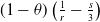 $(1-\theta )\left (\frac {1}{r}-\frac {s}{3}\right )$
holds due to (2.4) and (2.5).
$(1-\theta )\left (\frac {1}{r}-\frac {s}{3}\right )$
holds due to (2.4) and (2.5).
Remark 2.1. We would like to point out that Lemma 2.2 is valid in all dimensions, meaning that for $1\leq r \leq \infty, $ $1\leq m \lt \infty, $ $0\lt \alpha \lt n,$ $0\leq \theta \leq 1$
and
$0\leq \theta \leq 1$
and $\sigma \lt s$
, if we assume
$\sigma \lt s$
, if we assume $\Lambda ^\alpha u \in L^m(\mathbb{R}^n)$
,
$\Lambda ^\alpha u \in L^m(\mathbb{R}^n)$
, $\Lambda ^s u \in L^r(\mathbb{R}^n)$
and
$\Lambda ^s u \in L^r(\mathbb{R}^n)$
and
 \begin{equation*}\frac {1}{p}-\frac {\sigma }{n}= \theta \left (\frac {1}{m}-\frac {\alpha }{n} \right ) +(1-\theta )\left (\frac {1}{r}-\frac {s}{n}\right ), \end{equation*}
then
 \begin{equation*} \|\Lambda ^\sigma u\|_{L^p(\mathbb{R}^n)} \leq C \|\Lambda ^\alpha u\|_{L^m(\mathbb{R}^n)}^\theta \|\Lambda ^{s}u\|_{L^{r}(\mathbb{R}^n)}^{1-\theta }. \end{equation*}
We also need the Moser-type product laws for fractional Laplacian operators. The first estimate (2.6) is due to Kato-Ponce [Reference Kato and Ponce21] and Kenig-Ponce-Vega [Reference Kenig, Carlos and Vega25], and the second estimate (2.7) can be found in [Reference Bahouri, Chemin and Danchin3, Corollary 2.55].
Lemma 2.3. The following statement holds:
-
• Let $s\gt 0$
and
$1\lt p\lt \infty$
. If
$u\in L^{p_1}\cap \dot {W}^{s,p_2}(\mathbb{R}^3)$
and
$v\in L^{p_1}\cap \dot {W}^{s,p_3}(\mathbb{R}^3)$
with
$1\lt p_1,p_2,p_3,p_4\lt \infty$
satisfying
$\frac {1}{p}=\frac {1}{p_1}+\frac {1}{p_2}=\frac {1}{p_3}+\frac {1}{p_4}$
, then we have
$uv\in \dot {W}^{s,p}(\mathbb{R}^3)$
and
(2.6)
\begin{align} \|\Lambda ^{s}(uv)\|_{L^p}\leq C\|u\|_{L^{p_1}} \|\Lambda ^{s} v\|_{L^{p_2}}+C\|\Lambda ^{s}u\|_{L^{p_3}}\|v\|_{L^{p_4}}. \end{align}
$s\gt 0$
and
$1\lt p\lt \infty$
. If
$u\in L^{p_1}\cap \dot {W}^{s,p_2}(\mathbb{R}^3)$
and
$v\in L^{p_1}\cap \dot {W}^{s,p_3}(\mathbb{R}^3)$
with
$1\lt p_1,p_2,p_3,p_4\lt \infty$
satisfying
$\frac {1}{p}=\frac {1}{p_1}+\frac {1}{p_2}=\frac {1}{p_3}+\frac {1}{p_4}$
, then we have
$uv\in \dot {W}^{s,p}(\mathbb{R}^3)$
and
(2.6)
\begin{align} \|\Lambda ^{s}(uv)\|_{L^p}\leq C\|u\|_{L^{p_1}} \|\Lambda ^{s} v\|_{L^{p_2}}+C\|\Lambda ^{s}u\|_{L^{p_3}}\|v\|_{L^{p_4}}. \end{align}
-
• Let
$s_{1},s_{2}$
satisfy
$-\frac {3}{2}\lt s_{1},s_{2}\lt \frac {3}{2}$
and
$s_{1}+s_{2}\gt 0$
. If
$u\in \dot {H}^{s_1}(\mathbb{R}^3)$
and
$v\in \dot {H}^{s_2}(\mathbb{R}^3)$
, then we have
$uv\in \dot {H}^{s_{1}+s_{2}-\frac {3}{2}}(\mathbb{R}^3)$
and
(2.7)
\begin{align} \|\Lambda ^{s_1+s_2-\frac {3}{2}}(uv)\|_{L^2}\leq C\|\Lambda ^{s_1}u\|_{L^2}\|\Lambda ^{s_2} v\|_{L^2}. \end{align}










Finally, we recall Hardy’s inequality for fractional norms (see [Reference Bahouri, Chemin and Danchin3, Page 91]).
Lemma 2.4.
Let $0\leq s\lt \frac {3}{2}$
. For any
$0\leq s\lt \frac {3}{2}$
. For any $v\in \dot {H}^{s}(\mathbb{R}^{3})$
, it holds that
$v\in \dot {H}^{s}(\mathbb{R}^{3})$
, it holds that
 \begin{equation} \begin{aligned} &\Big (\int _{\mathbb{R}^{3}}\frac {|v(x)|^2}{|x|^{2s}}\,dx\Big )^{\frac {1}{2}}\leq C\|\Lambda ^{s}v\|_{L^2}. \end{aligned} \end{equation}
3. Regularity criteria
In this section, we aim at investigating the mechanism of possible finite time blow-up for the generalised chemotaxis-Navier–Stokes model (1.1), which enables us to study the global existence if the corresponding norms of these criteria can be controlled.
3.1. Proof of Theorem 1.2
We will give the proof of Theorem1.2. This can be proved by a contradictory argument. Assume that the maximal time $T_*$
is finite, and (1.6) is not true, i.e.
$T_*$
is finite, and (1.6) is not true, i.e.
 \begin{equation} B_{1}\;:\!=\;\lim _{T\rightarrow T_*}\int _0^{T}\left (\|n\|_{L^{q_1}}^{p_1}+\|u\|_{L^{q_2}}^{p_2} \right )\,dt \lt +\infty \end{equation}
for any $(p_i, q_i) (i=1, 2)$
satisfying (1.7). Then, once the
$(p_i, q_i) (i=1, 2)$
satisfying (1.7). Then, once the $H^2$
-norm of the solution
$H^2$
-norm of the solution $(n, c, u)$
to the Cauchy problem (1.1)–(1.2) is bounded when
$(n, c, u)$
to the Cauchy problem (1.1)–(1.2) is bounded when $t$
is close to
$t$
is close to $T_*$
, one can show that the assumption
$T_*$
, one can show that the assumption $T_*\lt +\infty$
will lead to a contradiction with the maximality of
$T_*\lt +\infty$
will lead to a contradiction with the maximality of $T_*$
in accordance with the local well-posedness result (Theorem1.1).
$T_*$
in accordance with the local well-posedness result (Theorem1.1).
In the following, we establish the key estimates of solutions. The proof is divided into three steps.
-
• Step 1:
$L^2$
-estimates of
$n$
and
$H^1$
-estimates of
$c,u$
.


In this step, our goal is to get
 \begin{equation} \sup _{t\in (0,T]}(\|n\|_{L^2}^2+\|(c,u)\|_{H^1}^2)+\int _{0}^{T}(\|\nabla n\|_{L^2}^2+\|\nabla c\|_{H^1}^2+\|\Lambda ^{\alpha }u\|_{H^1}^2)\,dt\leq C(B_1,T_*) \end{equation}
for any $0\lt T\lt T_*$
and some constant
$0\lt T\lt T_*$
and some constant $C(B_1,T_*)\gt 0$
.
$C(B_1,T_*)\gt 0$
.
To begin with, we give some uniform estimates. It follows from the classical maximum principle that
 \begin{equation} \begin{aligned} &n(t,x)\geq 0,\quad \quad 0\leq c(t,x)\leq \|c_0\|_{L^{\infty }},\quad (t,x)\in [0,T]\times \mathbb{R}^3. \end{aligned} \end{equation}
In addition, by taking the inner product of (1.1) $_2$
by
$_2$
by $c$
and using
$c$
and using $f(c)\geq 0$
, we arrive at
$f(c)\geq 0$
, we arrive at
 \begin{equation} \begin{aligned} \sup _{t\in (0,T]}\|c\|_{L^2}^2+\int _{0}^{T}\|\nabla c\|_{L^2}^2\,dt\leq \|c_0\|_{L^2}^2. \end{aligned} \end{equation}
In the following, we divide the proof of (3.2) into the cases $\alpha \geq 1$
and
$\alpha \geq 1$
and $\frac {3}{4}\lt \alpha \lt 1$
.
$\frac {3}{4}\lt \alpha \lt 1$
.
-
• Case 1:
$\alpha \geq 1$

Now, we perform the $L^2$
-estimate of
$L^2$
-estimate of $n$
and the
$n$
and the $H^1$
-estimates of
$H^1$
-estimates of $c,u$
. First, we multiply (1.1)
$c,u$
. First, we multiply (1.1) $_1$
by
$_1$
by $n$
, integrate the resulting equation by parts, and then derive
$n$
, integrate the resulting equation by parts, and then derive
 \begin{equation*} \begin{aligned} \frac {1}{2}\frac {d}{dt}\|n\|_{L^2 }^2+\|\nabla n\|_{L^2 }^2 &= \int _{\mathbb{R}^3}\chi (c) n\nabla c\cdot \nabla n\,dx\\[5pt] &\leq \sup _{0\leq c\leq \|c_0\|_{L^\infty }} |\chi (c)| \|\nabla n\|_{L^2 } \|n\|_{L^{q_1} }\|\nabla c\|_{L^\frac {2q_1}{q_1-2}}\\[5pt] &\leq C \|\nabla n\|_{L^2 } \|n\|_{L^{q_1} } \|\nabla c\|_{L^{2} }^\frac {q_1-3}{q_1} \|\nabla ^2c\|_{L^2 }^\frac {3}{q_1}\\[5pt] & \leq \frac {1}{2} \|\nabla n\|_{L^2 }^2+\frac {1}{4}\|\Delta c\|_{L^2}^2+C\|n\|_{L^{q_1} }^{\frac {2q_1}{q_1-3}}\|\nabla c\|_{L^2 }^2, \end{aligned} \end{equation*}
where we have used (3.3), $3\lt q_1\lt \infty$
, the Gagliardo–Nirenberg inequality (2.2) and the fact that
$3\lt q_1\lt \infty$
, the Gagliardo–Nirenberg inequality (2.2) and the fact that
 \begin{align} \|\Delta g\|_{L^2}\leq \|\nabla ^2g\|_{L^2}\leq C\|\Delta g\|_{L^2},\quad \forall g\in \dot {H}^2. \end{align}
Due to $\frac {2q_1}{q_1-3}\leq p_1$
, it thus follows that
$\frac {2q_1}{q_1-3}\leq p_1$
, it thus follows that
 \begin{equation} \frac {d}{dt}\|n\| _{L^2 }^2+\|\nabla n\|_{L^2 }^2 \leq \frac {1}{2}\|\Delta c\|_{L^2}^2+C(1+\|n\|_{L^{q_1}}^{p_1})\|\nabla c\| _{L^2 }^2. \end{equation}
Furthermore, we multiply both sides of (1.1) $_2$
by
$_2$
by $-\Delta c$
and integrate the resulting equation to obtain
$-\Delta c$
and integrate the resulting equation to obtain
 \begin{equation} \frac {1}{2} \frac {d}{dt}\|\nabla c\| _{L^2 }^2+\|\Delta c\| _{L^2 }^2 =\int _{\mathbb{R}^3} (u\cdot \nabla c)\cdot \Delta c\, dx+\int _{\mathbb{R}^3} n \Delta c f(c)\,dx. \end{equation}
Owing to $2\alpha -1\geq 1$
, we have
$2\alpha -1\geq 1$
, we have $\frac {2q_2}{q_2-3}\leq p_2$
, so it follows from (2.2) and (3.5) that
$\frac {2q_2}{q_2-3}\leq p_2$
, so it follows from (2.2) and (3.5) that
 \begin{equation*} \begin{aligned} \left |\int _{\mathbb{R}^3} (u\cdot \nabla c)\cdot \Delta c\, dx\right |&\leq \|u\|_{L^{q_2}}\|\nabla c\|_{L^\frac {2q_2}{q_2-2}} \|\Delta c\|_{L^2} \\[5pt] &\leq C \|u\|_{L^{q_2}} \|\nabla c\|_{L^2}^{\frac {q_2-3}{q_2}}\|\nabla ^2c\|_{L^2}^{\frac {3}{q_2}}\|\Delta c\|_{L^2}\\[5pt] &\leq \frac {1}{4}\|\Delta c\|_{L^2}^2+C\|u\|_{L^{q_2}}^{\frac {2q_2}{q_2-3}} \|\nabla c\|_{L^2}^2\\[5pt] &\leq \frac {1}{4}\|\Delta c\|_{L^2}^2+C(1+\|u\|_{L^{q_2}}^{p_2}) \|\nabla c\|_{L^2}^2. \end{aligned} \end{equation*}
And by (3.3), it is easy to verify that
 \begin{eqnarray*} \begin{aligned} \left |\int _{\mathbb{R}^3} n \Delta c f(c)\,dx\right |&\leq \frac {1}{4}\|\Delta c\|_{L^2}^2+\sup _{0\leq s\leq \|c_0\|_{L^\infty }}|f(s)|^2 \|n\| _{L^2 }^2. \end{aligned} \end{eqnarray*}
Hence, we have
 \begin{equation} \begin{aligned} & \frac {d}{dt}\|\nabla c\| _{L^2 }^2+\|\Delta c\| _{L^2 }^2\leq C(1+\|u\|_{L^{q_2}}^{p_2}) \|\nabla c\|_{L^2}^2+C\|n\| _{L^2 }^2. \end{aligned} \end{equation}
We are going to analyse the velocity $u$
. For the third equation in (1.1), one has
$u$
. For the third equation in (1.1), one has
 \begin{equation} \begin{aligned} \frac {1}{2}\frac {d}{dt}\|u\| _{L^2 }^2+\|\Lambda ^{\alpha } u\| _{L^2 }^2 =-\int _{\mathbb{R}^3} u\cdot n\nabla \phi \leq \|u\| _{L^2 }^2+C \|\nabla \phi \|_{L^\infty }^2\|n\| _{L^2 }^2. \end{aligned} \end{equation}
To deal with the $\dot {H}^1$
-estimates of
$\dot {H}^1$
-estimates of $u$
, we multiply both sides of the third equation of (1.1) by
$u$
, we multiply both sides of the third equation of (1.1) by $-\Delta u$
and integrate by parts, and then have
$-\Delta u$
and integrate by parts, and then have
 \begin{equation} \begin{aligned} \frac {1}{2} \frac {d}{dt} \|\nabla u\| _{L^2 }^2 +\|\Lambda ^{\alpha +1} u\| _{L^2 }^2 = \int _{\mathbb{R}^3} \Delta u \cdot n \nabla \phi \,dx+\int _{\mathbb{R}^3} \Delta u \cdot (u \cdot \nabla ) u\,dx. \end{aligned} \end{equation}
For the terms on the right-hand side of (3.10), we first deduce from the Gagliardo–Nirenberg inequality (2.2) and $\frac {2q_1}{q_1-3}\leq p_1$
that
$\frac {2q_1}{q_1-3}\leq p_1$
that
 \begin{equation} \begin{aligned} \left |\int _{\mathbb{R}^3} \Delta u \cdot n \nabla \phi \,dx \right |&\leq \|\nabla \phi \|_{L^\infty }\|\Delta u\| _{L^2 }\|n\| _{L^2 }\\[5pt] &\leq C \|\nabla u\| _{L^2 }^{1-\frac {1}{\alpha }} \|\Lambda ^{\alpha +1} u\| _{L^2 }^\frac {1}{\alpha }\|n\| _{L^2 }\\[5pt] &\leq \frac {1}{4} \|\Lambda ^{\alpha +1} u\| _{L^2 }^2 +C\|\nabla u\| _{L^2 }^2+C\|n\| _{L^2 }^2. \end{aligned} \end{equation}
Similarly, it holds by (2.2) that
 \begin{equation} \begin{aligned} \left |\int _{\mathbb{R}^3} \Delta u \cdot (u \cdot \nabla ) u \,dx\right |&=\left | \sum _{i,j,k=1}^{3}\int _{\mathbb{R}^3} u_k(\partial _{ik}u_j \partial _i u_j +\partial _k u_j \partial _{ii} u_j)\,dx \right |\\[5pt] &\leq C\|u\|_{L^{q_2}}\|\nabla u\|_{L^{r_1}}\|\Delta u\|_{L^{r_2}}\\[5pt] &\leq C\|u\|_{L^{q_2}} \|\nabla u\| _{L^2 }^\theta \|\Lambda ^{\alpha +1}u\| _{L^2 }^{1-\theta } \|\nabla u\| _{L^2 }^\theta \|\Lambda ^{\alpha +1}u\| _{L^2 }^{1-\theta }\\[5pt] & \leq \frac {1}{4} \|\Lambda ^{\alpha +1}u\| _{L^2 }^2+ C\|u\|_{L^{q_2}}^\frac {1}{\theta }\|\nabla u\| _{L^2 }^2, \end{aligned} \end{equation}
where we used $\alpha \geq 1$
, and the constants
$\alpha \geq 1$
, and the constants $r_1, \, r_2$
and
$r_1, \, r_2$
and $\theta$
satisfy
$\theta$
satisfy
 \begin{eqnarray*} \begin{cases} \dfrac {1}{r_1}+\dfrac {1}{r_2}+\dfrac {1}{q_2}=1,&\\[9pt] \dfrac {1}{r_1}-\dfrac {1}{3}=\theta \left (\dfrac {1}{2}-\dfrac {1}{3}\right )+ (1-\theta )\left (\dfrac {1}{2}-\dfrac {\alpha +1}{3}\right )&\\[9pt] \dfrac {1}{r_2}-\dfrac {2}{3}=\theta \left (\dfrac {1}{2}-\dfrac {1}{3}\right )+ (1-\theta )\left (\dfrac {1}{2}-\dfrac {\alpha +1}{3}\right ),& \end{cases} \end{eqnarray*}
which can be rewritten as
 \begin{equation*} r_1=\frac {6q_2}{2q_2-3},\,\,\quad r_2=\frac {6q_2}{4q_2-3},\,\, \quad \frac {1}{p_2}\leq \theta =1-\frac {1}{2\alpha }\left (1+\frac {3}{q_2}\right ). \end{equation*}
In order to promise $1\lt r_1, \, r_2\lt \infty$
and
$1\lt r_1, \, r_2\lt \infty$
and $0\lt \theta \lt 1$
, one requires
$0\lt \theta \lt 1$
, one requires $\min \{\frac {3}{2},\frac {3}{2\alpha -1}\}\lt q_2\lt \infty$
. Substituting (3.11) and (3.12) into (3.10), we conclude that
$\min \{\frac {3}{2},\frac {3}{2\alpha -1}\}\lt q_2\lt \infty$
. Substituting (3.11) and (3.12) into (3.10), we conclude that
 \begin{equation} \begin{aligned} \frac {d}{dt}\|\nabla u\| _{L^2 }^2 +\|\Lambda ^{\alpha +1} u\| _{L^2 }^2 \leq C \|n\|_{L^2}^2+\left (1+\|u\|_{L^{q_2}}^{p_2}\right )\|\nabla u\| _{L^2 }^2. \end{aligned} \end{equation}
The combination of (3.6), (3.8), (3.9) and (3.13) yields
 \begin{equation*} \begin{aligned} &\frac {d}{dt}(\|(n,\nabla c)\|_{L^2}^2+\| u\| _{H^1 }^2) +\frac {1}{2}\|(\nabla n,\Delta c)\|_{L^2}^2+ \frac {1}{2}\|\Lambda ^{\alpha } u\| _{H^1}^2\\[5pt] &\leq C(1+\|n\|_{L^{q_1}}^{p_1}+\|u\|_{L^{q_2}}^{p_2})(\|(n,\nabla c)\|_{L^2}^2+\| u\| _{H^1 }^2), \end{aligned} \end{equation*}
which, together with (3.1), (3.5) and Grönwall’s lemma, yields
 \begin{equation*} \begin{aligned} &\sup _{t\in (0,T]}(\|(n,\nabla c)\|_{L^2}^2+\| u\| _{H^1 }^2)+\int _{0}^{T}(\|(\nabla n,\nabla ^2 c)\|_{L^2}^2+ \|\Lambda ^{\alpha } u\| _{H^1}^2)\,dt\\[5pt] &\quad \leq Ce^{CB_1+C T}(\|(n_0,\nabla c_0)\|_{L^2}^2+\| u_0\|_{H^1}^2) \end{aligned} \end{equation*}
for any $0\lt T\lt T_*$
. This together with (3.4) yields (3.2) in the case
$0\lt T\lt T_*$
. This together with (3.4) yields (3.2) in the case $\alpha \geq 1$
.
$\alpha \geq 1$
.
-
• Case 2:
$\frac {3}{4}\lt \alpha \lt 1$

In this case, we are able to obtain the inequality (3.6) for $n$
as in Case 1. Regarding the estimates of
$n$
as in Case 1. Regarding the estimates of $c$
, the second term on the right-hand side of (3.7) can be handled in the same way in Case 1. To deal with the remainder on the right-hand side of (3.7), one has
$c$
, the second term on the right-hand side of (3.7) can be handled in the same way in Case 1. To deal with the remainder on the right-hand side of (3.7), one has
 \begin{equation*} \begin{aligned} \int _{\mathbb{R}^3} (u\cdot \nabla c)\cdot \Delta c\, dx&=-\int _{\mathbb{R}^3} (\nabla c \cdot \nabla u)\cdot \nabla c\,dx-\int _{\mathbb{R}^3}(u\cdot \nabla ^2 c)\cdot \nabla c\,dx \\[5pt] &=\int _{\mathbb{R}^3} \nabla ^2 c\;:\; \nabla u c\,dx, \end{aligned} \end{equation*}
derived from $\nabla \cdot u=0$
and integration by parts, so it holds by (2.2), (3.3) and (3.5) that
$\nabla \cdot u=0$
and integration by parts, so it holds by (2.2), (3.3) and (3.5) that
 \begin{equation*} \begin{aligned} \left |\int _{\mathbb{R}^3} (u\cdot \nabla c)\cdot \Delta c\, dx\right |&\leq \|c\|_{L^{\infty }} \|\nabla u\|_{L^2}\|\nabla ^2c\|_{L^2}\\[5pt] &\leq C\|c_0\|_{L^{\infty }} \|u\|_{L^2}^{\frac {\alpha }{\alpha +1}}\|\nabla \Lambda ^\alpha u\|_{L^2}^{\frac {1}{\alpha +1}} \|\Delta c\|_{L^2}\\[5pt] &\leq \frac {1}{4} \|\Delta c\|_{L^2}^2+\frac {1}{4}\|\nabla \Lambda ^{\alpha }u\|_{L^2}^2+C \|u\|_{L^2}^2. \end{aligned} \end{equation*}
Therefore, we gain
 \begin{equation} \begin{aligned} & \frac {d}{dt}\|\nabla c\| _{L^2 }^2+\|\Delta c\| _{L^2 }^2\leq \frac {1}{2}\|\nabla \Lambda ^{\alpha }u\|_{L^2}^2+C\|(n,u)\| _{L^2 }^2. \end{aligned} \end{equation}
Furthermore, we are going to establish the $\dot {H}^1$
-estimates of
$\dot {H}^1$
-estimates of $u$
. In fact, multiplying both sides of the third equation of (1.1) by
$u$
. In fact, multiplying both sides of the third equation of (1.1) by $-\Delta u$
and integrating by parts, one has
$-\Delta u$
and integrating by parts, one has
 \begin{equation} \begin{aligned} \frac {1}{2} \frac {d}{dt} \|\nabla u\| _{L^2 }^2 +\|\nabla \Lambda ^{\alpha } u\| _{L^2 }^2 = \int _{\mathbb{R}^3} \Delta u \cdot n \nabla \phi \,dx+\int _{\mathbb{R}^3} \Delta u \cdot (u \cdot \nabla ) u \,dx. \end{aligned} \end{equation}
The first term on the right-hand side of (3.15) is analysed by
 \begin{equation} \begin{aligned} \left |\int _{\mathbb{R}^3} \Delta u \cdot n \nabla \phi \,dx \right |&=\left |\int _{\mathbb{R}^3} \nabla u \cdot \nabla (n \nabla \phi )\,dx \right |\\[5pt] &\leq \|\nabla u\|_{L^2}\|n\| _{L^2 }\|\nabla ^2 \phi \|_{L^\infty }+\|\nabla u\|_{L^2}\|\nabla n\| _{L^2 }\|\nabla \phi \|_{L^\infty }\\[5pt] &\leq C\|\nabla u\| _{L^2 }^2+C\|n\| _{L^2 }^2+\frac {1}{4}\|\nabla n\| _{L^2 }^2. \end{aligned} \end{equation}
As $\Lambda ^{\sigma }$
is self-adjoint for any
$\Lambda ^{\sigma }$
is self-adjoint for any $\sigma \gt 0$
, one deduces from
$\sigma \gt 0$
, one deduces from $\nabla \cdot u=0$
and (2.2) that
$\nabla \cdot u=0$
and (2.2) that
 \begin{equation*} \begin{aligned} \Big | \int _{\mathbb{R}^3} \Delta u \cdot (u \cdot \nabla ) u \,dx\Big |&=\Big | \int _{\mathbb{R}^3} \Lambda ^{\alpha -1}\Delta u \cdot \Lambda ^{1-\alpha } \nabla \cdot (u \otimes u) \,dx\Big |\\[5pt] &\leq C\|\nabla \Lambda ^{\alpha }u\|_{L^2} \|\Lambda ^{2-\alpha }(u\otimes u)\|_{L^2}. \end{aligned} \end{equation*}
Note that the product law (2.6) and the Gagliardo–Nirenberg inequality (2.2) imply that
 \begin{equation*} \begin{aligned} \|\Lambda ^{2-\alpha }(u\otimes u)\|_{L^2}\leq C\|u\|_{L^{q_2}} \|\Lambda ^{2-\alpha }u\|_{L^{\frac {2q_2}{q_2-2}}}\leq C\|u\|_{L^{q_2}} \|\nabla u\|_{L^2}^{1-\theta } \|\nabla \Lambda ^{\alpha }u\|_{L^2}^{\theta }, \end{aligned} \end{equation*}
where $\theta =\frac {1}{\alpha }(1+\frac {3}{q_2})-1$
fulfills
$\theta =\frac {1}{\alpha }(1+\frac {3}{q_2})-1$
fulfills
 \begin{equation*} \frac {q_2-2}{2q_2}-\frac {2-\alpha }{3}=\left (\frac {1}{2}-\frac {1}{3}\right )(1-\theta )+\left (\frac {1}{2}-\frac {1+\alpha }{3}\right )\theta . \end{equation*}
Since $\frac {2}{1-\theta }\leq p_2$
due to (1.7), we obtain
$\frac {2}{1-\theta }\leq p_2$
due to (1.7), we obtain
 \begin{equation*} \begin{aligned} \Big | \int _{\mathbb{R}^3} \Delta u \cdot (u \cdot \nabla ) u \,dx\Big | &\leq \frac {1}{2}\|\nabla \Lambda ^{\alpha }u\|_{L^2}^2+C\|u\|_{L^{q_2}}^{\frac {2}{1-\theta }}\|\nabla u\|_{L^2}^2\\[5pt] &\leq \frac {1}{2}\|\nabla \Lambda ^{\alpha }u\|_{L^2}^2+C(1+\|u\|_{L^{q_2}}^{p_2})\|\nabla u\|_{L^2}^2. \end{aligned} \end{equation*}
It thus follows that
 \begin{equation} \begin{aligned} \frac {d}{dt} \|\nabla u\| _{L^2 }^2 +\|\nabla \Lambda ^{\alpha } u\| _{L^2 }^2&\leq C(1+\|u\|_{L^{q_2}}^{p_2})\|\nabla u\|_{L^2}^2+C\|n\|_{L^2}^2+\frac {1}{2}\|\nabla n\| _{L^2 }^2. \end{aligned} \end{equation}
Collecting the estimates (3.6), (3.11) and (3.14) and (3.17) and thence applying (3.1) and Grönwall’s lemma, we arrive at
 \begin{equation*} \begin{aligned} &\sup _{t\in (0,T]}(\|(n,\nabla c)\|_{L^2}^2+\| u\| _{H^1 }^2)+\int _{0}^{T}(\|(\nabla n,\nabla ^2 c)\|_{L^2}^2+ \|\Lambda ^{\alpha } u\| _{H^1}^2)\,dt\\[5pt] &\quad \leq e^{CT+CB_1}(\|(n_0,\nabla c_0)\|_{L^2}^2+\|u_0\|_{H^1}^2). \end{aligned} \end{equation*}
Together with (3.4), we thus establish (3.2) for all $\alpha \gt \frac {3}{4}$
.
$\alpha \gt \frac {3}{4}$
.
-
• Step 2:
$H^1$
-estimates of
$n$
and
$H^2$
-estimates of
$c,u$
.


In this step, we claim that for any $0\lt T\lt T_*$
, there exists some constant
$0\lt T\lt T_*$
, there exists some constant $C(B_1,T_*)$
such that
$C(B_1,T_*)$
such that
 \begin{equation} \sup _{t\in (0,T]}\|(\nabla n,\nabla ^2 c,\nabla ^2 u)\|_{L^2}^2+\int _{0}^{T}\|(\nabla ^2 n,\nabla ^3 c,\Lambda ^{\alpha +2}u)\|_{L^2}^2\,dt\leq C(B_1,T_*). \end{equation}
Despite the $H^1$
-estimate of
$H^1$
-estimate of $c$
having been obtained in Step 1, it is not enough to control the chemotaxis term
$c$
having been obtained in Step 1, it is not enough to control the chemotaxis term $\nabla \cdot (\chi (c) n \nabla c)$
in (1.1)
$\nabla \cdot (\chi (c) n \nabla c)$
in (1.1) $_1$
. To this end, we first establish the
$_1$
. To this end, we first establish the $H^2$
-estimate of
$H^2$
-estimate of $c$
. Applying
$c$
. Applying $\Delta$
to (1.1)
$\Delta$
to (1.1) $_2$
yields
$_2$
yields
 \begin{equation} \partial _t \Delta c-\Delta \Delta c=-\Delta (u \cdot \nabla c)-\Delta (nf(c)). \end{equation}
Multiplying (3.19) by $\Delta c$
, we obtain
$\Delta c$
, we obtain
 \begin{equation} \begin{aligned} \frac {1}{2}\frac {d}{dt}\|\Delta c\| _{L^2 }^2 +\|\nabla \Delta c\| _{L^2 }^2 =\int _{\mathbb{R}^3} \nabla \Delta c \cdot \nabla (u \cdot \nabla c)\,dx +\int _{\mathbb{R}^3}\nabla \Delta c \cdot \nabla (n f(c))\,dx. \end{aligned} \end{equation}
In view of (2.2) and Sobolev’s inequality, the terms on the right-hand side of (3.20) can be analysed as
 \begin{equation} \begin{aligned} &\left |\int _{\mathbb{R}^3} \nabla \Delta c \cdot \nabla (u \cdot \nabla c)\,dx \right |\\[5pt] & \quad \leq \|\nabla \Delta c\|_{L^2 }\left ( \|\nabla u\|_{L^3} \|\nabla c\|_{L^6}+ \|u\|_{L^\infty }\|\nabla ^2 c\| _{L^2 } \right )\\[5pt] &\quad \leq C \|\nabla \Delta c\| _{L^2 } \left ( \|\Lambda ^{\alpha +1} u\| _{L^2 }^\frac {3}{2(1+\alpha )} \|u\| _{L^2 }^{1-\frac {3}{2(1+\alpha )}} \|\nabla ^2 c\| _{L^2 }+\|u\|_{H^{\alpha +1}}\|\Delta c\| _{L^2 }\right )\\[5pt] &\quad \leq \frac {1}{4}\|\nabla \Delta c\| _{L^2 }^2+C \|u\|_{H^{\alpha +1}}^2 \|\Delta c\| _{L^2 }^2, \end{aligned} \end{equation}
and
 \begin{equation} \begin{aligned} &\left |\int _{\mathbb{R}^3}\nabla \Delta c \cdot \nabla (n f(c))\,dx\right |\\[5pt] &\quad \leq \|\nabla \Delta c\|_{L^2}\Big (\sup _{0\leq s\leq \|c_0\|_{L^\infty }}|f(s)| \|\nabla n\|_{L^2}+\sup _{0\leq s\leq \|c_0\|_{L^\infty }}|f'(s)| \|n\|_{L^3} \|\nabla c\|_{L^6}\Big )\\[5pt] &\quad \leq C\|\nabla \Delta c\|_{L^2}(\|\nabla n\|_{L^2}+\|n\|_{L^2}^{\frac {1}{2}}\|\nabla n\|_{L^2}^{\frac {1}{2}} \|\Delta c\|_{L^2})\\[5pt] &\quad \leq \frac {1}{4}\|\nabla \Delta c\| _{L^2 }^2+C \|\nabla n \| _{L^2 }^2+C(\|n\|_{L^2}^2+\|\nabla n\|_{L^2}^2)\|\Delta c\|_{L^2}^2. \end{aligned} \end{equation}
Substituting (3.21) and (3.22) into (3.20), one has
 \begin{equation*} \begin{aligned} \frac {d}{dt}\|\Delta c \| _{L^2 }^2+\|\nabla \Delta c \| _{L^2 }^2 \leq C(\|n\|_{L^2}^2+\|\nabla n\|_{L^2}^2+\|u\|_{H^{\alpha +1}}^2)\|\Delta c\|_{L^2}^2+C\|\nabla n\| _{L^2 }^2, \end{aligned} \end{equation*}
which, together with (3.2) and Grönwall’s inequality, implies that, for any $t\in (0,T)$
with
$t\in (0,T)$
with $0\lt T\lt T_*$
,
$0\lt T\lt T_*$
,
 \begin{equation} \begin{aligned} &\sup _{t\in (0,T]} \|\nabla ^2 c \| _{L^2 }^2+ \int _0^{T}\|\nabla ^3 c \| _{L^2 }^2 \,dt\\[5pt] &\,\,\leq C \textrm {exp} \left \{\int _0^{T}(\|\nabla n\|_{L^2}^2+\|u\|_{H^{\alpha +1}}^2)\,dt+T\sup _{t\in (0,T)}\|n\|_{L^2}^2\right \}\\[5pt] &\,\,\quad \quad \quad \cdot \left ( \|\nabla ^2 c_0\| _{L^2 }^2+\int _0^{T} \|\nabla n\| _{L^2 }^2 \,dt \right )\leq C(B_1,T). \end{aligned} \end{equation}
Next, we are ready to bound $\nabla n$
. Taking the
$\nabla n$
. Taking the $L^2$
-inner product of (1.1)
$L^2$
-inner product of (1.1) $_1$
with
$_1$
with $\Delta n$
yields
$\Delta n$
yields
 \begin{equation} \begin{aligned} &\frac {1}{2}\frac {d}{dt}\|\nabla n\|_{L^2}^2+\|\Delta n\|_{L^2}^2\leq \frac {1}{2}\|\Delta n\|_{L^2}^2+\|u\cdot \nabla n\|_{L^2}^2+\|\nabla \cdot (\chi (c)n\nabla c)\|_{L^2}^2. \end{aligned} \end{equation}
Since $\alpha \gt \frac {1}{2}$
, we can use (2.2) and the Young inequality to obtain
$\alpha \gt \frac {1}{2}$
, we can use (2.2) and the Young inequality to obtain
 \begin{equation*} \begin{aligned} \|u\cdot \nabla n\|_{L^2}^2\leq \|u\|_{L^{\infty }}^2 \|\nabla n\|_{L^2}^2\leq C(\|u\|_{L^2}^2+\|\Lambda ^{1+\alpha }u\|_{L^2}^2)\|\nabla n\|_{L^2}^2, \end{aligned} \end{equation*}
and the last term in (3.24) can be controlled by
 \begin{equation*} \begin{aligned} \|\nabla \cdot (\chi (c)n\nabla c)\|_{L^2}^2&\leq C\sup _{0\leq s\leq \|c_0\|_{L^{\infty }}}|\chi '(s)| \|\nabla c\|_{L^6}^4\|n\|_{L^6}^2\\[5pt] &\quad +C\sup _{0\leq s\leq \|c_0\|_{L^{\infty }}}|\chi (s)|(\|\nabla n\|_{L^2}^2\|\nabla c\|_{L^\infty }^2+\|n\|_{L^{6}}^2\|\nabla ^2 c\|_{L^3}^2)\\[5pt] &\leq C(\|\nabla ^2 c\|_{L^2}^4+\|\nabla ^2c\|_{H^1}^2)\|\nabla n\|_{L^2}^2. \end{aligned} \end{equation*}
Hence, using Grönwall’s lemma and the estimates (3.2) and (3.23) at hand, for any $0\lt T\lt T_*$
, we obtain
$0\lt T\lt T_*$
, we obtain
 \begin{equation} \begin{aligned} &\sup _{t\in (0,T]}\|\nabla n\| _{L^2 }^2+ \int _0^{T}\|\nabla ^2 n\| _{L^2 }^2 \,dt\\[5pt] &\leq C\|\nabla n_0\| _{L^2 }^2 \cdot \textrm {exp} \left \{ \int _0^{T} \left (\|\nabla ^2 c\| _{L^2 }^4 +\|\nabla c\|_{H^2}^2+\|u\|_{L^2}^2+\|\Lambda ^{1+\alpha }u\|_{L^2}^2\right )\,dt \right \}\leq C(B_1,T). \end{aligned} \end{equation}
Regarding the estimates of $u$
, applying
$u$
, applying $\Delta$
to both sides of (1.1)
$\Delta$
to both sides of (1.1) $_3$
and then taking the inner product of the resulting equation by
$_3$
and then taking the inner product of the resulting equation by $\Delta u,$
we have
$\Delta u,$
we have
 \begin{equation} \begin{aligned} \frac {1}{2}\frac {d}{dt}&\|\Delta u\| _{L^2 }^2 +\|\Lambda ^{\alpha }\Delta u\| _{L^2 }^2\\[5pt] &= \int _{\mathbb{R}^3}\nabla \Delta u \cdot \nabla ((u \cdot \nabla u)u)\,dx+ \int _{\mathbb{R}^3}\nabla \Delta u \cdot \nabla (n\nabla \phi )\,dx. \end{aligned} \end{equation}
To proceed with the estimate, we deal with the two terms at the right-hand side of (3.26), respectively.
For any $\alpha \gt \frac {3}{4}$
, we note that
$\alpha \gt \frac {3}{4}$
, we note that
 \begin{equation*} \begin{aligned} &\int _{\mathbb{R}^3}\nabla \Delta u \cdot \nabla ((u \cdot \nabla ) u)\,dx\\[5pt] &\quad =\sum _{i,j,k,m=1}^3\int _{\mathbb{R}^3}\partial _{iij}u^m \partial _{j}(u^k\partial _{k}u^m)\,dx\\[5pt] &\quad =-\sum _{i,j,k,m=1}^3\int _{\mathbb{R}^3}\partial _{ii}u^m \partial _{jj}u^k \partial _{k}u^m\,dx-2\sum _{i,j,k,m=1}^3 \int _{\mathbb{R}^3}\partial _{ii}u^m \partial _{j}u^k\partial _{jk} u^m\,dx, \end{aligned} \end{equation*}
so it follows from the Gagliardo–Nirenberg inequality (2.2) that
 \begin{equation} \begin{aligned} &\left |\int _{\mathbb{R}^3}\nabla \Delta u \cdot \nabla ((u \cdot \nabla ) u)\,dx\right |\\[5pt] &\quad \leq 3 \|\nabla u\| _{L^2 } \|\nabla ^2 u\|_{L^4}^2\\[5pt] &\quad \leq C\|\nabla u\| _{L^2 } \|\nabla ^2 u\| _{L^2 }^{2-\frac {3}{2\alpha }} \|\Lambda ^{2+\alpha } u\| _{L^2 }^{\frac {3}{2\alpha }}\\[5pt] &\quad \leq \frac {1}{4} \|\Lambda ^{2+\alpha } u\| _{L^2 }^2 + C \|\nabla u\| _{L^2 }^{\frac {4\alpha }{4\alpha -3}}\|\nabla ^2 u\| _{L^2 }^2 \\[5pt] &\quad \leq \frac {1}{4} \|\Lambda ^{2+\alpha } u\| _{L^2 }^2 + C \|\nabla ^2 u\| _{L^2 }^2 \|\Lambda ^{\alpha +1} u\| _{L^2 }^{\frac {4\alpha }{(4\alpha -3)(\alpha +1)}}\|u\| _{L^2 }^\frac {4\alpha ^2}{(4\alpha -3)(\alpha +1)}\\[5pt] &\quad \leq \frac {1}{4} \|\Lambda ^{2+\alpha } u\| _{L^2 }^2 + C\left (1+\|\Lambda ^{\alpha +1} u\| _{L^2 }^2+\| u\| _{L^2 }^2\right ) \|\Delta u\| _{L^2 }^2. \end{aligned} \end{equation}
For the second term at the right-hand side of (3.26), in the case $\alpha \geq 1$
, we get from the Gagliardo–Nirenberg inequality (2.2) that
$\alpha \geq 1$
, we get from the Gagliardo–Nirenberg inequality (2.2) that
 \begin{equation} \begin{aligned} \left | \int _{\mathbb{R}^3}\nabla \Delta u \cdot \nabla (n\nabla \phi )\,dx\right | &\leq \|\nabla ^3 u\| _{L^2 }\|\nabla ( n \nabla \phi )\| _{L^2 }^2\\[5pt] &\leq C\|\Lambda ^{\alpha +2} u\| _{L^2 }^\frac {6}{2+\alpha } \|u\| _{L^2 }^{2-\frac {6}{2+\alpha }} + C\|\nabla \phi \|_{W^{1,\infty }}^2\|n\|_{H^1}^2 \\[5pt] &\leq \frac {1}{4} \|\Lambda ^{\alpha +2} u\| _{L^2 }^2+ C\left (\|u\| _{L^2 }^2 +\| n\|_{H^1}^2\right ). \end{aligned} \end{equation}
As for the case $\alpha \lt 1$
, one also has
$\alpha \lt 1$
, one also has
 \begin{equation} \begin{aligned} \left | \int _{\mathbb{R}^3}\nabla \Delta u \cdot \nabla (n\nabla \phi )\,dx\right | &\leq \|\Lambda ^{\alpha -1}\nabla \Delta u\|_{L^2}\|\Lambda ^{1-\alpha }\nabla (n\nabla \phi )\|_{L^2}\\[5pt] &\leq C\|\Lambda ^{\alpha }\Delta u\|_{L^2} \| \Lambda ^{2-\alpha }(n\nabla \phi )\|_{L^2}\\[5pt] &\leq \frac {1}{4} \|\Lambda ^{\alpha +2} u\| _{L^2 }^2+ C\| n\|_{H^2}^2, \end{aligned} \end{equation}
where we have used
 \begin{equation*} \| \Lambda ^{2-\alpha }(n\nabla \phi )\|_{L^2}\leq C\|n\nabla \phi \|_{L^2}^{\frac {\alpha }{2}}\|\nabla ^2(n\nabla \phi )\|_{L^2}^{1-\frac {\alpha }{2}} \leq C\|\nabla \phi \|_{W^{2,\infty }}\|n\|_{H^2}, \end{equation*}
derived from (2.2) and $1\lt 2-\alpha \lt 2$
. The combination of (3.26), (3.27), (3.28) and (3.29) yields
$1\lt 2-\alpha \lt 2$
. The combination of (3.26), (3.27), (3.28) and (3.29) yields
 \begin{eqnarray*} \begin{aligned} \frac {d}{dt}\|\Delta u\| _{L^2 }^2 +\|\Lambda ^{\alpha } \Delta u\| _{L^2 }^2 \leq C \left (1+\| u\|_{H^{\alpha +1}}^2\right )\|\Delta u\| _{L^2 }^2 +C\left (\|u\| _{L^2 }^2 +\|n\|_{H^2}^2 \right ). \end{aligned} \end{eqnarray*}
Hence, thanks to Grönwall’s inequality, (3.2), (3.5) (3.6) and (3.25), there holds that, for any $0\lt T\lt T_*$
,
$0\lt T\lt T_*$
,
 \begin{equation*} \begin{aligned} &\sup _{t\in (0,T]}\|\nabla ^2 u\| _{L^2 }+ \int _0^{T} \|\Lambda ^{\alpha +2} u\| _{L^2 }^2\, dt\\[5pt] &\,\,\leq C \textrm {exp} \left \{\int _0^{T} \left (1+\|u\|_{L^2}^2+\|u\|_{H^{\alpha +1}}^2\right )\,dt \right \}\\[5pt] &\,\,\quad \cdot \left ( \|\nabla ^2 u_0\| _{L^2 }^2+ T \sup _{t\in (0,T]} \left (\|u\| _{L^2 }^2+\|n\|_{H^1}^2 \right )+\int _{0}^{T} \|\nabla ^2 n\|_{L^2}^2\,dt\right )\leq C(B_1,T_*), \end{aligned} \end{equation*}
which, as well as (3.23) and (3.25), yields (3.18).
-
• Step 3:
$H^2$
-estimates of
$n$
.


Finally, it suffices to show that, for any $0\lt T\lt T_*$
,
$0\lt T\lt T_*$
,
 \begin{equation} \sup _{t\in (0,T]}\|\nabla ^2n\|_{L^2}^2+\int _{0}^{T}\|\nabla ^3n\|_{L^2}^2\,dt\leq C(B_1,T_*). \end{equation}
To achieve it, we first apply $\Delta$
to (1.1)
$\Delta$
to (1.1) $_1$
and then perform the
$_1$
and then perform the $L^2$
-energy estimate to have
$L^2$
-energy estimate to have
 \begin{equation} \begin{aligned} \frac {1}{2}\frac {d}{dt} \|\Delta n\| _{L^2 }^2+ \|\nabla \Delta n\| _{L^2 }^2 &= \int _{\mathbb{R}^3} \nabla \Delta n \cdot \nabla ( u \cdot \nabla n+ \nabla \cdot (\chi (c) n \nabla c))\,dx\\[5pt] &\leq \frac {1}{4}\|\nabla \Delta n\| _{L^2 }^2+C\|\nabla ( u \cdot \nabla n)\|_{L^2}^2+ \|\nabla \nabla \cdot (\chi (c) n \nabla c))\|_{L^2}^2, \end{aligned} \end{equation}
where the second term on the right-hand side of (3.31) can be estimated as
 \begin{equation*} \begin{aligned} \|\nabla ( u \cdot \nabla n)\|_{L^2}^2&\leq \|\nabla u\|_{L^6}^2\|\nabla n\|_{L^{3}}^2+\|u\|_{L^{\infty }}^2\|\nabla ^2n\|_{L^2}^2\\[5pt] &\leq C\|\nabla ^2 u\|_{L^2}^2\|\nabla n\|_{H^1}^2+\|u\|_{H^2}^2\|\nabla ^2n\|_{L^2}^2. \end{aligned} \end{equation*}
Note that
 \begin{equation} \begin{aligned} |\nabla \nabla \cdot (\chi (c) n \nabla c))|&\leq |\chi ''(c)| |\nabla c|^3 n+2|\chi '(c)| |\nabla ^2 c| |\nabla c| n+2|\chi '(c)| |\nabla c|^2 |\nabla n|\\[5pt] &\quad +|\chi (c)| |\nabla ^2n| |\nabla c|+|\chi (c)| |\nabla n| |\nabla ^2c|. \end{aligned} \end{equation}
By (3.32) and the Gagliardo–Nirenberg inequality, we handle the last term on (3.31) as follows
 \begin{equation*} \begin{aligned} \|\nabla \nabla \cdot (\chi (c) n \nabla c))\|_{L^2}^2& \leq C(1+\|c\|_{H^2}^3)\|n\|_{H^2}^2\|\nabla c\|_{H^2}^2. \end{aligned} \end{equation*}
Thus, Grönwall’s inequality, together with (3.2) and (3.18), leads to (3.30).
The combination of (3.2), (3.18) and (3.30) gives rise to the required bounds to extend the solution $(n,c,u)$
beyond
$(n,c,u)$
beyond $T_*$
. Thus, we finish the proof of Theorem1.2.
$T_*$
. Thus, we finish the proof of Theorem1.2.
3.2. Proof of Theorem 1.3
Similarly, we show Theorem1.3 towards a contradiction. Assume that the maximal time $T_*$
is finite, and (1.8) fails, i.e.
$T_*$
is finite, and (1.8) fails, i.e.
 \begin{equation} B_{2}\;:\!=\;\lim _{T\rightarrow T_*}\int _0^{T}\left (\|\nabla c\|_{L^{q_1}}^{p_1}+\|\nabla u\|_{L^{q_2}}^{p_2} \right )\,dt \lt +\infty \end{equation}
for any $(p_i, q_i) (i=1, 2)$
satisfying (1.9). Our goal is to show that for any
$(p_i, q_i) (i=1, 2)$
satisfying (1.9). Our goal is to show that for any $0\lt T\lt T_*$
, the
$0\lt T\lt T_*$
, the $H^2$
-norms of
$H^2$
-norms of $(n, c, u)$
can be bounded by some constant depending on
$(n, c, u)$
can be bounded by some constant depending on $T_*$
and
$T_*$
and $B_2$
, and therefore the solution can be extended beyond
$B_2$
, and therefore the solution can be extended beyond $T_*$
, which leads to the contradiction.
$T_*$
, which leads to the contradiction.
First, one deduces from (1.1) $_1$
, (3.3) and the Gagliardo–Nirenberg inequality that
$_1$
, (3.3) and the Gagliardo–Nirenberg inequality that
 \begin{equation*} \begin{aligned} \frac {1}{2}\frac {d}{dt}\|n\|_{L^2 }^2+\|\nabla n\|_{L^2 }^2 &= \int _{\mathbb{R}^3}\chi (c) n\nabla c\cdot \nabla n\,dx\\[5pt] &\leq \sup _{0\leq c\leq \|c_0\|_{L^\infty }} |\chi (c)| \|\nabla n\|_{L^2 } \|n\|_{L^\frac {2q_1}{q_1-2}}\|\nabla c\|_{L^{q_1} }\\[5pt] &\leq C \|\nabla n\|_{L^2 } \|n\|_{L^{2} }^\frac {q_1-3}{q_1} \|\nabla n\|_{L^2 }^\frac {3}{q_1} \|\nabla c\|_{L^{q_1} }\\[5pt] & \leq \frac {1}{2} \|\nabla n\|_{L^2 }^2+C\|\nabla c\|_{L^{q_1} }^{\frac {2q_1}{q_1-3}}\|n\|_{L^2 }^2, \end{aligned} \end{equation*}
which, together with $\frac {2q_1}{q_1-3}\leq p_1$
(see (1.9)), leads to
$\frac {2q_1}{q_1-3}\leq p_1$
(see (1.9)), leads to
 \begin{equation*} \frac {d}{dt}\|n\| _{L^2 }^2+\|\nabla n\|_{L^2 }^2 \leq C(1+\|\nabla c\|_{L^{q_1}}^{p_1})\|n\| _{L^2 }^2. \end{equation*}
Hence, it follows from (3.33) that
 \begin{equation} \sup _{t\in (0,T]}\|n\|_{L^2}^2+\int _{0}^{T} \|\nabla n\|_{L^2}^2\,d\tau \leq e^{CT+CB_2}\|n_0\|_{L^2}^2 \end{equation}
for any $0\lt T\lt T_*$
.
$0\lt T\lt T_*$
.
Then, recall that (3.9) holds. Arguing similarly as in (3.14) in all the range $\alpha \gt \frac {1}{2}$
, one has
$\alpha \gt \frac {1}{2}$
, one has
 \begin{equation} \begin{aligned} & \frac {d}{dt}\|\nabla c\| _{L^2 }^2+\|\Delta c\| _{L^2 }^2\leq C\|(n, u)\| _{L^2 }^2+\frac {1}{8} \|\Lambda ^{1+\alpha }u\|_{L^2}^2. \end{aligned} \end{equation}
We now deal with the $\dot {H}^1$
-estimates of
$\dot {H}^1$
-estimates of $u$
. As in (3.10), we have
$u$
. As in (3.10), we have
 \begin{equation*} \begin{aligned} \frac {1}{2} \frac {d}{dt} \|\nabla u\| _{L^2 }^2 +\|\Lambda ^{\alpha +1} u\| _{L^2 }^2 = \int _{\mathbb{R}^3} \Delta u \cdot n \nabla \phi \,dx+\int _{\mathbb{R}^3} \Delta u \cdot (u \cdot \nabla ) u\,dx. \end{aligned} \end{equation*}
We estimate every term on the right-hand side of the above equality as follows. Arguing similarly as in (3.16), one has
 \begin{equation*} \begin{aligned} \left | \int _{\mathbb{R}^3} \Delta u \cdot n \nabla \phi \,dx\right |&\leq C\|\nabla u\| _{L^2 }^2+C\|n\| _{L^2 }^2+C\|\nabla n\| _{L^2 }^2. \end{aligned} \end{equation*}
After integrating by parts as in (3.12) and using $\nabla \cdot u=0$
and the Gagliardo–Nirenberg inequality (2.2), we deduce that
$\nabla \cdot u=0$
and the Gagliardo–Nirenberg inequality (2.2), we deduce that
 \begin{equation*} \begin{aligned} \left |\int _{\mathbb{R}^3} \Delta u \cdot (u \cdot \nabla ) u\,dx \right |&\leq \|\nabla u\|_{L^3}^3\\[5pt] &\leq C \|\nabla u\|_{L^{q_2}} \|\nabla u\|_{L^{\frac {2q_2}{q_2-1}}}^2\\[5pt] &\leq C \|\nabla u\|_{L^{q_2}} \|\nabla u\|_{L^{2}}^{2\theta } \|\Lambda ^{\alpha }\nabla u\|_{L^2}^{2(1-\theta )}\\[5pt] &\leq \frac {1}{8} \|\Lambda ^{\alpha +1}u\|_{L^2}^2+C\|\nabla u\|_{L^{q_2}}^{\frac {1}{\theta }} \|\nabla u\|_{L^2}^2, \end{aligned} \end{equation*}
where $\theta =1-\frac {3}{2q_2\alpha }$
satisfies
$\theta =1-\frac {3}{2q_2\alpha }$
satisfies $\frac {1}{\theta }\leq p_2$
due to (1.9). It thus holds that
$\frac {1}{\theta }\leq p_2$
due to (1.9). It thus holds that
 \begin{equation} \begin{aligned} \frac {d}{dt} \|\nabla u\| _{L^2 }^2 +\|\Lambda ^{\alpha +1} u\| _{L^2 }^2\leq C(1+\|\nabla u\|_{L^{q_2}}^{p_2}) \|\nabla u\|_{L^2}^2+C\|n\| _{L^2 }^2+C\|\nabla n\| _{L^2 }^2. \end{aligned} \end{equation}
Adding (3.9), (3.35) and (3.36) together and then using Grönwall’s inequality, (3.33) and (3.34), one has
 \begin{eqnarray*} \begin{aligned} &\sup _{t\in (0,T]}(\|\nabla c\|_{L^2}^2+\| u\| _{H^1}^2) +\int _{0}^{T}(\|\nabla ^2 c\|_{L^2}^2+\|\Lambda ^{\alpha } u\| _{H^1}^2)\,dt\leq C(T_*,B_2). \end{aligned} \end{eqnarray*}
Finally, repeating the same arguments as Steps 2--3 in Subsection 3.1, we are able to establish the higher-order estimates
 \begin{eqnarray*} \begin{aligned} &\sup _{t\in (0,T]}\|(n, c,u)\|_{H^2}^2 +\int _{0}^{T}(\|(\nabla n,\nabla c)\|_{H^2}^2+\|\Lambda ^{\alpha } u\| _{H^2}^2)\,dt\leq C(T_*,B_2),\quad \quad 0\lt T\lt T_*. \end{aligned} \end{eqnarray*}
For the sake of simplicity, we omitted the details here.
Thus, based on the above estimates and Theorem1.1, one can extend the solution $(n,c,u)$
beyond
$(n,c,u)$
beyond $T_*$
. This contradicts the fact that
$T_*$
. This contradicts the fact that $T_*$
is the maximal time for existence. The proof of Theorem1.3 is thus complete.
$T_*$
is the maximal time for existence. The proof of Theorem1.3 is thus complete.
4. Global existence and time-decay estimates
In this section, we aim to prove some global existence results under some suitable initial assumptions. First, it is shown that when $\alpha$
is greater than or equal to Lions’s index
$\alpha$
is greater than or equal to Lions’s index $\frac {5}{4}$
, the local solution can be extended to a global one once
$\frac {5}{4}$
, the local solution can be extended to a global one once $\|c_0\|_{L^{\infty }}$
is suitably small. Then, for the range
$\|c_0\|_{L^{\infty }}$
is suitably small. Then, for the range $\frac {3}{4}\lt \alpha \lt \frac {5}{4}$
, we not only prove the global existence but also establish uniform estimates under an initial mild small condition (1.12), which enables us to study the large-time behaviour of the solution.
$\frac {3}{4}\lt \alpha \lt \frac {5}{4}$
, we not only prove the global existence but also establish uniform estimates under an initial mild small condition (1.12), which enables us to study the large-time behaviour of the solution.
4.1. Proof of Theorem 1.4
In order to prove (1.4), we justify the blow-up criterion stated in Theorem1.3 as follows.
Lemma 4.1.
Let $(n,c,u)$
be a strong solution to the Cauchy problem (
1.1
)–(
1.2
) on
$(n,c,u)$
be a strong solution to the Cauchy problem (
1.1
)–(
1.2
) on $[0,T_*)$
obtained in Theorem
1.1
. Then there exists a constant
$[0,T_*)$
obtained in Theorem
1.1
. Then there exists a constant $\delta _0=\delta _0(p)$
such that if
$\delta _0=\delta _0(p)$
such that if $T_*$
is finite and (
1.10
) follows, then it holds for any
$T_*$
is finite and (
1.10
) follows, then it holds for any $0\lt T\lt T_*$
that
$0\lt T\lt T_*$
that
 \begin{equation} \begin{aligned} \sup _{t\in (0,T]}\|n\|_{L^r}\leq N_{r} \end{aligned} \end{equation}
for any $r\in (1,\infty )$
and some uniform constant
$r\in (1,\infty )$
and some uniform constant $C_r$
.
$C_r$
.
Furthermore, we have
 \begin{equation} \begin{aligned} \int _0^{T}\|u\|_{L^{q}}^{p}\,dt\leq C_{T_*}, \end{aligned} \end{equation}
where $C_{T_*}$
is a constant depending on
$C_{T_*}$
is a constant depending on $T_*$
, and
$T_*$
, and $p$
,
$p$
, $q$
satisfy
$q$
satisfy
 \begin{align} &\frac {2\alpha }{p}+\frac {3}{q}=\frac {3}{2},\quad 2\leq q\leq \frac {6}{3-2\alpha }\quad \text{for}\quad \frac {1}{2}\lt \alpha \lt \frac {3}{2},\quad 2\leq q\leq \infty \quad \text{for}\quad \alpha \gt \frac {3}{2}. \end{align}
Proof. If $\|c_{0}\|_{L^{\infty }}\leq \delta ^*$
with some suitably small
$\|c_{0}\|_{L^{\infty }}\leq \delta ^*$
with some suitably small $\delta ^*\gt 0$
, then we are able to obtain (4.1) according to the coupling structure of (1.1)
$\delta ^*\gt 0$
, then we are able to obtain (4.1) according to the coupling structure of (1.1) $_1$
–(1.1)
$_1$
–(1.1) $_2$
. The proof can be done by the following similar arguments as in the works [Reference Chae, Kang and Lee8, Proposition 2] or [Reference Tao47, Lemma 3.1]. For the sake of simplicity, the details are omitted here.
$_2$
. The proof can be done by the following similar arguments as in the works [Reference Chae, Kang and Lee8, Proposition 2] or [Reference Tao47, Lemma 3.1]. For the sake of simplicity, the details are omitted here.
We then deal with the estimates of $u$
. Given the
$u$
. Given the $L^2$
-estimate of
$L^2$
-estimate of $n$
due to (4.1), it follows from (3.9) that
$n$
due to (4.1), it follows from (3.9) that
 \begin{equation} \begin{aligned} &\sup _{t\in [0,T]}\|u\|_{L^2}^2+2\int _{0}^{T}\|\Lambda ^{\alpha }u\|_{L^2}^2\,dt\leq e^{T}( \|u_{0}\|_{L^2}^2+CN_{2}T). \end{aligned} \end{equation}
Hence, for $\theta =1-\frac {3}{\alpha }(\frac {1}{2}-\frac {1}{q})$
such that
$\theta =1-\frac {3}{\alpha }(\frac {1}{2}-\frac {1}{q})$
such that
 \begin{equation*} \frac {1}{q}=\frac {\theta }{2}+(1-\theta )(\frac {1}{2}-\frac {\alpha }{3}),\quad \quad p(1-\theta )=2, \end{equation*}
one has
 \begin{equation*} \begin{aligned} \int _0^{T}\|u\|_{L^{q}}^{p} \,dt&\leq C\int _0^{T}\|u\|_{L^{2}}^{p\theta } \|\Lambda ^{\alpha }u\|_{L^2}^{p(1-\theta )} \,dt\leq C\sup _{t\in (0,T]} \|u\|_{L^{2}}^{p\theta }\int _{0}^{T}\|\Lambda ^{\alpha }u\|_{L^2}^{2}\,dt\leq C_{T}, \end{aligned} \end{equation*}
derived from (4.4) and the Gagliardo–Nirenberg inequality (2.2). This completes the proof of Lemma4.1.
Proof of Theorem
1.4. Suppose $\alpha \geq \frac {5}{4}$
and that
$\alpha \geq \frac {5}{4}$
and that $(n_0,c_0,u_0)$
satisfies the conditions in Theorem1.4. By virtue of Theorem1.1, there exists a maximal time
$(n_0,c_0,u_0)$
satisfies the conditions in Theorem1.4. By virtue of Theorem1.1, there exists a maximal time $T_{*}\gt 0$
such that a unique strong solution
$T_{*}\gt 0$
such that a unique strong solution $(n,c,u)$
to the Cauchy problem (1.1)-(1.2) exists on
$(n,c,u)$
to the Cauchy problem (1.1)-(1.2) exists on $[0,T_*)$
.
$[0,T_*)$
.
We claim $T_{*}=\infty$
. Indeed, if
$T_{*}=\infty$
. Indeed, if $T_{*}\lt \infty$
, then for any
$T_{*}\lt \infty$
, then for any $0\lt T\lt T_*$
,
$0\lt T\lt T_*$
, $(n,u)$
satisfies the estimates (4.1) and (4.2) obtained in Lemma4.1. In fact, for
$(n,u)$
satisfies the estimates (4.1) and (4.2) obtained in Lemma4.1. In fact, for $(p,q)$
that satisfies (4.3) such that (4.2) follows, we can take
$(p,q)$
that satisfies (4.3) such that (4.2) follows, we can take $(p_2,q_2)=(p,q)$
in (1.7) due to the fact that
$(p_2,q_2)=(p,q)$
in (1.7) due to the fact that $\frac {3}{2}\leq 2\alpha -1$
for any
$\frac {3}{2}\leq 2\alpha -1$
for any $\alpha \geq \frac {5}{4}$
. Therefore, the estimates (4.1) and (4.2) contradict the blow-up criterion in Theorem1.2, so
$\alpha \geq \frac {5}{4}$
. Therefore, the estimates (4.1) and (4.2) contradict the blow-up criterion in Theorem1.2, so $(n,c,u)$
is a global strong solution to the Cauchy problem (1.1)-(1.2) that fulfills the properties (1.11).
$(n,c,u)$
is a global strong solution to the Cauchy problem (1.1)-(1.2) that fulfills the properties (1.11).
4.2. Proof of Theorem 1.5: Global existence
In this subsection, we shall prove the global existence part in Theorem1.5 if the initial $L^2$
energy of
$L^2$
energy of $(n_0,c_0, u_0)$
is small but the highest-order norm of initial data can be arbitrarily large. Our proof is based on elaborate energy estimates, the bootstrap argument as well as interpolation inequalities.
$(n_0,c_0, u_0)$
is small but the highest-order norm of initial data can be arbitrarily large. Our proof is based on elaborate energy estimates, the bootstrap argument as well as interpolation inequalities.
To achieve global existence, the key ingredient is to establish the following uniform a priori estimates.
Proposition 4.1. Let the assumptions of Theorem 1.5 hold. Define
 \begin{align*} \mathcal{E}_{0}\;:\!=\; \|(n_0, c_0,u_0)\|_{L^2}^2,\quad \quad \mathcal{E}_{2}\;:\!=\; \|(\nabla ^2 n_0,\nabla ^2 c_0,\nabla ^2 u_0)\|_{L^2}^2, \end{align*}
and
 \begin{align} S_{f,\chi }\;:\!=\;\sup _{0\leq s\leq \|c_0\|_{L^{\infty }}}(|f(s)|+|f'(s)|+|\chi (s)|+|\chi '(s)|+|\chi ''(s)|). \end{align}
For any $\frac {3}{4}\lt \alpha \lt \frac {5}{4}$
, suppose that
$\frac {3}{4}\lt \alpha \lt \frac {5}{4}$
, suppose that $(n,c,u)$
is a strong solution to the Cauchy problem (
1.1
)–(
1.2
) defined on
$(n,c,u)$
is a strong solution to the Cauchy problem (
1.1
)–(
1.2
) defined on $[0,T)$
satisfying
$[0,T)$
satisfying
 \begin{equation} S_{f,\chi }^2 \|\nabla c\|_{L^3}^2+\|(c,u)\|_{L^3}^2+\int _{0}^{t}\|\nabla u\|_{L^2}^{\frac {4\alpha }{4\alpha -3}}\, d\tau \leq M_{0} \end{equation}
for any $ 0\lt t\lt T$
and some generic constant
$ 0\lt t\lt T$
and some generic constant $M_{0}\gt 0$
given by (
4.9
), (
4.13
), (
4.16
), (
4.22
) and (
4.26
) below. Then, there exists a constant
$M_{0}\gt 0$
given by (
4.9
), (
4.13
), (
4.16
), (
4.22
) and (
4.26
) below. Then, there exists a constant $\delta _{1}$
depending only on
$\delta _{1}$
depending only on $S_{f,\chi }$
,
$S_{f,\chi }$
, $\|(1+|x|)\nabla \phi \|_{W^{2,\infty }}$
,
$\|(1+|x|)\nabla \phi \|_{W^{2,\infty }}$
, $\||x|^{1+\alpha }\nabla \phi \|_{L^{\infty }}$
and
$\||x|^{1+\alpha }\nabla \phi \|_{L^{\infty }}$
and $\|(\nabla ^2n_0,\nabla ^2c_0,\nabla ^2 u_0)\|_{L^2}$
such that if (
1.12
) holds, then for any
$\|(\nabla ^2n_0,\nabla ^2c_0,\nabla ^2 u_0)\|_{L^2}$
such that if (
1.12
) holds, then for any $0\lt t\lt T$
we have
$0\lt t\lt T$
we have
 \begin{equation} \begin{aligned} &S_{f,\chi }^2 \|\nabla c\|_{L^3}^2+\|(c,u)\|_{L^3}^2+\int _{0}^{t}\|\nabla u\|_{L^2}^{\frac {4\alpha }{4\alpha -3}} \,d\tau \leq \frac {1}{2}M_{0}, \end{aligned} \end{equation}
The proof of Proposition4.1 relies on the uniform estimates obtained in Lemmas4.2-4.4 below.
Lemma 4.2.
Under the assumptions of Proposition
4.1
, if (
4.6
) holds with some constant $M_0\gt 0$
, then for all
$M_0\gt 0$
, then for all $t\in (0,T)$
, we have
$t\in (0,T)$
, we have
 \begin{equation} \begin{aligned} &\sup _{\tau \in (0,t]}\|(n, c,u)\|_{L^2}^2+\int _{0}^{t}\|(\nabla n,\nabla c,\Lambda ^{\alpha }u)\|_{L^2}^2\,d\tau \leq C_{1,\phi } \mathcal{E}_0 \end{aligned} \end{equation}
for
 \begin{equation*} C_{1,\phi }\;:\!=\;C(1+\||x|^{1+\alpha }\nabla \phi \|_{L^{\infty }}^2). \end{equation*}
Proof. We recall that $c$
satisfies (3.4) which is uniform in time. Taking the inner product of (1.1)
$c$
satisfies (3.4) which is uniform in time. Taking the inner product of (1.1) $_{1}$
by
$_{1}$
by $n$
, we derive
$n$
, we derive
 \begin{equation*} \begin{aligned} &\frac {1}{2}\frac {d}{dt}\|n\|_{L^2}^2+\|\nabla n\|_{L^2}^2=\int _{\mathbb{R}^3} n\nabla n\cdot \nabla c \chi (c)\,dx. \end{aligned} \end{equation*}
According to the Sobolev embedding and $0\leq c\leq \|c_{0}\|_{L^{\infty }}$
, one has
$0\leq c\leq \|c_{0}\|_{L^{\infty }}$
, one has
 \begin{equation*} \begin{aligned} \left |\int _{\mathbb{R}^3} n\nabla n\cdot \nabla c \chi (c) \,dx\right |&\leq \sup _{0\leq s\leq \|c_{0}\|_{L^{\infty }}} \chi (s) \|\nabla n\|_{L^2} \|\nabla c\|_{L^3}\|n\|_{L^6} \leq C_1 S_{f,\chi } \|\nabla c\|_{L^3} \|\nabla n\|_{L^2}^2, \end{aligned} \end{equation*}
where the constant $S_{f,\chi }$
is given by (4.5). Therefore, we arrive at
$S_{f,\chi }$
is given by (4.5). Therefore, we arrive at
 \begin{equation*} \begin{aligned} &\frac {1}{2}\frac {d}{dt}\|n\|_{L^2}^2+\left (1-C_1 S_{f,\chi }\|\nabla c\|_{L^3}\right )\|\nabla n\|_{L^2}^2\leq 0, \end{aligned} \end{equation*}
where $C_1\gt 0$
is a generic constant. As long as (4.6) holds with
$C_1\gt 0$
is a generic constant. As long as (4.6) holds with
 \begin{align} M_0\leq \frac {1}{(2C_1)^2}, \end{align}
we deduce that
 \begin{equation} \begin{aligned} &\sup _{\tau \in (0,t]}\|n\|_{L^2}^2+\int _0^t\|\nabla n\|_{L^2}^2\,d\tau \leq \|n_0\|_{L^2}^2. \end{aligned} \end{equation}
On the other hand, from (1.1) $_{3}$
and Hardy’s inequality in Lemma2.4, one has
$_{3}$
and Hardy’s inequality in Lemma2.4, one has
 \begin{equation*} \begin{aligned} \frac {1}{2}\frac {d}{dt}\|u\|_{L^2}^2+\|\Lambda ^\alpha u\|_{L^2}^2&=-\int _{\mathbb{R}^3} n\nabla \phi \cdot u\,dx\\[5pt] &\leq \||x|^{1+\alpha }\nabla \phi \|_{L^{\infty }}\Big \|\frac {n}{|x|}\Big \|_{L^2}\Big \|\frac {u}{|x|^{\alpha }}\Big \|_{L^{2}}\\[5pt] &\leq \frac {1}{2}\|\Lambda ^{\alpha }u\|_{L^2}^2+C\||x|^{1+\alpha }\nabla \phi \|_{L^{\infty }}^2\|\nabla n\|_{L^{2}}^2, \end{aligned} \end{equation*}
which, as well as (4.10), yields
 \begin{equation*} \begin{aligned} &\|u\|_{L^2}^2+\int _{0}^{t}\|\Lambda ^{\alpha }u\|_{L^2}^2\,d\tau \leq \|u_{0}\|_{L^2}+C\||x|^{1+\alpha }\nabla \phi \|_{L^{\infty }}^2\|n_0\|_{L^2}^2. \end{aligned} \end{equation*}
Hence, we end up with (4.8).
Lemma 4.3.
Under the assumptions of Proposition
4.1
, if we have (
4.6
) with some constant $M_0\gt 0$
, then for all
$M_0\gt 0$
, then for all $t\in (0,T)$
, it holds that
$t\in (0,T)$
, it holds that
 \begin{equation} \begin{aligned} \sup _{\tau \in (0,t]}&\|(\nabla n,\nabla c,\nabla u)\|_{L^2}^2+\int _{0}^{t}(\|(\nabla ^2n,\nabla ^2 c,\nabla \Lambda ^{\alpha }u)\|_{L^2}^2)\,d\tau \\[5pt] &\leq \mathcal{C}_{2,\phi, f,\chi } (\mathcal{E}_0^{\frac {1}{2}}\mathcal{E}_2^{\frac {1}{2}}+\mathcal{E}_0^3+\mathcal{E}_0+\mathcal{E}_0^2\mathcal{E}_2), \end{aligned} \end{equation}
where $\mathcal{C}_{2,\phi, f,\chi }$
is given by
$\mathcal{C}_{2,\phi, f,\chi }$
is given by
 \begin{equation*} \begin{aligned} \mathcal{C}_{2,\phi, f,\chi }&\;:\!=\;C(1+S_{f,\chi }^4)(1+\|(1+|x|^{1+\alpha })\nabla \phi \|_{L^{\infty }}^6) \end{aligned} \end{equation*}
for some universal constant $C\gt 0$
.
$C\gt 0$
.
Proof. From (1.1) $_{2}$
, it holds that
$_{2}$
, it holds that
 \begin{equation*} \begin{aligned} \frac {1}{2}\frac {d}{dt}\|\nabla c\|_{L^2}^2+\|\Delta c\|_{L^2}^2 \leq \|u\cdot \nabla c\|_{L^2}^2+\|n f(c)\|_{L^2}^2+\frac {1}{2}\|\Delta c\|_{L^2}^2. \end{aligned} \end{equation*}
Regarding the first nonlinear term, one has
 \begin{equation} \begin{aligned} \|u\cdot \nabla c\|_{L^2}^2\leq \|u\|_{L^{3}}^2\|\nabla c\|_{L^6}^2\leq C_2\|u\|_{L^{3}}^2\|\Delta c\|_{L^2}^2 \end{aligned} \end{equation}
for some constant $C_2\gt 0$
. Due to
$C_2\gt 0$
. Due to $f(0)=0$
, we can write
$f(0)=0$
, we can write $f(c)=\tilde {f}(c)c$
with
$f(c)=\tilde {f}(c)c$
with $\tilde {f}(c)=\int _{0}^{1}f'(\theta c)\,d\theta$
. Therefore, the second nonlinear term is handled by
$\tilde {f}(c)=\int _{0}^{1}f'(\theta c)\,d\theta$
. Therefore, the second nonlinear term is handled by
 \begin{equation*} \begin{aligned} \|n f(c)\|_{L^2}^2&\leq S_{f,\chi }^2 \|n\|_{L^6}^2\|c\|_{L^3}^2\leq C S_{f,\chi }^2\|c\|_{L^3}^2\|\nabla n\|_{L^2}^2. \end{aligned} \end{equation*}
Thus, together with (3.3)–(3.4), we arrive at
 \begin{equation*} \begin{aligned} \frac {1}{2}\frac {d}{dt}\|\nabla c\|_{L^2}^2+(1-C_2\|u\|_{L^3}^2)\|\Delta c\|_{L^2}^2\leq C_2S_{f,\chi }^2\|c\|_{L^3}^2\|\nabla n\|_{L^2}^2. \end{aligned} \end{equation*}
Let $M_0$
satisfy
$M_0$
satisfy
 \begin{equation} \begin{aligned} &M_0\leq \frac {1}{2C_2}. \end{aligned} \end{equation}
This leads to
 \begin{equation} \begin{aligned} \sup _{\tau \in (0,t]}\|\nabla c\|_{L^2}^2+\int _{0}^{t}\|\nabla ^2 c\|_{L^2}^2\,d\tau &\leq \|\nabla c_0\|_{L^2}^2+ S_{f,\chi }^2 \int _{0}^{t}\|\nabla n\|_{L^2}^2\,d\tau \\[5pt] &\leq \|\nabla c_0\|_{L^2}^2+ C_{1,\phi }S_{f,\chi }^2\mathcal{E}_{0}, \end{aligned} \end{equation}
where (4.6) and (4.8) have been used.
To establish the estimate of $n$
, one takes the inner product of (1.1)
$n$
, one takes the inner product of (1.1) $_{1}$
with
$_{1}$
with $\Delta n$
to obtain
$\Delta n$
to obtain
 \begin{equation} \begin{aligned} &\frac {1}{2}\frac {d}{dt}\|\nabla n\|_{L^2}^2+\left (\frac {3}{4}-C_3 (S_{f,\chi }^2\|\nabla c\|_{L^3}^2+\|u\|_{L^3}^2) \right )\|\Delta n\|_{L^2}^2\\[5pt] &\,\leq C_3 (S_{f,\chi }^2+S_{f,\chi }^4) \|\nabla ^2c\|_{L^2}^4\|\nabla n\|_{L^2}^2, \end{aligned} \end{equation}
where $C_3\gt 0$
is a generic constant, and we have used Young’s inequality,
$C_3\gt 0$
is a generic constant, and we have used Young’s inequality,
 \begin{equation*} \begin{aligned} C\|u\cdot \nabla n\|_{L^2}^2\leq C\|u\|_{L^{3}}^2\|\nabla n\|_{L^6}^2\leq C_3\|u\|_{L^3}^2\|\Delta n\|_{L^2}^2, \end{aligned} \end{equation*}
and
 \begin{equation*} \begin{aligned} &C\|\nabla (\chi (c) n \nabla c)\|_{L^2}^2\\[5pt] &\quad \leq CS_{f,\chi }^2(\|n\|_{L^\infty }^2\|\nabla ^2 c\|_{L^2}^2+\|\nabla n\|_{L^6}^2\|\nabla c\|_{L^3}^2+\|\nabla c\|_{L^6}^4\|n\|_{L^6}^2)\\[5pt] &\quad \leq CS_{f,\chi }^2(\|\nabla n\|_{L^2}\|\nabla ^2n\|_{L^{2}}\|\nabla ^2 c\|_{L^2}^2+C\|\nabla ^2n\|_{L^2}^2\|\nabla c\|_{L^3}^2+ \|\nabla ^2 c\|_{L^2}^4\|\nabla n\|_{L^2}^2)\\[5pt] &\quad \leq \left (\frac {1}{4}+C_3 S_{f,\chi }^2\|\nabla c\|_{L^3}^2\right )\|\Delta n\|_{L^2}^2+C_3 (S_{f,\chi }^2+S_{f,\chi }^4) \|\nabla ^2 c\|_{L^2}^4\|\nabla n\|_{L^2}^2. \end{aligned} \end{equation*}
We recall (4.6) and let $M_0$
be such that
$M_0$
be such that
 \begin{equation} \begin{aligned} &M_0\leq \frac {1}{4C_3}. \end{aligned} \end{equation}
Thus, it follows from (4.8), (4.14) and (4.15) that
 \begin{equation} \begin{aligned} &\sup _{\tau \in (0,t]}\|\nabla n\|_{L^2}^2+\int _{0}^{t}\|\nabla ^2 n\|_{L^2}^2\,d\tau \\[5pt] &\quad \leq \|\nabla n_0\|_{L^2}^2 +2C_3 (S_{f,\chi }^2+S_{f,\chi }^4 ) \sup _{\tau \in (0,t]}\|\nabla c\|_{L^2}^4 \int _0^t \|\nabla n\|_{L^2}^2\,d\tau \\[5pt] &\quad \leq \|\nabla n_0\|_{L^2}^2+2C_3(S_{f,\chi }^2+S_{f,\chi }^4 )(\|\nabla c_0\|_{L^2}^2+ C_{1,\phi }S_{f,\chi }^2\mathcal{E}_{0})^2C_{1,\phi }\mathcal{E}_0. \end{aligned} \end{equation}
Finally, we are ready to establish the $L^2$
-estimates of
$L^2$
-estimates of $\nabla u$
. Taking the inner product of (1.1)
$\nabla u$
. Taking the inner product of (1.1) $_{3}$
with
$_{3}$
with $\Delta u$
, we have
$\Delta u$
, we have
 \begin{equation} \begin{aligned} \frac {1}{2}\frac {d}{dt}\|\nabla u\|_{L^2}^2+\|\Lambda ^{\alpha } \nabla u\|_{L^2}^2=\int _{\mathbb{R}^3} \nabla (n\nabla \phi )\;:\;\nabla u\,dx-\int _{\mathbb{R}^3} \nabla (u\cdot \nabla u)\;:\; \nabla u\,dx. \end{aligned} \end{equation}
We handle the first term on the right-hand side of (4.18) in two cases. In the case $1\leq \alpha \lt \frac {5}{4}$
, one deduces from Hardy’s inequality (2.8) and the Gagliardo–Nirenberg inequality (2.2) that
$1\leq \alpha \lt \frac {5}{4}$
, one deduces from Hardy’s inequality (2.8) and the Gagliardo–Nirenberg inequality (2.2) that
 \begin{equation*} \begin{aligned} \left |\int _{\mathbb{R}^3} \nabla (n\nabla \phi )\;:\; \nabla u\,dx\right |&=-\int _{\mathbb{R}^3} n\nabla \phi \cdot \Delta u\,dx\\[5pt] &\leq \||x|\nabla \phi \|_{L^{\infty }}\Big {\|}\frac {n}{|x|}\Big {\|}_{L^2}\|\Delta u\|_{L^2}\\[5pt] &\leq C\||x|\nabla \phi \|_{L^{\infty }}\|\nabla n\|_{L^2}\|u\|_{\dot {H}^{\alpha }}^{\alpha -1}\|u\|_{\dot {H}^{1+\alpha }}^{2-\alpha }. \end{aligned} \end{equation*}
In the case $\frac {3}{4}\lt \alpha \lt 1$
, one also has
$\frac {3}{4}\lt \alpha \lt 1$
, one also has
 \begin{equation*} \begin{aligned} &\left |\int _{\mathbb{R}^3} \nabla (n\nabla \phi )\;:\; \nabla u\,dx\right |\\[5pt] &\quad \leq \Big (\|\nabla n\|_{L^2}\|\nabla \phi \|_{L^{\infty }}+\Big \|\frac {n}{|x|}\Big \|_{L^2}\||x|\nabla \phi \|_{L^{\infty }}\Big )\|\nabla u\|_{L^2}\\[5pt] &\quad \leq C\|(1+|x|)\nabla \phi \|_{L^{\infty }}\|\nabla n\|_{L^2}\|u\|_{\dot {H}^{\alpha }}^{\alpha }\|u\|_{\dot {H}^{1+\alpha }}^{1-\alpha }. \end{aligned} \end{equation*}
Hence, for all $\frac {3}{4}\lt \alpha \lt \frac {5}{4}$
, we gain
$\frac {3}{4}\lt \alpha \lt \frac {5}{4}$
, we gain
 \begin{equation} \begin{aligned} \left |\int _{\mathbb{R}^3} \nabla (n\nabla \phi )\;:\; \nabla u\,dx\right |\leq \frac {1}{4}\|\Lambda ^{\alpha } \nabla u\|_{L^2}^2+C\|(1+|x|)\nabla \phi \|_{L^{\infty }}^2\|\nabla n\|_{L^2}^2+C\|u\|_{\dot {H}^{\alpha }}^2. \end{aligned} \end{equation}
Now the second term on the right-hand side of (4.18) is analysed as follows. Using the duality of $\dot {H}^{\sigma }$
and
$\dot {H}^{\sigma }$
and $\dot {H}^{-\sigma }$
for any
$\dot {H}^{-\sigma }$
for any $\sigma \in \mathbb{R}$
, we have
$\sigma \in \mathbb{R}$
, we have
 \begin{equation*} \begin{aligned} \Big | \int _{\mathbb{R}^3} \Delta u \cdot (u \cdot \nabla ) u \,dx\Big |&\leq \|\Delta u\|_{\dot {H}^{\alpha -1}}\|u\cdot \nabla u\|_{\dot {H}^{1-\alpha }}\leq C\|\Lambda ^{1+\alpha }u\|_{L^2}\|u\cdot \nabla u\|_{\dot {H}^{1-\alpha }}. \end{aligned} \end{equation*}
One deduces from $\nabla \cdot u=0$
, the product law (2.7) and the interpolation inequality (2.2) that
$\nabla \cdot u=0$
, the product law (2.7) and the interpolation inequality (2.2) that
 \begin{equation*} \begin{aligned} \|u\cdot \nabla u\|_{\dot {H}^{1-\alpha }}=\|\nabla \cdot (u\otimes u)\|_{\dot {H}^{1-\alpha }}\leq \|u\otimes u\|_{\dot {H}^{2-\alpha }}\leq C\|u\|_{\dot {H}^{\frac {7}{4}-\frac {\alpha }{2}}}^2\leq C\|u\|_{\dot {H}^1}^{3-\frac {3}{2\alpha }} \|u\|_{\dot {H}^{1+\alpha }}^{\frac {3}{2\alpha }-1}. \end{aligned} \end{equation*}
Here we note that $\frac {3}{2\alpha }\lt 2$
due to
$\frac {3}{2\alpha }\lt 2$
due to $\alpha \gt \frac {3}{4}$
. It thus follows that
$\alpha \gt \frac {3}{4}$
. It thus follows that
 \begin{equation} \begin{aligned} \left |\int _{\mathbb{R}^3} \nabla (u\cdot \nabla u)\;:\; \nabla u\,dx\right |&\leq \|\Delta u\|_{\dot {H}^{\alpha -1}}\|u\cdot \nabla u\|_{\dot {H}^{1-\alpha }}\\[5pt] &\leq C\|u\|_{\dot {H}^1}^{3-\frac {3}{2\alpha }} \|u\|_{\dot {H}^{1+\alpha }}^{\frac {3}{2\alpha }}\\[5pt] &\leq \frac {1}{4} \|\Lambda ^{\alpha } \nabla u\|_{L^2}^2+C\|\nabla u\|_{L^2}^{\frac {4\alpha }{4\alpha -3}}\|\nabla u\|_{L^2}^2. \end{aligned} \end{equation}
Putting (4.19) and (4.20) into (4.18) gives rise to
 \begin{equation*} \begin{aligned} &\frac {d}{dt}\|\nabla u\|_{L^2}^2+\|\Lambda ^{\alpha } \nabla u\|_{L^2}^2\leq C\|(1+|x|)\nabla \phi \|_{L^{\infty }}^2\|\nabla n\|_{L^2}^2+C\|u\|_{\dot {H}^{\alpha }}^2+C\|\nabla u\|_{L^2}^{\frac {4\alpha }{4\alpha -3}+2}. \end{aligned} \end{equation*}
Integrating the above inequality over $[0,t]$
, we infer that there exists a universal constant
$[0,t]$
, we infer that there exists a universal constant $C_4\gt 0$
such that
$C_4\gt 0$
such that
 \begin{equation*} \begin{aligned} &\sup _{\tau \in (0,t]}\|\nabla u\|_{L^2}^2+\int _{0}^{t}\|\Lambda ^{\alpha } \nabla u\|_{L^2}^2\,d\tau \\[5pt] &\quad \leq \|\nabla u_{0}\|_{L^2}^2+C_4\|(1+|x|)\nabla \phi \|_{L^{\infty }}^2\int _{0}^{t}\|\nabla n\|_{L^2}^2\,d\tau +\int _{0}^{t}\|u\|_{\dot {H}^{\alpha }}^2\,d\tau \\[5pt] &\quad +C_4\int _{0}^{t}\|\nabla u\|_{L^2}^{\frac {4\alpha }{4\alpha -3}} \,d\tau \sup _{\tau \in (0,t]}\|\nabla u\|_{L^2}^2. \end{aligned} \end{equation*}
This, as well as (4.6) and (4.8), implies that
 \begin{equation} \begin{aligned} &\frac {1}{2}\sup _{t\in (0,\tau ]}\|\nabla u\|_{L^2}^2+2\int _{0}^{t}\|\Lambda ^{\alpha } \nabla u\|_{L^2}^2\,d\tau \\[5pt] &\,\leq \|\nabla u_0\|_{L^2}^2+C_4(1+\|(1+|x|)\nabla \phi \|_{L^{\infty }}^2)C_{1,\phi }\mathcal{E}_0, \end{aligned} \end{equation}
when $M_0$
in (4.6) satisfies
$M_0$
in (4.6) satisfies
 \begin{align} M_0\leq \frac {1}{2C_4}. \end{align}
Combining (4.14), (4.17), (4.21) and the fact that $\|(\nabla n_0,\nabla c_0,\nabla u_0)\|_{L^2}^2\leq C\mathcal{E}_0^{\frac {1}{2}}\mathcal{E}_2^{\frac {1}{2}}$
due to (2.2), we conclude (4.11) and thus complete the proof of Lemma4.3.
$\|(\nabla n_0,\nabla c_0,\nabla u_0)\|_{L^2}^2\leq C\mathcal{E}_0^{\frac {1}{2}}\mathcal{E}_2^{\frac {1}{2}}$
due to (2.2), we conclude (4.11) and thus complete the proof of Lemma4.3.
Lemma 4.4.
Under the assumptions of Proposition
4.1
, if (
4.6
) holds with some constant $M_0\gt 0$
and let
$M_0\gt 0$
and let $\mathcal{E}_0\leq 1$
, then for all
$\mathcal{E}_0\leq 1$
, then for all $t\in (0,T)$
, we have
$t\in (0,T)$
, we have
 \begin{equation} \begin{aligned} \sup _{\tau \in (0,t]}&\|(\nabla ^2 c,\nabla ^2 u)\|_{L^2}^2+\int _{0}^{t}\|(\nabla ^3 c,\nabla ^2\Lambda ^{\alpha }u)\|_{L^2}^2\,d\tau \leq \mathcal{C}_{3,\phi, f,\chi }(\mathcal{E}_2+\mathcal{E}_0+\mathcal{E}_2^{3}), \end{aligned} \end{equation}
and
 \begin{equation} \begin{aligned} \sup _{\tau \in (0,t]}&\|\nabla ^2 n\|_{L^2}^2+\int _{0}^{t}\|\nabla ^3n\|_{L^2}^2\,d\tau \leq e^{\mathcal{C}_{3,\phi, f,\chi }(1+\mathcal{E}_2^{2})}\mathcal{C}_{3,\phi, f,\chi }(\mathcal{E}_2+\mathcal{E}_0+\mathcal{E}_2^{10}), \end{aligned} \end{equation}
where $C$
is a generic constant, and
$C$
is a generic constant, and $\mathcal{C}_{3,\phi, f,\chi }$
denotes some constant depending only on
$\mathcal{C}_{3,\phi, f,\chi }$
denotes some constant depending only on $S_{\chi, f}$
,
$S_{\chi, f}$
, $\|(1+|x|^{1+\alpha })\nabla \phi \|_{L^{\infty }}$
,
$\|(1+|x|^{1+\alpha })\nabla \phi \|_{L^{\infty }}$
, $\|\nabla ^2\phi \|_{L^{\infty }}$
and
$\|\nabla ^2\phi \|_{L^{\infty }}$
and $\| |x|\nabla ^3\phi \|_{L^{\infty }}$
.
$\| |x|\nabla ^3\phi \|_{L^{\infty }}$
.
Proof. We first perform the $L^2$
-estimates of
$L^2$
-estimates of $\nabla ^2 c$
. One deduces from (1.1)
$\nabla ^2 c$
. One deduces from (1.1) $_{2}$
that
$_{2}$
that
 \begin{equation*} \begin{aligned} \frac {1}{2} \frac {d}{dt}&\|\Delta c\| _{L^2 }^2+\|\nabla \Delta c\| _{L^2 }^2\\[5pt] &= \int _{\mathbb{R}^3}\nabla \Delta c \cdot \nabla (n f(c))\,dx+\int _{\mathbb{R}^3}\nabla \Delta c \cdot \nabla (u\cdot \nabla c)\,dx\\[5pt] &\leq \frac {1}{16}\|\nabla \Delta c\| _{L^2 }^2+C\| \nabla \cdot (n f(c))\|_{L^2}^2+C\|\nabla \cdot (u\cdot \nabla c)\|_{L^2}^2. \end{aligned} \end{equation*}
Here by $f(0)=0$
and (2.2) one can verify that
$f(0)=0$
and (2.2) one can verify that
 \begin{equation*} \begin{aligned} \| \nabla \cdot (n f(c))\|_{L^2}^2&\leq C S_{f,\chi }^2\Big (\|c\|_{L^6}^2\|\nabla n\|_{L^3}^2+\|n\|_{L^{\infty }}^2\|\nabla c\|_{L^2}^2\Big )\\[5pt] &\leq C S_{f,\chi }^2 \Big ( \|c\|_{L^6}^2\|\nabla n\|_{L^2}\|\Delta n\|_{L^2}+ \|\nabla n\|_{L^2}\|\nabla ^2 n\|_{L^2} \|\nabla c\|_{L^2}^2\Big ) \\[5pt] &\leq C S_{f,\chi }^2\|\Delta n\|_{L^2}^2+C S_{f,\chi }^2\|\nabla c\|_{L^2}^4 \|\nabla n\|_{L^2}^2, \end{aligned} \end{equation*}
and
 \begin{equation*} \begin{aligned} \|\nabla \cdot (u\cdot \nabla c)\|_{L^2}^2&\leq \|\nabla u\|_{L^{2}}^2\|\nabla c\|_{L^{\infty }}^2+\|u\|_{L^{6}}^2\|\nabla ^2c\|_{L^3}^2\\[5pt] &\leq C\|\nabla u\|_{L^2}^2\|\nabla ^2 c\|_{L^2}\|\nabla ^3c\|_{L^2} \\[5pt] &\leq \frac {1}{2}\|\nabla \Delta c\|_{L^2}^2+C\|\nabla u\|_{L^2}^4\|\nabla ^2 c\|_{L^2}^2. \end{aligned} \end{equation*}
Here $S_{f,\chi }$
is given by (4.5). Thus, it follows that
$S_{f,\chi }$
is given by (4.5). Thus, it follows that
 \begin{equation*} \begin{aligned} &\frac {d}{dt}\|\Delta c\| _{L^2 }^2+ \|\nabla \Delta c\| _{L^2 }^2\\[5pt] &\leq CS_{f,\chi }^2\|\Delta n\|_{L^2}^2+C S_{f,\chi }^2\|\nabla c\|_{L^2}^4 \|\nabla n\|_{L^2}^2+C\|\nabla u\|_{L^2}^4\|\nabla ^2 c\|_{L^2}^2, \end{aligned} \end{equation*}
which, together with (4.8) and (4.11), leads to
 \begin{equation} \begin{aligned} \sup _{\tau \in (0,t]}\|\nabla ^2c\|_{L^2}^2+\int _0^t \|\nabla ^3c\|_{L^2}^2\, d\tau &\leq \|\nabla ^2c_0\|_{L^2}^2+C S_{f,\chi }^2\int _{0}^{t}\|\nabla ^2 n\|_{L^2}^2\,d\tau \\[5pt] &\quad +C S_{f,\chi }^2\sup _{\tau \in (0,t]}\|\nabla c\|_{L^2}^4\int _{0}^{t}\|\nabla n\|_{L^2}^2\,d\tau \\[5pt] &\quad +C\sup _{\tau \in (0,t]}\|\nabla u\|_{L^2}^4\int _{0}^{t}\|\nabla ^2 c\|_{L^2}^2\,d\tau \\[5pt] &\leq \|\nabla ^2c_0\|_{L^2}^2+CS_{f,\chi }^2\mathcal{C}_{2,\phi, f,\chi }(\mathcal{E}_0^{\frac {1}{2}}\mathcal{E}_2^{\frac {1}{2}}+\mathcal{E}_0^3+\mathcal{E}_0+\mathcal{E}_0^2\mathcal{E}_2)\\[5pt] &\quad +CS_{f,\chi }^2 \mathcal{C}_{2,\phi, f,\chi }^2 C_{1,\phi }(\mathcal{E}_0^{\frac {1}{2}}\mathcal{E}_2^{\frac {1}{2}}+\mathcal{E}_0^3+\mathcal{E}_0+\mathcal{E}_0^2\mathcal{E}_2)^2\mathcal{E}_{0}\\[5pt] &\quad +C\mathcal{C}_{2,\phi, f,\chi }^3 (\mathcal{E}_0^{\frac {1}{2}}\mathcal{E}_2^{\frac {1}{2}}+\mathcal{E}_0^3+\mathcal{E}_0+\mathcal{E}_0^2\mathcal{E}_2)^3. \end{aligned} \end{equation}
Then, applying $\Delta u$
to (1.1)
$\Delta u$
to (1.1) $_3$
and then taking the inner product of the resulting equation by
$_3$
and then taking the inner product of the resulting equation by $\Delta u$
, we have
$\Delta u$
, we have
 \begin{equation*} \begin{aligned} \frac {1}{2}\frac {d}{dt}&\|\Delta u\|_{L^2}^2+\|\Lambda ^{\alpha } \Delta u\|_{L^2}^2\\[5pt] &= \int _{\mathbb{R}^3}\nabla \Delta u \cdot \nabla ((u \cdot \nabla ) u)\,dx-\int _{\mathbb{R}^3}\Delta u \cdot \Delta (n\nabla \phi )\,dx. \end{aligned} \end{equation*}
Similarly to (3.27), one can show
 \begin{equation*} \begin{aligned} &\left |\int _{\mathbb{R}^3}\nabla \Delta u \cdot \nabla ((u \cdot \nabla ) u)\,dx\right |\\[5pt] &\quad \leq 3 \|\nabla u\| _{L^2 } \|\nabla ^2 u\| _{L^2 }^{2-\frac {3}{2\alpha }} \|\Lambda ^{2+\alpha } u\| _{L^2 }^{\frac {3}{2\alpha }}\\[5pt] &\quad \leq \frac {1}{8}\|\nabla ^{2}\Lambda ^{\alpha } u\|_{L^2}^2+ C\|\nabla u\|_{L^2}^{\frac {4\alpha }{4\alpha -3}} \|\nabla ^2 u\|_{L^2}^2. \end{aligned} \end{equation*}
Moreover, due to $\alpha \lt 2\lt 2+\alpha$
, one deduces from (2.2) and (2.8) that
$\alpha \lt 2\lt 2+\alpha$
, one deduces from (2.2) and (2.8) that
 \begin{equation*} \begin{aligned} &\left |\int _{\mathbb{R}^3} \Delta u \cdot \Delta (n\nabla \phi )\,dx\right |\\[5pt] &\quad \leq \|\Delta u\|_{L^2}\left (\|\nabla ^2 n\|_{L^2}\|\nabla \phi \|_{L^{\infty }}+2\|\nabla n\|_{L^2}\|\nabla ^2\phi \|_{L^{\infty }}+\Big \|\frac {n}{|x|}\Big \|_{L^{2}}||x|\nabla ^3 \phi \|_{L^{\infty }}\right ) \\[5pt] &\quad \leq \frac {1}{8}\|\Lambda ^{\alpha } \Delta u\|_{L^2}^2+C\|\Lambda ^{\alpha } u\|_{L^2}^2\\[5pt] &\quad \quad +C\|\nabla \phi \|_{L^{\infty }}^2\|\nabla ^2 n\|_{L^2}^2+C(\|\nabla ^2\phi \|_{L^{\infty }}^2+\||x|\nabla ^3 \phi \|_{L^{\infty }}^2)\|\nabla n\|_{L^2}^2. \end{aligned} \end{equation*}
Therefore, we get
 \begin{equation*} \begin{aligned} \frac {d}{dt}&\|\Delta u\|_{L^2}^2+\|\Lambda ^{\alpha }\Delta u\|_{L^2}^2\\[5pt] &\leq C \|\nabla u\|_{L^2}^{\frac {4\alpha }{4\alpha -3}} \|\nabla ^2 u\|_{L^2}^2+C\|\Lambda ^{\alpha } u\|_{L^2}^2\\[5pt] &\quad +C(\|\nabla ^2\phi \|_{L^{\infty }}^2+\||x|\nabla ^3 \phi \|_{L^{\infty }}^2)\|\nabla n\|_{L^2}^2+C\|\nabla \phi \|_{L^{\infty }}^2\|\nabla ^2 n\|_{L^2}^2, \end{aligned} \end{equation*}
which, together with Grönwall’s inequality, (4.8), (4.11) and (4.6) with $M_0$
satisfying
$M_0$
satisfying
 \begin{align} M_0\leq 1, \end{align}
gives rise to
 \begin{equation} \begin{aligned} &\sup _{\tau \in (0,t]}\|\nabla ^2 u\|_{L^2}^2+\int _{0}^{t}\|\nabla ^2\Lambda ^{\alpha }u\|_{L^2}^2\,d\tau \\[5pt] &\quad \leq Ce^{\int _{0}^{t}\|\nabla u\|_{L^2}^{\frac {4\alpha }{4\alpha -3}} \,d\tau }\Big ( \|\nabla ^2 u_0\|_{L^2}^2+\int _{0}^{t}\|\Lambda ^{\alpha } u\|_{L^2}^2\,d\tau \\[5pt] &\quad \quad +(\|\nabla ^2\phi \|_{L^{\infty }}^2+\||x|\nabla ^3 \phi \|_{L^{\infty }}^2)\int _{0}^{t}\|\nabla n\|_{L^2}^2\,d\tau \\[5pt] &\quad \quad +\|\nabla \phi \|_{L^{\infty }}^2\int _{0}^{t}\|\nabla ^2 n\|_{L^2}^2\,d\tau \Big )\\[5pt] &\quad \leq C\bigg (\|\nabla ^2u_0\|_{L^2}^2+(1+\|\nabla ^2\phi \|_{L^{\infty }}^2+\| |x|\nabla ^3\phi \|_{L^{\infty }}^2)C_{1,\phi }\mathcal{E}_0\\[5pt] &\quad \quad +\|\nabla \phi \|_{L^{\infty }}^2 \mathcal{C}_{2,\phi, f,\chi } (\mathcal{E}_0^{\frac {1}{2}}\mathcal{E}_2^{\frac {1}{2}}+\mathcal{E}_0^3+\mathcal{E}_0+\mathcal{E}_0^2\mathcal{E}_2) \bigg ). \end{aligned} \end{equation}
Due to (4.25) and (4.27), (4.23) follows.
Finally, it suffices to have the higher estimates of $n$
. By (1.1)
$n$
. By (1.1) $_1$
, (3.32) and Gagliardo–Nirenberg–Sobolev inequalities, one has
$_1$
, (3.32) and Gagliardo–Nirenberg–Sobolev inequalities, one has
 \begin{equation*} \begin{aligned} &\frac {1}{2}\frac {d}{dt} \|\Delta n\| _{L^2 }^2+ \frac {1}{2}\|\nabla \Delta n\| _{L^2 }^2\\[5pt] &\leq \|\nabla ( u \cdot \nabla n+ \nabla \cdot (\chi (c) n \nabla c))\|_{L^2}^2\\[5pt] &\leq C\|\nabla u\|_{L^3}^2\|\nabla n\|_{L^6}^2+C\|u\|_{L^{\infty }}^2\|\nabla ^2 n\|_{L^2}^2\\[5pt] &\quad +C S_{f,\chi }^2\Big ( \|n\|_{L^{\infty }}^2\|\nabla c\|_{L^6}^6+\|n\|_{L^6}^2\|\nabla ^2 c\|_{L^6}^2\|\nabla c\|_{L^6}^2+\|\nabla c\|_{L^6}^4\|\nabla n\|_{L^6}^2\Big )\\[5pt] &\quad +C S_{f,\chi }^2\Big ( \|\nabla ^2 n\|_{L^3}^2\|\nabla c\|_{L^{6}}^2+\|\nabla n\|_{L^3}^2\|\nabla ^2 c\|_{L^6}^2+\|n\|_{L^{\infty }}^2\|\nabla ^3c\|_{L^2}^2\Big )\\[5pt] &\leq \frac {1}{4} \|\nabla \Delta n\|_{L^2}^2+CS_{f,\chi }^4\| \nabla ^2 c\|_{L^2}^4 \|\nabla ^2 n\|_{L^2}^2+C\|\nabla u\|_{L^2}\|\nabla ^2 u\|_{L^2} \|\nabla ^2 n\|_{L^2}^2\\[5pt] &\quad +C S_{f,\chi }^2\Big ( \|\nabla n\|_{L^2} \|\nabla ^2 n\|_{L^2}\|\nabla ^2 c\|_{L^2}^6+\|\nabla n\|_{L^2}^2\|\nabla ^2 c\|_{L^2}^2\|\nabla ^3 c\|_{L^2}^2+\|\nabla ^2 c\|_{L^2}^4\|\nabla ^2 n\|_{L^2}^2\Big )\\[5pt] &\quad +C S_{f,\chi }^2\|\nabla n\|_{L^2} \|\nabla ^2 n\|_{L^2} \|\nabla ^3 c\|_{L^2}^2. \end{aligned} \end{equation*}
Using Grönwall’s inequality, we end up with
 \begin{equation*} \begin{aligned} &\sup _{\tau \in (0,t]}\|\nabla ^2 n\| _{L^2 }^2+\frac {1}{2}\int _{0}^{t}\|\nabla ^3 n\| _{L^2 }^2\,d\tau \\[5pt] &\quad \leq e^{CS_{f,\chi }^4\sup \limits _{\tau \in (0,t]}\|\nabla ^2c\|_{L^2}^2\int _0^t\|\nabla ^2c\|_{L^2}^2\,d\tau }\bigg (\|\nabla ^2n_0\|_{L^2}^2+C\sup _{\tau \in (0,t]}\|\nabla u\|_{L^2}\sup _{\tau \in (0,t]}\|\nabla ^2u\|_{L^2}\int _{0}^t\|\nabla ^2n\|_{L^2}^2\,d\tau \\[5pt] &\quad +C S_{f,\chi }^2 \sup _{\tau \in (0,t]}\|\nabla ^2 c\|_{L^2}^6 \left (\int _0^t \|\nabla n\|_{L^2}^2\,d\tau \right )^{\frac {1}{2}}\left (\int _0^t \|\nabla ^2 n\|_{L^2}^2\,d\tau \right )^{\frac {1}{2}}\\[5pt] &\quad +C S_{f,\chi }^2 \sup _{\tau \in (0,t]}\|\nabla n\|_{L^2}^2 \sup _{\tau \in (0,t]}\|\nabla ^2 c\|_{L^2}^2 \int _0^t \|\nabla ^3 c\|_{L^2}^2\,d\tau \\[5pt] &\quad +CS_{f,\chi }^2\sup _{\tau \in (0,t]} \|\nabla ^2c\|_{L^2}^4 \int _0^t \|\nabla ^2 n\|_{L^2}^2\,d\tau \\[5pt] &\quad +CS_{f,\chi }^2 \sup _{\tau \in (0,t]} \|\nabla n\|_{L^2}\left (\int _{0}^{t}\|\nabla ^2 n\|_{L^2}^2\,dt\right )^{\frac {1}{2}}\int _{0}^{t}\|\nabla ^3 c\|_{L^2}^2\,dt\bigg ). \end{aligned} \end{equation*}
Recalling $\mathcal{E}_{0}\leq 1$
and combining the above estimate with (4.11), (4.25) and (4.27), we obtain the desired estimates of
$\mathcal{E}_{0}\leq 1$
and combining the above estimate with (4.11), (4.25) and (4.27), we obtain the desired estimates of $n$
in (4.24) and thus complete the proof of Lemma4.4.
$n$
in (4.24) and thus complete the proof of Lemma4.4.
Proof of Proposition
4.1: According to Theorem1.2, the Cauchy problem (1.1)–(1.2) has a unique strong solution $(n,c,u)$
on
$(n,c,u)$
on $[0,T_*)$
, where
$[0,T_*)$
, where $T_*\gt 0$
is a maximal existence time. Let
$T_*\gt 0$
is a maximal existence time. Let $M_{0}$
be a generic constant satisfying (4.9), (4.13), (4.16), (4.22) and (4.26).
$M_{0}$
be a generic constant satisfying (4.9), (4.13), (4.16), (4.22) and (4.26).
By virtue of Lemmas4.2-4.3 and the Gagliardo–Nirenberg inequality in Lemma2.2, there holds that
 \begin{equation*} \begin{aligned} \|u\|_{L^3}^2&\leq C\|u\|_{L^2}\|\nabla u\|_{L^2}\leq CC_{1,\phi }^{\frac {1}{2}}C_{2,\phi, f,\chi }^{\frac {1}{2}} (1+\mathcal{E}_2)\mathcal{E}_0^{\frac {3}{4}}\leq \frac {1}{6}M_0, \end{aligned} \end{equation*}
provided that we let
 \begin{align} \mathcal{E}_0\leq \delta _1\;:\!=\;\min \Big \{1, \Big (6 C C_{1,\phi }^{\frac {1}{2}}C_{2,\phi }^{\frac {1}{2}}(1+\mathcal{E}_2)\Big )^{-\frac {4}{3}}M_0\Big \}. \end{align}
In accordance with Lemmas4.2 and 4.4 as well as the Gagliardo–Nirenberg inequality, we also have
 \begin{equation*} \begin{aligned} S_{f,\chi }^2\|\nabla c\|_{L^3}^2&\leq CS_{f,\chi }^2\|c\|_{L^2}^{\frac {1}{4}}\|\nabla ^2 c\|_{L^2}^{\frac {3}{4}}\\[5pt] &\leq C S_{f,\chi }^2 C_{1,\phi }^{\frac {1}{4}} \Big (\mathcal{C}_{3,\phi, f,\chi }(1+\mathcal{E}_2^{3})\Big )^{\frac {3}{4}}\mathcal{E}_0^{\frac {1}{4}}\leq \frac {1}{6}M_0, \end{aligned} \end{equation*}
as long as
 \begin{align} \mathcal{E}_0\leq \delta _2\;:\!=\;\min \left \{1,\Big (6C S_{f,\chi }^2 C_{1,\phi }^{\frac {1}{4}}\Big (\mathcal{C}_{3,\phi, f,\chi }(1+\mathcal{E}_2^{3}))\Big )^{\frac {3}{4}}\Big )^{-4}M_0^{4}\right \}. \end{align}
To enclose the condition (4.6), it suffices to justify
 \begin{equation*} \int _{0}^{t}\|\nabla u\|_{L^2}^{\frac {4\alpha }{4\alpha -3}}\, d\tau \leq \frac {1}{6}M_0. \end{equation*}
In the case $1\leq \alpha \lt \frac {5}{4}$
, we observe that
$1\leq \alpha \lt \frac {5}{4}$
, we observe that $\frac {4\alpha }{4\alpha -3}-2\alpha =\frac {2\alpha (5-4\alpha )}{4\alpha -3}\gt 0$
. We thence take advantage of the interpolation inequality (2.2) and combine (4.8) and (4.11) together to obtain
$\frac {4\alpha }{4\alpha -3}-2\alpha =\frac {2\alpha (5-4\alpha )}{4\alpha -3}\gt 0$
. We thence take advantage of the interpolation inequality (2.2) and combine (4.8) and (4.11) together to obtain
 \begin{equation*} \begin{aligned} \int _{0}^{t}\|\nabla u\|_{L^2}^{\frac {4\alpha }{4\alpha -3}}\, d\tau &\leq C\sup _{\tau \in (0, t)}\|\nabla u\|_{L^2}^{\frac {2\alpha (5-4\alpha )}{4\alpha -3}}\int _{0}^{t} \|\nabla u\|_{L^2}^{2\alpha }\,d\tau \\[5pt] &\leq \sup _{\tau \in (0,t)}\|\nabla u\|_{L^2}^{\frac {2\alpha (5-4\alpha )}{4\alpha -3} } \sup _{\tau \in (0,t)}\|u\|_{L^2}^{2(\alpha -1)}\int _{0}^{t} \|\Lambda ^{\alpha }u\|_{L^2}^{2}\,d\tau \\[5pt] &\leq C\Big ( \mathcal{C}_{2,\phi, f,\chi } ( 1+\mathcal{E}_2) \Big )^{\frac {\alpha (5-4\alpha )}{4\alpha -3} } \Big (\mathcal{C}_{1,\phi }\mathcal{E}_0\Big )^{\alpha }\\[5pt] &\leq C\mathcal{C}_{1,\phi }^{\alpha }\mathcal{C}_{2,\phi, f,\chi }^{\frac {\alpha (5-4\alpha )}{4\alpha -3} } (1+\mathcal{E}_2)^{\frac {\alpha (5-4\alpha )}{4\alpha -3} } \mathcal{E}_0^{\alpha }\\[5pt] &\leq \frac {1}{6}M_0, \end{aligned} \end{equation*}
if for $1\leq \alpha \lt \frac {5}{4}$
we take
$1\leq \alpha \lt \frac {5}{4}$
we take
 \begin{equation} \begin{aligned} &\mathcal{E}_0\leq \delta _3=\min \Big \{ 1, \Big ( 6C\mathcal{C}_{1,\phi }^{\alpha }\mathcal{C}_{2,\phi, f,\chi }^{\frac {\alpha (5-4\alpha )}{4\alpha -3} } (1+\mathcal{E}_2)^{\frac {\alpha (5-4\alpha )}{4\alpha -3} } \Big )^{-\frac {1}{\alpha }}M_0 \Big \}. \end{aligned} \end{equation}
As for the case $\frac {3}{4}\lt \alpha \lt 1$
, one has
$\frac {3}{4}\lt \alpha \lt 1$
, one has $\frac {4\alpha }{4\alpha -3}-2(1+\alpha )=\frac {2(3+\alpha -4\alpha ^2)}{4\alpha -3}\gt 0$
. We thus conclude that
$\frac {4\alpha }{4\alpha -3}-2(1+\alpha )=\frac {2(3+\alpha -4\alpha ^2)}{4\alpha -3}\gt 0$
. We thus conclude that
 \begin{equation*} \begin{aligned} \int _{0}^{t}\|\nabla u\|_{L^2}^{\frac {4\alpha }{4\alpha -3}}\,d\tau &\leq C\sup _{\tau \in (0,t)}\|\nabla u\|_{L^2}^{\frac {2(3+\alpha -4\alpha ^2)}{4\alpha -3}}\int _{0}^{t} \|\nabla u\|_{L^2}^{2(1+\alpha )}\,d\tau \\[5pt] &\leq C\sup _{\tau \in (0,t)}\|\nabla u\|_{L^2}^{\frac {2(3+\alpha -4\alpha ^2)}{4\alpha -3}}\sup _{\tau \in (0,t)}\|u\|_{L^2}^{2\alpha }\int _{0}^{t} \|\Lambda ^{1+\alpha } u\|_{L^2}^{2}\,d\tau \\[5pt] &\leq C \Big ( \mathcal{C}_{2,\phi, f,\chi } (1+\mathcal{E}_2) \Big )^{\frac {(3+\alpha -4\alpha ^2)}{4\alpha -3}+1}\Big (\mathcal{C}_{1,\phi }\mathcal{E}_0\Big )^{\alpha }\\[5pt] &\leq C \mathcal{C}_{1,\phi }^{\alpha }\mathcal{C}_{2,\phi, f,\chi }^{\frac {\alpha (5-4\alpha )}{4\alpha -3} } (1+\mathcal{E}_2)^{\frac {\alpha (5-4\alpha )}{4\alpha -3} } \mathcal{E}_0^{\alpha }\\[5pt] &\leq \frac {1}{6}M_0, \end{aligned} \end{equation*}
when
 \begin{equation} \begin{aligned} &\mathcal{E}_0\leq \delta _3\;:\!=\;\min \Big \{ 1, \Big ( 6 C \mathcal{C}_{1,\phi }^{\alpha }\mathcal{C}_{2,\phi, f,\chi }^{\frac {\alpha (5-4\alpha )}{4\alpha -3} } (1+\mathcal{E}_2)^{\frac {\alpha (5-4\alpha )}{4\alpha -3} } \Big )^{-\frac {1}{\alpha }}M_0 \Big \}. \end{aligned} \end{equation}
Based on the above estimates, we choose
 \begin{equation*} \mathcal{E}_0\leq \delta _0\;:\!=\;\min \{\delta _1,\delta _2,\delta _3\}. \end{equation*}
Thus, the estimate (4.7) is true for all $[0,T_*)$
, and therefore the bounds in Lemma4.2–4.3 are valid. A standard continuity argument implies
$[0,T_*)$
, and therefore the bounds in Lemma4.2–4.3 are valid. A standard continuity argument implies $T_*=\infty$
and that
$T_*=\infty$
and that $(n,c,u)$
is indeed a global strong solution to the Cauchy problem (1.1)–(1.2) satisfying the uniform estimates (1.13). To complete the proof of Theorem1.5, we will establish the decay estimates (1.14) in the next subsection.
$(n,c,u)$
is indeed a global strong solution to the Cauchy problem (1.1)–(1.2) satisfying the uniform estimates (1.13). To complete the proof of Theorem1.5, we will establish the decay estimates (1.14) in the next subsection.
4.3. Proof of Theorem1.5: Time-decay estimates
This subsection is devoted to the time-decay part in Theorem1.5. We consider the global solution $(n,c,u)$
to the Cauchy problem (1.1)–(1.2) given by Subsection 4.2.
$(n,c,u)$
to the Cauchy problem (1.1)–(1.2) given by Subsection 4.2.
Under the conditions $n_0,u_0\in L^1$
, integrating (1.1)
$n_0,u_0\in L^1$
, integrating (1.1) $_1$
and (1.1)
$_1$
and (1.1) $_2$
over
$_2$
over $[0,t]\times \mathbb{R}^3$
and using (3.3), we obtain
$[0,t]\times \mathbb{R}^3$
and using (3.3), we obtain
 \begin{align} \|n\|_{L^1}=\|n_0\|_{L^1},\quad \quad \|c\|_{L^1}=\|c_0\|_{L^1},\quad \quad t\geq 0. \end{align}
Now we show the $L^p$
-decay estimates of
$L^p$
-decay estimates of $n$
and
$n$
and $c$
. For all
$c$
. For all $2\leq p\lt \infty$
, we perform the
$2\leq p\lt \infty$
, we perform the $L^p$
-energy estimates for (1.1)
$L^p$
-energy estimates for (1.1) $_1$
as follows
$_1$
as follows
 \begin{equation*} \begin{aligned} \frac {d}{dt}&\| n\|_{L^p}^p+\frac {4(p-1)}{p}\|\nabla n^{\frac {p}{2}}\|_{L^2}^2\\[5pt] &\leq p(p-1)\int _{\mathbb{R}^3} \chi (c)\nabla c n^{p-1}|\nabla n| \, dx\\[5pt] &\leq 2(p-1) \sup _{0\leq c\leq \|c_0\|_{L^\infty }} |\chi (c)| \|\nabla c\|_{L^3}\|n^{\frac {p}{2}}\|_{L^6}\|\nabla n^{\frac {p}{2}}\|_{L^2}\\[5pt] &\leq C \|\nabla c\|_{L^3}\|\nabla n^{\frac {p}{2}}\|_{L^2}^2. \end{aligned} \end{equation*}
Since $\|\nabla c\|_{L^3}$
is suitably small due to (4.8), (4.23) and
$\|\nabla c\|_{L^3}$
is suitably small due to (4.8), (4.23) and
 \begin{align} \|\nabla c\|_{L^3}&\leq C\|c\|_{L^2}^{\frac {1}{2}}\|\nabla ^2 c\|_{L^2}^{\frac {1}{2}}\lt \lt 1, \end{align}
it follows that
 \begin{equation} \begin{aligned} &\frac {d}{dt}\| n\|_{L^p}^p+\frac {2(p-1)}{p}\|\nabla n^{\frac {p}{2}}\|_{L^2}^2\leq 0. \end{aligned} \end{equation}
In view of (4.32) and the Gagliardo–Nirenberg inequality (2.2), we have
 \begin{equation} \begin{aligned} \| n\|_{L^p}^{p}= \|n^{\frac {p}{2}}\|_{L^{2}}^2\leq C\|n^{\frac {p}{2}}\|_{L^{\frac {2}{p}}}^{\frac {4}{3p-1}} \|\nabla n^{\frac {p}{2}}\|_{L^2}^{\frac {6(p-1)}{3p-1}}\leq C\|n_{0}\|_{L^1}^{\frac {8}{p(3p-1)}}\|\nabla n^{\frac {p}{2}}\|_{L^2}^{\frac {6(p-1)}{3p-1}}. \end{aligned} \end{equation}
Putting (4.35) into (4.34) leads to the differential inequality
 \begin{equation*} \begin{aligned} &\frac {d}{dt}\|n\|_{L^p}^p+C\Big (\|n\|_{L^p}^{p}\Big )^{1+\frac {2}{3(p-1)}} \leq 0, \end{aligned} \end{equation*}
from which we infer
 \begin{equation} \begin{aligned} \| n\|_{L^p}\leq C(1+ t)^{-\frac {3}{2}(1-\frac {1}{p})}\|n_{0}\|_{L^1},\quad \quad 2\leq p\lt \infty . \end{aligned} \end{equation}
In addition, using Hölder’s inequality gives
 \begin{equation*} \begin{aligned} \| n\|_{L^p}\leq \|n\|_{L^1}^{\frac {2}{p}-1} \|n\|_{L^2}^{2-\frac {2}{p}}\leq C(1+t)^{-\frac {3}{2}(1-\frac {1}{p})},\quad \quad 1\lt p\lt 2. \end{aligned} \end{equation*}
A similar argument yields
 \begin{equation} \begin{aligned} \| c\|_{L^p}\leq C(1+t)^{-\frac {3}{2}(1-\frac {1}{p})},\quad \quad 1\lt p\lt \infty . \end{aligned} \end{equation}
The details are omitted.
Next, we are going to establish the higher-order decay estimates of $n$
and
$n$
and $c$
. Multiplying (1.1)
$c$
. Multiplying (1.1) $_1$
by
$_1$
by $\Delta n$
and integrating it by parts yields
$\Delta n$
and integrating it by parts yields
 \begin{equation*} \begin{aligned} \frac {1}{2}\frac {d}{dt}\|\nabla n\|_{L^2}^2+\|\Delta n\|_{L^2}^2 \leq \|u\cdot \nabla n\|_{L^2}^2+\|\nabla \cdot (\chi (c)n\nabla c)\|_{L^2}^2+\frac {1}{2}\|\Delta n\|_{L^2}^2, \end{aligned} \end{equation*}
where the nonlinear terms are analysed as
 \begin{equation*} \begin{aligned} \|u\cdot \nabla n\|_{L^2}^2\leq \|u\|_{L^3}^2\|\nabla n\|_{L^6}^2\leq C\|u\|_{L^3}^2\|\Delta n\|_{L^2}^2, \end{aligned} \end{equation*}
and
 \begin{equation*} \begin{aligned} \|\nabla \cdot (\chi (c)n\nabla c)\|_{L^2}^2&\leq C\|n\|_{L^6}^2\|\nabla c\|_{L^6}^4+C\|\nabla c\|_{L^3}^2\|\nabla n\|_{L^6}^2+C\|n\|_{L^{\infty }}^2\|\nabla ^2c\|_{L^2}^2\\[5pt] &\leq C(\|n\|_{L^6}^2\|\nabla ^2 c\|_{L^2}^2+\|n\|_{L^6}\|\nabla ^2n\|_{L^2})\|\Delta c\|_{L^2}^2+C\|\nabla c\|_{L^3}^2 \|\Delta n\|_{L^2}^2. \end{aligned} \end{equation*}
Hence, it follows that
 \begin{equation} \begin{aligned} &\frac {d}{dt}\|\nabla n\|_{L^2}^2+(1-C\|(\nabla c,u)\|_{L^3}^2)\|\Delta n\|_{L^2}^2\\[5pt] &\leq C(\|n\|_{L^6}^2\|\nabla ^2 c\|_{L^2}^2+\|n\|_{L^6}\|\nabla ^2n\|_{L^2}) \|\Delta c\|_{L^2}^2. \end{aligned} \end{equation}
This requires an estimate of $c$
at the
$c$
at the $\dot {H}^1$
-regularity level. To achieve it, one deduces from (1.1)
$\dot {H}^1$
-regularity level. To achieve it, one deduces from (1.1) $_2$
that
$_2$
that
 \begin{equation*} \begin{aligned} \frac {1}{2}\frac {d}{dt}\|\nabla c\|_{L^2}^2+\|\Delta c\|_{L^2}^2 \leq \|u\cdot \nabla c\|_{L^2}^2-\int _{\mathbb{R}^3} n f(c) \Delta c \, dx+\frac {1}{2}\|\Delta c\|_{L^2}^2. \end{aligned} \end{equation*}
The first nonlinear term has been estimated in (4.12). We recall that $f(c)=\tilde {f}(c)c$
with
$f(c)=\tilde {f}(c)c$
with $\tilde {f}(c)=\int _{0}^{1}f'(\theta c)\,d \theta$
due to
$\tilde {f}(c)=\int _{0}^{1}f'(\theta c)\,d \theta$
due to $f(0)=0$
. Therefore, the second nonlinear term can be handled by
$f(0)=0$
. Therefore, the second nonlinear term can be handled by
 \begin{equation*} \begin{aligned} \left |\int n f(c) \Delta c\, dx\right |&\leq \left | \int _{\mathbb{R}^3} \tilde {f}(c)c\nabla n \cdot \nabla c\, dx\right |+\left |\int _{\mathbb{R}^3} n f'(c)\nabla c\cdot \nabla c \, dx\right |\\[5pt] &\leq C\|\nabla n\|_{L^6}\|c\|_{L^{\frac {3}{2}}}\|\nabla c\|_{L^6}+C\|n\|_{L^{\frac {3}{2}}}\|\nabla c\|_{L^{6}}^2\\[5pt] &\leq C\|(n,c)\|_{L^{\frac {3}{2}}}\|\Delta c\|_{L^2}^2+C\|c\|_{L^{\frac {3}{2}}}\|\Delta n\|_{L^2}^2. \end{aligned} \end{equation*}
It thus holds that
 \begin{equation} \begin{aligned} \frac {d}{dt}\|\nabla c\|_{L^2}^2+(1-C\|(n,c)\|_{L^{\frac {3}{2}}}-C\|u\|_{L^3}^2)\|\Delta c\|_{L^2}^2\leq C\|c\|_{L^{\frac {3}{2}}}\|\Delta n\|_{L^2}^2. \end{aligned} \end{equation}
Adding (4.38) and (4.39) together, we get
 \begin{equation*} \begin{aligned} &\frac {d}{dt}\|(\nabla n,\nabla c)\|_{L^2}^2\\[5pt] &\quad +\left (1-C\|(n,c)\|_{L^{\frac {3}{2}}}-C\|(\nabla c,u)\|_{L^3}^2-C\|n\|_{L^6}^2\|\nabla ^2 c\|_{L^2}^2-C\|n\|_{L^6}\|\nabla ^2n\|_{L^2}\right )\|(\Delta n,\Delta c)\|_{L^2}^2\leq 0. \end{aligned} \end{equation*}
Recall that in Lemma4.2, the $L^2$
-norm of
$L^2$
-norm of $\|(n, c, u)\|_{L^2}^2$
can be bounded by
$\|(n, c, u)\|_{L^2}^2$
can be bounded by $C_{1, \phi }\mathcal{E}_0$
which can be suitably small, while Lemma4.4 implies that the norms
$C_{1, \phi }\mathcal{E}_0$
which can be suitably small, while Lemma4.4 implies that the norms $\|\nabla ^2n\|_{L^2}$
and
$\|\nabla ^2n\|_{L^2}$
and $\|\nabla ^2c\|_{L^2}$
are uniformly bounded in time. Hence, we have (4.33) and
$\|\nabla ^2c\|_{L^2}$
are uniformly bounded in time. Hence, we have (4.33) and
 \begin{equation*} \begin{aligned} \|(n,c)\|_{L^{\frac {3}{2}}}&\leq C\|(n,c)\|_{L^1}^{\frac {1}{3}}\|(n,c)\|_{L^2}^{\frac {2}{3}}\lt \lt 1,\\[5pt] \|n\|_{L^6}&\leq C\|n\|_{L^2}^{\frac {1}{2}} \|\nabla ^2n\|_{L^2}^{\frac {1}{2}}\lt \lt 1,\\[5pt] \|u\|_{L^3}&\leq C\|u\|_{L^2}^{\frac {3}{4}}\|\nabla ^2 u\|_{L^2}^{\frac {1}{4}}\lt \lt 1. \end{aligned} \end{equation*}
Therefore, the following energy inequality holds:
 \begin{equation*} \begin{aligned} &\frac {d}{dt}\|(\nabla c,\nabla n)\|_{L^2}^2+\|(\Delta c,\Delta n)\|_{L^2}^2\leq 0. \end{aligned} \end{equation*}
The Gagliardo–Nirenberg inequality (2.2) and (4.32) ensure that
 \begin{equation*} \begin{aligned} \|(\nabla c,\nabla n)\|_{L^2}\leq C \|(c,n)\|_{L^1}^{\frac {2}{7}} \|(\Delta c,\Delta n)\|_{L^2}^{\frac {5}{7}}\leq C \|(\Delta c,\Delta n)\|_{L^2}^{\frac {5}{7}}. \end{aligned} \end{equation*}
Thus, we get
 \begin{equation*} \begin{aligned} &\frac {d}{dt}\|(\nabla c,\nabla n)\|_{L^2}^2+C\Big (\|(\nabla c,\nabla n)\|_{L^2}^2 \Big )^{1+\frac {2}{5}}\leq 0. \end{aligned} \end{equation*}
Solving this differential inequality, we have the decay of $(\nabla c,\nabla n)$
as follows
$(\nabla c,\nabla n)$
as follows
 \begin{equation*} \begin{aligned} \|(\nabla c,\nabla n)\|_{L^2}\leq C(1+t)^{-\frac {5}{4}}. \end{aligned} \end{equation*}
We finally deal with the estimates of $u$
. Taking the inner product of (1.1)
$u$
. Taking the inner product of (1.1) $_3$
with
$_3$
with $\Lambda ^{2\alpha }u$
leads to
$\Lambda ^{2\alpha }u$
leads to
 \begin{equation} \begin{aligned} \frac {1}{2}\frac {d}{dt}\|\Lambda ^{\alpha }u\|_{L^2}^2+\|\Lambda ^{2\alpha }u\|_{L^2}^2 \leq \frac {1}{2}\|\Lambda ^{2\alpha }u\|_{L^2}^2+\|u\cdot \nabla u\|_{L^2}^2+\|n\nabla \phi \|_{L^2}^2. \end{aligned} \end{equation}
Multiplying (4.40) by $t$
, we arrive at
$t$
, we arrive at
 \begin{equation*} \begin{aligned} \frac {d}{dt}\Big (t\|\Lambda ^{\alpha }u\|_{L^2}^2\Big )+t\|\Lambda ^{2\alpha }u\|_{L^2}^2\leq 2t \|u\cdot \nabla u\|_{L^2}^2+2t\|n\nabla \phi \|_{L^2}^2. \end{aligned} \end{equation*}
By virtue of the product law (2.7) with $s_1=\frac {3}{2}-\alpha$
,
$s_1=\frac {3}{2}-\alpha$
, $s_{2}=\alpha$
and
$s_{2}=\alpha$
and $\alpha \lt \frac {5}{2}-\alpha \lt 1+\alpha$
, it holds that
$\alpha \lt \frac {5}{2}-\alpha \lt 1+\alpha$
, it holds that
 \begin{equation*} \begin{aligned} 2 t \|u\cdot \nabla u\|_{L^2}^2\leq C\|u\|_{\dot {H}^{\frac {5}{2}-\alpha }}^2 t\|\Lambda ^{\alpha }u\|_{L^2}^2\leq C\|u\|_{\dot {H}^{\alpha }\cap \dot {H}^{1+\alpha }}^2 t\|\Lambda ^{\alpha }u\|_{L^2}^2. \end{aligned} \end{equation*}
And Hardy’s inequality in Lemma2.4 guarantees that
 \begin{equation*} \begin{aligned} 2 t\|n\nabla \phi \|_{L^2}^2\leq 2\||x|\nabla \phi \|_{L^{\infty }}^2 t\Big \|\frac {n}{|x|}\Big \|_{L^2}^2\leq C t\|\nabla n\|_{L^2}^2\leq C(1+t)^{-\frac {3}{2}}. \end{aligned} \end{equation*}
Hence, it follows that
 \begin{equation*} \begin{aligned} \frac {d}{dt}\Big (t\|\Lambda ^{\alpha }u\|_{L^2}^2\Big )+t\|\Lambda ^{2\alpha }u\|_{L^2}^2\leq C\|u\|_{\dot {H}^{\alpha }\cap \dot {H}^{1+\alpha }}^2 t\|\Lambda ^{\alpha }u\|_{L^2}^2+C(1+t)^{-\frac {3}{2}}. \end{aligned} \end{equation*}
Employing Grönwall’s inequality yields
 \begin{equation} \begin{aligned} &t\|\Lambda ^{\alpha }u\|_{L^2}^2+\int _{0}^{t}\tau \|\Lambda ^{2\alpha }u\|_{L^2}^2\,d\tau \leq Ce^{\int _{0}^{t}\|u\|_{\dot {H}^{\alpha }\cap \dot {H}^{1+\alpha }}^2 \,d\tau }\int _{0}^{t}(1+\tau )^{-\frac {3}{2}}d\tau \leq C. \end{aligned} \end{equation}
which, together with Sobolev’s embedding theorem, leads to
 \begin{equation*} \begin{aligned} &\|u\|_{L^{\frac {6}{3-2\alpha }}}\leq \|\Lambda ^{\alpha }u\|_{L^2}\leq C(1+t)^{-\frac {1}{2}}. \end{aligned} \end{equation*}
Furthermore, one also has
 \begin{equation} \begin{aligned} &\|u\|_{L^p}\leq \|u\|_{L^2}^{1-\frac {3}{\alpha }(\frac {1}{2}-\frac {1}{p})} \|u\|_{L^{\frac {6}{3-2\alpha }}}^{\frac {3}{\alpha }(\frac {1}{2}-\frac {1}{p})}\leq C(1+t)^{-\frac {3}{2\alpha }(\frac {1}{2}-\frac {1}{p})},\quad 2\lt p\lt \frac {6}{3-2\alpha }. \end{aligned} \end{equation}
By (4.36)–(4.37) and (4.41)–(4.42), we conclude (1.14) and complete the proof of Theorem1.5.
5. Conclusion and extensions
In this work, we first study the mechanisms of possible finite time blow-up of strong solutions to the Cauchy problem of the generalised chemotaxis-Navier–Stokes system in spatially three dimensions. Based on these criteria and some uniform a-priori estimates, we then prove some new global existence results. In particular, we establish uniform-in-time evolution and large-time behaviour of global solutions for initial data with small $L^2$
-norm and possibly large oscillations. We discuss some possible extensions and questions below.
$L^2$
-norm and possibly large oscillations. We discuss some possible extensions and questions below.
-
(1) Fractional diffusion effect on the population density equation. Our method may be applied to the study of the following chemotaxis-Navier–Stokes system:
Here the exponent
\begin{equation*} \begin{cases} \partial _t n+u\cdot \nabla n=-(\!-\Delta )^{\beta } n- \nabla \cdot (\chi (c)n \nabla c),\\[5pt] \partial _t c+u \cdot \nabla c=\Delta c-nf(c),\\[5pt] \partial _t u +u \cdot \nabla u+\nabla P=-(\!-\Delta )^\alpha u-n\nabla \phi, \\[5pt] \nabla \cdot u=0. \end{cases} \end{equation*}
$\beta$
will influence the blow-up mechanism and regularity estimates of the population density
$n$
. We expect that a result similar to Theorem1.4 holds without the smallness of the
$L^{\infty }$
-norm for
$c_0$
in (1.10) when
$\beta$
is suitably large.
-
(2) Global weak solutions. The global existence of weak solutions to (1.1)-(1.2) is well expected. However, the uniqueness of weak solutions is open, which is similar to the classical Navier–Stokes equations. It is possible to study the uniqueness and regularity issues assuming the quantities in (1.6) or (1.8) are bounded in a finite time interval. Furthermore, it also would be interesting to study the large-time behaviour of global weak solutions to the Cauchy problem. To this end, one may apply the Fourier splitting method, cf. e.g. [Reference Brandolese and Schonbek4, Reference Wiegner56].
-
(3) Enhanced dissipation phenomena. When the solution is close to some non-trivial stationary state, for example, the Couette flow, the enhanced dissipation phenomena have been studied in the recent works [Reference He16, Reference Zeng, Zhang and Zi66] and references therein. It would be interesting to adapt the methodology in [Reference He16, Reference Zeng, Zhang and Zi66] to be able to deal with the system (1.1) even in 2D. We also expect that this mechanism can relax the smallness of the
$L^2$
-norm for initial data in (1.12) using the argument in the proof of Theorem1.5.


6. Appendix: Local well-posedness
In this appendix, we prove Theorem1.1 concerning the local well-posedness to (1.1)-(1.2) with general initial data. Our work can also cover all the dissipation exponent $\alpha \gt \frac {1}{2}$
. In particular, we extend the previous works [Reference Carrillo, Peng and Xiang6, Reference Duan, Lorz and Markowich10] on the local well-posedness for the chemotaxis-Navier–Stokes system in the case
$\alpha \gt \frac {1}{2}$
. In particular, we extend the previous works [Reference Carrillo, Peng and Xiang6, Reference Duan, Lorz and Markowich10] on the local well-posedness for the chemotaxis-Navier–Stokes system in the case $\alpha =1$
, without assuming that the initial data is suitably small or higher order regularity of
$\alpha =1$
, without assuming that the initial data is suitably small or higher order regularity of $c_0$
.
$c_0$
.
Proof of Theorem 1.1. We split the proof into four steps.
-
• Step 1: construction of approximate sequence
Set $(n^0,c^0,u^0,P^0)=(0,0,0,0)$
. We consider the following iterative approximate system for
$(n^0,c^0,u^0,P^0)=(0,0,0,0)$
. We consider the following iterative approximate system for $j\geq 0$
:
$j\geq 0$
:
 \begin{equation} \begin{cases} \partial _t n^{j+1}-\Delta n^{j+1}=-u^j\cdot \nabla n^{j}- \nabla \cdot (\chi (c^j)n^{j} \nabla c^{j}),&\\[5pt] \partial _t c^{j+1}-\Delta c^{j+1}=-u^j\cdot \nabla c^{j}-n^{j}f(c^j),&\\[5pt] \partial _t u^{j+1}+(\!-\Delta )^\alpha u^{j+1}+\nabla P^{j+1}=-u^{j} \cdot \nabla u^{j}-n^j\nabla \phi, &\\[5pt] \nabla \cdot u^{j+1}=0 \end{cases} \end{equation}
with
 \begin{equation*}(n^{j+1}(x,0),c^{j+1}(x,0),u^{j+1}(x,0))=(n_0(x),c_0(x),u_0(x)). \end{equation*}
Notice that the system (6.1) is linear with respect to $(n^{j+1}, c^{j+1}, u^{j+1})$
, so the existence and uniqueness of solutions are evident. Hence, by induction, we will verify uniform regularity estimates of the sequence
$(n^{j+1}, c^{j+1}, u^{j+1})$
, so the existence and uniqueness of solutions are evident. Hence, by induction, we will verify uniform regularity estimates of the sequence $\{(n^j,c^j,u^j, P^j)\}_{j=0}^\infty$
in
$\{(n^j,c^j,u^j, P^j)\}_{j=0}^\infty$
in $t\in (0,T_0]$
for a short time
$t\in (0,T_0]$
for a short time $T_0$
determined in Steps 2 and 3.
$T_0$
determined in Steps 2 and 3.
-
• Step 2: Uniform estimates.
To begin with, we first claim that there exists a time $T_0\gt 0$
such that for all
$T_0\gt 0$
such that for all $j\geq 0$
,
$j\geq 0$
,
 \begin{equation} \begin{aligned} \sup \limits _{t\in (0,T_0]}\|c^j\|_{L^{\infty }}\leq \|c_0\|_{L^{\infty }}, \end{aligned} \end{equation}
and
 \begin{equation} \begin{aligned}&\sup \limits _{t\in (0,T_0]}\|(n^j, c^j,u^j)\|_{H^2}^2+ \int _0^{T_0}\|(\nabla n^{j},\nabla c^j,\Lambda ^{\alpha }u^j)\|_{H^2}^2\,dt\leq 2\|(n_0, c_0,u_0)\|_{H^2}^2. \end{aligned} \end{equation}
In addition, we mention that the main difficulty lies in analysing the high-order nonlinear term
 \begin{equation*} \nabla \cdot (\chi (c^j)n^j\nabla c^j), \end{equation*}
which requires the smallness of $L^2(0,T_0;H^2)$
-norm of
$L^2(0,T_0;H^2)$
-norm of $\nabla c^j$
. To achieve it, we let
$\nabla c^j$
. To achieve it, we let $c_{L}$
be the solution to the linear problem
$c_{L}$
be the solution to the linear problem
 \begin{align*} &\partial _{t}c_{L}-\Delta c_{L}=0,\quad \quad c_{L}|_{t=0}=c_0. \end{align*}
It is easy to verify that
 \begin{equation*} \begin{aligned} &\sup _{t\in (0,T_0]}\|c_{L}\|_{H^2}^2+2\int _0^{T_0} \|\nabla c_{L}\|_{H^2}^2\,dt\leq \|c_0\|_{H^2}^2. \end{aligned} \end{equation*}
This implies that $\mathop {\lim }\limits _{t\rightarrow 0} \|\nabla c_{L}\|_{L^2(0,T;H^2)}=0$
. Thus, for some small constant
$\mathop {\lim }\limits _{t\rightarrow 0} \|\nabla c_{L}\|_{L^2(0,T;H^2)}=0$
. Thus, for some small constant $R_0$
to be chosen later, one can find a time
$R_0$
to be chosen later, one can find a time $T_{R_0}\gt 0$
such that
$T_{R_0}\gt 0$
such that
 \begin{equation} \begin{aligned} \int _0^{T_{R_0}} \|\nabla c_{L}\|_{H^2}^2\,dt\leq R_0. \end{aligned} \end{equation}
We thus further claim that for all $j\geq 0$
and
$j\geq 0$
and $T_0\in (0,T_{R_0})$
, the following uniform estimate for the error
$T_0\in (0,T_{R_0})$
, the following uniform estimate for the error $c^{j}-c_{L}$
holds:
$c^{j}-c_{L}$
holds:
 \begin{equation} \begin{aligned} \int _0^{T_0} \|\nabla (c^{j}-c_{L})\|_{H^2}^2\,dt\leq R_0. \end{aligned} \end{equation}
In view of (6.4)-(6.5), we have
 \begin{equation} \begin{aligned} \int _0^{T_0} \|\nabla c^{j} \|_{H^2}^2\,dt\leq 2R_0. \end{aligned} \end{equation}
Our goal is to find some small $T_0$
and
$T_0$
and $R_0$
such that (6.2)-(6.3) and (6.5) indeed hold for all
$R_0$
such that (6.2)-(6.3) and (6.5) indeed hold for all $j\geq 0$
. It is clear for
$j\geq 0$
. It is clear for $j=0,1$
. We assume, by induction, that (6.2)-(6.3) and (6.5) hold for any fixed
$j=0,1$
. We assume, by induction, that (6.2)-(6.3) and (6.5) hold for any fixed $j\geq 1$
.
$j\geq 1$
.
We now justify (6.2)-(6.3) and (6.5) for $j+1$
. First, one can achieve (6.2) using the standard maximum principle for the transport-diffusion (6.1)
$j+1$
. First, one can achieve (6.2) using the standard maximum principle for the transport-diffusion (6.1) $_2$
. By the standard energy estimates for the uniformly parabolic equations (6.1)
$_2$
. By the standard energy estimates for the uniformly parabolic equations (6.1) $_1$
- (6.1)
$_1$
- (6.1) $_3$
, we obtain
$_3$
, we obtain
 \begin{equation} \begin{aligned} \frac {1}{2}\frac {d}{dt}&\|(n^{j+1}, c^{j+1},u^{j+1})\|_{H^2}^2+\|(\nabla n^{j+1},\nabla c^{j+1},\Lambda ^{\alpha } u^{j+1})\|_{H^2}^2\\[5pt] &\leq \underbrace {\int _{\mathbb{R}^3}\sum \limits _{0\leq |\zeta |\leq 2}\partial ^{\zeta }(\!-u^j\cdot \nabla n^{j}- \nabla \cdot (\chi (c^j)n^{j} \nabla c^{j}))\partial ^{\zeta }n^{j+1}\,dx}_{\mathcal{A}(t)}\\[5pt] &\quad +\underbrace {\int _{\mathbb{R}^3}\sum \limits _{0\leq |\beta |\leq 2}\partial ^{\beta }(\!-u^j\cdot \nabla c^{j}-n^{j}f(c^j))\partial ^{\beta } c^{j+1}\, dx}_{\mathcal{B}(t)}\\[5pt] &\quad +\underbrace {\int _{\mathbb{R}^3}\sum \limits _{0\leq |\gamma |\leq 2}\partial ^{\gamma }(\!-u^{j} \cdot \nabla u^{j}-n^j\nabla \phi )\cdot \partial ^{\gamma } u^{j+1}\,dx}_{\mathcal{C}(t)}, \end{aligned} \end{equation}
where $\zeta =(\zeta _1,\zeta _2,\zeta _3)$
,
$\zeta =(\zeta _1,\zeta _2,\zeta _3)$
, $\beta =(\beta _1,\beta _2,\beta _3)$
and
$\beta =(\beta _1,\beta _2,\beta _3)$
and $\gamma =(\gamma _1,\gamma _2,\gamma _3)$
.
$\gamma =(\gamma _1,\gamma _2,\gamma _3)$
.
Lert $C$
denote some constant only depending on
$C$
denote some constant only depending on $\|c_0\|_{L^{\infty }}$
,
$\|c_0\|_{L^{\infty }}$
, $f$
,
$f$
, $\chi$
and
$\chi$
and $\nabla \phi$
. Using (6.2) and the Gagliardo–Nirenberg–Sobolev inequalities, we obtain
$\nabla \phi$
. Using (6.2) and the Gagliardo–Nirenberg–Sobolev inequalities, we obtain
 \begin{equation} \begin{aligned} \mathcal{A}(t)\leq & \frac {1}{2}\|\nabla n^{j+1}\|_{H^2}^2+C\|n^{j+1}\|_{L^2}^2+C\|u^j\cdot \nabla n^j\|_{H^1}^2+C\|\nabla \cdot (\chi (c^j)n^j\nabla c^j)\|_{H^1}^2\\[5pt] \leq & \frac {1}{2}\|\nabla n^{j+1}\|_{H^2}^2+C\|u^j\|_{H^2}^2\|\nabla n^j\|_{H^1}^2+C(1+\|c^j\|_{H^2}^2)\|n^j\|_{H^2}^2 \|\nabla c^j\|_{H^2}^2, \end{aligned} \end{equation}
and
 \begin{equation} \begin{aligned} \mathcal{B}(t)\leq & \frac {1}{2}\|\nabla c^{j+1}\|_{H^2}^2+C\|c^{j+1}\|_{L^2}^2+C\|u^j\cdot \nabla c^{j}\|_{H^1}^2+C\|n^jf(c^j)\|_{H^1}^2\\[5pt] \leq & \frac {1}{2}\|\nabla c^{j+1}\|_{H^2}^2+\|u^j\|_{H^2}^2\|\nabla c^{j}\|_{H^2}^2+C\|n^j\|_{H^2}^2\|c^j\|_{H^1}^2. \end{aligned} \end{equation}
With regard to $\mathcal{C}(t)$
, we consider two cases
$\mathcal{C}(t)$
, we consider two cases $\alpha \geq 1$
and
$\alpha \geq 1$
and $\frac {1}{2}\lt \alpha \lt 1$
separately. For
$\frac {1}{2}\lt \alpha \lt 1$
separately. For $\alpha \geq 1$
, it is direct to get
$\alpha \geq 1$
, it is direct to get
 \begin{equation} \begin{aligned} \mathcal{C}(t)\leq & \frac {1}{2}\|u^{j+1}\|_{H^2}^2+C\|u^j\cdot \nabla u^j\|_{H^1}^2+C\|n^j\nabla \phi \|_{H^2}^2+\frac {1}{2} \|\Lambda ^{\alpha } u^{j+1}\|_{\dot {H}^2}^2\\[5pt] \leq & \frac {1}{2}\|u^{j+1}\|_{H^2}^2+\frac {1}{2} \|\Lambda ^{\alpha } u^{j+1}\|_{\dot {H}^2}^2+C\|u^j\|_{H^2}^4+C\|n^j\|_{H^2}^2. \end{aligned} \end{equation}
In the case $\frac {1}{2}\lt \alpha \lt 1$
, it follows from (2.2) and (2.6) that
$\frac {1}{2}\lt \alpha \lt 1$
, it follows from (2.2) and (2.6) that
 \begin{equation} \begin{aligned} \mathcal{C}&(t)\leq \frac {1}{2}\|\Lambda ^\alpha u^{j+1}\|_{\dot {H}^2}^2+\frac {1}{2}\|u^{j+1}\|_{H^2}^2+C\|u^j\cdot \nabla u^j\|_{H^1}^2+C\|n^j\nabla \phi \|_{H^2}^2\\[5pt] &\quad +C\|u^j\otimes u^j\|_{\dot {H}^{3-\alpha }}^2\\[5pt] &\leq \frac {1}{2}\|\Lambda ^\alpha u^{j+1}\|_{\dot {H}^2}^2+\frac {1}{2}\|u^{j+1}\|_{H^2}^2+C\|u^j\|_{H^2}^4+C\|n^j\|_{H^2}^2\\[5pt] &\quad +C\|u^j\|_{H^2}^2\|u^j\|_{\dot {H}^2}^{2\theta }\|\Lambda ^{\alpha } u^j\|_{\dot {H}^2}^{2(1-\theta )}, \end{aligned} \end{equation}
where we have used the fact that, due to (2.2) and (2.6),
 \begin{equation*} \begin{aligned} \|u^j\otimes u^j\|_{\dot {H}^{3-\alpha }}\leq & 2\|u^j\|_{L^\infty }\|u^j\|_{\dot {H}^{3-\alpha }}\leq C\|u^j\|_{H^2}\|u^j\|_{\dot {H}^{2}}^{\theta }\|\Lambda ^{\alpha }u^j\|_{\dot {H}^{2}}^{1-\theta } \end{aligned} \end{equation*}
with $\theta =2-\frac {1}{\alpha }\in (0,1)$
.
$\theta =2-\frac {1}{\alpha }\in (0,1)$
.
Then, we substitute (6.8)-(6.11) into (6.7), and get
 \begin{equation*} \begin{aligned} \frac {d}{dt}&\|(n^{j+1},c^{j+1},u^{j+1}) \|_{H^2}^2+\|(\nabla n^{j+1},\nabla c^{j+1}, \Lambda ^{\alpha } u^{j+1})\|_{H^2}^2\\[5pt] \leq & C\|(n^{j+1},c^{j+1},u^{j+1}) \|_{H^2}^2+C\|u^{j}\|_{H^2}^{2(1+\theta )}\|\Lambda ^{\alpha } u^j\|_{\dot {H}^2}^{2(1-\theta )}\\[5pt] &+C\left (\|n^j\|_{H^2}^2+\|u^j\|_{H^2}^4+\|u^j\|_{H^2}^2\|n^j\|_{H^2}^2+(1+\|c^j\|_{H^2}^2)\|n^j\|_{H^2}^2 \|\nabla c_j\|_{H^2}^2\right ), \end{aligned} \end{equation*}
for some $\widetilde {\theta }\in (0,1)$
. Let
$\widetilde {\theta }\in (0,1)$
. Let $\mathcal{X}_0\;:\!=\;\|(n_0,c_0,u_0)\|_{H^2}^2$
. By virtue of Grönwall’s inequality, it thence holds that
$\mathcal{X}_0\;:\!=\;\|(n_0,c_0,u_0)\|_{H^2}^2$
. By virtue of Grönwall’s inequality, it thence holds that
 \begin{equation*} \begin{aligned} \sup \limits _{t\in (0, T_0]}&\|(n^{j+1},c^{j+1},u^{j+1}) \|_{H^2}^2+\int _0^{T_0}\|(\nabla n^{j+1},\nabla c^{j+1}, \Lambda ^{\alpha } u^{j+1})\|_{H^2}^2\, dt \\[5pt] \leq & e^{CT_0}\bigg (\mathcal{X}_0+C\sup _{t\in (0,T_0]}\|u^{j}\|_{H^2}^{2(1+\widetilde {\theta })}\|\Lambda ^{\alpha }u^j\|_{L^2(0,T_0;H^2)}^{2(1-\widetilde {\theta })}T_0^{\theta }\\[5pt] &\quad +C(1+\sup _{t\in (0,T_0]}\|u^j\|_{H^2}^2)\sup _{t\in (0,T_0]}\|(n^j,u^j)\|_{H^2}^2T_0\\[5pt] &\quad +C(1+\sup _{t\in (0,T_0]}\|c^j\|_{H^2}^2)\sup _{t\in (0,T_0]}\|n^j\|_{H^2}^2\|\nabla c^j\|_{L^2(0,T_0;H^2)}^2\bigg ), \end{aligned} \end{equation*}
which, together with (6.3) and (6.6), gives rise to
 \begin{equation*} \begin{aligned} \sup \limits _{t\in (0, T_0]}&\|(n^{j+1},c^{j+1},u^{j+1}) \|_{H^2}^2+\int _0^{T_0}\|(\nabla n^{j+1},\nabla c^{j+1}, \Lambda ^{\alpha } u^{j+1})\|_{H^2}^2\, dt \\[5pt] &\leq e^{CT_0} \bigg ( \mathcal{X}_0+C\mathcal{X}_0^2 T_0^{\widetilde {\theta }}+C(1+\mathcal{X}_0)\mathcal{X}_0 T_0+(1+\mathcal{X}_0)\mathcal{X}_0 R_0\bigg )\\[5pt] &\leq 2\|(n_0,c_0,u_0)\|_{H^2}^2, \end{aligned} \end{equation*}
provided that we first choose
 \begin{equation*} R_0\;:\!=\;\frac {1}{5(1+\mathcal{X}_0)\mathcal{X}_0}, \end{equation*}
and then take
 \begin{equation*} T_0\leq T_1\;:\!=\;\min \left \{T_{R_0}, \log {\frac {5}{4}}, \frac {1}{(5C\mathcal{X}_0^{2})^{\frac {1}{\widetilde {\theta }}}},\frac {1}{5C\mathcal{X}_0(1+\mathcal{X}_0)}\right \}. \end{equation*}
In order to justify (6.5), we consider the error equation
 \begin{equation} \begin{aligned} &\partial _{t}(c^{j+1}-c_{L})-\Delta (c^{j+1}-c_{L})=-u^j\cdot \nabla c^j-n^j f(c^j),\quad \quad (c^{j+1}-c_{L})|_{t=0}=0. \end{aligned} \end{equation}
Performing $H^2$
-energy estimates for (6.12) and using (6.2)-(6.3), we can derive
$H^2$
-energy estimates for (6.12) and using (6.2)-(6.3), we can derive
 \begin{equation*} \begin{aligned} &\sup _{t\in (0,T_0]}\|c^{j+1}-c_{L}\|_{H^2}^2+\int _{0}^{T_0}\|\nabla (c^{j+1}-c_{L})\|_{H^2}^2\,dt\\[5pt] &\leq \int _0^{T_0} \|u^j\cdot \nabla c^j+n^j f(c^j)\|_{H^1}^2\,dt\\[5pt] &\leq C \sup \limits _{t\in (0, T_0]}(\|u^j\|_{H^2}\|c^j\|_{H^2}+\|n^j\|_{H^2}\|c^j\|_{H^1})T_0\\[5pt] &\leq C \mathcal{X}_0 T_0\\[5pt] &\leq R_0, \end{aligned} \end{equation*}
as long as we let
 \begin{equation*} T_0\leq T_2\;:\!=\; \frac {R_0}{C\mathcal{X}_0}. \end{equation*}
Hence, when $T_0\leq \min \{T_1,T_2\}$
, we conclude that the uniform bounds (6.2)-(6.3) and (6.6) hold true for any
$T_0\leq \min \{T_1,T_2\}$
, we conclude that the uniform bounds (6.2)-(6.3) and (6.6) hold true for any $j\geq 0$
.
$j\geq 0$
.
In addition, taking $\nabla \cdot$
to (6.1)
$\nabla \cdot$
to (6.1) $_3$
, we have
$_3$
, we have
 \begin{equation*} \Delta P^{j+1}=-\nabla u^j:\nabla u^{j}+\nabla \cdot (n^j\nabla \phi ), \end{equation*}
from which we infer
 \begin{equation} \begin{aligned} \|\nabla P^{j+1}\|_{L^2(0,T_0;H^{2})}&\leq C\|\nabla u^j:\nabla u^{j}\|_{L^2(0,T_0;H^2)}+\|n^j\nabla \phi \|_{L^2(0,T_0;H^{2})}\\[5pt] &\leq C\| \nabla u^{j}\|_{L^2(0,T_0;H^2)}\|\nabla u^j\|_{L^{\infty }(0,T_0;H^1)}+C\|n^j\|_{L^2(0,T_0;H^{2})}\\[5pt] &\leq C(1+T_0)\|(n_0, c_0,u_0)\|_{H^2}^2. \end{aligned} \end{equation}
-
• Step 3: Convergence and existence.
In order to obtain the convergence of the approximate equations (6.1) to the original equations (1.1), one needs to establish the strong compactness of the sequence $\{(n^j,c^j,u^j, P^j)\}_{j=0}^\infty$
in a suitable sense. To this end, we set
$\{(n^j,c^j,u^j, P^j)\}_{j=0}^\infty$
in a suitable sense. To this end, we set
 \begin{equation*} \begin{aligned} W^j(t)&\;:\!=\;\|n^j-n^{j-1}\|_{L^2}^2+\|c^j-c^{j-1}\|_{H^1}^2+\| u^j-u^{j-1}\|_{L^2}^2,\\[5pt] X^j(t)&\;:\!=\;\|\nabla (n^j-n^{j-1})\|_{L^2}^2+\|\nabla (c^{j}-c^{j-1}) \|_{H^1}^2+\|\Lambda ^\alpha (u^{j}-u^{j-1}) \|_{L^2}^2,\\[5pt] Y^j(t)&\;:\!=\;\|(n^j,c^j,u^j)\|_{H^2}^2. \end{aligned} \end{equation*}
We take the difference between $j+1$
and
$j+1$
and $j$
for Eq. (6.1), and attain
$j$
for Eq. (6.1), and attain
 \begin{equation*} \begin{cases} \partial _t (n^{j+1}-n^j)-\Delta (n^{j+1}-n^j)=-u^j\cdot \nabla n^{j}+u^{j-1}\cdot \nabla n^{j-1}&\\[5pt] \quad \quad \quad \quad \quad \quad - \nabla \cdot (\chi (c^j)n^{j} \nabla c^{j})+\nabla \cdot (\chi (c^{j-1})n^{j-1} \nabla c^{j-1}),&\\[5pt] \partial _t (c^{j+1}-c^j)-\Delta (c^{j+1}-c^j)=-u^j\cdot \nabla c^{j}-n^{j}f(c^j)+u^{j-1}\cdot \nabla c^{j-1}+n^{j-1}f(c^{j-1}),&\\[5pt] \partial _t(u^{j+1}-u^j)+(\!-\Delta )^\alpha (u^{j+1}-u^j)+\nabla (P^{j+1}-P^j)&\\[5pt] \quad \quad \quad \quad =-u^{j} \cdot \nabla u^{j}+u^{j-1} \cdot \nabla u^{j-1}-n^j\nabla \phi +n^{j-1}\nabla \phi, &\\[5pt] \nabla \cdot u^{j+1}=0.&\\[5pt] \end{cases} \end{equation*}
Similarly to Step 2, we use standard energy estimates to obtain
 \begin{equation} \begin{aligned} \frac {1}{2}\frac {d}{dt}W^{j+1}(t)+X^{j+1}(t)\leq & \frac {1}{2}W^{j+1}(t)+\frac {1}{2}X^{j+1}(t) +CW^{j}(t)[Y^j(t)+Y^{j-1}(t)+1]\\[5pt] &+\|u^j\cdot \nabla u^j-u^{j-1}\cdot \nabla u^{j-1}\|_{\dot {H}^{-\alpha }}^2\textbf {1}_{\alpha \in (\frac {1}{2},\frac {3}{2})}, \end{aligned} \end{equation}
where
 \begin{equation*} \textbf {1}_{\alpha \in (\frac {1}{2},\frac {3}{2})}=\begin{cases} 0,\quad \alpha \notin (\frac {1}{2},\frac {3}{2}),\\[5pt] 1,\quad \alpha \in (\frac {1}{2},\frac {3}{2}). \end{cases} \end{equation*}
In (6.14), the case of $\alpha \geq \frac {3}{2}$
can be directly controlled. However, one needs to handle the specific case of
$\alpha \geq \frac {3}{2}$
can be directly controlled. However, one needs to handle the specific case of $\frac {1}{2}\lt \alpha \lt \frac {3}{2}$
due to the weaker dissipation. To this end, by means of the product inequalities in Lemma2.3, we get
$\frac {1}{2}\lt \alpha \lt \frac {3}{2}$
due to the weaker dissipation. To this end, by means of the product inequalities in Lemma2.3, we get
 \begin{equation*} \begin{aligned} &\|u^j\cdot \nabla u^j-u^{j-1}\cdot \nabla u^{j-1}\|_{\dot {H}^{-\alpha }}\\[5pt] &\leq \|(u^j-u^{j-1})\cdot \nabla u^j\|_{\dot {H}^{-\alpha }}+\|u^{j-1}\cdot \nabla ( u^j-u^{j-1})\|_{\dot {H}^{-\alpha }}\\[5pt] &\leq \|u^i-u^{j-1}\|_{L^2}\|\nabla u^j\|_{\dot {H}^{\frac {3}{2}-\alpha }}+\|(u^j-u^{j-1})\|_{L^2}\|u^{j-1}\|_{\dot {H}^{\frac {5}{2}-\alpha }}\\[5pt] &\leq W^{j}(t)(Y^j(t)+Y^{j-1}(t)). \end{aligned} \end{equation*}
By means of the uniform estimates (6.2)-(6.3) obtained in Step 2, we have
 \begin{equation} \frac {d}{dt}W^{j+1}(t)\leq W^{j+1}(t)+C(1+\mathcal{X}_0) W^{j}(t),\quad \quad j\geq 1, \end{equation}
where we have recalled $\mathcal{X}_0\;:\!=\;\|(n_0,c_0,u_0)\|_{H^2}^2$
. This, combined with Grönwall’s inequality, yields
$\mathcal{X}_0\;:\!=\;\|(n_0,c_0,u_0)\|_{H^2}^2$
. This, combined with Grönwall’s inequality, yields
 \begin{equation*} \sup \limits _{t\in (0,T_0]}W^{j+1}(t)\leq C(1+\mathcal{X}_0)e^{T_0}T_0\sup \limits _{t\in (0,T_0]}W^{j}(s). \end{equation*}
Therefore, we take
 \begin{equation*} T_0\leq \min \{T_1,T_2,T_3\}\quad \text{with}\quad T_3\;:\!=\;\min \left \{ \log 2, \frac {1}{4C(1+\mathcal{X}_0)}\right \} \end{equation*}
such that
 \begin{equation*} \sup \limits _{0\leq t \leq T}W^{j+1}(t)\leq \frac {1}{2}\sup \limits _{0\leq t \leq T}W^{j}(t), \end{equation*}
which means that there exists a limit $(n,c,u)$
such that as
$(n,c,u)$
such that as $j\rightarrow \infty$
,
$j\rightarrow \infty$
, $(n^j,c^j,u^j)$
converges to
$(n^j,c^j,u^j)$
converges to $(n,c,u)$
strongly in
$(n,c,u)$
strongly in $L^{\infty }(0,T;L^2(\mathbb{R}^3))\times L^{\infty }(0,T;H^1(\mathbb{R}^3))\times L^{\infty }(0,T;L^2(\mathbb{R}^3))$
. In addition, in light of (6.13), there exists a limit
$L^{\infty }(0,T;L^2(\mathbb{R}^3))\times L^{\infty }(0,T;H^1(\mathbb{R}^3))\times L^{\infty }(0,T;L^2(\mathbb{R}^3))$
. In addition, in light of (6.13), there exists a limit $\nabla P$
such that, up to a subsequence,
$\nabla P$
such that, up to a subsequence, $\nabla P^j$
converges to
$\nabla P^j$
converges to $\nabla P$
weakly in
$\nabla P$
weakly in $L^2(0,T;H^2(\mathbb{R}^3))$
as
$L^2(0,T;H^2(\mathbb{R}^3))$
as $j\rightarrow \infty$
. Thus,
$j\rightarrow \infty$
. Thus, $(n,c,u,P)$
solves the system (1.1) in the sense of distributions on
$(n,c,u,P)$
solves the system (1.1) in the sense of distributions on $[0,T_0]\times \mathbb{R}^3$
. Thanks to the uniform estimates obtained in Step 2, Fatou’s property implies
$[0,T_0]\times \mathbb{R}^3$
. Thanks to the uniform estimates obtained in Step 2, Fatou’s property implies
 \begin{equation*} \begin{aligned} \sup \limits _{t\in (0,T_0]}&\|(n,c,u)\|_{H^2} + \int _0^{T}\|(\nabla n,\nabla c,\Lambda ^{\alpha } u)\|_{H^2}^2\,dt\leq C\|(n_0,c_0,u_0)\|_{H^2}^2. \end{aligned} \end{equation*}
Hence, $(n,c,u)$
is a strong solution to the Cauchy problem (1.1)-(1.2). Furthermore, by a standard argument one can show
$(n,c,u)$
is a strong solution to the Cauchy problem (1.1)-(1.2). Furthermore, by a standard argument one can show $\partial _{t}n,\partial _{t}c,\partial _{t}u\in L^2[0,T_0;H^1(\mathbb{R}^3))$
. This together with the Aubin-Lions Lemma implies that
$\partial _{t}n,\partial _{t}c,\partial _{t}u\in L^2[0,T_0;H^1(\mathbb{R}^3))$
. This together with the Aubin-Lions Lemma implies that $n,c,u\in C([0,T];H^2(\mathbb{R}^3))$
.
$n,c,u\in C([0,T];H^2(\mathbb{R}^3))$
.
-
• Step 4: Uniqueness.
It suffices to prove the uniqueness. Let $(n^i,c^i,u^i)$
,
$(n^i,c^i,u^i)$
, $i=1,2$
be two strong solutions to the Cauchy problem (1.1)-(1.2) satisfying (1.5) for given time
$i=1,2$
be two strong solutions to the Cauchy problem (1.1)-(1.2) satisfying (1.5) for given time $T\gt 0$
and supplemented with the same initial data. Then, similar to the calculations of (6.15) in Step 3, we can obtain
$T\gt 0$
and supplemented with the same initial data. Then, similar to the calculations of (6.15) in Step 3, we can obtain
 \begin{equation*}\begin{aligned} \frac {d}{dt}&(\|(n^1-n^2,u^1-u^2)\|_{L^2}^2+\|(c^1-c^2)\|_{H^1}^2)\\[5pt] \leq & C(1+\|(c^1,c^2,n^1,n^2,u^1,u^2)\|_{H^2}^2)(\|(n^1-n^2,u^1-u^2)\|_{L^2}^2+\|(c^1-c^2)\|_{H^1}^2) \end{aligned} \end{equation*}
for any $t\in (0,T]$
. Thus, Grönwall’s lemma implies
$t\in (0,T]$
. Thus, Grönwall’s lemma implies
 \begin{equation*}(n^1,c^1,u^1)(t,x)=(n^2,c^2,u^2)(t,x)\,\, \mbox{ for a.e. }\,\,(t,x)\in \mathbb{R}^3\times [0,T].\end{equation*}
This completes the proof of Theorem1.1.
Acknowledgements
We are thankful to the referees for their insightful suggestions, which have significantly improved the manuscript.
Financial Support
Q. He was supported by the ANR project ChaMaNe (ANR-19-CE40-0024). L.-Y. Shou was supported by National Natural Science Foundation of China (Grant No. 12301275). L. Wu was partially supported by National Natural Science Foundation of China (Grant Nos. 12401133 and 12031012), and the Guangdong Basic and Applied Basic Research Foundation (2025B151502069).
Competing interests
The authors do not have any possible conflicts of interest.
Data availability statement
Data sharing is not applicable to this article as no data sets were generated or analysed during the current study.


 Open access

