





Non-technical Summary
Whales are a diverse group of marine mammals exhibiting a range of adaptations for feeding in an aquatic environment, including changes to the mandibular symphysis. In mammals, the mandibular symphysis is where left and right mandibles meet anteriorly, forming the lower jaw. The symphysis ranges in degree of mobility and length. Whales span this range, with one lineage (baleen whales) evolving a highly mobile condition unique among mammals. Here, we examine patterns in the evolution of fusion and lengthening of the symphysis by mapping both traits across whale phylogeny. Based on the fossil record, early whales likely evolved from an ancestor with a fused, moderately elongated symphysis. Our results suggest that changes in the mobility and length of the symphysis coincided with ocean restructuring and diversification of feeding modes. During the Eocene, fused mandibles became less common as whales transitioned to a completely aquatic existence in the open ocean. Ancestors of baleen whales evolved unfused, highly mobile mandibles near the Eocene/Oligocene boundary. Several toothed whale lineages converged on fully fused, elongated mandibles in the Miocene. Analyses evaluating the influence of ecological variables on the mobility and length of the symphysis indicate strong correlations with feeding strategy, tooth morphology, and diet. The loss of prey processing with teeth, as well as changes to forces applied to the lower jaw during feeding, may explain correlations with tooth simplification. We suggest that diversity of the symphysis in whales relates to the fact that feeding in the water differs mechanically from feeding on land.
Introduction
The mammalian jaw is unique among vertebrates in comprising a single bone, called the dentary (Crompton Reference Crompton1963). Left and right dentaries articulate anteriorly at the midline, forming the mandibular symphysis (Scapino Reference Scapino1981). The morphology of this joint varies broadly across major mammalian clades, ranging from completely unfused and kinetic (e.g., anteaters) to completely fused and immobile (e.g., hominids) (Scapino Reference Scapino1981; Ferreira-Cardoso et al. Reference Ferreira-Cardoso, Fabre, de Thoisey, Delsuc and Hautier2020; Ravosa and Vinyard Reference Ravosa and Vinyard2020). This diversity of forms has been tied to functional ecology (Scapino Reference Scapino1981; Scott et al. Reference Scott, Hogue and Ravosa2012).
Whales (Cetacea) are a diverse group of marine mammals descended from terrestrial artiodactyls (Graur and Higgins Reference Graur and Higgins1994; Thewissen and Williams Reference Thewissen and Williams2002). The fossil record documents the transition from stem cetaceans to the two modern groups: toothed whales (odontocetes) and baleen whales (mysticetes) (Pyenson Reference Pyenson2017). The transition from land to sea coincides with extreme modifications to the ancestral mammalian feeding apparatus (Werth Reference Werth and Schwenk2000; Bloodworth and Marshall Reference Bloodworth and Marshall2007; Deméré et al. Reference Deméré, McGowen, Berta and Gatesy2008; Armfield et al. Reference Armfield, Zheng, Bajpai, Vinyard and Thewissen2013; Hocking et al. Reference Hocking, Marx, Park, Fitzgerald and Evans2017; Marshall and Pyenson Reference Marshall, Pyenson, Bels and Whishaw2019). These modifications include diverse modes of articulation at the mandibular symphysis. The range of symphyseal morphology in whales is unparalleled in other mammalian clades. As in terrestrial mammals, the mandibular symphyses of stem cetaceans and odontocetes range from a fibrocartilaginous connection to complete ossification. By contrast, the unfused and kinetic mandibles of extant mysticetes are unique among mammals and comparable to those of macrostomatan snakes (Vincent et al. Reference Vincent, Dang, Herrel and Kley2006; Fitzgerald Reference Fitzgerald2012; Marx et al. Reference Marx, Lambert and Uhen2016).
Symphyseal fusion has functional implications for feeding ecology. In mammals, fusion of the symphysis is linked to the biomechanics of mastication, occlusion, and bite force (Scapino Reference Scapino1981; Lieberman and Crompton Reference Lieberman and Crompton2000; Tseng et al. Reference Tseng, Grohé and Flynn2016; Ravosa and Vinyard Reference Ravosa and Vinyard2020). However, unlike their terrestrial ancestors, extant whales do not masticate or exhibit precise occlusion of the cheek teeth—two hallmarks of mammalian evolution (Crompton Reference Crompton1971; Herring Reference Herring1993; Hiiemae Reference Hiiemae and Schwenk2000; Armfield et al. Reference Armfield, Zheng, Bajpai, Vinyard and Thewissen2013). Instead, whales evolved diverse modes of aquatic feeding, such as raptorial piscivory, suction feeding, and bulk filter feeding (Werth Reference Werth and Schwenk2000, Reference Werth2006; Goldbogen et al. Reference Goldbogen, Cade, Calambokidis, Friedlaender, Potvin, Segre and Werth2017). Thus, we might expect symphyseal fusion in whales to have different drivers and constraints.
This study investigates macroevolutionary patterns associated with the form and function of the symphyseal joint in whales. We study two traits of symphyseal morphology: degree of fusion and length of the symphysis. Although there may be other important variables of symphyseal morphology, we focus on fusion and elongation, because these traits are well preserved in the fossil record and can be studied across whale phylogeny. Consequently, these traits have been incorporated into phylogenetic analyses as relevant morphological characters for diagnosing clades (Fordyce Reference Fordyce1994; Geisler and Sanders Reference Geisler and Sanders2003; Fitzgerald Reference Fitzgerald2006). Previous studies have also hypothesized a relationship between fusion and elongation (Fitzgerald Reference Fitzgerald2012) and proposed unique feeding adaptations associated with anomalous morphologies (Racicot et al. Reference Racicot, Deméré, Beatty and Boessenecker2014). Fossils of early whales from the Eocene suggest that the ancestral condition was a sutured, elongated symphysis (Fitzgerald Reference Fitzgerald2012). The fossil record also documents the transition to unfused, unsutured mandibles in mysticetes (Deméré et al. Reference Deméré, McGowen, Berta and Gatesy2008; Fitzgerald Reference Fitzgerald2012). However, evolutionary patterns of symphyseal morphology have never been quantified or studied across the entire group. Here, we perform ancestral state reconstructions of both symphyseal fusion and elongation, test for correlation between traits, and evaluate potential ecological influences on the morphology of the symphysis. Finally, we discuss major shifts in symphyseal morphology within the context of broader trends in whale phylogeny and evolution, as well as implications for functional ecology.
Methods
Specimen Selection
We examined the mandibles of 89 extant and fossil whales reposited in the Cleveland Museum of Natural History (CMNH), the Burke Museum of Natural History and Culture (UWBM), and the Smithsonian Institution’s National Museum of Natural History (USNM). This dataset includes representatives of some stem lineages and all major crown groups. We supplemented these observations with specimens publicly available in museum databases, online repositories, and the published literature. Our sample also includes mandibles of the extinct raoellid Indohyus indirae (evaluated from the literature; Thewissen et al. Reference Thewissen, Nanda, Bajpai, Prasad and Patnaik2020) and five extant terrestrial artiodactyls: dromedary camel (Camelus dromedarius), slender-horned gazelle (Gazella leptoceros), northern giraffe (Giraffa camelopardalis), hippopotamus (Hippopotamus amphibius), and wild boar (Sus scrofa). The full dataset includes 381 specimens (6 artiodactyls, 375 cetaceans) and 212 unique taxa (6 artiodactyls, 206 cetaceans), spanning all major cetacean clades (Supplementary Table S1).
The morphology of whale mandibles can vary through ontogenetic age due to allometric growth and the timing of sutural closure (Perrin Reference Perrin1975; Pyenson et al. Reference Pyenson, Goldbogen and Shadwick2013; Peredo and Pyenson Reference Peredo and Pyenson2021). To minimize the effect of ontogeny as a potential variable, we selected adult specimens where possible. However, some fossil taxa are known only from subadult specimens. These specimens were included and marked as subadult in Supplementary Table S1. We argue that including these subadult specimens is justifiable, because they were all past the age of weaning. Fusion of the symphysis begins ontogenetically early in terrestrial artiodactyls, with fusion occurring before or around the time of weaning and experiencing adult masticatory loads (Stover et al. Reference Stover, Sidote and Williams2017; Lee et al. Reference Lee, Popowics and Herring2019). Thus, we expect the effects of ontogeny as a confounding variable to be minimal. A comprehensive examination of fusion of the symphysis over ontogenetic age in whales is beyond the scope of this study.
Data Collection
We evaluated the mode of articulation at the symphysis as an ordinal variable, referred to here as “fusion.” We scored fusion using a four-category system modified from Scapino (Reference Scapino1981) and further developed by Strauch et al. (Reference Strauch, Berv, Fraser, Pyenson and Peredo2025) to accurately capture the morphology of the symphysis in whales. This system defines character states using both descriptive anatomy and standardized terminology for articular structure and function (Strauch et al. Reference Strauch, Berv, Fraser, Pyenson and Peredo2025; Supplementary Fig. S1). State 0 symphyses are decoupled and freely mobile. State 1 symphyses are joined by fibrocartilage and are slightly mobile. State 2 symphyses are connected by interlocking bone with little to no mobility (synostosis). Finally, state 3 symphyses are fully fused and immobile (ankylosis).
We followed previous authors in evaluating symphysis length as the proportion of the mandible that articulates at the symphysis, referred to here as “elongation” (Geisler and Sanders Reference Geisler and Sanders2003). This required measuring the length of the symphysis and the total length of the mandible. However, cetacean mandibles vary in shape, from concave in stem cetaceans, to straight in some odontocetes, to convex in mysticetes. Consequently, previous authors have defined and measured mandibular length in a number of different ways (Werth Reference Werth2006; Field et al. Reference Field, Campbell-Malone, Goldbogen and Shadwick2010; Nakamura et al. Reference Nakamura, Zenitani and Kato2013; Pyenson et al. Reference Pyenson, Goldbogen and Shadwick2013; Supplementary Fig. S2A). Here, we report mandible length using straight length (SL) and the length of the symphysis using symphyseal length (SY). We define elongation as SY/SL (Supplementary Fig. S2B). For taxa retaining no articulation between left and right mandibles (i.e., all crown and some stem mysticetes), we record SY as 0 mm, as there is no measurable symphyseal length.
For specimens observed from photographs or 3D models, we took digital measurements using ImageJ. For specimens observed in person, we took measurements using calipers and anthropometers and then repeated the measurements in ImageJ for consistency with the rest of the dataset. We repeated measurements digitally to standardize the procedure between specimens observed in person and those measured from photographs or 3D models. Data sourced from the literature varied because previous authors have used different methods for measuring mandible length (Supplementary Fig. S2A). To ensure that the length used reflects SL, we elected to re-measure digitally where possible rather than use reported measurements. We retained measurements only if the reported methodology was comparable to SL. For fossils with incomplete mandibles, we estimated SY and SL using corresponding cranial landmarks if possible. Otherwise, incomplete mandibles were excluded from the elongation analyses.
Phylogenetic Comparative Methods
We modified a recent tree by Lloyd and Slater (Reference Lloyd and Slater2021) for our phylogenetic framework using the phytools R package (Revell Reference Revell2024). We added five extant cetaceans and 25 extinct cetaceans. For fossil taxa, we inferred position and branch length from the primary literature and Paleobiology Database (Supplementary Table S2). We also added six terrestrial artiodactyls, rerooting the tree around artiodactyls as the outgroup. Divergence dates for terrestrial artiodactyls came from Meredith et al. (Reference Meredith, Janečka, Gatesy, Ryder, Fisher, Teeling and Goodbla2011). Our final tree is available at https://doi.org/10.5061/dryad.q83bk3jvp, and the accompanying R code is available at https://doi.org/10.5281/zenodo.15742307.
We reconstructed ancestral states for fusion and elongation using stochastic character mapping (Revell Reference Revell2024). Posterior probabilities of ancestral states were estimated by summarizing 1000 stochastic mapping simulations. To perform a discrete character ancestral state reconstruction for fusion, we assigned a single state to each taxon. For the 13 species exhibiting intraspecific variation (6.5% of the dataset), we chose the state most frequently observed. Fossil taxa are disproportionately represented by single specimens. Because we cannot assess intraspecific variation in the majority of taxa, we used the phytools function fitMk, assuming single states. We fit the following models of discrete character evolution: (1) equal rates (ER), (2) symmetric (SYM), and (3) all rates different (ARD). We then chose the model for the ancestral state reconstruction based on the Akaike information criterion (AIC) (Akaike Reference Akaike1974).
To examine elongation across phylogeny, we used the mean value of elongation (SY/SL) for each taxon. However, elongation values of 0 in crown mysticetes introduce excess zeros into the dataset. Because traditional models of continuous character evolution are sensitive to zero-inflated data, we discretized the continuous variable for the ancestral state reconstruction. We binned elongation into five character states: SY/SL = (0) 0; (1) 0.04–0. 21; (2) 0.21–0.37; (3) 0.37–0.54; and (4) 0.54–0.7. We used the phytools function fitHRM to fit an ordered model of discrete character evolution (Supplementary Fig. S10). The resulting Q-matrix was then used to simulate stochastic character maps.
To evaluate changes in evolutionary rate across time, we calculated the mean number of character transitions within equal-sized time intervals across 1000 stochastic mapping simulations. To control for the increase in number of lineages in more recent intervals, we divided the number of transitions by the total edge length of each interval. This approach is derived from the method used by Hughes et al. (Reference Hughes, Berv, Chester, Sargis and Field2021) for visualizing the relative frequencies of character transitions through time.
We performed a standard analysis of variance (ANOVA) to test whether different states of fusion significantly differed in elongation. We accounted for phylogeny by testing stem cetaceans and both crown groups separately. We chose this method because it minimizes the impact of zero-inflated data on our results.
Ecological Variables
To test the relationship between symphyseal morphology and functional ecology, we collected data on five ecological traits: (1) feeding strategy, (2) habitat, (3) dive type, (4) prey type, and (5) dentition. The categories and scores for the five traits follow Coombs et al. (Reference Coombs, Knapp, Park, Bennion, McCurry, Lanzetti, Boessenecker and McGowen2024). Data for taxa not included in Coombs et al. (Reference Coombs, Knapp, Park, Bennion, McCurry, Lanzetti, Boessenecker and McGowen2024) were sourced from the primary literature (Supplementary Table S3).
Feeding strategy includes raptorial, suction, and filter feeding. Habitat includes predominantly coastal, predominantly coastal-pelagic, riverine, and pelagic. Dive type includes shallow (estimated max. dive depth < 100 m), mid (estimated max. dive depth ~ 500 m), deep (estimated max. dive depth ~ 1000 m), and very deep (estimated max. dive depth > 1000 m). Prey type includes benthic invertebrates + fish; cephalopods + fish; fish; tetrapods + fish; and zooplankton + fish. Dentition includes heterodont, homodont, reduced, and edentulous.
We tested the relationship between discrete traits (fusion vs. feeding ecology) by running chi-square tests of independence. We accounted for phylogeny by testing mysticetes, odontocetes, and stem cetaceans separately. We chose this approach because available methods of phylogenetic regression test correlation between binary characters, and all ecological traits examined in this study have more than two states. We tested the relationship between elongation and feeding ecology by running ANOVAs. For the ecological analyses, we included only taxa for which the relevant data (feeding strategy, habitat, dive type, prey type, and dentition) were available or, in the case of fossils, could be reasonably inferred. For fossil taxa, ecological traits were assigned following Coombs et al. (Reference Coombs, Knapp, Park, Bennion, McCurry, Lanzetti, Boessenecker and McGowen2024).
Results
Fusion
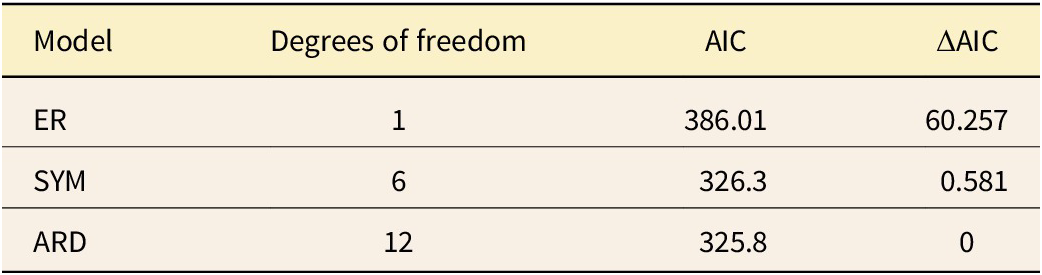
We assessed three models of discrete character evolution (Table 1, Supplementary Figs. S3–S5). The model assuming equal transition rates between fusion states had the poorest fit (AIC = 386.01, ΔAIC = 60.257). The SYM and ARD models had comparable fits (AIC = 326.3 and 325.8, respectively) and were not significantly different (ΔAIC = 0.581). Our preferred reconstruction of ancestral states therefore uses the SYM model, as it makes fewer assumptions (degrees of freedom [df] = 6 in SYM; df = 12 in ARD).
Model-fitting results for symphyseal fusion. The equal rates (ER) model assumes equal probabilities for all transitions between states. The symmetric (SYM) model assumes equal probabilities for forward and backward transitions between states (6 variable rates). The all rates different (ARD) model allows probabilities to vary across all state transitions (12 variable rates)

Our results indicate that the ancestral condition for Cetacea (Pakicetus + all crownward Cetacea) was a fused mandibular symphysis (Fig. 1). By contrast, the ancestral state for crown Cetacea was markedly less likely to have been fused (Fig. 1). Similarly, the ancestral state for mysticetes (Mystacodon + all crownward mysticetes) was likely unfused (Fig. 1). A disarticulated, kinetic symphysis was ancestral to crown Mysticeti (Fig. 1). The ancestral condition for odontocetes (Xenorophus + all crownward odontocetes) was likely a symphysis with minimal bony fusion (Fig. 1). However, the ancestral condition for crown odontocetes was likely a fused symphysis (Fig. 1). Complete fusion (state 3) re-evolved at least seven times in crown odontocetes (Fig. 1).
Ancestral state reconstruction of symphyseal fusion. Posterior probabilities of ancestral states were estimated using stochastic character mapping. Ancestral states are shown for: Cetacea (62.9% state 3, 36.8% state 2), crown Cetacea (60.5% state 1, 39.5% state 2), Mysticeti (62.1% state 1, 37.9% state 2), crown Mysticeti (100.0% state 0), Odontoceti (78.2% state 1, 21.7% state 2), and crown Odontoceti (83.4% state 2, 7.7% state 3, 8.9% state 1).

Evolutionary rates (relative frequency of transitions in fusion state) peak in the middle Eocene and at the Eocene/Oligocene boundary (Supplementary Table S4, Supplementary Fig. S9). Our stochastic mapping results suggest that a transition from full fusion to partial fusion occurred in stem cetaceans in the middle of the Eocene (Supplementary Figs. S6–S8, S19). We also detected a transition from partially fused to unfused symphyses later in the Eocene, before the inferred origin of crown Cetacea. The transition from unfused to decoupled mandibles likely occurred in stem mysticetes near the Eocene/Oligocene boundary, before the inferred origin of crown Mysticeti.
Elongation
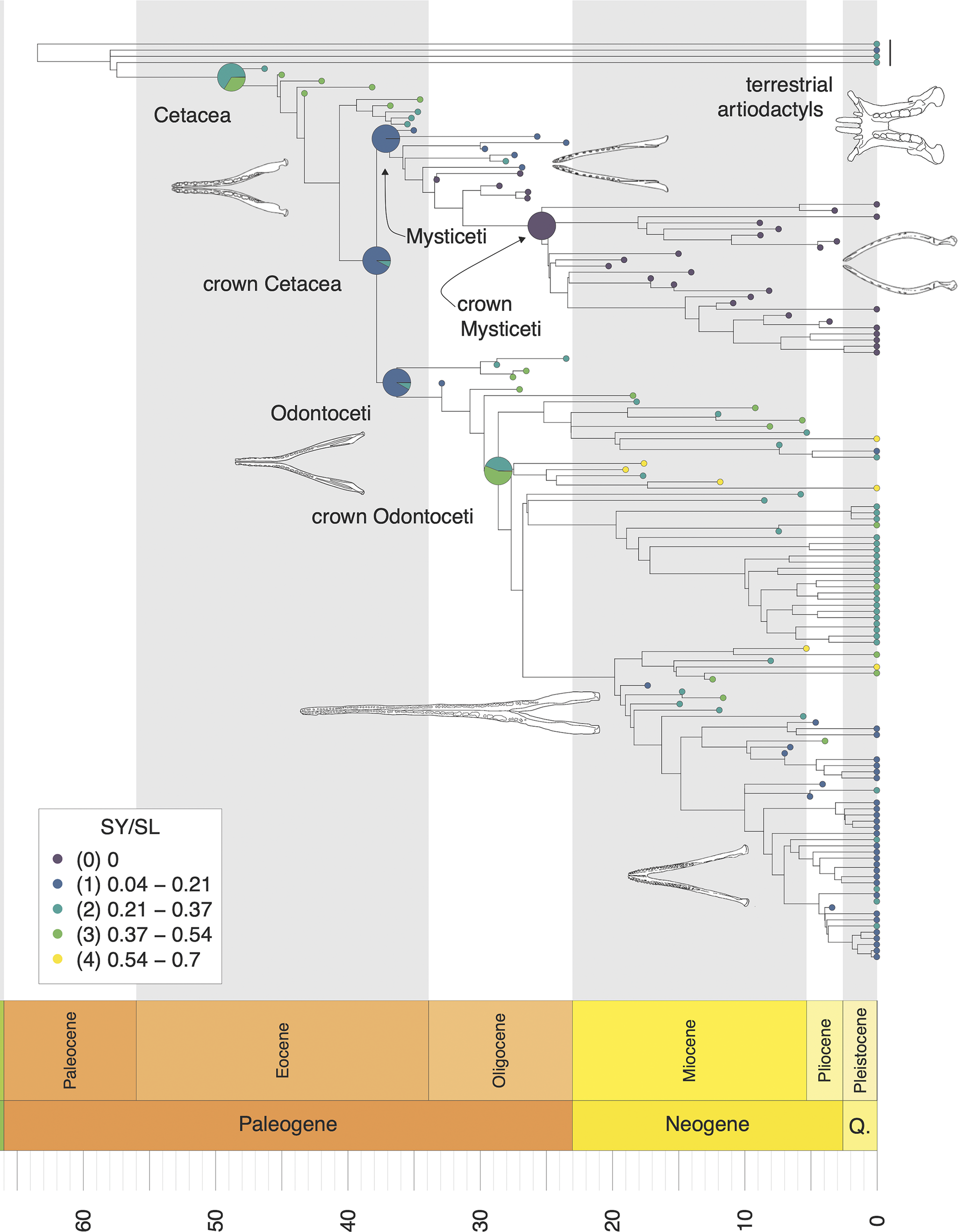
Analyses of elongation only include 149 taxa with mandibles complete enough to measure or estimate SY and SL. Elongation (SY/SL) ranges from 0 in crown (and some stem) mysticetes to 0.706 in Parapontoporia pacificus (x̄ = 0.222, σ = 0.169). The ancestral condition for Cetacea (Maiacetus + all crownward Cetacea) was a moderately elongated symphysis (Fig. 2). The ancestral symphysis for crown Cetacea, however, was shorter (Fig. 2). The ancestral state for mysticetes was a short symphysis (Fig. 2), with an elongation value of 0 as ancestral to crown Mysticeti (Fig. 2). The ancestral condition for odontocetes was also a short symphysis (Fig. 2), whereas the ancestral condition for crown Odontoceti was a longer symphysis (Fig. 2). Several odontocete lineages independently evolved extremely long symphyses with elongation values greater than 0.54. Short symphyses with elongation values less than 0.21 also evolved several times in crown cetaceans, including odontocetes (Fig. 2). Evolutionary rates (relative frequency of transitions in elongation state) peak in the Eocene, before the inferred origin of crown Cetacea (Supplementary Tables S5, Supplementary Figs. S11, S12).
Ancestral state reconstruction of symphyseal elongation. Elongation (SY/SL) was discretized into five bins, indicated by color. Posterior probabilities of ancestral states were estimated using stochastic character mapping. Ancestral states are shown for: Cetacea (65.7% 0.21–0.37, 33.7% 0.37–0.54), crown Cetacea (93.7% 0.04–0.21, 6.1% 0.21–0.37), Mysticeti (99.9% 0.04–0.21), crown Mysticeti (100% 0), Odontoceti (92.6% 0.04–0.21, 6.9% 0.21–0.37), and crown Odontoceti (50.8% 0.37–0.54, 48.0% 0.21–0.37).
Relationships between Morphological Variables
We found a strong relationship between fusion and elongation, F(3, 145) = 74.48, p < 0.001 (Supplementary Table S8, Supplementary Fig. S13). By group, this relationship was also significant in odontocetes and mysticetes (p < 0.001 in both groups) but not in archaeocetes (p = 0.272). Mean elongation values are 0.212 for unfused symphyses, 0.247 for partially fused symphyses, and 0.428 for fully fused symphyses. Given that there is no measurable length of symphyseal contact in decoupled symphyses, mean elongation is 0 with no spread. A Tukey multiple comparisons of means test identifies three significantly different groups: decoupled, fully fused, and a group combining unfused and partially fused symphyses. Unfused and partially fused symphyses are not significantly different from each other (p = 0.551) (Supplementary Table S8).
Relationships between Morphological and Ecological Variables
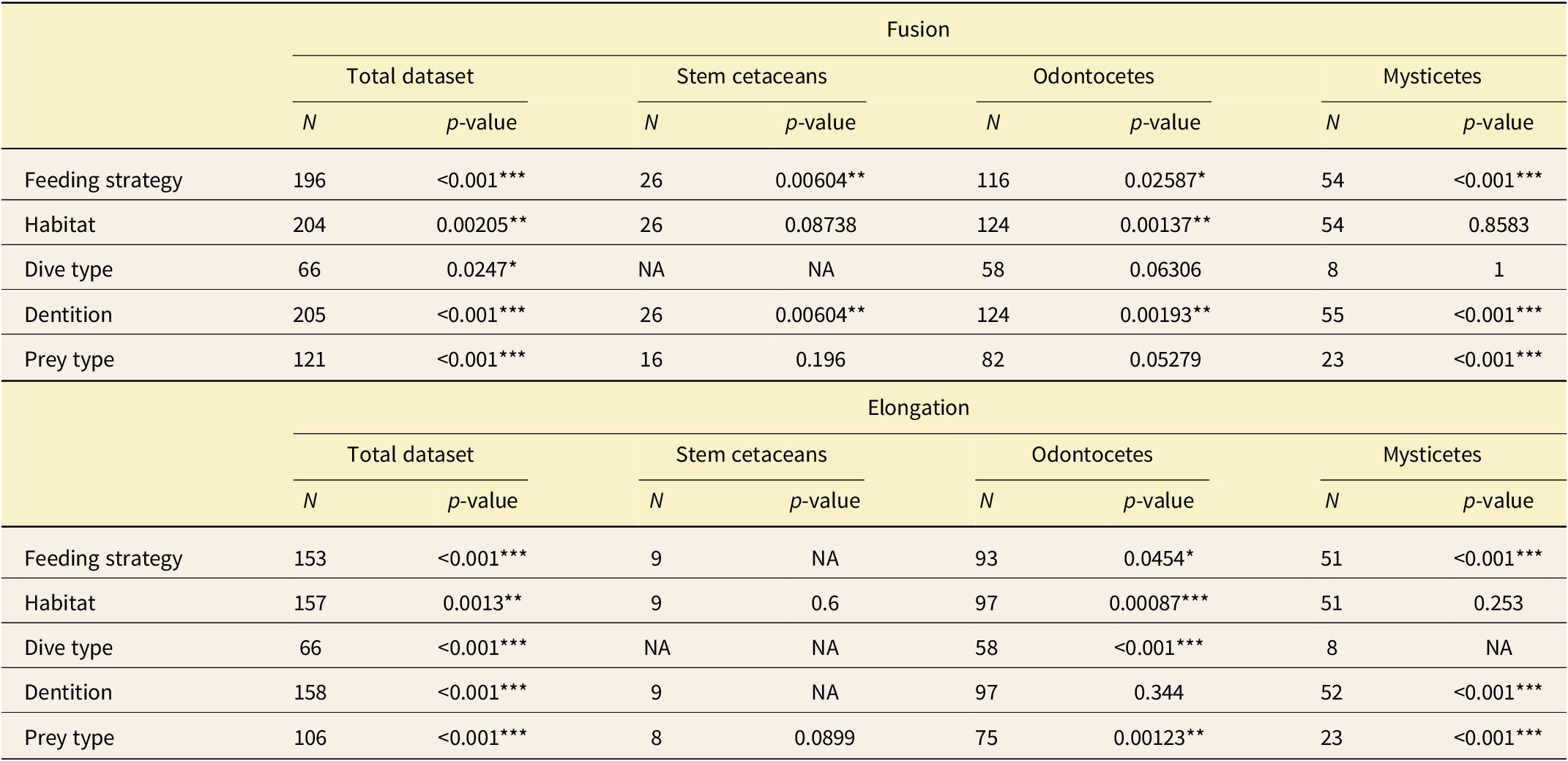
Our results indicate significant relationships between symphyseal morphology and all ecological variables examined (Table 2, Supplementary Tables S6, S7, Supplementary Figs. S14–S18). Although statistical significance varies when these relationships are tested by group, we found fusion and/or elongation to be related to feeding strategy, dentition, and prey type in both crown groups. Decoupled symphyses are strongly associated with filter feeding (standardized residual [r] = 13.795), edentulous dentition (r =14.318), and planktivory (r = 10.366). In odontocetes, fully fused symphyses and raptorial feeding are positively associated (r = 2.637). Our results indicate a positive association between full fusion and riverine habitats (r = 2.818) and a positive association between partial fusion and pelagic habitats (r = 3.848). Overall, the riverine habitat had the highest mean elongation (0.558) and was significantly different from marine habitats. We found no association between full fusion and suction feeding in odontocetes (r = −2.637). We also did not find an association between full fusion and a heterodont (r = −1.11) or reduced (r = −2.019) dentition. Instead, full fusion occurs more frequently in homodont cetaceans (r = 5.332).
Summary of ecological analyses. Reported p-values are from chi-square tests of independence (for fusion) and analyses of variance (for elongation). The number of taxa (N) is reported for each statistical test. Each test was conducted for the total dataset and by group (stem cetaceans, odontocetes, and mysticetes). Asterisks indicate the level of significance: *p ≤ 0.05; **p ≤ 0.01; ***p ≤ 0.001
Discussion
Major Shifts in Symphyseal Morphology
Whales evolved from terrestrial ancestors with a fused, moderately elongated symphysis. During the first phase of whale evolutionary history, whales became increasingly aquatic, evolving specialized underwater hearing and reduced hindlimbs (Pyenson Reference Pyenson2017). Although complete fusion is observed in some early whales, such as remingtonocetids (Thewissen and Bajpai Reference Thewissen and Bajpai2009), less extensive fusion is observed in the mandibles of increasingly pelagic stem whales, such as basilosaurids (Kellogg Reference Kellogg1936; Uhen Reference Uhen2004). Our results indicate a shift from state 3 (full fusion) to state 2 (partial fusion) in the middle Eocene, with ankylosed mandibles becoming rare by the end of the Eocene. This shift coincides temporally with a peak in evolutionary rate for symphyseal fusion, as well as the trans-Atlantic dispersal of cetaceans and the rise of Pelagiceti (Gohar et al. Reference Gohar, Antar, Boessenecker, Sabry, El-Sayed, Seiffert, Zalmout and Sallam2021; Antar et al. Reference Antar, Gohar, El-Desouky, Seiffert, El-Sayed, Claxton and Sallam2023).
Near the inferred origin of crown Cetacea, we identify a shift from state 2 (partial fusion) to state 1 (unfused), as well as peaks in evolutionary rate for both fusion and elongation. We also found a shift in the early Oligocene, when stem mysticetes evolved decoupled, highly mobile mandibles (state 0). Finally, we report a shift near the end of the Oligocene, when at least one lineage of odontocetes underwent a trait reversal to a fully fused mandible (state 3). These shifts during the Oligocene follow the opening of Drake Passage and the onset of the Antarctic Circumpolar Current (ACC) at the Eocene/Oligocene boundary. Increased ocean productivity associated with the ACC has been linked to the diversification of crown Cetacea (Fordyce Reference Fordyce1980; Marx and Uhen Reference Marx and Uhen2010; but see Pyenson Reference Pyenson2017), and changes in symphyseal morphology likely reflect diversification in feeding ecology (Marx and Fordyce Reference Marx and Fordyce2015).
Throughout the Miocene, odontocetes repeatedly converge on fully fused mandibles, especially among longirostrine forms such as platanistoids and some delphinidans (McCurry and Pyenson Reference McCurry and Pyenson2019). Conversely, only mysticetes with an unfused, state 0 mandible survive into the Miocene. Fully fused mandibles are less common after the end of the Miocene, likely due to the extinction of most longirostrine forms (Fordyce and de Muizon Reference Fordyce, de Muizon, Mazin and de Buffrénil2001; Marx et al. Reference Marx, Lambert and Uhen2016; Viglino et al. Reference Viglino, Buono, Tanaka, Cuitiño and Fordyce2022; but see Benites-Palomino et al. Reference Benites-Palomino, Vélez-Juarbe, Salas-Gismondi and Urbina2019). Nevertheless, fully fused mandibles do persist to the Holocene and are notably common among freshwater odontocetes (Pyenson et al. Reference Pyenson, Vélez-Juarbe, Gutstein, Little, Vigil and O’Dea2015; Page and Cooper Reference Page and Cooper2017).
Functional Implications for Feeding Ecology
Our results support the hypothesis that different ecological factors influence symphyseal morphology. We found significant relationships across all ecological traits examined, with strongest correlations in feeding strategy, dentition, and prey type. This suggests that ecological factors associated with feeding are stronger influences on fusion than environmental factors. Our results are consistent with the well-established conclusion that decoupled, highly mobile mandibles facilitate bulk filter feeding and planktivory in baleen whales (Fitzgerald Reference Fitzgerald2012). We also found a strong association between a long, fused symphysis and raptorial piscivory. Although fused mandibles have been identified as an adaptation or proxy for suction feeding (Adam and Berta Reference Adam and Berta2002; Johnston and Berta Reference Johnston and Berta2011), we did not find a strong association between suction feeding and a fused symphysis. Numerous lineages of obligate suction feeders, such as Physeter and some beaked whales (e.g., Hyperoodon sp.), have unfused (state 1) symphyses. Thus, our results suggest that suction feeding does not depend on specific symphyseal morphologies. Observations of sperm whales with injured or congenitally deformed mandibles indicate that—in at least some suction-feeding taxa—a functional symphysis may not even be required for feeding (Werth Reference Werth2004).
We also find an association between symphyseal morphology and tooth morphology. The transition from state 2 (partially fused) to state 1 (unfused) mandibles near the origin of crown Cetacea coincides with reduced tooth count and complexity in stem mysticetes and numerous lineages of odontocetes (Peredo et al. Reference Peredo, Peredo and Pyenson2018a). Patterns in both early odontocetes and mysticetes suggest a link between an unfused mandible and the reduction or simplification of teeth. Our results demonstrate that complete decoupling of the mandibles in mysticetes clearly coincides with tooth loss before the origin of crown Mysticeti, resulting in an unfused and toothless ancestral condition. By comparison, at least seven lineages of odontocetes independently converge on an edentulous or functionally edentulous dentition (Peredo et al. Reference Peredo, Peredo and Pyenson2018a,Reference Peredo, Pyenson, Marshall and Uhenb). Of these seven, at least three exhibit unfused mandibles. This may suggest that taxa with a reduced or absent dentition do not benefit mechanically from a fused symphysis.
In terrestrial mammals, symphyseal fusion has been linked to resisting stresses and reducing strain along the joint during mastication (Scott et al. Reference Scott, Hogue and Ravosa2012; Ravosa and Vinyard Reference Ravosa and Vinyard2020). Extant whales, however, do not masticate or process prey using their teeth. Because prey processing is a behavior that cannot be observed in fossil taxa, we used a heterodont dentition as a morphological proxy. We do not find an association between heterodonty and fusion. Instead, our results support the conclusion that heterodonty is largely driven by phylogeny (Peredo et al. Reference Peredo, Peredo and Pyenson2018a). Peredo et al. (Reference Peredo, Peredo and Pyenson2018a) proposed that trends in dental simplification since the Eocene are related to a decrease in prey-processing behavior. Concurrent trends in symphyseal morphology and dental simplification may be explained by the loss of prey-processing behavior and concomitant changes in masticatory loading regimes. This would further support the conclusion that aquatic feeding imposes different mechanical constraints than those associated with feeding on land (Hocking et al. Reference Hocking, Marx, Park, Fitzgerald and Evans2017; Marshall and Pyenson Reference Marshall, Pyenson, Bels and Whishaw2019).
Although the symphysis does not play a role in prey processing in crown whales, it still plays a key role in the mechanics of feeding. In general, fusion of the symphysis strengthens the joint and increases resistance to stresses (Scapino Reference Scapino1981; Ravosa and Vinyard Reference Ravosa and Vinyard2020). Most odontocetes do not exhibit complete fusion (ankylosis) and instead retain patent suturing with various degrees of ossification. For these taxa, the extent of fusion along the symphysis may be a response to the magnitude of loading and compliance (Scapino Reference Scapino1981). An unfused symphysis in baleen whales permits mandibular rotation during filter feeding. In rorquals, rotational properties of the mandibles accommodate expansion of the oral cavity during lunge feeding (Lambertsen et al. Reference Lambertsen, Ulrich and Straley1995; Fitzgerald Reference Fitzgerald2012; Pyenson et al. Reference Pyenson, Goldbogen, Vogl, Szathmary, Drake and Shadwick2012). In balaenids, mandibular kinesis allows for outward rotation of the large lower lip during continuous ram filtration (Lambertsen et al. Reference Lambertsen, Rasmussen, Lancaster and Hintz2005).
Elongation of the symphysis has been linked to trade-offs in strength and speed (Walmsley et al. Reference Walmsley, Smits, Quayle, McCurry, Richards, Oldfield and Wroe2013; McCurry et al. Reference McCurry, Walmsley, Fitzgerald and McHenry2017). Shorter symphyses are better at withstanding loads, such as those incurred from feeding on large prey or hard tissue. By contrast, longer symphyses operate as fast levers better suited for rapid piercing of small prey (McCurry et al. Reference McCurry, Walmsley, Fitzgerald and McHenry2017; Coombs et al. Reference Coombs, Knapp, Park, Bennion, McCurry, Lanzetti, Boessenecker and McGowen2024). Longer levers are inherently weaker and more susceptible to high strains (Walmsley et al. Reference Walmsley, Smits, Quayle, McCurry, Richards, Oldfield and Wroe2013). Many taxa with elongated mandibles also exhibit complete fusion, which may be an adaptation to mitigate deformation of a long lever by strengthening and stabilizing the joint.
Elongation of a Joint versus Other Metrics of Jaw Morphology
The work presented here should be distinguished from other important analyses investigating the link between cetacean jaw morphology and feeding ecology (Werth Reference Werth2006; Boessenecker et al. Reference Boessenecker, Fraser, Churchill and Geisler2017; Coombs et al. Reference Coombs, Knapp, Park, Bennion, McCurry, Lanzetti, Boessenecker and McGowen2024). Symphyseal elongation—one of the variables examined in this study—is both conceptually and empirically distinct from other metrics of the feeding apparatus, such as the mandibular bluntness index (MBI) (Werth Reference Werth2006) and rostral proportion index (RPI) (Boessenecker et al. Reference Boessenecker, Fraser, Churchill and Geisler2017). Werth (Reference Werth2006) developed MBI to quantify amblygnathy (shortening of the jaw and rostrum) in odontocetes. Although less blunt jaws (low MBI) might be expected for cetaceans with elongated symphyses (e.g., Platanista gangetica), blunt jaws (high MBI) do not necessarily follow from shortening the symphysis. Dwarf and pygmy sperm whales have the highest MBI values among extant odontocetes (Werth Reference Werth2006), yet their symphyses are long compared to those of other odontocetes with a lower MBI. Symphyseal elongation and MBI also rely on completely different dimensions, including measurements used for the length of the mandible (Supplementary Fig. S2).
Boessenecker et al. (Reference Boessenecker, Fraser, Churchill and Geisler2017) developed RPI to examine the evolution of rostral length in whales. While an elongated rostrum approximates an elongated symphysis in some taxa (McCurry and Pyenson Reference McCurry and Pyenson2019), symphyseal elongation departs from RPI in two important ways. First, although an elongated rostrum often coincides with an elongated mandible, it does not always coincide with an elongated symphysis. In mysticetes, an elongated rostrum co-occurs with elongated mandibles articulating at a comparatively short symphyseal region. Second, the rostrum is an anatomical region that consists of the premaxillae, maxillae, and (sometimes) frontal and nasal bones in cetaceans. The mandibular symphysis, however, is a joint. Our study therefore departs from previous work by considering the functional implications of elongating a joint with different modes of articulation and varying degrees of mobility.
Conclusion
This study is the first to document the distribution of diverse symphyseal morphologies across Cetacea and examine macroevolutionary patterns associated with the joint. Future work should aim to document the ontogenetic development of the mandibular symphysis in whales, as this would inform an understanding of how ontogenetic age influences symphyseal morphology. For species that exhibit fused symphyses, identifying when fusion occurs in an organism’s ontogeny might illuminate whether ossification is an adaptation or response to loads incurred on the joint during feeding (Scott et al. Reference Scott, Hogue and Ravosa2012). Our statistical analyses indicate a strong link between symphyseal morphology and functional ecology. However, establishing a direct relationship between these variables will require experimentally testing the functional performance of different morphologies. Previous studies have tested the biomechanical implications of an elongated symphysis in aquatic tetrapods (Walmsley et al. Reference Walmsley, Smits, Quayle, McCurry, Richards, Oldfield and Wroe2013; McCurry et al. Reference McCurry, Walmsley, Fitzgerald and McHenry2017), as well as the role of symphyseal morphology in prey-capture technique (Tseng et al. Reference Tseng, Grohé and Flynn2016). Functional hypotheses of fusion have been examined extensively in terrestrial mammals through both mechanical and behavioral studies (Lieberman and Crompton Reference Lieberman and Crompton2000; Ravosa and Vinyard Reference Ravosa and Vinyard2020). Future work should aim to identify the broader developmental patterns driving fusion and test the functional implications of fusion as it relates to aquatic feeding.
Acknowledgments
This work was supported by the Burke Museum Vertebrate Paleontology Collection Study Grant, the Smithsonian Institution’s Remington Kellogg Fund, and the Gates Foundation. J.S.B. was supported by an AI in Science Postdoctoral Fellowship (Schmidt Sciences, LLC). We thank C. A. Sidor, J. Bradley, and K. Anderson for facilitating access to collections at the Burke Museum. We thank R. Muehlheim for access to specimens at the Cleveland Museum of Natural History. We also thank T. Hsu, M. R. McGowen, D. Lunde, and A. Millhouse for facilitating access to specimens at the Smithsonian Institution’s National Museum of Natural History. Finally, we thank two anonymous reviewers for reading and suggesting revisions on a previous version of the paper.
Competing Interests
The authors declare no competing interests.
Data Availability Statement
Datasets are available from the Dryad repository: https://doi.org/10.5061/dryad.q83bk3jvp. Code is available from the Zenodo repository: https://doi.org/10.5281/zenodo.15742307. Supplementary tables and figures are available at https://doi.org/10.5281/zenodo.15742309.



 Open access

