





Introduction
Green kyllinga is a perennial plant in the Cyperaceae family. It is a C4 plant that thrives in areas with temperatures ranging between 30 C and 35 C. Its leaves are narrow and often mistaken for grass species. Like many other species of Cyperaceae, green kyllinga is adapted to open, sunny areas with reduced competition from taller plants whose shade would be suppressive (Bryson and Carter Reference Bryson, Carter, Naczi and Ford2008; Bryson et al. Reference Bryson, Carter, McCarty and Yelverton1997). Such habitats are often produced by natural or artificial disturbance. Green kyllinga is believed to have been introduced to the continental U.S. from Asia and although the time of introduction is uncertain it is known to have been established in the United States prior to 1821 (Elliott Reference Elliott1821). It is now primarily distributed along the coast in the temperate southeastern United States (Bryson et al. Reference Bryson, Carter, McCarty and Yelverton1997; McElroy et. al. Reference McElroy, Yelverton and Warren2005). Of the 13 kyllinga species that are considered weeds, green kyllinga is among the world’s worst. This species has been reported to grow among 17 crops and has been found in 43 countries (Holm et al. Reference Holm, Doll, Holm, Pancho and Herberger1997).
Green kyllinga spreads via highly viable seeds and a network of underground rhizomes (Molin et al. Reference Molin, Khan, Barinbaum and Kopec1997; Westbury et al. Reference Westbury, McCullough, McElroy, Rutland and Patel2022). The seed head of green kyllinga is simple, densely packed, and nearly round to oblong, and each head may contain up to 100 spikelets that are green, one-flowered, and deciduous as a unit (Cudney et al. Reference Cudney, Elmore, Shaw and Wilen1998; Godfrey and Wooten 1979 as cited in Bryson and Carter Reference Bryson, Carter, Naczi and Ford2008; McVaugh 1993 as cited in Bryson and Carter Reference Bryson, Carter, Naczi and Ford2008). Seeds from the plant are dispersed by both wind and water (Sumaryono and Basuki Reference Sumaryono and Basuki1986). The transportation of sod, mulch, soil, hay, and fodder is also associated with the dispersal of sedges in general. Frequent irrigation and mowing without removing clippings enhance the vegetative growth of perennial kyllinga species (Molin et al. Reference Molin, Khan, Barinbaum and Kopec1997; Yelverton and McCarty Reference Yelverton and McCarty1996). Green kyllinga can form dense mats that hinder crop production activities in cropping areas. Once established, it is challenging to control. In temperate regions, temperature is a limiting factor that is likely to affect biomass production, whereas it is less important in tropical or subtropical regions such as Florida (Rodiyati and Nakagoshi Reference Rodiyati and Nakagoshi2003).
Green kyllinga has become a problem in the bare soil between the raised, plastic-covered beds (row middle) in commercial strawberry and winter vegetable fields in central Florida in recent years. This is problematic because much of the published research examining the management of green kyllinga is focused on managing it in turf. As such, limited information exists on how green kyllinga would respond to commonly used herbicides in Florida specialty crop production. In turf, herbicides generally provide temporary suppression, but regrowth commonly occurs from uninjured stems and rhizomes (Blum and Yelverton Reference Blum and Yelverton1997; Lowe et al. Reference Lowe, Whitwell, McCarty and Bridges2000; Molin et al. Reference Molin, Khan, Barinbaum and Kopec1997; Porter and Shepard Reference Porter and Shepard1995; Yelverton and McCarty Reference Yelverton and McCarty1996). In addition, the first report of green kyllinga being resistant to acetolactate synthase inhibitors was identified in turf in Florida (Westbury et al. Reference Westbury, McCullough, McElroy, Rutland and Patel2022). There is a need to identify herbicide options that can be used in the row middles in specialty crop farms in the southeastern United States for the management of green kyllinga.
Therefore, the objectives of this study were to evaluate multiple preemergence herbicides for their efficacy to control green kyllinga and to characterize the dose effectiveness of the postemergence herbicide glufosinate (Rely 280; BASF, Durham, NC) on green kyllinga at the vegetative and bolting stages of development.
Materials and Methods
Experiments were conducted in a greenhouse (27.76°N, 82.22°W) located at the Gulf Coast Research and Education Center in Wimauma, Florida. No supplemental lighting was provided in the greenhouse. The temperature control system was set for 28/16 C (day/night) temperatures. In all experiments, drip irrigation was used to keep the soil moist for the duration of the experiment. All herbicides for all experiments were applied at 187 L ha−1 with a Generation 3 research sprayer (DeVries Manufacturing; Hollandale, MN) equipped with an EVS8002 nozzle (TeeJet Technologies, Glendale Heights, IL) at 241 kPa unless otherwise stated.
Green kyllinga plants were collected from a commercial strawberry field (27.949903°N, 82.120726°W) in Plant City, Florida, in January 2022. At the time of collection, the green kyllinga shoots were in the vegetative stage. Clumps of green kyllinga were separated and transferred to black, plastic pots with a 225-cm2 surface areas and 16.5-cm depths in the greenhouse to be used in the glufosinate dose response assay on bolted plants. A total of 10 additional pots of green kyllinga were kept in the greenhouse to produce F1 seeds, which were used both for a herbicide experiment and for subsequent glufosinate dose assays. The average seed weight used in the preemergence experiments was 0.20 g.
Efficacy of Preemergence Herbicides
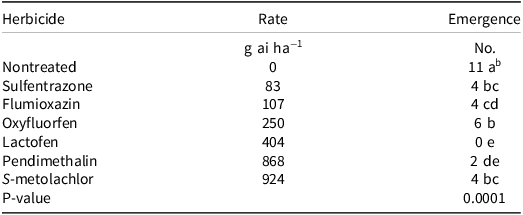
A greenhouse experiment was conducted to examine the efficacy of preemergence herbicides on green kyllinga. The experimental design was a randomized complete block design with seven treatments and four replications, and the experiment was repeated twice. Fifty green kyllinga seeds were placed in each pot 24 h before the herbicide application. Each pot was filled with a Myakka fine sand (sandy, siliceous hyperthermic Oxyaquic Alorthod) field soil with a composition of 92.4% sand, 2.8% clay, 4.8% silt, and 1.73% organic matter. A thin layer (approximately 1 cm) of the same soil was used to cover the seeds. Preemergence treatments included S-metolachlor (924 g ai ha−1), pendimethalin (868 g ai ha−1), lactofen (404 g ai ha−1), oxyfluorfen (250 g ai ha−1), flumioxazin (107 g ai ha−1), sulfentrazone (83 g ai ha−1), and a nontreated control (Table 1). Pots were moved to the spray cabinet immediately before herbicides were applied and returned to the greenhouse immediately after. Emerged weeds were counted and removed weekly, with the first count occurring 7 d after application (DAA) and the final count occurring 28 DAA.
Herbicide active ingredients, trade names, rates, and modes of action used in postemergence and preemergence green kyllinga trials.

Glufosinate Dose Assay
An experiment was conducted to evaluate green kyllinga control with multiple glufosinate rates applied at different green kyllinga growth stages. The experimental design was a two-by-seven factorial arranged as a randomized complete block design with four blocks and repeated twice. The first factor was growth stage (shoot height of 1 and 9 cm), and the second factor was glufosinate rate (0, 24, 48, 94, 189, 378, and 755 g ai ha−1). The alkylphenolpolyethoxylate and soybean-based fatty acids nonionic surfactant (Preference; Winfield Solution LLC, Arden Hills, MN) was added to the glufosinate at 200 mL L− 1. Seeds were sown in black pots filled with peat-lite mix (Speedling Inc., Sun City, FL) and were fertilized weekly after emergence using a 20-20-20 N-K-P Nutri-leaf soluble fertilizer (Miller Chemical, Hanover, PA). The fertilizer was applied at the concentration recommended on the packaging, but the precise amount applied per pot was not tracked. Prior to herbicide application, height was determined by measuring five kyllinga shoots in each pot from the base of the kyllinga shoot to the tip of the tallest leaf. Treatments were applied when the average shoot height reached 1 or 9 cm in the respective treatments.
Data collection included visual control ratings taken 2, 7, 14, and 28 DAA and rated on a scale of 0% to100% with 0% representing no control and 100% representing plant death. At 28 DAA the height of 5-leaf blades per pot was measured and shoot biomass was collected by cutting plants at the soil line, placing them in paper bags, and drying them in the oven for 7 d at 60 C.
Glufosinate Dose Assay on Bolted Green Kyllinga
Treatments were arranged as a randomized complete block design with five blocks. For the first run, green kyllinga rhizomes were collected from a commercial farm and sown in a greenhouse in pots filled with peat-lite mix (Speedling). All pots were fertilized weekly after emergence using a 20-20-20 Nutri-leaf soluble fertilizer as previously described. Glufosinate treatments were applied when plants reached maximum height and were flowering. For the second run of the experiment, green kyllinga shoots were grown from seeds collected from plants that had been harvested from the same rhizome source as plants used in Run 1.
Prior to herbicide application, five kyllinga shoots in each pot were measured from the base of the plant shoot to determine the height of bolted plant, which averaged 18 cm. Herbicides were applied at the same rates as listed above. Due to maintenance requirements for the Generation 3 research sprayer, herbicides were applied using a CO2-pressurized backpack sprayer (Solo Inc. Newport News, VA). The nozzle used was an EVS8002 model (TeeJet Technologies. Glendale Heights, IL), and the application volume was 187 L ha−1 at 241 kPa. Data collection was the same as the vegetative experiment but with the addition of a flower count on the bolted green kyllinga prior to biomass collection.
Data Analysis
In the preemergence experiment, total seedling emergence over the testing period was counted and compared with that of the nontreated control. Data were subjected to analysis of variance and means were separated at the 5% level of significance using the Tukey HSD test with SAS software (v.9.4; SAS Institute, Cary, NC).
For the glufosinate assay, the ANOVA procedure in SAS was used to test for treatment effects. Nonlinear regression analysis was then performed on control and dry weight data using the NLIN procedure. The four-parameter decay model was fit to early active vegetative growth and active vegetative dry matter data as follows: $f\left( x \right){\rm{\;}} = {\rm{\;}}y0 + a \cdot {e^{ - bx}} + c \cdot x$
where f(x) is the dry weight, y0 represents the y-intercept, a is the amplitude of the exponential term in the equation, b represents the rate or speed of decay of the exponential term as x increases, and c represents the linear term in the equation.
The three-parameter exponential growth model was fit to 1-cm and 9-cm vegetative control data as follows: $f{\rm{}}\left( x \right){\rm{\;}} = {\rm{\;}}y0 + a \cdot \left( {1 - {e^{ - bx}}} \right)$
where f(x) is the control, y0 represents the initial value or the y-intercept of the function, a represents the amplitude or the maximum increase in the function’s value, and b determines the rate at which the function approaches its maximum value.
Bolted Green kyllinga Glufosinate Dose Assay
The two-parameter decay model was fit to bolting green kyllinga dry matter data as follows: $f{\rm{}}\left( x \right){\rm{\;}} = {\rm{\;}}a \cdot {e^{ - bx}}$
where f(x) is the dry weight, a represents the amplitude or scale factor of the exponential function, and b represents the rate of decay of the exponential function as x increases. The three-parameter exponential growth model was fit to bolting green kyllinga control data as follows: $f{\rm{}}\left( x \right){\rm{\;}} = {\rm{\;}}y0 + a \cdot \left( {1 - {e^{ - bx}}} \right)$
where f(x) is the control, y0 represents the initial value or the y-intercept of the function, a represents the amplitude or the maximum increase in the function’s value, and b determines the rate at which the function approaches its maximum value.
Results and Discussion
Preemergence Herbicide Efficacy
Weed emergence data were averaged across trial iterations because there was no significant experiment by treatment interaction (P = 0.5430). Lactofen and pendimethalin were the most effective and provided 100% and 82% reduction in the number of weeds that emerged, respectively (Table 2), at 4 wk after treatment (WAT). Flumioxazin was not significantly different than pendimethalin, with 67% control at 4 WAT. Sulfentrazone provided 64% control of green kyllinga at 4 WAT. All other herbicides provided less than 59% control. All herbicides analyzed in this experiment provided some degree of suppression, with oxyfluorfen being the least effective.
Green kyllinga total seedling emergence following preemergence herbicide application. a

a Means within columns followed by different letters are significantly different at P < 0.05.
b Data were averaged over two experiments.
Previous research has primarily focused on postemergence herbicides applied to turf. McElroy et al. (Reference McElroy, Yelverton and Warren2005) found that applications of sulfentrazone effectively controlled green kyllinga more than bentazon. Pendimethalin was found to provide similar control of green kyllinga to our study when applied at rates of 0.77 and 1.02 kg ha−1 (Hsu and Chiang Reference Hsu and Chiang2000). Belcher et al. (Reference Belcher, Walker, Van Santen and Wehtje2002) found that S-metolachlor applied preemergence at 2,200 g ha−1 resulted in a 48% reduction of green kyllinga fresh weight compared with that found in a nontreated control at 4 WAT in growth chamber studies.
Glufosinate Dose Assay
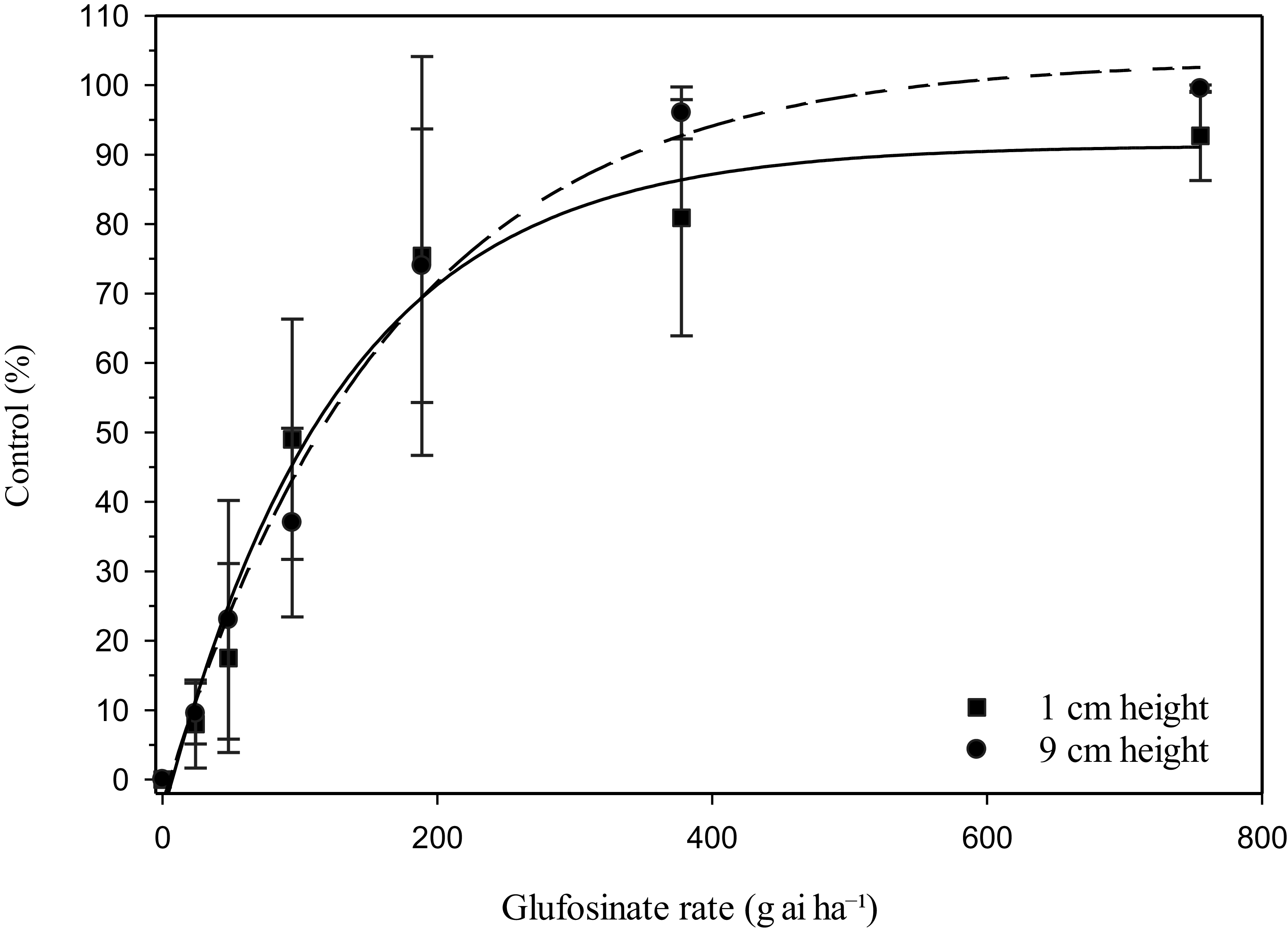
There was a significant effect of glufosinate rate with respect to green kyllinga control (P = 0.001) and dry weight (P = 0.001) at 4 WAT (Table 3). The three-parameter exponential growth model adequately explained the effect of glufosinate dose on the control of 1- and 9-cm-tall green kyllinga shoots (R 2 = 0.9793 and 0.9909). Glufosinate applied at rates of 189, 378, and 755 g ha−1 resulted in 75% to 93% control (Figure 1) when applied to shoots that were 1 cm tall. All other treatments provided no more than 49% control when applied to this growth stage when assessed at 4 WAT. Glufosinate applications on 9-cm-tall shoots at 77 and 378 g ha−1 resulted in 96% to 100% control, whereas glufosinate applied at 189 g ha−1 resulted in 74% control (Figure 1). All other glufosinate applications on 9-cm-tall shoots delivered no more than 37% control at 4 WAT.
Exponential rise to maximum parameters, exponential decay parameters, and lethal dose values fit to biomass data and data to create nonlinear regression curves for green kyllinga at different growth stages 4 WAT. a

a Abbreviations: LD50 and LD90, herbicide rate required to achieve 50% and 90% reductions, respectively, in dry biomass; SE, standard error; WAT, weeks after treatment.
b See the text for an explanation of parameters.
c Plants that were started from rhizomes collected from a commercial farm.
d Shoots that were 18 cm tall and flowering.
e Plants that were started from seeds collected from F1 plants grown in the greenhouse.
Visible control of green kyllinga at multiple glufosinate application rates on shoots that were 1 and 9 cm tall at 4 wk after treatment in greenhouse experiments conducted at the Gulf Coast Research and Education Center in Wimauma, Florida, in 2022. The error bars are the standard errors of the means.

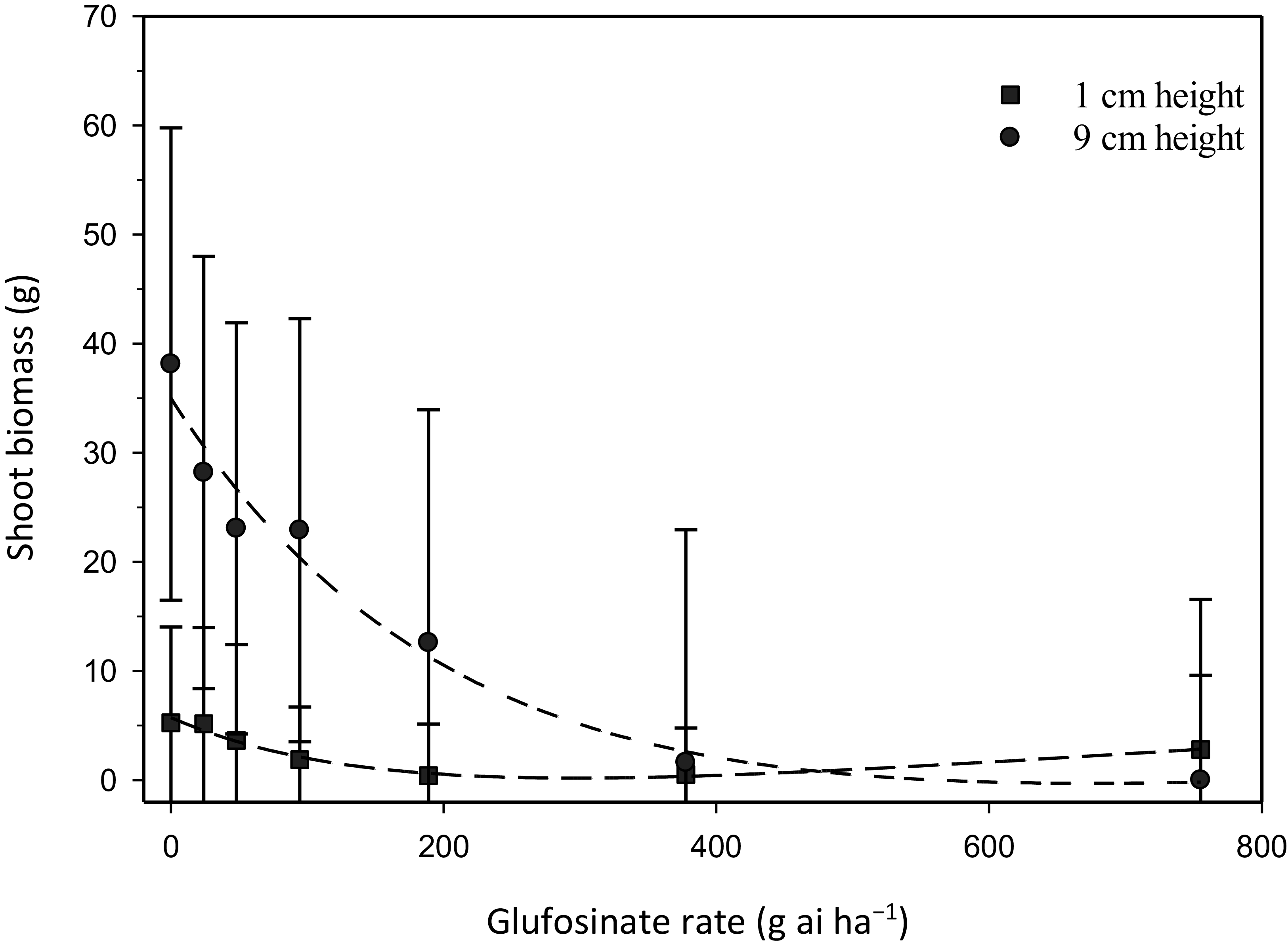
The four-parameter exponential decay model adequately explained the effect of glufosinate rate on green kyllinga shoot biomass when the herbicide was applied to 1-cm-tall (R 2 = 0.9633) and 9-cm-tall (R 2 = 0.9680) shoots (Figure 2). Green kyllinga biomass decreased as glufosinate rate increased at both the 1 cm and 9 cm vegetative stages. The rate required to achieve 90% dry biomass reduction (LD90) was 229 and 332 g ha−1 for 1-cm-tall and 9-cm-tall shoots. McCullough et al. (Reference McCullough, Yu, McElroy, Chen, Zhang, Grey and Czarnota2016) reported that glufosinate applied at 1,120 g ha−1 reduced shoot biomass by 86% to 93% compared with shoot mass in a nontreated control for two green kyllinga (10 cm height) biotypes in the greenhouse.
Green kyllinga shoot biomass at multiple glufosinate application rates on shoots that were 1 and 9 cm tall 4 wk after treatment. The error bars are the standard errors of the means.

The LD90 for shoot control on plants that were 1 cm tall at the vegetative growth stage was 339 g ha−1 of glufosinate, whereas the LD90 for 9-cm-tall shoots was 312 g ha−1 (Table 3). The 9-cm plants had a lower LD90 than plants at the earlier vegetative growth, suggesting that leaf blades on younger green kyllinga may be better equipped to survive the herbicide treatment. It is also possible that at a height of 1 cm, leaf blades were too small to hold adequate herbicide to cause plant death. Both LD90 rates fall within the registered rate for use on turf, and it may be possible to achieve adequate control of green kyllinga at the registered rate of glufosinate in row middles of plasticulture crops.
Bolted Green Kyllinga Glufosinate Dose Assay
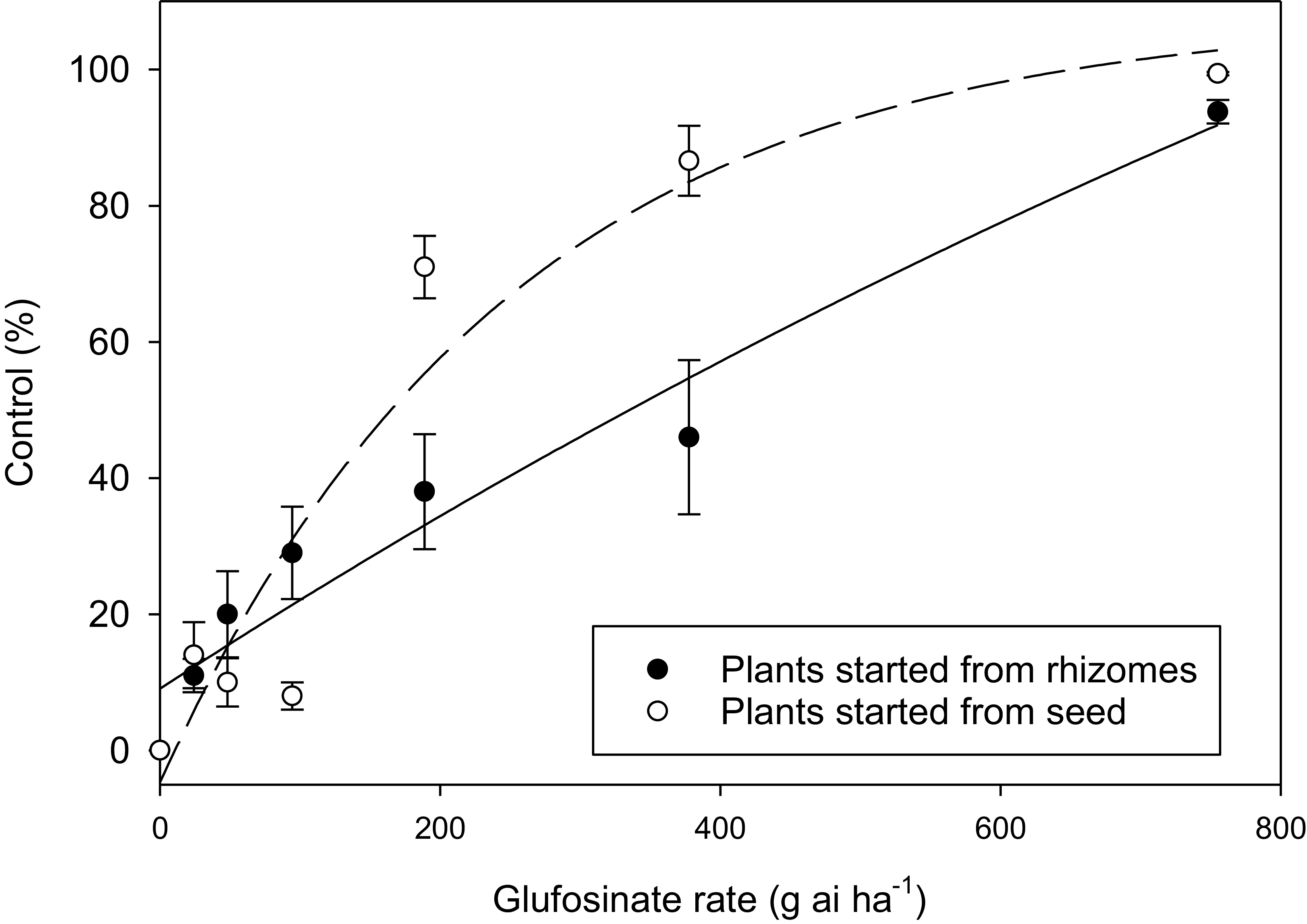
The effects of glufosinate rate varied with run (P < 0.0001) for green kyllinga control and therefore the results are presented separately for plants grown from rhizomes and seeds (Table 3, Figure 3). The three-parameter exponential growth model provided the best fit for the effects of rate on shoot control, with R 2 = 0.92 and 0.95 for plants that originated from rhizomes or shoots, respectively. The LD50 and LD90 were lower for plants that originated from rhizomes than those that originated from seeds (Table 3). For example, the LD90 for plants that originated from rhizomes was 43% lower than the LD90 for plants that originated from seeds. The data collected for this experiment cannot adequately explain why this difference occurred.
Visual control ratings of green kyllinga plants that were started from rhizomes or seeds but were 18 cm tall and flowering when exposed to multiple glufosinate application rates at 4 wk after treatment. The error bars are the standard errors of the means.

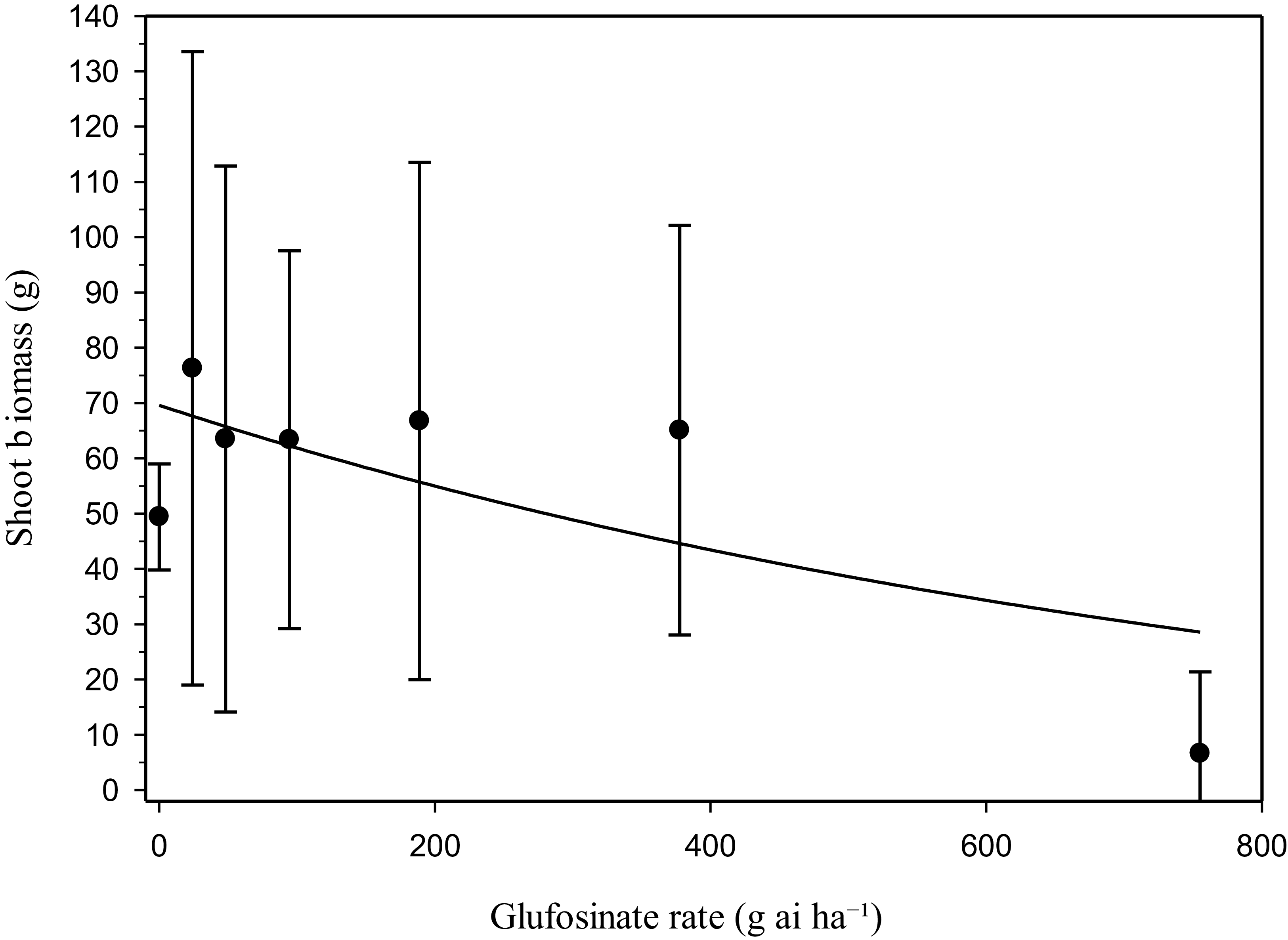
For shoot biomass, the effects of glufosinate rate did not differ between runs. The two-parameter exponential decay provided the best fit for the effect of glufosinate rate on shoot biomass (R 2 = 0.53) and dry shoot weight following applications of glufosinate did not consistently decrease until the highest glufosinate rate was applied (Figure 4). Based on the responses, the rate required to cause a 90% reduction in dry biomass (LD90) was 1,918 g ha−1 on flowering green kyllinga (Table 3). Our results highlight the importance of applying glufosinate prior to flowering.
Green kyllinga shoot biomass in response to multiple glufosinate application rates when shoots were 18 cm tall and flowering at 4 wk after treatment. The error bars are the standard errors of the means.

Practical Implications
Implementing an integrated weed management plan is an essential element in controlling the spread of green kyllinga among Florida specialty crops. Management plans need to emphasize preventing seed production and vegetative spread. Our research indicates that the use of preemergence herbicides such as lactofen and pendimethalin will effectively reduce the population density though additional field trials should be conducted. Green kyllinga escapes can be managed with postemergence applications of glufosinate at rates ranging from 378 to 755 g ha−1 if applied prior to flowering. However, inadequate control may occur if glufosinate is applied to small shoots (<1 cm), and regrowth can occur from uninjured stems (Blum and Yelverton Reference Blum and Yelverton1997; Lowe et al. Reference Lowe, Whitwell, McCarty and Bridges2000; Molin et al. Reference Molin, Khan, Barinbaum and Kopec1997; Porter and Shepard 1995; Yelverton and McCarty Reference Yelverton and McCarty1996). In some situations, repeated applications may be needed to sustain season-long control. It is important to note that glufosinate is a nonselective herbicide that can control crops and therefore must be applied during the fallow period or to row middles with a shielded applicator. Additional trials need to be conducted to confirm the efficacy of glufosinate on green kyllinga in field settings, but the results of this study suggest it is an effective option.
Funding
The research was funded by the Florida Strawberry Research and Education Foundation.
Competing Interests
The authors declare they have no competing interests.



 Open access

