

Ample empirical evidence indicates that trade booms can increase labor coercion. Rising grain exports have long been used to explain the Second Serfdom in Eastern Europe (Małowist Reference Małowist1958; Guzowski Reference Guzowski2011). The rising demand for coercion during trade booms has also been documented during the nineteenth century for Britain (Naidu and Yuchtman Reference Naidu and Yuchtman2013), Puerto Rico (Bobonis and Morrow Reference Bobonis and Morrow2014), and the British West Indies (Dippel, Greif, and Trefler Reference Dippel, Greif and Trefler2020). However, this literature largely focused on a single system of coercion: slavery in the Americas or serfdom in Europe. Yet, multiple coercive systems often coexisted. Slavery and serfdom coexisted in Russia until the eighteenth century (Hellie Reference Hellie, Eltis and Stanley2011), and indentured servitude of European immigrants long coexisted with black slavery in the Americas (Galenson Reference Galenson1984). The implications of trade booms under such dual-coercive environments are the focus of this article.
Specifically, this article investigates the effects of trade booms on labor coercion under the dual-coercion environment of slavery and state coercion. It focuses on the environment where slaves were imported from abroad, whereas local workers, who were recruited freely on the market, could not be enslaved but may have been subject to state coercion. Conceptually, trade booms may have different implications under dual-coercive systems. Within single-coercion environments, employers face a common labor supply and have access to a common coercive technology. However, under dual-coercive systems, labor supply and access to coercive systems may differ across employers. While all employers have access to foreign slaves sold in local slave markets, state coercion—like serfdom—is limited to the political elite, who can use state violence to coerce local workers, taking them out of the free labor market. This implies that slavery and state coercion are interdependent. The trade boom-induced rise in state coercion by the elite reduces the free local labor supply that faces non-elite landholders, inducing them to purchase more foreign slaves than under the slavery-only environment. In a similar vein, the abolition of slavery can exacerbate state coercion as the elite coerce more workers to compensate for their freed slaves.
This article draws on the case of Egypt during the First Globalization Era, from its trade liberalization in 1842 until WWI.Footnote 1 According to population census data digitized by Mohamed Saleh, while the majority of Egypt’s rural labor force in 1848 were self-employed peasants (51 percent) and wage agricultural laborers (10 percent), 8 percent were subject to coercion.Footnote 2 First, under the medieval slavery institution, foreign black slaves (1 percent in 1848), captured in the Nilotic Sudan and imported to Egypt, were sold competitively to all landholders, even though their use in agriculture had been exceedingly rare (Cuno Reference Cuno2009). Second, the Ottoman-Egyptian political elite—owners of large estates—could exclusively use state violence to coerce local workers (7 percent in 1848).
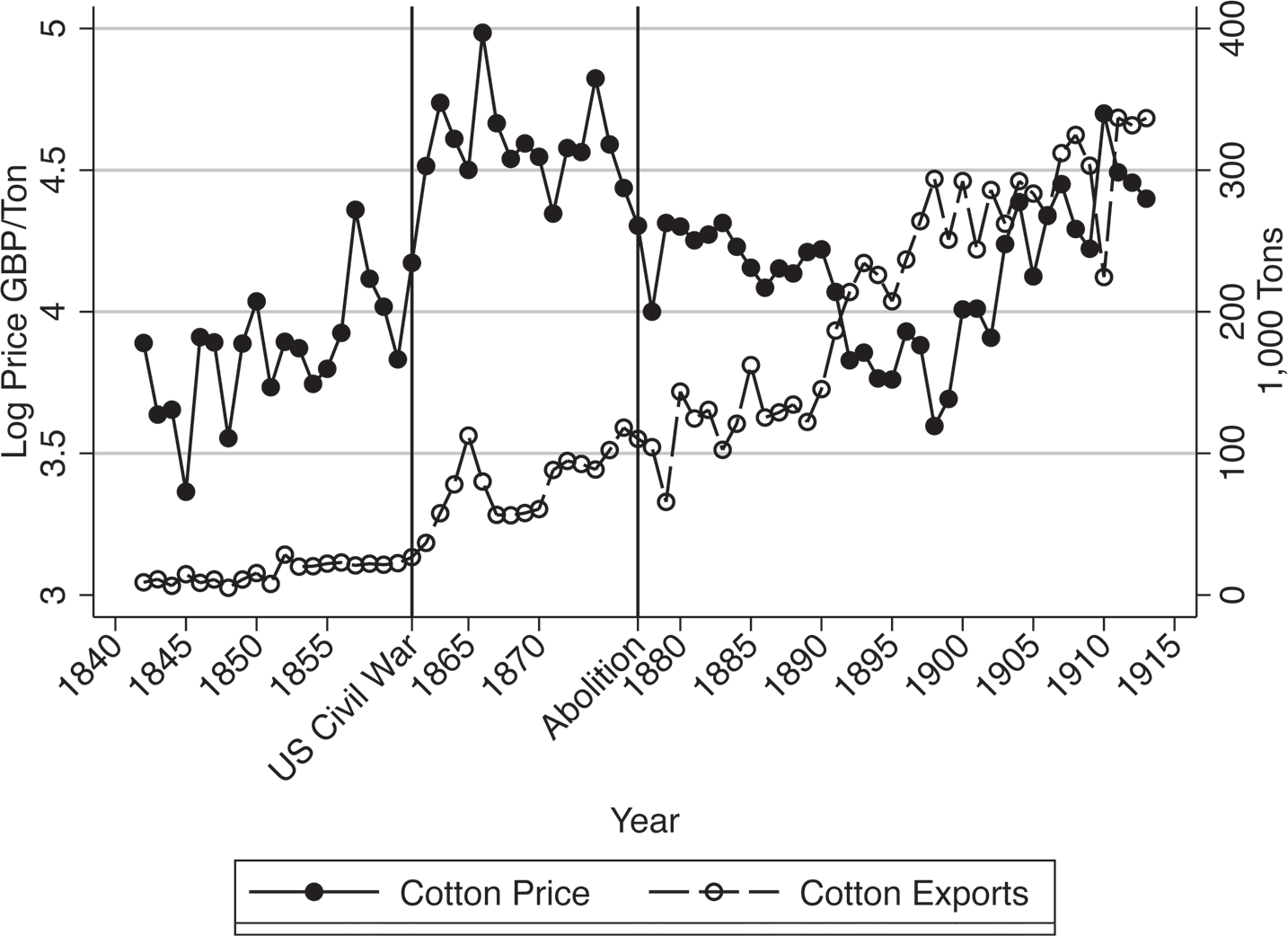
To investigate the effects of trade booms on labor coercion under Egypt’s dual-coercive system, I focus on two key events. The first event is the cotton boom during the U.S. Civil War in 1861–1865. Egypt, a global producer of high-quality long-staple cotton, quadrupled its cotton production and exports by 1865 (Figure 1). Unlike the United States, Egypt did not have international market power on the eve of the cotton boom, and hence, cotton prices were largely exogenous. The second event is the abolition of slavery via the Anglo-Egyptian Slave Trade Convention in 1877. Because the abolition was an outcome of British pressure, it was exogenous to landholders. Cotton exports continued to grow after 1877, despite the drop in prices.
PRICES AND EXPORTS OF EGYPTIAN COTTON IN 1842–1913
Notes: Quantities were originally in qintars, which I converted into tons according to the rate in Owen (Reference Owen1969, pp. 381–85). Prices were originally in Austrian thalers or Egyptian piasters, which I converted into British sterling pounds according to the rates in Owen (Reference Owen1969, pp. 381–85) and https://www.measuringworth.com. Cotton total output (not shown) is virtually equal to cotton exports.
Sources: Owen (Reference Owen1969, pp. 34, 73, 90–91, 123, 126), the 1873 Statistical Yearbook (Ministère de l’Intérieur 1873, pp. 172–73), and the 1914 Statistical Yearbook (Ministère des Finances 1914, p. 356).
I examine the effects of these two shocks using a wide range of novel, fine-grained data sources. These include, most importantly, two nationally representative individual-level samples of the Egyptian population censuses of 1848 and 1868 that I digitized from the original Arabic manuscripts at the National Archives of Egypt (Saleh Reference Saleh2013). These are among the earliest precolonial censuses from any non-Western country to include information on every household member, including females, children, and slaves. They are also the only surviving individual-level source on the slave population in Egypt and probably in the Middle East.
I employ a simple conceptual framework to guide the empirical analysis. Under the dual-coercive environment, the cotton boom increases both slaveholdings of non-elite landholders and state coercion of local workers by the elite. Wage employment declines, though, as the rise in state coercion takes more local workers out of the market. The cotton boom-induced rise in state coercion induces non-elite landholders to purchase more slaves than under the slavery-only environment. The subsequent abolition of slavery increases state coercion to compensate for the elite’s emancipated slaves, leading to a further decline in wage employment and a rise in wages.
The findings are mostly consistent with the implications of the conceptual framework. First, the cotton boom caused a substantial rise in agricultural slavery. The rural slave population tripled from 39,762 slaves (1 percent of the population) in 1848 to 144,592 slaves (3 percent) in 1868. The surging demand for slaves came from non-elite landholders—the rural middle class—and not the elite. Second, the cotton boom also caused a rise in state coercion of local workers by the elite and a decline in wage employment by non-elite landholders. Third, state coercion reinforced the demand for slaves among the rural middle class during the cotton boom. Finally, while the abolition increased wages in the free sector, I fail to find evidence that it affected state coercion or wage employment. I explain this finding by the rising political resistance to state coercion by rural middle-class Members of Parliament (MPs) after the abolition. The evidence on this mechanism remains suggestive, though, because I do not have evidence that the rise in MPs’ anti-state coercion attitudes in parliament during the post-abolition period is what mitigated state coercion.
This article mainly contributes to the literature on the causes of labor coercion. Besides being the first to examine the impact of trade booms on coercion under dual-coercive systems, this article also reveals that globalization can have far-reaching consequences. The U.S. Civil War, whose central conflict was the abolition of slavery, led unintentionally to increased coercion in Egypt. In the absence of international trade, labor coercion could also emerge due to the (exogenous) scarcity of labor relative to land (Domar Reference Domar1970; Ogilvie and Klein Reference Ogilvie and Klein2017). Alternatively, labor scarcity may increase workers’ outside wages, thus reducing coercion, which can explain the decline of coercion in Western Europe after the Black Death (North and Thomas 1973; Brenner Reference Brenner1976). Acemoglu and Wolitzky (Reference Acemoglu and Wolitzky2011) reconciled these countervailing effects. This article argues that the labor supply facing non-elite landholders is endogenous, as it can be reduced due to state coercion by the elite.
This article also speaks to the vast literature on the abolition of coercion (Fogel and Engerman Reference Fogel and Engerman1974; Fogel Reference Fogel1989; Markevich and Zhuravskaya Reference Markevich and Zhuravskaya2018; Ager, Boustan, and Eriksson Reference Ager, Boustan and Eriksson2021). While I do not examine the effects of the abolition on productivity, which has been the focus of this literature, I argue that the selective abolition of one coercive system may exacerbate the other system.
The affinity between cotton and slavery has been long documented (Marx 1861). This association was traced to specific features of cotton production, including effort intensity (Fenoaltea Reference Fenoaltea1984), returns to scale (Fogel Reference Fogel1989), and the relative productivity of women and children (Goldin and Sokoloff Reference Goldin and Sokoloff1984). More recently, the new history of capitalism literature emphasized the intertwined role of cotton and slavery in the historical development of global capitalism (Beckert Reference Beckert2015). In contrast to this thesis, I argue that neither slavery nor state coercion were necessary for cotton cultivation.
A recent body of literature examined the long-term effects of labor coercion on economic development (Engerman and Sokoloff Reference Engerman, Sokoloff and Stephen1997; Nunn Reference Nunn2008; Dell Reference Dell2010; Nunn and Wantchekon Reference Nunn and Wantchekon2011; Acemoglu, Garcia-Jimeno, and Robinson Reference Acemoglu, Garcia-Jimeno and Robinson2012; Dell and Olken Reference Dell and Olken2020). This article focuses instead on the causes of coercion. It also goes beyond the focus of this literature on colonial environments by studying coercion during the precolonial period. My finding that the ex-slave population disappeared gradually after the abolition implies that agricultural slavery did not have substantial long-term effects. On the contrary, state coercion persisted through at least WWI.
This article contributes to Egyptian history. Owen (Reference Owen1969)—a seminal contribution on the history of cotton in Egypt—did not mention the rise of slavery during the cotton boom. Other historians noted the surge in slavery during the cotton boom qualitatively, based on European narratives (Earle Reference Earle1926; Baer Reference Baer1967; Fredriksen Reference Fredriksen1977; Mowafi Reference Mowafi1981). Helal (Reference Helal1999) and Cuno (Reference Cuno2009) used the 1848 and 1868 censuses to document the rise of slavery within a handful of cotton-growing villages. State coercion occupied another group of scholars (Baer Reference Baer1962; Barakat Reference Barakat1977), although they did not examine how it was impacted by the cotton boom. This article provides the first comprehensive evidence—based on nationally representative samples of the 1848 and 1868 censuses—that the cotton boom increased both coercive systems and that the abolition did not affect state coercion. Beyond Egypt, historians documented the rise of indigenous slavery in sub-Saharan Africa and of the trans-Saharan slave trade during the nineteenth century (Austen Reference Austen1992; Wright Reference Wright2007; Lovejoy Reference Lovejoy2012). This article is the first to quantitatively document the rise of the trans-Saharan slave trade due to the cotton boom, as Egypt became the largest slave importer in North Africa.
COTTON, LAND, AND LABOR IN NINETEENTH-CENTURY RURAL EGYPT
Egyptian Cotton Cultivation on the Eve of the Cotton Boom
In 1821, a French industrialist discovered the superior quality of long-staple cotton seed in Egypt. Realizing its potential as an export crop, Muhammad Ali Pasha, the autonomous Ottoman viceroy of Egypt in 1805–1848, expanded its cultivation via the state monopoly system that lasted until 1842 and via the expansion of large estates thereafter. Two factors determined the suitability of a given area to cotton cultivation: mild temperature and the availability of perennial irrigation that provided the Nile water during the spring, the cotton planting season (Owen Reference Owen1969, pp. 28–57). Consequently, Muhammad Ali invested in perennial irrigation. New deep summer (sayfi) canals were constructed, traditional nili canals deepened, and water-lifting tools increased (Rivlin 1961, pp. 213–49).
Land and Labor on the Eve of the Cotton Boom
As Muhammad Ali granted land to his family members and top state officials—the Ottoman-Egyptian elite—large estates gradually expanded to occupy 53 percent of land in 1844. This elite were mostly absentee owners who lived in Cairo. Having a monopoly over state violence, they were able to confiscate both barren and peasants’ land. Large estates were formed on barren, deserted, or tax-arrears land, and only exceptionally on tax-paying land. The 1844 cadaster enumerates three legal forms of large estates. First, ib‘adiyas (17 percent of land) were formed on barren land for reclamation purposes. Second, ‘uhdas (28 percent) were formed on deserted and tax-arrears land. Third, jifliks (8 percent) were formed on tax-paying land and granted exclusively to the viceroy (Barakat Reference Barakat1977).
The remaining 47 percent of land in 1844 was usufruct land that belonged to village headmen (medium landholders) and the peasantry (small landholders).Footnote 3 Since village headmen were the largest landholders outside large estates, they constituted a rural middle class that first emerged in 1813 after the abolition of tax farming, as they acted as intermediaries between the peasantry and the state.
There were two labor-coercive institutions: imported slavery and state coercion of local workers. Slavery was a long-standing medieval institution since enslavement of foreign non-Muslims in ghazwas (holy raids) was permitted by Islamic law. Slavery was self-perpetuating by law; a slave’s conversion to Islam did not result in emancipation, and the offspring of a male slave were automatically slaves. In practice, though, the slave population was not sustainable by natural growth due to low fertility and low life expectancy among slaves, and annual slave imports were necessary to meet the demand for slaves.
Slaves constituted 1 percent of the population in 1848.Footnote 4 About 94 percent of slaves were blacks (aswad, sudani) from the Nilotic Sudan (Darfur, Kurdufan, and Sennar), while the remaining 6 percent were Abyssinians (habashi) from Ethiopia and whites (abyad) from Circassia and Georgia. Black slaves were transported to Egypt in caravans via trans-Saharan land routes (Fredriksen Reference Fredriksen1977, pp. 29–42). This eastern trans-Saharan slave trade between Egypt (and the Ottoman Empire) and the Nilotic Sudan and Ethiopia was largely segregated from the western trans-Saharan slave trade between North Africa, west of Egypt, and sub-Saharan Africa, west of present-day Sudan.
Employing slaves in agriculture was rare before the cotton boom. After the Abbasids’ attempt to introduce agricultural slavery in ninth-century Iraq ended with a slave rebellion, agricultural slavery mostly disappeared from the region.Footnote 5 In 1848, slaves were overrepresented in cities as domestic servants, where they constituted 3 percent of the population, 75 percent of whom were females.
Online Appendix Figure A.1 provides rough estimates of slave prices and imports in Egypt, based on remarks by contemporaneous European consuls and travelers. Panel (A) shows estimates of slave prices in 1800–1877. Whites (not shown) were the most expensive, followed by Abyssinians and blacks. Within each color, females were more expensive. Panel (B) shows estimates of the annual slave imports. Imports increased to 10,000 slaves annually between 1820, when Egypt invaded Sudan, and 1845, when the state stopped its slave raids in Sudan. However, the 1848 census reveals that these numbers are exaggerated. There were around 55,072 slaves in 1848, which is lower than what one would expect under an annual inflow of 10,000 slaves in 1820–1845. After 1845, imports dropped to about 5,000 slaves annually. The cotton boom period witnessed an unprecedented influx of slaves, about 27,500 per year. This is supported by the 1868 census, which shows that the slave population tripled between 1848 and 1868, going up from 55,072 to 173,654 (3 percent of the population).
The second coercive system was state coercion of local workers. Large estates constituted 7 percent of the rural population in 1848.Footnote 6 Labor organization varied by the legal form of the large estate. In ib‘adiyas, labor was supplied by agricultural laborers from neighboring villages (Cuno Reference Cuno1992, pp. 162–3). In ‘uhdas, peasants had to work for the landlord without pay until they paid back their tax arrears. In jifliks, peasants remained as tenants, cash-wage workers, or sharecroppers (Cuno Reference Cuno1992, pp. 161–2). Unlike slaves, coerced workers on large estates were not traded.
The Cotton Boom in 1861–1865
After the end of the state monopoly system in 1842, peasants were allowed to sell their output directly to exporters and, hence, became exposed to international price shocks. The U.S. Civil War cotton boom was unexpected, and cotton expansion was not state-planned, but rather due to individual decisions.Footnote 7 India and Brazil increased their cotton production too, with India replacing the United States as the world’s top cotton producer. But Egyptian cotton was of higher quality than Indian cotton and thus had a secure market share.
Abolition of Slavery in 1877
European abolitionists prioritized the transatlantic slave trade. Only later they turned their efforts toward abolishing the older, yet smaller and less known, trans-Saharan slave trade. Starting in 1837, British abolitionists pressured Egypt to abolish slavery. The Egyptian state was reluctant to comply because it profited from the slave trade. Furthermore, slavery was endorsed by Muslim jurists, and the abolition was thus against Islamic law (Baer Reference Baer1967).
The real push for abolition occurred in 1869–1876, when Khedive Ismail (1863–1879) ordered several British-led campaigns against Sudanese slave raiders, aiming to restore Egypt’s control over the Nilotic Sudan. The abolition was eventually achieved by the signing of the Anglo-Egyptian Slave Trade Convention in 1877 (Fredriksen Reference Fredriksen1977, pp. 157–80). This was probably facilitated by Ismail’s waning power vis-à-vis Britain, due to Egypt’s default on its international debt in 1876.
CONCEPTUAL FRAMEWORK
To guide the empirical analysis, I employ a simple conceptual framework that captures the main features of the historical context that I described in the previous section. I assume that land is fixed in each district and exogenously allocated to three classes of landholders, ranked by the size of their landholdings: the elite, the rural middle class, and the peasantry. There is a competitive market for local wage labor. The supply of wage labor is fixed and provided by landless agricultural workers. The demand for labor comes from the elite and the rural middle class. Peasants, on the other hand, recruit their own (unpaid) household labor.Footnote 8 All districts are equally suitable for wheat cultivation. Some districts are also suitable for cotton. Cotton is more labor-intensive than wheat. Wheat and cotton prices are determined internationally.
There are three environments. Under environment A (slavery only), there is a competitive market for imported foreign slaves, who are purchased for an upfront price.Footnote 9 The supply of foreign slaves is imperfectly elastic: Slave raiders can capture new slaves in response to higher slave prices. Under environment B (state coercion only), there is no foreign slave market, but the elite—the first movers in the market for local wage labor—can use state violence to coerce local workers to work on their large estates. State coercion takes agricultural laborers out of the wage labor market, reducing the local labor supply. The level of state coercion—the number of workers who are coerced by the elite—is determined by comparing the expected return from coercion (the productivity of coerced workers) to the cost of coercion (mobilizing the army, political resistance). Under environment C (dual coercive institutions), the observed environment in our context, the two coercive systems of slavery and state coercion co-exist.
Next, I analyze the effects of the cotton boom and the abolition of slavery under each environment. Before the cotton boom (1848–1861), cotton price is lower than wheat. During the cotton boom (1861–1877), cotton price rises substantially above wheat. During the abolition (post-1877), cotton price decreases, but remains higher than wheat, and slavery is abolished. I assume that emancipated slaves emigrate back to the Nilotic Sudan.Footnote 10
Impact of the Cotton Boom
In all three environments, the cotton boom induces landholders in cotton districts to cultivate cotton. Because cotton is labor-intensive, the demand for labor rises. Under environment A, the cotton boom increases slavery in cotton districts as the demand for imported slaves shifts outward. The positive effect on slaveholdings is largest among the elite—the richest landholders—followed by the rural middle class. The demand for local wage labor shifts outward too, although wage employment remains constant, as the local labor supply is fixed by assumption.Footnote 11 Both slave prices and wages go up.
Under environment B, the cotton boom increases state coercion of local workers by the elite. This implies an inward shift in wage labor supply, a fall in wage employment, and a rise in wages as coerced workers are taken out of the wage labor market. The demand for wage labor also shifts outward due to the rising demand among the rural middle class, causing wages to rise.
Under environment C, the cotton boom increases both slavery and state coercion. Slave employment and prices both go up as the demand for slaves shifts outward, where the positive effect on slaveholdings is largest among the rural middle class, not the elite (unlike in environment A). State coercion rises too, as the elite coerce more local workers. The rise in state coercion causes an inward shift in the supply of wage labor, leading wage employment to decline and wages to rise. The demand for wage labor also shifts outward, and wages rise. State coercion reinforces slavery: The cotton boom-induced rise in state coercion may induce the rural middle class to purchase more slaves than under environment A because it reduces the local labor supply facing the rural middle class.
Impact of the Abolition
In all three environments, landholders in cotton districts continue to grow cotton because it remains more profitable than wheat. Under environment A, the abolition induces a further outward shift in the demand for wage labor to substitute for the emancipated slaves. Because all freed slaves emigrate, wage employment remains constant, whereas wages rise.Footnote 12
Under environment C, the abolition of slavery causes state coercion to rise, as the elite substitute for their emancipated slaves by coercing more local workers. This leads to a further inward shift in the supply of wage labor and, hence, a further decline in wage employment and a rise in wages. The demand for wage labor also shifts outward to substitute for the freed slaves who were held by the rural middle class, leading wages to rise.
Testable Implications
To summarize, this framework produces the following testable implications (hypotheses) under the dual-coercive environment:Footnote 13
H1: Effects of the Cotton Boom:
(a) The cotton boom causes an increase in slavery.
(b) The effect of the cotton boom on slavery is largest among the rural middle class.
(c) The cotton boom increases state coercion of local workers by the elite.
(d) The cotton boom reduces wage employment by the rural middle class.
(e) The cotton boom-induced rise in state coercion induces the rural middle class to purchase more slaves than in the absence of state coercion.
H2: Effects of the Abolition of Slavery:
(a) The abolition of slavery further increases state coercion of local workers by the elite.
(b) The abolition of slavery reduces wage employment by the rural middle class.
(c) The abolition of slavery causes wages to rise.
Three notes are in order. First, the implications H1(a), H1(c), and H1(d), regarding the effects of the cotton boom on slavery, state coercion, and wage employment, and the implication H2(c), regarding the effect of the abolition of slavery on wages, are shared with single-coercion environments.Footnote 14 Second, the implications H1(b), H1(e), H2(a), and H2(b) are unique to the dual-coercive environment. The implication H1(b) demonstrates the heterogeneous slave demand response to the cotton boom across landholder classes, due to differences in political power, rather than income, whereas H1(e), H2(a), and H2(b) reflect the interdependence of slavery and state coercion. Second, this conceptual framework focuses on the economic response to the cotton boom and the abolition, not the political response. This is because it treats the (co)existence and abolition of the coercive institutions—the political environment—as exogenous. However, the elite or the rural middle class can (attempt to) alter the coercive institution(s) themselves, a political response that is not captured by the current framework. I come back to this point in the Discussion section.
THE COTTON BOOM AND LABOR COERCION
This section introduces an empirical analysis of the effects of the cotton boom. I first describe the data. I then discuss the empirical strategy and the findings.
Data
The empirical investigation of the effects of the cotton boom is based on the 1848 and 1868 population censuses. These censuses include a wide range of variables, such as sex, age, relationship to household head, slave/free status, nationality, religion, ethnicity (e.g., black), occupation, place of residence, and place of origin. Households are clearly delineated. A household record starts with a list of its free members, followed by its (free) servants and slaves. Within each category, males are always recorded before females.Footnote 15
The census samples are two cross-sections of around 80,000 individuals in each of 1848 and 1868. For the purpose of this article, I aggregated the samples to the household (head) level, which is a suitable level to measure slaveholdings, state coercion, and wage employment. I restrict the analysis to households residing in rural Egypt.Footnote 16 Out of the universe of 14 rural provinces (70 districts) in 1848, 8 provinces (45 districts) are missing in 1868. We do not know the reason behind this. It could be because the 1868 census was not conducted in these provinces or because their registers did not survive. I use stratified sampling by province each year, where I apply systematic sampling by page on the entire registers of each (surviving) province.Footnote 17 Because of the random sampling procedure, I observe neither the same households nor the same set of villages in 1848 and 1868.
I restrict the sample to households residing in the (panel of) 25 rural districts that are observed in both 1848 and 1868 in order to control for district fixed effects. This restriction results in two final cross-sectional samples of 2,469 households in 1848 and 3,321 households in 1868, residing in 504 villages in 25 “matched” districts, located within 6 provinces. Two remarks bolster my confidence in the representativeness of this restricted sample for the whole of rural Egypt. First, Online Appendix Table A.1 shows that households in matched districts are not statistically different from those in non-matched districts with respect to most characteristics in 1848. The exceptions are that matched districts have a higher proportion of households whose head is a slave (where all household members, including the head, are slaves), lower cotton and cereals productivity in 1877, a higher proportion of non-Muslim households, a lower proportion of Bedouin households, and a lower number of male free members per household who are 50+ years of age. I control for these characteristics (except the proportion of slave-headed households, which is an outcome) in the empirical analysis. Second, throughout the analysis, I weight the observations so that the restricted sample is representative of rural Egypt.Footnote 18
There are three outcomes of the cotton boom: slavery, wage employment, and state coercion (see H1 in the Conceptual Framework). I measure slavery at the household level by the number of slaves residing in the household, which captures the overall size of slavery, and by a dummy variable—defined among free household heads only—that equals one if the household head owns at least one slave, which captures the proportion of slave owners.Footnote 19 An individual’s slave/free status is recorded in both 1848 and 1868, although census takers in 1868 often omitted the “slave” label (‘abd), using other labels instead, such as “black” (aswad), “Sudanese” (sudani), and “follower” (tabi‘). Yet, since individuals with these alternative labels are listed at the end of the household return and do not have any blood or marriage relationships to the head, they are almost certainly slaves (Cuno Reference Cuno2009).
The censuses further enable me to measure the heterogeneity in slaveholdings across landholders by identifying four major social classes: the elite, the rural middle class, the peasantry, and non-landholders. First, I observe the legal form of each household’s area of residence within a village. I use this information to identify areas designated as large estates that belonged to the elite and areas outside large estates—mostly, village subsections (hissa)—that belonged to village headmen and the peasantry.Footnote 20 Second, for households in areas outside large estates, I use occupational titles to determine whether the household head is a village headman (i.e., rural middle class), peasant, or non-landholder. Non-landholders include landless agricultural laborers, white-collar workers, artisans, and unskilled non-agricultural workers.
I then examine the heterogeneity in slaveholdings across landholders using two datasets. Both datasets treat large estates as single area-level observations, but they differ on the level of measurement of households outside large estates: village headmen, peasants, and non-landholders. The first, landholder-level, dataset computes their slaveholdings at the household level, whereas the second, area-level, dataset aggregates their slaveholdings to the area level, and compares slavery in large estate areas to that in non-large estate areas. In both datasets, I measure slavery in large estates by the total number of slaves who resided in the estate.Footnote 21
The second outcome is the wage employment of local labor, which I measure at the household level by a dummy variable that equals one if the household head is a landless agricultural laborer. This includes both cash-wage agricultural workers (shaghal, tammali) and sharecroppers (muzari‘).
The third outcome is the state coercion of local labor, which I measure at the area level by the total local population—or, alternatively, the number of agricultural laborers—in large estates. Specifically, I examine the heterogeneity in employment of local workers across large estates (i.e., state coercion) and non-large estate areas (i.e., wage employment).Footnote 22
The main explanatory variable is the suitability of cotton cultivation, which I measure at the district level by the cotton yield per unit of land in 1877, based on the 1877 Statistical Yearbook (Ministère de l’Intérieur 1877)—the earliest official statistics on crop productivity at the district level.Footnote 23 Although cotton suitability may have evolved in response to the expansion of perennial irrigation through 1877, it was constrained by temperature and the technological feasibility of construction of summer canals. As a robustness check, I employ alternative measures of cotton suitability, including the Global Agro-Ecological Zones produced by the Food and Agriculture Organization of the United Nations (FAO-GAEZ) (see Online Appendix D). Figure 2 maps the cotton and cereals productivity in 1877 for the matched districts.Footnote 24
COTTON AND CEREALS PRODUCTIVITY IN 1877 IN MATCHED DISTRICTS
Notes: Cotton productivity is the cotton yield in qintars per feddan, and cereals productivity is the yield of wheat, barley, and beans in ardabbs per feddan, where 1 feddan = 6,368 square meters, 1 qintar = 44.5 kilograms, and 1 ardabb = 135 kilograms. The maps show the spatial distribution at the district level for the 25 matched districts.
Sources: The 1877 Statistical Yearbook (Ministère de l’Intérieur 1877).
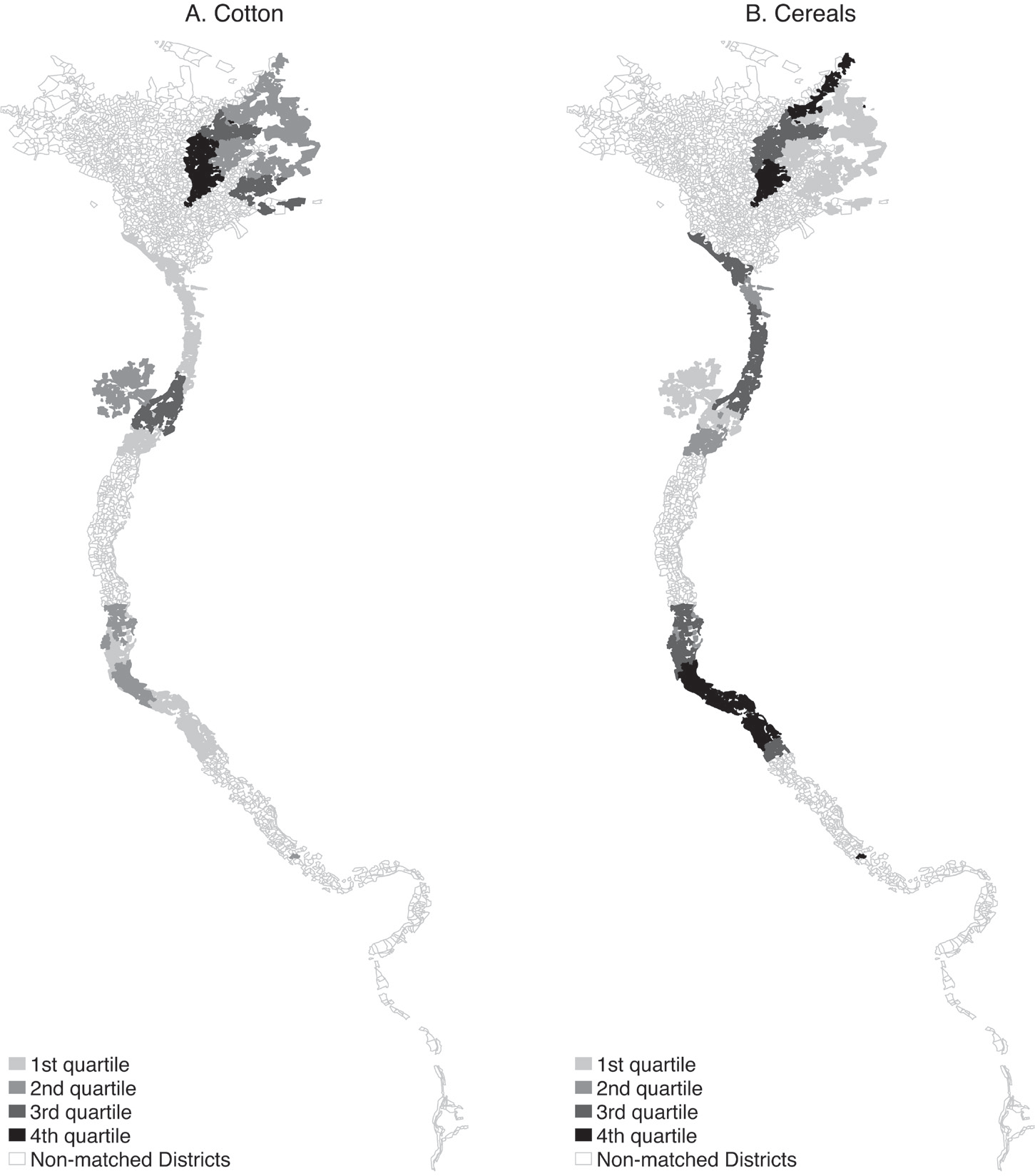
Table 1 shows the baseline differences in 1848 across high-cotton districts, those above the median cotton productivity, and low-cotton districts. The table reveals that slavery was much larger in low-cotton districts, which is consistent with the historical evidence on employing slaves in state-owned plantations and public works in the non-cotton-growing Nile Valley, before the cotton boom (Helal Reference Helal1999, pp. 110–22). High-cotton districts had a higher proportion of landless agricultural laborers, a lower proportion of self-employed peasants, a lower proportion of non-Muslims, and more free female members per household aged 41–50 years, than low-cotton districts.
BASELINE DIFFERENCES IN 1848 BY COTTON PRODUCTIVITY IN 1877
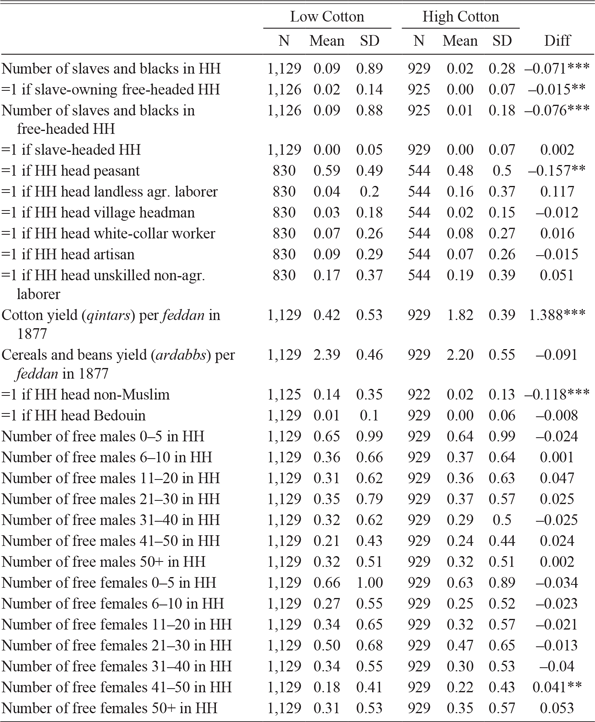
Notes: The sample is restricted to households residing in matched rural districts in 1848. The “Diff” column reports the coefficient of the following household-level regression in 1848: yhd + α1 + α2HighCottond + εhd, where y hd is the outcome of household h residing in district d, and HighCotton d = 1 if the household’s district of residence is above the median cotton productivity in 1877. Regressions are weighted by household weights. Standard errors are clustered at the district level. * p < 0.10, ** p < 0.05, *** p < 0.01.
Sources: The 1848 census sample. Data on crop productivity in 1877 are from the 1877 Statistical Yearbook (Ministère de l’Intérieur 1877).
Empirical Specification
To test the implications of the cotton boom for slavery and wage employment (H1(a) and H1(d)), I employ a difference-in-differences strategy, where I exploit the time variation of the cotton boom and the cross-district variation in cotton productivity:
 $${y_{hvdt}} = \delta ({cotton_d} \times {1868_t}) + {X_{hvdt}}{\gamma _1} + {M_{vdt}}{\gamma _2} + {\alpha _d} + {\beta _t} + {\varepsilon _{hvdt}}$$
where y hvdt is the outcome of household h residing in village v located within district d in census year t, cotton d is the cotton productivity in district d, 1868t is a dummy variable that equals one for the 1868 census (i.e., post the cotton boom), α d is district fixed effects to control for district time-invariant heterogeneity, β t is census year fixed effects to control for aggregate employment shocks in 1868, and ε hvdt is an error term. Standard errors are clustered at the district level, the level of aggregation of cotton suitability. To account for the small number of clusters (25 districts), I also report randomization inference (RI) p-values, which do not rely on the asymptotic properties of estimators (Heß Reference Heß2017). This procedure replicates the assignment process of households to districts with different levels of cotton suitability. It then re-estimates the regression under this new assignment and repeats this process 1,000 times. Finally, it constructs empirical p-values that represent the proportion of simulated t-statistics that are larger than the observed t-statistic in the data.Footnote 25
The vector X hvdt includes a host of household characteristics. I included two dummy variables indicating non-Muslim and Bedouin households, respectively. Non-Muslims were richer than Muslims on average, and Bedouins were granted land to settle in rural Egypt. Therefore, each group probably had more slaves and held a different occupational distribution. I also controlled for the number of non-slave household members broken down by sex and age, which captures a household’s capacity to employ unpaid household labor in agriculture—an alternative option to purchasing slaves and recruiting non-household wage labor on the market. The vector M vdt includes the district-level cereals productivity in 1877 interacted with the 1868 indicator, which controls for the confounding effect of the Crimean War cereals boom in 1853–1856 (Online Appendix Figures A.2 and A.6), and the village-level distance to Suez and its interaction with 1868, which capture the exposure to drafting local labor by coercion to work in the construction of the Suez Canal in 1859–1864.
The coefficient δ captures the differential growth of slavery and wage employment in 1848–1868 across districts with different levels of cotton productivity. According to H1(a) in the Conceptual Framework, δ > 0 for slavery, and according to H1(d), δ < 0 for wage employment.
The validity of Equation (1) rests on the parallel-trends assumption: In the absence of the cotton boom, slavery and wage employment would have evolved equally in 1848–1868 across districts with different cotton suitability levels, conditional on controls. There is no additional pre-cotton boom population census (besides the 1848 census), and hence, I cannot readily test for the existence of pre-boom differential trends in outcomes by cotton suitability. Instead, I provide three pieces of evidence in support of the parallel-trends assumption. First, Table 1 shows that high-cotton districts were not statistically different from low-cotton districts in 1848, with respect to most household characteristics, which I controlled for in Equation (1). Second, there were two other main shocks that occurred between 1848 and 1868 that I controlled for in Equation (1): the Crimean War cereals boom in 1853–1856, that I accounted for by controlling for cereals productivity, and the construction of the Suez Canal in 1859–1864.Footnote 26 Third, Online Appendix C provides suggestive evidence on the parallel trends of slavery by cotton productivity before the cotton boom, where I exploit the age profiles of slaves to trace the growth of household slaveholdings over time, under the assumption that a slave is purchased at age 6 and lives up to age 50.
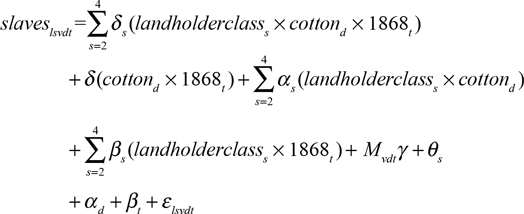
I then employ an augmented empirical specification that studies the heterogeneous effects of the cotton boom on slavery and local employment by landholder class (H1(b), H1(c), and H1(d)). I first use the landholder-level dataset to estimate the following model for slavery:
 $$\begin{array}{*{20}{c}}
{slave{s_{lsvdt}} = \sum\limits_{s = 2}^4 {{\delta _s}(landholderclas{s_s} \times {cotton_d} \times {{1868}_t})} } \\
{ + \delta ({cotton_d} \times {{1868}_t}) + \sum\limits_{s = 2}^4 {{\alpha _s}(landholderclas{s_s}) \times {cotton_d})} } \\
{ + \sum\limits_{s = 2}^4 {{\beta _s}(landholderclas{s_s} \times {{1868}_t}) + {M_{vdt}}\gamma + {\theta _s}} } \\
{ + {\alpha _d} + {\beta _t} + {\varepsilon _{lsvdt}}} \\
\end{array}$$
$$\begin{array}{*{20}{c}}
{slave{s_{lsvdt}} = \sum\limits_{s = 2}^4 {{\delta _s}(landholderclas{s_s} \times {cotton_d} \times {{1868}_t})} } \\
{ + \delta ({cotton_d} \times {{1868}_t}) + \sum\limits_{s = 2}^4 {{\alpha _s}(landholderclas{s_s}) \times {cotton_d})} } \\
{ + \sum\limits_{s = 2}^4 {{\beta _s}(landholderclas{s_s} \times {{1868}_t}) + {M_{vdt}}\gamma + {\theta _s}} } \\
{ + {\alpha _d} + {\beta _t} + {\varepsilon _{lsvdt}}} \\
\end{array}$$
where slaves lsvdt is the number of slaves owned by landholder l of class s {2,3,4}; the variable landholderclass s consists of three dummy variables that indicate peasants in areas outside large estates (s = 2), village headmen in areas outside large estates (s = 3), and large estates (s = 4), respectively; the omitted group consists of non-landholders in areas outside large estates, θ s is landholder class fixed effects.
Next, I use the area-level dataset to estimate the following model for both slavery and the employment of local labor:
 $${outcom{e_{avdt}} = {\delta _1}({largeestate_a} \times {cotton_d} \times {{1868}_t}) + \delta ({cotton_d} \times {{1868}_t})} \\
{ + {\alpha _1}({largeestate_a} \times {cotton_d}) + {\beta _1}({largeestate_{a \times }}{{1868}_t})} \\
{ + {M_{vdt}}\gamma + \theta {largeestatea_a} + {\alpha _d} + {\beta _1} + {\varepsilon _{avdt}}}$$
$${outcom{e_{avdt}} = {\delta _1}({largeestate_a} \times {cotton_d} \times {{1868}_t}) + \delta ({cotton_d} \times {{1868}_t})} \\
{ + {\alpha _1}({largeestate_a} \times {cotton_d}) + {\beta _1}({largeestate_{a \times }}{{1868}_t})} \\
{ + {M_{vdt}}\gamma + \theta {largeestatea_a} + {\alpha _d} + {\beta _1} + {\varepsilon _{avdt}}}$$
where outcome avdt is the outcome of area a in village v in district d in census year t, and largeestate a equals 1 if area a is a large estate and equals 0 otherwise.
The coefficients δ s in Equation (2) capture the heterogeneous effect of the cotton boom on slavery by landholder class in comparison to non-landholders. The implication H1(b) predicts that this effect is largest among the rural middle class (δ 3 > δ 2; δ 3 > δ 4). The coefficients δ and δ 1 in Equation (3) capture the heterogeneous effect of the cotton boom on the employment of local labor by landholder class. The implication H1(d) predicts that δ < 0 for the number of agricultural laborers in areas outside large estates (i.e., lower wage employment), while H1(c) predicts that δ 1 > 0 for local employment in large estates (i.e., higher state coercion).
Finally, I empirically investigate the implication H1(e) on the interdependence of slavery and state coercion during the cotton boom. I am not able to test this prediction directly because both slavery and state coercion are outcomes that were affected by the cotton boom, and because I do not observe the counterfactual of the slavery-only environment. Instead, I provide empirical support for this implication by examining, in a triple difference-in-differences strategy, whether rural middle-class landholders (village headmen) in cotton districts with higher state coercion purchased more slaves during the cotton boom than their counterparts in cotton districts with lower state coercion. To mitigate the endogeneity of state coercion, I measure it in 1848, prior to the cotton boom. I now turn to the findings in the next subsection.
Findings
The findings are shown in Tables 2–4 and graphically in Online Appendix Figures A.9–A.13.Footnote 27 The effect of the cotton boom on slavery is shown in Table 2. Slavery was rare in rural Egypt in 1848, with 0.05 slave per household, on average. Almost all slaves resided in households headed by freemen; only 1 percent of these households owned any slaves, and slave owners had 4.5 slaves on average. However, as predicted in H1(a), the cotton boom caused rural slavery to rise. Column (1) indicates that the boom had a positive and statistically significant effect on the number of slaves per household, and the effect is greater when adding the control variables in Column (2). Districts at the third quartile of cotton yield per unit of land in 1877 (Q 3 = 1.5) (henceforth, high-cotton districts) witnessed a greater rise in the number of slaves per household in 1848–1868 by 0.19 slave, relative to districts at the first quartile (Q 1 = 0) (henceforth, low-cotton districts), which is about four times the 1848 average. Column (4) further shows that the proportion of slave owners among free-headed households in high-cotton districts increased by 7 percentage points, relative to low-cotton districts, which is seven times the proportion in 1848. Taken together, Columns (2) and (4) imply that slave owners in high-cotton districts increased their slaveholdings by 2.7 slaves, on average.
THE COTTON BOOM AND SLAVERY
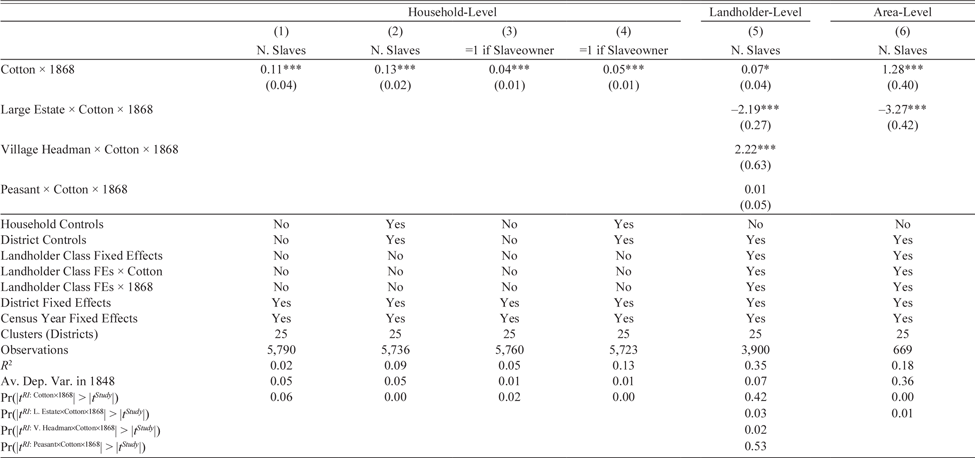
Notes: The sample is restricted to 25 rural districts that are observed in both 1848 and 1868. The sample in Columns (3)–(4) is further restricted to households with a free head. The omitted group is non-landholders in non-large estate areas in Column (5), and non-large estate areas in Column (6). Household controls are: =1 if household head is non-Muslim, =1 if household head is Bedouin, the number of household free members broken down by sex and age. District controls are the interaction of the district-level cereals productivity in 1877 with the 1868 indicator, the village’s distance to Suez, and its interaction with 1868. Regressions are weighted by household weights in Columns (1)–(5) (in Column (5), the weight of large estates is equal to the sum of household weights in the area), and by the sum of household weights in the area in Column (6). Standard errors clustered at the district level are in parentheses. * p < 0.10, ** p < 0.05, *** p < 0.01. The probabilities (Pr) refer to the randomization inference p-values.
Sources: The 1848 and 1868 population census samples. Data on cotton and cereals suitability are from the 1877 Statistical Yearbook (Ministère de l’Intérieur 1877).
THE COTTON BOOM, WAGE EMPLOYMENT, AND STATE COERCION OF LOCAL LABOR
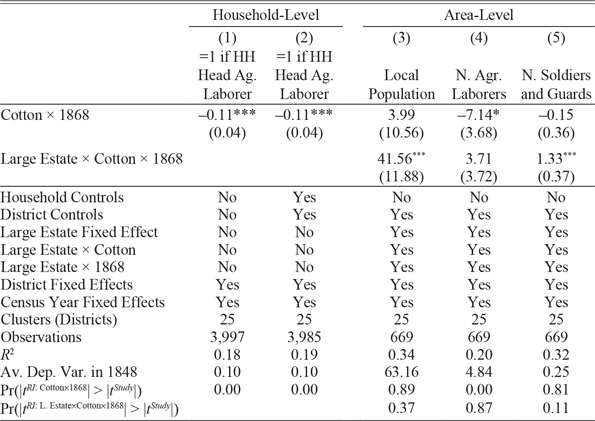
Notes: The sample in Columns (1)–(2) is restricted to households with a free head. Household and district controls are the same as in Table 2. Regressions in Columns (1)–(2) are weighted by household weights. Regressions in Columns (3)–(5) are weighted by the sum of household weights in the area. Standard errors clustered at the district level are in parentheses. * p < 0.10, ** p < 0.05, *** p < 0.01. The probabilities (Pr) refer to the randomization inference p-values.
Sources: See the sources of Table 2.
STATE COERCION REINFORCED SLAVERY DURING THE COTTON BOOM
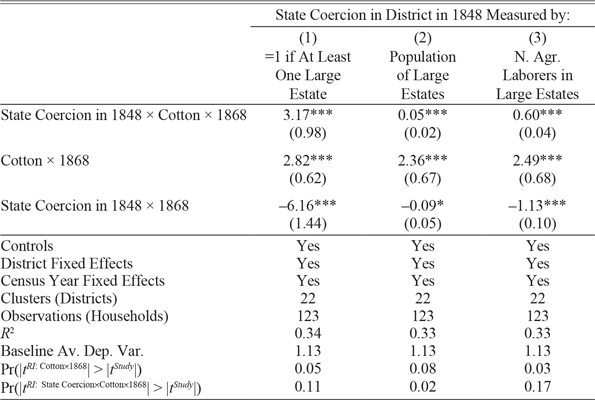
Notes: The dependent variable is the number of slaves in the (rural middle-class) household. The sample is restricted to village headmen. State coercion in district in 1848 is measured by a dummy variable =1 if there was at least one large estate (Column (1)), the population of large estates (Column (2)), and the number of agricultural laborers in large estates (Column (3)). Regressions are weighted by household weights. Controls are the cereals suitability interacted with the 1868 dummy variable. Standard errors clustered at the district level are in parentheses. * p < 0.10, ** p < 0.05, *** p < 0.01. The probabilities (Pr) refer to the randomization inference p-values.
Sources: See the sources of Table 2.
According to the Conceptual Framework, this positive impact on slavery is driven by the rising demand for labor due to the higher labor intensity of cotton.Footnote 28 A first alternative interpretation of this finding is that slavery increased because of the cotton boom-induced positive income effect. The censuses do not report the tasks of slaves, and hence, I do not observe whether slaves were indeed employed as agricultural laborers. However, following Cuno (Reference Cuno2009), Online Appendix Table A.3 shows that the positive effect on slavery is mostly driven by purchasing male, not female, slaves of working age—6–20 and 21–40 years. This suggests that slaves worked in agriculture, because if the rise of slavery in cotton areas were an (pure) income effect, one would expect most slaves to be females, as in cities, where 75 percent were women presumably working as domestic servants. This male bias also comes in contrast to the balanced sex ratio of slaves in rural provinces in 1848.Footnote 29, Footnote 30
A second alternative interpretation of the positive effect of the cotton boom on slavery is that slaves were transferred from low-cotton districts to high-cotton districts, via migration of slave owners or slave sales on secondary markets. However, the cotton boom caused an increase in Egypt’s slave imports as predicted by H1(a), and not (merely) a movement of slaves within Egypt. First, household slaveholdings in low-cotton districts did not decrease in 1848–1868. Second, the black slave population tripled between 1848 and 1868.
Having established that slavery surged in cotton areas during the cotton boom, I then investigate which landholder class(es) purchased slaves. Consistent with H1(b), Column (5) shows that the positive impact of the cotton boom on slaveholdings is largest among the rural middle class—village headmen in areas outside large estates. Village headmen’s slaveholdings in high-cotton districts surged in 1848–1868 by three slaves per household, compared to their counterparts in low-cotton districts. By contrast, the impact on slaveholdings among owners of large estates is negative, suggesting that the rise in slaveholdings is indeed driven by the rural middle class. The negative effect on slaveholdings in large estates can probably be explained by the rise in coercion of local workers, which I discuss next. Furthermore, I obtain similar results when I estimate the regression at the area level in Column (6), where I find that the positive impact on slaveholdings is driven by landholders in non-large estate areas, that is, non-elite landholders who include the rural middle class.
Table 3 shows the effect of the cotton boom on wage employment and state coercion of local labor. Consistent with H1(d), Columns (1) and (2) demonstrate that the cotton boom had a negative and statistically significant impact on wage employment. High-cotton districts witnessed a 13-percentage point decrease in the proportion of agricultural laborers in 1848–1868, relative to low-cotton districts.Footnote 31 Columns (3) and (4) show the heterogeneous effects on the employment of local labor across large estates and non-large estate areas. Consistent with H1(c), Column (3) shows that the cotton boom had a positive and statistically significant effect on the employment of local labor in large estates.Footnote 32 Large estates in high-cotton districts increased their local labor force in 1848–1868 by 61 individuals, on average, relative to large estates in low-cotton districts. As the proportion of the population of large estates declined from 7 percent in 1848 to 3 percent in 1868, this finding implies that large estates became fewer, but larger in size.Footnote 33 Furthermore, Column (4) shows a negative effect on the number of agricultural laborers in non-large estate areas, as predicted by H1(d), and a positive, yet statistically insignificant, effect on the number of agricultural laborers in large estates.
According to the Conceptual Framework, the increased employment of local labor in large estates during the cotton boom was via state coercion, and not wage recruitment on the market. Two pieces of evidence support this interpretation. First, the legal form distribution of large estates shifted to more coercive forms between 1848 and 1868, from ‘uhdas, where 86 percent of the population of large estates resided in 1848, to jifliks, which had 73 percent of the population of large estates in 1868. Whereas ‘uhdas were temporary confiscations of tax-arrears land that were eventually dissolved and returned to the peasantry in the 1860s as they paid back their taxes (Cuno Reference Cuno1992, pp. 157–60), jifliks were permanent confiscations of tax-paying land. Second, because of their more coercive nature, jifliks probably necessitated a higher use of state violence. Indeed, all jifliks in 1868 belonged to Khedive Ismail himself, which must have made it harder for local workers to flee. Furthermore, jifliks recruited more soldiers and guards, probably to subdue local workers. Column (5) reveals a positive and statistically significant impact of the cotton boom on the number of soldiers and guards on large estates. These soldiers likely implemented the confiscation of the tax-paying land and maintained a continuous presence on the ground to suppress any emerging dissent.
Taken together, the decline in wage employment, despite the rising demand for local labor, can be explained by the decline in labor supply due to state coercion. Consequently, the national-level average daily cash wages of agricultural laborers increased from 0.72 piasters in 1840–1841 (Al-Hitta Reference Al-Hitta1950, pp. 91–5) to 1.85 piasters in 1873, according to the 1873 Statistical Yearbook (Ministère de l’Intérieur 1873, p. 269).
The results on the interdependence of slavery and state coercion (H1(e)) are shown in Table 4. Consistent with H1(e), the findings reveal that rural middle-class landholders (village headmen) in cotton districts that were exposed to higher state coercion in 1848 purchased more slaves during the cotton boom than those in cotton districts with lower state coercion. This indicates that state coercion reinforced slavery during the cotton boom.
I conduct several robustness checks for the effects on slavery and wage employment, which I describe in Online Appendix D. I also demonstrate in Online Appendix E that the effects of the cotton boom on slavery and wage employment are driven by the expansion in cotton cultivation. However, this is not to say that labor coercion was necessary for cotton cultivation (see Online Appendix E).
Having described the effects of the cotton boom on slavery, state coercion, and wage employment, I examine in the next section the effects of the abolition of slavery.
THE ABOLITION OF SLAVERY
In the previous section, I showed that the cotton boom caused an increase in slavery and state coercion, and a decline in wage employment. About a decade later, Egypt abolished slavery and emancipated its slave population. In this section, I examine the effects of this selective abolition of slavery on state coercion, wage employment, and wages.
Data
To investigate the impact of the abolition, I complement the 1848 and 1868 censuses with the subsequent published censuses of 1882, 1897, 1907, and 1917 (Ministère de l’Intérieur 1884; Ministère de Finance 1898; Ministry of Finance 1909, 1920). These censuses enable me to measure state coercion and wage employment at the district level. In particular, the proportion of the population in large estates is observed in 1848, 1868, 1882, and 1897.Footnote 34 The proportion of agricultural laborers—including, cash-wage agricultural laborers, tenants, and sharecroppers—is observed in 1848, 1868, 1907, and 1917. The censuses also record the ex-slave population, which enables me to test the assumption that ex-slaves emigrated back to the Nilotic Sudan or gradually disappeared over time as they died without children. The proportion of (ex-)slaves is observed in 1848 and 1868 and is proxied by the proportion of the Sudanese population in 1882, 1907, and 1917.Footnote 35 I also provide suggestive province-level evidence on wages, as laborers’ average nominal daily wages in Egyptian piasters are observed for agricultural laborers in 1873 from the 1873 Statistical Yearbook (Ministère de l’Intérieur 1873), and for unskilled construction laborers in 1903, 1908, and 1913 from the 1914 Statistical Yearbook (Ministère des Finances 1914). However, the evidence on wages must be interpreted with caution due to the small number of provinces.
Empirical Specification
I exploit the variation across districts in the extent of slavery in 1868, on the eve of the abolition, and the time variation of the abolition, where I estimate the following model:
 $${y_{dt}} = \delta (slaver{y_{d,1868}} \times Post{1877_t}) + \gamma ({X_d} \times Post{1877_t}) + {\alpha _d} + {\beta _t} + {\varepsilon _{dt}}$$
where y dt is the outcome of district d in census year t, Slavery d,1868 is the proportion of slaves in district d in 1868, Post1877t is a dummy variable that equals one for the post-1877 period, α d and β t are district and census year fixed effects, respectively. Standard errors are clustered at the district level. I also report randomization inference p-values.
The vector X d consists of time-invariant characteristics of districts: the initial value of the dependent variable in 1848, the proportion of slaves in 1848, the district’s cereals productivity, and the district’s distance to Suez. To account for the potential endogeneity of slavery in 1868, I employ the interaction of the district’s cotton productivity with the post-1877 indicator, as an instrumental variable for Slavery d,1868 × Post 1877t.
The coefficient δ compares the evolution of outcomes before and after the abolition across districts with different levels of reliance on slavery in 1868. H2(a) predicts that δ > 0 for the proportion of the population in large estates: The abolition of slavery has a positive effect on state coercion of local workers. H2(b) predicts that δ < 0 for the proportion of agricultural laborers because the rise in state coercion will further reduce wage employment. The Conceptual Framework also predicts (by assumption) that δ < 0 for the ex-slave population. Finally, H2(c) predicts that δ > 0 for wages.
Findings
The results are shown in Table 5, and graphically in Online Appendix Figures A.14–A.16. Columns (1) and (2) show the effect of the abolition on state coercion of local workers. While the OLS and IV estimates are both positive, which is consistent with H2(a), they are not statistically significant. Similarly, Columns (3) and (4) reveal that the abolition had a negative effect on wage employment, which is consistent with H2(b), but the effect is not statistically significant. This suggests that while the positive effect of the abolition on state coercion, and its negative effect on wage employment, may have been at play, these effects were muted and not statistically significant. I interpret these findings in the Discussion section.
IMPACT OF THE ABOLITION OF SLAVERY ON STATE COERCION, WAGE EMPLOYMENT, AND WAGES
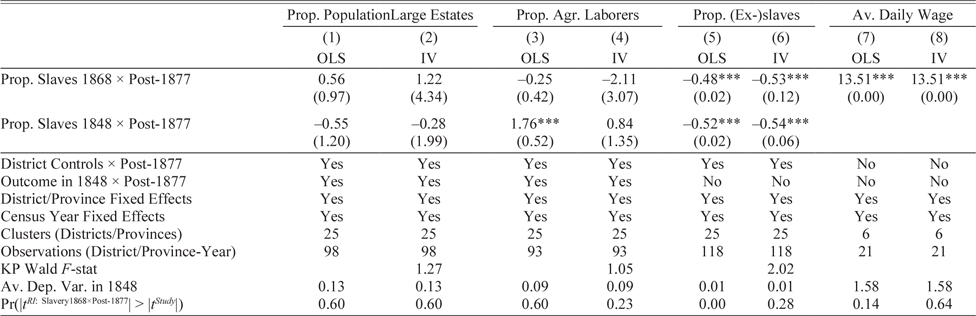
Notes: Regressions are at the district-year level in Columns (1)–(6) and at the province-year level in Columns (7)–(8). Standard errors are in parentheses, clustered at the district level in Columns (1)–(6), and at the province level in Columns (7)–(8). The IV regressions employ the interaction of the post-1877 dummy variable with the district’s (province’s) cotton productivity as an IV. * p < 0.10, ** p < 0.05, *** p < 0.01. The probabilities (Pr) refer to the randomization inference p-values.
Sources: The 1848 and 1868 population census samples, and the 1882, 1897, 1907, and 1917 population censuses (Ministère de l’Intérieur 1884; Ministère de Finance 1898; Ministry of Finance 1909, 1920). Wages are from the 1873 and 1914 Statistical Yearbooks (Ministère de l’Intérieur 1873; Ministère des Finances 1914).
I investigate the effect of the abolition on the proportion of emancipated slaves in Columns (5) and (6), finding a negative and statistically significant impact, which is consistent with the assumption of the Conceptual Framework that emancipated slaves did not become agricultural laborers. At the aggregate level, the Sudanese population in rural Egypt first increased between 1848 and 1868, remained constant through 1882, and then witnessed a secular decline from 149,312 in 1882 to 24,766 in 1917.Footnote 36 The results in Columns (5) and (6) further indicate that this post-1877 decline in the ex-slave population was greater in high-cotton districts. This negative effect can be explained by three mechanisms: (1) emigration: ex-slaves may have returned to the Nilotic Sudan; (2) gradual disappearance: first-generation slaves, who were mostly males, may have died without offspring; and (3) assimilation: descendants of slaves may have increasingly self-identified as Egyptians in the population censuses. Because assimilation of ex-slaves is unlikely to vary across districts by cotton suitability and because the ex-slave population did not decline in 1868–1882 and decreased only gradually thereafter, suggesting that there was no sudden large emigration wave after the abolition, the negative effect on the ex-slave population is probably explained by the gradual disappearance of slaves that was larger in high-cotton districts. Since the sex ratio of slaves in these districts was more male-biased than in low-cotton districts (Online Appendix Table A.3), slaves probably died without children, which was exacerbated by the low life expectancy of slaves (Lovejoy Reference Lovejoy2012, pp. 7–8). This phenomenon—the disappearance of slaves in the long run—has been noted before for the whole Middle East by various scholars including Wright (Reference Wright2007, p. 22) who noted that “most of these people [enslaved blacks] seem to have disappeared without trace,” and attributed the phenomenon to the low marriage rate of slaves and their low life expectancy. That said, I am not able to rule out both emigration to Sudan and assimilation as potential mechanisms at play.
Finally, Columns (7) and (8) show that the abolition had a positive effect on wages, which is consistent with H2(c). The evidence is only suggestive, though, because of the small number of provinces.
To summarize, the abolition of slavery did not have a statistically significant effect on state coercion and wage employment. However, it did have a negative effect on the ex-slave population, which can be due to gradual disappearance, emigration, or assimilation, and a positive effect on wages (subject to the caveat of the small number of provinces). I turn in the next section to a discussion of the empirical findings for both the cotton boom and the abolition.
DISCUSSION
The empirical results are mostly consistent with the implications of the Conceptual Framework under the dual-coercion environment. The empirical evidence supports the implications H1(a)–H1(e) of the cotton boom. The cotton boom in 1861–1865 caused a surge in slavery that was driven by the rising demand for slaves among rural middle-class landholders, not the elite. It also increased state coercion in large estates and reduced wage employment. Furthermore, among cotton districts, rural middle-class landholders in districts with higher levels of state coercion in 1848 purchased more slaves during the cotton boom, relative to their counterparts in cotton districts with lower levels of state coercion, suggesting that state coercion reinforced slavery during the cotton boom. However, the empirical evidence for the abolition of slavery is mixed. On the one hand, the abolition caused wages to rise, as predicted by H2(c). On the other hand, however, I fail to find supportive evidence for H2(a) and H2(b) that predict the abolition of slavery increased state coercion, and reduced wage employment. In this section, I discuss the political response by the rural middle class to the abolition as a potential reason behind these two latter findings.
Specifically, I argue that these two findings can be explained by the political effects of the abolition of slavery. Because the rural middle class lost access to slavery following the abolition, they politically pushed for lower state coercion, as they had to compete with the elite over the same scarce local labor. This political effect of the abolition probably countervailed its economic effects, namely the abolition-induced rise of state coercion and the decline of wage employment. By contrast, during the cotton boom, the argument goes, the economic and political effects likely operated in the same direction: Economically, the cotton boom caused a rise in state coercion by the elite and a decline in wage employment. Politically, the presence of slavery mitigated the political resistance of the rural middle class to state coercion, inducing the elite to coerce more local workers than under the state coercion-only environment.
The Egyptian parliamentary minutes during the precolonial period in 1866–1882 provide suggestive evidence in support of this explanation. The parliament during this period was almost entirely dominated by rural middle-class (village headmen) MPs. These parliamentary minutes thus provide a rare data source to observe the political attitudes of the rural middle class.Footnote 37 I used this source to investigate whether rural middle-class MPs from cotton districts became more likely to push for lower state coercion after the abolition of slavery in 1877, relative to their counterparts from non-cotton districts. To do so, I first limited the analysis to rural middle-class MPs. I then identified MP speeches on labor-related topics, and I manually classified these speeches into (1) anti-state coercion speeches, (2) pro-state coercion or neutral speeches, and (3) other labor-related speeches. Finally, I measured the political resistance to state coercion of local labor, at the MP and parliamentary cycle level, by the total length (word count) of anti-state coercion speeches. The results are in Online Appendix Table F.1, which shows that rural middle-class MPs from high-cotton districts made longer anti-state coercion speeches after the abolition, relative to their counterparts from low-cotton districts, and the effect is statistically significant at the 10-percent level (Column (2)). This suggests that the abolition of slavery increased the political pressure by rural middle-class MPs against state coercion, which may have countervailed the positive economic effect of the abolition of slavery on state coercion.
However, this evidence remains suggestive. First, it is based on the manual classification of attitudes of MP labor-related speeches, which may be subject to bias. Second, the effect, if any, is weak, being significant at 10 percent only. Third, even if there were an effect on MP speeches, this does not prove that it was MP pressure that mitigated state coercion post-1877. Specifically, the period 1876–1882 witnessed major political events, including Egypt’s default in 1876, the Urabi uprising against the Khedive in 1879–1882, the parliamentary demand for oversight in 1879–1882, and the British occupation in 1882 that defeated the uprising and established colonial rule that lasted until 1922. These major events may have affected state coercion beyond MP resistance.
CONCLUSION
This article analyzed the effect of international trade on labor coercion in nineteenth-century rural Egypt, when there were dual coercive institutions—slavery and state coercion—and after slavery was abolished. Using a wide range of novel data sources, I documented that both systems of labor coercion grew in the 1860s due to the cotton boom. The elite increased their coercion of local workers using state violence, wage employment went down, and the rural middle class, facing an increasingly scarce local labor supply due to the rise in state coercion, purchased more slaves. While the abolition of slavery increased wages and reduced the ex-slave population, it did not affect state coercion or wage employment, potentially because of the rising political pressure by rural middle-class MPs against state coercion.
This article opens new areas for future research. First, while this article studied slavery and state coercion as outcomes of the cotton boom and the abolition of slavery, examining the reverse causal relationship—the effect of labor coercion or its abolition on cotton production—is an exciting area for future research. The role of labor coercion in agricultural production has been strongly debated in scholarship on American slavery and European serfdom. Examining differences in productivity per worker across slaves, local workers in large estates, and wage workers outside large estates, and how productivity was impacted by the abolition of slavery, will shed new light on this question.
Second, the rural intra-elite conflict over factors of production and its effect on democratization is commonplace in the Global South. For example, the rural middle class played an important role in the democratization of Latin America during the nineteenth century because of their conflict over labor and land with the incumbent elite. This agrarian conflict fundamentally differs from the historical experience of Western democracies, where democratization emerged because an economically rising, yet politically disenfranchised, industrialist bourgeoisie demanded power-sharing with the incumbent aristocracy. Understanding this rural intra-elite conflict in nineteenth-century Egypt will broaden our knowledge of this phenomenon, and I examine this question in other work.
Finally, this article raises the question of when international trade can transmit welfare-enhancing institutions (e.g., abolition) or welfare-reducing institutions (e.g., labor coercion). Investigating this broader question from both theoretical and empirical perspectives is another exciting area for future research.


 Open access

