

Introduction
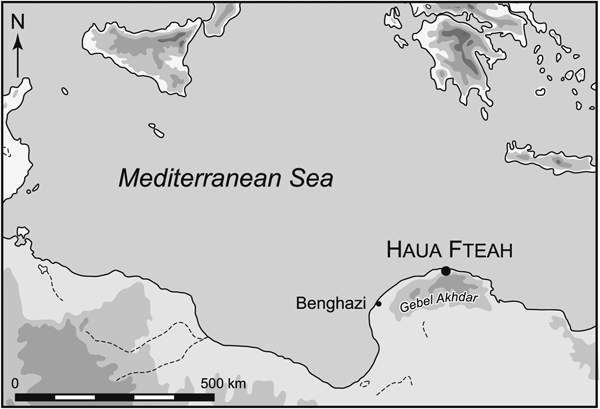
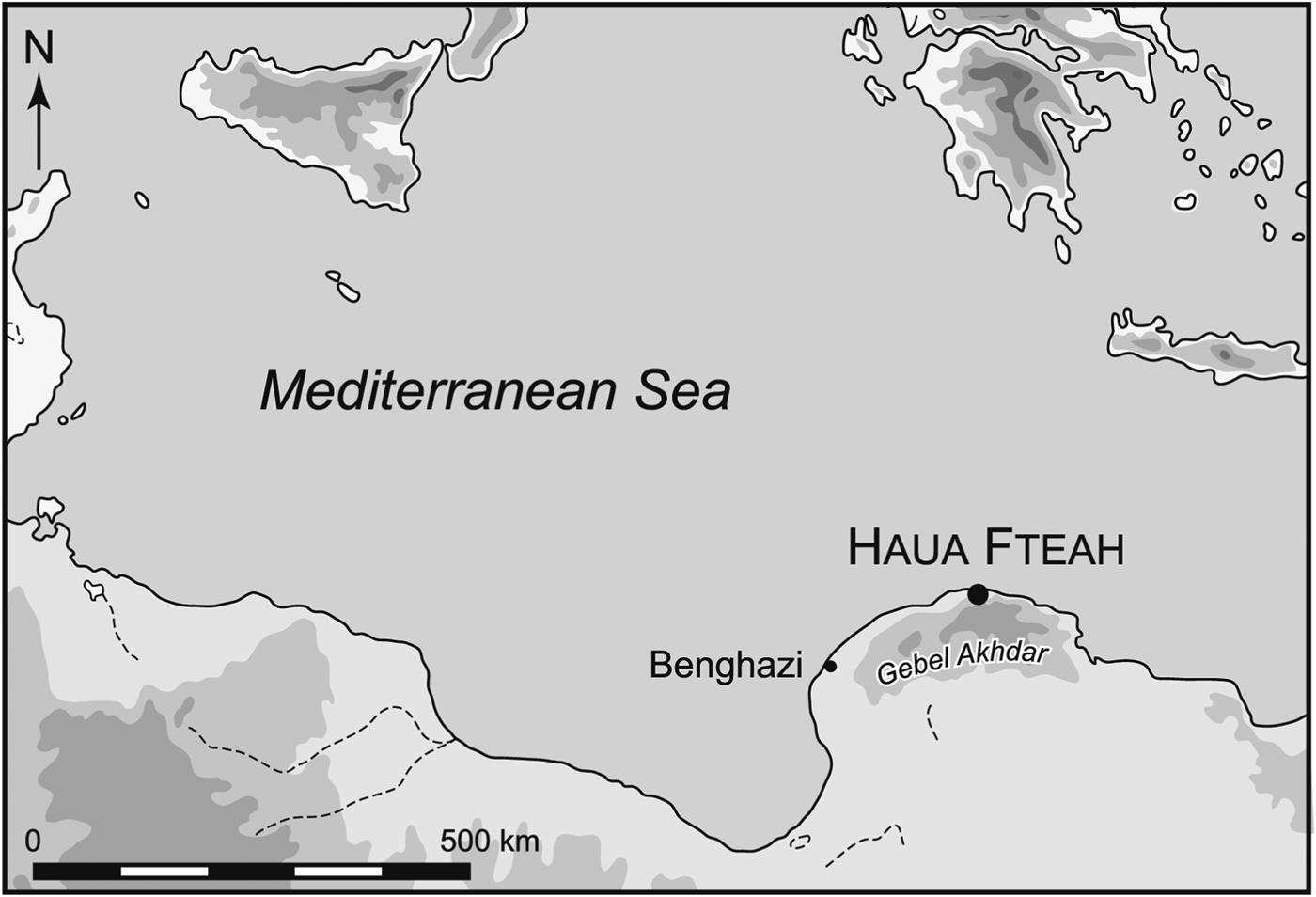
The site of the Haua Fteah in Cyrenaica, eastern Libya, has held a significant part in understanding the Palaeolithic of North Africa since McBurney's excavations there in the 1950s (McBurney Reference McBurney1967) (Figure 1). This site, located between the well-studied Maghreb in north-west Africa and the Egyptian Western Desert and Nile sequences, should provide materials to contribute to debates about human development in both areas and possibly beyond. Until relatively recently, it has not been possible for the site and its landscape to make this contribution as access had been limited but a team has been working at the site since 2006 and new data is emerging (Barker et al. Reference Barker, Hunt and Reynolds2007; Reference Barker, Basell, Brooks, Burn, Cartwright, Cole, Davidson, Farr, Grun, Hamilton, Hunt, Inglis, Jacobs, Leitch, Morales, Morley, Morley, Pawley, Pryor, Reynolds, EL-Rishi, Roberts, Simpson, Twati and Van Der Veen2008; Reference Barker, Antoniadou, Barton, Brooks, Candy, Drake, Farr, Hunt, Ibrahim, Inglis, Jones, Morales, Morley, Mutri, Rabett, Reynolds, Simpson, Twati and White2009; Reference Barker, Antoniadou, Armitage, Brooks, Candy, Connell, Douka, Drake, Farr, Hill, Hunt, Inglis, Jones, Lane, Lucarini, Meneely, Morales, Mutri, Prendergast, Rabett, Reade, Reynolds, Russell, Simpson, Smith, Stimpson, Twati and White2010; Reference Barker, Bennett, Farr, Hill, Hunt, Lucarini, Morales, Mutri, Prendergast, Pryor, Rabett, Reynolds, Spry-Marques and Twati2012; Douka et al. Reference Douka, Grun, Jacobs, Lane, Farr, Hunt, Inglis, Reynolds, Albert, Aubert, Hill, Kinsley, Roberts, Tomlinson, Wulf and Barker2014; Jacobs et al. Reference Jacobs, Lia, Farr, Hill, Hunt, Jones, Rabett, Reynolds, Roberts, Simpson and Barker2017). Subsequent work at the site of Jebel Irhoud in Morocco has once again changed the picture of early modern human occupation of North Africa (Hublin et al. Reference Hublin, Ben-Ncer, Bailey, Freidline, Neubauer, Skinner, Bergmann, Le Cabec, Benazzi, Harvati and Gunz2017; Richter et al. Reference Richter, Grun, Joannes-Boyau, Steele, Amani, Rue, Fernandes, Reynal, Geraads, Ben-Ncer, Hublin and McPherron2017) and the results of the Haua Fteah work need to be reconsidered in this light. This paper reviews the earlier work and draws upon the current work to explore how studies of the site and region may be located in contemporary debate.
Map showing the location of the Haua Fteah and the Jebel Akhdar in Cyrenaica, eastern Libya (drawn by D. Kemp for the CPP).
The Haua Fteah and Cyrenaica
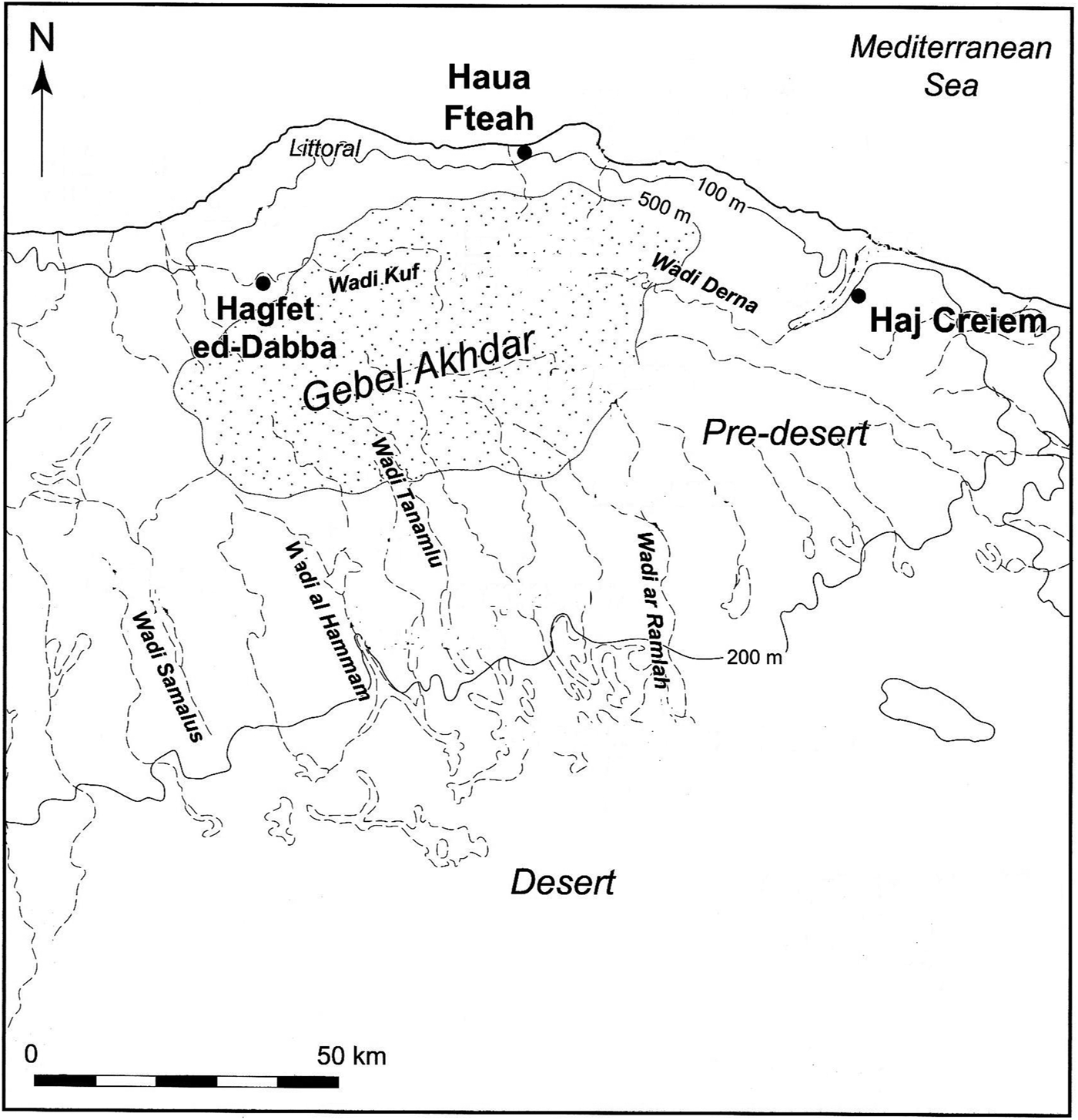
The Cyrenaica Prehistory Project based at the McDonald Institute for Archaeological Research, University of Cambridge, and led by Professor G. Barker is currently re-examining the pioneering work of McBurney in the region and applying modern techniques and approaches to investigate both the archive materials and new results from fieldwork at the Haua Fteah and a survey zone covering some 150 km × 150 km around it (Barker et al. Reference Barker, Hunt and Reynolds2007; Reference Barker, Antoniadou, Barton, Brooks, Candy, Drake, Farr, Hunt, Ibrahim, Inglis, Jones, Morales, Morley, Mutri, Rabett, Reynolds, Simpson, Twati and White2009; Reference Barker, Antoniadou, Armitage, Brooks, Candy, Connell, Douka, Drake, Farr, Hill, Hunt, Inglis, Jones, Lane, Lucarini, Meneely, Morales, Mutri, Prendergast, Rabett, Reade, Reynolds, Russell, Simpson, Smith, Stimpson, Twati and White2010; Reference Barker, Bennett, Farr, Hill, Hunt, Lucarini, Morales, Mutri, Prendergast, Pryor, Rabett, Reynolds, Spry-Marques and Twati2012; McBurney Reference McBurney1967; McBurney and Hey Reference McBurney and Hey1955). This research area runs south from the Mediterranean coast across the highland of the Jebel Akhdar and down into the pre-desert (Figure 2). The Jebel Akhdar is an area of some 300 km × 100 km of raised limestone in close proximity to the coast with some perennial freshwater supplies and predominantly Mediterranean fauna and flora. Similar landforms are not to be found along the Egyptian coast or along the Libyan coast west of Cyrenaica for considerable distances. Geographically, it could appear to have similarities to the Mount Carmel region of Israel and parts of southern Lebanon.
Map of part of Cyrenaica showing the Cyrenaican Prehistory Project research area and locations of the sites of Haua Fteah, Hagfet ed-Dabba and Haj Creiem (redrawn from Barker et al. Reference Barker, Antoniadou, Armitage, Brooks, Candy, Connell, Douka, Drake, Farr, Hill, Hunt, Inglis, Jones, Lane, Lucarini, Meneely, Morales, Mutri, Prendergast, Rabett, Reade, Reynolds, Russell, Simpson, Smith, Stimpson, Twati and White2010, 64).
Results of McBurney's work
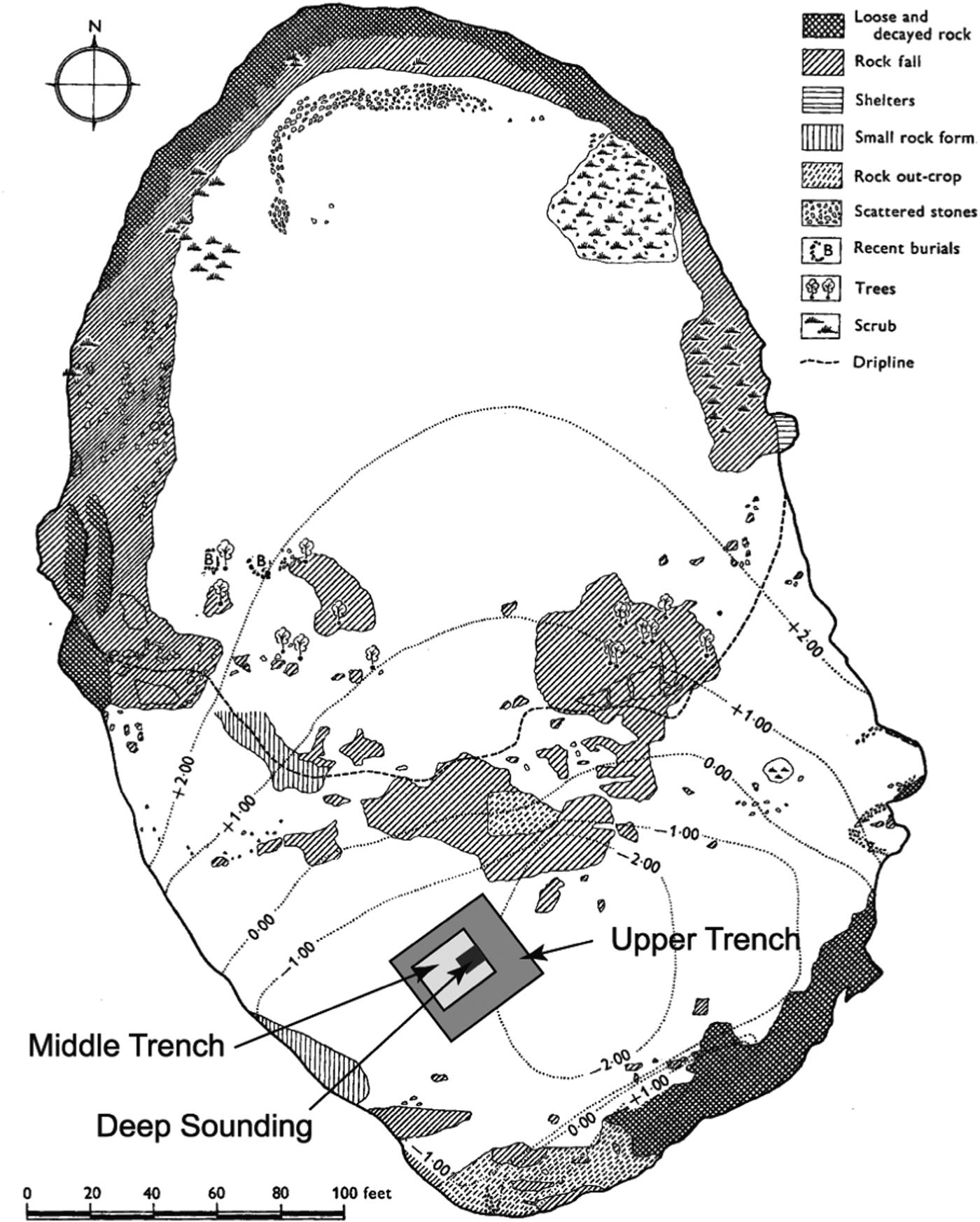
The Haua Fteah is a partially roofed doline located close to the coast north of the range of hills known as the Jebel Akhdar in Cyrenaica, north-eastern Libya (Barker et al. Reference Barker, Hunt and Reynolds2007). It was investigated by Charles McBurney in seasons of fieldwork in 1951, 1952 and 1955 (McBurney Reference McBurney1960; Reference McBurney1967; McBurney and Hey Reference McBurney and Hey1955). The site has a width of c. 80 m and the covered area a height of 20 m. McBurney's trench was c. 6.5 m depth. A deep sounding with an area of 3.8 m × 1.6 m was dug from the base of this (Figure 3). The total depth of McBurney's excavations reached 14 m and recovered a succession of sediments believed to span the sequence from the present day back to the Last Interglacial. It was thought by him that deposition in the site was nearly continuous for this period and correlation with 14C dates allowed an estimation of sediment deposition of 20–30 cm per 1,000 years. Excavation was undertaken in 6″ spits and materials assigned to broader ‘real’ stratigraphic layers after excavation. The isolation of single occupations or associated features was not undertaken (although McBurney Reference McBurney1967, 108, refers to a scatter of tools around discrete hearths within the Mousterian sequence), but a deep sequence with a succession of human activities was characterised. The possibility of occasional pieces being mixed into samples from either above or below is something that McBurney himself noted. Indeed, certain layers are described together as the spits that comprise them overlap the natural stratigraphy. A total of seven major cultural phases was identified:
Phase A was termed a ‘Libyan Pre-Aurignacian’ and considered to date between 80,000 and 65,000 years. It used a significant number of blades and burins were amongst the most common tool form.
Phase B was subdivided into four subunits, I–IV. Each of the subunits was of a broadly Levalloiso-Mousterian form. BI was believed to be older than 60,000–55,000 years. It included a small number of foliate bifacial forms and some ‘incipient tangs’. BII was thought to begin at c. 55,000 BP and was Levalloiso-Mousterian ‘in a Levantine sense’ (McBurney Reference McBurney1967, 326). It is from this sub-phase that two ‘Neanderthaloid’ mandibles were recovered. BIII was an industry of ‘probable Aterian character’ (McBurney Reference McBurney1967, 326) but not clearly attributable to it. No dates are given to this phase, although it is bracketed by those above and below it to between 55,000 and 40,000 BP. Phase BIV is a return to the Levalloiso-Mousterian that lasted until 40,000 BP.
Phase C was dated to 40,000–15,000 BP and termed Dabban (after the type site Hagfet ed-Dabba in the nearby Wadi Khuf). It is a fully Upper Palaeolithic industry with blades, end-scrapers and burins. It also has Levantine character in the use of chamfering as a retouch/resharpening method.
Phase D was dated to 14,000–10,000 BP and termed Eastern Oranian. It resembled the Oranian of the Maghreb.
Phase E dated to 10,000–7,000 BP. It is termed Libyco-Capsian, again resembling the Maghreb sequence.
Phase F dated to 7,000–4,700 BP, is a Neolithic industry of ‘Capsian tradition’.
Phase G was defined from 2,500 to the present. It included stone-packed burnt structures associated with a Graeco-Roman building.
Plan of the Haua Fteah showing the location of the original McBurney excavations and of the Deep Sounding within them (from Barker et al. Reference Barker, Antoniadou, Barton, Brooks, Candy, Drake, Farr, Hunt, Ibrahim, Inglis, Jones, Morales, Morley, Mutri, Rabett, Reynolds, Simpson, Twati and White2009).
In addition to this work at the Haua Fteah, McBurney also excavated at Hagfet ed-Dabba, a cave site in the Wadi Khuf and recovered materials that matched his ‘Dabban’ from the Haua Fteah. There were two main units, both with Dabban material, that demonstrated a chronological shift in emphasis from burins and chamfered pieces towards an industry with end-scrapers and fewer burins and chamfered pieces. This material supported his designation of the Dabban as an individual industry unique in North Africa. Other work at the site of Hajj Creiem in Wadi Derna, east of the Haua Fteah, revealed a lakeside occupation using Levalloiso-Mousterian material. Extensive exploration along the coast and the edge of the Jebel Akhdar failed to find any substantial evidence for an Acheulean presence (McBurney Reference McBurney1967; McBurney and Hey Reference McBurney and Hey1955), although fragments from bifaces were claimed from the lower units at the Haua Fteah and there was a cordiform biface in the Mousterian part of the sequence. A paper in 1947 reviewed the evidence for Acheulean presence and described some material from disturbed deposits found during the construction of the airfield at Benghazi and earlier finds by the Italians from railway ballast (McBurney Reference McBurney1947; Petrocchi Reference Petrocchi1940). Two pieces could be reliably assigned to terrace deposits inland from Benghazi.
Issues arising from McBurney's work
Earliest occupation: The description of the Pre-Aurignacian material was based upon published works from the Middle East (Garrod Reference Garrod1956; Rust Reference Rust1950) and was based on a perspective that sought the origins of the Upper Palaeolithic within preceding Middle Palaeolithic industries. This emphasis on industrial succession was emphasised by descriptions of elements of the Pre-Aurignacian using Acheulean terms and reflected the views of the time whereby Middle Eastern Middle Palaeolithic industries evolved through a sequence of an Acheulean Yabroudian and a blade-rich Amudian into Levallois-based Mousterian industries.
The Middle Palaeolithic sequence: There is a ‘Levantine’ Levalloiso-Mousterian, but is there also a ‘Maghrebi’ Aterian? At different times McBurney both supported and rejected the idea of an Aterian presence at the Haua Fteah. It was not frequent in the earlier landscape survey and only one site, Hagfet et-Tera, had been known to produce a significant number of diagnostic pieces. Additionally, the discussion of both the Dabban and the Aterian was shaped by McBurney's belief that the two were contemporary. McBurney saw changes in the forms and even presence of individual artefacts as the representation of population interaction. In these terms he can refer to the presence of specific tool types as being the result of exchange between two different populations.
The origins of the Upper Palaeolithic: McBurney saw the Dabban as an industry introduced by a new population to the area and so showing population movement. It was sufficiently different from the preceding Levalloiso-Mousterian to suggest this and also was thought to be contemporary with the Aterian which was to be found further west and so the Dabban population would have to derive from the east, Egypt and the Levant. The presence of chamfering and of a single Emiran point in the later Mousterian could be taken to confirm this sense of eastern influence.
The Cyrenaican Prehistory Project has undertaken further landscape survey and the evidence for a pre-Pre-Aurignacian Acheulean remains extremely limited in the region. A series of bifaces has been recovered from an intermontane basin at Al Marj between the Haua Fteah and Benghazi (Barker et al. Reference Barker, Antoniadou, Armitage, Brooks, Candy, Connell, Douka, Drake, Farr, Hill, Hunt, Inglis, Jones, Lane, Lucarini, Meneely, Morales, Mutri, Prendergast, Rabett, Reade, Reynolds, Russell, Simpson, Smith, Stimpson, Twati and White2010). These are in fluvial deposits and currently undated. In terms of morphology there is no reason to exclude them from late Acheulean MSA. A number of bifaces are also known from the pre-desert area to the south of the Jebel Akhdar and once again these remain undated and potentially late. Re-examination of the McBurney archive material currently held at the University Museum of Archaeology and Anthropology in Cambridge has not identified any elements of either bifaces or the manufacture of them in the Pre-Aurignacian. It is possible, on this limited amount of material, that the Jebel Akhdar was too remote to be accessed by pre-modern human groups in any numbers, which would contrast the evidence both in the Maghreb and the Egyptian Nile Valley. The origins of the Pre-Aurignacian may then lie in populations derived from these areas or from groups moving north across a ‘Green Sahara’ (Figure 4) (Reynolds Reference Reynolds, Boyle, Rabett and Hunt2014). The ‘Green Sahara’ is a term coined to refer to the Saharan region at stages when it was much wetter than the present day with major watercourses and substantial lakes forming a significant part of the landscape (Armitage et al. Reference Armitage, Jasim, Marks, Parler, Usik and Uerpman2011; Drake et al. Reference Drake, Blench, Armitage, Bristow and White2011; Osborne et al. Reference Osborne, Vance, Rohling, Barton, Roerson and Fello2008). It should be noted that the ‘Neanderthaloid’ mandibles are now classified as an early modern human (Homo sapiens) (Trinkaus Reference Trinkaus2005). Examination of the Pre-Aurignacian and Levalloiso-Mousterian materials at Cambridge suggests that they are, in many techno-typological aspects, very similar. It may be that the Pre-Aurignacian is a coastal/littoral facies of the broader Levalloiso-Mousterian and the differences are a result of the altered geography and associated economic opportunities (Jones et al. Reference Jones, Antoniadou, Barton, Drake, Farr, Hunt, Inglis, Reynolds, White, Barker, Jones and Stewart2016; Reynolds Reference Reynolds2013).
Map showing the possible humid corridors of the Green Sahara against a reconstruction of the humid Sahara (with kind permission of Dr N. Drake, from Drake et al. Reference Drake, Blench, Armitage, Bristow and White2011). The easternmost runs along the Nile Valley, the central route is from Lake Megachad to Cyrenaica and the westernmost runs through connected river valleys to the Atlas Mountains.

When discussing the Aterian, McBurney said that it was, and was not, present at the Haua Fteah (McBurney Reference McBurney1960; Reference McBurney1967; Reference McBurney, Wendorf and Marks1975). His theoretical approach to lithics allowed him to see the presence of different human groups in the presence of different artefact types. This meant that he could perceive individual artefacts as perhaps representing interaction between different human groups so the isolated ‘Aterian’ piece could have come from an encounter between Mousterians and Aterians. He also believed that the Aterian was a relatively late industry and was contemporary with the Dabban and so its presence earlier in the sequence would have been problematic. The Aterian has since become of significance in terms of human populations as it has been suggested that it could represent the first modern human populations spreading across North Africa (Balter Reference Balter2011; Garcea Reference Garcea2004; Reference Garcea and Garcea2010a; Reference Garcea and Garcea2010b; Scerri Reference Scerri2013). Its presence in Cyrenaica, then, would be significant. The Homo sapiens mandibles in a Levalloiso-Mousterian context render the Aterian = modern humans equation of less significance and the material from the terrace at Hagfet et-Tera shows that Aterian industries do occur in Cyrenaica. Within the project area Aterian also occurs in the pre-desert area south of the Jebel Akhdar (Jones et al. Reference Jones, Farr, Barton, Drake, White and Barker2011). The recent discoveries at Jebel Irhoud show an early modern human association with a Levallois using MSA (Hublin et al. Reference Hublin, Tillier and Tixier1987; Reference Hublin, Ben-Ncer, Bailey, Freidline, Neubauer, Skinner, Bergmann, Le Cabec, Benazzi, Harvati and Gunz2017; Richter et al. Reference Richter, Grun, Joannes-Boyau, Steele, Amani, Rue, Fernandes, Reynal, Geraads, Ben-Ncer, Hublin and McPherron2017), which would suggest that while modern humans made the Aterian it was not a component in their early adaptations and should not be used in a simple fashion as an indicator of modern human presence to the exclusion of other MSA forms.
It is significant that there is a distinct difference between the Levalloiso-Mousterian at the Haua Fteah itself and at the lakeside site of Hajj Creiem. Examination of the McBurney collections shows the latter would fit into assemblages from the Egyptian Western Desert without comment whilst the material from the Haua Fteah is rather different. It has fewer side-scraper forms and resharpening as described by Dibble (Reference Dibble1987) is less of a feature. Burins and resharpening by burination is present. There was also a single well-made biface from this collection. Work on redating the site suggests that the Levalloiso-Mousterian sequence begins ~80 kyrs with the Pre-Aurignacian predating this (Douka et al. Reference Douka, Grun, Jacobs, Lane, Farr, Hunt, Inglis, Reynolds, Albert, Aubert, Hill, Kinsley, Roberts, Tomlinson, Wulf and Barker2014; Jacobs et al. Reference Jacobs, Lia, Farr, Hill, Hunt, Jones, Rabett, Reynolds, Roberts, Simpson and Barker2017) with possible beginnings in early MIS 5 or even late MIS 6.
The Dabban is currently unique in North Africa and occurs at two excavated sites (Haua Fteah and Hagfet ed-Dabba) and possibly at an open-air site to the east of Derna (Barker et al. Reference Barker, Antoniadou, Armitage, Brooks, Candy, Connell, Douka, Drake, Farr, Hill, Hunt, Inglis, Jones, Lane, Lucarini, Meneely, Morales, Mutri, Prendergast, Rabett, Reade, Reynolds, Russell, Simpson, Smith, Stimpson, Twati and White2010). It continues a form of resharpening based on burination, this time in the form of chamfering, but otherwise is a blade and flake based industry with frequent burins and some end-scrapers. There is a chronological shift in frequency from the former to the latter at Dabba itself. Recent work has placed the date for the start of the Dabban at around 45,000 yrs BP (Douka et al. Reference Douka, Grun, Jacobs, Lane, Farr, Hunt, Inglis, Reynolds, Albert, Aubert, Hill, Kinsley, Roberts, Tomlinson, Wulf and Barker2014). This would place it amongst a group of Upper Palaeolithic industries to emerge (or spread?) at this time.
In summary of this, the uniqueness in North Africa of the earlier industries of the Haua Fteah as defined by McBurney does seem to be upheld by re-evaluation. They do not easily fit into the patterns seen in the Maghreb, but do in some elements resemble industries to the east. Interestingly, similarities with material from the Maghreb are notable after the LGM. Given Cyrenaica's geography is it reasonable to see the industries as representing population movements from the west and/or across the Sahara or could the region have connections with populations from the east (Reynolds Reference Reynolds, Boyle, Rabett and Hunt2014)?
This matter is not just of local interest as the origins and spread of modern humans out of Africa has been a major research subject for many years. It had been believed that modern humans left Africa via a route along the Nile Valley and into Asia via Israel and the surrounding lands (Van Peer Reference Van Peer1998; Van Peer and Vermeersch Reference Van Peer, Vermeersch, Mellars, Boyle, Bar-Yosef and Stringer2007). Recent work in the Arabian Peninsula has suggested the Mandab Straits may have been the main route for the rapid modern human population expansion believed to have colonised much of the Old World (Drake et al. Reference Drake, Breeze and Parker2013; Groucutt et al. Reference Groucutt, Petraglia, Bailey, Scerri, Parton, Clark-Balzan, Jennings, Lewis, Blinkhorn, Drake, Breeze, Inglis, Devès, Meredith-Williams, Boivin, Thomas and Scally2015; Mellars Reference Mellars2006; Oppenheimer Reference Oppenheimer2012; Petraglia Reference Petraglia2011), although the date of this population movement/expansion is still uncertain. This potentially reduces the role of the record from the Middle East and north-east Africa in providing an alternative source for population movement but the archaeology of both source (East Africa) and this route (the Mandab Straits/Arabia) is poorly known when compared with that of the Middle East and Egypt. It may well be that both routes were used, that several migrations occurred and that there was no single Out of Africa for modern humans.
Equally, although most interest centres on the Out of Africa issue, population movements within and into Africa should also be considered. This is compounded by the fact that it may have been possible for early humans to cross the area now occupied by the Sahara at a series of different times in the past. Research describes ‘corridors’ across a ‘Green Sahara’ and suggests that modern humans may have accessed North Africa by these routes rather than by the Nile Valley or a coastal route (Armitage et al. Reference Armitage, Drake, Stokes, EL-Hawati, Salem, White, Turner and Mclaren2007; Drake et al. Reference Drake, El-Hawati, Turner, Armitage, Salem, White and Mclaren2008; Reference Drake, Blench, Armitage, Bristow and White2011; Osborne et al. Reference Osborne, Vance, Rohling, Barton, Roerson and Fello2008). When this is added to suggestions that the Aterian industry has its origins in sub-Saharan Africa and represents modern humans it becomes important to review the evidence from North Africa to test these theories and contrast it with the available record for the Levant and sub-Saharan Africa. This paper will now focus on the record from Cyrenaica in Libya, as it has been suggested that this area was the recipient of populations from both sub-Saharan Africa (Balter Reference Balter2011; Drake et al. Reference Drake, El-Hawati, Turner, Armitage, Salem, White and Mclaren2008) and the Levant (Bar-Yosef Reference Bar-Yosef, Nitecki and Nitecki1994; Iovita Reference Iovita, Shea and Lieberman2009; Olivieri et al. Reference Olivieri, Achilli, Pala, Battaglia, Fornarino, Al-Zahery, Scozzari, Cruciani, Behar, Dugoujon, Coudray, Santachiara-Benerechetti, Semino, Bandlet and Torroni2006).
Getting to Cyrenaica, the Green Sahara
The first question in assessing the Green Sahara ‘corridors’ to Cyrenaica is one of scheduling. Is the presence of humid routes across the landscape a cyclical phenomenon that would allow various human populations to cross the region or is it a rarer, more isolated, series of events?
It should also be asked whether the scheduling and duration of the humid events were such that it was actually possible for human groups to spread across the Sahara. Were human population densities sufficient for an opportunistic rapid spread into newly humid districts or would populations have become isolated and extinct? It may be better to view the ‘corridors’ as patches or a mosaic of areas that became available for colonisation and model human spread into and within them rather than simply talk of corridors with its implied post hoc sense of direction.
The evidence for a ‘Green Sahara’ comes from studies of geomorphology, satellite imagery and geochemistry (Armitage et al. Reference Armitage, Drake, Stokes, EL-Hawati, Salem, White, Turner and Mclaren2007; Drake et al. Reference Drake, El-Hawati, Turner, Armitage, Salem, White and Mclaren2008; Reference Drake, Blench, Armitage, Bristow and White2011; Osborne et al. Reference Osborne, Vance, Rohling, Barton, Roerson and Fello2008). The earliest humid phase identified dates to MIS 11 (424,000 and 374,000 years ago), although this is poorly described. This period would allow populations of Homo heidelbergensis or Homo erectus to spread presumably carrying mode 2 and 3 industries. There is evidence for such material and dates from the Maghreb and possibly the Nile Valley but not as yet from Cyrenaica. The earlier humid events created large lakes such as lakes MegaChad and MegaFazzan through the Middle to Late Pleistocene interglacials (Armitage et al. Reference Armitage, Drake, Stokes, EL-Hawati, Salem, White, Turner and Mclaren2007; Drake et al. Reference Drake, El-Hawati, Turner, Armitage, Salem, White and Mclaren2008; Reference Drake, Blench, Armitage, Bristow and White2011). Later lakes were smaller and interglacials less humid (lakes only a few 1,000 km2). There were four potential corridors formed at differing times across the Sahara to the North African coast; Fazzan to Sirt, Sirir to the south of Cyrenaica, Sahabi to the south of Cyrenaica, and Al Kufra to the south of Cyrenaica. So this suggests access to Cyrenaica would have been possible via at least three routes (the Kufra route may have run further east; the middle two corridors run into Sabkhat al Qenien lake, but note it is c. 200 km south of the southern edge of Cyrenaica and so far no clear major channels link the two directly). Some channels in the Kufra delta could have fed lakes in the Siwa and Qatara Depressions – maybe even linked the Kufra river to the Nile, so the Green Sahara could have been an adjunct to, not necessarily an alternative for, the Nile Valley route. The main times these ‘corridors’ were available would have been MIS 5e (c. 130–115 Ka) and towards the end of MIS 5 (stage 5c [c. 105–92 Ka] or 5a [c. 85–74 Ka]). These dates crudely coincide with increases in the material record at Haua Fteah.
The Jebel Irhoud evidence – reappraisals required?
The renewed work at the site of Jebel Irhoud has confirmed the presence of early modern humans associated with Levallois used in the Middle Stone Age (Amani and Geraads Reference Amani and Geraads1993; Geraads et al. Reference Geraads, Amani, Ben-Ncer, McPherron, Raynal and Hublin2013; Hublin Reference Hublin1992; Hublin and Tillier Reference Hublin, Tillier and Stringer1981; Hublin et al. Reference Hublin, Tillier and Tixier1987; Salih Reference Salih and Chenorkian1995). The dating of the site has been difficult with fossils not always attributable to clear layers, but a series of dates by various means has ranged from 40 Ka to 160 Ka. The new earliest dates of 315+–34 Ka effectively double the period of occupation at the site (Richter et al. Reference Richter, Grun, Joannes-Boyau, Steele, Amani, Rue, Fernandes, Reynal, Geraads, Ben-Ncer, Hublin and McPherron2017). This means that the earliest occupants of the site become the earliest known modern humans in Africa and so debates about population movements need to be refined. They also appear at the time of one of the earlier ‘greening’ events in MIS 9, c. 337–300 Ka (Richter et al. Reference Richter, Grun, Joannes-Boyau, Steele, Amani, Rue, Fernandes, Reynal, Geraads, Ben-Ncer, Hublin and McPherron2017).
Getting to Cyrenaica, Egypt and the Levant
Egyptian palaeolakes have been studied and dated using U series on lake carbonates (Szabo et al. Reference Szabo, Haynes and Maxwell1995). At Bir Tarfawi, Bir Sahara East, Wadi Hussein, Oyo Depression and Great Selima Sand Sheet localities, five lake-forming episodes have been documented at 320–250 Ka, 240–190 Ka, 155–120 Ka, 90–65 Ka and 10–5 Ka. These correlate with interglacial stages 9, 7, 5e and 1 whilst the 90–65 Ka episode may correlate with 5c or 5a. There was no evidence of pluvial conditions between 60 and 30 Ka. The oldest lake and groundwater carbonates were more extensive than latest ones – the evidence of the latter was geographically localised in depressions and buried channels. This pattern resembles that observed by Drake et al. (Reference Drake, El-Hawati, Turner, Armitage, Salem, White and Mclaren2008; Reference Drake, Blench, Armitage, Bristow and White2011) for the Fazzan. In terms of population movements, the earliest in stage 9 would have given an assumed population of Homo heidelebergensis/Homo erectus, probably using Acheulean technologies, access to eastern Libya whilst the new evidence from Jebel Irhoud shows a population of early modern humans present in the Maghreb at this time, using Levallois-based MSA industries. It now needs to be seen whether there was a single early modern human population present in that region or whether archaic human populations persisted alongside the moderns. The stage 7 humidity may just have been experienced by early Homo sapiens populations. At that time MSA industries with and without bifaces and with and without Levallois technology could have been present across the area. Study of sapropels, which show the effects of freshwater run-off into the Mediterranean, gives dates of Sapropel 6 (S6) = MIS 6 S4 = 100 Ka S5 = 125.5 Ka, S7 = 194 Ka (there are four cold events within MIS 5 at 112, 96, 87, 80 Ka) (Kallel et al. Reference Kallel, Duplessy, Labeyrie, Fontugne, Paterne and Montacer2000). Again these dates would support both the Szabo et al. (Reference Szabo, Haynes and Maxwell1995) and Drake et al. (Reference Drake, El-Hawati, Turner, Armitage, Salem, White and Mclaren2008; Reference Drake, Blench, Armitage, Bristow and White2011) dated sequences. Additionally, study of travertines in the Egyptian Western Desert show that the youngest and best-dated travertines date to ~70–160 Ka in Wadi Kurkur and relate to springs and lakes at 2–3 m high terraces (Crombie et al. Reference Crombie, Arvidson, Sturchio, EL Alfy and Abu Zeid1997). Then there are travertines dated to 191–220 Ka. The ages of these studied travertines correspond to monsoonal maxima, eustatic high sea stands and interglacial maxima and again reinforce the patterns already described. At Kharga Oasis, five episodes of tufa formation have been dated by U series (Smith et al. Reference Smith, Giegengack, Schwarcz, McDonald, Kleindienst, Hawkins and Chucher2004) and subsequent work has shown Mata'na Site G Upper Levalloisian MSA overlies travertine dated by U series to 127.9 +–1.3 Ka and is overlain by tufa dated 103+–14 Ka. Bulaq Wadi 3 Locus 1 U series 114.4+–4.2 Ka on tufa over MSA KH/MD–10 MSA workshop has several Levallois reduction methods and post-dates 124 Ka. Spring flow in the region began during the MIS 6/5e transition before warmest period (Smith et al. Reference Smith, Hawkins, Asmerom, Polyak and Giegengack2007). All this work on related data sources shows a broadly contemporary humid phase across the north-east of Africa that would allow migration into the area by Homo sapiens.
A potential complicating factor in the Western Desert is a possible meteor impact dated 200–100 Ka. It would have had a significant effect on the environment that could have caused a population slump in human groups living in the area (Osinski et al. Reference Osinski, Schwarcz, Smith, Kleindienst, Haldemann and Churcher2007). This slump may have provided an opportunity for new groups to move into the area.
The Levantine sites
In the Levant the issue of human geography is complicated by the presence of two human populations: both Neanderthals and modern humans are present. There are questions as to whether these populations were contemporary and how different their ecologies were (Lieberman and Shea Reference Lieberman and Shea1994). While the morphological characteristics that differentiate European Neanderthals and Homo sapiens in Europe do not differentiate their counterparts in south-west Asia in such a straightforward way (Kramer et al. Reference Kramer, Crummet and Wolpoff2001), there is agreement that they were both present in the Levant during MIS 5 and 4 (Grun et al. Reference Grun, Stringer, McDermott, Nathan, Porat, Robertson, Taylor, Mortimer, Eggins and McCullough2005; Shea Reference Shea and Garcea2010). In Israel, the best-studied country in the region, there were Neanderthals at Tabun Cave and modern humans at Skhul Cave in the period c. 130–100 Ka, modern humans at Qafzeh c. 100–90 Ka, and Neanderthals at Tabun, Kebara, Geula and Amud c. 75–50 Ka. There is no definite evidence for Neanderthals surviving in the region after this time, the only hominin represented thereafter being modern humans (at Qafzeh and Ksar Akil, Lebanon, c. 38–25 Ka).
Both early modern humans and Neanderthals in the region used Middle Palaeolithic stone tool technologies, whereas modern humans after ~45 Ka used Upper Palaeolithic blade technologies. Thus there is much debate as to whether lithic technologies can be used to differentiate the economic and cultural components of the human populations. One view of the similarities between Neanderthal and early modern human technologies in south-west Asia is that they demonstrate contact and cultural continuity (Hovers Reference Hovers and Conard2006; Otte et al. Reference Otte, Biglari, Flas, Shidrang, Zwyns, Mashkour, Naderi, Mohaseb, Hashemi, Darvish and Radu2007), another that they reflect convergent technological strategies (Kuhn et al. Reference Kuhn, Stiner, Gulec, Őzer, Yilmaz, Baykara, Acikkol, Goldberg, Martinez Molina, Ünay and Susta-Alpasian2009; Shea Reference Shea, Hovers and Kuhn2006) or differing residential strategies (Lieberman and Shea Reference Lieberman and Shea1994). Shea (Reference Shea2008; Reference Shea and Garcea2010) also argues for a series of extinctions among the region's hominin populations in response to climatic forcing: both modern humans and Neanderthals died out and/or abandoned the area after failing to adapt to the abrupt development of colder and drier conditions c. 80–75 Ka. If such abandonment took place, a population movement westwards along the North African coast may have occurred. Sites such as the Haua Fteah and some of the Egyptian sites in the Western Desert may have been created by these populations. Neanderthals then reoccupied the Levant when warmer and wetter conditions returned after 70 Ka and survived until the major cooling of c. 50–45 Ka. Modern humans that were successfully adapted to the increasing cold and aridity of the latter part of MIS 3 then recolonised the region. The Levant is one of the few areas where it may legitimately be claimed that the Upper Palaeolithic evolves in situ from Middle Palaeolithic precursors through the Emiran into the Ahmarian, although this may be disputed (Kuhn et al. Reference Kuhn, Stiner, Gulec, Őzer, Yilmaz, Baykara, Acikkol, Goldberg, Martinez Molina, Ünay and Susta-Alpasian2009; Tostevin Reference Tostevin, Goring-Morris and Belfer-Cohen2003).
One of the major problems with resolving debates about the relative success or otherwise of Neanderthals and modern humans with regard to climate change in the Levant is that the best climate records tend not to be where we have the best cultural records. A detailed study of microfauna from Amud Cave, occupied by Neanderthals, found subtle contrasts between the nature of the climate and environment around the cave (i.e. as it would actually have been experienced by the Neanderthals using the site) and regional models of climate and environment inferred from the MIS predictions (Belmaker and Hovers Reference Belmaker and Hovers2011).
Scheduling
The evidence from the Sahara and the Western Desert shows a similar general pattern of climate change with humid phases happening at about the same time in both areas. It is not yet possible to examine the scheduling of the changes at a sufficiently small scale to be sure that local changes accumulate to create effective corridors or how long any such passages lasted. There is a tendency to view human activity within the area as migration, but this is to impose pattern. It is likely that human groups expanded piecemeal into habitats as they became available and a mosaic of populations existed with some becoming successful and expanding further and others becoming extinct. Some populations may have expanded northwards towards the coast while others may have moved south. At present the likelihood is that some sub-Saharan populations reached the North African coast during MIS 9, 7 and 5, but it is also likely that the Cyrenaican population already included groups from the east (the Western Desert) and possibly later in MIS 5 groups from even further east (the Levant). The scale of the different contributions of different areas probably varied and would at all times have been in low numbers. Human groups would themselves have been small and reproduction rates slow. There does not appear to have been any significant contribution of population from the west during the earliest phases of occupation at the Haua Fteah as far as this may be suggested from lithic technology. Later in the sequence at the Haua Fteah it is likely that the Dabban reflects an incoming group, perhaps that suggested by Olivieri et al. (Reference Olivieri, Achilli, Pala, Battaglia, Fornarino, Al-Zahery, Scozzari, Cruciani, Behar, Dugoujon, Coudray, Santachiara-Benerechetti, Semino, Bandlet and Torroni2006) and Maca-Meyer et al. (Reference Maca-Meyer, Gonzalez, Pestano, Flores, Larruga and Cabrera2003) using mtDNA to suggest that haplogroups M1 and U6 (which are now both predominantly North African) originated in south-west Asia and moved west into North Africa in 45–40 Ka. This timing would match the new dates for the start of the Dabban at the Haua Fteah. This population could also be related to the one in the Levant responsible for the spread of the Upper Palaeolithic into Europe.
Conclusions
Work in Cyrenaica is, at last, bringing the Pleistocene record from there to a broader archaeological audience. The area has been left behind by the rate of research in the Maghreb, Egypt and the Levant. However, the recent dates and fossils from Jebel Irhoud provide a longer time frame to consider (Hublin et al. Reference Hublin, Ben-Ncer, Bailey, Freidline, Neubauer, Skinner, Bergmann, Le Cabec, Benazzi, Harvati and Gunz2017; Richter et al. Reference Richter, Grun, Joannes-Boyau, Steele, Amani, Rue, Fernandes, Reynal, Geraads, Ben-Ncer, Hublin and McPherron2017). It is now time to integrate the different narratives created in each region to develop our understanding of how modern humans occupied and interacted across this broad space. A few key research questions remain outstanding. There is an urgent need to refine the chronology of evidence for the Green Sahara; how far is it possible to demonstrate that there were real ‘corridors’ of favourable habitats along which hominins could pass?
The discoveries at the Jebel Irhoud also mean that views on the direction of movements within and across the Sahara may need adjusting. Populations present at such an early period in the Maghreb currently predate the generally accepted origin and date for modern humans in East Africa. The fossils appear to be distinct morphologically (although sufficiently similar to share modern human status) from the late early modern humans at Skhul and Qafeh that most resemble the remains from Haua Fteah.
The archaeology also needs a more subtle definition and dating so that any directionality in the record can be effectively identified. The definition of the Aterian in particular is in urgent need of clarification and the numbers of well-described and dated sites for it needs to be increased. Earliest modern human populations in the Maghreb appear to use Levallois-derived MSA, not the Aterian or a biface tradition.
The relationships between human groups in the Pleistocene may be inferred by physical characteristics, but a study at the genetic level is needed to test the hypotheses about the relationships between different human groups both within Africa and between Africa and its neighbouring areas. The teeth present in the mandibles from Haua Fteah could provide a sample that could contribute to this debate. Caution is needed when using archaeological materials as proxies for human groups.
Acknowledgements
The work at the Haua Fteah has been carried out by a large team of individuals from various institutions listed in the project reports cited below (Barker et al. Reference Barker, Basell, Brooks, Burn, Cartwright, Cole, Davidson, Farr, Grun, Hamilton, Hunt, Inglis, Jacobs, Leitch, Morales, Morley, Morley, Pawley, Pryor, Reynolds, EL-Rishi, Roberts, Simpson, Twati and Van Der Veen2008, 9, 10). There are too many to thank individually, but particular thanks should go to our Libyan colleagues Dr Giuma Anag, Dr Salah Aghab, Mohammed Twati, Ahmed Buzaian, the late Abdulgader Mzeine, Ahmed Saber and Ibreik Qunine. The work has been funded by the European Research Council (Advanced Investigator Grant 230421: TRANS-NAP project: Cultural Transformations and Environmental Transitions in North African Prehistory), the Society for Libyan Studies, the Leakey Foundation and the Natural Environment Research Council (NERC Radiocarbon Facility). Dr Nick Drake is thanked for his permission to use the illustration in Figure 4, which comes from a paper in Drake et al. Reference Drake, Blench, Armitage, Bristow and White2011. Figures 1–3 were prepared for the project by Dora Kemp of the McDonald Institute for Archaeological Research, University of Cambridge.