




In February 1959, Adolphe Kisimba, a producer and performer from the Katanga province of the Belgian Congo, brought his magnum opus to Palais des Beaux-Arts in the heart of Brussels. Belgian audiences remembered Kisimba from the acclaimed tour of the folkloric show Changwe Yetu the summer before and eagerly awaited his metropolitan encore. To their surprise, Kisimba instead staged a multimedia spectacular, featuring a light show, songs and dances, and a projection of a satirical, reversed ethnographic film of Belgian culture that drew from Kisimba’s own experience working for the colonial state and his privileged travels through the metropole.Footnote 1 In Mu Kongo – Mu Belgique (In Congo – In Belgium), Kisimba designed skits and songs to portray his ensemble cast—and by extension the Katangan populations they came from—as globe-trotting performers.Footnote 2 Despite its staging in a colonial institution and its appearance just before independence, Mu Kongo – Mu Belgique would remain Kisimba’s most political work to travel abroad and unique among touring Congolese performance in its content even in the postcolonial period.
While his audience expected a trip down the well-worn path of “authentic” Central African dance, Kisimba’s artistic venture instead took them on an unexpected route—a glimpse into his experience working with his state-funded sponsor, the Centre Belge des Échanges Culturels Internationaux (Belgian Center for International Cultural Exchanges, or CBECI).Footnote 3 From the early 1950s until the debut of Mu Kongo – Mu Belgique, the CBECI’s African activities centered on the large-scale Central African “folkloric” dance troupe, Changwe Yetu (1956–58) and a series of itinerant “popular shows” that toured Leopoldville and Katanga province (1957–59). Yet when scholars of Congo discuss the CBECI and its cultural productions, they largely define them as a half-hearted “last ditch effort” by the Belgian government to disseminate pro-colonial propaganda as anticolonial sentiments rose.Footnote 4 Figures like Kisimba, their interiority as artists and professionals, and the political themes of their more personal and inventive creations within this colonial framework, such as Mu Kongo – Mu Belgique, often fall by the wayside. Recentering performers within this history presents a unique opportunity to understand the limits of colonial hegemony and cultural production in late colonial Africa.
This article tracks Kisimba and a cohort of African performers attached to the CBECI through three intertwined phases of late colonial performance in the Belgian Congo: the staging of the folkloric mass spectacle of Changwe Yetu and its travels to the 1958 Brussels World’s Fair, the locally touring performance program of Spectacles Populaires, and Kisimba’s colonial and Belgian tour of the multimedia Mu Kongo – Mu Belgique. It argues that Kisimba and his peers were deeply engaged participants in the internal logic of cultural development projects promoted by the CBECI—particularly their emphasis on travel, modern staging, and cultural exchange—and pursued cosmopolitan identities as mobile performers both on and off a world stage. Through their 1950s travels, Kisimba and his cohort resituated themselves as performing individuals rather than cultural objects, a repositioning they hoped would shift the existing imbalance of Belgo-Congolese cultural relations.
The mobility fostered by staged performance during the late colonial period is central to this article. Travel and performance have long been linked by the drive to find new markets and expectant audiences.Footnote 5 As performance scholar Christopher Balme has suggested, by the postwar period, performers involved with the “international, multi-sited movement known as theatrical modernism” came to distinguish theater arts as of “high cultural value and not just a commercial enterprise” through the cultivation of networked “epistemic communities” of professional artists, technicians, and critics.Footnote 6 African performers’ participation in postwar cultural development schemes imported from Europe, then, must be considered as inherently tied to the touring and travel that marked “modern” performance in the metropole.Footnote 7
Focusing on the case of the Belgian Congo underscores late colonial cultural institutions’ ambivalent relationship to colonial rule and the political openings that state-sponsored performance inadvertently afforded. Mobility was of political significance in the Belgian Congo, where colonial rule operated through an “imperial immobility” that guided the colonial administration to restrict travel between colony and metropole.Footnote 8 As Didier Gondola suggests, these immobilizing tendencies manifested in the colony as physical policies that served as a means of greater political silencing: the implementation of curfews, pass laws, and regulation of popular dance.Footnote 9 Congolese who were able to travel often did so in constrained circumstances, such as through missionary educational networks or, more violently, as part of “human zoo” exhibitions at world’s fairs.Footnote 10 Congolese attempts to push back against the colonial regime were also bodily, including the pursuit of real travel, the proxy mobility of epistolary relationships, imaginative dreaming, or engagement with imported cultural objects.Footnote 11 Given the relationship between (im)mobility and political silencing, this article asks whether colonial control of a bodily artform such as performance—even in state-sponsored initiatives—was as total as Belgians believed it to be.Footnote 12
Performers such as Kisimba were both affiliated with censorial colonial administrations and semi-exempt from colonial restrictions as they were deployed as representatives of the Belgian “civilizing mission” onstage and abroad. Similarly, Enid Guene has recently suggested that Katangan performers’ engagement in postcolonial, industry-sponsored theater defies easy categorization into “subversion and coercion.”Footnote 13 This article argues that scholars should also extend such consideration to African performers in the colonial period. Further detailed research into performance before independence is necessary to understand the historical basis of not only African performance’s relationship to the state or to power, but also to global artistic networks and Africans’ free mobility through them.Footnote 14 Performance, as many scholars of dance and theater have detailed, is both an affective and symbolic experience and a materially grounded process of staging, transporting, and touring physical shows; often, the latter is lost in sweeping studies of African performance.Footnote 15 By looking at the longer process of staging these touring performances across the 1950s, rather than treating them as discrete propaganda events, this article reveals how Central African performers repurposed Belgian interest in select performance styles into new artistic identities, further opportunities for travel, and contestations of the colonial status quo.Footnote 16
The onstage depictions and offstage discussions of mobility that defined Kisimba and other CBECI performers’ shows thus expand our notions of African performance’s political potential and geographic reach under colonial rule. Scholarship has underscored the role Afro-Diasporic cultural flows and cosmopolitan artistic imaginaries played in African music and dance, often challenging colonial ideas of African fixity and tradition.Footnote 17 Popular performance spaces and the embodied elements of music and dance in colonial Africa, as other scholars have suggested, rooted new urban identities and served as terrains of social debate that predated, but would affect, the postcolonial nation.Footnote 18 The rise of popular dance, music, and theater that did not promote nationalist or party politics was thus nevertheless, as Marissa Moorman argues, “the creation of a space parallel to politics but political in its own right.”Footnote 19 While scholarship on performance in Africa has recently moved away from questions of the state and towards more “everyday” forms of performance, this article suggests that institutional performance was likewise capable of generating new identities and articulating political horizons precisely due to its association with the colonial state, the mobility it enabled, and the proximity between European audiences and African performers that it demanded.Footnote 20 As this article lays out, Kisimba used the CBECI’s framework, technologies, and audiences to propose a radical new vision for Belgo-Congolese relations by way of his narrative emphasis on Katangans as world travelers, rather than objects of Belgian observation.Footnote 21 The historical subjects examined here attempted (and occasionally managed) to use their status as performers to contest inequalities of Euro-African exchange; these were in and of themselves acts of political significance that colonial historiography has thus far neglected.
This article begins with a discussion of the bottom-up nature of late colonial touring performance initiatives in the Belgian Congo. Next, it argues that the initiation of state-sponsored touring shows—Changwe Yetu in Europe and Spectacles Populaires in the colony—fostered new expectations of mobility and language of critique among performers. These manifest most clearly in Adolphe Kisimba’s Mu Kongo – Mu Belgique, which put themes of Central African mobility directly onstage, forcing Belgian audiences to reconsider the terms of Belgo-Congolese artistic relations, mere weeks after the Leopoldville Riots of 1959.Footnote 22 The end of the article follows the curious denouement of Kisimba’s performance career in the early years of Mobutu’s regime and asks why Kisimba’s late colonial vision went unrealized after 1960. This article ultimately suggests that Belgian audiences at the time, and historians since, neglected to see Kisimba’s “effort not to escape empire, but to transform it” and heed his call for more equal Euro-African artistic relations.Footnote 23
Developing Performing Arts in the Late Colonial Belgian Congo
In contrast to other empires, and despite small-scale or local attempts to intervene in Congolese performance as a matter of “security,” it was only after a postwar retooling of the colonial mission into a “developmentalist” one that the Belgian Ministry of Colonies involved itself with on-the-ground performance initiatives.Footnote 24 While it would be easy to imagine that the Belgian colonial state’s intervention into performance in the mid-1950s came from a top-down directive, a closer examination reveals that both Europeans and Africans interested in touring networks played a crucial role in state sponsorship of the performing arts. The individuals involved with the CBECI’s establishment, such Maurice Husiman, saw performance as an avenue of expanding both Belgium and the Congo’s international status, inextricably connecting their onstage movements and the Congolese performance circuits with which they linked up to international mobility.
Before the advent of the CBECI, African performers like Kisimba found institutional support from large companies such as the Union Minière du Haut-Katanga (UMHK), Catholic missions, municipal governments, and independent impresarios. Kisimba, born in the village of Kiambi in 1928 but raised in Elisabethville after the age of nine, began, like many educated Congolese boys, staging small-scale saynètes, songs, and “tribal” dances with a scouting troop and in school at the Benedictine Institut Saint-Boniface.Footnote 25 As Kisimba aged out of school, he took charge of programming folkloric dance performances for the Benedictines’ évolué association, the Cercle St. Benoît. Kisimba also worked with his own music and sketch group, the Jeunes Comiques du Kenya (“the young actors from [the commune of] Kenya,” or JECOKE).Footnote 26 In the early 1950s, Kisimba began innovating older presentations of folkloric dance by staging multiple ethnic styles at the same time, having “the dancers move in a parade, a sort of ballet.”Footnote 27 Kisimba’s dancers would “make the rounds,” staging performances in the cités indigènes (“indigenous cities”) in and around Elisabethville, a circuit of performance that the UMHK funded. Kisimba, an “évolué” and thus possessing greater freedoms of mobility, was one of many such artists in a generation of Africans who toured across mining towns in the Copperbelt, into neighboring Northern Rhodesia, and beyond.Footnote 28
Given UMHK funding and the Benedictines’ emphasis on performance, Elisabethville had emerged by the postwar period as a theatrical hub. This was the case for Europeans, too; in 1946 a Comité Spécial du Katanga (Katanga Special Committee, CSK) employee and artist named Albert Maurice founded the Elisabethville-based Union Africaine des Arts et des Lettres (African Union of Arts and Letters, UAAL). By the 1950s, the UAAL had established a modest but significant network of performance tours for white audiences across the colony emanating out of the Copperbelt.Footnote 29 In Belgium, entrepreneurial performers also sought to extend their touring networks to those in the colony. In 1947, Maurice Huisman, a theatrical producer working with the itinerant Comédiens Routiers in Belgium proposed a Congolese tour to the Ministry of Colonies, which he “developed after conversations with colonials, Belgian artists desiring to organize tours in Congo and figures from the Ministry of Public Instruction.”Footnote 30 In 1949 the Ministry of Colonies acquiesced and put its support behind Huisman and the new Centre Belge des Échanges Culturels Internationaux, whose first venture would be to bring small groups of Belgian performers to the colony under a program called Spectacles de Belgique. Footnote 31
Belgians’ interest in touring to the colony can be attributed to both the metropole’s growing fascination with the colony in the 1950s and a postwar internationalism that imbued the European theatrical scene. As performance scholar Jonathan Bollen notes, the postwar “jet age” brought about a “space-shrinking temporality” and a “new paradigm for international entertainment” in which constant movement and the accumulation of new audiences marked the success of new internationally recognized artists.Footnote 32 Spectacles de Belgique propagated an early example of such jet-age imagery as it circulated photographs of Belgian actors clad in the pith helmets or khakis of colonial explorers, lined up in front of departing Sabena Airlines planes; these images would help distinguish regional theater companies as world class by fact of their travels outside of Belgium.Footnote 33 Himself from an itinerant theater, Huisman’s project with the CBECI was to bring Belgian actors into the larger world, and he encouraged the troupes selected for these tours to extend their travels around the continent and into other colonies.Footnote 34
Congolese interest in seeing Spectacles de Belgique combined with concerns from the General Government in Leopoldville over Congolese leisure time would next lead the CBECI to propose two connected projects targeting the Congolese population and featuring the same focus on touring: Changwe Yetu (1956–58) and Spectacles Populaires (1957–59). These initiatives followed a paternalistic approach typical of Belgian cultural programs in providing Congolese performers “training” in their own arts, divided respectively in the two series between “traditional” and “modern” performance. Both, however, aimed to establish permanent traveling troupes for whom the reach of their touring network would mark their “development.”
Touring Changwe Yetu and the Promise of Travel
In late June 1958, dancers of the mass folkloric spectacle, Changwe Yetu, arrived by plane for their performances at the 1958 Brussels World’s Fair (Expo 58) and for their provincial tour around Belgium. The Belgian press made much of the fact that the troupe donned pants and jackets in these offstage moments, rather than appearing “swaddled in strange raffia suits” as they would in the show (see Fig. 1, above).Footnote 35 Such an image reflects the gulf between Belgian and Congolese expectations for the show and suggests the productive “friction” of the differing goals between Europeans and Africans in its staging.Footnote 36 A closer inspection of the process of staging Changwe Yetu and of its connection to the broader touring projects of the CBECI suggests that this show strengthened its casts’ identities as performing artists, rather than as the “authentic” living museum objects Belgian audiences had anticipated.
A photo of part of the cast of Changwe Yetu and Jean-Marc Landier (far right) arriving in Belgium in 1958, taken for the Brussels newspaper Le Soir.

Figure. 1 Long description
A large group of men and women are gathered near an airplane staircase. Many are standing on the stairs, while others are positioned on the ground in front of the aircraft. The group appears to be posing for a photograph, with some individuals waving or holding hats. The airplane is partially visible in the background and a flag is draped over the railing of the staircase. The setting suggests an airport or airfield environment.
In 1954, Huisman recruited Belgian director Jean-Marc Landier (née De Coninck) from the itinerant boat-based Théâtre Flottant, and, with Kisimba, they concocted an “educational” staging of “traditional” Central African dance, based on an ethnic organization akin to an ethnological museum.Footnote 37 Changwe Yetu’s first 1956 shows in the southern region of Katanga and its capital Elisabethville were pitched as the initial step in a three-phase project—next would come an extended version of the show to represent all of “Belgian Africa” at Expo 58, followed by an unrealized tour around Europe and the United States. Footnote 38 The CBECI hoped that, in contrast to the static image of Belgian colonial rule presented in the “human zoos” of previous expositions, Changwe Yetu would “finally demonstrate” the forward progress of the Belgian Congo and underscore to international audiences “that no color barrier opposes native talents as long as they are real.”Footnote 39
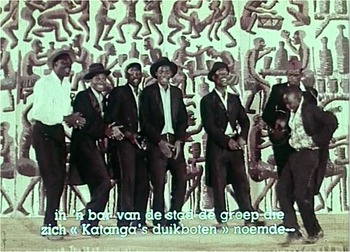
Changwe Yetu: Notre plus grande fête à nous tous (“Our Festivity: Our Biggest Celebration for Us All”) premiered in time for the 1956 fiftieth anniversary celebration of the grandes sociétés (the major industries) of Katanga, many of whom contributed funding to the troupe.Footnote 40 The francization from the typical Swahili spelling of “shangwe” to “changwe” made the troupe’s name internationally legible and indicated the troupe’s target audience: colonial and metropolitan Belgians. The show unfolded along a spectrum of “civilization,” from what the CBECI perceived to be the least “evolved” Congolese living in “the bush,” to dancers in the UN Trust Territory of Ruanda-Urundi, whom the CBECI perceived as “evolved.”Footnote 41 Despite the addition of new regions and their dances between the 1956 and 1958 shows, both versions of Changwe Yetu proceeded in a similar fashion: performers began with a “prelude in the city,” followed by a “fête dans la brousse” (“party in the bush”) (see Fig. 2, below), and then another section in the cité indigène featuring a variety group recruited by Kisimba called the Jeunes Sous-Marins du Katanga (JESOKAT, the “young submarines of Katanga,” Elisabethville slang denoting a group of pugnacious young men) (see Fig. 3, below).Footnote 42 Changwe Yetu then concluded with Burundian drummers and the intore (“warrior”) dancers or “royal drummers” of the mwami (king) of Ruanda.Footnote 43
Ekonda dancers in Changwe Yetu’s 1958 “fête dans la brousse,” in Leopoldville.

Figure. 2 Long description
A group of dancers is performing on a stage. They are wearing traditional attire and are engaged in a dynamic dance routine. The stage is set with lighting equipment visible in the background. To the left, a large audience is seated, attentively watching the performance. The scene captures a lively cultural event with a focus on the dancers' movements and the audience's engagement.
Image from the film Changwe Yetu directed by Jean-Marc Landier (1956) and produced by Sofidoc Belgium, of the Jeunes Sous-Marins du Katanga (JESOKAT) in the original performance’s “interlude in the city.” The caption reads: “In a bar in town, the group that calls themselves the “Submarines of Katanga.”.

Figure. 3 Long description
Seven men are standing in a row, all wearing suits and hats. They are positioned in front of a mural depicting various figures. The men appear to be engaged in a group activity or performance. Subtitles in a foreign language are visible at the bottom of the image, reading: 'in 'n bar van de stad de groep die zich 'Katanga's duikboten' noemde--'.
Although the public advertisement of Changwe Yetu emphasized its cast as isolated or, at least, naive to modern travel, the Central African performers of Changwe Yetu creatively made a variety of dance styles portable and adaptable to proscenium stages, while still satisfying expectations of a static African “authenticity.”Footnote 44 In the pre-Expo 58 tour of the colony, Changwe Yetu gave incremental “fragmentary performances,” collecting performers as a group of core dancers traveled in Elisabethville, Usumbura, Stanleyville and Coquilhatville; these were followed by full rehearsals and shows in Léopoldville and then by performances in Matadi and Thysville.Footnote 45
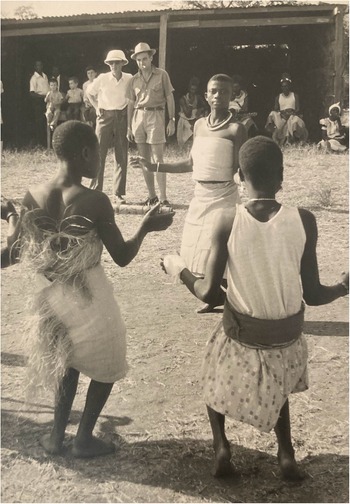
These travels required extensive editing of dances typically performed in open air and the adoption of multiple onstage personas for dancers, what scholar Brian Valente-Quinn has referred to as the “creative alienation” of staged “tribal” performance.Footnote 46 The Ekonda group from Bikoro, for example, decided to send replacement dancers rather than the requested “sacred chiefs” and adjusted their outfits (for example, changing leopard teeth to white beans) and choreography for the tour as a result.Footnote 47 Similar editing happened as the CBECI abridged numbers and reduced the cast size (from an ambitious 180 people to a final 120) via a sharing of dancers between acts.Footnote 48 In reports to the Ministry of Colonies, Landier was forthcoming about the fact that they had needed to create a smaller “orchestra capable of accompanying several dances” and that “musicians moved from one instrument to another” onstage, no matter their ethnicity. Similarly, Landier chose the “few good dancers” of the group to form “a single ‘corps de ballet’ that danced the dances of the different tribes” to fill out numbers.Footnote 49 The CBECI ordered recruited dancers to bring with them a “neutral pagne” (cloth wrapper) for this exact reason.Footnote 50 While official reports from Landier to the Ministry of Colonies highlighted the show’s reinforcement of “tribal” identities among the cast, the staging process brought performers into close proximity (see Fig. 4, below) and rewarded those who took on the persona of a performer. In one report of rehearsals in 1956, which took place at a UMHK workers’ camp, Landier happily relayed that performers emphatically “refused Union Minière workers’ sweaters ‘because we are dancers,’” rather than laborers, evidence of their “esprit de corps.”Footnote 51
Young girls rehearsing outside of Elisabethville, 1956. Public works employee of the city Henri Schumacher (left) and director Jean-Marc Landier (right) look on with European children and cast members watching.

Figure. 4 Long description
Three young girls are dancing outdoors. Two men stand in the background, observing the scene. A group of people, including children and adults, are seated and watching the performance. The setting appears to be an open area with a structure providing shade in the background.
The establishment of the regional Spectacle Populaires programs in 1957 further reinforced this identity through its emphasis on performing arts as a profession. With this regional project, the CBECI hoped to play a greater role in the numerous urban performance groups of the colony, such as Kisimba’s JECOKE in Elisabethville or actor Albert Mongita’s Congolese Folkloric League in Leopoldville.Footnote 52 In 1957, the CBECI recruited performers for tours in the provinces of Katanga and Leopoldville to stage the variety-act genre of spectacles populaires (the titular “popular shows”) while also disseminating official government information throughout their respective regions.Footnote 53
The spectacle populaire was (and is) a Congolese genre defined by the diversity of styles presented on stage: sketches, songs, dances, acrobatics, magic, lotteries, and games.Footnote 54 For Landier, head of the Katangan section, Spectacles Populaires was intended to teach local troupes how to professionalize through the exigencies of having to bring portable stages around the province “to be set up each day … anew,” in the cité indigène.Footnote 55 On the level of content, Spectacles Populaires were geared to Congolese life but premised on “an extreme mobility” of stages, equipment, and performers.Footnote 56 Landier, reflecting on the program’s disproportionate success in the Katanga section, likened performers’ willingness to follow an intense touring schedule to his experiences with the boat-based Théâtre Flottant; it was through the repetition of touring, Landier claimed, that his Congolese collaborators would see theater as a standardized art form and that it was “possible to make a profession out of it.”Footnote 57 Kisimba would later name “the technical side” of Spectacles Populaires as its most important element.Footnote 58 Between the 1956 and 1958 productions of Changwe Yetu, many troupes petitioned for inclusion in both Spectacles Populaires and Changwe Yetu’s Expo 58 tour, having seen the material and experiential opportunities the flush CBECI offered.Footnote 59
The CBECI incorporated Changwe Yetu’s second tour of the colony in June 1958 into the second season of Spectacles Populaires. When the folkloric dance troupe eventually made their way to Expo 58, posing in front of a Sabena plane like earlier CBECI tours of Belgian actors (see Fig. 1, above), the cumulative effect of such touring greatly impacted the troupe’s activities in the metropole.Footnote 60 Some performers scheduled parallel performances or accepted invitations to speak at other Congo-centric events of the expo.Footnote 61 While such opportunities varied depending on the individual Changwe Yetu performers themselves, all activities were closely monitored by Belgian Bureau of Information officers. Adolphe Kisimba was particularly flagged for being a “distributor of autographs at intermission,” exchanging information for letter writing, and being all around “the toast of the ladies”—a description that suggests Kisimba’s own daily performance as a successful producer on tour.Footnote 62
Performers also attempted to wield the rhetoric of a cultural exchange and the opportunities of travel promised by the CBECI to their benefit. In one well-reported case, the Rwandan drummers and dancers of Changwe Yetu published a petition to Minister of Colonies Léo Pétillon in the Brussels paper Le Soir, asking to extend their stay in Belgium and stating that that the tour had not lasted long enough for them to experience “the Belgian people, their achievements and their lifestyle, what could have been for us and our people an invaluable enrichment.”Footnote 63 This request was denied, and Le Soir published Huisman’s defense that it was “‘mainly technical and financial reasons that stand in the way of [the dancers’] wish.’”Footnote 64 Well known from their inclusion in the 1950 film King Solomon’s Mines, the Rwandan dancers were preceded by their reputation in Belgium and presented as the “summit” of Changwe Yetu.Footnote 65 Although Huisman had suggested that Changwe Yetu would demonstrate to the world that Central African performers had open horizons, the CBECI in fact sent all performers home, including their Rwandan stars.
Despite their quick return and the administration’s tight control over the tour, the experience of Changwe Yetu nonetheless shifted performers’ sense of unequal racial relations in the colony and emboldened them with a global awareness. A report on the Rwandan dancers’ return to Nyanza, for example, stated that they came home asking the territorial administrator where he was “from,” given how “‘in Belgium everyone has been extremely polite and considerate towards us,’” stating that they did not “‘understand that they can be the same Belgians in both cases,’” given colonials’ poor behavior toward Africans. Other dancers are described as having taken on metropolitan affectations on their return and giving Europeans “oblique looks” and “condescending smiles.”Footnote 66 Much of this description can be credited to administrators’ anxieties over dancers’ travels but reflects nonetheless performers’ attempt to use the experience of traveling to critique conditions back home.Footnote 67
Shaking off their surprise at Changwe Yetu performers’ lack of raffia offstage, Belgian audiences ultimately saw the production’s “authentic” dances as a Belgian triumph of cultural conservation at Expo 58 and potential fodder for their own artistic rejuvenation.Footnote 68 For Changwe Yetu’s cast, this “authenticity” was a stageable product, dependent on performers’ ability to adapt supposedly fixed traditions into a mobile format. Changwe Yetu’s impact, given this fact and performers’ attempts to make good on the CBECI’s promises of exchange, lay in the show’s extensive touring and the new opportunities its cast, such as Kisimba, pursued after the troupe’s final bow.
Katangans as World Explorers in Mu Kongo - Mu Belgique
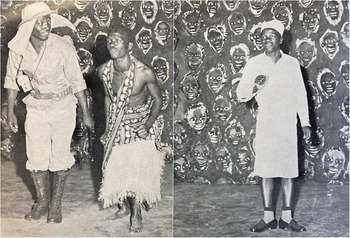
Amid performing in Changwe Yetu, Adolphe Kisimba was busy filming footage of Belgium on a portable camera. Upon his return to Elisabethville, Kisimba quickly assembled a film, Notre Voyage en Belgique (1958), that would become the centerpiece of a Spectacles Populaires du Katanga tour in the autumn of 1958.Footnote 69 Working once again with Landier, Kisimba added onto the improvised commentary he performed for the film with the goal of creating an evening-length performance. The final production, Mu Kongo – Mu Belgique (“in Congo, in Belgium”), toured Katanga and neighboring regions in late 1958 and Belgium in early 1959, presenting Kisimba’s film alongside songs, dances, and sketches performed by Changwe Yetu and Spectacles Populaires alumni Alphonse Ngandu, Marcel Tshama, Odilon Kyembe, Gabriel Musabila, and Abel Losta (see Fig. 5, above).Footnote 70
Images of two sketches in Mu Kongo – Mu Belgique’s 1959 Brussels program. Left: Alphonse Ngandu (left) and Odilon Kyembe (alias Papa Mufwankolo, right). Right: Kyembe in another sketch.

Figure. 5 Long description
The image shows two men performing in front of a backdrop filled with illustrated faces. On the left, a man in traditional attire, including a patterned cloth and a fringed skirt, is dancing. He is barefoot and appears to be in motion. Next to him, another man is dressed in a uniform with a hat, boots and a camera around his neck, suggesting a colonial or explorer theme. On the right, a man in a white uniform with a hat stands holding an object. The backdrop features numerous stylized faces, adding a dramatic effect to the scene.
Mu Kongo – Mu Belgique was a satirical show, full of Kisimba and company’s overt opinions about Belgium, performed largely in Swahili, and infused with a Copperbelt cosmopolitanism.Footnote 71 Mu Kongo – Mu Belgique thus exceeded Belgian expectations for Congolese performance while insisting upon the cultural exchange that the Belgian administration had sought to deny Changwe Yetu performers the year before. The show’s emphasis on Congolese travel, its performers’ role as explorers, and Belgium as an object of cultural observation flew against Belgian expectations of “traditional” Africa artists, resulting in negative reviews in the metropolitan press. As such, Mu Kongo – Mu Belgique—in its content and form—suggests that Kisimba saw an opening in early 1959 in which the Belgo-Congolese relationship could be remade according to the lofty promises of the CBECI.
Congolese mobility animated Mu Kongo – Mu Belgique’s inception and themes. The show’s central film was a satire of the European ethnographic genre, with Kisimba onstage acting out an anthropological lecture on Belgium. Narrating Notre Voyage en Belgique, Kisimba intended to let “the masses participate in this trip to Europe made by a privileged few.”Footnote 72 Those who saw the film on the 1958 Spectacles Populaires circuit remembered it as doing just that, allowing viewers to see Belgium from a Congolese perspective before Congolese travel to Europe was common.Footnote 73 In a period of increased Belgian research, filmmaking, and tourism in the Congo, Kisimba’s film presented cobblestones, steamships, and museums as culturally specific European oddities. (Museums, specifically, he described as “these houses… where they keep old things that are no longer needed, which are sometimes very strange things.”)Footnote 74 Kisimba’s representation of himself was that of an explorer, fashioned in the style of Belgium’s own colonial “pioneers,” and his film allowed reportedly tens of thousands of Congolese spectators to step into these subversive shoes and take ownership over knowledge of Belgian culture.
Kisimba’s presentation of his film in the 1958 Spectacles Populaires season replicated the ethnographic interest with which Belgians had peered upon Changwe Yetu. The show’s success at Expo 58 was itself emblematic of a larger craze for the “exotic” in Brussels, supported by another artistic exchange group called the Association pour la Diffusion Artistique et Culturelle (“Association for Artistic and Cultural Diffusion” or ADAC). The ADAC operated in conjunction with the metropolitan arm of the CBECI out of the Palais des Beaux Arts and, since 1950, had run a program called Exploration du Monde (“world exploration”). This series made Belgian audiences “explorers” from the comfort of their own city via foreign acts, ethnographic films, interactive cultural nights, and lectures by cartographers and reporters.Footnote 75 Now, via Spectacles Populaires and Kisimba’s narration, Katangan audiences could take part in this sort of proxy travel, at once challenging Belgian colonial restrictions on international movement and allowing colonized individuals to step into the imperial role of purveyor and collector of cultural curiosities.
The genre of the extended show bound for Europe, Mu Kongo – Mu Belgique, defied easy categorization. While pitched by the CBECI as an embodiment of Belgo-Congolese collaboration and thus a new stage in the development of “authentic” Congolese arts, Kisimba’s show was idiosyncratic and pulled from both local and global references in a manner distinct from the cultural performance of Changwe Yetu. Kisimba and Landier put music and sketches together with the new technology of “magic lantern” film projection that intercut various numbers.Footnote 76 This technique, debuted by the Czech Republic at Expo 58 in perhaps one of the only shows to rival Changwe Yetu, used multiple projectors to immerse audiences in film clips that, projected in 360-degrees, interacted with the performers onstage.Footnote 77 The projections included clips from Lumieres et Treteaux—a behind-the-scenes look at the production of Spectacles Populaires—alongside Notre Voyage. Together, this light show gave audiences the impression of being pulled into the casts’ broader travels in Katanga and Belgium.Footnote 78
Song and dance numbers that intercut these films, too, pointed to the artistic circulation of its performers in the Copperbelt and outside the colony. Beyond the shuffling Rhodesian-influenced dance steps in which Kisimba’s troupe specialized, other numbers were sung, for example, in isiZulu and featured steps common to South Africa.Footnote 79 Another number, simply entitled “Traveling is Bad!” (“Voyager C’est Mauvais!”), depicted the woes of a financially strapped but seasoned Congolese traveler attempting to catch up with King Baudouin during his 1955 tour of the colony.Footnote 80
The sketches in Mu Kongo – Mu Belgique, thematically connected, also all gestured to travel. “Three Congolese in Belgium,” for example, was performed largely in Swahili and depicted a trio of men recently arrived in Brussels with little knowledge of French, who decide to take a nap in Parc Royal.Footnote 81 During the night, a murder takes place in the park, and when confronted by local policemen who speak no Swahili, the men accidentally declare their guilt and consent to their arrest having only learned key phrases such as “we are three Congolese men” and “that’s okay with us.” Meant as a cautionary, joking tale for Congolese eager to travel but lacking in preparation, the sketch likely drew from the cast’s own (far less catastrophic) misunderstandings and limited communication during their earlier European tour.Footnote 82 The satire of the sketch lay partially in the characters’ shallow understanding of French, but also contained an undercurrent of racial tension, given that the three African travelers are immediately taken into custody. This sort of critique in Mu Kongo – Mu Belgique reflected the sensibilities of a cast ardently engaged with the CBECI as an expansion of their own performance circuits, as well as a recognition that mutual understanding—such as attempts to communicate across languages—was often a one-way street between Congolese and Belgians.
Mu Kongo – Mu Belgique made this asymmetry even more visible by emphasizing to viewers the culturally particular knowledge needed in order to appreciate its ensemble’s jokes. When giving a demonstration of Spectacles Populaires and an early version of Mu Kongo – Mu Belgique in Elisabethville’s Théâtre de la Ville (in the European neighborhood), Landier and Kisimba’s production team attempted to force this contact by physically transplanting the cité indigène onto the European stage. The organizers brought a small onstage “audience” of Congolese spectators, intended to react to the show and demonstrate to white audiences what Congolese might find funny or impressive.Footnote 83 This nesting-doll performance evokes an anthropological approach to understanding Congolese culture in situ, but it also staged a quasi-reversal of the politics of cultural assimilation to which évolués such as Kisimba had been held, as now Europeans were asked to shift their perspective to Congolese humor and mores.Footnote 84
The show’s inclusion of new technology and creative attempts at new stagings contributed to Kisimba and Landier’s larger suggestion that this was a “modern” and exciting performance resulting from the cultural development programs of the CBECI. The program was suffused with metaphors of movement; in the arc of this evening-length spectacle, Kisimba stood in as a metonym for cultural development, presenting his personal and physical trajectory as evidence of Congolese ascension. The show began with Kisimba’s birth in “a remote corner of the bush,” followed by a depiction of his introduction to theater in the city, work with Landier, first trip to Belgium, and finally an abbreviated Spectacles Populaires performance.Footnote 85 In the show’s Belgian program, journalist (and future Prime Minister) Évariste Kimba interpreted Kisimba’s literal movement from “the bush” to Europe as evidence of the “dizzying speed” of the Congo’s progress.Footnote 86 While the CBECI promoted Kisimba and Landier’s work on the show as the embodiment of the “Belgo-Congolese Community” (see Fig. 6, above), Kisimba’s personal promotion of the show crafted a larger narrative of his own mobility, stating that he had initiated the expansion of Notre voyage into an evening-length production “firstly to see people with whom I’ve developed friendships [in Belgium], and secondly because I enjoy traveling and participating in shows.”Footnote 87
Image of Jean-Marc Landier and Adolphe Kisimba from the Brussels program of Mu Kongo – Mu Belgique: “It is from the collaboration of JM Landier and A Kisimba that Mu Kongo – Mu Belgique was born.”.

Figure. 6 Long description
Two men are seated at a table, both leaning forward and looking at an open book. The man on the left is wearing a long-sleeved shirt, while the man on the right is in a checkered shirt. They appear to be engaged in a discussion or study session, with the book positioned between them on the table.
Belgians’ reactions to the show reflected an increasing anxiety over Belgo-Congolese relations in 1959 and points to the political weight of such types of African performance in the late colonial period. Mu Kongo – Mu Belgique premiered in Brussels in February of that year, delayed briefly by construction problems at the Palais des Beaux-Arts and the January political unrest in Leopoldville, a jolt to the Belgian imperial imagination that Kisimba re-created in miniature onstage.Footnote 88 L’Essor du Congo’s Brussels correspondent reported that the Bruxellois audience “99% of the time, does not understand the subtleties of the Kiswahili dialogue,” and were “left wanting more” than this “un-exportable product.”Footnote 89 The Brussels-based Commission for the Protection of Indigenous Arts and Crafts (Commission pour la Protection des Arts et Métiers Indigènes, COPAMI) deemed Mu Kongo – Mu Belgique “very disappointing” due to the lack of “folklore,” and issued an official “warning to show entrepreneurs so as to avoid the degradation of Congolese art.”Footnote 90 COPAMI’s disappointment is unsurprising; Mu Kongo – Mu Belgique played off of the expectations of Belgian audiences, referencing Changwe Yetu in its promotion, filmed interludes, and sketches while largely excluding “traditional” dance and opting for purposefully alienating stagings, such as the use of Swahili.
Kisimba’s attempt to translate (or rather, his literal refusal to translate) a Katangan performance to the Belgian theatrical market made visible the growing distance between Congolese performers’ expectations and that of European audiences. In Le Soir, a review called attention to the show’s “very laudable intention of making us feel the Congo and Belgium as the Blacks do.”Footnote 91 But, as a review from Les Beaux-Arts noted, this Congolese perspective left “our imagination shaken up a little roughly” by reversing the relationship established by Changwe Yetu. Instead, the critic remarked that audiences had left the show having realized that, eight months prior at Expo 58, “unbeknownst to us, we offered a marvelous terrain of exploration” in the metropole to the visitors of Changwe Yetu, “for whom we were the objects of exoticism as much as they were to us.”Footnote 92 Compared to the extractive gaze with which Belgians had viewed Changwe Yetu at Expo 58, Kisimba’s metropolitan encore now forced Belgians into a reciprocal position as objects of observation and artistic extraction themselves. The Beaux-Arts review conceded that their post-Changwe Yetu surety of Belgo-Congolese artistic relations, and of the colonial situation in total, “is what we risk when we look at ourselves in the mirror of our ‘explored’ made explorers.”Footnote 93
Although Mu Kongo – Mu Belgique was a critical failure in Brussels, the experience nonetheless marked a milestone in the casts’ professional careers. A year later, authorities in Leopoldville tapped Kisimba as a producer for the upcoming independence day festivities and as a coordinator for the soon-to-be independent Congolese government’s Federation Nationale des Beaux-Arts (the “National Federation of Fine Arts,” FNBA).Footnote 94 One of the cast’s rising stars, Odilon Kyembe, who is remembered today as a pioneer of Katangan theater under the stage name Papa Mufwankolo, received a training placement with the Théâtre de Verdure in Belgium before returning, too, to stage independence day festivities.Footnote 95 More importantly, Mu Kongo – Mu Belgique’s experiment in reversing the colonial gaze suggests an optimism on Kisimba’s part that this unique, late colonial form of stage performance might chart a new course for Congolese performers navigating emerging opportunities as international artists.
Postcolonial Foreclosures and Erasures
This article has argued that performance in the late colonial period was a key avenue through which Africans pursued new identities as international artists. In the case of the Belgian Congo, men such as Adolphe Kisimba used colonial development schemes to connect their regional performance networks to global ones and fashion on and offstage personas as mobile, cosmopolitan artists. Such aspirations both emerged from Belgian colonial cultural institutions such as the CBECI as well as exceeded their plans. Kisimba’s film, Notre Voyage en Belgique (1958) and its expansion into the evening-length Mu Kongo – Mu Belgique (1958–59), drew from a style of performance encouraged by the CBECI that highlighted a self-reflexive attention to mobility onstage that provoked a confrontation between Belgian expectations of African fixity and “authenticity” and Congolese plans for a more mobile future. As such, a close reading of this era of performance provides an example of the non-nationalist political engagements Africans pursued not despite, but through, their proximity to the colonial state.
Before independence, Kisimba aimed to rework Belgian expectations and continue his travels through an expanding theatrical network. Yet these aspirations were suppressed by the very political forces we might assume to liberate them. A week after the Independence Day festivities, which featured a miniature restaging of Changwe Yetu at the Palais des Nations in Leopoldville, Kisimba left the capital on the last plane to Katanga.Footnote 96 Moïse Tshombe’s secessionist government in Elisabethville, like Albert Mongita in the Department of Cultural Affairs in Leopoldville, quickly got to work on creating a “national ballet” after 1960; Kisimba, however, would not reenter such state-sponsored performance until 1965, directly after Joseph-Désiré Mobutu’s coup.Footnote 97
A confluence of factors brought Kisimba and his Belgian collaborators back to the fore: Mobutu’s 1965 ascension, the 1966 First World Festival of Black Arts (the Festival Mondial des Arts Nègres, FESMAN) in Dakar, and Belgium’s initiation of covert cultural damage control in late 1964.Footnote 98 Roger Domani of the Brussels-based Théâtre de Poche—himself once attached to the CBECI and potentially at the request of the Belgian information service—announced in 1965 his intention to create a new “traditional” dance troupe representing a “complete inventory of the dances, songs, and music of the Congo.”Footnote 99 Albert Mongita, in charge of organizing such a troupe for the Congo’s FESMAN contingent, backed this initiative, citing the material support Domani could provide as a boon to the new regime.Footnote 100 For the sake of efficiency, Domani and Mongita turned again to two familiar CBECI alumni—Adolphe Kisimba and Jean-Marc Landier—to create what they christened the Congolese National Folkloric Ballet.
The resulting troupe received lackluster reviews in Dakar and, back in the Congo, local performers took to the press to publicly accuse Domani of meddling in Congolese affairs and absconding with millions of francs to the ballet’s detriment.Footnote 101 European producers continued to play a contentious role in the staging and export of Congolese performance up until and after the 1975 establishment of the National Ballet of Zaire.Footnote 102 With all national focus now on staging performance in a format akin to Changwe Yetu, the forms of performance that had publicly contested such unequal “collaboration” in the late colonial period were now passé.Footnote 103
The energy with which such performers sought to reform artistic relationships in the CBECI era, and the self-reflexive formats through which they attempted to do so, remain relevant in a global theatrical milieu increasingly interested in colonial legacies. Although the CBECI ceased operations around 1960, the Belgian companies it supported in Spectacles de Belgique have recently been imbricated with Congo-focused content: in 2023 the Théâtre National Wallonie-Bruxelles presented a “poetic and intergenerational spectacle” performed by eight Congolese “grandmothers” and the Brussels-based Royal Flemish Theatre, known by the Dutch acronym KVS, now houses the “Congolisation” festival (initiated by Kinshasa-born artist Pitcho Womba Konga in 2015) following the end of the company’s Kinshasa-based initiative, Connexion Kin (2009–15).Footnote 104 During KVS’s fraught Connexion Kin enterprise, director Jan Goossens positioned its work in Congo as responding to the historical linkages between the two countries, yet simultaneously arguing that KVS was “hardly responsible for what happened before 1960” and instead focused on “seizing the opportunity to develop new, fairer relationships.”Footnote 105 Such a theatrical interest in Global North–South collaboration as a balm for histories of extraction has drawn not just Congolese, but African performers more generally, into European artistic initiatives and continued, as other scholars have noted, to put their artistic mobility in the hands of European sponsors.Footnote 106
For this reason, detailed, accurate historical research into colonial-era performance across Africa is a pressing matter. When scholars discuss the inequality of global performance networks, or global mobility writ large, they are likely to discuss colonial continuities, drawing attention to the Global North’s continued extraction of African cultural products and Africans’ creative negotiation of these legacies.Footnote 107 Further research can be done into the late colonial experiments in reforming such relationships and the forces that pushed African performers, such as Kisimba, to change course after political independence.Footnote 108 Attending to the historical minutiae of staged, state-sponsored performance, such as Changwe Yetu, Mu Kongo – Mu Belgique, or the myriad shows Africans put on across neighboring empires, is more than mere pedantry. Rather, the histories of performance and the creative output of figures like Kisimba reveal brief reorientations of unequal collaborations with Europeans and potential templates for future artists’ own political engagements.
Acknowledgements
Thank you to the JAH editors and reviewers, and to my readers for their feedback on earlier drafts of this article. The Fulbright U.S. Student Program, the Belgian American Educational Foundation, and The Ohio State University provided support for my research. A heartfelt thank you to Françoise Levie, Sarah Van Lamsweerde, John De Coninck, Sando Marteau, Léon Yav-A-Muyet, Justine Ngoie Ya Kachina Umba, and the late Adolphe Kisimba for their help with this project.




 Open access

