



INTRODUCTION
The ecosystems of the African continent collectively harbour some of the highest continental bird diversity in the world; only the Neotropics and tropical Asia are more diverse. Not surprisingly, the malaria parasites of these birds appear to be as diverse as their avian hosts (see also Clark et al. Reference Clark, Clegg and Lima2014), as reflected in a number of regional studies conducted over the past decade (e.g. Smith et al. Reference Smith, Thomassen, Freedman, Sehgal, Buermann, Saatchi, Pollinger, Milá, Pires, Valkiūnas and Wayne2011; Loiseau et al. Reference Loiseau, Harrigan, Robert, Bowie, Thomassen, Smith and Sehgal2012; Okanga et al. Reference Okanga, Cumming, Hockey, Nupen and Peters2014; Lauron et al. Reference Lauron, Loiseau, Bowie, Spicer, Smith, Melo and Sehgal2015; Lutz et al. Reference Lutz, Hochachka, Engel, Bell, Tkach, Bates, Hackett and Weckstein2015). While this diversity is to some extent driven by regional ecosystem differences including host distributions (see also Lauron et al. Reference Lauron, Loiseau, Bowie, Spicer, Smith, Melo and Sehgal2015), the underlying method of transmission is likely also a factor (Santiago-Alarcon et al. Reference Santiago-Alarcon, Palinauskas and Schaefer2012). Although all three major genera of avian malaria parasites are vectored by dipteran arthropods, the current understanding is that Plasmodium is vectored by mosquitoes, whereas Haemoproteus is transmitted by louse flies or biting midges, and Leucocytozoon is transmitted by black flies (Valkiūnas, Reference Valkiūnas2005). The different ecological requirements of these dipteran vectors (largely related to water availability, water flow and temperature) play a major role in the overall distribution of each haemosporidian genus. Our goal here is to use existing genetic data on parasite lineages to provide a synthesis of known malaria parasite diversity across sub-Saharan Africa. To accomplish this, we have characterized patterns of diversity in African avian malaria parasites to address three basic questions: (1) How diverse are malaria parasites within the biogeographic regions of Africa?, (2) How are parasite lineages distributed geographically, i.e. what are the proportions of endemic parasites in each region and are some regions more likely to share lineages than others?, and (3) What are the host preferences and host breadths of these parasites?
The state of the continent
From very early microscopy analyses of ~ 11 500 blood smears, 70 morphological Haemoproteus (including Parahaemoproteus and Haemoproteus) and 13 morphological Plasmodium species have been found in birds in Africa (Garnham, Reference Garnham1950; see Valkiūnas, Reference Valkiūnas2005 for summary). Yet of these, just 15 Parahaemoproteus, 2 Haemoproteus and 2 Plasmodium morpho-species were endemic to Africa. From the 1970s through early 1990s, surveys based on microscopy of blood smears collected from a taxonomically broad spectrum of host species were conducted in sub-Saharan Africa, and prevalence (percentage of birds with detectable parasites in the blood) ranged from similar levels of 11·5% in Senegal, 13% in Cameroon and 19·1% across sub-Saharan Africa (collectively), to a comparatively high level of 37% from East African savannah regions (Bennett and Herman, Reference Bennett and Herman1976; Bennett et al. Reference Bennett, Blancou, White and Williams1978; Kirkpatrick and Smith, Reference Kirkpatrick and Smith1988; Bennett et al. Reference Bennett, Earle, Du Toit and Huchzermeyer1992). In 2005, two very detailed studies, one focused on western African rainforests (Sehgal et al. Reference Sehgal, Jones and Smith2005) and one from Uganda (Valkiūnas et al. Reference Valkiūnas, Sehgal, Iezhova and Smith2005), highlighted the diversity of haemosporidian parasites in Africa using microscopy techniques. Combined, these two studies included 1276 individual birds, and haemosporidian parasites were identified in 27 avian families, with prevalence ranging from 28·6 to 61·9%, with the highest numbers from Uganda.
Surveys of molecular phylogenetic relationships generally return higher diversity and prevalence estimates than microscopy, although these can be inflated due to circulating sporozoites. A recent survey of parasites in Western Congolian rainforests (Møller et al. Reference Møller, Garamszegi, Peralta-Sánchez and Soler2011) identified haemosporidians from 25 host families from just 527 individual birds; Plasmodium infections alone were detected in 45% of individuals (Beadell et al. Reference Beadell, Covas, Gebhard, Ishtiaq, Melo, Schmidt, Perkins, Graves and Fleischer2009). And indeed, most molecular examinations of parasite diversity in birds have focused on just a few families (primarily sunbirds [Nectariniidae] and bulbuls [Pycnonotidae]) from the Western African or Western Congolian rainforests (Bonneaud et al. Reference Bonneaud, Sepil, Milá, Buermann, Pollinger, Sehgal, Valkiūnas, Iezhova, Saatchi and Smith2009; Chasar et al. Reference Chasar, Loiseau, Valkiūnas, Iezhova, Smith and Sehgal2009; Loiseau et al. Reference Loiseau, Valkiūnas, Chasar, Hutchinson, Iezhova and Sehgal2010; Iezhova et al. Reference Iezhova, Dodge, Sehgal, Smith and Valkiūnas2011; but see Hellgren et al. Reference Hellgren, Waldenström, Peréz-Tris, Szöll, Si, Hasselquist, Krizanauskiene, Ottosson and Bensch2007 and Lauron et al. Reference Lauron, Loiseau, Bowie, Spicer, Smith, Melo and Sehgal2015). Recent exceptions to these taxonomically limited, rainforest-based studies are from the Vwaza Marsh in Malawi (Lutz et al. Reference Lutz, Hochachka, Engel, Bell, Tkach, Bates, Hackett and Weckstein2015) and wetlands in the Western Cape of South Africa (Okanga et al. Reference Okanga, Cumming, Hockey, Nupen and Peters2014). The only study to assess diversity in the Saharan region used targeted sampling in northeastern Nigeria for a limited number of avian species (n = 9) thereby not reflecting the overall malaria diversity of that region (Waldenström et al. Reference Waldenström, Bensch, Kiboi, Hasselquist and Ottosson2002).
In a broader study of global parasite diversity, Clark et al. (Reference Clark, Clegg and Lima2014) include sub-Saharan Africa as a biodiversity hotspot for haemosporidian parasites, but do not explicitly discuss parasite distributions on the continent. In another study focusing on Plasmodium parasites from African sunbirds, Lauron et al. (Reference Lauron, Loiseau, Bowie, Spicer, Smith, Melo and Sehgal2015) show that there is a great deal of variation in the distributions of Plasmodium lineages, with some being geographically limited and others very widespread. Likewise, some Plasmodium lineages from sunbirds are probably more specialized on hosts than others.
State of the sampling: limitations
Studies of haemosporidian diversity in Africa, like those in virtually every other part of the world, have been inconsistent with collection and with laboratory protocols to detect parasites. Much of the variation that we see across Africa may be in part due to these research biases. The overwhelming majority of studies have focused on Haemoproteus and Plasmodium (Ricklefs and Fallon, Reference Ricklefs and Fallon2002; Waldenström et al. Reference Waldenström, Bensch, Kiboi, Hasselquist and Ottosson2002; Durrant et al. Reference Durrant, Reed, Jones, Dallimer, Cheke, McWilliam and Fleischer2007; Pérez-Tris et al. Reference Pérez-Tris, Hellgren, Križanauskiene, Waldenström, Secondi, Bonneaud, Fjeldså, Hasselquist and Bensch2007; Beadell et al. Reference Beadell, Covas, Gebhard, Ishtiaq, Melo, Schmidt, Perkins, Graves and Fleischer2009; Bonneaud et al. Reference Bonneaud, Sepil, Milá, Buermann, Pollinger, Sehgal, Valkiūnas, Iezhova, Saatchi and Smith2009; Ishtiaq et al. Reference Ishtiaq, Beadell, H.warren and Fleischer2012; Karamba et al. Reference Karamba, Kawo, Dabo and Mukhtar2012), and sometimes only on Plasmodium (Beadell et al. Reference Beadell, Ishtiaq, Covas, Melo, Warren, Atkinson, Bensch, Graves, Jhala, Peirce, Rahmani, Fonseca and Fleischer2006; Valkiūnas et al. Reference Valkiūnas, Iezhova, Loiseau, Smith and Sehgal2009; Loiseau et al. Reference Loiseau, Harrigan, Robert, Bowie, Thomassen, Smith and Sehgal2012). Of the 15 studies, the data for which are included in our analyses, only three include data from Leucocytozoon (Hellgren et al. Reference Hellgren, Waldenström, Peréz-Tris, Szöll, Si, Hasselquist, Krizanauskiene, Ottosson and Bensch2007; Ishak et al. Reference Ishak, Dumbacher, Anderson, Keane, Valkiünas, Haig, Tell and Sehgal2008; Lutz et al. Reference Lutz, Hochachka, Engel, Bell, Tkach, Bates, Hackett and Weckstein2015), because these other studies did not look for this parasite. Further restricting the potential diversity is that most studies include only passerines (songbirds, representing roughly ½ of avian diversity), or at least the majority of the samples came from passerines. And, finally, most studies have been geographically limited, as we discuss above.
We point out also that previous studies of African malaria parasites (see above) did not systematically sample across parasite lineages in their molecular techniques. In particular, primer bias issues in commonly used polymerase chain reaction (PCR) techniques exist such that some primers target primarily Plasmodium or Plasmodium and Haemoproteus but are not well suited for Leucocytozoon. Thus, any regional differences could be partially attributable to primer bias, rather than differences related to vectors and their life histories or to host specialization.
Biogeographic regional parasite diversity
Linder et al. (Reference Linder, de Klerk, Born, Burgess, Fjeldså and Rahbek2012) developed statistical models of faunal distributions across sub-Saharan Africa and here we use that which they developed and defined for birds (i.e. the hosts). Virtually all African avifauna cluster into these seven statistically-defined sub-Saharan biogeographic regions (rather than geographic as in Lauron et al. Reference Lauron, Loiseau, Bowie, Spicer, Smith, Melo and Sehgal2015): Saharan (to include Mauritanian), Sudanian, Ethiopian, Somalian, Congolian, Zambezian and Southern African. Although each region does have some number of endemic bird species, areas with a larger proportion of endemics are the Ethiopian, Congolian and Zambezian regions; these three regions also have the highest levels of species richness (Jetz and Rahbek, Reference Jetz and Rahbek2002; Fjeldså, Reference Fjeldså2003). For the Ethiopian region, endemism and species richness are tied to distinctive high elevation mountains, whereas endemism and species richness in the Congolian region are tied to lowland tropical forest habitat. And, in the Zambezian region, endemism and species richness are largely associated with Afromontane forests in the East Arc Mountains of Tanzania and Kenya. Much of the remainder of the Zambezian region comprises semi-arid savannah and deciduous dry forests, and as such, much of the avifauna found in the Zambezian region is also found in the different and varying habitats found in the Southern African region as well (see Sinclair and Ryan, Reference Sinclair and Ryan2010 for avian distributions).
Similarly, the desert and semi-arid northern savannahs found in the Saharan, Sudanian and to some extent the Ethiopian and Somalian regions also tend to share avian species. The Sudanian region is unique however in hosting a significant number of wintering European migrant species (see Sinclair and Ryan, Reference Sinclair and Ryan2010). And finally, avifaunal assemblages to the north of the Sahara, for example those found in the Atlas Mountains of Morocco and Algeria, tend to have closer ties to the European avifauna than to sub-Saharan ones. As a broad generalization then, avian species tend to be restricted to one or more northern regions, the Congolian region, or to either or both of the southern regions (Zambezian and Southern African). Because of the regional variation in avian assemblages, we sought to evaluate whether these partitions are also apparent in avian malaria parasites.
Geographic distribution of parasite lineages
With the large number of endemic bird species within each of the biogeographic regions, we were interested in evaluating whether this regional variation is also reflected in their malaria parasites. Here, we define an endemic parasite by whether the lineage was only recovered from one region but was found in two or more host individuals. We also wanted to know how many lineages are shared between regions, i.e. whether a parasite lineage was found in two or more regions. Because the genera of malaria parasites use different insect vectors (see above), we also evaluated the proportions of each parasite genus within each region. For an evolutionary context, we conducted a phylogenetic analysis of all lineages to determine whether phylogenetic structure was linked to biogeographic regions in any way, i.e. do one or more regions harbour distinct clades of malaria parasites as you might expect if parasites were host specific?
Host preferences
Recent research has shown that there may be as many avian malaria parasite species as there are avian hosts (see Ricklefs et al. Reference Ricklefs, Outlaw, Coelho, Medeiros, Ellis and Latta2014), so parasites should be the most diverse in regions with the greatest proportions of endemic host species. To address this, we determined the number of host species in which each parasite lineage was detected and how host families are parasitized by genus. Five of the best sampled passerine families (Cisticolidae, Estrildidae, Nectariniidae, Ploceidae and Pycnonotidae) have their greatest diversity in Africa. However, because these families are widespread across Africa, their distributions may homogenize parasite communities across African regions to some extent due to the Abundance–Occupancy Relationship (Drovetski et al. Reference Drovetski, Aghayan, Mata, Lopes, Mode, Harvey and Voelker2014). Finally, we used the Host Specificity Index (S TD; Poulin and Mouillot, Reference Poulin and Mouillot2003) to determine if, at the broad scale of genera (due to the limitations of ‘positive-only’ data in MalAvi; Bensch et al. Reference Bensch, Hellgren and Pérez–Tris2009), parasite genera demonstrate different strategies of parasitism. Without prevalence data by species and region, we cannot eliminate the possibility of spill-over infections into non-preferred or dead-end hosts confounding potential patterns; this is a major limitation of these data included here.
MATERIALS AND METHODS
Data compilation
We downloaded all malaria lineage data from MalAvi (April 2015; http://mbio-serv2.mbioekol.lu.se/Malavi/) and pruned the dataset to include only those lineages sampled from resident birds from continental sub-Saharan Africa (1068 cytochrome b sequences in 410 lineages [unique sequences]). Limiting our sampling to sub-Saharan Africa allowed us to make use of the statistically-derived African bird faunal regions from Linder et al. (Reference Linder, de Klerk, Born, Burgess, Fjeldså and Rahbek2012) for inter-regional comparisons and assessments of regional endemism. We assigned each malaria lineage to one or more of four regions: Congolian, South African, Sudanian and Zambezian (Table 1). Somalian and Ethiopian regions were excluded from the analyses because no data from MalAvi exist from these regions, and Saharan samples were excluded because just 13 parasite sequences have been found there (i.e. too few for meaningful comparisons). For some analyses, we also excluded South African samples because only ten lineages were found there.
Lineages found only within one region, by genus (P = 0·0002).

Data analyses
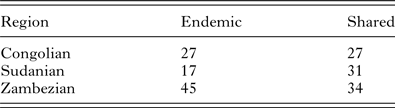
We compiled the numbers of lineages that were found in only one region (hereafter, ‘endemic’) or were found in two, or more regions (hereafter, ‘shared’), but excluded lineages found only once (i.e. lineages represented by only one sequence) (Table 2). Using a general linear model (SPSS v24), we tested whether biogeographic regions varied in their proportions of hosts infected by parasite genera (Haemoproteus, Plasmodium and Leucocytozoon). Using a chi-square test (vassarstats.net), we calculated whether biogeographic regions differed in their proportions of endemic and shared lineages. Host specificity was measured using taxonomic distance between host species infected with the same malaria lineage by using the host specificity index S TD and VarS TD, which measures taxonomic evenness (Clarke and Warwick, Reference Clarke and Warwick2001; Poulin and Mouillot, Reference Poulin and Mouillot2003). Host species are arranged into six broadly accepted taxonomic levels using class, superorder, order, family, genera and species (Dickinson and Remsen, Reference Dickinson and Remsen2013). These taxonomic steps provide the maximum value of S TD where 5 is the maximum steps needed to reach a common ancestor (Class Aves) when all other taxonomic classes are different and 1 being the minimum value when host are sister species; lower specificity values indicate increased host specificity. On the other hand, VarS TD values are indicative of symmetry in taxonomic structure (or evenness), such that a low score would indicate equal taxonomic distances (steps in the taxonomic hierarchy employed) across host species, whereas high values would indicate taxonomic asymmetry or unequal taxonomic distances across host species. Parasite lineages recovered once were removed from S TD and VarS TD analyses as no comparisons can be made.
Number of lineages in each region that are endemic to that region and number of lineages found in each region that are shared with other (1 or more) regions (P = 0·0617).
Phylogenetic analysis
We reconstructed 10 000 000 trees of all lineages using a Bayesian framework (BEAST v1.6.2 with HKY + I + Γ model of nucleotide substitution with estimated nucleotide frequencies and a Yule Process [speciation]) sampling every 1000 trees (Drummond et al. Reference Drummond, Suchard, Xie and Rambaut2012). After evaluating tree log-likelihood scores using Tracer (v1.6.0; Rambaut et al. Reference Rambaut, Suchard, Xie and Drummond2014) we calculated the maximum clade credibility tree from 10 000 trees with TreeAnnotator (v1.6.2). We coded each terminal branch by the biogeographic region from which it was found (or black for widespread lineages).
RESULTS AND DISCUSSION
Biogeographic regional parasite diversity
A total of 983 infections were reported in resident birds from sub-Saharan Africa. The Congolian region had 249 infections (71 Haemoproteus, 175 Plasmodium, 3 Leucocytozoon); the South African had 76 infections (19 Haemoproteus, 57 Plasmodium, 0 Leucocytozoon); the Sudanian had 167 infections (61 Haemoproteus, 62 Plasmodium, 44 Leucocytozoon); and the Zambezian had 491 infections (121 Haemoproteus, 216 Plasmodium, 154 Leucocytozoon). Focusing on lineages rather than infections, the number of lineages by genus found within only one region varied (chi-square, P < 0·0002, d.f. = 6); notably, when excluding lineages reported only once, the Congolian region harbours no Leucocytozoon lineages in resident birds. However, migratory birds collected there have been infected with this parasite genus (see Hellgren et al. Reference Hellgren, Waldenström, Peréz-Tris, Szöll, Si, Hasselquist, Krizanauskiene, Ottosson and Bensch2007).
The different proportions of parasite genera between regions may be due to the ecological distributions of their vectors or to uneven sampling, or to a combination thereof. For example, Plasmodium and its Culex mosquito vectors (Garnham, Reference Garnham1966; Valkiūnas, Reference Valkiūnas2005) tend to be broadly distributed (Clark et al. Reference Clark, Clegg and Lima2014), but Culex are limited by temperature and precipitation, and require standing water (often stagnant) for breeding (Patz and Olson, Reference Patz and Olson2006; other mosquito genera utilize floodwater areas). The genus Haemoproteus and its subgenera Haemoproteus and Parahaemoproteus are vectored by several species of hippoboscid flies (Hippoboscidae) and biting midges (Culicoides), respectively (Atkinson and van Riper, Reference Atkinson, van Riper, Loye and Zuk1991). Both hippoboscids and biting midges tend to range from semi-moist to more arid regions but require moist soil or water for breeding (Meiswinkel et al. Reference Meiswinkel, Venter and Nevill2004). Finally, Leucocytozoon is vectored by black flies (Simuliidae), which require clean, flowing water to lay their eggs (Carlsson, Reference Carlsson1967).
These different environmental preferences of vectors could explain some of the parasite genera proportions we found within regions. In the comparatively moist/humid Congolian region for example, Plasmodium dominated the infections (Fig. 1) with a moderate level of Haemoproteus, and Leucocytozoon was virtually absent. Importantly however, Leucocytozoon was found in many migrants from the Congolian region, the data for which were excluded from our analyses (see MalAvi; Bensch et al. Reference Bensch, Hellgren and Pérez–Tris2009). This same pattern held for the Sudanian region, which seems anomalous given that region is far more arid than the Congolian. However the specific localities sampled in the Sudanian region were close to the Congolian region. Thus, the higher rates of infection by Plasmodium and Haemoproteus would be expected. The same was also true for the Zambezian, a region also drier than the Congolian. Given that the bulk of the Zambezian sampling comes from a single study focused on the Vwaza Marshes of Malawi (Lutz et al. Reference Lutz, Hochachka, Engel, Bell, Tkach, Bates, Hackett and Weckstein2015), the high levels of Plasmodium and Haemoproteus are also expected. We would anticipate that sampling in the Sudanian and Zambezian regions, away from extensive water sources, would result in lower regional prevalence of Plasmodium and Haemoproteus. Finally, the Southern African region (which has the poorest sampling to date; Fig. 1) is dominated by Plasmodium infections, with a lower level of Haemoproteus infection and no Leucocytozoon infections. Given the broad range of habitat variation across this region, particularly in South Africa, we would expect that more intensive and systematic sampling will yield not only higher levels of Haemoproteus and Leucocytozoon infections, but also strong intra-regional differences in genus level infections.
Biogeographic regions of African avifauna (from Linder et al. Reference Linder, de Klerk, Born, Burgess, Fjeldså and Rahbek2012). Pie charts represent the relative proportions of parasite genera in each region (Grey: Plasmodium, Black: Leucocytozoon; White: Haemoproteus). Numbers in pie charts are the number of infections of each genus.

Geographic distribution of parasite lineages
There was no phylogenetic structuring of lineages by biogeographic region (Fig. 2), despite the differences in broad scale distributions of parasites at the generic level (Fig. 1) and the high proportions of endemics in several regions. This is probably due to the predominantly-sampled widespread avian families (largely Passeriformes, Table 3) that would homogenize, to some extent, parasite distributions across regions (see below). If this limited structure holds up to further sampling, this pattern would indicate the importance of other factors such as vector distributions and connectivity between regions due to host movements.
Phylogenetic reconstruction African avian malaria parasites. Coloured terminal branches correspond to biogeographic regions: Congolian – purple, Southern African – brown, Sudanian – orange, Zambezian – blue, widespread – black. Clades are highlighted to genus: Plasmodium – light grey, Leucocytozoon – white, Haemoproteus – medium grey. Note that branch lengths are depicted as in a cladogram for simplification.

Number of infections collected from hosts by host family, and number of lineages from each parasite genus by host family. Note that the number of lineages most often does not add up to the number of infected birds.

Host preferences
With a few exceptions based on geographic distributions, passerine families are infected by Plasmodium more than they are by Haemoproteus and Leucocytozoon (Table 3); however, very few studies sample all three genera at the same time, and these biases through ‘lack of’ sampling would almost certainly affect our interpretations. Weavers (Ploceidae) are infected by all three parasite genera, but slightly more by Haemoproteus. Old World warblers (Sylviidae) are also infected by all three parasite genera, but again, more so by Haemoproteus. Sampling of bush-shrikes (Malaconotidae) is low, but none are infected by Haemoproteus. Old World sparrows (Passeridae) are seemingly not infected by Leucocytozoon. Sampling of non-passerine families has been geographically spotty and taxonomically biased, and therefore we need much more broad sampling to firmly establish patterns of host use.
Previous studies have shown how variable parasite distributions can be, and for example, that the distribution of malaria parasites across the landscape was dependent on habitat (distance from rivers), or age and sex of the bird (Wood et al. Reference Wood, Cosgrove, Wilkin, Knowles, Day and Sheldon2007). The differing number of lineages parasitizing a host species or family may be due to migratory behaviour, habitat (even microhabitat as different vectors may specialize in different strata), other environmental variables, host evasion and other behaviours (gregariousness; Atkinson and van Riper, Reference Atkinson, van Riper, Loye and Zuk1991; Loiseau et al. Reference Loiseau, Valkiūnas, Chasar, Hutchinson, Iezhova and Sehgal2010; Rifkin et al. Reference Rifkin, Nunn and Garamszegi2012; Garcia-Longoria et al. Reference Garcia-Longoria, Garamszegi and Moller2014; Olsson-Pons et al. Reference Olsson-Pons, Clark, Ishtiaq and Clegg2015), as well as detection biases, i.e. abortive stages of development and PCR bias. For example, the somewhat higher levels of Haemoproteus infections in weavers could possibly be explained by the ease with which hippoboscid flies and midges could move between nests – many weaver species tend to nest in dense colonies. However, the former nesting behaviour is not characteristic of sylviids, which also showed higher Haemoproteus infections.
Parasite genera are not host-specific. Values of the Host Specificity Index (S TD ranged from 4·17 to 4·64; Table 4) reveal a low level of host specificity across all three parasite genera. When all the three genera are grouped the host specificity index remains high with a value of 4·28. Thus, parasite genera are widely distributed across Superorder and Orders of birds. VarSTD values were low, which indicates taxonomic structure was even across all parasite genera (individually and grouped) and further indicates that common ancestor distance of hosts were evenly distributed and reached at a high taxonomic level (in this case at the level of Order).
Host specificity indices by parasite genus.

FUTURE DIRECTIONS
There are major sampling gaps of avian malaria parasites in Africa, and this is problematic for understanding a range of malaria-related topics, from simple assessments of lineage diversity to regional assemblages and endemism to broader ecological questions related to vector habitat preferences and how and why some lineages are broadly distributed while others are not (i.e. the Abundance–Occupancy Relationship; Drovetski et al. Reference Drovetski, Aghayan, Mata, Lopes, Mode, Harvey and Voelker2014; see also Lauron et al. Reference Lauron, Loiseau, Bowie, Spicer, Smith, Melo and Sehgal2015). Indeed, we find that when we sample a new region or a new host-taxonomic group, that we almost inevitably find new parasite lineages at both the species- and genus-level (Martinsen et al. Reference Martinsen, Mcinerney, Brightman, Ferebee, Walsh, Mcshea, Forrester, Ware, Joyner, Perkins, Latch, Yabsley, Schall and Fleischer2016; Outlaw, unpublished data). The basic solution to all of these problems is simple: extensive geographic sampling is required and needs to include both molecular approaches and microscopy. And, sampling at each location should be as extensive as possible in terms of avian hosts (i.e. the broadest possible taxonomic diversity) and numbers of individual hosts sampled per species to convert singletons (or just a handful of birds of a given species) to reasonable frequencies for comparisons. Post-sampling, molecular assessments should be standardized in an effort to recover all the three malaria genera. Combined, these rather straightforward suggestions can provide an abundance of meaningful comparative data, even if just two regions are being compared (e.g. Mata et al. Reference Mata, da Silva, Lopes and Drovetski2015).
Despite sampling issues (both taxonomic and molecular), currently available data from sub-Saharan Africa does suggest that there are a substantial number of endemic malaria lineages within avifaunal regions, and that this endemism may in turn be related to regional avian host endemism. Further, there does seem to be a general relationship between the type of habitat in which a host was sampled, and the prevalence of malaria parasite genera, as one would predict based on vector breeding-habitat preference, Plasmodium tends to be more prevalent in mesic habitats because mosquitoes require standing water, Haemoproteus tend to be more prevalent in xeric habitats because midges often only require moist soil, and Leucocytozoon is tied to running water, which its black fly hosts require for breeding. To extend our call for additional sampling, intra-regional microhabitats are another missing puzzle piece, as intra-regional dynamics may be as important and perhaps of more interest than coarse inter-regional studies. The Vwaza Marsh study by Lutz et al. (Reference Lutz, Hochachka, Engel, Bell, Tkach, Bates, Hackett and Weckstein2015) is an excellent example of this. And, temporal variation may also play a role in malaria distribution in that temperature regimes may cause cyclical variation in prevalence; accounting for this should be considered, when and where possible (see Svensson-Coelho et al. Reference Svensson-Coelho, Blake, Loiselle, Penrose, Parker and Ricklefs2013).
As we increase sampling across and within African bioregions, and indeed bioregions on any continent, we will be able to better decipher patterns of diversification across different scales (from inter-regional to micro-habitat). A broader knowledge of biogeographic patterns will not only help us better understand patterns and processes of malaria distributions, but will naturally lead to informative studies of vectors and how their natural history impacts malaria distribution. This knowledge can also provide insight into studies of why some avian hosts are more susceptible to infection, why some hosts are more likely to carry parasites between regions or continents, and why some host species tend to be more highly parasitized than others (see also Clark et al. Reference Clark, Clegg and Lima2014). An added benefit will be that the extensive sampling of avian hosts will allow for much finer scale phylogeographic/population genetic sampling of those hosts than is currently available for most species. This is particularly important in understory-dwelling host species found in Afrotropical forests, where recent work has uncovered extensive cryptic diversity (e.g, Huntley and Voelker, Reference Huntley and Voelker2016). And together, extensive sampling of malaria parasites and their hosts will allow for powerful and meaningful assessments of the impacts of climate change over time. Ultimately, we do not know what is out there waiting to be discovered, and to expand our knowledge in these areas, it is all about the sampling.
ACKNOWLEDGEMENTS
This work would not have been possible without the samples that have been collected over the years across Africa, and the MalAvi database. We thank two anonymous reviewers whose critiques improved the manuscript. This is publication number 1532 of the Biodiversity Research and Teaching Collections at Texas A&M.
FINANCIAL SUPPORT
This research received no specific grant from any funding agency, commercial or not-for-profit sectors.



