


Introduction
Artisanal and small-scale mining refers to mining conducted with minimal or no mechanization (Hentschel et al., Reference Hentschel, Hruschka and Priester2002). Driven by the global demand for raw materials used in electronics and jewellery, it is estimated that artisanal and small-scale mining affects the livelihoods of 100 million people globally, mainly in developing countries, with 13–15 million people being directly dependent on it (Hentschel et al., Reference Hentschel, Hruschka and Priester2002; Dorner et al., Reference Dorner, Franken, Liedtke and Sievers2012; Dranginis, Reference Dranginis2014). In the Democratic Republic of Congo alone, the World Bank (2008) estimated that artisanal and small-scale mining provides a source of livelihood for 14–16% (8–10 million people) of the population, including 2 million miners. The environmental impacts of such mining are widely recognized, and its effects on bushmeat hunting, deforestation, land degradation and water pollution have been studied (Tarras-Wahlberg et al., Reference Tarras-Wahlberg, Flachier, Fredriksson, Lane, Lundberg and Sangfors2000; Hentschel et al., Reference Hentschel, Hruschka and Priester2002; Hilson, Reference Hilson2002; Kitula, Reference Kitula2006; Ingram et al., Reference Ingram, Tieguhong, Schure, Nkamgnia and Tadjuidje2011; Hayes & Perks, Reference Hayes, Perks, Lujala and Rustad2012). The social impacts, both positive and negative, have also been documented (Joyce & MacFarlane, Reference Joyce and MacFarlane2002; Kitula, Reference Kitula2006; Hilson, Reference Hilson2009; Matthysen & Montejano, Reference Matthysen and Montejano2013; Bashwira et al., Reference Bashwira, Cuvelier, Hilhorst and van der Haar2014; Hoedoafia et al., Reference Hoedoafia, Cheabu and Korang2014). Artisanal and small-scale mining is thought to be a particularly attractive livelihood option for people from both rural and urban areas because it generates quick and high economic returns compared to traditional livelihoods, while requiring low specialized knowledge and start-up costs (Kelly, Reference Kelly2014).
The eastern region of the Democratic Republic of Congo is a major source of gold, cassiterite (tin ore), coltan (columbite and tantalite) and wolframite (tungsten) (D'Souza, Reference D'Souza2003; IES, 2008; de Koning, Reference de Koning2011; Dorner et al., Reference Dorner, Franken, Liedtke and Sievers2012). In Kahuzi–Biega National Park, in South Kivu province, artisanal and small-scale mining is one of the main threats to Grauer's gorilla Gorilla beringei graueri and its habitat, as it is mainly conducted in areas that are not accessible to rangers because of the presence of armed groups and militia. The gorilla population is declining as a result of bushmeat hunting associated with mining activities (Amsini et al., Reference Amsini, Ilambu, Liengola, Kujirakwinja, Hart, Grossman and Plumptre2008; Nelleman et al., Reference Nelleman, Redmond and Refisch2010; Plumptre et al., Reference Plumptre, Nixon, Critchlow, Vieilledent, Nishuli and Kirkby2015). In the Itombwe Nature Reserve further south, the forest is being cleared to create or expand mining sites (Weinberg et al., Reference Weinberg, Chishugi, Levin and Beynon2012). Despite there being many reports on mining in eastern Democratic Republic of Congo, few have investigated the miners and the connections between mining, livelihoods and bushmeat hunting (Heemskerk, Reference Heemskerk2005; Geenen, Reference Geenen2014). Here we update the current information on the state of artisanal and small-scale mining in and around Kahuzi–Biega National Park and the Itombwe Nature Reserve, and attempt to provide a better understanding of some of the connections between mining and bushmeat hunting.
Study site
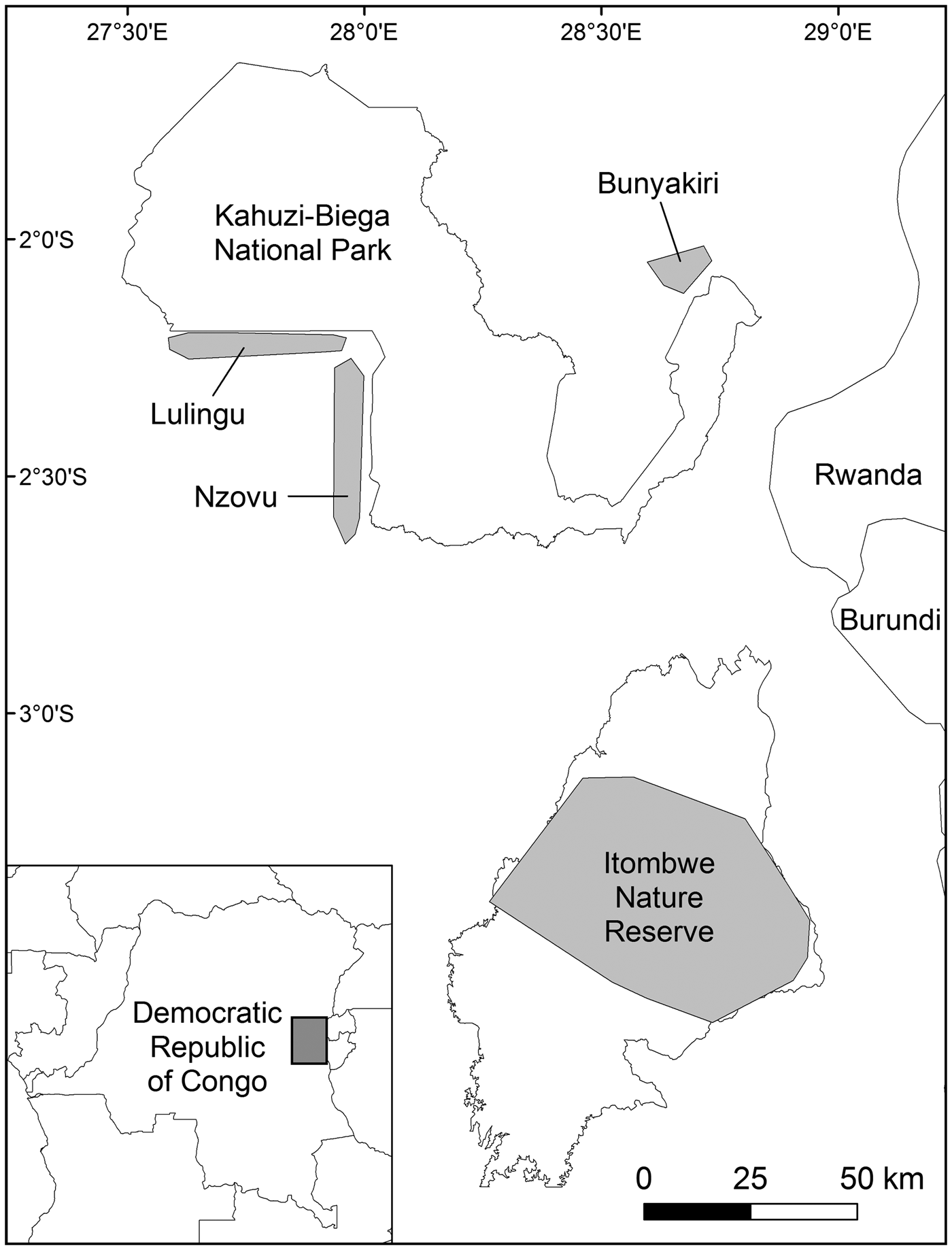
Kahuzi–Biega National Park, a World Heritage Site, is not only the most important protected area for the conservation of the endemic Grauer's gorilla but also harbours other threatened species, including forest elephants Loxodonta cyclotis, eastern chimpanzees Pan troglodytes schweinfurthii and many others that are endemic to the Albertine Rift (Plumptre et al., Reference Plumptre, Davenport, Behangana, Kityo, Eilu and Ssegawa2007). The Park was first gazetted in 1970 and was extended to 6,700 km2 in 1975. The Itombwe Nature Reserve, located south-east of the Park in the Itombwe Massif, is a crucial site for biodiversity conservation, with high numbers of endemic and threatened species (65 and 30 known species, respectively; Ilambu et al., Reference Ilambu, Hart, Butynski, Birhashirwa, Upoki and M'Keyo1999; Plumptre et al., Reference Plumptre, Davenport, Behangana, Kityo, Eilu and Ssegawa2007, Reference Plumptre, Ayebare, Segan, Kujirakwinja, Mugabe and Kirunda2014, Reference Plumptre, Nixon, Critchlow, Vieilledent, Nishuli and Kirkby2015). These two protected areas lie within the Albertine Rift region, the most biodiverse region in Africa (Plumptre et al., Reference Plumptre, Davenport, Behangana, Kityo, Eilu and Ssegawa2007). They are located in South Kivu province and include areas managed by traditional chiefs and various administrative sectors. There are human settlements around or within the boundaries of both protected areas. We surveyed four areas (groupements, local geographical entities that encompass several villages) in the region: Lulingu, Nzovu and Bunyakiri around Kahuzi–Biega National Park, and Itombwe within the Itombwe Nature Reserve (Fig. 1).
Location of four groupements around Kahuzi–Biega National Park and Itombwe Nature Reserve in eastern Democratic Republic of Congo where interview surveys were conducted.
Methods
Data were collected during September–November 2014 through interviews with community members who were directly involved in mining (i.e. miners), in the mining supply chain (e.g. mineral traders) or indirectly involved by being present at mining camps (e.g. miners' families, individuals running small businesses). We conducted semi-structured interviews that covered characteristics of mine sites, mineral value chains, the demography of miners, motivations for mining, revenues earned from mining, livelihoods, bushmeat hunting and consumption, and perceptions of changes in wildlife populations. With the exception of four mines, we were unable to interview individuals directly at the mine sites because of insecurity and the presence of armed groups (Cuvelier, Reference Cuvelier2010). Instead, the surveys were conducted in 147 villages near to mine sites. Upon arriving at a village, interviewers met with local leaders to inform them about the study. Snowball sampling techniques were used to identify individuals who conducted mining and were knowledgeable about the sector (Newing et al., Reference Newing, Eagle, Puri and Watson2011). As part of the snowballing process an initial contact was made with a key informant to develop a list of potential respondents (Goodman, Reference Goodman1961). This process was repeated with each respondent until as many respondents as possible were interviewed within the time available. Surveys were conducted in Swahili by trained local researchers and trained students from regional universities. The questionnaire was divided into two parts, the first focusing on mining and the second on bushmeat hunting. Sample sizes differ between the two parts of the questionnaire because a number of respondents felt comfortable discussing bushmeat hunting but not mining, and were unwilling to take the first part of the questionnaire. The section on mining was administered to 613 respondents, with 42% of interviews conducted in Itombwe (n = 256), 33% in Lulingu (n = 200), 16% in Nzovu (n = 101) and 9% in Bunyakiri (n = 56). Of the 613 respondents, 80% were active miners and 20% were not involved in mining but lived in the villages where interviews took place. The section on bushmeat hunting was administered to 727 respondents, with 35% of interviews conducted in Itombwe (n = 254), 29% in Bunyakiri (n = 212), 20% in Lulingu (n = 145) and 16% in Nzovu (n = 116). The data were analysed using R v. 3.1.2 (R Development Core Team, 2014). All statistical tests were considered significant at P = 0.05. Mineral values at various stages in the supply chain were compared based on local selling prices reported by respondents, and the global market price in March 2015 (InfoMine, 2015).
Results
Characteristics of mine sites
The most exploited minerals included cassiterite (65% of responses), gold (21%), coltan (16%) and wolframite (16%). All four were exploited in 24% of the sites. Wolframite was reported to be extracted in mine sites in Bunyakiri only. Miners in Lulingu and Nzovu exploited cassiterite significantly more than other minerals, whereas miners in Itombwe predominantly extracted gold and cassiterite (Fisher's exact test: P < 0.001).
Mining sites were defined as distinct areas where mining was taking place, without linkages to other mining areas. Excavation areas in mining sites (n = 39) ranged from < 2.5 km2 to > 40 km2 (Table 1) and mine sites in Itombwe were significantly larger than in other groupements (≥ 40 km2 on average; χ 2 test: χ 2 = 169.4, df = 12, P < 0.001). Most sites had been active for c. 20 years, ranging from < 1 year to > 80 years of activity (Fig. 2a), and were reported to employ a mean of 60 mine workers per site (Fig. 2b). The mining sites in Lulingu had been active for significantly longer (41 years, on average) than those in other groupements (Kruskal–Wallis rank sum test: H = 160, df = 3, P < 0.001).
Characteristics of mine sites (n = 39), based on 445 responses from interviews conducted in four groupements around Kahuzi–Biega National Park and Itombwe Nature Reserve (Fig. 1). (a) Number of years mine sites had been active; (b) number of mine workers per site. The filled circles indicate the mean values.

Sizes of the mine sites where survey respondents reported they had worked.

Seventy-five percent of the individuals surveyed stated that they were working at mines that had no legal authorization from a government agent. Mining sites that had authorization involved multiple certifiers, mostly agents and individuals. Agent certifiers were generally individuals with some sort of mandate (legal or illegal), who then leased the site to others for exploitation.
Value chain
The price of minerals varies depending on where in the supply chain they are sold, with the lowest reported prices found at mine sites (Table 2). Differences between prices at mine sites and global market prices were greatest for coltan (USD 158 per kg) and least for gold (USD 3.4 per g). Most miners sold their minerals at the mine site (64.5%) and at villages nearby (20.5%); others took the minerals as far as Bukavu and Goma cities (15%), where they could get better prices for gold.
Mean sale price of cassiterite, coltan and gold at various points along the value chain. Blank cells indicate no data.

* InfoMine (2015)
Demography of miners
Nearly all respondents were men (99%), aged 26–45 and married, with either a secondary (51%) or primary education (33%), and had families of 6–10 individuals. Among the interviewees, 80% were directly involved in mining (74% miners, n = 397; 6% mineral traders, n = 30). The others were farmers (9%), hunters (4%), teachers (3%) and nurses, taxi drivers, retailers and park rangers (1% each). All the park rangers surveyed (n = 6) were engaged in small businesses in mine sites in Lulingu and Nzovu, around Kahuzi–Biega National Park. One of them also admitted to being a hunter. Although not quantified in this survey, women and children were present at mine sites but were involved in other activities besides mining, including household activities and food preparation.
Motivations for working in mines
The main reasons miners had left their previous occupations were to support their families, for personal survival (i.e. to earn enough money to meet their most basic needs) or for direct economic gain. Some of the miners surveyed were students who had dropped out of school and joined mines to earn money to continue their education (14%). Notably, 3% of the respondents (n = 17) were ex-rangers from Kahuzi–Biega National Park, most of whom became miners (n = 10), traders (n = 3), farmers or hunters (n = 2 each). Significantly more individuals chose to exploit minerals as an additional livelihood to support their family (42%), with a minority reporting being motivated by personal gain (20%; χ 2 test: χ 2 = 113, df = 4, P < 0.001).
Most miners reported that they spent < 6 months at a site before moving to another (54%, n = 275), whereas 15% (n = 74) said that they usually spent > 6 months and up to 2 years at a site. The remaining 31% (n = 159) reported that they worked at a site for < 1 month before moving. This is because many mining sites start off as prospecting sites and develop if minerals are found or continue to be found but are otherwise abandoned.
Individuals that considered leaving the mining sector (64% of interviewees) indicated that they would support themselves through small businesses (39%), livestock rearing (28%) and agriculture (14%), but 15% declared that they would have no way of supporting themselves. Among the four groupements surveyed, Bunyakiri had the highest proportion of miners who considered leaving the mining sector (80%) and Itombwe had the lowest, although the majority of miners there would still prefer to leave mining (57%; χ 2 test: χ 2 = 13.6, df = 3, P = 0.004). Respondents’ motivations to leave the sector were similar to those that brought them there, including finding an alternative activity that provided better benefits for them and their families. Many miners were motivated to leave because of the risks and difficulty of the work involved. Reported risks included landslides (87%), wounds sustained from mining activities (10%), and fatalities from fights at the mine sites, including over mineral finds (3%).
Miners’ revenues and livelihoods
On average, miners earned significantly higher monthly revenues than non-miners (Wilcoxon rank sum test: W = 5,283, P < 0.001). The mean reported revenue for a miner was c. USD 116 per month, with some individuals earning up to c. USD 1,000 per month, whereas the mean reported revenue for a non-miner was USD 62 per month. Individuals who controlled mine sites and collected taxes from other miners earned the most, and these individuals often belonged to, or had strong connections to, the military or militia.
Approximately half (52%) of the miners interviewed conducted additional economic activities along with mining, including small business enterprises (80%), hunting (68%) and agriculture (10%). When miners were asked which livelihood activity their family was most dependent on, 72% stated mining, whereas 13% relied primarily on agriculture, 13% on commerce and 2% on hunting.
Bushmeat hunting methods
Of the 727 individuals surveyed, 57% stated that bushmeat hunting occurred at the mine sites. Individuals who were involved in hunting included hunters (35%), miners (14%), local militia/military (5%) and other members of the local population (2%). However, a large proportion of respondents (44%) were not willing to say who hunts, highlighting the sensitivity of talking about the people involved in bushmeat hunting, because of the illegality of the activity. It is likely that the actual number of hunters was higher than reported. Respondents were asked whether hunting took place in the Park/reserve, in farms, in forest neighbouring the village, or in abandoned farms. Many stated that hunting took place both outside (47% of responses) and inside protected areas (41%); others were not sure or were not comfortable stating where it occurred (12%). Hunting was reported to be conducted all year round, mainly using dogs, followed by firearms, spears, snares (nylon and metallic) and nets.
Motivations for hunting
Half of respondents stated they knew of miners who were involved in hunting. The main motivations for hunting were for both personal consumption and the bushmeat trade (49%), and for personal consumption only (31%). A minority of respondents (4%) stated that they hunted only to sell. Motivations for hunting differed significantly between groupements: in Bunyakiri personal consumption was the only reported motivation, whereas in Itombwe, Nzovu and Lulingu consumption and sale were more commonly reported (Fisher's exact test: P < 0.001).
The main motivation to consume bushmeat rather than domestic alternatives was its availability (68%), followed by taste (57%) and cost (23%). Motivations differed significantly between the groupements: respondents in Itombwe and Lulingu mostly consumed bushmeat because of its availability, whereas respondents in Bunyakiri mainly consumed because of taste preferences, and in Nzovu mostly because it was cheaper than domestic meat (χ 2 test: χ 2 = 246, df = 6, P < 0.001).
When miners were asked what would make them stop hunting, responses included having a secure income (e.g. from business), having their own livestock or practising aquaculture as a source of income and protein, greater availability of domestic meat, and enforcement of regulations (e.g. banning of firearms and the sale of bushmeat; Fig. 3). Some individuals (26%) stated that they would not stop hunting as it was part of their culture. Responses differed significantly between the groupements: in Bunyakiri, Lulingu and Nzovu respondents were most likely to stop hunting if they had their own livestock to provide a source of meat and revenue, whereas those in Itombwe indicated they would be more inclined to stop if regulations against hunting were enforced or if other meat sources were available (Fisher's exact test: P < 0.001). The proportions of respondents who were not willing to stop hunting were highest in villages in Bunyakiri and Itombwe (44 and 27%, respectively).
Interviewees’ responses when asked what would make them hunt less often or stop hunting.

Species exploited
Most hunting appeared to be opportunistic and indiscriminate. Targeted species included porcupines Atherurus africanus, the Gambian rat Cricetomys gambianus, duikers Cephalophus spp., and smaller primate species. Chimpanzees appeared to be the main threatened species hunted at mine sites, in particular in Bunyakiri (6% of responses) and in Itombwe (5%). Many respondents (68%) reported that some species that were previously present around mine sites were no longer found there, including gorillas (34%), chimpanzees (30%), elephants (27%), other primate species (15%), and buffalos Syncerus caffer (7%). No time scale was mentioned, and as many miners had only been around the mine site for a short period of time, this can be taken as anecdotal evidence only. The main causes for the disappearance of these species were believed to be hunting driven by the demand for bushmeat (38%), loss of habitat (16%), hunting with guns (3%), and other human activities (2%). When asked whether great apes still existed near the mine sites, 26% of respondents stated that they did (65% mentioned chimpanzees and 35% gorillas), despite the large perceived effect that hunting has had on great apes.
Twenty-four percent of respondents reported using wildlife for medicinal purposes, the most exploited species being porcupines (against intestinal worms and blood loss), tortoise species (blood loss) and Gambian rats (stomach pain and kwashiorkor, a form of severe malnutrition), followed by snakes (rheumatism and blood loss), pangolins Manis spp. (blood loss), chimpanzees (kwashiorkor and poison antidote), buffalos (skin illnesses and ring worm), caracals Caracal caracal (skin illnesses and poison antidote) and moles (scabies).
Discussion
Our findings confirm the ongoing presence of mining in the region, both within and around protected areas. Other studies have shown that artisanal and small-scale mining sustains large numbers of people who are exploiting cassiterite, gold, coltan and wolframite, largely illegally, with most mines being controlled by armed groups (Matthysen & Montejano, Reference Matthysen and Montejano2013).
Our findings indicate that the price of coltan around Kahuzi–Biega National Park has increased since D'Souza's (Reference D'Souza2003) study, from USD 10–15 per kg to c. USD 20 per kg. Our results are consistent with those of other studies from North and South Kivu provinces, which found that artisanal mining could provide an individual worker with USD 80–150 per month; this explains the attractiveness of mining compared to other livelihoods, given that the national mean income is USD 2–2.5 per day and 80% of the population relies on a daily income of < USD 1 (Kitula, Reference Kitula2006; Bryceson & Jønsson, Reference Bryceson and Jønsson2010; Hilson, Reference Hilson2010; Perks, Reference Perks2011; Global Witness, 2012; Hoedoafia et al., Reference Hoedoafia, Cheabu and Korang2014). Differences in global and local market prices between gold and coltan are related to their value chains and to the global demand: coltan is taxed more than gold along its transport from mine sites to processing sites, and the international demand for coltan is higher, driven by the technology industry (D'Souza, Reference D'Souza2003; World Bank, 2008; de Koning, Reference de Koning2011). Our demographic results further support trends found across the region, showing that mining attracts people from various professional and social classes and drives people's movements to some extent as they move to mine sites (D'Souza, Reference D'Souza2003; Hilson, Reference Hilson2009; Jønsson & Bryceson, Reference Jønsson and Bryceson2009; Perks, Reference Perks2011). Further research is needed to provide a better understanding of these migrations. The results also suggest that mining is an opportunistic occupation, as found in other studies, in which miners in the region were found to be seasonal and mobile workers with multiple livelihood activities (D'Souza, Reference D'Souza2003; Kitula, Reference Kitula2006; Jønsson & Bryceson, Reference Jønsson and Bryceson2009; Kwai & Hilson, Reference Kwai and Hilson2010; Global Witness, 2012). Those who conduct other livelihood activities in addition to mining are likely to invest some of their earnings from mining in those livelihood activities. Providing alternative, sustainable sources of income to communities in villages around the protected areas, or within the Reserve in the case of Itombwe, could therefore incentivize people to refrain from engaging in mining activities. As most miners do not perceive mining as a long-term livelihood, it is necessary to find ways to support miners to engage in other, more stable livelihood activities (Jønsson & Bryceson, Reference Jønsson and Bryceson2009; Kwai & Hilson, Reference Kwai and Hilson2010), while addressing the economic or safety-related barriers that prevent miners from leaving the sector (D'Souza, Reference D'Souza2003).
The debate over conflict minerals in the Democratic Republic of Congo has been widely reported, and it has been acknowledged that the abolition of artisanal mining would result in the loss of livelihoods of millions of small-scale miners, while fuelling conflict as armed groups battle to retain the resource for revenue (D'Souza, Reference D'Souza2003; Cuvelier, Reference Cuvelier2010; Ingram et al., Reference Ingram, Tieguhong, Schure, Nkamgnia and Tadjuidje2011; de Koning, Reference de Koning2011; Matthysen & Montejano, Reference Matthysen and Montejano2013; Geenen, Reference Geenen2014). The ultimate aim is for mining in the eastern Democratic Republic of Congo to be conflict and bushmeat free, following an equitable rule of law, with the elimination of human rights abuses, respect for indigenous rights and land rights, and without damage to the environment and biodiversity (de Koning, Reference de Koning2011; Dranginis, Reference Dranginis2014). To begin working towards this, there is a need to demilitarize mine sites (de Koning, Reference de Koning2010, Reference de Koning2011; Matthysen & Montejano, Reference Matthysen and Montejano2013), and this will require the involvement of the Congolese government, civilian authorities, peacekeeping troops, the private sector and international donors to succeed in the long term (Global Witness, 2011). Subsequent steps would include improving governance while closing gaps in infrastructure, rule of law and practice (IPIS, 2012; Dranginis, Reference Dranginis2014; Geenen, Reference Geenen2014).
Given the linkages we have shown between artisanal mining and bushmeat hunting in protected areas in the eastern Democratic Republic of Congo, of which the negative impacts on great ape species are known (Plumptre et al., Reference Plumptre, Nixon, Critchlow, Vieilledent, Nishuli and Kirkby2015), there is an urgent need to reduce people's reliance on mining, address the root drivers of bushmeat hunting and work towards the demilitarization of mine sites to facilitate enforcement of environmental laws within protected areas.
Recommendations for conservation
If the impacts of artisanal and small-scale mining on species of conservation concern are to be minimized then certain threats related to mining need to be addressed. We make the following recommendations:
(1) Our results show that bushmeat hunting to supply meat to mining sites is widespread, and therefore conservation initiatives are needed to reduce bushmeat hunting in mining areas through providing a sustainable meat supply. We found significant differences between groupements in motivations for hunting and preferences for bushmeat vs domestic meat, and therefore interventions should be designed at this level if they are to address the root drivers of bushmeat hunting. The different motivations for hunting between the groupements may be explained by differences in access to markets: in more isolated areas people are likely to hunt bushmeat for supply to mining sites rather than for their own consumption only. In cases where hunting is mainly for personal consumption, motivated by a preference for the taste of bushmeat, alternative meats would have to be cheaper than bushmeat to encourage a change in consumption behaviour (Wilkie & Carpenter, Reference Wilkie and Carpenter1999). Further studies should be conducted in Itombwe and Lulingu, where the likelihood of people stopping hunting was highest, to ensure the drivers of bushmeat hunting are well understood and can be addressed effectively, while taking into account the people who would not stop hunting because of taste and cultural preferences (Wilkie & Carpenter, Reference Wilkie and Carpenter1999).
(2) Most of the miners interviewed indicated they would be willing to leave the mining sector if they could find alternative sources of revenue, and therefore we recommend establishing micro-financing mechanisms to help those who are interested in leaving the sector to engage in profitable income-generating activities, by contributing to start-up costs, while supporting individuals in times of need (Perks, Reference Perks2011). Micro-credit schemes have been implemented by the Wildlife Conservation Society and the Institut Congolais pour la Conservation de la Nature in some communities around Kahuzi–Biega National Park, giving credit recipients opportunities to engage in sustainable livelihoods, including livestock raising, and thus reducing pressures on the Park's natural resources (Hammill et al., Reference Hammill, Matthew and McCarter2008). One way this has been implemented effectively is through establishing community cooperatives, which strengthen the coordination and management of community initiatives by creating a platform through which livelihood interventions can be conducted. There is a need to scale up these interventions to the lowland areas of the Park and also around the Itombwe Nature Reserve.
(3) We found that most mines were controlled by armed groups, and therefore we suggest there is a need for increased governmental support for the demilitarization of mines by removing and prosecuting rebel groups and Congolese military units engaged in illegal activities in mining areas (de Koning, Reference de Koning2010; Global Witness, 2011), particularly those that are located within and around protected areas. Without political support for negotiating with rebel factions to give up their weapons, military units, including peacekeeping troops, would need to intervene to disarm them (Global Witness, 2011). The demilitarization of mine sites would improve security and facilitate patrols by protected area rangers to enforce conservation laws and reduce illegal activities in the protected areas.
Since the research was conducted, the Wildlife Conservation Society has launched a micro-credit project in five sites located close to mining areas around Kahuzi–Biega National Park, aimed at providing beneficiaries with the means to engage in sustainable livelihoods while increasing the availability of domestic meat. Upon receiving micro-credit, project beneficiaries are presented with several livelihood options, including guinea-pig production, which has been used extensively in the region to improve food security (Maass et al., Reference Maass, Metre, Tsongo, Mugisho, Kampemba and Ayagirwe2014) and reduce the reliance on bushmeat. With appropriate scaling up, improved access to inexpensive domestic meat will extend beyond the household level to mine sites. A monitoring and evaluation plan has been developed and will be used throughout the project to ensure that it achieves its intended objectives of reducing bushmeat hunting and consumption in mine sites around protected areas. In 2016 the Wildlife Conservation Society began working with the mining sector to determine how to engage governmental actors in the region to remove armed groups and military units from mining sites. We believe this set of actions will reduce the impact of artisanal and small-scale mining on wildlife around protected areas in the region, and serve as a model for similar conservation efforts elsewhere.
Acknowledgements
We thank the Arcus Foundation, the Jane Goodall Institute, the U.S. Agency for International Development, and the Critical Ecosystem Partnership Fund for funding; Alain Twendilonge (Wildlife Conservation Society) for supervising the field interviews; and the following university students who helped with data collection in difficult conditions: Blandine Bishengezi, Précieux Thamani Mwaka, Bienfait Kulondwa Kabalama, Césaire Ubambo Munazi, Clément Imani Mushagalusa, Fiston Nshokano Zagabe (Institut Supérieur De Développement Rural), Justin Cubaka Biringanine (Université Officielle de Bukavu), Simon Kibonge (Maddison International University), Butoto Imani Wa Rusaati (Université de Kinshasa) and Asesa Lusamya (Université Libre des Grands Lacs).
Author contributions
DK designed the study, trained data collectors and organized the data collection and entry. AK cleaned the data and conducted preliminary analysis and writing. CS analysed the data and led the publication of the article. AJP raised funding for the study and contributed to the data analyses. All authors contributed to the writing of the article.
Biographical sketches
Charlotte Spira has been conducting applied conservation research in East and Central Africa since 2013. Andrew Kirkby has been managing The Wildlife Conservation Society's Grauer's Gorilla Conservation Project in Kahuzi–Biega National Park and adjacent reserves since 2014. Deo Kujirakwinja was Director of the Wildlife Conservation Society's Eastern Democratic Republic of Congo Program at the time of the study; he is now conducting doctoral research at the University of Rhodes, South Africa. Andrew Plumptre has been Director of the Wildlife Conservation Society's Albertine Rift Program since 2000.



