





Introduction
Phenology is the timing of recurring events in organismal life cycles. Phenological traits in plants include time of emergence, flowering, and senescence. The practical applications of studying plant phenology have long been recognized by agricultural scientists (Chmielewski Reference Chmielewski and Schwartz2013; Huberman Reference Huberman1941), and a growing number of studies in recent decades have focused on documenting phenological shifts in response to anthropogenic climate change (Forrest and Miller-Rushing Reference Forrest and Miller-Rushing2010). Such shifts often serve as crucial mechanisms by which plants become or remain well-adapted to their environments. Plants may plastically adjust their phenology in response to environmental cues received during their own (within-generation plasticity) or their parents’ (transgenerational plasticity) lifetimes (Auge et al. Reference Auge, Leverett, Edwards and Donohue2017). In addition, plant populations may evolve in response to selection on phenological traits (Donohue et al. Reference Donohue, Rubio De Casas, Burghardt, Kovach and Willis2010; e.g., Hall and Willis Reference Hall and Willis2006).
While incremental changes in plant phenology have been widely studied, categorical changes in life-cycle type have received less attention. Plants are typically classified as annuals if they complete their life cycles in 1 yr, biennials if they complete their life cycles in 2 yr, or perennials if they complete their life cycles in more than 2 yr. Annual plants can be further subdivided into summer annuals, which emerge in spring and reproduce by fall; and winter annuals, which emerge in fall, overwinter as a rosette, and reproduce from spring to summer. Facultative winter annuals can adopt either a winter or summer annual life cycle in response to different environmental conditions at the level of the population via evolution (Bloomer and Dean Reference Bloomer and Dean2017; Charbonneau et al. Reference Charbonneau, Tack, Lale, Goldston, Caple, Conner, Barazani, Ziffer-Berger, Dworkin and Conner2018; Meyer et al. Reference Meyer, Nelson and Carlson2004) and at the level of the individual via plasticity (Lu et al. Reference Lu, Tan, Baskin and Baskin2014; Sans and Masalles Reference Sans and Masalles1994). Both mechanisms often co-occur (Best and Mc Intyre Reference Best and Mc Intyre1976; Garrison et al. Reference Garrison, Norwood and Conner2024; Landers Reference Landers1995). Furthermore, nongenetic inheritance (i.e., parental effects) may also play a role in determining offspring life-cycle type (Kanomanyanga et al. Reference Kanomanyanga, Cussans, Moss, Ober, Liu and Coutts2025; Lu et al. Reference Lu, Tan, Baskin and Baskin2016; Mennan and Ngouajio Reference Mennan and Ngouajio2006). The effects of all of these factors on life-cycle differentiation are rarely studied together, making it difficult to compare their importance or look for interactions between genes and environment.
A promising proximal mechanism by which environmental or genetic variation influences life-cycle differentiation is through changes in levels of the plant growth hormone gibberellic acid (GA). Biosynthesis of GA generally increases in environmental conditions promoting growth (including shade avoidance) and decreases in stressful conditions such as freezing and drought (Colebrook et al. Reference Colebrook, Thomas, Phillips and Hedden2014). This hormone has been found to play a key role in germination, stem elongation, and flowering initiation (reviewed in Gupta and Chakrabarty [Reference Gupta and Chakrabarty2013] and Shah et al. [Reference Shah, Islam, Mohammad and Siddiqui2023]), which are all important parts of life-cycle differentiation. Exogenous GA application has been found to override normal photoperiod or temperature requirements for flowering in at least 42 species of rosette-forming summer annual, winter annual, biennial, and perennial plants (reviewed in Lang and Reinhard [Reference Lang, Reinhard and Gould1961] and Zeevaart [Reference Zeevaart1983]). One study showed that the exogenous application of GA accelerated the flowering of winter annual, but not summer annual ecotypes of wild radish (Raphanus raphanistrum L.), suggesting GA upregulation as a mechanism of evolved rapid summer annual flowering (Garrison Reference Garrison2022). Further, florist’s daisy (Chrysanthemum × morifolium Ramat.) summer-flowering mutants were found to have higher endogenous levels of GA than normal fall-flowering plants (Dong et al. Reference Dong, Deng, Wang, Gao, Stephen, Chen, Jiang and Chen2017).
In most previously studied facultative winter annual species, dormancy cycling plays an important role in shaping plant life cycles (Baskin et al. Reference Baskin, Chesson and Baskin1993; Burghardt et al. Reference Burghardt, Metcalf, Wilczek, Schmitt and Donohue2015; Footitt et al. Reference Footitt, Huang, Clay, Mead and Finch-Savage2013; Holloway et al. Reference Holloway, Pérez, Venceslai, Seville, Stock, Nakabayashi and Leubner-Metzger2025). In these systems, the timing of seed maturation and/or dispersal influences the dormancy state of seeds and thus their ability to germinate in different seasons. Other facultative winter annual species are not known to exhibit dormancy, and the mechanisms shaping life-cycle variation in these species are less clear. One prior study investigated this question using Canadian horseweed [Erigeron canadensis L.; syn.: Conyza canadensis (L.) Cronquist], subjecting seeds to various environmental conditions in the growth chamber (Schramski et al. Reference Schramski, Sprague and Patterson2021). The results suggested that winter versus summer annual life-cycle differentiation can be explained as a plastic response to seed vernalization (Schramski et al. Reference Schramski, Sprague and Patterson2021), where imbibed seeds are exposed to cold conditions that simulate winter, similar to seed stratification but used to accelerate flowering rather than break dormancy (Michaels and Amasino Reference Michaels and Amasino2000). Despite this compelling finding, it is limited by having few populations, few individuals per population, and only one parental environment, meaning that possible contributions of genetic and parental effects to the response remain unclear.
The present study builds on prior work in E. canadensis, using greenhouse and growth chamber experiments to test the following hypotheses and predictions: (1) We hypothesized that life-cycle type differentiation in E. canadensis is primarily plastic based on Schramski et al.’s (Reference Schramski, Sprague and Patterson2021) consistent results among their two collection sites, and thus we expected to find little variation explained among or within populations. (2) We hypothesized that plastic growth type differentiation could be explained by a combination of (a) parent life-cycle type and (b) the temperature seeds are exposed to before germination Specifically, we predicted that summer annual characteristics would be greatest in offspring of winter annual parents and seeds exposed to winter-mimicking seed conditions. (3) We hypothesized that the effects of seed vernalization are at least partially mediated by increased levels of GA. Based on this, we first predicted that plants treated with GA would be more likely to show summer annual characteristics. We then predicted that exogenous GA would have little effect on seed-vernalized plants if vernalization increases endogenous GA levels and, conversely, that seed vernalization would have little effect on plants receiving exogenous GA. Overall, our study aims to provide a more complete picture of the factors that influence variation in E. canadensis life-cycle type, serving as a useful case study for future studies of life-cycle types in other species and providing insight for managers of this harmful agricultural weed.
Materials and Methods
Study System
Erigeron canadensis is a weedy annual plant in the Asteraceae family that is native to Central and North America (Weaver Reference Weaver2001). It now commonly infests agricultural fields and disturbed habitats in temperate zones across the world. Erigeron canadensis plants release pollen before the flowers fully open, leading to high rates of self-fertilization (estimated at 96%; Smisek Reference Smisek1995). Seeds are wind dispersed and have been classified as nondormant or weakly dormant at most (Baskin and Baskin Reference Baskin and Baskin1988; Buhler and Owen Reference Buhler and Owen1997; Karlsson and Milberg Reference Karlsson and Milberg2007). It is considered a facultative winter annual because it can adopt a winter annual or summer annual life cycle. While there seem to be peaks of emergence in the fall and spring, the species has wide emergence and flowering windows (Main et al. Reference Main, Steckel, Hayes and Mueller2006; Tozzi et al. Reference Tozzi, Beckie, Weiss, Gonzalez-Andujar, Storkey, Cici and Van Acker2014). Plants classified as winter annuals generally form a low to the ground rosette for overwintering, whereas those classified as summer annuals skip the rosette stage by immediately growing upright. However, there is continuous variation in the degree to which plants form a rosette, and the life-cycle types are not morphologically distinguishable at flowering, as any rosette leaves have senesced by this point. Highly contrasting proportional spring versus fall emergence has been reported from nearby sites (Main et al. Reference Main, Steckel, Hayes and Mueller2006), and there does not appear to be a clear latitudinal pattern in life-cycle proportions (e.g., 4% to 24% summer annuals at 36°N [Main et al. Reference Main, Steckel, Hayes and Mueller2006]; 92% to 100% at 39°N [Davis and Johnson Reference Davis and Johnson2008]; 38% to 32% at 45°N [Buhler and Owen Reference Buhler and Owen1997]). However, these studies demonstrated that the two life-cycle types usually co-occur in the same field. There are also observational reports that the summer annual life cycle is becoming more common in Michigan (Schramski et al. Reference Schramski, Sprague and Patterson2021).
The 2021 Field Collections and 2022 Greenhouse Common Garden
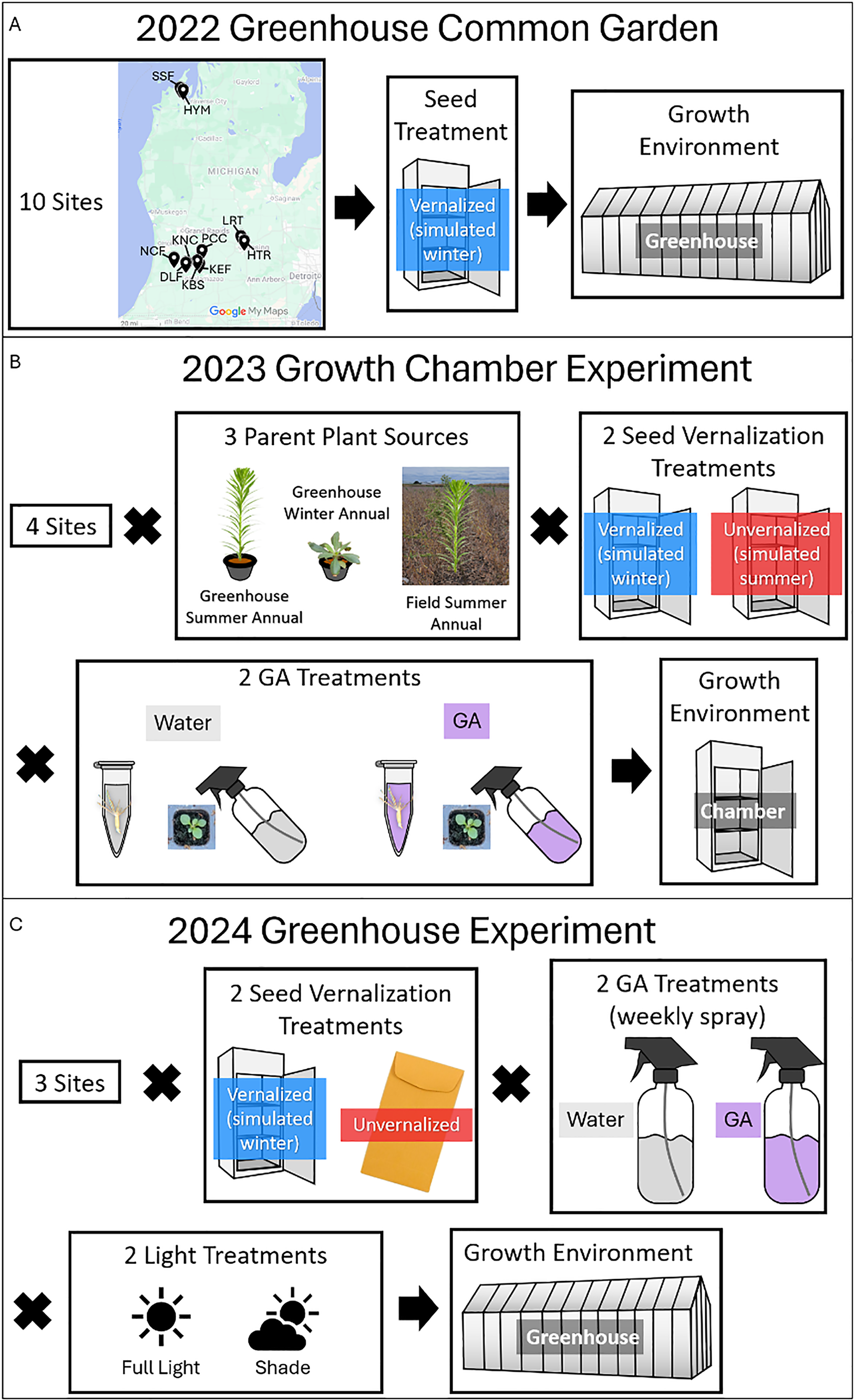
We conducted this experiment to look for genetic differentiation among populations in life-cycle traits in common environmental conditions, not to test the effects of vernalization and GA (Figure 1A). In the fall of 2021, seeds were collected from 30 individuals from each of 10 sites (except for site KNC with just 23), spread across Michigan’s Lower Peninsula (see Figure 1A and Supplementary Table S1 for site details). Sites were chosen to capture a range of habitats inhabited by E. canadensis, with half collected from actively cultivated crop fields and half from uncultivated areas like edges of forests and sidewalks. Sites varied in light, moisture, and soil nutrient measurements (Supplementary Figure S1). These 293 field parents were presumed summer annuals given their seed production in fall. The seeds produced by a given parent plant are likely highly homozygous, so we refer to them as lines. Given that E. canadensis seeds do not require stratification, seeds were stored in envelopes with desiccant at 5 C until used to prolong seed life. Our experimental unit was collection site, so our design included one replicate from all available lines per site rather than replicating at the level of the line. In May 2022, approximately 50 seeds per line were sown in randomized positions across two 200-cell plug trays and immediately vernalized in the same growth chamber set to 4 C and 8-h daylength for 3 wk (based on Schramski et al. Reference Schramski, Sprague and Patterson2021). Halfway through the vernalization period, tray positions were swapped with each other to reduce any effects of microenvironmental variation in the growth chamber. Trays were then moved to a greenhouse at the Kellogg Biological Station (Hickory Corners, MI). Cells were thinned to up to five seedlings and transplanted at the first true leaf stage together into 16.5-cm-diameter pots filled with SureMix potting soil (Michigan Grower Products, Galesburg, MI). Pots were placed in randomized positions in the greenhouse and thinned to one plant when leaves started to substantially overlap, with 240 of 293 sown lines producing a surviving plant (18 to 28 from each of 10 sites). These 240 plants were assigned to one of three categorical growth types based on visual assessment by the same observer about 1 wk after emergence and updated about 9 wk after emergence (as in Schramski et al. Reference Schramski, Sprague and Patterson2021). “Rosette” types had a basal circular arrangement of dark green, round leaves; “Upright” types had lighter and more elongated leaves arranged along a visible stem (i.e., caulescent); “Intermediate” types fell somewhere between the Rosette and Upright types in their characteristics. Plants that had not bolted by the end of August (about 11 wk since movement to greenhouse) were vernalized for 35 d in a growth chamber in the same conditions as those used for seed vernalization. All of these plants had been categorized as either Rosette (94%) or Intermediate types (6%). A thiophanate-methyl fungicide soak (3336® EG at 1.2 kg m−3, BFG Supply, Grand Rapids, MI, USA) was applied to the rosette-vernalized plants to prevent the spread of fungal root rot, which may have been caused by overwatering. Because the fungicide was applied after data collection, and we have not found any known reports linking thiophanate-methyl with plant GA biosynthesis, we do not expect it to influence our results. We also tested initial dormancy levels of seeds from a random subset of 30 of these greenhouse-grown parents with three seeds per parent (total N = 90) by sowing them in petri dishes, monitoring germination for 2 wk, then using a tetrazolium dye assay to assess viability of ungerminated seeds.
Overview of experimental designs for 2022 Greenhouse Common Garden (A), 2023 Growth Chamber Experiment (B), and 2024 Greenhouse Experiment (C).

Figure 1. Long description
Panel A: A flowchart depicting the 2022 Greenhouse Common Garden experiment. It shows 10 sites, seed treatment involving vernalized seeds, and a greenhouse as the growth environment. Panel B: A flowchart illustrating the 2023 Growth Chamber Experiment. It includes 4 sites, 3 parent plant sources (Greenhouse Winter Annual, Greenhouse Summer Annual, and Field Summer Annual), 2 seed vernalization treatments (vernalized and unvernalized), 2 GA treatments (water and GA), and a growth chamber as the growth environment. Panel C: A flowchart describing the 2024 Greenhouse Experiment. It features 3 sites, 2 seed vernalization treatments (vernalized and unvernalized), 2 GA treatments (weekly spray with water and GA), 2 light treatments (full light and shade), and a greenhouse as the growth environment.
The 2023 Growth Chamber Experiment
In this experiment, we tested the effects of seed vernalization and GA treatments, along with the seed source factors of population, line, and parent type (field summer annual, greenhouse summer annual, or greenhouse winter annual) on juvenile plant life-cycle type traits (Figure 1B). Due to the multiple treatments, we could not include seeds from all of the greenhouse common garden lines; instead, we used seeds from 24 of the lines: 6 from each of a subset of 4 of the sites, 2 from cultivated and 2 from uncultivated environments (DLF, KNC, NCF, and PCC; Supplementary Table S1). Because we did not have seeds from the same line exhibiting different life-cycle type within generations, we included offspring of three parent plant groups: 2021 field summer annual, 2022 greenhouse summer annual, and 2022 greenhouse winter annual (those requiring rosette vernalization to flower), with greenhouse-produced seeds briefly stored at room temperature before use. Comparing the latter two groups tests for parental effects of life-cycle type while controlling for other possible parental effects, but not for potential genetic effects due to using different lines in each group. Because the same lines were used in the first and last groups, we could test for parental effects of life-cycle type while controlling for genetic variation, but not for possible parental effects from the field versus greenhouse environment. Eighteen replicate seeds from each of the four sites, three lines, and three parent source types were randomly assigned to one of two vernalization treatments and one of two GA treatments (GA soak and spray vs. water control) in two temporal blocks, initiated 15 d apart (4 sites by 3 parent types by 3 lines by 2 vernalization treatments by 2 GA treatments by 3 individuals by 2 blocks = 864 total). The experimental design was a split-plot with vernalization treatment as the whole-plot unit; GA treatment as the subplot unit; site, parent type, and line fully randomized within subplots; and our two temporal blocks providing replication for the whole plot. A total of 563 seeds emerged and survived until data collection (65%). We also added a GA seed soak–only treatment in Block 1 and a GA spray–only treatment in Block 2 as a preliminary comparison of these two application methods, but these treatments were not replicated due to limited space.
Seeds were soaked in either a GA solution (1 g L−1; Purdom and Glover 2017) or in distilled water for 24 h at room temperature. After the soaking treatments were completed, seeds were sown onto the surface of 200-cell plug trays filled with moistened SureMix potting soil, with one tray per treatment (3 GA treatments by 2 vernalization treatments by 2 blocks = 12 total trays) and randomized positions within trays. Vernalized seeds were placed in a simulated winter growth chamber set to 4 C and 9-h daylength. Unvernalized seeds were placed in a simulated summer chamber set to 24 C and 15-h daylength. Although we expect seeds to primarily emerge in fall or spring in the field, the unvernalized seeds sown in simulated summer conditions readily emerged (Supplementary Figure S2). Surprisingly, some seeds in simulated winter conditions emerged in the cold (Supplementary Figure S2), with about 40% of seeds already emerged by the end of week 3 in Block 1. We ended the vernalization period in Block 2 after only 1 wk, when the same 40% of seeds had emerged, choosing to prioritize replicating the effect of vernalization on plant stage over its absolute time. After their vernalization treatments, both growth chambers were set to 17 C and 12-h daylength to simulate spring/fall equinox conditions (based on local average maximum temperatures and daylengths in mid-fall and mid-spring). At the point of cotyledon emergence, trays were individually removed from chambers, and seedling leaves were sprayed with approximately 0.25 ml of either a GA solution (0.035 g L−1 = 10−4 M; Khan et al. Reference Khan, Masroor and Gautam2006) or distilled water, before being returned to their chambers. Spray treatments were applied to a whole tray (subplot) due to the high chance of spray drifting to adjacent cells.
Pots were censused every day for newly emerging seedlings (final seedling emerged on day 33 in Block 1 and day 18 in Block 2). Seedlings were defined as having emerged once a stem and both cotyledons were visible. After 3 to 5 wk of growth, each individual was assigned a categorical growth type (as in the 2022 greenhouse common garden). Given the relatively continuous range of variation we observed, we complemented the categorical data with quantitative measures of leaf roundness and plant height growth rate, because rosette-forming winter annuals make rounder leaves and remain close to the soil surface before bolting (RW, personal observation). Measurements were taken of plant height, plant diameter, and leaf roundness on the same day by vernalization treatment. Vernalized plants were measured 16 d after unvernalized plants, enabling measurements to be taken after the same mean number of days since emergence in Block 1, but 11 d apart in Block 2 (staggering measurement points could not be done due to logistical constraints). Height was measured with a ruler as the vertical distance between the soil and the last node (meaning that height was close to 0 for a rosette structure). Overhead photographs and manual tracing in ImageJ were used to measure maximum plant diameter and leaf roundness (4 × area/[pi × major axis2], ranging from 0 to 1, with 1 being a perfect circle) on the largest leaf/plant for all plants with at least one clearly visible entire leaf (N = 785). Height growth rate was calculated as height in millimeters per days since emergence (results from alternative calculation as height in millimeters/diameter in millimeters provided in Supplementary Material). Although some plants were measured on different days since emergence, our analyses examine height growth rate rather than absolute height and leaf shape rather than size as quantitative indicators of life-cycle type.
The 2024 Greenhouse Experiment
In this experiment, we tested the effects of seed vernalization and GA along with the seed source factors of population and line on life-cycle traits in plants grown to maturity (Figure 1C). Given the differences between our 2023 experiment and Schramski et al. (Reference Schramski, Sprague and Patterson2021), in this experiment, we sourced seeds from five lines collected in fall 2023 from one of the same fields used in their experiment (MSU Agronomy Farm, Lansing, MI; see “MAF” in Supplementary Table S1) plus two to three lines from each of the two sites from our 2022 greenhouse generation geographically closest to the MSU Agronomy Farm (HTR and LRT). For each selfed line, pots (7-cm diameter) were randomly assigned to one of eight treatment combinations, detailed later, with five seeds per pot acting as subsamples for the experimental unit of pot (2 vernalization treatments by 2 GA treatments by 2 light treatments by 3 sites by 2 to 5 lines by 5 individuals = 400 total seeds). The light treatments were included to increase the generality of the results, but not to test the effects of light, as this treatment was unreplicated. Pots were filled with SureMix potting soil. Of the 400 seeds planted, 26% emerged, and of those that emerged, 46% survived to flower (substantial mortality resulted from fungal root rot), with similar survival rates among GA treatments (44% and 52%) and vernalization treatments (41% and 49%).
For Vernalized pots, soil was soaked and then the five seeds were spread on the surface of the soil. The pots were placed in randomized positions in a growth chamber set to 4 C and 8-h daylength. Pots were checked weekly for any emerging seedlings and to ensure moist soil conditions. After 4 wk, pots were removed from the growth chamber and placed in a greenhouse (Kellogg Biological Station, Hickory Corners, MI). On the same day, Unvernalized seeds were planted in pots following the procedure used for the Vernalized seeds, and pots were placed in the greenhouse. Note that in this experiment, the vernalization control was untreated seeds, because we wanted plants in both treatments to germinate and develop at the same time. Pots were placed on the same greenhouse bench in randomized positions within one of two light treatments: Full Light plants were placed in the open (mimicking spring emergence among sparse vegetation), while Shade pots were placed under a shade tent that reduced photosynthetically active radiation by about 76% (mimicking fall emergence among abundant vegetation). Because the light treatments were not replicated and are thus confounded with greenhouse position, we do not interpret these treatments in our main results, reporting only preliminary observations. Plant leaves were sprayed weekly using a spray bottle from emergence to flowering with approximately 3 ml of either Water (distilled) or GA solution (0.035 g GA3 L−1 distilled water). To minimize GA drift, pots were removed from their positions and sprayed approximately 1 m away from other plants. Drift of GA to water-control pots remains possible, making our report of GA’s effects more conservative. All pots were kept well watered and maintained until all plants had either died or flowered.
Pots were censused every 4 d for newly emerged seedlings for the first 16 d, and every 7 d for the next 7 wk, at which point no further emergence occurred. Plants were also censused weekly for signs of flowering, and plants were marked as having flowered if they contained at least one fully expanded flower. Plant height was measured as the length of the stem from the base of the soil to the last node on days 21, 49, and 64 since planting, along with at the first census in which they flowered. We defined height growth rate as day 64 plant height in millimeters per days since emergence. At 9 wk after planting, plants were assigned a categorical growth type (as in prior experiments), and leaf roundness was estimated from photos of the largest leaf from one plant per line.
Statistical Analyses
All statistical analyses were done in RStudio running R v. 4.4.2 (R Core Team 2024). All plots were made using the package ggplot2 (Wickham Reference Wickham2016), with estimated marginal means generated using the package emmeans (Lenth Reference Lenth2025).
In the 2022 greenhouse common garden, we tested for site differences in life-cycle type (Hypothesis 1) using a generalized linear model with a binomial distribution to model the effects of Environment type (Cultivated vs. Uncultivated) and Site nested within Environment on our binary response variable of life-cycle type based on rosette vernalization requirement for flowering. We used Wald χ2 tests implemented using emmeans to evaluate the significance of the two explanatory variables.
In the 2023 growth chamber experiment, we tested the effects of genetic variation due to source site and genetic line (Hypothesis 1), plasticity to parent type and vernalization treatment (Hypothesis 2), plasticity to GA treatment (Hypothesis 3), and the interaction between vernalization and GA treatment (Hypothesis 3) on plant life-cycle type (measured both categorically and quantitatively) after adjusting for variation due to block and the temperature at which seeds emerged. For our categorical growth type variable, given that the frequency of Intermediate was small and unbalanced, we analyzed two binary growth type variables, either grouping Intermediate with Upright or Rosette. Results for the two grouping methods were quantitatively similar, so we only report the latter grouping. A multivariable logistic regression did not converge due to probabilities of 1 or 0 in some groups, so instead we ran pairwise two-sample Fisher’s exact tests separately by site, vernalization treatment (vernalized vs. unvernalized), parent type (greenhouse winter annual vs. greenhouse summer annual vs. field summer annual), and GA treatment (GA vs. water). For fixed effects with more than two levels, we adjusted P-values for multiple testing using the Benjamini-Hochberg procedure to control the false discovery rate. These tests do not allow us to control for effects of Block (1 vs. 2) or the temperature at which a plant emerged (4 vs. 17 vs. 24 C), but neither variable significantly affected categorical growth type (P > 0.164).
For our 2023 quantitative measures, we used linear mixed-effects models (implemented using lme4; Douglas Bates et al. Reference Bates, Mächler, Bolker and Walker2015) with the response variables of height growth rate (log-transformed to improve normality of residuals) and leaf roundness; the fixed effects of GA treatment, seed vernalization treatment, block, and all two- and three-way interactions plus parent plant type, seed source site, and emergence temperature; and the random effect of selfed line nested within site. We ran a set of similar models using the unreplicated single GA application data, replacing GA treatment with number of GA applications to look for potentially different effects of the GA seed soak versus leaf spray. We tested the significance of our fixed effects using Wald F-tests with Satterthwaite-approximated denominator degrees of freedom (implemented using emmeans), analogous to Type III ANOVA, but more appropriate for models other than ordinary least squares. We used likelihood ratio tests implemented using the package lmerTest (Kuznetsova et al. Reference Kuznetsova, Brockhoff and Christensen2017) to evaluate the significance of our random effect. We also used the package MuMIn (Bartoń Reference Bartoń2025) to calculate marginal and conditional R2 values, where marginal is the variance explained by the fixed effects and conditional is the variance explained by both fixed and random effects (Nakagawa and Schielzeth Reference Nakagawa and Schielzeth2013). The difference between conditional and marginal was used to estimate the additional variance in the response explained by adding the random effect of line (not used for model selection).
We used a similar approach in the 2024 greenhouse experiment to test the same questions as in 2023 with the exception of parent type. Briefly, we used Fisher’s exact tests to look for differences in growth type by vernalization treatment, GA treatment, and source site, along with light treatment/greenhouse position (confounded). We ran linear mixed-effects models with height growth rate, leaf roundness, and days to first flower as our response variables; the fixed effects of GA treatment, seed vernalization treatment, light treatment/position, and all two- and three-way interactions plus seed source site; and the random effect of selfed line nested within site and pot identity (to account for non-independence of individuals within pots). For the leaf roundness model, we removed the three-way interaction, as the model did not converge when it was included, given the reduced sample size from subsampling leaf measurements.
Results and Discussion
Hypothesis 1: Life-Cycle Type Differentiation Is Primarily Plastic Rather Than Genetic
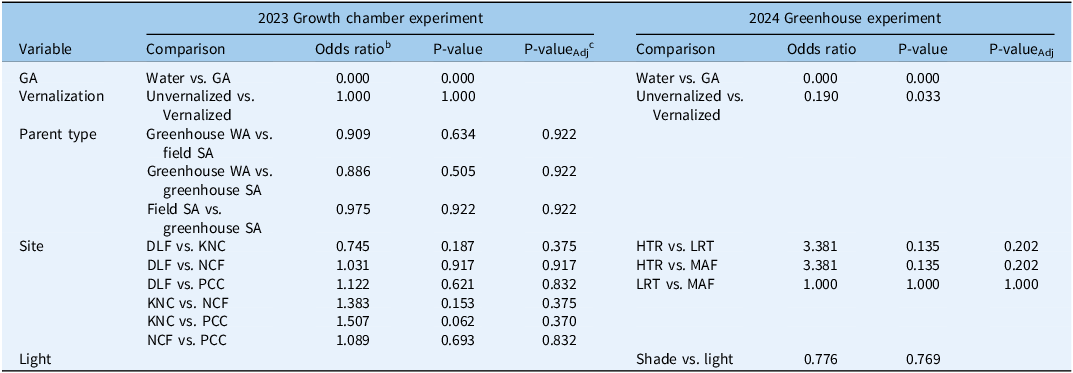
In our 2022 greenhouse common garden, the life-cycle type of plants sourced from field-collected, vernalized seeds varied significantly among 10 collection sites in Michigan, explaining 15% of the deviance in the response from a saturated model (P = 0.0004; Supplementary Figure S3A). When grouping sites into cultivated versus uncultivated environments, we found that plants from cultivated sites had a 26% greater probability of being categorized as summer annuals (P = 0.0005; Supplementary Figure S3A). However, there do not appear to be any patterns with latitude or average winter temperatures (Supplementary Table S1; e.g., lack of similarity between nearby DLF and KNC sites). Because we grew field-collected seeds in a common environment, these differences reflect some combination of evolved genetic differentiation and parental effects. We then grew offspring of these 2022 greenhouse plants alongside offspring of field parents from a subset of four sites in our 2023 growth chamber experiment. In our 2024 greenhouse experiment, we grew greenhouse offspring from a subset of two sites, plus offspring of field parents from a field site used by Schramski et al. (Reference Schramski, Sprague and Patterson2021). In both experiments, source site did not significantly affect any of our measured variables in either experiment (Tables 1 and 2; Supplementary Figure S3B and C). This lack of a significant site effect held when including only offspring of greenhouse-grown parents (P > 0.23).
Results of Fisher’s exact tests comparing the proportion of plants assigned to the Upright vs. Intermediate + Rosette types a

Table 1. Long description
A table comparing Fisher’s exact tests results for plant types in growth chamber and greenhouse experiments. The table has two main sections: 2023 Growth chamber experiment and 2024 Greenhouse experiment. Each section contains columns for Variable, Comparison, Odds ratio, P-value, and P-value_Adj. The 2023 Growth chamber experiment section has rows for GA Vernalization, Parent type, Site, and Light. The 2024 Greenhouse experiment section has rows for GA Vernalization, Parent type, Site, and Light. Each row provides specific comparisons and corresponding statistical values.
a Abbreviations: GA, gibberellic acid; SA, summer annual; WA, winter annual.
b Odds of plant being Upright in one comparison group vs. the other, where a value of 1 indicates no difference.
c P-values adjusted for multiple testing using false discovery rate, for variables with more than two levels.
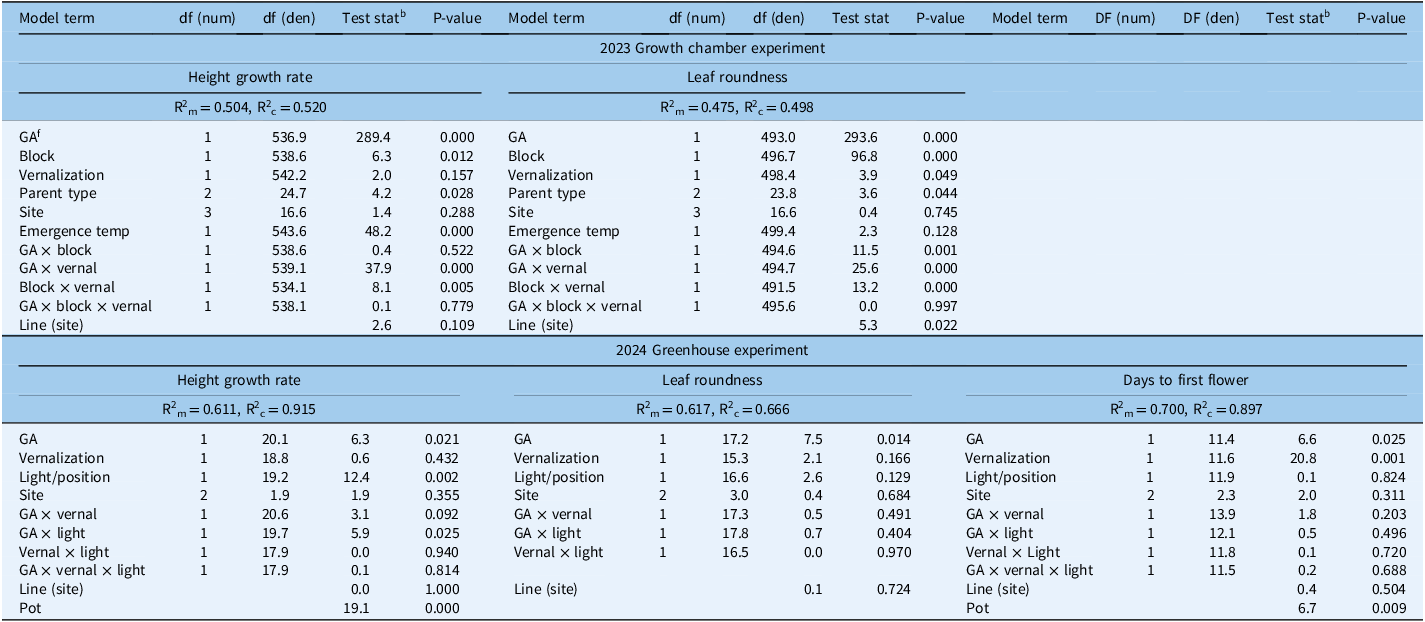
Model results for quantitative measures of life-cycle type a

Table 2. Long description
The table presents model results for quantitative measures of life-cycle type across different experiments. It includes data from the 2023 Growth Chamber Experiment and the 2024 Greenhouse Experiment, focusing on height growth rate and leaf roundness. The table has 12 rows and 15 columns, with column headers including Model term, df (num), df (den), Test stat, and P-value. Each row provides specific data for different model terms such as GA, Block, Vernalization, Parent type, Site, Emergence temp, and their interactions. The table also includes R-squared values for each experiment. Panel A describes the 2023 Growth Chamber Experiment with height growth rate and leaf roundness. Panel B describes the 2024 Greenhouse Experiment with height growth rate, leaf roundness, and days to first flower. Each panel includes detailed data on model terms, degrees of freedom, test statistics, and p-values.
a Abbreviations: df (num), numerator degrees freedom; df (den), denominator degrees freedom; R2 m, marginal R2 (only fixed effects); R2 c, conditional R2 (full model).
b F-ratios for fixed effects and likelihood ratios for random effect (Line).
Although we only grew seeds from 6 of the 10 originally sampled sites, our results suggest that the differences in traits associated with life-cycle type found in the first greenhouse generation primarily reflect nongenetic parental effects, rather than evolved genetic differentiation. For example, sites KNC and DLF were some of the most divergent in the 2022 greenhouse but did not significantly differ in the 2023 growth chamber.
In both experiments, we also included multiple genetic lines from each site, expected to be highly homozygous in this selfing species. Line explained a significant amount of variation in leaf roundness only in the growth chamber experiment. Even in this experiment, line explained only 2% of the variance, compared with 37% explained by GA and vernalization treatments for height growth rate and leaf roundness, respectively. The low levels of differentiation between presumably highly homozygous lines further supports the idea that variation in life-cycle type is not strongly predicted by genetic variation.
Although Schramski et al. (Reference Schramski, Sprague and Patterson2021) did not statistically test for differences among their four seed families from each of four fields, the highly consistent responses of all plants to their experimental treatments suggests little genetic variation for life-cycle type, consistent with our study. However, genetic differentiation across a broader geographic range in this widely distributed weed remains possible and should be tested in future studies.
Hypothesis 2a: Little Evidence for Nongenetic Effects of Parent Life-Cycle Type
In addition to comparing field-collected with greenhouse-produced seeds, we also explicitly looked for effects of parental life-cycle type on offspring life-cycle type in our 2023 growth chamber experiment. We compared seeds generated by parents exhibiting the summer annual growth type in the greenhouse, winter annual growth type in the greenhouse, or summer annual growth type in the field. We predicted that offspring of summer annual parents would be more likely to exhibit a winter annual life cycle than offspring of winter annual parents, enabling an alternation of life cycles. First, our study confirms that parents of both life-cycle types can produce offspring of both life-cycle types, whereas this was previously only shown for summer annual type parents (Schramski et al. Reference Schramski, Sprague and Patterson2021). We also found that parent type had small but significant effects on height growth rate and leaf roundness (Table 2); offspring of field summer annuals had slightly greater winter annual characteristics than those from the other two parent types, but only significantly so for one of two comparisons for each trait (Supplementary Figure S4). Categorical assignment to the upright summer annual type was similar among the three parent types (Table 1). Thus, while there was a slight difference between the field and greenhouse parents for our quantitative measures, the patterns do not support an effect of parent life-cycle type.
Alternating parent–offspring life cycles might be adaptive in nature if the parent environment is strongly predictive of the offspring environment (Uller Reference Uller2008), whereby seeds are shed by winter annual parents in favorable conditions for summer annual emergence, and vice versa. Such a pattern has been found previously in the facultative winter annual Isatis violascens (Bunge), for which parent germination season biases seeds toward the dimorphic dormancy type that promotes germination in a different season than the parent (Lu et al. Reference Lu, Tan, Baskin and Baskin2016). In systems lacking seed dormancy, such as E. canadensis, parent life-cycle type may play a less important role in shaping offspring life-cycle type. However, future studies in E. canadensis should include field winter annual parents as a comparison group to provide a more complete picture of how parental effects may influence life-cycle type.
Hypothesis 2b: Some Evidence for a Plastic Response of Life-Cycle Type to Seed Vernalization
Given that summer annuals emerge in spring after cold and wet winter conditions, we expected seeds exposed to simulated winter conditions to emerge as summer annuals. As expected for seeds lacking dormancy, the cold seed vernalization treatment had little effect on emergence rates, with the effect in opposite directions in the two experiments (+5% and −10% emergence of vernalized seeds in 2023 and 2024, respectively; Supplementary Figure S5A and B). Also consistent with the idea that E. canadensis seeds have little to no dormancy, our seed viability test of a subset of greenhouse-grown seeds showed that 97% of seeds either germinated or were nonviable, while 3% did not germinate and were still viable (Supplementary Figure S5D).
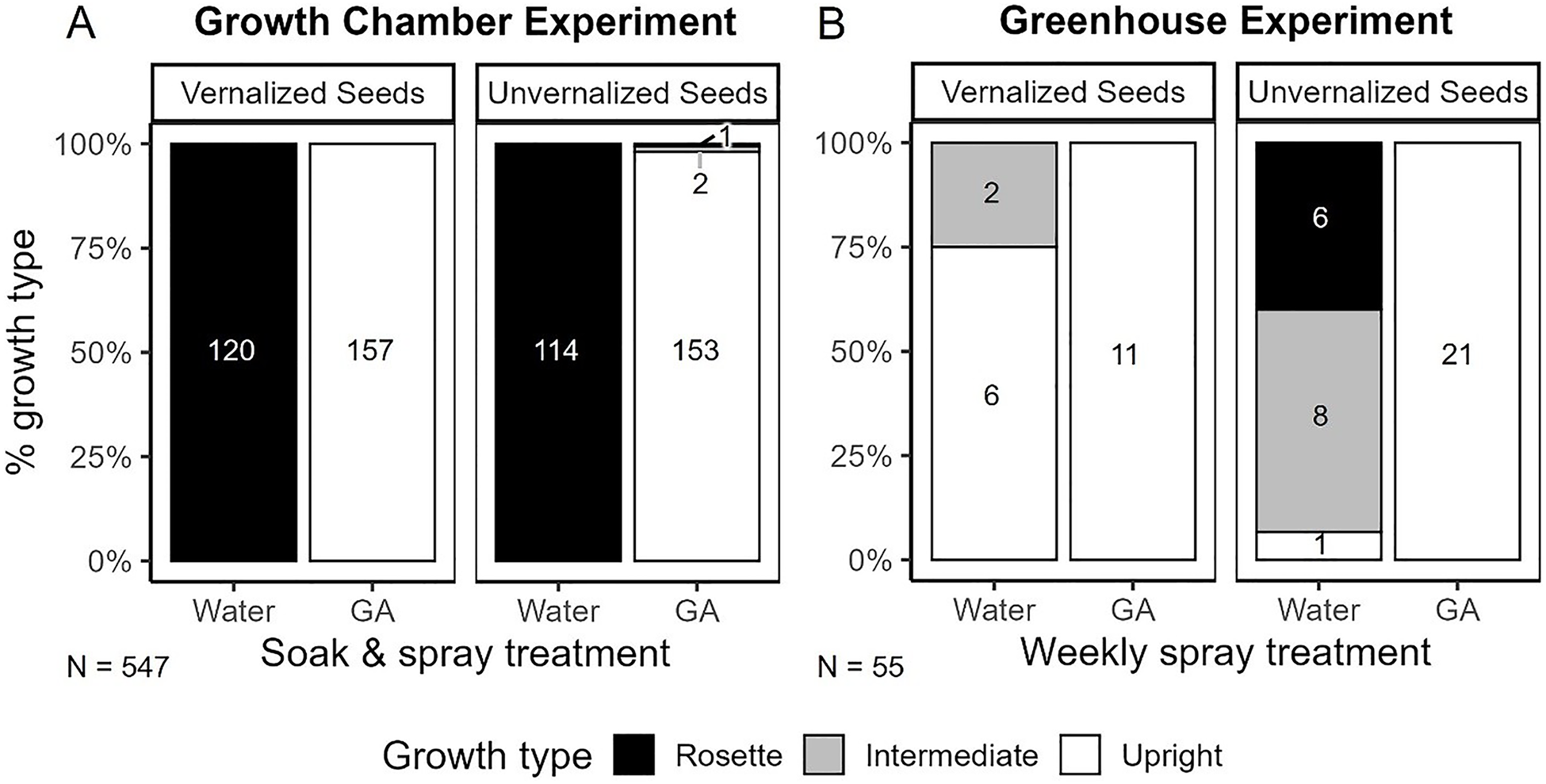
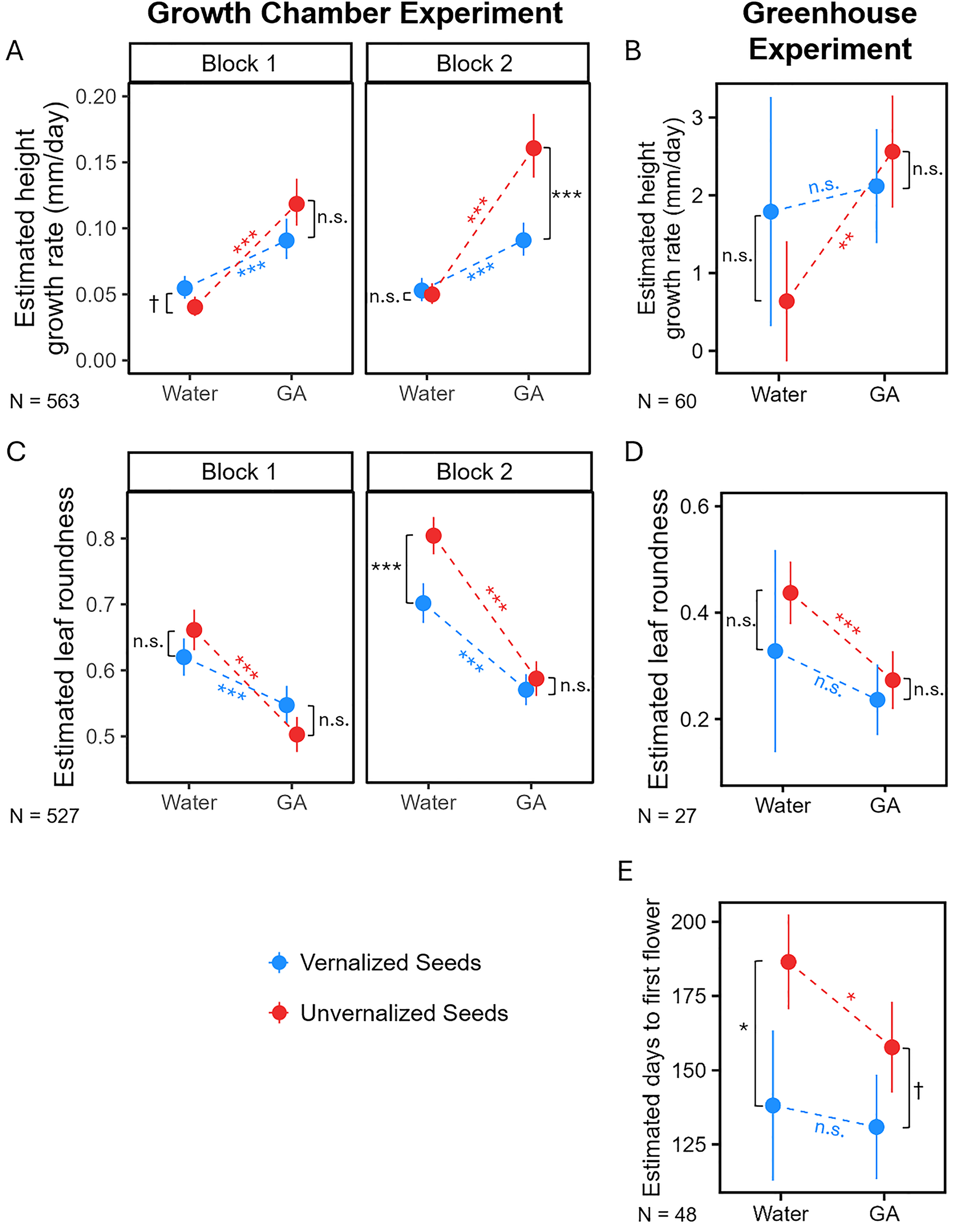
When seeds were vernalized for 3 wk and grown in a common greenhouse environment in 2022, an average of 65% of plants formed an overwintering rosette structure indicative of a winter annual life cycle. Similarly, 66% of plants only flowered after receiving additional cold through rosette vernalization, after failing to bolt for 11 wk (87% of these were Rosette types; Supplementary Figure S3A). In the 2023 and 2024 experiments, the overall effects of seed vernalization were also variable, but tended to increase summer annual type characteristics, in line with our prediction. Specifically, seed vernalization increased summer annual characteristics for all measures in the greenhouse experiment (though not significantly for height growth rate and leaf roundness; Figures 2B and 3B,D,E). In the growth chamber experiment, seed vernalization significantly affected leaf roundness in the predicted direction (Figure 3C) but did not significantly affect categorical growth type assignment or height growth rate (Figures 2A and 3A). These results should be interpreted with caution given that the vernalization duration differed between blocks.
Qualitative measure of life-cycle growth type in 2023 growth chamber (A) and 2024 greenhouse (B) experiments. Colored bars show the proportion of plants categorically assigned to Rosette (black), Intermediate (gray), or Upright (white) growth, with counts shown within bars. Panels separate seed vernalization treatments. Numbers in bars are counts.

Quantitative measures of life-cycle type in 2023 growth chamber (A and C) and 2024 greenhouse (B, D, and E) experiments: height growth rate (A and B), leaf roundness (C and D), and flowering time (E). Colors separate seed vernalization treatments and the slope of dotted lines is the effect of adding gibberellic acid (GA) within vernalization treatment. Panels separate blocks in A and C. Points are estimated marginal means after accounting for the other effects in the model (back-transformed from log transformation in A), and error bars are 95% confidence intervals. Asterisks on lines indicate significance of GA effect within vernalization groups, while asterisks between points indicate significance of vernalization effect within GA treatment groups from Tukey post hoc tests: n.s., P ≥ 0.10; †P < 0.10; *P < 0.05; **P < 0.01; ***P < 0.001.

These results contrast markedly from those of Schramski et al. (Reference Schramski, Sprague and Patterson2021), who classified no unvernalized plants as summer annuals, but 88% and 100% of plants vernalized for 2 wk and 4 wk as summer annuals, respectively. That study and all seed vernalization blocks in the present study utilized the same temperature (4 C) and the same or similar photoperiod (8 to 9 h). These results demonstrate that while seed vernalization plays a role in life-cycle determination, tending to increase summer annual traits, its variable effects point to interactions with other environmental or genetic factors. We note that in our 2024 greenhouse experiment, we observed little to no difference in growth type between plants within or outside our shade tent, but this comparison was not replicated and should be treated as preliminary.
A systematic field survey documenting the occurrence of winter versus summer annual E. canadensis across its range, along with habitat characteristics where these plants are found (e.g., mean winter temperatures, land-use type, and management) could suggest additional environmental factors that play a role in life-cycle type differentiation and would provide key baseline data for documenting changes in proportional life-cycle type occurrence over time. Studies tracking the outcomes of replicate seeds planted in fields varying in known environmental conditions would also be useful.
Hypothesis 3: GA Regulation Likely Involved in Seed Vernalization Response
Alongside our tests of genetic and environmental factors influencing E. canadensis life-cycle type differentiation, we also sought to test a hypothesized mechanism by which such differentiation may occur. In line with our predictions, the application of GA strongly and significantly increased all of our measures of summer annual type growth across both experiments. Specifically, plants exposed to exogenous GA were more likely to be assigned to the Upright growth type (Figure 2; Table 1), extended their height at a faster rate (Figure 3A and 3B), had more elongated leaves (Figure 3C and 3D), and flowered sooner (Figure 3E). This pattern held in the growth chamber experiment when excluding plants in the vernalization treatment that unexpectedly emerged while still in the cold (Supplementary Figure S6) or when quantifying growth rate as plant height per plant diameter rather than per day (Supplementary Figure S7). Across our life-cycle measures, applying GA only to seeds rather than only to leaves generally had a weaker effect in the same direction (Supplementary Figure S8), but this comparison was not replicated and so should be interpreted with caution. In line with our expectation for nondormant seeds, the GA seed soak had little effect on emergence rates (water control = 75% vs. GA soak = 79%; Supplementary Figure S5C).
We also predicted that if increased GA level is a mechanism by which seed vernalization influences life-cycle type, then the two treatments would be at least partially redundant. This would manifest as a statistical interaction between GA and vernalization treatments whereby each factor would have a stronger effect in the absence of the other. In line with these predictions, the GA effect was stronger in unvernalized plants, while the effects of seed vernalization (in cases where it also increased summer annual characteristics) were generally stronger in plants not receiving GA. Specifically, in the 2024 greenhouse experiment, seed vernalization in the absence of GA or GA in the absence of seed vernalization caused nearly all plants to be assigned Upright (interaction not statistically testable; Figure 2B). For the quantitative measures, seed vernalization was more likely to increase summer annual characteristics in the water control group compared with the GA-treated group, but only significantly so for leaf roundness in 2023 and days to first flower in 2024 (compare differences between red and blue points within treatments in Figure 3B–E). Similarly, for these measures, the GA effect was larger in magnitude in the unvernalized group than the vernalized group (compare slopes of red and blue lines in Figure 3B–E). For height growth rate in the growth chamber experiment, the magnitude of the GA effect was larger in unvernalized seeds as predicted, but the vernalization effect switched from slightly positive in the water-treated group (+0.009 mm d−1, P = 0.07) to negative in the GA-treated group (−0.05 mm d−1, P < 0.0001), opposing our prediction. Although the three-way interaction was not significant, we note that this surprising negative effect of vernalization on height growth rate in in the GA-treated group was only apparent in Block 2, where seeds were vernalized for just 1 wk.
Overall, these results suggest that increased levels of GA may be an important mechanism by which plants plastically respond to experiencing a period of cold before germination. Greater GA biosynthesis, more efficient GA transport, and decreased GA degradation all might contribute to increasing experienced levels of GA in plants exposed to cold conditions as seeds. Increased GA could accelerate flowering by triggering an earlier initiation of the reproductive growth stage (including immediate bolting upon emergence) or by increasing overall growth rates. The changes in height extension, leaf shape, and rosette formation we observed in our experiments suggest the first possibility. Although we did not explicitly attempt to quantify overall growth, we observed qualitatively similar leaf counts between rosette and upright plants that emerged on the same day.
It remains unclear why we did not find the predicted effect of seed vernalization and its interaction with GA for height growth rate in the growth chamber experiment, which was one of seven measures of life-cycle type across both experiments. One possibility relates to the germination of many seeds during seed vernalization at 4 C, which was surprising given prior studies reporting base germination temperatures of 8 to 14 C (Steinmaus et al. Reference Steinmaus, Prather and Holt2000; Tozzi et al. Reference Tozzi, Beckie, Weiss, Gonzalez-Andujar, Storkey, Cici and Van Acker2014) and the fact that it never occurred in the common garden or greenhouse experiment. Although results were similar when excluding plants that emerged in the cold, all or a larger fraction of seeds may have begun the germination process, changing their development. We note that the height growth rates for these plants were very low in comparison with the greenhouse plants (mean = 0.1 vs. 2.0 mm d−1), potentially indicating stunted growth.
It has long been hypothesized that GA and vernalization act through a common mechanism, given the ability of exogenous GA to initiate flowering in plants that normally require vernalization (Zeevaart Reference Zeevaart1983). This mechanism has been studied in detail in the model plant mouseear cress [Arabidopsis thaliana (L.) Heynh.], where vernalization and GA both act on the floral integrator gene SOC1 (Moon et al. Reference Moon, Suh, Lee, Choi, Hong, Paek, Kim and Lee2003). Interactive effects of GA and cold treatments on plant life-cycle traits have also been studied in a number of crop systems (Mutasa-Göttgens et al. Reference Mutasa-Göttgens, Qi, Zhang, Schulze-Buxloh, Jennings, Hohmann, Müller and Hedden2010; Rezaee et al. Reference Rezaee, Ghasemnezhad and Zeinali2023; Zhao et al. Reference Zhao, Li, Yu, Zhang, Wang, Jiang, Wu and Pi2023), but seldom in weeds. However, Garrison (Reference Garrison2022) found that the native winter annual ecotype of R. raphanistrum could be induced to flower without rosette vernalization by exogenous application of GA, whereas the weedy summer annual ecotype showed little response to GA. Syntheses on the interactive effects of temperature and GA do not generally distinguish between a cold period at the seed versus the seedling stage, although Chouard (Reference Chouard1960) reported that GA seed treatment cannot replace seed vernalization.
Our study extends prior work by suggesting that E. canadensis seeds experiencing cold winter conditions increase their levels of GA, helping to stimulate development as a summer annual. Interestingly, applying GA at the seedling rather than at the seed stage appeared to be more effective in producing plants with summer annual traits. A similar tendency for GA spray compared with seed soak to cause accelerated life-cycle traits has been found previously in three annual crops (Chakravarti Reference Chakravarti1958; Wilson Reference Wilson1981). This indicates that although the key environmental cue of cold temperatures may be experienced as a seed, the seedling stage may be a critical period for hormonal regulation. Further studies in other facultative winter annual species are needed to determine the generality of a GA-mediated seed vernalization mechanism for life-cycle differentiation. In addition, future studies might test for increases in endogenous levels of GA or expression levels of genes in the GA response pathway in summer annual versus winter annual plants growing in the field. Finally, comparing the life-cycle characteristics of GA-deficient mutants with control plants subjected to seed vernalization versus unvernalized control treatments would more directly link GA to a vernalization-mediated plastic life-cycle response.
Applied Significance
A review of 19 common Canadian winter annual agricultural weeds found that the facultative ability to adopt a winter or summer annual life cycle predominates in these species, yet the authors noted a general lack of information on many important aspects of their biology (Cici and Van Acker Reference Cici and Van Acker2009). Gaining a better understanding of the genetic and environmental factors contributing to variation in E. canadensis life-cycle types has implications for the management of this widespread and problematic agricultural weed. According to the most recent Weed Science Society of America surveys of U.S. and Canadian farmers, E. canadensis is among the top five most troublesome weeds in winter cereal grains, fruits, nuts, and soybean [Glycine max (L.) Merr.] (Van Wychen Reference Van Wychen2022, Reference Van Wychen2023). A highly flexible life cycle within populations may be particularly beneficial in crop fields that are actively managed to prevent E. canadensis growth. This is because unpredictable and high-mortality environments are expected to favor strategies that produce temporal phenological variation, such as bet-hedging dormancy in other systems (Donohue et al. Reference Donohue, Rubio De Casas, Burghardt, Kovach and Willis2010). Preliminary observations from a pilot study support this idea, suggesting that plants expressing the seasonally mismatched growth type (rosette in summer annual field and upright in winter annual field) have lower survival (N = 23 total flowered/247 transplanted seedlings).
Of particular note for management, summer annual type plants, and especially those of resistant biotypes, were found to be more resistant to glyphosate when grown in a greenhouse (Schramski et al. Reference Schramski, Sprague and Patterson2021). This increased resistance was partially attributable to reduced glyphosate retention (Fisher et al. Reference Fisher, Sprague, Patterson and Schramski2023). Prior studies in E. canadensis and other facultative winter annual populations have also found that by skipping the overwintering stage, spring-emerging summer annuals are more likely to survive to seed set but produce fewer seeds on average than fall-emerging winter annuals (Marks and Prince Reference Marks and Prince1981; Regehr and Bazzaz Reference Regehr and Bazzaz1979; Sans and Masalles Reference Sans and Masalles1994).
Our study indicates that E. canadensis plants expressing either life-cycle type may plastically switch to the other type in the next generation, potentially completing two generations per year. Therefore, switching crop life cycle or eliminating only those E. canadensis plants with the same life-cycle type as the desired crop is unlikely to prevent E. canadensis infestation. Manipulating the winter temperatures or levels of GA experienced by E. canadensis seeds may allow managers to bias life-cycle type differentiation in a favorable direction. Recently observed increases in the summer annual type in Michigan are less likely to be due to rapid evolution than to a change in the environment or the differential survival of the two life-cycle types.
Supplementary material
To view supplementary material for this article, please visit https://doi.org/10.1017/wsc.2026.10131
Acknowledgments
We thank Kate Shaw and Mark Hammond for greenhouse and growth chamber management; Ava Garrison for assistance with watering; and Second Spring Farm, Natural Cycles Farm, and DeLano Farms for seed-collection access. This article was improved by comments from the Conner Lab and four anonymous reviewers. This is Kellogg Biological Station contribution no. 2443.
Funding statement
This work was supported by the Education and Workforce Development Program of the U.S. Department of Agriculture’s National Institute of Food and Agriculture (2023-67011-40398 to RW) and the Research Experiences for Undergraduates Program of the U.S. National Science Foundation Division of Biological Infrastructure (2150104).
Competing interests
The authors declare no conflicts of interest.


 Open access

