


This paper contains supplementary material that can be found online at http://journals.cambridge.org
Hunting is a major threat to biodiversity in the tropics and requires management across multiple spatial scales (Bennett et al., Reference Bennett, Blencowe, Brandon, Brown, Burn and Cowlishaw2006; Corlett, Reference Corlett2007). In India hunting intensity has increased concomitant with a rapidly growing human population (Velho et al., Reference Velho, Karanth and Laurance2012). While poaching of high-profile species such as the tiger Panthera tigris and Asian elephant Elephas maximus are well documented, few studies have investigated localized hunting contexts in India (but see Aiyadurai et al., Reference Aiyadurai, Singh and Milner-Gulland2010).
Although the biodiversity of India faces many conservation challenges, the wildlife of Arunachal Pradesh state, in north-east India, is particularly vulnerable (Velho et al., Reference Velho, Karanth and Laurance2012). This state includes a complex of environments spanning two global biodiversity hotspots, the eastern Himalaya and Indo-Myanmar regions. Arunachal Pradesh has suffered serious population declines and local extinctions of hunted species (Datta et al., Reference Datta, Anand and Naniwadekar2008) as a result of changing perceptions, the emergence of new wildlife markets and failing government institutions (Aiyadurai et al., Reference Aiyadurai, Singh and Milner-Gulland2010).
To document the changing threats to wildlife in Arunachal Pradesh we assessed patterns of bushmeat hunting in an Indo-Tibetan tribe that has cultural and Buddhist religious practices (following the Gelug and Nyingma sects of Buddhism). We evaluated how cultural practices or the shared values, beliefs and social interactions of an Indo-Tibetan tribe mediate hunting impacts, and how traditional laws (which are implemented by a legally empowered village council) and taboos affect hunting.
We interviewed 50 residents from three large settlements (Rupa, Thungri and Shergaon) near the periphery of Eaglenest Wildlife Sanctuary in western Arunachal Pradesh (Fig. 1). Interviewees belonged to the Shertukpen tribe, which has nine clans and inhabits 13 settlements along river valleys in the West Kameng district of the state. These are shifting cultivators and hunters who have substantial trade links with people from the adjoining Assam plains, with whom they exchange key commodities. Eaglenest Wildlife Sanctuary is now a protected area but is considered by the Shertukpen tribe to represent part of their community land, through which they formerly transited yearly to the Assam plains as part of their barter economy. They have now shifted to growing cash crops such as tomatoes and, with increased road connectivity, their annual migrations to the plains are no longer essential for economic purposes.
Surveyed settlements around Eaglenest Wildlife Sanctuary (marked as a black box in the inset map of the north-east Indian states) in the state of Arunachal Pradesh.

We conducted semi-structured interviews (Supplementary Material 1) from the last week of July to the first week of September 2012. Interviews were conducted by NV and trained assistants, with Shertukpen advisers, in Hindi, the most widely spoken language in the state. These interviews were with active hunters (who continue to hunt), people who accompany hunters, former hunters (who have stopped hunting for various reasons ranging from old age to disinterest), administrative officers, village chiefs and council members. To establish an atmosphere of trust we first met with village chiefs in each village prior to commencing our surveys. Based on these interviews, plus information from village council members, teachers and administrative officials, potential interviewees and villages were selected. Our approach suffers from potential pitfalls, such as non-truthful disclosures, errors with recall of data and limited replication, comparable to other studies (Rao et al., Reference Rao, Htun, Zaw and Myint2010). Notably, our study portrays the perceptions of hunters but not the rest of the population. In our study area only men hunt, and therefore one male hunter per household was interviewed. We collected information on patterns, methods, preferred game species for consumption, motivation, taboos, penalties and regulations related to hunting. Each interview lasted at least 90 minutes. Photographs were used to confirm the identity of hunted species.
Twenty species (18 mammal and two bird species) were reportedly hunted. Although interviewees stated that they do not hunt small birds and only a few pheasant species, the number of bird species hunted is likely to be an underestimate given that birds are usually not recalled during important hunting events (Aiyadurai et al., Reference Aiyadurai, Singh and Milner-Gulland2010). All hunters used guns to shoot wildlife; a small number (6%) also used dogs trained to track and flush animals.
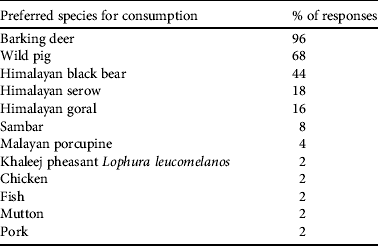
The most common reasons given for hunting were recreation, provision of meat and for commerce (Table 1). Species considered taboo to hunters (see below), except the cattle-like gaur Bos gaurus, are not hunted for recreation. Species hunted for recreation are also valued for their meat (Table 1). Among available wildlife and domestic species, respondents listed 12 species preferred for consumption. Overall, bushmeat was ranked more highly than domestic meat (Table 2); 96% of all respondents preferred wild over domestic meat, mostly for taste and perceived meat purity.
Reasons for hunting given by 50 male interviewees of the Shertukpen tribe in Arunachal Pradesh, India (Fig. 1), the percentage of those interviewed who hunt for each purpose, and the species hunted.

Wildlife species and meat of domesticated animals preferred for consumption, as indicated in interviews with 50 men of the Shertukpen tribe in Arunachal Pradesh, India (Fig. 1).
Our interviewees indicated that, until two generations ago, tribe members did not eat the meat of domesticated animals (except of sheep and yak), as domestic animals were considered impure. Poultry, eggs, onions and garlic were also not formerly part of their diet. The breeding of domestic pigs is not allowed in the village, and beef is also not consumed.
Species such as tiger, clawless otter (Aonyx sp.) and Himalayan musk deer Moschus chrysogaster have been exploited for commercial markets. Hunters, mainly from the states of Assam and Rajasthan, reportedly come to hunt otters and tigers. Himalayan black bear Ursus thibetanus is heavily hunted for its gall bladder, which is traded to people from Bhutan and Assam state, and can fetch INR 10,000–25,000 (USD 180–450) each.
Some species are used in traditional medicine and for their cultural importance. The meat of the Himalayan black bear and the intestines of the Malayan porcupine Hystrix brachyura are believed to cure malaria and dysentery. The horn of the Himalayan serow Capricornis thar is used in festivals and for treating abscesses. The wattle of the tragopan Tragopan sp. is used as ornamentation in a religious ceremony. Animal parts are rarely used to make utilitarian products (although bear skins are sometimes used to make winter mattresses) but rather are sold to other tribes (such as the Akas and Nyishis for ornamental use in their headgear, bags and machete sheaths).
Hunting taboos (cultural prohibitions sometimes drawn from religious tenets) within the community are well known; 94% of respondents knew of their existence. Killing of the revered Asian elephant is the most widespread (76%) cultural taboo. Respondents stated that primates (40%), gaur (30%), hornbills (28%), squirrels (22%) and tigers (18%) are also considered taboo species. In addition, four respondents (8%) listed the Himalyan serow and small passerine birds as taboo species.
However, three respondents (6%) stated that it was not forbidden to kill taboo species such as primates and squirrels when they raid crops; it was only taboo to eat their meat. Hunting of the Himalayan serow was considered taboo until a few generations ago, as it was considered to be a ‘mount of the gods’. They are now widely hunted, and were ranked as the fourth most-preferred bushmeat species (Table 2). Taboos are also changing for gaur and tiger. Respondents stated that when a gaur is killed its tail is cut off and depredation is attributed to a wild predator, such as the dhole or tiger. The meat is not sold but distributed in the village to share the burden of sin. Blame for killing the once-revered tiger is diverted to a lower-status member of another Shertukpen clan. In 1990 these clan members were brought into the Shertukpen fold and there is no longer any segregation.
The village council has a decentralized, three-tier system, with village chiefs as heads, administrative members, and nine members from each clan that provide information to the other tiers. The council has prohibited the use of dynamite or bleaching for fishing, tree felling within a 3-km radius of the council headquarters and at certain sacred sites, the ignition of forest fires, trapping and snaring of wild animals, and hunting on holy days (the 8th, 15th and 30th day of each month).
Fines for hunting infractions range from INR 10,000 (USD 180) for dynamiting to INR 1,200 (USD 22) for hunting. The fees are reviewed every 3 years, and are subject to change. Five to six years ago the council adopted a month-long hunting ban during the holy month (termed Phogde or Dawazipa). The ban was reduced 2–3 years ago to a 16-day period, following strident lobbying by hunters.
Our findings reveal a major gulf between local taboos and practices and national wildlife legislation (which has not factored these various cultural contexts into government policies) in India. On the one hand, the Wildlife (Protection) Act, which is a national legislation that prohibits hunting of any protected species, is often not followed. On the other hand, Shertukpen village councils have instituted hunting bans during the peak wildlife breeding season (May–June) and have banned traps and snares (but not guns) for hunting. Hunting is a tradition in this society, embedded in animistic beliefs before the arrival of Buddhism, with bushmeat still sought for festival celebrations. Buddhist monks have played a key role in lobbying for the hunting ban during the breeding season, and hunting may have declined in the general area in 2003 following the visit of Dalai Lama (Mishra et al., Reference Mishra, Madhusudan and Datta2006).
Hunting practices in north-eastern India have closer cultural affinities with those in South-east Asia than with peninsular India. As in nearby Myanmar, wild pig and deer are the most preferred species for hunters (Rao et al., Reference Rao, Myint, Zaw and Htun2005). Our interviewees expressed an overwhelming preference for bushmeat over domestic meat, with their views mirroring those of villagers in Lao PDR that wild game ‘tasted better, was healthier for you and fun to pursue’ (Hansel, Reference Hansel2004).
The future will bring important challenges for the sustainability of bushmeat hunting as taboos weaken, commercial markets expand and human populations continue to grow. Wildlife species exploited for legal or illegal trade can face particularly acute pressures (Laurance et al., Reference Laurance, Croes, Tchignoumba, Lahm, Alonso and Lee2006). In west and central Africa stakeholders have attempted to reach a consensus to balance bushmeat harvests and conservation (Bennett et al., Reference Bennett, Blencowe, Brandon, Brown, Burn and Cowlishaw2006). Apart from strengthening governance and institutions, they call for engagement across the public health, development and other sectors. Similar partnerships are needed in India to balance wildlife conservation with hunting, given the tension between hunters and formalized rules (either traditional or national), which often play out in the context of rapid social and environmental changes. This gamut of partnerships, especially at the national level, should include religious and cultural leaders as their teachings could influence attitudes and rules governing local hunting.
Acknowledgements
We thank the Rufford Small Grants Foundation for financial support, Aditi Kulkarni, Karthikeyan Paneerselvam, Indi Glow and Umesh Srininvasan for help with data collection and logistics, Subrata Gayen for help in preparing the map and the Tukpen Village Council for sharing their knowledge and practices.
Biographical sketches
Nandini Velho studies the governance, social and ecological challenges facing India's tropical forests. Her earlier work focused on plant–animal interactions in tropical rainforests and the anthropogenic threats that disrupt these interactions. She is now studying the impacts of hunting on biodiversity under different protection regimes in north-east India. She also works with government departments, policy makers and field staff to collaborate on solutions to pressing conservation issues. William F. Laurance studies the ecology and conservation of tropical forests throughout the world. Much of his work focuses on assessing the impacts of land-use pressures such as habitat fragmentation, logging, fires and hunting on tropical ecosystems and biodiversity. He is also interested in climatic change and environmental synergisms, and is engaged in conservation policy and public outreach.



