


Introduction
Over the last 40 years there has been an evolving narrative around the role of local people who often lose but should stand to gain the most from conservation efforts, and who could be key partners and implementers of conservation actions (Hulme & Murphree, Reference Hulme and Murphree2001). Such thinking signalled a move away from so-called fortress conservation approaches that excluded local communities and paid little attention to their needs. In contrast, integrated conservation and development approaches recognized the material needs of local communities (Wells et al., Reference Wells, Brandon and Hannah1992), and a more recent focus on the rights of communities and indigenous peoples has brought good governance and an emphasis on participation in decision making to the fore (Springer et al., Reference Springer, Campese and Painter2011).
Traditionally, conservationists come from a background in the natural sciences and tend to apply ecological principles and quantitative methods (e.g. assessments of global endangerment or rarity, ecological roles of species, and biodiversity hotspots and eco-regions) to determine conservation values, priorities and interventions. In the 1980s and 1990s, responding to the perceived need for local support, conservation actions began to target communities with education programmes to inform them why scientifically designated sites or species were important and the subject of conservation activities. However, importance was expressed in largely scientific and economic terms that were often incomprehensible or lacking in local relevance or resonance. Even when intangible and intrinsic values were described, these attributions of importance were implicitly coloured by western culture and semantics. Community-oriented approaches were intended to build local support for top-down, biologically derived conservation programmes (Wells et al., Reference Wells, Brandon and Hannah1992) but failed to include, or else marginalized, how local communities themselves valued their natural world (Infield, Reference Infield2001).
Drawing on multiple definitions, culture, and the associated terms cultural values and cultural approaches, is understood here to be complex, relative and changing, and to include spiritual and ethical dimensions (Infield & Mugisha, Reference Infield and Mugisha2013), to confer identity, meaning, worth, aspirations and a sense of place on individuals and communities (Goulet, Reference Goulet and Hamilton1993), and to comprise relationships between individuals, groups, ideas and perspectives (Rao & Walton, Reference Rao, Walton, Rao and Walton2004). Culture is necessarily, therefore, at the centre of relationships between nature and people (Schama, Reference Schama1996; Posey, Reference Posey1999). However, such values may be specific to particular groups or localities, and their relevance may be context-specific, as opposed to generic globalizing of Western values. People value nature, or even the same object, in a variety of ways, and scientific values (and in some cases economic values) traditionally emphasized by Western conservation may lack meaning or importance to local and indigenous communities. Connections to and behaviours towards the natural world are as strongly affected by cultural constructions of nature as by economic factors (Croll & Parkin, Reference Croll and Parkin1992). This is not to say that tensions do not exist within communities between demands to utilize material values and demands to maintain cultural values, but in some situations these can be resolved through traditional institutions. Failing to reflect the value systems that link communities to their natural worlds and motivate them to protect nature may undermine conservation intentions and even exacerbate conservation problems (Jepson & Canney, Reference Jepson and Canney2003; van der Ploeg et al., Reference van der Ploeg, Araño and van Weerd2011). Interpreting or recasting the cultural values of a community through the language or values of science and Western understandings of nature can be equally damaging (West, Reference West2006).
Conservation is a process that aims to conserve the world's natural values both for nature's own sake and for the global community, particularly for those living closest to nature, those with profound relationships with the natural environment, and those most immediately reliant on it. Incorporating locally specific cultural values has the potential to imbue conservation initiatives with new and additional relevance for local communities. Cultural approaches help, therefore, to re-focus actions around critical questions: what and whose values should underpin conservation?
Despite notable successes in protecting particular sites or species, conservation faces serious challenges. The conservation movement urgently needs to bring the innovation of cultural approaches into mainstream practice. Recognizing the constraints of conservation's traditional focus on scientific and economic values also helps bring non-material objectives of conservation back into the frame.
Although cultural values in nature receive considerable academic attention, there have been few explorations of their potential to inform mainstream conservation practice (Peterson et al., Reference Peterson, Russell, West and Brosius2010). More progress has been made within biocultural conservation approaches, in which cultural values are central (Maffi, Reference Maffi2005), and efforts are made to ensure cultural values are adequately reflected in ecosystem services frameworks (Chan et al., Reference Chan, Satterfield and Goldstein2012). By adopting a cultural values approach—a lens through which locally held values can be viewed and therefore incorporated—conservation actions can be underpinned by the real relationships that exist between people and nature. To understand conservation problems sufficiently and address them effectively we must employ interdisciplinary skills and resources and integrate both the biological and social characteristics of ecosystems in our work (Setchell et al., Reference Setchell, Fairet, Shutt, Waters and Bell2017).
Since the late 1990s Fauna & Flora International (FFI) has taken a range of approaches to community engagement and participation, complementing rights-based and sustainable livelihoods approaches with an emphasis on the deep cultural connections that exist between people and their natural environment. Non-material, culturally defined values of nature make significant contributions to people's lives. Engaging with the beliefs, values and practices that connect people to nature, cultural values approaches help to reinforce these, embedding them in conservation initiatives, and harnessing mutual benefits for conservation and cultural protection.
General lessons identified from adopting cultural values approaches
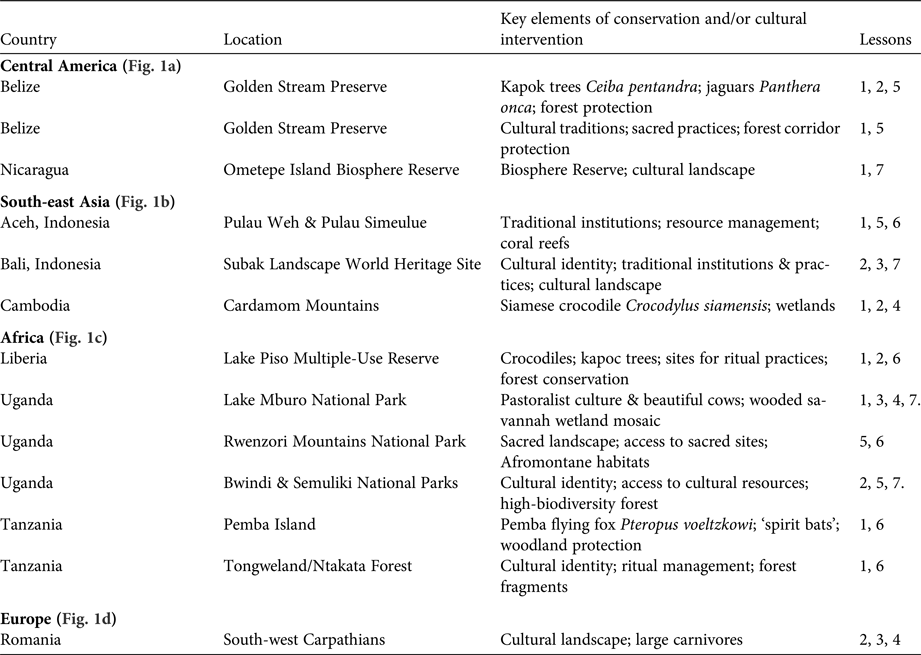
The implementation of cultural approaches within FFI's conservation programme over a 20-year period has helped deliver outcomes for specific species and sites (Fig. 1). Over this time FFI's understanding of these approaches, the opportunities they create and their potential limitations also evolved. Lessons learned during early interventions helped to inform the design and implementation of later initiatives. The key areas of interest and lessons emerging from various interventions are summarized in Table 1. These are the subjects of the historical narrative that follows. The general lessons identified are listed here:
-
(1) Socially and culturally conditioned relationships between people and nature create justifications and motivations for conservation that are meaningful for different groups, helping to align conservation programmes with communities’ own conservation priorities.
-
(2) Helping communities to maintain the integrity and vigour of the cultural institutions that underpin their sense of identity can also strengthen their capacity to respond and adapt to internal and external change.
-
(3) Although cultural approaches are highly contextual to local situations, communities are not homogeneous, and the risk that selecting a particular set of values identified by a dominant or more vocal group may disadvantage other groups must be recognized and responded to carefully.
-
(4) Cultural values approaches may require compromises to be made by both conservationists and communities, as incompatible demands can result from the characteristics of ecological systems as well as from embedded perspectives or norms deemed non-negotiable by conservation or community institutions.
-
(5) Recognizing cultural values can help ensure local and indigenous community rights are respected, and raise awareness of the rights of communities to enjoy their culture, amongst national and international conservation organizations.
-
(6) Cultural norms determine relations between people and nature, and when mediated through cultural institutions and traditions can enforce compliance more effectively than foreign sanctions.
-
(7) Utilizing cultural values is difficult and time consuming, is reliant on building trusting relationships with local people, and requires well-trained facilitators.
These lessons are explored in more detail through a series of project examples below (summarized in Table 1), which are contextualized against the narrative of FFI's own evolving understanding of cultural values, and the changing conservation discourse that it was, in part, responding to.
Locations of projects or interventions in (a) Central America, (b) South-east Asia, (c), Africa, and (d) Europe in which FFI implemented cultural values approaches to conservation over 20 years (Table 1).

Sites of projects and interventions (Fig. 1), key elements of conservation and/or cultural intervention, and lessons revealed or emphasized (see text for description of Lessons 1–7), from 20 years of implementing cultural values approaches to conservation.
An historical narrative
Exploratory phase (1990s)
The idea that protected areas would ultimately fail without the support of the communities living in and around them, and particularly their leaders, gained common currency during the 1980s (Adams & McShane, Reference Adams and McShane1992), stimulating conservation theory and practice to move away from traditional fines-and-fences approaches to engage with communities. The dominant mechanism for engaging communities during the 1990s was the integrated conservation and development approach that relied on a combination of demonstrating the economic value of conservation to communities (Wells et al., Reference Wells, Brandon and Hannah1992) and providing environmental education through adult and schools programmes and wildlife clubs.
Following a strategic review and name change in the early 1990s FFI (previously the Fauna & Flora Preservation Society) adopted a specific focus on building the capacity of in-country conservation organizations, and on the role of communities at the heart of sustainable conservation. From this, the potential power of incorporating communities’ cultural values and motivations into its conservation interventions was identified. It also, however, raised the challenge, in line with FFI's mission, of putting local values at the heart of conservation initiatives whilst ensuring projects responded to globally defined considerations of significance and scientific importance.
A number of projects informed FFI's internal awareness of the potential influence of cultural values to drive conservation. An early example came from work on the Tanzanian island of Pemba (1995–2000) to protect the endemic Pemba flying fox Pteropus voeltzkowi, which at the time was categorized as Critically Endangered on the IUCN Red List, but following active conservation intervention has been recategorized as Vulnerable (Entwistle & Juma, Reference Entwistle and Juma2016). Although the project originated from a global assessment of species at risk, it became clear that the bats had strong cultural resonance for the islanders, linked to pre-Islamic animist religions that associated spirit bats with specific woodland areas (AE, pers. comm.). Islanders placed an intrinsic value on the bats, but they had been unaware that the population was declining as a result of unsustainable use and habitat loss (Entwistle & Corp, Reference Entwistle and Corp1995) or that the bats were endemic to the island, a fact that resonated with an emerging separatist movement (of Pemba from Zanzibar) at the time. The scientific information reinforced the intrinsic cultural values held for the bats, catalysing village elders to establish local by-laws to reduce disturbance at roost sites and restrict hunting to traditional methods. There was a clear synergy between international scientific values and local cultural values, which together drove conservation decision making and delivered a subsequent recovery of the species (Robinson et al., Reference Robinson, Bell, Saleh, Suleiman and Barr2010).
The influence of cultural values on conservation interventions and disconnections between Western scientific values of biodiversity and locally held values also became clear from work carried out in Belize. FFI and its local NGO partner were protecting a forest (Golden Stream Preserve; Fig. 1a) identified as being important for conserving jaguars Panthera onca. However, Mayan leaders identified different values for the forest, in particular, the kapok tree Ceiba pentandra. This widespread and non-threatened species represented for the Maya the link between heaven and the underworld and was more important to them than the values of the forest emphasized by scientifically defined conservation interests. The local NGO working on the project responded to this understanding of Mayan values by renaming themselves Ya'axché, the Mayan name for the kapok tree (Bowen-Jones & Entwistle, Reference Bowen-Jones and Entwistle2002). In this example, international conservationists and local communities were interested in the same forest but their interests were mediated by different focal species, with different values for each party (jaguars vs kapok trees).
In other projects it was clear how cultural values had protected species prior to any external intervention. For example, FFI's baseline studies conducted in the Cardamom Mountains in Cambodia in 2000 discovered a relict population of the Critically Endangered Siamese crocodile Crocodylus siamensis. Reverence for the crocodile among the indigenous Khmer communities had ensured it was not persecuted as it had been elsewhere in the region (Daltry et al., Reference Daltry, Chheang and Nhek2004). However, changing local contexts threatened that status quo, and a partnership with the Cambodian government and the local communes provided a model through which both crocodiles and community well-being could benefit (Daltry et al., Reference Daltry, Chheang and Nhek2004).
Development phase: Uganda (2000s)
The 2000s saw integrated conservation and development projects begin to fall from favour as their over-simplified understanding of relationships between poverty and resource pressure was exposed and the practical difficulties of implementation were revealed (Wells, Reference Wells, Perrings, Mäler, Folke, Holling and Jansson1995). The neo-liberal economic mechanisms (wildlife must pay its way) that underpinned integrated conservation and development approaches also began to be questioned (Sandbrook et al., Reference Sandbrook, Scales, Vira and Adams2011).
Responding to these developments, FFI's experiences in Tanzania, Belize and Cambodia discussed above suggested the utility of recognizing and integrating local values more fully in the design and implementation of its conservation programmes, in particular the idea that cultural values approaches could deliver benefits for both conservation and the well-being of local communities. This led to a partnership with the Uganda Wildlife Authority to design and implement the Culture, Values and Conservation Project, which ran for 10 years from 2005.
This work emerged from the outcomes of a previous community conservation project supporting Lake Mburo National Park during the late 1990s, which found that economic incentives provided to a pastoralist community to encourage their engagement with the project's conservation objectives did not help resolve the fierce conflicts between them and the Park's management (Infield & Namara, Reference Infield and Namara2001). The pastoralists valued the Park as an historically important grazing area for their prized long-horned Ankole cattle (Plate 1), a cultural icon as well as an economic resource. They considered the decision to exclude cows from the area, to protect wildlife, to be fundamentally wrong. The differences between the pastoralists and park managers over the values of the landscape were identified as the underlying cause of decades of damaging conflict that undermined the effectiveness of the Park and the lives of the pastoralists, which could not be addressed successfully through economic compensation (Infield, Reference Infield2002).
Long-horned Ankole cow with owner, in a pastoral community near Lake Mburo National Park, Uganda (Fig. 1c), in 1995. Photograph by Mark Infield.

In partnership with the Uganda Wildlife Authority, FFI piloted a cultural values approach in two National Parks (Lake Mburo and Rwenzori Mountains) to test the idea that building cultural values into park management could improve local interest in, and support for, protected areas whilst improving local well-being. A key focus of the Culture, Values and Conservation Project was to determine if recognizing and embedding cultural values could improve relations between communities and park managers. The project later expanded to work in the Albertine Rift forest parks of Semliki and Bwindi.
Mutwa demonstrating plants and traditional use of plants to project and Park staff in Bwindi Impenetrable National Park, Uganda, in 2013. Photograph by Pamela Wairagala.

FFI and its partners employed exploratory dialogue and discussion to identify and understand the significance of communities’ cultural connections to nature and to the Parks, and their potential relevance to achieving more effective conservation of both nature and culture. Phenomenological qualitative surveys showed that perceptions of the values of nature and the Parks differed between the communities and the park managers. By gaining an understanding of local communities’ cultural connections to and understandings of nature and the protected area, the project team identified activities that could reinforce both cultural values and conservation, helping communities and park managers to agree priority values and integrate them into park management.
Integrating pastoral values into park management
At Lake Mburo National Park the project focused on means to maintain the cultural connections between the land and the pastoralists, which would involve the grazing of Ankole cows within the Park. A community-based organization was established to preserve the breed and traditional knowledge associated with its breeding and care, and a partnership was developed between them and the Uganda Wildlife Authority to establish and manage a cultural herd within the Park. Although the Park's management plan was updated to recognize and integrate the pastoralists’ cultural values explicitly, the proposal to graze cattle within the Park was not implemented as it was deemed by the authorities to contradict conservation and tourism objectives (Infield, Reference Infield2002), indicating that in practice there can be limits to the full implementation of a cultural values approach. Although the cultural herd was not officially accepted to graze in the Park, relations between park management and the pastoralists continue to strengthen, progress on integrating pastoral values has been maintained through a cultural centre established in the Park, and the presence of the herd in the Park is tacitly accepted by park managers locally.
Recognizing a sacred landscape
At Rwenzori Mountains National Park, a cultural analysis identified the sacredness of the mountains as the key to understanding how the Bakonzo, or Mountain, people valued the landscape, which informed how they behaved towards the Park. Although this was not new information (it is well documented in Henry Osmaston's Guide to the Ruwenzori, originally published in 1972, for example) the processes of gazetting the Park in 1992 and inscribing it as a World Heritage Site in 1994 made no reference to this. The communities’ cultural leaders and park managers agreed to focus attention on the sacred values of the mountains, and the project worked to ensure that these were recognized in the Park's management plans and integrated into day-to-day operations. Access to sacred sites and to resources used in rituals and ceremonies was negotiated and agreed to, and the role of traditional leaders in managing access to the mountains and their resources was successfully integrated into the Park's management structure.
Validating indigenous cultural connections between the Batwa and the forest
At Semliki and Bwindi National Parks the centuries-old relationships between the forests and Batwa hunter-gathers had been effectively ignored by park managers since the Parks were gazetted in the early 1990s. The Batwa are the original inhabitants of the area, pre-dating the now dominant Bantu peoples by many centuries. The project facilitated a process of cultural values assessment, ensuring that Batwa elders led this process. This exposed park staff to the depth of Batwa knowledge of the forest, allowed the Batwa to share, explain and demonstrate the meanings they attached to the forest, and established the potential for a cultural interpretation of nature and the Parks. Areas of mutual interest for Batwa and the Park were embedded in park management plans. The project further helped develop Batwa-led tourism operations, brokered agreements on the employment of Batwa for their specialist knowledge, and supported the development of Park interpretation materials highlighting Batwa values.
Building institutional sustainability for cultural values
In parallel to the above engagements, the project supported local cultural institutions that would champion local values and build sustainable partnerships with park management. In some cases the project supported the initial development of such bodies (e.g. the Ankole Cow Conservation Association around Lake Mburo). In other cases, such as for the marginalized Batwa people, the project brokered their relationship with park authorities by training them in negotiation skills, as well as ensuring they participated in project governance structures. The cultural institutions of the Bakonzo people had remained despite their official dismemberment in 1966, and once allowed to operate officially by the Ugandan government in 2008, the kingship became a robust and active champion for the sacred values of the mountains and their integration into the Park.
Efforts to embed cultural values thinking within the institution of the Uganda Wildlife Authority were initially successful; for example, park planning protocols were modified to ensure that both general and operational plans reflected local cultural values. However, despite high levels of engagement and apparent enthusiasm amongst senior staff of the Authority, successful interventions on the ground did not translate into higher-level policies and guidelines. This experience indicates the need for institutional buy-in, which is difficult when new ideas and approaches do not align with the traditions and culture of statutory institutions, where compromises and devolution of rights may be more challenging. In this case the Authority's leadership found it difficult to incorporate community aspirations and decision making, particularly where it might compromise underlying tenets of conservation policy. Thus, although the project identified wider opportunities to strengthen community engagement in resource management and park governance, and to institutionalize a cultural values approach, these were not realized. In such circumstances, organizations hoping to achieve an institutional shift in culture require patience, long-term engagement, and realistic expectations.
Mainstreaming phase (2010 onwards)
Building on concerns over the conflicts with communities that many conservation endeavours, especially protected areas, generated, and the growing determination that conservation should at least do no harm, the demand for rights-based approaches to conservation began to be actively expressed during the 2000s. A growing focus on governance, going beyond ideas of consultation and participation to genuine sharing of decision making came to the fore, emphasizing issues of equity and the sharing of responsibilities.
By 2010 FFI was already working actively to ensure its conservation programmes addressed the needs and rights of local communities effectively, and was promoting a sustainable livelihoods approach in its operations. This requires understanding of the complexity of rural livelihoods, including the need to move beyond framing livelihoods in solely economic terms, recognizing that livelihoods are complex and dynamic and are not solely a means of making a living but a way of life in which autonomy, a sense of purpose, and a voice in decision making are often as important as income, and sometimes more so. By this stage FFI had established a Conservation, Livelihoods and Governance Programme to help ensure that its conservation activities did not disadvantage poor, vulnerable or marginalized people but enhanced well-being and social equity (FFI, 2010a), and was actively engaged in promoting a consideration of human rights within conservation, for example, through the Conservation Initiative on Human Rights (FFI, 2010a).
By 2010 the stories and results emerging from Uganda, both positive and negative, raised interest within FFI as to how a cultural values approach could be applied more broadly and effectively across the organization. A paper prepared for the MacArthur Foundation (the funder of the Culture, Values and Conservation project) on the role of cultural values and ethics in conservation (Infield & Mugisha, Reference Infield and Mugisha2013) explored the growing recognition of links between culture and nature explored through biocultural approaches (Maffi, Reference Maffi2005; Gorenflo et al., Reference Gorenflo, Romaine, Mittermeier and Walker-Painemilla2012), cultural values and rights (Springer et al., Reference Springer, Campese and Painter2011), culture and development (Sen, Reference Sen, Rao and Walton2004), and culture and ecosystem services (Brown et al., Reference Brown, Walpole, Simpson and Tierney2011), providing impetus to engage further with the concept.
As a complement to its wider work on rights, governance and livelihoods, FFI developed a programme focused on cultural values, recognizing the role of values, traditions and behaviours as a specific means for engaging communities within conservation and livelihood projects. Cultural approaches were applied to help communities maintain their values, knowledge and practices, and manage their natural resources, and to develop practical applications to address conservation problems, improving conservation outcomes, the conservation of culture, and community well-being.
In 2010 FFI's Chief Executive Officer, Mark Rose, wrote to FFI's members, observing that ‘Conservation today emphasizes the material and economic values of nature but tends to ignore many other values that create profound links between people and nature. If communities lose these values, will people lose their interest in nature and its conservation?’ (FFI, 2010b). The Cultural Values and Conservation Programme was launched in 2011, providing a means to ensure that non-material values of nature were communicated proactively at local and global levels. Central to the conception of the programme was that investigating and articulating local cultural values within the design of projects, rather than making assumptions about what and whose values should be conserved, would help engage local and indigenous peoples more effectively and would ensure that FFI was responding to their priorities. In contrast, a brief review of the operations of other conservation organizations at that time showed little mention of culture or cultural values in their conservation narratives, which were dominated by economic value statements (FFI, 2011).
During 2011–2015 the Cultural Values programme investigated how to embed and mainstream cultural values approaches more widely in FFI's operations. Key to this was the use of demonstration projects that could describe various mechanisms to incorporate local cultural connections with nature into conservation delivery. The programme supported projects or developed interventions in Africa, Eurasia, Asia and the Americas, each one providing unique responses to unique circumstances.
-
(1) In Tanzania, the Tongwe people's ancient connections to their cultural landscape and the network of clan-based institutions that linked groups of people to specific rivers, mountains and forests were used to inform efforts to conserve forest fragments outside formal protected areas.
-
(2) In Romania, cultural assessment is being used to integrate cultural perspectives into the design of corridors for large carnivores in the south-western Carpathian mountains, helping to ensure they meet cultural perspectives and expectations as well as biodiversity needs.
-
(3) In Belize, forest conservation efforts explored integrating Mayan values and traditions that linked forest management and the production of their staple crops of corn and beans into a landscape of spiritual significance.
-
(4) In Liberia's Lake Piso area, cultural values and uses of forest fragments that provided key cultural resources as well as sites for graveyards, ceremonies and secret societies were assessed to understand how they had helped protect these fragments and how they could be incorporated into the design of a protected area (Infield, Reference Infield2013).
-
(5) In Bali, Indonesia, the multiple values of biodiversity-rich rice terraces of an ancient production landscape inscribed as a World Heritage Site were assessed under an ecosystem services framework to support their conservation. Building on this work, FFI developed and tested its Guidance for the Rapid Assessment of Cultural Ecosystem Services (GRACE) as part of a wider programme of ecosystem services assessments (Infield et al., Reference Infield, Morse-Jones and Anthem2015).
-
(6) In Aceh, Indonesia, customary marine resource management institutions (the Panglima Laot or Commanders of the Sea) were revitalised, enabling local fishers to take active roles in the management of marine and coastal resources. Research indicates that where Panglima Laot were active there was subsequently greater fish biomass and coral cover (Campbell et al., Reference Campbell, Kartawijaya, Ardiwijaya, Mukmunin, Herdiana, Rudi, Obura, Tamelander and Linden2008)
-
(7) In Nicaragua's Ometepe Island Biosphere Reserve, discussions with communities about their perceptions of, and relations to, nature revealed that cultural values associated with the island's forested volcanoes, including a sense of place and heritage, and a source of mythical stories and aesthetics, ranked higher than the provisioning and regulating ecosystem services that had been the focus of interventions by conservation organizations and development officials
As discussion of cultural values was stimulated across this varied array of projects, others within FFI began to identify and describe how they were applying cultural values approaches. For example, research carried out around Liberia's Sapo National Park revealed that the large size of the Park's chimpanzee Pan troglodytes population (the largest in the country) was not attributable to protected area legislation but rather to the Wedjah people (approximately translated as ‘the people from the place where the chimps are’). These communities maintained a strict tradition of not hunting or eating chimpanzees, linked to the story of the Wedjah’s migration to escape the disruption of the collapse of the ancient Mali Empire, in which they were rescued by chimpanzees and provided safe passage. In gratitude, the Wedjah protect and feed chimpanzees when they come into contact with them. The discovery of these cultural practices has provided both conservation challenges and opportunities. Their beliefs suggest that the Wedjah could be effective allies in protecting and monitoring chimpanzees. However, the feeding of chimpanzees risks disease transmission and encourages crop raiding. Identification of Wedjah beliefs and practices, however, means that conservation actions that are in line with local values and customs can be devised, increasing the likelihood of effective and sustainable conservation outcomes and strengthening Wedjah cultural institutions.
Conclusion
Cultural and biological diversity are inextricably linked (International Society of Ethnobiology, 1988). Responding to this perspective led FFI to reassess its understanding of what conservation means, what its purpose is, who it is for, and by whom it is best carried out. Engaging with cultural values has helped FFI identify general lessons that have informed the design and delivery of its conservation programmes:
-
(1) By engaging with cultural values, projects have reaffirmed the importance to both communities and conservation of relationships with nature, broadened justifications for conservation, and recognized that different motivations for conservation resonate with different cultures and societies. Values-based approaches are a valuable tool for making conservation relevant to indigenous and local communities in diverse circumstances.
-
(2) Remote communities, especially indigenous communities, are exposed to the negative effects of environmental and social change, including globalization. Impacts are exacerbated when cultural institutions have been lost or weakened. Cultural values approaches, however, afford a mechanism to strengthen cultural institutions and build new and sustainable partnerships with them, whilst strengthening the resilience of communities and their institutions to the impacts of rapid social, economic and environmental change, including climate change.
-
(3) There are important differences within communities in how individuals and groups regard particular cultural values and institutions and are affected by them. Decision making led by local groups on the basis of cultural values can disadvantage groups with low cultural status, including women and the youth, while favouring groups with high status. It should not be assumed that the values of one group represent those of all groups within a community.
-
(4) Some local values are easily integrated into conservation initiatives whereas others are not, and some conservation actions are easily acceptable to communities whereas others are not. Difficulties may result from specific biological or ecological factors, or from perceived economic conflicts, but many result from the rejection of trade-offs. Trade-offs may be rejected when embedded perspectives of conservation norms are at odds with cultural priorities; for example, despite a 15-year partnership, there was a failure to find a compromise position that would allow a cultural herd of Ankole cows to be part of Lake Mburo National Park. Trade-offs may also be rejected when cultural practices conflict with conservation values or ethics; for example, the hunting and consumption of great apes cannot be sanctioned by most Western conservation organizations.
-
(5) Recognizing cultural values can encourage conservation organizations to respect the rights of local and indigenous communities. This can result in the customary use of natural resources being encouraged and interventions that undermine traditional practices being avoided. It can also discourage actions to deny communities access to culturally important sites or resources. The promotion of cultural values approaches can also raise awareness of the value of cultural diversity, and the recognition of the rights of local and indigenous peoples amongst national conservation authorities and international conservation organizations.
-
(6) Cultural ties that link people to the natural world remain strong in many communities living close to biodiversity. Cultural institutions enforce norms of practice through compliance mechanisms that depend on continued belief in, or attachment to, traditions and values (Ostrom, Reference Ostrom1990) and can be more effective than externally imposed sanctions (Colding & Folkes, Reference Colding and Folke2001). Ties to, and obligations under, these institutions, however, are becoming marginal within many communities as a result of immigration, modernization, access to other forms of knowledge, and shifting values, and are openly challenged by groups within larger communities, especially by young people. The forces and pressures of globalization threaten traditional values and norms and related knowledge and practices, just as they threaten biodiversity. Seeking synergies and linking the protection of nature with the protection of cultures through the application of cultural values approaches helps to achieve both outcomes.
-
(7) The application of cultural values approaches to conservation action is a painstaking process. Community members with cultural knowledge do not always share this information easily, or openly promote what they believe. Cultural values can be hard to articulate and may not even be overtly recognized by those that hold them. Many forms of cultural belief and practice are kept secret from outsiders or even from insiders not initiated into them. The relativism and specificity of cultural values makes them hard to describe, and even harder to translate into other languages. It is therefore important that cultural values approaches plan for long-term engagement with communities and recognize the need for highly skilled and dedicated facilitators and multidisciplinary practitioners.
Fauna & Flora International recognizes that people value the diverse elements of nature in a multitude of ways, both monetary and non-monetary. To empower people to care for nature and use its gifts sustainably we need to appreciate and respect these multiple values. Where values conflict, whether within communities or between communities and conservation interests, trade-offs must be negotiated. However, recognizing multiple values provides opportunities to identify powerful synergies between the interests of conservation, the interests of local communities, indigenous peoples in particular, and the interests of the global community. The organization has spent a number of years including cultural values within broader participatory and empowering approaches and concluded that cultural values approaches have an important role to play in conservation endeavours globally, including in the selection, design and management of protected and other conservation areas. Cultural values should be accorded the necessary focus and resources by national conservation authorities and global conservation organizations, and should be promoted with and for local communities and the organizations that support them. No single approach will meet all conservation needs or respond to all threats to species, sites, ecosystems and landscapes, but adding cultural approaches can help the conservation endeavour to meet its present and future challenges.
Acknowledgements
We gratefully acknowledge the financial support of numerous donors that made it possible for the interventions discussed here to be undertaken, with special thanks to the MacArthur Foundation, which supported the Uganda Culture, Values and Conservation Programme for 10 years, and the Darwin Initiative. We thank the Uganda Wildlife Authority for their decade-long partnership, and two anonymous reviewers whose valuable comments helped us improve this article.
Author contributions
All authors played roles in one or more of the interventions described, and contributed to the drafting and editing of various elements of the article. MI proposed the article, provided material on the Uganda programme and the consolidation phase, and undertook much of the editing; AE provided the original concept and structure for the article, and material on the exploratory phase, and undertook much of the editing; HA provided analysis of livelihood and governance aspects; AM provided material on the Uganda programme; and KP reported the example of chimpanzees in Liberia.
Biographical sketches
Mark Infield is interested in the interface between protected areas and the social environment in which they must be sustained. Most recently he has concentrated on integrating local culture into conservation initiatives. Abigail Entwistle started her career as a bat ecologist but has since worked across many aspects of conservation planning, delivery and evaluation. Helen Anthem has experience in both the development and conservation sectors and is particularly interested in participatory approaches, gender and empowerment. Arthur Mugisha has championed innovative ways to strengthen protected area/community relations and is currently supporting efforts to address the impacts of national parks on indigenous peoples in Uganda. Kathryn Phillips has a background in primatology, notably great ape conservation. She is particularly interested in the application of interdisciplinary research approaches within conservation initiatives.



