


“Ohio Hopewell” is an archaeological concept that is known worldwide. It represents a climax in the visual and constructional arts in eastern North America approximately 2,000 years ago (Figure 1). Specifically located in southern Ohio, Ohio Hopewell is part of a geographic pattern across the Midwest and Southeast that is termed simply “Hopewell” or “Hopewellian” and characterized by specific object classes and style elements of broad distribution but short duration (Griffin Reference Griffin1967). Ohio Hopewell acts and actions have been interpreted variously as the results of colonization, agriculturally driven social complexity, peer-politic interaction, the control of trade and crafting, and a variety of other social or historical processes.Footnote 1 Today, it is perhaps best interpreted as part of an early American Indian socioreligious movement—a reworking of sacred propositions—with distinct shrine or cultic centers (Beck and Brown Reference Beck and Brown2011:73–74, 76). The term “Ohio Hopewell” has been a part of professional archaeology since at least the 1930s, and even before that, the constituent mounds and earthworks were at the heart of the “Mound Builder myth” that drove much of nineteenth-century American antiquarianism (Silverberg Reference Silverberg1968).
The core area of Ohio Hopewell manifestations (after Griffin Reference Griffin1967). Map by authors.

Today, Ohio Hopewell art and earthen constructions continue to force engagement and bring to the fore questions of heritage, preservation, the deep rootedness of cosmological concepts, and the various potentialities of middle-range societies—sometimes with deeper and more subtle undertones pertaining to race, progress, and the exotic. The archaeological significance of Ohio Hopewell is manifested most concretely in the establishment of Hopewell Culture National Historical Park (HOCU) in 1992, with associated land acquisition, sponsored research, and public history stakeholders. HOCU is a large part of the next UNESCO World Heritage Site listing in the United States (National Park Service 2022). As a result, a protected and interpretable Ohio Hopewell landscape is growing in the twenty-first century, spurred on by the application of a remarkable array of new techniques—geophysical, chemical, and geographical. We would argue that Accelerator Mass Spectroscopy (AMS) dating of organic materials, and the careful evaluation of resultant determinations, are important parts of this strong pulse of new knowledge. Time is a key dimension of the Ohio Hopewell narrative.
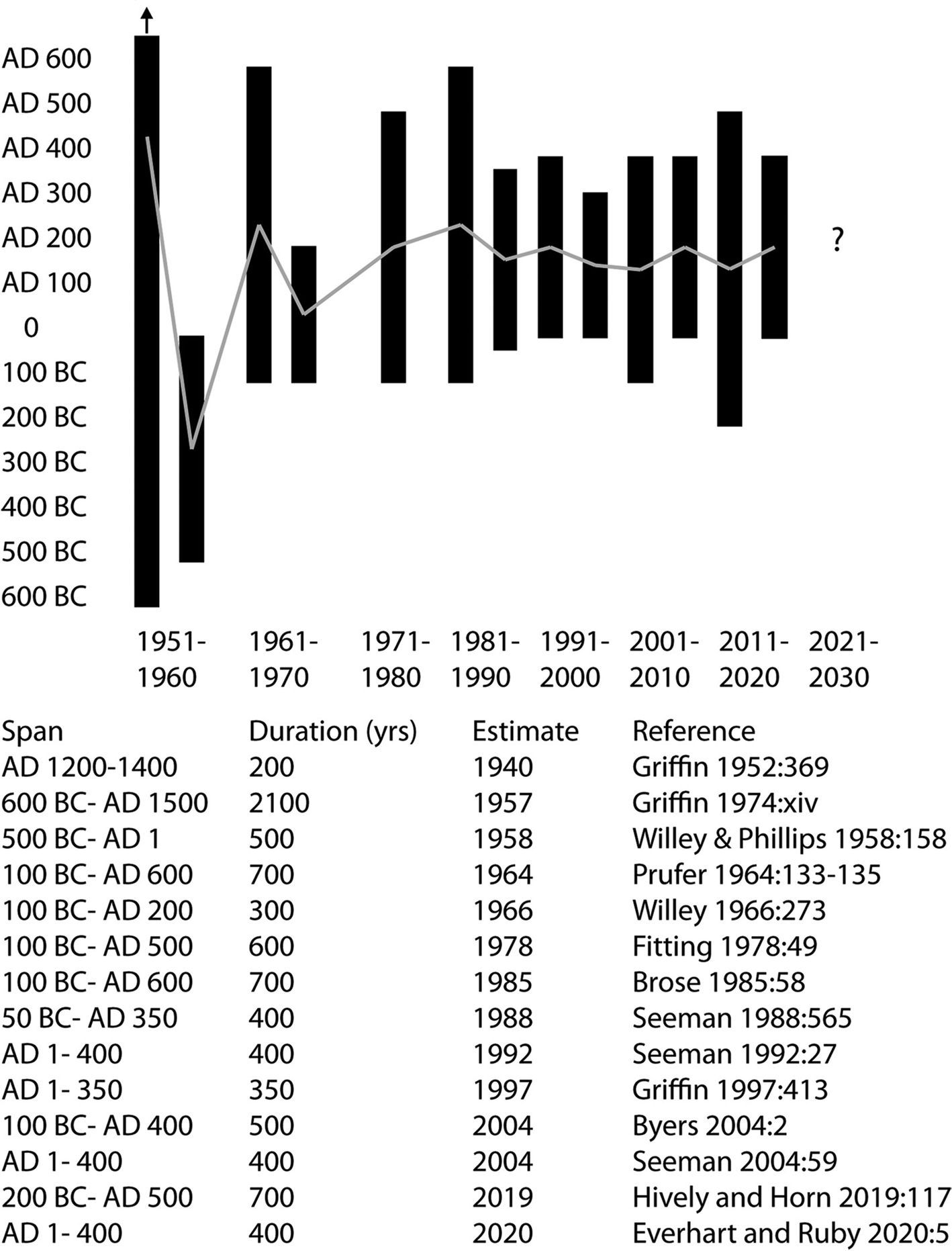
Time and temporality make a difference in our understanding of accumulated Hopewell history; a narrative that unfolds over 250 years rather than 700 carries different agental possibilities, and at the same time, raises questions as to how we classify a continuous past into meaningful categories of history—and even more generally, how our Western perspective of reckoning time is in reasonable concordance with those of the ancient peoples we study. Notwithstanding these larger issues, we recognize that archaeological time in the Midwest is, in practice, measured in radiocarbon years. Our view of ancient history is therefore conditioned by the accuracy, precision, and replicability of our best practices on this score. For Ohio Hopewell, and as technology has become more available and affordable, the date range has contracted and has become more consistent across estimates (Figure 2). This is further reflected in a recent poll of Ohio Hopewell scholars (Supplemental Text 1).
Variation in perceptions of Ohio Hopewell duration by decade, AD 1951–2020.
All radiocarbon dates are not created equal, nor do they always tell us the truth. Or perhaps more properly, sometimes we are ill equipped to understand their truth. Some of the reasons for this radiometric discord are well known: some samples are poorly provenienced, some do not relate to the archaeological event of interest, some samples have considerable inbuilt age, some can suffer from unknown or variable reservoir effects, and some legacy dates were obtained with methods that were less accurate than those available today (Schmid et al. Reference Schmid, Wood, Newton, Véstenisson and Dugmore2019:630). As a result, a variety of protocols have been developed to minimize these effects under the general rubric of “chronometric hygiene” (Rieth and Hunt Reference Rieth and Hunt2008). AMS dates on short-lived, terrestrial materials are generally privileged in such evaluations, and they also tend to produce somewhat shorter and younger chronologies than those containing many legacy beta-count dates (Fortier et al. Reference Fortier, Emerson and McElrath2006:187; Nolan Reference Nolan2012:189, 190, 202; Rieth et al. Reference Rieth, Hunt, Lipo and Wilmshurst2011:2745; Taché and Hart Reference Taché and Hart2013:365, 367; Wilmshurst et al. Reference Wilmshurst, Hunt, Lipo and Anderson2011:1815, 1817).Footnote 2 At the same time, we recognize that legacy dates can still contain useful information and, at the very least, provide an important comparative context for evaluation. For this project, we have compiled a dataset of 425 14C determinations attributed to Ohio Hopewell components in the Middle Ohio River Valley (MORV; Supplemental Table 1 and Supplemental Text 2). We then apply a classification weighing most heavily the most hygienic assays in examining the duration of the general Ohio Hopewell episode as well as the specific histories of the most important sites.
For our first use of the Ohio Hopewell 14C dataset, we have focused on a chronological evaluation of several well-known sites, sometimes referenced as the “the Big Four” (Willey and Phillips Reference Willey and Phillips1958:158), or more properly, the “Big Six” (Griffin Reference Griffin and Jennings1983:261; Shetrone Reference Shetrone1930:190)—the Hopewell Mound Group, Liberty, Mound City, Seip, Tremper, and Turner.
Ohio Hopewell and the “Big Six”
Ohio Hopewell sites are distributed along the southerly flowing tributaries of the Ohio River in what is now the state of Ohio (Greber Reference Greber1998; Griffin Reference Griffin1967; Sieg and Hollinger Reference Sieg, Eric Hollinger, Applegate and Mainfort2005). Here are found large and complex geometric earthworks, conjoined and elongated mounds, “Great House” submound buildings, puddled clay altars, large and small artifact deposits, ritual fire features, and a variety of regionally specific object forms (e.g., Ross Barbed spears, pottery vessels, copper buttons, effigy boatstones, and metallic breastplates and headplates). There is also a common set of “artistic” stylizations in a variety of media (Seeman Reference Seeman and Townsend2004; Spielmann Reference Spielmann2013), as well as commonalities in measurement and celestial observation not evident in earlier regional complexes (Hively and Horn Reference Hively, Horn, Redmond, Ruby and Burks2019; Romain Reference Romain2000). Recent geophysical work suggests that the monumental construction of massive, circular wooden enclosures should be added to this list (Ruby Reference Ruby, Redmond, Ruby and Burks2019). These are the “touchables and feelables” that give Ohio Hopewell its form. Together they provide a useful but sometimes fuzzy demarcation of the flow of history, and close inspection reveals that many of the characteristic object classes such as rocker-stamped pottery or prismatic blades actually may transcend the temporal bounds of Ohio Hopewell as traditionally recognized, whereas others such as metallic panpipes do not reach these boundaries at all. Rather, such characters follow their own particular sociotemporal pathways producing what Lucas (Reference Lucas2015:5–6) calls “imbrication relationships.” Consequently, we recognize indistinctiveness around the margins of Ohio Hopewell that leads us to narrow our focus to certain key contexts for purposes of the present investigation.Footnote 3
In categorical thinking, certain cases can be seen as more privileged or representative than others. Consequently, for example, Goatly (Reference Goatly1997:19) argues that a robin is closer to “birdiness” than a penguin because a penguin cannot fly. Within Ohio Hopewell, six sites since at least the early twentieth century—the Hopewell Mound Group, Liberty, Mound City, Seip, Tremper, and Turner—have conceptually centered the construct. Five of these sites are located in the Scioto Valley of south-central Ohio, and the sixth is located in the lower Little Miami Valley one drainage to the west. All six have yielded elaborate human burials, nonmortuary artifactual deposits, and a variety of architectural details that numerically outstrip the characters present at other presumably contemporaneous sites. For our first use of the Ohio Hopewell 14C dataset, we anticipate little argument in saying that temporally Ohio Hopewell is the time when distinctive materials and object classes (e.g., obsidian, Knife River chalcedony, Ross Barbed spears, copper breastplates, effigy platform pipes), monumental geometric earthworks, rectangular clay basins, large ceremonial buildings, and loaf-shaped mounds were being made and used at the Big Six. Brief descriptions of these sites are as follows:
(1) Hopewell Mound Group (33Ro27): This site is located on a terrace above the North Fork of Paint Creek, a small tributary of the Scioto River in Ross County, Ohio. It consists of a massive D-shaped earthwork conjoined with a smaller square, more than 30 mounds, a summer solstice–oriented post circle, an interior embankment structure, submound buildings, offerings, graves, ritual basins, and ancillary residential and production areas. The outer walls enclose 45 ha, but the site is somewhat larger when peripheral loci such as Datum H and Riverbank are considered. The Hopewell Mound Group was first excavated by Squier and Davis (Reference Squier and Davis1848); later by Moorehead (Reference Moorehead1922) and Shetrone and Greenman (Reference Shetrone and Greenman1931); and more recently, by a variety of National Park Service investigators (e.g., Pacheco et al. Reference Pacheco, Burks and Wymer2012; Ruby Reference Ruby, Redmond, Ruby and Burks2019; Weinberger and Brady Reference Weinberger and Brady2010). The Hopewell Mound Group is a unit of Hopewell Culture National Historical Park and is open to the public. We record 43 14C dates from Hopewell.
(2) Liberty Earthworks (33Ro22): The site is located on a terrace of the Scioto River and consists of a geometric earthwork of conjoined circles and a square, plus 14 mounds, ancillary production areas, and at least one large “killed” biface cache. The site covers an area of approximately 38 ha. The center of the largest circle is dominated by the loaf-shaped Edwin Harness mound, which has been excavated many times, initially by Squier and Davis (Reference Squier and Davis1848), followed by Putnam (Reference Putnam1885), Moorehead (Reference Moorehead1897), Mills (Reference Mills1907), and most recently by Greber (Reference Greber1983). The Liberty Earthworks are now largely destroyed by agricultural activities. Investigations here have resulted in 38 14C dates.
(3) Mound City Group (33Ro32): This site is located on a terrace of the Scioto River immediately upstream from the modern city of Chillicothe, Ohio. It was first described in 1808 (Brown Reference Brown2012:2) and excavated several times by Squier and Davis (Reference Squier and Davis1848), Mills (Reference Mills1922), Brown and Baby (Reference Brown and Baby1966), and more recently, by Lynott (Reference Lynott2015) and others. The site consists of a squarish embankment enclosing an area of 6.3 ha, at least 25 interior mounds, exterior barrow pits, staging areas, manufacturing loci, prepared clay (cremation) facilities, offerings/deposits, secondary and primary burials, charnel houses, and a variety of diagnostic artifact forms, often made of exotic materials. The site was declared a National Monument in 1923 and is today the major interpretive component of Hopewell Culture National Historical Park. We record 27 14C dates from Mound City.
(4) Seip Earthworks (33Ro40): This site is located along Paint Creek, a tributary of the Scioto River. It consists of conjoined circular embankments and square enclosing 49 ha and with walls extending over 3.2 km. There are at least six mounds on the site, including the loaf-shaped Seip-Pricer mound excavated in 1925 and 1928 (Shetrone and Greenman Reference Shetrone and Greenman1931). Eight buildings north of Seip-Pricer have seen considerable recent excavation. Lynott (Reference Lynott2015) provides a detailed summary of Seip investigations. This site was listed on the National Register of Historic Places in 1974 and is currently a unit of Hopewell Culture National Historical Park. Excavations at Seip have resulted in 18 14C dates.
(5) Tremper Works (33Sc4): This site is located on a terrace of the Scioto River close to its confluence with the Ohio. It is within 2 km from the source of Ohio Pipestone, a flint clay of importance in the manufacture of smoking pipes for more than 2,000 years. Comparatively, the site is small (1.8 ha), and it consists of a squarish embankment; a conjoined central mound; a large, multiroom submound building; crematory basins; secondary burials; and offerings/artifact deposits. Tremper was first documented by Squier and Davis (Reference Squier and Davis1848), excavated by Mills (Reference Mills1916), and listed on the National Register Historic Places in 1972. There are five 14C dates from the Tremper site.
(6) Turner Earthworks (33Ha26): This site is located on a terrace of the Little Miami River in Hamilton County, Ohio. Major earthwork features include a circle linked to an oval by a graded way and a nearby elongated oval enclosure. It includes 15 mounds, a large lithic workshop and production area, a stone pavement, a separate burial ground, numerous submound buildings, offerings, and individual graves. The site covers approximately 80 ha, most of which has been destroyed by sand and gravel mining. Major excavations were conducted in 1882, 1886, 1889–1890, and 1905 (Willoughby Reference Willoughby1922). There are six 14C dates from Turner contexts.
The temporal relationships among the Big Six have been examined previously. This began with a comparison of trait lists (Shetrone and Greenman Reference Shetrone and Greenman1931; Webb and Snow Reference Webb and Snow1945) and was followed by chronologies based on some of the earliest 14C dates (Griffin Reference Griffin1958; Prufer Reference Prufer1968), and even later, examinations of stylistic cross-ties (Seeman Reference Seeman1977), seriations (Ruhl Reference Ruhl1996), and obsidian hydration (Hughes Reference Hughes1992; Stevenson et al. Reference Stevenson, Abdelrehim and Novak2004). Beyond noting that Tremper is early in the sequence, there is little agreement, prompting (Griffin Reference Griffin and Jennings1983:264) to state that all such chronology-building efforts were inconclusive, and Lynott (Reference Lynott2015:60) to comment that “Ohio Hopewell archaeology suffers from a disarray of radiocarbon results.” By assembling a comprehensive dataset and evaluating it from the perspective of temporal hygiene, we begin to unmuddy these waters.
Our Approach
In considering hygienic priorities and constructing analytical classes, we have been governed by four principles following from Napolitano and colleagues (Reference Napolitano, DiNapoli, Stone, Levin, Jew, Lane, O'Connor and Fitzpatrick2019:9). First, we recognize that the dispersion among extant Ohio Hopewell dates indicates that both contamination and mis-affiliation have been, and continue to be, problems: many sites are situated on precisely the same well-drained high terraces that were used extensively by earlier and later populations; they have suffered 200 years of intensive Euro-American agriculture, gravel mining, and development; and they have seen hundreds of generations of burrowing mammals, countless tree roots, and few opportunities for natural deposition. This is more of a problem for dating contexts at open sites than for those buried by mound or earthwork fill (see Taché and Hart Reference Taché and Hart2013:365). Second, legacy beta-count determinations with associated large standard deviations are not as precise as those available today due to improvements in laboratory procedures. In this light, we note that Taché and Hart (Reference Taché and Hart2013:365) recommend using only dates with standard deviations of less than 60 years, and Siklóski and Szilágyi (Reference Siklóski and Szilágyi2021:24) less than 50 years when constructing chronologies. Similarly, Pettitt and colleagues (Reference Pettitt, Davies, Gamble and Richards2003:1690) discount all dates obtained before 1970, and Blockley and Pinhasi (Reference Blockley and Pinhasi2011:101) discount them prior to the late 1980s. Third, the “old wood problem” highlights the inbuilt differences in organic materials that privilege short-lived plant materials or terrestrial animal bone for dating—especially, in our case, the annual plants of the Eastern Agricultural Complex (Napolitano et al Reference Napolitano, DiNapoli, Stone, Levin, Jew, Lane, O'Connor and Fitzpatrick2019:9; Nolan Reference Nolan2012:187–188; Taché and Hart Reference Taché and Hart2013:365, 367). Against this reality must be balanced the fact that many Ohio Hopewell architectural constructions of key concern were built with long-lived oak and hickory wood, not annual plants or bone. Finally, a poll of Hopewell specialists makes it clear that “Ohio Hopewell” in current practice lies somewhere within the interval 2050–1500 14C years BP (Supplemental Text 1). We follow Wilmshurst and colleagues (Reference Wilmshurst, Hunt, Lipo and Anderson2011:1815) in using this poll of subject experts to establish an initial broad window in order to exclude modern or other implausible dates.
With the above in mind, we have collected information on 425 14C dates from contexts identified as Ohio Hopewell (Supplemental Table 1; Supplemental Text 2). We then define seven analytical classes based on chronometric hygiene criteria and association with cultural materials of interest (for a similar treatment of association, see Krus Reference Krus2016), and we identify each date with one of these classes. Subsequent to classification, we examine and interpret resultant patterning. Our analysis focuses mainly on radiocarbon years as a measure of time and as the results of primary laboratory analysis, although we also will examine in limited fashion the effects of calibration and Bayesian modeling. Our hygienic classification is as follows:
Class 1: AMS dates derived from samples of short-lived nuts, seeds, fibers, terrestrial bone, or bark having clear associations with diagnostic artifacts and/or sealed within Hopewell mound or embankment contexts; standard deviations equal to or less than 60 14C years.
Class 2: AMS dates derived from carbonized wood or unspecified charcoal having clear associations with diagnostic artifacts and/or sealed within Hopewell mound or embankment contexts; standard deviations equal to or less than 60 14C years.
Class 3: Beta-count (conventional) dates on organic materials—generally carbonized wood—with clear diagnostic associations and/or sealed within Hopewell mound or embankment contexts; standard deviations equal to or less than 60 14C years and assayed after AD 1970.
Class 4: Dates with clear diagnostic associations and/or sealed within mound or embankment contexts with standard deviations greater than 60 14C years. Included here are many pre–AD 1970 legacy beta-count dates.
Class 5: Dates from nonmound or nonembankment contexts where diagnostic associations are unspecified, unclear, or unknown. Generally, these are postholes in open, unstratified habitation sites with prominent Hopewell components.
Class 6: Dates outside the range 2050–1500 14C years BP. We assume these dates pertain to other, non-Hopewell components, although clearly investigators thought (or hoped) they would pertain to ancient Ohio Hopewell activities at the time samples were taken.
Class 7: Dates with incomplete provenience or sample information that preclude any other classification at this time, plus all the dates from the Dicarb Radioisotope Co. (see below). For one date in this category we can do little more than to confirm its probable existence.
The 425 dates in our Ohio Hopewell dataset represent measurements by 17 different laboratories (Supplemental Table 2). Historically, they include three of the earliest 14C determinations ever made by Willard Libby at the University of Chicago lab as well as AMS dates obtained within the last few years. Beta Analytic Inc. (Beta) is by far the preferred laboratory for Ohio Hopewell archaeologists and has produced two-thirds (284/425 = 67%) of the determinations in our compilation. The University of Georgia (UGAMS) is a second (40/425 = 9%). We assume that dates from these 17 laboratories are comparable (see Boaretto et al. Reference Boaretto, Bryant, Carmi, Cook, Gulliksen, Harkness and Heinemeier2003:151, 154; Scott et al. Reference Scott, Cook and Naysmith2010:863–865) according to the seven criteria specified above, with one exception. The comparability of dates from Dicarb Radioisotope Co. (Dicarb) to all others in our analysis has been questioned (Reuther and Gerlach Reference Reuther and Craig Gerlach2005). To this we add the facts that the Dicarb dates at a local Ohio Valley site indicate a similar discrepancy (Shott Reference Shott1992), and that the lab director, Irene Stehli, told one of us (Seeman) that she had a problem with the oxalic acid standard for a number of dates run in the 1980s and offered to provide correction equations. For these and other reasons, and for purposes of the present study, we have placed all Dicarb dates in our Class 7.
Finally, and following from Lynott (Reference Lynott2015:174), we have chosen to average the three AMS dates on a rare material (pine charcoal) from what is considered “a brief burning episode” in the southeast barrow pit at Mound City in our analysis. These are among the most recent Ohio Hopewell dates from the Big Six—1590 ± 40, 1630 ± 40, and 1720 ± 40 14C years BP, respectively. It should be noted that Mound City has seen intensive disturbance and modification due to the construction and use of Camp Sherman, a World War I training facility placed squarely on this Ohio Hopewell site.
Although we see uncalibrated 14C assays as useful comparative measures, it has been shown since at least 1958 that radiocarbon years can be calibrated in order to better estimate their placement in Gregorian time. For the current investigation, we have used the most recently available calibration—IntCal20 (Reimer et al. Reference Reimer, Austin, Bard, Bayliss, Blackwell, Ramsey and Butzin2020) and Bayesian analytical functions in OxCal 4.4 (Bronk Ramsey Reference Bronk Ramsey2009a)—to construct various models for each site as well as a combined Ohio Hopewell sample, (a) including all dates without outlier analysis (Bronk Ramsey Reference Bronk Ramsey2009b), and (b) incorporating outlier analysis. Where acceptable agreement cannot be achieved, we have removed dates that are poor fits with the respective models. We further recognize that calibrations since their inception have themselves been subject to change and therefore provide something of a moving target. In addition, presumed increases in accuracy do not necessarily equal increases in precision. With regard to the former and with direct relevance to the Hopewell episode, we note reported differences of 50 years circa 1900–1700 cal BP between IntCal20 and its immediate predecessor, IntCal13, in a test case (Staff and Liu Reference Staff and Liu2021:1–2). Calibrated and modeled years are not the same as radiocarbon years, nor for that matter are they the same as solar years or sidereal years—or defining spring as beginning when a red oak leaf is the size of a mouse's ear. However, all are acceptable, complementary, and useful measures of time under given circumstances. In sum, after evaluating Classes 1–7 of 14C assays comparatively, we will combine and/or exclude classes for purposes of modeling a more hygienic Ohio Hopewell chronology. We report and compare our findings in both radiocarbon years and as calibrated and modeled to approximate familiar calendar years.
Findings
Comparative summary statistics for our constructed classes of Ohio Hopewell 14C dates provide insights for hygienic consideration (Table 1). The seven class mean ages range between 1653.1 14C years BP and 1832.0 14C years BP. Excluding Class 7, the range of central tendencies is reduced by 135.5 14C years. Classes 1–5 show relatively consistent medians, with Class 6 and Class 7 as outliers—particularly Class 6. The within-class variability of the 14C years BP age estimates (σA in Table 1) shows Class 1 as the most internally consistent (σA = 78.1), followed by Class 3 (98.3), then Class 2 (108.3). The scale of difference in dispersion within classes is relatively consistent between Class 2 and Class 4 (ΔσA = 19.3) and between Class 4 and Class 5 (ΔσA = 22.8). Class 6 and Class 7 dates exhibit extreme variability (σA = 1171.0 and 242.1, respectively). Classes 1–3 have precision estimates that are very consistent within each class (σB in Table 1; Figure 3), with a qualitative leap in the variability of precision estimates for Classes 4–6, and again for Class 7. Given these findings, we argue that better quality dates can be found in Classes 1–3 than in Classes 4–7 for purposes of refining the current Ohio Hopewell chronology. In short, they show the least internal variability and the most precision. We now turn our attention more specifically to Classes 1–3 in incremental fashion as they affect our estimate of the span and placement of the general Ohio Hopewell episode as well as the Big Six individually.
Comparative Values for Seven Classes of Radiocarbon Dates in Ohio Hopewell Dataset.

Note : Table values are Radiocarbon Years before Present (RCYBP). Three Class 2 cases from Mound City, southeast barrow pit averaged, see p. 174. Four cases from Class 6 and two from Class 7 omitted because of incomplete data or “modern” values.
a ơA = standard deviation of dates in class.
b ơB = standard deviation of the standard deviations as reported by laboratories for all dates in each class.
Plot of Ohio Hopewell Class 1, 2, 3, and 4 14C assays by their individual standard deviations.

Table 2 shows comparatively descriptive statistics for dates in Classes 1–3, now limited to dates from just the Big Six and added incrementally into more inclusive sets based on our assumptions of utility. Set 1 (Class 1 only) shows the least variation of the three sets, both in terms of assayed values and among their associated standard deviations (Table 2 σA and σB). This group also has, on average, the youngest values when sites with more than one radiocarbon date are considered. The resultant sample size for Set 1 dates (n = 31) is small, leaves half the sites with less than three assays, and limits our interpretations: first, Mound City shows earlier usage and a longer span than Liberty or Hopewell, and second, the duration of the Ohio Hopewell episode using the best-quality dates is only 220 radiocarbon years—1660–1880 14C years BP. This is shorter than traditional estimates for the Ohio Hopewell episode by half, and it is much shorter than the span of Class 1 dates for the entire population. However, the quartile ranges are more similar (1710–1815 versus 1720–1830 14C years BP), especially for the younger end, indicating that there may very well be legitimate Ohio Hopewell contexts prior to 1880 14C years BP. The average standard deviation from each Set 1 assay is 31.1 14C years (σB Mean in Table 2).
Descriptive Statistics for Increasingly Inclusive Sets of Hygienic 14C Dates by Site.
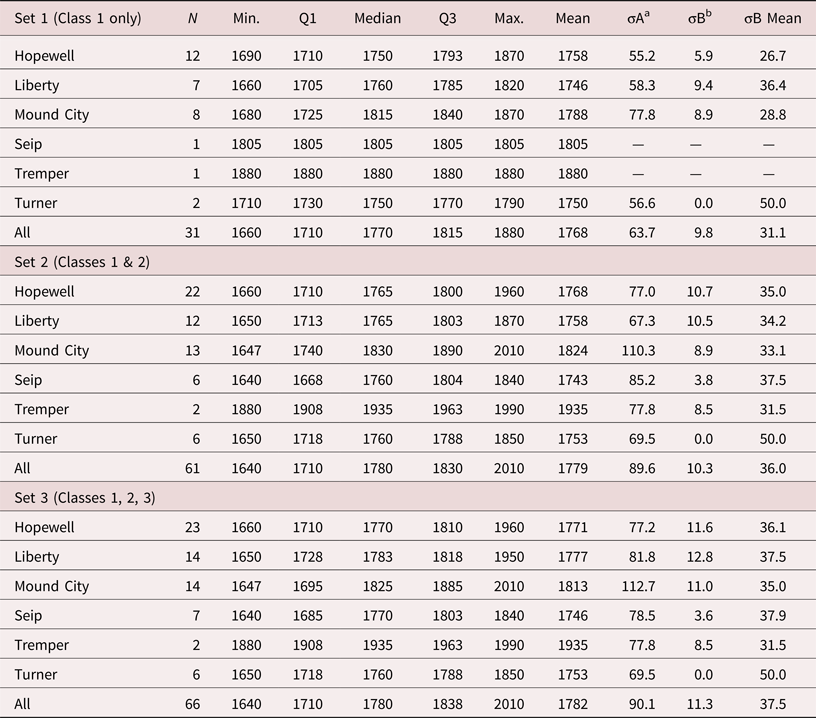
a σA is standard deviation of assayed values.
b σB is standard deviation of the standard deviation reported with each assayed value.
By relaxing our hygiene criteria to include Class 2 dates (AMS assays, good context, carbonized wood, long-lived plants) along with Class 1 dates into a Set 2, we double the size of the Big Six sample (Table 2). Now, all but Tremper have more than five dates (there are only five total dates from Tremper of any kind). The overall mean of Set 2 is slightly older (1114C years) than that of Set 1, and the associated variance of age estimates is consistently greater (σA in Table 2), indicating some loss of precision. However, average uncertainty only increases by 5.0 14C years (σB Mean in Table 2). Set 2 dates document temporal relationships that are somewhat different, and presumably clearer, than those possible using Set 1 dates alone. Notably, the duration of the Ohio episode increases by 150 14C years, or to a total of 370 14C years. This range (2010–1640 14C years BP) is consistent with the range that archaeologists have traditionally considered (Supplemental Text 1). Regarding specific sites, Tremper has the oldest mean of the Big Six—1935 14C years BP. Mound City has the second-oldest mean, 1824 14C years BP, and the maximum age estimate, but still carries the broadest standard deviation of any site under consideration (σA in Table 2). This could be measurement errors, or as noted for Set 1, a longer use span. The Hopewell Mound Group, Liberty, Seip, and Turner provide 14C records that are more similar to one another, with Seip showing the largest percentage of late dates. A clear pattern is the relatively sudden termination of site use at approximately 1650 14C years BP for five of the six sites.
By further relaxing our hygienic criteria to include Class 3 dates (standard beta-count dates, standard deviations less than 60 14C years, generally on carbonized wood), we increase the Big Six sample by only 8% (5/61 = 8%) over that of Set 2, but the sample size of Liberty and Seip by 17% and 18%, respectively. The inclusion of these dates results in a slight increase in average uncertainty associated with each assay by 1.5 14C years to 37.5 14C years (σB Mean in Table 2). The estimated maximum Ohio Hopewell episode remains as it was under the previous conditions—2010–1640 14C years BP—but the quartile range increases by eight 14C years. Once again, Tremper and some contexts at Mound City are clearly earlier than those at the other four sites (Figure 4). The mean of the two dates at Tremper is still the earliest, and Mound City the second earliest. Mound City still shows the longest span as a historic Ohio Hopewell place, and Tremper the shortest. The end of Ohio Hopewell is consistent across five of the six sites at approximately 1650 14C years BP, with Seip providing the latest dated contexts.
Boxplots showing increasingly inclusive sets that combine the three most hygienic classes of 14C dates for six Ohio Hopewell sites.

Finally, it is useful to briefly consider the effects of calibration and Bayesian modeling, focusing on the combined sample of Set 3. Here we consider a total of seven models, six for the individual sites considered separately, and then bundling all 66 Set 3 dates into an Ohio Hopewell single-phase model, all using the Bayesian modeling tools of OxCal 4.4 (Bronk Ramsey Reference Bronk Ramsey2009a). Results are presented in Table 3, and the coding and procedures are described in Supplemental Text 3, Supplemental Table 3, and Supplemental Table 4. Six of the seven models (all assays equal, no internal structure) have model and overall indexes above the critical value. Liberty is the exception, and here only the Amodel Index was satisfactory (Liberty Amodel Index = 70.5, Liberty Aoverall Index = 52.7). Consequently, Liberty was remodeled using two outliers models for the two dates with low agreement with the original model—in this case, two assays from the central Edwin Harness mound (Beta-145873 and UGA-2419). Assay UGA-2419 was wood charcoal and, following Bronk Ramsey (Reference Bronk Ramsey2009b), we employed a Charcoal outlier model. For Beta-145873 we used a Palimpsest outlier model given that the measurement was too young (Supplemental Text 3). The outlier-modeled Liberty phase produced the satisfactory model reported.
Single-Phase and Individual Site Models for Set 3 (Classes 1–3), Ohio Hopewell 14C Dates.

a with outlier modeling
b minimum hpd = shortest interval among all Bayesian credible intervals
c maximum hpd = longest interval among all Bayesian credible intervals
d model resulted in a bimodal probability distribution with 68.3% probability (1ơ) being split into two mutually exclusive ranges: AD 90–120 (36.2%), AD 130–170 (32.1%) with a 95.4% range of AD 70–185.
Considering the site models first, the Hopewell Mound Group, easily the most structurally complex of the six under consideration (Seeman Reference Seeman1979:302, 307), covers a relatively brief Span—only 215 calibrated and modeled years when compared to a range of 370 uncalibrated radiocarbon years (Tables 2 and 3). Liberty covers even less time—115 calibrated and modeled years—whereas the distribution of uncalibrated dates is longer and looks very similar to the Hopewell Mound Group (Tables 2 and 3). Mound City in comparison to the above has a much longer Span than either the Hopewell Mound Group or Liberty, with the earliest mean start date and latest mean end date of the three. The modeling of Mound City as long lived is consistent with the relative placement of the site in uncalibrated radiocarbon years. The temporal placement of Seip relative to the Hopewell Mound Group, Liberty, and Mound City is likewise similar to that obtained with uncalibrated radiocarbon dates; consequently, Seip starts at about the same time as Liberty and a bit later than the Hopewell Mound Group but lasts longer than either. The Tremper model provides index scores that indicate a good model, but it is based on only two dates, and the results are not useful for our purposes. Turner, the last site under consideration, shows the latest mean start date and ends within 55 modeled years of four of the other five sites, although comparatively, not as late as is implied by the uncalibrated radiocarbon dates. As calibrated and modeled, there is still reasonable congruence for the end use of five of the six sites, although this correspondence is not as precise as implied by a consideration of age based on radiocarbon years alone. The seventh model bundles all 66 radiocarbon dates into a single Ohio Hopewell phase as a coherent cultural phenomenon. The model fit (A = 79.6) and the overall fit (A = 61.9) are above the critical threshold (A ≥ 60), despite three dates exhibiting a poor fit with the model (Beta-115625, Beta-253201, ISGS-5645). Results indicate a mean start date of 125 ± 30 AD, a mean end date of 410 ± 15 AD, and a Span of 285 ± 35 calibrated and modeled years.
The main substantive finding resulting from the calibration and Bayesian modeling our data is that the entire Ohio Hopewell span is only 285 ± 35 calibrated and modeled years, with a minimum Bayesian credible interval beginning AD 90–120 (36.2 hpd) and ending AD 395–430 (68.3 hpd). This would seem to be a briefer span than would be concluded by measuring time in radiocarbon years alone, although strictly speaking, this is not a fair comparison (Tables 2 and 3). Perhaps fairer is comparing these results with the span and placement of the Hopewell episode by a survey of practitioners (Supplemental Text 1). Here again, the modeled data shows a shorter span and a notably younger range in Gregorian calendar years than is commonly recognized—285 calibrated and modeled years versus 350 calendar years, and beginning AD 90–120 versus AD 1. In sum and as modeled, Ohio Hopewell begins later than is sometimes recognized, four sites have a mean end date within 55 years of one another, Tremper and Mound City begin earlier than the other sites, Mound City shows the longest span of continuous use, and the few high-quality dates from Tremper minimize the utility of modeling the timing of this site.
Interpreting Findings and Ohio Hopewell Chronology
By focusing on those three classes of 14C determinations that we assume to be of the most acceptable quality, we have utilized 16% (66/425 = 16%) of the interpretable sample and 50% (66/131 = 50%) of the available dates for the Big Six. Together, they provide an Ohio Hopewell chronology that is reasonably interpretable. By way of comparison, Taché and Hart (Reference Taché and Hart2013:360) used only 16% of the available assays in their study of Vinette 1 pottery, and Wilmshurst and colleagues (Reference Wilmshurst, Hunt, Lipo and Anderson2011:1817) used only 14% in their research on Polynesian colonization. That is not to say, however, that even good-quality dates will not vary, and inclusion or exclusion of classes changes the details of the narrative somewhat. As modeled, the general temporal relationship among sites appears similar but differs in details, most notably, on the shorter and overall younger estimation of the temporal span. Time in radiocarbon years offers the advantage of stability and hence comparability among dates—especially in a region where comprehensive chronologies based on Bayesian modeling are not yet widely available—whereas modeled data provides the advantage of better approximating Gregorian time, evermore closely with each newly improved model.
Our summary assessment is that Mound City and Tremper are the earliest of the Big Six centers, with reliable dates circa 2000 14C years BP but that calibrate and model somewhat later. The floor deposit at Tremper may be the scene of the earliest large-scale Ohio Hopewell ritual events given that Class 1 and Class 2 AMS dates from the Tremper mound floor are slightly earlier than any of the Class 1 and Class 2 dates from the two best-dated mounds at Mound City—specifically, Mound 10 and Mound 13. This early position of Tremper fits with most previous analyses based on stylistic and trait list similarities (e.g., Prufer Reference Prufer1968:148–149; Ruhl Reference Ruhl1996; Seeman Reference Seeman1977; Shetrone and Greenman Reference Shetrone and Greenman1931:493; Webb and Snow Reference Webb and Snow1945:204–217; see also Gehlback Reference Gehlbach1988), and also, with gorget and pipe styles from Tremper that occur in early Havana Hopewellian contexts to the west (Farnsworth Reference Farnsworth2004:414; Farnsworth et al. Reference Farnsworth, Hynes, Hughes and Wisseman2016; Meinkoth Reference Meinkoth1995:55; Tankersley et al. Reference Tankersley, Munson, Munson, Shaffer, Leininger, Lasca and Donahue1990:223–224). At Tremper, in contrast to Mound City, most of the platform pipes were made of exotic western Illinois Sterling pipestone and Minnesota catlinite, and they equally mark the introduction of new platform pipe styles with deeper temporal roots in the Illinois Valley (Emerson et al. Reference Emerson, Farnsworth, Wisseman and Hughes2013; Farnsworth et al. Reference Farnsworth, Emerson and Hughes2021). The large physical size of crematory basins at both Tremper and Mound City (when compared with earlier individual inhumations and, later, smaller Hopewell basins) and their associated secondary cremains and offerings indicate that rituals and their presumed tie to community identities were probably broadening at this early time, as does the increased value placed on extraregional preciosities worked into objects of consistent style. Cultic innovations and wide-scale reinterpretations are key aspects of American Indian religiosity historically, and we see no reason why such patterns would not extend into deep time (see Hall Reference Hall1997). The ceramics at Tremper also are unique among the Ohio Hopewell centers (Stoltman Reference Stoltman2015:3, 55).
Mound City clearly covers much more time than Tremper based on available best-quality 14C dates. The dates from the North 40 area at Mound City to the north of the earthen walls represent as a group the earliest dates from a Big Six context (Everhart and Ruby Reference Everhart and Ruby2020), and dates from the southeast barrow pit are some of the latest (Supplemental Table 1). As noted above, some dates from Mound 10 and 13 are relatively early, and artifactual cross-ties between undated Mound City Mound 8 and Tremper suggest even closer temporal proximity (with due appreciation to prospects of style lag and/or later emulation). More specifically, the tight stylistic similarities of the dated effigy platform pipes from Mound City Mound 8 and Tremper are well recognized (Brown Reference Brown2012:301; Emerson et al. Reference Emerson, Farnsworth, Wisseman and Hughes2013:60; Prufer Reference Prufer, Caldwell and Hall1964:47). To drill down on this relationship more specifically, we note effigy pipes from Tremper and Mound City Mound 8 where the animal effigy faces perpendicular to the platform (Mills Reference Mills1916:328; Squier and Davis Reference Squier and Davis1848:271). This is in contrast to the near universal depiction on Hopewell pipes from other Ohio Hopewell sites, on which effigies face the smoker. Similar sideways-facing examples occur in several early Illinois Hopewellian contexts, and the single AMS date of 1908 ± 16 14C years BP (cal AD 140 ± 40) from Naples-Russell Mound 8 in western Illinois (Farnsworth and Atwell Reference Farnsworth and Atwell2015:121, 181) is quite consistent with the early dates from Tremper. A remarkably styled toad pipe further ties Mound City Mound 8 to the Naples-Russell Mound 8 date (Farnsworth and Atwell Reference Farnsworth and Atwell2015:174–175) and, by extension, to Tremper.
By way of cross-ties to Mound City, two additional Hopewellian dates from Illinois must be considered. Elizabeth Mound 7 in the lower Illinois Valley yielded a standard date on white oak charcoal of 1940 ± 70 14C years BP (Leigh et al. Reference Leigh, Charles and Albertson1988:70) and another of 1940 ± 15 14C years BP (Farnsworth and Atwell Reference Farnsworth and Atwell2015:196). Their relevance lies in the dating of specific forms of Hopewellian Gulf Coast bird symbolism—specifically, the “hooked tail” motif and “stubby body” forms—which tie Elizabeth Mound 7 and Naples-Russell Mound 8 in Illinois with Mound City Mound 1, Mound 2, and Mound 8 in Ohio and, farther afield, to the Crooks site in Louisiana (Brown Reference Brown2012:243; Farnsworth and Atwell Reference Farnsworth and Atwell2015:138, 175–178; Ford and Willey Reference Ford and Willey1940:66–71; Morgan Reference Morgan, Charles, Leigh and Buikstra1988:144). In sum, although the available good-quality dates from Mound City cover a considerable span, cross-ties to dated contexts elsewhere suggest somewhat more intensive use toward the earlier period of Ohio Hopewell mound building. This evaluation is consistent with Brown's (Reference Brown2012:248) conclusion that the ceramics from Mound City are relatively early in the Ohio Hopewell sequence.
Although both Tremper and Mound City have simple earthen enclosures, those at the Hopewell Mound Group, Liberty, Seip, and Turner are larger and more complex, with the appropriate developmental implications. Of these four, the Hopewell Mound Group covers the longest temporal span in 14C years, but after Bayesian modeling, Seip and the Hopewell Mound Group appear more similar—Spans of 215 and 225 modeled years, respectively. Duration at such sites can be measured not only as sequential events but in the historical life of buildings and heirlooms as they enter later contexts. Consequently, for example, within Hopewell Mound Group Mound 25, the Set 1 (Class 1 only) dates from Burial 11 and Burial 41 are separated by 90 14C years with nonoverlapping standard deviations. Similarly, the two Class 2 dates from Burials 260–261 above the floor of Hopewell Mound Group Mound 25 span even more time. Burials 260–261 are noteworthy in that “the mass of material deposited with them exceeds that associated with any other burial so far discovered in the United States” (Moorehead Reference Moorehead1922:110). A similar span of dates occurs with materials associated with Hopewell Mound Group Mound 25, Altar 1 (Supplemental Table 1). These examples support the interpretation that certain public rites carried with them the use of ancestral materials with retained animacy over time, and/or that the use life of particular ritual spaces sometimes unfolded across several generations of practitioners (Seeman Reference Seeman, Redmond, Ruby and Burks2020:325–326).
Regarding Liberty, the most important finding is that by demoting the Dicarb dates to Class 7, the site falls much more in line with chronological expectations when compared with other centers and does not extend Ohio Hopewell nearly as late as implied by these determinations. Although it is notable that Liberty and Seip bear a number of strong constructional similarities, Seip provides the later series, primarily because activities there continued after those at Liberty had ended. The ending of activities at Seip circa 1640 14C years BP, or 355–500 AD as modeled, is consistent with the presence of certain object stylizations, including steatite Copena-style pipes and also plummets similar to those found at Crystal River, Cincinnati, and Mann Mound 3 (Thompson et al. Reference Thompson, Pluckhahn, Colvin, Cramb, Napora, Lulewicz and Ritchison2017:202). The six Turner dates, although a small sample, suggest that site differences when compared to Scioto Valley centers may have more to do with distance than time, contrary to previous discussions based in large part on artifact styles that have placed Turner as the latest of the major site centers (Prufer Reference Prufer1968:148–149; Ruhl Reference Ruhl1996).
Finally, it is worth emphasizing that although available high-quality 14C determinations from the Hopewell Mound Group, Liberty, Seip, and Turner show considerable overlap and a relatively synchronous ending, overlap should not be confused with exact contemporaneous usage and/or interaction—something that is very difficult to demonstrate given our current dating tools in the American Midwest but that bears directly on the two main competing social models of Ohio processes deemed the proximity and synaptic models, respectively (Nolan et al. Reference Nolan, Hill, Seeman, Olson, Butcher, Chavali, Hillard, Redmond, Ruby and Burks2020:151).
Conclusions
When is Ohio Hopewell? The answer lies in how time is reckoned, which is in large part determined by the quality of the 14C determinations that are deemed acceptable, and the specific calibration and modeling programs that are used. The present study has examined some of these complexities and their implications, and in the process, we confront the negotiable nature of time itself as we attempt to bend it to our purposes (see Hawking Reference Hawking1988; Holdaway and Wandsnider Reference Holdaway and Wandsnider2008; Lucas Reference Lucas2005). We recognize that our own struggle with such issues is not unique, and that is further complicated by the changing viewpoints used to define and interpret Ohio Hopewell over its hundred-year history of use. The when of Hopewell always has been tied to the what and the why of Hopewell in complex fashion. Consequently, for example, in the 1950s, when Ohio Hopewell was thought to have lasted for 2,000 years, the notion of gradual colonization from a motherland might have made sense. Today, we know the time frame is much shorter, but how much shorter depends on how we sample and interpret the available 14C dates. Our approach here foregrounds the variable quality of dates in our dataset and the contingent nature of temporal interpretations. As long as we find the Hopewell concept useful, we must regularly revisit the dating of its touchable, feelable, and sortable characteristics with new techniques and new approaches. The same holds true for other enduring archaeological concepts such as Olmec and Chavin in the Americas, Bell Beaker and Bandkeramik in Europe, and Natufian and Jōmon in Asia. These are all “fuzzy sets” that recognize degrees of membership and/or the assessment of elements that have each performed a delicate dance of what, when, and why across the decades. The present study indicates that Tremper and Mound City are somewhat earlier than the other four major Ohio Hopewell sites under consideration, that Mound City is the most enduring, that Turner is no later than the other centers, and that there was a relative sudden ending to the practices we identify with these places. Reasonable estimates for the Ohio Hopewell episode are 2010–1640 14C years BP and beginning AD 90–120 and ending AD 395–430 as calibrated and modeled.
Our concern here with temporal hygiene simply recognizes in formal terms that some dates are “worse than” or “better than” in constructing a past. An appreciation of such contingency produces chronologies that may look messy when compared to the crisp slices of time that were produced in the 1960s to 1990s. This reality should not go unappreciated when we tell our public that 14C dates provide “absolute dates for the past 40,000 years” (Feinman and Price Reference Feinman and Douglas Price2010:145), or that “the actual measurement of radiocarbon is straightforward” (Feinman and Price Reference Feinman and Douglas Price2010:146), or that radiocarbon dates can now be “correctly converted to calendar years” (Feinman and Price Reference Feinman and Douglas Price2010:146). Furthermore, we should perhaps contemplate the extent to which such claims may be, or may have been, tied to our own professional identities. In sum, available data and a critical, hygienic approach suggest that Ohio Hopewell religious practices provided shorter-term satisfaction and stability than previously recognized.
Acknowledgments
We thank Ronald Hatfield, president and CEO of Beta Analytic Inc., for identifying if dates were AMS determinations in cases where it was unclear from the published accounts, and/or if they were submitted by deceased colleagues. We thank Ann Bauermeister, Jarrod Burks, Paul Pacheco, Robert Riordan, Bret Ruby, and Rebecca Wiewel for providing contextual and technical data on dates they obtained; and Gavin Lucas, Bret Ruby, and two anonymous reviewers for providing comments on our draft manuscript. We are grateful to Kevin Schwarz and Robert W. Stone for assistance with the Spanish abstract. Nineteen new AMS dates from Ohio Hopewell contexts were submitted under NSF grant (BCS1419225, PIs: M. Hill, K. Nolan, and M. Seeman) for the SCHoN project.
Funding Statement
This study funded in part by NSF BCS1419225.
Data Availability Statement
Primary dataset and OxCal code used are in Supplemental Text 3, Supplemental Table 3, and Supplemental Table 4.
Competing Interests
The authors declare none.
Supplemental Material
For supplemental material accompanying this article, visit https://doi.org/10.1017/aaq.2023.6.
Supplemental Text 1. Blind Poll of Ohio Hopewell Scholars on Temporal Span and Placement.
Supplemental Text 2. References for Ohio Hopewell 14C Dataset.
Supplemental Text 3. Descriptive Guide to OxCal Calibration and Modeling Inputs and Outputs.
Supplemental Table 1. Ohio Hopewell 14C Dataset.
Supplemental Table 2. Ohio Hopewell 14C Dates by Laboratory.
Supplemental Table 3. Coding for All Assays Used in OxCal Modeling.
Supplemental Table 4. OxCal Results.


 Open access

