


Introduction
Space security – of assets in space and their role in security and strategic practices on Earth – is an unavoidable aspect of international security today. The ‘logistical penetration of territory has increased exponentially over the last century and a half’, Michael Mann wrote in 1984.Footnote 1 It has only increased since, not least due to the proliferation of space infrastructures and related data, navigation, and communications services, extending large technical systems (LTS) or infrastructures into orbit via rockets and ground stations, and back down again via radio teleports and handheld peripheral devices and miniaturised receivers. The number of active satellites in Earth orbit has grown tenfold from around 1,100 in 2012 to over 12,000 today.Footnote 2 With the advent of ‘mega-constellations’ beyond Starlink, active satellites may reach a population of tens of thousands more by mid-century.
This article responds to previous calls to bring space infrastructures and astropolitics ‘in from the margins’ of international securityFootnote 3 by critiquing emerging periodisations of outer space and bringing them into dialogue with the wider infrastructural turn in international security. Due to the importance of space systems for international security, these periodisations’ broad interpretations of the Space Age stand to influence wider perceptions of space among broader generalist international security scholarship with ahistorical and parochial blinkers. The apparent growth in space activities has led to emerging interpretations of the Space Age that centre on three distinct periods, or Space Ages, across space security literature and within practitioner communities in space security. The First Space Age begins with the launch of Sputnik 1 in October 1957 and ends with the collapse of the Soviet Union and the end of the bipolar Cold War in 1991. The Second Space Age generally refers to the supposed democratisation and commercialisation wave in space from 1991 to the late 2010s or 2020. The Third Space Age is generally framed as around 2020 through to today, characterised by rising military threats from China and Russia, ending a previous condition of sanctuary for (US) satellites from attack. Saadia Pekkanen captured ‘three deeply intertwined trends – democratization, commercialization, and militarization’ that correlate with the three periodisations. Each theme claims three significant transformations: a democratising regime due to the growth in space-faring states, the displacement of states by private actors, and the militarisation of a previously sanctuarised space environment.Footnote 4
These periodisations are important to critique as they are used by high-profile practitioners, think tanks, and journalists that shape wider perceptions of space activities, which can in turn influence scholarship.Footnote 5 Periodisation can be useful in summarising complex or large events for wider audiences and highlight important changes or tensions despite apparent continuities.Footnote 6 However, they can also facilitate presentism or Whiggish history, where the past is interpreted as a teleological, inexorable, or linear ‘progress’ of events towards the preferred, inevitable conditions and values of the present day.Footnote 7 They can impose ‘a specific Western conception of time and…a progressivist…teleological process towards Western civilisation’, in this case privileging US space security experiences and considerations over the rest of the world.Footnote 8 Periodisations must be recognised as ‘a political technique that…regulates past, present, and future’, and international security and the study of space security must take heed of the ‘global turn’ across history and IR.Footnote 9 Whilst there is a growing literature on global orientations towards space security and astropolitics,Footnote 10 the emerging Space Age periodisations now gaining traction in public and academic discourse have hitherto remained unexamined and risk perpetuating parochial visions of space security that conflict with empirical reality.
Drawing from technopolitical scholarship, this article presents an original critique of the periodisations of the Space Age by applying the concept of system builders’ concentration of power and four paradoxes of infrastructures to space developments to show that these periodisations’ claims are less persuasive than they first appear. First, space infrastructures have been an arena for the concentration of power among multiple ‘space system builders’ during and after the Cold War, rather than outer space suddenly being democratised beyond only two superpowers after 1991. Second, the global space economy remains reliant on state or public spending, undermining hyperbolic claims of a transformative commercial revolution in space at the expense of the state. Finally, Earth orbit has always engendered a risk of warfare ever since space began to be used for military and economic infrastructure, rather than the 2020s heralding a dramatic end to a sanctuary from possible destruction. The article concludes with a contribution to the field by suggesting a singular, shorthand periodisation – a ‘Global Space Age’ – to challenge the parochialising blinkers of the three Space Ages and make the space technologies and the growing body of literature in space security more accessible to wider scholarship in international security.
System builders and infrastructure paradoxes
IR’s infrastructural turn highlights the importance of relatively mundane technological systems in the creation and sustainment of, and resistance to, material power and security practices at a global scale.Footnote 11 Infrastructures have become ‘major objects of global politics because they underpin international affairs. They connect actors, facilitate flows, and enable transactions.’Footnote 12 They are ‘dense social, material, aesthetic, and political formations…they have histories and “grow” incrementally’.Footnote 13 They directly contribute towards and become objects of contesting the ‘command the commons’ of Earth.Footnote 14 Infrastructures express McCarthy’s argument that ‘global politics is thoroughly socio-technical; anarchy is the product of people and machines’.Footnote 15 However, there remains a relative invisibility to infrastructure.Footnote 16 Strands of thought in IR on infrastructure treat infrastructures as determinants in positions of power in the international system, as things to be possessed and controlled and as forms of transformative and material structural power in the international system.Footnote 17 Mann referred to infrastructural power as the standards, bureaucracy, organisation, unified territorial reach, and state-centric governmentality methods of an imperial centre reaching out towards the provinces and peripheries. Infrastructures act on the physical and social environments in which they are installed and create dense webs of interactions, such as roads and rail. Though infrastructures are large material systems, an important part of infrastructure is ‘about who gets to tell the story of infrastructures and dominate its imagination at a particular time and place’.Footnote 18 To critique these emerging stories or linear periodisations about space and international security, an infrastructural approach and LTS, system builders, and their paradoxes need to be explained.
LTS, or large infrastructures, tend towards concentration in a political–economic system in part by the designs of system builders. Classic LTS definitions are based on domestic infrastructure creation and deployment, such as railways and electricity grids, where system builders refer to the overlap of the inventor-entrepreneurs, corporations, or public institutions of a state driving them.Footnote 19 At the international level, the system builders are the aggregate political authorities and networks that can corral a plethora of different actors and technical systems that accrete to form LTS according to their interests – often the privileged states that become a focal point for a patchwork of supporters, contractors, entrepreneurs, and beneficiariesFootnote 20 that have come to shape material structures of international security today, not least via space technologies’ underwriting of advanced military and economic systems. The privileged, materially capable actors in the international system build and embed their values and agendas into LTS, which structure the freedoms and restrictions of others. LTS remain socio-political institutions rather than brute material facts alone and ‘span the globe and define the medium…of interaction between actors’.Footnote 21 Infrastructure directly and indirectly pressures users to make certain choices over others that the system builders favour whilst being far less visible in exerting that pressure – through material services and socially constructed and agreed standards, norms, and rules created for their use. If LTS are defined by large scales and their technical, material cores, which link complex, diverse material, and social systems, which are integrated over large spans of space and time and also underpin the functioning of many other technical systems,Footnote 22 then satellite launch vehicles (SLVs) and most satellite systems, space tracking networks, and the weapons needed to disrupt or destroy them meet the criteria of LTS.
Concentration in infrastructure can also refer to the thorny entanglement of state and corporate actors. Farrell and Newman argue that global economic systems lead to interdependence, which then causes or entrenches inequalities in power and security, rather than mutual vulnerability. This is exercised through controls and chokepoints where nodes of that infrastructure have accumulated, or points through which the use or traffic of that infrastructure must go. These path dependencies can be ‘weaponised’ – or used – for coercive objectives by the possessors of that infrastructure at the expense of their users. Rather than leading to reciprocal dependence and a diffusion of relative power, as liberal IR scholars argue, interdependency leads to increased power asymmetry and security vulnerabilities. These generate ‘rich-get-richer’ effects as they are resistant to any individual actors’ attempts to overturn them.Footnote 23
An infrastructural, LTS approach instead by-passes the analytically superficial distinctions over state versus non-state power and emphasises how space infrastructures are systems and require an ensemble of actors, public and private, to bring them about and keep them working.Footnote 24 Capitalist powers marshal military–industrial complexes that require a strong state as part of them, even if only as an outsourcer-in-chief, such as in the contractor state of eighteenth-century Europe.Footnote 25 States are not inherently separate from large and capable private industries and the socio-economic elites of society. Creating a hermetic seal between public and private actors in global infrastructural power analysis is therefore difficult. As demonstrated below, large-scale studies of space security should follow the actions, power, and intent of the ensemble of space system builders where the emphasis is on a network of agents and institutions that together create, deploy, and maintain LTS, with an emphasis on the infrastructural qualities of spacepower rather than any singular capability or type of actor.
The concept of space system builders focuses analysis on how space interacts with international security, with a material basis as a starting point. Spacepower is a tool of state power, characterised by its use of and capacity to use outer space and space technologies for political ends. It is largely expressed through long-term infrastructure programmes.Footnote 26 Orbital infrastructures could not work without other terrestrial LTS, and increasingly vice versa; therefore, space system builders are often general system builders in the international system more broadly. This is also a material counterpart to Paikowsky’s construct of the ‘Space Club’, which emphasises the role of techno-nationalist prestige in space accomplishments shaping social power in the international system.Footnote 27 A focus on the system builders is valuable as ‘the agendas of system builders become inscribed in the technical features of infrastructural technologies’.Footnote 28 The value of this approach is shown through the specific space LTS encountered below. SLVs are huge national and transnational undertakings and provide access to space in the first place. As a chokepoint or hub for Space Age LTS, launch systems and their ground infrastructures (e.g., spaceports, control, tracking and telemetry stations) confer power to their builders as they become infrastructure for other space-faring states who also want to use them without developing their own equivalents. Position, navigation, and timing (PNT) satellites, like most navigation technologies, have long been crucial to state power, trade, and security practices. Global navigation satellite systems (GNSS) are as crucial to precise, automated warfare as they are to everyday economic and financial services, or even energy grid management. Only four such systems exist. Satellite communications (SATCOM) and Earth observation (EO) or intelligence, surveillance, and reconnaissance (ISR) perform critical infrastructure functions, as all major communications, mapping, and detection systems do. These Space Age LTS are crucial vehicles for space system builders’ pursuit of political, economic, and security interests in the international system.
The second important dimension of infrastructure for this analysis is that it is riddled with paradoxes, which directly undermine the linear logics of periodisation. Howe et al. suggest three paradoxes: ruin, retrofit, and risk. Ruin means that as infrastructure is generated it also degenerates, requiring constant maintenance and replacement. Despite rhetoric of progress and construction, decay and deconstruction surround infrastructure and its politics. Retrofit connects the old infrastructures of the past to the present and an idealism of future infrastructure. Further, the constant adaptation of old or existing infrastructure to new needs shows that infrastructure is less solid or immovable than it may appear. Risk refers to the fact that whilst infrastructure can be built to mitigate some risks, it will generate new ones, particularly as it could fail or become a target and create acute weaknesses that could be exploited by hostile actors, creating a ‘security paradox’.Footnote 29
Closely connected is a fourth paradox of technological determinism. There is a constant interaction between human agency in creating and adapting technologies and the objective material forces that technological artefacts create and impose on humans once they exist. This is a typical agent vs. structure debate and cannot be relitigated in depth here. However, it is important to have a clear position on it for analysis. Humans choose what gets invented and developed, but they also have to respond to brute material properties and surroundings imposed on them by material objects, including the past decisions of the humans who created those material structures that already existed.Footnote 30 Whether intentional or not, international security is in part impacted by the effects of non-human objects’ material characteristics. Technological momentum can develop when path dependencies become established, or as a ‘user heuristic’ where system users respond to infrastructural technologies in ways builders did not foresee, giving infrastructures some agency.Footnote 31 LTS can generate effects from giant masses of matter and the human-driven goals and values that are embedded in such matter.Footnote 32 Technologies can get harder to change the longer they are allowed to establish themselves and drag actors into dependency networks, becoming a determining force on ‘others’ that have little direct control over LTS.Footnote 33 Social and material forces interact, compete, and reinforce at the same time. Material objects have implications just as people do.
Rather than seeing technology and infrastructure as a purely non-human force that simply happened, we can apportion aggregate blame and credit for the insecurities we face in space and perhaps help others to find ways out of the paradoxes and perils presented for international security by space systems that otherwise could seem fatalistic. Focusing on the space system builders and the paradoxes of infrastructure results in a more nuanced materialist approach to astropolitics and international security that balances a focus on major powers with the recognition of impacts on and agencies of smaller actors and transnational knowledge flows, rather than the linearity and false dichotomies of the three Space Ages, to which this article now turns.
Democratisation and the First Space Age
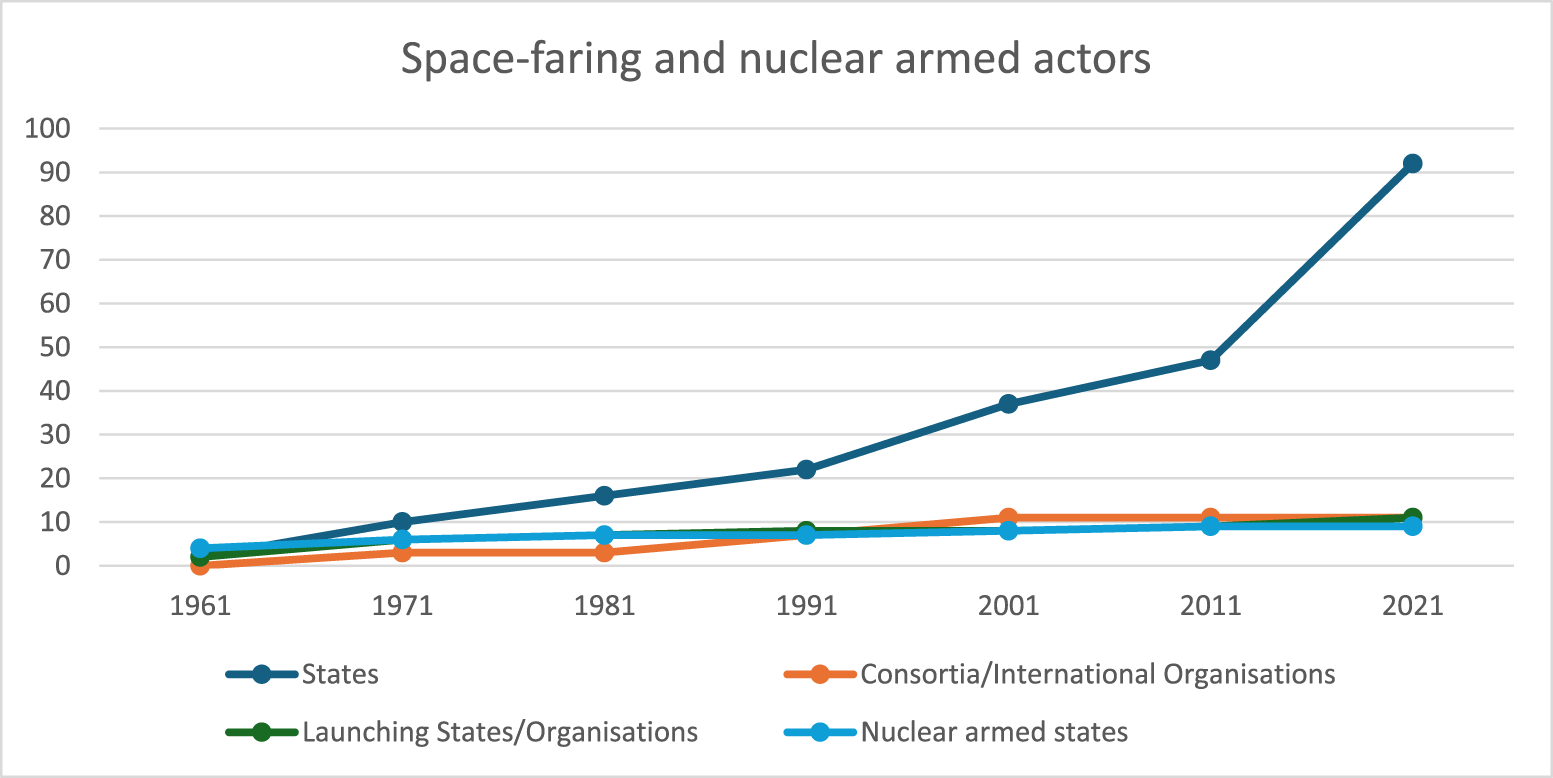
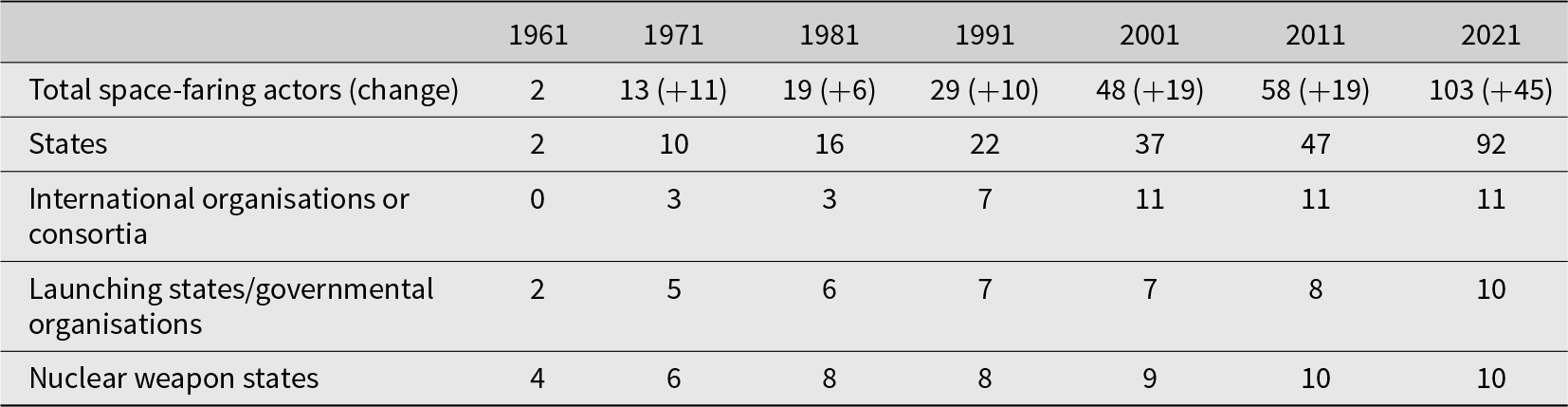
William E. Burrows popularised the First and Second Space Ages in his 1998 book This New Ocean: The Story of the First Space Age.Footnote 34 Crewed spaceflight cooperation between Washington and Moscow in the 1990s was symbolic of a new, Second Space Age that had moved on from bipolar competition.Footnote 35 This periodisation continues to influence contemporary scholars, practitioners, and policy.Footnote 36 The bipolar First Space Age saw the superpowers account for 96 per cent of launches and 94 per cent of satellites.Footnote 39 A Second Space Age came to mean democratisation due to a report from an influential US think tank, citing 43 per cent of new satellites and 39 per cent of launches in 1991–2016 as coming from outside the United States and Russia.Footnote 40 Space ‘democratization means space activities are expanding to a growing number of states and nonstate actors, distinguishing this space age from one when two powers – the United States and the Soviet Union – were dominant’.Footnote 41 The number of actors in space has grown over time (see Table 1 and Figure 1).
Space-faring and nuclear armed actors.Footnote 38
Cumulative number of space and nuclear actors over time (table)Footnote 37.
Yet the linear story of a bipolar First Space Age followed by a democratised post-1991 Second Space Age obscures efforts to develop alternative centres of spacepower beyond the superpowers. The Soviet collapse coincided with the maturation – not emergence – of the space programmes of western Europe, China, India, and Japan, which accounted for most other satellite launches. Sheehan noted in 2007 ‘a gradual emergence of a growing multipolarity’ along the fault lines of states that possessed ‘vigorous space programmes’.Footnote 42 One space historian noted a ‘radical shift’ in political patterns:
where two superpowers vied alone for prestige and military advantage, now seven nations have launched satellites on homemade boosters, and dozens have participated in cooperative satellite programs for commercial, scientific, and technological motives… Where once government arsenals monopolized spaceflight, now a spectrum of institutions – public, semipublic, and private, military and civilian, national, bilateral, and multinational – adapt to the demands of space development… the space age…will be shaped in years to come as much by developments in the ‘second tier’ of European and Asian states as in the Big Two.Footnote 43
These words were penned by Walter McDougall in 1985. This undermines a Cold War–centric periodisation of the First and Second Space Ages. France (1965), Japan (1970), China (1970), the UK (1971), and India (1980) launched their own satellites into space on their own SLVs. Israel also joined a prestigious Space Club by 1988; however it cannot launch heavy objects beyond low-Earth orbit (LEO).Footnote 44 It is no coincidence that the majority of these launching actors correspond to states that possess nuclear weapons or extensive nuclear and missile industries, or are in nuclear alliances.Footnote 45 Since 1991, only three new launching states with significant launcher programmes have emerged: Iran (2009), North Korea (2012), and South Korea (2013). The number of space-faring actors looks like a stable trend before and after 1991, but there is marked increase in space-faring states only after 2011, as shown in Table 1 and Figure 1.Footnote 46 Space-faring actors refers to states that have successfully sent a satellite into orbit or have registered orbital craft in their jurisdictions, such as commercial or privately owned satellites for whose behaviour their owning or launching states are ultimately liable, as per Article VI of the Outer Space Treaty.
In 2024, the United States launched 169 orbital rockets, China 68, Russia 17, and Japan 7, whilst Europe and India launched 5 each.Footnote 47 The major pathways to space have run through the United States, China, Russia, western Europe/France, India, and Japan as political authorities – or space system builders – since the early 1980s. Contrary to the periodisations, the end of the Cold War in 1991 seems like an unremarkable date by such a measure. The periodisations deprivilege the quality and character of specific capabilities and technologies, where nuanced stories and meaning in global infrastructural politics are lost in the statistics. In 1985 Europe had overtaken the United States in its share of the commercial satellite launch market and China secured 10 per cent between 1988 and 1998.Footnote 48 These were not insignificant achievements in developing alternative LTS and infrastructure in the context of American and Soviet dominance. Today both China and the European Union (EU) have completed the deployment of their answers to the US global positioning system (GPS): Beidou and Galileo, respectively. Japan and India have also developed independent regional or GPS augmentation navigation satellites. Russia has struggled to modernise and maintain GLONASS as a fully operational system in the twenty-first century, expressing the infrastructural paradoxes of ruin and risk.Footnote 50 But these constellations are not numerically large – each GNSS constellation typically numbers around thirty satellites and therefore does not appear significant in aggregate satellite bean-counting methods of assessing spacepower, as seen in Table 2. Conversely, Starlink’s 7,050 satellites give the United States a stark numerical advantage in the absolute numbers of satellites and launches. That single constellation – which accounts for most of SpaceX’s launches due to the high volume and replenishment/maintenance requirement as a result of the orbital decay of its low-flying satellites – provides a useful but only one kind of communications service, which cannot meet all strategic or economic needs like the patchwork of other, smaller constellations.
Number of active satellites owned by or registered within stated political authority, March 2025Footnote 49.

This demonstrates why the qualitative breadth of capabilities, or thinking about large technical systems, rather than quantitative depth alone, matters and why big pictures of space security and astropolitics must look beyond China and the United States and towards a small ensemble of space system builders. Aliberti et al. echo this by placing the same six leading authorities ahead of others in the UN system.Footnote 51 For Japan and India, the paradox of retrofit is evident in their PNT systems. Their GPS augmenter constellations, QZSS and IRNSS respectively, are building capacities for potential GNSS development independent of GPS in the future, but until they do so, they remain dependent on the ‘legacy’ GPS technologies of the United States. The EU began its GNSS journey with a GPS augmenter of its own (European Geostationary Navigation Overlay Service; EGNOS), which became the basis for its own GNSS and a source of PNT service independent of direct American control. Retrofitting and adapting to existing infrastructure can lead to new combinations and systems with time, resources, and political will – though very few actors can do so. This encapsulates difficulties in interpreting power given the paradox of retrofit, where much PNT infrastructure today and into the future is built upon or in contrast to GPS, a 1970s technology programme built to prioritise the US military’s needs and values at the time – not least nuclear warfighting rather than civilian applications.
The First Space Age’s Cold War superpower claims to a post-1991 democratisation turning point deprivileges other actors’ important early achievements in developing alternative LTS through the 1960s–1980s, which required transnational knowledge and technology flows, including between the less capable powers. Peoples and Stevens note that orbital infrastructures tend to reinforce political fault lines rather than transform them, contrary to what the periodisations imply.Footnote 52 Space system builders can be traced along those fault lines, arguably most evidently with SLV and PNT systems, which are among the most costly and difficult orbital infrastructures, amounting to some of the most important LTS or infrastructural chokepoints in the twenty-first century.
Given a mastery of essential technologies and industries across a number of satellite types and successive deployments over decades, as well as the capability to launch their own rockets up to geostationary orbit (GEO) or beyond, the United States, China, Russia, Europe (collectively via the European Space Agency and European Union), India, and Japan can be classed as space system builders. Any other state or actor wishing to make inroads in space in a way that is not entirely autarkic will need to reckon with their influence and infrastructural power. Rather than a tide of democratisation, space system builders remain few in number, and therefore infrastructural power is concentrated and may point towards a new duopoly given America and China’s rocket and satellite production leads over all other space powers. The United States remains arguably the most capable spacepower, with China as their nearest rival, with the latter using space technologies as part of the infrastructural Belt and Road Initiative.Footnote 53 Either way, neither side of the debate on relative US–China power or a multipolar order supports a widely democratised interpretation of the political regime in outer space when the material base for all space activities remains in few political hands.
The First Space Age periodisation undervalues the non-superpower space system builders during the Cold War, whilst over-emphasising the extent of democratisation in space after 1991. There were significant material–social achievements by the non-superpower space system builders during the Cold War, taking advantage of global, transnational knowledge and technical flows in their pursuit of creating their own footholds in Space Age LTS. This contrasts with a ‘democratised’ Second Space Age that underemphasises the material concentration of space infrastructure and power among a fraction of the political authorities in the UN system. Taking democratisation in the post–Cold War years to mean more actors with satellites in spaceFootnote 54 is a superficial quantitative claim that does not make the United Nations’s instruments more democratic in quality when around ten states can disproportionately influence the rest of the actors of the international system because they alone can provide access to space, or attempt to prevent its use by others. Redistributive justice elements in the international outer space legal regime have been watered down, resembling neocolonial injustices despite the increase in space actors.Footnote 55 There have been successes in new governance agreements in recent years, such as the 2018 Long Term Sustainability Guidelines, but many instruments remain ‘soft law’ approaches with wide discrepancies in adherence, or remain draft treaties. Despite states only accounting for 67 per cent of the involved delegations, an effort at developing a report identifying common threats and responsible behaviours in space failed at the UN General Assembly in 2023 largely as the result of Russia’s refusal.Footnote 56
Perceiving the first decades of the Space Age through the coming and going of Cold War bipolarity – or superpower concentration followed by a mass democratising decentralisation of capability – elides the impacts of ‘infrastructural spacepower’ for other actors with or without their own space systems. They open new avenues for dependencies as developing states are increasingly using military space applications and civil space infrastructure and pursuing indigenous space technology development in cooperation with major space powers, such as Nigeria, Egypt, and South Africa.Footnote 57 Such states want to increase their roles as users of the system but do not possess the launch and satellite industries the system builders have. States and their industries must conform to the standards and regulations of the foreign launching authorities, satellite builders, and markets, whilst cooperation partnerships may involve restrictive intellectual property and technology modification provisions, or jurisdictional issues in case of disputes, such as UK–Nigeria space cooperation in the late 1990s and early 2000s.Footnote 58 A major component of a draft EU space law requires all non-EU vendors of space services to the EU market to adhere to all EU industrial and environmental laws and standards, or be denied market access – projecting European standards, values, and norms beyond the EU’s jurisdictions along the contours of Europe’s space LTS, specifically SLVs and PNT systems.Footnote 59
Encapsulating the paradox of risk, achieving the impressive technopolitical goal of launching a satellite in space may only further increase newcomers’ (weaponisable) dependencies on the space system builders, as they provide much of the services and infrastructure needed to maximise the operations of any satellite constellation, from launches to ground stations, from teleport receiving stations to satellite tracking sensors and orbital traffic analytics that warn of potential collisions with other satellites or space debris. Ukraine’s dependency on third-party space support, in particular on Starlink, in fighting off the Russian invasion has also shown the danger of weaponisable dependencies relying on third parties for space support for offensive military operations.Footnote 60 This is the aggregate result of the work of the space system builders: the United States, Soviet Union/Russia, Europe, China, Japan, and India. Their roles as system builders had been in place long before the Berlin Wall fell. This supports the overturning of the centrality of the Cold War in the wider study of global history between 1945 and 1991.Footnote 61
Commercialisation and the Second Space Age
A Second Space Age is often defined through the commercialisation of space, leading to a reduction in the state’s role in driving space activities and industry.Footnote 62 It is true that there are more privately owned satellites in space today compared to forty years ago. Thirty-six per cent of new satellites in 1991–2016 belonged to commercial entities, as opposed to 4 per cent until 1990.Footnote 63 Decreased launch costs and miniaturised payloads reduced barriers to entry and allowed more private companies to start in the space business, a trend the space community refers to as new space.Footnote 64 Santiago Rementeria summarises it as ‘a liberalised and diverse ecosystem convergent with the digital economy and supported by a new spaceflight culture…viewed as a disruptive transformation’.Footnote 65 In the mid- to late 2000s, private investors tilted towards the US space industry by funding a new ecosystem of satellite, launch, and tourism space companies, where around 150 startup companies received $16 billion from private and public sources between 2000 and 2016.Footnote 66 The most successful – SpaceX, with its Falcon-9 SLV series and reusable first-stage boosters –, broke the old monopoly over the US government launch contracting held by United Launch Alliance (ULA), a company jointly owned by Boeing and Lockheed Martin. Townsend expresses a popular sentiment that commercialisation, particularly after deregulatory reforms in the Obama administration, is driving a ‘renaissance’ in US space activities and has enabled new infrastructures such as mega-constellations of small satellites populated by hundreds or thousands of satellites of a few hundred kilograms of mass,Footnote 67 as opposed to low dozens or handfuls of big satellites per constellation measured by the tonne, manufactured by the large ‘primes’ of the aerospace and defence industries.
Yet the ownership of a satellite does not explain where the demand for that service or product is coming from – or who needs and pays for that service, which tells us more about the political economy. A Bryce Tech report shows that over 75 per cent of satellites launched into space in the first quarter of 2025 are operated by commercial entities, but it does not show the public sector investment, grants, or custom those commercial operators depend upon as a business.Footnote 68 Distinguishing public from private power and agency is not only a Western difficulty: a Chinese definition of commercial launch activities includes companies using private and public finance models to satisfy security goals.Footnote 69 Distinctions between profit-driven ‘merchants’ and security-driven ‘guardians’ in the space sector are increasingly difficult to maintain in practice as power concentrates among a mix of public and private actors, or a ‘space system’ with a ‘complex of institutions, artifacts, national and international networks, production facilities and commercial activities’.Footnote 70
A full accounting of all space companies and their revenue streams is not possible, but there is scant evidence available that private demand or custom has decisively outgrown the public sector’s grants or custom. In other words, it is not clear if any private space companies would be financially viable without public spending. SATCOM is one of the applications with the longest established private sector demand, yet Intelsat, Iridium, and ViaSat still sell their services to a mix of public and private customers, including military forces, public broadcasters, and other military–industrial companies reliant on the public purse themselves.Footnote 71 Some commercial operators have been able to offer new imagery and SIGINT services, but again primarily for governmental institutions.Footnote 72 Commercial contractors and providers have long been important, if not symbiotic, actors within US national security space policies and acquisitions.Footnote 73 The United States Space Force (USSF) and the National Reconnaissance Office (NRO) are spending large sums on new contracts for their largest ever constellations, Starshield, provided by SpaceX under contract.Footnote 74 Motorola’s Iridium relied on Pentagon investment during and after development/deployment in the 1990s, not unlike Starlink receiving hundreds of millions of dollars in military R&D many years later.Footnote 75 SpaceX effectively subsidises individual subscriptions to Starlink services to make them affordable to commercial users, as their ‘phased-array devices have traditionally been too expensive for commercial use, thus limiting them to military use’.Footnote 76 In 2023 the public sector accounted for 74 per cent of the global ‘space business’.Footnote 77 In 2024, SpaceX’s revenues from the profitable parts of its launch business amounted to $4.9 billion, of which $3.8 billion came from US government contracts – 77.6 per cent.Footnote 78
Townsend claims that proliferated commercial ISR constellations, with very frequent revisit rates measured in hours, have ‘revolutionized everything’ because of the increasing availability and use of high-resolution space-based imagery made by commercial companies in areas such as transport, surveillance, and agriculture.Footnote 79 Yet the relatively availability of commercial optical (visible light) space-based imagery in the weeks leading up to the full-scale Russian invasion of Ukraine in 2022 was still selective and subject to ‘shutter controls’, where the US government selected what information was available to the media and public, and when.Footnote 80 France could claim to have already pioneered a more entrepreneurial and agile approach to space products with the SPOT imagery programme in 1982.Footnote 81 Commercial space imagery legislation in the United States can be traced back to 1984 with the Land Remote Sensing Commercialization Act.Footnote 82 Therefore, the ‘newness’ of new space is open to debate, and the new space term itself can be traced back to 1988.Footnote 83 Thus, this intermingling of public and private, military and civilian, is not new to the post–Cold War era or the twenty-first century, nor are commercial space intelligence providers immune from the influence of the state.
New production methods do not necessarily herald a new era, either, though they can feature in claims to new eras. A senior practitioner claimed in 2021 that ‘we are now entering the Henry Ford phase of the space age’ due to the mass production of generic satellites for SpaceX’s Starlink, rather than small batches of made-to-order unique satellites.Footnote 84 Yet twenty years prior, Motorola had apparently ‘done for satellite manufacturing what Henry Ford did for automobiles in 1908 with his invention of the production line. Sixteen-hundred-pound [725 kg] Iridium satellites were produced on an assembly line, one every 4.5 days.’Footnote 85 If claims of the displacement of the state as the prime demander, and therefore driver, of space development is to be achieved, one would not expect the public sector to still be footing the majority of the bill for such services or being called upon to provide public incentives – as Townsend does – for new commercial ventures in a supposed new commercially driven era in space.Footnote 86 Even with mostly privately funded ventures, a ‘linear expectation of an entirely business-driven “New Space” scenario is illusory’, and instead a complex co-evolution between a mix of public, semi-public, and a range of small and large private actors continues.Footnote 87 This is not to deny incremental or noteworthy technical changes, but claims to political–economic revolution are overblown when what is seen is the paradox of retrofit connecting tethers between old innovations and new variants, between the past and present, furthering the supremacy of the same space system builders, in particular the United States.Footnote 88 New heights of American entrepreneurship in space may reflect evolutions of an entrenched government–industrial space complex, rather than the revolutionary displacement of the state in space.Footnote 89 The Chinese commercial space industry may be seen by central government only as a method to offset, rather than replace, the large public cost of maintaining space infrastructures.Footnote 90 The demise of the state in space may well have been exaggerated. Rather, new space may perhaps be a quintessential ‘shock of the old’.Footnote 91
In space, a twist is evident in Farrell and Newman’s logic sequence of states ‘weaponising’ global economic infrastructure. They argue that economic networks:
were not constructed as tools of statecraft. They typically reflect the incentives of businesses… By building centralized networks, market actors inadvertently provide states… with the necessary levers to extend their influence across borders Thus, structures that were generated by market actors…can be put to quite different purposes by states.Footnote 92
In space, the story is different and a crucial point for international security studies. What began as global military and weapons networks have become global economic networks. They are paragons of the paradoxes of ruin, retrofit, risk, and technological determinism. GPS is perhaps the greatest example: a system designed to assist in nuclear warfighting is now also used to deliver pizza and is ushering in a ‘gig economy’ twinned with mobile devices and location-based software across the connected world.Footnote 93 Market forces alone do not explain the rise of four separate GNSS infrastructures that seek to provide the same services – but a ‘war economy’ that seeks to duplicate crucial productive infrastructure with security and military needs served alongside economic needs does.Footnote 94 China’s Beidou GNSS has clear sovereign military applications alongside its commercial–industrial applications within China and abroad in its Belt and Road programmes.Footnote 95 Whilst commercial space services and companies can meet collaborative and humanitarian needs, private actors are layered onto exertions of soft power and political influence by their host institutions.Footnote 96 The Space Age state is not reactively taking advantage of the invisible hand of the market – the state has been in on it from the start as a space system builder.
The paradox of ruin, of creation and destruction, becomes evident at the intersection of military and commercial services provision from satellites – or dual use systems. Useful services are provided for relatively benign ends (such as search and rescue in remote regions), but the same systems are also used in destructive practices in the name of the state by military forces or extend a capital’s unilateral ‘logistical penetration’ and centralise domestic power. Iridium and Starlink service availability in remote regions shows the continuing ability of public–private military logistics to shape civilian economic development. The ‘Uber for Artillery’ metaphor to describe Ukraine’s Viasat, then Starlink-enabled artillery command and control and graphical information system (GIS)Footnote 97 is merely the latest example of civil–military infrastructural intermingling. Whilst production systems have been increasingly globalised and privatised,Footnote 98 the state and markets have been aggregate system builders throughout the First and Second Space Ages. If the state is to be eclipsed as the driving (or funding) force in the global space economy, this is not evident yet. Capitalist space powers marshal military–industrial complexes, which require a strong state as part of them, even if only as an outsourcer-in-chief or perhaps a ‘space age company-state’ where corporate assets are indistinguishable from state-controlled assets.Footnote 99 This is hardly a political–economic revolution or a discrete new kind of Space Age because of the generations of precedence in public–private entanglement in infrastructures. Indeed, even with the rise of many new commercial entities, they have not ‘radically altered the social purpose of space activities’ away from state interests.Footnote 100 Just-in-time logistics for the everyday consumer mirrors long-standing logistics in the US military where war and trade are entangled, civil–military distinctions are precarious, and logistics is the site of capital accumulation and violence.Footnote 101 These systems have long been targeted in wars, and space systems are no different.
Militarisation and sanctuary’s end in the Third Space Age
The paradoxes of ruin, retrofit, risk, and determinism surrounding space infrastructures become evident in, and fatally undermine, the Third Space Age. As infrastructures reach orbit, accruing new advantages for the space system builders and users, the paradox of ruin ensures that they are also capable of destruction, whether by enabling more precise and lethal long-distance missile strikes, letting such systems fall into disrepair, or degrading the orbital environment further with more debris that can remain in orbit for decades, centuries, or more, making specific orbits unusable in the future.
Cowen states that ‘the supply chain is understood to be both vital and vulnerable and so in urgent need of protection’,Footnote 102 which corresponds to wider concerns about the development of new methods of attacking more rearward logistics lines with smaller and cheaper munitions, particularly drones and infrastructure sabotage, leading to the logistics ‘tail’ needing ‘teeth’.Footnote 103 Failing to protect LTS that are entwined with military and civilian critical infrastructures could lead to paralysis in wartime, meaning that space warfare seems ever more likely should major powers go to war, as the service loss and economic damage caused by a conflagration in orbit continue to increase. This paradox of risk is acute for modern and expeditionary military forces in particular, despite the advantages they accrue from commanding the coastline of Earth orbit.Footnote 104 New logistical capabilities are rolled out using complex and advanced logistics chains that now spread into outer space to confer military advantage – only for them to become targets themselves. This increased desire and apparent risk for counterspace operations is now leading some to periodise a Third Space Age defined by ASAT weapons development and an end to the condition of sanctuary from conflict in space. This is in direct opposition to an argument that the increasing commercial stakes in space may deter conflict due to the greater asset values in space and the costs of any conflict.Footnote 105 As economic interests increase, so do the stakes and political objects of conflict. There is no automatic logic that this decreases the likelihood of war.
David Lupton defines ‘space sanctuary’ as a doctrine that space systems are a stabilising factor in nuclear deterrent postures, and that their role in missile early warning and preventing surprise attacks means the best way to ensure deterrence and maintain the right of overflight of other states via orbit is to designate space as a ‘war-free sanctuary’.Footnote 106 In August 2023, USSF Lieutenant General John Shaw stated that the most significant development of the Third Space Age is the emergence and advancement of threats and potential for conflict extending into the domain as a result of increasingly sophisticated Chinese and Russia counterspace weapons development and testing, including highly manoeuvrable satellites that have weapons potential.Footnote 107 Russia’s Luch/Olymp satellites, and the US Geosynchronous Space Situational Awareness Program (GSSAP), or Hornet, are known platforms for such operations. China demonstrated a ‘space tug’ operation in 2022 with the SJ-21 satellite, which grappled an inactive Chinese satellite in the lucrative GEO belt at an altitude of 35,786 km above the equator and flung it on a trajectory into a higher, less useful orbit or ‘graveyard’, freeing up a slot in GEO.Footnote 108 Some Chinese manoeuvres have been dramatically described as ‘dogfighting’ by the USSF.Footnote 109 It is estimated that China has tested or deployed over 100 satellites with advanced manoeuvrability capabilities across all orbits.Footnote 110 This encapsulates paradoxes of ruin and risk. Though the technologies and techniques have many benign uses for the sustainable use of space, such as refuelling, repairing, and clearing ‘dead’ satellites, conducting disruptive or damaging close operations against non-consensual satellites as a weapon is possible as such a potential capability is an objective material characteristic of the technology.
Yet neither these nor the use of non-kinetic methods of disrupting satellites, such as electronic warfare and cyber-attacks, is an unprecedented rupture with the past. These and other ASAT programmes have long pedigrees stretching over decades and across the three Space Ages. Sanctuary is not ‘only now’ being ended, as the paradox of retrofit emphasises the long historical legacies modern systems are built upon. Earth orbit as a passive, sanctuarised military environment and a stabilising factor enabled what Gaddis referred to as the ‘reconnaissance revolution’, or what Moltz calls ‘space stability’, which has only since 2020 become threatened according to Third Space Age proponents.Footnote 111 With the United States declaring outer space a ‘warfighting domain’ and NATO using the ‘operational domain’ nomenclature, it is at first glance not unreasonable for Steven Lambakis to declare in 2022 that ‘the argument over whether space is a warfighting domain or a sanctuary is over’.Footnote 112 Yet Lupton emphatically argued thirty-four years earlier that ‘the Sanctuary doctrine is gone and cannot come back’, referring to it as a ‘fallen star’, ‘bygone’, and ‘passe’ as a result of 1980s US and Soviet ASAT and space support for conventional terrestrial forces programmes.Footnote 113 These do not include electronic warfare or cyber methods of attacking or disrupting satellites, the activities of which are harder to obtain unclassified information on but are known to occur, not least in Ukraine,Footnote 114 and undermine the view of space as having been a place of ‘sanctuary’ from hostile actions.
Declaring an end to space sanctuary today relies on a textual and linguistic move to pacify or conceal military histories during the Global Space Age and paint a fatalistic military picture to the benefit of those arguing for more aggressive postures. It betrays what Herbert Butterfield defines as a Whiggish interpretation of history, referring to ‘the tendency…to emphasise certain principles of progress in the past and to produce a story which is the ratification if not the glorification of the present’.Footnote 115 This is embedding political values into space LTS and ASATs. There is a claim to action against an acute threat made in a Third Space Age periodisation. The supposed sudden end of space sanctuary obscures the uneven, non-linear, long-term, and sometimes reversed development and deployment of space weapons that complicate simplistic notions of space today no longer being a sanctuary from war, justifying a new armaments programme and more belligerent rhetoric.
Whilst the United States never explicitly declared space a sanctuary or that it would attack Soviet reconnaissance satellites in a time of war, in practice ‘neither [Cold War] superpower really treated space as a sanctuary’ and would be able to attack space systems in the context of a general war.Footnote 116 In keeping with the paradox of ruin – space weapons have seen many systems being deployed only to fall out of use or into general disrepair or withdrawal. The USSR’s space-based weapon system, Isrebitel Sputnikov (IS; Satellite Destroyer), saw eighteen known intercept tests against satellites between 1963 and 1982, was declared operational in 1973, and paved the way for a more advanced version, Naryad, in the late 1980s, which was decommissioned in the 1990s.Footnote 117 Nudol is a resuscitation or a ‘retrofit’ of old Soviet era systems. Between 1963 and 2008, the United States conducted thirty-five direct-ascent kinetic-energy ASAT tests, but such systems did not trigger an inevitable slide towards warfare or a perpetual deterioration in relations between the space system builders.Footnote 118
This paradox of retrofit is most evident in the proposed Golden Dome space-based nuclear missile interceptor programme, which is a reincarnation of Ronald Reagan’s Strategic Defense Initiative or ‘Star Wars’ programme of the 1980s. Various missile defence and ASAT developments continued after the 1980s, particularly in the United States, such as with the Ground Based Interceptors and SM-3 missiles, which can be adapted to anti-satellite rather than missile defence roles. The first Trump administration’s rhetoric on space warfare can be seen as déjà vu, echoing the George W. Bush era Pentagon publication, Joint Vision 2010.Footnote 119 Space weapons developments are longer-term capability hedges with peaks and troughs in activity reflecting waxing and waning space security concerns, rather than singular ruptures or points of no return. Kinetic-energy ASAT testing saw a peak in the mid-1960s, lower levels of activity in the 1980s, virtually none in the 1990s, and a resurgence since 2005, peaking in 2019.Footnote 120 These show not only the long threads behind these systems but also their adaptability and flexibility when the centres of power demand it, again raising a paradox in the apparent rigidity of LTS.
Pacifying or de-militarising two previous Space Ages imposes blinkers on historical truth and is a rather US-centric, parochial imposition, which is unwise for a global field of study such as international security to adopt. The Third Space Age also deprivileges the agency and perspectives of the other space system builders. It elides the long and uneven history of space weapons development, where the United States is a co-participating space system builder alongside Russia, China, India, Europe, and Japan. They put targets worth hitting in space in the first place, unleashing the infrastructural paradox of risk in orbit.
China, Japan, and India are expanding military satellite programmes according to their own needs and timeframes, and their military space histories do not fit the US-centric periodisations. Indeed, once the United States was a major ally of China’s space development. The 1970s and 1980s saw US–China space technology transfers and sales that were recast as a normal part of bilateral relations, a history that now seems largely forgotten in the US space and foreign policy community. China hosted a missile tracking site for US needs after the 1979 Iranian Revolution and LANDSAT receiving terminals that helped Beijing monitor Soviet forces on its northern borders.Footnote 121 Following space technology investment as part of Deng Xiaoping’s Four Modernisations, China responded to the shocks of the 1991 Gulf War, 1996 Taiwan Strait Crisis, and the 1999 bombing of the Chinese embassy in Serbia by accelerating military space modernisation alongside other information and missile capabilities.Footnote 122
Moving to the smaller space system builders, for Japan, the ‘Taepodong Shock’ of 1998 showed a complete lack of Japanese technical intelligence over North Korean missile proliferation. It set in motion reforms that would usher in changes to the constitution, manifesting in space through the Basic Space Law of 2008. This allowed the Japanese Ministry of Defense to embark on several explicit military space programmes, including communications and reconnaissance satellites to develop initial industrial and operational capabilities, signalling the possible final demise of the Yoshida doctrine.Footnote 123 Now Japan is embarking on a significant rollout of new military ISR systems, composed of dozens of military satellites, as part of the ‘Space Security Initiative’.Footnote 124 India’s Ministry of Defence embarked on more explicit and ambitious satellite communications and ISR programmes, including radar imagery, with a particular focus on maritime traffic monitoring, in the wake of the 2008 Mumbai terrorist attacks.Footnote 125 Israel could also be included as a significant space system builder closely tied to the United States on the military front, as it is the only state so far known to have intercepted a missile in outer space outside of a test with its Arrow-3 interceptor, which could be used as an anti-satellite weapon in lower orbits.Footnote 126 Following a test intercept in 2019, India now wields an ever-increasing array of military satellites and ASAT capabilities, even as China’s own space dependencies have grown. The paradox of determinism is evident here as the space system builders are responding at the same time to the actions of other humans and the objective characteristics and possibilities of their technological systems.
Conclusion: Infrastructure matters in a Global Space Age
The superpower–democratisation, state–private, sanctuary–warfare dichotomies imposed by the periodised Space Ages are limiting and parochialising for security research and the imagination. Instead, the infrastructural LTS approach is more useful for space security research. This article has interpreted the leading space powers and their significant private actors as aggregate space system builders who concentrate infrastructural power or weaponisable interdependency, particularly among those with SLVs, broad satellite industries, and PNT systems, which are the backbone and an objective material reality for the majority of states in the UN system that have little say in their deployment, provision, maintenance, and renewal. Contrary to the concept of weaponised interdependence, the public and private sectors have long been co-builders in developing orbital infrastructures, rather than the state reactively instrumentalising or militarising previously strictly commercial behaviour. It has also shown how space infrastructures, like all infrastructures, are characterised by four paradoxes that space security research may find useful to frame future research agendas on orbital and their connected terrestrial infrastructures: first, where the promise of new space capabilities and services is haunted by degradation, destruction, and the ruin of other systems and people. Second, where apparently inflexible and expensive Space Age architectures and weapons systems are constantly retrofitted or adapted subject to political will. Third, where greater risks and insecurity follow the security or advantages gained by new space systems that invite hostile fire due to their inherent, objective material power. Finally, where the space system builders are constantly acting in a social and material environment where technically embedded ideas, people and political wills, and brute or objective material forces can sit in opposition or collusion at any given time. Scholarship in international security can benefit from this infrastructural approach as it by-passes debates on polarity and order that demand overly prescriptive and categorial analyses that override more nuanced materialist interpretations and recognise power concentrations via infrastructure and systems as well as the transnational flows of technology and knowledge, which accept blurred boundaries between actors and capability.
There are limits to this approach. Focusing on LTS can come at the expense of micro-level studies that foreground experience and knowledge at the individual and local levels, particularly in historically marginalised places.Footnote 127 Who counts as a system builder is also not watertight, but its emphasis on networks and systems, rather than discrete units of agency, makes it amenable to including other actors in such networks where some significant capabilities or abilities to resist the networks are present, such as Israel or North Korea. This is preferable than applying a Cold War, superpower yardstick or a Western ‘pioneering agency’ to analysis.Footnote 128
If any periodisation is to remain useful for international security, one is surely enough for the relatively short time span that we have lived in a Space Age. Indeed, determining the impact of a singular ‘Global Space Age’ since 1957 on international security in its entirety is an intriguing enough question without needing to periodise further. McDougall identified Sputnik as a saltation as it was a striking accomplishment in itself, and the subsequent transformation in sciences from orbital flight would cement a ‘perpetual technological revolution’ in many countries.Footnote 129 For Sheehan, it ‘was only with the advent of the first satellite that space became an ontological reality directly experienced by mankind’.Footnote 130 Whilst there was no political or economic rupture as a result of ‘entering’ outer space in 1957, it was still a dawn of tangible, qualitatively new ways of concentrating power via infrastructures, creating new material dependencies and power concentrations in global politics, such as the United States supplanting the British Empire as a leading system builder, with satellites taking over from copper telephone cables in global communications in the 1960s.Footnote 131 Though crafted for nuclear weapons and an irrevocable part of the nuclear age,Footnote 132 orbital-capable rockets opened the cosmos for other uses that became part of globe-spanning LTS as the most capable system builders and industries increased their ‘logistical penetration’ within and beyond their borders. Comprehending the Global Space Age requires grappling with the paradoxes of LTS and large-scale human–machine interactions, and the political–economic networks that constitute and drive the space system builders. More satellite dependencies have created new forms of dependency and new avenues for destruction and the paradox of risk: material energies and dynamics that human agents must now respond to or suffer a significant setback in material assets, power, and qualities of life, further compounding the paradoxes of technological determinism.
Grasping these technologies and who controls and depends on them are important material realities for scholars of international security. Without astropolitical research, international security risks consuming parochialising caricatures of developments in Earth orbit that impact wider research on global insecurity and general shifts in the international system. If the Cold War and superpower-centric periodisations are not challenged, at worst they produce a US ‘standard of civilization’Footnote 133 and narrative of humanity and outer space that eclipses an important truth: no single state, society, or civilisation has a unique claim to the triumphs and traumas of our Global Space Age.
Acknowledgements
I would like to thank Drs David Morgan-Owen, Cameron Hunter, and Brieg Powel for their time and insight in providing comments and encouragement on earlier drafts of the work. I would also like to thank the co-panellists and audience at the BISA Annual Conference 2025 in Belfast for the discussion, questions, and opportunity to present this work with the Astropolitics Working Group. Thank you as well to the FutureSpace Talks team at the University of Vienna for a chance to present the research online in 2025. Thanks are also due to Emil Archambault for the invitation to present elements of the commercial spacepower research at the School of Government and International Affairs’ New Insights in Political Violence Conference in Durham in 2025. Thanks also to Andrew Jones for the clarifications on Chinese space system designations. Thank you to the reviewers and EJIS editor Professor Andrew Mumford in their scrutiny and support of the manuscript.
Funding statement
This research was generously supported by Durham University’s internal Strategic Research Fund and Durham University’s Space Research Centre (SPARC).
Bleddyn E. Bowen, FHEA, is Associate Professor of Astropolitics at the School of Government and International Affairs, and Co-Director of the Space Research Centre, Durham University. He specialises in the politics of outer space and is the author of two monographs: Original Sin: Power, Technology and War in Outer Space (Hurst, 2022) and War in Space: Strategy, Spacepower, Geopolitics (Edinburgh University Press, 2020). He is the founder and a co-convenor of the Astropolitics Working Group at the British International Studies Association.


 Open access

