


FAO and United Nations (UN) addressed food waste as an important determinant for malnutrition worldwide, with an average of 30 % of food waste in general, and more than 50 % in the case of fruits and vegetables(1,2) . In most European countries, such as Portugal, school meals initially emerged to overcome food deprivation, to improve child nutrition and to promote health(Reference Truninger, Teixeira and Horta3). More recently, their importance has grown to address changes in family lifestyles and the extension of school schedules(Reference Bes-Rastrollo, Basterra-Gortari and Sanchez-Villegas4,Reference Hayes, Contento and Weekly5) . In Portugal, school lunches are regulated and partially funded by the National government. However, its implementation, logistic arrangements and catering contracts are regulated and supervised by municipalities(6,7) .
Schools have the responsibility to offer healthy, balanced and safe meals, in order to overcome children’s nutritional needs. School lunches provide a vital contribution to the dietary intake of schoolchildren accounting for 1/4 to 1/3 of children’s daily intake for energy and nutrients(Reference Briefel, Wilson and Gleason8). School lunch plays an important role in children’s diet and may provide several benefits in terms of health, well-being and academic achievement, while also reducing risk factors for some chronic diseases in later life(Reference Hayes, Contento and Weekly5,Reference Lucas, Patterson and Sacks9) . In addition, the school setting provides a valuable opportunity to reinforce messages about the importance of a balanced diet and a willingness to try new foods(Reference Jones, Dailami and Weitkamp10).
In spite of the increase of the prevalence of children’s overweight and obesity(Reference Rito, Buoncristiano and Spinelli11), meal planning is based on the average of children’s needs not to compromise the nutritional support of all children. Furthermore, when analysing school meals in different countries both European and American, it was stated that school meals have a greater significant impact on children from lower socio-economic status since they might be the only nutritious meal of the day(Reference Hayes, Contento and Weekly5,Reference Lucas, Patterson and Sacks9) .
Several studies performed in different countries found that compliance of nutritional content of school lunches with nutritional standards implement at each country was unsatisfactory(Reference Lagorio, Pinto and Golini12–Reference Taylor, Hernandez and Caiger17). In US-based studies, different authors found that National School Lunch Program standards were not met, emphasising vitamins A and C, or Fe(Reference Joyce, Rosenkranz and Rosenkranz14,Reference Smith and Cunningham-Sabo16) . A Canadian study showed that the overall nutritional quality of lunches offered in school was poor(Reference Taylor, Hernandez and Caiger17). In a Swedish study, the mean intake from school meals regardless energy, carbohydrates, dietary fibre, PUFA and vitamins D and E did not reach the reference values, while the intake of SFA and Na exceeded the reference values(Reference Osowski, Lindroos and Barbieri15). In an Italian-based study, 17·5 kg of food were thrown away each day, corresponding to about thirty meals consisting of a first dish, main course, side dish, bread and fruit(Reference Lagorio, Pinto and Golini12), while a study in the Poland found that students waste 23 g of food per day with high losses of nutritional value for vitamin C, dietary fibre, K and folate(Reference Kowalewska Maria13).
Meals offered in schools frequently fail to meet recommendations for many nutrients, resulting from inadequate menu planning or serving portions(Reference Joyce, Rosenkranz and Rosenkranz14,Reference Balzaretti, Ventura and Ratti18) .
Additionally, it is important to ensure that meals offered are effectively consumed(Reference Baik and Lee19). The guidelines for school meals composition are made with the assumption that all foods served are consumed, but this may be compromised if substantial amounts of foods are recurrently wasted(6,Reference Osowski, Lindroos and Barbieri15,Reference Smith and Cunningham-Sabo16,Reference Cohen, Richardson and Austin20) .
High plate waste at school lunch has been reported both for US National School Lunch Program and for Portuguese School Lunch Program. These reports may indicate that children are not fully benefiting from the meals offered(Reference Smith and Cunningham-Sabo16,Reference Shanks, Banna and Serrano21,Reference Liz Martins, Rodrigues and Cunha22) . Additionally, children who are not consuming enough food at lunch may consume higher quantities of less-nutritious foods during the afternoon(Reference Templeton, Marlette and Panemangalore23,Reference Liz Martins, Rodrigues and Cunha24) .
The nutrient intake supplied by school lunch is not only a result of food portions provided but also of what has been chosen and consumed by children. Assessment of nutritional adequacy of lunch consumed by children at school canteens is necessary to explore at the contribution of portion inadequacy and excessive plate waste on the nutritional intake of the students(Reference Osowski, Lindroos and Barbieri15,Reference Smith and Cunningham-Sabo16) .
The objectives of the present study were to determine if the school lunch provided and consumed by children complies with nutritional standards and also to assess the impact of food waste on nutrient intake of primary schoolchildren.
Methods
Sampling
The present case study focused on public schools of the city of Porto, in the North of Portugal. Following a multistage cluster sampling, twenty-one schools were chosen. For each selected school, all children attending fourth-grade, aged from 9 to 10 years old, were considered (n 784). Students were eligible to participate in the study if they had lunch at the school canteen on the data collection days (n 525). Children under special diets or presenting food allergies were excluded from this study. The final sample included all children who had information about soup and main dish (n 448) (Fig. 1).
Flow of participants, fourth-grade children from Porto primary schools
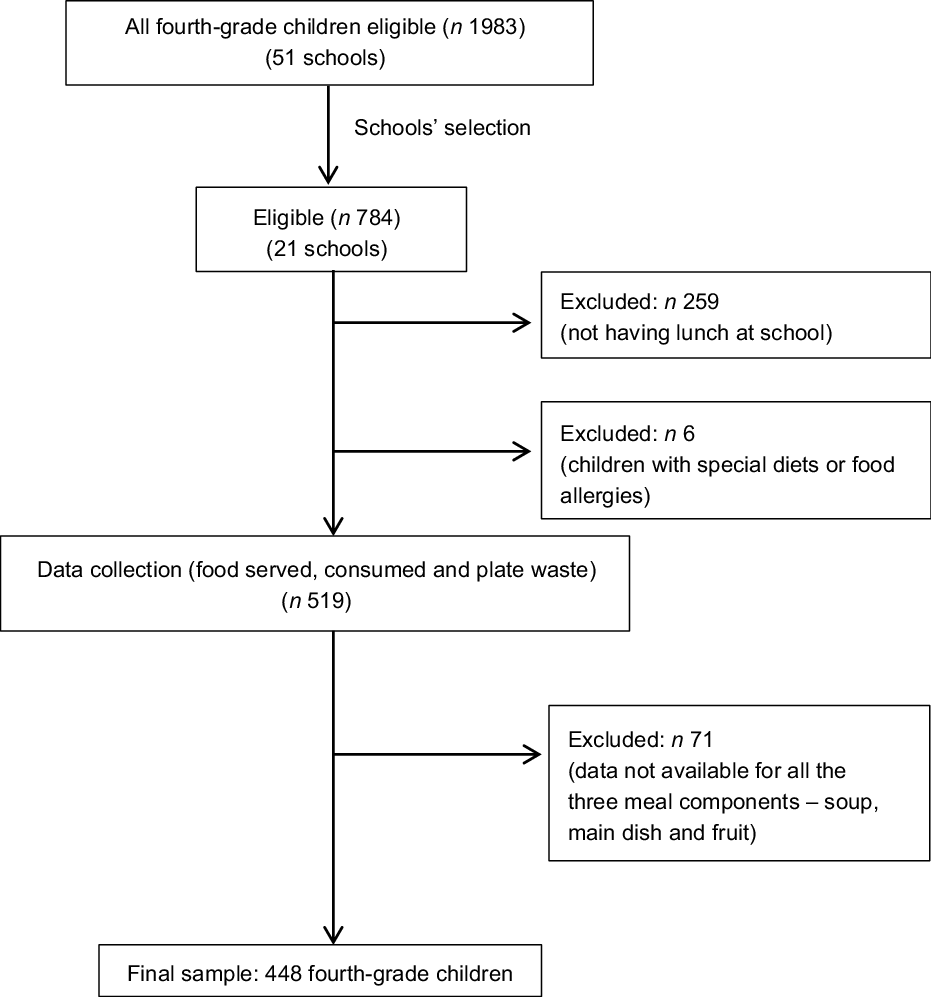
Contrary to the other components of the meal (soup and main dish), fruit is frequently supplied to be consumed outside the canteen during the break which implied that it was not possible to assess fruit effectively consumption as they can throw it away or trading in the break.
School meal programme and meal setting
The Portuguese National school meal programme promotes the widespread access of a full meal to all public primary schoolchildren(25). According to this programme, the school lunch must include: (1) a soup, a water-based recipe with blended or whole vegetables; (2) a main dish that contains a mix of a main protein source (fish or meat or egg), a main carbohydrate source (rice, pasta, potato or pulses, daily varied) and a component of vegetables (e.g. tomato, lettuce, onion, carrot, cabbage, daily varied) and (3) fruit (one portion by child corresponding to around 100 g, supplying in average 50 kcal, delivering in the end of the meal). Tap water is the only available beverage. The type of foods offered and individual portions are previously defined by the National school meal programme in order to guarantee the fulfilment of children’s nutritional needs. Regular monitorisation is performed by nutritionists of the Municipalities to verify the accomplishment of the rules defined by the National School meal programme(6).
According to the household income, the criteria for allocating financial support define three levels: A, total meal funding; B, 50 % share of meal price and C, no financial support(7).
All school food units were leased to the same catering company, which serves about 6500 lunches daily in Porto public primary schools.
Data collection
Field work was performed during 1 month, in order to obtain a large variety of menus containing fish and meat dishes, as well as, composed and non-composed dishes. Composed dishes are those presenting the main protein source in fractions mixed with other ingredients. Non-composed dishes have the main protein source separated from the carbohydrate source.
Data collection was performed by fourteen trained researchers, including the main researcher. A reference guide was developed as a tool to standardise data collection procedures. Training was designed to ensure that plate waste measurement procedures were as consistent as possible from school to school and that all researchers operated the scales accurately.
Initial servings and plate waste determination
The weighing method was used, as described by other authors, for evaluating initial servings and plate waste for soup and main dish(Reference Comstock, St Pierre and Mackiernan26). At each school, a maximum of two researchers were responsible to weigh the meals after plating, while another two were distributing meals to children in accordance with the codes previously assigned. Stickers with unique codes were placed under each plate for identification purposes. All plates were weighed empty and after plating, and the serving amount were determined by the weight difference. At the end of the meal, plates were collected, non-edible items were removed, plates were weighed and the amount of food consumed and wasted was determined by the weight difference.
Plate waste was defined as food served to the consumer that was not eaten(Reference Buzby and Guthrie27), and it was calculated as a ratio of edible food discarded per edible food served(Reference Carr and Levins28). All weightings were performed on a digital scale accurate to the nearest gram (SECA® model 851).
Nutritional content
Energy and nutritional contents of meals served, consumed and wasted were estimated using the nutritional analysis software Food Processor Plus (ESHA Research Inc.) adapted with information from the Portuguese Food Composition Table Database(29). Foods and recipes not included in the software’s database were added based on school food service recipes.
The mean nutritional value of food served and consumed by children was compared with nutritional guidelines for lunch, considering international recommendations(30–38).
The mean daily energy intake was estimated based on the Estimated Energy Requirements and activity levels from the Institute of Medicine Dietary Reference Intakes Macronutrients Report. The average intake value for 9–10-year-old male and female children, with a moderate activity level, was considered(37). According to standards defined by the United States Department of Health and Human Services and the United States Department of Agriculture(31,32) , it was considered that school lunch should provide 30 % of the daily nutritional requirements. According to the macronutrients energy distribution recommended by the WHO, school lunch should be composed of 10–15 % of proteins, 15–30 % of lipids and 55–75 % of carbohydrates(30).
Data analysis
Statistical software package IBM SPSS Statistics, version 21.0, was used for data analyses. Mean and standard deviations were used to provide an indication of the average energy and nutrient content of meals served, consumed and wasted.
Mann–Whitney U test was used to compare wasted nutritional mean content between genders. A 0·05 level of significance was considered.
Results
Meals served and consumed
Tables 1 and 2 show the mean energy and nutrient content of lunch provided and consumed by 448 fourth-grade children at school canteens, as well as, the percentage of lunches meeting nutritional standards.
Adequacy of lunches served and consumed at school canteens, regarding to energy and macronutrients – fourth-grade children from public primary schools in Porto (n 448)

* WHO, 2003 – lower and upper limits for macronutrients; dietary reference intakes (2005) for energy.
† To convert kcal to kJ, multiply it by 4·184.
Adequacy of lunches served and consumed at school canteens, regarding to dietary fibre and micronutrients – fourth-grade children from public primary schools in Porto (n 448)
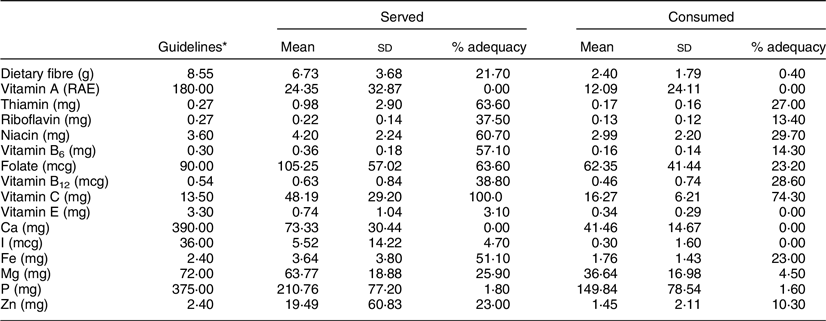
RAE, Retinol activity equivalents.
* Dietary reference intakes (1997) for P, Mg; dietary reference intakes (1998) for thiamin, riboflavin, niacin, vitamin B6, folate, vitamin B12; dietary reference intakes (2000) for vitamin C, vitamin E; dietary reference intakes (2001) for vitamin A, I, Fe, Zn; dietary reference intakes (2005) for Fibre; dietary reference intakes (2011) for Ca.
Lunches provided 413·8 (±120·6) kcal, 23·1 (±17·0) g of proteins, 53·4 (±17·2) g of carbohydrates, 11·3 (±3·9) g of lipids and 6·7 (±3·7) g of dietary fibre.
These meals did not meet international dietary guidelines for energy and macronutrients, since only 12·5 % were adequate for energy, 33·5 % for proteins, 11·9 % for carbohydrates and 57·1 % for lipids. The majority of meals served were below the age-specific lower limit, namely for energy (83·7 %) and carbohydrates (86·8 %). The only exception, also unbalanced, was observed for proteins, as 42·4 % of lunches served exceeded the recommended upper limit (Table 1).
A 100 % of lunch inadequacy for energy and carbohydrates was observed. Thirty-five percentage of meals were adequate for lipid content. It was observed that 17·6 % of students consumed lunches higher in protein than recommended (Table 1).
The lunches offered did not meet the dietary guidelines for dietary fibre and for the micronutrients evaluated. Only 22 % of lunches served met the dietary fibre intake target. Additionally, it was observed that only 0·4 % of children accomplished dietary fibre intake. Although the meals did supply recommended levels of vitamin C, food waste impaired the fulfilment of children’s needs. It was also observed that no child met the recommendations for vitamins A and E and minerals, Ca and iodine in lunch consumed at school (Table 2).
Meals wasted
Nutrient loss caused by plate waste at school lunch is presented in Table 3. Children wasted 26 % of energy, 25 % of proteins and 29 % of carbohydrates served. Regarding micronutrients, it was observed that 27 % of dietary fibre, vitamin A and folic acid was also discarded.
Nutrients loss caused by plate waste at school lunch, according to gender (n 448)
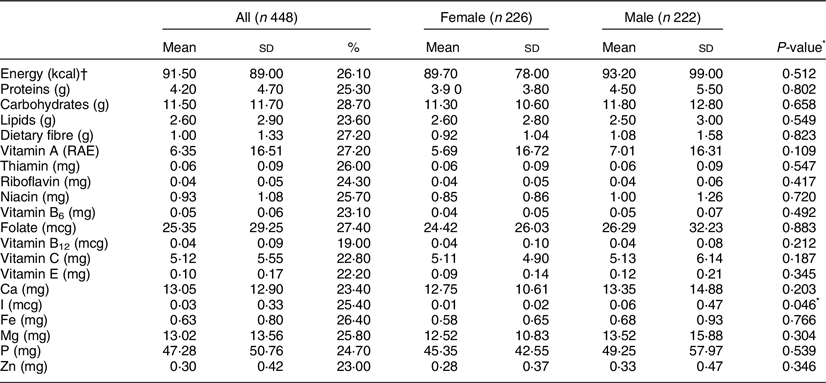
RAE, Retinol activity equivalents.
* P-values according to non-parametric Mann–Whitney U test significant at 95 % CI.
† To convert kcal to kJ, multiply it by 4·184.
As a consequence, children’s average intake failed to meet energy requirements since 26 % of the energy content provided, corresponding to 91·5 kcal at lunch were wasted. No significant differences were found for nutrients wasted by gender, except for iodine (Table 3).
Discussion
Results found in the present study showed that lunches offered to children at school canteens did not meet dietary guidelines, intensified by the high plate waste values found. Consequently, children’s average intake at school lunch failed to meet the energy and nutritional requirements, considering that lunch should offer at least 30 % of the daily Reference Dietary Intake for energy and nutrients.
Findings presented in this study were supported by previous researchers showing that school meals frequently did not provide sufficient energy and nutrients and also that children failed to meet the energy and nutritional requirements(Reference Osowski, Lindroos and Barbieri15,Reference Smith and Cunningham-Sabo16,Reference Shanks, Banna and Serrano21,Reference Templeton, Marlette and Panemangalore23,Reference Niaki, Moore and Chen39) . These waste values rise concern regarding the fulfilment of children’s nutritional needs that if persistent in time may increase the risk of malnutrition(1).
In our research, it was observed that the school meals offered did not provide enough energy, as a consequence of insufficient food portion served determined mainly by the lack of carbohydrate source provided by rice, pasta and potato. These results were in line with those found by Gould et al. in British secondary schools(Reference Gould, Russell and Barker40) and by other authors in American primary schools(Reference Smith and Cunningham-Sabo16,Reference Crepinsek, Gordon and McKinney41) .
Our results are in accordance with those found by Gatenby, who has observed that children’s average intake failed to meet the energy and carbohydrate requirements in two American primary schools(Reference Gatenby42). In fact, our findings follow what has been shown by several researches. Lee et al. evaluated lunch consumption by primary schoolchildren and observed that it failed to meet the RDA for energy, Fe and vitamin A(Reference Lee, Lee and Shanklin43). These may be explained by the low supply of meat, fish, eggs and pulses according to portions served(29). Although individual portion is previously defined by the National school meal programme, food handlers responsible for platting are different for each school and utensils that are used for serving meals varied between school canteens. These factors and lack of daily monitor could influence portions served and consequently recommendations failure. Other authors, in British primary schools, observed that only proteins and vitamin C did not meet recommendations at lunch(Reference Rogers, Ness and Hebditch44). Gougeon et al. showed that school lunch provided one-third of the recommendations for analysed vitamins, as recommended by Canadian School Nutrition Program(Reference Gougeon, Henry and Ramdath45).
The intake of micronutrients evaluated in our study was below the recommended minimum amounts for school lunches, as observed by other authors(Reference Smith and Cunningham-Sabo16,Reference Taylor, Hernandez and Caiger17,Reference Cohen, Richardson and Austin20,Reference Gould, Russell and Barker40,Reference Gatenby42) . These results may be underestimated by the lack of data concerning fruit intake, since this is the one of the main sources of micronutrients in these meals. As referred on study methodology, fruit is frequently supplied in the end of the meal to be consumed outside the canteen during the break. However, during informal monitoring activities previous to this study, it was observed that fruit is frequently discarded during break and nutrients provided are lost. In our study, only approximately 23 % of children achieved Fe and folate recommendations for lunch, likewise reported by Gould et al. (Reference Gould, Russell and Barker40).
Different authors referred to low intakes of dietary fibre at school lunches(Reference Gatenby42,Reference Gougeon, Henry and Ramdath45) . The similar result found in our study was probably associated with low intake of vegetables(Reference Smith and Cunningham-Sabo16,Reference Georgiou, Martin and Long46) that are usually separated by children from other main dish components during lunch consumption and consequently wasted.
Moreover, in our study, approximately 26 % of the calories served were wasted.
Similar results were observed by other authors, which have shown that 19–28 % of lunch energy was wasted in school lunch(Reference Smith and Cunningham-Sabo16,Reference Shanks, Banna and Serrano21,Reference Niaki, Moore and Chen39) . Cohen et al. found worse results, since students only consumed half of the energy content provided(Reference Cohen, Richardson and Austin20). The wide range of plate waste values found in different studies may be explained by different factors affecting plate waste and also by different assessing methodologies.
Additionally, our results indicate that children were more likely to discard carbohydrate sources, as reported in another study developed in American schools(Reference Martin, Thomson and LeBlanc47).
Supply of balanced meals does not ensure the satisfaction of nutritional needs. It is observed that overall waste had an important impact on the average nutrients consumed at lunch as already reported in American middle school students(Reference Cohen, Richardson and Austin20).
Even if school lunch menus are planned in accordance with dietary guidelines, the intake may not be adequate if substantial amounts of food are wasted(Reference Cohen, Richardson and Austin20). Inadequacy of lunches served at school canteens and high waste levels found in this study may impair the benefits from nutrients provided by meals(Reference Baik and Lee19). It is known that the provision of adequate school meals can benefit behaviour, concentration and academic achievement in children(Reference Golley, Baines and Bassett48–Reference Buzby and Guthrie50). Moreover, for some children, school meals present the main source of food daily(Reference Gatenby42,Reference Harper and Wood51) . Baik and Lee have studied plate waste in rural Korean primary schools and demonstrated that children with regular plate waste had insufficient intakes of some nutrients, which might lead to growth impairment if the situation persists(Reference Baik and Lee19). Nutritional inadequacy of lunches consumed and persistent plate waste could facilitate the intake of less-nutritious foods such as energy-dense, high-salt and high-sugar snacks and drinks available from competitive sources between main meals(Reference Cohen, Richardson and Austin20,Reference Templeton, Marlette and Panemangalore23,Reference Liz Martins, Rodrigues and Cunha24) .
In Portugal, the only main source of food in primary schools is the school canteen since there are no snack-bars and vending machines in primary schools. The competitive food available comes from home and are parents’ responsibility and if consumed during morning may impair appetite at lunch. The students have about 90 min for lunch. Nevertheless, they are more interested in playing at schoolyard.
Strategies such as reducing portion sizes, preparing less food or giving children the opportunity to select foods they want(Reference Guthrie and Buzby52) may not be desirable, since they could compromise compliance with nutritional guidance or the educational value of introducing new foods.
Although some studies proposed to reduce the amount of food offer in order to reduce food waste(Reference Cohen, Richardson and Austin20,Reference Rosario, Araujo and Oliveira53) , in our study this is not desirable once the served amount is already below the recommendations. Furthermore, school lunch monitoring by teachers and school staff may have positive results. They could serve as role models, with a positive impact on children’s consumption(Reference Liz Martins, Rodrigues and Cunha22).
Besides that, our findings showed that even if children eat full portions of food provided, the minimum amounts of energy and nutrients recommended by the Institute of Medicine and WHO would not be achieved. School meal quality should be improved, and menus should be planned in order to meet nutritional goals. Evaluation of factors that may influence children’s consumption such as preferences, acceptability and plating should be performed to help in the improvement of the nutritional quality of school meals(Reference Lee, Lee and Shanklin43). At the same time, other factors such as taste, variety, cultural/ethnic features and visual appeal need to be considered to ensure that students eat the school lunch provided and waste less(Reference Liz Martins, Rodrigues and Cunha24,Reference Byker, Pinard and Yaroch54) .
Some limitations were identified in the present study. Fruit consumed and discarded were not considered due to canteen service constraints. Lack of this information could be a source of bias in evaluating nutritional intake.
As referenced by Gatenby, there are limitations to databases related to the variability of the composition of foods and incomplete coverage of all foods that make up the human diet(Reference Gatenby42). To overcome these limitations, recipes with ingredients and weights were introduced into the database considering information available on the Portuguese Food Composition Table Database(29).
Additionally, a child with an empty lunch tray did not necessarily mean consumption of all lunch items served since there was a possibility of trading food between children.
The strengths of the present study include the assessment of lunches, since all foods were weighed at the beginning and at the end of the meal, which provide detailed and accurate information. Furthermore, plate waste methodology overcomes the need to rely on students’ memory or lack of ability to accurately estimate portion sizes.
Furthermore, to our knowledge, this is the first study developed at Portuguese primary school canteens aiming to analyse nutritional adequacy of what has been served, consumed and wasted using plate waste weighing methodology.
Conclusion
The lunches served to children at school canteen did not meet the guidelines for energy and nutrients. Children’s average intake at school lunch failed to meet the energy and nutritional requirements. These results are not only a consequence of lunches served but also a result of high plate waste values observed. Children wasted an average of 26 % of energy, 25 % of proteins, 29 % of carbohydrates and 27 % of dietary fibre, vitamin A and folic acid.
Acknowledgements
Acknowledgements: This research was supported by national funds through FCT – Portuguese Foundation for Science and Technology within the scope of UIDB/50016/2020, UIDB/05748/2020, UIDP/05748/2020 and UIDB/04033/2020. The authors thank Phil Lonsdale for the English grammar and structure revision of the manuscript. Financial support: This research received no specific grant from any funding agency, commercial or not-for-profit sectors. Conflict of interest: There are no conflicts of interest. Authorship: L.M.M. responsible for study design, data collection, manuscript writing and data analysis. R.S.S.P. responsible for study design and reviewing. C.L.M. responsible for study design and data analysis. R.A. is responsible for study design and reviewing. Ethics of human subject participation: Consent for this study was obtained from the Municipality of Porto, the School’s Councils and the catering company that provides the lunches. This study was conducted according to the guidelines laid down in the Declaration of Helsinki, and all procedures involving study participants were approved by the Portuguese Ministry of Education was obtained – Project No. 025280000. Written consent from children’s parents and verbal consent from children involved were previously obtained. Verbal consent was witnessed and formally recorded.



