


Introduction
With recent results from ancient DNA research showing an extensive incoming gene flow into Europe shortly after 3000 BC (Allentoft et al. Reference Allentoft, Sikora, Sjögren, Rasmussen, Rasmussen, Stenderup, Damgaard, Schroeder, Ahlström, Vinner, Malaspinas, Margaryan, Higham, Chivall, Lynnerup, Harvig, Baron, Della Casa, Dąbrowski, Duffy, Ebel, Epimakhov, Frei, Furmanek, Gralak, Gromov, Gronkiewicz, Grupe, Hajdu, Jarysz, Khartanovich, Khokhlov, Kiss, Kolář, Kriiska, Lasak, Longhi, McGlynn, Merkevicius, Merkyte, Metspalu, Mkrtchyan, Moiseyev, Paja, Pálfi, Pokutta, Pospieszny, Price, Saag, Sablin, Shishlina, Smrčka, Soenov, Szeverényi, Tóth, Trifanova, Varul, Vicze, Yepiskoposyan, Zhitenev, Orlando, Sicheritz-Pontén, Brunak, Nielsen, Kristiansen and Willerslev2015; Haak et al. Reference Haak, Lazaridis, Patterson, Rohland, Mallick, Llamas, Brandt, Nordenfelt, Harney, Stewardson, Fu, Mittnik, Bánffy, Economou, Francken, Friederich, Garrido Pena, Hallgren, Khartanovich, Khokhlov, Kunst, Kuznetsov, Meller, Mochalov, Moiseyev, Nicklisch, Pichler, Risch, Rojo Guerra, Roth, Szécsényi-Nagy, Wahl, Meyer, Krause, Brown, Anthony, Cooper, Alt and Reich2015), we are finally in a position where migrations can be documented rather than debated as an element in the formation of the Corded Ware Culture. This has lifted an interpretative burden from archaeology in much the same way as did 14C dating when it was introduced. The new ‘freedom’ can instead be invested in properly theorising and interpreting local processes of migration, integration and consolidation, which represent an underdeveloped field of research. By integrating recent results from genetics, stable isotopes, archaeology and historical linguistics, this will in turn allow us to formulate better-founded models for the interaction of intruding and settled groups and the formation of a new material culture, and consequently better models for language dispersal and language change.
Re-theorising migrations
The evidence from the recent studies of ancient DNA documenting human migrations into temperate Europe during the early third millennium BC can be summarised as follows:
-
• There was a widespread process of genetic admixture, leading to a reduction of Neolithic DNA in temperate Europe and the dramatic increase of a new genomic component that was only marginally present in Central Europe prior to 3000 BC (Allentoft et al. Reference Allentoft, Sikora, Sjögren, Rasmussen, Rasmussen, Stenderup, Damgaard, Schroeder, Ahlström, Vinner, Malaspinas, Margaryan, Higham, Chivall, Lynnerup, Harvig, Baron, Della Casa, Dąbrowski, Duffy, Ebel, Epimakhov, Frei, Furmanek, Gralak, Gromov, Gronkiewicz, Grupe, Hajdu, Jarysz, Khartanovich, Khokhlov, Kiss, Kolář, Kriiska, Lasak, Longhi, McGlynn, Merkevicius, Merkyte, Metspalu, Mkrtchyan, Moiseyev, Paja, Pálfi, Pokutta, Pospieszny, Price, Saag, Sablin, Shishlina, Smrčka, Soenov, Szeverényi, Tóth, Trifanova, Varul, Vicze, Yepiskoposyan, Zhitenev, Orlando, Sicheritz-Pontén, Brunak, Nielsen, Kristiansen and Willerslev2015; Haak et al. Reference Haak, Lazaridis, Patterson, Rohland, Mallick, Llamas, Brandt, Nordenfelt, Harney, Stewardson, Fu, Mittnik, Bánffy, Economou, Francken, Friederich, Garrido Pena, Hallgren, Khartanovich, Khokhlov, Kunst, Kuznetsov, Meller, Mochalov, Moiseyev, Nicklisch, Pichler, Risch, Rojo Guerra, Roth, Szécsényi-Nagy, Wahl, Meyer, Krause, Brown, Anthony, Cooper, Alt and Reich2015; Cassidy et al. Reference Cassidy, Martiniano, Murphy, Teasdale, Mallory, Hartwell and Bradley2016).
-
• Although the details of this admixture event can and will be debated for years to come (Vander Linden Reference Vander Linden2016), it remains beyond question that the observed change in the gene pool must have involved the migration of people. Moreover, the apparent abruptness with which this change occurred suggests that it was a large-scale migration event, rather than a slow periodic gene flow across many centuries.
-
• The Yamnaya people from the Pontic-Caspian steppe are the best-known proxy for this incoming gene flow. The exact source could have been another, yet unsampled, group of people, but, in that case, they must have been very closely related genetically to Yamnaya.
What facilitated this major demographic event remains open to speculation, but the late fourth millennium BC was a period of widespread technological innovation, which also introduced long-distance travel. This horizon could thus have formed a prelude to the Yamnaya migrations, opening up new corridors of cultural transmission on which subsequent developments depended (Johannsen & Laursen Reference Johannsen and Laursen2010; Hansen Reference Hansen, Hansen and Müller2011, Reference Horejs and Mehofer2014). Moreover, a decline in Neolithic activity around 3000 BC (Hinz et al. Reference Hinz, Feeser, Sjögren and Müller2012; Shennan et al. Reference Shennan, Downey, Timpson, Edinborough, Colledge, Kerig, Manning and Thomas2013) could indicate a crisis in Neolithic societies, thereby allowing space for incoming migrants. In that light, the recent documentation of an early form of plague, widespread from Siberia to the Baltic in the early third millennium BC, could play a key role in explaining this genetic changeover (Rasmussen et al. Reference Rasmussen, Allentoft, Nielsen, Orlando, Sikora, Sjögren, Pedersen, Schubert, Van Dam, Kapel, Nielsen, Brunak, Avetisyan, Epimakhov, Khalyapin, Gnuni, Kriiska, Lasak, Metspalu, Moiseyev, Gromov, Pokutta, Saag, Varul, Yepiskoposyan, Sicheritz-Pontén, Foley, Mirazón Lahr, Nielsen, Kristiansen and Willerslev2015).
These extensive demographic changes led to the formation of a new social and economic order in large parts of temperate Europe, resulting in the formation of the Corded Ware Culture. As evident from, for example, western Jutland (Andersen Reference Andersen1993; Kristiansen Reference Hornborg and Crumley2007), Corded Ware people burned down forests on a massive scale, thereby creating open, steppe-like grazing lands for their herds. A more gradual opening of the landscape is also found in other regions (Doppler et al. Reference Doppler, Gerling, Heyd, Knipper, Kuhn, Lehmann, Pike and Schibler2015), while subsistence seems to have been a variable mix of cultivation, husbandry and some hunting and gathering (Müller et al. Reference Müller, Seregély, Becker and Christensen2009).
The Corded Ware Culture elected the battle-axe as the most prominent male symbol, and created new types of pottery. Among the Yamnaya cultures, the tradition of pottery-making was weakly developed. Being a pastoral, mobile economy, they instead employed containers made of leather, wood and bast, and woven vessels could have been used as well, just as they used mats and other lightweight materials that were easy to transport in their wagons (Shishlina Reference Shishlina2008: 60, fig. 54).
The Corded Ware Culture had widely shared similarities in burial rituals over vast distances (Furholt 2014: fig. 7), and had strong affinities to the Yamnaya burial rituals known from the steppe. The tens of thousands of small, single-grave barrows in Northern Europe were aligned in rows across the landscape, in a similar way to the practice on the steppe. They formed visible lines of communication in these vast open environments (Hübner Reference Hübner2005; Bourgeois Reference Bourgeois2013).
The unifying element between Yamnaya and Corded Ware is the burial ritual of a single inhumation under a barrow, even though there are minor differences in grave goods and the positioning of the body. Burial rituals are among the most fundamental social institutions in any society, as they relate to the transmission of property and power at death, to cosmology and religion, and, in the case of settlements, to the way households are organised. We can therefore formulate this as an axiom:
A strong relationship exists between burial ritual and social and religious institutions, because a burial is the institutionalised occasion for the transmission of property and power, and the renewal of social and economic ties (Oestigaard & Goldhahn Reference Oestigaard and Goldhahn2006). A radical change in burial rites therefore signals a similar change in beliefs and institutions. If such a change occurs rapidly without transition it signals a transformation of society, often under strong external influence, possibly a migration (to be supported also by settlement change and economic change). This does not rule out the effects of internal contradictions, which, however, often go hand in hand with external forces of change.
By contrast, the portable material culture is more readily prone to change, as it relates to various forms of personal identity and group identities that may fluctuate in time and space, as demonstrated by Hodder (Reference Hodder1982). The institutions of burial ritual and of households or settlements should therefore form the core in comparative analyses of mobility and migrations because they do not change easily (see too Kristiansen Reference Kristiansen1989; Burmeister Reference Burmeister2000; Prien Reference Prien2005). Lack of a theoretical understanding of social institutions, and their differing role in organising material culture, goes a long way to explaining the many failed attempts to come to terms with migrations in the archaeological record, as well as with various forms of ethnicity (e.g. Andresen Reference Andresen2004; Brather Reference Brather2004). Portable material culture can be used selectively to identify mobility, depending on its social and personal role. Thus, fibulae and pins are carried as part of dress, and may be helpful in defining the movements of individuals. Most previous research on the Corded Ware Culture has used portable material culture, especially pottery, as a diagnostic feature, and therefore stressed differences between Corded Ware and Yamnaya steppe cultures while overlooking more basic similarities. We therefore need to re-analyse the (possible) social processes from initial Yamnaya migration to settling down and forming a new material culture: Corded Ware (Furholt 2014).
The formation of the Yamnaya and Corded Ware Cultures
Given that widespread migrations from the Caspian-Pontic steppe now constitute a key element in any plausible explanation of the Corded Ware phenomenon, we need to focus attention on how it unfolded locally in order to understand processes of demographic and cultural dominance. But we also need to understand the economic and social system of the Yamnaya culture from which it originated, and which flourished and expanded from around 3000 BC (Anthony Reference Anthony2007).
First, it should be noted that the Yamnaya cultures of the Pontic and Caspian steppe represented the first development of a fully pastoral economy that exploited different ecological niches during small-scale seasonal movements of people and animals between summer and winter grazing. Its economy and variability has been analysed in detail by Natalia Shishlina in a classic work (Shishlina Reference Shishlina2008). This variability is also reflected in diet (Shishlina et al. Reference Shishlina, Sevastyanov, Hedges, Kaiser, Burger and Schier2012). The period after 3000 BC saw a more humid climate that favoured grassland productivity, and thus the new pastoral economy experienced a rapid demographic expansion that included eastern Central Europe: Bulgaria, Hungary and Transylvania, and Northern Europe soon afterwards (Harrison & Heyd Reference Harrison and Heyd2007; Heyd Reference Heyd, Celka and Borgna2011; Gerling et al. Reference Gerling, Bánffy, Dani and Köhler2012; Horváth et al. Reference Horváth, Dani, Pető, Pospieszny, Svingor, Heyd, Kulcsár and Szeverényi2013; Kaiser & Winger Reference Kaiser and Winger2015). Herds consisted of cattle, sheep and horse, and the mobile lifestyle within small territories was supported by the use of wagons as mobile homes. Only a few stable settlements are known, but from burial pits, we find extensive use of thick plant mats and felt covers; the same materials were probably in use for dwellings. Light-framework dwellings could easily be assembled and disassembled and transported on pack animals. The economy was based on meat and dairy products, as well as fish (reflected in high 15N values), and seeds from wild plants were collected and used in soup with meat (Schulting & Richards Reference Schulting, Richards, Anthony, Brown, Khokhlov, Kuznetsov and Mochalov2016). No agriculture is documented, but to the west, some cereal cultivation was practised (Pashkevych Reference Pashkevych2012). Extensive exchange systems linked different groups together and secured access to products outside the pastoral economy, such as metal. The healthy diet meant that life expectancy was fairly high, with many individuals living to 50–60 years old. We can also observe a selection for lactose tolerance and for height (Mathieson et al. Reference Mathieson, Lazaridis, Rohland, Mallick, Patterson, Alpaslan Roodenberg, Harney, Stewardson, Fernandes, Novak, Sirak, Gamba, Jones, Llamas, Dryomov, Pickrell, Arsuaga, Bermúdez De Castro, Carbonell, Gerritsen, Khokhlov, Kuznetsov, Lozano, Meller, Mochalov, Moiseyev, Rojo Guerra, Roodenberg, Vergès, Krause, Cooper, Alt, Brown, Anthony, Lalueza-Fox, Haak, Pinhasi and Reich2015). Barrows were aligned in groups forming lines in the landscape to mark seasonal routes. Similar arrangements are found in Northern Europe, suggesting a shared perception and use of landscapes among Single Grave populations from Holland to western Jutland (Hübner Reference Hübner2005; Bourgeois Reference Bourgeois2013).
Secondly, we should observe that Corded Ware Cultures co-existed with late Neolithic cultures for shorter or longer periods across much of Central and Northern Europe. In Denmark, there were late Funnel Beaker communities in the Danish islands (Iversen Reference Iversen2015); in other parts of Northern Europe they were often in close proximity, such as the Globular Amphora Culture in Poland (Szmyt Reference Szmyt1999). What we observe, therefore, in the archaeological record is a gradual process of acculturation and integration, which meant that after 2400 BC, the former strict cultural boundaries were gradually dissolved and a new, shared material culture appeared, represented first and foremost in Denmark by flint daggers, and in Central Europe by early Únetiče metal daggers. Bell Beaker groups had by now also emerged on the scene, introducing metallurgy, and they further complicated the mix of cultures and people. In burial rituals, however, old megalithic traditions still had an impact, as seen in a revival of stone cist burial in some regions. It was only on the advent of the Middle Bronze Age that cultural homogenisation prevailed. Thus, it took nearly 1000 years before all regions in Northern and Central Europe had adopted a shared social and cultural outlook that in all probability also included shared languages.
With the help of strontium isotopic analysis and ancient DNA we can now reconstruct in some detail the social processes behind the observable archaeological changes. At the Corded Ware cemetery of Eulau, the application of strontium isotopic tracing, ancient DNA and archaeology has allowed a full reconstruction of a singular family massacre and its local background (Haak et al. 2008; Meyer et al. Reference Meyer, Brandt, Haak, Ganslmeier, Meller and Alt2009; Muhl et al. Reference Muhl, Meller and Heckenhahn2010). Four multiple burials contained single families of father, mother and children in various combinations, and it could be demonstrated that the mothers were of non-local origin, most probably originating in the Harz Mountains 50–60km north of the settlement. The arrows that had killed the families confirmed this, as they belonged to another Neolithic culture: the Schönfeld, which was located in this area and practised cremation, a burial custom different to that of the Corded Ware Culture (compare Muhl et al. Reference Muhl, Meller and Heckenhahn2010: 44, 125). Contacts between the two are also illustrated by the occurrence of Schönfeld pottery in Corded Ware graves in the Halle-Saale region (Furholt Reference Furholt2003). Other Neolithic groups in the region, such as the Bernburg Culture, practised collective burials of multiple family groups, as demonstrated by genetics, again being distinctively different from the Corded Ware practice of individual burials (Meyer et al. Reference Meyer, Ganslmeier, Dresely, Alt, Kolář and Trampota2012). We observe two things: that Corded Ware males practised exogamy, perhaps marriage by abduction, which provides a possible explanation for the killing. The question is: was this a unique case, or did it reflect a more widespread marriage practice, as suggested by Schönfeld pottery in Corded Ware burials?
In a recent work on diet and mobility among Corded Ware cemeteries from southern Germany (Sjögren et al. Reference Sjögren, Price and Kristiansen2016), it was possible to demonstrate that exogamy was indeed a common practice among Corded Ware groups in this larger region (from a sample of 60). Most adult women (between 28 and 42 per cent) were of non-local origin and had a different diet during childhood. Such evidence fits well with recent genetic information documenting more-varied mtDNA haplogroups among Corded Ware females than among males (Lazaridis et al. Reference Lazaridis, Patterson, Mittnik, Renaud, Mallick, Kirsanow, Sudmant, Schraiber, Castellano, Lipson, Berger, Economou, Bollongino, Fu, Bos, Nordenfelt, Li, De Filippo, Prüfer, Sawyer, Posth, Haak, Hallgren, Fornander, Rohland, Delsate, Francken, Guinet, Wahl, Ayodo, Babiker, Bailliet, Balanovska, Balanovsky, Barrantes, Bedoya, Ben-Ami, Bene, Berrada, Bravi, Brisighelli, Busby, Cali, Churnosov, Cole, Corach, Damba, Van Driem, Dryomov, Dugoujon, Fedorova, Gallego Romero, Gubina, Hammer, Henn, Hervig, Hodoglugil, Jha, Karachanak-Yankova, Khusainova, Khusnutdinova, Kittles, Kivisild, Klitz, Kuč, inskas, Laredj, Litvinov, Loukidis, Mahley, Melegh, Metspalu, Molina, Mountain, Näkkäläjärvi, Nesheva, Nyambo, Osipova, Parik, Platonov, Posukh, Romano, Rothhammer, Rudan, Ruizbakiev, Sahakyan, Sajantila, Salas, Starikovskaya, Tarekegn, Toncheva, Turdikulova, Uktveryte, Utevska, Vasquez, Villena, Voevoda, Winkler, Yepiskoposyan, Zalloua, Zemunik, Cooper, Capelli, Thomas, Ruiz-Linares, Tishkoff, Singh, Thangaraj, Villems, Comas, Sukernik, Metspalu, Meyer, Eichler, Burger, Slatkin, Pääbo, Kelso, Reich and Krause2014).
The female diet was more similar to previous Neolithic diets, while in Corded Ware as a whole there is a shift towards higher δ15N values, suggestive of a shift in diet and/or in cultivation practices. There may be several different explanations for this shift, such as intense forms of cultivation, higher reliance on freshwater fish, or on animal versus vegetable protein, or a greater reliance on milk and milk products. The latter is supported by a widespread opening-up of landscapes in some regions for grazing animals (Andersen Reference Andersen1993, Reference Andersen1995; Doppler et al. Reference Doppler, Gerling, Heyd, Knipper, Kuhn, Lehmann, Pike and Schibler2015; Dietre et al. Reference Dietre, Walser, Kofler, Kothieringer, Hajdas, Lambers, Reitmaier and Haas2016). The analysis comprises 60 individuals and covers the period from the early Corded Ware to the mature and late Corded Ware; in other words, from 2900/2800–2300 BC. Among the burials from the earliest, colonising phase at Tiefbrunn, we find a multiple burial of three individuals: one older male with a hammer-headed pin of steppe type, a young adult male and a female child, around four years old. mtDNA haplogroups were different for all three, indicating that they were not related on the maternal side (Allentoft et al. Reference Allentoft, Sikora, Sjögren, Rasmussen, Rasmussen, Stenderup, Damgaard, Schroeder, Ahlström, Vinner, Malaspinas, Margaryan, Higham, Chivall, Lynnerup, Harvig, Baron, Della Casa, Dąbrowski, Duffy, Ebel, Epimakhov, Frei, Furmanek, Gralak, Gromov, Gronkiewicz, Grupe, Hajdu, Jarysz, Khartanovich, Khokhlov, Kiss, Kolář, Kriiska, Lasak, Longhi, McGlynn, Merkevicius, Merkyte, Metspalu, Mkrtchyan, Moiseyev, Paja, Pálfi, Pokutta, Pospieszny, Price, Saag, Sablin, Shishlina, Smrčka, Soenov, Szeverényi, Tóth, Trifanova, Varul, Vicze, Yepiskoposyan, Zhitenev, Orlando, Sicheritz-Pontén, Brunak, Nielsen, Kristiansen and Willerslev2015). Sr isotope ratios suggest that the older man was non-local, while the younger man and the child may have been locals. The skulls of all three individuals exhibited signs of severe trauma and they had probably suffered violent deaths, which again demonstrates that the newcomers were not always welcomed peacefully. There is a similar early burial from the Kujawy region in Poland, of an elderly male of non-local origin, who also had a hammer-headed pin showing steppe influence (Pospieszny et al. Reference Pospieszny, Sobkowiak-Tabaka, Price, Frei, Hildebrandt-Radke, Kowalewska-Marszałek, Krenz-Niedbała, Osypińska, Stróżyk and Winiarska-Kabacińska2015). Analysis of ancient DNA from the Tiefbrunn multiple burial showed a high percentage of Yamnaya steppe DNA. The larger, consolidated cemeteries from Bergrheinfeld and Lauda-Königshofen are from the middle phase of the Corded Ware Culture (2600–2500 BC), and here the practice of exogamy was well established over a longer period of time. We cannot know where the non-local women were from, but as their diet looked more ‘Neolithic’, we may assume that they originated in late Neolithic cultures still residing on the higher elevations in the region.
Exogamy is a clever, and perhaps necessary, policy if new migrating groups are mainly constituted by males. This is a probable scenario for an expanding pastoral economy, and is supported by archaeological data from the early horizon of the Single Grave/Corded Ware Culture in Jutland, where 90 per cent of all burials belonged to males (Hübner Reference Hübner2005: 632–33, fig. 454). It gains further support from later historical sources from India to the Baltic and Ireland (Falk Reference Falk1986; Kershaw Reference Kershaw2000). They describe, as a typical feature of these societies, the formation of warrior youth bands consisting of boys from 12–13 up to 18–19 years of age, when they were ready to enter the ranks of fully grown warriors. Such youthful war-bands were led by a senior male, and they were often named ‘Black Youth’ or given names of dogs and wolves as part of their initiation rituals. The nature of this institution was recently summarised as follows:
In the Indo-European past, the boys first moved into the category of the (armed) youths and then, as members of the war-band of unmarried and landless young men, engaged in predatory wolf-like behaviour on the edges of ordinary society, living off hunting and raiding with their older trainers/models. Then about the age of twenty they entered into the tribe proper as adults (Petrosyan Reference Petrosyan2011: 345).
The activities of the young war-bands were seasonal; during the rest of the year they lived within their households and communities, perhaps engaged in herding animals and other forms of farm labour. Such bands were mainly made up of younger sons, as inheritance was restricted to the oldest son. Thus, they formed a dynamic force that could be employed in pioneer migrations (Sergent Reference Sergent2003). Archaeological evidence of this institution has been documented in the Russian steppe from the Bronze Age onwards (Pike-Tay & Anthony Reference Pike-Tay, Anthony, Anthony, Brown, Khokhlov, Kuznetsov and Mochalow2016; Brown & Anthony in press).
There is additional evidence to support the idea that males dominated the initial Yamnaya migrations and the formation of the early Corded Ware Culture: in burials from the earliest horizon, often with males, as in Tiefbrunn and Kujawy, there was no typical Corded Ware material culture. This was followed shortly afterwards by the deposit of A-type battle-axes in male burials, but there was as yet no pottery (Furholt 2014: 6, fig. 3). Corded Ware pottery appeared later in Northern Europe, and we may suggest that this did not happen until women with ceramic skills married into this culture and started to copy wooden, leather and woven containers in clay. This process began in the early phase both south and north of the Carpathians (Ivanova Reference Ivanova2013; Frînculeasa et al. Reference Frînculeasa, Preda and Heyd2015).
Some confirmation of such material transformations is found in a uniquely preserved find of the typical flat bowl with short feet made of wood (Muhl et al. Reference Muhl, Meller and Heckenhahn2010: 47), well suited for turning milk into yogurt or similar dairy products overnight. Its pottery version became a shared type throughout the Corded Ware Culture, and later the Bell Beaker Culture.
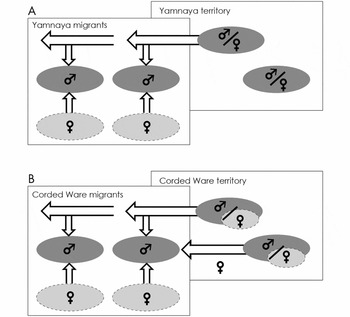
We may also note that pastoral economies historically tend to dominate agrarian economies, as they are both more mobile and more warlike in their behaviour. Such a pattern of economic and social dominance, reflected in taking wives from farming cultures while sending young males in organised war-bands to settle in new territories, would explain both the genetic and linguistic dominance of the Yamnaya steppe migrations, the results of which we can observe to this day. Figure 1 summarises these transformative processes in a model.
Model of the social processes of exogamy transforming Yamnaya to Corded Ware Culture, and its subsequent migration as Corded Ware Culture leading to further adaptations and transformations.
Language dispersal and the formation of Proto-Germanic in northern Europe
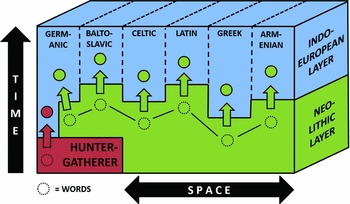
These local processes of social integration between intruding Yamnaya/Corded Ware populations and remnant Neolithic populations can be applied to language dispersal. We should expect that the transformation from Proto-Indo-European to Pre-Proto Germanic would reveal the same kind of hybridisation between an earlier Neolithic language of the Funnel Beaker Culture, and the incoming Proto-Indo-European language. This is precisely what recent linguistic research has been able to demonstrate (Kroonen & Iversen in press). In their study on the formation of Proto-Germanic in Northern Europe, Kroonen and Iversen document a bundle of linguistic terms of non-Indo-European origin linked to agriculture that were adopted by Indo-European-speaking groups who were not fully fledged farmers. The most plausible, and perhaps the only possible, context for this to have happened would be the introduction of Proto-Germanic by the intruding Yamnaya groups. Archaeologically, this adoption can be understood from their interaction over several hundred years with late Funnel Beaker groups still residing in eastern Jutland and on the Danish islands, where they maintained a largely agricultural economy. From this we can conclude that terms linked to farming, and the cultivation of many important crops, were missing among the early Yamnaya/Corded Ware groups, who may well have acquired cereals (barley) mainly for the purpose of producing and consuming beer (Klassen Reference Klassen2005). In addition, we learn that the Neolithic language of the Funnel Beaker Culture was in all probability non-Indo-European. This process of language interaction is illustrated by the model in Figure 2. It illustrates that different Indo-European language branches were in contact with one and the same Neolithic tongue throughout Europe.
Schematic representation of how different Indo-European branches have absorbed words (circles) from a lost Neolithic language or language group (dark fill) in the reconstructed European linguistic setting of the third millennium BC, possibly involving one or more hunter-gatherer languages (light fill) (after Kroonen & Iversen in press).
The new data conforms well to the reconstructed lexicon of Proto-Indo-European (Mallory & Adams Reference Mallory and Adams2006), which provides important clues that the subsistence strategy of early Indo-European-speaking societies was based on animal husbandry. It includes, for instance, terms related to dairy and wool production, horse breeding and wagon technology. Words for crops and land cultivation, however, have proved to be far more difficult to reconstruct. These results from historical linguistics are supported by similar evidence from archaeology (Andersen Reference Andersen1995; Kristiansen Reference Hornborg and Crumley2007). With the recent study by Kroonen and Iversen (in press), we can now demonstrate how social and economic interaction with existing Neolithic societies also had a corresponding linguistic imprint. This should not surprise us, as similar results are well documented from the interaction of Yamnaya societies with their northern Uralic-speaking neighbours (Parpola & Koskallio Reference Parpola and Koskallio2007).
From this we may conclude that Funnel Beaker societies spoke a non-Indo-European language, and thus another pillar in support of the Anatolian hypothesis of farming/language dispersal (Renfrew Reference Renfrew1987) has fallen. When the whole complex of wagon terminology is taken into account, i.e. ‘wheel’, ‘axle’, ‘nave’, ‘thill’, ‘yoke’, ‘hame’ (Anthony & Ringe Reference Anthony and Ringe2015: tab. 1, fig. 1), the idea that all of those terms arose independently in the daughter languages seems extremely unlikely. When we add the evidence from ancient DNA, and the additional evidence from recent linguistic work discussed above, the Anatolian hypothesis must be considered largely falsified. Those Indo-European languages that later came to dominate in western Eurasia were those originating in the migrations from the Russian steppe during the third millennium BC.
Conclusion
We have been able to reconstruct the social processes of cultural integration and hybridisation that followed from (probable) Neolithic women marrying into Yamnaya settlements dominated by males of first-generation migrants. This practice continued over several generations, and the women soon started to produce new pottery versions of existing containers made of organic materials, with some further innovations. The original herding economy of the Yamnaya migrants gradually gave way to new agrarian practices of crop cultivation, which led to the adaptation of new words. The result of this hybridisation process was the formation of a new material culture, the Corded Ware Culture, and of a new dialect, Proto-Germanic (or perhaps more correctly, Pre-Proto-Germanic). The latter was likewise an adaptation to new conditions, with the borrowing of novel terms from neighbouring Neolithic communities and from women who had married in to the migrant communities. Archaeology here provides a socio-linguistic setting for a process of language change over several hundred years between 2800 and 2400 BC.
This integrated model of cultural, linguistic and genetic change explains the formation of Corded Ware Cultures as a result of local adaptations and of interaction between migrant Yamnaya populations and indigenous Neolithic cultures. The social institution of exogamy provided an integrating mechanism, despite sometimes hostile relations between intruding Corded Ware groups and residing Neolithic groups; the burials at Eulau are the most prominent example of this. Burial rituals also reveal a major difference in property relations and thus social organisation between existing Neolithic groups and intruding Yamnaya/Corded Ware groups. Both Yamnaya and Corded Ware groups shared individual burials under small family mounds, reflecting the transmission among individual families of animals and other property between generations. In contrast to this, the collective, megalithic or similar type burials of Neolithic groups reflected collective, clan-like shared ownership of property, animals and land. This collision of ideologies was played out gradually, with the Corded Ware political economy and interlinked cosmology as the winner once we enter the Bronze Age. Some influences from the Neolithic past, however, remained in both language and social organisation. This new historical interpretation rests on relatively solid ground, and represents a return to a more dramatic past than the prevailing model of cultural and technological transmissions. Some may not like it for its resemblance to an older paradigm of migrations as a primary cause of cultural change, as represented by Gustav Kossinna and Gordon Childe (Kristiansen 1998: 7–24), but we are now in a position to unravel the complexities behind the historical processes in much detail, and thus avoid the simplistic models of the past. Through this we realise that peaceful interaction and intermarriage between culturally and genetically different groups formed the day-to-day foundations of social life, interspersed with episodes of conflict. In the long term, however, the Corded Ware social formation had the potential to dominate, not least when supported by the migrations of related Bell Beaker groups. Together, their social and demographic force would finally create the foundations for the rise of the Bronze Age. We are only beginning to understand these processes, however, and much new evidence can be expected that will add detail and refine our models, while retaining the big picture.
Acknowledgements
Research for this paper was part of the project ‘Travels, transmissions and transformations in the 3rd and 2nd millennium BC in northern Europe: the rise of Bronze Age societies’ at the University of Gothenburg, led by Kristian Kristiansen and funded by the European Research Council (ERC Advanced Grant ERC-2010-AdG—Proposal no 269442 THE RISE). It also produced the genetic and isotopic research behind the following articles: Allentoft et al. Reference Allentoft, Sikora, Sjögren, Rasmussen, Rasmussen, Stenderup, Damgaard, Schroeder, Ahlström, Vinner, Malaspinas, Margaryan, Higham, Chivall, Lynnerup, Harvig, Baron, Della Casa, Dąbrowski, Duffy, Ebel, Epimakhov, Frei, Furmanek, Gralak, Gromov, Gronkiewicz, Grupe, Hajdu, Jarysz, Khartanovich, Khokhlov, Kiss, Kolář, Kriiska, Lasak, Longhi, McGlynn, Merkevicius, Merkyte, Metspalu, Mkrtchyan, Moiseyev, Paja, Pálfi, Pokutta, Pospieszny, Price, Saag, Sablin, Shishlina, Smrčka, Soenov, Szeverényi, Tóth, Trifanova, Varul, Vicze, Yepiskoposyan, Zhitenev, Orlando, Sicheritz-Pontén, Brunak, Nielsen, Kristiansen and Willerslev2015; Pospieszny et al. Reference Pospieszny, Sobkowiak-Tabaka, Price, Frei, Hildebrandt-Radke, Kowalewska-Marszałek, Krenz-Niedbała, Osypińska, Stróżyk and Winiarska-Kabacińska2015; Rasmussen et al. Reference Rasmussen, Allentoft, Nielsen, Orlando, Sikora, Sjögren, Pedersen, Schubert, Van Dam, Kapel, Nielsen, Brunak, Avetisyan, Epimakhov, Khalyapin, Gnuni, Kriiska, Lasak, Metspalu, Moiseyev, Gromov, Pokutta, Saag, Varul, Yepiskoposyan, Sicheritz-Pontén, Foley, Mirazón Lahr, Nielsen, Kristiansen and Willerslev2015; Sjögren et al. Reference Sjögren, Price and Kristiansen2016.


 Open access

