









1. Introduction
Tangent categories describe a categorification of differential geometry by focusing on and abstracting the properties of the tangent bundle functor $T\colon \mathbf{SMan} \to \mathbf{SMan}$
, where
$T\colon \mathbf{SMan} \to \mathbf{SMan}$
, where $\mathbf{SMan}$
is the category of smooth (real) manifolds, and formalizing notions of tangent bundle and differential bundle that can be applied in further abstract categorical settings. This abstract formalism provides an algebraic description of what it means to be smooth and brings monadic techniques to the study of manifolds and differential-geometric objects. The notion of tangent categories was originally developed in Rosický (Reference Rosický1984) and then rediscovered and generalized in Cockett and Cruttwell (Reference Cockett and Cruttwell2014). Tangent categories are now an area of study in category theory in their own right, and they are used to study problems in differential geometry, algebraic geometry, linear logic, the
$\mathbf{SMan}$
is the category of smooth (real) manifolds, and formalizing notions of tangent bundle and differential bundle that can be applied in further abstract categorical settings. This abstract formalism provides an algebraic description of what it means to be smooth and brings monadic techniques to the study of manifolds and differential-geometric objects. The notion of tangent categories was originally developed in Rosický (Reference Rosický1984) and then rediscovered and generalized in Cockett and Cruttwell (Reference Cockett and Cruttwell2014). Tangent categories are now an area of study in category theory in their own right, and they are used to study problems in differential geometry, algebraic geometry, linear logic, the $\lambda$
-calculus, machine learning, synthetic differential geometry, programming theory, and more. However, while tangent categories do a good job of creating an algebraic/equational formulation of what it means for a (real) manifold to be smooth, this formalism has not yet been extended to model interactions with group actions and local symmetries. More generally, the ways in which tangent structures interact with equivariant descent still need to be explored; this paper provides a first step in that direction. A central ingredient toward studying these interactions lies in understanding pseudolimits of diagrams in the
$\lambda$
-calculus, machine learning, synthetic differential geometry, programming theory, and more. However, while tangent categories do a good job of creating an algebraic/equational formulation of what it means for a (real) manifold to be smooth, this formalism has not yet been extended to model interactions with group actions and local symmetries. More generally, the ways in which tangent structures interact with equivariant descent still need to be explored; this paper provides a first step in that direction. A central ingredient toward studying these interactions lies in understanding pseudolimits of diagrams in the $2$
-category
$2$
-category $\mathfrak{Tan}$
of tangent categories.
$\mathfrak{Tan}$
of tangent categories.
Pseudolimits are a higher-categorical weakening of the notion of a limit in traditional category theory where the triangles that define the cones involving the projections are only required to commute up to coherent isomorphisms. Pseudolimits provide important tools in higher categorical geometry and topology and in particular in descent theory, as they provide a structure with which to track the ways in which you recognize objects to be “sufficiently equivalent” to each other. In fact, the categories of equivariant sheaves and the equivariant derived categories which appear in algebraic geometry, algebraic topology, differential geometry, and representation theory (when one wants to know about equivariant cohomology) can all be viewed as pseudolimits. This perspective is explored at great length in Vooys (Reference Vooys2024) and used to study both equivariant algebraic geometry and equivariant algebraic topology. In this paper, we will explore how pseudolimits facilitate equivariance for tangent structures in categorical differential geometry.
Because of their importance as a technical tool in studying equivariant descent and tangent theory simultaneously, the first half of the paper focuses on the nature of when the pseudolimits of pseudofunctors $F\colon \mathscr{C}^{\;\textrm {op}} \to \mathfrak{Cat}$
(for
$F\colon \mathscr{C}^{\;\textrm {op}} \to \mathfrak{Cat}$
(for $\mathscr{C}$
a
$\mathscr{C}$
a $1$
-category) are tangent categories based on the structure of the fiber categories
$1$
-category) are tangent categories based on the structure of the fiber categories $F(X)$
for objects
$F(X)$
for objects $X$
of
$X$
of $\mathscr{C}$
and based on the nature of the transition functors
$\mathscr{C}$
and based on the nature of the transition functors $F(\,f)$
for morphisms
$F(\,f)$
for morphisms $f$
of
$f$
of $\mathscr{C}$
. This then leads us to study how the hom-
$\mathscr{C}$
. This then leads us to study how the hom- $2$
-category
$2$
-category $\mathsf{Bicat}(\mathscr{C}^{\;\textrm{op}},\mathfrak{Cat})$
can be used to probe the
$\mathsf{Bicat}(\mathscr{C}^{\;\textrm{op}},\mathfrak{Cat})$
can be used to probe the $2$
-category
$2$
-category $\mathfrak{Tan}_{\operatorname {strong}}$
of tangent categories equipped with strong tangent morphisms for certain pseudolimits. We then show that, under the same mild technical assumptions as just described, the pseudolimit in
$\mathfrak{Tan}_{\operatorname {strong}}$
of tangent categories equipped with strong tangent morphisms for certain pseudolimits. We then show that, under the same mild technical assumptions as just described, the pseudolimit in $\mathfrak{Cat}$
of a pseudofunctor
$\mathfrak{Cat}$
of a pseudofunctor $F\colon \mathscr{C}^{\;\textrm{op}} \to \mathfrak{Tan}_{\operatorname {strong}}$
, when equipped with its pseudolimit tangent structure (defined and proved to exist below), is actually a pseudolimit of the corresponding diagram in
$F\colon \mathscr{C}^{\;\textrm{op}} \to \mathfrak{Tan}_{\operatorname {strong}}$
, when equipped with its pseudolimit tangent structure (defined and proved to exist below), is actually a pseudolimit of the corresponding diagram in $\mathfrak{Tan}_{\operatorname {strong}}$
(in other words, the forgetful
$\mathfrak{Tan}_{\operatorname {strong}}$
(in other words, the forgetful $2$
-functor
$2$
-functor $\textrm {Forget}\colon \mathfrak{Tan}_{\operatorname {strong}} \to \mathfrak{Cat}$
preserves and reflects pseudolimits of pseudofunctors
$\textrm {Forget}\colon \mathfrak{Tan}_{\operatorname {strong}} \to \mathfrak{Cat}$
preserves and reflects pseudolimits of pseudofunctors $F$
whose domain is a
$F$
whose domain is a $1$
-category). Because these calculations show the structure of how tangent structures must behave with respect to descent, we then use our study of pseudolimits and tangent categories to study equivariant tangent structures in algebraic and differential geometry.
$1$
-category). Because these calculations show the structure of how tangent structures must behave with respect to descent, we then use our study of pseudolimits and tangent categories to study equivariant tangent structures in algebraic and differential geometry.
The study of equivariance (as the broad interpretation of how functions and maps may interact, record, and witness group actions) and equivariant objects in mathematics is deep and varied. These objects arise in the study of representation theory, algebraic geometry, algebraic topology, homotopy theory, statistics, number theory, analysis, stack theory, descent theory, and everywhere and anywhere in between. Of particular interest in equivariant mathematics are orbifolds and geometric representation theory. In both areas of research, we want to work with generalized quotients because real quotients do not have the correct structure (e.g., they may not be smooth) and lose too much information. The notion of orbifold atlas handles the problem by keeping track of the local (finite) isotropy groups with their actions on charts and the ways these actions are related to each other, while the Langlands Programme uses descent data taken in quotients of actions of algebraic groups on sufficiently nice varieties in order to study representations of groups in geometric and ring-theoretic ways. Orbifolds may also be represented by a particular type of smooth groupoids; in this case, the group actions are encoded in the groupoid structure. We see that in all these cases there are natural notions of tangents, but describing these tangent structures formally requires studying how the equivariant descent and tangent theories interact.
In this paper, we will show how to make sense of having a descent-equivariant tangent structure on varieties over fields and on smooth manifolds with an action of a compact Lie group. This gives an idea of how to get tangent category theory to interact with the language of descent theory, scheme theory, differential geometry, and group representation theory. Applications to orbifolds, however, will be presented in a sequel paper.
Finally, some words regarding the general nature of this paper. Leung (Reference Leung2017) showed that to give a tangent category structure on a category $\mathscr{C}$
is the same as giving the category
$\mathscr{C}$
is the same as giving the category $\mathscr{C}$
a
$\mathscr{C}$
a $\mathsf{Weil}_1$
-actegoryFootnote
1
structure. A more high-level approach to what we are doing in this paper could be taken by constructing a certain
$\mathsf{Weil}_1$
-actegoryFootnote
1
structure. A more high-level approach to what we are doing in this paper could be taken by constructing a certain $\mathsf{Weil}_1$
-actegorical structure on the pseudolimit; however, we do not take this perspective in this paper. Instead, we take a much more explicit and calculation-based approach. Because of the applications to scheme theory, orbifold theory, and representation theory, we anticipate it is important to have tools and examples showing exactly how computations and manipulations involving equivariant categories should be executed. Additionally, when seeking how to have descent theory (at least as far as it is recorded by a pseudofunctor) and tangent-theoretic information interact, we anticipate that it will be useful to have these computations worked out and presented for future work and future practitioners.
$\mathsf{Weil}_1$
-actegorical structure on the pseudolimit; however, we do not take this perspective in this paper. Instead, we take a much more explicit and calculation-based approach. Because of the applications to scheme theory, orbifold theory, and representation theory, we anticipate it is important to have tools and examples showing exactly how computations and manipulations involving equivariant categories should be executed. Additionally, when seeking how to have descent theory (at least as far as it is recorded by a pseudofunctor) and tangent-theoretic information interact, we anticipate that it will be useful to have these computations worked out and presented for future work and future practitioners.
It is also worth noting that Lanfranchi has introduced the notion of what it means to be a tangent object (as well as a morphism of tangent objects and a $2$
-morphism between morphisms of tangent objects) internal to a
$2$
-morphism between morphisms of tangent objects) internal to a $2$
-category in Lanfranchi (Reference Lanfranchi2023). We use this perspective frequently and seriously in the first half of the paper in order to show how tangent objects in the
$2$
-category in Lanfranchi (Reference Lanfranchi2023). We use this perspective frequently and seriously in the first half of the paper in order to show how tangent objects in the $2$
-category
$2$
-category $\mathsf{Bicat}(\mathscr{C}^{\;\textrm {op}},\mathfrak{Cat})$
compare with various concepts in Lanfranchi (Reference Lanfranchi2023), as well as how they can be used to determine the pseudolimits in the
$\mathsf{Bicat}(\mathscr{C}^{\;\textrm {op}},\mathfrak{Cat})$
compare with various concepts in Lanfranchi (Reference Lanfranchi2023), as well as how they can be used to determine the pseudolimits in the $2$
-category
$2$
-category $\mathfrak{Tan}$
of tangent categories which are taken over diagrams
$\mathfrak{Tan}$
of tangent categories which are taken over diagrams $D$
whose domain is a
$D$
whose domain is a $1$
-category.
$1$
-category.
1.1 Structure of the paper
The structure of the paper is as follows. In Section 2, we review the basic theory of pseudocones, as they form a central technical backbone of the paper. We also introduce the category $\mathbf{PC}(F)$
of pseudocones of a pseudofunctor
$\mathbf{PC}(F)$
of pseudocones of a pseudofunctor $F:\mathscr{C}^{\;\textrm {op}} \to \mathfrak{Cat}$
in this section. As shown in Vooys (Reference Vooys2024), this gives a pseudolimit for
$F:\mathscr{C}^{\;\textrm {op}} \to \mathfrak{Cat}$
in this section. As shown in Vooys (Reference Vooys2024), this gives a pseudolimit for $F$
in
$F$
in $\mathfrak{Cat}$
. We also discuss why the lax version of this construction is more poorly behaved and why this necessitates working with pseudonatural transformations and not just lax or oplax transformations in this paper; in particular, we discuss how the lax limit construction in
$\mathfrak{Cat}$
. We also discuss why the lax version of this construction is more poorly behaved and why this necessitates working with pseudonatural transformations and not just lax or oplax transformations in this paper; in particular, we discuss how the lax limit construction in $\mathfrak{Cat}$
does not lift to
$\mathfrak{Cat}$
does not lift to $\mathfrak{Tan}$
, but the pseudolimit construction does (cf. Theorem4.9). Additionally, we give a detailed study of the limits which appear in the pseudocone categories
$\mathfrak{Tan}$
, but the pseudolimit construction does (cf. Theorem4.9). Additionally, we give a detailed study of the limits which appear in the pseudocone categories $\mathbf{PC}(F)$
.
$\mathbf{PC}(F)$
.
In Section 3, we review the basic theory of tangent categories as developed by Cockett and Cruttwell before taking the rest of the section to prove the first main results of the paper as expressed in the following two theorems. Both these theorems rely on our first key definition: that of a tangent indexing functor (cf. Definition 3.9).
Theorem 1.1 (cf. Theorem3.34). Let $F\colon \mathscr{C}^{\;\textrm {op}} \to \mathfrak{Cat}$
be a tangent indexing functor. Then the category
$F\colon \mathscr{C}^{\;\textrm {op}} \to \mathfrak{Cat}$
be a tangent indexing functor. Then the category $\mathbf{PC}(F)$
is a tangent category.
$\mathbf{PC}(F)$
is a tangent category.
Theorem 1.2 (cf. Theorem3.43). Let $\mathscr{C}$
be a
$\mathscr{C}$
be a $1$
-category and consider the
$1$
-category and consider the $2$
-category
$2$
-category $\mathsf{Bicat}(\mathscr{C}^{\;\textrm {op}},\mathfrak{Cat})$
. Then a tuple
$\mathsf{Bicat}(\mathscr{C}^{\;\textrm {op}},\mathfrak{Cat})$
. Then a tuple $(F,T,p,\operatorname {add},0,\ell ,c)$
in
$(F,T,p,\operatorname {add},0,\ell ,c)$
in $\mathsf{Bicat}(\mathscr{C}^{\;\textrm {op}},\mathfrak{Cat})$
is a tangent object in the sense of Lanfranchi (Reference Lanfranchi2023
, Definition 3.2) if and only if
$\mathsf{Bicat}(\mathscr{C}^{\;\textrm {op}},\mathfrak{Cat})$
is a tangent object in the sense of Lanfranchi (Reference Lanfranchi2023
, Definition 3.2) if and only if $F\colon \mathscr{C}^{\;\textrm {op}} \to \mathfrak{Cat}$
is a tangent indexing functor.
$F\colon \mathscr{C}^{\;\textrm {op}} \to \mathfrak{Cat}$
is a tangent indexing functor.
Note that we give rather detailed explicit proofs of these theorems, as we want to provide the details one needs in order to be able to perform computations with equivariant categories and the descent-equivariant tangent structures (cf. Sections 5 – 7).
In Section 4, we prove that the chosen pseudolimit tangent categories $\mathbf{PC}(F)$
are suitably functorial. In particular, after recalling what it means to have morphisms between tangent objects and transformations between tangent morphisms in a general
$\mathbf{PC}(F)$
are suitably functorial. In particular, after recalling what it means to have morphisms between tangent objects and transformations between tangent morphisms in a general $2$
-category, we characterize the morphisms and transformations in the
$2$
-category, we characterize the morphisms and transformations in the $2$
-category
$2$
-category $\mathfrak{Tan}(\mathsf{Bicat}(\mathscr{C}^{\;\textrm {op}},\mathfrak{Cat}))$
. We then use this to prove the next main theorems of the paper which show that the
$\mathfrak{Tan}(\mathsf{Bicat}(\mathscr{C}^{\;\textrm {op}},\mathfrak{Cat}))$
. We then use this to prove the next main theorems of the paper which show that the $2$
-category
$2$
-category $\mathfrak{Tan}_{\operatorname {strong}}$
has all pseudolimits indexed by
$\mathfrak{Tan}_{\operatorname {strong}}$
has all pseudolimits indexed by $1$
-categorical diagrams and that the forgetful
$1$
-categorical diagrams and that the forgetful $2$
-functor
$2$
-functor $\mathfrak{Tan}_{\operatorname {strong}} \to \mathfrak{Cat}$
reflects and preserves these pseudolimits.
$\mathfrak{Tan}_{\operatorname {strong}} \to \mathfrak{Cat}$
reflects and preserves these pseudolimits.
Theorem 1.3 (cf. Theorem4.8). The strict $2$
-functor
$2$
-functor $\mathbf{PC}(-)$
restricts to a strict
$\mathbf{PC}(-)$
restricts to a strict $2$
-functor
$2$
-functor
 \begin{equation*} \mathbf{PC}\colon \mathfrak{Tan}\left (\mathsf{Bicat}\left (\mathscr{C}^{\;\textrm {op}},\mathfrak{Cat}\right )\right ) \to \mathfrak{Tan}_{\operatorname {strong}} \end{equation*}
and makes the diagram of $2$
-categories
$2$
-categories

commute strictly.
Theorem 1.4 (cf. Theorem4.9). Let $F\colon \mathscr{C}^{\;\textrm {op}} \to \mathfrak{Cat}$
be a tangent indexing functor. The tangent category
$F\colon \mathscr{C}^{\;\textrm {op}} \to \mathfrak{Cat}$
be a tangent indexing functor. The tangent category $\mathbf{PC}(F)$
equipped with the tangent structure of Theorem
3.34
is the pseudolimit in
$\mathbf{PC}(F)$
equipped with the tangent structure of Theorem
3.34
is the pseudolimit in $\mathfrak{Tan}_{\operatorname {strong}}$
of shape
$\mathfrak{Tan}_{\operatorname {strong}}$
of shape $F$
.
$F$
.
In Section 5, we review and recall the foundations toward doing equivariant algebraic geometry and equivariant differential geometry. Note that there are many technical footnotes in this section for the reader who is interested in some of the technical details in equivariant geometry, but these details can be safely skipped for the reader who is willing to go with the adjective-laden flow. Most of what appears here is located in various locations in the literature, but we collect the results centrally here to introduce the reader to how to go about the equivariant geometry yoga and to also illustrate the remarkable similarities between the algebraic and differential cases. We also present 12 different examples of the sorts of “equivariant categories” which can appear over/on varieties $X$
and smooth manifolds
$X$
and smooth manifolds $M$
in Example 5.20 and which can all have their own tangent structures. However, we only pay explicit attention to a few of these examples.
$M$
in Example 5.20 and which can all have their own tangent structures. However, we only pay explicit attention to a few of these examples.
In Section 6, we compute an extended example and construct the descent-equivariant tangent category of schemes over a fixed variety $X$
. To do this, we recall the Zariski tangent structure on
$X$
. To do this, we recall the Zariski tangent structure on $\mathbf{Sch}_{/S}$
for an arbitrary scheme
$\mathbf{Sch}_{/S}$
for an arbitrary scheme $S$
. After doing this, we prove that for an arbitrary scheme morphism
$S$
. After doing this, we prove that for an arbitrary scheme morphism $f\colon S \to T$
,
$f\colon S \to T$
, $f^{\ast }\colon \mathbf{Sch}_{/T} \to \mathbf{Sch}_{/S}$
is a strong tangent morphism for the Zariski tangent structure and that these tangent morphisms vary pseudofunctorially in
$f^{\ast }\colon \mathbf{Sch}_{/T} \to \mathbf{Sch}_{/S}$
is a strong tangent morphism for the Zariski tangent structure and that these tangent morphisms vary pseudofunctorially in $S$
and
$S$
and $T$
. Putting these together we show how to define the tangent category of descent-equivariant schemes over a variety
$T$
. Putting these together we show how to define the tangent category of descent-equivariant schemes over a variety $X$
; cf. Definition 6.17 and Theorem6.18 for details. We also conclude the section by showing first that the Zariski tangent category of schemes is compatible with gluing of affine schemes in the sense that the Zariski tangent category of schemes over a base scheme
$X$
; cf. Definition 6.17 and Theorem6.18 for details. We also conclude the section by showing first that the Zariski tangent category of schemes is compatible with gluing of affine schemes in the sense that the Zariski tangent category of schemes over a base scheme $X$
is equivalent to the pseudolimit of any open affine subcover
$X$
is equivalent to the pseudolimit of any open affine subcover $\lbrace \,f_i:U_i \to X \; \left . \right | \; i \in I \rbrace$
. We also extend this to the equivariant setting when we know that the morphisms in the given cover of
$\lbrace \,f_i:U_i \to X \; \left . \right | \; i \in I \rbrace$
. We also extend this to the equivariant setting when we know that the morphisms in the given cover of $X$
are themselves equivariant.
$X$
are themselves equivariant.
Proposition 1.5 (cf. Proposition 6.19). Let $X$
be a scheme and let
$X$
be a scheme and let $\mathscr{U} = \lbrace f_i:U_i \to X \; \left . \right | \; i \in I \rbrace$
be an affine open cover of
$\mathscr{U} = \lbrace f_i:U_i \to X \; \left . \right | \; i \in I \rbrace$
be an affine open cover of $X$
. Then there is an equivalence of tangent categories
$X$
. Then there is an equivalence of tangent categories
 \begin{equation*} \left (\mathbf{Sch}_{/X},\mathbb{T}_{\mathbf{Zar}({X})}\right ) \simeq \operatorname {pseudolim}\left (\mathbf{Sch}_{/U_i},\mathbb{T}_{\mathbf{Zar}({U_i})}\right ). \end{equation*}
Proposition 1.6 (cf. Proposition 6.20). Let $\mathscr{U} := \lbrace f_i:U_i \to X \; \left . \right | \; i \in I \rbrace$
be an affine open cover of a
$\mathscr{U} := \lbrace f_i:U_i \to X \; \left . \right | \; i \in I \rbrace$
be an affine open cover of a $K$
-variety
$K$
-variety $X$
for which each map
$X$
for which each map $f_i$
is
$f_i$
is $G$
-equivariant for a smooth algebraic group
$G$
-equivariant for a smooth algebraic group $G$
. Then there is an equivalence of tangent categories
$G$
. Then there is an equivalence of tangent categories
 \begin{equation*} \left (\left (\mathbf{Sch}_{/X}\right )_G,\mathbb{T}_{X}\right ) \simeq \operatorname {pseudolim} \left (\left (\mathbf{Sch}_{/U_i}\right )_G, \mathbb{T}_{U_i}\right ). \end{equation*}
In Section 7, we do a second extended example and show how to build the descent-equivariant tangent category of smooth manifolds over a fixed smooth manifold $M$
equipped with a (smooth) action by a Lie group
$M$
equipped with a (smooth) action by a Lie group $L$
by defining a tangent indexing functor. To do this, we recall the notion of what it means to be an étale map in a tangent category and then prove some small results about how étale maps in tangent categories interact with pullback functors between slice tangent structures. Afterward, we define our pseudofunctor and prove that it is a tangent indexing functor; taking the pseudolimit of this diagram then gives us the descent-equivariant tangent category of smooth manifolds over
$L$
by defining a tangent indexing functor. To do this, we recall the notion of what it means to be an étale map in a tangent category and then prove some small results about how étale maps in tangent categories interact with pullback functors between slice tangent structures. Afterward, we define our pseudofunctor and prove that it is a tangent indexing functor; taking the pseudolimit of this diagram then gives us the descent-equivariant tangent category of smooth manifolds over $M$
. We also conclude this section much as we do the section on the descent-equivariant tangent category of schemes: we show that the tangent category of smooth manifolds over
$M$
. We also conclude this section much as we do the section on the descent-equivariant tangent category of schemes: we show that the tangent category of smooth manifolds over $M$
is equivalent to the pseudolimit of the tangent categories for the charts
$M$
is equivalent to the pseudolimit of the tangent categories for the charts $\lbrace U_i \to M \; \left . \right | \; i \in I \rbrace$
of a smooth atlas for
$\lbrace U_i \to M \; \left . \right | \; i \in I \rbrace$
of a smooth atlas for $M$
and then extend this to the equivariant setting as well.
$M$
and then extend this to the equivariant setting as well.
Proposition 1.7 (cf. Proposition 7.14). Let $M$
be a smooth manifold and let
$M$
be a smooth manifold and let $\mathscr{U} = \lbrace f_i:U_i \to M \; \left . \right | \; i \in I \rbrace$
be a chart in a smooth atlas for
$\mathscr{U} = \lbrace f_i:U_i \to M \; \left . \right | \; i \in I \rbrace$
be a chart in a smooth atlas for $M$
. Then there is an equivalence of tangent categories
$M$
. Then there is an equivalence of tangent categories
 \begin{equation*} \left (\mathbf{SMan}_{/M},\mathbb{T}_{\mathbf{Smooth}/M}\right ) \simeq \operatorname {pseudolim}\left (\mathbf{SMan}_{/U_i},\mathbb{T}_{\mathbf{Smooth}/U_i}\right ). \end{equation*}
Proposition 1.8 (cf. Proposition 7.15). Let $\mathscr{U} := \lbrace f_i:U_i \to M \; \left . \right | \; i \in I \rbrace$
be a chart in a smooth atlas for a manifold
$\mathscr{U} := \lbrace f_i:U_i \to M \; \left . \right | \; i \in I \rbrace$
be a chart in a smooth atlas for a manifold $M$
for which each map
$M$
for which each map $f_i$
is
$f_i$
is $L$
-equivariant for a Lie group satisfying Assumption 5.13
. Then there is an equivalence of tangent categories
$L$
-equivariant for a Lie group satisfying Assumption 5.13
. Then there is an equivalence of tangent categories
 \begin{equation*} \left (\left (\mathbf{SMan}_{/M}\right )_L,\mathbb{T}_{M}\right ) \simeq \operatorname {pseudolim} \left (\left (\mathbf{SMan}_{/U_i}\right )_L, \mathbb{T}_{U_i}\right ). \end{equation*}
Finally, in Section 8, we make some comments toward generalizing the results in this paper. In particular, we discuss some thoughts toward generalizing our constructions to orbifolds.
Throughout the paper, we will keep careful track of the role of the structure 2-cells in the whole framework; for example, although the pseudolimit of a diagram defined by a pseudofunctor is functorial along pseudonatural transformations, it need not be along lax or oplax transformations. It is tempting to want to generalize our work to lax indexing functors, (op)lax limits, and the category of tangent categories with lax or colax morphisms. However, this is not possible and there are several reasons for this. To clarify what can be generalized and what cannot be generalized, we will add comments throughout the paper to make the reader aware of these 2-categorical subtleties.
1.2 Remarks on chronology and perspectives
The key definition we use in this paper, namely that of a tangent indexing functor (cf. Definition 3.9), is similar to what is called an indexed tangent category in Lanfranchi (Reference Lanfranchi2023, Definition 3.7). On its face, our notions are simply similar: on the one hand, we define tangent indexing functors to be pseudofunctors $F\colon \mathscr{C}^{\;\textrm {op}} \to \mathfrak{Cat}$
which, broadly speaking, have categories
$F\colon \mathscr{C}^{\;\textrm {op}} \to \mathfrak{Cat}$
which, broadly speaking, have categories $F(X)$
given by tangent categories and which have functors
$F(X)$
given by tangent categories and which have functors $F(\,f)$
which form the functor component of a morphism
$F(\,f)$
which form the functor component of a morphism $(F(\,f),\!\,_{f}{\alpha })$
of a strong morphism of tangent categories (in the lax direction) for which the transformations
$(F(\,f),\!\,_{f}{\alpha })$
of a strong morphism of tangent categories (in the lax direction) for which the transformations $\!\,_{f}{\alpha }$
vary pseudonaturally in
$\!\,_{f}{\alpha }$
vary pseudonaturally in $\mathscr{C}^{\;\textrm {op}}$
(cf. Definition 3.3 for the definition of strong tangent morphisms). On the other hand, in Lanfranchi (Reference Lanfranchi2023), an indexed tangent category is a tangent category
$\mathscr{C}^{\;\textrm {op}}$
(cf. Definition 3.3 for the definition of strong tangent morphisms). On the other hand, in Lanfranchi (Reference Lanfranchi2023), an indexed tangent category is a tangent category $(\mathscr{C},\mathbb{T})$
equipped with a pseudofunctor
$(\mathscr{C},\mathbb{T})$
equipped with a pseudofunctor $F\colon \mathscr{C}^{\;\textrm {op}} \to \mathfrak{Tan}_{\operatorname {strong}}$
where
$F\colon \mathscr{C}^{\;\textrm {op}} \to \mathfrak{Tan}_{\operatorname {strong}}$
where $\mathfrak{Tan}_{\operatorname {strong}}$
is the
$\mathfrak{Tan}_{\operatorname {strong}}$
is the $2$
-category of tangent categories and strong tangent morphisms. These notions are readily compared and contrasted in the following immediate ways:
$2$
-category of tangent categories and strong tangent morphisms. These notions are readily compared and contrasted in the following immediate ways:
-
• The definition of an indexed tangent category $((\mathscr{C},\mathbb{T}), F\colon \mathscr{C}^{\;\textrm {op}} \to \mathfrak{Tan}_{\operatorname {strong}})$
in Lanfranchi (Reference Lanfranchi2023) has nothing to do with the tangent structure
$\mathbb{T}$
on
$\mathscr{C}$
. For instance, if
$\mathbb{I}$
is the identity tangent structure and if
$\mathbb{T}$
is an arbitrary tangent structure on
$\mathscr{C}$
, then
$((\mathscr{C},\mathbb{I}),F\colon \mathscr{C}^{\;\textrm {op}} \to \mathfrak{Tan}_{\operatorname {strong}})$
and
$((\mathscr{C},\mathbb{T}),F\colon \mathscr{C}^{\;\textrm {op}} \to \mathfrak{Tan}_{\operatorname {strong}})$
form indexed tangent categories with the same pseudofunctor but with distinct tangent structures. In particular, the pseudofunctor
$F$
need not depend on any way on the tangent structure
$\mathbb{T}$
.
$((\mathscr{C},\mathbb{T}), F\colon \mathscr{C}^{\;\textrm {op}} \to \mathfrak{Tan}_{\operatorname {strong}})$
in Lanfranchi (Reference Lanfranchi2023) has nothing to do with the tangent structure
$\mathbb{T}$
on
$\mathscr{C}$
. For instance, if
$\mathbb{I}$
is the identity tangent structure and if
$\mathbb{T}$
is an arbitrary tangent structure on
$\mathscr{C}$
, then
$((\mathscr{C},\mathbb{I}),F\colon \mathscr{C}^{\;\textrm {op}} \to \mathfrak{Tan}_{\operatorname {strong}})$
and
$((\mathscr{C},\mathbb{T}),F\colon \mathscr{C}^{\;\textrm {op}} \to \mathfrak{Tan}_{\operatorname {strong}})$
form indexed tangent categories with the same pseudofunctor but with distinct tangent structures. In particular, the pseudofunctor
$F$
need not depend on any way on the tangent structure
$\mathbb{T}$
. -
• The definition of a tangent indexing functor (cf. Definition 3.9), while presented in a minimal way, is equivalent to giving a pseudofunctor
$F\colon \mathscr{C}^{\;\textrm {op}} \to \mathfrak{Tan}_{\operatorname {strong}}$
(cf. Proposition 3.10). The difference in perspective largely comes from the fact that we are interested primarily in pseudolimits (and in particular showing that the pseudolimit of a diagram
$F\colon \mathscr{C}^{\;\textrm {op}} \to \mathfrak{Cat}$
in
$\mathfrak{Cat}$
lifts to give a pseudolimit
$F\colon \mathscr{C}^{\;\textrm {op}} \to \mathfrak{Tan}_{\operatorname {strong}}$
whenever
$F$
is a tangent indexing functor), while Lanfranchi (Reference Lanfranchi2023) is interested in a tangent-categorical version of the Grothendieck construction.











We show that these two seemingly distinct concepts are equivalent (cf. Theorems3.42 and 3.43) in the sense that both present data which is both necessary and sufficient to giving tangent objects in the $2$
-category
$2$
-category $\mathsf{Bicat}(\mathscr{C}^{\;\textrm {op}},\mathfrak{Cat})$
. We present our focus on indexing tangent functors in order to both be in a position to ask for minimal structure and prove what exists by virtue of the pseudofunctor itself, as well as to show that the
$\mathsf{Bicat}(\mathscr{C}^{\;\textrm {op}},\mathfrak{Cat})$
. We present our focus on indexing tangent functors in order to both be in a position to ask for minimal structure and prove what exists by virtue of the pseudofunctor itself, as well as to show that the $2$
-functor
$2$
-functor $\textrm {Forget}:\mathfrak{Tan} \to \mathfrak{Cat}$
creates pseudolimits of pseudofunctors
$\textrm {Forget}:\mathfrak{Tan} \to \mathfrak{Cat}$
creates pseudolimits of pseudofunctors $F$
which are indexed by
$F$
which are indexed by $1$
-categories. Finally, we would also like to remark that a preliminary version of our notion of tangent indexing functor appeared prior to Lanfranchi (Reference Lanfranchi2023): the second author first presented a notion of tangent indexing functor (and in particular the notions which appear in Sections 5 and 6 regarding varieties) at the 2022 Foundational Methods in Computer Science conference in Vooys (Reference Vooys2022).
$1$
-categories. Finally, we would also like to remark that a preliminary version of our notion of tangent indexing functor appeared prior to Lanfranchi (Reference Lanfranchi2023): the second author first presented a notion of tangent indexing functor (and in particular the notions which appear in Sections 5 and 6 regarding varieties) at the 2022 Foundational Methods in Computer Science conference in Vooys (Reference Vooys2022).
2. A Review of Pseudocones
In this section, we review the 2-categorical material on pseudolimits that will be used as foundation for everything we do in this paper. Specifically, we will be considering lax and pseudocones over pseudofunctors into $\mathfrak{Cat}$
, the 2-category of categories. We also will be defining the hom-bicategory
$\mathfrak{Cat}$
, the 2-category of categories. We also will be defining the hom-bicategory $\mathsf{Bicat}(\mathscr{B}, \mathscr{B}^{\prime })$
of pseudofunctors, pseudonatural transformations, and modifications between two given bicategories
$\mathsf{Bicat}(\mathscr{B}, \mathscr{B}^{\prime })$
of pseudofunctors, pseudonatural transformations, and modifications between two given bicategories $\mathscr{B}$
and
$\mathscr{B}$
and $\mathscr{B}^{\prime }$
; when the bicategory
$\mathscr{B}^{\prime }$
; when the bicategory $\mathscr{B}^{\prime }$
is a
$\mathscr{B}^{\prime }$
is a $2$
-category, so too is the hom-bicategory
$2$
-category, so too is the hom-bicategory $\mathsf{Bicat}(\mathscr{B},\mathscr{B}^{\prime })$
by Johnson and Yau (Reference Johnson and Yau2021, Corollary 4.4.12).
$\mathsf{Bicat}(\mathscr{B},\mathscr{B}^{\prime })$
by Johnson and Yau (Reference Johnson and Yau2021, Corollary 4.4.12).
For readers new to the theory of 2-categories and bicategories, we recommend Johnson and Yau (Reference Johnson and Yau2021) as a reference. Specifically, the definitions of 2-categories and bicategories can be found in Johnson and Yau (Reference Johnson and Yau2021, Definition 2.1.3). The notion of pseudofunctor is defined in Johnson and Yau (Reference Johnson and Yau2021, Definition 4.1.2). However, as we will use slightly different notation for the laxity constraints, also called structure cells, of a lax or pseudofunctor, we include our version of the definition of pseudofunctor here:
Definition 2.1.
Given two bicategories $\mathscr{B}$
and
$\mathscr{B}$
and $\mathscr{B}'$
, a pseudofunctor
$\mathscr{B}'$
, a pseudofunctor $F\colon \mathscr{B}\to \mathscr{B}'$
consists of
$F\colon \mathscr{B}\to \mathscr{B}'$
consists of
-
• A function
$F_0\colon \mathscr{B}_0\to \mathscr{B}'_0$
on objects;
-
• For each pair of objects
$X,Y\in \mathscr{B}_0$
, a local functor
\begin{equation*}F_{X,Y}\colon \mathscr{B}(X,Y)\to \mathscr{B}'(F_0X,F_0Y)\end{equation*}
-
• For each triple of objects
$X,Y,Z\in \mathscr{B}$
, invertible structure transformations:
with component 2-cells
$\phi _{g,f}={\!\,_{X,Y,Z}{\phi }}_{g,f}\colon Fg\circ Ff\stackrel {\sim }{\Rightarrow } F(gf)$
and
$\phi _X={\!\,_{X}{\phi }}_{*}\colon 1'_{FX}\stackrel {\sim }{\Rightarrow }F(1_X)$
, where
$*$
is the unique object of
$\unicode {x1D7D9}$
. (Note that we will generally not use the more cumbersome notation involving the objects.) These 2-cells are required to satisfy coherence conditions with respect to the associativity and unity cells of
$\mathscr{B}'$
as described in Johnson and Yau (Reference Johnson and Yau2021
, Definition 4.1.2).






The notions of lax natural transformation between these functors is described in Johnson and Yau (Reference Johnson and Yau2021, Definition 4.2.1), and the modifications between transformations can be found in Johnson and Yau (Reference Johnson and Yau2021, Definition 4.4.1). Here, we just want to point out that such a transformation $\alpha \colon F\Rightarrow G\colon \mathscr{B}\rightarrow \mathscr{B}'$
is given by the following data:
$\alpha \colon F\Rightarrow G\colon \mathscr{B}\rightarrow \mathscr{B}'$
is given by the following data:
-
• for each object
$X\in \mathscr{B}_0$
, an arrow
$\alpha _X\colon FX\to GX$
in
$\mathscr{B}'$
; -
• for each arrow
$X\stackrel {f}{\rightarrow }Y$
in
$\mathscr{B}$
, a 2-cell




These data need to satisfy unity and naturality conditions as can be found in Johnson and Yau (Reference Johnson and Yau2021, Definition 4.4.1).
Remark 2.2. We make the simplifying assumption that all pseudofunctors $F\colon \mathscr{C}^{\;\textrm {op}} \to \mathfrak{Cat}$
we consider in this paper are normalized, that is
$F\colon \mathscr{C}^{\;\textrm {op}} \to \mathfrak{Cat}$
we consider in this paper are normalized, that is $F(\textrm {id}_{ A}) = \textrm {id}_{FA}$
, for all objects
$F(\textrm {id}_{ A}) = \textrm {id}_{FA}$
, for all objects $A \in \mathscr{C}_0$
, instead of merely having a natural isomorphism between the functors. This may be done without loss of generality; cf. (Grothendieck, Reference Grothendieck1971, Exposé VI.9, pp. 180, 181).
$A \in \mathscr{C}_0$
, instead of merely having a natural isomorphism between the functors. This may be done without loss of generality; cf. (Grothendieck, Reference Grothendieck1971, Exposé VI.9, pp. 180, 181).
With this notation in place, we can begin our discussion of pseudocones and pseudolimits.
2.1 Pseudocones
Given a category $\mathscr{C}$
, a lax cone
$\mathscr{C}$
, a lax cone $(\mathscr{K},\kappa )$
with vertex
$(\mathscr{K},\kappa )$
with vertex $\mathscr{K}$
for a contravariant normal pseudofunctor
$\mathscr{K}$
for a contravariant normal pseudofunctor $F\colon \mathscr{C}^{\;\textrm {op}}\to \mathfrak{Cat}$
is given by a lax transformation
$F\colon \mathscr{C}^{\;\textrm {op}}\to \mathfrak{Cat}$
is given by a lax transformation $\kappa \colon \mathsf{const}(\mathscr{K}\,\,)\Rightarrow F$
, where
$\kappa \colon \mathsf{const}(\mathscr{K}\,\,)\Rightarrow F$
, where $\mathsf{const}(\mathscr{K}\,\,)\colon \mathscr{C}^{\;\textrm {op}}\to \mathfrak{Cat}$
is the constant functor with value
$\mathsf{const}(\mathscr{K}\,\,)\colon \mathscr{C}^{\;\textrm {op}}\to \mathfrak{Cat}$
is the constant functor with value $\mathscr{K}$
on the objects and sending all arrows and 2-cells to identities.
$\mathscr{K}$
on the objects and sending all arrows and 2-cells to identities.
In detail, this lax cone is given by a functor $\!\,_{C}{\kappa }\colon \mathscr{K}\to FC$
for each object
$\!\,_{C}{\kappa }\colon \mathscr{K}\to FC$
for each object $C\in \mathscr{C}$
and a natural transformation:
$C\in \mathscr{C}$
and a natural transformation:

for each arrow $D\xrightarrow {f}C$
in
$D\xrightarrow {f}C$
in $\mathscr{C}$
. These transformations are functorial in the sense that
$\mathscr{C}$
. These transformations are functorial in the sense that

is equal to

(where $\phi _{g,f}$
is a structure cell for the pseudofunctor
$\phi _{g,f}$
is a structure cell for the pseudofunctor $F$
) and
$F$
) and $\!\,_{\textrm {id}_C}{\kappa }=\textrm {id}_{\!\,_{C}{\kappa }}$
. The lax cone
$\!\,_{\textrm {id}_C}{\kappa }=\textrm {id}_{\!\,_{C}{\kappa }}$
. The lax cone $(\mathscr{K}, \kappa )$
is a pseudocone if all
$(\mathscr{K}, \kappa )$
is a pseudocone if all $\!\,_{f}{\kappa }$
are invertible 2-cells.
$\!\,_{f}{\kappa }$
are invertible 2-cells.
Remark 2.3. Note that we normally write the indices for the components of a transformation as right-hand indices. However, we will encounter a number of occasions, where the components of a transformation are themselves transformations or modifications that have components of their own. In that case, we will write the first components as left-indices so that the right index is free for the next level.
Definition 2.4.
A pseudocone $(\mathscr{L},\lambda )$
over
$(\mathscr{L},\lambda )$
over $F$
is a limiting pseudocone if it satisfies the following two universal properties:
$F$
is a limiting pseudocone if it satisfies the following two universal properties:
-
• For any other pseudocone
$(\mathscr{K}, \kappa )$
over
$F$
, there is a unique arrow
$r\colon \mathscr{K}\to \mathscr{L}$
such that
$\lambda _Cr=\kappa _C$
for all objects
$C\in \mathscr{C}$
and
$\lambda _f \ast r=\kappa _f$
for each arrow
$f$
in
$\mathscr{C}$
. -
• For any map between cones with the same vertex,
$(\mathscr{K},\kappa )\Rightarrow (\mathscr{K},\kappa ')$
given by a compatible family of 2-cells
$\theta _C\colon \!\,_{C}{\kappa }\Rightarrow \!\,_{C}{\kappa '}$
, there is a unique 2-cell
$\rho \colon r\Rightarrow r'\colon \mathscr{K}\rightarrow \mathscr{L}\,$
between the induced unique arrows such that
$\lambda _C\ast \rho =\theta _C$
for all
$C\in \mathscr{C}$
.







Remark 2.5. The basics of limiting pseudocones were discussed in Giraud (Reference Giraud1971, Chapitre I, Section 1.1.5) originally under the language of fibered categories (without proof that their model gives a pseudolimit and without the pseudouniversal property) and also, more explicitly and $2$
-categorically, in Lack (Reference Lack2010, Section 6.10). We follow the exposition of Vooys (Reference Vooys2024), however, as it is quite explicit and provides a concrete model for working with the pseudolimit of a pseudofunctor in
$2$
-categorically, in Lack (Reference Lack2010, Section 6.10). We follow the exposition of Vooys (Reference Vooys2024), however, as it is quite explicit and provides a concrete model for working with the pseudolimit of a pseudofunctor in $\mathfrak{Cat}$
.
$\mathfrak{Cat}$
.
By Theorem 2.3.16 on page 43 of Vooys (Reference Vooys2024), the apex for the limiting pseudocone for a pseudofunctor $F$
into
$F$
into $\mathfrak{Cat}$
is given by:
$\mathfrak{Cat}$
is given by:
 \begin{equation*}\mathbf{PC}(F)=\mathsf{Bicat}(\mathscr{C}^{\;\textrm {op}},\mathfrak{Cat})(\mathsf{const}(\unicode {x1D7D9}),F).\end{equation*}
This is the category of pseudocones over $F$
; it has been described in full detail in Vooys (Reference Vooys2024). Here, we include a quick description of its objects and arrows (taken from page 35 of Vooys (Reference Vooys2024)):
$F$
; it has been described in full detail in Vooys (Reference Vooys2024). Here, we include a quick description of its objects and arrows (taken from page 35 of Vooys (Reference Vooys2024)):
-
• objects are natural transformations
$\mathsf{const}(\unicode {x1D7D9})\Rightarrow F$
, which correspond to a family of objects,with a family of invertible transition morphisms
\begin{equation*} A = \lbrace \negthinspace \,_{X}{A} \in F(X)_0 \; \left . \right | \; X \in \mathscr{C}_0 \rbrace \end{equation*}
satisfying the cocycle condition,
\begin{equation*} \Sigma _A = \big\lbrace \tau _f^{A}\colon F(\,f)(\negthinspace \,_{Y}{A}) \xrightarrow {\sim } \negthinspace \,_{X}{A} \; \left . \right | \; f\colon X \to Y, f \in \mathscr{C}_1 \big\rbrace \end{equation*}
for any pair of composable morphisms
\begin{equation*}\tau _{g \circ f}^A \circ \phi _{f,g} = \tau _f^A \circ F(\,f)\left (\tau _g^A\right )\end{equation*}
$X \xrightarrow {f} Y \xrightarrow {g} Z$
in
$\mathscr{C}$
. We will write
$(A,\Sigma _A)$
for the object corresponding to this data.
-
• a morphism
$P\colon (A,\Sigma _A) \to (B, \Sigma _B)$
is a modification determined by a collection of morphismssuch that for any morphisms
\begin{equation*} P = \lbrace \negthinspace \,_{X}{\rho }\colon \negthinspace \,_{X}{A} \to \negthinspace \,_{X}{B} \; \left . \right | \; X \in \mathscr{C}_0 \rbrace \end{equation*}
$f\colon X \to Y$
the diagram
commutes.





As described in Vooys (Reference Vooys2024), the pseudonatural transformation $\mathsf{const}(\mathbf{PC}(F))\Rightarrow F$
defining the limiting pseudocone has component functors
$\mathsf{const}(\mathbf{PC}(F))\Rightarrow F$
defining the limiting pseudocone has component functors $p_X\colon \mathbf{PC}(F) \to F(X)$
, indexed by
$p_X\colon \mathbf{PC}(F) \to F(X)$
, indexed by $X \in \mathscr{C}_0$
, defined as the composites
$X \in \mathscr{C}_0$
, defined as the composites

where $\pi _X$
is the usual projection out of the product and
$\pi _X$
is the usual projection out of the product and $p\colon \mathbf{PC}(F) \to \prod _{X \in \mathscr{C}_0} F(X)$
is the functor which on objects
$p\colon \mathbf{PC}(F) \to \prod _{X \in \mathscr{C}_0} F(X)$
is the functor which on objects $(A,T_A)$
forgets the transition isomorphisms and sends
$(A,T_A)$
forgets the transition isomorphisms and sends $A$
to
$A$
to $(\negthinspace \,_{X}{A})_{X \in \mathscr{C}_0}$
and on morphisms sends
$(\negthinspace \,_{X}{A})_{X \in \mathscr{C}_0}$
and on morphisms sends $P$
to
$P$
to $(\negthinspace \,_{X}{\rho })_{X \in \mathscr{C}_0}$
. Now define the natural isomorphism
$(\negthinspace \,_{X}{\rho })_{X \in \mathscr{C}_0}$
. Now define the natural isomorphism $p_f\colon F(\,f) \circ p_Y \Rightarrow p_X$
by setting, for all objects
$p_f\colon F(\,f) \circ p_Y \Rightarrow p_X$
by setting, for all objects $(A,T_A) \in \mathbf{PC}(F)_0$
,
$(A,T_A) \in \mathbf{PC}(F)_0$
,
 \begin{equation*} p_f^{A} := \tau _f^{A}. \end{equation*}
2.2 Functoriality of
$\mathbf{PC}(\textit{F})$

Similar to the case for ordinary cones for diagrams in 1-categories, a pseudonatural transformation ${\alpha }\colon F \Rightarrow E$
gives rise to a morphism
${\alpha }\colon F \Rightarrow E$
gives rise to a morphism $\underline {\alpha }\colon \mathbf{PC}(F) \to \mathbf{PC}(E)$
between their pseudocone categories, through composition,
$\underline {\alpha }\colon \mathbf{PC}(F) \to \mathbf{PC}(E)$
between their pseudocone categories, through composition,

Similarly, a modification $\rho \colon \alpha \Rrightarrow \beta \colon F \Rightarrow E$
gives rise to a natural transformation
$\rho \colon \alpha \Rrightarrow \beta \colon F \Rightarrow E$
gives rise to a natural transformation $\underline {\rho }$
between functors
$\underline {\rho }$
between functors $\underline {\alpha },\underline {\beta }\colon \mathbf{PC}(F) \to \mathbf{PC}(E)$
through post-whiskering,
$\underline {\alpha },\underline {\beta }\colon \mathbf{PC}(F) \to \mathbf{PC}(E)$
through post-whiskering,

However, in the next section, we will need the exact details of the components of these morphisms and 2-cells, in particular, the explicit formulation of the transition isomorphisms of an object $\underline {\alpha }(A)$
, in order to define tangent structures on pseudocones. We will give this explicit formulation in the next theorem, which was taken from Vooys (Reference Vooys2024), and include parts of the proof, because it illustrates why we need to work with pseudofunctors in order for the category of pseudocones to have the universal property of the pseudolimit (and hence also the correct functoriality). In particular, we show that this formulation of the transition isomorphisms cannot necessarily be done with lax or oplax transformations. For further explicit details regarding these calculations, see (Vooys, Reference Vooys2024, Theorem 4.1.1, p. 80) for the case of the functors
$\underline {\alpha }(A)$
, in order to define tangent structures on pseudocones. We will give this explicit formulation in the next theorem, which was taken from Vooys (Reference Vooys2024), and include parts of the proof, because it illustrates why we need to work with pseudofunctors in order for the category of pseudocones to have the universal property of the pseudolimit (and hence also the correct functoriality). In particular, we show that this formulation of the transition isomorphisms cannot necessarily be done with lax or oplax transformations. For further explicit details regarding these calculations, see (Vooys, Reference Vooys2024, Theorem 4.1.1, p. 80) for the case of the functors $\underline {\alpha }\colon \mathbf{PC}(F) \to \mathbf{PC}(E)$
and (Vooys, Reference Vooys2024, Lemma 4.1.11, p. 90) for the calculation of the explicit form of the natural transformations.
$\underline {\alpha }\colon \mathbf{PC}(F) \to \mathbf{PC}(E)$
and (Vooys, Reference Vooys2024, Lemma 4.1.11, p. 90) for the calculation of the explicit form of the natural transformations.
Theorem 2.6 (Vooys (Reference Vooys2024), Theorem 4.1.1, Lemma 4.1.11). Assume $F,E\colon \mathscr{C}^{\;\textrm {op}} \to \mathfrak{Cat}$
are pseudofunctors.
$F,E\colon \mathscr{C}^{\;\textrm {op}} \to \mathfrak{Cat}$
are pseudofunctors.
-
(1) If
$\alpha \colon F \Rightarrow E$
is a pseudonatural transformation with component functors
$\,_{X}{\alpha }$
and natural isomorphisms:
then there is a functor
$\underline {\alpha }\colon \mathbf{PC}(F) \to \mathbf{PC}(E)$
given on objects
$(A,\Sigma _A)$
of
$\mathbf{PC}(F)$
by
$\underline {\alpha }((A,\Sigma _A)=(\underline {\alpha }(A),\Sigma _{\underline {\alpha }A})$
, where
and
\begin{equation*} \underline {\alpha }(A) = \left \lbrace \negthinspace \,_{X}{\alpha }(\negthinspace \,_{X}{A}) \; \left . \right | \; X \in \mathscr{C}_0, \negthinspace \,_{X}{A} \in A\right \rbrace \end{equation*}
\begin{equation*} \Sigma _{\underline {\alpha }A} = \left \lbrace \!\,_{X}{\alpha }\left (\tau _f^A\right ) \circ \left (\left (\,_{f}{\alpha }\right )_{\negthinspace \,_{Y}{A}}\right )^{-1} \; \colon \; f \in \mathscr{C}_1 \right \rbrace . \end{equation*}
-
(2) If
$\alpha ,\beta \colon F \Rightarrow E$
are pseudonatural transformations between
$F$
and
$E$
and if
$\rho \colon \alpha \Rrightarrow \beta$
is a modification from
$\alpha$
to
$\beta$
, then there is a natural transformation
$\underline {\rho }$
providing a
$2$
-cell
where
$\underline {\rho }_{A}\colon \underline {\alpha }A \to \underline {\beta }A$
is defined by
\begin{equation*} \underline {\rho }_{A} := \left \lbrace \left . \left (\!\,_{X}{\rho }\right )_{\!\,_{X}{A}}\colon \!\,_{X}{\alpha }\left (\!\,_{X}{A}\right ) \to \!\,_{X}{\beta }\left (\!\,_{X}{A}\right ) \; \right | \; X \in \mathscr{C}_0 \right \rbrace . \end{equation*}








Sketch.
Statement $(1)$
: Here, we import parts of the proof (Vooys, Reference Vooys2024, Theorem 4.1.1) in order to indicate the use of inverses in giving this description. We only focus on the fact that the claimed form of the transition isomorphisms
$(1)$
: Here, we import parts of the proof (Vooys, Reference Vooys2024, Theorem 4.1.1) in order to indicate the use of inverses in giving this description. We only focus on the fact that the claimed form of the transition isomorphisms $\Sigma _{\underline {\alpha }A}$
ultimately comes down to the two chains of equalities which we present below.
$\Sigma _{\underline {\alpha }A}$
ultimately comes down to the two chains of equalities which we present below.
Because the vertical composition
 \begin{equation*} \underline {\alpha }A = \alpha \circ (A,\Sigma _A) = (\underline {\alpha }(A), \Sigma _{\underline {\alpha }A}) \end{equation*}
has object components
 \begin{equation*} \underline {\alpha }(A) = \left \lbrace \! \,_{X}{\alpha }\left (\!\,_{X}{A}\right ) \; \colon \; X \in \mathscr{C}_0 \right \rbrace \end{equation*}
we only need to determine the transition isomorphisms $\Sigma _{\underline {\alpha }A}$
. From our convention regarding the direction of transition isomorphisms and the definition of the vertical composite
$\Sigma _{\underline {\alpha }A}$
. From our convention regarding the direction of transition isomorphisms and the definition of the vertical composite $\alpha \circ (A,\Sigma _A)$
, we get that
$\alpha \circ (A,\Sigma _A)$
, we get that
 \begin{equation*} \tau _f^{\underline {\alpha }A} = \left (\,_{f}{(\alpha \circ (A,T_A))}\right )^{-1} = \!\,_{X}{\alpha }\left (\,_{f}{(A,T_A)}\right )^{-1} \circ \!\,_{f}{\alpha }^{-1} = \,_{X}{\alpha }(\tau _f^A) \circ \left (\,_{f}{\alpha }\right )^{-1}. \end{equation*}
The fact that this indeed gives a pseudonatural transformation (and that we did not make an error in defining the transition isomorphisms) follows from the fact that the pseudonaturality of $\alpha$
implies that if we have any composable pair of morphisms
$\alpha$
implies that if we have any composable pair of morphisms $X \xrightarrow {f} Y \xrightarrow {g} Z$
 \begin{equation*} E(\,f)\left (\!\,_{Y}{\alpha }\left (\tau _{g}^{A}\right )\right ) = \left (\,_{f}{\alpha }\right )_{\!\,_{Y}{A}} \circ \!\,_{X}{\alpha }\left (F(\,f)\tau _g^A\right ) \circ \left (\left (\,_{f}{\alpha }\right )_{F(g)(\!\,_{Z}{A})}\right )^{-1}. \end{equation*}
This allows us to compute that
 \begin{align} &\tau _{f}^{\underline {\alpha }A} \circ E(\,f)\tau _g^{\underline {\alpha }A} \notag \\ &= \,_{X}{\alpha }\big(\tau _f^A\big) \circ \big (\,_{f}{\alpha _{\,_{Y}{A}}}\big )^{-1} \circ E(\,f)\big (\negthinspace \,_{Y}{\alpha }(\tau _g^A) \circ \left (\negthinspace \,_{g}{\alpha _{\,_{Z}{A}}}\right )^{-1}\big ) \notag \\ &=\,_{X}{\alpha }\big(\tau _f^A\big) \circ \left (\,_{f}{\alpha _{\,_{Y}{A}}}\right )^{-1} \circ E(\,f)\big (\negthinspace \,_{Y}{\alpha }(\tau _g^A)\big ) \circ E(\,f)\big (\negthinspace \,_{g}{\alpha _{\,_{Z}{A}}}\big )^{-1} \notag \\ &= \,_{X}{\alpha }\big(\tau _f^A\big) \circ \left (\,_{f}{\alpha _{\,_{Y}{A}}}\right )^{-1} \circ \left (\,_{f}{\alpha _{\,_{Y}{A}}}\right ) \circ \negthinspace \,_{X}{\alpha }\big (F(\,f)\tau _g^A\big ) \circ \left (\,_{f}{\alpha _{F(g)\!\,_{Z}{A}}}\right )^{-1} \circ E(\,f)\big (\negthinspace \,_{g}{\alpha _{\,_{Z}{A}}}\big )^{-1} \end{align}
 \begin{align} &= \,_{X}{\alpha }\big(\tau _f^A\big) \circ \negthinspace \,_{X}{\alpha }(F(\,f)\tau _g^{A}) \circ \left (\,_{f}{\alpha _{F(g)\!\,_{Z}{A}}}\right )^{-1} \circ E(\,f)\big (\negthinspace \,_{g}{\alpha _{\,_{Z}{A}}}\big )^{-1}\notag \\ &= \,_{X}{\alpha }\big (\tau _f^A \circ F(\,f)\tau _g^A\big ) \circ \left (\,_{f}{\alpha _{F(g)\!\,_{Z}{A}}}\right )^{-1} \circ E(\,f)\big (\negthinspace \,_{g}{\alpha _{\,_{Z}{A}}}\big )^{-1} \notag \\ &= \,_{X}{\alpha }\big(\tau _{g \circ f}^A \circ \negthinspace \,_{F}{\phi _{f,g}}\big)\circ \left (\,_{f}{\alpha _{F(g)\!\,_{Z}{A}}}\right )^{-1} \circ E(\,f)\big (\negthinspace \,_{g}{\alpha _{\,_{Z}{A}}}\big )^{-1} \notag \\ &= \,_{X}{\alpha }\big(\tau _{g \circ f}^{A}\big) \circ \negthinspace \,_{X}{\alpha }\big(\negthinspace \,_{F}{\phi _{f,g}}\big)\circ \left (\,_{f}{\alpha _{F(g)\!\,_{Z}{A}}}\right )^{-1} \circ E(\,f)\big (\negthinspace \,_{g}{\alpha _{\,_{Z}{A}}}\big )^{-1}. \end{align}
We again use the pseudonaturality of $\alpha$
to obtain the commuting diagram
$\alpha$
to obtain the commuting diagram

and substitute the induced equation to get
 \begin{align*} &\!\,_{X}{\alpha }\big(\tau _{g \circ f}^{A}\big) \circ \!\,_{X}{\alpha }(\!\,_{F}{\phi _{f,g}})\circ \left (\,_{f}{\alpha _{F(g)\!\,_{Z}{A}}}\right )^{-1} \circ E(X)\big (\!\,_{g}{\alpha _{\,_{Z}{A}}}\big )^{-1} \\&= \!\,_{X}{\alpha }\big(\tau _{g \circ f}^A\big) \circ \big (\!\,_{g \circ f}{\alpha _{\,_{Z}{A}}}\big )^{-1} \circ \!\,_{E}{\phi _{f,g}} = \tau _{g \circ f}^{\underline {\alpha }A} \circ \! \,_{E}{\phi _{f,g}}. \end{align*}
This shows that $\tau _{g \circ f}^{\underline {\alpha }A} \circ \,_{E}{\phi _{f,g}} = \tau _{f}^{\underline {\alpha }A} \circ E(\,f)(\tau _g^{\underline {\alpha }A})$
and hence that
$\tau _{g \circ f}^{\underline {\alpha }A} \circ \,_{E}{\phi _{f,g}} = \tau _{f}^{\underline {\alpha }A} \circ E(\,f)(\tau _g^{\underline {\alpha }A})$
and hence that $\underline {\alpha }(A)$
has the form claimed in the statement of the theorem.
$\underline {\alpha }(A)$
has the form claimed in the statement of the theorem.
Statement $(2)$
follows from untangling the combinatorial description of the whiskering of the
$(2)$
follows from untangling the combinatorial description of the whiskering of the $2$
-morphism
$2$
-morphism $P$
by the
$P$
by the $1$
-morphism
$1$
-morphism $\alpha$
in
$\alpha$
in $\mathsf{Bicat}(\mathscr{C}^{\;\textrm {op}},\mathfrak{Cat})$
. Explicitly we find
$\mathsf{Bicat}(\mathscr{C}^{\;\textrm {op}},\mathfrak{Cat})$
. Explicitly we find
 \begin{equation*} \underline {\alpha }(P) = \alpha \circ P = \alpha \ast P \end{equation*}
and so the description
 \begin{equation*} \alpha \ast P = \underline {\alpha }P = \left \lbrace \negthinspace \,_{X}{\alpha }\left (\negthinspace \,_{X}{\rho }\right ) \; : \; X \in \mathscr{C}_0\right \rbrace \end{equation*}
follows. That this is indeed a modification (and hence a morphism in $\mathbf{PC}(E)$
) is a straightforward check using the identity
$\mathbf{PC}(E)$
) is a straightforward check using the identity
 \begin{equation*} E(\,f)\left (\!\,_{Y}{\alpha }\left (\!\,_{Y}{\rho }\right )\right ) = \!\,_{f}{\alpha }_{\!\,_{Y}{B}} \circ \!\,_{X}{\alpha }\left (F(\,f)\!\,_{Y}{\rho }\right ) \circ \left (\,_{f}{\alpha }_{\!\,_{Y}{A}}\right )^{-1} \end{equation*}
which allows us to deduce
 \begin{align*} \tau _f^{\underline {\alpha }B} \circ E(\,f)\big (\!\,_{Y}{\alpha }(\!\,_{Y}{\rho })\big ) &= \tau _f^{\underline {\alpha }B} \circ \!\,_{f}{\alpha _{\,_{Y}{B}}} \circ \!\,_{X}{\alpha }\big (F(\,f)\!\,_{Y}{\rho }\big ) \circ \left (\,_{f}{\alpha _{\,_{Y}{A}}}\right )^{-1} \\ &= \!\,_{X}{\alpha }\big(\tau _f^B\big) \circ \left (\,_{f}{\alpha _{\,_{Y}{B}}}\right )^{-1} \circ \!\,_{f}{\alpha _{\,_{Y}{B}}} \circ \!\,_{X}{\alpha }\big (F(\,f)\!\,_{Y}{\rho }\big ) \circ \left (\,_{f}{\alpha _{\,_{Y}{A}}}\right )^{-1} \\ &= \!\,_{X}{\alpha }\big(\tau _f^B\big) \circ \!\,_{X}{\alpha }\big (F(\,f)\!\,_{Y}{\rho }\big ) \circ \left (\,_{f}{\alpha _{\,_{Y}{A}}}\right )^{-1} \\ &= \!\,_{X}{\alpha }\Big (\tau _f^B \circ F(\,f)\!\,_{Y}{\rho }\Big ) \circ \left (\,_{f}{\alpha _{\,_{Y}{A}}}\right )^{-1} \\ &= \!\,_{X}{\alpha }\big(\!\,_{X}{\rho } \circ \tau _f^A\big) \circ \left (\,_{f}{\alpha _{\,_{Y}{A}}}\right )^{-1} \\ &= \!\,_{X}{\alpha }(\!\,_{X}{\rho }) \circ \!\,_{X}{\alpha }\big(\tau _f^A\big) \circ \left (\,_{f}{\alpha _{\,_{Y}{A}}}\right )^{-1} \\ &= \!\,_{X}{\alpha }(\!\,_{X}{\rho }) \circ \tau _{f}^{\underline {\alpha }A} \end{align*}
which is what was to be shown.
Remark 2.7. It is worth noting that the exact use of the invertibility of the witness transformations of the pseudonatural transformations appears in Lines (2.1) and (2.2) of the proof above. In particular, we actually canceled a natural isomorphism with its inverse. This shows that if we tried to define the pseudolimit’s two-dimensional universal property with respect to lax or oplax transformations, this would not work. For similar reasons, we cannot try to define a pseudolimit for a lax or oplax functor in this way. There is a similar result for oplax limits of lax functors (in terms of the category of oplax cones). However, the explicit formula for the transition isomorphisms $\Sigma _{\underline {\alpha }A}$
as given in Theorem 2.6 in this oplax cone extension of the result will not be the same.
$\Sigma _{\underline {\alpha }A}$
as given in Theorem 2.6 in this oplax cone extension of the result will not be the same.
Corollary 2.8.
For any $1$
-category
$1$
-category $\mathscr{C}$
, the pseudocone construction
$\mathscr{C}$
, the pseudocone construction $\mathbf{PC}(-)$
gives a strict
$\mathbf{PC}(-)$
gives a strict $2$
-functor
$2$
-functor $\mathbf{PC}:\mathsf{Bicat}(\mathscr{C}^{\;\textrm {op}},\mathfrak{Cat}) \to \mathfrak{Cat}$
. In particular,
$\mathbf{PC}:\mathsf{Bicat}(\mathscr{C}^{\;\textrm {op}},\mathfrak{Cat}) \to \mathfrak{Cat}$
. In particular, $\mathbf{PC}(-)$
gives a strictly functorial model of
$\mathbf{PC}(-)$
gives a strictly functorial model of $1$
-category-indexed pseudolimits in
$1$
-category-indexed pseudolimits in $\mathfrak{Cat}$
.
$\mathfrak{Cat}$
.
2.3 Limits in
$\mathbf{PC}(F)$

In Section 3, we will need to discuss ( $1$
-categorical) limits in pseudocone categories
$1$
-categorical) limits in pseudocone categories $\mathbf{PC}(F)$
as we will need to consider certain pullbacks when investigating the conditions on
$\mathbf{PC}(F)$
as we will need to consider certain pullbacks when investigating the conditions on $\mathbf{PC}(F)$
to be a tangent category. To aid us, we recall a handy theorem from Vooys (Reference Vooys2024) which gives a description of these (
$\mathbf{PC}(F)$
to be a tangent category. To aid us, we recall a handy theorem from Vooys (Reference Vooys2024) which gives a description of these ( $1$
-categorical) limits in terms of data recorded by the pseudofunctor
$1$
-categorical) limits in terms of data recorded by the pseudofunctor $F\colon \mathscr{C}^{\;\textrm {op}} \to \mathfrak{Cat}$
. Effectively, this gives that if we have a diagram
$F\colon \mathscr{C}^{\;\textrm {op}} \to \mathfrak{Cat}$
. Effectively, this gives that if we have a diagram $d\colon I \to \mathbf{PC}(F)$
for which each induced diagram
$d\colon I \to \mathbf{PC}(F)$
for which each induced diagram $I \xrightarrow {d} \mathbf{PC}(F) \xrightarrow {\pi _X} F(X)$
has a limit, and if the functors
$I \xrightarrow {d} \mathbf{PC}(F) \xrightarrow {\pi _X} F(X)$
has a limit, and if the functors $F(\,f)$
preserve these limits, then
$F(\,f)$
preserve these limits, then $\mathbf{PC}(F)$
has a limit for the diagram
$\mathbf{PC}(F)$
has a limit for the diagram $d$
whose object-local components are given by the limits in
$d$
whose object-local components are given by the limits in $F(X)$
. Explicit details regarding this construction may be found in Vooys (Reference Vooys2024, Theorem 3.1.4, p. 54).
$F(X)$
. Explicit details regarding this construction may be found in Vooys (Reference Vooys2024, Theorem 3.1.4, p. 54).
Theorem 2.9 (Vooys (Reference Vooys2024), Theorem 3.1.4). Let $F\colon \mathscr{C}^{\;\textrm {op}} \to \mathfrak{Cat}$
be a pseudofunctor and assume that we have a diagram of shape
$F\colon \mathscr{C}^{\;\textrm {op}} \to \mathfrak{Cat}$
be a pseudofunctor and assume that we have a diagram of shape $d\colon I \to \mathbf{PC}(F)$
and for each
$d\colon I \to \mathbf{PC}(F)$
and for each $X \in \mathscr{C}_0$
let
$X \in \mathscr{C}_0$
let $d_{X}\colon I \to F(X)$
denote the functor
$d_{X}\colon I \to F(X)$
denote the functor

where $\tilde {\imath }\colon \mathbf{PC}(F) \to \prod _{X \in \mathscr{C}_0} F(X)$
is defined by forgetting the transition isomorphisms of an object
$\tilde {\imath }\colon \mathbf{PC}(F) \to \prod _{X \in \mathscr{C}_0} F(X)$
is defined by forgetting the transition isomorphisms of an object $(A,T_A)$
. If each
$(A,T_A)$
. If each $d_{X}$
has a limit in
$d_{X}$
has a limit in $F(X)$
and if for all
$F(X)$
and if for all $f \in \mathscr{C}_1$
the functors
$f \in \mathscr{C}_1$
the functors $F(\,f)$
preserve the limits
$F(\,f)$
preserve the limits $\lim d_{X}$
then
$\lim d_{X}$
then $\mathbf{PC}(F)$
admits a limit of
$\mathbf{PC}(F)$
admits a limit of $d$
.
$d$
.
In conclusion, in this section, we have seen a very concrete representation of the pseudolimit of a diagram in $\mathfrak{Cat}$
indexed by a pseudofunctor together with an analysis of limits in these pseudolimit categories.
$\mathfrak{Cat}$
indexed by a pseudofunctor together with an analysis of limits in these pseudolimit categories.
3. Tangent Structures and Pseudolimits
In this section, we begin by recalling the notion of tangent category and the notions of morphisms between them. We will then introduce the notion of a tangent indexing functor and use the remainder of the section to discuss some of its properties. First, we show that whenever $F\colon \mathscr{C}^{\;\textrm {op}} \to \mathfrak{Cat}$
is a tangent indexing functor, its pseudolimit
$F\colon \mathscr{C}^{\;\textrm {op}} \to \mathfrak{Cat}$
is a tangent indexing functor, its pseudolimit $\mathbf{PC}(F)$
has a tangent structure induced by the tangent structures on the categories
$\mathbf{PC}(F)$
has a tangent structure induced by the tangent structures on the categories $FX$
for the objects
$FX$
for the objects $X\in \mathscr{C}^{\;\textrm {op}}$
. Then we show that our tangent indexing functors are tangent objects in the hom 2-category
$X\in \mathscr{C}^{\;\textrm {op}}$
. Then we show that our tangent indexing functors are tangent objects in the hom 2-category $\mathsf{Bicat}(\mathscr{C}^{\;\textrm {op}}, \mathfrak{Cat})$
, as introduced in Lanfranchi (Reference Lanfranchi2023). We note here that while the core ideas of this section and the next are fairly straightforward, we do spell out the technical details of the constructions and proofs. We do this in order to support generalizing and extending these ideas (it is easy, if one is not careful, to end up with an arrow to point in the wrong direction) and to indicate how to apply these ideas in various geometric situations.
$\mathsf{Bicat}(\mathscr{C}^{\;\textrm {op}}, \mathfrak{Cat})$
, as introduced in Lanfranchi (Reference Lanfranchi2023). We note here that while the core ideas of this section and the next are fairly straightforward, we do spell out the technical details of the constructions and proofs. We do this in order to support generalizing and extending these ideas (it is easy, if one is not careful, to end up with an arrow to point in the wrong direction) and to indicate how to apply these ideas in various geometric situations.
3.1 Tangent categories
Let us recall what it means for a category to be a tangent category following Cockett and Cruttwell (Reference Cockett and Cruttwell2014). These categories are an abstraction of what it means to have a category and tangent bundle functor, assigning to each object its tangent bundle (which is again an object of the same category), together with all the relations and structure we require/expect of such a bundle object. In what follows below, if $\alpha \colon F \Rightarrow \textrm {id}_{\mathscr{C}}$
is a natural transformation for an endofunctor
$\alpha \colon F \Rightarrow \textrm {id}_{\mathscr{C}}$
is a natural transformation for an endofunctor $F\colon \mathscr{C} \to \mathscr{C}$
, we write
$F\colon \mathscr{C} \to \mathscr{C}$
, we write $F_2X$
for the pullback
$F_2X$
for the pullback

if it exists in $\mathscr{C}$
.
$\mathscr{C}$
.
Definition 3.1 (Cockett and Cruttwell (Reference Cockett and Cruttwell2014), Definition 2.3). A category $\mathscr{C}$
has a tangent structure
$\mathscr{C}$
has a tangent structure $\mathbb{T} = (T,p,0,+,\ell ,c)$
when:
$\mathbb{T} = (T,p,0,+,\ell ,c)$
when:
-
(1)
$T\colon \mathscr{C} \to \mathscr{C}$
is a functor equipped with a natural transformation
$p\colon T \Rightarrow \textrm {id}_{\mathscr{C}}$
such that for every object
$X \in \mathscr{C}_0$
all pullback powers of
$p_X\colon TX \to X$
exist and for all
$n \in \mathbb{N}$
the functors
$T^n$
preserve these pullback powers.
-
(2) There are natural transformations
$+\colon T_2 \Rightarrow T$
and
$0\colon \textrm {id}_{\mathscr{C}} \to T$
for which each map
$p_X\colon TX \to X$
describes an additive bundle in
$\mathscr{C}$
; that is,
$p\colon TX \to X$
is an internal commutative monoid in
$\mathscr{C}_{/X}$
with addition and unit given by
$+$
and
$0$
, respectively.
-
(3) There is a natural transformation
$\ell \colon T \Rightarrow T^2$
such that for any
$X \in \mathscr{C}_0$
, the squares
all commute; that is.,
$(\ell _X, 0_X)$
is a morphism of bundles in
$\mathscr{C}$
(cf. (Cockett and Cruttwell, Reference Cockett and Cruttwell2014
, Definition 2.2)).
-
(4) There is a natural transformation
$c\colon T^2 \Rightarrow T^2$
such that for all
$X \in \mathscr{C}_0$
the squares
commute, that is,
$(c_X,\textrm {id}_{TX})$
describes a bundle morphism in
$\mathscr{C}$
. -
(5) We have the equations
$c^2 = \textrm {id}_{\mathscr{C}}, c \circ \ell = \ell$
, and the diagrams
commute in the functor category
$[\mathscr{C},\mathscr{C}]$
where
$F \ast \alpha$
and
$\alpha \ast F$
denote the post-whiskering of a natural transformation
$\alpha$
by a functor
$F$
and the pre-whiskering of a natural transformation
$\alpha$
by a functor
$F$
, respectively.
-
(6) The diagram
is an equalizer in
$\mathscr{C}$
.





Remark 3.2. In Cockett and Cruttwell (Reference Cockett and Cruttwell2014), we find the following useful observations about the parts of Definition 3.1:
-
• Part 1 names
$T$
the tangent functor of the tangent structure
$\mathbb{T}$
on
$\mathscr{C}$
and
$p$
. -
• Part 2 describes the object
$p_X\colon TX \to X$
as a tangent bundle in
$\mathscr{C}$
. -
• Part 3 names
$\ell$
as the vertical lift. -
• Part 4 names
$c$
as the canonical flip. -
• Part 5 gives the coherence relations on
$\ell$
and
$c$
. -
• Part 6 describes the universality of the vertical lift.


Note also that when we say that $\mathscr{C}$
is a tangent category, we really mean that
$\mathscr{C}$
is a tangent category, we really mean that $(\mathscr{C},\mathbb{T})$
is a category equipped with a specific tangent structure
$(\mathscr{C},\mathbb{T})$
is a category equipped with a specific tangent structure $\mathbb{T}$
and have omitted the explicit mention of the tangent structure. In fact, this is an abuse of notation; it is possible for a category to have multiple distinct tangent structuresFootnote
2
, so when we say
$\mathbb{T}$
and have omitted the explicit mention of the tangent structure. In fact, this is an abuse of notation; it is possible for a category to have multiple distinct tangent structuresFootnote
2
, so when we say $\mathscr{C}$
is a tangent category we mean that
$\mathscr{C}$
is a tangent category we mean that $(\mathscr{C},\mathbb{T})$
is a category equipped with a specific (potentially unspecified) tangent structure
$(\mathscr{C},\mathbb{T})$
is a category equipped with a specific (potentially unspecified) tangent structure $\mathbb{T}$
.
$\mathbb{T}$
.
Equally as important to tangent categories are the morphisms of tangent categories. These come in two flavors: one, which is weaker and another which is strong. We will usually work with strong tangent morphisms but provide the complete definition.
Definition 3.3 (Cockett and Cruttwell, Reference Cockett and Cruttwell2014, Definition 2.7). Let $(\mathscr{C},\mathbb{T}) = (\mathscr{C},T,p,0,+,\ell ,c)$
and
$(\mathscr{C},\mathbb{T}) = (\mathscr{C},T,p,0,+,\ell ,c)$
and $(\mathscr{D},\mathbb{S}) = (\mathscr{D},S,q,0^{\prime },\oplus ,\ell ^{\prime },c^{\prime })$
be tangent categories. A morphism of tangent categories is a pair
$(\mathscr{D},\mathbb{S}) = (\mathscr{D},S,q,0^{\prime },\oplus ,\ell ^{\prime },c^{\prime })$
be tangent categories. A morphism of tangent categories is a pair $(F,\alpha )\colon (\mathscr{C},\mathbb{T}) \to (\mathscr{D},\mathbb{S})$
where
$(F,\alpha )\colon (\mathscr{C},\mathbb{T}) \to (\mathscr{D},\mathbb{S})$
where $F\colon \mathscr{C} \to \mathscr{D}$
is a functor and
$F\colon \mathscr{C} \to \mathscr{D}$
is a functor and $\alpha$
is a natural transformation
$\alpha$
is a natural transformation

called a lax distributive law. The following diagrams of functors and natural transformations are required to commute:


Additionally, we say that the morphism $(F,\alpha )$
is strong if the distributive law
$(F,\alpha )$
is strong if the distributive law $\alpha$
is a natural isomorphism and if
$\alpha$
is a natural isomorphism and if $F$
preserves the equalizers and pullbacks of the tangent structure
$F$
preserves the equalizers and pullbacks of the tangent structure $(\mathscr{C},\mathbb{T})$
. Finally, we say that
$(\mathscr{C},\mathbb{T})$
. Finally, we say that $(F,\alpha )$
is strict if
$(F,\alpha )$
is strict if $\alpha$
is the identity transformation.
$\alpha$
is the identity transformation.
Remark 3.4. In Lanfranchi (Reference Lanfranchi2023), what we have defined as a morphism of tangent categories in Definition 3.3 is called instead a lax tangent morphism. With this language, a colax morphism of tangent categories $(\mathscr{C},\mathbb{T}) \to (\mathscr{D},\mathbb{S})$
(a colax morphism in Lanfranchi (Reference Lanfranchi2023)) is a pair
$(\mathscr{C},\mathbb{T}) \to (\mathscr{D},\mathbb{S})$
(a colax morphism in Lanfranchi (Reference Lanfranchi2023)) is a pair $(F,\alpha )$
where
$(F,\alpha )$
where $F\colon \mathscr{C} \to \mathscr{D}$
is a functor and
$F\colon \mathscr{C} \to \mathscr{D}$
is a functor and $\alpha$
is a colax distributive law, that is, a natural transformation typing as
$\alpha$
is a colax distributive law, that is, a natural transformation typing as

which satisfies the corresponding analogs of the diagrams defining a morphism of tangent categories in Definition 3.3. We will use this terminology in Lemma 3.37 and in the proof of Theorem3.42, but sparingly elsewhere in this paper.
We now present the notion of a tangent natural transformation so that we can define the $2$
-category of tangent categories, morphisms of tangent categories, and tangent natural transformations.
$2$
-category of tangent categories, morphisms of tangent categories, and tangent natural transformations.
Definition 3.5 (Garner, Reference Garner2018). A tangent natural transformation between morphisms $\rho \colon (F,\alpha )\Rightarrow (G,\beta )\colon (\mathscr{C},\mathbb{T}) \to (\mathscr{D},\mathbb{S})$
is a natural transformation
$\rho \colon (F,\alpha )\Rightarrow (G,\beta )\colon (\mathscr{C},\mathbb{T}) \to (\mathscr{D},\mathbb{S})$
is a natural transformation

for which the equation
 \begin{equation*} (\textrm {id}_{S} \ast \rho ) \circ \alpha = \beta \circ (\rho \ast \textrm {id}_T) \end{equation*}
holds.
Definition 3.6.
The $\boldsymbol{2}$
-category
$\boldsymbol{2}$
-category $\mathfrak{Tan}$
of tangent categories is defined as follows: the objects are tangent categories, the morphisms are tangent category morphisms, and the
$\mathfrak{Tan}$
of tangent categories is defined as follows: the objects are tangent categories, the morphisms are tangent category morphisms, and the $2$
-cells are tangent natural transformations with compositions as in
$2$
-cells are tangent natural transformations with compositions as in $\mathfrak{Cat}$
. The full sub-
$\mathfrak{Cat}$
. The full sub- $2$
-category of
$2$
-category of $\mathfrak{Tan}$
generated by the strong (lax directional) morphisms of tangent categories will be denoted by
$\mathfrak{Tan}$
generated by the strong (lax directional) morphisms of tangent categories will be denoted by $\mathfrak{Tan}_{\operatorname {strong}}$
.
$\mathfrak{Tan}_{\operatorname {strong}}$
.
Remark 3.7. We will use the terms “strong lax” and “strong colax” morphism for strong morphisms $(F,\alpha )$
when we want to emphasize the direction of the distributive law natural isomorphism
$(F,\alpha )$
when we want to emphasize the direction of the distributive law natural isomorphism $\alpha$
as indicated in Remark 3.4. By default we will give strong morphisms with the distributive law in the lax direction, but we will have reason to consider a strong colax morphism in Lemma 3.37.
$\alpha$
as indicated in Remark 3.4. By default we will give strong morphisms with the distributive law in the lax direction, but we will have reason to consider a strong colax morphism in Lemma 3.37.
Remark 3.8. It is worth noting that the composition of tangent morphisms in $\mathfrak{Tan}$
requires a composition of distributive laws. It is explicitly computed as follows. If
$\mathfrak{Tan}$
requires a composition of distributive laws. It is explicitly computed as follows. If $(F,\alpha )\colon (\mathscr{C},\mathbb{T}) \to (\mathscr{D},\mathbb{S})$
and
$(F,\alpha )\colon (\mathscr{C},\mathbb{T}) \to (\mathscr{D},\mathbb{S})$
and $(G,\beta )\colon (\mathscr{D},\mathbb{S}) \to (\mathscr{E},\mathbb{R})$
are tangent morphisms, then their composite
$(G,\beta )\colon (\mathscr{D},\mathbb{S}) \to (\mathscr{E},\mathbb{R})$
are tangent morphisms, then their composite $(G, \beta ) \circ (F,\alpha )\colon (\mathscr{C},\mathbb{T}) \to (\mathscr{E},\mathbb{R})$
is computed by taking the underlying functor to be
$(G, \beta ) \circ (F,\alpha )\colon (\mathscr{C},\mathbb{T}) \to (\mathscr{E},\mathbb{R})$
is computed by taking the underlying functor to be $G \circ F$
and defining the distributive law
$G \circ F$
and defining the distributive law $\gamma _{G \circ F}$
to be the natural transformation:
$\gamma _{G \circ F}$
to be the natural transformation:
 \begin{equation*} G \circ F \circ T \xrightarrow {\textrm {id}_G \ast \alpha } G \circ S \circ F \xrightarrow {\beta \ast \textrm {id}_F} R \circ G \circ F. \end{equation*}
3.2 The tangent structure on pseudolimits
We now provide our first new key definition: that of a tangent indexing pseudofunctor.
Definition 3.9.
We say that a pseudofunctor $F\colon \mathscr{C}^{\;\textrm {op}} \to \mathfrak{Cat}$
is a tangent indexing functor if:
$F\colon \mathscr{C}^{\;\textrm {op}} \to \mathfrak{Cat}$
is a tangent indexing functor if:
-
(1) For each
$X \in \mathscr{C}_0$
,
$F(X)$
is a tangent category; that is, each category
$F(X)$
comes equipped with some specific tangent structure
$\!\,_{X}{\mathbb{T}} = (\!\,_{X}{T}, \,_{X}{p}, \,_{X}{0}, \,_{X}{+}, \,_{X}{\ell }, \,_{X}{c})$
. -
(2) For each
$f\colon X \to Y$
in
$\mathscr{C}_1$
, there is a natural isomorphism
such that the pair
$(F(\,f),\!\,_{f}{T})\colon (F(Y),\!\,_{Y}{\mathbb{T}}) \to (F(X),\!\,_{X}{\mathbb{T}})$
is a strong morphism of tangent categories.
-
(3) The natural isomorphisms
$\!\,_{f}{T}^{-1}$
vary pseudonaturally in the sense that the collection of functors
$\,_{X}{T}$
indexed by
$X \in \mathscr{C}_0$
and of natural transformations
$\!\,_{f}{T}^{-1}$
indexed by
$f \in \mathscr{C}_1$
form a pseudonatural transformation
$T$
:








We now show that to give a tangent indexing functor is precisely to give a pseudofunctor into $\mathfrak{Tan}_{\operatorname {strong}}$
, as this gives another perspective on the information encapsulated by Definition 3.9.
$\mathfrak{Tan}_{\operatorname {strong}}$
, as this gives another perspective on the information encapsulated by Definition 3.9.
Proposition 3.10.
To give a tangent indexing functor $F\colon \mathscr{C}^{\;\textrm {op}} \to \mathfrak{Cat}$
, it is necessary and sufficient to define a pseudofunctor
$F\colon \mathscr{C}^{\;\textrm {op}} \to \mathfrak{Cat}$
, it is necessary and sufficient to define a pseudofunctor $\underline {F}\colon \mathscr{C}^{\;\textrm {op}} \to \mathfrak{Tan}_{\operatorname {strong}}$
.
$\underline {F}\colon \mathscr{C}^{\;\textrm {op}} \to \mathfrak{Tan}_{\operatorname {strong}}$
.
Proof. On the one hand assume that we have a tangent indexing functor $F\colon \mathscr{C}^{\;\textrm {op}} \to \mathfrak{Cat}$
. We define the pseudofunctor
$F\colon \mathscr{C}^{\;\textrm {op}} \to \mathfrak{Cat}$
. We define the pseudofunctor $\underline {F}\colon \mathscr{C}^{\;\textrm {op}} \to \mathfrak{Tan}_{\operatorname {strong}}$
as follows:
$\underline {F}\colon \mathscr{C}^{\;\textrm {op}} \to \mathfrak{Tan}_{\operatorname {strong}}$
as follows:
-
• For objects
$X \in \mathscr{C}_0$
, we define
$\underline {F}(X) := (F(X),\,_{X}{\mathbb{T}})$
. -
• For morphisms
$f\colon X \to Y$
in
$\mathscr{C}_1$
, we define
$\underline {F}(\,f) := (F(\,f), \,_{f}{T})$
. -
• For composable pairs of morphisms
$f\colon X \to Y$
and
$g\colon Y \to Z$
in
$\mathscr{C}$
, we define the compositor
$\,_{\underline {F}}{\phi _{f,g}}\colon \underline {F}(\,f) \circ \underline {F}(g) \Rightarrow \underline {F}(g \circ f)$
by setting
$\,_{\underline {F}}{\phi _{f,g}} := \,_{F}{\phi _{f,g}}$
.







Because we already know that $F$
is a pseudofunctor and that the transformations
$F$
is a pseudofunctor and that the transformations $\,_{f}{T}^{-1}$
vary pseudonaturally in
$\,_{f}{T}^{-1}$
vary pseudonaturally in $\mathscr{C}^{\;\textrm {op}}$
, to deduce that
$\mathscr{C}^{\;\textrm {op}}$
, to deduce that $\underline {F}$
is a pseudofunctor it suffices to prove that
$\underline {F}$
is a pseudofunctor it suffices to prove that $\,_{\underline {F}}{\phi _{f,g}}$
is a tangent transformation, that is, that the diagram
$\,_{\underline {F}}{\phi _{f,g}}$
is a tangent transformation, that is, that the diagram

commutes. However, the commutativity of this diagram exactly follows from the pseudonaturality of $T\colon F \Rightarrow F$
.
$T\colon F \Rightarrow F$
.
On the other hand, if we have a pseudofunctor $\underline {F}\colon \mathscr{C}^{\;\textrm {op}} \to \mathfrak{Tan}_{\operatorname {strong}}$
, then a straightforward but tedious check shows that the assignment
$\underline {F}\colon \mathscr{C}^{\;\textrm {op}} \to \mathfrak{Tan}_{\operatorname {strong}}$
, then a straightforward but tedious check shows that the assignment $F\colon \mathscr{C}^{\;\textrm {op}} \to \mathfrak{Cat}$
given by, for the forgetful
$F\colon \mathscr{C}^{\;\textrm {op}} \to \mathfrak{Cat}$
given by, for the forgetful $2$
-functor
$2$
-functor $\textrm {Forget}\colon \mathfrak{Tan}_{\operatorname {strong}} \to \mathfrak{Cat}$
,
$\textrm {Forget}\colon \mathfrak{Tan}_{\operatorname {strong}} \to \mathfrak{Cat}$
,
-
• For objects
$X \in \mathscr{C}_0$
,
$F(X) := \textrm {Forget}(\underline {F}(X))$
. -
• For morphisms
$f\colon X \to Y$
in
$\mathscr{C}_1$
,
$F(\,f) := \textrm {Forget}(\underline {F}(\,f))$
. -
• For any composable pair of morphisms
$f\colon X \to Y$
and
$g\colon Y \to Z$
in
$\mathscr{C}$
,
$\,_{F}{\phi _{f,g}} := \,_{\underline {F}}{\phi _{f,g}}$







is a pseudofunctor. Furthermore, if we have a morphism $f \in \mathscr{C}_1$
and write each distrubtive law of the tangent morphism
$f \in \mathscr{C}_1$
and write each distrubtive law of the tangent morphism $\underline {F}(\,f)$
as
$\underline {F}(\,f)$
as $\alpha _f$
, then the pseudofunctoriality of
$\alpha _f$
, then the pseudofunctoriality of $\underline {F}$
and the colax direction of the transformations
$\underline {F}$
and the colax direction of the transformations $\alpha _f$
imply that the assignments
$\alpha _f$
imply that the assignments
-
• For objects
$X \in \mathscr{C}_0$
, define the functor
$\,_{X}{T}\colon F(X) \to F(X)$
as the tangent functor of the tangent category
$\underline {F}(X)$
; -
• For morphisms
$f \in \mathscr{C}_1$
, define the natural isomorphism
$\,_{f}{T} := \alpha _f^{-1}$
;




define a pseudonatural transformation $T\colon F \Rightarrow F$
. Thus
$T\colon F \Rightarrow F$
. Thus $F$
, together with the pseudonatural transformation
$F$
, together with the pseudonatural transformation $T$
, form a tangent indexing functor.
$T$
, form a tangent indexing functor.
Example 3.11.
As observed in Cockett and Cruttwell (Reference Cockett and Cruttwell2014
, p. 10), every category $\mathscr{C}$
has a trivial tangent structure
$\mathscr{C}$
has a trivial tangent structure
 \begin{equation*}\mathbb{I}_{\mathscr{C}} = (\textrm {id}_{\mathscr{C}}, \iota _{\textrm {id}}, \iota _{\textrm {id}}, \iota _{\textrm {id}}, \iota _{\textrm {id}}, \iota _{\textrm {id}})\end{equation*}
where $\iota _{\textrm {id}}$
is the identity natural isomorphism on the identity functor
$\iota _{\textrm {id}}$
is the identity natural isomorphism on the identity functor $\textrm {id}_{\mathscr{C}}$
. Each functor
$\textrm {id}_{\mathscr{C}}$
. Each functor $F\colon \mathscr{C} \to \mathscr{D}$
is a strong tangent functor
$F\colon \mathscr{C} \to \mathscr{D}$
is a strong tangent functor $(F,\iota _F)\colon (\mathscr{C},\mathbb{I}_{\mathscr{C}}) \to (\mathscr{D},\mathbb{I}_{\mathscr{D}})$
.Footnote
3
Because of this, any pseudofunctor
$(F,\iota _F)\colon (\mathscr{C},\mathbb{I}_{\mathscr{C}}) \to (\mathscr{D},\mathbb{I}_{\mathscr{D}})$
.Footnote
3
Because of this, any pseudofunctor $F\colon \mathscr{C}^{\;\textrm {op}} \to \mathfrak{Cat}$
is a tangent indexing functor when each category
$F\colon \mathscr{C}^{\;\textrm {op}} \to \mathfrak{Cat}$
is a tangent indexing functor when each category $F(X)$
is equipped with the tangent structure
$F(X)$
is equipped with the tangent structure $\mathbb{I}_{F(X)}$
and the natural isomorphisms
$\mathbb{I}_{F(X)}$
and the natural isomorphisms $\,_{f}{T}$
are defined to be
$\,_{f}{T}$
are defined to be $\!\,_{f}{T} := \iota _{F(\,f)}$
.
$\!\,_{f}{T} := \iota _{F(\,f)}$
.
Given a tangent indexing functor $F\colon \mathscr{C}^{\;\textrm {op}} \to \mathfrak{Cat}$
as in Definition 3.9 we can give its category of cones,
$F\colon \mathscr{C}^{\;\textrm {op}} \to \mathfrak{Cat}$
as in Definition 3.9 we can give its category of cones, $\mathbf{PC}(F)$
, the structure of a tangent category; that is, we will define the tangent functor
$\mathbf{PC}(F)$
, the structure of a tangent category; that is, we will define the tangent functor $T\colon \mathbf{PC}(F) \to \mathbf{PC}(F)$
as well as the bundle, zero, addition, vertical lift, and canonical flip natural transformations by making use of Theorem2.6. We will show that the pair
$T\colon \mathbf{PC}(F) \to \mathbf{PC}(F)$
as well as the bundle, zero, addition, vertical lift, and canonical flip natural transformations by making use of Theorem2.6. We will show that the pair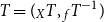 $T = (\!\,_{X}{T},\!\,_{f}{T}^{-1})$
forms a pseudonatural transformation
$T = (\!\,_{X}{T},\!\,_{f}{T}^{-1})$
forms a pseudonatural transformation $T\colon F \Rightarrow F$
and then show that the various natural constructions give rise to modifications between the various pullback and compositional powers of
$T\colon F \Rightarrow F$
and then show that the various natural constructions give rise to modifications between the various pullback and compositional powers of $T$
(after we prove that pullback powers of
$T$
(after we prove that pullback powers of $T$
exist, of course).
$T$
exist, of course).
Lemma 3.12.
If $F\colon \mathscr{C}^{\;\textrm {op}} \to \mathfrak{Cat}$
is a tangent indexing functor, then there is a pseudonatural transformation
$F\colon \mathscr{C}^{\;\textrm {op}} \to \mathfrak{Cat}$
is a tangent indexing functor, then there is a pseudonatural transformation $T\colon F \Rightarrow F$
whose object-local components are given by the tangent functors in the tangent structures
$T\colon F \Rightarrow F$
whose object-local components are given by the tangent functors in the tangent structures $(F(X),\,_{X}{\mathbb{T}})$
. In particular,
$(F(X),\,_{X}{\mathbb{T}})$
. In particular, $T\colon F \Rightarrow F$
determines an endofunctor
$T\colon F \Rightarrow F$
determines an endofunctor
 \begin{equation*} \underline {T}\colon \mathbf{PC}(F) \to \mathbf{PC}(F). \end{equation*}
Proof. The first part of the statement of the lemma is axiomatized and hence holds by Condition (3) of Definition 3.9. The second statement follows from Theorem2.6.
Remark 3.13. In Definition 3.9, when we ask that the data $(\!\,_{X}{T}, \!\,_{f}{T}^{-1})$
constitute a pseudonatural transformation
$(\!\,_{X}{T}, \!\,_{f}{T}^{-1})$
constitute a pseudonatural transformation $T\colon F\Rightarrow F$
, in light of Lemma 3.12 we are asking that the transition isomorphisms on an object
$T\colon F\Rightarrow F$
, in light of Lemma 3.12 we are asking that the transition isomorphisms on an object $\underline {T}A$
take the form:
$\underline {T}A$
take the form:
 \begin{equation*} \Sigma _{\underline {T}A} = \left \lbrace \!\,_{X}{T}\left (\tau _f^{A}\right ) \circ \! \,_{f}{T}_{\!\,_{Y}{A}} \; : \; f \in \mathscr{C}_1, \tau _f^A \in \Sigma _A \right \rbrace . \end{equation*}
In particular, this means that the transition isomorphisms are given as a composition of the tangent functor as applied to the transition isomorphisms an object starts with, pre-composed with the tangent morphism’s naturality witness.
Lemma 3.14.
Let $F\colon \mathscr{C}^{\;\textrm {op}} \to \mathfrak{Cat}$
be a tangent indexing functor. There is a modification
$F\colon \mathscr{C}^{\;\textrm {op}} \to \mathfrak{Cat}$
be a tangent indexing functor. There is a modification $p\colon T \Rrightarrow \iota _F$
as in the diagram
$p\colon T \Rrightarrow \iota _F$
as in the diagram

where the natural transformations $p_{X}$
of the modification are all given by
$p_{X}$
of the modification are all given by
 \begin{equation*} p_{X} := \!\,_{X}{p}\colon \!\,_{X}{T} \to \textrm {id}_{F(X)} \end{equation*}
where $\!\,_{X}{p}$
is the bundle transformation in the tangent structure
$\!\,_{X}{p}$
is the bundle transformation in the tangent structure $(F(X),\!\,_{X}{\mathbb{T}})$
.
$(F(X),\!\,_{X}{\mathbb{T}})$
.
Proof. To prove that $p$
is a modification, it suffices to verify that the diagram of functors and natural transformations
$p$
is a modification, it suffices to verify that the diagram of functors and natural transformations

commutes for any $f\colon X \to Y$
in
$f\colon X \to Y$
in $\mathscr{C}_1$
. However, this is equivalent to asking that the diagram of functors and natural transformations
$\mathscr{C}_1$
. However, this is equivalent to asking that the diagram of functors and natural transformations

commutes, which follows from the fact that $(F(\,f),\!\,_{f}{T})$
is a (strong) tangent morphism. Thus,
$(F(\,f),\!\,_{f}{T})$
is a (strong) tangent morphism. Thus, $p\colon T \Rrightarrow \iota _{F}$
is a modification.
$p\colon T \Rrightarrow \iota _{F}$
is a modification.
Corollary 3.15.
If $F$
is a tangent indexing functor, then there is a natural transformation
$F$
is a tangent indexing functor, then there is a natural transformation
 \begin{equation*}\underline {p}\colon \underline {T} \to \textrm {id}_{\mathbf{PC}(F)}\colon \mathbf{PC}(F) \to \mathbf{PC}(F).\end{equation*}
Lemma 3.16.
Let $F\colon \mathscr{C}^{\;\textrm {op}} \to \mathfrak{Cat}$
be a tangent indexing functor. Then there is a modification
$F\colon \mathscr{C}^{\;\textrm {op}} \to \mathfrak{Cat}$
be a tangent indexing functor. Then there is a modification $0\colon \iota _F \Rrightarrow T$
as in the diagram
$0\colon \iota _F \Rrightarrow T$
as in the diagram

whose object-local natural transformations are given by
 \begin{equation*} \!\,_{X}{0}\colon \textrm {id}_{F(X)} \Rightarrow \!\,_{X}{T} \end{equation*}
where $\!\,_{X}{0}$
is the zero of the tangent structure
$\!\,_{X}{0}$
is the zero of the tangent structure $(F(X),\!\,_{X}{\mathbb{T}})$
.
$(F(X),\!\,_{X}{\mathbb{T}})$
.
Proof. To prove that $0$
is a modification, it suffices to verify that the diagram of functors and natural transformations
$0$
is a modification, it suffices to verify that the diagram of functors and natural transformations

commutes for any $f\colon X \to Y$
in
$f\colon X \to Y$
in $\mathscr{C}_1$
. However, this is equivalent to asking that the diagram of functors and natural transformations
$\mathscr{C}_1$
. However, this is equivalent to asking that the diagram of functors and natural transformations

commutes, which follows from $(F(\,f),\!\,_{f}{T})$
being a strong tangent morphism.
$(F(\,f),\!\,_{f}{T})$
being a strong tangent morphism.
Corollary 3.17.
If $F$
is a tangent indexing functor, then there is a natural transformation:
$F$
is a tangent indexing functor, then there is a natural transformation:

Recall that it is a centrally important aspect of tangent categories that we have a notion of additive tangent bundles. As such, we will require a short discussion of finite pullback powers of the tangent bundle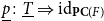 $\underline {p}\colon \underline {T} \Rightarrow \textrm {id}_{\mathbf{PC}(F)}$
in
$\underline {p}\colon \underline {T} \Rightarrow \textrm {id}_{\mathbf{PC}(F)}$
in $\mathbf{PC}(F)$
. Perhaps unsurprisingly, this will make use of Theorem2.9 above.
$\mathbf{PC}(F)$
. Perhaps unsurprisingly, this will make use of Theorem2.9 above.
Lemma 3.18.
Let $F\colon \mathscr{C}^{\;\textrm {op}} \to \mathfrak{Cat}$
be a tangent indexing functor and let
$F\colon \mathscr{C}^{\;\textrm {op}} \to \mathfrak{Cat}$
be a tangent indexing functor and let $A \in \mathbf{PC}(F)_0$
. Then for any
$A \in \mathbf{PC}(F)_0$
. Then for any $n \in \mathbb{N}$
, the pullback
$n \in \mathbb{N}$
, the pullback $T_nA$
exists in
$T_nA$
exists in $\mathbf{PC}(F)$
.
$\mathbf{PC}(F)$
.
Proof. Since $T_0A = A$
and
$T_0A = A$
and $T_1A = p_A\colon TA \to A$
, it suffices to show that
$T_1A = p_A\colon TA \to A$
, it suffices to show that $T_2A$
exists. For this, the cospan is considered
$T_2A$
exists. For this, the cospan is considered
 \begin{equation*} TA \xrightarrow {\underline {p}_A} A \xleftarrow {\underline {p}_A} TA \end{equation*}
in $\mathbf{PC}(F)$
. At each
$\mathbf{PC}(F)$
. At each $X \in \mathscr{C}_0$
, this gives the cospan
$X \in \mathscr{C}_0$
, this gives the cospan
 \begin{equation*} \!\,_{X}{T}\left (\!\,_{X}{A}\right ) \xrightarrow {\,_{X}{\! p}_{\!\,_{X}{A}}} \!\,_{X}{A} \xleftarrow {\!\,_{X}{p}_{\!\,_{X}{A}}} \!\,_{X}{T}\left (\!\,_{X}{A}\right ) \end{equation*}
in the tangent category $(F(X),\!\,_{X}{\mathbb{T}})$
. Because
$(F(X),\!\,_{X}{\mathbb{T}})$
. Because $F(X)$
is a tangent category with tangent structure
$F(X)$
is a tangent category with tangent structure $\!\,_{X}{\mathbb{T}}$
, we have that
$\!\,_{X}{\mathbb{T}}$
, we have that $\!\,_{X}{T}_2\left (\!\,_{X}{A}\right )$
exists in
$\!\,_{X}{T}_2\left (\!\,_{X}{A}\right )$
exists in $F(X)$
for all
$F(X)$
for all $X \in \mathscr{C}_0$
. Furthermore, because each functor
$X \in \mathscr{C}_0$
. Furthermore, because each functor $F(\,f)$
is the functor component of a strong tangent morphism
$F(\,f)$
is the functor component of a strong tangent morphism $(F(\,f),\!\,_{f}{T})$
, each functor
$(F(\,f),\!\,_{f}{T})$
, each functor $F(\,f)$
preserves each tangent pullback. It thus follows from Theorem2.9 that the pullback
$F(\,f)$
preserves each tangent pullback. It thus follows from Theorem2.9 that the pullback

exists.
We now prove that the pullback powers of the tangent functor $\underline {T}_n$
on
$\underline {T}_n$
on $\mathbf{PC}(F)$
arise themselves as pseudocone functors coming from pseudonatural transformations. While not strictly speaking necessary for the existence of the pullbacks
$\mathbf{PC}(F)$
arise themselves as pseudocone functors coming from pseudonatural transformations. While not strictly speaking necessary for the existence of the pullbacks $T_2$
, this shows how the natural transformations
$T_2$
, this shows how the natural transformations $\!\,_{f}{T_2}$
connecting
$\!\,_{f}{T_2}$
connecting $F(\,f) \circ \!\,_{Y}{T_2} \Rightarrow \!\,_{X}{T_2} \circ F(\,f)$
for any
$F(\,f) \circ \!\,_{Y}{T_2} \Rightarrow \!\,_{X}{T_2} \circ F(\,f)$
for any $f\colon X \to Y$
arise and are constructed. In particular, it shows that we can use Theorem2.6 to define our addition natural transformation.
$f\colon X \to Y$
arise and are constructed. In particular, it shows that we can use Theorem2.6 to define our addition natural transformation.
Proposition 3.19.
Let $F\colon \mathscr{C}^{\;\textrm {op}} \to \mathfrak{Cat}$
be a tangent indexing functor. There is a pseudonatural transformation
$F\colon \mathscr{C}^{\;\textrm {op}} \to \mathfrak{Cat}$
be a tangent indexing functor. There is a pseudonatural transformation $T_2$
$T_2$

whose functors $\!\,_{X}{T_2}$
are given by sending an object
$\!\,_{X}{T_2}$
are given by sending an object $A \in F(X)_0$
to the pullback
$A \in F(X)_0$
to the pullback $\!\,_{X}{T_2}(A)$
of the cospan
$\!\,_{X}{T_2}(A)$
of the cospan $\!\,_{X}{T}(A) \xrightarrow {\,_{X}{p}_A} A \xleftarrow {\,_{X}{p}_A} \!\,_{X}{T}(A)$
.
$\!\,_{X}{T}(A) \xrightarrow {\,_{X}{p}_A} A \xleftarrow {\,_{X}{p}_A} \!\,_{X}{T}(A)$
.
Proof. We need to construct the natural isomorphism $\!\,_{f}{T_2}\colon F(\,f) \circ \!\,_{Y}{T_2} \stackrel {\cong }{\Rightarrow }\! \,_{X}{T_2} \circ F(\,f)$
. For this let
$\!\,_{f}{T_2}\colon F(\,f) \circ \!\,_{Y}{T_2} \stackrel {\cong }{\Rightarrow }\! \,_{X}{T_2} \circ F(\,f)$
. For this let $f\colon X \to Y$
be a morphism in
$f\colon X \to Y$
be a morphism in $\mathscr{C}_1$
and let
$\mathscr{C}_1$
and let $A \in F(Y)_0$
. Consider the cube:
$A \in F(Y)_0$
. Consider the cube:

We define $(\,_{f}{T_2})_A$
to be the unique dotted arrow which renders the cube above commutative and define
$(\,_{f}{T_2})_A$
to be the unique dotted arrow which renders the cube above commutative and define $\,_{f}{T_2} := \lbrace (\,_{f}{T_2})_A \; \left . \right | \; A \in F(Y)_0\rbrace$
. That
$\,_{f}{T_2} := \lbrace (\,_{f}{T_2})_A \; \left . \right | \; A \in F(Y)_0\rbrace$
. That $\!\,_{f}{T_2}$
is a natural transformation is routinely checked by using that if
$\!\,_{f}{T_2}$
is a natural transformation is routinely checked by using that if $\rho \in F(X)(A,B)$
then the morphism
$\rho \in F(X)(A,B)$
then the morphism $\!\,_{X}{T_2}(\rho )$
is the unique map making the cube
$\!\,_{X}{T_2}(\rho )$
is the unique map making the cube

commute. We also note that $\!\,_{f}{T_2}$
is a natural isomorphism because the functor
$\!\,_{f}{T_2}$
is a natural isomorphism because the functor $F(\,f)$
, as a strong tangent morphism, preserves tangent pullbacks and the maps which constitute
$F(\,f)$
, as a strong tangent morphism, preserves tangent pullbacks and the maps which constitute $\!\,_{f}{T_2}$
witness this. Finally, the pseudonaturality of the collection
$\!\,_{f}{T_2}$
witness this. Finally, the pseudonaturality of the collection $(\!\,_{X}{\!T_2},\!\,_{f}{T_2})$
follows from the fact that the object functors
$(\!\,_{X}{\!T_2},\!\,_{f}{T_2})$
follows from the fact that the object functors $\!\,_{X}{\!T_2}$
are defined by taking pullbacks of the pseudonatural transformation
$\!\,_{X}{\!T_2}$
are defined by taking pullbacks of the pseudonatural transformation $T$
, while the natural isomorphisms
$T$
, while the natural isomorphisms $\!\,_{f}{T_2}$
are defined by the limit preservation isomorphisms of
$\!\,_{f}{T_2}$
are defined by the limit preservation isomorphisms of $F(\,f)$
.
$F(\,f)$
.
Corollary 3.20.
For any $n \in \mathbb{N}$
, there is a pseudonatural transformation
$n \in \mathbb{N}$
, there is a pseudonatural transformation

whose underlying fiber functors $\,_{X}{T_n}$
are the
$\,_{X}{T_n}$
are the $n$
-fold tangent pullback powers.
$n$
-fold tangent pullback powers.
Proof. This is a routine induction with $T_0A := A$
,
$T_0A := A$
, $T_1A := TA$
, and taking
$T_1A := TA$
, and taking $T_2A$
as the base case for an induction involving finite pullback powers.
$T_2A$
as the base case for an induction involving finite pullback powers.
Corollary 3.21.
If $F\colon \mathscr{C}^{\;\textrm {op}} \to \mathfrak{Cat}$
is a tangent indexing functor, then the
$F\colon \mathscr{C}^{\;\textrm {op}} \to \mathfrak{Cat}$
is a tangent indexing functor, then the $n$
-fold tangent pullback functor
$n$
-fold tangent pullback functor $\underline {T_n}\colon \mathscr{C}^{\;\textrm {op}} \to \mathfrak{Cat}$
arises as the functor associated with the pseudonatural transformation
$\underline {T_n}\colon \mathscr{C}^{\;\textrm {op}} \to \mathfrak{Cat}$
arises as the functor associated with the pseudonatural transformation $T_n:F \Rightarrow F$
. In particular,
$T_n:F \Rightarrow F$
. In particular, $[\underline {T}]_2 = \underline {T_2}$
.
$[\underline {T}]_2 = \underline {T_2}$
.
Proof. The existence of $\underline {T_n}$
for all
$\underline {T_n}$
for all $n \in \mathbb{N}$
follows from applying Theorem2.6 to Corollary 3.20. Finally, note that if
$n \in \mathbb{N}$
follows from applying Theorem2.6 to Corollary 3.20. Finally, note that if $(A,T_A)$
is an object in
$(A,T_A)$
is an object in $\mathbf{PC}(F)$
, then
$\mathbf{PC}(F)$
, then $\underline {T_2}A = \underline {T}_2A$
. Thus, the fact that
$\underline {T_2}A = \underline {T}_2A$
. Thus, the fact that $[\underline {T}]_2 = \underline {T_2}$
comes down to noticing that for any
$[\underline {T}]_2 = \underline {T_2}$
comes down to noticing that for any $f\colon X \to Y$
in
$f\colon X \to Y$
in $\mathscr{C}_1$
, the naturality isomorphisms
$\mathscr{C}_1$
, the naturality isomorphisms

of the pseudonatural transformation $T_2$
are exactly the limit preservation isomorphisms induced by
$T_2$
are exactly the limit preservation isomorphisms induced by $F(\,f)$
preserving tangent pullbacks. As such the transition isomorphisms of
$F(\,f)$
preserving tangent pullbacks. As such the transition isomorphisms of $T_{\underline {T_2}A}$
coincide with the transition isomorphisms of
$T_{\underline {T_2}A}$
coincide with the transition isomorphisms of $T_{\underline {T}_2A}$
and so
$T_{\underline {T}_2A}$
and so $\underline {T}_2 = \underline {T_2}$
.
$\underline {T}_2 = \underline {T_2}$
.
Corollary 3.22.
Let $n, m \in \mathbb{N}$
and let
$n, m \in \mathbb{N}$
and let $F$
be a tangent indexing functor on
$F$
be a tangent indexing functor on $X$
. Then
$X$
. Then $\underline {T}^n \circ \underline {T}_m \cong \underline {T}_m \circ \underline {T}^n,$
that is, powers of
$\underline {T}^n \circ \underline {T}_m \cong \underline {T}_m \circ \underline {T}^n,$
that is, powers of $\underline {T}$
preserve all tangent pullbacks
$\underline {T}$
preserve all tangent pullbacks $\underline {T}_m$
.
$\underline {T}_m$
.
Proof. This follows from the fact that object-locally we have natural isomorphisms
 \begin{equation*} \!\,_{X}{\!T^n} \circ \!\,_{X}{\!T_m} \cong \!\,_{X}{\!T_m} \circ \!\,_{X}{\!T^n} \end{equation*}
by virtue of $(F(X),\!\,_{X}{\mathbb{T}})$
being a tangent category and each
$(F(X),\!\,_{X}{\mathbb{T}})$
being a tangent category and each $\!\,_{X}{\!T}$
being a tangent functor. From here, checking the modification axioms for these natural isomorphisms is a straightforward but tedious process we omit here.
$\!\,_{X}{\!T}$
being a tangent functor. From here, checking the modification axioms for these natural isomorphisms is a straightforward but tedious process we omit here.
We now use the tangent pullback functor $\underline {T_2} = \underline {T}_2$
we just built in order to prove that we can add pseudolimit bundles by making sure that the object-local pieces of the bundle addition on
$\underline {T_2} = \underline {T}_2$
we just built in order to prove that we can add pseudolimit bundles by making sure that the object-local pieces of the bundle addition on $\underline {T}_2A$
are given by the bundle addition
$\underline {T}_2A$
are given by the bundle addition $\,_{X}{+}\colon \!\,_{X}{T_2}(\!\,_{X}{A}) \to \!\,_{X}{T}(\!\,_{X}{A})$
.
$\,_{X}{+}\colon \!\,_{X}{T_2}(\!\,_{X}{A}) \to \!\,_{X}{T}(\!\,_{X}{A})$
.
Lemma 3.23.
Let $F\colon \mathscr{C}^{\;\textrm {op}} \to \mathfrak{Cat}$
. Then there is an addition modification
$F\colon \mathscr{C}^{\;\textrm {op}} \to \mathfrak{Cat}$
. Then there is an addition modification $+\colon T_2 \Rrightarrow T$
as in the diagram
$+\colon T_2 \Rrightarrow T$
as in the diagram

whose natural transformations are given by
 \begin{equation*} \,_{X}{+}\colon \!\,_{X}{\!T_2} \to \!\,_{X}{\!T} \end{equation*}
where $\,_{X}{+}$
is the bundle addition transformation in the tangent structure
$\,_{X}{+}$
is the bundle addition transformation in the tangent structure $(F(X),\!\,_{X}{\mathbb{T}})$
.
$(F(X),\!\,_{X}{\mathbb{T}})$
.
Proof. To prove that $+$
is a modification it suffices to prove that the diagram of functors and natural transformations
$+$
is a modification it suffices to prove that the diagram of functors and natural transformations

commutes. However, this follows immediately because $(F(\,f),\!\,_{f}{T})$
is a strong tangent morphism.
$(F(\,f),\!\,_{f}{T})$
is a strong tangent morphism.
Corollary 3.24.
For any tangent indexing functor $F$
on
$F$
on $X$
, there is an addition natural transformation
$X$
, there is an addition natural transformation $\underline {+}\colon \underline {T}_2 \Rightarrow \underline {T}$
.
$\underline {+}\colon \underline {T}_2 \Rightarrow \underline {T}$
.
Proof. Apply Theorem2.6 to the modification $+\colon T_2 \Rrightarrow T$
.
$+\colon T_2 \Rrightarrow T$
.
Proposition 3.25.
Let $F$
be a tangent indexing functor on
$F$
be a tangent indexing functor on $X$
. For any
$X$
. For any $A \in \mathbf{PC}(F)_0$
, the tangent bundle
$A \in \mathbf{PC}(F)_0$
, the tangent bundle $\underline {T}A$
is an additive bundle in
$\underline {T}A$
is an additive bundle in $\mathbf{PC}(F)$
, that is,
$\mathbf{PC}(F)$
, that is,
 \begin{equation*} \left (\underline {p}_A\colon \underline {T}A \to A,\underline {+}_A\colon \underline {T}_2A \to \underline {T}A, \underline {0}_A\colon A \to \underline {T}A\right ) \end{equation*}
is a commutative monoid in $\mathbf{PC}(F)_{/A}$
.
$\mathbf{PC}(F)_{/A}$
.
Proof. It suffices to show that $\underline {0}_A$
is a left-and-right unit for
$\underline {0}_A$
is a left-and-right unit for $\underline {p}_A\colon \underline {T}A \to A$
and that bundle addition
$\underline {p}_A\colon \underline {T}A \to A$
and that bundle addition $\underline {+}_A$
is commutative and associative over
$\underline {+}_A$
is commutative and associative over $A$
. However, checking that the diagrams
$A$
. However, checking that the diagrams


all hold, where $s$
is the product-swapping map, may be done object-locally, that is, it may be checked over each category
$s$
is the product-swapping map, may be done object-locally, that is, it may be checked over each category $F(X)$
. However, because each category
$F(X)$
. However, because each category $(F(X), \,_{X}{\mathbb{T}})$
is a tangent category we have that
$(F(X), \,_{X}{\mathbb{T}})$
is a tangent category we have that $\,_{X}{T}(\,_{X}{A})$
is an additive bundle over
$\,_{X}{T}(\,_{X}{A})$
is an additive bundle over $\,_{X}{A}$
and so each desired object-local diagram commutes. Thus,
$\,_{X}{A}$
and so each desired object-local diagram commutes. Thus, $\underline {T}A$
is an additive
$\underline {T}A$
is an additive $A$
-bundle.
$A$
-bundle.
We now recall a basic construction in $2$
-category and bicategory theory in order to better understand how to define and work with the composite
$2$
-category and bicategory theory in order to better understand how to define and work with the composite $\underline {T}^2$
directly from its descent incarnation from the vertical composition
$\underline {T}^2$
directly from its descent incarnation from the vertical composition $T^2 = T \circ T$
of pseudonatural transformations. If
$T^2 = T \circ T$
of pseudonatural transformations. If $F,G,H\colon \mathfrak{C} \to \mathfrak{D}$
are two pseudofunctors between
$F,G,H\colon \mathfrak{C} \to \mathfrak{D}$
are two pseudofunctors between $2$
-categories and if we have pseudonatural transformations as in the diagram
$2$
-categories and if we have pseudonatural transformations as in the diagram

then the vertical composite $\beta \circ \alpha \colon F \Rightarrow H\colon \mathfrak{C} \to \mathfrak{D}$
has object functors defined by, for all
$\beta \circ \alpha \colon F \Rightarrow H\colon \mathfrak{C} \to \mathfrak{D}$
has object functors defined by, for all $X \in \mathfrak{C}_0$
 \begin{equation*} (\beta \circ \alpha )_X = \beta _X \circ \alpha _X, \end{equation*}
while it has morphism natural transformations defined by, for all $f\colon X \to Y \in \mathfrak{C}_1$
:
$f\colon X \to Y \in \mathfrak{C}_1$
:

From this we get that $\underline {T}^2\colon \mathbf{PC}(F) \to \mathbf{PC}(F)$
arises as the functor associated with the pseudonatural transformation
$\underline {T}^2\colon \mathbf{PC}(F) \to \mathbf{PC}(F)$
arises as the functor associated with the pseudonatural transformation $T^2 = T \circ T\colon F \Rightarrow F$
described by fiber functors
$T^2 = T \circ T\colon F \Rightarrow F$
described by fiber functors
 \begin{equation*} \,_{X}{(T^2)} := (\,_{X}{T})^2 \end{equation*}
and fiber transformations
 \begin{equation*} \,_{f}{T^2} := (_{X}{T} \ast \,_{f}{T}) \circ (\,_{f}{T} \ast \,_{Y}{T}) \end{equation*}
for any $f\colon X \to Y$
in
$f\colon X \to Y$
in $\mathscr{C}_1$
. We will use this observation below in proving the existence of both the verical lift
$\mathscr{C}_1$
. We will use this observation below in proving the existence of both the verical lift $\underline {\ell }\colon \underline {T} \Rightarrow \underline {T}^2$
and the canonical flip
$\underline {\ell }\colon \underline {T} \Rightarrow \underline {T}^2$
and the canonical flip $\underline {c}\colon \underline {T}^2 \Rightarrow \underline {T}^2$
.
$\underline {c}\colon \underline {T}^2 \Rightarrow \underline {T}^2$
.
Lemma 3.26.
Let $F$
be a tangent indexing functor on
$F$
be a tangent indexing functor on $X$
. There is then a vertical lift modification
$X$
. There is then a vertical lift modification $\ell \colon T \Rrightarrow T^2$
as in the diagram
$\ell \colon T \Rrightarrow T^2$
as in the diagram

whose object-local natural transformations are given by the vertical lifts
 \begin{equation*} \!\,_{X}{\ell }\colon \!\,_{X}{T} \to \!\,_{X}{T^2} \end{equation*}
of the tangent structure $(F(X),\!\,_{X}{\mathbb{T}})$
.
$(F(X),\!\,_{X}{\mathbb{T}})$
.
Proof. To show that $\ell$
is a modification it suffices to check that the diagram of functors and natural transformations
$\ell$
is a modification it suffices to check that the diagram of functors and natural transformations

commutes for any $f\colon X \to Y$
in
$f\colon X \to Y$
in $\mathscr{C}_1$
. However, this is equivalent to asking that the diagram
$\mathscr{C}_1$
. However, this is equivalent to asking that the diagram

commutes, which holds because $(F(\,f),\,_{f}{T})$
is a (strong) tangent morphism and
$(F(\,f),\,_{f}{T})$
is a (strong) tangent morphism and
 \begin{equation*} \,_{f}{T^2} = (_{X}{T} \ast \,_{f}{T}) \circ (\,_{f}{T} \ast \,_{Y}{T}). \end{equation*}
Corollary 3.27.
Let $F$
be a tangent indexing functor. Then there is a vertical lift natural transformation
$F$
be a tangent indexing functor. Then there is a vertical lift natural transformation $\underline {\ell }\colon \underline {T} \Rightarrow \underline {T^2}$
.
$\underline {\ell }\colon \underline {T} \Rightarrow \underline {T^2}$
.
Proof. Apply Theorem2.6 to the vertical lift modification $\ell \colon T \Rrightarrow T^2$
.
$\ell \colon T \Rrightarrow T^2$
.
Lemma 3.28.
Let $F$
be a tangent indexing functor on
$F$
be a tangent indexing functor on $X$
and let
$X$
and let $A$
be an object of
$A$
be an object of $\mathbf{PC}(F)$
. Then
$\mathbf{PC}(F)$
. Then $(\underline {\ell }_A,0_{A})$
is a bundle morphism in
$(\underline {\ell }_A,0_{A})$
is a bundle morphism in $\mathscr{C}$
.
$\mathscr{C}$
.
Proof. It suffices to show that the squares

all commute in $\mathbf{PC}(F)$
. However, because these amount to checking the commutativity of diagrams in
$\mathbf{PC}(F)$
. However, because these amount to checking the commutativity of diagrams in $\mathbf{PC}(F)$
, it suffices to check that the diagrams all commute object-locally. That is, it suffices to prove that for all
$\mathbf{PC}(F)$
, it suffices to check that the diagrams all commute object-locally. That is, it suffices to prove that for all $X \in \mathscr{C}_0$
, the squares
$X \in \mathscr{C}_0$
, the squares


all commute. However, this follows by Axiom 3 of Definition 3.1 applied to $(F(X),\,_{X}{\mathbb{T}})$
.
$(F(X),\,_{X}{\mathbb{T}})$
.
Lemma 3.29.
Let $F$
be a tangent indexing functor on
$F$
be a tangent indexing functor on $X$
. There is then a canonical flip modification
$X$
. There is then a canonical flip modification $c\colon T^2 \Rrightarrow T^2$
as in the diagram
$c\colon T^2 \Rrightarrow T^2$
as in the diagram

whose object-local natural transformations are given by the canonical flips
 \begin{equation*} \,_{X}{c}\colon \,_{X}{T^2} \to \,_{X}{T^2} \end{equation*}
of the tangent structure $(F(X),\,_{X}{\mathbb{T}})$
.
$(F(X),\,_{X}{\mathbb{T}})$
.
Proof. To show that $c$
determines a modification it suffices to prove that for any
$c$
determines a modification it suffices to prove that for any $f\colon X \to Y$
in
$f\colon X \to Y$
in $\mathscr{C}_1$
the diagram of functors and natural transformations
$\mathscr{C}_1$
the diagram of functors and natural transformations

commutes. However, this is equivalent to asking that the diagram

commutes, which holds because $(F(\,f), \,_{f}{T})$
is a tangent morphism and because
$(F(\,f), \,_{f}{T})$
is a tangent morphism and because
 \begin{equation*} \!\,_{f}{T^2} = (\!\,_{X}{T} \ast \!\,_{f}{T}) \circ (\,_{f}{T} \ast \!\,_{Y}{T}). \end{equation*}
Corollary 3.30.
For any tangent indexing functor $F$
on
$F$
on $X$
, there is a canonical flip natural transformation
$X$
, there is a canonical flip natural transformation $\underline {c}\colon \underline {T}^2 \Rightarrow \underline {T}^2$
.
$\underline {c}\colon \underline {T}^2 \Rightarrow \underline {T}^2$
.
Lemma 3.31.
Let $F$
be a tangent indexing functor on
$F$
be a tangent indexing functor on $X$
and let
$X$
and let $A$
be an object of
$A$
be an object of $\mathbf{PC}(F)$
. Then
$\mathbf{PC}(F)$
. Then $(\underline {c}_A,\textrm {id}_{\underline {T}A})$
is a bundle morphism in
$(\underline {c}_A,\textrm {id}_{\underline {T}A})$
is a bundle morphism in $\mathscr{C}$
.
$\mathscr{C}$
.
Proof. It suffices to show that the squares

all commute in $\mathbf{PC}(F)$
. However, because these amount to checking the commutativity of diagrams in
$\mathbf{PC}(F)$
. However, because these amount to checking the commutativity of diagrams in $\mathbf{PC}(F)$
, it suffices to check that the diagrams all commute object-locally. That is, it suffices to prove that for all
$\mathbf{PC}(F)$
, it suffices to check that the diagrams all commute object-locally. That is, it suffices to prove that for all $X \in \mathscr{C}_0$
, the squares
$X \in \mathscr{C}_0$
, the squares


all commute. However, this follows by Axiom 4 of Definition 3.1 applied to $(F(X),\,_{X}{\mathbb{T}})$
.
$(F(X),\,_{X}{\mathbb{T}})$
.
Proposition 3.32.
Let $F$
be a tangent indexing functor. Then the canonical flip and vertical flip transformations satisfy the following coherences:
$F$
be a tangent indexing functor. Then the canonical flip and vertical flip transformations satisfy the following coherences: $\underline {c}^2 = \iota _{\underline {F}}$
,
$\underline {c}^2 = \iota _{\underline {F}}$
, $\underline {c} \circ \underline {\ell } = \underline {\ell }$
, and the diagrams of functors and natural transformations
$\underline {c} \circ \underline {\ell } = \underline {\ell }$
, and the diagrams of functors and natural transformations

all commute.
Proof. It suffices through Theorem2.6 to show that the corresponding identities and commuting diagrams hold for the corresponding pseudonatural transformations and modifications. In particular, it suffices to verify each corresponding identity in $F(X)$
for all
$F(X)$
for all $X \in \mathscr{C}_0$
. However, each identity holds because each object is given in terms of the corresponding functor/natural transformation in the tangent structure
$X \in \mathscr{C}_0$
. However, each identity holds because each object is given in terms of the corresponding functor/natural transformation in the tangent structure $(F(X),\,_{X}{\mathbb{T}})$
.
$(F(X),\,_{X}{\mathbb{T}})$
.
As a last lonely proposition, we show the universality of the vertical lift in $\mathbf{PC}(F)$
. This is our final ingredient in proving that
$\mathbf{PC}(F)$
. This is our final ingredient in proving that $\mathbf{PC}(F)$
carries the structure of a tangent category.
$\mathbf{PC}(F)$
carries the structure of a tangent category.
Proposition 3.33.
Let $F$
be a tangent indexing functor on
$F$
be a tangent indexing functor on $X$
. Then for any
$X$
. Then for any $A \in \mathbf{PC}(F)_0$
the diagram
$A \in \mathbf{PC}(F)_0$
the diagram

is an equalizer in $\mathbf{PC}(F)$
.
$\mathbf{PC}(F)$
.
Proof. Recall that because each pair $(F(\,f),\,_{f}{T})$
for
$(F(\,f),\,_{f}{T})$
for $f \in \mathscr{C}_1$
is a strong tangent morphism, all the pullbacks expressing the universality of the vertical lift are preserved by
$f \in \mathscr{C}_1$
is a strong tangent morphism, all the pullbacks expressing the universality of the vertical lift are preserved by $F(\,f)$
. Thus, in order to prove the given diagram is an equalizer it suffices by Theorem2.9 to check that for every
$F(\,f)$
. Thus, in order to prove the given diagram is an equalizer it suffices by Theorem2.9 to check that for every $X \in \mathscr{C}_0$
, the diagram
$X \in \mathscr{C}_0$
, the diagram

is an equalizer. However, this holds because $(F(X),\,_{X}{\mathbb{T}}) = (F(X),\,_{X}{T},\,_{X}{p}, \,_{X}{+}, \,_{X}{0}, \,_{X}{\ell }, \,_{X}{c})$
is a tangent category.
$(F(X),\,_{X}{\mathbb{T}}) = (F(X),\,_{X}{T},\,_{X}{p}, \,_{X}{+}, \,_{X}{0}, \,_{X}{\ell }, \,_{X}{c})$
is a tangent category.
With this we can finally prove that when $F$
is a tangent indexing functor the pseudolimit category,
$F$
is a tangent indexing functor the pseudolimit category, $\mathbf{PC}(F)$
is a tangent category.
$\mathbf{PC}(F)$
is a tangent category.
Theorem 3.34.
If $F\colon \mathscr{C}^{\;\textrm {op}} \to \mathfrak{Cat}$
is a tangent indexing functor, then
$F\colon \mathscr{C}^{\;\textrm {op}} \to \mathfrak{Cat}$
is a tangent indexing functor, then $\mathbf{PC}(F)$
is a tangent category where the tangent structure
$\mathbf{PC}(F)$
is a tangent category where the tangent structure $\mathbb{T}$
is given by
$\mathbb{T}$
is given by $\mathbb{T} = (\underline {T}, \underline {p}, \underline {0}, \underline {+}, \underline {\ell }, \underline {c})$
for the functors and natural transformations determined in Lemma 3.12 and in Corollaries 3.15
, 3.17, 3.24, 3.27, 3.30.
$\mathbb{T} = (\underline {T}, \underline {p}, \underline {0}, \underline {+}, \underline {\ell }, \underline {c})$
for the functors and natural transformations determined in Lemma 3.12 and in Corollaries 3.15
, 3.17, 3.24, 3.27, 3.30.
Proof. The existence of each functor and natural transformation is given in the statement of the theorem, so we only need to prove the desired coherences and structural properties of Definition 3.1. However, one may prove that the axioms in Definition 3.1 hold for $(\mathbf{PC}(F),\mathbb{T})$
as follows:
$(\mathbf{PC}(F),\mathbb{T})$
as follows:
-
(1) Part
$1$
is verified by the existence of
$\underline {T}$
(cf. Lemma 3.12), the existence of
$\underline {p}$
(cf. Corollary 3.15), the existence of pullback powers of
$\underline {p}_A\colon \underline {T}A \to A$
for all
$A \in \mathbf{PC}(F)_0$
(cf. Corollary 3.21), and the commutativity of composite powers of
$\underline {T}$
with pullback powers of
$\underline {p}$
(cf. Corollary 3.22). -
(2) Part
$2$
holds by the existence of the bundle addition map
$\underline {+}$
(cf. Corollary 3.24), the existence of the bundle unit
$\underline {0}$
(cf. Corollary 3.17), and Proposition 3.25. -
(3) Part
$3$
is verified in two steps. First, the existence of
$\underline {\ell }$
follows from Corollary 3.27. Second, each pair
$(\underline {\ell }_A,\underline {0})_A$
is a bundle map for all
$A \in \mathbf{PC}(F)_0$
by Lemma 3.28. -
(4) Part
$4$
is verified in two steps. First, the canonical flip
$\underline {c}$
exists by Corollary 3.30. Second, the pair
$(\underline {c}_A, \textrm {id}_{\underline {T}A})$
is a bundle map for any
$A \in \mathbf{PC}(F)_0$
by Lemma 3.31. -
(5) Part
$5$
holds by Proposition 3.32. -
(6) Part
$6$
holds by Proposition 3.33.


Thus $(\mathbf{PC}(F),\mathbb{T})$
is a tangent category.
$(\mathbf{PC}(F),\mathbb{T})$
is a tangent category.
Example 3.35.
Let $F\colon \mathscr{C}^{\;\textrm {op}} \to \mathfrak{Cat}$
be any pseudofunctor and equip each fiber category
$F\colon \mathscr{C}^{\;\textrm {op}} \to \mathfrak{Cat}$
be any pseudofunctor and equip each fiber category $F(X)$
with the trivial tangent structure
$F(X)$
with the trivial tangent structure $\,_{X}{I}$
. Then the pseudolimit tangent structure
$\,_{X}{I}$
. Then the pseudolimit tangent structure $(\mathbf{PC}(F),{\mathbb{I}})$
asserted by Theorem
3.34
coincides with the trivial tangent structure
$(\mathbf{PC}(F),{\mathbb{I}})$
asserted by Theorem
3.34
coincides with the trivial tangent structure $(\mathbf{PC}(F), \mathbb{I}_{\mathbf{PC}(F)})$
on
$(\mathbf{PC}(F), \mathbb{I}_{\mathbf{PC}(F)})$
on $\mathbf{PC}(F)$
.
$\mathbf{PC}(F)$
.
For further (families of) examples of pseudolimit tangent structures, see Definitions 6.17 and 7.12.
Remark 3.36. The general theme so far in this paper has been to take a pseudofunctor $F\colon \mathscr{C}^{\;\textrm {op}} \to \mathfrak{Cat}$
, assume each category
$F\colon \mathscr{C}^{\;\textrm {op}} \to \mathfrak{Cat}$
, assume each category $F(X)$
for
$F(X)$
for $X \in \mathscr{C}_0$
has some structure
$X \in \mathscr{C}_0$
has some structure $S$
(such as a limit of shape
$S$
(such as a limit of shape $D$
, a tangent structure, etc.), assume that each functor
$D$
, a tangent structure, etc.), assume that each functor $F(\,f)$
for
$F(\,f)$
for $f\colon X \to Y$
preserves this structure, and determine if and when the pseudolimit
$f\colon X \to Y$
preserves this structure, and determine if and when the pseudolimit $\mathbf{PC}(F)$
has the same structure (cf. Theorems 2.9, 3.34). This is an instance of a more general approach for doing descent-theoretic
$\mathbf{PC}(F)$
has the same structure (cf. Theorems 2.9, 3.34). This is an instance of a more general approach for doing descent-theoretic $2$
-and-
$2$
-and- $bi$
-category theory which can be outlined/summarized as follows:
$bi$
-category theory which can be outlined/summarized as follows:
-
(1) Begin by choosing a structure
$S$
which can apply to some (subclass, if need be) of categories. That is,
$S$
applies to a subclass
$\mathscr{S}$
of
$\mathbf{Cat}_0$
. -
(2) Assume that we have a category
$\mathscr{C}$
and a pseudofunctor
$F\colon \mathscr{C}^{\;\textrm {op}} \to \mathfrak{Cat}$
for which: each category
$F(X)$
has structure
$S$
for all
$X \in \mathscr{C}_0$
and each functor
$F(\,f)$
preserves
$S$
or “commutes with”
$S$
, up to a natural isomorphism (such as a distributive law), for all morphisms
$f$
in
$\mathscr{C}$
. -
(3) Assume that the isomorphisms which witness that each
$F(\,f)$
preserves/commutes with the structure
$S$
vary coherently in
$\mathscr{C}^{\;\textrm {op}}$
. -
(4) Then deduce that the pseudolimit
$\mathbf{PC}(F)$
satisfies the structure
$S$
as well.





Effectively, this comes down to witnessing that these are precisely the pseudofunctors $F$
and properties
$F$
and properties $S$
for which one can do effective descent. This has been studied in depth in Vooys (Reference Vooys2024). For instance, there it is shown using
$S$
for which one can do effective descent. This has been studied in depth in Vooys (Reference Vooys2024). For instance, there it is shown using $S$
as a category being a (braided) monoidal category with translation functors being strong (braided) monoidal functors;
$S$
as a category being a (braided) monoidal category with translation functors being strong (braided) monoidal functors; $S$
being a regular category with translation functors regular functors;
$S$
being a regular category with translation functors regular functors; $S$
being that a category has all (co)limits of a fixed shape and the translation functors preserve these (co)limits;
$S$
being that a category has all (co)limits of a fixed shape and the translation functors preserve these (co)limits; $S$
being that a category is triangulated and having translation functors all be triangulated functors; and more. Theorem3.34 continues this trend, but an exact study of which structures
$S$
being that a category is triangulated and having translation functors all be triangulated functors; and more. Theorem3.34 continues this trend, but an exact study of which structures $S$
one can examine, internal to which
$S$
one can examine, internal to which $2$
-categories/bicategories
$2$
-categories/bicategories $\mathscr{K}$
, and how they relate to both effective descent and the Grothendieck construction is the subject of future work and future examination.
$\mathscr{K}$
, and how they relate to both effective descent and the Grothendieck construction is the subject of future work and future examination.
3.3 Tangent objects in the hom-2-category
We close this section with a discussion of the theory of tangent objects and the relation of tangent indexing functors and tangent objects in the hom $2$
-category
$2$
-category $\mathsf{Bicat}(\mathscr{C}^{\;\textrm {op}},\mathfrak{Cat})$
. Recently, in Lanfranchi (Reference Lanfranchi2023), Lanfranchi has defined the notion of a tangent object within a
$\mathsf{Bicat}(\mathscr{C}^{\;\textrm {op}},\mathfrak{Cat})$
. Recently, in Lanfranchi (Reference Lanfranchi2023), Lanfranchi has defined the notion of a tangent object within a $2$
-category as a natural generalization of what it means to be a tangent category; in fact, Lanfranchi’s definition is motivated by characterizing the tangent objects of
$2$
-category as a natural generalization of what it means to be a tangent category; in fact, Lanfranchi’s definition is motivated by characterizing the tangent objects of $\mathfrak{Cat}$
as precisely tangent categories. We begin by showing that the tangent objects of
$\mathfrak{Cat}$
as precisely tangent categories. We begin by showing that the tangent objects of $\mathsf{Bicat}(\mathscr{C}^{\;\textrm {op}},\mathfrak{Cat})$
can be described in terms of pseudofunctors
$\mathsf{Bicat}(\mathscr{C}^{\;\textrm {op}},\mathfrak{Cat})$
can be described in terms of pseudofunctors $F:\mathscr{C}^{\;\textrm {op}} \to \mathfrak{Cat}$
which factor through the forgetful
$F:\mathscr{C}^{\;\textrm {op}} \to \mathfrak{Cat}$
which factor through the forgetful $2$
-functor
$2$
-functor

and so we characterize the indexed tangent categories (Lanfranchi, Reference Lanfranchi2023, Definition 3.8) as exactly the tangent objects in $\mathsf{Bicat}(\mathscr{C}^{\;\textrm {op}},\mathfrak{Cat})$
.Footnote
4
To prove this, we begin with a convenient and important technical lemma.
$\mathsf{Bicat}(\mathscr{C}^{\;\textrm {op}},\mathfrak{Cat})$
.Footnote
4
To prove this, we begin with a convenient and important technical lemma.
Lemma 3.37.
Let $(\mathscr{C},\mathbb{T})$
and
$(\mathscr{C},\mathbb{T})$
and $(\mathscr{D},\mathbb{S})$
be tangent categories. Then a morphism
$(\mathscr{D},\mathbb{S})$
be tangent categories. Then a morphism $(F,\alpha )\colon \mathscr{C} \to \mathscr{D}$
is a strong lax morphism of tangent categories if and only if
$(F,\alpha )\colon \mathscr{C} \to \mathscr{D}$
is a strong lax morphism of tangent categories if and only if $(F,\alpha ^{-1})\colon \mathscr{C} \to \mathscr{D}$
is a strong colax morphism of tangent categories.
$(F,\alpha ^{-1})\colon \mathscr{C} \to \mathscr{D}$
is a strong colax morphism of tangent categories.
Proof. $\implies$
: If
$\implies$
: If $(F,\alpha )$
is a strong lax morphism of tangent categories then
$(F,\alpha )$
is a strong lax morphism of tangent categories then

is a natural isomorphism. That this forms the natural transformation of a colax morphism of tangent categories follows by virtue of inverting the direction of all the maps $\alpha :F \circ T \Rightarrow S \circ F$
together with the corresponding coherences.
$\alpha :F \circ T \Rightarrow S \circ F$
together with the corresponding coherences. $\impliedby$
: If we instead know that
$\impliedby$
: If we instead know that $(F,\alpha )$
is a strong colax morphism of tangent categories, then
$(F,\alpha )$
is a strong colax morphism of tangent categories, then

is a natural isomorphism. That this forms the natrual transformation of a lax morphism of tangent categories follows by virtue of inverting the direction of all the maps $\alpha :S \circ F \Rightarrow F \circ T$
together with the corresponding coherences.
$\alpha :S \circ F \Rightarrow F \circ T$
together with the corresponding coherences.
Because we require it in the remainder of this section and in Section 4, we now recall the definition of what it means to be a tangent object in a $2$
-category
$2$
-category $\mathfrak{C}$
. This definition requires the use of Leung (Reference Leung2017) and the approach to tangent categories as categories
$\mathfrak{C}$
. This definition requires the use of Leung (Reference Leung2017) and the approach to tangent categories as categories $\mathscr{C}$
together with a
$\mathscr{C}$
together with a $\mathsf{Weil}_1$
-actegory structure, that is, a strong monoidal functor
$\mathsf{Weil}_1$
-actegory structure, that is, a strong monoidal functor $\mathsf{Weil}_1 \to [\mathscr{C},\mathscr{C}]$
. We consequently also recall the definition of the category
$\mathsf{Weil}_1 \to [\mathscr{C},\mathscr{C}]$
. We consequently also recall the definition of the category $\mathsf{Weil}_1$
as well.
$\mathsf{Weil}_1$
as well.
Definition 3.38 (Leung (Reference Leung2017)). The category $\mathsf{Weil}_1$
is the monoidal category where:
$\mathsf{Weil}_1$
is the monoidal category where:
-
• Objects: Finite tensor products of the
$\mathbb{N}$
-algebras
\begin{equation*} W^n := \frac {\mathbb{N}[x_1, \cdots , x_n]}{(x_ix_j: 1 \leq i, j \leq n)}. \end{equation*}
-
• Morphisms: As in the category of augmented
$\mathbb{N}$
-algebras.
-
• Composition: As in the category of augmented
$\mathbb{N}$
-algebras.
-
• Identities: The identity of a Weil algebra
$A$
is
$\textrm {id}_A$
. -
• Monoidal Product: The monoidal product is the
$\mathbb{N}$
-tensor product
$\otimes _{\mathbb{N}}$
. -
• Monoidal unit: The monoidal unit is
$\mathbb{N}$
. -
• Unitors: The tensor units
$A \otimes _{\mathbb{N}} \mathbb{N} \cong A$
and
$A \cong \mathbb{N} \otimes _{\mathbb{N}} A$
. -
• Associators: The tensor associator:
$(A \otimes _{\mathbb{N}} B) \otimes _{\mathbb{N}} C \cong A \otimes _{\mathbb{N}} (B \otimes _{\mathbb{N}} C)$
.



The category $\mathsf{Weil}_1$
is equipped with a special algebra
$\mathsf{Weil}_1$
is equipped with a special algebra $W := \mathbb{N}[x]/(x^2)$
which largely generates the category. It is used as a placeholder for determining the tangent structure on
$W := \mathbb{N}[x]/(x^2)$
which largely generates the category. It is used as a placeholder for determining the tangent structure on $\mathscr{C}$
by determining the functor that
$\mathscr{C}$
by determining the functor that $W$
is mapped to by the strong monoidal functor
$W$
is mapped to by the strong monoidal functor $\alpha :\mathsf{Weil}_1 \to [\mathscr{C},\mathscr{C}]$
. The corresponding ways to translate the remainder of the tangent structure (namely the bundle projection, the sum, the zero, the lift, and the flip) are given by the following morphisms:
$\alpha :\mathsf{Weil}_1 \to [\mathscr{C},\mathscr{C}]$
. The corresponding ways to translate the remainder of the tangent structure (namely the bundle projection, the sum, the zero, the lift, and the flip) are given by the following morphisms:
-
•
$p:W \to \mathbb{N}$
induced by sending
$x \mapsto 0$
; this is the map which realizes
$W$
as an augmented
$\mathbb{N}$
-algebra. -
• The zero morphism
$z:\mathbb{N} \to W$
is the rig map which witnesses
$W$
as an
$\mathbb{N}$
-algebra. -
• The sum map
$\operatorname {add}:W^2 \to W$
which sends the two generators
$x_1$
and
$x_2$
of
$W^2$
to the generator
$x$
of
$W$
. -
• The vertical lift
$\ell :W \to W \otimes _{\mathbb{N}} W$
is the map which sends the generator
$x$
of
$W$
to the element
$x \otimes y$
. -
• The canonical flip
$c:W \otimes _{\mathbb{N}} W \to W \otimes _{\mathbb{N}} W$
is defined to be the mapgiven by
\begin{equation*} \frac {\mathbb{N}[x_1,x_2]}{(x_1^2, x_2^2)} \to \frac {\mathbb{N}[x_1, x_2]}{(x_1^2, x_2^2)} \end{equation*}
$x_1 \mapsto x_2$
and
$x_2 \mapsto x_1$
.








Generally, we will denote by $p_A:A \to \mathbb{N}$
the augmentation of the algebra
$p_A:A \to \mathbb{N}$
the augmentation of the algebra $A$
for all Weil algebras
$A$
for all Weil algebras $A$
.
$A$
.
Definition 3.39 (Lanfranchi, Reference Lanfranchi2023, Definition 4.3). Let $\mathfrak{C}$
be a
$\mathfrak{C}$
be a $2$
-category. We say that an object
$2$
-category. We say that an object $X$
of
$X$
of $\mathfrak{C}$
is a tangent object with a tangent structure
$\mathfrak{C}$
is a tangent object with a tangent structure $\mathbb{T}$
if there is a strong monoidal functor
$\mathbb{T}$
if there is a strong monoidal functor $F_{\mathbb{T}}:\mathsf{Weil}_1 \to \mathfrak{C}(X,X)$
for which:
$F_{\mathbb{T}}:\mathsf{Weil}_1 \to \mathfrak{C}(X,X)$
for which:
-
(1)
$F_{\mathbb{T}}$
preserves the pullbacks of the form
for all Weil-algebras
$A, B, C$
and that these pullbacks be pointwise, that is, they are preserved by all functors
$\mathfrak{C}(\,f,X)$
. Note that we also have omitted the unitor
$A \otimes _{\mathbb{N}} \mathbb{N} \cong A$
in the description of the pullback above.
-
(2) The functor
$F_{\mathbb{T}}$
perserves the universality of the vertical lift, that is, if
$\xi$
is the pairing map of
then
$F_{\mathbb{T}}$
preserves the pullback square
and sends it to a pointwise limit in
$\mathfrak{C}(X,X)$
.


Remark 3.40. The definition of a tangent object is more general than we will require in this paper. What it means to give a tangent object in the $2$
-category
$2$
-category $\mathsf{Bicat}(\mathscr{C}^{\;\textrm {op}},\mathfrak{Cat})$
is to require:
$\mathsf{Bicat}(\mathscr{C}^{\;\textrm {op}},\mathfrak{Cat})$
is to require:
-
(1) The existence of a pseudofunctor
$F\colon \mathscr{C}^{\;\textrm {op}} \to \mathfrak{Cat}$
, a pseudonatural transformation
$T$
, and a modification
$p$
,such that all iterated pullbacks against the cospan
$T \xrightarrow {p} \textrm {id}_{F} \xleftarrow {p} T$
exist in
$\mathsf{Bicat}(\mathscr{C}^{\;\textrm {op}},\mathfrak{Cat})(F,F)$
and are preserved by all powers
$T^m$
. We define the pullback of
$T \xrightarrow {p} \textrm {id}_{F} \xleftarrow {p} T$
to be the pseudonatural transformation
$T_2$
. -
(2) The existence of a pair of modifications
which make
$(T, \operatorname {add}:T_2 \to T, 0:\textrm {id}_F \to T)$
into a commutative monoid in
$\mathsf{Bicat}(\mathscr{C}^{\;\textrm {op}},\mathfrak{Cat})(T,T)$
. -
(3) The existence of modifications
-
(4) The diagram
is a (pointwise) pullback in
$\mathsf{Bicat}(\mathscr{C}^{\;\textrm {op}},\mathfrak{Cat})(F,F)$
.











Below are the coherences we require the tangent objects to satisfy:
 \begin{align} \ell \circ \operatorname {add} &= \left (\operatorname {add} \ast T\right ) \circ \left (\ell \times \ell \right ) & c \circ (T \ast \operatorname {add})&= (\!\operatorname {add} \ast T) \circ (c \times c) \end{align}
 \begin{align} (p \ast T) &= T \ast p & 0 \ast T&= c \circ (T \ast 0) \end{align}
 \begin{align} c \circ \ell &= \ell & c \circ c &= \textrm {id}_{T^2} \end{align}
 \begin{align} (T \ast \ell ) \circ \ell &= (\ell \ast T) \circ \ell & (\ell \ast T) \circ c &= (T \ast c) \circ (c \ast T) \circ \ell \end{align}
 \begin{align} (T \ast c) \circ (c \ast T) \circ (T \ast c) &= (c \ast T) \circ (T \ast c) \circ (c \ast T) \end{align}
Remark 3.41. In the proof of the theorem below, we indicate where it is that we need to use pseudofunctors which land in $\mathfrak{Tan}_{\operatorname {strong}}$
and not merely lax functors which land in
$\mathfrak{Tan}_{\operatorname {strong}}$
and not merely lax functors which land in $\mathfrak{Tan}$
. The issue arises in each case where we invoke Lemma 3.37, as this indicates that we require the naturality morphisms to be actual isomorphisms.
$\mathfrak{Tan}$
. The issue arises in each case where we invoke Lemma 3.37, as this indicates that we require the naturality morphisms to be actual isomorphisms.
Theorem 3.42.
Tangent objects in $\mathsf{Bicat}(\mathscr{C}^{\;\textrm {op}},\mathfrak{Cat})$
are determined by pseudofunctors
$\mathsf{Bicat}(\mathscr{C}^{\;\textrm {op}},\mathfrak{Cat})$
are determined by pseudofunctors $F\colon \mathscr{C}^{\;\textrm {op}} \to \mathfrak{Cat}$
which factor through the forgetful functor:
$F\colon \mathscr{C}^{\;\textrm {op}} \to \mathfrak{Cat}$
which factor through the forgetful functor:

Proof. $\implies$
: Assume that
$\implies$
: Assume that $(F,T,p,0,\operatorname {add},\ell ,c)$
is a tangent object in
$(F,T,p,0,\operatorname {add},\ell ,c)$
is a tangent object in $\mathsf{Bicat}(\mathscr{C}^{\;\textrm {op}},\mathfrak{Cat})$
. The object-local versions of the pasting diagrams and coherences required of a tangent object (cf. Lines (3.1)–(3.5)) imply that for every object
$\mathsf{Bicat}(\mathscr{C}^{\;\textrm {op}},\mathfrak{Cat})$
. The object-local versions of the pasting diagrams and coherences required of a tangent object (cf. Lines (3.1)–(3.5)) imply that for every object $X \in \mathscr{C}^{\;\textrm {op}}$
, the category
$X \in \mathscr{C}^{\;\textrm {op}}$
, the category $F(X)$
is a tangent category with tangent functor
$F(X)$
is a tangent category with tangent functor $\,_{X}{T}$
, bundle projection
$\,_{X}{T}$
, bundle projection $\,_{X}{p}$
, zero section
$\,_{X}{p}$
, zero section $\,_{X}{0}$
, addition
$\,_{X}{0}$
, addition $\,_{X}{\operatorname {add}}$
, lift
$\,_{X}{\operatorname {add}}$
, lift $\,_{X}{\ell }$
, and canonical flip
$\,_{X}{\ell }$
, and canonical flip $\,_{X}{c}$
. This shows us that the object-assignment
$\,_{X}{c}$
. This shows us that the object-assignment $F_0:\mathscr{C}^{\;\textrm {op}}_0 \to \mathfrak{Cat}_0$
factors through
$F_0:\mathscr{C}^{\;\textrm {op}}_0 \to \mathfrak{Cat}_0$
factors through $\textrm {Forget}_0:\mathfrak{Tan}_0 \to \mathfrak{Cat}_0$
. To see that the morphisms
$\textrm {Forget}_0:\mathfrak{Tan}_0 \to \mathfrak{Cat}_0$
. To see that the morphisms $Ff:FY \to FX$
are the functor components of (strong) lax tangent morphisms, recall that because
$Ff:FY \to FX$
are the functor components of (strong) lax tangent morphisms, recall that because $T:F \Rightarrow F$
is a pseudonatural transformation for any
$T:F \Rightarrow F$
is a pseudonatural transformation for any $f:X \to Y$
in
$f:X \to Y$
in $\mathscr{C}$
, there is a corresponding invertible
$\mathscr{C}$
, there is a corresponding invertible $2$
-cell
$2$
-cell

which, by virtue of the coherences implied in Lines (3.1)–(3.5), gives rise to a colax morphism of tangent categories. Moreover, because $T$
is a pseudonatural transformation,
$T$
is a pseudonatural transformation, $\,_{f}{T}$
is invertible and so
$\,_{f}{T}$
is invertible and so $(F(\,f),\,_{f}{T})$
is a strong colax morphism of tangent categories. However, applying Lemma 3.37 shows that
$(F(\,f),\,_{f}{T})$
is a strong colax morphism of tangent categories. However, applying Lemma 3.37 shows that $(F(\,f),\,_{f}{T}^{-1})$
is a strong lax morphism of tangent categories and hence shows that
$(F(\,f),\,_{f}{T}^{-1})$
is a strong lax morphism of tangent categories and hence shows that $F_1$
factors through
$F_1$
factors through $\mathfrak{Tan}$
as well. Thus,
$\mathfrak{Tan}$
as well. Thus, $F:\mathscr{C}^{\;\textrm {op}} \to \mathfrak{Cat}$
factors through
$F:\mathscr{C}^{\;\textrm {op}} \to \mathfrak{Cat}$
factors through $\textrm {Forget}:\mathfrak{Tan}_{\operatorname {strong}} \to \mathfrak{Cat}$
.
$\textrm {Forget}:\mathfrak{Tan}_{\operatorname {strong}} \to \mathfrak{Cat}$
. $\impliedby$
: Assume that
$\impliedby$
: Assume that $F:\mathscr{C}^{\;\textrm {op}} \to \mathfrak{Cat}$
factors as:
$F:\mathscr{C}^{\;\textrm {op}} \to \mathfrak{Cat}$
factors as:

Because $F$
lands first in the
$F$
lands first in the $2$
-category
$2$
-category $\mathfrak{Tan}_{\operatorname {strong}}$
, for any morphism
$\mathfrak{Tan}_{\operatorname {strong}}$
, for any morphism $f:X \to Y$
in
$f:X \to Y$
in $\mathscr{C}$
there is a strong tangent morphism
$\mathscr{C}$
there is a strong tangent morphism $(F(\,f),\,_{f}{\alpha })$
. But then by Lemma 3.37, the map
$(F(\,f),\,_{f}{\alpha })$
. But then by Lemma 3.37, the map $\,_{f}{\alpha }^{-1}$
fits into a
$\,_{f}{\alpha }^{-1}$
fits into a $2$
-cell
$2$
-cell

which varies pseudofunctorially in $\mathscr{C}^{\;\textrm {op}}$
. Arguing as in Lemmas 3.12 shows that the data described by
$\mathscr{C}^{\;\textrm {op}}$
. Arguing as in Lemmas 3.12 shows that the data described by $T = (\,_{X}{T},\,_{f}{\alpha }^{-1})_{X \in \mathscr{C}_0, f \in \mathscr{C}_1}$
is then a pseudonatural transformation
$T = (\,_{X}{T},\,_{f}{\alpha }^{-1})_{X \in \mathscr{C}_0, f \in \mathscr{C}_1}$
is then a pseudonatural transformation $T:F \Rightarrow F$
. Similarly, arguing as in Lemmas 3.14, 3.16, 3.23, Proposition 3.25, Lemma 3.26, and Lemma 3.29 shows that the object-local assignments for the bundle projections
$T:F \Rightarrow F$
. Similarly, arguing as in Lemmas 3.14, 3.16, 3.23, Proposition 3.25, Lemma 3.26, and Lemma 3.29 shows that the object-local assignments for the bundle projections $\,_{X}{p}$
, the zero maps
$\,_{X}{p}$
, the zero maps $\,_{X}{0}$
, the additions
$\,_{X}{0}$
, the additions $\,_{X}{\operatorname {add}}$
, the lifts
$\,_{X}{\operatorname {add}}$
, the lifts $\,_{X}{\ell }$
, and the canonical flips
$\,_{X}{\ell }$
, and the canonical flips $\,_{X}{c}$
determine modifications
$\,_{X}{c}$
determine modifications $p$
,
$p$
, $0$
,
$0$
, $\operatorname {add}$
,
$\operatorname {add}$
, $\ell$
, and
$\ell$
, and $c$
which determine a commutative monoid in
$c$
which determine a commutative monoid in $\mathsf{Bicat}(\mathscr{C}^{\;\textrm {op}},\mathfrak{Cat})(F,F)$
, satisfy the coherences in Lines (3.1)–(3.5), and have universal vertical lifts. As such, by extracting this information we find that
$\mathsf{Bicat}(\mathscr{C}^{\;\textrm {op}},\mathfrak{Cat})(F,F)$
, satisfy the coherences in Lines (3.1)–(3.5), and have universal vertical lifts. As such, by extracting this information we find that $F$
determines a tangent object in
$F$
determines a tangent object in $\mathsf{Bicat}(\mathscr{C}^{\;\textrm {op}},\mathfrak{Cat})$
.
$\mathsf{Bicat}(\mathscr{C}^{\;\textrm {op}},\mathfrak{Cat})$
.
We now show how our notion of a tangent indexing functor fits into this formulation and language via the theorem below.
Theorem 3.43.
Let $\mathscr{C}$
be a
$\mathscr{C}$
be a $1$
-category and consider the
$1$
-category and consider the $2$
-category
$2$
-category $\mathsf{Bicat}(\mathscr{C}^{\;\textrm {op}},\mathfrak{Cat})$
. Then a tuple
$\mathsf{Bicat}(\mathscr{C}^{\;\textrm {op}},\mathfrak{Cat})$
. Then a tuple $(F,T,p,\operatorname {add},0,\ell ,c)$
in
$(F,T,p,\operatorname {add},0,\ell ,c)$
in $\mathsf{Bicat}(\mathscr{C}^{\;\textrm {op}},\mathfrak{Cat})$
is a tangent object in the sense of Lanfranchi (Reference Lanfranchi2023
, Definition 3.2) if and only if
$\mathsf{Bicat}(\mathscr{C}^{\;\textrm {op}},\mathfrak{Cat})$
is a tangent object in the sense of Lanfranchi (Reference Lanfranchi2023
, Definition 3.2) if and only if $F\colon \mathscr{C}^{\;\textrm {op}} \to \mathfrak{Cat}$
is a tangent indexing functor.
$F\colon \mathscr{C}^{\;\textrm {op}} \to \mathfrak{Cat}$
is a tangent indexing functor.
Remark 3.44. Note that in Theorem 3.43, the roles of the witness isomorphism of the pseudonatural transformation $\,_{f}{T}$
and its inverse
$\,_{f}{T}$
and its inverse $\,_{f}{T}^{-1}$
are reversed when passing between tangent indexing functors and tangent objects. This illustrates another reason why we work with pseudonatural transformations as opposed to lax transformations.
$\,_{f}{T}^{-1}$
are reversed when passing between tangent indexing functors and tangent objects. This illustrates another reason why we work with pseudonatural transformations as opposed to lax transformations.
Proof. The theorem follows because to give a tangent indexing functor $F\colon \mathscr{C}^{\;\textrm {op}} \to \mathfrak{Cat}$
is precisely to give a pseudofunctor
$F\colon \mathscr{C}^{\;\textrm {op}} \to \mathfrak{Cat}$
is precisely to give a pseudofunctor $\underline {F}\colon \mathscr{C}^{\;\textrm {op}} \to \mathfrak{Tan}_{\operatorname {strong}}$
by Proposition 3.10 and because tangent objects in
$\underline {F}\colon \mathscr{C}^{\;\textrm {op}} \to \mathfrak{Tan}_{\operatorname {strong}}$
by Proposition 3.10 and because tangent objects in $\mathsf{Bicat}(\mathscr{C}^{\;\textrm {op}},\mathfrak{Cat})$
are exactly pseudofunctors
$\mathsf{Bicat}(\mathscr{C}^{\;\textrm {op}},\mathfrak{Cat})$
are exactly pseudofunctors $\underline {F}\colon \mathscr{C}^{\;\textrm {op}} \to \mathfrak{Tan}_{\operatorname {strong}} \xrightarrow {\textrm {Forget}} \mathfrak{Cat}$
by Theorem3.42.
$\underline {F}\colon \mathscr{C}^{\;\textrm {op}} \to \mathfrak{Tan}_{\operatorname {strong}} \xrightarrow {\textrm {Forget}} \mathfrak{Cat}$
by Theorem3.42.
Since tangent objects in $\mathfrak{Cat}$
are tangent categories, we obtain now the following corollary to Theorem3.34.
$\mathfrak{Cat}$
are tangent categories, we obtain now the following corollary to Theorem3.34.
Corollary 3.45.
The pseudolimit 2-functor $\mathbf{PC}\colon \mathsf{Bicat}(\mathscr{C}^{\;\textrm {op}}, \mathfrak{Cat})\to \mathfrak{Cat}$
sends tangent objects to tangent objects.
$\mathbf{PC}\colon \mathsf{Bicat}(\mathscr{C}^{\;\textrm {op}}, \mathfrak{Cat})\to \mathfrak{Cat}$
sends tangent objects to tangent objects.
The fact that $\operatorname {pseudolim}$
lifts to a 2-functor on 2-categories of tangent objects is a direct consequence of Theorem4.8.
$\operatorname {pseudolim}$
lifts to a 2-functor on 2-categories of tangent objects is a direct consequence of Theorem4.8.
4. Pseudolimit Tangent Morphisms
So far we have seen in Theorem3.34 that tangent indexing functors $F\colon \mathscr{C}^{\;\textrm {op}} \to \mathfrak{Cat}$
give rise to tangent structures on their pseudolimit
$F\colon \mathscr{C}^{\;\textrm {op}} \to \mathfrak{Cat}$
give rise to tangent structures on their pseudolimit $\mathbf{PC}(F)$
. In this section, we will examine the functoriality of this construction based on the strict
$\mathbf{PC}(F)$
. In this section, we will examine the functoriality of this construction based on the strict $2$
-functor
$2$
-functor $\mathbf{PC}(-)\colon \mathsf{Bicat}(\mathscr{C}^{\;\textrm {op}},\mathfrak{Cat}) \to \mathfrak{Cat}$
constructed in Vooys (Reference Vooys2024, Lemma 4.1.11, p. 80); note that we have already seen the object assignment of
$\mathbf{PC}(-)\colon \mathsf{Bicat}(\mathscr{C}^{\;\textrm {op}},\mathfrak{Cat}) \to \mathfrak{Cat}$
constructed in Vooys (Reference Vooys2024, Lemma 4.1.11, p. 80); note that we have already seen the object assignment of $\mathbf{PC}(-)$
in the construction of the pseudocone categories and
$\mathbf{PC}(-)$
in the construction of the pseudocone categories and $1$
-and-
$1$
-and- $2$
-cell assignments of
$2$
-cell assignments of $\mathbf{PC}(-)$
in Theorem2.6. The content of the citation given here is that this construction is strictly
$\mathbf{PC}(-)$
in Theorem2.6. The content of the citation given here is that this construction is strictly $2$
-functorial, that is,
$2$
-functorial, that is, $\mathbf{PC}(-)$
is a pseudofunctor with identity structure cells.
$\mathbf{PC}(-)$
is a pseudofunctor with identity structure cells.
Our next main goal is to establish Theorem4.8, which states that the diagram

exists, commutes strictly, and creates pseudolimits indexed by $1$
-categories in the
$1$
-categories in the $2$
-category
$2$
-category $\mathfrak{Tan}$
. To do this, however, we will need to understand the
$\mathfrak{Tan}$
. To do this, however, we will need to understand the $2$
-category
$2$
-category $\mathfrak{Tan}\left (\mathsf{Bicat}(\mathscr{C}^{\;\textrm {op}},\mathfrak{Cat})\right )$
of tangent objects, tangent morphisms, and tangent transformations in the
$\mathfrak{Tan}\left (\mathsf{Bicat}(\mathscr{C}^{\;\textrm {op}},\mathfrak{Cat})\right )$
of tangent objects, tangent morphisms, and tangent transformations in the $2$
-category
$2$
-category $\mathsf{Bicat}(\mathscr{C}^{\;\textrm {op}},\mathfrak{Cat})$
introduced in Lanfranchi (Reference Lanfranchi2023) as well as what they correspond to in terms of tangent indexing functors and the data
$\mathsf{Bicat}(\mathscr{C}^{\;\textrm {op}},\mathfrak{Cat})$
introduced in Lanfranchi (Reference Lanfranchi2023) as well as what they correspond to in terms of tangent indexing functors and the data $\mathsf{Bicat}(\mathscr{C}^{\;\textrm {op}}, \mathfrak{Cat})$
encodes.
$\mathsf{Bicat}(\mathscr{C}^{\;\textrm {op}}, \mathfrak{Cat})$
encodes.
We begin the task above by recalling what it means to be a morphism of tangent objects in the sense of Lanfranchi (Reference Lanfranchi2023), as this will form the crux of our discussion of functoriality on $1$
-cells and
$1$
-cells and $2$
-cells.
$2$
-cells.
Definition 4.1 (Lanfranchi, Reference Lanfranchi2023, Definition 4.15). If $\mathfrak{C}$
is a
$\mathfrak{C}$
is a $2$
-category with tangent objects
$2$
-category with tangent objects $(X,\mathbb{T})$
and
$(X,\mathbb{T})$
and $(Y,\mathbb{S})$
, then a (lax) morphism of tangent objects
$(Y,\mathbb{S})$
, then a (lax) morphism of tangent objects $(X,\mathbb{T}) \to (Y,\mathbb{S})$
is a pair
$(X,\mathbb{T}) \to (Y,\mathbb{S})$
is a pair $(\,f,\alpha )$
where:
$(\,f,\alpha )$
where:
-
(1)
$f\colon X \to Y$
is a
$1$
-cell in
$\mathfrak{C}$
; -
(2)
$\alpha$
is a
$2$
-cell:
-
(3) The diagrams of
$1$
-cells and
$2$
-cells
each commute in the relevant hom-categories.


Specializing this to the $2$
-category
$2$
-category $\mathsf{Bicat}(\mathscr{C}^{\;\textrm {op}},\mathfrak{Cat})$
we find the following characterization of (lax) tangent morphisms of tangent indexing functors. By Theorem3.43, this characterizes the tangent morphisms between tangent objects in the hom-
$\mathsf{Bicat}(\mathscr{C}^{\;\textrm {op}},\mathfrak{Cat})$
we find the following characterization of (lax) tangent morphisms of tangent indexing functors. By Theorem3.43, this characterizes the tangent morphisms between tangent objects in the hom- $2$
-category
$2$
-category $\mathsf{Bicat}(\mathscr{C}^{\;\textrm {op}},\mathfrak{Cat})$
.
$\mathsf{Bicat}(\mathscr{C}^{\;\textrm {op}},\mathfrak{Cat})$
.
Proposition 4.2.
Let $F,G\colon \mathscr{C}^{\;\textrm {op}} \to \mathfrak{Cat}$
be tangent indexing functors with tangent object structures
$F,G\colon \mathscr{C}^{\;\textrm {op}} \to \mathfrak{Cat}$
be tangent indexing functors with tangent object structures $(F,T,\!\,_{T}{p},\,_{T}{0},\!\,_{T}{\operatorname {add}},\!\,_{T}{\ell },\,_{T}{c})$
and
$(F,T,\!\,_{T}{p},\,_{T}{0},\!\,_{T}{\operatorname {add}},\!\,_{T}{\ell },\,_{T}{c})$
and $(G,S,\!\,_{S}{p}, \!\,_{S}{0}, \!\,_{S}{\operatorname {add}}, \!\,_{S}{\ell }, \!\,_{S}{c})$
, respectively. To give a tangent morphism
$(G,S,\!\,_{S}{p}, \!\,_{S}{0}, \!\,_{S}{\operatorname {add}}, \!\,_{S}{\ell }, \!\,_{S}{c})$
, respectively. To give a tangent morphism $(h,\alpha )\colon F \to G$
, it is necessary and sufficient to give a pseudonatural transformation
$(h,\alpha )\colon F \to G$
, it is necessary and sufficient to give a pseudonatural transformation $h\colon F \Rightarrow G$
and a modification
$h\colon F \Rightarrow G$
and a modification

such that for all objects $X$
in
$X$
in $\mathscr{C}$
, the equations
$\mathscr{C}$
, the equations
 \begin{align} \!\,_{X}{h} \ast \!\,_{X}{\left (\,_{T}{p}\right )} &= \!\,_{X}{\left (\!\,_{S}{p} \ast h\right )} \circ \!\,_{X}{\alpha } \end{align}
 \begin{align} \!\,_{X}{\alpha } \circ \!\,_{X}{\left (h \ast \!\,_{T}{0}\right )}&=\!\,_{X}{\left (\!\,_{S}{0} \ast h\right )} \end{align}
 \begin{align} \!\,_{X}{\left (\!\,_{S}{\operatorname {add}} \ast h\right )} \circ \!\,_{X}{\alpha _2} &= \!\,_{X}{\alpha } \circ \!\,_{X}{\left (h \ast \,_{T}{\operatorname {add}}\right )} \end{align}
 \begin{align} \!\,_{X}{\left (\!\,_{G}{\ell }\right )} \circ \! \,_{X}{\alpha } &= \!\,_{X}{\left (S \ast \alpha \right )} \circ \!\,_{X}{\left (\alpha \ast T\right )} \circ \!\,_{X}{\left (\!\,_{F}{\ell }\right )} \end{align}
 \begin{align} \!\,_{X}{\left (S \ast \alpha \right )} \circ \!\,_{X}{\left (\alpha \ast T\right )} \circ \!\,_{X}{\left (\!\,_{T}{c}\right )} &= \!\,_{X}{\left (\!\,_{S}{c}\right )} \circ \!\,_{X}{\left (S \ast \alpha \right )} \circ \!\,_{X}{\left (\alpha \ast T\right )} \end{align}
hold. Additionally, $(h,\alpha )$
is strong if and only if
$(h,\alpha )$
is strong if and only if $\alpha$
is an isomorphism.
$\alpha$
is an isomorphism.
Proof. To see that the equations are sufficient, we note that by requiring that each of the equations in lines (4.1)–(4.5) hold for each object $X \in \mathscr{C}_0$
, the coherence diagrams given in Item (3) of Definition 4.1 are all satisfied.
$X \in \mathscr{C}_0$
, the coherence diagrams given in Item (3) of Definition 4.1 are all satisfied.
Alternatively, to see that giving a pseudonatural transformation $h\colon F \Rightarrow G$
and modification
$h\colon F \Rightarrow G$
and modification $\alpha \colon h \circ T \Rrightarrow S \circ h$
for which the equations given in Lines (4.1)–(4.5) are necessary. First, we note that in order for Items (1) and (2) of Definition 3.3 to hold, we require a pseudonatural transformation
$\alpha \colon h \circ T \Rrightarrow S \circ h$
for which the equations given in Lines (4.1)–(4.5) are necessary. First, we note that in order for Items (1) and (2) of Definition 3.3 to hold, we require a pseudonatural transformation $h$
and modification
$h$
and modification $\alpha$
of the typing declared in the statement of the proposition. Finally, each of the coherence diagrams in Item (3) of Definition 4.1 are described object-wise by the equations described in Lines (4.1)–(4.5), which shows their necessity. The final claim follows immediately by inspection.
$\alpha$
of the typing declared in the statement of the proposition. Finally, each of the coherence diagrams in Item (3) of Definition 4.1 are described object-wise by the equations described in Lines (4.1)–(4.5), which shows their necessity. The final claim follows immediately by inspection.
The proposition above allows us to deduce that giving tangent morphisms between tangent objects in $\mathsf{Bicat}(\mathscr{C}^{\;\textrm {op}},\mathfrak{Cat})$
is equivalent to giving a pseudonatural transformation and modification pair which is object-locally a tangent functor for every object in the base category
$\mathsf{Bicat}(\mathscr{C}^{\;\textrm {op}},\mathfrak{Cat})$
is equivalent to giving a pseudonatural transformation and modification pair which is object-locally a tangent functor for every object in the base category $\mathscr{C}$
.
$\mathscr{C}$
.
Corollary 4.3.
Let $F, G\colon \mathscr{C}^{\;\textrm {op}} \to \mathfrak{Cat}$
be tangent indexing functors with corresponding object-local tangent structures
$F, G\colon \mathscr{C}^{\;\textrm {op}} \to \mathfrak{Cat}$
be tangent indexing functors with corresponding object-local tangent structures $(F(X),\!\,_{X}{\mathbb{T}})$
and
$(F(X),\!\,_{X}{\mathbb{T}})$
and $(G(X),\!\,_{X}{\mathbb{S}})$
, respectively. To give a tangent morphism
$(G(X),\!\,_{X}{\mathbb{S}})$
, respectively. To give a tangent morphism $(h,\rho )\colon F \to G$
is to give a pseudonatural transformation and modification pair
$(h,\rho )\colon F \to G$
is to give a pseudonatural transformation and modification pair

such that for all $X \in \mathscr{C}_0$
the pair
$X \in \mathscr{C}_0$
the pair $(\!\,_{X}{h}, \!\,_{X}{\alpha })$
is a morphism of tangent categories. Additionally,
$(\!\,_{X}{h}, \!\,_{X}{\alpha })$
is a morphism of tangent categories. Additionally, $(h,\alpha )$
is strong if and only if each map
$(h,\alpha )$
is strong if and only if each map $(\,_{X}{h}, \,_{X}{\alpha })$
is strong.
$(\,_{X}{h}, \,_{X}{\alpha })$
is strong.
Proof. In both cases, we are given the existence of a pseudonatural transformation $h\colon F \Rightarrow G$
and a modification
$h\colon F \Rightarrow G$
and a modification $\alpha \colon h \circ T \Rrightarrow S \circ h$
, so it suffices to verify that being a tangent morphism is equivalent to having each functor/natural transformation pair
$\alpha \colon h \circ T \Rrightarrow S \circ h$
, so it suffices to verify that being a tangent morphism is equivalent to having each functor/natural transformation pair $(\!\,_{X}{h},\!\,_{X}{\alpha })$
be a morphism of tangent categories. Observe, however, that the equations (4.1)–(4.5) precisely declare that each pair
$(\!\,_{X}{h},\!\,_{X}{\alpha })$
be a morphism of tangent categories. Observe, however, that the equations (4.1)–(4.5) precisely declare that each pair $(\!\,_{X}{h}, \!\,_{X}{\alpha })$
is a morphism of tangent categories, as they are exactly the coherences declared in Definition 3.3. Thus, declaring that the equations in Lines (4.1)–(4.5) hold for all
$(\!\,_{X}{h}, \!\,_{X}{\alpha })$
is a morphism of tangent categories, as they are exactly the coherences declared in Definition 3.3. Thus, declaring that the equations in Lines (4.1)–(4.5) hold for all $X \in \mathscr{C}_0$
is equivalent to
$X \in \mathscr{C}_0$
is equivalent to $(\!\,_{X}{h}, \!\,_{X}{\alpha })$
being a morphism of tangent categories for all objects. As in Proposition 4.2, the final claim of the corollary is clear from inspection.
$(\!\,_{X}{h}, \!\,_{X}{\alpha })$
being a morphism of tangent categories for all objects. As in Proposition 4.2, the final claim of the corollary is clear from inspection.
Theorem 4.4.
Let $F,G\colon \mathscr{C}^{\;\textrm {op}} \to \mathfrak{Cat}$
be tangent indexing functors and let
$F,G\colon \mathscr{C}^{\;\textrm {op}} \to \mathfrak{Cat}$
be tangent indexing functors and let $(h,\alpha )\colon F \Rightarrow G$
be a tangent morphism between them in
$(h,\alpha )\colon F \Rightarrow G$
be a tangent morphism between them in $\mathsf{Bicat}(\mathscr{C}^{\;\textrm {op}},\mathfrak{Cat})$
. Then the pair
$\mathsf{Bicat}(\mathscr{C}^{\;\textrm {op}},\mathfrak{Cat})$
. Then the pair $(\underline {h},\underline {\alpha })\colon \mathbf{PC}(F) \to \mathbf{PC}(G)$
is a morphism of tangent categories.
$(\underline {h},\underline {\alpha })\colon \mathbf{PC}(F) \to \mathbf{PC}(G)$
is a morphism of tangent categories.
Proof. Note that the content of this theorem amounts to proving that the diagrams of functors and natural transformations


all must commute. However, to show this it suffices to prove that for any object $A = \lbrace \!\,_{X}{A} \; \left . \right | \; X \in \mathscr{C}_0 \rbrace$
of
$A = \lbrace \!\,_{X}{A} \; \left . \right | \; X \in \mathscr{C}_0 \rbrace$
of $\mathbf{PC}(F)$
, the
$\mathbf{PC}(F)$
, the $X$
-local versions of the diagrams above,
$X$
-local versions of the diagrams above,


all must commute; note that for readability, we have omitted the $\!\,_{X}{A}$
subscript for the component of each natural transformation. However, each of these diagrams holds by virtue of the fact that
$\!\,_{X}{A}$
subscript for the component of each natural transformation. However, each of these diagrams holds by virtue of the fact that $(h,\alpha )$
is a tangent morphism, an application of Corollary 4.3, and the fact that each
$(h,\alpha )$
is a tangent morphism, an application of Corollary 4.3, and the fact that each $\!\,_{X}{A} \in F(X)_0$
. As such, it follows that the diagrams expressed in Lines (4.6) and (4.7) commute and so that
$\!\,_{X}{A} \in F(X)_0$
. As such, it follows that the diagrams expressed in Lines (4.6) and (4.7) commute and so that $(\underline {h},\underline {\alpha })$
is a morphism of tangent categories.
$(\underline {h},\underline {\alpha })$
is a morphism of tangent categories.
We now characterize the tangent transformations of Lanfranchi (Reference Lanfranchi2023) in $\mathsf{Bicat}(\mathscr{C}^{\;\textrm {op}},\mathfrak{Cat})$
and then prove that they become tangent natural transformations after applying the pseudocone
$\mathsf{Bicat}(\mathscr{C}^{\;\textrm {op}},\mathfrak{Cat})$
and then prove that they become tangent natural transformations after applying the pseudocone $2$
-functor
$2$
-functor $\mathbf{PC}(-)$
. For this, however, we will start by recalling what it means to be a tangent transformation.
$\mathbf{PC}(-)$
. For this, however, we will start by recalling what it means to be a tangent transformation.
Definition 4.5 (Lanfranchi, Reference Lanfranchi2023, Definition 4.16). Let $\mathfrak{C}$
be a
$\mathfrak{C}$
be a $2$
-category with tangent objects
$2$
-category with tangent objects $(X,\mathbb{T}), (Y,\mathbb{S})$
and with tangent morphisms
$(X,\mathbb{T}), (Y,\mathbb{S})$
and with tangent morphisms $(h,\alpha ), (k,\beta )\colon (X,\mathbb{T}) \to (Y,\mathbb{S})$
. A tangent transformation
$(h,\alpha ), (k,\beta )\colon (X,\mathbb{T}) \to (Y,\mathbb{S})$
. A tangent transformation $\rho \colon (h,\alpha ) \Rightarrow (k,\beta )$
described visually as
$\rho \colon (h,\alpha ) \Rightarrow (k,\beta )$
described visually as

is given by a $2$
-cell
$2$
-cell $\rho \colon h \Rightarrow k$
for which the composite
$\rho \colon h \Rightarrow k$
for which the composite $2$
-cell
$2$
-cell

is equal to the composite $2$
-cell:
$2$
-cell:

Proposition 4.6.
To give a tangent transformation in $\mathsf{Bicat}(\mathscr{C}^{\;\textrm {op}},\mathfrak{Cat})$
of type
$\mathsf{Bicat}(\mathscr{C}^{\;\textrm {op}},\mathfrak{Cat})$
of type

for tangent indexing functors $F, G$
and tangent morphisms
$F, G$
and tangent morphisms $(h,\alpha ), (k,\beta )$
between them is equivalent to giving a modification
$(h,\alpha ), (k,\beta )$
between them is equivalent to giving a modification $\rho \colon h \Rrightarrow k$
such that for all
$\rho \colon h \Rrightarrow k$
such that for all $X \in \mathscr{C}_0$
, the component natural transformation
$X \in \mathscr{C}_0$
, the component natural transformation $\!\,_{X}{\rho }$
is a tangent natural transformation.
$\!\,_{X}{\rho }$
is a tangent natural transformation.
Proof. This is similar to proving Corollary 4.3, and so some details are omitted. To this end, note that asking for the composites of modifications $(\textrm {id}_{S} \ast \rho ) \circ \alpha = \beta \circ (\rho \ast \textrm {id}_T)$
is equivalent to asking that for all
$(\textrm {id}_{S} \ast \rho ) \circ \alpha = \beta \circ (\rho \ast \textrm {id}_T)$
is equivalent to asking that for all $X \in \mathscr{C}_0$
, the equations
$X \in \mathscr{C}_0$
, the equations
 \begin{equation*} \left (\left (\textrm {id}_{\!\,_{X}{S}}\right ) \ast \!\,_{X}{\rho }\right ) \circ \!\,_{X}{\alpha } = \!\,_{X}{\left (\textrm {id}_{S} \ast \rho \right )} \circ \!\,_{X}{\alpha } = \!\,_{X}{\beta } \circ \!\,_{X}{\left (\rho \ast \textrm {id}_T\right )} = \!\,_{X}{\beta } \circ \left (\!\,_{X}{\rho } \ast \left (\textrm {id}_{\!\,_{X}{T}}\right )\right ) \end{equation*}
hold. However, each such equation is equivalent to $\!\,_{X}{\rho }$
being a tangent natural transformation, which gives the proposition.
$\!\,_{X}{\rho }$
being a tangent natural transformation, which gives the proposition.
Theorem 4.7.
Let $F,G\colon \mathscr{C}^{\;\textrm {op}} \to \mathfrak{Cat}$
be a tangent indexing functors with tangent morphisms
$F,G\colon \mathscr{C}^{\;\textrm {op}} \to \mathfrak{Cat}$
be a tangent indexing functors with tangent morphisms $(h,\alpha ), (k,\beta )\colon F \rightarrow G$
and with a tangent
$(h,\alpha ), (k,\beta )\colon F \rightarrow G$
and with a tangent $2$
-cell
$2$
-cell $\rho \colon (h,\alpha ) \Rightarrow (k,\beta )$
. Then the induced natural transformation
$\rho \colon (h,\alpha ) \Rightarrow (k,\beta )$
. Then the induced natural transformation $\underline {\rho }$
fitting into the diagram
$\underline {\rho }$
fitting into the diagram

is a tangent natural transformation $\underline {\rho }\colon (\underline {h},\underline {\alpha }) \Rightarrow (\underline {k},\underline {\beta })$
.
$\underline {\rho }\colon (\underline {h},\underline {\alpha }) \Rightarrow (\underline {k},\underline {\beta })$
.
Proof. Note that to ensure that $\underline {\rho }$
is a tangent transformation, we must show that the equation
$\underline {\rho }$
is a tangent transformation, we must show that the equation
 \begin{equation*} (\textrm {id}_{\underline {S}} \ast \underline {\rho }) \circ \underline {\alpha } = \underline {\beta } \circ (\underline {\rho } \ast \textrm {id}_{\underline {T}}) \end{equation*}
holds. To this end, let $A = \lbrace \!\,_{X}{A} \; \left . \right | \; X \in \mathscr{C}_0 \rbrace$
be an object in
$A = \lbrace \!\,_{X}{A} \; \left . \right | \; X \in \mathscr{C}_0 \rbrace$
be an object in $\mathbf{PC}(F)$
. By Proposition 4.6, we know that each
$\mathbf{PC}(F)$
. By Proposition 4.6, we know that each $\!\,_{X}{\rho }$
is a tangent natural transformation. As such, because morphisms in
$\!\,_{X}{\rho }$
is a tangent natural transformation. As such, because morphisms in $\mathbf{PC}(F)$
are determined by their object-local actions, it suffices to show the above identity holds for all
$\mathbf{PC}(F)$
are determined by their object-local actions, it suffices to show the above identity holds for all $X \in \mathscr{C}_0$
and for all component morphisms of the natural transformation. We now compute that the
$X \in \mathscr{C}_0$
and for all component morphisms of the natural transformation. We now compute that the $\!\,_{X}{A}$
-component of
$\!\,_{X}{A}$
-component of $(\textrm {id}_{\underline {S}} \ast \underline {\rho }) \circ \underline {\alpha }$
satisfies
$(\textrm {id}_{\underline {S}} \ast \underline {\rho }) \circ \underline {\alpha }$
satisfies
 \begin{align*} \left ((\textrm {id}_{\underline {S}} \ast \underline {\rho }) \circ \underline {\alpha }\right )_{\!\,_{X}{A}} &= \left (\textrm {id}_{\underline {S}} \ast \underline {\rho }\right )_{\!\,_{X}{A}} \circ \underline {\alpha }_{\!\,_{X}{A}} = \left (\left (\textrm {id}_{\!\,_{X}{S}}\right ) \ast \!\,_{X}{\rho }\right )_{\!\,_{X}{A}} \circ \left (\!\,_{X}{\alpha }\right )_{\!\,_{X}{A}} \\ &= \left (\!\,_{X}{\beta }\right )_{\!\,_{X}{A}} \circ \left (\!\,_{X}{\rho } \ast \left (\textrm {id}_{\!\,_{X}{T}}\right )\right )_{\!\,_{X}{A}} =\left (\underline {\beta }\right )_{\!\,_{X}{A}} \circ \left (\underline {\rho } \ast \textrm {id}_{\underline {T}}\right )_{\!\,_{X}{A}} \\ &= \left (\underline {\beta } \circ \left (\underline {\rho } \ast \textrm {id}_{\underline {T}}\right )\right )_{\!\,_{X}{A}} \end{align*}
exactly because $\!\,_{X}{\rho }$
is a tangent transformation. However, this implies that
$\!\,_{X}{\rho }$
is a tangent transformation. However, this implies that
 \begin{equation*} \left ((\textrm {id}_{\underline {S}} \ast \underline {\rho }) \circ \underline {\alpha }\right )_{A} = \left (\underline {\beta } \circ (\underline {\rho } \ast \textrm {id}_{\underline {T}})\right )_{A} \end{equation*}
and so proves that $\underline {\rho }$
is a tangent transformation.
$\underline {\rho }$
is a tangent transformation.
We now collect our results above (namely Theorems3.34, 4.4, and 4.7) to give a strict $2$
-functor
$2$
-functor
 \begin{equation*} \mathbf{PC}\colon \mathfrak{Tan}\left (\mathsf{Bicat}\left (\mathscr{C}^{\;\textrm {op}},\mathfrak{Cat}\right )\right ) \to \mathfrak{Tan}. \end{equation*}
Theorem 4.8.
The strict $2$
-functor
$2$
-functor $\mathbf{PC}(-)$
lifts to a strict
$\mathbf{PC}(-)$
lifts to a strict $2$
-functor
$2$
-functor $\mathbf{PC}\colon \mathfrak{Tan} \left (\mathsf{Bicat}\left (\mathscr{C}^{\;\textrm {op}},\mathfrak{Cat}\right )\right ) \to \mathfrak{Tan}$
and makes the diagram of
$\mathbf{PC}\colon \mathfrak{Tan} \left (\mathsf{Bicat}\left (\mathscr{C}^{\;\textrm {op}},\mathfrak{Cat}\right )\right ) \to \mathfrak{Tan}$
and makes the diagram of $2$
-categories
$2$
-categories

commute strictly.
Proof. The strictness of $\mathbf{PC}$
is described in Vooys (Reference Vooys2024, Lemma 4.1.11, p. 80). That it sends tangent objects in
$\mathbf{PC}$
is described in Vooys (Reference Vooys2024, Lemma 4.1.11, p. 80). That it sends tangent objects in $\mathsf{Bicat}(\mathscr{C}^{\;\textrm {op}},\mathfrak{Cat})$
to tangent categories is a combination of Theorems3.34 and 3.43, while the statement that
$\mathsf{Bicat}(\mathscr{C}^{\;\textrm {op}},\mathfrak{Cat})$
to tangent categories is a combination of Theorems3.34 and 3.43, while the statement that $\mathbf{PC}$
takes tangent morphisms to tangent functors is Theorem4.4 and that
$\mathbf{PC}$
takes tangent morphisms to tangent functors is Theorem4.4 and that $\mathbf{PC}$
takes tangent
$\mathbf{PC}$
takes tangent $2$
-cells to tangent natural transformations is Theorem4.7. As such, it follows that
$2$
-cells to tangent natural transformations is Theorem4.7. As such, it follows that $\mathbf{PC}$
restricts to
$\mathbf{PC}$
restricts to
 \begin{equation*} \mathbf{PC}\colon \mathfrak{Tan}\left (\mathsf{Bicat}\left (\mathscr{C}^{\;\textrm {op}},\mathfrak{Cat}\right )\right ) \to \mathfrak{Tan}. \end{equation*}
Finally, the commutativity of the diagram

is immediate by construction.
We now close this section with a discussion of pseudolimits indexed by $1$
-categories in
$1$
-categories in $\mathfrak{Tan}$
. In particular, we will show that if
$\mathfrak{Tan}$
. In particular, we will show that if $F\colon \mathscr{C}^{\;\textrm {op}} \to \mathfrak{Cat}$
is a tangent indexing functor then
$F\colon \mathscr{C}^{\;\textrm {op}} \to \mathfrak{Cat}$
is a tangent indexing functor then $\mathbf{PC}(F)$
is the pseudolimit of the induced diagram
$\mathbf{PC}(F)$
is the pseudolimit of the induced diagram $\tilde {F}\colon \mathscr{C}^{\;\textrm {op}} \to \mathfrak{Tan}$
. Afterward, we will discuss how to use the strict
$\tilde {F}\colon \mathscr{C}^{\;\textrm {op}} \to \mathfrak{Tan}$
. Afterward, we will discuss how to use the strict $2$
-functor
$2$
-functor $\mathbf{PC}(-)$
to show that the forgetful functor
$\mathbf{PC}(-)$
to show that the forgetful functor $\textrm {Forget}\colon \mathfrak{Tan} \to \mathfrak{Cat}$
reflects and preserves (and hence creates) pseudolimits indexed by
$\textrm {Forget}\colon \mathfrak{Tan} \to \mathfrak{Cat}$
reflects and preserves (and hence creates) pseudolimits indexed by $1$
-categories in
$1$
-categories in $\mathfrak{Cat}$
.
$\mathfrak{Cat}$
.
Theorem 4.9.
Let $F\colon \mathscr{C}^{\;\textrm {op}} \to \mathfrak{Cat}$
be a tangent indexing functor. The tangent category
$F\colon \mathscr{C}^{\;\textrm {op}} \to \mathfrak{Cat}$
be a tangent indexing functor. The tangent category $\mathbf{PC}(F)$
is the pseudolimit in
$\mathbf{PC}(F)$
is the pseudolimit in $\mathfrak{Tan}$
and in
$\mathfrak{Tan}$
and in $\mathfrak{Tan}_{\operatorname {strong}}$
of shape
$\mathfrak{Tan}_{\operatorname {strong}}$
of shape $F$
.
$F$
.
Remark 4.10. It is worth noting that in this proof we are showing that even though a tangent indexing functor $F$
is equivalently described as a pseudofunctor
$F$
is equivalently described as a pseudofunctor $\underline {F}:\mathscr{C}^{\;\textrm {op}} \to \mathfrak{Tan}_{\operatorname {strong}}$
,
$\underline {F}:\mathscr{C}^{\;\textrm {op}} \to \mathfrak{Tan}_{\operatorname {strong}}$
, $\mathbf{PC}(F)$
is a pseudolimit in both the
$\mathbf{PC}(F)$
is a pseudolimit in both the $2$
-category of
$2$
-category of $\mathfrak{Tan}$
of tangent categories and (potentially) lax morphisms and in
$\mathfrak{Tan}$
of tangent categories and (potentially) lax morphisms and in $\mathfrak{Tan}_{\operatorname {strong}}$
.
$\mathfrak{Tan}_{\operatorname {strong}}$
.
Proof. Our strategy here is to mimic the proof of the fact that $\mathbf{PC}(F)$
is the pseudolimit in
$\mathbf{PC}(F)$
is the pseudolimit in $\mathfrak{Cat}$
presented in Vooys (Reference Vooys2024, Theorem 2.3.16, p. 43) and adapt it to the tangent categorical situation and then finally conclude from this that if all relevant were in
$\mathfrak{Cat}$
presented in Vooys (Reference Vooys2024, Theorem 2.3.16, p. 43) and adapt it to the tangent categorical situation and then finally conclude from this that if all relevant were in $\mathfrak{Tan}_{\operatorname {strong}}$
, so too are all comparisons. We do this in four main steps:
$\mathfrak{Tan}_{\operatorname {strong}}$
, so too are all comparisons. We do this in four main steps:
-
(1) We show that for all
$X \in \mathscr{C}_0$
, the functor
$\operatorname {pr}_X\colon \mathbf{PC}(F) \to F(X)$
is a strict tangent functor. -
(2) We show that for all morphisms
$f\colon X \to Y$
in
$\mathscr{C}$
, the
$2$
-cellis a tangent natural transformation
$\!\,_{f}{\alpha }\colon (F(\,f) \circ \operatorname {pr}_X, \!\,_{f}{T} \ast \operatorname {pr}_X) \Rightarrow (\operatorname {pr}_Y, \textrm {id})$
. -
(3) We will show that if there is a tangent category
$(\mathscr{D},\mathbb{S})$
with tangent functors
$\!\,_{X}{G}\colon \mathscr{D} \to F(X)$
for all objects
$X \in \mathscr{C}_0$
and tangent natural transformationswhich vary pseudofunctorially in
$\mathscr{C}^{\;\textrm {op}}$
, there is a tangent functor
$G\colon \mathscr{D} \to \mathbf{PC}(F)$
for which the
$2$
-cellpastes to the
$2$
-cell: -
(4) Assume we have a tangent category
$(\mathscr{D},\mathbb{S})$
with two tangent morphisms
$(G,\beta )\colon \mathscr{D} \to \mathbf{PC}(F)$
and
$(H,\gamma )\colon \mathscr{D} \to \mathbf{PC}(F)$
and a family of tangent transformationsfor all
$X \in \mathscr{C}_0$
subject to the coherences that for all
$f\colon X \to Y$
in
$\mathscr{C}$
,We will then show that there exists a unique tangent transformation
\begin{equation*} \!\,_{X}{\rho } \circ \left (\,_{f}{\alpha } \ast G\right ) = \left (\,_{f}{\alpha } \ast H\right ) \circ \left (F(\,f) \ast \!\,_{Y}{\rho }\right ). \end{equation*}
$P\colon (G,\beta ) \Rightarrow (H,\gamma )$
for which
$\operatorname {pr}_X \ast P = \!\,_{X}{\rho }$
.

















We begin by proving (1). Fix an object $X \in \mathscr{C}_0$
and recall that the functor
$X \in \mathscr{C}_0$
and recall that the functor $\operatorname {pr}_X\colon \mathbf{PC}(F) \to F(X)$
is defined by
$\operatorname {pr}_X\colon \mathbf{PC}(F) \to F(X)$
is defined by
 \begin{equation*} \operatorname {pr}_X\left (\left \lbrace \!\,_{Y}{A} \; \left . \right | \; Y \in \mathscr{C}_0 \right \rbrace , \left \lbrace \tau _f^{A} \; \left . \right | \; f \in \mathscr{C}_1 \right \rbrace \right ) = \!\,_{X}{A}. \end{equation*}
We then find that for all objects $A$
of
$A$
of $\mathbf{PC}(F)$
,
$\mathbf{PC}(F)$
,
 \begin{align*} \left (\operatorname {pr}_X \circ \underline {T}\right )(A) &= \left (\operatorname {pr}_X\left (\underline {T}\left \lbrace \!\,_{Y}{A} \; \left . \right | \; Y \in \mathscr{C}_0 \right \rbrace \right )\right ) = \operatorname {pr}_X\left \lbrace \!\,_{X}{T}\left (\!\,_{X}{A}\right )\right \rbrace = \!\,_{X}{T}\left (\!\,_{X}{A}\right ) \\ &=\! \,_{X}{T}\left (\operatorname {pr}_X\left \lbrace \!\,_{Y}{A} \; \left . \right | \; Y \in \mathscr{C}_0\right \rbrace \right ) = \left (\!\,_{X}{T} \circ \operatorname {pr}_X\right )(A), \end{align*}
proving that $\operatorname {pr}_X\colon (\mathbf{PC}(F),\mathbb{T}) \to (F(X),\!\,_{X}{\mathbb{T}})$
is a strict tangent functor.
$\operatorname {pr}_X\colon (\mathbf{PC}(F),\mathbb{T}) \to (F(X),\!\,_{X}{\mathbb{T}})$
is a strict tangent functor.
We now prove (2). Let $f\colon X \to Y$
be a morphism in
$f\colon X \to Y$
be a morphism in $\mathscr{C}$
and consider the
$\mathscr{C}$
and consider the $2$
-cell:
$2$
-cell:

Note that the natural transformation $\!\,_{f}{\alpha }$
is given via the assignment
$\!\,_{f}{\alpha }$
is given via the assignment
 \begin{equation*} \left (\,_{f}{\alpha }\right )_A := \left \lbrace \tau _{f}^{A} \; \left . \right | \; f \in \mathscr{C}_1\right \rbrace \end{equation*}
for all objects $A$
in
$A$
in $\mathbf{PC}(F)$
; it is proved to be natural in Vooys (Reference Vooys2024, Theorem 2.3.16, p. 81). With this in mind, we now must prove that
$\mathbf{PC}(F)$
; it is proved to be natural in Vooys (Reference Vooys2024, Theorem 2.3.16, p. 81). With this in mind, we now must prove that $\!\,_{f}{\alpha }$
constitutes a tangent natural transformation
$\!\,_{f}{\alpha }$
constitutes a tangent natural transformation $(F(\,f) \circ \operatorname {pr}_X, \!\,_{f}{T} \ast \textrm {id}) \to (\operatorname {pr}_Y,\textrm {id})$
. To this end, we compute that on the one hand
$(F(\,f) \circ \operatorname {pr}_X, \!\,_{f}{T} \ast \textrm {id}) \to (\operatorname {pr}_Y,\textrm {id})$
. To this end, we compute that on the one hand
 \begin{equation*} \textrm {id}_{\!\,_{X}{T}} \circ \left (\,_{f}{\alpha } \ast \textrm {id}_{\underline {T}}\right )_{A} = \textrm {id}_{\!\,_{X}{T}} \circ \left (\,_{f}{\alpha }\right )_{\underline {T}(A)} = \tau _f^{\underline {T}A}. \end{equation*}
On the other hand,
 \begin{equation*} \left (\textrm {id}_{\!\,_{X}{T}} \ast \!\,_{f}{\alpha }\right )_{A} \circ \left (\,_{f}{T} \ast \textrm {id}_{\mathbf{PC}(F)}\right )_{A} = \!\,_{X}{T}\left (\tau _{f}^{A}\right ) \circ \left (\,_{f}{T}\right )_{\!\,_{Y}{A}} = \tau _f^{\underline {T}A} \end{equation*}
where the identity in the last equality sign is described in Remark 3.13. As such, it follows that $\!\,_{f}{\alpha }$
is a tangent natural transformation.
$\!\,_{f}{\alpha }$
is a tangent natural transformation.
We now prove (3). Assume that we have a tangent category $(\mathscr{D},\mathbb{S})$
together with tangent functors
$(\mathscr{D},\mathbb{S})$
together with tangent functors $(\!\,_{X}{G},\!\,_{X}{\alpha })\colon \mathscr{D} \to F(X)$
for all objects
$(\!\,_{X}{G},\!\,_{X}{\alpha })\colon \mathscr{D} \to F(X)$
for all objects $X \in \mathscr{C}_0$
and tangent natural transformations
$X \in \mathscr{C}_0$
and tangent natural transformations

which vary pseudofunctorially in $\mathscr{C}^{\;\textrm {op}}$
. Again guided by Vooys (Reference Vooys2024, Theorem 2.3.16), we consider the comparison functor
$\mathscr{C}^{\;\textrm {op}}$
. Again guided by Vooys (Reference Vooys2024, Theorem 2.3.16), we consider the comparison functor $G\colon \mathscr{D} \to \mathbf{PC}(F)$
defined by the object assignment
$G\colon \mathscr{D} \to \mathbf{PC}(F)$
defined by the object assignment
 \begin{equation*} G(Z) := \left \lbrace \!\,_{X}{G}\left (Z\right ) \; \left . \right | \; X \in \mathscr{C}_0 \right \rbrace \end{equation*}
with transition isomorphisms
 \begin{equation*} T_{G(Z)} := \left \lbrace \! \,_{f}{\beta }_{Z} \; \left . \right | \; Z \in \mathscr{C}_0 \right \rbrace . \end{equation*}
Let us now show that $G$
is a part of a morphism of tangent categories. To do this define the natural transformation
$G$
is a part of a morphism of tangent categories. To do this define the natural transformation $\alpha \colon G \circ S \Rightarrow \underline {T} \circ G$
by setting, for all
$\alpha \colon G \circ S \Rightarrow \underline {T} \circ G$
by setting, for all $Z \in \mathscr{D}_0$
,
$Z \in \mathscr{D}_0$
,
 \begin{equation*} \alpha _A := \left \lbrace \!\,_{X}{\alpha _Z} \; \left . \right | \; Z \in \mathscr{C}_0\right \rbrace . \end{equation*}
If we can show that $\alpha$
is a morphism in the category
$\alpha$
is a morphism in the category $\mathbf{PC}(F)$
, the fact that
$\mathbf{PC}(F)$
, the fact that $\alpha$
is a natural transformation follows immediately from the naturality of the
$\alpha$
is a natural transformation follows immediately from the naturality of the $\!\,_{X}{\alpha }$
. Similarly, if we know that
$\!\,_{X}{\alpha }$
. Similarly, if we know that $\alpha _Z$
is a morphism in
$\alpha _Z$
is a morphism in $\mathbf{PC}(F)$
, then the fact that
$\mathbf{PC}(F)$
, then the fact that $\alpha$
fits into a tangent morphism
$\alpha$
fits into a tangent morphism $(G,\alpha )$
follows from the fact that each
$(G,\alpha )$
follows from the fact that each $(\!\,_{X}{G},\!\,_{X}{\alpha })$
is a morphism of tangent categories. To this end, note that we must prove that for any
$(\!\,_{X}{G},\!\,_{X}{\alpha })$
is a morphism of tangent categories. To this end, note that we must prove that for any $f\colon X \to Y$
in
$f\colon X \to Y$
in $\mathscr{C}$
, the diagram
$\mathscr{C}$
, the diagram

commutes. Because on the one hand we have that
 \begin{equation*} \tau _f^{G(SZ)} = \!\,_{f}{\beta }^{SZ} = \left (\,_{f}{\beta } \ast \textrm {id}_{S}\right )_Z \end{equation*}
and that
 \begin{equation*} \tau _f^{\underline {T}(GZ)} = \!\,_{X}{T}\left (\,_{f}{\beta }^{Z}\right ) \circ \left (\,_{f}{T}\right )_{\!\,_{Y}{G}(Z)}. \end{equation*}
So, using that $\!\,_{f}{\beta }$
is a tangent natural transformation
$\!\,_{f}{\beta }$
is a tangent natural transformation $\left (F(\,f) \circ \!\,_{Y}{G},\!\,_{f}{T} \ast \!\,_{Y}{\alpha }\right ) \Rightarrow \left (\!\,_{X}{G}, \!\,_{X}{\alpha }\right )$
, we compute that
$\left (F(\,f) \circ \!\,_{Y}{G},\!\,_{f}{T} \ast \!\,_{Y}{\alpha }\right ) \Rightarrow \left (\!\,_{X}{G}, \!\,_{X}{\alpha }\right )$
, we compute that
 \begin{align*} \!\,_{X}{\alpha }_Z \circ \tau _{f}^{G(SZ)} &= \!\,_{X}{\alpha }_Z \circ \!\,_{f}{\beta }^{SZ} = \!\,_{X}{\alpha }_Z \circ \left (\,_{f}{\beta } \ast \textrm {id}_S\right )_{Z} = \left (\!\,_{X}{\alpha } \circ \left (\,_{f}{\beta } \ast \textrm {id}_S\right )\right )_Z \\ &= \left (\left (\!\,_{X}{T} \ast \!\,_{f}{\beta }\right ) \circ \left (\,_{f}{T} \ast \!\,_{Y}{\alpha }\right )\right )_Z = \left (\!\,_{X}{T} \ast \!\,_{f}{\beta }\right )_Z \circ \left (\,_{f}{T} \ast \!\,_{Y}{\alpha }\right )_Z \\ &= \!\,_{X}{T}\left (\,_{f}{\beta }^{Z}\right ) \circ \left (\,_{f}{T} \ast \!\,_{Y}{\alpha }\right )_Z = \!\,_{X}{T}\left (\,_{f}{\beta }^{Z}\right ) \circ \!\,_{f}{T}_{\!\,_{Y}{G}(Z)} \circ F(\,f)\left (\!\,_{Y}{\alpha }_Z\right ) \\ &= \tau _{f}^{\underline {T}(GZ)} \circ F(\,f)\left (\!\,_{Y}{\alpha }_Z\right ). \end{align*}
This shows that $\alpha _Z$
is a morphism in
$\alpha _Z$
is a morphism in $\mathbf{PC}(F)$
and hence proves that
$\mathbf{PC}(F)$
and hence proves that $(G,\alpha )\colon \mathscr{D} \to \mathbf{PC}(F)$
is a morphism of tangent categories. Finally, that
$(G,\alpha )\colon \mathscr{D} \to \mathbf{PC}(F)$
is a morphism of tangent categories. Finally, that $(G,\alpha )$
makes the pasting diagram
$(G,\alpha )$
makes the pasting diagram

equal to

is immediate from definition of all the morphisms in sight. As such, we have that $\mathbf{PC}(F)$
is a pseudolimit in
$\mathbf{PC}(F)$
is a pseudolimit in $\mathfrak{Tan}$
.
$\mathfrak{Tan}$
.
We now prove (4). Assume we have a tangent category $(\mathscr{D},\mathbb{S})$
with two tangent morphisms
$(\mathscr{D},\mathbb{S})$
with two tangent morphisms $(G,\beta )\colon \mathscr{D} \to \mathbf{PC}(F)$
and
$(G,\beta )\colon \mathscr{D} \to \mathbf{PC}(F)$
and $(H,\gamma )\colon \mathscr{D} \to \mathbf{PC}(F)$
and a family of tangent transformations
$(H,\gamma )\colon \mathscr{D} \to \mathbf{PC}(F)$
and a family of tangent transformations

for all $X \in \mathscr{C}_0$
subject to the coherences that for all
$X \in \mathscr{C}_0$
subject to the coherences that for all $f\colon X \to Y$
in
$f\colon X \to Y$
in $\mathscr{C}$
,
$\mathscr{C}$
,
 \begin{equation*} \! \,_{X}{\rho } \circ \left (\,_{f}{\alpha } \ast G\right ) = \left (\,_{f}{\alpha } \ast H\right ) \circ \left (F(\,f) \ast \!\,_{Y}{\rho }\right ). \end{equation*}
Let $A \in \mathscr{C}_0$
. To define
$A \in \mathscr{C}_0$
. To define $P\colon G \Rightarrow H$
, we set the
$P\colon G \Rightarrow H$
, we set the $A$
-component morphism
$A$
-component morphism $P_A\colon GA \to HA$
to be given by
$P_A\colon GA \to HA$
to be given by
 \begin{equation*} P_A := \left \lbrace \left (\!\,_{X}{\rho }\right )_A\colon \left (\operatorname {pr}_X \circ G\right )(A) \to \left (\operatorname {pr}_X \circ H\right )(A) \; : \; X \in \mathscr{C}_0 \right \rbrace \colon GA \longrightarrow HA. \end{equation*}
To see that this is a morphism in $\mathbf{PC}(F)$
, recall that
$\mathbf{PC}(F)$
, recall that $\tau _f^{GA} = (\,_{f}{\alpha })_{GA}$
and that
$\tau _f^{GA} = (\,_{f}{\alpha })_{GA}$
and that $\tau _f^{HA} = (\,_{f}{\alpha })_{HA}$
. We then find that the
$\tau _f^{HA} = (\,_{f}{\alpha })_{HA}$
. We then find that the $A$
-component of the required coherence
$A$
-component of the required coherence
 \begin{equation*} \left (\!\,_{X}{\rho }\right )_A \circ \left (\,_{f}{\alpha } \ast G\right )_A = \left (\,_{f}{\alpha } \ast H\right )_A \circ \left (F(\,f) \ast \!\,_{Y}{\rho }\right )_A \end{equation*}
expands to the form
 \begin{equation*} \left (\!\,_{X}{\rho }\right )_A \circ \tau _f^{GA} = \left (\!\,_{X}{\rho }\right )_A \circ \left (\,_{f}{\alpha }\right )_{GA} = \left (\,_{f}{\alpha }\right )_{HA} \circ F(\,f)\left (\left (\!\,_{Y}{\rho }\right )_A\right ) = \tau _f^{HA} \circ F(\,f)\left (\left (\!\,_{Y}{\rho }\right )_A\right ) \end{equation*}
which shows that the diagram

commutes. Thus, $P_A\colon GA \to HA$
is a morphism in
$P_A\colon GA \to HA$
is a morphism in $\mathbf{PC}(F)$
.
$\mathbf{PC}(F)$
.
To see that the assignment $A \mapsto P_A$
is natural in
$A \mapsto P_A$
is natural in $\mathscr{D}$
, note that if
$\mathscr{D}$
, note that if $f\colon A \to B$
is a morphism in
$f\colon A \to B$
is a morphism in $\mathscr{D}$
, the naturality of each component natural transformation
$\mathscr{D}$
, the naturality of each component natural transformation $\!\,_{X}{\rho }$
implies that the diagram
$\!\,_{X}{\rho }$
implies that the diagram

commutes. Because this holds for all $f \in \mathscr{D}_1$
, we have that
$f \in \mathscr{D}_1$
, we have that $P$
is a natural transformation with component morphisms
$P$
is a natural transformation with component morphisms $P_A$
. That this is a tangent transformation follows from the fact that each
$P_A$
. That this is a tangent transformation follows from the fact that each $\!\,_{X}{\rho }$
is a tangent transformation by an analog of Proposition 4.2 and the fact that being a tangent transformation valued in
$\!\,_{X}{\rho }$
is a tangent transformation by an analog of Proposition 4.2 and the fact that being a tangent transformation valued in $\mathbf{PC}(F)$
can be checked object-locally. Moreover, a quick calculation for each object
$\mathbf{PC}(F)$
can be checked object-locally. Moreover, a quick calculation for each object $X \in \mathscr{C}_0$
shows that for any object
$X \in \mathscr{C}_0$
shows that for any object $A$
of
$A$
of $\mathscr{D}$
 \begin{equation*} \operatorname {pr}_X \ast P = \operatorname {pr}_X(P) = \!\,_{X}{\rho }. \end{equation*}
That $P$
is unique with this property is immediate to verify, as if there were any other tangent transformation
$P$
is unique with this property is immediate to verify, as if there were any other tangent transformation $\Sigma \colon G \Rightarrow H$
with
$\Sigma \colon G \Rightarrow H$
with $\!\,_{X}{\rho } = \operatorname {pr}_X \ast \Sigma$
then we immediately have that for all objects
$\!\,_{X}{\rho } = \operatorname {pr}_X \ast \Sigma$
then we immediately have that for all objects $A$
in
$A$
in $\mathscr{D}$
and for all objects
$\mathscr{D}$
and for all objects $X$
in
$X$
in $\mathscr{C}$
,
$\mathscr{C}$
,
 \begin{equation*} \left (\!\,_{X}{P}\right )_A = \left (\!\,_{X}{\rho }\right )_A = \left (\operatorname {pr}_X \ast P\right )_A = \left (\operatorname {pr}_X \ast \Sigma \right )_A = \left (\!\,_{X}{\Sigma }\right )_A. \end{equation*}
Since each component of $\Sigma$
agrees with each component of
$\Sigma$
agrees with each component of $P$
, it follows that
$P$
, it follows that $P = \Sigma$
and so
$P = \Sigma$
and so $P$
is unique.
$P$
is unique.
Finally, observe that if tangent morphisms $\,_{X}{G}$
are strong tangent morphisms, then so too is
$\,_{X}{G}$
are strong tangent morphisms, then so too is $G$
by the
$G$
by the $2$
-out-of-property for isomorphisms. Thus, the comparison morphims
$2$
-out-of-property for isomorphisms. Thus, the comparison morphims $G$
is a strong tangent morphism when the diagram factors though
$G$
is a strong tangent morphism when the diagram factors though $\mathfrak{Tan}_{\operatorname {strong}},$
which shows
$\mathfrak{Tan}_{\operatorname {strong}},$
which shows $\mathbf{PC}(F)$
is a pseudolimit in
$\mathbf{PC}(F)$
is a pseudolimit in $\mathfrak{Tan}_{\operatorname {strong}}$
as well.
$\mathfrak{Tan}_{\operatorname {strong}}$
as well.
Corollary 4.11.
The forgetful functor $\textrm {Forget}\colon \mathfrak{Tan}_{\operatorname {strong}} \to \mathfrak{Cat}$
reflects and preserves pseudolimits indexed by
$\textrm {Forget}\colon \mathfrak{Tan}_{\operatorname {strong}} \to \mathfrak{Cat}$
reflects and preserves pseudolimits indexed by $1$
-categories.
$1$
-categories.
Proof. An alternative way of phrasing this corollary is that for any tangent indexing functor $F\colon \mathscr{C}^{\;\textrm {op}} \to \mathfrak{Cat}$
with corresponding pseudofunctor
$F\colon \mathscr{C}^{\;\textrm {op}} \to \mathfrak{Cat}$
with corresponding pseudofunctor $\tilde {F}\colon \mathscr{C}^{\;\textrm {op}} \to \mathfrak{Tan}_{\operatorname {strong}}$
induced by swapping the roles of
$\tilde {F}\colon \mathscr{C}^{\;\textrm {op}} \to \mathfrak{Tan}_{\operatorname {strong}}$
induced by swapping the roles of $\!\,_{f}{T}$
with
$\!\,_{f}{T}$
with $\!\,_{f}{T}^{-1}$
(cf. Theorem3.43),
$\!\,_{f}{T}^{-1}$
(cf. Theorem3.43), $\mathbf{PC}(F)$
is the pseudolimit of
$\mathbf{PC}(F)$
is the pseudolimit of $F$
in
$F$
in $\mathfrak{Cat}$
if and only if
$\mathfrak{Cat}$
if and only if $\mathbf{PC}(F)$
is also the pseudolimit of
$\mathbf{PC}(F)$
is also the pseudolimit of $\mathbf{PC}(\tilde {F})$
in
$\mathbf{PC}(\tilde {F})$
in $\mathfrak{Tan}$
. However, both these facts are immediate by Remark 2.5 and the combination of Theorems4.8 and 4.9.
$\mathfrak{Tan}$
. However, both these facts are immediate by Remark 2.5 and the combination of Theorems4.8 and 4.9.
5. Equivariant Descent and Equivariant Categories on Smooth Manifolds and on Varieties
We now change gears and discuss equivariant algebraic geometry and equivariant differential geometry so that we can apply the theory developed in the above sections and define the categories of equivariant descent schemes and equivariant descent manifolds. We also provide this section as a way of illustrating that the perspective on equivariant descent for both varieties and for manifolds is fiber-wise in nature. Note that because perpsectives are primarily descent-theoretic in nature, we provide a short topological descent discussion before focusing on manifolds.
To describe equivariant descent (tangent) categories on varieties and smooth manifolds, we begin by recalling some of the formalism developed in Vooys (Reference Vooys2024) for this purpose. In essence, if $G$
is a smooth algebraic group over a field
$G$
is a smooth algebraic group over a field $K$
such an equivariant category on a left
$K$
such an equivariant category on a left $G$
-variety
$G$
-variety $X$
(or, in the topological formulation, a left
$X$
(or, in the topological formulation, a left $G$
-space
$G$
-space $X$
for a Lie group
$X$
for a Lie group $G$
and a smooth real manifold
$G$
and a smooth real manifold $X$
) has objects given by collections of equivariant descent data as it varies through a pseudofunctor defined on a class of principal
$X$
) has objects given by collections of equivariant descent data as it varies through a pseudofunctor defined on a class of principal $G$
-fibrations. These fibrations serve to resolve the action
$G$
-fibrations. These fibrations serve to resolve the action $\alpha _X\colon G \times X \to X$
. The flexibility of allowing the equivariant category to be determined by a pseudofunctor is that it allows us to give flexible categorical structures with which to probe and study geometric and equivariant-geometric properties; cf. Example 5.20 below for a large list of some of the categories which appear in algebraic geometry, algebraic topology, differential geometry, and representation theory.
$\alpha _X\colon G \times X \to X$
. The flexibility of allowing the equivariant category to be determined by a pseudofunctor is that it allows us to give flexible categorical structures with which to probe and study geometric and equivariant-geometric properties; cf. Example 5.20 below for a large list of some of the categories which appear in algebraic geometry, algebraic topology, differential geometry, and representation theory.
Assumption 5.1.
If $K$
is a field, all
$K$
is a field, all $K$
-varieties
$K$
-varieties $X$
are assumed to be quasi-projective. That is
Footnote
5
, there is a projective scheme
$X$
are assumed to be quasi-projective. That is
Footnote
5
, there is a projective scheme $Y$
with closed immersion
$Y$
with closed immersion $i\colon Y \to \mathbb{P}_K^n$
and an open immersion
$i\colon Y \to \mathbb{P}_K^n$
and an open immersion $j\colon X \to Y$
for which the structure map
$j\colon X \to Y$
for which the structure map $X \to \textrm {Spec}\; K$
factors as
$X \to \textrm {Spec}\; K$
factors as

We set the stage for the notion of equivariant category by defining the objects which we use to resolve the actions first in the variety-theoretic case and second in the topological case. Let $K$
be a field and let
$K$
be a field and let $G$
be an affineFootnote
6
smooth algebraic group over
$G$
be an affineFootnote
6
smooth algebraic group over $K$
. The category of smooth free
$K$
. The category of smooth free $G$
-varieties,
$G$
-varieties, $\mathbf{Sf}(G)$
, is defined as follows:
$\mathbf{Sf}(G)$
, is defined as follows:
Definition 5.2 (Lusztig (1995)). We say that $\Gamma$
is a smooth free
$\Gamma$
is a smooth free $G$
-variety if
$G$
-variety if $\Gamma$
is a left
$\Gamma$
is a left $G$
-variety (over
$G$
-variety (over $K$
) with a geometric quotient
Footnote
7
(cf. (Mumford and Fogarty, Reference Mumford and Fogarty1982
, Definition 0.6))
$K$
) with a geometric quotient
Footnote
7
(cf. (Mumford and Fogarty, Reference Mumford and Fogarty1982
, Definition 0.6)) $\mathsf{quot}_\Gamma \colon \Gamma \to G\backslash \Gamma$
for which
$\mathsf{quot}_\Gamma \colon \Gamma \to G\backslash \Gamma$
for which $\mathsf{quot}_{\Gamma }$
is a smooth
$\mathsf{quot}_{\Gamma }$
is a smooth $G$
-principal fibration; that is,
$G$
-principal fibration; that is, $\mathsf{quot}_{\Gamma }$
is étale locally trivializable with fiber
$\mathsf{quot}_{\Gamma }$
is étale locally trivializable with fiber $G$
.
$G$
.
Definition 5.3.
The category $\mathbf{Sf}(G)$
is defined as follows:
$\mathbf{Sf}(G)$
is defined as follows:
-
• Objects: Smooth free
$G$
-varieties
$\Gamma$
of pure dimension.
-
• Morphisms: Smooth
$G$
-equivariant maps
$f\colon \Gamma \to \Gamma ^{\prime }$
of constant fiber dimension.
-
• Composition and Identities: As in
$\mathbf{Var}_{/K}$
.


We now describe some of the important technical properties $\mathbf{Sf}(G)$
has which justify it as a reasonable category with which to do equivariant descent for varieties. That it is sufficient is at least partially justified in practice by the various equivalences of categories described in Vooys (Reference Vooys2021, Proposition 7.1.24, Theorems 7.1.26, 7.2.14, 9.0.38).
$\mathbf{Sf}(G)$
has which justify it as a reasonable category with which to do equivariant descent for varieties. That it is sufficient is at least partially justified in practice by the various equivalences of categories described in Vooys (Reference Vooys2021, Proposition 7.1.24, Theorems 7.1.26, 7.2.14, 9.0.38).
Proposition 5.4 (Vooys Reference Vooys2024, Proposition 6.1.4, p. 141). Let $\Gamma \in \mathbf{Sf}(G)_0$
and let
$\Gamma \in \mathbf{Sf}(G)_0$
and let $X$
be a (quasi-projective) left
$X$
be a (quasi-projective) left $G$
-variety. Then the variety
$G$
-variety. Then the variety $\Gamma \times X$
is free with a smooth quotient morphism
$\Gamma \times X$
is free with a smooth quotient morphism
 \begin{equation*} \mathsf{quot}_{\Gamma \times X}\colon \Gamma \times X \to G\backslash (\Gamma \times X). \end{equation*}
Furthermore, if $f\colon \Gamma \to \Gamma ^{\prime }$
is a morphism in
$f\colon \Gamma \to \Gamma ^{\prime }$
is a morphism in $\mathbf{Sf}(G)$
then there exists a unique smooth morphism
$\mathbf{Sf}(G)$
then there exists a unique smooth morphism $\overline {f}$
for which the diagram
$\overline {f}$
for which the diagram

commutes in $\mathbf{Var}_{/K}$
.
$\mathbf{Var}_{/K}$
.
Remark 5.5. The above proposition is false in general if $X$
is not a quasi-projective variety or if
$X$
is not a quasi-projective variety or if $G$
is a non-affine algebraic group. There are ways around the non-affine-ness of
$G$
is a non-affine algebraic group. There are ways around the non-affine-ness of $G$
, but we cannot drop the assumption that our
$G$
, but we cannot drop the assumption that our $G$
-varieties are quasi-projective.
$G$
-varieties are quasi-projective.
Remark 5.6. It is possible to modify the definition of $\mathbf{Sf}(G)$
by instead taking the category
$\mathbf{Sf}(G)$
by instead taking the category $\mathscr{C}$
of smooth free
$\mathscr{C}$
of smooth free $G$
-varieties which need not be of pure dimension and taking morphisms to be smooth
$G$
-varieties which need not be of pure dimension and taking morphisms to be smooth $G$
-equivariant morphisms which need not be of constant fiber dimension. If you do this you will arrive at a category which is not equivalent but is sufficient for doing equivariant homological algebra in the sense that the resulting equivariant derived category is equivalent to the equivariant derived category we define. The main difference is that computing the varieties
$G$
-equivariant morphisms which need not be of constant fiber dimension. If you do this you will arrive at a category which is not equivalent but is sufficient for doing equivariant homological algebra in the sense that the resulting equivariant derived category is equivalent to the equivariant derived category we define. The main difference is that computing the varieties $G \backslash \Gamma$
and
$G \backslash \Gamma$
and $G \backslash (\Gamma \times X)$
is significantly simpler when
$G \backslash (\Gamma \times X)$
is significantly simpler when $\Gamma$
is of constant dimension and having
$\Gamma$
is of constant dimension and having $f$
be of constant fiber dimension also simplifies computations of morphisms. The idea of working with the category
$f$
be of constant fiber dimension also simplifies computations of morphisms. The idea of working with the category $\mathbf{Sf}(G)$
explicitly is due to Lusztig (cf. (Lusztig ,Reference Lusztig1995, Section 1.9)), although working with arbitrary pseudofunctors defined on
$\mathbf{Sf}(G)$
explicitly is due to Lusztig (cf. (Lusztig ,Reference Lusztig1995, Section 1.9)), although working with arbitrary pseudofunctors defined on $\mathbf{Sf}(G)$
(or categories isomorphic to
$\mathbf{Sf}(G)$
(or categories isomorphic to $\mathbf{Sf}(G)$
, at any rate) was first seen in Vooys (Reference Vooys2021).
$\mathbf{Sf}(G)$
, at any rate) was first seen in Vooys (Reference Vooys2021).
Definition 5.7.
For any $\Gamma \in \mathbf{Sf}(G)_0$
and any left
$\Gamma \in \mathbf{Sf}(G)_0$
and any left $G$
-variety
$G$
-variety $X$
, we will write the quotient variety of
$X$
, we will write the quotient variety of $\Gamma \times X$
by
$\Gamma \times X$
by $G$
as
$G$
as
 \begin{equation*} \!\,_{\Gamma }{X} := G \backslash (\Gamma \times X) \end{equation*}
in order to reduce the notational complexity of this work.
Corollary 5.8.
There is a functor $\mathsf{quot}_{(-)\times X}:\mathbf{Sf}(G) \to \mathbf{Var}_{/K}$
given on objects by
$\mathsf{quot}_{(-)\times X}:\mathbf{Sf}(G) \to \mathbf{Var}_{/K}$
given on objects by $\Gamma \times X \mapsto \!\,_{\Gamma }{X}$
and on morphisms by
$\Gamma \times X \mapsto \!\,_{\Gamma }{X}$
and on morphisms by $f \times \textrm {id}_X \mapsto \overline {f}$
.
$f \times \textrm {id}_X \mapsto \overline {f}$
.
What we have just seen in the geometric case can be run mutatis mutandis in the topological case, save that there are many simplifying aspects of the theory. Our discussion of the resolution theory of topological groups acting on topological spaces follows the exposition of Bernstein and Lunts (Reference Bernstein and Lunts1994), as their work established the modern formalism used for the equivariant derived category of a topological spaceFootnote 8 and established the use of the descent-theoretic perspective to equivariant derived categories in general. For what follows we will recall the notion of free spaces for a topological group before moving on to discussing free resolutions and the analogous category and quotient functor in the topological case.
Definition 5.9 (Bernstein and Lunts, Reference Bernstein and Lunts1994, Definition 2.1.1). Let $L$
be a topological group. We say that a left
$L$
be a topological group. We say that a left $L$
-space
$L$
-space $F$
is free if the quotient map
$F$
is free if the quotient map $q\colon F \to L \backslash F$
is locally trivializable with fiber
$q\colon F \to L \backslash F$
is locally trivializable with fiber $L$
. That is, there is an open cover
$L$
. That is, there is an open cover $\lbrace U_i \to L \backslash F \; \left . \right | \; i \in I \rbrace$
of
$\lbrace U_i \to L \backslash F \; \left . \right | \; i \in I \rbrace$
of $F$
for which in the pullback
$F$
for which in the pullback

we have a commuting diagram with an $L$
-equivariant isomorphism:
$L$
-equivariant isomorphism:

Remark 5.10. When $L$
is a Lie group and
$L$
is a Lie group and $L\backslash F$
is a manifold, what we have called free
$L\backslash F$
is a manifold, what we have called free $L$
-spaces here are sometimes known as principal
$L$
-spaces here are sometimes known as principal $L$
-bundles in the differential geometry literature; cf. (Kolář et al., Reference Kolář, Michor and Slovák1993, Section 10) for details.
$L$
-bundles in the differential geometry literature; cf. (Kolář et al., Reference Kolář, Michor and Slovák1993, Section 10) for details.
We now define a category of free $L$
-spaces, as well as the notion of what it means for a map of topological spaces to be
$L$
-spaces, as well as the notion of what it means for a map of topological spaces to be $n$
-acyclic for
$n$
-acyclic for $n \in \mathbb{N}$
. These notions are important for equivariant descent and the equivariant derived category on a topological space, as it is the descent through
$n \in \mathbb{N}$
. These notions are important for equivariant descent and the equivariant derived category on a topological space, as it is the descent through $n$
-acyclic resolutions (as
$n$
-acyclic resolutions (as $n$
varies through
$n$
varies through $\mathbb{N}$
) which control and define the equivariant derived category.
$\mathbb{N}$
) which control and define the equivariant derived category.
Definition 5.11.
Let $L$
be a topological group. We define the category
$L$
be a topological group. We define the category $\mathbf{Free}(L)$
of free
$\mathbf{Free}(L)$
of free $L$
-spaces by:
$L$
-spaces by:
-
• Objects: Free
$L$
-spaces
$P$
. -
• Morphisms:
$L$
-equivariant surjective morphisms of spaces. -
• Composition and Identities: As in
$\mathbf{Top}$
.


The definition above is well suited to studying the equivariant descent theory of actions of topological groups on topological spaces by freely resolving the action by free spaces. However, we are primarily interested in the cases where the topological group $L$
is a Lie group (i.e., a group object in
$L$
is a Lie group (i.e., a group object in $\mathbf{SMan}$
) and when the space
$\mathbf{SMan}$
) and when the space $M$
on which
$M$
on which $L$
acts is a smooth manifold as well. In this case, we wish to resolve the action of
$L$
acts is a smooth manifold as well. In this case, we wish to resolve the action of $L$
on
$L$
on $M$
by free
$M$
by free $L$
-spaces (i.e., by principal
$L$
-spaces (i.e., by principal $L$
-bundles) in order to record how the differential structures of the actions vary. To do this, however, we necessitate knowing that the group
$L$
-bundles) in order to record how the differential structures of the actions vary. To do this, however, we necessitate knowing that the group $L$
admits free
$L$
admits free $L$
-spaces which are themselves, smooth manifolds. Luckily, in most cases of interest to representation theorists, there are positive answers to this question.
$L$
-spaces which are themselves, smooth manifolds. Luckily, in most cases of interest to representation theorists, there are positive answers to this question.
Remark 5.12. It is known from (Bernstein and Lunts, Reference Bernstein and Lunts1994, Lemma 3.1, p. 34) that if $L$
is either a closed subgroup of
$L$
is either a closed subgroup of $\textrm {GL}_n(\mathbb{R})$
for some
$\textrm {GL}_n(\mathbb{R})$
for some $n \in \mathbb{N}$
or if
$n \in \mathbb{N}$
or if $L$
is a Lie group with finitely many connected components, then
$L$
is a Lie group with finitely many connected components, then $L$
has free spaces which are smooth manifolds. In the case
$L$
has free spaces which are smooth manifolds. In the case $L$
is a linear group, the Stiefel manifold
$L$
is a linear group, the Stiefel manifold $S_{n,k}$
of
$S_{n,k}$
of $k$
-frames in
$k$
-frames in $\mathbb{R}^{n+k}$
is a free
$\mathbb{R}^{n+k}$
is a free $L$
-space which is a smooth manifold for all
$L$
-space which is a smooth manifold for all $k$
.
$k$
.
Because of the remark above, we make an assumption which allows us to ensure that we have free $L$
-spaces which are smooth manifolds. This also will allow us to have a tractable handle on the principal bundle theory of the group
$L$
-spaces which are smooth manifolds. This also will allow us to have a tractable handle on the principal bundle theory of the group $L$
which stays inside the category
$L$
which stays inside the category $\mathbf{SMan}$
.
$\mathbf{SMan}$
.
Assumption 5.13.
We assume that $L$
is a Lie group which is either a closed subgroup of some
$L$
is a Lie group which is either a closed subgroup of some $\textrm {GL}_n(\mathbb{R})$
or a Lie group with finitely many connected components.
$\textrm {GL}_n(\mathbb{R})$
or a Lie group with finitely many connected components.
Under these assumptions, we have that $L$
admits free
$L$
admits free $L$
-spaces which are smooth manifolds. In this case, we will focus on the category of these free
$L$
-spaces which are smooth manifolds. In this case, we will focus on the category of these free $L$
-manifolds as opposed to all possible free
$L$
-manifolds as opposed to all possible free $L$
-spaces so as to stay within
$L$
-spaces so as to stay within $\mathbf{SMan}$
.
$\mathbf{SMan}$
.
Definition 5.14.
Let $L$
be a Lie group satisfying Assumption 5.13. We define the category
$L$
be a Lie group satisfying Assumption 5.13. We define the category $\mathbf{FMan}(L)$
of free
$\mathbf{FMan}(L)$
of free $L$
-manifolds as follows:
$L$
-manifolds as follows:
-
• Objects: Free
$L$
-spaces
$M$
which are smooth manifolds and whose
$L$
-action on
$M$
is smooth.
-
• Morphisms:
$L$
-equivariant surjective submersions.
-
• Composition and Identities: As in
$\mathbf{Free}(L)$
.


Because of the presence of surjective submersions in our definition of free $L$
-manifolds, it will be helpful to recall that said maps are closed with respect to composition and post-compositional factors. While this is certainly well known to experts, we prove it in this paper explicitly.
$L$
-manifolds, it will be helpful to recall that said maps are closed with respect to composition and post-compositional factors. While this is certainly well known to experts, we prove it in this paper explicitly.
Lemma 5.15.
Let $f:X \to Y$
and
$f:X \to Y$
and $g:Y \to Z$
be morphisms in
$g:Y \to Z$
be morphisms in $\mathbf{SMan}$
. Then:
$\mathbf{SMan}$
. Then:
-
(1) If
$f$
and
$g$
are surjective submersions, so too is
$g \circ f$
. -
(2) If
$g \circ f$
and
$f$
are surjective submersions, so too is
$g$
.


In particular, if $f$
is a surjective submersion then
$f$
is a surjective submersion then $g \circ f$
is a surjective submersion if and only if
$g \circ f$
is a surjective submersion if and only if $g$
is a surjective submersion.
$g$
is a surjective submersion.
Proof. Begin by observing that the final claim of the lemma follows by combining the statements in Items $(1)$
and
$(1)$
and $(2)$
simultaneously. Thus, it suffices to simply prove
$(2)$
simultaneously. Thus, it suffices to simply prove $(1)$
and
$(1)$
and $(2)$
in isolation.
$(2)$
in isolation. $(1)$
: Assume that
$(1)$
: Assume that $f\colon X \to Y$
and
$f\colon X \to Y$
and $g\colon Y \to Z$
are surjective submersions. Then
$g\colon Y \to Z$
are surjective submersions. Then $g \circ f$
is surjective and for all
$g \circ f$
is surjective and for all $x \in X$
,
$x \in X$
,
 \begin{equation*} T(g \circ f)_x =D[g \circ f](x) = D[g](\,f(x)) \circ D[f](x) \end{equation*}
is a composite of surjective morphisms and hence also surjective. Thus, $g \circ f$
is also a submersion.
$g \circ f$
is also a submersion. $(2)$
: Assume that
$(2)$
: Assume that $g \circ f$
and
$g \circ f$
and $f$
are surjective submersions. Because surjections are post-compositionally permanent,
$f$
are surjective submersions. Because surjections are post-compositionally permanent, $g$
is necessarily a surjection as well. Additionally, consider that for all
$g$
is necessarily a surjection as well. Additionally, consider that for all $y \in Y$
, since
$y \in Y$
, since $y = f(x)$
for some
$y = f(x)$
for some $x \in X$
, we can write
$x \in X$
, we can write
 \begin{equation*} D[g](y) = Tg_y = Tg_{f(x)} = D[g](\,f(x)). \end{equation*}
Now because
 \begin{equation*} D[g](\,f(x)) \circ D[f](x) = D[g \circ f](x) \end{equation*}
is surjective it also follows that $D[g](\,f(x)) = D[g](y)$
is surjective for all
$D[g](\,f(x)) = D[g](y)$
is surjective for all $y \in Y$
. Thus
$y \in Y$
. Thus $g$
is a submersion.
$g$
is a submersion.
In the case that $M$
is a free
$M$
is a free $L$
-manifold, the group action
$L$
-manifold, the group action $L \times M \to M$
is free and acts on the fibers of
$L \times M \to M$
is free and acts on the fibers of $M$
by translation in the
$M$
by translation in the $L$
-atlas of
$L$
-atlas of $M$
. This allows us to put a smooth manifold structure on the quotient space
$M$
. This allows us to put a smooth manifold structure on the quotient space $L \backslash M$
and also deduce that the morphism
$L \backslash M$
and also deduce that the morphism $\mathsf{quot}_{M}\colon M \to L \backslash M$
is a submersion of smooth manifolds, as the local trivialization of the quotient map
$\mathsf{quot}_{M}\colon M \to L \backslash M$
is a submersion of smooth manifolds, as the local trivialization of the quotient map $\mathsf{quot}_{M}\colon M \to L \backslash M$
gives the quotient map
$\mathsf{quot}_{M}\colon M \to L \backslash M$
gives the quotient map $\mathsf{quot}_{M}$
the structure of a differential
$\mathsf{quot}_{M}$
the structure of a differential $L\backslash M$
-bundle. We collect the observations we require on free smooth
$L\backslash M$
-bundle. We collect the observations we require on free smooth $L$
-manifolds in order to use later.
$L$
-manifolds in order to use later.
Proposition 5.16.
Let $L$
be a Lie group satisfying Assumption 5.13 and let
$L$
be a Lie group satisfying Assumption 5.13 and let $M$
be a smooth left
$M$
be a smooth left $L$
-space; that is, a smooth manifold
$L$
-space; that is, a smooth manifold $M$
with a smooth group action
$M$
with a smooth group action $\alpha \colon L \times M \to M$
. Then:
$\alpha \colon L \times M \to M$
. Then:
-
(1) If
$F$
is a free
$L$
-manifold, then the quotient morphism
$\mathsf{quot}_{F}\colon F \to L \backslash F$
is a submersion.
-
(2) For any manifold
$F$
in
$\mathbf{FMan}(L)$
, the quotient space
$L\backslash (F \times M)$
is a smooth manifold and the quotient morphism
$\mathsf{quot}_{F \times M}\colon F \times M \to L \backslash (F \times M)$
is a submersion of manifolds.
-
(3) For any morphism
$f\colon F \to E$
in
$\mathbf{FMan}(L)$
, there is a unique morphism
$\overline {f}\colon L \backslash (F \times M) \to L \backslash (E \times M)$
fitting into the commutative square:
In particular, there is a functor
$\mathsf{quot}_{(-)\times M}\colon \mathbf{FMan}(L) \to \mathbf{SMan}$
given on objects by
$F \mapsto L \backslash (F \times M)$
and on morphisms by
$f \mapsto \overline {f}$
. -
(4) For any morphism
$f\colon F \to E$
of free
$L$
-spaces in
$\mathbf{FMan}(L)$
, the map
$\overline {f}\colon L \backslash (F \times M) \to L \backslash (E \times M)$
is a surjective submersion.









Proof. For (1), we note that the discussion of the fact that $L \backslash F$
is smooth is given directly prior to the statement of the proposition. That the map
$L \backslash F$
is smooth is given directly prior to the statement of the proposition. That the map $\mathsf{quot}_{F}\colon F \to L\backslash F$
is a submersion follows from (Kolář et al., 1993, Lemma 10.3) and the fact that the local trivialization of the quotient map makes
$\mathsf{quot}_{F}\colon F \to L\backslash F$
is a submersion follows from (Kolář et al., 1993, Lemma 10.3) and the fact that the local trivialization of the quotient map makes $F$
into a differential
$F$
into a differential $L \backslash F$
-bundle.
$L \backslash F$
-bundle.
The content of (2) is precisely (Kolář et al., Reference Kolář, Michor and Slovák1993, Theorem 10.7.(1)).
To prove (3) note that the manifold $L \backslash (F \times M)$
is the coequalizer of
$L \backslash (F \times M)$
is the coequalizer of $\alpha _{F \times M},\pi _2\colon L \times (F \times M) \to F \times M$
in
$\alpha _{F \times M},\pi _2\colon L \times (F \times M) \to F \times M$
in $\mathbf{SMan}$
by virtue of (2). As such, the existence of the map
$\mathbf{SMan}$
by virtue of (2). As such, the existence of the map $\overline {f}$
follows immediately from the universal property of the coequalizers. Finally, the functoriality of this construction in
$\overline {f}$
follows immediately from the universal property of the coequalizers. Finally, the functoriality of this construction in $\mathbf{FMan}(L)$
is immediate from (1), (2), and the existence of uniqueness of the maps
$\mathbf{FMan}(L)$
is immediate from (1), (2), and the existence of uniqueness of the maps $\overline {f}$
.
$\overline {f}$
.
To prove (4) note that since the diagram

commutes with both $\mathsf{quot}_{E \times M}$
and
$\mathsf{quot}_{E \times M}$
and $f \times \textrm {id}_M$
surjective submersions,
$f \times \textrm {id}_M$
surjective submersions, $\mathsf{quot}_{E \times M} \circ (\,f \times \textrm {id}_M)$
is a surjective submersion by Part
$\mathsf{quot}_{E \times M} \circ (\,f \times \textrm {id}_M)$
is a surjective submersion by Part $(1)$
of Lemma 5.15. Because
$(1)$
of Lemma 5.15. Because
 \begin{equation*} \mathsf{quot}_{E \times M} \circ (\,f \times \textrm {id}_M) = \overline {f} \circ \mathsf{quot}_{F \times M} \end{equation*}
is a surjective submersion with $\mathsf{quot}_{F \times M}$
a surjective submersion as well, Part
$\mathsf{quot}_{F \times M}$
a surjective submersion as well, Part $(2)$
of Lemma 5.15 gives that
$(2)$
of Lemma 5.15 gives that $\overline {f}$
is a surjective submersion, as was claimed.
$\overline {f}$
is a surjective submersion, as was claimed.
We now recall the definition of a pre-equivariant pseudofunctor and then the equivariant category on a variety.
Definition 5.17.
Let $G$
be a smooth algebraic group over a field
$G$
be a smooth algebraic group over a field $K$
with
$K$
with $X$
a left
$X$
a left $G$
-variety and let
$G$
-variety and let $L$
be a Lie group satisfying Assumption 5.13 with
$L$
be a Lie group satisfying Assumption 5.13 with $M$
a smooth left
$M$
a smooth left $L$
-manifold with smooth
$L$
-manifold with smooth $L$
-action. A pre-equivariant pseudofunctor on
$L$
-action. A pre-equivariant pseudofunctor on $X$
is a pair
$X$
is a pair $(F,\overline {F})$
of pseudofunctors
$(F,\overline {F})$
of pseudofunctors $F\colon \mathscr{C}^{\;\textrm {op}} \to \mathfrak{Cat}$
and
$F\colon \mathscr{C}^{\;\textrm {op}} \to \mathfrak{Cat}$
and $\overline {F}\colon \mathbf{Var}_{/K}^{\textrm {op}} \to \mathfrak{Cat}$
making the diagram
$\overline {F}\colon \mathbf{Var}_{/K}^{\textrm {op}} \to \mathfrak{Cat}$
making the diagram

commute. Similarly, a pre-equivariant pseudofunctor on $M$
is a pair
$M$
is a pair $(E, \overline {E})$
of pseudofunctors
$(E, \overline {E})$
of pseudofunctors $E\colon \mathbf{FMan}(L)^{\textrm {op}} \to \mathfrak{Cat}$
and
$E\colon \mathbf{FMan}(L)^{\textrm {op}} \to \mathfrak{Cat}$
and $\overline {E}\colon \mathbf{SMan}^{\textrm {op}} \to \mathfrak{Cat}$
making the diagram
$\overline {E}\colon \mathbf{SMan}^{\textrm {op}} \to \mathfrak{Cat}$
making the diagram

commute.
Remark 5.18. The term “pre-equivariant” in the definition above seems strange at first glance. However, we call the pair $(F,\overline {F})$
a pre-equivariant pseudofunctor for the following (arguably esthetic) reasons and as a way of organizing one’s thoughts.
$(F,\overline {F})$
a pre-equivariant pseudofunctor for the following (arguably esthetic) reasons and as a way of organizing one’s thoughts.
In practice, an equivariant category (such as a category of equivariant sheaves, the equivariant derived category, a category of equivariant perverse sheaves, equivariant local systems, equivariant quasi-coherent sheaves, equivariant $\mathscr{D}$
-modules, etc.) is determined by three aspects: A pseudofunctor defined on a “sufficiently global” category (such as the category of varieties, smooth varieties, smooth manifolds, etc.), all possible equivariant descent data recorded by the quotient functor
$\mathscr{D}$
-modules, etc.) is determined by three aspects: A pseudofunctor defined on a “sufficiently global” category (such as the category of varieties, smooth varieties, smooth manifolds, etc.), all possible equivariant descent data recorded by the quotient functor $\mathsf{quot}_{(-) \times X}\colon \mathbf{Sf}(G) \to \mathbf{Var}_{/K}$
or
$\mathsf{quot}_{(-) \times X}\colon \mathbf{Sf}(G) \to \mathbf{Var}_{/K}$
or $\mathsf{quot}_{(-) \times M}\colon \mathbf{FMan}(L) \to \mathbf{SMan}$
, and the fact that in forming the equivariant category itself we take what amounts to all possible effective descent data mediating between the group action resolutions and the pseudofunctor itself. In this sense, by giving the pseudofunctors
$\mathsf{quot}_{(-) \times M}\colon \mathbf{FMan}(L) \to \mathbf{SMan}$
, and the fact that in forming the equivariant category itself we take what amounts to all possible effective descent data mediating between the group action resolutions and the pseudofunctor itself. In this sense, by giving the pseudofunctors $F$
and
$F$
and $\overline {F}$
, we furnish ourselves with the first two pieces of equivariant descent data. It’s only after taking global sections (as in the Cartesian fibrations of the elements of
$\overline {F}$
, we furnish ourselves with the first two pieces of equivariant descent data. It’s only after taking global sections (as in the Cartesian fibrations of the elements of $F$
) that we arrive with an actual equivariant category, so a pre-equivariant pseudofunctor is “pre-equivariant” in the sense that it is the information with which we can begin to consider equivariant descent, but have not yet imposed any descent conditions and as such have not yet made the information completely equivariant.
$F$
) that we arrive with an actual equivariant category, so a pre-equivariant pseudofunctor is “pre-equivariant” in the sense that it is the information with which we can begin to consider equivariant descent, but have not yet imposed any descent conditions and as such have not yet made the information completely equivariant.
Definition 5.19.
Let $F = (F,\overline {F})\colon \mathbf{Sf}(G)^{\textrm {op}} \to \mathfrak{Cat}$
be a pre-equivariant pseudofunctor on
$F = (F,\overline {F})\colon \mathbf{Sf}(G)^{\textrm {op}} \to \mathfrak{Cat}$
be a pre-equivariant pseudofunctor on $X$
. The equivariant category of
$X$
. The equivariant category of $F$
over
$F$
over $X$
is defined to be the category
$X$
is defined to be the category $F_G(X) := \mathbf{PC}(F)$
.
$F_G(X) := \mathbf{PC}(F)$
.
Example 5.20.
Here are some examples of equivariant categories which appear in equivariant algebraic geometry, equivariant differential geometry, and equivariant algebraic topology. As before, $G$
here is a smooth algebraic group over a field
$G$
here is a smooth algebraic group over a field $K$
,
$K$
, $X$
is a left
$X$
is a left $G$
-variety,
$G$
-variety, $L$
is a Lie group satisfying Assumption 5.13
, and
$L$
is a Lie group satisfying Assumption 5.13
, and $M$
is a smooth left
$M$
is a smooth left $L$
-space with
$L$
-space with $\mathbf{SMan}$
group action
$\mathbf{SMan}$
group action $L \times M \to M$
. Note that we are illustrating the uses of the equivariant category formalism and that these categories need not necessarily carry interesting tangent structures.
$L \times M \to M$
. Note that we are illustrating the uses of the equivariant category formalism and that these categories need not necessarily carry interesting tangent structures.
-
(1) If
$\mathbb{D},\mathbb{D}^b$
are the pseudofunctors
with
on objects
\begin{equation*} \mathbb{D}(\Gamma ) := D_c(_{\Gamma } {X}), \quad \mathbb{D}^b(\Gamma ) = D_c^b(_{\Gamma } {X}) \end{equation*}
$\Gamma$
and
then
\begin{equation*} \mathbb{D}(\,f) = L\overline {f}^{\ast }, \quad \mathbb{D}^b(\,f \times \textrm {id}_X) = L\overline {f}^{\ast }, \end{equation*}
$\mathbf{PC}(\mathbb{D}^{b}) = \mathbb{D}^b_G(X) = D_G^b(X)$
and
$\mathbf{PC}(\mathbb{D}) = \mathbb{D}_G(X) = D_G(X)$
are the bounded and unbounded equivariant derived categories, respectively. Note that the category
$D_c^b(\,_{\Gamma }{X})$
is the derived category of bounded constructible étale sheaves on
$\,_{\Gamma } {X}$
; cf. (Freitag and Kiehl, Reference Freitag and Kiehl1988
, Definition II.4.7) for details regarding constructible sheaves.
-
(2) The differential-geometric/algebraic-topological equivariant derived category on
$M$
is described as follows. Define the pre-equivariant pseudofunctors
$\mathbb{D}, \mathbb{D}^b$
by
where
$\mathbb{D}(F) := D_c(L \backslash (F \times M))$
,
$\mathbb{D}^b(F) := D_c^b(L \backslash (F \times M))$
, and
$\mathbb{D}(\,f) = \overline {f}^{\ast }$
while
$\mathbb{D}^b(\,f) = \overline {f}^{\ast }$
. Then the equivariant categories
$D_L(M) =: \mathbb{D}_L(M)$
and
$D_L^b(M) =: \mathbb{D}^b_L(M)$
are the topological equivariant derived and bounded derived categories on
$M$
, respectively.
-
(3) If
$\underline { {D}_ {c}^ {b}({-};\;\overline {\mathbb{Q}}_{\ell })}$
is the pre-equivariant pseudofunctor
with
on objects and
\begin{equation*} \underline { {D}_{ {c}}^{ {b}}({\Gamma };\;\overline {\mathbb{Q}}_{\ell })} = {D}_{ {c}}^{ {b}}({\,_{\Gamma }{ {X}}};\;\overline {\mathbb{Q}}_{\ell }) \end{equation*}
then
\begin{equation*} \underline { {D}_{ {c}}^{ {b}}({f};\;\overline {\mathbb{Q}}_{\ell })} = \overline { {f}}^{\ast } \end{equation*}
$\underline { {D}_{ {c}}^{ {b}}({X};\;\overline {\mathbb{Q}}_{\ell })}_G = {D}_{ {G}}^{ {b}}({X};\;\overline {\mathbb{Q}}_{\ell })$
is the equivariant derived category of
$\ell$
-adic sheaves on
$X$
(\,for
$\ell \gt 0$
an integer prime with
$\gcd (\operatorname {char}(X),\ell ) = 1$
if
$\operatorname {char}(X) \gt 0$
).
-
(4) If
$\mathbb{S}$
is the pre-equivariant pseudofunctor
whereon objects and
\begin{equation*} \mathbb{S}(\Gamma ) := \mathbf{Ab}(\,_{\Gamma }{ {X}};\;\overline {\mathbb{Q}}_{\ell }) \end{equation*}
on morphisms then
\begin{equation*} \mathbb{S}(\,f) := \overline { {f}}^{\ast } \end{equation*}
$\mathbb{S}_G(X) =: \mathbf{Shv}_G(X;\;\overline {\mathbb{Q}}_{\ell })$
is the category of equivariant
$\ell$
-adic sheaves on
$X$
for
$\ell \gt 0$
an integer prime with
$\gcd (\operatorname {char}(X),\ell ) = 1$
if
$\operatorname {char}(X) \gt 0$
. Note that
$\mathbf{Shv}_G(X;\;\overline {\mathbb{Q}}_{\ell })$
is equivalent to the usual category of equivariant
$\ell$
-adic sheaves by Vooys (Reference Vooys2021
, Proposition 7.1.26).
-
(5) If
$\mathbb{P}$
is the pre-equivariant pseudofunctor
with
and
\begin{equation*} \mathbb{P}(\Gamma ) := \mathbf{Per}(\,_{\Gamma }{ {X}};\;\overline {\mathbb{Q}}_{\ell }) \end{equation*}
then
\begin{equation*} \mathbb{P}(\,f) := {}^{p}\overline { {f}}^{\ast } \end{equation*}
$\mathbb{P}_G(X) =: \mathbf{Per}_G(X;\;\overline {\mathbb{Q}}_{\ell })$
is the category of equivariant perverse
$\ell$
-adic sheaves on
$X$
. Note that
$\mathbf{Per}_G(X;\;\overline {\mathbb{Q}}_{\ell })$
is equivalent to the usual category of equivariant
$\ell$
-adic perverse sheaves by Vooys (Reference Vooys2021
, Theorem 7.1.28).
-
(6) Let
$\mathbb{L}$
be the pre-equivariant pseudofunctor given by
where
on objects andon morphisms for
\begin{equation*} \mathbb{L}(\,f) = \overline { {f}}^{\ast } \end{equation*}
$\mathbf{Shv}(\,_{\Gamma }{ {X}}_{\text{'e}t})_{\text{lcf}}$
the category of locally constant finite étale sheaves on
$\,_{\Gamma }{ {X}}$
. Then
$\mathbb{L}_G(X) =: \mathbf{Shv}_G(X_{\text{{'e}t}})_{\text{lcf}}$
is the category of equivariant locally constant finite étale sheaves on
$X$
.
-
(7) Let
$\mathbb{Q}(-):\mathbf{SfResl}_G(X)^{\textrm {op}} \to \mathfrak{Cat}$
be the pre-equivariant pseudofunctor
on objects and
\begin{equation*} \mathbb{Q}(\Gamma ):= \mathbf{QCoh}(\,_{\Gamma }{ {X}}) \end{equation*}
Then
\begin{equation*} \mathbb{Q}(\,f) := \overline { {f}}^{\ast }. \end{equation*}
$\mathbb{Q}_G(X) =: \mathbf{QCoh}_G(X)$
is the category of equivariant quasi-coherent sheaves on
$X$
.
-
(8) Recall that if
$K$
is a complete valued field, a
$K$
-analytic space is a locally ringed space
$X = (\lvert X \rvert , \mathscr{O}_X)$
for which there is an open cover
$\mathfrak{U} = \lbrace U_i \; \left . \right | \; i \in I \rbrace$
of
$X$
by locally ringed spaces
$U_i = (\lvert U_i \rvert , \mathscr{O}_{U_i})$
(so in particular there is a gluing
in the category
\begin{equation*} X \cong \bigcup _{i \in I} U_i \end{equation*}
$\mathbf{LRS}$
of locally ringed spaces) where for each
$i \in I$
there is an isomorphism of locally ringed spaces
$U_i \cong Z_i$
where
$Z_i$
is an analytic
$K$
-variety. More explicitly, there is an open subset
$V_i \subseteq K^{n_i}$
for some
$n_i \in \mathbb{N}$
and a collection of analytic functions
$f_1, \cdots , f_{m_i}$
on
$V_i$
for which
$\lvert Z_i\rvert = \lbrace x \in V_i \; \left . \right | \; f_1(x) = \cdots = f_{m_i}(x) = 0 \rbrace$
equipped with the subspace topology and
$\mathscr{O}_{Z_i} \cong \mathscr{O}_{V_i}/\mathscr{I}(\,f_1, \cdots , f_{m_i})$
where
$\mathscr{O}_{V_i}$
is the sheaf of analytic functions on
$V_i$
and
$\mathscr{I}(\,f_1, \cdots , f_{m_i})$
is the ideal sheaf of
$\mathscr{O}_{Z_i}$
generated by the
$f_j$
. It is well known that to each finite-type
$K$
-scheme
$X$
, there is an associated
$K$
-analytic space
$X_{\text{an}}$
which is functorial in
$\mathbf{Sch}_{/K}^{\text{f.t.}}$
; that
is, there is a functor
where
\begin{equation*} (-)_{\text{an}}\colon \mathbf{Sch}^{\text{f.t.}}_{/K} \to \mathbf{AnSp}_{K} \end{equation*}
$\mathbf{AnSp}_K$
is the category of
$K$
-analytic spaces. We now construct a pre-equivariant pseudofunctor
$\operatorname {AnCoh}\colon \mathbf{Sf}(G)^{\textrm {op}} \to \mathfrak{Cat}$
as follows. Let
$\mathbf{Coh}\colon \mathbf{AnSp}_{K}^{\textrm {op}} \to \mathfrak{Cat}$
be the coherent module pseudofunctor (so for each
$K$
-analytic space
$Y$
,
$\mathbf{Coh}(Y)$
is the category of coherent sheaves over
$Y$
and for each morphism
$f\colon Y \to Z$
of analytic spaces
$\mathbf{Coh}(\,f) = f^{\ast }\colon \mathbf{Coh}(Z) \to \mathbf{Coh}(Y)$
is the pullback functor of coherent sheaves. Now define
$\operatorname {AnCoh}$
by:
Then
$\operatorname {AnCoh}_G(X)$
describes the category of analytic coherent sheaves on
$X$
(when regarded as an analytic space).
-
(9) Define the pre-equivariant pseudofunctor
$\mathscr{C}$
by
where
is the category of sheaves of
\begin{equation*} \mathscr{C}(F) := C^{\infty }\mathbf{Shv}(L \backslash (F \times M)) \end{equation*}
$C^{\infty }$
-modules on
$L \backslash (F \times M)$
and where
Then
\begin{equation*} \mathscr{C}(\,f) := f^{\ast }. \end{equation*}
$\mathscr{C}_L(M) =: C^{\infty }\mathbf{Shv}_L(M)$
describes the category of
$L$
-equivariant
$C^{\infty }$
-modules on
$M$
.
-
(10) Let
$\mathbb{V}$
be the pre-equivariant pseudofunctor
where
$\mathbf{SMan}_{\operatorname {sub}}^{\textrm {op}}$
is the category of smooth manifolds with submersions as morphisms
Footnote
9
and where
is the category of (smooth) vector bundles over
\begin{equation*} \mathbb{V}(F) := \mathbf{Vec}(L \backslash (F \times M)) \end{equation*}
$L \backslash (F \times M)$
and where the functor
is given by pullback. Then the category
\begin{equation*} \mathbb{V}(\,f) := \overline {f}^{\ast } \end{equation*}
$\mathbb{V}_L(M) =: \mathbf{Vec}_L(M)$
describes the category of equivariant vector bundles on
$M$
.
-
(11) Let
$\mathscr{S}$
be the pre-equivariant pseudofunctor
where
and where
\begin{equation*} \mathscr{S}\,(\Gamma ) := \mathbf{Sch}_{/\,_{\Gamma }{ {X}}} \end{equation*}
Then
\begin{equation*} \mathscr{S}\,(\,f) := \overline { {f}}^{\ast }. \end{equation*}
$\mathscr{S}_G(X)$
defines and describes the category of equivariant descent data in schemes over
$X$
.
-
(12) Similarly to the last example, if
$\mathscr{M}$
is the pre-equivariant pseudofunctor
where
$\mathbf{SMan}_{\operatorname {sub}}$
is the category of smooth manifolds with submersions as morphisms,
is the category of smooth manifolds over
\begin{equation*} \mathscr{M}(F) := \mathbf{SMan}\downarrow \left ({(L \backslash (F \times M))}\right ) \end{equation*}
$L \backslash (F \times M)$
, and where
is given by pullback Footnote 10 . Then the category
\begin{equation*} \mathscr{M}(\,f) := \overline {f}^{\ast } \end{equation*}
$\mathscr{M}_{L}(M) = \mathbf{SMan}_{L}(M)$
describes the category of descent-equivariant smooth manifolds over
$M$
.

























Remark 5.21. Each of the categories $D_G(X),$ $ {D}^{ {b}}_{{G}}({X})$
,
$ {D}^{ {b}}_{{G}}({X})$
, $D_L(M),$ $D_L(M)^b$
,
$D_L(M)^b$
, $ {D}_{ {G}}^{ {b}}({X};\;\overline {\mathbb{Q}}_{\ell })$
,
$ {D}_{ {G}}^{ {b}}({X};\;\overline {\mathbb{Q}}_{\ell })$
, $\mathbf{Per}_G(X;\;\overline {\mathbb{Q}}_{\ell })$
,
$\mathbf{Per}_G(X;\;\overline {\mathbb{Q}}_{\ell })$
, $\mathbf{Shv}_G(X;\;\overline {\mathbb{Q}}_{\ell }),$ $\mathbf{QCoh}_G(X),$ $\mathbf{Vec}_L(M),$
and
$\mathbf{Vec}_L(M),$
and $C^{\infty }\mathbf{Shv}_L(M)$
are additive categories. The categories
$C^{\infty }\mathbf{Shv}_L(M)$
are additive categories. The categories $D_G(X),$ $D_L^b(M)$
,
$D_L^b(M)$
, $D_L(M)$
,
$D_L(M)$
, $ {D}^{ {b}}_{{G}}({X}),$
and
$ {D}^{ {b}}_{{G}}({X}),$
and $ {D}_{ {G}}^{ {b}}({X};\;\overline {\mathbb{Q}}_{\ell })$
are all triangulated categories with standard and perverse
$ {D}_{ {G}}^{ {b}}({X};\;\overline {\mathbb{Q}}_{\ell })$
are all triangulated categories with standard and perverse $t$
-structures whose hearts are equivalent to the usual categories of equivariant (
$t$
-structures whose hearts are equivalent to the usual categories of equivariant ( $\ell$
-adic) sheaves and perverse sheaves; cf. (Vooys, Reference Vooys2024, Example 5.1.23, Corollaries 5.1.27, 5.1.28). The categories
$\ell$
-adic) sheaves and perverse sheaves; cf. (Vooys, Reference Vooys2024, Example 5.1.23, Corollaries 5.1.27, 5.1.28). The categories $\mathbf{Per}_G(X;\;\overline {\mathbb{Q}}_{\ell }), \mathbf{Shv}_G(X;\;\overline {\mathbb{Q}}_{\ell })$
, and
$\mathbf{Per}_G(X;\;\overline {\mathbb{Q}}_{\ell }), \mathbf{Shv}_G(X;\;\overline {\mathbb{Q}}_{\ell })$
, and $\mathbf{QCoh}_G(X)$
are all Abelian categories; cf. (Vooys, Reference Vooys2024, Corollary 3.1.13). In general, to show an equivariant category
$\mathbf{QCoh}_G(X)$
are all Abelian categories; cf. (Vooys, Reference Vooys2024, Corollary 3.1.13). In general, to show an equivariant category $F_G(X)$
is enriched in models of a Lawvere theory, Abelian, additive, triangulated, etc., it suffices to show that each category
$F_G(X)$
is enriched in models of a Lawvere theory, Abelian, additive, triangulated, etc., it suffices to show that each category $F(\Gamma )$
has the desired structure and that the fiber functors
$F(\Gamma )$
has the desired structure and that the fiber functors $F(\,f)$
all preserve this structure up to isomorphism; cf., for instance, (Vooys, Reference Vooys2024, Lemma 2.4.5, Proposition 3.1.12, Theorem 3.2.3, Proposition 3.2.7, Proposition 3.3.6, Theorem 5.1.10, Theorem 5.1.21) – these various results show that the categories
$F(\,f)$
all preserve this structure up to isomorphism; cf., for instance, (Vooys, Reference Vooys2024, Lemma 2.4.5, Proposition 3.1.12, Theorem 3.2.3, Proposition 3.2.7, Proposition 3.3.6, Theorem 5.1.10, Theorem 5.1.21) – these various results show that the categories $F_G(X)$
satisfy the flavor of structural theory discussed.
$F_G(X)$
satisfy the flavor of structural theory discussed.
6. The Descent-Equivariant Zariski Tangent Structure
In a recent paper, Cruttwell and Lemay (Reference Cruttwell and Lemay2023) have proved that the category $\mathbf{Sch}_{/S}$
admits a tangent structure for any base scheme
$\mathbf{Sch}_{/S}$
admits a tangent structure for any base scheme $S$
. The tangent functor
$S$
. The tangent functor $T\colon \mathbf{Sch}_{/S} \to \mathbf{Sch}_{/S}$
sends an
$T\colon \mathbf{Sch}_{/S} \to \mathbf{Sch}_{/S}$
sends an $S$
-scheme
$S$
-scheme $X$
to the (Zariski) tangent fiber of
$X$
to the (Zariski) tangent fiber of $X$
relative to
$X$
relative to $S$
constructed by Grothendieck in Grothendieck and Dieudonné (Reference Grothendieck and Dieudonné1967, Section 16.5). In particular, for an
$S$
constructed by Grothendieck in Grothendieck and Dieudonné (Reference Grothendieck and Dieudonné1967, Section 16.5). In particular, for an $S$
-scheme
$S$
-scheme $X$
we haveFootnote
11
$X$
we haveFootnote
11
 \begin{equation*} T(X) := T_{X/S} = \textrm {Spec}\left (\textrm {Sym}(\Omega ^1_{X/S})\right ). \end{equation*}
For an affine scheme $S = \textrm {Spec}\, A$
and an affine
$S = \textrm {Spec}\, A$
and an affine $S$
-scheme
$S$
-scheme $X = \textrm {Spec}\, B$
, the scheme
$X = \textrm {Spec}\, B$
, the scheme $T_{X/S} = T_{B/A} = \textrm {Spec}(\textrm {Sym}(\Omega ^1_{B/A}))$
is an affine scheme. The ring
$T_{X/S} = T_{B/A} = \textrm {Spec}(\textrm {Sym}(\Omega ^1_{B/A}))$
is an affine scheme. The ring
 \begin{equation*} C = \textrm {Sym}_B\left (\Omega _{B/A}^{1}\right ) \end{equation*}
is generated by symbols $b, \textrm{d}b$
for
$b, \textrm{d}b$
for $b \in B$
generated by the rules that addition and multiplication for symbols from
$b \in B$
generated by the rules that addition and multiplication for symbols from $b \in B$
are as in
$b \in B$
are as in $B$
and the Leibniz rule
$B$
and the Leibniz rule
 \begin{equation*} \textrm{d}(bb^{\prime }) = b^{\prime }\,\textrm{d}(b) + b\,\textrm{d}(b^{\prime }) \end{equation*}
holds with $(\textrm{d}b)\,(\textrm{d}b^{\prime }) = 0$
and
$(\textrm{d}b)\,(\textrm{d}b^{\prime }) = 0$
and $\textrm{d}(a) = 0$
for
$\textrm{d}(a) = 0$
for $a \in A$
. With this definition we find that
$a \in A$
. With this definition we find that
 \begin{equation*} T_2(X) = (T_{B/A})_{2} = \textrm {Spec}\left (\textrm {Sym}_B(\Omega _{B/A}^1) \otimes _B \textrm {Sym}_B(\Omega _{B/A}^{1})\right ) \end{equation*}
and that
 \begin{equation*} T^2(X) = T_{T_{B/A}/A} = \textrm {Sym}_{\textrm {Sym}_B(\Omega ^1_{B/A})}\left (\Omega ^{1}_{\textrm {Sym}_B(\Omega _{B/A}^1)/B}\right ). \end{equation*}
It is worth noting for what follows that the algebra $C$
with
$C$
with $T^2_{B/A} = \textrm {Spec}\, C$
,
$T^2_{B/A} = \textrm {Spec}\, C$
,
 \begin{equation*} C = \textrm {Sym}_{\textrm {Sym}_B(\Omega _{B/A}^1)}\left (\Omega ^1_{\textrm {Sym}_B(\Omega _{B/A}^1)/B}\right ), \end{equation*}
is generated by symbols $b, \textrm{d}b, \delta b,$
and
$b, \textrm{d}b, \delta b,$
and $(\delta \textrm{d})(b)$
for all
$(\delta \textrm{d})(b)$
for all $b \in B$
. Essentially, there is a new derivational neighborhood
$b \in B$
. Essentially, there is a new derivational neighborhood $\delta$
of
$\delta$
of $\textrm {Sym}(\Omega _{B/A}^1)$
which gives us a notion of
$\textrm {Sym}(\Omega _{B/A}^1)$
which gives us a notion of $2$
-jets and a distinct “orthogonal” direction of
$2$
-jets and a distinct “orthogonal” direction of $1$
-jets (the
$1$
-jets (the $\delta$
-direction – the idea is that
$\delta$
-direction – the idea is that $T^2$
roughly corresponds to the mixed partials
$T^2$
roughly corresponds to the mixed partials $\partial ^2/\partial x\partial y$
and
$\partial ^2/\partial x\partial y$
and $\partial ^2/\partial y \partial x$
when both partials are regarded as nil-square operators).
$\partial ^2/\partial y \partial x$
when both partials are regarded as nil-square operators).
Theorem 6.1 (Cruttwell and Lemay, Reference Cruttwell and Lemay2023). For affine schemes $\textrm {Spec}\, B \to \textrm {Spec}\, A$
, the tangent structure
$\textrm {Spec}\, B \to \textrm {Spec}\, A$
, the tangent structure $(\mathbf{Sch}_{/\textrm {Spec}\, A}, \mathbb{T})$
is generated by the maps and functors on affine schemes:
$(\mathbf{Sch}_{/\textrm {Spec}\, A}, \mathbb{T})$
is generated by the maps and functors on affine schemes:
-
• The tangent functor is given by
$T_{\textrm {Spec}\, B/\textrm {Spec}\, A} = T_{B/A} = \textrm {Spec}\left (\textrm {Sym}_B(\Omega _{B/A}^1)\right )$
. -
• The bundle map
$p_B\colon T_{B/A} \to \textrm {Spec}\, B$
is the spectrum of the ring map
generated by
\begin{equation*} q_B\colon B \to \textrm {Sym}_B(\Omega _{B/A}^1) \end{equation*}
$b \mapsto b$
.
-
• The zero map
$0_B\colon T_{B/A} \to \textrm {Spec}\, B$
is the spectrum of the ring map
given by
\begin{equation*} \zeta _B\colon \textrm {Sym}_B(\Omega _{B/A}^{1}) \to B \end{equation*}
$b \mapsto b, \textrm{d}b \mapsto 0$
.
-
• The bundle addition map
$+_B\colon (T_{B/A})_{2} \to T_{B/A}$
is the spectrum of the map
given by
\begin{equation*} \operatorname {add}_B\colon \textrm {Sym}(\Omega ^{1}_{B/A}) \to \textrm {Sym}_B(\Omega ^{1}_{B/A}) \otimes _B \textrm {Sym}_B(\Omega ^{1}_{B/A}) \end{equation*}
$b \mapsto b \otimes 1_B, \textrm{d}b \mapsto \textrm{d}b \otimes 1 + 1 \otimes \textrm{d}b$
.
-
• The vertical lift
$\ell _B\colon T_{B/A} \to T^2_{B/A}$
is given as the spectrum of the ring map
generated by
\begin{equation*} v_B\colon \textrm {Sym}_{\textrm {Sym}_B(\Omega ^1_{B/A})}\left (\Omega ^1_{\textrm {Sym}_B(\Omega _{B/A}^1)/B}\right ) \to \textrm {Sym}_B\left (\Omega ^1_{B/A}\right ) \end{equation*}
$b \mapsto b, \textrm{d}b \mapsto 0, \delta b \mapsto 0$
,
$\delta \textrm{d}(b) \mapsto \textrm{d}b$
.
-
• The canoncial flip is the map
$c_B\colon T^2_{B/A} \to T^2_{B/A}$
generated as the spectrum of the ring map
which interchanges
\begin{equation*} \gamma _B\colon \textrm {Sym}_{\textrm {Sym}_B(\Omega ^1_{B/A})}\left (\Omega ^1_{\textrm {Sym}_B(\Omega _{B/A}^1)/B}\right ) \to \textrm {Sym}_{\textrm {Sym}_B(\Omega ^1_{B/A})}\left (\Omega ^1_{\textrm {Sym}_B(\Omega _{B/A}^1)/B}\right ) \end{equation*}
$1$
-jets, that is, the map is generated by
$b \mapsto b, \textrm{d}b \mapsto \delta b, \delta b \mapsto \textrm{d}b$
and
$(\delta \textrm{d})b \mapsto (\delta \textrm{d})b$
.


Remark 6.2. In order to reduce notational complexity, we will omit the subscripts on the $\textrm {Sym}$
functors if no confusion is likely to arise from said omission.
$\textrm {Sym}$
functors if no confusion is likely to arise from said omission.
Definition 6.3.
We define the Zariski tangent structure on a scheme $S$
to be the tangent structure
$S$
to be the tangent structure $\mathbb{T}_{\mathbf{Zar}({S})} = (T_{-/S}, p, 0, +, \ell , c)$
on the category
$\mathbb{T}_{\mathbf{Zar}({S})} = (T_{-/S}, p, 0, +, \ell , c)$
on the category $\mathbf{Sch}_{/S}$
described by Theorem
6.1
when
$\mathbf{Sch}_{/S}$
described by Theorem
6.1
when $S$
is affine and the one induced by quasi-coherent gluing of the affine tangent structures when
$S$
is affine and the one induced by quasi-coherent gluing of the affine tangent structures when $S$
is nonaffine.
$S$
is nonaffine.
This is, in some sense, the “canonical” tangent structure on $\mathbf{Sch}_{/S}$
, as the tangent scheme
$\mathbf{Sch}_{/S}$
, as the tangent scheme $T_{X/S}$
captures
$T_{X/S}$
captures $S$
-derivations of
$S$
-derivations of $X$
in the following sense: If
$X$
in the following sense: If $S = \textrm {Spec} K$
for a field
$S = \textrm {Spec} K$
for a field $K$
and if
$K$
and if $\textrm {Spec}\, A$
is an affine
$\textrm {Spec}\, A$
is an affine $K$
-scheme, then the
$K$
-scheme, then the $A$
-points of the tangent scheme
$A$
-points of the tangent scheme $T_{X/S}(A)$
satisfy
$T_{X/S}(A)$
satisfy
 \begin{equation*} T_{X/S}(A) = \mathbf{Sch}_{/K}(\textrm {Spec}\, A,T_{X/S}) \cong \mathbf{Sch}_{/K}\left (\textrm {Spec}\left (\frac {A[x]}{(x^2)}\right ), X\right ) \end{equation*}
so in particular $K$
-points of
$K$
-points of $T_{X/S}$
give the
$T_{X/S}$
give the $1$
-differentials
$1$
-differentials $\Omega _{X/K}^1$
. Moreover, for any closed point
$\Omega _{X/K}^1$
. Moreover, for any closed point $x \in \lvert X \rvert$
we have a canonical isomorphism
$x \in \lvert X \rvert$
we have a canonical isomorphism
 \begin{equation*} T_{X/S}(x) \cong {K}-\mathbf{Alg}\left (\frac {\mathfrak{m}_{x}}{\mathfrak{m}^{2}_{x}},K\right ) \end{equation*}
of $T_{X/S}(x)$
with the Zariski tangent space of
$T_{X/S}(x)$
with the Zariski tangent space of $X$
over
$X$
over $K$
.
$K$
.
Remark 6.4. The tangent functor $T_{(-)/S}:\mathbf{Sch}_{/S} \to \mathbf{Sch}_{/S}$
is a representable tangent functor. If
$T_{(-)/S}:\mathbf{Sch}_{/S} \to \mathbf{Sch}_{/S}$
is a representable tangent functor. If $W_S$
is the object
$W_S$
is the object
 \begin{equation*} W_S := S \times _{\textrm {Spec}\, \mathbb{Z}} \textrm {Spec}\,\frac {\mathbb{Z}[x]}{(x^2)} = S \times _{\textrm {Spec}\, \mathbb{Z}} \mathbb{Z}[\varepsilon ] \end{equation*}
then there is an adjunction $(-) \times _S W_S \dashv T_{(-)/S}$
Footnote
12
. When
$(-) \times _S W_S \dashv T_{(-)/S}$
Footnote
12
. When $S = \textrm {Spec}\, R$
is an affine scheme and we have
$S = \textrm {Spec}\, R$
is an affine scheme and we have $X = \textrm {Spec}\, A$
and
$X = \textrm {Spec}\, A$
and $Y = \textrm {Spec}\, B$
affine
$Y = \textrm {Spec}\, B$
affine $S$
-schemes, we have isomorphisms
$S$
-schemes, we have isomorphisms
 \begin{align*} \mathbf{Sch}_{/S}(Y,T_{X/S}) &\cong \mathbf{Sch}_{/S}(Y, [W_S,X]) \cong \mathbf{Sch}_{/S}(Y \times _S W_S, X) \\ &\cong \mathbf{Sch}_{/S}(\textrm {Spec}\, B \times _{R} \textrm {Spec}\, R[\varepsilon ], \textrm {Spec}\, A) \cong \mathbf{Sch}_{/S}\left (\textrm {Spec}(B \otimes _R R[\varepsilon ]), \textrm {Spec}\, A\right ) \\ &\cong \mathbf{Sch}_{/S}\left (\textrm {Spec}\, B[\varepsilon ], \textrm {Spec}\, A\right ) \cong \mathbf{CAlg}_{R}(A, B[\varepsilon ]) \\ &\cong \operatorname {Der}_R(A, B) \cong \mathbf{R-Mod}(\Omega ^{1}_{A/R},B), \end{align*}
so the tangent scheme functor may be thought of as a way of geometrizing the story of algebraic derivations.
With this tangent construction we now want to establish, for a smooth algebraic group $G$
and a left
$G$
and a left $G$
-variety
$G$
-variety $X$
, that there is an equivariant Zariski tangent structure on
$X$
, that there is an equivariant Zariski tangent structure on $X$
; that is, that the category of descent-equivariant schemes on
$X$
; that is, that the category of descent-equivariant schemes on $X$
is a tangent category. In light of Theorem3.34, it suffices to prove that the pre-equivariant pseudofunctor
$X$
is a tangent category. In light of Theorem3.34, it suffices to prove that the pre-equivariant pseudofunctor

defined by
 \begin{equation*} F(\Gamma ) := \mathbf{Sch}_{/\,_{\Gamma }{ {X}}} \end{equation*}
on objects and via the pullback functors
 \begin{equation*} F(\,f) := \overline {f}^{\ast }\colon \mathbf{Sch}_{/\,_{\Gamma ^{\prime }}{ {X}}} \to \mathbf{Sch}_{/\,_{\Gamma }{ {X}}} \end{equation*}
on morphisms is a tangent pre-equivariant indexing functor on $X$
. In particular, this involves showing four main ingredients:
$X$
. In particular, this involves showing four main ingredients:
-
(1) The pullback functors
$\overline { {f}}^{\ast }$
preserve tangents in the sense that for any
$Z \in \mathbf{Sch}_{/\,_{\Gamma ^{\prime }}{ {X}}}$
, if
$Z^{\prime } := Z \times _{\,_{\Gamma ^{\prime }}{ {X}}} \,_{\Gamma }{ {X}}$
then there is an isomorphism
\begin{equation*} T_{Z^{\prime }/\,_{\Gamma }{ {X}}} \cong T_{Z/\,_{\Gamma ^{\prime }}{ {X}}} \times _{\,_{\Gamma ^{\prime }}{ {X}}} \,_{\Gamma }{ {X}}; \end{equation*}
-
(2) The pullback functors
$\overline { {f}}^{\ast }$
preserve all tangent pullbacks/limits that arise in
$\mathbf{Sch}_{/\,_{\Gamma ^{\prime }}{ {X}}}$
. -
(3) For any
$f\colon \Gamma \to \Gamma ^{\prime } \in \mathbf{Sf}(G)_0$
, there is a natural isomorphism
$\!\,_{f}{T}$
for which the pair
$(\overline { {f}}^{\ast },\!\,_{f}{T})$
is a strong tangent morphism. -
(4) The
$(T_{-/\,_{\Gamma }{ {X}}},\!\,_{f}{T}^{-1})$
constitute a pseudonatural transformation
$T\colon F \Rightarrow F$
.


We will now endeavor to show that these all hold in turn. However, we will do this at a slightly more general level: we will show that the pullback functors are always strong tangent morphisms for any morphism of schemes, as this significantly makes the theory easier to establish and follow notationally. We begin with the observation that the pullback functors do indeed preserve the tangent functors and all tangent limits that arise.
Proposition 6.5.
For any morphism $f\colon X \to Y$
of schemes and for any
$f\colon X \to Y$
of schemes and for any $Y$
-scheme
$Y$
-scheme $Z$
, there is a canonical natural isomorphism of schemes
$Z$
, there is a canonical natural isomorphism of schemes
 \begin{equation*} T_{f^{\ast }Z/X} = T_{Z \times _Y X/X} \cong T_{Z/Y} \times _Y X. \end{equation*}
Proof. This is Grothendieck and Dieudonné (Reference Grothendieck and Dieudonné1967, Equation IV.16.5.12.2).
In what follows when given a scheme map $f\colon X \to Y$
, we define the natural isomorphism
$f\colon X \to Y$
, we define the natural isomorphism
 \begin{equation*} \!\,_{f}{T}\colon f^{\ast } \circ T_{-/Y} \stackrel {\cong }{\Rightarrow } T_{-/X} \circ f^{\ast } \end{equation*}
by setting each $\!\,_{f}{T}_Z$
, for
$\!\,_{f}{T}_Z$
, for $Z \to Y$
a
$Z \to Y$
a $Y$
-scheme, to be the isomorphism
$Y$
-scheme, to be the isomorphism
 \begin{equation*} (\,f^{\ast } \circ T_{-/Y})(Z) = T_{Z/Y} \times _Y X \xrightarrow [\!\,_{f}{T}_{Z}]{\cong } T_{f^{\ast }Z/X} = (T_{-/X} \circ f^{\ast })(Z) \end{equation*}
described in Proposition 6.5.
Corollary 6.6.
For a morphism $f\colon X \to Y$
of affine schemes and any affine
$f\colon X \to Y$
of affine schemes and any affine $Y$
-scheme
$Y$
-scheme $Z$
, if
$Z$
, if $X \cong \textrm {Spec}\, A$
,
$X \cong \textrm {Spec}\, A$
, $Y \cong \textrm {Spec}\, C$
, and
$Y \cong \textrm {Spec}\, C$
, and $Z \cong \textrm {Spec}\, B$
, then the isomorphism
$Z \cong \textrm {Spec}\, B$
, then the isomorphism $\!\,_{f}{T_Z}$
is induced by the ring isomorphism
$\!\,_{f}{T_Z}$
is induced by the ring isomorphism $\theta _B$
 \begin{equation*} \textrm {Sym}\left (\Omega ^1_{A \otimes _C B/A}\right ) \xrightarrow [\theta _B]{\cong } \textrm {Sym}\left (\Omega ^1_{B/C}\right ) \otimes _C A \end{equation*}
given on pure tensors by
 \begin{equation*} b \otimes a \mapsto b \otimes a, \textrm{d}(b \otimes a) \mapsto \textrm{d}b \otimes a. \end{equation*}
Lemma 6.7.
For any morphism $f\colon X \to Y$
of schemes, if
$f\colon X \to Y$
of schemes, if $Z$
is a limit in
$Z$
is a limit in $\mathbf{Sch}_{/Y}$
then
$\mathbf{Sch}_{/Y}$
then $f^{\ast }Z$
is a limit in
$f^{\ast }Z$
is a limit in $\mathbf{Sch}_{/X}$
. In particular,
$\mathbf{Sch}_{/X}$
. In particular, $f^{\ast }$
preserves all tangent pullbacks and equalizers.
$f^{\ast }$
preserves all tangent pullbacks and equalizers.
Proof. This is immediate from the fact that the functor $f^{\ast }Z = Z \times _Y X$
is a pullback and hence commutes with all limits.
$f^{\ast }Z = Z \times _Y X$
is a pullback and hence commutes with all limits.
With Proposition 6.5 and Lemma 6.7, in order to prove that $(\,f^{\ast },\!\,_{f}{T})$
is a strong tangent morphism it suffices to prove that the five commutative diagrams displayed in Definition 3.3 actually commute. We will do this by proving six technical lemmas below – one for being able to check things affine-locally and then one for each diagram of Definition 3.3 – before concluding in Proposition 6.15 that
$(\,f^{\ast },\!\,_{f}{T})$
is a strong tangent morphism it suffices to prove that the five commutative diagrams displayed in Definition 3.3 actually commute. We will do this by proving six technical lemmas below – one for being able to check things affine-locally and then one for each diagram of Definition 3.3 – before concluding in Proposition 6.15 that $(\,f^{\ast },\!\,_{f}{T})$
is always a strong tangent morphism.
$(\,f^{\ast },\!\,_{f}{T})$
is always a strong tangent morphism.
Our first technical lemma establishes that for any morphism of schemes $f\colon X \to Y$
and for any
$f\colon X \to Y$
and for any $Y$
-scheme
$Y$
-scheme $Z$
, checking any of the commuting diagrams in Definition 3.3 may be done affine-locally on the base and target. In particular, it suffices in all situations to establish the tangent morphism diagrams for affine schemes.
$Z$
, checking any of the commuting diagrams in Definition 3.3 may be done affine-locally on the base and target. In particular, it suffices in all situations to establish the tangent morphism diagrams for affine schemes.
Lemma 6.8.
To establish that $(\,f^{\ast },\!\,_{f}{T})$
is a tangent morphism it suffices to assume that
$(\,f^{\ast },\!\,_{f}{T})$
is a tangent morphism it suffices to assume that $f\colon X \to Y$
is a morphism
$f\colon X \to Y$
is a morphism $f\colon \textrm {Spec}\, B \to \textrm {Spec}\, A$
between affine schemes and establish the diagrams of Definition 3.3 for affine schemes over
$f\colon \textrm {Spec}\, B \to \textrm {Spec}\, A$
between affine schemes and establish the diagrams of Definition 3.3 for affine schemes over $\textrm {Spec}\, A$
.
$\textrm {Spec}\, A$
.
Proof. We begin by first noting for any scheme map $f\colon X \to Y$
and any scheme
$f\colon X \to Y$
and any scheme $Z$
over
$Z$
over $Y$
, the sheaf of
$Y$
, the sheaf of $1$
-differentials
$1$
-differentials $\Omega _{Z/Y}^1$
is a quasi-coherent sheaf on
$\Omega _{Z/Y}^1$
is a quasi-coherent sheaf on $Z$
and is given affine-locally on
$Z$
and is given affine-locally on $Z$
as
$Z$
as $\Omega _{U/Y}^1$
for
$\Omega _{U/Y}^1$
for $U$
an affine open of
$U$
an affine open of $Z$
. As such, when working with
$Z$
. As such, when working with $\Omega _{Z/Y}^1$
, provided all constructions in sight are quasi-coherent it suffices to work with sheaves on affine schemes and glue appropriately. The symmetric algebra construction
$\Omega _{Z/Y}^1$
, provided all constructions in sight are quasi-coherent it suffices to work with sheaves on affine schemes and glue appropriately. The symmetric algebra construction $\textrm {Sym}(\Omega ^1_{U/Y})$
is a ring over
$\textrm {Sym}(\Omega ^1_{U/Y})$
is a ring over $\Gamma (U)$
built out of a sheaf of quasi-coherent
$\Gamma (U)$
built out of a sheaf of quasi-coherent $\mathscr{O}_U$
-algebras; in particular,
$\mathscr{O}_U$
-algebras; in particular, $\textrm {Sym}(\Omega _{U/Y}^1)$
arises as a
$\textrm {Sym}(\Omega _{U/Y}^1)$
arises as a $\Gamma (S(\Omega _{U/Y}^1))$
where
$\Gamma (S(\Omega _{U/Y}^1))$
where $S(\Omega _{U/Y}^1)$
is the sheaf of symmetric algebras on
$S(\Omega _{U/Y}^1)$
is the sheaf of symmetric algebras on $\Omega _{U/Y}^1$
and
$\Omega _{U/Y}^1$
and $\textrm {Spec}(S(\Omega _{U/Y}^1)) \to U$
is affine over
$\textrm {Spec}(S(\Omega _{U/Y}^1)) \to U$
is affine over $U$
.Footnote
13
In particular,
$U$
.Footnote
13
In particular, $\textrm {Sym}(\Omega ^1_{U/Y})$
is a quasi-coherent construction. Finally, since
$\textrm {Sym}(\Omega ^1_{U/Y})$
is a quasi-coherent construction. Finally, since $\textrm {Sym}$
commutes with tensor products (cf. (Grothendieck and Dieudonné, Reference Grothendieck and Dieudonné1961, Section 1.7.5), (Hartshorne, Reference Hartshorne1977, Exercise II.5.16.e)) and since pullbacks are built affine-locally in any category of relative schemes
$\textrm {Sym}$
commutes with tensor products (cf. (Grothendieck and Dieudonné, Reference Grothendieck and Dieudonné1961, Section 1.7.5), (Hartshorne, Reference Hartshorne1977, Exercise II.5.16.e)) and since pullbacks are built affine-locally in any category of relative schemes $\mathbf{Sch}_{/S}$
, calculating the sheaves which represent and construct
$\mathbf{Sch}_{/S}$
, calculating the sheaves which represent and construct $f^{\ast }T_{Z/Y}$
and
$f^{\ast }T_{Z/Y}$
and $T_{Z/Y} \times _Y X$
may be done affine-locally on
$T_{Z/Y} \times _Y X$
may be done affine-locally on $Z^{\prime } = Z \times _{Y} X$
. However, since the set
$Z^{\prime } = Z \times _{Y} X$
. However, since the set
 \begin{equation*} \left \lbrace U_i \times _{W_k} V_j \; \left . \right | \; U_i \to Z, V_j \to X, W_k \to Y \text{affine open}, i \in I, j \in J, k \in \Lambda \right \rbrace \end{equation*}
is an affine open cover of $Z \times _Y X$
and
$Z \times _Y X$
and $S(\,f^{\ast }\Omega _{Z/Y}^1)$
and the sheaves of quasi-coherent
$S(\,f^{\ast }\Omega _{Z/Y}^1)$
and the sheaves of quasi-coherent $\mathscr{O}_{Z \times _Y X}$
-algebras
$\mathscr{O}_{Z \times _Y X}$
-algebras $S(\Omega _{(Z \times _Y X)/X}^1)$
may be calculated and then glued over this cover as
$S(\Omega _{(Z \times _Y X)/X}^1)$
may be calculated and then glued over this cover as
 \begin{equation*} S\left (\,f^{\ast }\Omega _{U_i/{W_k}}^1\right ) = S\left (\,f^{-1}\Omega ^1_{U_i/W_k} \otimes _{f^{-1}\mathscr{O}_{W_k}} \mathscr{O}_{V_j}\right ), \qquad S\left (\Omega ^1_{(U_i \times _{W_k} V_j)/V_j}\right ) = S\left (\Omega ^1_{f^{\ast }U_i/W_k}\right ) \end{equation*}
respectively, the lemma follows.
Remark 6.9. We thank the anonymous referee for the following argument to show Proposition 6.15 below by making use of the fact that the tangent structure on $\mathbf{Aff}_{/\textrm {Spec}\, A}$
is given by the dual tangent structure in the sense of Cockett and Cruttwell (Reference Cockett and Cruttwell2014, Proposition 5.14). Recall that (Cockett and Cruttwell (Reference Cockett and Cruttwell2014, Proposition 5.14) shows that if
$\mathbf{Aff}_{/\textrm {Spec}\, A}$
is given by the dual tangent structure in the sense of Cockett and Cruttwell (Reference Cockett and Cruttwell2014, Proposition 5.14). Recall that (Cockett and Cruttwell (Reference Cockett and Cruttwell2014, Proposition 5.14) shows that if $(\mathscr{C},\mathbb{T})$
is a tangent category such that there is a left adjoint
$(\mathscr{C},\mathbb{T})$
is a tangent category such that there is a left adjoint $L \dashv T$
for the tangent functor
$L \dashv T$
for the tangent functor $T$
of
$T$
of $\mathbb{T}$
, then there is a corresponding tangent structure
$\mathbb{T}$
, then there is a corresponding tangent structure $\mathbb{L}$
on
$\mathbb{L}$
on $\mathscr{C}^{\;\textrm {op}}$
with tangent functor
$\mathscr{C}^{\;\textrm {op}}$
with tangent functor $L$
.
$L$
.
Observe that $\mathbf{Aff}_{/\textrm {Spec}\, A} \simeq \mathbf{Cring}_{/A}^{\textrm {op}} = \mathbf{CAlg}_{A}^{\textrm {op}}$
for any commutative ring
$\mathbf{Aff}_{/\textrm {Spec}\, A} \simeq \mathbf{Cring}_{/A}^{\textrm {op}} = \mathbf{CAlg}_{A}^{\textrm {op}}$
for any commutative ring $A$
with unity and that if we have a morphism
$A$
with unity and that if we have a morphism $f:A \to B$
of rings, then the functor
$f:A \to B$
of rings, then the functor $f^{\ast }:\mathbf{Aff}_{/\textrm {Spec}\, B} \to \mathbf{Aff}_{\textrm {Spec}\, A}$
is given as (the opposite of) the functor
$f^{\ast }:\mathbf{Aff}_{/\textrm {Spec}\, B} \to \mathbf{Aff}_{\textrm {Spec}\, A}$
is given as (the opposite of) the functor $(-) \otimes _A B:\mathbf{CAlg}_A \to \mathbf{CAlg}_B$
. These functors all have right adjoints
$(-) \otimes _A B:\mathbf{CAlg}_A \to \mathbf{CAlg}_B$
. These functors all have right adjoints

where $\operatorname {Res}_f$
is the algebra restriction of scalars functor, that is,
$\operatorname {Res}_f$
is the algebra restriction of scalars functor, that is, $\operatorname {Res}_f$
sends a commutative
$\operatorname {Res}_f$
sends a commutative $B$
-algebra
$B$
-algebra $\nu :B \to R$
to the commutative
$\nu :B \to R$
to the commutative $A$
-algebra generated by pre-composing the structure map
$A$
-algebra generated by pre-composing the structure map $\nu$
with
$\nu$
with $f$
:
$f$
: $A \xrightarrow {f} B \xrightarrow {\nu } R$
.
$A \xrightarrow {f} B \xrightarrow {\nu } R$
.
Note now that the dual numbers tangent structure $(\mathbf{CAlg}_A, \mathbb{D})$
which has
$(\mathbf{CAlg}_A, \mathbb{D})$
which has $D(A) := A[\varepsilon ] \cong A[x]/(x^2)$
. This tangent functor
$D(A) := A[\varepsilon ] \cong A[x]/(x^2)$
. This tangent functor $D$
additionally has a left adjoint
$D$
additionally has a left adjoint $T_{(-)/A}$
. Observe now that we have an invertible
$T_{(-)/A}$
. Observe now that we have an invertible $2$
-cell
$2$
-cell

where $D_A$
denotes the dual numbers tangent structure on
$D_A$
denotes the dual numbers tangent structure on $\mathbf{CAlg}_A$
and where
$\mathbf{CAlg}_A$
and where $D_B$
denotes the dual numbers tangent structure on
$D_B$
denotes the dual numbers tangent structure on $\mathbf{CAlg}_B$
. The pair
$\mathbf{CAlg}_B$
. The pair $(\operatorname {Res}_f, \alpha ^{-1})$
is thus a strong tangent morphism from
$(\operatorname {Res}_f, \alpha ^{-1})$
is thus a strong tangent morphism from $(\mathbf{CAlg}_B, D_B)$
to the tangent category
$(\mathbf{CAlg}_B, D_B)$
to the tangent category $(\mathbf{CAlg}_A,D_A)$
. Upon taking mates, we arrive at the
$(\mathbf{CAlg}_A,D_A)$
. Upon taking mates, we arrive at the $2$
-cell:
$2$
-cell:

Upon recognizing that $\hat {\alpha }_f = \,_{f}{T}$
and observing that the
$\hat {\alpha }_f = \,_{f}{T}$
and observing that the $\alpha _f$
are pseudofunctorial in
$\alpha _f$
are pseudofunctorial in $\mathbf{Cring}^{\textrm {op}} \simeq \mathbf{Aff}$
, it follows that the functor/natural isomorphism pair
$\mathbf{Cring}^{\textrm {op}} \simeq \mathbf{Aff}$
, it follows that the functor/natural isomorphism pair $(\,f^{\ast },\,_{f}{T})$
is pseudofunctorial in
$(\,f^{\ast },\,_{f}{T})$
is pseudofunctorial in $\mathbf{Cring} \simeq \mathbf{Aff}^{\textrm {op}}$
. Thus, upon gluing and performing Zariski descent, it follows that for any morphism of schemes
$\mathbf{Cring} \simeq \mathbf{Aff}^{\textrm {op}}$
. Thus, upon gluing and performing Zariski descent, it follows that for any morphism of schemes $g:X \to Y$
, the pair of functors
$g:X \to Y$
, the pair of functors $(g^{\ast },\,_{g}{T})\colon (\mathbf{Sch}_{/Y},\mathbb{T}_{\mathbf{Zar}({Y})}) \to (\mathbf{Sch}_{/X},\mathbb{T}_{\mathbf{Zar}({X})})$
give strong tangent morphisms which are pseudofunctorial in
$(g^{\ast },\,_{g}{T})\colon (\mathbf{Sch}_{/Y},\mathbb{T}_{\mathbf{Zar}({Y})}) \to (\mathbf{Sch}_{/X},\mathbb{T}_{\mathbf{Zar}({X})})$
give strong tangent morphisms which are pseudofunctorial in $\mathbf{Sch}$
.
$\mathbf{Sch}$
.
We now check the five necessary technical conditions for $(\,f^{\ast },\!\,_{f}{T})$
to be a tangent morphism. First, we will establish that
$(\,f^{\ast },\!\,_{f}{T})$
to be a tangent morphism. First, we will establish that $f^{\ast }$
and
$f^{\ast }$
and $\!\,_{f}{T}$
commute suitably with the bundle morphism
$\!\,_{f}{T}$
commute suitably with the bundle morphism $p\colon T \Rightarrow \textrm {id}$
and the zero morphism
$p\colon T \Rightarrow \textrm {id}$
and the zero morphism $0\colon \textrm {id} \Rightarrow T$
.
$0\colon \textrm {id} \Rightarrow T$
.
Lemma 6.10. For any morphism of schemes $f\colon X \to Y$
and any
$f\colon X \to Y$
and any $Y$
-scheme
$Y$
-scheme $Z$
the diagram
$Z$
the diagram

commutes.
Proof. By Lemma 6.8, it suffices to prove this for affine schemes. Write $X = \textrm {Spec}\, A, Y = \textrm {Spec}\, C,$
and
$X = \textrm {Spec}\, A, Y = \textrm {Spec}\, C,$
and $Z = \textrm {Spec}\, B$
in the cospan of schemes:
$Z = \textrm {Spec}\, B$
in the cospan of schemes:

To show that the diagram

commutes in $\mathbf{Sch}_{/X}$
it suffices to prove that the diagram
$\mathbf{Sch}_{/X}$
it suffices to prove that the diagram

commutes in $A \downarrow \mathbf{Cring}$
. To check this, we find on one hand for any pure tensor
$A \downarrow \mathbf{Cring}$
. To check this, we find on one hand for any pure tensor $b \otimes a$
,
$b \otimes a$
,
 \begin{equation*} (q_B \otimes \textrm {id}_A)(b \otimes a) = b \otimes a \end{equation*}
while on the other hand
 \begin{equation*} (\theta _B \circ q_{B \otimes _C A})(b \otimes a) = \theta _B(b \otimes a) = b \otimes a, \end{equation*}
so the diagram indeed commutes.
Lemma 6.11.
For any morphism of schemes $f\colon X \to Y$
and any
$f\colon X \to Y$
and any $Y$
-scheme
$Y$
-scheme $Z$
the diagram
$Z$
the diagram

commutes.
Proof. By Lemma 6.8, it suffices to prove this for affine schemes. Write $X = \textrm {Spec}\, A, Y = \textrm {Spec}\, C,$
and
$X = \textrm {Spec}\, A, Y = \textrm {Spec}\, C,$
and $Z = \textrm {Spec}\, B$
in the cospan of schemes:
$Z = \textrm {Spec}\, B$
in the cospan of schemes:

To show that the diagram

commutes in $\mathbf{Sch}_{/X}$
it suffices to prove that the diagram
$\mathbf{Sch}_{/X}$
it suffices to prove that the diagram

commutes in $A \downarrow \mathbf{Cring}$
. To check this we find on the one hand for any pure tensor
$A \downarrow \mathbf{Cring}$
. To check this we find on the one hand for any pure tensor $b \otimes a$
,
$b \otimes a$
,
 \begin{equation*} \zeta _{B \otimes _C A}(b \otimes a) = b \otimes a \end{equation*}
while for any differential $\textrm{d}(b \otimes a)$
,
$\textrm{d}(b \otimes a)$
,
 \begin{equation*} \zeta _{B \otimes _C A}\left (\textrm{d}\big (b \otimes a\big )\right ) = 0. \end{equation*}
Now we calculate that on the other hand
 \begin{equation*} \left ((\zeta _B \otimes \textrm {id}_A) \circ \theta _B\right )(b \otimes a) = (\zeta _B \otimes \textrm {id}_A)(b \otimes a) = b \otimes a \end{equation*}
while
 \begin{equation*} \left ((\zeta _B \otimes \textrm {id}_A) \circ \theta _B\right )\big (\textrm{d}(b \otimes a)\big ) = (\zeta _B \otimes \textrm {id}_A)\big (\textrm{d}b \otimes a\big ) = 0 \otimes a = 0, \end{equation*}
so the diagram indeed commutes.
We will now show that the pullback functors $f^{\ast }$
commute suitably with the bundle addition morphisms
$f^{\ast }$
commute suitably with the bundle addition morphisms $+\colon T_2 \Rightarrow T$
.
$+\colon T_2 \Rightarrow T$
.
Lemma 6.12.
For any morphism $f\colon X \to Y$
of schemes and for any
$f\colon X \to Y$
of schemes and for any $Y$
-scheme
$Y$
-scheme $Z$
, the diagram
$Z$
, the diagram

commutes.
Proof. By Lemma 6.8, it suffices to prove this for affine schemes. Write $X = \textrm {Spec}\, A, Y = \textrm {Spec}\, C,$
and
$X = \textrm {Spec}\, A, Y = \textrm {Spec}\, C,$
and $Z = \textrm {Spec}\, B$
in the cospan of schemes:
$Z = \textrm {Spec}\, B$
in the cospan of schemes:

To prove that the diagram

commutes it suffices to prove that the diagram

commutes in $A \downarrow \mathbf{Cring}$
. Note that by construction we have that
$A \downarrow \mathbf{Cring}$
. Note that by construction we have that $(\theta _2)_B$
acts on a pure tensor
$(\theta _2)_B$
acts on a pure tensor $(b \otimes a) \otimes (b^{\prime } \otimes a^{\prime })$
by the assignment
$(b \otimes a) \otimes (b^{\prime } \otimes a^{\prime })$
by the assignment
 \begin{equation*} (\theta _2)_B\big ((b \otimes a) \otimes (b^{\prime } \otimes a^{\prime })\big ) = b \otimes b^{\prime } \otimes aa^{\prime } \end{equation*}
and for a differential $\textrm{d}(b \otimes a) \otimes \textrm{d}(b^{\prime } \otimes a^{\prime })$
via
$\textrm{d}(b \otimes a) \otimes \textrm{d}(b^{\prime } \otimes a^{\prime })$
via
 \begin{equation*} (\theta _2)_B\big (\textrm{d}(b \otimes a) \otimes \textrm{d}(b^{\prime } \otimes a^{\prime })\big ) = \textrm{d}b \otimes \textrm{d}b^{\prime } \otimes aa^{\prime }. \end{equation*}
We begin by calculating the top half of the square above, that is, we compute that for any pure tensor $b \otimes a$
in
$b \otimes a$
in $B \otimes _C A$
that
$B \otimes _C A$
that
 \begin{align*} \big ((\theta _2)_B \circ \operatorname {add}_{B \otimes _C A}\big )(b \otimes a) &= (\theta _2)_B(b \otimes a \otimes 1_{B \otimes _C A}) = b \otimes 1_B \otimes a \end{align*}
while on differentials we have
 \begin{align*} \big ((\theta _2)_B \circ \operatorname {add}_{B \otimes _C A}\big )\left (\textrm{d}(b \otimes a)\right ) &= (\theta _2)_B\left (\textrm{d}(b \otimes a) \otimes 1 + 1 \otimes \textrm{d}(b \otimes a)\right )\\& = \left (\textrm{d}b \otimes 1_B\right ) \otimes a + \left (1_B \otimes \textrm{d}b\right ) \otimes a. \end{align*}
Let us now compute the bottom half of the square above. Fix a pure tensor $b \otimes a$
and observe that on the one hand we have
$b \otimes a$
and observe that on the one hand we have
 \begin{equation*} \big ((\!\operatorname {add}_B \otimes \textrm {id}_A) \circ \theta _B\big )(b \otimes a) = (\!\operatorname {add}_B \otimes \textrm {id}_A)(b \otimes a) = b \otimes 1_B \otimes a \end{equation*}
while on the other hand for differentials we get
 \begin{equation*} \big ((\!\operatorname {add}_B \otimes \textrm {id}_A) \circ \theta _B\big )\left (\textrm{d}(b \otimes a)\right ) = (\!\operatorname {add}_B \otimes \textrm {id}_A)(\textrm{d}b \otimes a) = (\textrm{d}b \otimes 1_B) \otimes a + (1_B \otimes \textrm{d}b) \otimes a. \end{equation*}
It follows that $(\theta _2)_B \circ \operatorname {add}_{B \otimes _C A} = (\!\operatorname {add}_B \otimes \textrm {id}_A) \circ \theta _B$
so the diagram indeed commutes.
$(\theta _2)_B \circ \operatorname {add}_{B \otimes _C A} = (\!\operatorname {add}_B \otimes \textrm {id}_A) \circ \theta _B$
so the diagram indeed commutes.
We now establish that the pullback functor commutes suitably with the vertical lift natural transformation $\ell \colon T \Rightarrow T^2$
and the canonical flip natural transformation
$\ell \colon T \Rightarrow T^2$
and the canonical flip natural transformation $c\colon T^2 \Rightarrow T^2$
.
$c\colon T^2 \Rightarrow T^2$
.
Lemma 6.13.
For any morphism $f\colon X \to Y$
of schemes and for any
$f\colon X \to Y$
of schemes and for any $Y$
-scheme
$Y$
-scheme $Z$
, the diagram
$Z$
, the diagram

commutes.
Proof. By Lemma 6.8, it suffices to prove this for affine schemes. Write $X = \textrm {Spec}\, A, Y = \textrm {Spec}\, C,$
and
$X = \textrm {Spec}\, A, Y = \textrm {Spec}\, C,$
and $Z = \textrm {Spec}\, B$
in the cospan of schemes:
$Z = \textrm {Spec}\, B$
in the cospan of schemes:

To prove that the diagram

commutes it suffices to prove that the diagram

commutes in $A \downarrow \mathbf{Cring}$
. Note that the morphism
$A \downarrow \mathbf{Cring}$
. Note that the morphism $\sigma _B$
is the ring map corresponding to the scheme isomorphismFootnote
14
$\sigma _B$
is the ring map corresponding to the scheme isomorphismFootnote
14 $\!\,_{f}{T^2_B}$
and is given on generators by
$\!\,_{f}{T^2_B}$
and is given on generators by
 \begin{equation*} b \otimes a \mapsto b \otimes a, \quad \textrm{d}(b \otimes a) \mapsto \textrm{d}b \otimes a, \quad \delta (b \otimes a) \mapsto \delta b \otimes a, \quad \delta \textrm{d}(b\otimes a) \mapsto \delta \textrm{d}b \otimes a. \end{equation*}
Fix a pure tensor $b \otimes a$
. We now compute the top half of the diagram on all generators:
$b \otimes a$
. We now compute the top half of the diagram on all generators:
 \begin{align*} \big ((v_B \otimes \textrm {id}_A) \circ \sigma _B\big )(b \otimes a) &= (v_B \otimes \textrm {id}_A)(b \otimes a) = b \otimes a; \\ \big ((v_B \otimes \textrm {id}_A) \circ \sigma _B\big )\big (\textrm{d}(b \otimes a)\big ) &= (v_B \otimes \textrm {id}_A)(\textrm{d}b \otimes a) = 0 \otimes a = 0; \\ \big ((v_B \otimes \textrm {id}_A) \circ \sigma _B\big )\big (\delta (b \otimes a)\big ) &= (v_B \otimes \textrm {id}_A)(\delta b \otimes a) = 0 \otimes a = 0; \\ \big ((v_B \otimes \textrm {id}_A) \circ \sigma _B\big )\big (\delta \textrm{d}(b \otimes a)\big ) &= (v_B \otimes \textrm {id}_A)(\delta \textrm{d}b \otimes a) = \textrm{d}b \otimes a. \end{align*}
Alternatively, the bottom half of the diagram is computed on all generators as follows:
 \begin{align*} \big (\theta _B \circ v_{B \otimes _C A}\big )(b \otimes a) &= \theta _B(b \otimes a) = b \otimes a; \\ \big (\theta _B \circ v_{B \otimes _C A}\big )\big (\textrm{d}(b \otimes a)\big ) &= \theta _B(0) = 0; \\ \big (\theta _B \circ v_{B \otimes _C A}\big )\big (\delta (b \otimes a)\big ) &= \theta _B(0) = 0; \\ \big (\theta _B \circ v_{B \otimes _C A}\big )\big (\delta \textrm{d}(b \otimes a)\big ) &= \theta _B\big (\textrm{d}(b \otimes a)\big ) = \textrm{d}b \otimes a. \end{align*}
Because all assignments agree on all generators, it follows that the square commutes.
Lemma 6.14.
For any morphism $f\colon X \to Y$
of schemes and for any
$f\colon X \to Y$
of schemes and for any $Y$
-scheme
$Y$
-scheme $Z$
, the diagram
$Z$
, the diagram

commutes.
Proof. By Lemma 6.8, it suffices to prove this for affine schemes. Write $X = \textrm {Spec}\, A, Y = \textrm {Spec}\, C,$
and
$X = \textrm {Spec}\, A, Y = \textrm {Spec}\, C,$
and $Z = \textrm {Spec}\, B$
in the cospan of schemes:
$Z = \textrm {Spec}\, B$
in the cospan of schemes:

To prove that the diagram

commutes it suffices to prove that the diagram

commutes. To show this we calculate both paths of the square on all generators. For the top path, we get
 \begin{align*} \big ((\gamma _B \otimes \textrm {id}_A) \circ \sigma _B\big )(b \otimes a) &= (\gamma _B \otimes \textrm {id}_A)(b \otimes a) = b \otimes a; \\ \big ((\gamma _B \otimes \textrm {id}_A) \circ \sigma _B\big )\big (\textrm{d}(b \otimes a)\big ) &= (\gamma _B \otimes \textrm {id}_A)(\textrm{d}b \otimes a) = \delta b \otimes a; \\ \big ((\gamma _B \otimes \textrm {id}_A) \circ \sigma _B\big )\big (\delta (b \otimes a)\big ) &= (\gamma _B \otimes \textrm {id}_A)(\delta b \otimes a) = \textrm{d}b \otimes a; \\ \big ((\gamma _B \otimes \textrm {id}_A) \circ \sigma _B\big )\big (\delta \textrm{d}(b \otimes a)\big ) &= (\gamma _B \otimes \textrm {id}_A)(\delta \textrm{d}b \otimes a) = \delta \textrm{d}b \otimes a. \end{align*}
Alternatively, for the bottom path we calculate
 \begin{align*} \big (\gamma _B \circ \gamma _{B \otimes _C A}\big )(b \otimes a) &= \sigma _B(b \otimes a) = b \otimes a; \\ \big (\sigma _B \circ \gamma _{B \otimes _C A}\big )\big (\textrm{d}(b \otimes a)\big ) &= \sigma _B(\delta (b \otimes a)) = \delta b \otimes a; \\ \big (\sigma _B \circ \gamma _{B \otimes _C A}\big )\big (\delta (b \otimes a)\big ) &= \theta _B(\textrm{d}(b \otimes a)) = \textrm{d}b \otimes a\; \\ \big (\sigma _B \circ \gamma _{B \otimes _C A}\big )\big (\delta \textrm{d}(b \otimes a)\big ) &= \sigma _B\big (\delta \textrm{d}(b \otimes a)\big ) = \delta \textrm{d}b \otimes a. \end{align*}
Because all assignments agree on all generators, it follows that the square commutes.
We now finally establish that for any scheme map $f\colon X \to Y$
the pullback functor
$f\colon X \to Y$
the pullback functor $f^{\ast }$
and tangent commutativity isomorphism
$f^{\ast }$
and tangent commutativity isomorphism $\!\,_{f}{T}\colon f^{\ast } \circ T_{-/Y} \Rightarrow T_{-/X} \circ f^{\ast }$
constitute a strong tangent morphism.
$\!\,_{f}{T}\colon f^{\ast } \circ T_{-/Y} \Rightarrow T_{-/X} \circ f^{\ast }$
constitute a strong tangent morphism.
Proposition 6.15.
Let $f\colon X \to Y$
be a morphism of schemes and equip each category
$f\colon X \to Y$
be a morphism of schemes and equip each category $(\mathbf{Sch}_{/X},\mathbb{T}_{\mathbf{Zar}({X})})$
and
$(\mathbf{Sch}_{/X},\mathbb{T}_{\mathbf{Zar}({X})})$
and $(\mathbf{Sch}_{/Y},\mathbb{T}_{\mathbf{Zar}({Y})})$
with their respective Zariski tangent structures. Then the functor and natural transformation pair
$(\mathbf{Sch}_{/Y},\mathbb{T}_{\mathbf{Zar}({Y})})$
with their respective Zariski tangent structures. Then the functor and natural transformation pair $(\,f^{\ast },\!\,_{f}{T})\colon (\mathbf{Sch}_{/Y},\mathbb{T}_{\mathbf{Zar}({Y})}) \to (\mathbf{Sch}_{/X},\mathbb{T}_{\mathbf{Zar}({X})})$
is a strong morphism of tangent categories.
$(\,f^{\ast },\!\,_{f}{T})\colon (\mathbf{Sch}_{/Y},\mathbb{T}_{\mathbf{Zar}({Y})}) \to (\mathbf{Sch}_{/X},\mathbb{T}_{\mathbf{Zar}({X})})$
is a strong morphism of tangent categories.
Proof. The fact that the natural transformation $\!\,_{f}{T}$
is an isomorphism is Proposition 6.5 and that
$\!\,_{f}{T}$
is an isomorphism is Proposition 6.5 and that $f^{\ast }$
preserves all tangent pullbacks and equalizers follows from Lemma 6.7. Finally, the fact that
$f^{\ast }$
preserves all tangent pullbacks and equalizers follows from Lemma 6.7. Finally, the fact that $(\,f^{\ast },\!\,_{f}{T})$
satisfy the commuting diagrams of Definition 3.3 follows from Lemmas 6.10 to 6.14.
$(\,f^{\ast },\!\,_{f}{T})$
satisfy the commuting diagrams of Definition 3.3 follows from Lemmas 6.10 to 6.14.
We now show that the information $(T_{-/X},\!\,_{f}{T}^{-1})$
forms a pseudonatural transformation
$(T_{-/X},\!\,_{f}{T}^{-1})$
forms a pseudonatural transformation $T\colon \mathbf{Sch}_{/-} \Rightarrow \mathbf{Sch}_{/-}$
of the pseudofunctor
$T\colon \mathbf{Sch}_{/-} \Rightarrow \mathbf{Sch}_{/-}$
of the pseudofunctor $\mathbf{Sch}_{/-}\colon \mathbf{Sch} \to \mathfrak{Cat}$
given by
$\mathbf{Sch}_{/-}\colon \mathbf{Sch} \to \mathfrak{Cat}$
given by
 \begin{equation*} \mathbf{Sch}_{/-}(X) := \mathbf{Sch}_{/X}; \qquad \mathbf{Sch}_{/-}(\,f) := f^{\ast }\colon \mathbf{Sch}_{/Y} \to \mathbf{Sch}_{/X}, f^{\ast }Z := Z \times _Y X. \end{equation*}
on objects and morphisms. For any composable pair of morphisms $X \xrightarrow {f} Y \xrightarrow {g} Z$
, the compositor natural isomorphisms
$X \xrightarrow {f} Y \xrightarrow {g} Z$
, the compositor natural isomorphisms $\phi _{f,g}\colon f^{\ast } \circ g^{\ast } \Rightarrow (g \circ f)^{\ast }$
are induced by the cancelation and reassociation isomorphisms
$\phi _{f,g}\colon f^{\ast } \circ g^{\ast } \Rightarrow (g \circ f)^{\ast }$
are induced by the cancelation and reassociation isomorphisms

for any $Z$
-scheme
$Z$
-scheme $W$
. Affine-locally, if
$W$
. Affine-locally, if $X = \textrm {Spec}\, A, Y = \textrm {Spec}\, B, Z = \textrm {Spec}\, C$
, and
$X = \textrm {Spec}\, A, Y = \textrm {Spec}\, B, Z = \textrm {Spec}\, C$
, and $W = \textrm {Spec}\, D$
this is the composition of spectra of canonical isomorphisms
$W = \textrm {Spec}\, D$
this is the composition of spectra of canonical isomorphisms
 \begin{equation*} (D \otimes _C B) \otimes _B A \cong D \otimes _C (B \otimes _B A) \cong D \otimes _C A. \end{equation*}
In what follows, we will denote the natural isomorphism $D \otimes _C A \xrightarrow {\cong } (D \otimes _C B) \otimes _B A$
by
$D \otimes _C A \xrightarrow {\cong } (D \otimes _C B) \otimes _B A$
by
 \begin{equation*} \omega _D^{A,B,C}\colon D \otimes _C A \xrightarrow {\cong } (D \otimes _C B) \otimes _B A; \end{equation*}
note that $\omega _{D}^{A,B,C}(d\otimes a) = (d \otimes 1_B) \otimes a$
for any pure tensor
$\omega _{D}^{A,B,C}(d\otimes a) = (d \otimes 1_B) \otimes a$
for any pure tensor $d \otimes a \in D \otimes _C A$
. Now to show that
$d \otimes a \in D \otimes _C A$
. Now to show that $(T_{-/X},\!\,_{f}{T}^{-1})$
constitute a pseudonatural transformation of
$(T_{-/X},\!\,_{f}{T}^{-1})$
constitute a pseudonatural transformation of $\mathbf{Sch}_{/-}$
, because
$\mathbf{Sch}_{/-}$
, because $\mathbf{Sch}$
is a
$\mathbf{Sch}$
is a $1$
-category regarded as a
$1$
-category regarded as a $2$
-category by inserting trivial
$2$
-category by inserting trivial $2$
-cells, it suffices to prove that the pasting diagram
$2$
-cells, it suffices to prove that the pasting diagram

is equivalent to the pasting diagram:

It is worth noting that because the natural transformations $\!\,_{f}{T}_W\colon f^{\ast } \circ T_{-/Y} \Rightarrow T_{-/X} \circ f^{\ast }$
are generated affine-locally by the isomorphisms
$\!\,_{f}{T}_W\colon f^{\ast } \circ T_{-/Y} \Rightarrow T_{-/X} \circ f^{\ast }$
are generated affine-locally by the isomorphisms
 \begin{equation*} \theta _B\colon \textrm {Sym}\left (\Omega _{B \otimes _C A/A}^1\right ) \to \textrm {Sym}\left (\Omega ^1_{B/C}\right ) \otimes _C A \end{equation*}
defined on pure tensors by $b \otimes a \mapsto b \otimes a$
and
$b \otimes a \mapsto b \otimes a$
and $\textrm{d}(b \otimes a) \mapsto \textrm{d}b \otimes a$
, the map
$\textrm{d}(b \otimes a) \mapsto \textrm{d}b \otimes a$
, the map $\!\,_{f}{T^{-1}}$
is generated affine-locally by the inverse isomorphisms
$\!\,_{f}{T^{-1}}$
is generated affine-locally by the inverse isomorphisms
 \begin{equation*} \theta _B^{-1}\colon \textrm {Sym}\left (\Omega _{B/C}^1\right ) \otimes _C A \to \textrm {Sym}\left (\Omega ^1_{B \otimes _C A/A}\right ) \end{equation*}
defined by $b \otimes a \mapsto b \otimes a$
and
$b \otimes a \mapsto b \otimes a$
and $\textrm{d}b \otimes a \mapsto \textrm{d}(b \otimes a)$
on pure tensors. Furthermore, it follows from Lemma 6.8 and the fact that the isomorphisms above are all Zariski-locally defined, it even suffices to prove the equivalence of the pasting diagrams above on affine schemes using the maps
$\textrm{d}b \otimes a \mapsto \textrm{d}(b \otimes a)$
on pure tensors. Furthermore, it follows from Lemma 6.8 and the fact that the isomorphisms above are all Zariski-locally defined, it even suffices to prove the equivalence of the pasting diagrams above on affine schemes using the maps $\theta ^{-1}_B$
.
$\theta ^{-1}_B$
.
Proposition 6.16.
For any composable pair of morphisms of schemes $X \xrightarrow {f} Y \xrightarrow {g} Z$
, the pasting diagram
$X \xrightarrow {f} Y \xrightarrow {g} Z$
, the pasting diagram

is equivalent to the pasting diagram:

In particular, $(T_{-/X},\!\,_{f}{T}^{-1})$
describe the data of a pseudonatural transformation
$(T_{-/X},\!\,_{f}{T}^{-1})$
describe the data of a pseudonatural transformation
 \begin{equation*} T\colon \mathbf{Sch}_{/-} \Rightarrow \mathbf{Sch}_{/-}\colon \mathbf{Sch} \to \mathfrak{Cat}. \end{equation*}
Proof. After expanding out the pasting diagrams, we see that we are asking to show that the morphism $\alpha$
encoding the first pasting diagram defined via the diagram
$\alpha$
encoding the first pasting diagram defined via the diagram

is equal to the morphism $\beta$
encoding the second pasting diagram defined via the diagram:
$\beta$
encoding the second pasting diagram defined via the diagram:

To show this we let $W$
be an arbitrary
$W$
be an arbitrary $Z$
-scheme. From the discussion prior to the statement of the proposition, we know it suffices to prove the equality of
$Z$
-scheme. From the discussion prior to the statement of the proposition, we know it suffices to prove the equality of $\alpha$
and
$\alpha$
and $\beta$
on affine schemes. For this, we assume that
$\beta$
on affine schemes. For this, we assume that $X \cong \textrm {Spec}\, A$
,
$X \cong \textrm {Spec}\, A$
, $Y \cong \textrm {Spec}\, B$
,
$Y \cong \textrm {Spec}\, B$
, $Z \cong \textrm {Spec}\, C$
, and
$Z \cong \textrm {Spec}\, C$
, and $W \cong \textrm {Spec}\, R$
in the diagram
$W \cong \textrm {Spec}\, R$
in the diagram

of schemes.
We will now calculate how $\alpha$
acts on its domain. It is a straightfoward unwinding of definitions to check that
$\alpha$
acts on its domain. It is a straightfoward unwinding of definitions to check that $\alpha _W = \alpha _R$
is the spectrum of the composite of ring maps
$\alpha _W = \alpha _R$
is the spectrum of the composite of ring maps
 \begin{equation*} \Gamma (\alpha ^{\sharp }_R) = \left (\theta _{R \otimes _C B}^{A,B}\right )^{-1} \circ \left (\left (\theta _R^{B,C}\right )^{-1} \otimes \textrm {id}_A\right ) \circ \omega _{\textrm {Sym}(\Omega ^1_{R/C})}^{A,B,C} \end{equation*}
which is seen visually as
 \begin{align*} \textrm {Sym}\left (\Omega _{R/C}^1\right ) \otimes _C A &\xrightarrow {} \left (\textrm {Sym}\left (\Omega _{R/C}^1\right ) \otimes _C B\right ) \otimes _B A \\ &\xrightarrow {} \left (\textrm {Sym}\left (\Omega _{R \otimes _C B/B}\right )\right ) \otimes _{B} A \to \textrm {Sym}\left (\Omega _{(R \otimes _C B) \otimes _B A/A}\right ). \end{align*}
We now fix a pure tensor $r \otimes a$
in
$r \otimes a$
in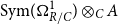 $\textrm {Sym}(\Omega _{R/C}^1) \otimes _C A$
with
$\textrm {Sym}(\Omega _{R/C}^1) \otimes _C A$
with $r \in R$
and
$r \in R$
and $a \in A$
. We then calculate that
$a \in A$
. We then calculate that
 \begin{align*} \Gamma (\alpha _R^{\sharp })(r \otimes a) &= \left (\left (\theta _{R \otimes _C B}^{A,B}\right )^{-1} \circ \left (\left (\theta _R^{B,C}\right )^{-1} \otimes \textrm {id}_A\right ) \circ \omega _{\textrm {Sym}(\Omega ^1_{R/C})}^{A,B,C}\right )(r \otimes a) \\ &= \left (\left (\theta _{R \otimes _C B}^{A,B}\right )^{-1} \circ \left (\left (\theta _R^{B,C}\right )^{-1} \otimes \textrm {id}_A\right )\right )\big ((r \otimes 1_B) \otimes a\big ) \\ &= (r \otimes 1_B) \otimes a \end{align*}
while for differential pure tensors $\textrm{d}r \otimes a$
we get that
$\textrm{d}r \otimes a$
we get that
 \begin{align*} \Gamma (\alpha _R^{\sharp })(\textrm{d}r \otimes a) &= \left (\left (\theta _{R \otimes _C B}^{A,B}\right )^{-1} \circ \left (\left (\theta _R^{B,C}\right )^{-1} \otimes \textrm {id}_A\right ) \circ \omega _{\textrm {Sym}(\Omega ^1_{R/C})}^{A,B,C}\right )(\textrm{d}r \otimes a) \\ &= \left (\left (\theta _{R \otimes _C B}^{A,B}\right )^{-1} \circ \left (\left (\theta _R^{B,C}\right )^{-1} \otimes \textrm {id}_A\right )\right )\big ((\textrm{d}r \otimes 1_B) \otimes a\big ) \\ &= \left (\theta _{R \otimes _C B}^{A,B}\right )^{-1}\big (\textrm{d}(r \otimes 1_B) \otimes a\big ) \\ &= \textrm{d}\big ((r \otimes 1_B) \otimes a\big ). \end{align*}
Because the pure tensors of the form $r \otimes a, \textrm{d}r \otimes a$
for
$r \otimes a, \textrm{d}r \otimes a$
for $r \in R$
and
$r \in R$
and $a \in A$
linearly generate
$a \in A$
linearly generate $\textrm {Sym}(\Omega _{R/C}^1) \otimes _C A$
, this completely determines the action of
$\textrm {Sym}(\Omega _{R/C}^1) \otimes _C A$
, this completely determines the action of $\Gamma (\alpha _R^{\sharp })$
after extending linearly.
$\Gamma (\alpha _R^{\sharp })$
after extending linearly.
We now calculate the action of $\beta _W = \beta _R$
on its domain. By construction,
$\beta _W = \beta _R$
on its domain. By construction, $\beta _{R}$
is the composite of the ring maps
$\beta _{R}$
is the composite of the ring maps
 \begin{equation*} \Gamma (\beta _{R}^{\sharp }) := \textrm {Sym}(\Omega ^1(\omega _R^{A,B,C}))\circ \left (\theta _{R}^{A,C}\right )^{-1} \end{equation*}
which is seen visually as
 \begin{equation*} \textrm {Sym}\left (\Omega _{R/C}^1\right ) \otimes _C A \xrightarrow {} \textrm {Sym}\left (\Omega ^1_{R \otimes _C A/A}\right ) \xrightarrow {} \textrm {Sym}\left (\Omega ^1_{(R \otimes _C B) \otimes _B A}\right ). \end{equation*}
We then compute that on pure tensors $r \otimes a$
for
$r \otimes a$
for $r \in R$
and
$r \in R$
and $a \in A$
,
$a \in A$
,
 \begin{align*} \Gamma (\beta _{R}^{\sharp })(r \otimes a) &= \left (\textrm {Sym}(\Omega ^1(\omega _R^{A,B,C}))\circ \left (\theta _{R}^{A,C}\right )^{-1}\right )(r \otimes a) = \textrm {Sym}(\Omega ^1(\omega _R^{A,B,C}))(r \otimes a) \\ &= (r \otimes 1_B) \otimes a. \end{align*}
while for differentials pure tensors $\textrm{d}r \otimes a$
we get
$\textrm{d}r \otimes a$
we get
 \begin{align*} \Gamma (\beta _{R}^{\sharp })(\textrm{d}r \otimes a) &= \left (\textrm {Sym}(\Omega ^1(\omega _R^{A,B,C}))\circ \left (\theta _{R}^{A,C}\right )^{-1}\right )(\textrm{d}r \otimes a) = \textrm {Sym}\Big(\Omega ^1\Big(\omega _R^{A,B,C}\Big)\Big)\big (\textrm{d}(r \otimes a)\big ) \\ &= \textrm{d}\big ((r \otimes 1_B) \otimes a\big ). \end{align*}
Because the pure tensors of the form $r \otimes a, \textrm{d}r \otimes a$
for
$r \otimes a, \textrm{d}r \otimes a$
for $r \in R$
and
$r \in R$
and $a \in A$
linearly generate
$a \in A$
linearly generate $\textrm {Sym}(\Omega _{R/C}^1) \otimes _C A$
, this completely determines the action of
$\textrm {Sym}(\Omega _{R/C}^1) \otimes _C A$
, this completely determines the action of $\Gamma (\beta _R^{\sharp })$
after extending linearly. Furthermore, because
$\Gamma (\beta _R^{\sharp })$
after extending linearly. Furthermore, because $\Gamma (\alpha _R^{\sharp })$
and
$\Gamma (\alpha _R^{\sharp })$
and $\Gamma (\beta _R^{\sharp })$
coincide on generators, it follows that they coincide and we get that
$\Gamma (\beta _R^{\sharp })$
coincide on generators, it follows that they coincide and we get that $\Gamma (\alpha _R^{\sharp }) = \Gamma (\beta _R^{\sharp })$
. This implies that
$\Gamma (\alpha _R^{\sharp }) = \Gamma (\beta _R^{\sharp })$
. This implies that $\alpha _R = \beta _R$
and so the two pasting diagrams are equivalent by once again invoking Lemma 6.8. Furthermore, because
$\alpha _R = \beta _R$
and so the two pasting diagrams are equivalent by once again invoking Lemma 6.8. Furthermore, because $\mathbf{Sch}$
is regarded as a
$\mathbf{Sch}$
is regarded as a $2$
-category with trivial
$2$
-category with trivial $2$
-cells, the equivalence of these pasting diagrams implies that the data
$2$
-cells, the equivalence of these pasting diagrams implies that the data $(T_{-/X},\!\,_{f}{T}^{-1})$
defines a pseudonatural transformation
$(T_{-/X},\!\,_{f}{T}^{-1})$
defines a pseudonatural transformation $T\colon \mathbf{Sch}_{/-} \Rightarrow \mathbf{Sch}_{/-}$
.
$T\colon \mathbf{Sch}_{/-} \Rightarrow \mathbf{Sch}_{/-}$
.
With all these facts, we now have the ingredients to define and construct the (equivariant) tangent structure on the equivariant category of schemes over a base variety $X$
by way of the Zariski tangent indexing functor.
$X$
by way of the Zariski tangent indexing functor.
Definition 6.17.
Let $G$
be a smooth algebraic group and let
$G$
be a smooth algebraic group and let $X$
be a (quasi-projective) left
$X$
be a (quasi-projective) left $G$
-variety. Define the pre-equivariant pseudofunctor
$G$
-variety. Define the pre-equivariant pseudofunctor $\mathscr{S}$
to be the one given in Item (11) of Example 5.20; that is,
$\mathscr{S}$
to be the one given in Item (11) of Example 5.20; that is, $\mathscr{S} = (\mathscr{S},\mathbf{Sch}_{/(-)})$
is the pre-equivariant pseudofunctor:
$\mathscr{S} = (\mathscr{S},\mathbf{Sch}_{/(-)})$
is the pre-equivariant pseudofunctor:

We then define the category of descent-equivariant schemes
Footnote
15
to be the equivariant category $(\mathbf{Sch}_{/X})_G := \mathscr{S}_G(X)$
. We also define the descent-equivariant Zariski tangent category on
$(\mathbf{Sch}_{/X})_G := \mathscr{S}_G(X)$
. We also define the descent-equivariant Zariski tangent category on $X$
to be the pseudolimit tangent category
$X$
to be the pseudolimit tangent category $((\mathbf{Sch}_{/X})_G,\mathbb{T})$
.
$((\mathbf{Sch}_{/X})_G,\mathbb{T})$
.
The fact that the definition of the descent-equivariant Zariski tangent category is actually a tangent category is justified by the theorem below.
Theorem 6.18.
Let $G$
be a smooth algebraic group and let
$G$
be a smooth algebraic group and let $X$
be a (quasi-projective) left
$X$
be a (quasi-projective) left $G$
-variety. Then the equivariant Zariski tangent category
$G$
-variety. Then the equivariant Zariski tangent category $((\mathbf{Sch}_{/X})_G,\mathbb{T})$
is a tangent category.
$((\mathbf{Sch}_{/X})_G,\mathbb{T})$
is a tangent category.
Proof. By Theorem3.34, it suffices to show that the pre-equivariant pseudofunctor $\mathbb{S}$
is a tangent pre-equivariant indexing functor. However:
$\mathbb{S}$
is a tangent pre-equivariant indexing functor. However:
-
(1) That each category
$\mathscr{S}(\Gamma )$
is a tangent category is Theorem6.1; -
(2) That each pair
$(\mathscr{S}(\,f), \!\,_{f}{T}) = (\overline { {f}}^{\ast },\!\,_{\overline { {f}}}{T})$
is a strong tangent morphism is Proposition 6.15; -
(3) That the data
$(\!\,_{\Gamma }{T},\!\,_{f}{T}^{-1}) = (T_{-/\,_{\Gamma }{ {X}}},\!\,_{\overline { {f}}}{T^{-1}})$
constitutes a pseudonatural transformation
$T\colon \mathscr{S} \Rightarrow \mathscr{S}$
follows from Proposition 6.16.




Thus, $(\mathscr{S}_G(X), \mathbb{T}_G)$
is a tangent category and we are done.
$(\mathscr{S}_G(X), \mathbb{T}_G)$
is a tangent category and we are done.
We now conclude this section by showing just below in Propositions 6.19 and 6.20 that the descent-equivariant Zariski tangent structure on $\mathbf{Sch}_{/X}$
is compatible with the gluings of schemes in the sense that:
$\mathbf{Sch}_{/X}$
is compatible with the gluings of schemes in the sense that:
-
(1) First, if we have a scheme
$X$
with an open affine cover
$\mathscr{U} = \lbrace f_i\colon U_i \to X \; \left . \right | \; i \in I \rbrace$
, then there is an equivalence of tangent categories
\begin{equation*} \left (\mathbf{Sch}_{/X},T_{\mathbf{Zar}({X})}\right ) \simeq \operatorname {pseudolim} \left (\mathbf{Sch}_{/U_i}, T_{\mathbf{Zar}({U_i})}\right ). \end{equation*}
-
(2) Second, these gluing pseudolimits are compatible with the equivariant Zariski cover in the sense that if we have an open affine cover
$\lbrace f_i\colon U_i \to X \; \left . \right | \; i \in I \rbrace$
by equivariant afffine opens then there is an equivalencewhere each
\begin{equation*} \left (\left (\mathbf{Sch}_{/X}\right )_G,\mathbb{T}_X\right ) \simeq \operatorname {pseudolim} \left (\left (\mathbf{Sch}_{/U_i}\right )_G,\mathbb{T}_{U_i}\right ) \end{equation*}
$\mathbb{T}_{(-)}$
is the tangent structure defined in Theorem6.18.


Proposition 6.19.
Let $X$
be a scheme and let
$X$
be a scheme and let $\mathscr{U} = \lbrace f_i\colon U_i \to X \; \left . \right | \; i \in I \rbrace$
be an affine open cover of
$\mathscr{U} = \lbrace f_i\colon U_i \to X \; \left . \right | \; i \in I \rbrace$
be an affine open cover of $X$
. Then there is an equivalence of tangent categories
$X$
. Then there is an equivalence of tangent categories
 \begin{equation*} \left (\mathbf{Sch}_{/X},\mathbb{T}_{\mathbf{Zar}({X})}\right ) \simeq \operatorname {pseudolim}\left (\mathbf{Sch}_{/U_i},\mathbb{T}_{\mathbf{Zar}({U_i})}\right ). \end{equation*}
Proof. Begin by letting $\mathbb{U}$
denote the sublattice of
$\mathbb{U}$
denote the sublattice of $\mathbf{Open}(X)$
generated by the open immersions
$\mathbf{Open}(X)$
generated by the open immersions $f_i\colon U_i \to X$
.Footnote
16
Recall that each pullback diagram of open inclusions
$f_i\colon U_i \to X$
.Footnote
16
Recall that each pullback diagram of open inclusions

induces an invertible $2$
-cell
$2$
-cell

of pullback functors. Furthermore, as we have indicated above, each pullback functor is a strong tangent morphism (in the lax direction) by Proposition 6.15 when we equip each scheme category with the corresponding Zariski tangent structure. A routine check using the universal properties of the various $\textrm {Sym}$
functors involved in defining the tangent functors shows that the transformation
$\textrm {Sym}$
functors involved in defining the tangent functors shows that the transformation $\gamma _{ij}$
is a tangent transformation. Using that the Zariski topology is subcanonical as a Grothendieck topology and that
$\gamma _{ij}$
is a tangent transformation. Using that the Zariski topology is subcanonical as a Grothendieck topology and that $\mathscr{U}$
is an affine open cover of
$\mathscr{U}$
is an affine open cover of $X$
, then implies that we have an equivalence of categories
$X$
, then implies that we have an equivalence of categories
 \begin{equation*} \mathbf{Sch}_{/X} \simeq \operatorname {pseudolim} \mathbf{Sch}_{/U_i}. \end{equation*}
Now observe that we can write the pseudolimit $\operatorname {pseudolim}\mathbf{Sch}_{/U_i}$
as a pseudocone category for a tangent indexing functor as follows. Consider the pseudofunctor
$\operatorname {pseudolim}\mathbf{Sch}_{/U_i}$
as a pseudocone category for a tangent indexing functor as follows. Consider the pseudofunctor
 \begin{equation*} T_{\mathbf{Zar}({(-)})}\colon \mathbb{U}^{\textrm {op}} \to \mathfrak{Cat} \end{equation*}
given by sending objects $V \mapsto \mathbf{Sch}_{/V}$
and sending morphisms of open immersions
$V \mapsto \mathbf{Sch}_{/V}$
and sending morphisms of open immersions $g\colon V \to W$
to the pullback tangent morphism
$g\colon V \to W$
to the pullback tangent morphism
 \begin{equation*} (g^{\ast },\,_{g}{T})\colon \left (\mathbf{Sch}_{/W},\mathbb{T}_{\mathbf{Zar}({W})}\right ) \to \left (\mathbf{Sch}_{/V},\mathbb{T}_{\mathbf{Zar}({(})V)}\right ) \end{equation*}
asserted by Proposition 6.15. By Proposition 6.5, this determines a tangent indexing functor. Observe also that effective Zariski descent then gives an equivalence of categories
 \begin{equation*} \operatorname {pseudolim} \mathbf{Sch}_{/U_i} \simeq \mathbf{PC}(T_{\operatorname {Zar(-)}}) \end{equation*}
and hence by composing equivalences we get
 \begin{equation*} \mathbf{Sch}_{/X} \simeq \mathbf{PC}\big(T_{\mathbf{Zar}({(-)})}\big) \end{equation*}
in $\mathfrak{Cat}$
induced by the assignment
$\mathfrak{Cat}$
induced by the assignment

for all $X$
-schemes
$X$
-schemes $Z \to X$
and all open immersions
$Z \to X$
and all open immersions $f_i\colon U_i \to X$
in
$f_i\colon U_i \to X$
in $\mathscr{U}$
. Now, since the above assignment is induced as a pseudocone over
$\mathscr{U}$
. Now, since the above assignment is induced as a pseudocone over $T_{\mathbf{Zar}({(-)})}$
, it follows from Theorem4.9 that
$T_{\mathbf{Zar}({(-)})}$
, it follows from Theorem4.9 that $\mathbf{Sch}_{/X}$
equipped with the Zariski tangent structure is equivalent to the desired pseudolimit in
$\mathbf{Sch}_{/X}$
equipped with the Zariski tangent structure is equivalent to the desired pseudolimit in $\mathfrak{Tan}$
.
$\mathfrak{Tan}$
.
Proposition 6.20.
Let $\mathscr{U} := \lbrace f_i\colon U_i \to X \; \left . \right | \; i \in I \rbrace$
be an affine open cover of a
$\mathscr{U} := \lbrace f_i\colon U_i \to X \; \left . \right | \; i \in I \rbrace$
be an affine open cover of a $K$
-variety
$K$
-variety $X$
for which each map
$X$
for which each map $f_i$
is
$f_i$
is $G$
-equivariant for a smooth algebraic group
$G$
-equivariant for a smooth algebraic group $G$
. Then there is an equivalence of tangent categories
$G$
. Then there is an equivalence of tangent categories
 \begin{equation*} \left (\left (\mathbf{Sch}_{/X}\right )_G,\mathbb{T}_{X}\right ) \simeq \operatorname {pseudolim} \left (\left (\mathbf{Sch}_{/U_i}\right )_G, \mathbb{T}_{U_i}\right ). \end{equation*}
Proof. Because the cover $\mathscr{U}$
is
$\mathscr{U}$
is $G$
-equivariant, it follows from a routine argument that for any smooth free
$G$
-equivariant, it follows from a routine argument that for any smooth free $G$
-variety
$G$
-variety $\Gamma$
, the set
$\Gamma$
, the set
 \begin{equation*} \mathscr{U}_{\Gamma } = \left \lbrace f_i \times \textrm {id}_{\Gamma }: U_i \times \Gamma \to X \times \Gamma \; \left . \right | \; i \in I\right \rbrace \end{equation*}
is a $G$
-equivariant open cover of
$G$
-equivariant open cover of $X \times \Gamma$
. As such, by Proposition 6.19 we know that for every smooth free
$X \times \Gamma$
. As such, by Proposition 6.19 we know that for every smooth free $G$
-variety
$G$
-variety $\Gamma$
we have equivalences of categories
$\Gamma$
we have equivalences of categories
 \begin{equation*} \mathbf{Sch}_{/X \times \Gamma } \simeq \operatorname {pseudolim} \mathbf{Sch}_{/U_i \times \Gamma } \end{equation*}
and hence, after taking $G$
-quotients,
$G$
-quotients,
 \begin{equation*} \mathbf{Sch}_{/\,_{\Gamma }{X}} \simeq \operatorname {pseudolim} \mathbf{Sch}_{/\,_{\Gamma }{U_i}} \end{equation*}
for all open immersions $f_i\colon U_i \to X$
. Furthermore, these equivalences are pseudonatural in
$f_i\colon U_i \to X$
. Furthermore, these equivalences are pseudonatural in $\mathbf{Sf}(G)$
and so we can proceed as in the proof of Proposition 6.19 by using Theorem2.6 to produce functors between the our categories.
$\mathbf{Sf}(G)$
and so we can proceed as in the proof of Proposition 6.19 by using Theorem2.6 to produce functors between the our categories.
7. A Sketch of the Descent-Equivariant Tangent Structure on Smooth Manifolds
Perhaps unsurprisingly, we can play a similar game in the case of smooth manifolds as what we did with varieties and produce a tangent category of descent-equivariant smooth manifolds. However, in order to define such a tangent category over a given left $L$
-manifold
$L$
-manifold $M$
, we need, analogously to the scheme case, the result that the pre-equivariant pseudofunctor
$M$
, we need, analogously to the scheme case, the result that the pre-equivariant pseudofunctor $\mathscr{M} = (\mathscr{M}, \mathbf{SMan}_{/(-)})$

defines a tangent indexing functor. In this shorter section, we sketch how to go about this by first recalling some general tangent category theory regarding tangent display morphisms, relative/vertical tangent structures, and how the two concepts interact. To motivate this discussion, let us pose the following question. If $f\colon X \to Y$
is a morphism in a tangent category
$f\colon X \to Y$
is a morphism in a tangent category $(\mathscr{C},\mathbb{T})$
for which all pullbacks against
$(\mathscr{C},\mathbb{T})$
for which all pullbacks against $f$
exist and are preserved by all powers
$f$
exist and are preserved by all powers $T^m$
for
$T^m$
for $m \in \mathbb{N}$
, then what tangent structures can we equip each of
$m \in \mathbb{N}$
, then what tangent structures can we equip each of $\mathscr{C}_{/X}$
and
$\mathscr{C}_{/X}$
and $\mathscr{C}_{/Y}$
with to make the functor
$\mathscr{C}_{/Y}$
with to make the functor $f^{\ast }\colon \mathscr{C}_{/Y} \to \mathscr{C}_{/X}$
into a strong tangent morphism?
$f^{\ast }\colon \mathscr{C}_{/Y} \to \mathscr{C}_{/X}$
into a strong tangent morphism?
Recall that when given a tangent category $\mathscr{C}$
, there are two main techniques for building tangent structures on the slice categories
$\mathscr{C}$
, there are two main techniques for building tangent structures on the slice categories $\mathscr{C}_{/X}$
. The first is the direct approach as described by Cockett and Cruttwell (Reference Cockett and Cruttwell2014, Proposition 2.5) and Rosický (Reference Rosický1984): simply define the tangent functor on the slice category
$\mathscr{C}_{/X}$
. The first is the direct approach as described by Cockett and Cruttwell (Reference Cockett and Cruttwell2014, Proposition 2.5) and Rosický (Reference Rosický1984): simply define the tangent functor on the slice category $T\colon \mathscr{C}_{/X} \to \mathscr{C}_{/X}$
by the assignment:
$T\colon \mathscr{C}_{/X} \to \mathscr{C}_{/X}$
by the assignment:

The other family of tangent structures on the slice categories $\mathscr{C}_{/X}$
can be defined less often (in the sense that the construction required need not always exist), but is the one we will need to consider in order to make the pullback functor
$\mathscr{C}_{/X}$
can be defined less often (in the sense that the construction required need not always exist), but is the one we will need to consider in order to make the pullback functor $f^{\ast }$
a strong tangent functor when
$f^{\ast }$
a strong tangent functor when $f$
is a surjective submersion. These are the tangent structures on
$f$
is a surjective submersion. These are the tangent structures on $\mathscr{C}_{/X}$
defined by use of what is called the relative tangent bundle of a map
$\mathscr{C}_{/X}$
defined by use of what is called the relative tangent bundle of a map $f\colon X \to Y$
in Cruttwell and Lemay (Reference Cruttwell and Lemay2023).
$f\colon X \to Y$
in Cruttwell and Lemay (Reference Cruttwell and Lemay2023).
Relative tangent bundles were originally discussed and discovered by Rosický in Rosický (Reference Rosický1984, pp. 5, 6) in his original paper on tangent categories. There the relative tangent bundle functors $T_{(-)/Y}$
are ways of building tangent structures on the categories
$T_{(-)/Y}$
are ways of building tangent structures on the categories $\mathscr{C}_{/Y}$
which are not simply induced by applying the “global” tangent structure on
$\mathscr{C}_{/Y}$
which are not simply induced by applying the “global” tangent structure on $\mathscr{C}$
to the “local-to-
$\mathscr{C}$
to the “local-to- $Y$
” category
$Y$
” category $\mathscr{C}_{/Y}$
by selecting only the tangent vectors which live “in the direction directly above
$\mathscr{C}_{/Y}$
by selecting only the tangent vectors which live “in the direction directly above $Y$
.” Rosický did this by considering equalizers of the form:
$Y$
.” Rosický did this by considering equalizers of the form:

However, we use the following alternative construction of Cruttwell and Lemay (Reference Cruttwell and Lemay2023) to construct relative tangent bundles.
Definition 7.1 (Cruttwell and Lemay (Reference Cruttwell and Lemay2023)). Let $f\colon X \to Y$
be a morphism in a tangent category
$f\colon X \to Y$
be a morphism in a tangent category $\mathscr{C}$
. The relative tangent bundle of
$\mathscr{C}$
. The relative tangent bundle of $X$
over
$X$
over $Y$
,
$Y$
, $V_{f}(X)$
, is the pullback
$V_{f}(X)$
, is the pullback

if it exists.
Remark 7.2. The existence and basic properties of the relative bundle $V_{f}(X)$
are studied in detail in the preprint Lemay and Vooys (Reference Lemay and Vooys2025) (in which a morphism
$V_{f}(X)$
are studied in detail in the preprint Lemay and Vooys (Reference Lemay and Vooys2025) (in which a morphism $f$
is called
$f$
is called $0$
-carrable precisely when
$0$
-carrable precisely when $V_{f}(X)$
exists). There Lemay and the second author of this paper showed that whenever
$V_{f}(X)$
exists). There Lemay and the second author of this paper showed that whenever $V_{f}(X)$
exists and whenever the pullback
$V_{f}(X)$
exists and whenever the pullback

exists, then $V_{f}(X)$
is the kernel of the unique map
$V_{f}(X)$
is the kernel of the unique map $\theta _f\colon TX \to f^{\ast }(TY)$
in the category
$\theta _f\colon TX \to f^{\ast }(TY)$
in the category $\mathbf{DBun}(X)$
of differential bundles over
$\mathbf{DBun}(X)$
of differential bundles over $X$
equipped with linear maps between them.
$X$
equipped with linear maps between them.
Example 7.3.
In $\mathbf{SMan}$
if
$\mathbf{SMan}$
if $f\colon X \to Y$
is a morphism of smooth manifolds then the relative tangent bundle
$f\colon X \to Y$
is a morphism of smooth manifolds then the relative tangent bundle $V_{f}(X)$
is given by
$V_{f}(X)$
is given by
 \begin{equation*} V_{f}(X) := \left \lbrace \left (x, \overrightarrow {v}\right ) \in TX \; | \; D[f](x)\overrightarrow {v} = \overrightarrow {0}\right \rbrace . \end{equation*}
In particular, every morphism $f\colon X \to Y$
admits a relative tangent bundle.
$f\colon X \to Y$
admits a relative tangent bundle.
Example 7.4.
In $\mathbf{CAlg}_{R}^{\textrm {op}}$
for a base (commutative) ring
$\mathbf{CAlg}_{R}^{\textrm {op}}$
for a base (commutative) ring $R$
, if
$R$
, if $A$
is a commutative
$A$
is a commutative $R$
-algebra then
$R$
-algebra then $V_{\varphi }(A) = \textrm {Sym}{A}(\Omega _{{R}/{A}}^1)$
; that is, the relative tangent bundle of
$V_{\varphi }(A) = \textrm {Sym}{A}(\Omega _{{R}/{A}}^1)$
; that is, the relative tangent bundle of $A$
over
$A$
over $R$
is the
$R$
is the $R$
-algebra with structure map
$R$
-algebra with structure map
 \begin{equation*} R \to A \to \textrm {Sym}_{A}\left (\Omega _{{A}/{R}}^1\right ). \end{equation*}
When a tangent category $\mathscr{C}$
has the property that every map is
$\mathscr{C}$
has the property that every map is $0$
-carrable then by Rosický (Reference Rosický1984, pp. 5, 6) the functor
$0$
-carrable then by Rosický (Reference Rosický1984, pp. 5, 6) the functor $T_{(-)/Y}\colon \mathscr{C}_{/Y} \to \mathscr{C}_{/Y}$
is the tangent functor for what we call the relative tangent structure on
$T_{(-)/Y}\colon \mathscr{C}_{/Y} \to \mathscr{C}_{/Y}$
is the tangent functor for what we call the relative tangent structure on $\mathscr{C}_{/Y}$
. It has bundle projection
$\mathscr{C}_{/Y}$
. It has bundle projection $p_{X/Y}$

and zero section given by the unique map $0_{X/Y}\colon X \to V_{f}(X)$

factoring the naturality square of the zero transformation.
What is remarkable about the relative tangent bundles is that they are very well behaved with respect to pullback against tangent display morphisms. Let us recall the definition of tangent display maps (as incarnated in MacAdam (Reference MacAdam2022) and Cruttwell and Lanfranchi (Reference Cruttwell and Lanfranchi2025)) and then prove a helpful technical proposition.
Definition 7.5 (cf. MacAdam, Reference MacAdam2022; Cruttwell and Lanfranchi, Reference Cruttwell and Lanfranchi2025). Let $\mathscr{C}$
be a tangent category. A morphism
$\mathscr{C}$
be a tangent category. A morphism $f\colon X \to Y$
is said to be a tangent display morphism (alterntively
$f\colon X \to Y$
is said to be a tangent display morphism (alterntively $T$
-
display) if for any map
$T$
-
display) if for any map $g\colon Z \to Y$
the pullback
$g\colon Z \to Y$
the pullback

exists and is preserved by all powers $T^m$
of the tangent functor for
$T^m$
of the tangent functor for $m \in \mathbb{N}$
Example 7.6.
In $\mathbf{CAlg}_{R}^{\textrm {op}}$
, for
$\mathbf{CAlg}_{R}^{\textrm {op}}$
, for $R$
a commutative rig, every morphism is
$R$
a commutative rig, every morphism is $T$
-display because the tangent functor is continuous (as it is a right adjoint) and because the category
$T$
-display because the tangent functor is continuous (as it is a right adjoint) and because the category $\mathbf{CAlg}_{R}$
is both complete and cocomplete.
$\mathbf{CAlg}_{R}$
is both complete and cocomplete.
Example 7.7.
In $\mathbf{SMan}$
a morphism
$\mathbf{SMan}$
a morphism $f\colon X \to Y$
is
$f\colon X \to Y$
is $T$
-display if and only if
$T$
-display if and only if $f$
is a submersion by Cruttwell and Lanfranchi (Reference Cruttwell and Lanfranchi2025
, Theorem 2.31).
$f$
is a submersion by Cruttwell and Lanfranchi (Reference Cruttwell and Lanfranchi2025
, Theorem 2.31).
We now show that $T$
-display morphisms behave particularly well with respect to the relative tangent structures on slice categories. We will use this to ultimately deduce that the pullback functors
$T$
-display morphisms behave particularly well with respect to the relative tangent structures on slice categories. We will use this to ultimately deduce that the pullback functors $f^{\ast }\colon \mathbf{SMan}_{/N} \to \mathbf{SMan}_{/M}$
are strong tangent morphisms for submersions
$f^{\ast }\colon \mathbf{SMan}_{/N} \to \mathbf{SMan}_{/M}$
are strong tangent morphisms for submersions $f\colon M \to N$
when each category is equipped with its relative/vertical tangent structure.
$f\colon M \to N$
when each category is equipped with its relative/vertical tangent structure.
Proposition 7.8.
Let $\mathscr{C}$
be a tangent category in which every object
$\mathscr{C}$
be a tangent category in which every object $S$
has a relative tangent bundle functor
$S$
has a relative tangent bundle functor $V_{(-)}\colon \mathscr{C}_{/S} \to \mathscr{C}_{/S}$
and let
$V_{(-)}\colon \mathscr{C}_{/S} \to \mathscr{C}_{/S}$
and let $f\colon X \to Y$
be a
$f\colon X \to Y$
be a $T$
-display morphism. Then if
$T$
-display morphism. Then if $f^{\ast }\colon \mathscr{C}_{/Y} \to \mathscr{C}_{/X}$
is the functor given by
$f^{\ast }\colon \mathscr{C}_{/Y} \to \mathscr{C}_{/X}$
is the functor given by $Z \mapsto X \times _Y Z$
, there is a natural isomorphism
$Z \mapsto X \times _Y Z$
, there is a natural isomorphism
 \begin{equation*} f^{\ast } \circ \,_{Y}{V_{(-)}} \cong \,_{X}{V_{(-)}} \circ f^{\ast }. \end{equation*}
Proof. We begin by observing that since $f$
is
$f$
is $T$
-display, for any
$T$
-display, for any $g:Z \to Y$
with corresponding pullback square
$g:Z \to Y$
with corresponding pullback square

then the diagram

is a pullback square as well. Now, on the one hand we observe that $T_{f^{\ast }Z/X}$
is computed via the pullback square
$T_{f^{\ast }Z/X}$
is computed via the pullback square

so pasting this square with the diagram describing that $T$
preserves the pullback
$T$
preserves the pullback $f^{\ast }Z$
and using the Pullback Lemma allows us to deduce that
$f^{\ast }Z$
and using the Pullback Lemma allows us to deduce that $V_{\pi _0}(\,f^{\ast }Z)$
also arises from the pullback diagram:
$V_{\pi _0}(\,f^{\ast }Z)$
also arises from the pullback diagram:

That is, $V_{\pi _0}(\,f^{\ast }Z)$
arises as the pullback of
$V_{\pi _0}(\,f^{\ast }Z)$
arises as the pullback of $Tf \circ 0_X:X \to TY$
against
$Tf \circ 0_X:X \to TY$
against $Tg:TZ \to TY$
.
$Tg:TZ \to TY$
.
On the other hand, consider that the object $f^{\ast }T_{Z/Y}$
arises by pasting the pullback squares
$f^{\ast }T_{Z/Y}$
arises by pasting the pullback squares

together. Since $X \times _Y Y \cong X$
, we can replace
$X \times _Y Y \cong X$
, we can replace $X \times _Y Y$
with
$X \times _Y Y$
with $X$
. Furthermore,
$X$
. Furthermore, $f^{\ast }(TY)$
is a differential bundle over
$f^{\ast }(TY)$
is a differential bundle over $X$
with the property that if we write
$X$
with the property that if we write $\theta _f$
for the unique map rendering
$\theta _f$
for the unique map rendering

commutative, then the diagram

commutes as well. But now it follows that $\pi _1 \circ (\textrm {id}_X \times 0_Y) = \pi _1 \circ \theta _f \circ 0_X = Tf \circ 0_X$
and hence that the diagram
$\pi _1 \circ (\textrm {id}_X \times 0_Y) = \pi _1 \circ \theta _f \circ 0_X = Tf \circ 0_X$
and hence that the diagram

commutes. Putting this together we find that $X \times _Y V_{g}(Z) = f^{\ast }(V_{g}(Z))$
is the pullback of
$X \times _Y V_{g}(Z) = f^{\ast }(V_{g}(Z))$
is the pullback of $Tf \circ 0_X\colon X \to TY$
against
$Tf \circ 0_X\colon X \to TY$
against $Tg\colon TZ \to TY$
and hence that
$Tg\colon TZ \to TY$
and hence that $f^{\ast }(V_{g}(Z)) \cong V_{\pi _0}(\,f^{\ast }Z)$
.
$f^{\ast }(V_{g}(Z)) \cong V_{\pi _0}(\,f^{\ast }Z)$
.
Corollary 7.9.
In $\mathbf{SMan}$
, if
$\mathbf{SMan}$
, if $f\colon X \to Y$
is a submersion then for any map
$f\colon X \to Y$
is a submersion then for any map $g\colon Z \to Y$
, there is an isomorphism
$g\colon Z \to Y$
, there is an isomorphism $V_{\pi _0}(\,f^{\ast }(Z)) \cong f^{\ast }(V_{g}(Z)).$
With Proposition 7.8 in mind, it is relatively straightforward to show that when every morphism in a tangent category admits a relative tangent bundle then $T$
-display morphisms have pullback functors as part of strong tangent morphisms. It is worth noting that this appears implicitly in Cruttwell and Lanfranchi (Reference Cruttwell and Lanfranchi2025, Section 3.3) when the authors discuss the universal property of slicing tangent categories.
$T$
-display morphisms have pullback functors as part of strong tangent morphisms. It is worth noting that this appears implicitly in Cruttwell and Lanfranchi (Reference Cruttwell and Lanfranchi2025, Section 3.3) when the authors discuss the universal property of slicing tangent categories.
Proposition 7.10.
Let $\mathscr{C}$
be a tangent category such that every morphism
$\mathscr{C}$
be a tangent category such that every morphism $g\colon W \to Z \in \mathscr{C}_1$
has a pullback square:
$g\colon W \to Z \in \mathscr{C}_1$
has a pullback square:

If $f\colon X \to Y$
is a
$f\colon X \to Y$
is a $T$
-display morphism in a tangent category
$T$
-display morphism in a tangent category $\mathscr{C}$
and if both
$\mathscr{C}$
and if both $X$
and
$X$
and $Y$
admit relative tangent bundles, then the functor
$Y$
admit relative tangent bundles, then the functor $f^{\ast }\colon \mathscr{C}_{/Y} \to \mathscr{C}_{/X}$
is a strong tangent morphism with distributor
$f^{\ast }\colon \mathscr{C}_{/Y} \to \mathscr{C}_{/X}$
is a strong tangent morphism with distributor $\alpha$
the natural isomorphism
$\alpha$
the natural isomorphism $T_{f^{\ast }Z/X} \cong f^{\ast }T_{Z/Y}$
for all object
$T_{f^{\ast }Z/X} \cong f^{\ast }T_{Z/Y}$
for all object $Z$
over
$Z$
over $Y$
.
$Y$
.
We now apply the various general results above to show that for any Lie group $L$
satisfying Assumption 5.13 and for any left
$L$
satisfying Assumption 5.13 and for any left $L$
-manifold
$L$
-manifold $M$
, there is a “sliced-over-
$M$
, there is a “sliced-over- $\mathbf{SMan}$
” pseudofunctor
$\mathbf{SMan}$
” pseudofunctor
 \begin{equation*} \mathscr{M}\colon \mathbf{FMan}(L)^{\textrm {op}} \to \mathfrak{Cat} \end{equation*}
which is a tangent indexing functor. Because of this, however, we will have to introduce slice categories with notationally complicated terms which contain many slash and backslash characters. In order to make sure our categories are as readable as possible, we have adopted the comma category notation $\mathscr{C} \downarrow X$
in order to indicate the slice category
$\mathscr{C} \downarrow X$
in order to indicate the slice category $\mathscr{C}_{/X}$
of
$\mathscr{C}_{/X}$
of $\mathscr{C}$
over
$\mathscr{C}$
over $X$
.
$X$
.
Recall that by Part (4) of Proposition 5.16, for each morphism $f\colon F \to E$
in the category
$f\colon F \to E$
in the category $\mathbf{FMan}(L)$
, the corresponding morphism
$\mathbf{FMan}(L)$
, the corresponding morphism $\overline {f}\colon L \backslash (F \times M) \to L \backslash (E \times M)$
is a surjective submersion in
$\overline {f}\colon L \backslash (F \times M) \to L \backslash (E \times M)$
is a surjective submersion in $\mathbf{SMan}$
. As such, because submersions are
$\mathbf{SMan}$
. As such, because submersions are $T$
-display in
$T$
-display in $\mathbf{SMan}$
, we have a functor
$\mathbf{SMan}$
, we have a functor

for every morphism in $\overline {f}$
(which, in turn, is the technology which allows us to equip
$\overline {f}$
(which, in turn, is the technology which allows us to equip $\mathbf{FMan}(L)$
with the pseudofunctor
$\mathbf{FMan}(L)$
with the pseudofunctor $\mathscr{M}$
described above). Our goal is to establish that this pseudofunctor is a tangent indexing functor when we regard each category
$\mathscr{M}$
described above). Our goal is to establish that this pseudofunctor is a tangent indexing functor when we regard each category $\mathbf{SMan} \downarrow X$
as a tangent category with its relative tangent structure.
$\mathbf{SMan} \downarrow X$
as a tangent category with its relative tangent structure.
To establish this, we once again observe that by Part (4) of Proposition 5.16 we know that $\overline {f}$
is a surjective submersion. Thus by Corollary 7.9 there is an isomorphism, for any smooth manifold
$\overline {f}$
is a surjective submersion. Thus by Corollary 7.9 there is an isomorphism, for any smooth manifold $\varphi \colon N \to L \backslash (E \times M)$
,
$\varphi \colon N \to L \backslash (E \times M)$
,
 \begin{equation*} \left (\,_{f}{\alpha }\right )_{N}\colon V_{\pi _0}\left (N \times _{L \backslash (E \times M)} \big (L \backslash (F \times M)\big )\right ) \xrightarrow {\cong } V_{\varphi }(N) \times _{L \backslash (E \times M)} \big (L\backslash (F \times M)\big ). \end{equation*}
That this ismorphism is natural in the structure map $\varphi \colon N \to L \backslash (E \times M)$
is trivial to verify by virtue of the universal property of pullbacks. We claim that the pairs
$\varphi \colon N \to L \backslash (E \times M)$
is trivial to verify by virtue of the universal property of pullbacks. We claim that the pairs
 \begin{equation*} (\overline {f}^{\ast },\!\,_{f}{\alpha })\colon \mathbf{SMan}\downarrow {\big (L \backslash (E \times M)\big )} \longrightarrow \mathbf{SMan}\downarrow {\big (L \backslash (F \times M)\big )} \end{equation*}
are strong tangent morphisms when each of the corresponding slice categories are given the relative tangent structures.
Proposition 7.11.
For any Lie group $L$
satisfying Assumption 5.13
, for any left
$L$
satisfying Assumption 5.13
, for any left $L$
-manifold
$L$
-manifold $M$
, and for any morphism
$M$
, and for any morphism $f\colon F \to E$
in
$f\colon F \to E$
in $\mathbf{FMan}(L)$
, the pair
$\mathbf{FMan}(L)$
, the pair
 \begin{equation*} (\overline {f}^{\ast },\!\,_{f}{\alpha })\colon \mathbf{SMan}\downarrow {\big (L \backslash (E \times M)\big )} \longrightarrow \mathbf{SMan}\downarrow {\big (L \backslash (F \times M)\big )} \end{equation*}
constitutes a strong tangent morphism.
Proof. Observe that because the functor $\overline {f}^{\ast }$
is continuous, it restricts to a functor
$\overline {f}^{\ast }$
is continuous, it restricts to a functor
 \begin{equation*} \overline {f}^{\ast }\colon \mathbf{CMon}\left (\mathbf{SMan}\downarrow {\big (L \backslash (E \times M)\big )}\right ) \longrightarrow \mathbf{CMon}\left (\mathbf{SMan}\downarrow {\big (L \backslash (F \times M)\big )}\right ) \end{equation*}
by virtue of preserving the relevant diagrams describing commutative monoids; moreover, by the fact that each map $\overline {f}$
is a display map
$\overline {f}$
is a display map $\overline {f}^{\ast }$
preserves the additivity of the tangent bundles and interacts appropriately with the bundle transformations
$\overline {f}^{\ast }$
preserves the additivity of the tangent bundles and interacts appropriately with the bundle transformations $p, 0,$
and
$p, 0,$
and $\operatorname {add}$
via
$\operatorname {add}$
via $\!\,_{f}{\alpha }$
and its pullback power
$\!\,_{f}{\alpha }$
and its pullback power $(\,_{f}{\alpha })_2$
. Similarly,
$(\,_{f}{\alpha })_2$
. Similarly, $\overline {f}^{\ast }$
and
$\overline {f}^{\ast }$
and $\!\,_{f}{\alpha }$
interact appropriately with the lifts
$\!\,_{f}{\alpha }$
interact appropriately with the lifts $\lambda$
by virtue of the fact that
$\lambda$
by virtue of the fact that $\overline {f}$
is a tangent display map. The preservation of the canonical flip
$\overline {f}$
is a tangent display map. The preservation of the canonical flip $c$
comes down to verifying that the diagram
$c$
comes down to verifying that the diagram

commutes, but this is a straightforward albeit tedious check using that each path around the square describes a cone morphism between the two isomorphic copies of the pullback.
From here, an extremely tedious but straightforward check shows that functor/transformation pairs $(V_{(-)},\!\,_{f}{\alpha }^{-1})$
vary pseudofunctorially in
$(V_{(-)},\!\,_{f}{\alpha }^{-1})$
vary pseudofunctorially in $\mathbf{FMan}(L)^{\textrm {op}}$
; this essentially uses the fact that pullbacks vary pseudofunctorially and that the relative tangent functors themselves vary pseudonaturally over surjective submersions. Applying Theorem3.34 shows that the category
$\mathbf{FMan}(L)^{\textrm {op}}$
; this essentially uses the fact that pullbacks vary pseudofunctorially and that the relative tangent functors themselves vary pseudonaturally over surjective submersions. Applying Theorem3.34 shows that the category $\mathbf{PC}(\mathscr{M}) = \mathscr{M}_L(M)$
is a tangent category, and hence (by definition) a tangent category of descent-equivariant smooth manifolds over the manifold
$\mathbf{PC}(\mathscr{M}) = \mathscr{M}_L(M)$
is a tangent category, and hence (by definition) a tangent category of descent-equivariant smooth manifolds over the manifold $M$
. We collect these observations into a definition and theorem justifying the name below.
$M$
. We collect these observations into a definition and theorem justifying the name below.
Definition 7.12.
Let $L$
be a Lie group satisfying Assumption 5.13 and let
$L$
be a Lie group satisfying Assumption 5.13 and let $M$
be a left
$M$
be a left $L$
-manifold. Then we define the category of descent
$L$
-manifold. Then we define the category of descent $\boldsymbol{L}$
-equivariant smooth manifolds over
$\boldsymbol{L}$
-equivariant smooth manifolds over $\boldsymbol{M}$
to be the category
$\boldsymbol{M}$
to be the category
 \begin{equation*} \mathscr{M}_{L}(M) =: \left (\mathbf{SMan}_{/M}\right )_L \end{equation*}
and we call the pseudolimit tangent structure the descent $L$
-equivariant tangent structure over
$L$
-equivariant tangent structure over $M$
.
$M$
.
Theorem 7.13.
The descent $L$
-equivariant tangent structure on
$L$
-equivariant tangent structure on $M$
claimed in Definition 7.12 exists.
$M$
claimed in Definition 7.12 exists.
Sketch.
In light of Theorem3.34, we must argue that the pseudofunctor $\mathscr{M}$
is a tangent-indexing functor. However, this is argued by Proposition 7.11 and the discussion prior to the statement of Definition 7.12.
$\mathscr{M}$
is a tangent-indexing functor. However, this is argued by Proposition 7.11 and the discussion prior to the statement of Definition 7.12.
We now conclude this section by showing that the manifold versions of Propositions 6.19 and 6.20 hold as well. The reason this works is not surprising: the open subspace Grothendieck topology on a manifold is subcanonical.
Proposition 7.14.
Let $M$
be a smooth manifold and let
$M$
be a smooth manifold and let $\mathscr{U} = \lbrace f_i\colon U_i \to M \; \left . \right | \; i \in I \rbrace$
be a chart in a smooth atlas for
$\mathscr{U} = \lbrace f_i\colon U_i \to M \; \left . \right | \; i \in I \rbrace$
be a chart in a smooth atlas for $M$
. Then there is an equivalence of tangent categories
$M$
. Then there is an equivalence of tangent categories
 \begin{equation*} \left (\mathbf{SMan}_{/M},\mathbb{T}_{\mathbf{Smooth}/M}\right ) \simeq \operatorname {pseudolim}\left (\mathbf{SMan}_{/U_i},\mathbb{T}_{\mathbf{Smooth}/U_i}\right ). \end{equation*}
Proof. Using that the open cover Grothendieck topology on $\mathbf{SMan}$
is subcanonical, this result follows mutatis mutandis to Proposition 6.19 once we realize that injective local diffeomorphisms
$\mathbf{SMan}$
is subcanonical, this result follows mutatis mutandis to Proposition 6.19 once we realize that injective local diffeomorphisms $f_i:U_i \to M$
are
$f_i:U_i \to M$
are $T$
-display morphisms in
$T$
-display morphisms in $\mathbf{SMan}$
.
$\mathbf{SMan}$
.
Proposition 7.15.
Let $\mathscr{U} := \lbrace f_i\colon U_i \to M \; \left . \right | \; i \in I \rbrace$
be a chart in a smooth atlas for a manifold
$\mathscr{U} := \lbrace f_i\colon U_i \to M \; \left . \right | \; i \in I \rbrace$
be a chart in a smooth atlas for a manifold $M$
for which each map
$M$
for which each map $f_i$
is
$f_i$
is $L$
-equivariant for a Lie group satisfying Assumption 5.13
. Then there is an equivalence of tangent categories
$L$
-equivariant for a Lie group satisfying Assumption 5.13
. Then there is an equivalence of tangent categories
 \begin{equation*} \left (\left (\mathbf{SMan}_{/M}\right )_L,\mathbb{T}_{M}\right ) \simeq \operatorname {pseudolim} \left (\left (\mathbf{SMan}_{/U_i}\right )_L, \mathbb{T}_{U_i}\right ). \end{equation*}
Proof. This follows mutatis mutandis to the proof of Proposition 6.20.
8. Remarks Toward Future Work
In the last section of this paper, we showed how to take the tangent categorical language of smooth manifolds and have it interact with the equivariant descent recorded by having a Lie group $L$
act on a smooth manifold
$L$
act on a smooth manifold $M$
. We are especially interested in examining this descent-equivariant tangent structure when
$M$
. We are especially interested in examining this descent-equivariant tangent structure when $M$
is an orbifold regarded as a
$M$
is an orbifold regarded as a $L$
-space for some Lie group
$L$
-space for some Lie group $L$
(each orbifold can be represented this way; cf. Pardon (Reference Pardon2022)). In order to show that this is well behaved for orbifolds, that is, independent of the chosen presentation, we need to prove that different Morita equivalent representations of an orbifold give rise to suitably equivalent descent-equivariant (tangent) categories. This is left as a topic for future work, as it will involve delicate and technical arguments involving change of group functors and manipulations of bibundles. An alternative approach toward studying tangent structures on orbifolds would be to take Proposition 7.15 as a point of departure and generalize it to orbifold charts and atlases.
$L$
(each orbifold can be represented this way; cf. Pardon (Reference Pardon2022)). In order to show that this is well behaved for orbifolds, that is, independent of the chosen presentation, we need to prove that different Morita equivalent representations of an orbifold give rise to suitably equivalent descent-equivariant (tangent) categories. This is left as a topic for future work, as it will involve delicate and technical arguments involving change of group functors and manipulations of bibundles. An alternative approach toward studying tangent structures on orbifolds would be to take Proposition 7.15 as a point of departure and generalize it to orbifold charts and atlases.
As a final comment, we also close with the following observation.
Proposition 8.1.
If $F\colon \mathscr{C}^{\;\textrm {op}} \to \mathfrak{Cat}$
is a pseudofunctor where each category
$F\colon \mathscr{C}^{\;\textrm {op}} \to \mathfrak{Cat}$
is a pseudofunctor where each category $F(X)$
for
$F(X)$
for $X \in \mathscr{C}_0$
is a category with finite biproducts and each functor
$X \in \mathscr{C}_0$
is a category with finite biproducts and each functor $F(\,f)$
for
$F(\,f)$
for $f \in \mathscr{C}_1$
preserves finite biproducts, then
$f \in \mathscr{C}_1$
preserves finite biproducts, then $F(X)$
is a category finite biproducts as well. In particular, if we regard each category
$F(X)$
is a category finite biproducts as well. In particular, if we regard each category $F(X)$
with its finite biproduct tangent structure, then
$F(X)$
with its finite biproduct tangent structure, then $F$
is a tangent indexing functor and the induced tangent structure on
$F$
is a tangent indexing functor and the induced tangent structure on $\mathbf{PC}(F)$
corresponds to the finite biproduct tangent structure on
$\mathbf{PC}(F)$
corresponds to the finite biproduct tangent structure on $\mathbf{PC}(F)$
.
$\mathbf{PC}(F)$
.
This shows that in particular the pseudolimit in $\mathfrak{Tan}$
of a diagram
$\mathfrak{Tan}$
of a diagram $F\colon \mathscr{C}^{\;\textrm {op}} \to \mathfrak{Tan}_{\operatorname {strong}}$
for which each object category
$F\colon \mathscr{C}^{\;\textrm {op}} \to \mathfrak{Tan}_{\operatorname {strong}}$
for which each object category $F(X)$
is a CDC is itself a CDC. It would be of interest to see how the pseudolimit structure may be used in the study of CDCs.
$F(X)$
is a CDC is itself a CDC. It would be of interest to see how the pseudolimit structure may be used in the study of CDCs.
Acknowledgments
The first author would like to thank the support of an NSERC Discovery Grant and the second author would like to thank the support of an AARMS postdoctoral fellowship. The second author would also like to thank the organizers of the 2022 Foundational Methods of Computer Science conference for the hospitality and intellectually stimulating environment as well as the opportunity to present a preliminary version of this work. Both authors would also like to thank Marcello Lanfranchi for illuminating discussions and sharing his work and ideas with us. Both authors would also like to thank the anonymous referees for their insightful questions and helpful comments that have led them to write a much better structured paper where the pseudolimits of tangent categories with their properties take the center place, followed by a wide variety of examples.
Competing interests
The authors declare none.














 Open access

