





Before long, the settler will be feasting on a carcass.Footnote 1
In 1911, the German-born, U.S.-based piano manufacturer Alfred Dolge published a book entitled Pianos and Their Makers, which has since become a reference for scholars and practitioners interested in the art and business of piano making.Footnote 2 A leading supplier of various piano parts, including felts, cases, soundboards, and lumber,Footnote 3 Dolge was a connoisseur of the provenance of the instrument’s main components. Reflecting his expertise, a whole section of his book discusses the sourcing and processing of various kinds of woods, metals, and wool used in piano production. As a prelude to his examination of these commodities, Dolge portrayed the piano as an assemblage of materials from the corners of the earth. He wrote:
All inhabited parts of the globe contribute, more or less, the raw material for a piano. Asia and Africa supply the ivory and ebony for the keyboard. Sweden, England, and America, iron ore for strings, pins, and plates. North and South America, Australia and Africa, wool for felts, while Europe, North, and South America, the Philippine and West India islands supply the various kinds of woods.Footnote 4
In mapping this geography, Dolge’s statement is suggestive of the piano’s – and, more broadly, of music’s – implication in multiple extractivist processes. As Martin Daughtry has noted, ‘Instrument makers throughout history have recruited a vast number of nonhuman bodies into the project of musicking’: ‘as we insistently pound on these carcasses and pluck these fibers and tickle these tusks, we engage, unapologetically, in an incantatory display that . . . presents humans as masters of a nonhuman world that exists for them alone’.Footnote 5 Achille Mbembe’s image of the settler feeding on a carcass, which serves as an epigraph to this article, aptly captures the fact that, since the European colonization of the Americas, Asia, and Africa, such displays of mastery over nature have often unfolded within deeply violent and unequal power relations.
Dolge’s statement contains multiple examples of such intricacies between the piano’s materials and hegemonic eco-political developments. The ivory and ebony trades, although neither new, nor exclusively Western-driven, intensified at the end of the nineteenth century, following the partitioning of Africa between European nations.Footnote 6 Similarly, the availability of merino wool, the primary material for the production of felts, was linked to the colonization and intensive sheep farming of South Africa.Footnote 7 Even the production of seemingly ‘European’ materials, such as iron, was enmeshed with expansionist projects – in this case, the Dutch empire’s exploitation of Swedish forests and the making of the seventeenth- and eighteenth-century Atlantic world.Footnote 8
In light of these connections, the piano exemplifies what Lisa Lowe has called ‘the intimacies of four continents’, in reference to the relations between Europe, Africa, Asia, and the Americas at the turn of the eighteenth century, as well as the connections between colonialism, slavery, imperial trades, and Western liberalism.Footnote 9 The piano’s materials particularly illustrate what Lowe terms ‘the fetishism of colonial commodities’, highlighting the entanglement between European colonialism and imperialism, and the commodification of products such as tea, sugar, cotton, and opium.Footnote 10 As Amitav Gosh and others have shown, these political and economic dynamics carried significant environmental implications: the global exploitation of resources by colonial powers has shaped – and continues to shape – ecological developments to this day.Footnote 11
At the turn of the twentieth century, the piano was ubiquitous across the world and among diverse segments of societies. Due to this ubiquity, its manufacture exerted considerable pressures on communities and environments across the world. The broad availability of the instrument depended on the killing of East African elephants and the deforestation of several parts of South America and the Caribbean. It also relied on the labour of enslaved, indentured, and low-waged workers in various parts of the Global North and South. Despite the rising interest of music and sound scholars for questions of political ecology and social justice,Footnote 12 and despite the piano’s centrality in twentieth-century music cultures,Footnote 13 no study has thoroughly examined the extraction, circulation, and transformation of the diverse animal, plant, and mineral matters that enabled the rise of the instrument.Footnote 14
This essay marks a step in this direction by tracing the global journey of ivory, the primary material used for the construction of piano keyboards since the mechanization of ivory cutting at the turn of the nineteenth century. This innovation enabled the production of thin veneers, maximizing the volume of material obtained from each tusk.Footnote 15 The application of ivory to cover piano keys underscored its high value in Western cultures, established since Antiquity. As an exotic and expensive commodity, ivory served as a social marker and a symbol of quality. It appears in a variety of musical instruments, including oliphants, lutes, recorders, flutes, violins, and pianos. In all these objects, ivory plays a visual and tactile role, rather than an acoustic one – keyboard players particularly appreciated its ‘softness’ and ‘coolness’.
In line with the topic of this special issue, I examine ivory as a medium of transatlantic encounters. From the warehouses of European and American traders in Zanzibar to ivory auction houses at London and Antwerp, and from these sites to American keyboard factories and consumers’ homes, ivory used in pianos enabled various forms of contact between East Africa, Europe, and North America. Reflecting Dolge’s positionality and agenda as a U.S.-based piano manufacturer, the linear and straightforward picture of extraction encapsulated in his portrayal fails at capturing the complexity of the material’s journey. In this article I demonstrate that the transfer of ivory across continents was a complex process, made of a series of multidirectional exchanges that took place within diverse transatlantic configurations.
To unpack these dynamics, I draw on the extensive archive left by the two companies that processed most of the ivory used for the construction of pianos in the United States – Comstock Cheney & Co., and Pratt, Read & Co.Footnote 16 Through a critical examination of a broad range of sources – including letters between ivory traders, piano manufacturers, and their families; workers’ photographs and interviews; and collections of ivory items – I recover the variety of transatlantic connections embedded in piano ivory, as well as their reciprocal nature. These connections not only highlight the global and colonial roots of piano making but also demonstrate how this complex process shaped environment and societies on both sides of the Atlantic Ocean. After tracing ivory’s Atlantic geography, I examine four forms of encounters mediated by the material, attending to the frictions and uncertainties characteristic of each. Overall, this article highlights the value of material approaches to instruments within global music and sound studies, as well as the reciprocal benefits that global perspectives offer to eco-musicological conversations.
Ivory’s Atlantic geography
Few instruments capture the transatlantic musical relations of the modern era as clearly as the piano. A creation of Ferdinando de Medici’s employee Bartolomeo Cristofori (1655–1731), the piano emerged in Italy around 1700,Footnote 17 before spreading to Germany, Austria, England, and France at the turn of the nineteenth century. Over the following decades, the production of pianos underwent a spectacular increase – from 2,000 per year in 1800 to 50,000 in 1850, and 500,000 in 1900.Footnote 18 This boom went hand in hand with a reconfiguration of the instrument’s geography. While in 1850 half of the world’s pianos came from Britain (with most of the remainder from France), from the 1860s and until the Second World War, the United States – and to a lesser extent, Germany – dominated the global piano market. In 1850, the United States built fewer than a quarter of the world’s pianos. By 1910 – the peak year in the history of piano production – it was responsible for manufacturing 370,000 of the estimated 600,000 instruments that entered the market.Footnote 19
In addition to these quantitative dynamics, qualitative changes also reveal the United States’ growing influence in global piano markets. Until the 1860s, French and British makers set the tone in aesthetic discourses surrounding the instrument, which praised the ‘elegance’, ‘purity and distinction of tone’, and ‘brilliance’ of Érard and Broadwood pianos, while mocking the ‘heaviness’ of U.S. and German instruments. Around 1900, however, ‘solidity’, ‘power’, and ‘nuance’ had become the defining qualities of a good piano. These words of praise now went to American and German instruments, while their French and British counterparts were criticized for their ‘monotony’ and ‘weakness’.Footnote 20 Initially a receiver of European pianos and their associated values, the United States became the global reference point for piano production – until the rise of Japanese and Korean firms in the final decades of the twentieth century. The rise of the U.S. piano industry illustrates the reconfiguration of musical cultures around the new superpower, drawing attention to the musical ramifications of global geopolitical and economic transformations.
As recent work has shown, however, the history of the instrument far exceeds the Euro–American competition for industrial and cultural supremacy. From the mid-nineteenth century onward, pianos spread across the world, shaping a broad range of local social and musical practices, all the way from Tahiti to Tunisia, and even the North Pole.Footnote 21 As Claudius Torp has analysed, the instrument played an important role in Japanese nation-building programmes during the Meiji period (1868–1912), while also shaping differentiated experiences across South African society – whether in the salons of Anglophone whites or the workers’ bars of Johannesburg.Footnote 22 Pianos not only circulated globally but also originated from a variety of manufacturing centres. According to Morton Wan, the first Chinese piano was made in 1877.Footnote 23 And as Kirsten Paige has shown, the firm Misquith & Co., based in Myanmar and active between 1842 and 1911, supplied pianos to India and the Strait Settlements.Footnote 24
My study expands on this scholarship, to trace yet further connections embedded in the piano’s materials. Drawing on the case of ivory, I examine relationships beyond those previously discussed, linking East Africa, Europe, and North America. A biological material derived from the tusks and teeth of several mammals, ivory is found across a variety of (extant and extinct) animal species across the world, including elephants, mammoths, mastodons, wild boars, warthogs, hippopotami, walruses, whales, and narwhals. Among these, ivory from elephants has long been regarded as the most valuable, due to the large size of their tusks, which enabled a broader range of crafting and later industrial practices.Footnote 25 African ivory, praised for its particular malleability, was considered superior to its Asian counterpart.Footnote 26 Although piano key makers at the turn of the twentieth century worked with a variety of materials to meet the enormous demand of the market, many thought bull elephants from Abyssinia to be the best source of ivory.Footnote 27
By the time Cristofori built the first piano, the global circulation of ivory already had a very long history. For millennia, the material had been a good of exchange across the Mediterranean, Western Europe, the Persian Gulf, and the Indian Ocean. From as early as the third millennium BCE, merchants from Akkadia, Sumeria, Egypt, and Phoenicia engaged in trade across the Red Sea and Indian Ocean. By 300 BCE, the Indian Ocean trade had expanded considerably, with notable exchanges involving ivory, elephants, and other goods between Africa, India, and Persia. The Roman Empire also contributed to elephant population declines through their use of elephants in spectacles and warfare. After the fall of Rome, the ivory trade shifted toward China and India, where ivory was used in various crafts and ceremonial items. The rise of Islam further transformed exchanges in the Indian Ocean, facilitating connections across regions and leading to increased Arab participation in trade. Reflecting the importance of these connections, most of the funding for ivory caravans headed into East Africa in the nineteenth century came from Western India, via Oman and Zanzibar.Footnote 28
Owing to industrialization and the growing popularity of the piano and of other ivory goods, including cutlery handles, billiard balls, and hair combs, the nineteenth-century ivory trade expanded towards the Atlantic Ocean. London and New York became the primary entry points for the material, with Antwerp, Liverpool, and Hamburg serving as secondary hubs. Reflecting these dynamics, London showed an increase from an annual average of 192,000 pounds per year imported throughout the eighteenth century to a million pounds in 1864 to nearly 1.5 million pounds in 1890.Footnote 29 By 1900, the United States surpassed Britain as the world’s largest consumer of ivory: between 1884 and 1911, 4,900 tons of ivory entered the United States via New York;Footnote 30 and in 1894 the country received 80% of the ivory exported from Zanzibar.Footnote 31 The manufacture of pianos was a major driver behind this expansion of the ivory trade into the Western world,Footnote 32 with Pratt, Read & Co. and Comstock, Cheney & Co. being some of the main players in this market.
‘Tales of Zanzibar’
The empowerment of European and American merchants transformed the East African ivory trade, particularly by flooding the region with firearms. This shift drastically altered elephant hunting and increased the number of elephants killed. Between 1750 and 1830, the ivory trade was responsible for the death of a few hundred elephants annually. In the second half of the nineteenth century, between 6,000 and 12,000 elephants were killed annually to sustain the supply of ivory to global markets.Footnote 33 The integration of East Africa into Atlantic trading networks also resulted in sociopolitical change, including the emergence of specialist hunters, porters, and middlemen, and the establishment of trading centres, such as Ujiji and Tabora (respectively located on Lake Tanganyika and on the central plateau of what is today Tanzania). To meet the demands of Western markets, Omani and Swahili traders organized large-scale elephant hunts that relied on both wage and slave labour. They also coordinated the transportation of tusks using caravans of hundreds of porters, many of whom died over the course of these arduous journeys, which could span up to a thousand miles. Animals could not replace humans in this task, due of the presence of tsetse fly in the region.Footnote 34 Once on the coast, ivory reached the warehouses of Omani and Indian traders in Zanzibar via boat.Footnote 35
The ivory trade, however, was not a one-way street. While historians of the nineteenth-century ivory trade have long described it as a ‘moving frontier’ unilaterally driven by the penetration of European and American merchants, recent scholarship offer a more nuanced picture.Footnote 36 As Bernhardt Gissibl and Alexandra Kelly have argued, the growth of the ivory trade in the nineteenth century owed as much to internal factors as it did to external pressures. Demand for Western products in Zanzibar and East Africa, including glass beads, cotton cloths, guns, and brass wires, was a key factor for the constitution of global trade links in the region. Western demand for ivory merely provided an opportunity to ‘procure economic and symbolical capital that was actively embraced by many East African societies’.Footnote 37 Meanwhile, American and European merchants’ commercial opportunities were ‘entirely dependent on the goodwill of Indian merchants and Omani leaders in Zanzibar’.Footnote 38 The transatlantic connections mediated by ivory, thus, were multidirectional, with ‘communities on both “sides” of the world system [being] simultaneously integrated into the world capitalist system’.Footnote 39
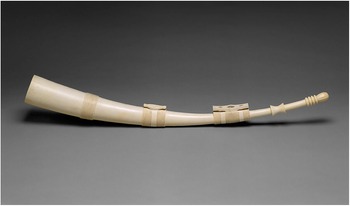
Gissibl also emphasizes the relative agency of elephants in the nineteenth-century ivory trade, noting that in response to hunting pressure, they learned to be cautious and migrated.Footnote 40 Elephants also held significant symbolic power in African hunting rituals, influencing how Euro–American hunters interacted with them. Contrary to the common portrayal of the solitary white hunter with his trophy, Gissibl explains that ‘the white hunter hardly ever was alone in his pursuit’.Footnote 41 He relied heavily on Indigenous knowledge of the landscape and the elephants, as well as the labour of both men and women for the hunt. The involvement of local villagers compelled European and American hunters to ‘share the spoil of the hunt’Footnote 42 while also infusing their encounters with East African elephants and environments with local values and practices. These local values were evident in the cultural significance of elephant in various religious, social, and political rituals.Footnote 43 For example, trumpets made of tusks, such as the one shown in Figure 1, were played in pairs during dances or to mark the entrance and departure of kings in the Congo. This vividly illustrates the diversity of musical uses and values surrounding ivory during the piano’s golden age.
Side-blown trumpet, nineteenth century, Democratic Republic of the Congo. Metropolitan Museum of Arts, New York.

Archives related to the activities of Pratt, Read & Co. and Comstock, Cheney & Co. reflect the multidirectionality of the connections established by ivory between East African and Western traders. In the context of relative scarcity on ivory markets, due to the depletion of elephant populations and significant competition from German, French, British, and other American manufacturers, the two firms had to navigate the control exerted by Omani and Swahili traders over East African caravans. For instance, in 1902, William Arnold, the trading agent for the two companies, reported that one of their usual suppliers had failed to report to him the shipment of ivory from Aden (in present-day Yemen) to New York. Arnold speculated that this lapse might have been due to the merchant’s dissatisfaction with a previous sale where Pratt, Read & Co. had offered too little money.Footnote 44 The following year, in 1903, Arnold complained that one of the companies’ main suppliers in Zanzibar was ‘holding his ivory on the coast, out of sight’, which led to a rise in ivory prices that prevented Pratt Read and Co. from purchasing it.Footnote 45 ‘The market has to rest’, Arnold concluded, highlighting the passive role that American merchants sometimes had to adopt as part of their dealings with East African traders.
The multidirectionality of the connections established through ivory becomes particularly evident when we examine the lives of Western merchants and their families. The ivory trade expanded professional horizons for New Englanders ‘in search of fortune’,Footnote 46 while more broadly shaping local communities’ imaginations of the world – imbuing the name ‘Zanzibar’ with a particular ‘charm’ and a ‘romantic halo’.Footnote 47 Traders’ voyages to East Africa were also transformative, especially for women who occasionally accompanied their husbands on these journeys.Footnote 48 One striking example of such an initiatory voyage marked the prelude to the creation of Comstock, Cheney & Co. In 1853, George A. Cheney, who worked as an agent for an ivory trader based in Providence, embarked on a voyage to Zanzibar with his wife Sarah – who was also the daughter of George’s employer.Footnote 49 After his return, in 1860, George partnered with Samuel Comstock to create Comstock, Cheney & Co. Sarah’s letters to her sister attest to the impact that this two-year voyage had on her, from the storm they endured around the Cape of Good Hope to the tears she struggled to repress when thinking about her beloved piano, to her fear of raising infants without access to Western medical care.Footnote 50
Today, these letters are held in a special folder at the Connecticut River Museum, which bears the Orientalist title ‘Tales of Zanzibar’.Footnote 51 Its outstanding status in the collection reveals the significance of Sarah’s experience in the family’s – and more broadly, the town’s – collective memory. The most striking piece in this folder, the transcript of a recording made by one of Sarah’s great-granddaughters, named Carlotta Welles, contains tales passed among generations of women in the family, which attest to the long-lasting impact of transatlantic voyages on Western families. Most of Welles’s stories revolve around fears, or fantasies, of miscegenation and loss of status, revealing how the ivory trade challenged established racial and social boundaries. According to the family legend, Sarah, who gave birth twice in Zanzibar, was once forced to nurse one of the sultan’s babies. ‘Those of you who have nursed babies’, Welles comments, ‘might imagine what it would feel like, what your feelings might be as a white woman to be nursing a red and black striped baby’ (the infant’s face was partly covered with red paint). She further claims that ‘when Sarah returned to Essex she was a social outcast, rejected by the people of Essex because she had broken station and gone beyond their world, gone beyond an area where none of them had ever been or could ever go, and it was many months before they were kind again or accepted her into the community’.Footnote 52 Whether true or not, these tales show that ivory trading was not a unidirectional process that merely transformed African communities and environments. Instead, it fostered multidirectional connections that reshaped Western societies as well.
Figures of uncertainty
Once ivory left Zanzibar, Aden, or Mombasa, it was put aboard ships headed to Europe and the United States, often via Bombay.Footnote 53 The largest ivory market was London, with substantial quantities being sold in Antwerp, Liverpool, Hamburg, and New York. In these cities, the presence of elephant tusks – awaiting their distribution towards, and transformation within, manufacturing centres – offered local audiences glimpses into remote parts of the globe that would otherwise have remained out of reach to most. Debora L. Silverman has traced the impact of this encounter on artists’ imagination, showing how Belgian architects’, sculptors’, and jewellers’ exposure to ivory following King Leopold’s 1885 colonization of the Congo gave birth to what she calls ‘imperial modernism’, in reference to a ‘Congo style’ of Art Nouveau.Footnote 54 Beyond artists’ studios and museums, elephant tusks were regular features at World’s Fairs and auction houses, as well as in newspapers depicting such displays. In 1892, the journal The Leisure Hour took its readers on a tour of London’s Ivory Tower, a building located on Saint Katharine’s dock, accessible through an imposing iron gate surrounded by two sculptures of seated elephants:
The floor is crowded with ivory of all sorts and sizes, in tusks and sections, and odds at ends, some of it in huge teeth weighing 70 lb each, some mere trifles of 20 lb apiece, some mere pigmy ‘scrivelloes’, and crooked, cracked, hollow, decayed, and broken. On every lot is a big clumsy number and every assemblage of lots has a notice board giving the broker’s name and the first and last numbers of the lots he has to sell. The wilderness of teeth seems all in movement round the gigantic pair of travelling scales in the centre; the curving tusks are like so many worms, all strangely scratched and scribed, and are of all colours, from white through to brown to almost black; and an expert can tell at a glance where each came from, and can sort the lots from the pink Calcutta to the black West Coast which comes wrapped up in the raw hides bearing the mysterious name of ‘schroons’.Footnote 55
Beyond the fascination exerted by the large quantity and broad variety of elephant tusks gathered at London’s Ivory Tower, this text is revealing of auction houses’ role in organizing the material’s trade. The function of such displays was to allow potential buyers to inspect tusks before the sale. To enable this process, brokers divided ivory into different categories reflecting traders’ attempt to establish norms in relation to industrial, crafting, and commercial needs. The transformation of tusks into cutlery handles, billiard balls, hair combs, or piano keys required different qualities. For example, while the tusks of female elephants were particularly praised for the carving of billiard balls ‘as they are less curved than the larger tusks from the bull elephants’,Footnote 56 the great size of male elephants made them more attractive to piano key manufacturers. ‘The ends of so-called “scrivello” tusks (those weighing less than from 6 to 10 pounds)’, for their part, ‘are flattened out at the broader end so as to form paper cutters, and are found to be very effective for this purpose’.Footnote 57
In addition to these specific qualities, ivory’s use for the manufacture of different goods demanded both consistency and sufficient quantities to enable industrial production. The popularity of ivory goods on Western markets resulted from technological developments that facilitated their mass production. In 1798, goldsmith and clockmaker Phineas Pratt from the Potapoug Quarter of Saybrook (present-day Essex) invented a circular saw that enabled the cutting of teeth for combs; and in 1809, his son Phineas Pratt II participated in the construction of a waterwheel for powering ivory cutting machinery. By the mid-1830s, this technology was used to produce ivory veneers for the keys of clavichords, melodeons, and pianos.Footnote 58 These inventions made ivory, once a handcrafted luxury reserved to the wealthy, accessible to middle-class customers as well, fuelling a surge in the Western demand for the material.
However, the transformation of ivory into a commodity of mass consumption faced challenges due to the resistance of animal materials to processes of standardization. Histories of commodities have highlighted the role of markets in homogenizing products. In his influential Nature’s Metropolis, William Cronon analyses how, in the 1850s, Chicago, the world’s largest grain market, established standardized grades and measures that revolutionized grain and its trade. To manage the vast flow of grain brought into the city by new railroads, merchants utilized elevators – large buildings where grain was sorted into bins and then delivered to ships or trains for distribution across the country. This process turned grain into a homogenous product, detached from its specific origin, enabling commercial transactions without the actual transfer of grain. This system, akin to modern banking, allowed for the creation of ‘futures markets’: the trading of grain prices rather than grain itself, effectively dealing with abstract figures instead of tangible objects.Footnote 59
The history of the ivory trade, much like other animal-derived commodities, such as fur, feathers, or skin, followed a distinct trajectory. Unlike grown commodities, animal-derived materials exhibit an inherent diversity that creates considerable friction in the commodification process. To be sure, auction houses at London and Antwerp established boundaries between different kinds of tusks, and there – like in Chicago – telegraphs helped disseminate information about stocks and pricing, enabling transactions on a global scale.Footnote 60 Yet the nineteenth-century ivory trade remained crossed by a tension between traders’ attempts to rationalize and standardize ivory exchanges through the production of abstract figures and taxonomies, on the one hand, and the inconsistent quality and quantity of tusks available on the other. Ultimately, this unpredictability rendered the creation of ‘futures markets’ impossible: even as ivory was being commodified, it remained closely tied to its place of origin and specific characteristics.
Archives documenting the purchase of ivory by Pratt, Read & Co. exemplifies this tension, central to discussions between Pratt, Read & Co., Comstock, Cheney & Co., and trading agent William Arnold.Footnote 61 His collection of letters includes numerous tables listing prices, measurements, and other statistics, all aimed at translating tusks into abstract figures suitable for commercial and industrial use. Drawing on Lisa Lowe’s concept of ‘an archive of colonial uncertainty’, which refers to British records related to trade in China, full of ‘contradictory strategies, practices, and purviews’,Footnote 62 I interpret Arnold’s collection of letters not merely as a repository of facts but as a reflection of the uncertainties inherent in the ivory trade. I specifically examine the interplay between Arnold’s efforts to rationalize ivory use for piano construction and the material’s resistance to this process.
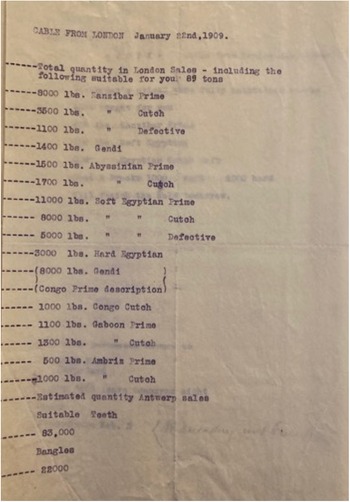
Arnold’s letters are filled with tables like the one presented in Figure 2, which categorize ivory according to its classification at the London auction. Such cables from either London or Antwerp are regular features in Arnold’s correspondence, reflecting the role of Atlantic submarine cables as critical infrastructures for the ivory trade, as well as the reliance of Pratt, Read & Co. on networks of traders located in the European ports of London, Antwerp, and Liverpool where the companies bought a significant amount of material. In addition to offering large volumes of ivory, the auction houses at London and Antwerp further established prices and patterns on global markets, all the way back to East Africa.
‘Cable from London’, 22 January 1909. Courtesy of the Connecticut River Museum. Cheney/Downing Collection. Box 2, Folder 4.
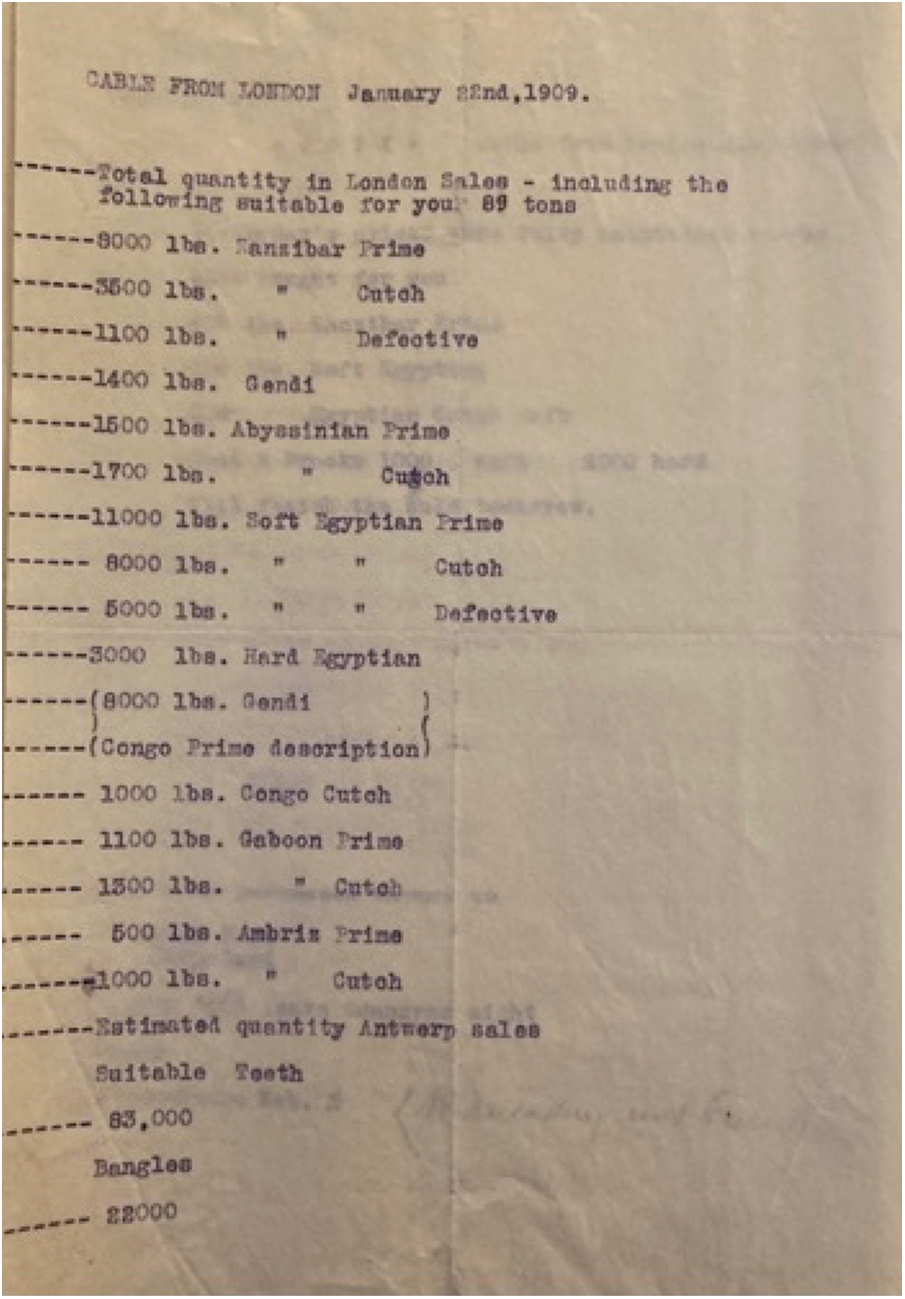
If European auction houses imprinted their mark on global ivory markets, their practices, in turn, were shaped by East African trading communities. Notably, the use of the Swahili term gendi (‘soft’) on the table below shows that the categories in use in London emerged from the encounter between Western and East African traders, which especially resulted in the delimitation between two main markets for ivory: the Indian Ocean and the Atlantic Ocean.Footnote 63 In London, ivory’s classification was based primarily on geographic provenance (‘Zanzibar’, ‘Abyssinia’, ‘Ambriz’, ‘Congo’, ‘Gaboon’), which was itself indexical of physical qualities relevant to specific production processes. As Marianna Szczygielska has analysed, such classifications link the material to particular environments, reflecting historical scientific beliefs that different ecosystems produced different types of ivory, especially regarding colour and consistency. For example, in contrast to Congo ivory, which was deemed ‘hard, brittle, white, and translucent’, the Zanzibar kind was expected to be ‘opaque and soft in texture’.Footnote 64 According to some experts, these differences had to do with the elephant’s diet – thus depending on the animal’s specific habitat(s).Footnote 65
The table also compiles information about the tusks’ size and condition (‘prime’, ‘cutch’, or ‘defective’), which provides insights into the animals’ sex and life trajectories. The tusks of female elephants are typically smaller than those of males, and elephants are either left or right-tusked, with their tusks reflecting their use for feeding, fighting, and exploring territories. According to Szczygielska, ultimately each tusk reflects ‘the elephant’s life history’: what appears to be a flawless tusk may show ‘imperfections, such as cavities or growth deformities, during processing’. As she observes, this variability and unpredictability ultimately made ivory a challenging material to standardize for mass production.Footnote 66
Arnold’s collection of letters illustrates this phenomenon. It shows how the early twentieth-century ivory market, with its depleted elephant populations, led to expanded hunting and trading networks, resulting in a greater diversity of ivory entering the market. The burgeoning piano production market and intense international competition pushed traders and manufacturers to seek new sources of ivory. Consequently, as the piano became mass-produced and consumed, the ivory used in their keyboards became increasingly heterogenous.
In 1902, for instance, Arnold noted, ‘We are unable to get the required quantity at Zanzibar’, adding that ‘The supply at all points in Antwerp has been short for the last four of five months. . . . It is all round a situation I have never before seen’.Footnote 67 Likewise, in April 1904, Arnold observed that, in the space of six months, he had only been able to send Pratt, Read & Co. half of the quantity of ivory that he had shipped the year before.Footnote 68 A few months later, in August, he complained that ‘the arrival of Ivory is very light’, noting that the material’s supply ‘has slowly decreased for six months past’.Footnote 69 When available, the ivory often did not meet the company’s quality standards, and market prices exhibited unpredictable fluctuations.
Ultimately, far from the logic of abstraction that Cronon analysed in relation to grain, Cheney travelled to Europe to examine firsthand what was happening in ivory auction houses.Footnote 70 What emerged from this trip was a deep distrust of European traders. As Arnold wrote: ‘I quite agree that the London brokers “monkey” with the sales [and] furnish more “Hot air” than can be found in any other trade’.Footnote 71 These conditions led to constant adjustments that further increased the diversity of materials used in pianos. Notably Arnold encouraged Pratt, Read & Co. in 1903 to explore using defective ivory instead of prime ivory, even though he recognized that ‘Defective Ivory has no standard of quality, and no two lots can be alike’.Footnote 72 And Arnold reported in 1904 the purchase of 400 pounds of mammoth ivory,Footnote 73 even though his secretary noted the difficulty of gathering information about the material’s quality.Footnote 74 Pratt, Read & Co. and Comstock, Cheney & Co. began experimenting with synthetic substitutes for ivory in the 1870s, highlighting the challenge of reconciling an animal-derived product with the demands of mass production. Their decision to discontinue the use of ivory in 1956 stemmed from economic and technical considerations rather than ethical or environmental concerns.Footnote 75
The history of the nineteenth-century ivory trade, despite merchants’ and manufacturers’ relentless hunger for the material, was far from the unidirectional and smooth narrative of extraction presented by Dolge. Ivory’s highly specific nature made it resistant to commodification. These material uncertainties, however, fostered labour-intensive practices that transformed several American communities. Just as Chicago became a hub for distributing grain produced across the Great West, cities like Deep River and Ivoryton emerged as key points in the networks supplying materials extracted from the Global South.
‘The towns that elephants built’
The history of pianos’ ivory not only brought into contact American and European traders with East African merchants, rulers, porters, hunters, elephants, and environments, but also involved the labour of factory workers, often migrants from Europe. The rise of the piano led to the production of hundreds of thousands of instruments and also fostered the emergence of entire towns, including Deep River and Ivoryton, which, as local people like to say, ‘Elephants built’. Between East African communities and ecosystems on one side and American consumer homes on the other, the ivory used in pianos mediated exchanges that, once again, demonstrate the multidirectionality of the connections established by this material.
To meet the growing labour needs of Comstock, Cheney & Co., the firm sent an agent to New York to recruit new immigrants as they arrived from Europe. In addition, the company’s hiring practices followed ‘chain migration patterns’, where immigrants from a specific region would follow others from their area to a particular destination, forming a community with shared language, customs, and culture.Footnote 76 The trajectory of Johanna Kallgren is exemplary of this dynamic. A twenty-one-year-old native of Sweden, Johanna arrived in New York in 1887 as a travelling maid before settling in Ivoryton, where she married another Swedish immigrant who worked as a mechanic for Comstock, Cheney & Co. In 1910, the couple lived there with their six children. In 1889, Johanna’s younger sister, Emma Ulricke Kallgren, emigrated to the United States at the age of sixteen and settled in Ivoryton, where she also married a Swedish employee of Comstock, Cheney & Co. – they, too, went on to raise six children. In all likelihood, either Johanna, or her Swedish employer, or the Swedish community at large supported Emma’s voyage to the United States. In any case, Emma’s plan to settle in, and her actual experience of, Ivoryton were undoubtedly shaped by her sister’s presence.Footnote 77 The trajectory of Ignacy Budney, a Polish immigrant who started working for Comstock, Cheney & Co. in 1880, and married a Polish woman named Hulda Petersen, further illustrates the logic of chain migration that fuelled the firm with cheap labour. Thanks to their savings, the couple bought a property in Ivoryton replete with a barn, which they converted into a boarding house for newly arrived Swedes and Poles.Footnote 78
Immigrant workers in Ivoryton mostly came from Sweden, Poland, and Italy. The town still bears the mark of this immigration history, which made the rise of the U.S. piano industry possible. In addition to statues and drawings of elephants – which serve as reminders of the region’s past connections with East Africa – the presence of European immigrants is memorialized through urban topography. Reflecting the origins of many of its workers, Ivoryton is organized around ethnic neighbourhoods known as ‘Swedeville’, ‘Little Italy’, and ‘Polack Town/Warsaw Street’.Footnote 79 Each of these districts reflected the diverse religious beliefs and cultural habits of its inhabitants. For example, right after 1900, a Swedish Mission Church was established in Swedeville.Footnote 80
For immigrant workers, ivory was a factor of geographic and social mobility, allowing decent wages and relative comfort within highly paternalistic organizations. Comstock, Cheney & Co. was not only the main employer but also the largest taxpayer and real estate holder in Ivoryton, making it a typical factory town. In 1871, the firm initiated a fifty-year building programme that resulted in the construction of more than 130 houses, which the company rented or mortgaged to its employees. The company also built a general store (in 1873) and a playhouse (in 1911), which kept workers entertained. The town also comprised several social clubs, including the R. H. Comstock Drum Corps, founded in 1888, which played on holidays, at weekends, and at special events.Footnote 81
Following the closure of Pratt, Read & Co. in 1992, an oral history project documented the experiences of the company’s employees. These interviews shed important light on the encounter between elephant tusks and factory workers. The transformation of tusks into piano keyboards involved a division of labour, with workers first cutting the tusks into large cylinders and rectangular blocks, and then into fine veneers. Others ‘bleached’ – that is, whitened – the ivory using a combination of chemical treatment and solar energy. This part of the process was especially delicate and labour-intensive. Workers first immersed pieces of ivory into glass jars filled with dilute hydrogen peroxide for several days. At this stage, control over drying time and water temperature was crucial to ensure the visual and structural consistency of the ivory. Following this, the ivory was laid on wooden racks and exposed to sunlight in glasshouses for around three weeks, although the timing varied significantly from batch to batch due to variations in the weather. Once the bleaching process was complete, workers matched the ivory by colour – often a task performed by women – and glued it to wooden keys before polishing them.Footnote 82
As in many factory jobs, some workers complained about the repetitive nature of their tasks resulting from this division of labour,Footnote 83 while others praised the company’s practice of rewarding employees with bonuses for exceeding production targets.Footnote 84 However, the workers’ interviews also revealed significant challenges and risks associated with their jobs. The smell of chemicals was overwhelming in the bleaching department, and a worker described cutting ivory as ‘a gruesome job’,Footnote 85 with frequent cuts, some of which led to complications – such as the case of Ray Carter, who died of anthrax.Footnote 86 Several workers also noted the high flammability of celluloid, with one highlighting the ‘unstable temper’ of the material.Footnote 87
The history of Deep River and Ivoryton shows that turning tusks into keys was far from straightforward and required considerable labour. The processing of ivory brought about significant urban, environmental, economic, social, and cultural change in the Essex region, profoundly affecting the lives and bodies of thousands of individuals who crossed the Atlantic Ocean to take advantage of the economic opportunities offered by ivory’s popularity in Western markets. Although this case resembles other histories of industrialization from the same period, and recent studies have examined questions of labour conditions in relation to new sonic media, it is surprising that, given the scale of industrialization in piano production, music and sound scholars have not yet focused on these stories. Pianos, it seems, have a remarkable tendency to obscure the conditions of their production.
The elephant in the piano
Scholars have emphasized the role of the piano in shaping gender and class identities. Throughout the nineteenth and early twentieth centuries, the piano served as a sign of social status and a symbol of ‘respectability’,Footnote 88 providing a measure of a woman’s training in the necessary accomplishments of genteel society.Footnote 89 However, the piano’s allure did not merely arise from its ability to showcase feminine skills; it also stemmed from the value of its components, particularly its most exotic materials, including ivory, ebony, and mahogany. As Kelly summarizes, in Victorian society, ‘commodities influenced class, gender, and race formation, the rise of individuality and self-expression, sexuality, domestic space, and global relations’.Footnote 90 In other words, imperialism and the global trade in materials ultimately shaped Western notions of identity.
What role did ivory play in these processes? In particular, to what extent did the material shape transatlantic encounters between Africa, Europe, and North America, as well as influence environmental and musical cultures? Answering this question is challenging – first, because few records document past sensory experiences, and second, due to the highly subjective nature of such experiences. Thus, it is difficult to generalize conclusions drawn from specific sources.Footnote 91 However, this section offers avenues for reflection on the encounters between ivory and audiences in the various social spaces where pianos were present.
Once again, I take inspiration from Lowe’s approach, especially her analysis of the tension inherent in colonial commodities. As she writes, materials such as silk, mahogany, tea – and ivory – both ‘evoked yet obscured their conditions of production’.Footnote 92 While nineteenth-century literature exemplifies the role of colonial commodities as media shaping imaginations of a global order, it also reveals these materials’ tendency to conceal the social relations they embody – particularly the reliance on enslaved and indentured labour, as well as environmental exploitation and destruction. For instance, in Charlotte Brontë’s Jane Eyre (1847), the global connections articulated by mahogany are ‘not the history that the novel narrates, but the history that the novel secretes: the history it hides and emits, the one it conceals and produces as it calls to mind the locations of deforestation and slavery for which mahogany is a metaphor, a metonym, and a literal representation’.Footnote 93 Likewise, William Makepeace Thackeray’s Vanity Fair (1847–1848) illustrates the ‘dynamic of presence and absence’ that characterizes commodities’ ‘ubiquitous appearance’ in the novel – and in Victorian society more broadly.Footnote 94 The piano exemplifies the tendency of materials to obscure their origin. As Edward Gillin notes, at the turn of the twentieth century, the moral qualities attributed to pianos and the perceived ethereality of music appeared to redeem what was increasingly viewed as problematic labour conditions and animal treatment.Footnote 95 However, music and sound’s seeming immateriality also activated ivory’s primary quality: its vitality and the tendency to blur the boundaries between life and death, human and inhuman.
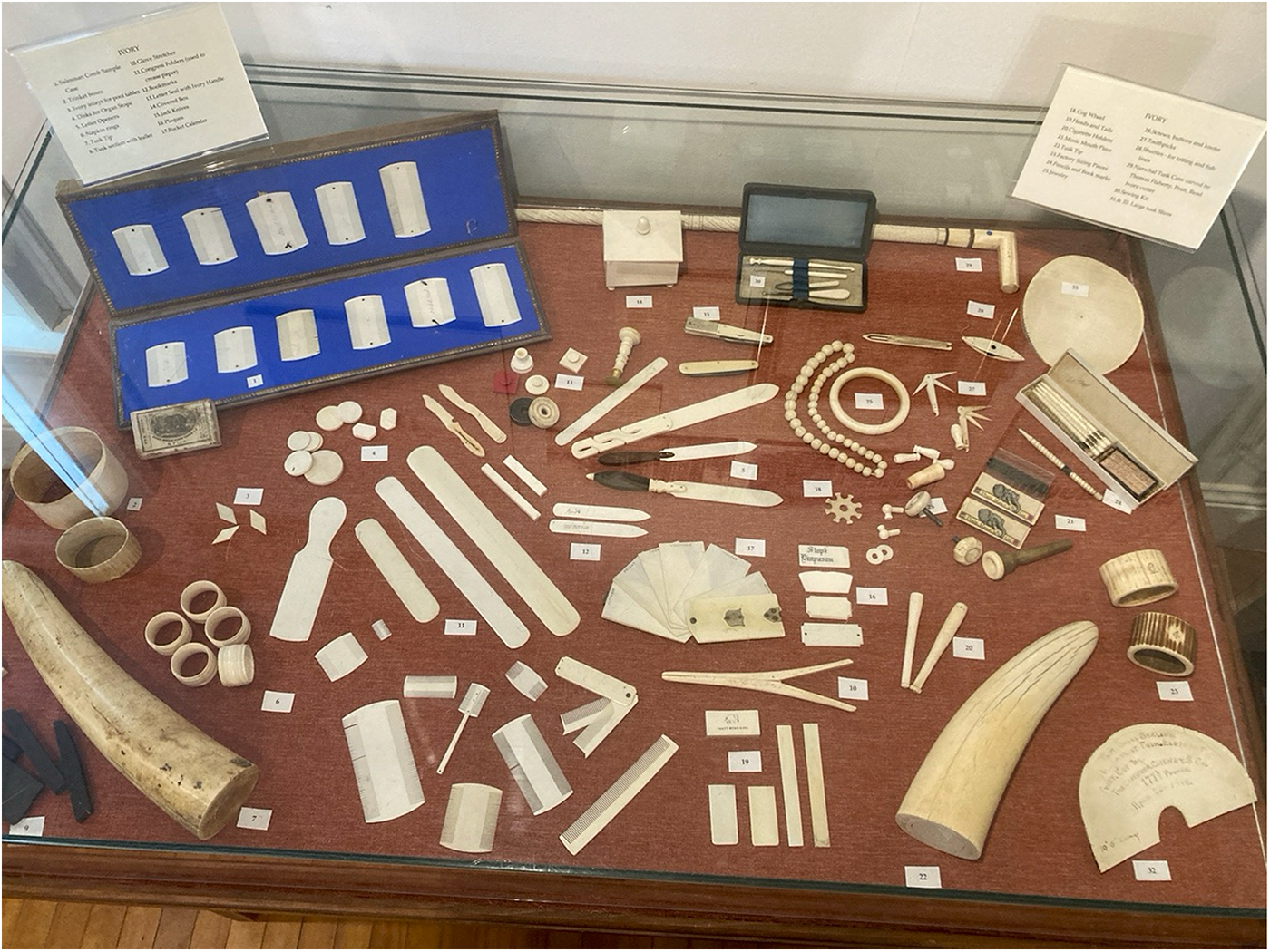
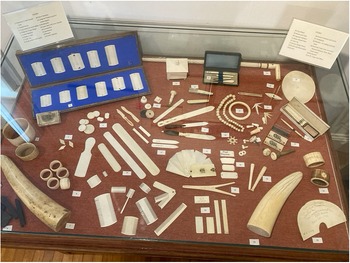
Throughout the nineteenth and early twentieth centuries, ivory connected a variety of objects associated with domesticity and the body, as illustrated by Figure 3. Ivory mediated various forms of social and physical intimacy, enabling individuals to record commitments on miniature calendars carried close to their body, shaping hygiene practices, and serving as dental prosthesis. In all these objects, ivory was praised for its sturdiness and flexibility, as well as its softness and coolness.
Ivory Exhibit. Courtesy of the Deep River Historical Society.
The primary quality that audiences attributed to the material in relation to pianos was its porosity and associated absorbency. Pianists often described ivory keys as ‘breathing’, while a worker from Ivoryton remarked that ivory is ‘like a sponge’. Nowhere was ivory’s absorbent, living quality more perceptible than in comparisons with its main substitute: plastic. In an interview, the same worker explained these differences. When asked, ‘Can you tell the difference between ivory and plastic?’, he responded:
Yes. Rub that one. That’s plastic. Rub your finger on it. You’ve got a lot more control on your ivory key than you do on plastic. Plastic – if your fingers sweat, they slide very fast . . . the ivory will absorb the moisture from your fingers.Footnote 96
Ivory’s vitality was also attested – and constructed – through anatomical framings of the piano. The ivory parts of piano keys were designated using animal metaphors – the vertical, shorter part was called the ‘head’, the horizontal, longer piece the ‘tail’, and the juncture the ‘shoulder’. As Kirsten Paige observes, literary texts often framed the piano’s keyboard as the giant mouth of a living creature.Footnote 97 In Edna Ferber’s 1926 novel Show Boat, for example, the piano bears an ‘ivory mouth, fixed in a death grin’,Footnote 98 while in another essay, ‘the grand piano opens its ivory mouth like the familiar monster of the place’.Footnote 99
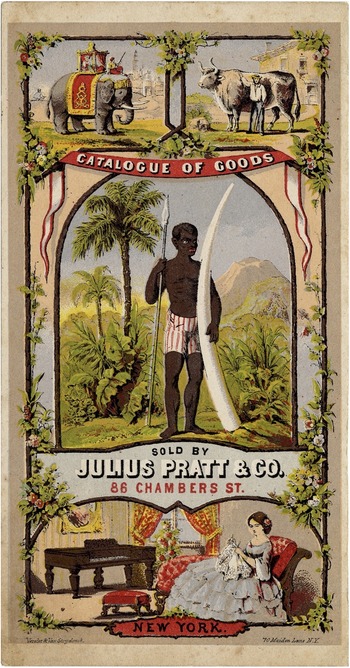
These vitalist conceptions carried significant racial, gender, and social implications. The image presented in Figure 4 is one of many unsettling documents that form part of the archive of the ivory trade. It presents a dehumanizing vision of an African body while also misleadingly depicting Indian elephants as the sources of American pianos’ ivory and perpetuating clichés about women and domesticity. However, I reproduce it because it effectively captures the role of ivory as an imperial commodity dependent on an ethos of mastery – over nature, and over human beings constructed as ‘others’.
Cover of a Julius Pratt & Co. catalogue in New York, mid-nineteenth century. Courtesy of the Ivoryton Library.
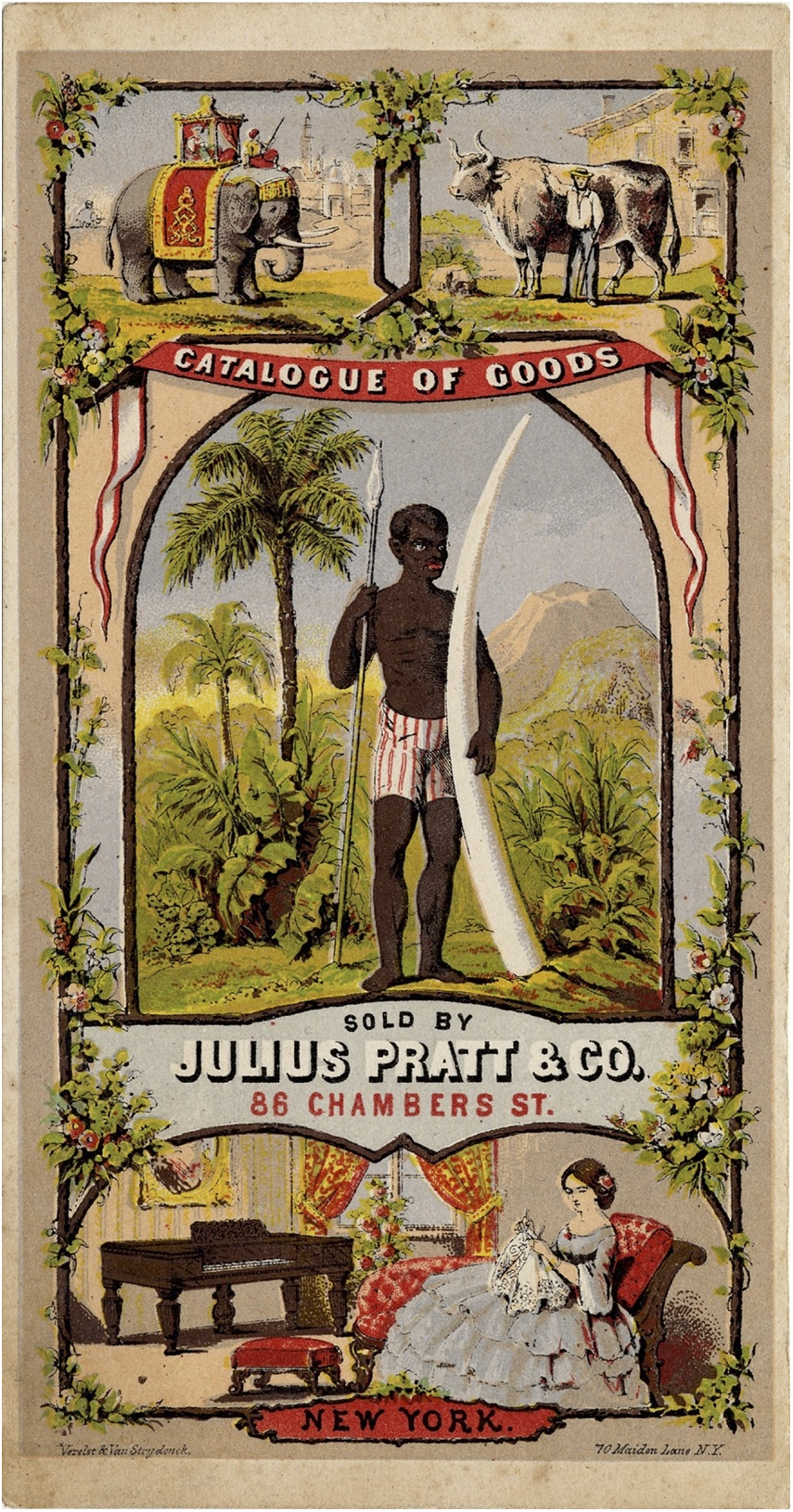
Figure 4 Long description
Ornamental catalogue cover with a vine-and-flower border around three illustrated scenes and several curved banners. Upper scene: An elephant with a cloth covering stands on ground, with a small structure on its back holding seated figures. A city skyline appears in the distance. In a separate upper-right scene, a horned animal stands beside a standing man, with a building behind them. Middle scene: An arched frame contains a standing human figure holding a long staff. A large curved tusk stands beside the figure. Plants fill the foreground and a mountain rises in the background. Lower scene: An indoor room scene shows a piano with a matching stool. A seated woman in a long dress sits on a sofa holding a piece of fabric or paper. Curtains and a window are shown behind the seating area. Text in English: CATALOGUE OF GOODS. SOLD BY. JULIUS PRATT and CO. 86 CHAMBERS ST. NEW YORK. Verrill and Kim, Springfield. 70 Maiden Lane N. Y.
The use of exoticist motifs in advertising for industrial products served to obscure their production processes and imbue them with an aura of luxury and exclusivity.Footnote 100 The technique of covering piano keys with thin ivory veneers, along with using wood veneers on piano cases, is a striking example of this performance of mimicry. By juxtaposing a fictional representation of the material’s origins with an American parlour, this advertisement conceals the many steps that separate these two moments in the material’s global journey. It particularly erases the role of Pratt, Read & Co.’s factory in Deep River, thereby obscuring the reliance of polished bourgeois spaces and identities on industrial processes and the emergence of an ethnically diverse American working class.
By exposing ivory’s animal origins, this image further demonstrates how the material, even at this stage, mediated the appropriation of animal vitality – a process foundational to the production of Western identities. As Szczygielska argues, this ethos is reminiscent of what Zakiyyah Jackson refers to as ‘the plasticity of antiblackness’, highlighting how vitality is co-opted to define the human subject along racial, classed, and gendered lines.Footnote 101 The juxtaposition of the middle and lower parts of this image invokes the then-common tropes of Black and white ivory, or ebony and ivory.Footnote 102 Considerable effort was made to whiten elephant tusks in Ivoryton and Deep River. In light of this document and its symbolic linkage between the colours of ebony and ivory and the skin tones of Black and white individuals, I concur with Szczygielska, who suggests that ivory played a pivotal role in the production and reproduction of racial, gendered, and class identities – particularly through ‘the repetitive rituals of everyday [musical] practices’.Footnote 103 This symbolic and material significance of ivory is further underscored by Carlotta Welles’s account of Sarah Cheney nursing a ‘black and red’ striped infant with her white breast. By highlighting the racialized and gendered dynamics embedded in the ivory trade, this episode reveals how both the material itself and the social meanings and connections generated through its global exchange worked together in the construction of identity.
Conclusion
The history of ivory reveals multiple forms of encounter between environment and musical cultures, as well as between East Africa, Europe, and North America. This material connected diverse human and non-human networks, spanning East African savannas, forests, and coastal cities, the Indian and Atlantic Oceans, European and American ports and industrial centres, and extending to consumers’ homes and various spaces equipped with pianos. As I have shown, the relationships among the different actors involved in this global exchange of materials were complex, multifaceted, and multidirectional. Contrary to Dolge’s straightforward narrative of extraction, the history of ivory highlights the immense amount of labour involved in making piano keys. Ivory facilitated a series of transatlantic exchanges that reshaped societies and environments on both sides of the Atlantic. It is not passive; like wood, wool, and metal, ivory is vibrant, unpredictable, and stubbornly resistant.
This perspective contributes to ongoing discussions surrounding the eco-politics of sound and music in three ways. First, it complicates narratives of extraction by highlighting the complexities, uncertainties, and failures inherent in these processes. Ultimately, ivory, despite its esteemed status in Western societies, was not well suited to a mass-produced instrument such as the piano. As Henry Steinway remarked after his company discontinued the use of the material for most pianos in 1956: ‘Ivory was always a pain in the neck’.Footnote 104 Throughout its time as one of the piano’s primary materials, ivory presented challenges for manufacturers and never truly aligned with the industrial modes of production characteristic of the instrument’s golden age. The towns of Ivoryton and Deep River stand as striking reminders of the efforts made to reduce ivory’s specificity and the many transformations these efforts brought about. At the same time, East African actors involved in the ivory trade ‘were not isolated “natives” waiting for white explorers to stumble on them, but rather savvy merchants aggressively pursuing mercantile, social, and political agendas and taking advantage of newcomers in the region’.Footnote 105 In tracing the origins of commodities, we must be vigilant not to reproduce the historical narratives of Western dominance that are integral to extractive processes, but instead foreground other forms of – both human and non-human – agency.Footnote 106 Undoing these dynamics requires not only reading against the grain of colonial archives, but also including perspectives from East African actors involved in the trade. As I continue this research, I aim to expand the archival record to counterbalance the dominance of voices like Carlotta Welles’s and her family, in favour of those of East African porters, traders, and rulers.
Second, this approach highlights the inseparability of aesthetics and eco-politics, contributing to an ongoing reconceptualization of sound as a multisensory, deeply embodied experience. The material supply of pianos – and of musical instruments more broadly – mobilized the entire sensorium of all those involved in their construction. Ivory for piano keys had to meet exacting standards of colour and texture, prompting meticulous, repeated visual and haptic evaluation by those involved in its selection, purchase, and processing. Performers and listeners were not the only ones interacting with the softness and whiteness of ivory. Throughout the global journey of this material, economic and technical considerations related to logistics, transportation, and industry were intertwined with sensory experiences and aesthetic values, which in turn fine-tuned the extraction process.Footnote 107
Focusing on this point about aesthetics, the third contribution of my work is to map an alternative geography of ‘piano music’. As I note in several sections of the article, ivory not only supported the development of a wide range of pianistic repertoires, but also reveals previously unexamined connections between seemingly unrelated musical practices. The trumpet shown in Figure 1 illustrates how interactions between Euro–American and East African traders facilitated the exchanges of musical instruments, drawing Western audiences’ attention to different uses of ivory in the musical practices of the nineteenth and twentieth centuries. In a city like New York, tusks were simultaneously viewed as raw material for piano keys and as sonic devices linked to emerging knowledge of African societies and rituals. Additionally, in towns such as Deep River and Ivoryton, ivory processing contributed to the cultivation of various musical styles, including organ playing and singing in local churches, vaudeville and other ‘light’ performances at the Ivoryton Playhouse, and brass band music. Ultimately, this research seeks to foster new ways of engaging with the piano – whether through musical, curatorial, or listening practices – to uncover some of the stories, lives, and musics embedded within this iconic, yet still largely unknown, figure of contemporary musical soundscapes.
Acknowledgements
This article has benefited from the help of many people. I thank Elizabeth Alvord, Rhonda Forristall, Melissa Josefiak, Brenda Milkofsky, Amy Trout, and Woody Comstock for generously sharing their archives and knowledge with me. Research for this article was supported by NYU’s Center for the Humanities and enriched by the very insightful suggestions of its 2024–2025 cohort of fellows. Versions of this paper were presented at the 2024 Annual Meeting of the American Musicological Society; the ‘Global Musical Instrument Market: Making, Trading, and Collecting in the Nineteenth and Early Twentieth Century’ conference organized by the Musée de la musique – Philharmonie de Paris (18 November 2024); the 2024-2025 Eastman School of Music Symposium Series; and the 2024-2025 UC Berkeley Music Department Colloquium Series. I am grateful for the valuable feedback of participants at these events. I am also deeply indebted to Ana R. Alonso Minutti, Esteban Buch, Alexandra Celia Kelly, Michal Thomas Taylor, Judy Townley, Vera Volkowicz, and the two anonymous reviewers for their thoughtful feedback and support throughout this project.

 Open access

