

The Iran-Saudi Arabia rivalry stands as one of the most intricate and precarious contests in the Middle East and North Africa (MENA) region. These two nations represent stark antitheses: Saudi Arabia embodies Sunni Islam, while Iran adheres to Shia Islam. Despite both being theocratic, their governmental structures differ significantly, with Saudi Arabia governed as an absolute monarchy and Iran incorporating quasi-democratic republican institutions. Disagreements arise over the custodianship of holy places in the region, and their stances on major regional issues consistently oppose each other. Competing visions for regional politics, control over natural resources, diverse alliance portfolios, and relations with the US and Russia fuel their rivalry. This contention extends to territorial influence, including their involvement in proxy conflicts in Syria, Bahrain, and Yemen (Miraz et al. Reference Mirza, Abbas and Qaisrani2021). Saudi Arabia collaborates with Israel and the US to address Iran’s nuclear program, while Iran seeks to advance its nuclear capabilities, leading to perpetual tensions with the US and Israel in the region. Saudi Arabia appears as a conservative status quo actor, while Iran adopts a dynamic, revolutionary, and revisionist foreign policy approach. Saudi Arabia maintains relatively amicable relations with the liberal international world order, while Iran has remained in consistent conflict with it since the 1979 Islamic revolution.
We suggest that instrumental motivation shapes religion-based foreign policy discourse in the Iran-Saudi Arabia rivalry. While the relationship between these regional powers is intricate, religion remains a contentious element. Saudi Arabia asserts itself as the true custodian of traditional Islam and leader of the Muslim world, governed as an absolute monarchy with a strict Sunni interpretation of religious sources. In contrast, Iran, since the 1979 Islamic Revolution, presents an alternative model with a quasi-democratic political system and some personal freedoms. Iran actively supports Shia groups across the region and promotes revolutionary ideas, advocating resistance against oppressive monarchical regimes to establish theocratic rule (Mirza et al., Reference Mirza, Abbas and Qaisrani2021). These faith-based divisions are often seen as indicative of deep-seated incompatibilities between the two nations. However, it is essential to recognize that faith is just one aspect. Building on the scholarship that acknowledges the influence of power politics without ignoring religion’s role, this study seeks to elucidate how religion functions within this rivalry amid a broader array of considerations. We contend that Saudi Arabia and Iran, as regional powers, adapt to their evolving security environment while pragmatically addressing their ideological disparities.
Using role theory as a foreign policy analysis (FPA) approach, we identify and analyze secular and religious national role conceptions (NRCs) of Saudi Arabia and Iran to answer the following questions: What are the faith-based foreign policy NRCs of Iran and Saudi Arabia? How have these NRCs evolved over time? Are they sectarian in nature? How do the NRCs of Iran and Saudi Arabia interact?
We do not consider secular or faith-based NRCs as monolithic determinants that are mutually exclusive, but as ingredients that are calibrated by foreign policy executives (hereinafter FPE). Our analysis section builds on this theoretical premise. To systematically account for role utterances by Iranian and Saudi foreign executive officials, we use a content analysis method to measure the intensity and frequency of religious and secular foreign policy NRCs (Authors 2019) attributed to Iranian and Saudi foreign policy by their own officials in the 2015–2021 period. We analyze the most salient communicated roles by officials in the two countries on their official TwitterFootnote 1 accounts.
Our findings suggest faith-based and secular NRCs coexist, which encourages us to look beyond religion vs. secular dichotomy. We also find that Iran and Saudi Arabia’s approach to religion in foreign policy is not static. Faith is not the only focus of both countries’ foreign policies, and religion-based NRCs are used dynamically. This result hints at the instrumental motivations of FPEs in religion-based policymaking. While there are historical roots of the sectarian divide, current competition might not be rooted in them. Singling out sectarian concerns might overestimate the importance of religion. Finally, we observe statistically significant associations between both states’ use of faith-based NRCs on each other’s foreign policy role conceptualizations. Collectively, these findings suggest the complexity of Iran-Saudi relations, which requires an approach beyond the ancient hatred argument. While not as deeply rooted, they also show that religion is indeed part of this competition. In addition, results provide much-needed clarity on how religious and secular roles interact and help in explaining the March 2023 reproachment.
By engaging with faith-based NRCs, this study provides a rare opportunity to connect religion and role theory. Methodologically, it contributes to the emerging field of automated text-based political analysis in International Relations (IR). Both of these elements give access to the nature of one of the most important regional rivalries.
The remainder of this study is organized as follows: The next section reviews the literature on the Iran-Saudi Arabia rivalry and presents the theoretical framework of the study. We follow with a discussion on foreign policy roles as analytical units. After presenting the research design and empirical analysis, we discuss our findings. The final section provides a review of the implications of our findings.
Iran-Saudi Arabia Rivalry: Battle of the Sects?
The competition between Iran and Saudi Arabia is tied to myriad factors, such as religion, leadership, balance of power politics, military competition, geopolitics, and regime survival.Footnote 2 Relevant scholarship can be divided into three general categories: 1) studies assuming sectarian difference to be the driving force of the rivalry due to their ancient roots; 2) works that single out power politics and competition for leadership; and 3) scholarship that recognizes the influence of power politics without ignoring religion’s role.Footnote 3 This study builds on the third category, with the acknowledgment that the current context of regional political relations constitutes the background of bilateral competition. This context includes strategic interest and sectarian elements. Islam is a significant determinant of foreign policy in the Middle East (Wiarda Reference Wiarda2013). From the rise of political Islam to the sectarian polarization, MENA keeps faith close to its politics.
In Iran-Saudi Arabia affairs, 1979 is a crucial year (Mabon Reference Mabon2016; Cerioli Reference Cerioli2018; Adısönmez et al. Reference Adısönmez, Onursal and Öztığ2023). Three key events of 1979, the Iranian Revolution, the Grand Mosque seizure, and the Soviet invasion of Afghanistan, created the foundation for the competition to lead the Muslim world and expand power through the use of faith politics (Ghattas Reference Ghattas2020: 2).
Considering the larger presence of sectarianism (Abdo Reference Abdo2017; Nasr Reference Nasr Vali2007) and identity-based sentiments (Gause III Reference Gause and Gregory2003) in Middle Eastern politics, it is easy to see this rivalry through religious identities. While sectarianism is crucial, it is not static. There is a “political context” in which “sectarianism becomes prominent in a country’s politics” and “neither sectarian conflict nor sectarian political alliances are immutable.” (Gause III Reference Gause and Gregory2013: n.p.) Also, while there are sectarian aspects to the Saudi Arabia-Iran competition, it is also about “domestic political systems of the region’s weak states” (Gause III Reference Gause and Gregory2014: 1). Mabon (Reference Mabon2016) acknowledges the coexistence of identity-based and geopolitical sources of the competition with a focus on soft power. Similarly, Tzemprin et al. (Reference Tzemprin, Jozić and Lambaré2015: 189) identify “geopolitics and ideology” as the “two distinct but highly intertwined spheres of competition between Iran and Saudi Arabia.” They also suggest that sectarian elements became more prominent with the Arab uprisings (Tzemprin et al. Reference Tzemprin, Jozić and Lambaré2015). Since the beginning of the Arab uprisings in December 2010, and with the escalated tensions in the region, the traditional sectarian fault lines have served as a basis for further competition and conflict.
Darwich (Reference Darwich2016) looks beyond identity versus material interest discussions with an ontological security framework. Building on Darwich (Reference Darwich2016), (Adısönmez et al. Reference Adısönmez, Onursal and Öztığ2023: 102) unpack the rivalry through ontological security and conclude that fatwas of Saudi scholars “have been mobilized to constitute and reconstitute the ontological security narrative in Saudi Arabia, justifying domestic and foreign policy choices, and responding to the ideational threats by Iran.” Power politics explains why the strategic factors might be in place. However, previous scholarship gives us very little on exactly how religion matters in power politics (Henne Reference Henne2023a). Henne (Reference Henne2023a: 18) argues that “religious appeals have an impact due to the significant influence religion has over many societies, even though they are strategic tools used by states.” Strategic use of religious appeals connects faith to foreign policy. However, there are conditions to the use of such appeals by states (Henne Reference Henne2023a). In the case of Iran and Saudi Arabia, religion is engrained in state building. Cesari (Reference Cesari2014: xiv) explains in Muslim-majority countries, “the building of the state led to a situation” that she labels “hegemonic Islam,” that is, “the religion is not only absorbed within state institutions but also fused with national identity and with the norms of the public space.” “Hegemonic Islam” explains how religion in Muslim states has a different role in “state institutions,” “national identity,” and “the norms of the public space” in connection to the state-building process (Cesari Reference Cesari2014: xiv). Cesari (Reference Cesari2014: 279) suggests “[t]he politicization of Islam is… the tragic outcome of the construction of Islam as a modern religion. […] Islam as a modern religion has become far more reaching and controlling of the religious self than it was in premodern Muslim polities” (Cesari Reference Cesari2014: 279). For Saudi Arabia and Iran, this led to the reimagining of ancient sectarian divides to be new memories that are tied to unforgivable historical wounds. (Ghattas Reference Ghattas2020: 330)
We suggest this reimagining to be instrumental in nature. While they refer to historical divides, they are designed to achieve current foreign policy goals. Figure 1 displays key components of our theoretical framework and how they connect to the three hypotheses of the study.
National role conceptions (NRCs) for Iran and Saudi Arabia.

The first and last columns outline national role conception (NRC) reserves for each state. Columns 2 and 3 note how these NRCs are utilized in the context of the rivalry. Building on the arguments on the presence and reinvention of religion, we consider the following two hypotheses: First, we expect both Iran and Saudi Arabia to adopt faith-based NRCs in foreign policy discourse. These two theocratic states claim to be the true representatives of Islam in the MENA and globally; thus, religious overtones in foreign policy role conceptualizations are unavoidable. Second, we anticipate a positive association across the faith-based NRCs of Iran and Saudi Arabia that suggests a need to sustain religious influence and leadership. Both states are theocratic in their philosophy, which requires a leadership claim as the two largest denominations of Islam. Their foreign policy is shaped by this strive for leadership of the “true faith” and of the region.
Sectarian divides of Iran and Saudi Arabia are redefined to serve national interests in a region that has been increasingly unstable. A look at the events of the last half-century confirms these observations. The Islamic revolution in Iran in 1979, the Iran-Iraq War, the Gulf War, the United States’ invasion of Iraq in 2003, and the events that followed have created opportunities for competition and polarization in the region. While Saudi Arabia is a conservative force aligned with the US in the region, Iran is the hotbed of revolutionary Islamism with stronger ties with Russia. With the Arab uprising in the region and all the conflicts that followed them, the Iran-Saudi rivalry seems to be exactly placed on the old-fashioned sectarian and political fault lines. While Iran has sided very closely with Syria, Hezbollah, and Russia with revolutionary overtones of foreign policy, Saudi Arabia has chosen to be more in line with the status quo and the US allies in the region. Among these events, the civil wars in Syria and Yemen are perhaps the best examples of increasing sectarian ideology, which has been played against the backdrop of regional international politics. These are proxy battlegrounds for Iran and Saudi Arabia, where Iran aligns itself with Shia groups, and Saudi Arabia supports Sunni Arab actors. These two states’ elites’ choices of foreign policy roles for their countries to play in the region are influenced by the current state of MENA’s international politics. However, even in examples like Yemen and Syria, where faith appears to be the best explanatory factor, other concerns are visible as well. For the House of Saud, Iranian influence in Yemen is a geopolitical red flag. In the same vein, losing an ally like Syria is detrimental to Iranian interests in the region.Footnote 4 Religious or not, these proxy wars advance divisions in Syrian and Yemeni societies.
A similar dynamic is observed in Africa, where competition between Riyadh and Tehran amplified the role of religion and sectarian identity. Bahi (Reference Bahi2018: 36) suggests that West Africa’s tolerant outlook is replaced with rising sectarianism “as Saudi Arabia and Iran export their views on Islam through schools, mosques, and cultural centers” and “intervene in support of their respective sects.” However, competition in Africa is not just about religion. Both ethnic and geopolitical factors are at play (Bahi Reference Bahi2018).
The coexistence of religious and non-religious factors makes it quite difficult to determine whether one or the other defines this rivalry. Previous research suggests that such dualities are not reflective of religion’s role in politics. Tepe (Reference Tepe2008: 345) cautions against the categorization of “pure religious and secular domains” since they “often prevent us from probing into the crucial areas where critical engagements of secular and sacred occur.” Henne (Reference Henne2023b: 2) notes the importance of examining “the presence and nature of religious rhetoric” rather than “determining whether religion had a greater influence than other factors.” Similarly, we aim to locate religion rather than measure it against other categories of influence. Ramazani (Reference Ramazani2004: 549) suggests that “tension between religious ideology and pragmatism has persisted throughout the Iranian history” since Cyrus, and resolved in favor of “pragmatic calculation of national interest” after the Islamic revolution. Similarly, Darwich (Reference Darwich2014) argues Saudi opposition to the rise of Muslim Brotherhood and other Islamist movements in the MENA after 2011 is an example of shared identity not providing cooperation, due to pragmatic security concerns. We suggest that the leaders of Iran and Saudi Arabia use religion instrumentally. Despite its importance for both nations, religion is not the only component of this rivalry. Saudi Arabia and Iran are two regional powers responding to their changing security environment, such as following the Arab uprisings, with a practical take on their sectarian differences. However, both nations value the soft power of their sectarian identity. Also, even if religion is utilized with instrumentalist sentiments, it can still divide societies across sectarian lines. As we have seen in Africa, “othering” through religious identity could harm the culture of tolerance and inclusion. Such polarization might increase the value of investing in sectarian divides to achieve foreign policy goals.
Therefore, we consider the third hypothesis: moving away from a monolithic approach to religion, we anticipate fluctuation in the salience of faith-based NRCs. We think that although the rivalry has religious elements, it is not deeply rooted in (or shaped by) religion. Religion is used, although in a pragmatic and dynamic manner, depending on the foreign policy issues of the day, frequently determined by the modern politics of the region. In the lower ends of columns 2 and 3, there are dormant and active religious NRCs. We expect quick switches from one category to another, suggesting tendencies to move away or come back to religious NRCs.
We explore the foreign policy of Iran and Saudi Arabia with a broad spectrum of NRCs to locate these instrumental attitudes. Despite the static outlook of NRCs in role theory scholarship, we contend they change over time. We also expect an interaction between the NRCs of Iran and Saudi Arabia. We suggest this interaction is shaped by both substantial differences (like in interpretations of Islam or government structures) and similarities (like shared characteristics of “hegemonic Islam” and state building (Cesari Reference Cesari2014, 11-12). These similarities are useful in understanding the mirror image problem when it comes to blaming the other for fanning the sectarian tension, as well as preferring to use proxy actors or engage in proxy wars. They are also helpful in understanding officials’ reactions to protect the regime at home. Shared characteristics can explain intense rivalry for NRCs, such as “the leader of the Muslim world,” which is explained further in the next section. In addition, one could expect tendencies of “religious outbidding”Footnote 5 when there are such common grounds and parallel goals.Footnote 6
Building on the arguments outlined earlier, therefore, H1) we expect both Iran and Saudi Arabia to adopt faith-based NRCs in foreign policy discourse; H2) we anticipate a positive association across the faith-based NRCs of Iran and Saudi Arabia that suggests a need to sustain religious influence and leadership; and H3) we anticipate fluctuations in the salience of faith-based NRCs.
Foreign Policy Roles as Analytical Units
To test the effects of religious rivalry between Iran and Saudi Arabia, we use foreign policy roles uttered by officials as theoretical blocks in this paper. Role theory assumes a link between NRCs and foreign policy orientations of states. “NRCs are ‘policymakers’ own definitions of the general kinds of decisions, commitments, rules, and actions suitable to their state and of the functions, if any, their state should perform on a continuing basis in the international system. It is their image of the appropriate orientations and functions of their state toward, or in, the external environment” (Holsti Reference Holsti1970: 245–246). The assumption is that if we unearth the NRCs of a given state, we can understand the determinants of its foreign policy. Since its adaptation from the discipline of sociology (Holsti Reference Holsti1970; Walker Reference Walker1987), this approach has been used to understand complex foreign policy dynamics (Engstrand Reference Engstrand2023; Godwin Reference Godwin2022; Cantir and Kaarbo Reference Cantir and Kaarbo2016; Breuning Reference Breuning, Harnisch, Frank and Maull2011; Thies Reference Thies2013). In this sense, using foreign policy roles as a proxy to measure Iran-Saudi rivalry is an appropriate choice.
In addition to our contribution to the literature on the intersection of religion and politics, another major impact of this paper is the examination of faith-based national role conceptualizations. To a large extent, religion’s small footprint in the role theory literature is attributed to the lack of scholarly attention on faith in IR. For decades, religion was ignored in the study of world politics (Fox Reference Fox2001). In the same vein, religion is a newcomer to FPA literature.Footnote 7 This is rather surprising since religion could influence 1) the perception of individuals (Seul Reference Seul1999); 2) crisis behavior (Fox and Sandal Reference Fox, Sandal and James2010); 3) the likelihood of third-party support to conflicts (Fox Reference Fox2004); and 4) the development of civil wars (Reynal-Querol Reference Reynal-Querol2002). Only a few studies, such as Ghose and James (Reference Ghose and James2005), Akbaba and Özdamar (Reference Akbaba and Özdamar2019), Malici and Walker (Reference Malici and Walker2017), and Cerioli (Reference Cerioli2018), consider faith-based role conceptions in FPA. Iran and Saudi Arabia are different from one another in many ways, but as two authoritarian states (Coppedge et al. Reference Coppedge2024), religion is part of the foreign policy toolbox. With foreign policy roles as analytical units that can be objectively measured, we have the opportunity to consider faith-based and secular factors in analyzing the Saudi-Iran relations and ask if, indeed, it is the battle of sects?
Data and Research Design
Role theory suggests that states assume various roles over time, influenced by international and domestic factors, leading them to shift in and out of different NRCs (Harnisch et al. Reference Harnisch, Frank and Maull2011). This section explores the evolving NRCs of Iran and Saudi Arabia, with a particular focus on their faith-based dimensions. Our analysis relies on data collected from eight official Twitter accounts associated with Iranian and Saudi political figures responsible for foreign policy. These figures include Ayatollah Ali Khamenei, Iran’s supreme leader; Hassan Rouhani, Iran’s president; Javad Zarif, Iran’s Foreign Minister; Iran’s Foreign Ministry official account; Adel Aljubeir, Saudi Arabia’s former foreign minister and the current Minister of State for Foreign Affairs; Faisal bin Farhan Al-Saud, the current Minister of Foreign Affairs; and the two Saudi Ministry of Foreign Affairs accounts. We’ve compiled tweets from January 2015 to August 2021. Notably, our analysis begins in 2015, coinciding with Saudi officials’ entry into Twitter for foreign policy communication, as illustrated in Figures 2 and 3, as we aim to examine the interplay between the foreign policy NRCs of both nations.
A tweet by Faisal Bin Farhan, Foreign Minister of Saudi Arabia, reacting to President Biden’s speech.

The number of monthly tweets by Iranian accounts.

We primarily rely on Twitter as our data source for several key reasons. Social media has become a part of foreign policy-making process in the last two decades. In the MENA region, the effect of social media in politics was felt throughout the region after the contested election of Ahmadinejad in 2009 in Iran, and during the Arab uprisings, which began in 2011. (Rubenzer Reference Rubenzer2017). In addition, while containing more information, official statements from foreign policy ministries occur less frequently. This limits our ability to capture the dynamic rivalry between Iran and Saudi Arabia. In contrast, unofficial Tweets, being less formal and more frequent, offer a valuable means of communication. In some situations, foreign ministries need to respond to events or news without issuing official statements. A simple Tweet can effectively convey their country’s stance less formally.
Furthermore, official statements and weekly press conferences are frequently delivered in the official language of these nations. While these events may garner foreign audiences, they often contain messages tailored primarily for domestic consumption. For instance, during the Nuclear Negotiations, Iran’s negotiation team may adopt a more moderate stance, while their spokesperson might employ a more radical tone when addressing Iranian journalists, signaling a stance against the US to conservatives. In contrast, Tweets in English are designed to reach global audiences, including other regional countries. Therefore, Tweets serve as a more effective data source for capturing and analyzing the messages that Iran and Saudi Arabia intend to convey to each other and neighboring nations.Footnote 8
Another reason for choosing Twitter is its emerging applications in political science research. Social media is considered to be a platform both for governments to disseminate information and serve as a platform for competition between them. In this sense, scholars have used social media, specifically Twitter, to measure variables about international conflict, such as Iranian-Israeli competition in the MENA region (Zeitzoff et al. Reference Zeitzoff2015). Political scientists have also used Twitter to study political ideology and attitudes (Barberá Reference Barberá2015), authoritarian regimes (Reuter and Szakonyi Reference Reuter and Szakonyi2015), protests (Christensen Reference Christensen2011), economic sanctions (RezaeeDaryakenari et al. Reference RezaeeDaryakenari, Ghafouri and Kasap2025), and populism (Boucher and Thies Reference Boucher and Thies2019). While some of these studies explored how online social media platforms such as Twitter have changed political participation and activism, other studies used the enormous data collected by these platforms to examine older political concepts from a new perspective. This study belongs to the latter group. Although “rivalry” is not a new topic in International Relations scholarship, we explore it with a large and more dynamic data set and contend that the impact of religion in foreign policy NRCs is more dynamic than it was perceived before.Footnote 9
The Twitter data in this project are collected directly from the Twitter Application Programming Interface (API). Twitter supports academic research by allowing researchers to connect to their servers and collect a wide range of data based on their research questions. After submitting a use case application and its approval, you receive a set of credentials to collect data based on your queries. We had a simple query for this project: give us all the tweets that the eight aforementioned Iranian and Saudi accounts posted since they created their Twitter accounts. The Twitter username of these eight official accounts is reported in the online appendix. As a micro-blogging platform, Twitter allows its users to communicate their thoughts and opinions in short posts of less than 280 characters. Other users on this platform can react to these posts by liking, reposting, or commenting on them. Figure 2 shows an example of a tweet by Foreign Minister Faisal Bin Farhan. In this tweet, he reacts to a speech by President Biden and communicates Saudi Arabia’s collaboration with the West to defend its security and territory.
Figures 3 and 4 display the monthly tweet frequency of Iranian and Saudi accounts from January 2015 to August 2021, totaling 85,943 tweets. Notably, 54% of these tweets came from Iranian accounts. Initially, Iranian accounts were more active in 2013, driven by Hassan Rouhani’s campaign to normalize relations with the West and emphasize nuclear negotiations, led by Foreign Minister Javad Zarif. However, following Donald Trump’s 2016 election, Iran reduced its digital diplomacy efforts, shifting focus to military matters. This shift explains the decreased online presence of Iran’s president and Foreign Minister. Conversely, Saudi diplomats seized the opportunity of Trump’s presidency to exert international and regional pressure on Iran.
The number of monthly tweets by Saudi accounts.

The Twitter activity of Iran and Saudi Arabia’s official accounts provides insights into their domestic politics and IR. Iran demonstrates significantly higher Twitter activity than Saudi Arabia. This surge in activity, dating back to 2013, reveals Iran’s adept use of Twitter in public diplomacy. Before Donald Trump’s presidency and the withdrawal from the Iranian nuclear deal, all four Iranian official accounts under study were highly active. However, activity levels waned notably after the 2020 assassination of Qasem Soleimani, paralleling a decline in diplomatic relations with the EU and the US. Saudi Arabia, in contrast, embraced Twitter more in 2018, with Faisal bin Farhan being the sole account holder in 2013. Subsequently, the Ministry of Foreign Affairs’ account became increasingly active, serving as a diplomatic communication channel with the world from 2018 onwards. This coincides with a particularly turbulent time for Saudi Arabia. With Mohammed bin Salman’s rise to power, the Kingdom experienced significant changes in political and social realms, including its foreign policy. Therefore, some of the trends in discourse could be connected to such changes rather than rivalry with Iran.
Iranian and Saudi National Role Conceptualizations
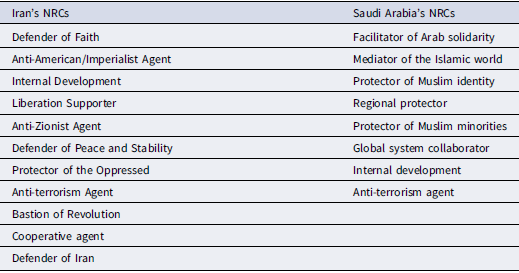
For our analysis of Iran and Saudi Arabia’s foreign policy NRCs using Twitter data, we employ a dictionary-based content analysis method (Grimmer & Stewart Reference Grimmer and Stewart2013). Previous work by Authors in 2019 examined these rivals’ foreign policy NRCs using leaders’ public speeches through traditional content analysis, providing us with a comprehensive set of NRCs used in their foreign policy discourse.Footnote 10 In this study, we utilize each country’s Twitter accounts to determine whether the NRCs identified by Authors in 2019 are employed by their respective foreign policy officials. Given the established categories and their considerable number, we opt for the dictionary method, as discussed by Grimmer & Stewart (Reference Grimmer and Stewart2013). Then, we conducted a manual annotation of the most frequently occurring English 3-grams, determining their association with specific roles (Table 1). The online appendix provides a detailed discussion of our content analysis of the tweets.
The list of foreign policy national role conceptions (NRCs) for Iran and Saudi Arabia after the Arab uprisings identified by Authors (2019)

Empirical analysis
After coding how Tweets are linked with foreign policy NRCs, we can determine how tweets in our sample are clustered around each role and how they are associated with each other. In other words, tweets can now be represented as a network where words in the tweets and foreign policy NRCs are the nodes, and the connection between the words and their link to the identified NRCs is the edge of the graph. Using this semantic network analysis approach, instead of focusing merely on the frequency of roles, allows us to measure the salience of roles in connection with other words and roles (see Xiao et al. Reference Xiao, Hannu Toivonen, Amilcar Cardoso and Penousal Machado2019; Radicioni et al. Reference Radicioni, Squartini, Pavan and Saracco2021).Footnote 11 As an illustration, Figures 5 and 6 show the networks of NRCs for Iran and Saudi Arabia, respectively, in 2018.Footnote 12 They are illustrative in terms of presenting a general picture of Iranian and Saudi foreign policy NRCs for this year. Later in this article, we conduct a regression analysis of all changes in Saudi Arabia’s and Iran’s NRCs, including all years (2015–2021) covered in this study. However, to discuss our methods as well as the importance of 2018 in the relationship between Iran and Saudi Arabia, we use this year as our illustrative case. In 2018, there was a shift in the US foreign policy toward Iran and Saudi Arabia. President Trump withdrew from the nuclear deal with Iran and altered President Obama’s plan to balance Iran-Saudi Relations- “sharing the neighborhood” to a pro-Saudi Arabia policy. The figures show each country’s most frequently used role by their respective accounts and the networked relationship between those NRCs. The results illuminate Iran and Saudi Arabia’s foreign policy NRCs and deeds in the region.
The network of Iran’s NRCs in 2018.

The network of Saudi Arabia’s NRCs in 2018.

Figure 5 presents a network analysis of the most frequently communicated Iranian NRCs. This analysis shows that Iran has two sets of role conceptualizations. The first set is about the centrality of revolutionary foreign policy that Iran has pursued for over four decades in the region: “liberation supporter,” “anti-Zionist agent,” and “bastion of revolution.” Iranian accounts also tried to present this country as a “defender of faith.” This religious role refers to the Iranian states’ ideological and revolutionary stance in both religious and political spheres. It represents the Iranian regime’s commitment to the Islamic revolution and its sui generis regime both at home and abroad. As the network analysis shows clearly, the “bastion of revolution” role is closely connected to the Islamic regime’s defender of Islamic faith and regime NRCs and its permanent commitment to exporting revolution abroad.
In the top half of Figure 5, we also observe “liberation supporter” and “defender of peace and stability” NRCs. These two NRCs relate to the larger principles of revolutionary Iranian foreign policy in the region. The Iranian regime has been supporting various liberation and anti-government movements in the region since the early 1980s. Many times, framed as supporting democratic movements against oppressive governments, Iran has supported liberation movements in Lebanon, Gaza, Iraq, and Yemen in the name of defending peace and stability in the region.
On the left-hand side of Figure 5, we see another set of Iranian foreign policy NRCs that are closely connected. These NRCs define Iran’s relationship with unfriendly regional actors (such as Saudi Arabia and Israel) in the form of self-claimed anti-terrorism agents and enemies such as the US and Israel. “Anti-terrorism agent” by Iranian officials is a broadly defined role that can include any group that fights against Iran or its allies (such as the Syrian opposition supported by the Saudi regime or all US military personnel in the region after the assassination of Qassem Soleimani). Iran is clearly subscribing to “anti-American and anti-imperialist” NRCs and self-defines itself as a regional protector against American intrusions and as an anti-Zionist agent that clearly targets the Israeli state. To sum up, this networked visualization of Iranian NRCs presents an active, revolutionary, regime-exporting, anti-status quo Iran, both in the region and globally, targeting the US, Israel, and Saudi Arabia interests.
The role theoretic analysis of Saudi Arabian accounts’ tweets in 2018 (Figure 6) shows a stark difference from Iran’s foreign policy. Saudi officials express a set of foreign policy NRCs that center around a good international citizen working toward global system collaboration and regional leadership through defending Islam, protecting the region against intruders (such as Iran and Russia), and maintaining good neighborly and economic relations. Compared to Iran’s revolutionary and active foreign policy in the region, the Saudi regime seems to be the status quo power par excellence. Saudi Arabia not only maintains good relations with the US and Israel in regional affairs, but its officials also describe the most important role for the Kingdom as being a “global system collaborator,” which entails maintaining good relations with the liberal international world order and its institutions.
Related to this main role, Saudi Arabia represents itself as a regional protector against malicious actors, a protector of Muslim identity in the form of traditional Sunni Islam, and a supporter of internal economic development for Saudi Arabia and its population. Regarding the various independence movements supported by Iran, Saudi officials also conceptualize their role as anti-terrorism agents and facilitators and mediators of Arab solidarity vis-à-vis the civil strife seen in different Arab states in the region. Overall, Saudi NRCs in 2018 represent a status quo regional power that maintains good relations with the US and Israel in the region (despite the grassroots enmity toward these powers) and supports Sunni Islamic faith and populations in the context of Arab and Muslim solidarity.
Thus, our hypothesis (H1) that both Iran and Saudi Arabia adopt faith-based NRCs in their foreign policy discourse is supported by this analysis of 2018 data. Tweets by official accounts in both countries confirm that both states adopt foreign policy NRCs whose source lies with religious legitimacy. Our analysis of Twitter data reveals that this is more the case for Iran than Saudi Arabia, at least at the public relations level. Iran seems to be more inclined to use religion, the idea of Islamic awakening and revolt against oppressive monarchies, and revolutionism in its foreign policy discourse and in its self-role attribution. Saudi Arabia also uses faith-based NRCs. Most importantly, Saudi Arabia presents itself as the true representative of the traditional Islamic faith (Sunnah) and a mediator of the Islamic world; both representations directly target Iran, its Shia faith-based political system, and its revolutionary foreign policy in the region.
Role Salience
While focusing on 2018 tweets as an illustration allows us to introduce our conceptualization of NRCs and discuss the religion-backed role, we are also interested in a more systematic study of these NRCs and their dynamics over time. This requires measuring the salience of each role to account for the Iran-Saudi rivalry and foreign policies in the MENA. The visualization of the tweets and NRCs as a network allows us to show that some NRCs are more central in Iran and Saudi Arabia’s Twitter diplomacy. In Figures 5 and 6, the NRCs with larger fonts present those with more connections with other keywords in the network. To quantify this salience for each role, we can use one of the centrality measures defined in network analysis.
Centrality measures in network analysis quantify the importance of the nodes in a network (Ward, Stovel, & Sacks, 2017). We, therefore, apply the network centrality concept to our network of NRCs to quantify the importance of role nodes in our tweets network. Iacobucci et al. (Reference Iacobucci, McBride, Popovich and Rouziou2017) show that the commonly used measures of centrality are mostly correlated. Therefore, we pick eigenvector centrality as conceptually and theoretically more consistent with our theoretical arguments and data structure. Eigenvector centrality is closely related to degree measure, which counts the number of edges a node has in a network. The higher the number of edges, the higher the number of connectivity, and the higher the centrality measure.
Eigenvector centrality helps identify NRCs that are influential within the semantic network, considering not just their direct connections but also the importance of the NRCs they connect to.Footnote 13 If an NRC is frequently connected to terms and topics that appear in social media posts, it reflects higher salience and importance. This suggests that such NRCs play a key role in the discourse by using shared or widely recognized terms to communicate policies effectively.Footnote 14
To analyze changes in the salience of NRCs over time and examine the relationship between one country’s NRCs and the other’s, we created weekly networks of NRCs for both Iran and Saudi Arabia. These networks, similar in structure to Figures 5 and 6 but aggregated at the weekly level, allowed us to calculate the weekly salience of NRCs.Footnote 15 Therefore, our unit of analysis is country-week, and we cover data from January 2015 to August 2021—a period in which Iran and Saudi Arabia had a highly intense rivalry. Twitter data have a high level of time precision. We can aggregate the data by minutes, hours, days, and so forth. We chose the week as the temporal unit of analysis for several reasons. First, these official accounts do not tweet every day, so we will have relatively many days with zero tweets. Another reason is that studying NRCs at a daily level can lead to capturing too much noise in the data. Suppose a topic is important for Iran and Saudi Arabia, and their Twitter accounts want to communicate with them. In that case, we should expect to see more Tweets about topic-specific tweets over several days instead of tweeting only for one day.
Figure 7 reports the trends of adopted NRCs by Iranian accounts. Among the plotted NRCs, “defender of Iran,” “internal development,” and “protector of oppressed” are the least salient NRCs. The most salient and frequently mentioned NRCs are “anti-terrorism agent,” “bastion of revolution,” “defender of faith,” and “liberation supporter.” These are consistent with our discussion of Iran’s role in 2018 (Figure 5). The changes in the salience of NRCs in Figure 6 show a noteworthy pattern. Before Donald Trump’s presidency and his withdrawal from the Joint Comprehensive Plan of Action agreement, also known as the Iran Nuclear Deal, Iranian accounts’ tweets mostly avoided the “anti-American/anti-imperialist agent” role. However, after the withdrawal from the Iran Deal, the “anti-American/anti-imperialist agent” role salience increased. Also, the salience of the “liberation supporter” role after 2018 rose, which is consistent with Iran’s support for its proxy forces, led by the Islamic Revolutionary Guard Corps (IRGC) Quds Forces, in the Middle East. “Defender of faith,” “anti-terrorism,” and “bastion of revolution” NRCs show similar patterns of salience during the period of our analysis. This salience analysis shows that Iranian officials use NRCs in a very instrumental manner. Although some NRCs, such as bastion of revolution, seem to be the central and permanent role of Iran’s government, other NRCs, such as “anti-American/anti-imperialist agent” or “anti-Zionist” agents, are only used when tensions rise with the US and Israel.
Changes in the salience of Iran’s NRCs across time.

Figure 8 presents the evolving salience of Saudi Arabia’s foreign policy NRCs over time. The trends reveal a primary focus on projecting NRCs such as “Global System Collaborator,” “Regional Protector,” “Internal Development Agent,” and “Protector of Muslim Identity.” Notably, “Global System Collaborator” emerges as the most salient role, with “Regional Protector” and “Protector of Muslim Identity” also showing noteworthy prominence. Conversely, “Facilitator of Arab Solidarity” ranks as the least salient among the analyzed NRCs. These findings show Saudi Arabia’s conservative foreign policy approach, characterized by a preference for cooperative relations with superpowers, regional allies, and global institutions. Simultaneously, the Kingdom seeks to exert influence in the region by countering Iranian and Russian influence, offering financial and political support to friendly regimes and groups, and positioning itself as the guardian of authentic Islam.
Changes in the salience of Saudi’s NRCs across time.

This analysis suggests two main conclusions. First, although both states use faith-based NRCs in their foreign policy discourse, their approach to religion in foreign policy is not static and exclusive. That is, as this analysis concludes, for both Iran and Saudi Arabia, faith-based NRCs coexist with more secular NRCs, such as a global system collaborator or defender of peace and stability. Second, although certainly very important for two countries ruled with a theocratic structure, religion-based NRCs are used quite inconsistently and not-so-frequently, as a more sentimental analysis of these two countries would suggest. Both countries appear to use religion-based NRCs rather instrumentally, depending on the foreign policy issue, when they fit their actual foreign policy interests strategically.
For example, although it is a very contentious role, Saudi Arabia uses the mediator of the Islamic world role sparingly. Similarly, the protector of Muslim identity role seems to be used sporadically, as seen in Figure 8. For Iran, the defender of faith plays the major role. However, Figure 7 shows the ups and downs in the usage of that role over time. Thus, Iranian foreign policy is not exclusively and monolithically about defending the true faith in foreign policy. This analysis supports our other hypothesis (H3) that there is a fluctuation in the salience of faith-based NRCs in foreign policy discourses of both countries, and contrary to the general perception, there is no monolithic approach to religion by both theocratic regimes. Faith-based NRCs do not disappear and actually make a comeback, as Figures 7 and 8 represent.
Regression Analysis
In the theoretical section, we argued that if Iran and Saudi Arabia are two rival regional powers in the MENA, we should find evidence that these countries adopted associated NRCs. We use regression analysis to explore these associations systematically. We estimated two sets of regression models for Iran and Saudi Arabia: the effect of all of Saudi Arabia’s NRCs on each of Iran’s NRCs and vice versa. Since the measured NRCs, Equation (1), are continuous variables, we have used a linear model, Ordinary Least Squares, to estimate these regression models. Since diplomatic responses are often calculated reactions, the independent variables (other countries’ NRCs) are lagged for one week. In addition to consistency with our theoretical arguments, this can help us (to some extent) address the issues raised due to simultaneous association.
Furthermore, since the data are time-series, the temporal correlation and autocorrelation can lead to biased estimations. We address this concern by estimating generalized least squares models using the Prais-Winsten method, which allows adjusting the autocorrelations based on Durbin-Watson statistics (Cochrane & Orcutt, Reference Cochrane and Orcutt1949). In addition, we estimate standard errors using robust methods to address concerns regarding the heteroskedasticity problem. Figures 9 and 10 present the coefficients of estimated models for Iran and Saudi Arabia.Footnote
16
The filled circles in these figures show the point estimation of coefficients, and the lines around them present the estimated 90% confidence intervals. Therefore, if these estimated confidence intervals do not overlap with the dashed vertical zero-line, we can conclude that the estimated coefficient is statistically different from zero with a ${p_{value}} \lt 10\% $
.
${p_{value}} \lt 10\% $
.
Estimated association between Iran’s NRCs (dependent variable) and Saudi Arabia’s NRCs at t-1 (independent variable) with 90% confidence intervals. The roles on the y-axis are Saudi Arabia’s NRCs, and the NRCs in each sub-graph are Iran’s NRCs.

Estimated association between Saudi Arabia’s NRCs (dependent variable) and Iran’s NRCs at t-1 (independent variable) with 90% confidence intervals. The roles on the y-axis are Iran’s NRCs, and the NRCs in each sub-graph are Saudi Arabia’s NRCs.

Figure 9 shows how Saudi Arabia’s identified NRCs affected each of Iran’s identified NRCs in the following week. Each sub-graph shows one of Iran’s NRCs. The estimated results show that Iran’s NRCs are significantly associated with Saudi Arabia only in a few situations. The only time that Iran’s role changes significantly ( ${p_{value}} \lt .05$
) after an increase in Saudi Arabia’s role is when Saudi accounts communicate “regional protector” NRC, and Iranian accounts show an increase in communicating “protector of oppressed” NRC. There are also a few other associations between Iran’s and Saudi Arabia’s NRCs that just marginally miss being statistically significant. When the salience of the “anti-terrorism agent” in Saudi Arabia’s tweets increases, the salience of the “anti-Zionist agent” in Iran’s communicated roles decreases. Also, the salience of the “protector of Muslim identity” role by Saudi Arabia is positively associated with the salience of the “defender of peace and stability” role by Iran. All the above associations clearly show the nature of the Iran-Saudi Arabia rivalry. When Saudi Arabia adopts NRCs associated with the “protector of the region,” mostly associated with taking sides in various conflicts and civil wars in the region, one can clearly see the reaction and pushback from Iranian authorities in the form of the protector of the oppressed role by Iran. The Yemeni war is a clear example of such an action-reaction sequence between two rivals. That said, the above association analysis shows that Saudi Arabia cannot trigger a reaction by Iranian accounts, except in a few cases.
${p_{value}} \lt .05$
) after an increase in Saudi Arabia’s role is when Saudi accounts communicate “regional protector” NRC, and Iranian accounts show an increase in communicating “protector of oppressed” NRC. There are also a few other associations between Iran’s and Saudi Arabia’s NRCs that just marginally miss being statistically significant. When the salience of the “anti-terrorism agent” in Saudi Arabia’s tweets increases, the salience of the “anti-Zionist agent” in Iran’s communicated roles decreases. Also, the salience of the “protector of Muslim identity” role by Saudi Arabia is positively associated with the salience of the “defender of peace and stability” role by Iran. All the above associations clearly show the nature of the Iran-Saudi Arabia rivalry. When Saudi Arabia adopts NRCs associated with the “protector of the region,” mostly associated with taking sides in various conflicts and civil wars in the region, one can clearly see the reaction and pushback from Iranian authorities in the form of the protector of the oppressed role by Iran. The Yemeni war is a clear example of such an action-reaction sequence between two rivals. That said, the above association analysis shows that Saudi Arabia cannot trigger a reaction by Iranian accounts, except in a few cases.
Figure 10 similarly shows how the salience of adopted NRCs by Saudi Arabia is associated with the salience of adopted NRCs by Iran in the previous week. Like the results in Figure 9, most of Iran’s and Saudi Arabia’s NRCs are communicated independently. However, there are more situations in which Iran’s NRCs can trigger a change in Saudi Arabia’s communicated NRCs. When the salience of “internal development agent” in Iran’s NRCs increases, the salience of “global system collaborator” in Saudi’s NRCs decreases. Iran’s “protector of oppressed” is also negatively associated with Saudi Arabia’s “internal development” role, indicating that when Iranian accounts claim a regional role, it is less likely that Saudi accounts respond by focusing on their “internal development” role. In addition, the salience of “anti-American/anti-imperialist agent” in Iranian accounts is negatively associated with the salience of the “mediator of Islamic world” role in Saudi accounts. Here, the salient of “mediator of Islamic World” as a faith-based NRC in Saudi accounts decreases following an increase in Iran’s “anti-American/anti-imperialist agent,” as a secular NRC. “Protector of Muslim identity,” another faith-based role in Saudi Arabia’s NRCs, is not associated with any of Iran’s NRCs. On the other hand, when the salience of “anti-Zionist agent,” “defender of faith,” and “defender of peace and stability” in Iran’s communicated NRCs increases, the salience of the “regional protector” role in Saudi accounts increases. These findings clearly represent the two countries’ different visions about foreign policy in the region and globally. This is a clear indicator of how Saudi Arabia and Iran’s policies toward Yemen, Syria, and Libya diverge.
The above findings provide partial support for our second hypothesis (H2), where we expected a positive association between Iran’s and Saudi Arabia’s NRCs. There are occasions when Iran and Saudi Arabia respond to each other’s faith-based NRCs, yet our analysis does not find strong support that these action and reaction sequences are applied exclusively to faith-based roles. While Iran’s NRCs are virtually passive to Saudi Arabia’s communicated NRCs, the latter occasionally responds to the former’s communicated NRCs. However, Iran’s faith-based communicated roles do not necessarily trigger faith-based NRCs by Saudi accounts, where these accounts primarily respond with secular roles. This implies that Iran and Saudi Arabia do not use religion in their foreign policy in the context of religious rivalry, but they adopt faith-based NRCs selectively whenever it fits their foreign policy agenda better. Iran and Saudi Arabia’s policies regarding the Israel-Hamas conflict since 2023 are also a testament to religious roles being utilized as they fit to national interest rather than being consistently followed. Despite its support for Hamas in general, Iran denied its involvement in October 7 attacks vociferously and only called for ending hostilities between the two parties since the beginning of the conflict. Although Hamas openly called for its axis of resistance allies to join the war against Israel, Iran did not intervene in the conflict (Hafezi et al. Reference Hafezi2023). Iran’s traditional roles, such as defender of Islamic faith, anti-imperialism/anti-zionism, and liberation supporter, would require closer support for Hamas, national interest, and security concerns prevailed. Saudi Arabia’s cautious diplomatic approach to Gaza since October 2023 is also a testimony to the fact that the Kingdom puts its economic transformation and good foreign relations with Israel and the US ahead of ideologically motivated wars, despite its clearly stated roles such as protector of Muslim identity and Muslim minorities. We suggest Iran and Saudi Arabia’s approach to religion in foreign policy is not static. Contrary, both countries appear to use religion-based NRCs rather instrumentally. Occasionally, Iran and Saudi Arabia might lock themselves in a battle of sects. Every now and then, this could stem from religion-based NRCs. However, for the most part, we need to ask if this is indeed a battle of sects?
Conclusion
We examined the nature of the Iran-Saudi Arabia rivalry through the NRCs’ lens. Our goal was to identify how religion relates to the competition. Findings show the following. First, both countries engage in religious rhetoric over political affairs on a daily basis, most time against each other. Second, foreign policy NRCs, including faith-based NRCs, are not static, and their utilization by authorities changes quickly over time as regional and global affairs change. We observe that faith-based NRCs have been used dynamically, but not consistently, by both sides. Depending on the specific foreign policy issues of the day, religion is pragmatically used by Saudi and Iranian officials. Time series plots have shown more specific results on the nature of how faith-based NRCs are used and their interactions.
Third, secular and religious NRCs coexist in both countries’ foreign policy rhetoric. In all the plots, we observe faith-based NRCs and more secular, mundane foreign policy NRCs associated with each country’s foreign policy. One example is the presence of two dominant NRCs frequently attributed to both countries’ foreign policies by their leaders. Defender of faith (faith-based) as a role (protecting the holy religion of Islam) fits our general perception of Iran and Saudi Arabia as two theocratic states. However, at the same time, we observe both states’ officials representing their state’s foreign policy as typical international good citizens by referring to the “defender of peace and stability” role. This role is associated with a proper middle power role in the international system, which focuses on promoting peace, security, and stability; it is considered to be a part of a secular approach to foreign affairs. Coexistence of secular and religious NRCs also underlines the importance of understanding the larger security conditions of the rivalry rather than a narrowed down version of the triggers. For future research, we suggest that scholars further explore when or under which conditions countries choose distinct NRCs to manage their rivalries.
Our fourth conclusion is that foreign policy NRCs seem to be used selectively by both sides. That is, both religious and secular NRCs seem to be used at appropriate times to facilitate that both countries’ foreign policy has room to maneuver. In this sense, despite their seemingly archaic rhetoric, both Iranian and Saudi officials seem pragmatic, flexible, and adaptable to foreign policy crises and each other’s moves in the region. As two of the most vehemently theocratic states in the international system, Iran and Saudi Arabia use religion to help their rhetoric and foreign policy actions. However, it is best to consider these findings in the context of the scholarship that engages with the identity, ontological security, and domestic politics of Iran and Saudi Arabia. (Adısönmez et al. Reference Adısönmez, Onursal and Öztığ2023; Darwich Reference Darwich2016; Gause III Reference Gause and Gregory2013, Adısönmez and Onursal Reference Adısönmez and Onursal2022).
Methodologically, this article makes an important contribution to political science and FPA literature in that Twitter-based data are indeed useful sources of politically oriented systematic content analysis. Politics, including political and religious rivalries, all occur in a discursive or written manner. Analyzing written or spoken text has become a promising area of political analysis thanks to new computational techniques. There is an array of automated text analysis applications. This article introduced a set of exciting new methods to the literature on FPA and role theory. These methods allow us to make better inferences over collected and analyzed data about very contentious and complex issues, like religious conflicts. In this sense, this article provides an opportunity to examine a religious rivalry through social media posts. Despite their edge, automated text analysis also has its limitations (Grimmer Reference Grimmer and Stewart2013; Windsor Reference Windsor2022).
Twitter also has its limitations. Our goal was to measure and model the foreign policy NRCs of two rival countries and explore their dynamics and whether they are associated with each other, and Twitter works well for this purpose. However, we cannot solely rely on Twitter to scrutinize the dynamics of foreign policy NRCs. Indeed, considering the methods and measurements developed in this study, we suggest scholars add Tweets alongside other social media platforms and classic sources for FPA, such as speeches and statements, to capture, map, and model further dynamics. We also assumed that the individual accounts communicate their NRCs in a coordinated manner. However, FPEs might have different perspectives and agendas, and rivalry within executive branches of a government can lead to communicating inconsistent NRCs, so we suggest future studies explore this further.
In addition, recent policy changes on the Twitter platform, including limitations on academic API access, may pose challenges for future studies relying on Twitter data. However, the methodological framework developed in this study is adaptable and can be applied to data from other social media platforms, such as Bluesky, or to archival collections of tweets preserved by scholars. This flexibility ensures the continued relevance and applicability of our approach in analyzing social media content across different platforms and data sources. Therefore, we recommend that future studies explore the application of the methods developed in this article to data collected from alternative platforms and consider conducting cross-platform analyses of communicated NRCs.
While our study focused on the NRCs of Iran and Saudi Arabia, examining their interactions, our innovative dynamic measure of the foreign policy roles adopted by these countries demonstrated how these roles can be influenced by both domestic and foreign political factors. For instance, while President Trump’s withdrawal from the Iran Deal was associated with shifts in Iran’s communicated roles, the reforms initiated by Mohammed Bin Salman also appeared to impact Saudi Arabia’s expressed roles. Although our empirical methods enabled us to document these changes, a systematic analysis of their causal roots was beyond the scope of this project. Future research could usefully explore the domestic and international factors that shape foreign policy roles in greater depth.
Finally, this paper reveals interesting results for policymakers. The Iran-Saudi Arabia rivalry goes back many years. The current rivalry certainly bears historical tones. However, this analysis shows that religion is, to a great extent, instrumental and dynamic in this rivalry. It is easier to buy the more sensational argument that all politics in MENA are religious, old-fashioned, and thus irrational. Nevertheless, this analysis shows that although there are many overlapping religious and historical fault lines with actual events, it is not a battle of sects. Both states are strategic in their usage of religion in foreign affairs. Such contextualization of religion in politics in the region will help foreign analysts make sense of day-to-day political developments in the region.
Supplementary material
To view supplementary material for this article, please visit https://doi.org/10.1017/S1755048325100126
Competing interests
The author(s) declare none.
Babak RezaeeDaryakenari is a Senior (Tenured) Assistant Professor of International Relations at Leiden University’s Institute of Political Science. His research focuses on political violence and conflict, with a methodological emphasis on employing machine-learning algorithms, social media data mining, and artificial intelligence to study and forecast political conflict and violence.
Özgür Özdamar is Professor and Chair of International Relations at Bilkent University, specializing in foreign policy analysis and leadership studies. His co-authored books include Role Theory in the MENA: Politics, Economics and Identity (Routledge, 2019) and Leaders in the Middle East and North Africa: How Ideology Shapes Foreign Policy (Cambridge University Press, 2023), which won the International Studies Association’s Best Book in Foreign Policy Analysis award in 2024.
Yasemin Akbaba is a Professor in Political Science Department at Gettysburg College and co-editor of International Studies Perspectives. She has published several journal articles and book chapters on the role of religion in IR. She is co-author of Role Theory in the Middle East and North Africa (Routledge, 2019) and IR: Seeking Security, Prosperity, and Quality of Life in a Changing World 5th edition (CQ Press/Sage, 2025).




 Open access

