


Introduction
With respect to volunteering in civil society organizations (CSOs), we sometimes assume that everyone will be able to find their niche and be able to act according to their competencies and desires (e.g., Stebbins Reference Stebbins2009). Many see volunteering as a tool that contributes to social integration (of immigrants, see Handy and Greenspan Reference Handy and Greenspan2009; Hapke Reference Hapke2009, 329; of retired people, see Moen et al. Reference Moen, Fields, Meador and Rosenblatt2000). Naturally, volunteers fulfill many roles that help CSOs to serve the public good, but volunteering itself does not automatically foster integration and inclusion. A large body of research shows that volunteering is not only determined by individuals’ willingness to volunteer, but also by their resources and individual circumstances (Broese van Groenou and van Tilburg Reference Broese van Groenou and van Tilburg2012; Institute for Volunteering Research 2004; Shachar Reference Shachar2014; Smith Reference Smith1994; Tang Reference Tang2006; Wilson Reference Wilson2000). While most research has investigated the factors that determine whether someone volunteers, fewer studies have explored the individual factors determining within which fields volunteering happens (e.g., van Ingen and Dekker Reference Van Ingen and Dekker2010; Hustinx Reference Hustinx2007; Hustinx and Lammertyn Reference Hustinx and Lammertyn2003), or the organizational factors that attract and select volunteers (Hustinx and Handy Reference Hustinx and Handy2009; Fisher and Ackerman Reference Fisher and Ackerman1998).
Yet all of these studies tell us little about which volunteers reach senior/managerial positions, i.e., supervisory and board positions. As volunteering is hierarchically stratified, some positions involve more authority over people and budgets, while others only carry out narrow tasks assigned to them by others (Musick and Wilson Reference Musick and Wilson2008). Research that explains this stratification is scarce, and its field-specific reasons have not been investigated at all. Overall, there are various reasons why the stratification of volunteers within voluntary organizations deserves more attention in inequality research. First, because it indicates that different social groups have different opportunities to actualize their interests in volunteering and thus in society. Second, before recommending volunteering as a measure to fight inequality (for integration of the unemployed, immigrants, or the elderly), more research has to be conducted on the effects of volunteering on inequality. Research on membership points toward adverse effects: “privileged citizens—who do not need the benefits of associational involvement in the first place—show the highest membership rates and occupy the most important positions within associations” (Van Ingen Reference Van Ingen2009, 144). Third, the need to recruit the best volunteers is often in conflict with CSOs’ goal to integrate disadvantaged groups. Thus, both in management and governance a conflict arises between stakeholder representation, accessibility, and the particular skills demanded from volunteers. Finally, volunteering is not a homogenous field. We therefore suggest a field-specific approach to disclose the different rules that forward inequality in different fields of volunteering.
This article is structured as follows: First, we summarize prior research and elaborate on social mechanisms that explain hierarchical stratification in volunteering. We then explain the unequal access to senior/managerial positions in different fields of volunteering, i.e., politics, religion, sports, and social services. Based on field-specific characteristics of volunteers (voluntary workforce), paid workforce and organizations, we hypothesize field-specific spillover-effects for gender, occupational and educational status. We then describe the context, data and methods of our study. Finally, we present and discuss our results; how gender together with occupational and educational status contribute to the attaining of senior/managerial positions in different fields of volunteering.
Literature Review
Previous research has concentrated on determinants that predict voluntary engagement. Authors use different concepts to bundle the various socioeconomic and demographic variables. Educational level is one of the factors that appears in most studies as a “consistent predictor of volunteering” (Wilson Reference Wilson2000, 219; Wilson Reference Wilson2012, 185). Only rarely do we find research casting doubt on the influence of education on voluntary engagement, since it is difficult to disentangle from social background (e.g., Egerton Reference Egerton2002). Income and occupational status also correlate positively with volunteering (Pearce Reference Pearce1993; Tang Reference Tang2006; Wilson Reference Wilson2012, 187). As far back as a century ago, Max Weber (Reference Weber1921/1980, 170) was describing such resources as prerequisites for those volunteering at the executive level (Honoratioren, i.e., notables); they should be wealthy, and should have a high reputation to get elected and gain the trust of the other members (Weber Reference Weber1921/1980, Reference Weber1978, 290). Occupations of the day that were considered appropriate included rentiers, part-time entrepreneurs, and other self-employed positions that bestowed plenty of wealth and spare time.
More recently, Musick and Wilson (Reference Musick and Wilson2008) have addressed the hierarchy in volunteering. Results of their analyses suggest that neither race, employment status, nor church attendance have a bearing on a volunteer’s hierarchical position. Yet the higher ranks are more likely to be filled by older people, as well as males, professionals, managers, and persons with higher education. In this respect, the voluntary sector seems to therefore mirror paid work (Webb and Abzug Reference Webb and Abzug2008). Volunteering, however, is not a monolithic endeavor. Rather, it is one that occurs in diverse social fields and is embedded in various social worlds, which are in turn composed of characteristic groups, events, routines, practices, and organizations (Stebbins Reference Stebbins1996; Unruh Reference Unruh1979, Reference Unruh1980).
Aside from volunteers’ motives, social transmission mechanisms link individual characteristics with roles and positions within the respective fields. First, direct relations between resources and the field-positions can be explained by either spillover- or contrast-effects, which will guide our hypotheses. Prior research strongly supports the spillover hypothesis. Second, ascribed characteristics (e.g., the social construction of gender, age, and race) also contribute directly to an actor’s position within the organization. Social learning, role modeling, and value internalization influence the general inclination toward volunteering and toward senior/managerial positions. Mechanisms of homophily, which denotes the attractiveness of similarities, could also affect the selection of volunteers (McPherson et al. Reference McPherson, Smith-Lovin and Cook2001; Rotolo and Wharton Reference Rotolo and Wharton2003).
The contrast-effect hypothesis postulates a reversed stratification in the field of volunteering as compared to other fields. “Volunteer work offers itself as an alternative stratification system in which the powerless can gain authority and exercise power” (Rotolo and Wilson Reference Rotolo and Wilson2007, 559f.). Yet the spillover-effect hypothesis suggests the opposite relation as “generative processes of inequality mutually reinforce or at least facilitate each other in different fields of activity” (Diewald and Faist Reference Diewald and Faist2011). Stratification in volunteer work mirrors and reproduces the social hierarchy in paid work. Rotolo and Wilson (Reference Rotolo and Wilson2007) confirm the spillover hypothesis with respect to gender. As recruiting and organizing are becoming similar in volunteering and paid work, men are overrepresented on CSOs’ boards and committees. Moreover, positions in paid work have different consequences for male and female volunteering. “Although women are less likely than men to supervise others [in the field of paid work], being a supervisor promotes women’s volunteering but not men’s” (Marshall and Taniguchi Reference Marshall and Taniguchi2012, 228). Spillover- and contrast-effects are both based upon and moderated by at least three underlying mechanisms, namely accumulative advantage, signaling, and homophily.
Accumulative advantage, also known as the Matthew Effect, is the phenomenon by which the rich get richer and the poor get poorer (e.g., Merton Reference Merton1968). Those already privileged in paid work will capture superior positions in volunteering (Brady Reference Brady2003; Rigney Reference Rigney2010). On the one hand, volunteering requires specific knowledge, education, social capital, and reputation, but also financial security. On the other hand, volunteering in turn facilitates the augmentation of these same resources (Ruiter and De Graaf Reference Ruiter and De Graaf2009; Handy and Mook Reference Handy and Mook2011, 413). The reputational gains from voluntary board and committee membership are significant (Handy et al. Reference Handy, Cnaan, Hustinx, Kang, Brudney, Haski-Leventhal, Holmes, Meijs, Pessi, Ranade, Yamauchi and Zrinscak2010; Wilson and Musick Reference Wilson and Musick1997a, 709).
Board- and committee-volunteering contributes particularly to a mutual development of prestige for both volunteers and organizations: Enhancing prestige “is a highly sought after by-product of volunteering. Unlike donations, which anyone can make, board seats are extremely limited, thereby creating an aura of selectivity” (Handy and Mook Reference Handy and Mook2011, 414). The more elitist and prestigious the organization, the more it bestows prestige on its volunteers (Ostrower Reference Ostrower2002). By contrast, members of lower social classes benefit much less from their voluntary engagement (Ruiter and De Graaf Reference Ruiter and De Graaf2009).
Likewise, signaling contributes to spillover-effects. Labor markets use single characteristics of actors to evaluate skills, competencies, or traits, e.g., educational degrees as indicators for cognitive skills (Spence Reference Spence1973). Therefore CSOs tend to recruit better educated individuals for board positions (Rotolo and Wilson Reference Rotolo and Wilson2007, 563; Nisbett and Wilson Reference Nisbett and Wilson1977; Wetzel et al. Reference Wetzel, Wilson and Kort1981). Similarly, volunteering signals an individual’s specific traits and competencies to the labor market and other social fields. These signals are not only helpful for re-entry into job markets (e.g., after parental leaves) or for career advancement, but are also supportive for students’ admission to universities (Handy et al. Reference Handy, Cnaan, Hustinx, Kang, Brudney, Haski-Leventhal, Holmes, Meijs, Pessi, Ranade, Yamauchi and Zrinscak2010).
Individuals prefer to interact with others who share a similar ethnic heritage and social status, hence also sharing experiences and tastes (Tolsma et al. Reference Tolsma, Meer and v. d., and Gesthuizen, M.2009, 287). The pervasiveness of homophily, the degree of similarity between interacting individuals, has gained substantial support in a wide array of studies (Blau Reference Blau1977; Lazarsfeld and Merton Reference Lazarsfeld, Merton, Berger, Abel and Page1954; Melamed et al. Reference Melamed, Simpson, Harrell, Munn, Abernathy and Sweitzer2020). Gender- and minority-biased hierarchies were borne of such observations (e.g., Tharenou and Conroy Reference Tharenou and Conroy1994; Pfeffer et al. Reference Pfeffer, Davis-Blake and Julius1995; Landau Reference Landau1995; Haberfeld Reference Haberfeld1992). Recent studies have shown that homophily plays a role in religious volunteering (Galen et al. Reference Galen, Sharp and McNulty2015; Merino Reference Merino2012, Reference Merino2013), yet less in community engagement (Tolsma et al. Reference Tolsma, Meer and v. d., and Gesthuizen, M.2009).
Empirical findings indicate that a volunteer’s position within an organization depends on his/her individualistic characteristics, pointing toward a reproduction of social inequality. However, prior research has not investigated differences between fields of volunteering, like sports, religion, or social services.
Theory
Inequalities such as these are the focus of Pierre Bourdieu’s theory of practice (see Macmillan Reference Macmillan2013; Quinn Reference Quinn2020 for applications of this theory for volunteering). It rests on four core concepts (Bourdieu Reference Bourdieu1977, Reference Bourdieu1984, Reference Bourdieu and Richardson1986b): (1) social fields, (2) rules of the game, i.e., structures of the field, (3) capital, i.e., cultural, social and economic resources of actors, and (4) the actor’s habitus. An actor’s capital relates to his/her position in the fields of volunteering. In our study and according to Bourdieu, social fields are playgrounds or battlefields with particular rules. According to them, actors try to maintain or improve their positions through their field-relevant capital and a patterned set of practices. Though we will not strictly operationalize this theory, our research has been inspired by its analytical potential, in particular by Bourdieu’s notion of social fields. Unlike institutional fields, policy fields, or strategic action fields (for a comparison of field concepts, see Zietsma et al. Reference Zietsma, Groenewegen, Logue and Hinings2017), Bourdieu’s fields explicitly explain stratification, and introduce economic, social, and cultural capital in its basic, institutionalized or incorporated (habitualized) form to dynamically explain actors’ positions and status.
Individuals follow a particular logic of practice and acquire resources (Bourdieu Reference Bourdieu1986a) that might also be of value in other fields. Practices follow the rules and structures of the field, and users of which simultaneously contribute to those rules and structures, either by reinforcing or eroding them. Symbolic capital is the prestige or status that derives from previous practice. As with occupational prestige or educational status, it is a prerequisite for many board and committee positions, and these positions again contribute to an actor’s reputation. Field-specific structures, however, determine which combinations of resources yield reputation. In terms of Bourdieu’s economie des biens symbolique (Bourdieu Reference Bourdieu1998, 92ff.), the gains of prestige are not arbitrary but rather depend on time and amount of prestige invested.
Although individual motives for voluntary work (e.g., VFI,Footnote 1 Clary et al. Reference Clary, Ridge, Stukas, Snyder, Copeland, Haugen and Miene1998) involve self-oriented aspects (career, skills, social networks), a recent meta-analysis of 48 studies shows that altruistic and humanitarian concerns are dominant in all fields (Chacón et al. Reference Chacón, Gutiérrez, Sauto, Vecina and Pérez2017). This is not surprising, since it would not serve actors well to admit that their voluntary engagement is motivated by reputational gains (Small Reference Small2009). For this form of delusion, Bourdieu uses the notion of illusio (Bourdieu Reference Bourdieu1998, 76ff.). Investments in volunteering will yield reputational gains only if the economic nature of transactions remains hidden: “This sort of double-consciousness, which is undoubtedly common to all social agents who participate both in the economic universe and the anti-economic sub-universes (we might think of all party activists and all ‘volunteer workers’), is at the basis of a very great (partial) lucidity …” (Bourdieu Reference Bourdieu1998, 113). Hence, altruism is still the dominant illusio in the fields of volunteering, though it has grown paler in some fields such as sports and politics (e.g., Schlesinger and Gubler Reference Schlesinger and Gubler2016) and has developed toward reflexive volunteering (Hustinx Reference Hustinx2010; Hustinx and Lammertyn Reference Hustinx and Lammertyn2003) that becomes part of identity work (Grönlund Reference Grönlund2011). Perhaps self-actualization is about to replace altruism as the field-dominant illusio.
Bourdieu’s framework suggests a reinterpretation of the effects described above. A contrast effect, for instance, is based on rules that differ between social fields, whereas a spillover effect suggests that the capital (particularly symbolic capital) advantageous in the first field also promotes an actor’s status in the second. Signaling is either based on specific forms of capital that are easily visible, or on symbolic capital and the impact of reputation. The Matthew effect describes how a previous capital endowment acquired contributes to a superior position and privileges that further enhance this endowment in different fields, such as volunteering. Finally, homophily results from field rules that promote actors with a similar habitus.
Hypotheses
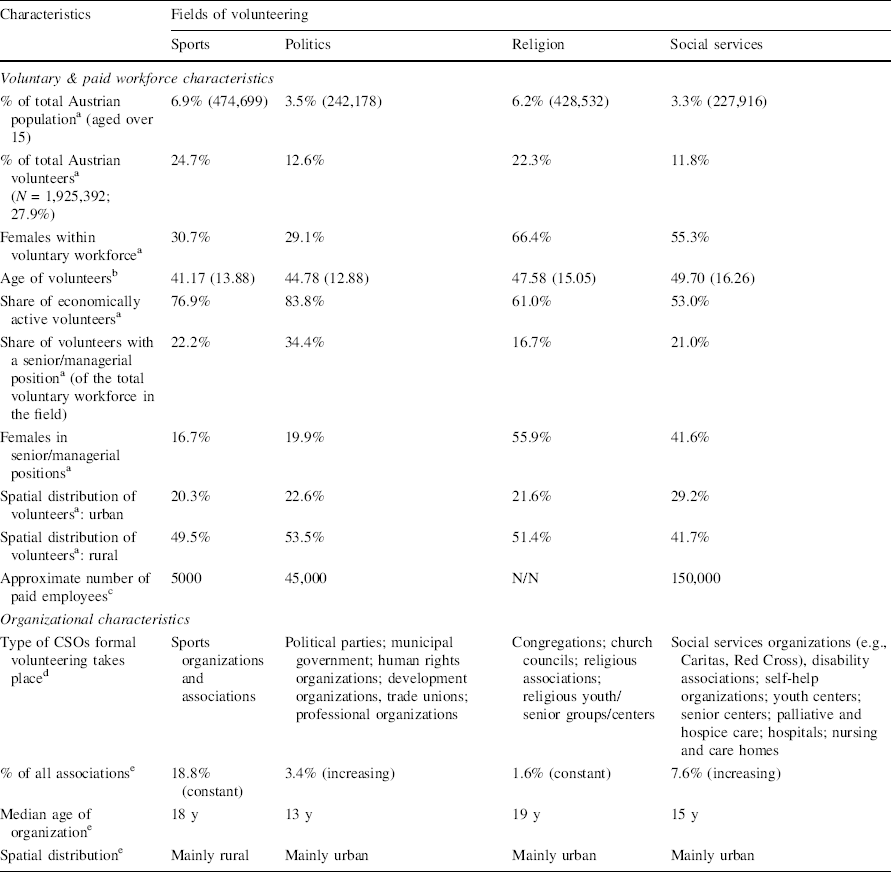
Voluntary organizations operate in particular subfields (e.g., see ICNPO, Salamon and Anheier Reference Salamon and Anheier1996). They deliver products and services, provide public advocacy and lobbying, and they participate in building communities and social capital (James and Rose-Ackermann Reference James and Rose-Ackermann1986). In this respect, some fields are closer to business, some fields are closer to politics, and some fields are closer to communities. Therefore, we selected four distinct fields of volunteering: sports, politics, religion, social services. Table 1 summarizes the characteristics of these fields. These fields represent some very diverse functions of civil society.
Characteristics of the four fields of volunteering

Characteristics |
Fields of volunteering |
|||
|---|---|---|---|---|
Sports |
Politics |
Religion |
Social services |
|
Voluntary & paid workforce characteristics |
||||
% of total Austrian populationa (aged over 15) |
6.9% (474,699) |
3.5% (242,178) |
6.2% (428,532) |
3.3% (227,916) |
% of total Austrian volunteersa (N = 1,925,392; 27.9%) |
24.7% |
12.6% |
22.3% |
11.8% |
Females within voluntary workforcea |
30.7% |
29.1% |
66.4% |
55.3% |
Age of volunteersb |
41.17 (13.88) |
44.78 (12.88) |
47.58 (15.05) |
49.70 (16.26) |
Share of economically active volunteersa |
76.9% |
83.8% |
61.0% |
53.0% |
Share of volunteers with a senior/managerial positiona (of the total voluntary workforce in the field) |
22.2% |
34.4% |
16.7% |
21.0% |
Females in senior/managerial positionsa |
16.7% |
19.9% |
55.9% |
41.6% |
Spatial distribution of volunteersa: urban |
20.3% |
22.6% |
21.6% |
29.2% |
Spatial distribution of volunteersa: rural |
49.5% |
53.5% |
51.4% |
41.7% |
Approximate number of paid employeesc |
5000 |
45,000 |
N/N |
150,000 |
Organizational characteristics |
||||
Type of CSOs formal volunteering takes placed |
Sports organizations and associations |
Political parties; municipal government; human rights organizations; development organizations, trade unions; professional organizations |
Congregations; church councils; religious associations; religious youth/senior groups/centers |
Social services organizations (e.g., Caritas, Red Cross), disability associations; self-help organizations; youth centers; senior centers; palliative and hospice care; hospitals; nursing and care homes |
% of all associationse |
18.8% (constant) |
3.4% (increasing) |
1.6% (constant) |
7.6% (increasing) |
Median age of organizatione |
18 y |
13 y |
19 y |
15 y |
Spatial distributione |
Mainly rural |
Mainly urban |
Mainly urban |
Mainly urban |
aSource: Austria Micro-census 2006/Q4
bAverage age of the Austrian population older than 15 years: 46.07 (18.70)
c Source: Neumayr et al. (Reference Neumayr, Pennerstorfer, Vandor, Meyer, Vandor, Traxler, Millner and Meyer2017)
d Source: Federal Ministry of Labor Social Affairs and Consumer Protection 2015
eAustrian Register of Associations
There are additional reasons for our selection. First, these four fields cover the vast majority of volunteering in Austria—71.4% of all volunteers work in one of these four fields. Second, they encompass various forms of CSOs, each differing in terms of their size, age, and spatial distribution: 18% of all Austrian CSOs operate in the field of sports, 7.6% in social services, 3.4% in politics, and 1.6% in religion. The median age of the CSOs varies between 13 years in the field of politics and 19 years in the field of religion. In politics, religion, and social services, CSOs are mainly located in urban areas, whereas sports CSOs are mainly located in rural areas. Third, in politics and social services, the share of paid workforce is much higher than in sports and religion (Neumayr et al. Reference Neumayr, Pennerstorfer, Vandor, Meyer, Vandor, Traxler, Millner and Meyer2017). Again, the organizational size in politics and social services points toward stronger spillover-effects than those found in sports and religion.
Fourth, the fields also differ in their voluntary workforce characteristics. Volunteers in sports, religion, and politics typically live in rural neighborhoods, whereas volunteering in social services typically occurs in urban environments. The gender ratio within the voluntary workforce ranges from 66.4% females in the field of religion and 55.3% in social services, down to 30.7% in sports and 29.1% in politics. The average age of volunteers ranges from 41.17 years in sports to 49.70 in social services. In politics, 83.8% of the volunteers economically active population. This ratio falls to 76.9% in sports, 61.0% in religion, and 53.0% in social services. These characteristics point in particular to a stronger effect of gender in sports and politics.
Fifth and finally, the four fields differ considerably in the degree of hierarchization of the volunteers (Diewald and Faist Reference Diewald and Faist2011; Therborn Reference Therborn2006), namely the proportion of volunteers in senior/managerial positions. In religion, only 16.7% of the volunteers are in senior/managerial positions. In politics, this ratio is 34.4%, while sports (22.2%) and social services (21.0%) lie between these extremes. A closer look reveals more gender inequality: In sports, the overall gender ratio of 30.7% drops down to 16.7% for senior/managerial positions. The same pattern holds for religion: While females represent 66.4% of all volunteers in this field, they represent only 55.9% of all senior/managerial positions. We assume that the scarcity of volunteer-senior/managerial positions in religion will increase the relevance of education in attaining such roles.
In some fields, CSOs are larger and more business-like; in other fields, they are smaller, more grassroots and social-movement orientated. Larger formal CSOs, employing larger numbers of paid workforce, will likely display a similar inequality pattern to the field of paid work. This may be less prevalent in smaller organizations with higher proportions of volunteers. Likewise, the overall share of females in a particular field of volunteering is likely to positively affect females’ access to higher ranks. Based on these assumptions, we formulate hypotheses for field-specific spillover-effects, specifying which resources we assume to contribute to inequality in volunteering.
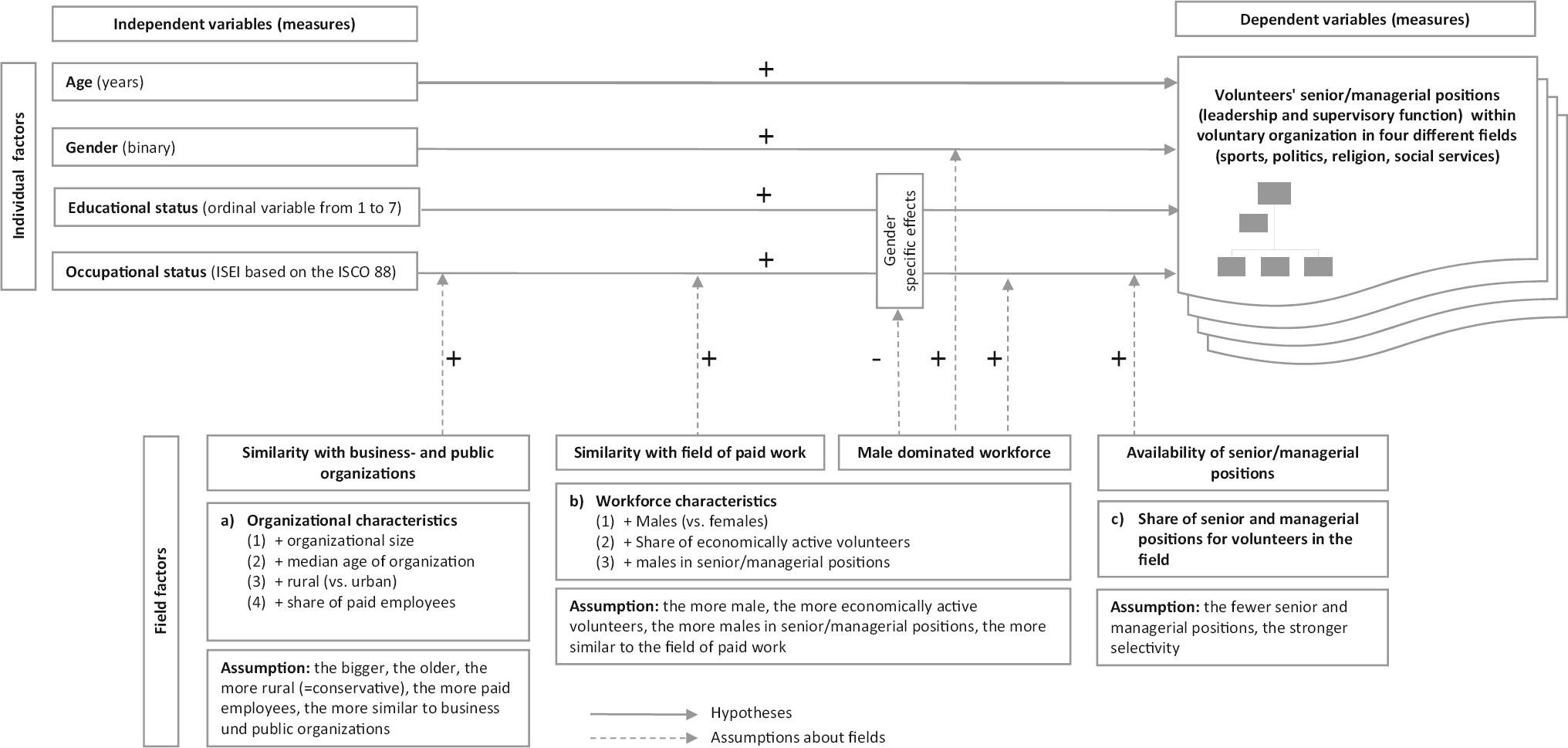
Figure 1 gives an overview of the factors that constitute field-specific relations between occupational and educational status, gender, age, and senior/managerial positions. We assume that three factors are particularly relevant for the strength of spillover-effects: (a) organizational characteristics, (b) voluntary workforce characteristics, and (c) the share of senior and managerial positions in the field, which we will then condense to field-specific assumptions:
(a) We expect stronger spillover-effects in fields with rather big organizations and a higher share of paid workforce.
(b) We expect stronger spillover-effects in male-dominated fields with a higher percentage of economically active volunteers in the voluntary workforce, mainly for the same reasons.
(c) We expect stronger spillover-effects in fields with fewer senior and managerial positions due to a stronger selectivity, and thus potential reputational advantages in these fields.
Variables, measures, and assumptions

Generally, we assume that stratification in the field of volunteering mirrors societal stratification; primarily, due to an occupational spillover-effect:
H1
A higher occupational status in paid work contributes positively to gaining a senior/managerial position in volunteering.
We also assume that education and gender also relate positively with senior/managerial positions in volunteering.
H2
Educational level relates positively with senior/managerial positions in volunteering.
H3
Male gender relates positively with senior/managerial positions in volunteering.
Given this effect, that females are less likely to gain senior/managerial positions, we suppose that females can only compensate for it with an extra endowment of education and occupational prestige, and that they do not advance in hierarchy through seniority alone.
H4
In comparison with that of men, the number of females in senior/managerial positions correlates more strongly with occupational and educational status than with age.
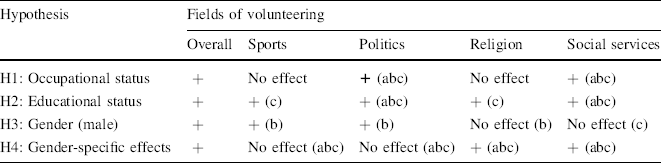
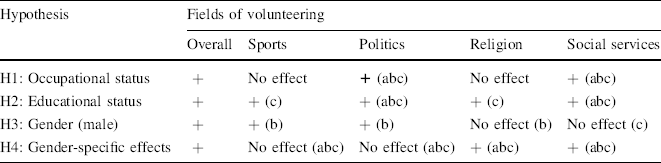
We then formulate field-specific hypotheses. The spillover-effects outlined above in assumptions (a) to (c) strengthen or weaken our hypotheses 1–4 for our fields, yielding the following hypotheses (see Table 2):
Overall and field-specific hypotheses of spillover-effects for achieving senior/managerial positions in volunteering
Hypothesis |
Fields of volunteering |
||||
|---|---|---|---|---|---|
Overall |
Sports |
Politics |
Religion |
Social services |
|
H1: Occupational status |
+ |
No effect |
+ (abc) |
No effect |
+ (abc) |
H2: Educational status |
+ |
+ (c) |
+ (abc) |
+ (c) |
+ (abc) |
H3: Gender (male) |
+ |
+ (b) |
+ (b) |
No effect (b) |
No effect (c) |
H4: Gender-specific effects |
+ |
No effect (abc) |
No effect (abc) |
+ (abc) |
+ (abc) |
(a) Organizational characteristics
(b) Voluntary workforce characteristics
(c) The share of senior and managerial positions in the field
Field-specific H1
The higher the similarity between a specific field of volunteering and the field of paid work, the stronger the occupational spillover-effects will be (H1-politics, H1-social).
Field-specific H2
For sports and religion, we assume educational effects (H2-sport, H2-religion), which also work in politics and social services (H2-politics, H2-social), in addition to the occupational spillover-effect.
Field-specific H3
The higher the male dominance in a field of volunteering, the stronger its effect on achieving senior/managerial positions, which should be true for sports and politics (H3-sports, H3-politics).
Field-specific H4
The higher the female dominance in a field of volunteering, the more females will need a superior occupational or educational status to advance to senior/managerial positions in that field, which should be true for religion and social services (H4-religion, H4-social).
Methods
Questionnaire. Data was collected by Statistik Austria in the 2006 micro-census on volunteering. Participation in the questionnaire (CATI method) was optional and a supplement to the general micro-census questionnaire. A randomized share of 63% (26,128 people) of the total micro-census sample were invited to take part in the survey. A total of 11,661 people agreed to complete the questionnaire. A particular strength of our data lies in the differentiated measurement of respondents’ paid jobs, employment status, and occupational characteristics. Together with the variables on volunteering, this allows for a thorough testing of the spillover hypothesis. Although the data was collected more than a decade ago, more recent surveys suggest that there have been no significant changes in the fields of volunteering in Austria that might sway our major findings (Federal Ministry of Labor Social Affairs and Consumer Protection 2015).
Data. In 2012, 28% of all Austrians older than 15 were engaged in formal volunteering, with the engagement of more men (32%) than women (24%) (Federal Ministry of Labor Social Affairs and Consumer Protection 2015). Within Europe, the Austrian rate is in the middle, between Sweden at the top (54%), and Portugal and Ukraine at the bottom (12%) (Hodgkinson Reference Hodgkinson, Dekker and Halman2003). Austria’s voluntary sector has been influenced by the two-party system established after World II, the relevance of the (Catholic) church, the federal structure and the third-sector regime (Neumayr et al. Reference Neumayr, Schneider, Meyer and Haider2007, Reference Neumayr, Pennerstorfer, Vandor, Meyer, Vandor, Traxler, Millner and Meyer2017). Due to the corporatist particularities of the welfare state and the high level of government spending, volunteering within the fields of social services (3.3%) and education (2.5%) is relatively low in comparison with the USA.
Measures. For measuring the hierarchical status of positions, the respondents were asked to classify their voluntary engagement as either core operative, supportive/administrative, or leadership. The leadership-category contains both supervisory and board positions. We recoded this variable into to a binary one, meaning that in the regression models (Tables 4, 5, and 6) volunteers with at least one leadership position are coded as (1) and those without a senior/managerial position are coded as (0).
Educational status was measured through the highest level of educational qualification as an ordinal variable from 1 to 7. The Austrian Version of the NACE (Nomenclature statistique des activités économiques dans la Communauté européenne) and the ISCO 88 (International Standard Classification of Occupations) was used to indicate the occupational domains and the occupational status, and for further analyses, was allocated to the metric classification of ISEI.Footnote 2
Logistic Regression. In order to explore the determinants associated with the hierarchical segregation of volunteers in Austria, our hypothesis was tested through the use of bivariate and multivariate analyses, especially logistic regression models (Pampel Reference Pampel2000; Mood Reference Mood2010).
Findings
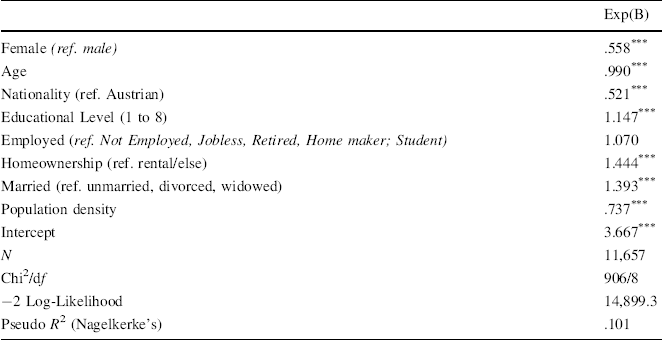
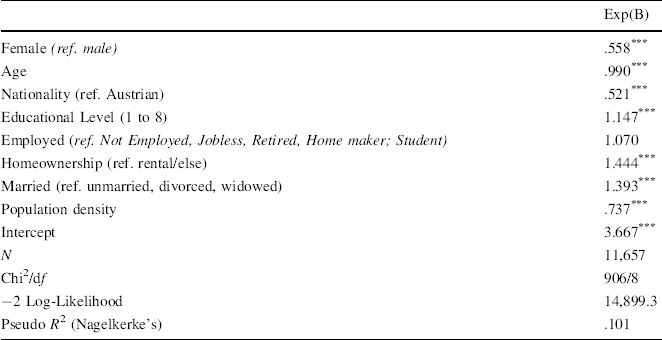
In Austria, the factors that shape formal volunteering are very similar to other OECD countries, which suggests the applicability of our findings to other countries (see Table 3). As previous research has shown (Brand Reference Brand2010; Musick and Wilson Reference Musick and Wilson2008; Wilson Reference Wilson2012), education is important for voluntary engagement and is a significant predictor (1.147***) for volunteering in Austria, too. In interaction with the other determinants, being in a paid job (1.070) does not increase the likelihood of volunteering. Homeownership is highly associated with volunteering (1.444***), though this can be interpreted in different ways, such as a proxy for wealth, stable residence, a higher stake in the local community, or for a rural residency (Rotolo et al. Reference Rotolo, Wilson and Hughes2010). Being married is another independent predictor (1.393***) for volunteering. Females (0.558***) and immigrants (0.521***) have smaller chances to get involved in volunteering, compared to males and Austrian citizens, respectively.
Logistic regression: determinants of volunteering in Austria.
Exp(B) |
|
|---|---|
Female (ref. male) |
.558*** |
Age |
.990*** |
Nationality (ref. Austrian) |
.521*** |
Educational Level (1 to 8) |
1.147*** |
Employed (ref. Not Employed, Jobless, Retired, Home maker; Student) |
1.070 |
Homeownership (ref. rental/else) |
1.444*** |
Married (ref. unmarried, divorced, widowed) |
1.393*** |
Population density |
.737*** |
Intercept |
3.667*** |
N |
11,657 |
Chi2/df |
906/8 |
−2 Log-Likelihood |
14,899.3 |
Pseudo R 2 (Nagelkerke's) |
.101 |
* p < .05; **p < .01; ***p < .001
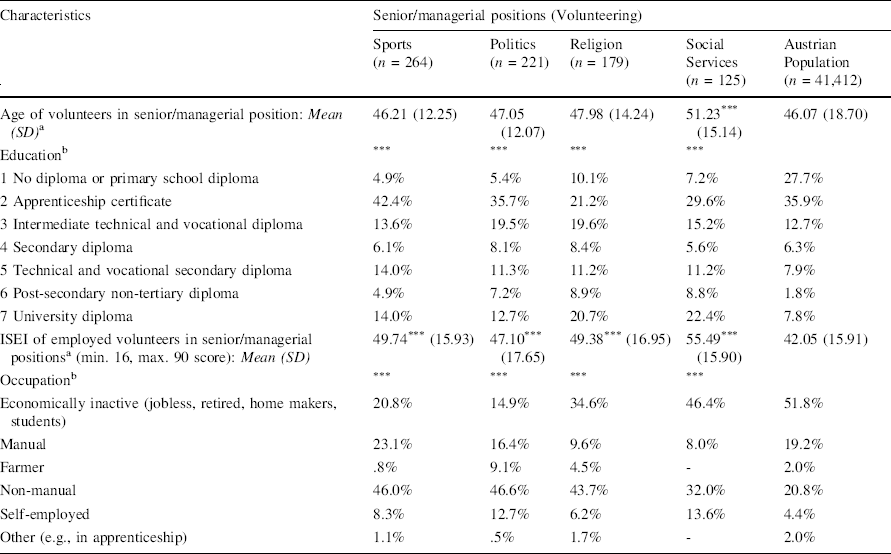
Table 4 shows the characteristics of leading volunteers in the four selected fields. Their average age is similar to the average age of the Austrian population over 15 years (46.07) in the fields of sport (46.21), politics (47.05), and religion (47.98). Only in social services are volunteers in senior/managerial positions (51.23***) significantly older than the average population (46.07). People with the lowest educational status are significantly underrepresented in senior/managerial positions in all four fields, whereas people with post-secondary and tertiary diplomas are overrepresented, especially in the field of religion (12.9%), and social services (+ 14.6%).
Descriptive characteristics of volunteers in senior/managerial positions in the four fields in comparison with the Austrian Population.

Characteristics |
Senior/managerial positions (Volunteering) |
||||
|---|---|---|---|---|---|
Sports (n = 264) |
Politics (n = 221) |
Religion (n = 179) |
Social Services (n = 125) |
Austrian Population (n = 41,412) |
|
Age of volunteers in senior/managerial position: Mean (SD) a |
46.21 (12.25) |
47.05 (12.07) |
47.98 (14.24) |
51.23*** (15.14) |
46.07 (18.70) |
Educationb |
*** |
*** |
*** |
*** |
|
1 No diploma or primary school diploma |
4.9% |
5.4% |
10.1% |
7.2% |
27.7% |
2 Apprenticeship certificate |
42.4% |
35.7% |
21.2% |
29.6% |
35.9% |
3 Intermediate technical and vocational diploma |
13.6% |
19.5% |
19.6% |
15.2% |
12.7% |
4 Secondary diploma |
6.1% |
8.1% |
8.4% |
5.6% |
6.3% |
5 Technical and vocational secondary diploma |
14.0% |
11.3% |
11.2% |
11.2% |
7.9% |
6 Post-secondary non-tertiary diploma |
4.9% |
7.2% |
8.9% |
8.8% |
1.8% |
7 University diploma |
14.0% |
12.7% |
20.7% |
22.4% |
7.8% |
ISEI of employed volunteers in senior/managerial positionsa (min. 16, max. 90 score): Mean (SD) |
49.74***(15.93) |
47.10***(17.65) |
49.38***(16.95) |
55.49***(15.90) |
42.05 (15.91) |
Occupationb |
*** |
*** |
*** |
*** |
|
Economically inactive (jobless, retired, home makers, students) |
20.8% |
14.9% |
34.6% |
46.4% |
51.8% |
Manual |
23.1% |
16.4% |
9.6% |
8.0% |
19.2% |
Farmer |
.8% |
9.1% |
4.5% |
- |
2.0% |
Non-manual |
46.0% |
46.6% |
43.7% |
32.0% |
20.8% |
Self-employed |
8.3% |
12.7% |
6.2% |
13.6% |
4.4% |
Other (e.g., in apprenticeship) |
1.1% |
.5% |
1.7% |
- |
2.0% |
Testing for differences between the volunteers and the Austrian population (age ≥ 15y)
at test
bChi-squared test
* p < .05; **p < .01; ***p < .001
Paid work matters (Marshall and Taniguchi Reference Marshall and Taniguchi2012; Webb and Abzug Reference Webb and Abzug2008). In all four fields, the occupational status (ISEI) of volunteers in senior/managerial positions (49.74***, 47.10***, 49.38***, and 55.49***) is significantly higher in comparison with the Austrian population (42.05). With the exception of the social services field, employment itself is strongly related to having a senior/managerial position within the volunteering sector (Table 4, Strauß Reference Strauß2008). Intermediate and higher ranks as well as professional occupations, executives, and the self-employed are overrepresented in senior/managerial positions in all four fields, whereas farmers “in charge” are only overrepresented in the field of politics (+ 7.1%) and religion (+ 2.5%).
Senior/Managerial Positions
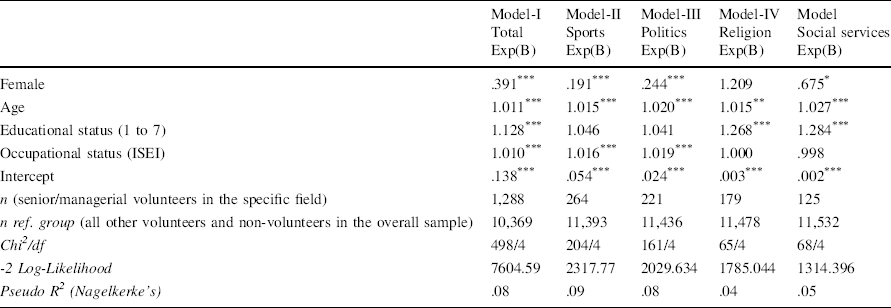
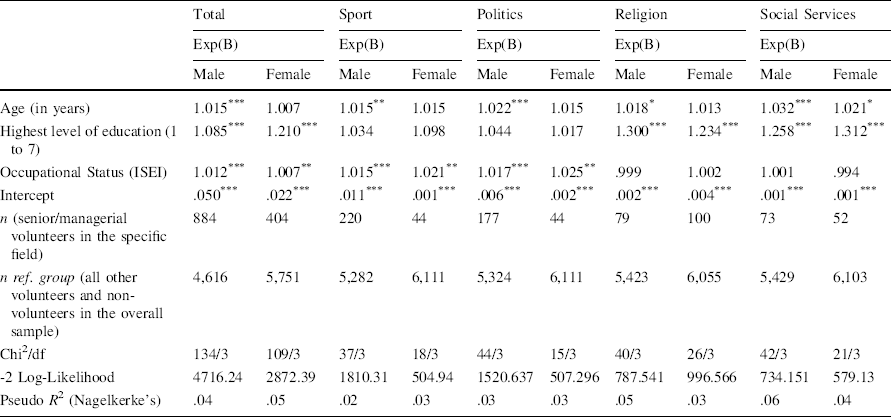
The logistic regression modelsFootnote 3 (Tables 5 and 6) indicate that occupational and educational status independently and significantly affect the hierarchization of voluntary positions. Gender as well as age are significant, too. This mirrors gender and age stereotypes as well as the hierarchical segregation in most business career fields (Mayrhofer et al. Reference Mayrhofer, Meyer, Schiffinger and Schmidt2008). A higher occupational status in paid work contributes (1.010**) to gaining a senior/managerial position in volunteering. An increase of one score on the ISEI scale (min. 16, max. 90 score) increases the probability of getting into a senior/managerial position in volunteering by 1%. Compared to males, females’ likelihood to be in charge (0.391***) is reduced to 60.9%. Likewise, educational status increases the chance to be in a senior/managerial position by 12.8% by each step further on the educational ladder. Therefore, H1, H2, and H3 are strongly supported. For men (see Table 6), age is a significant predictor (1.015***) for senior/managerial positions. In contrast, age does not significantly increase the likelihood for females (1.007). Due to the impossibility of testing for the significance of differences between odds ratios of two different subgroups, we cannot support or reject our hypothesis (H4) on gender-differences. The odds ratios (see Table 6) indicate that senior/managerial positions relate with occupational status similarly for females (1.007**) and males (1.012***). Yet for females, educational status relates more strongly (1.210***) with senior/managerial positions than for males (1.085***).
Logistic regression: senior/managerial position in volunteering.

Model-I |
Model-II |
Model-III |
Model-IV |
Model |
|
|---|---|---|---|---|---|
Total |
Sports |
Politics |
Religion |
Social services |
|
Exp(B) |
Exp(B) |
Exp(B) |
Exp(B) |
Exp(B) |
|
Female |
.391*** |
.191*** |
.244*** |
1.209 |
.675* |
Age |
1.011*** |
1.015*** |
1.020*** |
1.015** |
1.027*** |
Educational status (1 to 7) |
1.128*** |
1.046 |
1.041 |
1.268*** |
1.284*** |
Occupational status (ISEI) |
1.010*** |
1.016*** |
1.019*** |
1.000 |
.998 |
Intercept |
.138*** |
.054*** |
.024*** |
.003*** |
.002*** |
n (senior/managerial volunteers in the specific field) |
1,288 |
264 |
221 |
179 |
125 |
n ref. group (all other volunteers and non-volunteers in the overall sample) |
10,369 |
11,393 |
11,436 |
11,478 |
11,532 |
Chi 2 /df |
498/4 |
204/4 |
161/4 |
65/4 |
68/4 |
-2 Log-Likelihood |
7604.59 |
2317.77 |
2029.634 |
1785.044 |
1314.396 |
Pseudo R 2 (Nagelkerke's) |
.08 |
.09 |
.08 |
.04 |
.05 |
*p < .05; **p < .01; ***p < .001
Gender-specific contrast or spillover: logistic regression: senior/managerial position in volunteering.

Total |
Sport |
Politics |
Religion |
Social Services |
||||||
|---|---|---|---|---|---|---|---|---|---|---|
Exp(B) |
Exp(B) |
Exp(B) |
Exp(B) |
Exp(B) |
||||||
Male |
Female |
Male |
Female |
Male |
Female |
Male |
Female |
Male |
Female |
|
Age (in years) |
1.015*** |
1.007 |
1.015** |
1.015 |
1.022*** |
1.015 |
1.018* |
1.013 |
1.032*** |
1.021* |
Highest level of education (1 to 7) |
1.085*** |
1.210*** |
1.034 |
1.098 |
1.044 |
1.017 |
1.300*** |
1.234*** |
1.258*** |
1.312*** |
Occupational Status (ISEI) |
1.012*** |
1.007*** |
1.015*** |
1.021** |
1.017*** |
1.025** |
.999 |
1.002 |
1.001 |
.994 |
Intercept |
.050*** |
.022*** |
.011*** |
.001*** |
.006*** |
.002*** |
.002*** |
.004*** |
.001*** |
.001*** |
n (senior/managerial volunteers in the specific field) |
884 |
404 |
220 |
44 |
177 |
44 |
79 |
100 |
73 |
52 |
n ref. group (all other volunteers and non-volunteers in the overall sample) |
4,616 |
5,751 |
5,282 |
6,111 |
5,324 |
6,111 |
5,423 |
6,055 |
5,429 |
6,103 |
Chi2/df |
134/3 |
109/3 |
37/3 |
18/3 |
44/3 |
15/3 |
40/3 |
26/3 |
42/3 |
21/3 |
-2 Log-Likelihood |
4716.24 |
2872.39 |
1810.31 |
504.94 |
1520.637 |
507.296 |
787.541 |
996.566 |
734.151 |
579.13 |
Pseudo R 2 (Nagelkerke's) |
.04 |
.05 |
.02 |
.03 |
.03 |
.03 |
.05 |
.03 |
.06 |
.04 |
*p < .05; **p < .01; ***p < .001
Field-Specific Analysis
Occupational status significantly relates to senior/managerial positions in the field of sports and politics, but not in the fields of religion and social services. With an odds ratio of 1.016***, each step on the occupational status scale (ISEI) significantly raises higher probability in sports by 1.6%. Therefore, we have to reject H1-sport. Following our hypothesis H1-politics, occupational status also increases (1.019***) the probability of getting into senior/managerial positions in politics. With an odds ratio of 1.000 H1religion has to be supported, and H1-social (0.998) has to be rejected, revealing that there is no spillover of occupational status in religion or in social services.
Educational status significantly increases the chance of holding a senior/managerial position in the field of religion (1.268***) and social services (1.284***). Each increase in educational status by one-step increases the probability to be in charge by 26.8% (religion) or even 28.4% (social services). Therefore, H2-religion and H2-social are supported by our data. In sports and politics, however, the educational status does not raise the probability of holding a senior/managerial position. Thus, we reject H2-sport and H2-politics.
Gender also has a significant impact. Females have less chances to get into senior/managerial positions in sports (0.391***), politics (0.191***), and even in social services (0.675*). In religion, males and females have similar chances to be in a senior/managerial position. Thus, our analyses support H3-sport, H3-politics, and H3-religion, but reject H3- social.
Field-specific findings on spillover-effects of occupational status in sports (males: 1.015, females: 1.021) and politics (males: 1.017, females: 1.025) point in the same direction for both genders. The differences in the odds ratios of males and females are marginal (see Table 6).
Likewise, we found no gender-specific spillover-effects in religion (males: 0.999; females: 1.002) and social services (males: 1.001, females: 0.994). The impact of educational status does not differ, either, between genders. Though we cannot directly test for differences in odds ratios, these findings suggest support our gender-specific hypotheses H4-sport and H4-politics, but rather reject H4-religion and H4-social.
In summary, we found direct occupational spillover-effects in the fields of sports and politics, and educational effects in the fields of religion and social services. Finally, we found gender effects in all fields except religion.
Discussion
Our study contributes a more fine-grained analysis of four different fields of volunteering, and shows that spillover-effects dominate volunteering, not only in general, but also in sports, politics, religion, and social services. We did not find any empirical support for a contrast-effect hypothesis. Obviously, resources and reputation acquired previously in other fields is crucial for advancement in volunteering, and the field of volunteering rather mirrors and replicates economic and societal inequalities.
Yet we have also revealed remarkable differences between the fields of sports, politics, religion, and social services. Altogether, we have shown direct spillover-effects of occupational status in sports and politics, but not in religion and social services, in which educational status contributes to the chance of getting into senior/managerial positions. Men are much more likely to reach a senior/managerial position in sports, politics, and social services, but not in religion. Finally, we have found no evidence for extra-resources needed by females to get into senior/managerial positions in any field.
Revisiting the basic forces that might drive inequality in volunteering, we have confirmed one of the hypothesized spillover-effects of occupational status, namely in politics, but not in social services. For sports and politics, inequalities of paid work are widely transferred to volunteering (Diewald and Faist Reference Diewald and Faist2011). These similarities between sports and politics are perhaps typical for central European countries, as has been shown for Italy and the Czech Republic (Numerato and Baglioni Reference Numerato and Baglioni2012), where sports organizations bear some political characteristics and relate with politics in board-membership and careers in volunteering. Both fields favor males with higher occupational status for superior positions in volunteering.
Interestingly, there are no occupational spillover-effects in the two fields that are widely dominated by female volunteering, religion, and social services. This may also relate with the smaller share of economically active volunteers. As 39% (religion) and even 47% of all volunteers are out of paid employment, or in household, a relevant share of volunteers has a weak occupational status, which brings educational status to the foreground when it comes to advancement in volunteering. Furthermore, religion and social services are maybe more prone to education.
Yet they are not so prone to forward females. Only the field of religion seems to provide equal opportunities for female volunteers to get into senior/managerial positions. At first glance, it is surprising that the Catholic Church and its various CSOs still dominate the field of religion in Austria while not offering female access to priesthood. On closer examination, churches might compensate their gender discrimination in priesthood by including women in parish councils and similar boards. The higher number of women than men in Austria belonging to a particular religion might also have an effect.
We expected stronger spillover-effects in fields with larger organizations and a higher share of paid workforce, which was supported for politics but not for social services. We assume that volunteering in a social services CSO means working with highly vulnerable beneficiaries, which is often assumed to involve some form of “warm-glow” gratification from helping others, without yielding much prestige (Handy and Mook Reference Handy and Mook2011). Furthermore, social services require capabilities such as ease of communication with marginalized groups, empathy, and care-giving. These capabilities do not relate with occupational status in other fields. Generally speaking, the adverse is also probable; the set of skills required for managerial positions may perhaps not be appropriate in the fields of elderly care and childcare. The tabooed symbolic exchange is maybe weakest in this field, i.e., volunteers in social services earn less symbolic capital and reputation. Social services is a field dominated by females that promises little reputational gains. However, effects of educational status and gender hinder social services from becoming a real egalitarian playground for alternative careers in volunteering.
We assumed that spillover-effects were stronger in male-dominated fields and in fields with a higher percentage of employed volunteers (as opposed to the retired, homemakers, or others not in paid employment). This is the case in sports and politics. We further assumed stronger spillover-effects in fields with fewer senior/managerial positions, thus appealing to exclusivity. This assumption was not supported by our results, as we did not reveal direct spillover-effects in religion and social services. In these fields, it is less the occupational status but much more the educational status that shapes high-level careers in volunteering.
Although the male-dominated fields (sports and politics) widen the gender gap when it comes to senior/managerial positions, and although even in the female-dominated social services field males do have easier access to superior positions, we did not find any gender-differences in the requirement of occupational or educational status. This means that for volunteering in politics, sports, and social services women are disadvantaged in their advancement toward senior/managerial positions, and they cannot compensate for this disadvantage with a higher occupational or educational status.
Our study findings contribute to the discussion of stratification within different fields of volunteering. Until now, research has paid little attention to mechanisms that lead to hierarchical segregation and a lack of diversity in the voluntary sector. Prior research on ethnic, gender, and age segregation has focused on entry barriers. It neglected the meritocratic relations between cultural, economic, social, and symbolic capital, which is invested in volunteering, and yields different returns in other fields. We have referred to Pierre Bourdieu, who explains why these benefits and returns have to be tabooed by the illusio of the voluntary field (Bourdieu Reference Bourdieu1998, 76ff.). We suppose that fields like sports and politics convey symbolic capital more directly, thus also providing their leading volunteers with economic benefits. In religion and social services, the symbolic capital provided is much more specific and cannot be converted easily into economic advantages, at least not in continental Europe. This explains the strong spillovers in sports and politics, and the male dominance in these more prestigious fields. In a nutshell, “the long arm of the job” (Wilson and Musick Reference Wilson and Musick1997b) shapes volunteering in the fields of sports and politics, whereas the long arm of education shapes it in the fields of religion and social services.
Implications and Limitations
There are various implications of our study. Social elites do not only have superior qualities and quantities of resources at their disposal (capital endowment), they also have the power of designation, since elites influence how we perceive the social world and how we evaluate resources (Vogt Reference Vogt2005, 157). Unequal probabilities of reaching a senior/managerial position in volunteering therefore show that different groups have unequal chances of actualizing their interests in the voluntary sector and, in a broader sense, in civil society.
Aside from detailing our results, we hope to further progress the theoretical discussion surrounding volunteering. To date, resource theories (Wilson Reference Wilson2000) and status theories (Smith and Wang Reference Smith and Wang2016) have provided competing explanations for the access to voluntary work (Qvist Reference Qvist2018). We expand on theory explaining inequalities and stratification within volunteering, and with Bourdieu’s theory of practice, we offer a theoretical bridge between resource- and status-based approaches. In this theory, individual actors acquire resources (capital) that contribute to their status in various social fields. Next, this status signals resources for achieving executive positions in other fields as well, insofar as a status achieved in one field works as a resource in another field. Hence, there is a reinforcing process between capital and status, which constitutes the dynamics of the field. For instance, a successful businessperson who has gained reputation, i.e., symbolic capital, which is also valued in the field of volunteering also results in them taking a highly esteemed board position in a sports club. Also in Bourdieu’s terms, this leads to an accumulation of capital, i.e., to the Matthew effect.
Our results reveal interesting differences: In politics and sports, there is a rather straightforward translation of occupational prestige into voluntary status. Of course, there may be very specific capital not covered by our study that is crucial. For instance, leading board members of sports organizations who have been successful athletes formerly, or volunteers in politics who come from strongly politicized families. Such nuanced capital and habitual predispositions for advancement in volunteering provide fertile ground for further research.
Whereas occupational status translates rather directly into social position in politics and sports, we found a subtler translation of cultural capital into status in the fields of religion and social services. In these fields, mechanisms discriminate less overtly against females, and rather hold education in higher esteem than mere occupational status.
Our findings indicate subtle distinctions in the styles of volunteering (Bourdieu Reference Bourdieu1984) that could provide a promising field for further research. As we have outlined above, altruism is the illusio of volunteering, as volunteers justify their engagement by their need to help others. Maybe this illusio is changing, and self-actualization will gradually replace altruism as the core delusion of volunteers, at least in particular fields (as has already been suggested by Thompson and Bono Reference Thompson and Bono1992, and Anderson and Moore Reference Anderson and Moore1978).
We also see implications for CSOs’ volunteer management, volunteer agencies, and for policymaking. First, diversity management should be strengthened for volunteering. Organizations should, for instance, run special programs that lead to more diversity and promote, for example, women to senior/managerial positions. To align the managerial desire for the best volunteers with the civic endeavor to integrate underrepresented groups, we recommend to better analyze the potential of volunteers with regard to their professional and personal development. Furthermore, board positions should be for those who represent underrepresented stakeholders and not for those with the highest reputation (Vantilborgh et al. Reference Vantilborgh, Bidee, Pepermans, Willems, Huybrechts and Jegers2011). The CSOs that advocate for more justice, equal opportunities, and social inclusion should at least avoid discriminatory mechanisms in their own processes of recruitment and promotion of volunteers. Finally, policymakers are advised to be more cautious with promoting voluntary engagement as a measure against discrimination (e.g., for the elderly, for immigrants).
Our study suffers from a couple of limitations, the first of which being that there are many imperfections in our database. Although we are endowed with a large sample size that allows unique and detailed quantitative analyses of single fields, we could not collect data on income and wealth. Further, we would have appreciated a finer measurement of hierarchical status in volunteering, such as by distinguishing between board positions and executive positions. We also lack data on ethnic origin, as we only know from our data that individuals born abroad are broadly underrepresented in volunteering.
Furthermore, we only analyzed characteristics of volunteers and not how CSOs selected them due to specific requirements, as we lack any matching organizational data. It is not surprising that boards and committees consist of high-status individuals, as they are helpful in external governance (Maier and Meyer Reference Maier and Meyer2011) and for the managerialization of CSOs (Maier et al. Reference Maier, Meyer and Steinbereithner2016). Insofar, our data is rich on the individual level but lacks organizational requirements. Hence, we did not investigate mechanisms of inequality that are located on the organizational level and shaped, for example, by funding sources, governance structures, levels of professionalization, managerialization, and marketization. The structure and culture of CSOs should be investigated as a bottleneck and gatekeeper for volunteering, for example by their tendency toward homophily (e.g., Aksoy Reference Aksoy2015; Ibarra Reference Ibarra1992). Further research should also address this perspective, for instance, by qualitatively analyzing CSOs that do not conform with the usual spillover-effects of their field when they select their volunteers and promote them into senior/managerial positions.
Finally, the bridge between our guiding theory and the empirical analysis is narrow and shaky. For this study, the framework of Pierre Bourdieu provided us with inspiration and helped us in sense-making. Yet we admit that our data fit the theoretical concepts only in a rudimentary way, as our database lacks detailed information on volunteers’ circumstances and capital endowment. Therefore, we strongly encourage further research to better utilize the richness of Pierre Bourdieu’s concepts.
The underlying challenge that we could not untangle with our methodology was to find the interrelation between the levels of supply and demand in terms of the voluntary workforce. In this respect, causality is hard to reveal. Therefore, it either needs a multilevel longitudinal panel that tracks the interplay of individual and organizational factors, or a very fine-grained qualitative methodology that elaborates on this interplay. As an alternative, we found refuge in Bourdieu’s theory that assumes a circularity between agency and structure, in our case between the individual characteristics, such as traits, capabilities and motivations, and the organizational demand. Therefore, we cannot safely blame either of these two sides for the inequalities present in volunteering. We are confident that we have revealed some underlying pattern in the fields of volunteering. We hope that our research encourages CSOs to further act against unfair exclusion and that it promotes an equal accessibility of attractive and powerful positions in volunteering.
Funding
Open Access funding provided by Vienna University of Economics and Business (WU). The authors received no financial support for the research, authorship, and/or publication of this article.
Compliance with Ethical Standards
Conflict of interest
The authors declared no potential conflicts of interest with respect to the research, authorship, and/or publication of this article.

 Open access

