

1 Introduction
In studies of design ideation, there is a lack of consensus on what counts as an idea. This is notable considering that ideation sessions are characterised by the scoring of the ideas generated (Girotra, Terwiesch & Ulrich Reference Girotra, Terwiesch and Ulrich2010). Design ideas generated by participants in experimental studies are counted and presented for evaluation in a variety of formats including audio recordings (Atman et al. Reference Atman, Adams, Cardella, Turns, Mosborg and Saleem2007), sketches (Perttula & Sipilä Reference Perttula and Sipilä2007), written statements (Girotra et al. Reference Girotra, Terwiesch and Ulrich2010), physical models (Meneely & Portillo Reference Meneely and Portillo2005; Viswanathan & Linsey Reference Viswanathan and Linsey2012), or digital models (Viswanathan & Linsey Reference Viswanathan and Linsey2014). Across studies, ideas are generated by participants in sessions that range in duration a few seconds (Alexiou et al. Reference Alexiou, Zamenopoulos, Johnson and Gilbert2009), several minutes (Gonçalves, Cardoso & Badke-Schaub Reference Gonçalves, Cardoso and Badke-Schaub2013), multiple hours (Viswanathan & Linsey Reference Viswanathan and Linsey2012), days or weeks (Yang Reference Yang2009), or undefined time limits (Atman et al. Reference Atman, Adams, Cardella, Turns, Mosborg and Saleem2007). Design ideas are the elementary particles of design ideation, yet it is far from clear what is a design idea, and how to study their genesis.
The ad hoc treatment of what constitutes a design idea leads to a lack of clarity that is compounded by the assortment of metrics applied in their evaluation, which tend to include fluency, flexibility, and novelty as typical components of creative value (Perttula & Sipilä Reference Perttula and Sipilä2007), in addition to criteria such as purchase intent (Girotra et al. Reference Girotra, Terwiesch and Ulrich2010), ease of use (Cardoso & Badke-Schaub Reference Cardoso and Badke-Schaub2011), and technical feasibility (Shah, Smith & Vargas-Hernandez Reference Shah, Smith and Vargas-Hernandez2003) – or in holistic assessments with implicit criteria (Cardoso & Badke-Schaub Reference Cardoso and Badke-Schaub2011). The lack of consistency in how design ideas are characterised and evaluated reflects a variety of implicit definitions of creativity (Batey Reference Batey2012). Even the seemingly straightforward task of counting the number of ideas generated in a session can be contentious since the output tends to be interpreted, and inductively coded or categorised in different schemas ranging from whole design concepts (Meneely & Portillo Reference Meneely and Portillo2005; Kokotovich Reference Kokotovich2008) to decomposition by general functional principles (Viswanathan & Linsey Reference Viswanathan and Linsey2012), or by components and sub-functions (Perttula & Sipilä Reference Perttula and Sipilä2007). Such inconsistencies in empirical studies of design ideation suggest a lack of theoretical grounding (Sutton & Staw Reference Sutton and Staw1995) that calls for a clearer understanding of the building blocks of design ideation and the conditions that shape idea formation.
Studies of design ideation have a precedent in the field of creative cognition where ideas are simply defined as responses to questionnaires or puzzle problems, such as the Alternate Uses or the Remote Associates Tasks (Silvia et al. Reference Silvia, Winterstein, Willse, Barona, Cram, Hess, Martinez and Richard2008). However, in studies of design ideation such treatment does not translate well. Terms such as ideas, concepts, designs, and solutions are interchangeably used across and within studies (Daly et al. Reference Daly, Yilmaz, Christian, Seifert and Gonzalez2012) denoting a treatment of concepts that lacks clarity, uniqueness, parsimony, and measurement properties (Wacker Reference Wacker2008). A theoretically sound definition of design ideas and their formation would increase clarity and reliability in their treatment and analysis. With a strong theoretical basis, design ideas could be more clearly defined, more reliably identified, treated, and measured, and a research programme could be formulated to advance their scientific study and to support professional practices of ideation.
This paper presents an exercise in disciplined imagination (Weick Reference Weick1989) that seeks to develop the intellectual machinery and the tools for a systematic reasoning and the rigorous study of idea formation in design. We start by identifying an assumption across the literature that the creative value of sketchy ideas quickly generated in response to a design task can be evaluated in valid and reliable ways. We define early design ideas (‘early ideas’ for short) as those generated in ideation sessions with durations of a few minutes and less than one hour – a range covered by a substantial subset of experimental studies (Sosa Reference Sosa2018). Across studies of ideation, early ideas are treated as well-defined units that can be objectively identified and evaluated by external judges against criteria such as ‘technical feasibility, originality, specificity, market demand, and overall value’ (Girotra et al. Reference Girotra, Terwiesch and Ulrich2010). We identify this as the essentialist assumption of creative design ideation, which often remains implicit, but does lead researchers to act as if the creative qualities of a final design solution were traceable to its primordial origins.
An essentialist view supports the belief that metrics of creative value can be ‘usually adequately estimated even though there is not enough quantitative information to do formal analysis’ (Shah et al. Reference Shah, Smith and Vargas-Hernandez2003), despite the documented effects that clarity of representations such as design sketches have on the scoring of early ideas (Kudrowitz & Wallace Reference Kudrowitz and Wallace2013). An essentialist view reveals itself in different ways and is identifiable in studies where external judges rank early ideas using creativity metrics. Such scoring by external raters has even been used to assess the capacity of participants to evaluate and select their own ‘best ideas’ (Girotra et al. Reference Girotra, Terwiesch and Ulrich2010). This implies that certain early ideas have a creative quality that other early ideas lack, which can be objectively determined, and which arguably manifests in the final solution if those creative early ideas are selected, and not others.
The purpose of evaluating early ideas is only occasionally explicitly articulated in the literature, such as when successful ideation is depicted as ‘helpful in supporting engineers to generate novel and creative designs, innovative solutions will follow’ (Daly et al. Reference Daly, Yilmaz, Christian, Seifert and Gonzalez2012); when it is portrayed as playing ‘a crucial role in the development of innovative and creative products’ (Viswanathan & Linsey Reference Viswanathan and Linsey2014); and when it is assumed to be ‘likely related to the quality of the final design solution’ (Shroyer et al. Reference Shroyer, Lovins, Turns, Cardella and Atman2018). Such likely causation link between the quality of early and final ideas, whilst may appear intuitively sound, is not explained by theory and remains unsupported by evidence, calling for closer examination. In all, many ideation studies, including the most highly cited, rest on theoretical principles that remain ambiguous and untested, and are largely informed by ad hoc intuitions and assumptions.
An example can help elucidate the conceptual gap between early and final ideas in design. The 2016 Dyson Award winner, the EcoHelmet by Isis Shiffer, is described as a ‘folding, recyclable, vendable helmet for bike share’ (Shiffer Reference Shiffer2016). This design was praised for a number of winning ideas, including its disposability, made of waterproof paper, a radial honeycomb shape, and its low cost. It was also praised for its capacity to help casual cyclists ‘to ride more confidently, more safely and more often’. Whilst the originality of these isolated features (ideas) is debatable, perhaps the core winning idea of this design is the way in which these elements are integrated into a desirable, feasible, and viable solution (Lidwell & Manacsa Reference Lidwell and Manacsa2011). There are indeed mechanisms to identify the unique features of a final design, for instance by the claims in a patent application or the specifications of a competition entry. But the essentialist stance seems to imply that the output of early ideation is akin a set of pieces of a puzzle (functions, components, or attributes of measurable creative value) that are aggregated into a final solution. This line of reasoning would suggest that puzzle pieces with creative qualities such as ‘waterproof paper’, ‘foldable’, and ‘radial honeycomb’ in the EcoHelmet are selected for the final solution, whilst the rest are eliminated – Figure 1 of Girotra et al. (Reference Girotra, Terwiesch and Ulrich2010) graphically depicts this assumption. In essentialist thinking, the creative essence of early ideas is estimated by external judges (Shah et al. Reference Shah, Smith and Vargas-Hernandez2003). Is this a valid and persuasive approach to the study of early ideas in design? What may be wrong with assuming that the creative essence of the EcoHelmet is traceable to singular ideas generated in an initial ideation session? If evaluation in design compares the expected performance or behaviour with the actual behaviour derived from structure (Gero & Kannengiesser Reference Gero and Kannengiesser2004), it seems premature to evaluate the creative value of early ideas that do not yet exist beyond a quick sketch or verbal description. The theoretical work presented here stems from asking to what extent may the creativeness of a final design solution be present in early ideas? And, what alternatives exist to assess early ideas than to simply apply the same metrics used to evaluate final solutions?
The exercise presented in this paper goes back to reconsider how early design ideas are defined, treated, and analysed with the goal of building a cohesive conceptual framework for the study and improvement of creative ideation. The goal of this exercise is to systematically consider a more thorough understanding of early ideas and to inspect alternatives to the alleged implication that external observers are able to determine the creativity of early ideas more effectively and more objectively than those who generated them. By implication, this exercise explores the types of qualities that can be expected from early, sketchy, and incomplete ideas generated in short ideation sessions, and ways to characterise early ideation processes and early outcomes.
We set here to formulate a theory that conceptualises ideation beyond the primacy of essence by examining this fundamental assumption and formulating alternative possibilities. We adopt an ‘ex ante approach’ to theory building, where we look for vantage points to imaginatively develop new insights and challenge taken-for-granted assumptions in order to illuminate, understand and problematise the phenomenon of study. We conduct the three iterative steps suggested for ex ante theory building (Andersen & Kragh Reference Andersen and Kragh2010): first, groundwork to rehash the previously accepted research approaches; second, data analysis to reconsider key findings from the literature and their causal explanations (Patton Reference Patton1999); and third, theory building to synthesise new concepts and perspectives.
Whilst theory building is an exercise of disciplined imagination, a set of criteria guides the formation of good theory including interest, plausibility, and believability as substitutes for validation (Weick Reference Weick1989). Other key criteria include imaginative conceptual development and mapping, well-structured definitions and relationships (Weick Reference Weick1989), sharpness and strength of argumentation to address causation (Sutton & Staw Reference Sutton and Staw1995), and persuasion (Andersen & Kragh Reference Andersen and Kragh2010). Good theory building also exhibits conservatism in how definitions are coined, so that new terms are clear and clearly distinguished from existing concepts (Wacker Reference Wacker2008). Short definitions (parsimony) that avoid concept stretching and conceptual uniqueness in definitions are deemed as superior as well as establishing conceptual clarity before measurement to avoid findings that are ‘statistically significant but practically unimportant’ (Wacker Reference Wacker2008).
Guided by these principles, we set to initiate a theory shaping exercise to guide future empirical research to arrange the pieces of the puzzle of ideation. In particular, this theory seeks to define the construct of early design ideas, and to delineate approaches for their evaluation. A strong theory that ‘answers queries of why’ (Sutton & Staw Reference Sutton and Staw1995) should help interpret key findings such as the misalignment between scores by external judges and participants, or the effects of the quality of sketches on their scoring. A strong theory should explain this type of outcomes by shedding light on the causal forces behind the evaluation of early ideas. It is worth asking, for example, what qualities do participants who generate ideas see in their own sketches and notes, which may be lost in representation–interpretation by external judges? To this end, we first turn to sources of professional practices around ideation for insights.
The next section presents an analysis of early ideation from studies of professional practitioners and from their own accounts to rethink the metrics to evaluate incipient design ideas. An examination is then carried out to scope for representative metaphors (Weick Reference Weick1989) with the potential to guide the theory building exercise and open new ways of thinking about early ideation. Vignettes from professional ideation are presented to illustrate the value of applying a different lens to design ideas, and evaluation regimes are discussed for different stages of ideation. The last section synthesises these new arguments at a higher level of abstraction, addresses limitations of our approach, and suggests future directions for design ideation research.
2 Professional ideation
This section presents a review of group ideation from empirical studies as well as first-hand accounts by seasoned professionals. This is to reconsider ideation principles by looking at practices ‘in the wild’. Ideation need not be limited only to the front end or initial stages of a project, since professional designers iterate through divergent and convergent stages (Shih Reference Shih2011; Kocienda Reference Kocienda2018). Ideation then refers here to episodes of divergent thinking throughout a design project where early ideas are generated aimed at various decisions including problem framing, user requirements, form-giving, materials and fabrication processes, etc.
Professional ideation can be highly structured around clear and explicit rules and procedures. Osborn, building on professional experience, developed brainstorming in the 1930s with the primary rule known as delay judgement aimed at encouraging divergent reasoning and the formation of a large pool of assorted ideas (Osborn Reference Osborn1963). A second brainstorming guideline is to connect and extend ideas ‘into still another idea’, which based on a combinatorial postulate, explains how quantity can breed further divergence and quality based on synthesis from the exponential growth of connections between ideas – and not merely by increasing the probability of finding a great idea (Shah et al. Reference Shah, Smith and Vargas-Hernandez2003). To reiterate, in empirical studies ideation is often treated as repeated sampling and therefore the average and variance of the underlying quality distribution are viewed as driving the expected quality of early ideas (Girotra et al. Reference Girotra, Terwiesch and Ulrich2010). In contrast, practitioners treat ideation as combinatorial synthesis as in the prominent quote ‘Ideas are like rabbits. You get a couple and learn how to handle them, and pretty soon you have a dozen’ (Petit Reference Petit1963). Third, Osborn pointed the essential interplay between individual and group ideation, noting that ideation is more effective when individuals generate ideas in isolation before they engage in group sharing (Osborn Reference Osborn1963). Last, early ideas are documented and shared with participants shortly after a session to stimulate follow-up ideas – which tend to include some of the most original (Tassoul Reference Tassoul2009).
Despite these recommendations from practice, the research literature on brainstorming has largely focused on comparing individual vs group idea generation, and consistently fails to apply and enforce the guidelines and rules (Isaksen & Gaulin Reference Isaksen and Gaulin2005). The disconnect between group ideation as used by professionals and as replicated by researchers in the laboratory was identified as a result of a mechanistic view of ideation (Sutton & Hargadon Reference Sutton and Hargadon1996) where inputs (a brief, participants, sticky notes, and an ideation method) produce concrete outcomes (ideas). A key premise of the mechanistic approach is that design ideas can be objectively evaluated from their earliest manifestation: ‘We have to evaluate quality of ideas to determine which ones should be developed further’ (p. 131) (Shah et al. Reference Shah, Smith and Vargas-Hernandez2003). Criticisms of the mechanistic view include that it misses key metrics of importance in professional contexts beyond the perceived qualities of the sketchy ideas produced (Sutton & Hargadon Reference Sutton and Hargadon1996).
Early ideas have been dubbed ‘ugly babies’ to explain their originality and value as fragile, and to show that new ideas are ‘far from pretty’ (Catmull Reference Catmull2014). In ways that challenge the essentialist view, Catmull characterises early ideas for their successful films as ‘not beautiful, miniature versions of the adults they will grow up to be. They are truly ugly: awkward and unformed, vulnerable and incomplete. They need nurturing – in the form of time and patience – in order to grow’ (p. 131) (Catmull Reference Catmull2014). The nature and characteristics of such growth process can be difficult to grasp by external observers who only see the finalised outcome, i.e., an award-winning movie fully formed after years of development.
Catmull cautions against the lure of judging early ideas: ‘If you sat down and watched the early reels of any of our films, the ugliness would be painfully clear. But the natural impulse is to compare the early reels of our films to finished films – by which I mean to hold the new to standards only the mature can meet. Our job is to protect our babies from being judged too quickly. Our job is to protect the new.’ (p. 131) (Catmull Reference Catmull2014). That ‘natural impulse’ explains essentialist thinking by which creative design solutions are believed to originate from creative early ideas, thus (mis)leading researchers to apply metrics of performance such as ‘technical feasibility’ to ideas formed in only a few minutes (Shah et al. Reference Shah, Smith and Vargas-Hernandez2003). In contrast, Catmull points out: ‘When someone hatches an original idea, it may be ungainly and poorly defined. If, while in this vulnerable state, it is exposed to naysayers who fail to see its potential or lack the patience to let it evolve, it could be destroyed. Part of our job is to protect the new from people who don’t understand that in order for greatness to emerge, there must be phases of not-so greatness’ (Catmull Reference Catmull2014).
This account of new ideas as unsightly, radically questions the essentialist application of quality metrics to early ideas. This is regardless of inter-rater agreement if early ideas are exposed in a vulnerable state to evaluators who, however consensually, are likely to fail to see the potential of ‘not-so great’ early ideas to grow and evolve. A professional view of early ideas as ‘ugly babies’ reveals the limits of essentialist thinking and suggests that metrics of potential and not of performance may be more appropriate to assess early ideation.
The risk of evaluating early ideas against metrics of quality is also identified by a designer of Project Purple at Apple (Kocienda Reference Kocienda2018). Kocienda stresses the importance of iterative evaluation and only through concrete representations (working prototypes) rather than spending time deliberating about the potential merits of early ideas as imagined on paper. His experience designing the first iPhone on-screen keyboard suggests that early ideas can be selected based on the capacity of an early embodiment to show potential and sustain motivation for the next iteration cycle. In other words, Kocienda implies that more appropriate criteria for early ideas are the extent to which they are promising, suggestive, and interesting.
Design researchers have characterised the co-evolution of the solution and the problem spaces (Maher & Poon Reference Maher and Poon1996; Dorst & Cross Reference Dorst and Cross2001), which in this context suggests that the evaluation of early ideas starts with tentative criteria, which are likely to change as new or more information becomes available and decisions are made that reframe the problem. This is particularly consistent with two of the properties of design problems: ‘personal evaluation functions’ and ‘incremental development of artifact’ (Goel & Pirolli Reference Goel and Pirolli1992). Whilst it is possible that early versions of embodiment influence a creative project by shaping the development path to some degree, this need not entail a clear causation link between the properties of the first and the last versions of design ideas. The analogy here is the attempt to forecast the performance of an adult athlete by a complete analysis of her genetic qualities at birth. Whilst her DNA remains unchanged, it is wrong to treat innate qualities as predictors of the complex behaviours of a fully developed person.
An essentialist view of early ideas offers the apparent methodological advantage of making creators redundant during idea evaluation. Sketches, written and verbal descriptions, and early models are customarily analysed in ideation studies without participants being present. It is questionable whether an ‘objective and auditable’ treatment of sketchy depictions of future ideas is possible in such conditions (Shah et al. Reference Shah, Smith and Vargas-Hernandez2003). Consider that in many creative industries including product design and venture capital funding, the creative potential of new ideas is assessed primarily during face-to-face interviews, or ‘the pitch’ (Elsbach & Kramer Reference Elsbach and Kramer2003). Evidence shows that in high-stakes pitches, evaluators base their judgement of creative potential by ‘paying attention to their own behaviour and self-perceptions during pitches … they found themselves becoming excited, passionate, or engaged in the pitch, or having a creative inspiration of their own’ (Elsbach & Kramer Reference Elsbach and Kramer2003). This assessment approach may explain why some of the early ideas are judged by peers as having high potential, despite their low objective performance – such as entries 4, 16, and 41 in Table 3 of Shah et al. (Reference Shah, Smith and Vargas-Hernandez2003). Detached assessments may also account for the misalignment between the scores of external judges and participants (Girotra et al. Reference Girotra, Terwiesch and Ulrich2010). The ‘creative pitches’ studied by Elsbach point towards the importance of enactment in the evaluation of early ideas where relational and introspective evaluation based on abductive reasoning takes place (Dong, Garbuio & Lovallo Reference Dong, Garbuio and Lovallo2016). For design ideation research this could mean not only the need to redefine metrics but also that the ways in which ideas are presented for evaluation need to carry sufficient information to increase the validity and meaning of evaluation.
In creative entrepreneurial practice, the quest for a great idea is considered to be misled (Belsky Reference Belsky2018). Belsky identifies the messy middle in entrepreneurial projects, a stage that connects the start of an idea with its successful realisation – a journey that ‘isn’t pretty’ (p. 8) where focused work and high levels of motivation and persuasion can be especially scant after the initial ‘dopamine rush and the self-confidence’ (p. 26) wears down. In the early stages, Belsky recommends to work with ‘a small audience that loves your product’ (p. 58) with a ‘narrative before product’ approach to drive the messy middle in the form of stories that address: ‘Why does [your idea] need to exist? What makes it relevant? How does it make the future better? … the ethos of a product’ (p. 255). A combination of ‘healthy incrementalism [and] the occasional transformational jolt’ is needed to identify when entrepreneurs ‘need to take a leap, not a step’ (p. 289). In this context, the evaluation of early ideas in the messy middle ‘can be destructive when it comes to creativity because evaluation can create a hard stop in an argument; instead of having healthy debates, data tend to cut the conversation and subsequent exploration of the full terrain of possibility’ (p. 302) (Belsky Reference Belsky2018). In sum, new ideas in entrepreneurial activity are considered ‘inflections and must be executed in full before they function’ (p. 289) (Belsky Reference Belsky2018).
Early ideas are often captured in an ideation session in hand-drawn sketches or sketch models (Pei, Campbell & Evans Reference Pei, Campbell and Evans2011) which are considered autographic representations, in contrast to non-autographic or allographic media (Goodman Reference Goodman1976). Autographic representations can be ambiguous because they are not based on codified notations such as a music score or a fabrication blueprint. Whilst autographic media is aimed at an ‘audience of one’ (creators), allographic media can be read by others (judges) (Goodman Reference Goodman1976). Fragmentary early ideas are represented in autographic media rather than unambiguously depicted in formats that can be adequately understood by external observers.
These experiences from professional ideation are reminiscent of the conceptual distinction between audition and show. Auditions are partial trials where many of the critical elements of the final version are missing and where assessment criteria are demonstrably different from those applied to evaluate a final stage production (Jacobsen Reference Jacobsen2002).
2.1 Ideaspaces in professional ideation
The concept of ideaspaces stems from the process by which designers evolve and expand early ideas ‘into an exploration of the boundaries and possibilities of the idea’ (Shroyer et al. Reference Shroyer, Lovins, Turns, Cardella and Atman2018). Ideaspaces are collections of fragmentary ideas ‘presented not as one specific implementable solution, but as a constrained space of possible solutions’ (p. 27). The concept of ideaspaces suggests that early design ideas rather than being discrete and distinct outputs of a single session which external judges can objectively identify and evaluate, are networks or spaces with multiple paths or subcomponents formed by collective contributions. This can be compared to a two-dimensional model of creative concept formation that includes stabilisation (emergent to well-defined concepts) and representational modality (textual to enacted, embodied) (Engeström Reference Engeström, Sannino and Ellis2013). Evidence shows how new concepts can emerge over multiple sessions conducted in a period of months as participants gradually appropriate and expand the meaning of the new concept where its ‘elusive, skeletal name has begun to gather flesh and blood around it’ (p. 248) (Engeström Reference Engeström, Sannino and Ellis2013). During this process of expansive collective creation, new concepts are gradually concretised and reshaped from an abstract and emergent textual notion to a materially enacted and embodied idea that becomes sharper and more stable (Engeström Reference Engeström, Sannino and Ellis2013).
Such expansive process of concept formation suggests problems with the quantifying of the ideas generated in a single session. For example, whilst a design team can engage in eleven idea discussions in 30 min, it can also produce many more sticky notes in a session (Shroyer et al. Reference Shroyer, Lovins, Turns, Cardella and Atman2018). However, 11 or 20 in such sessions are rather arbitrary choices as indicators of fluency given that ‘the team discusses many options for ideas related to what is written on the post-it note’ (Shroyer et al. Reference Shroyer, Lovins, Turns, Cardella and Atman2018). Ideaspaces thus, shift the focus away from ideas as individual units and towards the formation of discussions around ideas, i.e., ‘looking at the 30-min ‘share back’ activity in video 21 enabled us to notice the prolonged discussion around ideas documented on post-it notes’ (Shroyer et al. Reference Shroyer, Lovins, Turns, Cardella and Atman2018). Likewise, the demo derby (Kocienda Reference Kocienda2018) as well as the idea narrative (Belsky Reference Belsky2018) seem to serve as vehicles to generate discussions where the potential of ideas is continuously assessed and where feedback is sought to guide decisions to move forward. Evidence that ideation episodes occur throughout a design project (Shih Reference Shih2011; Kocienda Reference Kocienda2018; Shroyer et al. Reference Shroyer, Lovins, Turns, Cardella and Atman2018) further points to the importance of recurring conversations as the sites where ideas are expanded. The view emerging from professional ideation expands the scope of this theory building exercise from a narrow focus on early ideas to a more comprehensive view that includes process. Professional practice shows a crisis of normal science in empirical studies of design ideation (Kuhn Reference Kuhn1996) and shows the need for a paradigmatic shift in its theorising. This view is contrasted to practices in experimental ideation research on Table 1.
Comparison of ideation in prominent studies and professional practice

Equipped with these insights from professional ideation, the next section presents the result of a search for candidate models of formation to explain ideation better than as an assemblage of creative essences. Accretion is examined as a growth model to rethink idea formation.
3 Accretion model of idea formation and growth
Metaphors are useful instruments to describe, define, and reason about complex phenomena to guide theory building (Weick Reference Weick1989). This section starts by elaborating the principles of accretion to then draw parallels to re-examine design ideation in ways that acknowledge insights from professional practices. Accretion in astrophysics refers to a process of growth by collision in which various complex bodies form including planets (Kokubo & Ida Reference Kokubo and Ida2012; Johansen & Lambrechts Reference Johansen and Lambrechts2017). Essentialist thinking would explain planetary formation of a fully formed Earth (with layers, tectonic plates, and an atmosphere) as the aggregation of many early miniature planets with such viable qualities. Instead, planets initially form from minute particles in a relatively rapid time frame (in relation to their host star) in well understood stages where different types of physics govern complex formation dynamics (Kokubo & Ida Reference Kokubo and Ida2002).
Initially, an accretion disk forms as a ring-shaped nebula of dense gas and dust orbiting a newly formed star. This region holds the reservoir of homogeneous matter out of which a planetary system may form starting with micrometre-sized chondrules that initially amass by the collision of gas and dust as they flocculate by intermolecular and electromagnetic forces into clump-like masses (Kokubo, Kominami & Ida Reference Kokubo, Kominami and Ida2006). Materials condense at different temperatures, so disk regions form with elements like aluminium and silicon near the star and sulphur, nitrogen and carbon in the outer regions. This differential condensation segregates metallic, rocky, and icy solids. Beyond the general effects of these materials on whether planets end up being rocky or gaseous, there is nothing essential in early accretion that can predict the properties of fully formed planets.
Whilst multiple hypotheses exist for the growth from centimetre-to-metre range, planetary accretion takes over as gravitational forces at that scale drive a runaway process where growth accelerates as mass increases (Kokubo & Ida Reference Kokubo and Ida2012). Pebbles and chondrules at this stage collide and stick together to form boulder to mountain-size bodies – planetesimals (Johansen & Lambrechts Reference Johansen and Lambrechts2017). Runaway accretion leads to the preferential expansion of larger planetesimals by collisions and gravitational interactions at the expense of smaller ones. The accretion rate by which kilometre-sized planetesimals form into planetary embryos or protoplanets slows down by their gravitational influence over smaller bodies. The next stage becomes oligarchic accretion where a few dominant bodies continue to slowly grow by accreting smaller planetesimals. At this point only oligarchs can grow, and they do so in rates that decline with their increasing mass. The accretion of oligarchs continues until all debris in their paths is cleared, yet oligarchs orbiting in nearby regions can become massive enough to perturb each other, causing their orbits to become chaotic and collide (Kokubo & Ida Reference Kokubo and Ida2002). This picture shows that planetary accretion is far from linear, large masses can come apart as a result of collisions. In addition to emerging planets being bombarded by debris, they can also migrate between orbits affecting the accretion of other planets.
Accretion ends when planets are fully formed: they are massive enough to become a sphere, they orbit a star, and they have ‘cleared the neighbourhood’ of debris around their orbit. However, fully formed planets can still undergo radical transformations as the result of massive impacts from within and beyond their planetary systems, as well as from internal dynamics (Chambers Reference Chambers2013). Rocky planets initially form from a homogeneous mix of materials and gradually lighter elements rise by buoyancy and heavy elements sink (Morbidelli et al. Reference Morbidelli, Lunine, O’Brien, Raymond and Walsh2012). As a terrestrial planet cools down, its surface settles and core formation forms a solid inner core and a layered structure with differentiated material compositions. The final properties of a planet like Earth (atmosphere, electromagnetism, oceans, tectonic plates) are only possible at its final stage of formation – the constituent planetesimals, protoplanets and asteroids colliding in the ‘Late Heavy Bombardment’ period all contributed to Earth’s qualities but they did not exhibit those qualities on their own (Morbidelli et al. Reference Morbidelli, Lunine, O’Brien, Raymond and Walsh2012). Namely, heavy metals – while present in planetesimals and protoplanets – present electromagnetic effects once they organise and form the inner core of Earth – a behaviour that is possible due to other factors including the formation of the liquid outer core. Early bodies that survive from the initial formation of a solar system can have substantial effects on fully formed planets including moon creation and extreme global climatic effects.
Standard accretion phases in planetary formation – after Wurm (Reference Wurm2018).
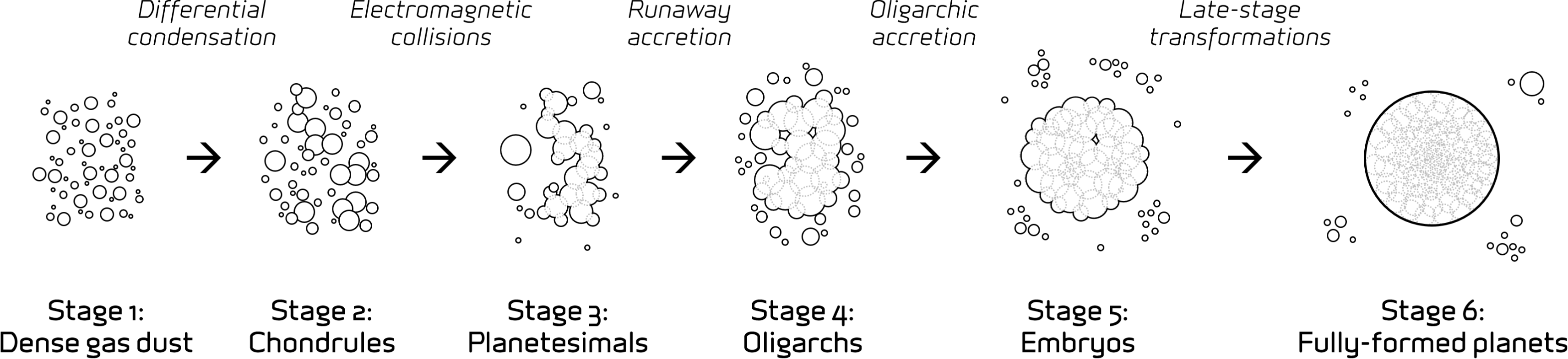
Accretion forms terrestrial planets, which are considered rare celestial bodies in terms of their materials, distance to their star, rapid formation time spans, and potential to host life. This extreme value principle suits well the rarity of ground-breaking or award-winning design solutions – but not because of any essential properties of the constitutive elements. Rather, accretion theory, like evolution theory, allows for extraordinary outcomes from rather ordinary building blocks. The properties of planet Earth are unique compared to other rocky planets known to date – 161 confirmed in 2979 known planetary systems (NASA 2019). However, the early fragments of Earth have a similar origin in the homogeneous materials orbiting close to stars. Accretion occurs in a vast pool of primordial particles, which also maps well onto the notion that quantity is important in ideation to form a ‘feeding zone’ that supports necessary interactions between ideas (stage 0 in Figure 1). In ideation sessions that yield only a few idea fragments, formation of ideasimals is not supported since for attraction forces to kick in, a high density of ideas is necessary to clump together solid ideas.
The accretion metaphor as a model of growth is more compatible with the insights from professional ideation than with essentialist thinking from prominent empirical studies – contrasted on Table 1. Based on the dynamics of planetary accretion, the next subsection casts a view of design ideation as a collisional system of early idea fragments. Parallels between accretion and ideation are formulated and illustrated with vignettes from ideation.
3.1 Accretion in early design ideation
Theoretical contributions can be made ‘when data are more illustrative than definitive’ (Sutton & Staw Reference Sutton and Staw1995). In this sense, we use the level 5 analysis of the segment v21 of the Design Research Thinking Symposium (DTRS11) (Shroyer et al. Reference Shroyer, Lovins, Turns, Cardella and Atman2018) as a vehicle to develop the analogy from accretion theory to design ideation. We start by defining the scale at which the session analysed fits accretion thinking given that ideation can be modelled at different scales and accretion occurs in distinct phases, i.e., gravitational effects only have an effect once the ‘metre-size barrier’ is crossed (Kokubo & Ida Reference Kokubo and Ida2002). A primary step for ideation research thus, is to establish the scale of analysis and the dynamics at work at the phase or scale under study. This can help to structure ideation theory along a time dimension for which different ideation physics may govern: from ideas produced in a few seconds (Alexiou et al. Reference Alexiou, Zamenopoulos, Johnson and Gilbert2009; Goucher-Lambert, Moss & Cagan Reference Goucher-Lambert, Moss and Cagan2019), to several minutes (Gonçalves et al. Reference Gonçalves, Cardoso and Badke-Schaub2013), multiple hours (Viswanathan & Linsey Reference Viswanathan and Linsey2012), days or weeks (Yang Reference Yang2009), and months (Engeström Reference Engeström, Sannino and Ellis2013; Kocienda Reference Kocienda2018).
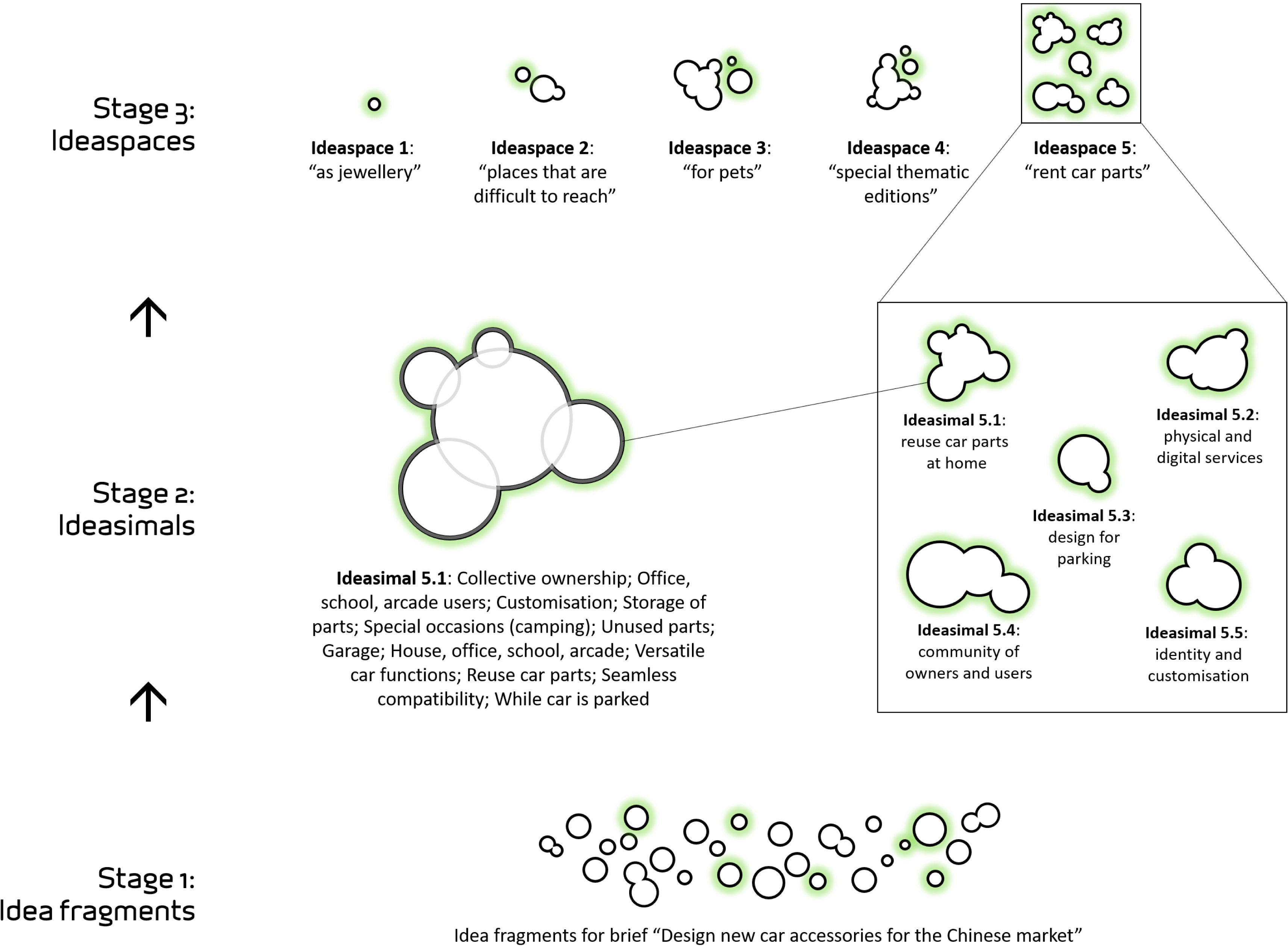
Idea formation is analysed here at the level of verbal interactions in micro-episodes (Shroyer et al. Reference Shroyer, Lovins, Turns, Cardella and Atman2018) in group sessions. This is regarded as an appropriate scale to draw parallels with accretion to focus on collisions between fragmentary ideas as they are shared and discussed in groups where attraction forces take over and have an effect in shaping their growth. Therefore, the focus here is first on the formation of ideasimals defined as the earliest version of recognisable design ideas suitable for systematic scrutiny in micro-episodes of group ideation. Just like gravitational attraction does not have an effect at tiny scales because of low mass density (stages 1 and 2 in Figure 1), we assume that only when idea fragments start to clump into observable ideasimals, attraction drives the growth of solid ideas with sufficient structure and meaning for people to engage in conversations around them – and for researchers to systematically study them (stages 3 and onwards in Figure 1). Ideasimals are thus viewed here as early tangible ideas that serve as primary attractors of discussion in ideation, as they begin to cluster and form ideaspaces through conversations (Shroyer et al. Reference Shroyer, Lovins, Turns, Cardella and Atman2018). This accretion architecture of early ideation is depicted graphically in Figure 3 with idea fragments scaling into ideasimals, which are collaboratively accreted into ideaspaces by the group. The guideline in professional ideation to first generate ideas individually can be considered at the scale of idea fragments, as well as the ideas generated in only a few seconds such as in neurological studies of ideation (Goucher-Lambert et al. Reference Goucher-Lambert, Moss and Cagan2019). As fragments are expressed through visual, verbal, or physical media and shared with a group, ideasimal formation takes over and during an ideation session it forms structures such as ideaspaces.
3.1.1 From idea fragments to ideasimals
The level 5 analysis of segment v21 in the DTRS11 dataset (Shroyer et al. Reference Shroyer, Lovins, Turns, Cardella and Atman2018) illustrates early ideation accretion as a team shapes ‘a collectively generated space made up of many idea fragments’ (Shroyer et al. Reference Shroyer, Lovins, Turns, Cardella and Atman2018). The DTRS11 dataset captured the work of a design team in a car company over three months, producing twenty video recordings of design meetings of between 30 and 90 min in length. Here we look at the 30-min meeting in segment v21 as analysed by Shroyer et al. (Reference Shroyer, Lovins, Turns, Cardella and Atman2018) where they inspect the emergence of an early idea generated in one of the eleven discussions in that meeting. The two-minute conversation analysed in micro-episodes centred around the idea ‘to rent out parts of your car’ (Shroyer et al. Reference Shroyer, Lovins, Turns, Cardella and Atman2018).
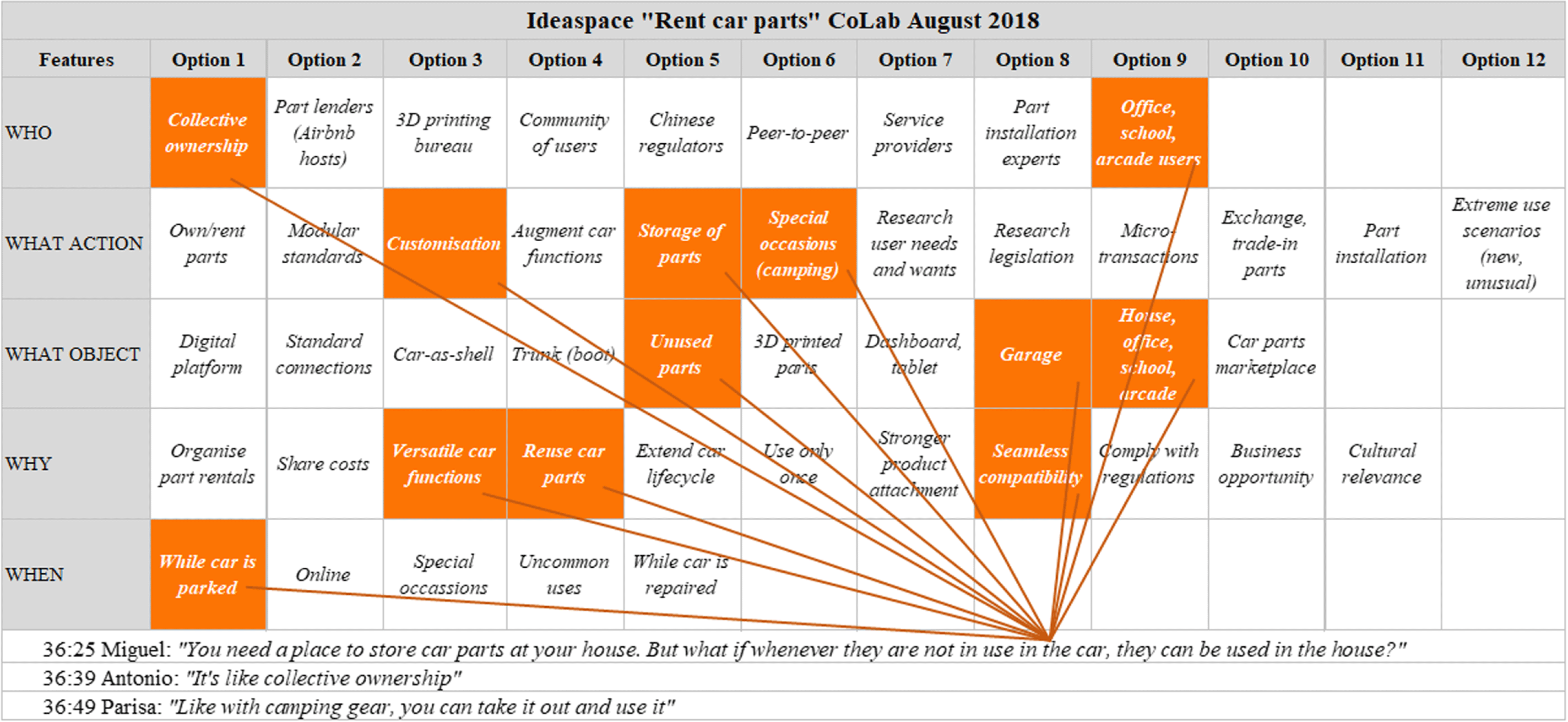
In August 2018 we conducted an ideation session at CoLab in Aotearoa, New Zealand with three professional product designers as a means to reproduce the type of raw data where early ideas emerge applying the same design task as in segment v21 (Shroyer et al. Reference Shroyer, Lovins, Turns, Cardella and Atman2018). The goal is not to replicate a study carried out with an inductive approach, but to generate new data to enable a similar type of analysis. The three participants in the CoLab study (two males, one female, average age 28 years) have an average of five years of professional experience and advance expertise in ideation as participants and facilitators. A 30-min session was planned and conducted applying all of Osborn’s guidelines and recommendations (Osborn Reference Osborn1963; Isaksen & Gaulin Reference Isaksen and Gaulin2005). The design brief to ‘Design new car accessories for the Chinese market’ was given to participants in parallel to the ideation themes of the DTRS11 study. The CoLab session was video and audio recorded, transcribed, and coded for features (who, action, object, why, when, and type of accessory) and options following the level 5 methods of Shroyer et al. (Reference Shroyer, Lovins, Turns, Cardella and Atman2018). We examine the formation of the ideaspace ‘rent car parts’ in Shroyer et al. (Reference Shroyer, Lovins, Turns, Cardella and Atman2018) and in the CoLab session shown in Figure 2.
Ideaspace ‘Rent car parts’ from CoLab study where the ideasimal ‘reuse car parts at home’ builds up by the collision of twelve fragments highlighted in the ideaspace.
Collisions between idea fragments are discernible across the ideaspace depicted in Figure 9 in Shroyer et al. (Reference Shroyer, Lovins, Turns, Cardella and Atman2018) including the chain formed between ‘rent car parts’ $\rightarrow$
‘mafia can rent trunk’
$\rightarrow$
‘mafia can rent trunk’ $\rightarrow$
‘kindergarten can use the front’. In the CoLab study participants form a similar chain forms from the same idea fragment but attracting other ideas ‘rent car parts’
$\rightarrow$
‘kindergarten can use the front’. In the CoLab study participants form a similar chain forms from the same idea fragment but attracting other ideas ‘rent car parts’ $\rightarrow$
‘collective car ownership’
$\rightarrow$
‘collective car ownership’ $\rightarrow$
‘modular car parts’
$\rightarrow$
‘modular car parts’ $\rightarrow$
‘storage at home of unused car parts’
$\rightarrow$
‘storage at home of unused car parts’ $\rightarrow$
‘reuse car parts at home’ as shown in the ideaspace in Figure 2. Rather than aiming to evaluate these idea fragments in isolation, the discussions where they form seem a more appropriate site for analysis, since conversations are where ideaspaces form.
$\rightarrow$
‘reuse car parts at home’ as shown in the ideaspace in Figure 2. Rather than aiming to evaluate these idea fragments in isolation, the discussions where they form seem a more appropriate site for analysis, since conversations are where ideaspaces form.
Accretion regimes include orderly, runaway, and oligarchic, and the transition between these phases is stepwise. In forty-five minutes the CoLab participants generated ideas that formed five distinct ideaspaces depicted in level 3 of Figure 3: (1) ‘car accessories as jewellery’, (2) ‘car accessories for places that are difficult to reach’, (3) ‘car accessories for pets’, (4) ‘car accessories for special editions themed around famous people and sport teams’, and the introduced (5) ‘rent car parts’. The distribution of ideas across these ideaspaces is highly skewed: the longest discussion lasted 16 minutes and attracted more than twenty fragmentary ideas, whilst the shortest discussion of 5 min only addressed eight idea fragments. Five ideasimals (recognisable thematic groupings of fragmentary ideas) emerged in the ideaspace of ‘rent car parts’ depicted in level 2 of Figure 3: (1) reuse car parts and accessories at home; (2) physical and digital services; (3) design for parking; (4) a community of car owners and users; and (5) identity and customisation. Notably, all these ideasimals feed from idea fragments that appeared in other ideaspaces in the CoLab session, depicted in level 1 of Figure 3. For example, the ideasimal ‘people can design their own parts to rent’ has precedents in the idea fragments ‘3D printed car parts’ and ‘customised car parts’ shared in the ideaspaces ‘accessories for pets’ and ‘car accessories as jewellery’, respectively. Hence, ideasimals in the CoLab session form not from unitary and unique ideas, but rather from ‘awkward and unformed, vulnerable and incomplete’ (p. 131) (Catmull Reference Catmull2014) fragments. For clarity, Figure 3 does not show the hundreds of fragmentary ideas that failed to accrete into ideasimals.
An accretion architecture of ideation: early ideas scale up from fragments (bottom) to ideasimals (middle) and into ideaspaces (top). Ideasimal 5.1 ‘reuse car parts at home’ emerged in the CoLab session in the ‘rent car parts’ ideaspace.
Since ideasimals can absorb smaller idea fragments from their own ideaspace and even from other ideaspaces, it could be expected that a few ideas attract a disproportionate number of conversations during a session. In effect, the ‘trunk space’ fragment is mentioned five times by three participants in Shroyer et al. (Reference Shroyer, Lovins, Turns, Cardella and Atman2018) and ‘screen-based interfaces to connect car users’ materialises seven times in the CoLab study. It is possible that ideasimals have basic properties akin to planetesimals’ drag force, gravitational attraction, relative velocity, mass, radius, and trajectory. Such properties would shape the possible outcomes from idea encounters: ideas can collide or fly-by, or they may accrete and grow; when they collide, they may fragment and disperse. The mapping between these accretion processes and early ideation is beyond the scope of this initial exercise and deserves further attention in future studies. A glimpse into such ideation physics is given by the ideasimal ‘reuse car parts at home’ originated from the collision of twelve previous idea fragments in the CoLab session as shown in Figure 2. A follow-up idea that splintered from this was ‘to extend the house/car idea into spaces such as office, school, or arcade’. The CoLab study also provides evidence of emergent properties of ideasimals: the ‘screen-based interfaces’ fragmentary idea had appeared earlier during the session but radically changed meaning when it re-appeared in the ‘rent car parts’ ideaspace right after the ‘Airbnb of car parts’ fragment in the form of ‘dashboard as a tablet like a Tesla’ when it led participants to imagine business opportunities for a ‘provider of content for parts rented’.
Ideasimals appear in a continuous state of transformation, inasmuch as they point to the discussions around fragmentary ideas. Early ideasimals are thus expected to be of different types: some as questions to inform future steps (ask what legislation exists or what target users do), others as statements of intent (accessories must be sustainable), others to provide focus or reveal opportunities (accessories for parking), yet others as thematic or to define a strategy that can be applied to other ideas (customisable accessories). In accretion, the same idea can lead to different directions depending on how it collides with other ideas during a session: this is illustrated when comparing the idea ‘rent trunk or boot of car’ in v21 of Shroyer et al. (Reference Shroyer, Lovins, Turns, Cardella and Atman2018) and in the CoLab session. In the DTRS11 data, this ideaspace included electricity as service, mafia, kindergarten, and homeless people, whilst the CoLab participants viewed it as a means ‘to increase space for special occasions’. Such nascent chain of ideas in our study led to ‘a hybrid system of purchase/rental of cars’ and to the question of ‘what may be uncommon uses for which Chinese car users need to rent car parts?’, with clear precedents in the earlier fragment ‘what may Chinese users want in terms of events, clubs, and celebrities for a themed car collection?’. Such cross-chaining between ideaspaces starts to show how ideasimals can migrate between orbits (conversations) and collide with other ideasimals.
Under an accretion lens, nascent ideas can morph or wither if they are absorbed by other ideas or are ejected from the system (ideation task). In the CoLab study, the fragmentary ideas ‘car crash’, ‘distractions’, and ‘safe driving’ were mentioned early but in the conversations covering more than one-hundred ideas across five ideaspaces, ideas on safety failed to re-appear. As the organisation of accretion disks probabilistically determines the formation of complex bodies, in ideation the way in which the design task or brief is presented to participants may indirectly shape the type of ideas formed. If the brief for this ideation session had been ‘Design new car accessories for safer cars’, then a larger number of idea fragments may coalesce into more relevant ideasimals around safe driving – a premise worth examining in future studies.
The CoLab study illustrates the key observation that ‘instead of one cohesive idea, as the post-it note representation might suggest, the discussion created a space full of possible fragments of ideas that together describe what “renting out parts of the car” might mean.’ (Shroyer et al. Reference Shroyer, Lovins, Turns, Cardella and Atman2018). However, these short ideation sessions only produced initial ideaspaces where early ideasimals form. A longitudinal view of a design project is necessary to build parallels from later accretion stages into more advanced stages of ideation (stages 3–5 in Figure 1). The next subsection examines an account of a professional design project (Kocienda Reference Kocienda2018) applying an accretion lens to look for parallels to late idea accretion stages.
3.2 Accretion throughout a design project
This section zooms out to a larger scale by examining ideation throughout a two-year design project as documented in detail by the lead keyboard designer of Project Purple at Apple (Kocienda Reference Kocienda2018). The method close reading was applied to Chapters 6 to 8 where the author recounts his experiences leading the design of the on-screen keyboard for the first iPhone from the summer of 2005 to its launch in 2007. Closeness in this method refers to the practice of studying a text by annotating, searching, and mapping concepts and moving in iterative cycles through passages gradually selecting highly specific textual evidence to reveal connections and claims (Smith Reference Smith2016). Whilst this is a primary method in literary studies to analyse narrative features, here it was applied to trace and connect all aspects related to idea formation as described by the author. The quality and credibility of this analysis is guided by strategies for reducing systematic bias including careful consideration of competing themes and explanations, triangulation, credibility of the source and analyst, and direct consultation with the author (Patton Reference Patton1999). A tentative timeline of key ideation events was developed focusing on decisions linked to the origins and the journey of the keyboard ideas that ultimately shaped the final design solution documented in patent USPTO 2007/0152980. Triangulation of sources was conducted by identifying and analysing the key ideation milestones and main inflection points of the project in a separate source, a 3-h interview (Kocienda & Williamson Reference Kocienda, Williamson, Hsu and Weber2017). The overall picture construed in this process was refined via a personal email conversation with the author in October 2018. Figure 4 presents the resulting visual summary of the ideation journey that informs our analysis. As with the DTRS11 data, the main value of this vignette is illustrative rather than conclusive (Sutton & Staw Reference Sutton and Staw1995).
Purple keyboard idea accretion stages, ideation outcomes, and evaluation approaches.
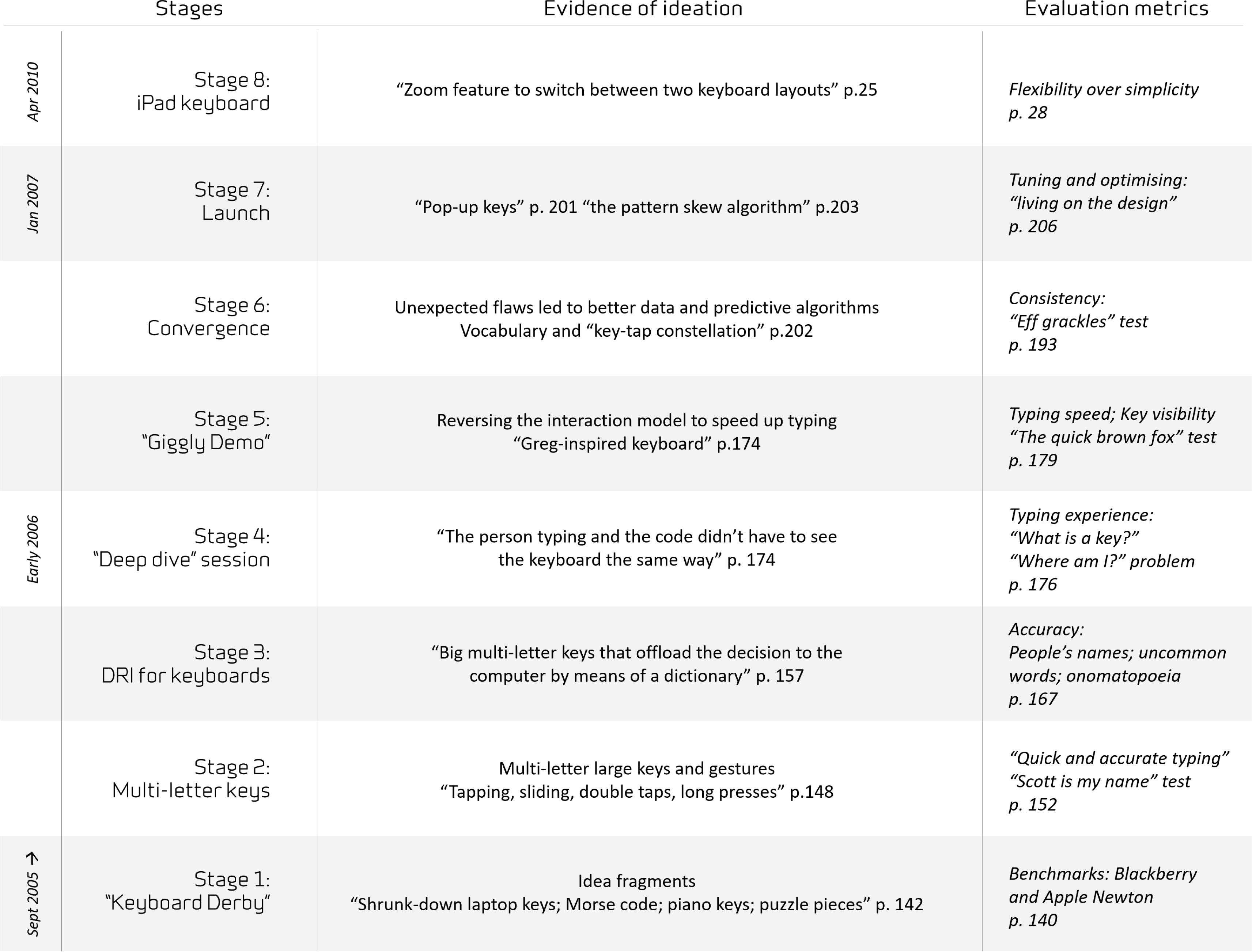
All quotations related to this vignette where parallels between accretion and ideation are shaped, are direct citations from Kocienda (Reference Kocienda2018) in keeping with a close reading approach. In the summer of 2005, Ken Kocienda joined the development team led by Scott Forstall with the brief ‘We are designing a cell phone built around touch’ (p. 135). By September 2005 the team of fifteen engineers were called to a ‘keyboard emergency’ meeting where they were asked to set all projects aside and work on new keyboard ideas that could support reliable typing results, given that the options designed so far were reminiscent of the failed Newton keyboard (p. 140). At the time, the BlackBerry had set the standard for reliable typing on cell phones using physical keys, so the design of a dependable touchscreen keyboard was a high-stake challenge. The team had a few weeks to conceive and build working prototypes for the Keyboard Derby where Forstall would test them and pick a winner (p. 141). The early and fragmentary keyboard ideas were highly diverse, and included ‘shrunk-down laptop keys’, ‘Morse code’, ‘piano keys’, and ‘interlocking puzzle pieces’ (p. 144) shown in stage 1 at the bottom row of Figure 4. As the team prepared their demos, they tested each other’s keyboards and provided feedback. The main accuracy problems with touchscreen typing were initially attributed to fingertip size, the lack of tactile feedback, visual obstruction of the keys when typing, and remaining screen space for content. With the realisation that these problems meant that a ‘big keys’ solution was necessary, many Derby ideas featured a few multi-letter large keys, with a range of means to choose the desired character: ‘tapping’, ‘sliding’, ‘double taps’, and ‘long presses’ (p. 145) – shown in stage 2 one row up from the bottom of Figure 4.
Kocienda built and tested five prototypes in two weeks, all of which informed his derby idea: ‘a big-key QWERTY keyboard that displayed multiple letters per key but that offloaded the decision of picking the letters to the computer’ by means of a dictionary to select ‘the most sensible word’ given the combination of keys pressed (p. 148) – depicted in stage 3 of Figure 4. At the keyboard derby, engineers presented their idea and Forstall tested them using the Wallaby, a tethered multitouch display with the touchscreen feel of the planned hardware. During these sessions, everyone spoke up and Forstall shared ‘something positive about each demo’ (p. 150). None of the keyboards met the expectations of ‘quick and accurate typing’ until he tried Kocienda’s, which he judged ‘amazing’ earning him the position of ‘direct responsible individual (DRI) for keyboards’ (p. 153).
At this stage the competing keyboards fit our definition of ideasimals as collections of multiple idea fragments in working prototypes that sustain conversations and provoke feedback. These ideasimals collided during the weeks leading to the Demo Derby as engineers built and shared their prototypes, tested each other’s’ designs, and shared feedback and recommendations for improvement. The wide use of multi-letter keys shows that the ‘big keys’ idea fragment resonated with several designers and was integrated into multiple ideasimals. Understanding that ‘most demos fail in the absolute dead-end sense of the word’ suggests the necessary ugliness to take early ideas ‘from the intangible to the tangible’ (p. 156). The demo-winning idea ‘set the course for the period of work that followed’ (p. 157) and set a breakthrough that ‘didn’t represent an end, it signalled a beginning’ (p. 163) which aligns well with accretion growth once a few design concepts start to dominate in an ideaspace. At this stage, the evaluation of early keyboard ideas was informed by cursory and largely implicit criteria of reliability and accuracy for an activity that was poorly understood at that time: on-screen typing in small screens. Whilst Kocienda’s early ideas were promising, they would later reveal multiple limitations linked to on-screen typing that were unknown at the time of the derby.
The next stage of development is characterised by an intricate journey of unsuccessful demos, new discoveries, and new understandings of typing problems which led to ‘rethink some of the decisions that led to the derby-winning design, perhaps all of them’ (p. 163). In close collaboration with other developers like Richard Williamson, the limitations behind the premises of the derby design were uncovered, a process also critically informed by feedback from all the Purple colleagues who used it ‘in their daily routine for months’ (p. 167) – a process they called ‘living on’ the design. At this stage, ideation shows properties of runaway growth in accretion, with keyboard ideas cumulatively being incorporated and tested at increasing rates as momentum builds up. Kocienda describes a collaborative culture of pervasive testing that is further illustrated by a screen game developed by Scott Hertz at the time, where team members played to tap a button on the screen in trials where its location and size changed thus providing data that revealed top accuracy for areas of fifty-seven pixels square (p. 226). Many keyboard layout options were tested at this stage, with the familiar QWERTY arrangement being chosen ‘fairly late in the progression of prototypes’ (p. 181). They eventually understood that four principles: ‘big multi-letter keys’, ‘a QWERTY layout’, ‘every gesture a tap’, and ‘a dictionary to provide active assistance’ (p. 172) made typing rather unreliable beyond common short words – such as those used to judge the derby ideas, i.e., the simple phrase ‘Scott is my name’ (p. 152). To reiterate, in a co-evolving process as early ideas started to be implemented, they informed the evaluation criteria most relevant and incrementally informed the framing of the on-screen typing problem.
By early 2006 a ‘deep-dive session’ produced two ideas that collided with the premises of the derby-winning idea: first, ‘one letter on every key’ (p. 173) and second, ‘the keyboard as a means for people to communicate their intent to the device’ (p. 174) – depicted in Figure 4 (stage 4). Kocienda describes how these two new fragmentary ideas changed his understanding of the role of the keyboard in the typing experience at this late stage, after months of work: ‘the person typing and the autocorrection code didn’t have to see the keyboard the same way’ (p. 174). This key insight led to a new idea altogether: the software implementation made the actual keys bigger whilst they visually ‘appeared smaller to the typist’ (p. 174) – or in legalese: ‘the effective contact area or strike area may be larger than the displayed icon size in at least one dimension of the display surface’ from patent USPTO 2007/0152980.
This version of the keyboard design addressed many of the shortcomings revealed at this stage, yet it also helped identify a new problem that slowed down typing by the need to pause at the end of every word to choose between the entered and the suggested words: ‘the suggestion bar bubbles were like speed bumps’ while typing (p. 177). Kocienda addressed by reversing the interaction model, i.e., the space bar enters the top dictionary suggestion whilst the typist taps the suggestion bar to select their exact typing – depicted in stage 5 of Figure 4. Kocienda refers to the testing of this keyboard as the ‘Giggly Demo’ (p. 180) due to the giddiness he and Williamson felt when testing this idea. In oligarchic accretion, growth rate decreases, and one idea dominates the process of formation, as illustrated here by Kocienda referring to the Giggly Demo as exhibiting ‘glimpses of potential’ (p. 189). In a process of several months shaped by continuous changes to the evaluation criteria, the early and sketchy ideas that made Kocienda DRI for keyboards had morphed significantly into a sharper, more definite and well-rounded protosolution. Instances of early ideas appearing late in the process are still visible, such as reversing the input method for suggested words. Importantly, the derby ideas were protected in the early stages and through trial-and-error attracted other ideas as the new practice of screen typing was increasingly understood through testing the attempted solutions, and notions of accuracy and reliability were increasingly defined to evaluate ideas.
The term convergence was used by Apple teams for the final phase of development ‘after the features had been locked down’ and the last months were dedicated to ‘fixing bugs and polishing details’ (p. 191). Nine months before convergence, the Purple keyboard was still to undergo significant changes – just like significant transformations can occur in the late stages of planetary formation. In response to unexpected flaws during demos in this late period, Kocienda incorporated two new ideas to his protosolution to increase the usefulness of autocorrect as depicted in stage 6 of Figure 4: first, better data to form the dictionary and rank word probabilities which was addressed by input from the Purple team ‘living on’ the design. Second, an entirely new design of the predictive algorithms, creatively tackled by weighing the key sequences as a ‘key-tap constellation’ (p. 202) that could then be paired to the closest-matching error-free centred pattern for each word in the dictionary, i.e., ‘the pattern skew algorithm’ (p. 203). This ‘final’ design solution was still tuned and optimised significantly over the following months to improve the typing experience (p. 207). After fifteen months of work, the Purple team was introduced to the first phone, which was announced to the public in January 2007 – stage 7 of Figure 4. In subsequent product releases, the keyboard would still undergo significant transformations – stage 8 of Figure 4 – including the first iPad keyboard, initially designed with a zoom feature to switch between two layouts (p. 28). The changes to the on-screen keyboard designs of subsequent versions of the iPhone and the early iPad models map well onto the changes that a fully formed solution can undergo, such as the ‘Late Heavy Bombardment’ period that drastically shaped the present qualities of planet Earth.
When reflecting upon this journey, Kocienda emphasises that he and his collaborators were constantly forging ahead for the next iteration, always ‘starting small with some inspiration’, making demos, mixing feedback, listening to guidance from colleagues, blending in variations, improving ideas in incremental steps gradually moving step by step ‘from the spark of an idea to a finished product’ and never waiting for ‘an epiphany that would jump us directly from an early-stage concept to a complete product design’ (p. 217). To Kocienda this process feels ‘like trying to fit together a jigsaw puzzle when we weren’t sure what the final picture was supposed to look like, and the pieces kept changing shape’ (p. 244) as ‘we could rarely see the full implications of any one choice in the moment of any one demo’ (p. 245). Kocienda’s jigsaw puzzle analogy further contradicts the essentialist expectation to select jigsaw puzzle pieces of good quality at early stages. To be clear, the ideasimals in the derby-winning design did not have the creative features that the final solution did as essentialist thinking would expect, in fact one of its four premises was wrong (big multi-letter keys) and the rest underwent significant transformations in a combination of gradual and punctuated transformations.
The growth of fragmentary ideas into ideasimals and their evolution over several months enabled and informed conversations about what on-screen typing meant including fundamental design questions such as ‘What is a key?’. For this account to support essentialist thinking, all or the main advantages of the early (derby) ideas in September 2005 would need to be discernible not only to Kocienda but to external experts too. By definition, expertise in creative projects is lacking; at that stage no-one knew what an on-screen keyboard was, and how to design the experience of typing on a small touchscreen. More crucially, for Project Purple to support an essentialist view, the evaluation criteria applied to the final solution in January 2007 would have to be known twenty months in advance in order to assess the novelty, feasibility, and ease of use of early ideas.
The accretion theory of ideation formulated here shows signs of ‘good’ theory by supporting well-structured definitions and relationships (Weick Reference Weick1989). It enables a structure to designate and treat early ideas, and to distinguish between stages of formation. It provides a system of formation by collision of fragmentary ideas growing into perceptible units over time. Further, it enables ways to name and map formation stages, and ways to characterise the processes and the dynamics that govern the growth of ideas. These theoretical bases strongly adhere to descriptions of ideation in the wild summarised in Table 1. The conceptual development of an accretion theory of ideation suggests that viewing idea formation through the lens of planetary formation allows us to form sharper, stronger, more believable and more imaginative ways to reason about and study design ideation – including the ways in which early ideas are evaluated.
3.3 Evaluation regimes of ideation stages
Inspired by accretion as a model of growth to explain ideation stages, we propose three distinct regimes for the assessment of design ideas depending on their stage of growth. These regimes focus on individual and team levels, introduce a new factor or facet of measurement, and span objective and self-rating approaches (Batey Reference Batey2012). To account for the early nature of ugly ideas (‘unformed and incomplete’ (Catmull Reference Catmull2014)), we extend the 4Ps of creativity with a fifth P, idea particle. In its original formulation, the 4Ps strands are defined as: the person, their mental process, the influence of the environment (press), and ‘ideas’ (product) (Rhodes Reference Rhodes1961). The fourth P refers to ‘ideas embodied into a tangible form’ that become accessible when ‘inventions appear’ (Rhodes Reference Rhodes1961), therefore it refers to the completed design solution. Particle is thus used here to capture the early ideas in state of formation which require assessment approaches that bridge across process and product.
3.3.1 Evaluation of fragmentary ideas
First, when evaluating ideas in their earliest state (idea fragments), an accretion theory explains why practitioners avoid making substantive claims about creative value, i.e., the delay judgement rule (Osborn Reference Osborn1963) and protect the new (Catmull Reference Catmull2014). Fragmentary ideas are too general, too incomplete and too unknown to be objectively assessed for originality or feasibility. In early stages it is inadequate to claim objective judgements of creative value of fragmentary ideas such as ‘big keys’ in Project Purple or ‘rent trunk of car’ in the DTRS11 dataset, especially when represented verbally or through a simple sketch. The ultimate creative value and the meaning of such idea fragments only become concrete and can be assessed as more information is available and makes the idea concrete in later stages. Beyond originality or feasibility, we suggest evaluation criteria that is compatible with an accretion view of ideation.
At their earliest stage, ideas can be evaluated for their capacity to attract interest, trigger and sustain conversations, promote trust and participation, and spark new ideas. This can be called the fertility of early ideas (Sosa & Chaszar Reference Sosa and Chaszar2016). New metrics of fluency and flexibility may also be relevant as long as ideasimals are counted as part of networks such as ideaspaces, rather than as well-defined individual units. This goes beyond characterising an ideation session simply by the alleged total number of ideas generated – counting droplets in a storm is immaterial. Metrics for ideaspaces such as density and temperature will be relevant to characterise their extensive and intensive properties at an aggregate level. In the CoLab study, early ideas such as ‘reuse car parts at home’ attracted discussion for longer periods and in higher intensities than most other ideas. In Purple team’s demos, specific ideas attracted more feedback, energised people, and fed the ‘virtuous collaborative cycle’ of building, sharing, testing, giving and using feedback to make improvements – such as the ‘Greg-inspired layout’ (p. 174) (Kocienda Reference Kocienda2018). A strategy to study the properties of ideaspaces consists of sampling them to estimate the extent to which they are formed by fragmentary ideas of high fertility, and if so, to mark them as spaces for further exploration of connections and expansion, rather than select specific individual ideas.
The societal construction of early ideaspaces (van Amstel et al. Reference van Amstel, Hartmann, van der Voort and Dewulf2016) also suggests approaches to evaluation using metrics of conversation (Oak Reference Oak2011) to characterise the creative qualities of an ideation session including, for example, by means of indicators of engagement such as ‘yes and’, ‘deviations’, and ‘humour’ interactions (Sonalkar, Mabogunje & Leifer Reference Sonalkar, Mabogunje and Leifer2013). Evaluations of early ideation can also include a triangulation of product and process metrics for idea particles, including turn-taking dynamics and lexical analysis of the conceptual scope of an ideaspace. In the end, the purpose of evaluation in early ideation is not so much to select ‘the best’ ideas and discard others, but to identify conditions that promote idea collisions and growth. Accretion dynamics respond to structural features of the stellar cloud such as material condensation; similarly the study of ideaspaces may inform strategies to protect and focus on certain types of ideaspaces whilst keeping others at hand for iterative review as the evaluation criteria change (Sosa & Chaszar Reference Sosa and Chaszar2016).
3.3.2 Evaluation of ideasimals
When evaluating ideasimals, the representation format and medium (verbal protocols, sketches, and prototypes) should align with the brief, participants’ skills, project stage, and evaluation approach (Pei et al. Reference Pei, Campbell and Evans2011). The choice of representation must demonstrate support to capture qualities of potential and intent, such as in auditions where most of the elements of a final performance are omitted focusing instead in the demonstrable potential for future possibilities. Design researchers who do not study ideation ‘in the wild’, could draw from practices of professional ideation to design their laboratory or classroom studies. If ‘pitches’ and ‘demo derbies’ are used in the creative industries, then the validity of evaluating solely annotated sketches or written descriptions in experimental setups deserves to be questioned.
Assessment criteria for ideasimals could be directed at their capacity to sustain ‘a spur to take to the next stage’ (Kocienda Reference Kocienda2018). This capacity can be called idea potency and accounts for the type and level responses triggered by ideasimals including feedback and the impact on informing assumptions and evaluation criteria. Idea potency is a contextual property that indicates the fitness of ideasimals to the team, the development stage and timeframe, and the skills at hand, i.e.: ‘give a good idea to a mediocre team and they will screw it up. Give a mediocre idea to a great team, and they will either fix it or come up with something better’ (p. 315) (Catmull Reference Catmull2014). Evaluation at this stage remains heavily dependent on inter-subjective judgements, hence it must account for the evaluators’ own behaviour and self-perceptions and capture the extent to which early ideas make evaluators ‘excited, passionate, or engaged [or have] a creative inspiration of their own’ (Elsbach & Kramer Reference Elsbach and Kramer2003).
Metrics of build-up and growth can help identify ideasimals that attract feedback and spur other ideas thus promoting a focused progress which aligns well with the expectation that in early stages ‘focused creativity is more important than more creativity’ (p. 221) (Belsky Reference Belsky2018). Idea potency can also indicate the capacity to draw people into collaborative practices to synergistically combine knowledge and skills to tackle and explore the unknown.
3.3.3 Evaluation of oligarchs
When evaluating protosolutions that have gained significant traction, practitioners evaluate ideas over time through lived experience (‘to live in’ them) rather than simply judging them early and once. Protosolutions are evaluated by their capacity to persuade, generate feedback, and reveal insights over sustained testing and tweaking. At this oligarchic stage, a few protosolutions can still interact with many ideasimals, so at late stages of a project fragmentary ideas can alter the course of a solution. Just like an asteroid can reshape a fully formed planet, so can a small idea have transformative effects on an embryonic or even a near-to-final design solution. When a protosolution becomes ‘massive enough’ to become stable and dominates over other smaller ideas, it enters a stage of ‘convergence’ (p. 191) (Kocienda Reference Kocienda2018). Full criteria of performance including feasibility then become relevant. Because the emphasis in this paper is on early ideation, the evaluation of final solutions is beyond its scope.
Table 2 summarises the evaluation regimes for ideation stages specifying the evaluation approach and criteria most relevant for process, particle, and product. Person and press dimensions are beyond the scope of this paper.
Assessment of idea particles for three ideation stages: relation to process and product metrics
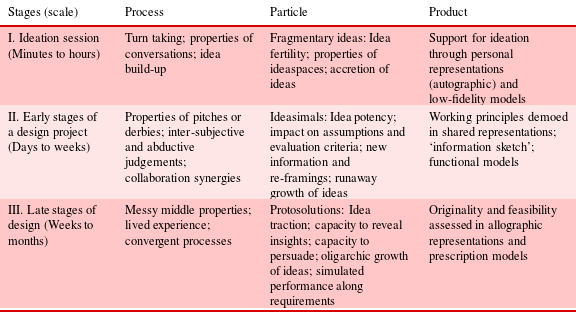
In the co-evolution of problem and solution spaces, the criteria for evaluating ideas are bound to evolve between early and late ideas. Criteria that are critical to evaluate late ideas, such as technical feasibility, are largely irrelevant to evaluate early ideas when design decisions that impact manufacturing and materials have not been made. Instead, criteria that are more relevant to assess early ideas include interest, engagement, and capacity to further inspire other ideas.
In relation to process, an accretion view suggests that a good ideation process is certainly necessary to build a high-quality final solution, but may not be sufficient. An ideation session may be enjoyable to participants, but their enthusiasm may be around ideas that turn out to be out of the scope of the task, or lead to dead ends down the line. Other examples of processes that may score high in the type of metrics inferred here and yet fail to produce creative solutions include the bias of persuasive presentations in the acceptance of new ideas (Lu et al. Reference Lu, Bartol, Venkataramani, Zheng and Liu2018), and the unexpected effects of mood in ideation (Bose, Folse & Lee-Wingate Reference Bose, Folse and Lee-Wingate2013). Viewing ideation as a complex system, in order to explain a final design solution that is ultimately evaluated as exceptionally creative, an alignment of conditions need to occur not unlike the so-called Swiss Cheese model, with good-quality ideation processes satisfying the latent conditions for creativity (Reason Reference Reason2000).
4 Discussion
This paper set to formulate the bases for a theory of idea formation in design. It started by identifying and challenging the unexamined belief that the constitutional qualities of final solutions can be identified in early ideas. Such essentialist view requires that early ideas be objectively assessed applying criteria of creative value including novelty and feasibility. By entailment, an essentialist view infers that when such creative early ideas are selected, they will lead to creative design solutions. The formation of design ideas is analysed here by questioning such premises, deriving insights from professional ideation, and by imaginatively building a theoretical model of accretion to rethink the formation of early ideas. Vignettes illustrate idea accretion from sessions analysed and from a prominent industry project. Evaluation regimes are suggested in reference to multi-level frameworks for the assessment of creativity. The examination of early ideation conducted here supports the role of conversations as ‘a site of design space exploration that deserves more attention’ (Shroyer et al. Reference Shroyer, Lovins, Turns, Cardella and Atman2018). An accretion theory shows value to shine new light over unexamined inferences and ad hoc beliefs in a field that remains weak on theoretical grounding (Sutton & Staw Reference Sutton and Staw1995). Table 3 shows the main conceptual definitions in an accretion theory of ideation.
Definitions of terms in an accretion architecture of ideation
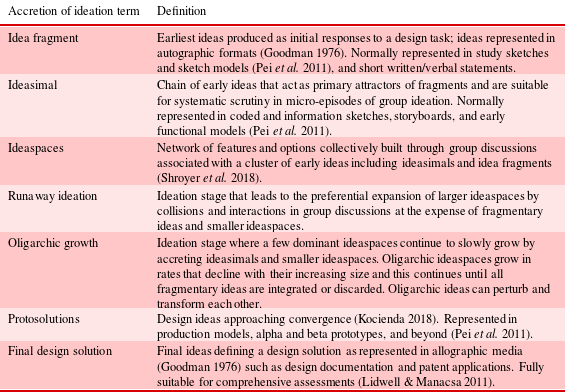
The accretion architecture of ideation sketched here suggests a definition of design creativity as an extraordinary outcome that does not require extraordinary formation processes (Weisberg & Reeves Reference Weisberg and Reeves2013). Complex emergent outcomes can be materialised by formation processes where causation is non-linear and emergent: an atmosphere, oceans, and electromagnetism are planet-level properties not traceable to the homogeneous cloud of dense gas and dust orbiting a star. Likewise, the creative value of a final design solution may not be measurable in its earliest origins because it need not be present in embryonic or scattered ways in them. If so, then design creativity comes into existence at the organisational level of ideas, rather than as a property of individual ideas. An entailment of this perspective is that design creativity may be heavily execution-dependent, and thus shaped by ideas colliding over relatively long time periods – even if its actualisation may occur as a phase transition once the brewing components and favourable conditions eventuate. Accretion thinking is next considered in relation to relevant theoretical principles of design ideation.
The concept of a ‘primary generator’ refers to a dominating idea that expert designers use to structure the solution space from the early stages of a project (Lawson Reference Lawson2004). Experts seem to define an initial focus of attention on a limited set of constraints whilst design students tend to ‘create more problems than they solve by selecting impractical or inappropriate primary generators’ (Lawson Reference Lawson2004). Essentialist thinking would argue that high-quality primary generators lead to better design solutions right from the early stages of a project. However, upon closer inspection, primary generators have certain key properties that make them highly compatible with an accretion theory: first, a primary generator looks like an ideaspace as they ‘can in fact be a group of related concepts rather than a single idea’ (p. 38) (Darke Reference Darke1979). Second, a primary generator is ‘usually more of an article of faith on the part of the architect, a designer-imposed constraint, not necessarily explicit’ (p. 38) (Darke Reference Darke1979). Third, a primary generator is evaluated ‘interactively, in the light of the effect on the emerging concept and on other parameters’ and it ‘is not rejected unless there is a fairly glaring mismatch between it and the detailed requirements’ (Darke Reference Darke1979). These three characteristics of primary generators support non-essentialist interpretations of ideation that do not rely on the creative value of early ideas, but instead emphasise the advanced skills of expert designers to transform multiple early fragmentary and loosely defined ideas of indeterminate quality into a final solution. Crucially, primary generators are not selected for their intrinsic qualities.
An essentialist view of ideation may seem more parsimonious than an accretion view: at first sight, the explanation that good early ideas produce good final solutions seems simpler. Yet, parsimony is still present in accretion, since all that is needed is to view the evaluation criteria from early to final ideas as variable rather than constant. Accretion shows that whilst qualities of a fully formed Earth cannot be derived from a close analysis of early chondrules and pebbles, the chemical composition of the planetary disk can inform the likelihood of certain types of outcomes, such as rocky or gas planets (Morbidelli et al. Reference Morbidelli, Lunine, O’Brien, Raymond and Walsh2012). Accretion takes place in stages with different phases, which is still a parsimonious model of growth.
Abductive reasoning in design aligns with accretion, as this ‘logic of discovery’ is used to generate rather than evaluate hypotheses (Roozenburg Reference Roozenburg1993). Accretion addresses the observation that expert designers make a considerable effort ‘to make the initial idea work, rather than to stand back and adopt a fresh point of departure’ (Cross Reference Cross2004). Essentialist thinking predicts that expert designers continuously generate–evaluate to select-or-discard early ideas until they find a good one. Instead, expert design behaviour shows adherence to an initial concept (Cross Reference Cross2004), so that rather than generating good early ideas, they exhibit advanced skills ‘to modify their concepts rather fluently during development’ (Cross Reference Cross2004). If experts modify their early ideas, as observed in the Purple project, then it need not matter how good these seem to external judges in their earliest versions. In essentialist thinking, the problem remains fixed and evaluation of early ideas is based on well-defined criteria, which contradicts the co-evolution of problem and solution spaces (Maher & Poon Reference Maher and Poon1996; Dorst & Cross Reference Dorst and Cross2001). Essentialist thinking also contradicts what professional designers do: ‘We didn’t wait for an epiphany that would jump us directly from an early-stage concept to a complete product design’ (p. 217) (Kocienda Reference Kocienda2018).
It is possible to cite essentialist accounts of ideation, including first-person narratives where the individual creator is depicted as the genius illuminated by a flash of inspiration. This apparent inconsistency with an accretion theory offers opportunities for deeper insights (Patton Reference Patton1999). The validity of hagiographic accounts of creativity has been questioned for years (Weisberg Reference Weisberg1993), and considered indicative of a paradigm that elevates the (typically) white male individual as the lone creator (Arendt Reference Arendt2013). Even in fields where individual contributions have arguably been the norm, ‘massive collaborations’ are gaining traction and they provide support for elements of accretion. Polymath projects show ‘vividly how ideas grow, change, improve and are discarded, and how advances in understanding may come not in a single giant leap, but through the aggregation and refinement of many smaller insights’ (Gowers & Nielsen Reference Gowers and Nielsen2009). These cases produce detailed data on idea formation, such as the 800 entries by 27 contributors containing 170 000 words in a single polymath project (Gowers & Nielsen Reference Gowers and Nielsen2009). The formation and interaction of fragmentary ideas in a project become visible because they are explicitly stated, shared, and developed in the open (Tao Reference Tao2009). In contrast, hagiographic explanations offer no evidence other than the narrative retold by an individual about their own act of ideation.
Figure 5 shows the change along four dimensions of design ideas from early to late ideation stages. Early design ideas form in timeframes of minutes to hours and are largely abstract, at the individual level, are represented in autographic notations, and are evaluated for potential. Late design ideas form in weeks to months and are concrete, generated in collaboration, are represented in allographic notations, and can be evaluated using performance metrics. Accretion provides a lens by which early and late design ideas are of a different kind, which needs to be acknowledged in their study.
Changes between early and late ideation stages along four dimensions: individual-to-group; abstract-to-concrete; potential-to-performance; and autographic-to-allographic representations.

The exercise of theory building presented here points to a view of creative design as a situated, collaborative, and embodied activity. It also calls for further reflection on the gap between design research and design practice. In addition to scientific rigor, design research can benefit from design rigor from professional practice to support more substantial and valid contributions to knowledge and practice. Since theory building is ‘ideational trial and error’ (Weick Reference Weick1989), our exercise presents several limitations and is likely to undergo significant transformations in future work. First, whilst we have strived to present accretion informed by the standards of good conceptual definitions (Wacker Reference Wacker2008), these need empirical testing including more sophisticated approaches to measurement. Characteristics of an accretion theory of ideation still remain to be developed including its degrees of generalisability and abstractness (Wacker Reference Wacker2008). It is our goal that an accretion view of ideation will serve as a metaphor ‘to grasp the object of study’ in ideation studies (Weick Reference Weick1989). More research is also needed to develop the domain, relationships, and predictions of an accretion theory of design ideation (Wacker Reference Wacker2008).
At this stage of theory formation, an accretion view of ideation goes beyond the data to formulate assumptions that inform future inquiry (Popper Reference Popper1962). The fecundity (Wacker Reference Wacker2008) and heuristic power (Sirgy Reference Sirgy1988) of an accretion theory of ideation are illustrated by framing here a research programme for the development and testing of a disciplinary matrix (Kuhn Reference Kuhn1996). Accretion theory suggests that sampling of ideas at various stages of a design project (minutes, hours, days, weeks) should reveal a complex, non-linear growth in which vaguely defined initial fragmentary ideas interact, pile up, and morph into more well-defined ideas. In this process of copious hazy fragments clumping into a few concrete concepts, designers would show an increasingly clear and more complete understanding of the properties and entailments of ideas, including their creative value. To the extent that this type of studies produce evidence that the creative value calculated in final solutions is detectable in individual early ideas, then the accretion theory of ideation would be falsified. If evidence were to account for both essentialist and accretion types of ideation, then research would need to target the underlying factors behind such differences. The effects of the design brief, team dynamics, and ideation methods could reveal important insights about the stage of a design project at which creative value materialises – if it does at all.
Studies of several design teams tackling a shared design brief would be a suitable setup to capture all early ideas generated across teams. Upon completion of the projects, final solutions can be assessed for creative value and the researchers can go back to the repository of early ideas and ask independent judges (design experts) to rate their perceived creative value in a blind process to eliminate confirmation bias. Support for essentialist thinking would be declared if judges are able to identify the best performing teams by the creative value of their early ideas. The lack of such results would support accretion thinking, since the perceived creativeness of early ideas would not predict the expressed creativeness of the final designs. In a similar scenario, researchers could select the early ideas generated by the top performing team(s) and seed those into a new set of design teams tackling the same brief. If the performance of these teams is significantly higher than the control condition, then essentialist thinking would be supported since there is something in that ideaspace that leads to more creative solutions. In the absence of such effects on team performance, support for accretion would increase indicating that the link between the creativeness of early and final ideas is non-existent or negligible.
Idea evaluation is of central importance in the study of early ideas, and it can be studied by comparing the assessments by independent judges under two conditions: when experts evaluate early ideas in annotated sketches and verbal statements, and when experts base their evaluations on creative pitches where participants present them. Controlling for other factors, significant differences between these conditions would suggest that early ideas are too vague and hazy to be adequately interpreted and evaluated in the absence of direct communication with the idea generators. Such studies would show whether early ideas are aerobic (if they survive and grow in a culture medium of direct human interactions) or anaerobic (if they can be adequately expressed via representations like sketches). If early ideas turn out to be aerobic, that would provide support for accretion in that it would highlight the importance of conversations and discussions as the appropriate sites for analysis of early ideas. This would falsify essentialist thinking which rests on the assumption that early ideas are suitable for the evaluation in the absence of the designer’s voice, as is possible when judging a final design solution.
Studies are also required to test how participants and judges define ideas in the first place. For example, Shah et al. (Reference Shah, Smith and Vargas-Hernandez2003) define ideas as physical principles in a design task ‘to build a device made from a fixed set of materials and powered by a fixed volume of pressurised air’. It is possible that different participants and judges adopt different models and strategies to count, categorise, and evaluate ideas even for tasks that only have one evaluation criterion (distance travelled). To some, an idea could refer to the device as a whole assembly; to others, ideas could be the principles behind separate components such as the means of locomotion (wheeled, continuous tracks, legged), or the architecture of components (number and layout of wheels). Ideas could also be geometrical and topological properties (spherical devices, modular devices), or whether the device is single use or reusable, whether its motion denotes grace or humour, or the ways in which the materials available were used. The significant gaps between peer evaluations and the performance metrics in that exercise, could suggest that participants perceived early ideas in ways that evoked potential beyond what is perceivable by external judges (Shah et al. Reference Shah, Smith and Vargas-Hernandez2003). If evidence confirms that early ideas can mean (very) different things to different designers, and if early ideas can hold (many) different meanings for a single designer, then accretion theory would receive support over an essentialist view which requires early ideas to be objectively identified to be reliably assessed.
Ideation studies could incorporate a metric of ‘potential’ as a precursor of creativity in early ideas. Judges can be asked to consider the extent to which a team may reach a creative solution if they were to further develop that initial idea. Would such ratings of potential correlate with standard metrics of creative value such as novelty or feasibility, or with consensual assessments? Fragmentary ideas can be tested by asking experienced designers to review and select an idea from a pool of early ideas, and to develop it into a creative solution.
Studies that address the ‘quantity leads to quality’ link (Paulus & Nijstad Reference Paulus and Nijstad2003) would be valuable to explain whether it is attributable to combinatorial or to repeated sampling effects. If combinatorial mechanisms explain the path from fluency to quality, this offers support for accretion by implication that the collision of fragmentary ideas produces ideas with properties that are not reducible to their constitutive elements. If the results point to repeated sampling, essentialist thinking would receive more support by implication that the pool of initial ideas contains some good and some bad fragments from the beginning.
The study of ideaspaces will be valuable to identify characteristics of ideaspace formation that lead to creative designs. Design fixation has been defined as restricted exploration of the design space (Crilly & Cardoso Reference Crilly and Cardoso2017). In accretion terms, the exploration of a solution space is more than traversing a landscape of ideas as landmarks; an accretion view of design exploration entails a growth rather than a search process (Woodbury & Burrow Reference Woodbury and Burrow2006). As such, design fixation can be defined here in a theory-driven approach as an accretion process that is disrupted and fails to coalesce ideas, such as the asteroid belt in our solar system where no planet formation took place. The causes could include a pool of early ideas that is too sparse to sustain the collisions between idea fragments that sustain growth; or the premature formation of a giant core idea that swallows, expels, and destroys all idea fragments in or near its path. This suggests that a way to provide participants in studies of fixation with examples (Crilly & Cardoso Reference Crilly and Cardoso2017) would be to seed fragmentary ideas in the design brief, rather than fully formed solutions or even ideasimals that may rapidly trigger oligarchic growth and overpower incipient ideas.
The study of an accretion theory of ideation echoes calls for a broadening of the research approaches that have dominated to date, including methodological triangulation, longitudinal studies, and diversity of researchers (Crilly & Cardoso Reference Crilly and Cardoso2017). The blueprint for an accretion theory of design ideation is drafted here by observing characteristics of ‘good’ theory formation, including strategies for its falsification (Popper Reference Popper1962). Accretion tackles the question ‘Where do ideas come from?’ in new terms: early ideas seem to come incomplete. Early ideas seem more like marsupials than placental mammals or oviparous species: they first emerge fragile, undone, and unfinished. They then form in stages of growth governed by ideation physics that we have yet to understand.
Many paths remain to be explored in future inquiry of ideation. Two that are closely related to accretion are threshold concepts and evolutionary models of creativity. Threshold concepts are considered by learning scientists as ‘akin to a portal opening up a new and previously inaccessible way of thinking’ (Meyer & Land Reference Meyer and Land2005). May the formation of design ideas display a phase transition into threshold ideas that unlock qualities that were previously undetectable? This and a thorough juxtaposition of accretion and evolutionary models for creativity will be addressed in future work.


 Open access

