


Twenty years ago, Forbes remarked that body fat mass (FM) and fat-free mass (FFM) are, ‘in a sense companions: a change in one … somehow induces a change in the other, and in the same direction’ (Forbes, Reference Forbes1987). Forbes described an empirical, non-linear relationship between FFM and FM using cross-sectional body composition data and theorised that longitudinal changes of body composition were described by movement along the cross-sectional curve (Forbes, Reference Forbes1987, Reference Forbes2000). Based on this theory, Forbes derived a mathematical expression for the FFM proportion of a body weight (BW) change as a function of the initial FM (Forbes, Reference Forbes1987, Reference Forbes2000). However, Forbes's mathematical expression is strictly valid only for infinitesimal weight changes.
Here, I present an extension of Forbes's theory to account for macroscopic weight changes. The new equation predicts that the composition of weight change depends on both the direction and magnitude of the weight change in addition to the initial FM. The new equation was compared with experimental data from underfeeding and overfeeding in humans. I also describe the relationship between Forbes's theory and an alternative representation of body composition change that postulates the existence of an energy partitioning parameter, called the P-ratio (Dugdale & Payne, Reference Dugdale and Payne1977; Payne & Dugdale, Reference Payne and Dugdale1977a, Reference Payne and Dugdaleb). The P-ratio defines the fraction of an energy imbalance accounted for by changes of the body's protein reserves. While the P-ratio was originally assumed to be a constant for each individual (Dugdale & Payne, Reference Dugdale and Payne1977; Payne & Dugdale, Reference Payne and Dugdale1977a, Reference Payne and Dugdaleb), here I show that the new expression of Forbes's theory implies that the P-ratio depends on the initial body composition as well as the direction and magnitude of weight change.
Research methods
In women of similar stature, Forbes found that FFM and FM were related according to the following empirical function, f:

with FFM and FM in kg (Forbes, Reference Forbes1987, Reference Forbes2000). Forbes theorised that longitudinal changes of body composition were described by movement along the cross-sectional curve. For infinitesimal BW changes, dBW, the following equation was derived (Forbes, Reference Forbes1987, Reference Forbes2000):
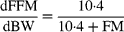
Thus, Forbes's theory predicted that the contribution of FFM to an infinitesimal weight change depended only on the FM.
For a macroscopic change of BW, ΔBW, I rewrote the equation ΔBW = ΔFFM+ΔFM as:
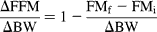
where FMi and FMf are the initial and final values of the FM, respectively. My goal was to find the equation for ΔFFM/ΔBW such that only FMi and ΔBW were on the right hand side. Such an equation predicts the macroscopic body composition change for a given change of BW and initial FM. To accomplish this goal, FMf was rewritten in terms of FMi and ΔBW as follows:

Since the final BW is equal to the initial BW plus ΔBW, then:

Solving Equation 5 for FFMf, and substituting into Equation 4 gave the following:

Equation 6 is a transcendental equation for FMf that was solved using the Lambert W function, W (Corless et al. Reference Corless, Gonnet, Hare, Jeffery and Knuth1996):

Therefore, the macroscopic body composition changes were given by:
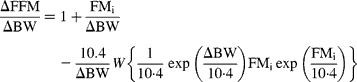
Unlike Forbes's original equation, Equation 8 also depends on the sign and magnitude of the BW change. In the limit that ΔBW approaches zero, Equation 8 reduces to Forbes's original equation. I evaluated Equation 8 using Mathematica™ software (Wolfram Research Inc.).
To examine the implications of Forbes's modified equation for the P-ratio, I neglected the contribution of glycogen and assumed a constant proportion of FFM as protein (Dulloo et al. Reference Dulloo, Jacquet and Girardier1996; Dulloo & Jacquet, Reference Dulloo and Jacquet1999). Therefore, the P-ratio was calculated as:

where α = 9·05 was the ratio of the energy densities of FM to FFM (Dulloo et al. Reference Dulloo, Jacquet and Girardier1996; Dulloo & Jacquet, Reference Dulloo and Jacquet1999).
Results
Fig. 1a and b shows the contribution of FFM to the overall weight change for different degrees of weight loss and weight gain, respectively. The solid curves correspond to Forbes's original equation 2 for infinitesimal weight changes. Increased initial FM was associated with a smaller contribution of FFM to both weight gain and loss.
The fat-free proportion of the body weight change (ΔFFM/ΔBW) as a function of initial fat mass (FM) during weight loss (a, c, d) and weight gain (b). The theoretical curves are presented for different degrees of body weight change along with data points from experimental feeding studies in humans. (a) - - - -, ΔBW = − 55 kg; - - - -, ΔBW = − 25 kg; ——, ΔBW = 0 kg; ○, >4000 kJ/d; × , 2000–4000 kJ/d; ●, 0–2000 kJ/d. (b) - - - -, ΔBW = 55 kg; - - - -, ΔBW = 25 kg; ——, ΔBW = 0 kg; × , Leibel; □, Diaz; ○, Norgan; ♦, Webb; ▲, Deriaz. (c) - - - -, ΔBW = − 55 kg; - - - -, ΔBW = − 25 kg; ——, ΔBW = 0 kg; ■, Keys; Δ, de Boer. (d) Data for body composition changes following bariatric surgery where the average body weight losses are indicated beside each data point. - - - -, ΔBW = − 55 kg; - - - -, ΔBW = − 25 kg; ——, ΔBW = 0 kg; □, Tacchino; ○, Benedetti; ●, Strauss; ■, Das; Δ, Wadstrom; ♦, van Gemert. See the text for a detailed description.

The curves in Fig. 1a show that larger BW losses resulted in a greater predicted contribution from FFM loss. While Forbes's original theory did not account for such an effect, he noted that different degrees of energy intake appeared to impact the predicted body composition change (Forbes, Reference Forbes1987, Reference Forbes2000). These data are reproduced in Fig. 1a where the measured average body composition changes are grouped according to the level of energy intake. The subjects with less energy intake, and presumably greater weight loss, tended to have a higher proportion of FFM loss in accordance with the new equation but previously unexplained by Forbes's equation 2.
Fig. 1b shows the predicted effects of weight gain, where the curves illustrate that higher initial FM results in a greater contribution of FM to the total weight gained. Furthermore, as BW increases, a greater proportion of the weight gain is accounted for by increased FM. During the review of the present manuscript, a referee kindly pointed out that the weight gain data originally presented by Forbes in support of his theory included data from weight regain studies in anorexic patients (Forbes, Reference Forbes1987, Reference Forbes2000). Consequently, after removing the data from the anorexic subjects with very low initial FM, there was insufficient evidence of a relationship between the composition of weight gain and the initial FM. To address this issue, I re-analysed body composition data from several published weight gain experiments (Norgan & Durnin, Reference Norgan and Durnin1980; Webb & Annis, Reference Webb and Annis1983; Diaz et al. Reference Diaz, Prentice, Goldberg, Murgatroyd and Coward1992; Leibel et al. Reference Leibel, Rosenbaum and Hirsch1995) and plotted the results in Fig. 1b. Data from the individual subjects are plotted, with the exception of the studies by Deriaz et al. (Reference Deriaz, Tremblay and Bouchard1993) and Leibel et al. (Reference Leibel, Rosenbaum and Hirsch1995) where I plotted the average values. In accordance with Forbes's theory, subjects with a higher initial FM tended to gain weight with an increased proportion of FM compared with the subjects with lower initial FM. The average weight gain in these studies was < 10 kg.
Fig. 1c plots the individual subject data from the classic Minnesota experiment (Keys, Reference Keys1950) as well as body composition data from the weight loss study of de Boer et al. (Reference de Boer, van Es, Roovers, van Raaij and Hautvast1986). These data also appear to support Forbes's theory regarding the relationship between initial FM and the composition of weight loss. The initially lean young men from the Minnesota experiment lost an average of 17 kg after 6 months of semi-starvation. Accordingly, most of the Minnesota experiment data points fall between Forbes's original curve and the curve corresponding to ΔBW = − 25 kg. The average weight loss from the de Boer study was 11 kg.
When large amounts of weight are lost, Forbes's original Equation 2 differs significantly from the new Equation 8. Fig. 1d plots the average body composition change as a function of initial FM resulting from massive weight loss following various bariatric surgery procedures (Benedetti et al. Reference Benedetti, Mingrone, Marcoccia, Benedetti, Giancaterini, Greco, Castagneto and Gasbarrini2000; van Gemert et al. Reference van Gemert, Westerterp, van Acker, Wagenmakers, Halliday, Greve and Soeters2000; Wadstrom et al. Reference Wadstrom, Backman, Forsberg, Nilsson, Hultman, Reizenstein and Ekman2000; Das et al. Reference Das, Roberts, McCrory, Hsu, Shikora, Kehayias, Dallal and Saltzman2003; Strauss et al. Reference Strauss, Marks, Growcott, Stroud, Lo, Dixon and O'Brien2003; Tacchino et al. Reference Tacchino, Mancini, Perrelli, Bianchi, Giampietro, Milardi, Vezzosi, Sacco and De Marinis2003). The average body weight losses are indicated beside each data point. As expected, Forbes's original equation consistently underestimated the proportion of FFM lost. For example, Equation 2 predicted a FFM loss of 6·7 kg in the patients from the study of Das et al. (Reference Das, Roberts, McCrory, Hsu, Shikora, Kehayias, Dallal and Saltzman2003), whereas the average measured FFM loss was 11·3 kg and the new Equation 8 predicted a loss of 9·9 kg.
Fig. 2 recasts the curves and data from Fig. 1 in terms of the P-ratio. Forbes's theory implies that the P-ratio during underfeeding is a decreasing function of the initial FM, an observation first pointed out by Dulloo et al. (Dulloo et al. Reference Dulloo, Jacquet and Girardier1996; Dulloo & Jacquet, Reference Dulloo and Jacquet1999).
The energy partitioning parameter (P-ratio) as a function of initial fat mass (FM) during weight loss (a, c, d) and weight gain (b). (a) - - - -, ΔBW = − 55 kg; - - - -, ΔBW = − 25 kg; ——, ΔBW = 0 kg; ○, >4000 kJ/d; × , 2000–4000 kJ/d; ●, 0–2000 kJ/d. (b) - - - -, ΔBW = 55 kg; - - - -, ΔBW = 25 kg; ——, ΔBW = 0 kg; × , Leibel; □, Diaz; ○, Norgan; ♦, Webb; ▲, Deriaz. (c) - - - -, ΔBW = − 55 kg; - - - -, ΔBW = − 25 kg; ——, ΔBW = 0 kg; ■, Keys; Δ, de Boer. (d) - - - -, ΔBW = − 55 kg; - - - -, ΔBW = − 25 kg; ——, ΔBW = 0 kg; □, Tacchino; ○, Benedetti; ●, Strauss; ■, Das; Δ, Wadstrom; ♦, van Gemert.

Discussion
Forbes's theory provides a framework for describing the interaction between the major determinants of body composition change: the initial FM as well as the direction and magnitude of weight change. Forbes's original equation only accounted for the initial FM, but the new Equation 8 presented here now includes the contribution of the body weight change. Interestingly, the new equation demonstrated only a weak dependence on the magnitude of the body weight change as indicated in Figs. 1 and 2. This explains why Forbes's original equation for infinitesimal weight changes (equation 2) worked so well for modest weight gain and loss.
However, large changes of body weight were predicted to have a significant influence on the composition of the weight change. Forbes's original equation consistently underestimated the amount of FFM lost following bariatric surgery. Such surgical procedures are becoming increasingly popular for the treatment of obesity, and it may be dangerous to assign a greater proportion of the observed weight loss erroneously to decreased body fat. The new Equation 8 may provide the basis for better predictions of the relative loss of FFM versus FM following bariatric surgery. I have not adjusted Forbes's original parameters to optimise the fit to the weight loss data, but such an optimised equation may be a valuable tool for the assessment of bariatric surgery patients.
The vast majority of the bariatric surgery patients depicted in Figs. 1d and 2d were women, and the original parameterisation of Forbes's equation was derived from body composition studies of women. At first glance, it is surprising that the theory is at all applicable to men who typically have significantly higher FFM. However, the predicted body composition changes depend only on the shape of the logarithmic curve, but not its vertical position. If men have a similarly shaped curve, but shifted upwards corresponding to a higher FFM, then the theory would hold for men as well as women.
Some investigators have assumed a constant composition of weight loss or gain (Dugdale & Payne, Reference Dugdale and Payne1977; Payne & Dugdale, Reference Payne and Dugdale1977a, Reference Payne and Dugdaleb; Kreitzman, Reference Kreitzman1992). The theory also provides the conditions for such an assumption to be valid. A linear relationship between FFM versus FM results in a body composition change that depends only on the slope of the line and is independent of the initial FM or the weight change (not shown). Thus, a group of subjects operating on an approximately linear part of the FFM versus FM curve would show very little dependence on initial FM or the weight change.
Forbes's theory is a convenient model for body composition change in humans, but many questions still remain. For example, is it true that longitudinal changes follow the cross-sectional relationship of FFM versus FM? Furthermore, it is unclear whether the FFM versus FM curve would be followed over the entire time course of weight gain and loss, or only after the transients have dissipated and a new steady state is achieved. Fortunately, these questions are amenable to both experimental and theoretical investigation, and such studies will probably provide important new insights into how body composition is regulated in humans.
Acknowledgements
K. H. is supported by the Intramural Research Program of the NIH, NIDDK.



