





Nutrition for optimal growth and development of children is a key feature for the health and well-being of children in the short-term and as they grow into adulthood(Reference Patton, Neufeld and Dogra1,Reference Wells, Sawaya and Wibaek2) . Childhood is a critical window that establishes life-long eating habits and food preferences which continue to follow an established trajectory across the lifespan(Reference Patton, Neufeld and Dogra1–Reference Venter and Harris4). The environments in which children live, learn and play are key to providing access to information and education about nutrition and healthy eating as well as access to healthy food choices(Reference Patton, Neufeld and Dogra1,Reference Townsend, Murphy and Moore5) . Internationally, the WHO and the United Nations FAO have identified schools as key to creating an enabling environment for children that promotes healthy eating and good nutrition(6–8). In high-income countries, most children attend school for 5 days a week, for up to 30 h, meaning that schools are an opportunity for continuous, intensive contact with children and potentially their families and communities(Reference Peralta, Werkhoven and Cotton9,Reference Dudley, Cotton and Peralta10) . In response, the FAO has developed the School-based food and nutrition education framework to support agencies to develop, strengthen and support school food policies and programmes that have a collective impact on childhood nutrition, community development and local food systems(11). The framework speaks to the importance of incorporating food and nutrition education (FNE) (defined as educational strategies and learning activities that are integrated in the curriculum) and healthy food provisioning across the entire school, specifically through the incorporation of FNE into regular school activities, the active involvement of parents, provision of fruit and vegetables within the classroom and ongoing integration of food and nutrition into curricula(11). The framework includes activities from each element of the socio-ecological model (sem)(Reference Bronfenbrenner12), in that it includes the individual, the household, the community and broader policy context. This scoping review is focused on the FNE aspect of the FAO framework, specifically the teacher and their capacity to deliver FNE in the classroom. It focused on primary (or elementary) schools as an environment where children (aged 5–11 years) are undertaking foundational learning including the development of life-long eating habits and food preferences.
School-based FNE programmes delivered in primary school settings have been shown to be effective in positively influencing children’s energy intakes, fruit and vegetable consumption and nutrition knowledge(Reference Peralta, Dudley and Cotton13,Reference Murimi, Moyeda-Carabaza and Nguyen14) . They are also linked to improved psychological and behavioural outcomes as well as academic performance(Reference Porter, Koch and Contento15,Reference Pucher, Boot and De Vries16) . While schools are recognised as ideal settings and nutrition education has been shown to be effective, the capacity of the school and its workforce to implement these interventions is often not considered(Reference Porter, Koch and Contento15,Reference Gard, Vander Schee, Fitzpatrick and Tinning17) . Despite some evidence of teacher motivation(Reference Perera, Frei and Frei18), a lack of resources, time and pedagogy knowledge as well as the impact of high-stakes assessment and curriculum have all been identified as limiting the ability of schools and teachers to actively embed FNE(Reference Dudley, Cotton and Peralta10,Reference Peralta, Dudley and Cotton13,Reference Love, Booth and Margerison19,Reference Polesel, Rice and Dulfer20) . If schools are to deliver FNE then we need to understand the enablers and barriers that affect teacher’s self-efficacy related to the design and delivery of effective learning episodes on food and nutrition. This review sought to investigate factors impacting on the capacity of this workforce to deliver FNE. It took a socio-ecological perspective to explore the intra- and interpersonal, school, external and policy environmental factors that impact on the ability and likelihood of primary school teachers in high-income countries to deliver nutrition education.
Methods
This scoping review was designed using the Preferred Reporting Items for Systematic reviews and Meta-Analyses extension for Scoping Reviews (PRISMA-ScR) Checklist (Reference Tricco, Lillie and Zarin21) and was registered on The Open Science Framework (9 November 2022) (https://doi.org/10.17605/OSF.IO/VAMJ4). The review was guided by the following research question: among teachers at primary schools in high-income countries, what are the attitudes, knowledge, beliefs, perceptions, confidence, capacity and self-efficacy relating to the teaching, delivery and management of school-based FNE?
Systematic searches of five databases (APA PsycInfo, ERIC, Medline, CINAHL and Scopus) were undertaken using the terms ‘primary/elementary school teacher’ AND ‘self efficacy’ AND ‘food’ OR ‘nutrition’ and a combination of synonyms of these terms (further search detail provided in see online supplementary material, Supplementary File 1). Database functionality was used to filter the results to include only peer-reviewed articles published in English from 2005 until May 2023. Results were downloaded to Endnote (Clarivate, USA) and duplicates removed. Eligibility screening of the results was undertaken against the criteria in Table 1.
Inclusion criteria
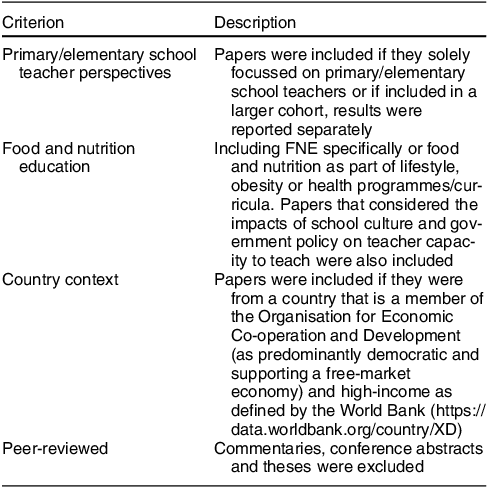
A title screen was undertaken by one researcher (EE) with 20 % of the results checked by a second researcher. Results from this stage were uploaded to Covidence (Veritas Health Innovation, Vic, Australia) where two researchers (EE, DG) conducted an abstract then full-text review. Articles from the full-text review underwent forwards and backwards citation searches to identify additional articles for inclusion. A critical appraisal of all included studies was undertaken by two authors (EE, DG) using the Joanna Briggs Institute quality assessment tools for cross-sectional(Reference Moola, Munn, Tufanaru, Aromataris and Munn22), quasi-experimental(Reference Tufanaru, Munn, Aromataris, Aromataris and Munn23) and qualitative(Reference Lockwood, Munn and Porritt24) study designs. The Joanna Briggs Institute tools were used as they provide a coherent suite of tools for multiple study types.
The data charting process was iterative and collaborative. Two authors discussed the initial impressions of the papers and developed a framework to extract significant results from the included studies in Covidence, led by one author (EE) with 20 % cross-referenced by a second author (DG). Synthesis included a narrative interpretation of the quantitative data that was then integrated with the qualitative themes using a convergent integrated approach(Reference Stern, Lizarondo and Carrier25).
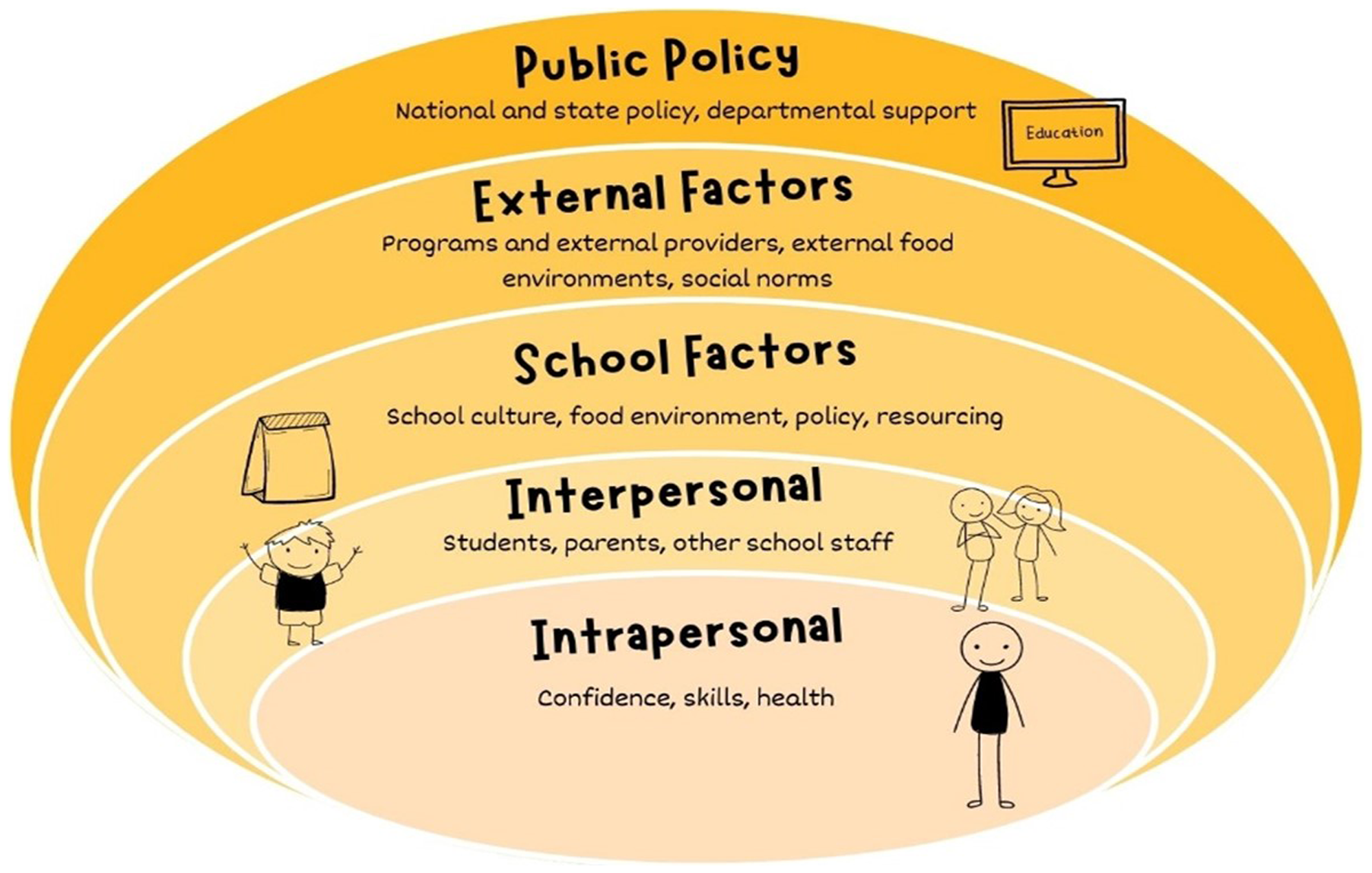
The socio-ecological model is used extensively as a conceptual framework to understand the multiple interacting determinants that impact on child health and development. It posits that children are at the centre of complex interactions between intrapersonal (individual characteristics), interpersonal (interactions and relationships between people), institutional (interactions with organisations (e.g. the school as an institution), community (socio-cultural norms, external agents) and broad macro policy factors(Reference Bronfenbrenner12,Reference McLeroy, Bibeau and Steckler26,Reference Hu, Zhou and Crowley-McHattan27) . The synthesis of results was interpreted using the ecological model adapted to nutrition education in schools by two authors (EE, DG) articulated in Fig. 1.
Ecological model for nutrition education in schools adapted from(Reference McLeroy, Bibeau and Steckler26,Reference Hu, Zhou and Crowley-McHattan27)
Results
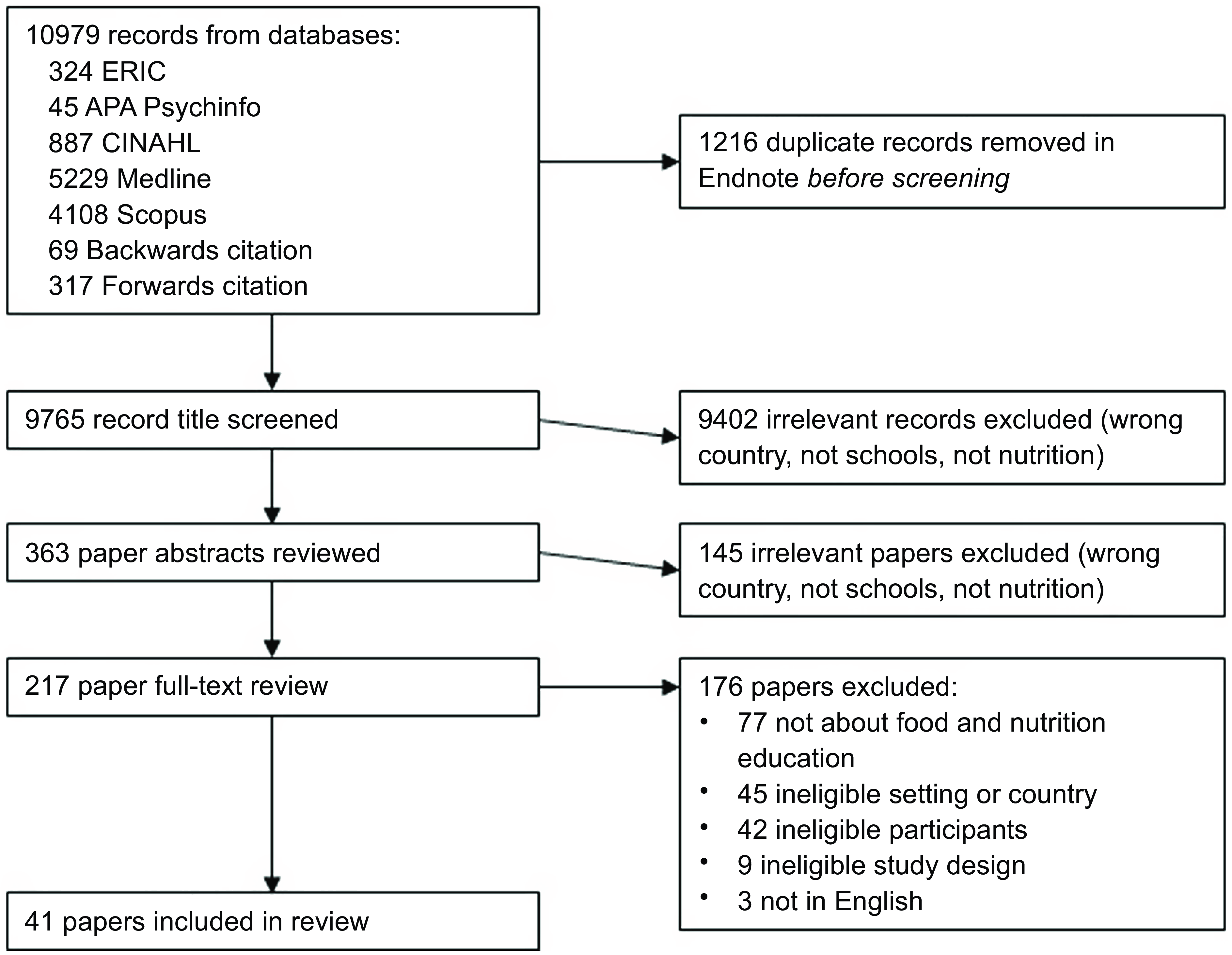
In total, forty-one studies were analysed for the scoping review (see Fig. 2). These included nine quasi-experimental (six high and three medium confidence of quality), twenty cross-sectional (eleven high, two medium, four low confidence and three poor quality), eleven qualitative studies (four high, three medium, one low confidence and three poor quality) and one mixed methods (high quality for qualitative, poor quality for cross-sectional) studies. Detailed quality assessment can be found in see online supplementary material, Supplementary File 2.
PRISMA diagram – identification of studies included in the scoping review
Most studies were from the USA (n 27), with four Australian studies, two studies each from Greece and Cyprus and one each from Chile, England, Finland, Korea, Norway and Sweden. Table 2 identifies which aspects of our modified socio-ecological model (Fig. 1) each study reported on. While all studies reported on intrapersonal factors (n 41), just under two-thirds of studies reported on school factors (n 26), about half reported on interpersonal (n 18) and external factors (n 19) and less than one in five reported on public policy factors (n 8). Further details of study design, methods, country, teacher characteristics, theoretical framework and a summary of findings can be found in see online supplementary material, Supplementary File 3.
Included studies by area of socio-ecological model and study type (by first author surname, year, reference)

Many of the included studies were focussed on FNE for the purpose of preventing or reducing childhood obesity and identified schools as a key setting for behaviour change interventions. Due to the diversity of papers and in keeping with a scoping review, we have identified five themes which align with the socio-ecological model. These were (i) perceived food and nutrition responsibilities of teachers, (ii) teacher beliefs and self-efficacy, (iii) opportunities to build teacher nutrition knowledge and self-efficacy, (iv) interpersonal contributors and (v) broader environmental, structural and policy contributors. The results were mind-mapped and are schematically represented in Fig. 3 (arrows are not intended to imply effect size).
The identified components and interactions of the teaching ecosystem for food and nutrition education

Perceived food and nutrition responsibilities of teachers
Teachers saw themselves fulfilling two main roles related to FNE in schools: educators and role models(Reference Aydin, Margerison and Worsley57,Reference Hall, Chai and Albrecht63,Reference Maliotou and Liarakou65) .
Educators
In the identified studies, a majority of teachers from USA (79 %)(Reference Stage, Roseno and Hodges36), Greece (87 %)(Reference Katsagoni, Apostolou and Georgoulis31) and Finland (89 %)(Reference Laitinen, Antikainen and Mikkonen33) believed it was part of a teachers’ role to provide FNE, which was reiterated in qualitative studies(Reference Aydin, Margerison and Worsley58,Reference Bergling, Pendleton and Owen61) . Between 64 and 76 % of teachers reported delivering FNE as a standalone subject or integrated with other subjects, such as mathematics, science and humanities(Reference Harris and Linnell44,Reference Jones and Zidenberg-Cherr47,Reference Lambert and Carr49,Reference Prelip, Erausqui and Slusser66) . One-third of teachers (N 221, 30 %) reported including nutrition competencies in their lesson plans(Reference Lambert, Monroe and Wolff50) and half (N 482, 53 %) reported the use of formal lesson plans(Reference Lambert and Carr49). There was limited reporting of the volume of teaching time dedicated to FNE; however, three studies found between half(Reference Harris and Linnell44,Reference Hart and Page45) and two-thirds(Reference Lambert and Carr49) of teachers taught 1–10 h annually, and another study found that about half of teachers taught 1–5 h annually(Reference Metos, Sarnoff and Jordan52). One study found that the number of FNE hours was predicted by teachers’ beliefs regarding their impact on students and their self-efficacy to deliver FNE(Reference Metos, Sarnoff and Jordan52).
Role models
Teachers recognised their potential influence as role models(Reference Metos, Sarnoff and Jordan52,Reference Aydin, Margerison and Worsley57,Reference Koutsaki, Saltaouras and Diamantopoulou64) . Most teachers, in one study, believed they could make a difference to student health behaviour (N 628, 81 %)(Reference Metos, Sarnoff and Jordan52), and in another that their own eating behaviours influenced student eating behaviour (N 87, 71 %)(Reference Findholt, Izumi and Shannon40). Healthy eating role modelling was typically defined as teacher consumption of healthy foods and water during class time(Reference Findholt, Izumi and Shannon40,Reference Hamilton, Goodman and Roberts42) . Teachers reported healthy eating role modelling about once a week while concurrently reporting unhealthy role modelling about once a fortnight(Reference Hamilton, Goodman and Roberts42). Another study reported high consumption of water (N 87, 87 %) and ‘low fat snacks’ (88 %) in conjunction with moderate consumption of energy dense-nutrient poor snacks (78 %)(Reference Findholt, Izumi and Shannon40). Between one-third (N 75, 66 %)(Reference Arcan, Hannan and Himes28) and nearly one-half (43 %) reported consuming sugar-sweetened beverages in class(Reference Findholt, Izumi and Shannon40).
Self-reported poor personal health also impacted on teachers’ ability to act as effective role models(Reference Coccia, Tamargo and Macchi38,Reference Hamilton, Goodman and Roberts42) . A study including pre-service teachers (individuals enrolled in a teacher education programme) (N 90) found that those with lower self-reported personal health and lower BMI had a higher likelihood of using confectionary as a reward (as a proxy for unsuitable role modelling). This association potentially reflects that teachers with weight issues may be more aware of the relationship between weight gain and food rewards(Reference Coccia, Tamargo and Macchi38). Teachers with higher self-reported personal health were more likely to report healthy modelling and were less likely to engage in unhealthy classroom food practices(Reference Hamilton, Goodman and Roberts42). This was only possible if teachers were permitted to eat with students and if the school food environment supported healthy eating messages(Reference Berggren, Olsson and Rönnlund60). Being a role model, however, needs to be balanced with the rights of teachers to privacy and downtime, essential for the management of teacher stress(Reference Berggren, Olsson and Rönnlund60). This potentially limited the opportunities for school meals to be opportunities for role modelling.
Teachers’ beliefs and self-efficacy
A range of factors were identified as influencing role modelling and the teaching of nutrition including sex, age and years of experience(Reference Bae and Yoon37,Reference Hamilton, Goodman and Roberts42,Reference Henry, White and Smith46,Reference Kinsler, Slusser and Erausquin48,Reference Perikkou, Kokkinou and Panagiotakos53) . Personal factors in Korea (age (being older), sex (being a woman)) were the only socio-demographics that remained significant for FNE after considering school type, school culture and health literacy(Reference Bae and Yoon37). More years of teaching experience increased confidence/self-efficacy to implement (plan and deliver) FNE(Reference Henry, White and Smith46,Reference Kinsler, Slusser and Erausquin48,Reference Perikkou, Kokkinou and Panagiotakos53) . Conversely, fewer years of teaching experience was also associated with higher endorsement of healthy role modelling practices(Reference Hamilton, Goodman and Roberts42).
Beliefs regarding the importance of nutrition
Across multiple studies, there was consistently high agreement (92–97 %) that nutrition and the foods students eat impacted on learning and on current(Reference Henry, White and Smith46) and future health(Reference Coccia, Tamargo and Macchi38,Reference Findholt, Izumi and Shannon40,Reference Henry, White and Smith46,Reference Metos, Sarnoff and Jordan52,Reference Aydin, Margerison and Worsley58) . If teachers believed nutrition was as important as other subjects, it was prioritised(Reference Hall, Chai and Albrecht63). However, prioritisation was influenced by teachers’ personal beliefs and values related to the importance of nutrition and health(Reference Bergling, Pendleton and Owen61,Reference Bergling, Pendleton and Shore68) . Teachers across several studies agreed FNE should be included in their students’ curriculum(Reference Lambert and Carr49,Reference Koutsaki, Saltaouras and Diamantopoulou64) , should be compulsory(Reference Koutsaki, Saltaouras and Diamantopoulou64) and taught across all age groups(Reference De Vlieger, van Rossum and Riley39,Reference Rafiroiu and Evans55) . In an Australian study (N 97), teachers unanimously reported that educating students about the benefits of consuming vegetables was valuable(Reference Ritter-Gooder, Havlovic and Anderson-Knott35). Despite these consistent beliefs about the importance of nutrition for their students, one study reported that three-quarters (N 69, 74 %) of teachers felt their students did not receive enough FNE(Reference Hammerschmidt, Tackett and Golzynski43).
Self-efficacy
Self-efficacy to teach FNE was moderate(Reference Hawkins, Belson and McClave30,Reference Henry, White and Smith46,Reference Lambert and Carr49,Reference Lambert, Monroe and Wolff50) . Higher self-efficacy was found to help overcome perceived barriers to FNE(Reference Perikkou, Kokkinou and Panagiotakos53) and was predictive of the number of FNE hours taught(Reference Metos, Sarnoff and Jordan52). Once teachers felt they had effectively taught health content (including FNE), they were more likely to embed it into their practice(Reference Kulinna, Cothran and Kloeppel32).
Teachers with higher self-reported personal health had higher FNE self-efficacy(Reference Coccia, Tamargo and Macchi38) and were more likely to deliver self-led or supported FNE lessons(Reference Perikkou, Kokkinou and Panagiotakos53). However, another study found teacher’s personal health, attitudes and beliefs had only a modest influence on classroom practices(Reference Metos, Sarnoff and Jordan52). Studies focused on pre-service teachers reported less than half indicated good personal health, satisfaction with their own eating habits(Reference Coccia, Tamargo and Macchi38) and higher likelihood of eating energy dense-nutrient poor foods(Reference Rossiter, Glanville and Taylor56). Health was conceptualised as weight status in some studies, although no significant relationship was found between weight status and teacher’s confidence with FNE(Reference Coccia, Tamargo and Macchi38,Reference Hamilton, Goodman and Roberts42,Reference Prescott, Lohse and Balgopal54) . Another study found that teachers’ personal health was more relevant than nutrition knowledge in influencing food-related practices and modelling in classrooms(Reference Hamilton, Goodman and Roberts42).
Nutrition knowledge and food skills
Nutrition knowledge was regarded as poor to fair among teachers and pre-service teachers(Reference Katsagoni, Apostolou and Georgoulis31,Reference Coccia, Tamargo and Macchi38,Reference Jones and Zidenberg-Cherr47,Reference Rafiroiu and Evans55) . In one study, a quarter (N 1094, 24 %) of teachers believed they had the nutrition knowledge to provide FNE to their students(Reference Katsagoni, Apostolou and Georgoulis31). In that study, higher nutrition knowledge was positively associated with teacher attitudes towards role modelling, their beliefs about the importance of nutrition and their age but not their years of teaching experience nor position as specialist (health) teachers(Reference Katsagoni, Apostolou and Georgoulis31). While in one study, nutrition knowledge did not appear to be associated with FNE self-efficacy(Reference Kinsler, Slusser and Erausquin48), in two other studies, teachers cited limitations in their nutrition knowledge as an intrapersonal barrier to FNE(Reference Jones and Zidenberg-Cherr47,Reference Koutsaki, Saltaouras and Diamantopoulou64) .
Building teacher nutrition knowledge and self-efficacy
Initial teacher education
Training provided during initial teacher education was identified as potentially improving teacher attitudes towards FNE, nutrition knowledge and FNE self-efficacy. Most pre-service teachers in one study in the USA reported they had little to no confidence in their initial teacher education training to prepare them to teach nutrition concepts effectively or to answer students’ nutrition-related questions(Reference Coccia, Tamargo and Macchi38). Participation in a health methods class among pre-service teachers (USA), with quality skills-based instruction, effectively increased self-efficacy and outcome expectancy for health education (including nutrition) post-intervention(Reference Fahlman, Hall and Gutuskey29).
Professional development
In several studies across the USA, Australia and Greece teachers reported inadequate in-service training to incorporate nutrition into curricula(Reference Lambert, Monroe and Wolff50,Reference Aydin, Margerison and Worsley58,Reference Koutsaki, Saltaouras and Diamantopoulou64) . Participation in FNE professional development interventions had mixed outcomes for teachers. In some studies (Australia, Cyrpus, USA), confidence to teach FNE improved with training and the provision of resources,(Reference Ritter-Gooder, Havlovic and Anderson-Knott35,Reference Perikkou, Kokkinou and Panagiotakos53) which could remain stable over time(Reference Ritter-Gooder, Havlovic and Anderson-Knott35). Teachers in the USA undertaking some form of professional development, tended to report a greater understanding of concepts(Reference Stage, Roseno and Hodges36) and improved classroom food practices(Reference Arcan, Hannan and Himes28). Engagement in professional development also led to teachers being more receptive to FNE resources, school food and nutrition guidelines and the implementation of FNE in their classrooms(Reference Henry, White and Smith46). However, other professional development interventions (one-day, e-learning) showed no improvements in confidence to teach FNE(Reference Hawkins, Belson and McClave30), teacher perceptions of their influence on student nutrition knowledge or attitudes(Reference Stage, Roseno and Hodges36) or changes to their intentions to teach FNE to their students(Reference Katsagoni, Apostolou and Georgoulis31). The length of time devoted to professional development varied from intensive 1–2-day sessions(Reference Arcan, Hannan and Himes28,Reference Stage, Roseno and Hodges36) to less intensive sessions spread over time(Reference Findholt, Izumi and Shannon40).
Resources
Access to easy-to-use teaching resources increased teacher confidence and knowledge(Reference Aydin, Margerison and Worsley57,Reference Hall, Chai and Albrecht63) . Teachers valued resources that were geared towards being engaging for students, especially those with interactive elements including real food experiences(Reference Katsagoni, Apostolou and Georgoulis31,Reference De Vlieger, van Rossum and Riley39,Reference Beinert, Palojoki and Åbacka59) or enjoyable activities and games(Reference Myers, Wright and Blane34,Reference Ritter-Gooder, Havlovic and Anderson-Knott35,Reference Vio, Yañez and González67) . Across multiple studies between a quarter and a third of teachers (25–33 %) consistently reported inadequate access to (or ability to identify) quality resources or the food/nutrition information they wanted to deliver FNE(Reference Katsagoni, Apostolou and Georgoulis31,Reference De Vlieger, van Rossum and Riley39,Reference Henry, White and Smith46,Reference Kinsler, Slusser and Erausquin48,Reference Perikkou, Kokkinou and Panagiotakos53) . Teachers widely supported the provision of resources for FNE, including lesson plans, curriculum resources, information about how to integrate nutrition with other learning areas and materials for engagement with parents(Reference Myers, Wright and Blane34,Reference Graham and Zidenberg-Cherr41,Reference Harris and Linnell44,Reference Jones and Zidenberg-Cherr47) .
There were indications that teachers, while appreciating lesson plans and outlines, also wanted them to be adaptable and flexible(Reference Prelip, Erausqui and Slusser66). This flexibility allowed teachers the agency to apply a strengths-based approach to determining the content they delivered(Reference Bergling, Pendleton and Owen61,Reference Bergling, Pendleton and Shore68) and in doing so influenced curriculum through adaptation in their individual classrooms(Reference Hall, Chai and Albrecht63). Teachers also wanted to protect their autonomy to decide what foods were allowed in their classrooms(Reference Lambert, Chang and Varner51), despite mostly low endorsement of unhealthy classroom food practices(Reference Hamilton, Goodman and Roberts42).
The sources of materials mattered to teachers. One study noted that sources of FNE materials were ad hoc and included websites, other teachers and sponsored education materials(Reference Jones and Zidenberg-Cherr47). A lack of awareness of availability (and accessibility) of appropriate nutrition resources was identified as a key barrier to FNE(Reference Jones and Zidenberg-Cherr47). Teachers reported high use of online information such as websites and games as resource materials to teach nutrition(Reference De Vlieger, van Rossum and Riley39). Another study reported that teachers moderately agreed on the importance of access to FNE materials from government agencies, including reliable information for their own knowledge(Reference Henry, White and Smith46). Programmes such as Crunch & Sip (an in-class fruit, vegetable and water consumption programme, in Australia) that provided initial and ongoing materials were highly regarded by teachers(Reference Myers, Wright and Blane34).
Interpersonal contributors
Within-school networks and school leadership
Principals were identified as key agents influencing teacher beliefs, attitudes and behaviours and therefore their ability to act as food and nutrition educators. Principal support was also considered key for the integration of food and nutrition into curricula (see also the section below on school culture)(Reference Lambert, Chang and Varner51,Reference Aydin, Margerison and Worsley58,Reference Maliotou and Liarakou65) . Additionally, teachers’ beliefs about the acceptability of the use of energy dense-nutrient poor foods were found to be highly influenced by their perceptions about how others (principals, parents and other teachers) viewed their use(Reference Lambert, Chang and Varner51). One study identified that less than half (48 %) of teachers reported they had support from, or opportunity to collaborate with (39 %), other teachers or staff at school or outside nutrition expertise(Reference Lambert and Carr49).
What students get out of food and nutrition education matters
The top three reasons teachers gave for teaching FNE included its importance as a topic, their enjoyment of teaching it and their student’s interest(Reference Harris and Linnell44). Teachers’ enjoyment of FNE was enhanced if students had positive attitudes towards the topic(Reference Hall, Chai and Albrecht63). In several studies, teachers indicated students were more engaged in FNE which included interactive components(Reference Aydin, Margerison and Worsley58,Reference Beinert, Palojoki and Åbacka59,Reference Hall, Chai and Albrecht63,Reference Vio, Yañez and González67) and experiential learning (typically cooking)(Reference Prescott, Lohse and Balgopal54,Reference Koutsaki, Saltaouras and Diamantopoulou64) .
Views about how much interest students would take in FNE varied. One study reported the intention to teach FNE was strongly associated with teacher beliefs about outcome expectations for student behaviours (i.e. beyond food and nutrition knowledge)(Reference Fahlman, Hall and Gutuskey29). A study reported teachers believed that more hours of FNE teaching would have the biggest impact on student knowledge, attitudes and behaviours(Reference Stage, Roseno and Hodges36). In another study, teachers reported enhanced FNE enjoyment if they perceived a change in student dietary behaviour(Reference Bergling, Pendleton and Owen61). However, other studies reported the opposite, revealing teachers did not believe that students would change their behaviour because of the information provided via a FNE intervention(Reference Katsagoni, Apostolou and Georgoulis31), or that more time spent on FNE would have greater impacts on student knowledge, attitudes and beliefs about nutrition(Reference Ritter-Gooder, Havlovic and Anderson-Knott35).
Parents and the connection to home
Teachers believe that parents play an important role in establishing the dietary patterns of children and reinforcing healthy eating(Reference Koutsaki, Saltaouras and Diamantopoulou64). In one study, 25 % of teachers believed it was the responsibility of parents to teach children about nutrition(Reference De Vlieger, van Rossum and Riley39). Teachers were identified as the link between parents, students and the school environment with the potential to reach parents and provide them with support and resources to enable them to feed their children healthily(Reference Aydin, Margerison and Worsley58,Reference Koutsaki, Saltaouras and Diamantopoulou64) . Teachers in Greece believed there was an opportunity for students to apply the knowledge they learnt in the classroom to the home environment(Reference Koutsaki, Saltaouras and Diamantopoulou64). Two studies reported teachers’ interest in materials and resources to share with parents around nutrition education(Reference Myers, Wright and Blane34,Reference Harris and Linnell44) and for developing closer links with parents(Reference Maliotou and Liarakou65).
Broader environmental, structural and policy contributors
School culture
One study investigating the impact of school culture found it explained significant variance in teacher health-promoting behaviours, with positive school culture predicting health-promoting behaviours, interpersonal relations and stress management(Reference Bae and Yoon37). In many studies, teachers made the link between FNE, the school food environment and student food-related behaviours(Reference Arcan, Hannan and Himes28,Reference Findholt, Izumi and Shannon40,Reference Hammerschmidt, Tackett and Golzynski43,Reference Hart and Page45) . Teachers were cognisant that the school environment including, where provided, school meals was often the only exposure to healthy eating some children received(Reference Hall, Chai and Albrecht63). Overall teachers believed that there should be some parameters about the quality of foods provided at school and were generally supportive of measures to improve the nutritional quality of school-provided meals and to remove or minimise energy dense-nutrient poor foods and beverages from vending machines, canteens, within school fundraising activities and the removal of marketing or advertising of these products on school grounds(Reference Arcan, Hannan and Himes28,Reference Coccia, Tamargo and Macchi38,Reference Findholt, Izumi and Shannon40,Reference Henry, White and Smith46,Reference Metos, Sarnoff and Jordan52,Reference Rossiter, Glanville and Taylor56) .
Teachers generally reported having below-average support from the school to provide FNE in the classroom, such as appropriate materials (resources, books, curriculum/syllabus), equipment, funding and training (in-service)(Reference Myers, Wright and Blane34,Reference De Vlieger, van Rossum and Riley39,Reference Hart and Page45–Reference Jones and Zidenberg-Cherr47,Reference Lambert and Carr49,Reference Lambert, Monroe and Wolff50,Reference Metos, Sarnoff and Jordan52) . In England, strong school leadership was identified as a key factor for the successful implementation of whole school policy and FNE(Reference Hart and Page45). In this English study, only about a half (47 %) of primary schools had school governing bodies actively supporting and monitoring school food practices with senior leadership oversight of school food environments and FNE(Reference Hart and Page45).
Lack of time
Time was identified as a critical factor for the implementation of formal and informal FNE in the classroom(Reference Hart and Page45,Reference Aydin, Margerison and Worsley58–Reference Bergling, Pendleton and Owen61,Reference Hall, Chai and Albrecht63–Reference Bergling, Pendleton and Shore68) , some citing an already overcrowded curriculum(Reference Aydin, Margerison and Worsley58,Reference Maliotou and Liarakou65) , or higher academic priorities (reading, maths, language) and associated high-stakes assessment(Reference Myers, Wright and Blane34,Reference De Vlieger, van Rossum and Riley39,Reference Graham and Zidenberg-Cherr41,Reference Hammerschmidt, Tackett and Golzynski43,Reference Harris and Linnell44,Reference Jones and Zidenberg-Cherr47,Reference Lambert and Carr49,Reference Lambert, Monroe and Wolff50) . Finding time in the curriculum to be able to engage both theory and practice was difficult, acknowledging that more time would promote deeper learning(Reference Beinert, Palojoki and Åbacka59). However, two studies reported that the perception of time and workload barriers (especially the burden of implementation in addition to other responsibilities) diminished when self-efficacy and familiarity with FNE increased(Reference Bergling, Pendleton and Owen61,Reference Bergling, Pendleton and Shore68) despite no net change to curriculum or assessment overall.
Policy
Few studies directly explored the role of wider policy in supporting teachers to teach FNE. In the USA, schools are required to develop a School Wellness Policy aimed at student wellness that includes FNE. There is, however, flexibility within school districts to interpret what represents student wellness locally(Reference Findholt, Izumi and Shannon40,Reference Hamilton, Goodman and Roberts42) . While one study found more than half of schools had integrated FNE via this policy mechanism(Reference Hammerschmidt, Tackett and Golzynski43), another study found that teacher awareness and confidence to implement their school wellness policy tended to be low(Reference Henry, White and Smith46). Other studies reported that around one-third (36 %) of teachers were unaware if their school had a food/nutrition policy(8) or had participated in any FNE education programmes(Reference Metos, Sarnoff and Jordan52). However, exploration of urban and suburban schools with established School Wellness Policies found over time teachers were less likely to endorse the use of food in the classroom(Reference Hamilton, Goodman and Roberts42). Conversely, another study found there was little change in rural teacher food-related behaviours over the 10 years since the School Wellness Policy legislation had been passed(Reference Findholt, Izumi and Shannon40).
Embedding food and nutrition education
The three most common ways FNE was integrated into schools was through a school wellness or food and nutrition policy, embedded within FNE-specific health curriculum or other curricula, or by using external providers(Reference Hammerschmidt, Tackett and Golzynski43). School meals where offered may be an opportunity for embedding FNE. However, the studies included in this review found no pertinent examples of this integration. Teachers consistently reported moderate agreement for the need to have a written school food and nutrition policy or guidelines to support FNE(Reference Arcan, Hannan and Himes28,Reference Findholt, Izumi and Shannon40,Reference Henry, White and Smith46) . About one-third of teachers reported they believed they were given opportunities to influence school food/wellness policies including how to incorporate nutrition competencies into lesson plans(Reference Arcan, Hannan and Himes28,Reference Lambert, Monroe and Wolff50) . The focus and the rigidity of the curriculum concentrating on what are considered core academic subjects (and high-stakes assessment) was identified as another barrier(Reference Hall, Chai and Albrecht63,Reference Maliotou and Liarakou65) . The pressures for teachers in a standards-based education system were identified as a barrier to some FNE activities (e.g. school gardens); however, the integration of nutrition into core academic subjects was identified as overcoming this(Reference Graham and Zidenberg-Cherr41).
External providers of food and nutrition education
Access to and use of external providers for FNE in classrooms or to integrate FNE into schools were reported by between one-third and one-half of teachers across several studies(Reference Hammerschmidt, Tackett and Golzynski43,Reference Lambert and Carr49,Reference Lambert, Monroe and Wolff50,Reference Metos, Sarnoff and Jordan52) . One study identified moderate agreement of the importance of external providers being nutrition experts(Reference Henry, White and Smith46). Another identified that schools tended to utilise existing contacts as external providers to deliver FNE (mostly parents, college students or other teachers with far fewer dietitians, school nurse or food staff)(Reference Metos, Sarnoff and Jordan52). A qualitative study in Greece identified the need for a health professional in schools to support the nutrition environment(Reference Koutsaki, Saltaouras and Diamantopoulou64). Another advocated for a FNE coordinator position at the district (regional) level, to assist schools in developing FNE syllabus and facilitating lessons between schools(Reference Lambert, Monroe and Wolff50).
Discussion
This review has identified that influencing the capacity of teachers to engage in nutrition education in primary schools is a complex interaction between broad education policy, leadership within schools, allocation of and access to resources and individual teacher factors. Most papers focussed on intra- and interpersonal factors with very few interrogating the influence of high-level policy. Focussing on more upstream factors will inevitably lead to addressing those issues for individual teachers effectively optimising the integration of FNE in primary schools.
One of the key upstream factors that will influence FNE in primary schools is a change in school culture. School culture is impacted by broad education policy as well as local school leadership (predominantly led by school principals)(Reference Liu, Bellibaş and Gümüş69). Teachers’ perceptions of the organisational structure within schools is postulated to impact on their experiences of burnout, time pressures, job satisfaction and self-efficacy(Reference Skaalvik and Skaalvik70). A learning goal structure that focusses on individual student performance, and on safe and inspiring learning environments was associated with stronger self-efficacy and improved job satisfaction. A learning focus optimises teacher agency and brings to the forefront the skills of teachers in assessing individual student needs and adjusting accordingly. Conversely, a performance goal structure focuses on student performance and achievements and tends to be associated with increased experience of time pressures and burnout(Reference Skaalvik and Skaalvik70,Reference Richards, Hemphill and Templin71) . A performance goal structure has been the feature of neoliberal education policy in the UK, USA and Australia and has as its central features a focus on accountability: competition (between schools, teachers and students) and reporting scales(Reference Polesel, Rice and Dulfer20). The goal structure of a school is set by broader policy and by the school leadership(Reference Nwoko, Emeto and Malau-Aduli72). The findings of this review suggest that teacher attitudes and food-related behaviours and their motivation to integrate FNE can change over a long period of time in response to national policy and/or policies at the school district level if they have appropriate structural support between the national-district-school nexus.
High-level policy that acknowledges and promotes the importance of food and nutrition is key to student learning. Strong school leadership to influence classroom food practices and whole-of-school cultural change is needed to embed normative practices and support teacher role modelling. Curriculum planning mechanisms are ideal for developing such FNE practices with local (community-relevant) contexts in mind. FNE in schools is optimised through facilitating cross-curricular integration of nutrition, a supportive school food environment (including promotion and curriculum integration of school meals and gardens)(Reference Olarte, Koch and Wolf73,Reference Block, Gibbs and Staiger74) and the integration of experiential learning [policy] while at the same time promoting teacher agency(Reference Love, Booth and Margerison19,75) . Teacher agency has been widely contested but is broadly accepted as the degree to which teachers, as individuals but also as a community of professionals feel they have the power to act, make decisions and take a stance on approaches that affect their work and their identities(Reference Eteläpelto, Vähäsantanen, Hökkä, Billett, Harteis and Gruber76,Reference Priestley, Biesta, Robinson, Evers and Kneyber77) . The current predominant approach based on standardised-based policies, detailed national curriculum documents and national assessment protocols has constrained agency and has threatened the professional identities of teachers(Reference Poulton78). Despite these constraints one of the key features of agency is developing skills and competencies including the development of self-efficacy and capacity to negotiate between the constraints of policy and the needs of their learners(Reference Molla and Nolan79). The review highlights the need for a ‘bottom-up’ approach, acknowledging teachers as key agents in the transformation process of contextualising curriculum and integrating teaching and learning episodes, in this case that are focussed on FNE(Reference Fullan80,Reference Lim-Ratnam, Atencio and Lee81) .
There is growing international support for the integration of 21st century skills and competencies into curricula and this would include FNE as a life skill. Amid determining what 21st century skills and competencies might comprise, practicing teachers have identified an overcrowded curriculum and professional pressure to address national standards and accreditation values as barriers hindering the implementation of these skills and competencies(Reference Kopish82,Reference Drake and Reid83) . At a more fundamental level, practicing teachers are unsure about the design, implementation and assessment of these ‘additional’ capabilities(Reference van de Oudeweetering and Voogt84). Integration of FNE with other curricula areas could be a means of overcoming the barriers expressed by teachers(Reference Drake and Reid83,Reference Drake and Reid85–Reference Follong, Verdonschot and Prieto-Rodriguez87) . However, a performance focus and the siloing of key learning areas means that the integration of curriculum remains relatively unexplored. This can be partially overcome by aligning FNE content across other subjects considered more academically significant with high-stakes assessment.
Schools, heads of curriculum and teachers need to be given appropriate access to resources to ensure that integrating FNE reduces rather than increases workload. These resources are not necessarily lesson plans that limit teacher agency but rather resources that enable teachers to creatively adjust their teaching processes in a dynamic ongoing way. This review has also found that an increase in teacher self-efficacy and enhancement of their own health and well-being reduces perception of workload burden when adding FNE as part of their role. While teacher self-efficacy is optimised via the school structure and broader policy, the perception of lack of time and the workload associated with the burden of implementation of FNE that is in addition to their other responsibilities diminishes when self-efficacy and familiarity increase. The findings in this review indicated that providing professional development that is inclusive of self-efficacy principles is creative in how FNE is delivered across curriculum areas and that optimise teacher agency will be the most effective(Reference Timperley and Alton-Lee88).
It is increasingly acknowledged that teaching is a highly complex, stressful and demanding role(Reference Berger, Reupert and Campbell89,Reference Herman, Hickmon-Rosa and Reinke90) . In everyday practice, teachers encounter a range of challenges including but not limited to responding to varied student’s needs, navigating interpersonal relationships (with students, parents, other staff), managing expectations of all stakeholders, time pressures related to the demands of standards-based education and policy and work-life balance. With schools assuming a higher load associated with student’s psychosocial, emotional and physical well-being, this is increasing the burden on schools and teachers. If schools are to be sites that promote and teach health and well-being for its students, then the health and well-being of its teachers needs to be protected. Programmes to improve teacher health may improve their health behaviours and practices in schools and their motivation and self-efficacy to role model and teach food and nutrition(Reference Skaalvik and Skaalvik70).
This review had three key limitations. Firstly, the papers included are heterogenous and many are small studies within localised contexts that may not be generalisable. This was overcome in part by applying an ecological lens to synthesise the data more broadly. Secondly, many of the papers emerged from school environments in which school meals are provided and the delivery of FNE in this context is very different to those where students bring food from home. Finally, this review was limited to primary/elementary school contexts and did not include middle or high school/secondary school, where eating behaviours and food literacy are still forming and where teachers can still be influential.
Based on this review, key recommendations for moving forward in building FNE into primary schools include as follows:
-
1. A continued focus on education reform to be more learner-centred to promote teacher agency;
-
2. Embedding FNE skills into initial teacher education for the next generation of teachers;
-
3. Ensuring that principals and school leadership teams understand the role and importance of FNE for student outcomes;
-
4. Adaptable and flexible integration of FNE into curriculum planning supported by school leadership;
-
5. Workplace environments that ensure and promote teacher health and well-being to support their capability to act as role models and
-
6. Providing resources to creatively integrate FNE across curricular areas to minimise workload, promote self-efficacy and build student life skills.
Finally, this review has demonstrated a complex interplay of factors that support or hinder the integration of FNE in primary school settings. These include interpersonal and intrapersonal teacher factors through to broader upstream school culture and policy influences. Taking a socio-ecological approach and working across systems will potentially enhance the capacity of schools to make FNE core business.
Acknowledgements
This work was funded by the Queensland Children’s Hospital Foundation via a philanthropic donation from Woolworths. We are grateful for the staff and customer donations that made it possible for us to undertake this research. We also acknowledge Tina Gingell for her research assistance.
Financial support
This study was funded by Children’s Hospital Foundation (via philanthropic donation from the commercial funder Woolworths). The Children’s Hospital Foundation had no role in the design, analysis or writing of this article.
Conflict of interest
Danielle Gallegos and Emma Esdaile have received research support from the Children’s Hospital Foundation via a philanthropic donation from the commercial funder Woolworths. Danielle Gallegos and Emma Esdaile declare they have no other conflicts of interest. Lee Wharton and Helen Vidgen declare they have no conflicts of interests.
Authorship
Study searches were carried out by a research assistant. E.K.E. and D.G. reviewed titles, abstracts and full-text articles, extracted and synthesised data and wrote the paper. H.V. and L.W. contributed to the discussion. All authors contributed to the final version of the paper.
Supplementary material
For supplementary material accompanying this paper, visit https://doi.org/10.1017/S1368980024001812


 Open access

