

It isn’t hard for a layman to study the chief directions of maritime currents from scholarly books, but the fact that these currents at times change their routes dramatically, refracting, splitting, and affecting the condition of their destination, is something that hasn’t entered the common consciousness at all.
In the spring of 1868, the New Bedford bark William Rotch on its voyage out of Honolulu approached a rocky and treeless isle several hundred miles south of Japan in search of guano deposits. On shore, the sailors noticed the remains of a wrecked ship and several large planks with Japanese script, and soon they came upon a castaway crew of seven. The men had survived for eighteen months in complete isolation, feeding off of albatross meat, limpets, and collecting rain in eggshells. The castaways explained how, sailing out of Osaka, they had been caught in a storm that badly battered their junk, leaving them adrift for two weeks before they washed up in this desolate place. Captain E. F. Nye, intrigued by his discovery of the remains of large dwellings, followed the castaways up the valley to find three “bomb-proofs” cut into the solid rock with a fireplace each and several sleeping bunks, and hundreds of albatross eggs filled with water and oil. As the captain later reported in the Hawaiʻi-based Pacific Commercial Advertiser,
near by were a number of niches cut into the rock, each containing several smooth flat stones with Japanese writing on them. My Japanese stopped and translated the inscriptions for me: they were records of six different shipwrecked crews that had been cast upon the island, some of them a long time ago. We next came to one with three stones set up in it, which proved to be the record of Manjaras [Nakahama Manjirō, see Chapters 4, 5, and 6], who was shipwrecked some 30 or 35 years ago. He was taken off by Captain Whitfield of the William & Eliza, I think.Footnote 1
Over the years, decades, and centuries, a recurring southward deviation of the Kuroshio had driven uncounted sailors into the open ocean and but a few of them were fortunate to land on an isle large enough to grant food and water to survive. Even fewer sailors managed to improvise rafts out of driftwood and debris collected over decades to return home and record their experiences for posterity.Footnote 2 The involuntary colony of castaways on the volcanic islands of the Izu Ridge, blown off course by winds and the meandering Kuroshio, belonged to an uncertain geography of drift that shaped the realm of fishermen and maritime cargo workers.
This chapter argues that early modern Japan was embedded in the ocean as a terraqueous economy for which the ocean was both resource and infrastructure. Encounters like the one described illustrate that regardless of Japan’s centuries-long political introversion, the offshore remained an important and densely traveled part of Japan’s economic realm. Sailors from all provinces busily plied the archipelago’s coastal waters, though mostly on cheaply built boats unfit to venture into the open ocean. Fishermen and whalers, again, harvested the archipelago’s inter-island seas intensively. Both sailors and fisherfolk at times ventured beyond sight of the shore, but all maritime activities came with an elevated risk of accidents: Since some of the most important cargo routes followed the Kuroshio along the archipelago’s southern verges, it happened frequently that winter gales and summer typhoons blew Japanese vessels into the unknown. This fraught relationship between the inhabitants of Tokugawa Japan and the ocean that surrounded them has long shaped knowledge and economic practices of the hydrosphere.
The occasional return of castaways from uninhabited isles or foreign countries attracted curiosity from the general public and suspicion from state authorities. In 1670, a crew of drifters first reported the discovery of a group of “uninhabited” Munin or “Bonin” Islands, a piece of news that inspired a costly expedition to map and inventory the remote archipelago (see Chapter 3). In 1797, a certain Chōhei from Tosa province (1762–1821) returned from a “bird island” or Torishima south of Honshu. Over thirteen years Chōhei had collected driftwood and debris from vessels lost at sea, and together with two other crews that had washed up there over the years, he finally managed to sail home. In Japan, he thence made a living traveling and recounting his story.Footnote 3 In 1826, a crew of seven returned from Palau by way of Manila and China, and after a certain Otokichi and his crew had drifted across the Pacific to the Olympic Peninsula in 1832, attempts to instrumentalize his repatriation in 1837 culminated in a skirmish at Edo Bay against the American missionary vessel Morrison (see Chapter 4).Footnote 4 Around 300 “drifting accounts” or hyōryūki are known today, written down in the bureaucratic language of official interrogations, or recounted in vernacular for the curious public. Popular renderings of these drifter stories circulated widely in commercial publications, sometimes embellished with episodes of cannibals and fantastic creatures, feeding on the public’s lurid imaginary of the endless ocean. This paradoxical situation – the intense material and cultural relationship with the archipelago’s marine environs, and a deeply rooted aversion Marcia Yonemoto has described as Japan’s “ocean fears” – has puzzled many historians.Footnote 5
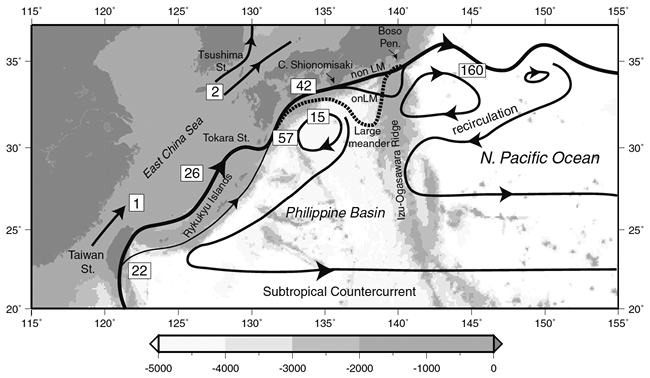
There are specific, though fluid and unstable, geographies and temporalities through which the Japanese experienced the ocean, subject to geophysical processes in the ocean and in the atmosphere. Perhaps the most prominent among those processes is the Kuroshio current, which is often likened to the “Gulf Stream of the Pacific.” With speeds up to 250 cm per second, the Kuroshio is an extraordinarily quick current.Footnote 6 Along its path from the equator to Northeast Asia and eastward into the North Pacific, the current first encounters the islands of the Bashi Strait, a region home to the seafaring Tao people who, before national borders divided the sea, traveled back and forth between Taiwan and Luzon along the current and its local countercurrents (Figure I.1).Footnote 7 Further north, the Island of Lüdao in the middle of the current became a nest of renegades around 1800 when Qing authorities expanded their control over the Taiwan Strait.Footnote 8 As it passes over the subaqueous Yilan ridge east of Taiwan, the surface flow accelerates to the speed of a light jog.Footnote 9 The upwelling near the Senkaku Islands long attracted rich fish stocks and, starting in 1897, Japan’s first industrial tuna fisheries under the fisheries magnate Koga Tatsujirō.Footnote 10 Halfway into the East China Sea, the Kuroshio splits into the northbound Tsushima current, flowing past the old whaling stations of the Gotō islands and over the colder waters of the Japan Sea, and a main branch that crosses the Tokara Strait north of Kyushu to meander along the southern shores of the Japanese main islands. Across the Tokara Strait, it separated the Ryukyuan islands Japan’s southernmost Satsuma province, marking the furthest extent of the Ryukyu kingdom before the Japanese invasion of 1609.Footnote 11
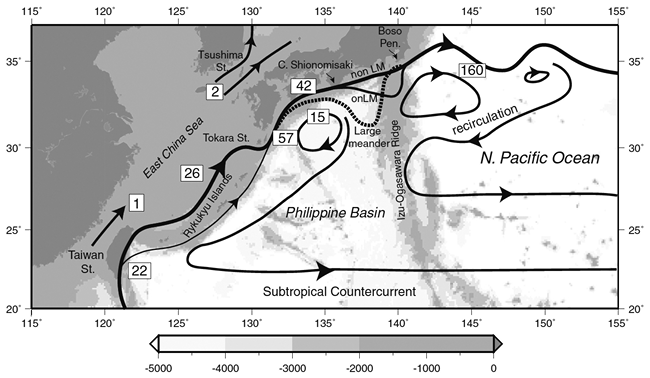
Centuries of experience-based interaction with the sea throughout this Kuroshio region continues to shape contemporary knowledge of the ocean. The current’s heat and nutrient transport from the low latitudes exerts a major influence on atmospheric thermodynamics, humidity, and precipitation, and as an effect, on agriculture and fisheries throughout the region.Footnote 12 Accelerated by a subtropical gyre – forced into a clockwise rotation by the Coriolis force in the manner of a high-pressure area – the current meanders to the southern capes of Shikoku and the Kii Peninsula, where Japan’s most prominent whaling businesses took shape in the seventeenth century. Every decade or so, the Kuroshio changes its path over several hundred kilometers within a few weeks, forming a “Large Meander” to the south, radically reshuffling fishing grounds throughout the region, and affecting precipitation and temperature across Japan (Figure 1.1).Footnote 13 Likewise, the Kuroshio Extension on the open Pacific is highly unstable, fluctuating widely on its eastbound path. Depending on weather and wind, the subtropical gyre can deflect branches of the Kuroshio so far south that they form a southern recirculation that is forced back to the Bonin Islands.Footnote 14 Immersed in this dynamic oceanic topography, the Japanese islands are historically sunken into the rhythmic fluctuations of marine and atmospheric strata.
The main and lateral branches of the Kuroshio with gyres and countercurrents. In: Talley et al., Descriptive Physical Oceanography, 2011, 309.
Awareness of these terraqueous processes matters not only for a neo-materialist reading of economic history, but it also challenges Eurocentric paradigms about the environmental context of early capitalism. In particular, the temporalities of marine and atmospheric processes, or the shared experiences of climatic events between distant regions, may inspire an alternative set of overlapping and interlinked histories. The term “terraqueous,” which I use to describe this metabolic relationship, emerges from early modern descriptions of global geography, at a time before continental categories had turned the archipelago of old and new worlds into a binary of oceans and continents. Today, the concept serves to frame histories that transcend the shoreline and are essentially shaped by the fluidity of the sea. As Alison Bashford writes, terraqueous histories “foreground the meeting of land and sea that has engaged so many historians of different periods and places, substantively, symbolically, and epistemologically.”Footnote 15 In other words, they revisit moments of knowledge production and cultural transformation as contingent on their material environment. But besides human exchange mediated by the hydrosphere, terraqueous histories also have a metabolic dimension, one that has been overshadowed by the land-centric bias of Japan’s early modern archive.
In this chapter, I will first outline the most significant geophysical processes that regulate climate and ecology across the western North Pacific in an interconnected manner: the East Asian Monsoon and two major current systems, the Kuroshio and the Oyashio.Footnote 16 The fluid geography these processes created shaped oceanic knowledge and economies in important ways. The Kuroshio, which feeds abundant fishing and whaling grounds off Honshu, and the Oyashio, which carries nutrients down from the Arctic, played important roles in the development of Japan’s terraqueous polity. Secondly, I discuss how fisheries, whaling, and shipping businesses that operated in this fluctuating environment linked aquatic and terrestrial nutrient cycles, thereby supporting economic growth on shore. What Toshihiro Higuchi has called Japan’s “organic empire” was in fact fueled by an expansive oceanic resource base.Footnote 17 The chapter concludes with a reflection on the implications of a materialist, ocean-centric framing of Japanese history since the seventeenth century. In most essential terms, the expansion of Japan’s oceanic resource base undermines the widely propagated myths of a small and resource-poor country, as well as the claims that its economic emergence was, in any ways, miraculous.
The Kuroshio, the Monsoon, and Other Alternatives to Euro-normativism
At the turn of the twenty-first century, Japanese historian Hamashita Takeshi described maritime East Asia as a chain of “interlinked sea zones,” an early modern network of entrepôts that reached from the Sea of Okhotsk in the north to the Yellow, East, and South China Seas and on to the Java Sea and the Indian Ocean.Footnote 18 Scholars in the Braudelian tradition, attuned to longue-durée perspectives on transnational regions, celebrated the economic entanglement of early modern East Asia beyond the rigid maritime policies of anxious governments, and have put forward the idea of an “East Asian Mediterranean.”Footnote 19 Perhaps inspired by the emergence of “tiger states” and the expansion of the Chinese economy since the 1980s, these histories were primarily concerned with the emergence of Asian capitalisms. Though aware of the seasonal rhythms that historically dominated traffic between the region’s commercial and political centers, such scholarship was trade-centric and ultimately limited to the intensely plied and semi-bounded seas west of the Philippines, Taiwan, Ryukyu, and the Japanese islands. Shifting the focus to the eastern boundaries of this East Asian archipelago, where the bulk of Japanese economic life took place, however, reveals the limitations of such Euro-normative models. Instead of the classical Euro-Japanese comparison, I suggest that terraqueous Japan be understood as embedded in the macro-geographies of the Kuroshio, Oyashio, and the East Asian Monsoon, which make for shared and teleconnected experiences with societies in the Indian and Pacific oceans.
Japan’s southern and eastern shores are especially dominated by rapid currents, winds, and seasonal storms that make the zone a much riskier environment for ocean travel than more bounded seas. It is widely accepted among climatologists today that the constant southeasterly summer winds that pump moisture from the Pacific onto the Asian continent, and the strong northerly winter winds that create a dry climate in most of those regions during the winter months are part of the monsoon pattern which also dominates the climate of East and Southeast Asia.Footnote 20 Coupled with climatic events in the ocean, such as the interannual El Niño-Southern Oscillation (ENSO) or the decadal “Large Meander” of the Kuroshio, as well as seasonal typhoons, these processes historically made the Kuroshio region a hazardous and often unpredictable environment for marine economies and trade.Footnote 21 Such aspects of the oceanic environment conditioned a specific temporality of interaction and a context of heightened risk to maritime businesses compared with the relatively calm and contained Mediterranean sea.
The Pacific, the largest body of water on earth, pools climatic processes and seismic events, creating teleconnected experiences of disaster. Transpacific tsunamis have time and again caused death and damage all around the “ring of fire.” When an “orphan tsunami” hit the coast of northeastern Japan on January 27, 1700, nobody could have known about the wave’s origin in the Olympic Peninsula, where a major earthquake and mudslides buried entire villages.Footnote 22 Since the Chilean Tsunami of 1960, however, pan-Pacific disasters have inspired the creation of transnational warning systems, put to the test by the massive tsunami that bolted eastward across the ocean on March 11, 2011.Footnote 23 The sheer size of the Pacific basin moreover allows the formation of particularly violent tropical cyclones. Climatological research keeps adding evidence of how the occurrence of super-typhoons, as well as oscillations in the marine climate of the North Pacific’s Kuroshio current, respond to a global context of climatic phenomena. For example, El Niño events that otherwise manifest themselves most clearly in the Americas and Southeast Asia, move the genesis of tropical cyclones southeast, making for a longer seaborne pathway and more violent landfalls.Footnote 24 Tropical cyclones – taifū in Japanese or taifeng in Chinese – create a transnational geography of seasonal hazards, risk avoidance, and castaway encounters over vast distances, a “riskscape” that is shifting today under the impact of climate change. These currents, storms, and seismic waves function historically as an integrated ecosystem with changing geographies of resource extraction, energy injection and biological homogenization, as Ryan Tucker Jones has argued.Footnote 25
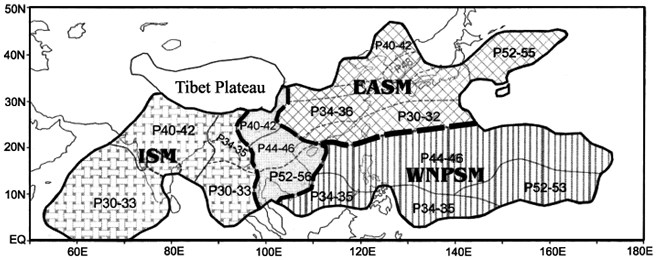
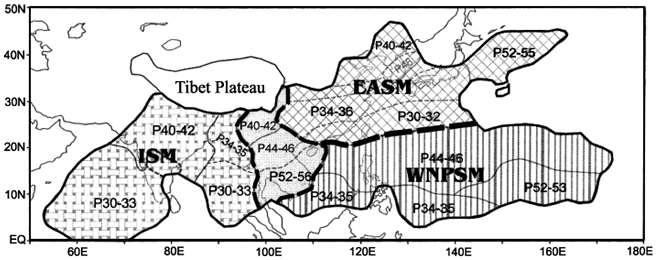
Transregional geophysical processes like these – and the contingency in their response to climate change – may inspire new interpretive frameworks to move beyond worn-out East–West dualisms. In the meteorological classification, Northeast Asia’s summerly “plum rain,” – tsuyu in Japanese or méiyǔ in Chinese – constitute a part of the Australasian Monsoon System, a large wind pattern that stretches from the tropical Pacific deep into the Chinese mainland, encompassing the Indian subcontinent and expanding as far as Java and other densely populated zones of the southern hemisphere. The monsoon fluctuates seasonally, pumping moisture from the Pacific onto the Asian continent in summer, and reverting its direction to create a dry climate in these regions during the winter months. The monsoon’s rhythm affects some 60 percent of the world’s population today, making for one of the most powerful climatological teleconnections in the earth system (see Figure 1.2).Footnote 26
Geographical subdivision of the Asian Monsoon system into an East Asian Summer Monsoon (EASM), a Western North Pacific Summer Monsoon (WNPSM), and an Indian Summer Monsoon (ISM), in Ding and Chan, “The East Asian Summer Monsoon,” 2005, 118.
The monsoon’s transregional influence on culture, migration, and commerce has been most minutely explored in the context of the Indian Ocean. More than just a seasonal pattern that dictated the direction of sail or the geographical limits of rice agriculture, the monsoon created a maritime interaction zone that connected India and Southeast Asia through migration and trade. The monsoon networks Sunil Amrith shows that spanned from the Bay of Bengal to the “Sea of Melayu” were only severed – though not entirely – by the drawing of national borders and the emergence of landward-looking agendas of national development in the twentieth century.Footnote 27 Others have found that imperial encounters with the tropical cyclones of the Indian Ocean created essential data trails for mathematical models of risk assessment by British insurance companies.Footnote 28 The Indian Ocean World’s multipolar networks of trade, knowledge, and migration across the monsoon zone from East Africa to Southeast Asia have been identified as reaching far inland to Lake Tanganyika in East Africa and into the South and East China Seas.Footnote 29 In short, following the monsoon winds, historians are rediscovering Asian oceans as interconnected cultural spaces in their own right, emancipated from the Eurocentric trajectories of imperialism and globalization.
Questioning East–West dualisms is by no means an argument for uniqueness of the Japanese case – at least not more so than the observation that any historical situation consists of unique constellations and unpredictable outcomes. Accordingly, re-framing Japan not as an eastern endpoint of an East Asian Mediterranean, but as a maritime zone subject to a climate fundamentally distinct from that of other “advanced organic societies” in northern Europe, opens new possibilities.Footnote 30 Exchange of historical experience as seen through an actor-network-theory lens attuned to distributed human and nonhuman agencies, can be likened to the behavior of oceanic currents. This observation inspired Prasenjit Duara to suggest “circulatory” paradigms of history, without a beginning, an end, or singular turning points.Footnote 31 The metaphorical “drift” in the meanders of historical currents can be described, but not predicted or repeated. Just like meteorology, historiography can be synoptic and abstracted. Such histories are decentralized, teleconnected, and interdependent, as they are refracted across the myriad vectors of a fluid environment. Classical maritime maps commonly indicated the Kuroshio as a bold arrow in the sea, expressing confidence about future directions. Contemporary models, by contrast, represent moving water masses as myriad tridimensional vectors. How will modern history appear if thought of as a meandering drift rather than a firm trajectory of forward progress?
Unlike environmental processes that only constitute themselves as such in the macroscopic perception of modern science, the Kuroshio is both a scientifically perceived phenomenon and a historical source term. Where ancient Chinese cosmologies believed in a “cosmic drain” in the ocean, early modern mariners of Japan understood the current as a “river” Kuroshio that carries drifters all the way to America.Footnote 32 It is possible to revisit the current’s historical perception while avoiding the anachronism inherent in most modern scientific categories – on some of which I will nevertheless build a part of my argument in this chapter. The history of the current’s ideological use, moreover, reveals the career of a Japanese concept evolving from the secretive knowledge of experienced sailors into the vocabulary of modern oceanography, as Chapter 3 will show in more detail. For now, we will look into the question of how attention to the texture and temporality of ocean and atmosphere around Japan can reposition the archipelago in global history.
The Kuroshio in Japan’s Maritime Highway Network
The quasi-feudal bakuhan polity of the Tokugawa depended logistically on a tightly-knit network of maritime highways, ports of call, and clearing stations. A strong scholarly attachment to the land-borne highway network of early modern Japan – given its prominent place in printed sources – has obscured the fact that maritime routes were of overwhelming importance for the prosperity of urban centers and for the archipelago’s commercial and cultural integration.Footnote 33 The intensification of marine traffic along the Kuroshio route made the current a part of the archipelago’s offshore infrastructure.
Before the famous edicts of the late 1630s that effectively prohibited Japanese traders from venturing abroad and reduced foreign exchange to a few diplomatic “windows” under more or less direct shogunal control, Japanese actors in fact wielded major maritime power. Tokugawa Ieyasu himself harbored far-reaching plans for transpacific engagement in the early seventeenth century. Ieyasu aimed to establish a trade route to New Spain (Mexico), operated by Japanese crews and vessels with the goal of competing against the Spanish “Manila Galleons,” whose eastbound voyages to Acapulco had begun following the path of the Kuroshio in the 1560s.Footnote 34 Joshua Batts points out that Ieyasu’s plans represent the first attempt at a bilateral relationship across the Pacific, making Spain’s intra-colonial trade the object of an inter-imperial competition.Footnote 35 In 1609, the current drifted the former governor of Luzon, Rodrigo de Viviero y Velasco (?–1636), to eastern Honshu in distress while en route to New Spain. The incident offered Ieyasu a pretext to escort the governor to Acapulco the next year, along with a diplomatic delegation. A few years later, in 1613, the Keichō embassy to Rome, sponsored by Date Masamune of Sendai (1567–1636), crossed to Acapulco on the Japanese-built San Juan Batista, and, by way of it, repatriated the Spanish explorer and ambassador, Sebastian Vizcaíno (1548–1628), who had spent over a year in Japan on his search for the famed Isles of Silver and Gold.Footnote 36 The shogunate’s efforts to break into this transpacific exchange eventually faltered when the shogunate severed its ties with New Spain and Manila in 1625, in reaction to Spanish efforts to lock Japan out of its intra-imperial affairs.Footnote 37 Although the shogunate subsequently adopted what Robert Hellyer has called a “non-voyaging agenda,”Footnote 38 the navigators in its service were, at one point, at the forefront of long-distance navigation along the Kuroshio.
When Ieyasu decided to move the headquarters of his military regime to the village of Edo in 1603, he also set in motion a major shift in the archipelago’s economic geography. Within a few decades, the construction of Edo castle and the establishment of domain residences grew the field camp into one of the largest capitals (if not the largest) of the early modern world. By the early eighteenth century, the metropole counted an estimated one million inhabitants, significantly more than contemporary metropoles in China or Europe at the time.Footnote 39 As the urban economy was growing over the seventeenth century, the shipping industry crew increasingly commercialized as well and expanded in scale.Footnote 40 The most important of these routes, the mercantile arteries between Edo and Osaka, led sailors through seas marked by strong currents and seasonal typhoons. The elevated risk did not deter sailors from shipping along the archipelago’s Pacific routes, but it affected the way Japanese ship owners operated and invested.
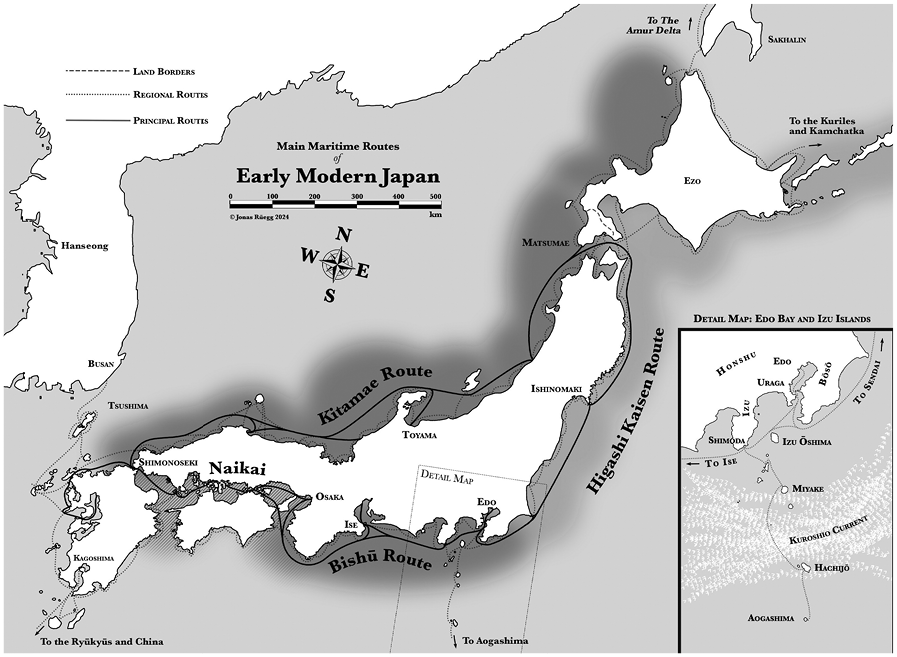
Louis Cullen estimates that some 4–5,000 vessels passed through Osaka and well over 7,000 entered Edo each year between the 1720s and the 1870s.Footnote 41 Vessels arriving from the western provinces with tax rice and commercial goods destined for the markets of Edo were ordered to undergo inspection at Shimoda and again at Uraga before entering Edo Bay. Goods coming in on the higashi-kaisen route from northern Honshu were either shipped around the Bōsō Peninsula to meet the western routes at Uraga, or they reached the city by way of an increasingly complex system of canals furrowed across the Kantō plain.Footnote 42 Marine transportation was at the mercy of seasonal winds. The northerly winter winds impeded shipping northward to the Japan Sea side on the nishi-kaisen or kitamae route, and also along Honshu’s southern shore; these winds elevated the risk that ships were lost at sea. Despite the scale and political importance of the merchandise transported at sea – the largest vessels carried tax rice across the realm – the vessels often had to wait for wind and weather. Shipping times varied seasonally and by chance: The sail from Osaka to Iwami province on the Japan Sea could last between eight days and a month, and the voyage from Osaka to Edo took at least ten, but could last as long as seventy-three days. The vessels had to call several times along their coastal routes, and it was common that they would have to turn back shortly after leaving the harbors. At times, they had to wait for days or even weeks for the right winds.Footnote 43 Yet, traveled densely in the vicinity of the shore, the maritime highways along Honshu’s southern coast were, together with the land-borne highways Tōkaidō and Nakasendō, the essential trunk roads connecting Eastern and Western Japan (see Figure 1.3).
Principal inter-city shipping routes of early modern Japan. The routes encircled Honshu and connected the urban centers of the Kantō and Kinki regions. From Edo to Toyama on the Japan Sea coast, a shipment employed about a month and a half taking either the eastward Okusuji Route via Tsugaru, or on the westward Naikai/Kitamae route via Shimonoseki.
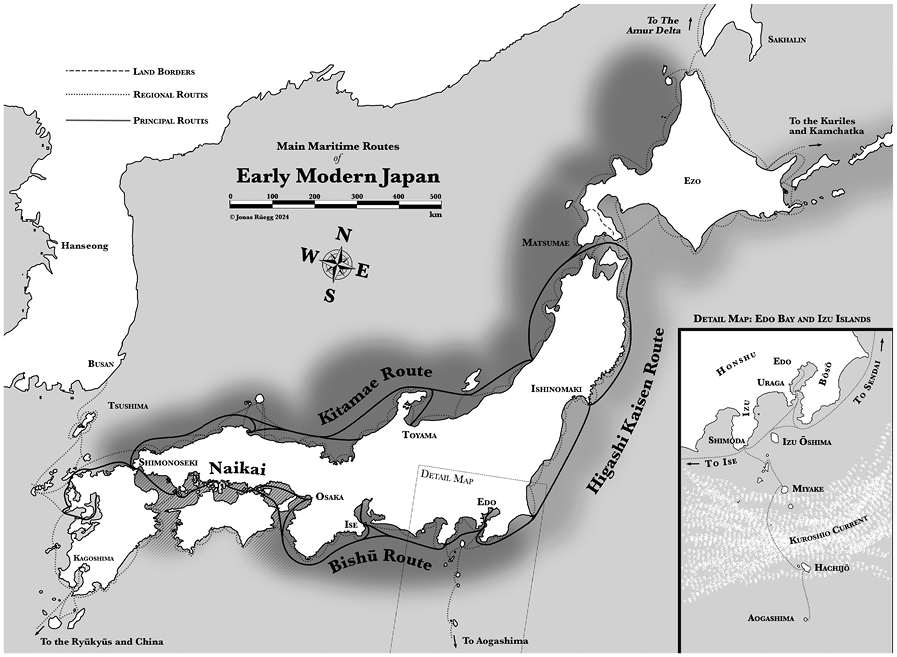
Figure 1.3 Long description
The map identifies four major shipping routes: the Higashi Kaisen Route along the northeastern Coast of Honshu, the Kitamae Route along the Japan Sea coast, the Naikai route in the Seto Inland Sea, and the BishG route between Edo and Osaka along Honshu’s southern coast. The map also features routes to neighboring countries, such as Ryukyu, Korea, the Kuriles and the Amur region.
For the most part, sailing routes clung to the coasts as the navigational methods were rudimentary. Mainly, Japanese sailors oriented themselves by the shoreline’s silhouette, or counting the time elapsed since the passage of a familiar landmark. This technique of estimating one’s position based on direction, speed of travel, and time is called dead reckoning, contrasting with the mathematical and astronomical methods practiced by the multinational crews that cruised East Asian waters in the sixteenth and seventeenth centuries. Yet, despite the reliance on place-specific knowledge and defying the risk of currents and storms, shipping routes often led into the rapid Kuroshio. In particular, routes to Ryukyu and around the southern capes of Honshu and Shikoku, as well as the more exposed maritime paths to remote southeastern islands, regularly led sailors across the ravenous current.
The Kuroshio is particularly strong between Miyake and Hachijō, where it passes over the Izu ridge with peak velocities of up to 150 cm per second.Footnote 44 It was in this very location that sailors crossed to the islands of Hachijō, Kojima, and Aogashima, some 200 kilometers off Honshu’s southeastern edge. Boats set sail from Miyake, which was located north of the current at most times, and headed west as far as a rock called Inanba, where a constant whirl marked the entrance to the “black rapids” or kurose, as the sailors called the dangerous whirls of the current. They thence steered hard south and let the current carry them into the vicinity of Hachijō. Accidents happened time and again, and sailors often went missing along the eighty kilometers between Miyake and Hachijō. In 1644, even the shogunal envoy drowned in the floods. Accordingly, it was wise to sail with the seasonal rhythm of winds – north with the summer monsoon and south in fall before the northerly winter winds became too strong.Footnote 45 Navigational knowledge of these regions was treated with utmost secrecy by the sailing communities, as outside visitors remarked. As an effect, the annual monsoon rhythm and the necessity of place-specific knowledge limited the access of central authorities and created a special sort of autonomy for the local elites, as Chapter 2 will discuss in more detail.
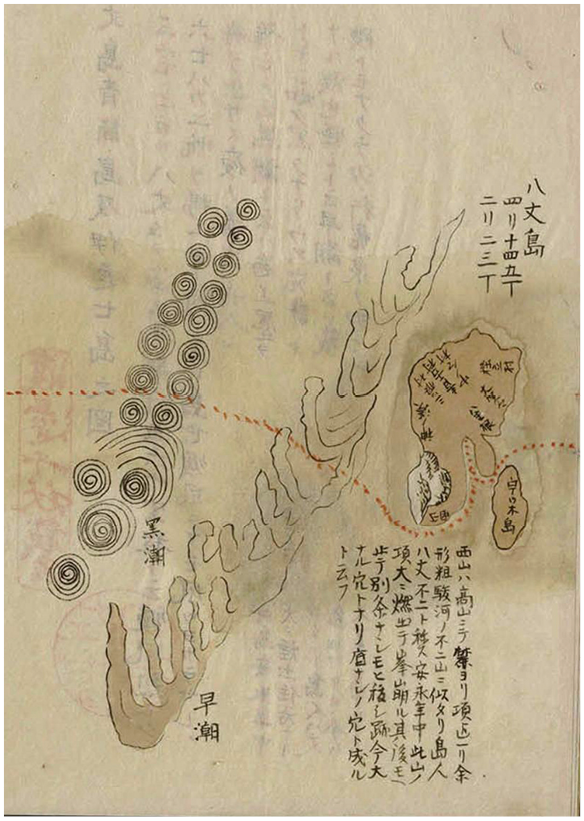
The seafarers of Hachijō were not modest about the dangers they confronted on the route. In 1796, the shogunal official Mikawaguchi Terumasa visited Hachijō and spent several months conducting research into customs, language, and society on the secluded island. The renowned geographer Furukawa Koshōken (1726–1807) later summarized Mikawaguchi’s findings in an ethnographic treatise titled Brush Notes on Hachijō.Footnote 46 (See Figure 1.4.) Furukawa reported that
even if [the sailors] examine the wind and find the weather is fine, it happens often that boats are toppled over by large waves. When the wind is not good and they cannot decide to dispatch a vessel within a day, and there is no favorable wind from the sea, it is necessary to wait for several days until the weather turns clement … Whoever runs into this current will be driven off to America or so, and never come back.Footnote 47
The current’s constant eastward flow was a portal into the unknown that fascinated many landlubbers of Furukawa’s time. Leading out onto an open ocean that would only become known more widely as the “Pacific” (Taiheiyō) decades after Furukawa’s time, the Kuroshio connected the Izu archipelago to the distant rims of a shared oceanic space.
Graphical depiction of the Kuroshio and “Hayashio” Currents (l.) north of Hachijō (r.), with the shipping route from Miyake in the Izu Islands. From a manuscript copy of Furukawa Koshōken’s Brush Notes on Hachijō. Hachijōjima hikki, in: RYU, p. 4.
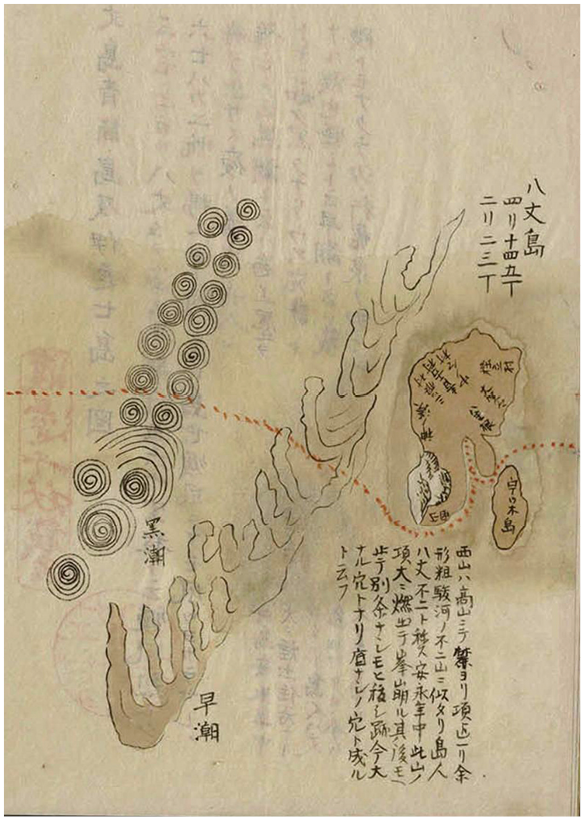
The historian Kondō Tomizō (1805–1887) of Hachijō was likely the first in Japan to describe the “River Kuroshio” as an interregional maritime highway. An exiled samurai from Edo, Tomizō grew interested in the surprising number of castaways that arrived on the island each winter and interviewed the sailors about their drift. In a manuscript dating to 1853, he compiled a route map from five westward harbors, remarking that the sailors often propelled their eastward journey by sailing in the current:
The River Kurose is also called Kuroshio. The clashing waves and quick flows on the great sea are actually its rims. From Cape Tosa to Shiosaki in Kii, and unto the rock Zenisu, the sailors call it the hidden tide. I hear that from Cape Daiō in Shima Province, it flows 88 ri [343 km] offshore…. In summer and fall it is easy to sail; in winter and spring it is difficult. If, again, one sails south from Toba in Shima province, they say, it is extraordinarily easy to make way towards the east. In Tosa, they tell that this tide is one path of fresh water from river Ryūsa in India.Footnote 48
According to Tomizō’s investigations, sailors on the east–western route were familiar with the current and its utility for accelerating eastbound voyages. Unlike those kuni-ezu maps created by state officials for administrative purposes, the virtual geography of the sailors connected ocean currents to a globally connected geography. To them, the current was a place with a specific topography of waves, whirls, and visibly changing water qualities that required special methods to cross (see Figure 1.4). Invisible to most conventional maps, for those mariners who facilitated the archipelago’s logistics, the offshore constituted an indispensable part of the archipelagic transport infrastructure, one shaped by the winds and currents of the Kuroshio region.
Oceanic History and the Myths of Islanded Japan
There is a major paradox that transcends the marine identities of modern Japan. On the one hand, ancient and modern mythologies have created the basis for a marine, seafaring identity. According to the eigth-century chronology Kojiki, the Japanese islands were dropped into the ocean from the tip of a divine spear, and since 1941, the Meiji Emperor’s voyage to Hokkaidō in 1876 – his only trip by boat – is commemorated on the “day of the sea.” On the other hand, insularity has structured the nation’s sense of self-exoticism. Essentializing visions of a unique national culture have long relied on the paradigm of “national seclusion” or sakoku, a term that was originally coined by a frustrated foreigner who found himself quarantined on the island of Dejima in the 1690s.Footnote 49 On the receiving end of the Tokugawa shogunate’s strategy of highly selective diplomacy, seclusion was certainly a crude reality. Yet, over the past several decades, the fixation on restrictive diplomacy under the Tokugawa has been largely replaced in the academic discourse by a more complete picture of diplomatic, commercial, and intellectual engagement beyond the formal interaction between governments.Footnote 50 Regardless, the contradictions in Japan’s ideological and metabolic relationship with the ocean remain unresolved.
Japan’s apparent smallness and resource poverty has been used to claim that the nation developed a “harmonious” rapport with the natural environment. In particular, forest resources – forests were cut to build megacities while the topsoil was searched for fertilizing materials – became the object of elaborate resource management regulations. By the late eighteenth century, effective policies ranging from sumptuary laws, building regulations, and afforestation systems helped preserve forest resources.Footnote 51 Narratives of sustainability in isolation feature prominently in Japanese environmental discourses, academic and popular. Ishikawa Eisuke, for example, draws a wide audience with bestsellers titled Saving Energy in Great Edo (2009), Recycling in Great Edo (1997), or simply Edo Period – Eco Period (2008).Footnote 52 Green-washed ideas of the national past also pervade government voices. The “primeval circular economy,” as the Ministry of the Environment characterizes the condition of an apparently timeless pre-industrial Japan, were allegedly enabled by “the spirit of mottainai [affection for things] and a dedication to cleanliness, feelings which shaped a society in harmony with nature.”Footnote 53
Environmental essentialism, rooted in a romanticized early modernity that since its historiographical inception served to contrast industrial modernity, has been deployed time and again in discourses of superiority. In colonial Korea, for example, allegedly superior abilities in resource management provided the pretext for Japanese administrators to appropriate local forest resources for strategic industries.Footnote 54 Much of early modern Japan’s alleged ecological utopia also hinges on the idea of national seclusion, where early modern development needs to be seen in its border-crossing material dimension. As Tessa Morris-Suzuki stresses, “Japan’s forest resources could more easily be protected because … Japanese merchants were extending their economic control over the land of the Ainu.”Footnote 55 Similarly, Japan’s myths of smallness, resource scarcity, and a culturally ingrained harmony with nature are also drawn into question once the archipelago’s marine resource base is considered more carefully.
The geography of maritime economy in Japan was gradually reshaped between the country’s unification under Oda Nobunaga (1534–1582), the social control systems introduced under Toyotomi Hideyoshi (1537–1598), and, eventually, the centralization of foreign relations under the Tokugawa shogunate. By the time the third shogun Iemitsu promulgated his prohibitions on foreign travel, international trade had been subjected to the “Vermillion Seal” system of shogunal approval for over thirty years.Footnote 56 The mariners known as wakō pirates who, since the fourteenth century, had raided the coasts of Northeast Asia and once were important agents in the Manila trade, had been dispersed and driven to shore by Hideyoshi’s “sword hunt at sea” of 1588.Footnote 57 As an effect, whaling groups emerged along the Kuroshio, chasing whales by the methods previously used to hunt down trading vessels.Footnote 58 Whale products were traded throughout the archipelago as foodstuffs, bone tools, and most importantly, pulverized as fertilizer. By the 1620s, these businesses started to recruit labor on an expanding scale, and by mid-century, it can be extrapolated that up to 22,000 men may have been involved in whaling, as will be discussed in more detail in Chapter 4. Likewise, sardine and herring were commodified as fertilizer resources, proto-industries that expanded significantly over the eighteenth and nineteenth centuries, with fishing colonies as far north as Sakhalin and the Kuril Islands.Footnote 59
The demand for marine fertilizers to replenish nutrients in the archipelago’s intensively farmed core lands expanded at pace with the growth of the Japanese economy. In broad strokes, the first half of the Tokugawa period saw considerable population growth, while numbers stagnated in the second half, though these developments varied regionally. By 1875, Japan boasted a total population of 34.4 million, up from some 12 to 18 million around 1600.Footnote 60 Economic historians have calculated that until 1850, the archipelago’s economy sustained an average annual GDP growth of some 0.13 percent, mostly powered by the secondary and tertiary sectors, which accounted for one-third of the GDP by the mid nineteenth century.Footnote 61 While these sectors grew more significantly than their agrarian base in terms of value generation, they remained harnessed to increases in food productivity. This is apparent in the exceptionally high concentration of population in the archipelago’s urban centers: With Edo, Osaka and Kyoto, Japan boasted three cities that ranked among the largest urban centers in the eighteenth-century world. Hayami Akira estimates that by the end of the Tokugawa period, Japan reached an urbanization rate upwards of 20 percent, with particularly high population densities in the Kinki and Kantō regions.Footnote 62 As Toshihiro Higuchi has argued, Japan’s agricultural core only managed to overcome a soil nutrient crisis by using fish as fertilizers of various kinds that were shipped to the region from the archipelago’s maritime peripheries.Footnote 63 Marine nutrients also entered the land-borne nutrient cycle as seafood by way of the human intestine. Like most agrarian societies at the time, early modern Japan had a sophisticated nutrient recycling system. Besides the local reapplication of manure, commercial networks specialized in nightsoil recycling between the archipelago’s urban centers and their agrarian hinterland, as David Howell has shown.Footnote 64 Regardless, as the archipelago’s population doubled or, according to some calculations, almost tripled over the early modern period, the pressure on its natural resources grew proportionately.
Though economic development varied regionally, the urban regions and their hinterlands, such as the Kinki region around Osaka as well as domains facing the Inland Sea, experienced significant agricultural commercialization reliant on the constant influx of commercial fertilizers.Footnote 65 This is apparent in the geographical expansion of the fertilizer resource base from local ecosystems to Ezo and the Sea of Okhotsk. Tapping resources beyond organic matter collected in local forests began with composting seaweed, a trend best documented for Lake Biwa in a series of lawsuits over user rights that reach back to the early days of the Tokugawa shogunate.Footnote 66 The development of commercial fertilizer production from seaweed, fish, and whale meal over increasingly far-flung distances stood in direct connection with the intensification and commercialization of the agrarian economy from the early seventeenth century. The most common types of fish fertilizer were processed out of sardines, either dried as “hoshika,” or as cakes of dried and crushed fish, called “iwashi shimekasu.” These sardines were initially fished near the Kantō plain of eastern Honshu.Footnote 67 Later, as the center of fish fertilizer production shifted to the northern island of Ezo as a result of expanding demand, herring meal or “nishin shimekasu” became the most widely available type of commercial fertilizer.Footnote 68
The shift from the Kuroshio to the abundant Oyashio Current was a response to the decline in sardine stocks in the vicinity of the agrarian core, the chief supplier of marine manure until the mid eighteenth century.Footnote 69 Even though Japanese settlement was prohibited north of the land border of Matsumae domain, which separated the Japanese polity from the Ezo territory, licenses for nonpermanent fisheries settlements were issued in 1719 for designated zones north of the border. Over the 1790s, further zones were opened along the west coasts further north, and by the Tempō period (1830–1844), authorized permanent fisheries were to be found even along the island’s northern coast, operated by refugees from the Tempō famine (1833–1836).Footnote 70 In Ezo, herring fisheries soon grew into the most important branch of the economy, developing proto-capitalist institutions such as a contracting system and wage labor, as David Howell has shown.Footnote 71 By the mid nineteenth century, 200,000 to 300,000 koku of dried herrings were shipped across the Japan Sea to out of Ezo, a number that would triple again by the 1890s.Footnote 72 In other words, Japan’s fisheries expanded between the eighteenth and nineteenth centuries as a state-sanctioned, commercially driven fisheries frontier powered at least in part by economic refugees.
The southern shores of Japan remained important fishing and whaling regions as well. As Chapter 4 will discuss in more detail, whaling enterprises burgeoned along Japan’s southern shores beginning in the mid seventeenth century, gradually moving closer to the current’s abundant whale stocks. These businesses relied on the availability of hundreds of men to chase whales in tens of boats at once, and hence involved entire village communities as well as outside wage labor. Far from the romanticized image of “traditional” subsistence whaling, these enterprises were profit-oriented investments objects of significant scale and complexity. Whale products – strings, leather, bone or baleen – were traded far beyond the whaling regions. Whale oil fired oil lamps in Edo, and whale guts were made into shamisen strings for the noble quarters of Miyako (Kyoto).Footnote 73 Most importantly, however, bones and the less palatable parts of the whale’s meat were ground into fertilizers and traded to the archipelago’s agrarian zones.Footnote 74 In this way, even the most remote farming villages became integrated into increasingly sophisticated trade networks with the marine origins of their fish, seaweed and whale fertilizers, whale oil pesticide, and whale string tools.Footnote 75 The wide circulation of these nonperishable marine products shows that growing commercial integration over the early modern period connected the land-borne economy of Tokugawa Japan intimately to the ocean.
Terraqueous Nutrient Imperialism
Scientists today describe the Kuroshio as the most powerful marine energy and nutrient stream of the West Pacific, wielding a far-reaching influence on climate and fish resource availability in the region.Footnote 76 Emerging as the northward deflection of the North Equatorial Circulation off Luzon, the Kuroshio is now classified as a western boundary current comparable to the Gulf Stream in the Atlantic.Footnote 77 Currents are compact masses of water that differ from each other in temperature, density, and salinity, therefore mixing just inertly. The Kuroshio’s mean temperature differs from its surroundings by several degrees centigrade, making for a heat energy transmission to the atmosphere of over 125 watts per square meter even after passing Japan. This makes the Kuroshio region “one of the strongest global air-sea heat loss regions,”Footnote 78 with a massive impact on the regional climate. The heat energy it transports from the low latitudes to the North Pacific exerts a major influence not only on air temperatures, but also on atmospheric thermodynamics and, as an effect, on humidity transport and precipitation. Fluctuations in the current have vastly diverging climatic impacts on different regions within Japan, leading to locally varying effects on agriculture.Footnote 79
The current carries elevated concentrations of reactive nitrates and phosphates – essential nutrients for plankton and plant growth – from the tropical climes. Nitrates are chiefly accumulated in the ocean by the nitrogen-fixing bacterium trichodesmium, which proliferates in the tropics and subtropics, and by an influx from river inlets.Footnote 80 Nutrients accumulate naturally in the deep sea through the recycling of sunken organic matter near the ocean floor and are transported over vast distances by the global deep sea or thermohaline circulation.Footnote 81 The Kuroshio picks up these nutrients as they are upwelled in the Pacific. With its core around 500 m below the surface, the current keeps most nutrients out of the reach of phytoplankton until it rises to shallower layers as it climbs over underwater ridges or on the continental shelf, as it does near the Senkaku/Diaoyu islands, in the East China Sea, and in the vicinity of southern Honshu. Only in the euphotic zone, those shallow layers of the ocean permeated by solar light, can photosynthesis fuel the absorption of nutrients by organic matter. Having lost some of its nutrients in the shallow waters as it leaves the East China Sea, the current mingles with the deep Ryukyu current that replenishes, again, high concentrations of nitrate.Footnote 82 By the time the current passes the Izu islands to continue onto the open Pacific as the “Kuroshio Extension,” the Kuroshio proper is relatively depleted and regains nutrients from its confluence with the northerly Oyashio Current east of Honshu. The Oyashio, this cold but abundant current from the Arctic, at this point contributes a larger amount of upwelled nutrients to the convergence zone than the Kuroshio itself.Footnote 83 This confluence zone creates an especially abundant region for tuna fishing and whaling, as both Japanese fishermen and Atlantic whalers had discovered by the early nineteenth century. This “Japan Ground,” as the Kuroshio’s downstream region was called by Western whalers, therefore became widely known in the West through works such as Herman Melville’s Moby Dick.Footnote 84
The reliance on an expanding marine resource base continued through the downfall of the Tokugawa shogunate in 1868, and into the industrial revolution that enthralled the politics of the subsequent Meiji Period. Indeed, Japan’s reliance on marine resources only expanded with the empire’s industrialization. Herring was found to be particularly rich in phosphate, at 5.6 percent relative to dry weight.Footnote 85 If the volume of herring fertilizers from fisheries in Hokkaidō and Sakhalin had reached some 200,000 koku per year at the end of the Tokugawa period, the output peaked at around 700,000 koku annually in the 1890s. Yet by that time, marginal catch rates were already in decline.Footnote 86 As domestic fisheries failed to keep up with the growing demand for nutrients, fertilizer trading companies began exploring alternative sources of fertilizers. Since the 1890s, the forerunner company of Nissan Chemical tackled research into synthetic fertilizers – chiefly superphosphates – while other companies began importing fishmeal, ammonium nitrate, and other sources of essential nutrients from abroad.Footnote 87 The company Suzuka Shōten, which had previously traded in animal-based fertilizers, began importing cattle bones and ammonium nitrate from Australia in 1896, an trade it expanded over the subsequent decade importing additionally from Britain, Germany, and the United States.Footnote 88 Manzan Shōten, again, a major dealer in herring meal under the shogunate, by 1900 began adding soy bean cake from northeastern China to its range, anticipating a major new nutrient influx.Footnote 89
Takahashi Chikashi has pointed out that Japan’s victory in the Russo-Japanese war of 1905, which secured Korea and Northeast China for Japanese imperial advances and infrastructure projects, marked a turning point in the structure of Japanese nutrient imports: Between 1905 and 1913, soy bean cake imports expanded fourfold to 720,000 tons, around ten times the domestic output.Footnote 90 Of all fertilizers traded in 1902, 39.26 percent circulated as marine products, chiefly whale and fishmeal, 45.77 percent were plant-based, and some 13.63 percent were nutrients recycled in the form of human nightsoil.Footnote 91 By the 1930s, the empire’s structural dependence on industrial soybean farming in Manchuria (by then the Japanese puppet state of Manchukuo) had led to massive soil degradation.Footnote 92 At the same time, Japan’s oceanic resource base expanded rapidly: The country’s motor-powered fishing fleet expanded from a few dozen in the 1900s to almost 6,000 in 1920, and by the early 1930s, Japan was the world’s leading fishing nation, exporting some 80 percent of its catch to foreign markets as cash commodities.Footnote 93 The gradually expanding demand for marine fertilizers of the early modern period had segued into a colonial system of resource extraction at sea and on the continent.
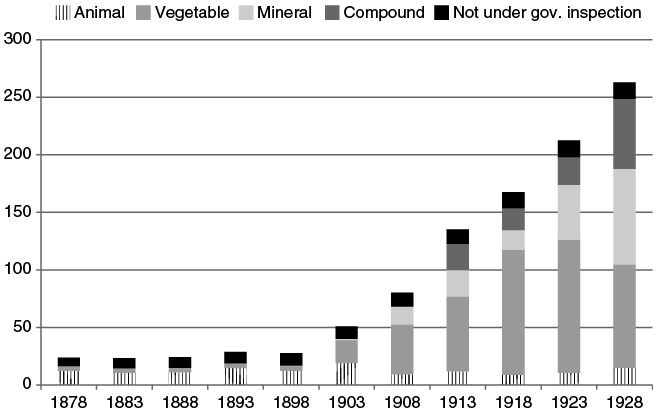
Japan’s imperial metabolism continued to rely mainly on organic fertilizers into the 1920s, but mineral and synthetic fertilizers gained ground as well. (see Figure 1.5).Footnote 94 The production of chemical fertilizers and nitrogenous explosives expanded rapidly thereafter, mostly powered by hydraulic power plants in the colonies. In the postwar period, new access to Middle Eastern petroleum put the country on a new, radically expanded energy base, enabling energy-intensive compound fertilizers – synthetic nitrogen, that is – to dominate the markets.Footnote 95 Phosphates were a different issue. Soy beans fixate high levels of nitrogen from the atmosphere, accounting for 7.7 percent of the dried and compressed bean cake, but unlike herring or human manure, they do not provide sufficient quantities of mineral phosphates.Footnote 96 Phosphates could be sourced from petrified bird droppings or “guano,” a substance mined by Western corporations since the mid nineteenth century on remote islands with large bird populations. Expanding use of guano in this era has been equated to a “first green revolution” in Europe and the Americas.Footnote 97 It was not until the 1910s that guano was mined domestically in Japan, once large deposits on the formerly inaccessible “bird island” of Rasa came into reach; instead, phosphates were imported from places such as British-controlled Banaba and German-controlled Nauru.Footnote 98
Expansions of fertilizer in the Japanese Empire. Fertilizer production expanded rapidly in the early twentieth century, mainly with the addition of imported vegetable fertilizers, the emergence of mineral phosphates, and the industrial production of synthetic nitrogen in the 1910s. Nevertheless, up until the mid-1920s, organic fertilizers made for half of all fertilizers applied in the Japanese homeland. In: Higuchi, “Japan as an Organic Empire,” 2015, 141.
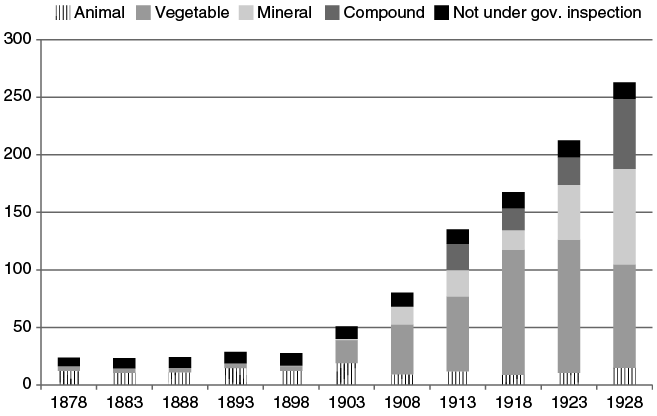
Figure 1.5 Long description
It is visible that vegetable fertilizers expanded until 1923. Only in 1928 did mineral and compound fertilizers first make for more than half of all fertilizers.
By the turn of the twentieth century, demand for fertilizers had brought about ambitious research projects into superphosphates and synthetic nitrogen fixation in Japan. Over the new century’s first decade, Italian, German, and Japanese scientists competed fiercely and brought about a variety of more and less efficient chemical processes. In 1909, the year in which Fritz Haber patented his famous Haber-Bosch process, nitrogen fixation was first practiced industrially in Japan. Yet technological lags and energy scarcity delayed the industry’s expansion until the 1920s, when hydraulic power plants in Korea could be harnessed. The chemical processes were ultimately scaled up over the 1930s with the support of the army, because just like fertilizers, explosives, too, were made of nitrogen.Footnote 99 Given this terraqueous – and eventually, atmospheric – expansion of the nutrient resource base, the continued expansion of Pacific fisheries remained central to the imperial metabolism.
Conclusion
Early modern economic and demographic growth in Japan neither sprouted from a secluded island space, nor were its resource cycles truly closed or “sustainable.” The ocean’s dynamic topography mattered to the expansion of Japan’s terraqueous economy. Under the shogunate’s non-voyaging agenda, marine industries mainly expanded in the archipelago’s inter-island and peripheral seas, yet commercialization and capital accumulation based on a maritime resource base predated the modern empire’s later expansion in Asia and the Pacific. I have argued that the dynamic environmental context of seasonal monsoon winds and rapid currents that dominate these seas complicate comparisons with the emergence of maritime capitalism in the Mediterranean. Instead, attention to these geophysical processes can enable alternative comparisons by evidencing shared or teleconnected experiences with remote zones in the Pacific and the Indian Ocean.
Throughout the Tokugawa period, the ocean remained an important part of the archipelagic transport infrastructure. From the beginning of the Manila Galleon trade in the late sixteenth century, the Kuroshio route attracted geopolitical attention, and even after shogun Iemitsu had proclaimed a ban on foreign travels in the 1630s, the backbone of the archipelago’s cargo infrastructure consisted of coastal and offshore shipping lines. Despite a significant risk of ship loss and drift in the meanders of currents, many sailors followed and crossed currents routinely with the seasonal winds. The ocean was an unpredictable riskscape, but sailors and investors found ways to reduce or distribute entrepreneurial risks. Temperature, moisture, and nutrients transported by these winds and currents, again, sustained the region’s abundant whaling and fishing grounds – from whaling stations burgeoning along the Kuroshio current to fisheries outposts mushrooming around the Sea of Okhotsk. Increasingly commercialized marine industries, funded by urban investors, guided by state officials, and powered by wage labor, preformed a crucial link between aquatic and terrestrial ecosystems.Footnote 100 They extracted nitrates and phosphates from the sea in the form of foodstuffs, but also of seaweed, fish, and whale-based fertilizers, which were injected into the terrestrial nutrient circulation.
The expansion of Japan’s nutrient base continued with the importation of fertilizers from Northeast Asia in the late nineteenth century. By the close of the century, border-crossing trade expanded Japan’s nutrient frontier to the continent, while guano mining, industrial fisheries, and offshore whaling pushed the resource base ever deeper into the Pacific.Footnote 101 By 1905, soybean cake imports, mostly from Manchuria, outpaced herring fertilizers on Japanese markets. Nutrient extraction from Northeast Asia has been labeled a “soy frontier,” the terrestrial counterpart to the systematic exploitation of Pacific fishing and whaling grounds.Footnote 102 In the words of Toshihiro Higuchi, “the agricultural core sucked up the organic material while transferring the environmental costs of its production to the colonial frontier.”Footnote 103 The expansion of Japan’s terraqueous resource base accelerated in the 1930s, when Japan boasted the largest fishing and whaling fleets worldwide – an economy William Tsutsui has called Japan’s “pelagic empire.”Footnote 104
Did the ocean help Japan avoid an ecological impasse and falling into a “high-level equilibrium trap,” a situation in which economic growth itself had minimized the marginal productivity to the point of an innovative standstill?Footnote 105 Were oceanic resources and infrastructure the factors that distinguished Japan’s economic path from that of China in the “great divergence?”Footnote 106 These questions are yet to be addressed quantitatively by economic historians. It is safe to say that, after the relative high-growth period of the eighteenth century, marginal outputs certainly diminished overall until the nineteenth century, indicating that the economy was headed toward stagnation. As Jakobina Arch phrases it: “Just as Western Europe (particularly England) leveraged their colonial landholdings to break through eighteenth-century ecological limits, adding the productivity from these “ghost acres” to their per capita resource supply in the imperial center, Tokugawa Japan began to leverage their connections to the Pacific’s marine environment to supplement scarce terrestrial resources.”Footnote 107
With regards to transportation as well, Japan’s situation in the late Tokugawa period resembles that of China’s Jiangnan region where water-borne transportation disincentivized the use of steam propulsion.Footnote 108 But to think with Jack Goldstone, high economic development at a pre-fossil stage may matter less for industrialization than changing material conditions as an effect of technological change.Footnote 109 In other words, spatial access to resource frontiers and the availability of the right resources at the right time was key to the making of modern Japan. Just like the fuel impasse during World War II threatened to halt the imperial endeavor (and instead led to fatal decisions), the opening of new frontiers – organic fertilizers in the early modern period, coal in the late nineteenth century, Middle Eastern petroleum in the postwar period, and, perhaps, rare earth minerals in the near future – created an economic impetus at crucial moments. The ocean, in this series of serendipities, was both resource and infrastructure.

 Open access