

3.1 Introduction
Ever since it started to look as if the dinosaurs were done in by a nagging case of asteroids, the hypothesis has been pursued that every mass extinction has had an extraterrestrial cause, while some have expressed a strong preference for an earthly cause.Footnote 1 Here I frame the pursuit of the Nemesis hypothesis of an extraterrestrially caused periodicity in mass-extinction events as a process of ‘reading’ the fossil and geologic records in pursuit of narrative closure.Footnote 2 In the case of mass extinction, I am particularly keen on understanding how periodicity guides the search for evidence in pursuit of a causal narrative. In contrast to narratives of periodic extinction stand narratives of particular mass extinctions, where the plot is driven by the specific setting, characters, and one-off events. Of course, narratives of periodicity and one-time events do not exhaust the space of possible narrative explanations, and in the end I will describe somewhat of a middle path that seems to be gaining traction.
3.2 Periodicity of Mass Extinctions
In 1979, in Gubbio, Italy, a team of researchers led by Walter Alvarez discovered an iridium anomaly in sedimentary strata dated to be of end-Cretaceous age. This worldwide temporal horizon happens to coincide with the last known fossil occurrence of a number of biological taxa, including non-avian dinosaurs, ammonites, rudist bivalves, pterosaurs, mosasaurs and large numbers of plant and bird species. In terms of severity, the Cretaceous-Tertiary (or K-T) extinction (now known as the Cretaceous-Paleogene, or K-Pg extinction) ranks among the ‘big five’ mass extinctions in the fossil record: the end-Ordovician, Devonian, Permian, Triassic and K-Pg.
Like many discoveries in the earth sciences, the discovery of the iridium anomaly was serendipitous (Reference Glen and HookGlen 2002). The Alvarez team, assuming a statistically constant rain of meteoritic iridium throughout geologic time, thought that they could use that iridium flux to estimate elapsed time represented by sedimentary deposits. But the concentration they found was far off-scale relative to the known rate, and further lab analysis of samples confirmed that there was a ‘spike’ in iridium in a red boundary clay layer at the top of Cretaceous strata. Iridium concentrations in strata immediately above and below that layer fell off exponentially to zero (Reference Alvarez, Alvarez, Asaro and MichelAlvarez et al. 1980). Because Iridium is quite rare in the earth’s crust, the Alvarez team hypothesized an asteroid or comet impact.Footnote 3
Meanwhile, as the Alvarez group pursued evidence for an asteroid or other bolide impact at the Cretaceous–Tertiary boundary, David Raup and Jack Sepkoski were independently at work analysing broad extinction patterns in a synoptic database compiled by Sepkoski, A Compendium of Fossil Marine Families (Reference Sepkoski1982). Sepkoski had been compiling this database for years by combing the published literature for new reports of fossil occurrences, and continually updated this record of the first known and last known fossil appearances of marine families.Footnote 4 By tabulating the record of first and last appearances, a diversity curve for the entire Phanerozoic eon could be generated, and the number of families becoming extinct could be chronicled for each subdivision of geologic time. By Reference Raup and Sepkoski1982, Raup and Sepkoski’s statistical analyses of Sepkoski’s data resulted in a clear pattern of five large mass-extinction events – the so-called ‘big five’ – standing as outliers against a backdrop of smaller events (see Figure 3.1).
The ‘big five’ mass extinctions
The Ashgillian event at the close of the Ordovician, the Frasnian-Famennian event of the late Devonian, the Guadalupian-Dzhulfian event at the end of the Permian, the Norian event of the late Triassic and the Maestrichtian event at the Cretaceous–Tertiary boundary.

As Jack Sepkoski continued to compile a pen-and-ink database of first and last fossil appearance of marine families, his colleague at Chicago, David Raup, became interested in computerizing, tabulating, plotting and analysing them statistically. Whereas Sepkoski had plotted the data at the level of the stratigraphic series (e.g., upper Cretaceous), Raup decided to plot the data at a finer resolution, that of the stratigraphic stage (e.g., the Maestrichtian stage, a subdivision of the upper Cretaceous; Reference Sepkoski and GlenSepkoski Jr 1994). The gestalt they perceived was one of mass extinctions evenly spaced (Figure 3.2). Could this be a periodic array?
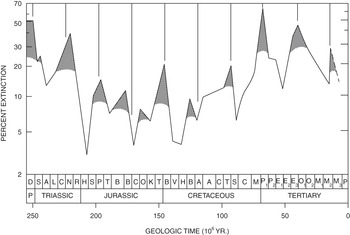
The stratigraphic record of the twelve largest mass-extinction events of the past 250 million years appeared to be periodic. However, two methodological constraints on the system had the potential to make the fossil record of mass extinction look periodic, regardless of whether it was or not. First, the stratigraphic record is divided into 40 stratigraphic stages (bins) of varying duration, and the dates of mass extinctions are resolved only to the level of the stratigraphic stage. Second, extinction peaks can only be recognized if they occur in non-consecutive stages, imposing some minimum separation between events. Spurious periodicity needed to be distinguished from the real thing. The questions raised were, within these methodological constraints: (1) what periodicity best fit the data? and (2) what is the probability of obtaining such a well-fitting periodicity simply due to chance?
To answer the first question, they needed to determine the best-fit periodicity, which required a measure of goodness of fit. Reference Raup and SepkoskiRaup and Sepkoski (1984) tried a range of periods from 12 million to 60 million years. For each period length they took a perfectly periodic time series and lined it up as closely as possible to the time series of mass extinctions and computed the standard deviation as a goodness-of-fit statistic. The best-fitting period came out to be 26 million years, with some standard deviation (call it sd*) from perfect periodicity. To answer the second question, they asked how frequently such a close fit to periodicity would occur if the timescale were randomized and extinction peaks were assigned to non-adjacent stages. As it turns out, the probability of obtaining a fit of sd* or better by chance was vanishingly small, and on this basis Reference Raup and SepkoskiRaup and Sepkoski (1984) were able to argue that the periodicity of 26 million years is very unlikely to have arisen by chance and thus should be provisionally accepted.Footnote 5
3.3 The Nemesis Affair and Narrative Closure
Raup and Sepkoski’s finding of periodicity, coupled with the Alvarez group’s discovery of an iridium anomaly coinciding with the mass extinction of the dinosaurs at the end of the Cretaceous period, led to the formulation of the Nemesis hypothesis (Reference Davis, Hut and MullerDavis, Hut and Muller 1984; Reference Whitmire and JacksonWhitmire and Jackson 1984). According to the Nemesis hypothesis, the sun has a companion star, Nemesis, which every 26 million years perturbs the orbits of comets in the Oort cloud, sending some of them on an earth-crossing orbit, with the resulting impact causing a mass extinction.Footnote 6 Linking periodicity with a possible extraterrestrial cause for mass extinction altered the temporality governing palaeontological research to one based on periodicity. In addition, it set in motion a search for a cause capable of producing the extinction periodicity: an astronomical search for a companion star (Reference MullerMuller 1988), a statistical search for periodicity in the ages of impact craters on earth (Reference Rampino and StothersRampino and Stothers 1984b) and a search for indicators of impact at stratigraphic horizons corresponding with mass extinctions around the world (e.g., Reference Claeys, Casier and MargolisClaeys, Casier and Margolis 1992). In short, this new ‘narrative of nature’ was compelling enough to galvanize a coalition of researchers from different disciplines, and changed the nature of extinction research, setting in motion a search for narrative closure.Footnote 7 Yet alongside the search, critiques were mounted, falling into one of five categories: general scepticism about the warrant for extraterrestrial causation (e.g., Reference HoffmanHoffman 1989), uncertainties in the ages of the dated events (e.g., Reference Grieve, Sharpton, Goodacre and GarvinGrieve et al. 1985), mismatch between timing of cause and effect, the possibility that periodicity may be spurious (e.g., Reference Stigler and WagnerStigler and Wagner 1987) and alternative explanations for the presence of the indicator in question (e.g., Reference Wang, Attrep and OrthWang, Attrep and Orth 1993).
3.4 Mass Extinction as a Recurring Narrative
While it was already accepted prior to Raup and Sepkoski’s finding of periodicity that there have been major mass extinctions in the history of life, there had been no reason to suspect that each of these mass extinctions had the same cause.Footnote 8 There was every reason to believe that if each mass extinction were to yield to any analysis at all, if the cause or causes were to be found, an idiographic approach was called for. Geologists and palaeontologists are highly trained in the identification of traces, in extracting information from remains, in inferring causal sequence, in arriving at consiliences of inductions and in pursuing multiple working hypotheses. In short, they are trained in reconstructing events from their available traces.Footnote 9 This may explain why, among many palaeontologists, the Nemesis hypothesis was met with suspicion. One eminent palaeontologist, Steven Stanley of Johns Hopkins, who in his 1987 book Extinction mounted a compelling argument that mass extinction is largely explicable in terms of well-documented changes in climate, summed up the prevailing view well:
If every peak forms part of the periodic array, then it must be attributed to the periodic agent. […] Do we really need to invoke an extraterrestrial cause for the event that occurred during the latter part of the Eocene Epoch, for example, when we know that at this time both deep-sea waters and terrestrial climates became cold (and remained so to the present) – and when we have a potential earthly explanation for these events in the form of the isolation of Antarctica over the South Pole via the final fragmentation of a large segment of Gondwanaland?Footnote 10
This is a paradigmatic idiographic narrative explanation. Stanley is pointing out that the elements of a narrative explanation were beginning to coalesce – approaching narrative closure – when out of nowhere, like an asteroid, comes a new narrative. Note that he is not contesting the plausibility or empirical support for the extraterrestrial narrative (although he would do so elsewhere), but rather whether, given the existence of a climatological narrative, the extraterrestrial narrative was necessary.Footnote 11
3.5 On Rereading the Book of Nature
Historian David Sepkoski has written an account of the rise of analytical palaeobiology entitled Rereading the Fossil Record, focusing on the period from around 1970 to the mid-eighties. Darwin and Lyell are understood to have brought us the metaphor of the fossil record as a book from which are missing several chapters, and from the remaining chapters many pages, and from the remaining pages many words, written in a slowly changing language.Footnote 12 Sepkoski’s account describes three historical phases of rereading that fossil record: literal, idealized and generalized. The literal rereading of the fossil record is exemplified by Reference Eldredge, Gould and SchopfEldredge and Gould’s (1972) model of punctuated equilibria in which the absence of morphological intermediates from the fossil record is not absence of evidence so much as evidence of absence (of morphologic change in species)! The idealized rereading is exemplified by the nomothetic palaeobiology of the Marine Biological Laboratory (MBL) group, which abstracted away from species as individuals and modelled them as particles in space and time, nomothetism denoting the search for lawlike generalities among historical events.Footnote 13 The generalized rereading combines empirical and statistical analysis made possible by the painstaking compilation and digitization of taxonomic data by Sepkoski’s father, Jack, with mathematical modelling undertaken for the most part with David Raup (Reference SepkoskiSepkoski 2012). During the generalized rereading phase of the rise of analytical palaeobiology emerged David Raup and Jack Sepkoski’s work on mass extinctions, first as a statistical phenomenon quantitatively distinct from background extinctions and then as a recurring phenomenon registering a 26 million-year periodicity.
In coming to a better understanding of how scientists reread the fossil record, it may be helpful or at least instructive to appeal explicitly to narrative theory as it has been developed in the study of literature. Clearly this is a vast field encompassing a large body of scholarship. I would like to start with the key distinction in narrative theory, as formulated by the Russian formalists, Vladimir Propp (1895–1970) and Viktor Shklovsky (1893–1984).Footnote 14
This is the distinction between the supposed chronological sequence of events, referred to as the fabula, and the way they are presented in the narrative discourse, the syuzhet. Notably, fabula and the syuzhet register different orderings.Footnote 15 The relationship between these two orderings of events contributes to the literary characteristics of a narrative, allowing for it to exert its effects on a reader, and to elicit a certain aesthetic response. For example, in Dostoevsky’s Crime and Punishment, Raskolnikov’s murder of the pawnbroker is presented early in the narrative. It is only after reading for a good number of pages that we learn from Porfiry Petrovich’s cross-examination that several months prior to the murder Raskolnikov had written an essay arguing that the extraordinary man is not bound by common morality. This ordering of the presentation of events between fabula and syuzhet elicits an affective response from the reader, for example a feeling of suspense over whether Raskolnikov will crack under questioning.
Crime and Punishment is rather noteworthy for its subversion of the narrative of a typical murder mystery, so, although it illustrates the difference between fabula and syuzhet, we might be better served using the more conventional genre of the ‘whodunnit’. In this genre, the murder is revealed early on in the syuzhet, and suspense builds until the identity of the murderer is eventually revealed. I will return to this idea later.
If we take the idea of reading (or rereading) the fossil record seriously, we might regard the traces in the fossil record as forming the syuzhet, from which the palaeobiologist infers the fabula. The palaeobiologist ‘reads on’, and keeps rereading in a search for narrative closure. If this is so, then the narrative structure of the mass-extinction account may help explain the search for evidence as the search for closure.
It is important to acknowledge disanalogies between narrative closure in reading a work of fiction and in reading the fossil record. From the reader’s point of view, in a work of fiction, the fabula is something inferred, and, depending on the work in question, there may not be sufficient textual evidence to adjudicate among rival fabulae. At first it might be tempting to think that something analogous is at work in reading the fossil record. Due to underdetermination, scientists may differ in their readings of the fossil evidence, with each reading consistent with the available evidence. In both cases, one might bring in background knowledge, theories of interpretation and the like to provide support for one reading over another. In both cases, we may have no choice but to sit pat with the situation unresolved. Yet there are at least two important disanalogies between reading a work of fiction and reading the fossil record. The first stems from the nature of fiction. It is entirely possible that an author is, to put it glibly, ‘all syuzhet and no fabula’. That is to say, there need not even exist an underlying fabula to which the syuzhet refers.Footnote 16 The author may present, in whatever order, a set of events in the narrative discourse over which there could be great disagreement as to what their true chronological ordering was, and it is possible that there does not even exist any true chronological ordering: what we have are the words on the page and an argument in favour of one reading or another. Indeed, Reference WalshWalsh (2001) has argued that even in conventional cases of narrative fiction, fabula is not ontologically prior to syuzhet. Rather, from the syuzhet, the reader is constructing – not reconstructing – a fabula (not the fabula) in an ongoing process of interpretation. Fabula is the reader’s working version of what happened in the world of the characters – a fictional world. Yet reading the fossil record differs from this: the history of life is not a fiction. First, the palaeontologist presumes that, whether it is empirically ascertainable, there does exist an ordering of events, wie es eigentlich gewesen, to which the syuzhet (the fossil record as it is read) must in some way be connected. The fabula of the history of life is ontologically (and temporally) prior to the syuzhet (order of presentation in the fossil record that the palaeontologist is reading). It is being reconstructed from the record it has left behind.Footnote 17 Second, the form of reading on which the palaeontologist is embarked allows her to expand the text, to look to other stratigraphic horizons, to seek out new evidence, to read on in search of narrative closure an ever-expanding text, in which one narrative is better supported than others, at which point narrative closure will have been achieved, at least temporarily. This is not to say that the situation is completely unlike that of rereading a work of literature, in which other information external to the text (e.g., early drafts, memoirs by the author, inter- and extratextual references, theories of interpretation) may help to support both the existence of a fabula and give some notion of what it is. Indeed, in the historical sciences in general, it has been argued that at any given time, even in the face of a fixed set of fossils and geological evidence (analogous to the closed form of the written text), the totality of the rest of science (theory, method, observations), which is constantly changing, enables an assessment of which of many possible fabulae are best supported (Reference JeffaresJeffares 2010).
Under periodicity, which presented a narrative of recurrent, extraterrestrial perturbation of the biosphere, the search for evidence looked completely different. Planetary geologists and astronomers began to reread the record of impact structures (craters, astroblemes) for evidence of periodicity (Reference Grieve, Sharpton, Goodacre and GarvinGrieve et al. 1985). While this record is even more fragmentary and less well-dated then the fossil record, it eventually did yield periodicity (Reference Rampino and StothersRampino and Stothers 1984a; Reference Rampino and Stothers1984b), and the hypothesis of impact periodicity continues to be pursued (Reference Rampino, Caldeira, Prokoph, Koeberl and BiceRampino, Caldeira and Prokoph 2019; Reference Rampino, Caldeira and ZhuRampino, Caldeira and Zhu 2020). At stratigraphic boundaries marking extinction events, iridium anomalies were sought and sometimes detected (although for certain events, such as the end-Permian extinction, iridium anomalies have so far turned out to be spurious; Reference ErwinErwin 2015 and personal communication). Where iridium anomalies proved wanting, other markers of impact were sought: shocked quartz (with a distinctive crystalline lattice), microtektites (bits of molten rock associated with the high heat of impact), buckminsterfullerenes, osmium isotopes and soot (Reference RaupRaup 1986: 75–87). Markers of one type or another proved adequate to justify continued pursuit of the hypothesis. Meanwhile, astrophysicists, chiefly Berkeley astrophysicist Richard A. Muller, continued to scan the heavens searching for Nemesis, which as of 2007 was still an ongoing search. The pursuit of narrative closure does not always end in achieving it.
To summarize, emplotting all mass extinctions of the past 250 million years in the narrative of a cause that recurs with clocklike regularity enabled Raup and Sepkoski to resurrect the nomothetism of the 1970s in which they had been integrally involved by fitting a periodic model to the record of mass extinctions, yet at the same time to create a narrative, a narrative of recurrence which drove scientists from a number of different fields – astronomy, planetary geology, isotope geochemistry, mineralogy and palaeontology – to embark on a quest for narrative closure on the basis of a periodic pattern or cause.
In so doing, Raup and Sepkoski’s research on extinction resolved an ongoing tension in the history of the earth sciences between uniformitarianism and catastrophism by putting forward an exemplar of a catastrophe (asteroid impact) that behaved according to a uniform periodicity rooted in the regularity of astronomical orbits. The Nemesis hypothesis was thus idiographic and nomothetic, catastrophist and uniformitarian, and it was a narrative explanation.
3.6 Rereading the Book of Nature through Diagrams
One step along the way to constructing a narrative of extinction is to ‘read’ and reread the stratigraphic record. In order to test whether patterns in the fossil record are consistent with a given causal narrative, such as sudden, catastrophic extinction, it is helpful to be able to investigate historical counterfactuals, which are narratives of events that could have happened, but did not. In the study of mass extinction, one of the templates for the formulation and articulation of counterfactual narratives has been the stratigraphic diagram. Stratigraphic diagrams do not operate alone to produce these counterfactual narratives, but in the context of tacit knowledge and ‘ways of seeing’ that are an extension of the practices of palaeontological and geological fieldwork. A common visual language and sets of practices makes possible the diagrammatic narratives that have been central to studies of mass extinction.
The stratigraphic diagram thus becomes a template for framing narratives of extinction and even for experimenting with alternative, counterfactual narratives; from reading through different configurations of syuzhet, scientists gain a sense of which fabulae are consistent with it, answering questions thrown up by the Nemesis hypothesis.Footnote 18
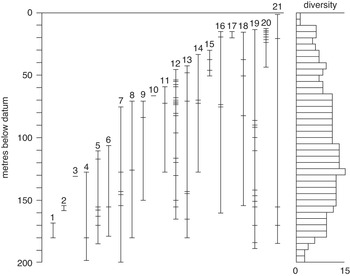
For example, in his 1989 paper, ‘The Case for Extraterrestrial Causes of Extinction,’ David Raup presents a diagram, plotting the distribution of fossil occurrences of different ammonite species in a stratigraphic section of late Cretaceous age in Zumaya, Spain, based on the fieldwork of Peter Ward (Figure 3.3). Ammonites, cephalopods with a coiled morphology, are one of the taxa that became extinct at the K-Pg boundary. The question Raup sets out to answer is whether this extinction was gradual, stepwise or sudden. Here one must distinguish between apparent and actual patterns: the apparent pattern of last known fossils and the actual pattern of last surviving members of the species. If the actual pattern of ammonite extinction (and, by extension, the end-Cretaceous extinction of other species) was gradual leading up to the K-Pg boundary, then a sudden cause such as a bolide impact is not tenable. If the actual pattern of extinction was stepwise, then a multi-phase event such as a comet shower is not ruled out. And if the actual pattern of extinction was sudden, then an impact-caused extinction becomes viable.
Stratigraphic ranges of 21 lineages (i.e., species genus Linnaeus) of ammonites found at Zumaya, Spain
Vertical scale marks distance in metres below the Cretaceous-Tertiary (today called the Cretaceous-Paleogene) boundary. Numbered vertical lines refer to ammonite lineages. Each horizontal tick mark designates a horizon at which a specimen of the lineage was found and identified. Note the ‘gappiness’ of the fossil records of the various lineages. For example, specimens of lineage 4 (Pachydictus epiplectus) were found and identified at 3 horizons: 200 m, 180 m, and 135 m below the Cretaceous–Tertiary boundary). The histogram on the right plots the number of lineages (inferred from first and last occurrences of specimens) in each 5 m interval (e.g., the 15 lineages who range through the 130 m to 125 m interval). Based on field data of Peter Ward.
The methodological problem palaeontologists face is that of stratigraphic range truncation: due to gaps in preservation or failure to find or identify species, there is often elapsed time between the last appearance datum (LAD) for any given species in the fossil record and the time that the species actually went extinct, a mismatch between apparent and actual patterns of extinction. This is a missing data problem. The consequence is that the fossil record of sudden, simultaneous extinction of many species can look as if the event were smeared out over geologic time: a sudden extinction event in the fabula will appear in the syuzhet as gradual, a phenomenon known as the Signor-Lipps effect (Reference RaupRaup 1986). Conversely, if there is a large hiatus in preservation or sampling, then a gradual extinction in which species became extinct one after another over an extended period of time will leave a record that looks as if species all became extinct simultaneously: a gradual extinction on the level of fabula will be read as sudden in the syuzhet. Alternatively, smaller hiatuses in preservation or sampling can mean an extinction is read as if it happened in a series of bursts – stepwise extinction – even if the extinction was gradual or sudden.
Reference RaupRaup (1989) points out a paradox in how palaeontologists have tended to read the fossil record. On one hand, palaeontologists know that the fossil record is gappy: absence of evidence does not (generally) constitute evidence of absence; the syuzhet requires interpretation in order to reconstruct the fabula. On the other hand, there is a tendency to read the last appearance datum as the time of extinction for a species. Raup believes this to be fundamentally a methodological problem, ultimately to yield to a quantitative treatment, but chooses to illustrate the point using an experiment – a thought experiment – which happens to take the form of a visual, counterfactual narrative. Suppose, he asks, that all fossil occurrences of ammonites were eliminated beginning at a stratigraphic horizon 100 m below the K-T boundary: what would the fossil record of this sudden mass extinction look like? As can be seen from Figure 3.3, he argues, it would look gradual (with a spurious step introduced at the 125 m mark).
As has been pointed out elsewhere, palaeontology has a distinctive visual culture that places a premium on being able to show visually that which might also be demonstrated analytically or mathematically (Reference Huss, Sepkoski and RuseHuss 2009). For example, when a palaeontologist looks at a stratigraphic diagram, he or she can visualize it as an idealized, synoptic representation of a rock outcrop embedded with specimens of fossil species, as well as the fruit of a great deal of integrative inference. It will be second nature for any geologist or palaeontologist to read this diagram from bottom (oldest) to top (youngest). Field skills and geologic training allow the interpreter to give the diagram a spatiotemporal reality that may not be perspicuous to others (Reference Huss, Bouton and HunemanHuss 2017). Embedded in such a diagram as that depicted in Figure 3.3 is a ‘research narrative’, as well as one of nature. Palaeontological field workers sought, found and identified fossils at certain horizons in the stratigraphic record. Tectonic forces may have distorted, tilted or completely inverted the sequence as found in the field. All is righted in the diagram. Laterally dispersed localities needed to be correlated using principles of stratigraphic inference to determine whether specimens of different species were found at the ‘same’ horizon. There are many such sketches of the reconstructive aspect of palaeontology that are encoded in a scientific diagram. While they need not be fleshed out each time, and the identities of those making the scientific contribution would itself need to be reconstructed from other sources, when palaeontologists look at a stratigraphic diagram they see encoded in it a community’s research narrative.Footnote 19
Yet Figure 3.3 also encodes a ‘narrative of nature’. Beds of sediment were laid down, organisms lived and died and left fossilizable hard parts. Periods of erosion or depositional hiatus, along with dissolution of shells, create gaps in the rock and fossil records. Narratives of morphological change and differentiation – microevolution and macroevolution – leave their traces in the patterns of fossil occurrences. Broad temporal trends in species gain and species loss, ultimately culminating in extinction, can be inferred from the patterns of diversity that are depicted in the running histogram jutting out from the right-hand side of the diagram. Tacit knowledge would enable most palaeontologists to provide a narrative sketch of what they see in Figure 3.3. Experts on ammonites may be able to venture a richer narrative, but some elements of the causal story remain outstanding. While scientists broadly understand some of the processes that gave rise to the patterns of spatiotemporal distribution of fossils in this diagram, ultimately, the causal analysis of evolution and extinction will need to be found elsewhere. The patterns in Figure 3.3 are the explanandum. Specific causal hypotheses are the explanans.
Figure 3.4 enables a visual reading of a counterfactual narrative: given the same evolutionary history and gappy stratigraphic distribution of fossils, what would the pattern of last appearances look like if extinction occurred suddenly at the 100 metre datum?Footnote 20 Because the temporal sequence of geological and evolutionary events leaves a spatial record – a vertical array of fossil occurrences organized into geologic strata consisting of depositional, erosional and quiescent horizons – the resulting visual chronology lends itself to a narrative treatment, including the formulation of alternative narratives to help assess the plausibility of the proposed narrative explanation under consideration. In the same fashion as Figure 3.3, the thought experiment depicted in Figure 3.4 draws upon the knowledge and interpretive habits of palaeontologists, who are now in a position to see that even cases of sudden, simultaneous extinction can leave a misleadingly gradual trace in the fossil record.
Thought experiment on causes of extinction
Here a thought experiment is posed: what if all lineages had suddenly become extinct at a datum 100 m below the Cretaceous-Tertiary boundary? Would the pattern of last appearances look sudden or gradual? Note that despite the instantaneousness of this hypothetical extinction event, the apparent pattern of die-off is gradual, with a spurious ‘step’ appearing at around the 125 m mark. The conclusion may be drawn that an extinction event that was in fact sudden and simultaneous may look gradual when filtered through the ‘gappiness’ of the fossil record. From data plotted in Figure 3.3.
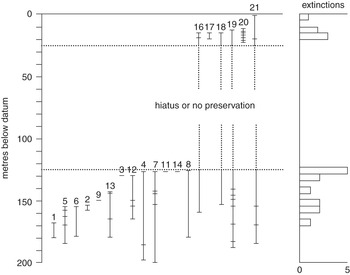
In the historical sciences, one often wishes to reconstruct what happened – to produce a historical narrative – based on physical traces, background theory and other assumptions.Footnote 21 One way to assess a pattern of physical traces as evidence for or against a proposed narrative is to ask whether a similar pattern would have been expected under an alternative narrative scenario. In these diagrams, the focal question is not what caused the extinction, but how to read the fossil record – what combination of species extinction and spotty preservation does it reflect? Understanding their relative contributions can give rise to a corrected pattern of species extinction, which is what, qua historians of life, palaeontologists seek to explain.
Ultimately, however, the narrative that explains the fossil record as we find it, that gives an account of the patterns therein, is relevant to the grander, causal narratives of mass extinction: extraterrestrial, climatological, ecological, volcanogenic, etc. At a minimum, the fossil patterns must be consistent with the proposed mechanism of extinction, but the search for additional evidence – of impact, climate change, trophic shift or volcanism – has taken scientists beyond the fossil patterns themselves to competing narratives of extinction and the evidence relevant to adjudicating among them.
3.7 Narrative Closure in Philosophical Context
Philosophers have disagreed about the epistemic underpinnings of narrative closure in the historical sciences. For starters, there remains the very real possibility that, depending on the question at issue, narrative reconstructions of the past are always one data point or a few data points away from being reopened such that scientists should always be open to the temporariness of narrative closure (Reference TurnerTurner 2007). To this, I should add that narrative explanation is remarkably flexible and resilient in the way that components can be retained as well-established (e.g., suddenness of extinction, periodicity), even as evidence for other components of the narrative is found lacking, inconclusive or is even overturned (e.g., evidence for the existence of Nemesis). Second, there is an ongoing debate about what epistemically grounds narrative closure (Reference ClelandCleland 2002; Reference TurnerTurner 2007; Reference Forber and GriffithForber and Griffith 2011). Cleland has argued that narrative closure is achieved when a ‘smoking gun’ is found: a piece of evidence that is consistent with one narrative but inconsistent with its rivals. In this view, the Chicxulub crater that has been dated to the end of the Cretaceous period played this role in establishing an asteroid impact as the cause of the K-Pg extinction. Yet Forber and Griffith point out that any given datum only has evidentiary value against a background of auxiliary assumptions, which in the historical sciences can be difficult to test. Hence, data that appear to rule in one hypothesis and rule out its rivals may prove to be indecisive, because their doing so is too sensitive to weak auxiliary assumptions: there is no one-to-one mapping between fabula and syuzhet. As we saw earlier, in the discussion of Reference RaupRaup’s (1989) rereading of the stratigraphic record at Zumaya, evidence that the K-Pg extinction was gradual, based on a petering out of certain species as the K-Pg boundary is approached from below, can easily be shown to be consistent with sudden mass extinction if different assumptions are made about how preservation is expected to result in the observed fossil record. It is easy to ‘explain away’ inconsistencies in this way: one can ‘save the narrative’ by deflecting inconsistencies to auxiliary assumptions. Thus, Reference Forber and GriffithForber and Griffith (2011) have argued that a more promising and robust way to achieve closure that is likely to be less ephemeral is to ground historical inferences by a consilience of inductions (Reference WhewellWhewell 1858), namely by finding lines of evidence that each depend on independent sets of auxiliary assumptions. They give the example of several different sets of evidence that were used to predict the size of the asteroid impact at the end of the Cretaceous and the degree to which they did or did not share auxiliary assumptions as crucial factors in assessing the strength of evidence, both in probabilistic terms and in reception by scientists (Reference Forber and GriffithForber and Griffith 2011). For my purposes here, I merely wish to note that historical science as the pursuit of narrative closure is consistent with both of these models.
3.8 Conclusions
A recurrent narrative such as the Nemesis hypothesis challenges some distinctions that have been used to set up oppositions between approaches in palaeontology. Simply put, a narrative of lawlike recurrence has both nomothetic and idiographic components consisting of the mathematical laws governing the periodic forcing agent as well as the overall causal narrative explaining which taxa became extinct, which survived and why. It also challenges the distinction between uniformitarianism and catastrophism, in a sense rendering bolide impact uniformitarian – a periodic catastrophe, as it were (Reference Sepkoski and GlenSepkoski Jr 1994).
The narrative of recurrent extinction known as the Nemesis hypothesis set in motion a search for narrative closure, and for communities of scientists, a quest for evidence that each mass extinction had been caused by an extraterrestrial impact. In the case of the K-Pg extinction, in which the dinosaurs, ammonites and a number of other groups perished, narrative closure was achieved with the discovery of an impact crater of approximately the size predicted on the basis of the iridium anomalies found around the world (Reference Forber and GriffithForber and Griffith 2011). This effectively closed off debate about alternative narrative explanations for that particular extinction.
The legacy of the Nemesis affair is far more complicated. For starters, the periodic pattern in mass extinction appears to be too stable to be compatible with the instability of the calculated orbit of the supposed companion star Nemesis (Reference Melott and BambachMelott and Bambach 2010)! Still, the pursuit of closure in the impact narrative is ongoing, especially on the part of Michael Rampino and colleagues (Reference Rampino, Caldeira, Prokoph, Koeberl and BiceRampino, Caldeira and Prokoph 2019; Reference Rampino, Caldeira and ZhuRampino, Caldeira and Zhu 2020), but in general there is greater pluralism. Volcanism and deep ocean anoxia are among the proposed causal agents at horizons where evidence of impact is lacking (Reference Rampino, Caldeira, Prokoph, Koeberl and BiceRampino, Caldeira and Prokoph 2019), and three episodes of large-scale igneous province (LIP) eruptions are dated at times that coincide with the inferred ages of the three largest known impact craters, all of them falling at or near extinction peaks now computed as having a 27.5 million year periodicity (Reference Rampino, Caldeira and ZhuRampino, Caldeira and Zhu 2020). This periodicity has been found to be statistically significant over the past 500 million years, extending it twice as far back in time as had been found in Raup and Sepkoski’s original analyses (Reference BambachBambach 2017; see also Reference Erlykin, Harper, Sloan and WolfendaleErlykin et al. 2017). It is close to the half-period of passes of the solar system through the plane of the Milky Way galaxy – conjuring the image of a ‘Galactic Carousel’ (Reference Rampino, Haggerty, Rickman and ValtonenRampino and Haggerty 1996). In a bit of brand differentiation, the hypothesis that the concomitant mass-extinction periodicity is due to the resultant galactically governed influx of asteroids, comets or even dark matter has been dubbed the ‘Shiva hypothesis’ (Reference GouldGould 1984; Reference Rampino, Haggerty, Rickman and ValtonenRampino and Haggerty 1996). Statistical searches for periodicity in the timing of mass extinctions, asteroid crater ages and oscillations through the galactic plane have been ongoing (Reference Rampino and StothersRampino and Stothers 1984a; Reference Melott and BambachMelott and Bambach 2014; Reference Rampino, Caldeira, Prokoph, Koeberl and BiceRampino, Caldeira and Prokoph 2019; Reference Rampino, Caldeira and ZhuRampino, Caldeira and Zhu 2020). These analyses have also turned up an approximately 60-million-year periodicity in an isotopic signature in marine sediments that has given rise to a variety of alternative narratives involving internal drivers of plate tectonic activity, galactically driven increases in the influx of cosmic rays with effects on upper atmospheric ionization and climate and possible coupling between astronomical cycles and internal geodynamical cycles (Reference Melott, Bambach, Petersen and McArthurMelott et al. 2012).
In other words, despite the pursuit of narrative closure, the science does not seem to be approaching it. Rather, narrative seems to be a rather flexible tool for adjusting to what scientists find as they ‘read on’. So what does the Nemesis affair teach us about the pursuit of narrative closure in the case of periodicity of mass extinction? First, periodicity in the temporal pattern of the mass extinctions themselves has stood up to improved resolution of the data, revisions to the geological timescale (Reference Melott and BambachMelott and Bambach 2014) and the use of a range of different statistical methods (Reference Rampino, Caldeira and ZhuRampino, Caldeira and Zhu 2020). Closure seems to have been achieved in the pattern in the timing of the mass extinctions themselves. Second, as might be expected when vastly different narratives compete, such as ‘earth-bound’ narratives of particular mass extinctions and astronomically driven recurrent causes of the periodic pattern, attempts to achieve narrative closure in one camp are met with attempts to keep the narrative open in another, sometimes by folding the objections in to produce a unifying narrative (Reference Rampino, Caldeira and ZhuRampino, Caldeira and Zhu 2020). Third, the Nemesis narrative itself, while today finding few adherents, reoriented attitudes such that astronomical processes are deemed worthy candidates for driving biotic and geologic phenomena on planet Earth. Finally, in the case of periodic mass extinction, the search for narrative closure has been empirically and methodologically fruitful. Scientists really are pursuing narratives, seeking to assemble a causal story that can account for the apparent periodicity – we see this particularly in the attempt to connect galactic processes with oceanic, atmospheric and geological processes – drawing on that narrative to guide an empirical quest, and reading on in pursuit of evidence that can provide narrative closure, however elusive it may be.Footnote 22


 Open access