




Introduction
The interactions of religion and the COVID-19 pandemic and religious life have been widely reported and shown to be multifaceted and complex. Among the many questions addressed by researchers are those exploring effects of the pandemic on spirituality or religion (Baker et al., Reference Baker, Martí, Braunstein, Whitehead and Yukich2020; Coppola et al., Reference Coppola, Rania, Parisi and Lagomarsino2021; Hyde & Joseph, Reference Hyde and Joseph2022; Joseph & Hyde, Reference Joseph and Hyde2022; Lucchetti et al., Reference Lucchetti, Góes, Amaral, Ganadjian, Andrade, Almeida, do Carmo and Manso2021; Ting et al., Reference Ting, Aw Yong, Tan and Yap2021), the role of religious or spiritual coping during the pandemic (Chang et al., Reference Chang, Chen, Lee, Lin, Chiang, Tsai, Kuo and Lung2021; Counted et al., Reference Counted, Pargament, Bechara, Joynt and Cowden2022; DiGregorio et al., Reference DiGregorio, Corcoran, Colyer and Stein2021; Kadiroğlu et al., Reference Kadiroğlu, Güdücü Tüfekci and Kara2021; Kelley et al., Reference Kelley, Dollahite, James and Marks2023; Pankowski & Wytrychiewicz-Pankowska, Reference Pankowski and Wytrychiewicz-Pankowska2023; Pirutinsky et al., Reference Pirutinsky, Cherniak and Rosmarin2020; Xie & Ren, Reference Xie and Ren2023; Zhang et al., Reference Zhang, Hook, Van Tongeren, Davis, Aten, McElroy-Heltzel, Davis, Shannonhouse, Hodge and Captari2021) and the relationships of spirituality or religion to health during the pandemic (De Diego-Cordero et al., Reference De Diego-Cordero, Ávila-Mantilla, Vega-Escaño, Lucchetti and Badanta2022; Rigoli, Reference Rigoli2021; Village & Francis, Reference Village and Francis2023a). Lockdowns disrupted familiar religious gatherings and the virtual worship rituals that sprang up to replace them were seen as opportunities for creative change by some and second-rate substitutes by others (Campbell, Reference Campbell2020; Edelman et al., Reference Edelman, Vincent, Kolata and O’Keeffe2021; Village & Francis, Reference Village and Francis2023d).
One facet of this unprecedented event has been the effect of the pandemic, and its associated effects on psychological well-being, on the spiritual well-being of religious people. Although there have been widespread reports of declines in psychological well-being among religious groups (Crea et al., Reference Crea, Filosa and Alessandri2021; Kappler et al., Reference Kappler, Okozi, Diouf and Hartinger2022; McFerran & Graveling, Reference McFerran and Graveling2021; Village & Francis, Reference Village and Francis2021a, 2022b), there have also been reports of spiritual growth or renewal among individuals during the pandemic (Büssing et al., Reference Büssing, Rodrigues Recchia, Dienberg, Surzykiewicz and Baumann2021; Büssing et al., Reference Büssing, Rodrigues Recchia, Hein and Dienberg2020; Francis et al., Reference Francis, Village and Lewis2021, Reference Francis, Village and Lewis2022). Some individuals in these studies reported increases in the frequency of prayer, greater closeness to God and better general spiritual well-being (Village & Francis, Reference Village and Francis2023a). The notion of ‘religious coping’ has been used to argue that many people increased their religious or spiritual practices as a way of offsetting the negative psychological effects caused by the fear of catching COVID-19 or the indirect effects of being locked down (for example, see Counted et al., Reference Counted, Pargament, Bechara, Joynt and Cowden2022). Whether the relationship is one of cause and effect, or a co-relationship of spiritual and psychological dimensions of well-being is difficult to tell because the evidence comes from cross-sectional studies. What does seem certain is that those who reported positive changes in spiritual well-being also tended to report improved (or less deterioration in) psychological well-being during the pandemic.
Balanced Affect and Spiritual Well-being in COVID-19
Of the many studies of psychological or subjective well-being during the pandemic, a number have drawn on the notion of affect balance, first suggested by Bradburn (Reference Bradburn1969). This argues that overall psychological well-being is shaped by a combination of positive and negative affect, which may be determined independently of one another. Balanced affect studies during COVID-19 have been reported from several countries including Spain (Matud et al., Reference Matud, Zueco, Díaz, Del Pino and Fortes2023; Pérez-Fuentes et al., Reference Pérez-Fuentes, Molero Jurado, Martos Martínez and Gázquez Linares2020), Turkey (Yıldırım et al., Reference Yıldırım, Arslan and Wong2022), Italy (Cattelino et al., Reference Cattelino, Testa, Calandri, Fedi, Gattino, Graziano, Rollero and Begotti2023), Chile (Lacomba-Trejo et al., Reference Lacomba-Trejo, Schoeps, Valero-Moreno, del Rosario and Montoya-Castilla2022), Canada (Desrochers et al., Reference Desrochers, Bell, Nisbet and Zelenski2022) and the UK (Francis & Village, Reference Francis and Village2021). Most of these studies have combined the positive and negative dimensions to produce a single scale of subjective well-being, which is then shown to be related to a wide range of other psychological factors such as mental health and resilience. Where positive and negative affect measures have been treated separately, they have been shown to be predicted by slightly different sets of variables (Village & Francis, Reference Village and Francis2021c, Reference Village and Francis2023a, Reference Village and Francis2023b), implying that in trying to improve psychological well-being it may be better to attend to factors promoting positive affect rather than trying to remove factors that increase negative affect (Francis & Village, Reference Francis and Village2023).
The balanced affect model suggests that spiritual well-being may be differentially related to positive and negative affect. The spiritual well-being change scale (SWCS), developed in the Covid-19 & Church-21 survey, is based on self-reported changes in prayer, Bible reading, closeness to God, the quality of spiritual life and spiritual health (Village & Francis, Reference Village and Francis2023a). Among 1,878 Anglicans living in England, this scale predicted better changes in self-reported mental and physical health, after controlling for changes in individual differences and psychological well-being. More positive change in spiritual well-being was apparent in women rather than in men, among older rather than younger people, among those who lived alone, among those with certain psychological type preferences and among those who showed better changes in psychological well-being (Village & Francis, Reference Village and Francis2023a). In that study, positive affect was correlated with an overlapping, but different, subset of variables than negative affect, suggesting that it may be better to treat the two aspects of psychological well-being separately when looking for predictors of spiritual well-being.
Psychological Type and Spiritual Well-being
Psychological type, a model of personality developed initially by Carl Jung (Jung, Reference Jung1923) and modified by Katharine Briggs and Isabel Briggs Meyers (Myers & Myers, Reference Myers and Myers1980), has been shown to predict a wide range of individual differences across many religious groups (see Francis, Reference Francis2005; Village & Francis, Reference Village and Francis2023c and references therein). During the pandemic, better positive affect change was associated with psychological dispositions such as extraversion rather than introversion and intuition rather than sensing, while worse positive affect change was associated with emotional volatility and preference for thinking rather than feeling (Village & Francis, Reference Village and Francis2022c, Reference Village and Francis2023a). Changes in negative affect showed little relationship to psychological type preferences, which is in line with the idea that positive and negative affect may have independent effects on overall psychological well-being.
Lockdown in the USA during the Pandemic
Although lockdowns were a common feature during the COVID-19 pandemic, different countries applied these in different ways and at different times. In the UK, for example, the initial lockdown in 2020 was universal and excluded people from churches; it was followed by regional and local lockdowns in autumn 2020 and by another national lockdown in 2021, when churches were allowed to offer socially distanced services. In the USA, the situation was more complex because stay-at-home orders varied by state and over time. In the first few months of the pandemic, 42 states issued such orders (Moreland et al., Reference Moreland, Herlihy, Tynan, Sunshine, McCord, Hilton, Poovey, Werner, Jones, Fulmer, Gundlapalli, Strosnider, Potvien, García, Honeycutt and Baldwin2020), and these were generally in force for the next year, restricting movements for non-essential activities. This resulted in a more varied pattern for the lockdown of churches than in the UK. It is estimated that only around a third of churches were closed in summer of 2020 and by March 2022 43% of churchgoers reported services were back to pre-pandemic levels (Nortey, Reference Nortey2022).
Research Questions
A modified version of the Covid-19 & Church-21 survey was distributed from June to August 2021 among the Episcopal Church in the United States (TEC), a province of the Anglican Communion. This offered a chance to replicate some of the analyses used on the sample of English Anglicans and to focus more specifically on what factors might have shaped changes in spiritual well-being. This paper examines change in spiritual well-being in this sample in relation demography, personality and psychological well-being in order to address the following research questions:
-
1. Which groups in TEC fared better or worse in terms of spiritual well-being during the COVID-19 pandemic in 2021?
-
2. Did psychological type preferences explain any of the variation in spiritual well-being changes?
-
3. Were changes in spiritual well-being related to changes in psychological well-being as measured by changes in positive and negative affect?
Method
Procedure
The Covid-19 & Church-21 online survey was launched on 22 January 2021 in order to capture an update on how clergy and laity across Great Britain and Ireland were faring after such a prolonged period of disruption caused by the COVID-19 pandemic. It coincided with another national lockdown introduced earlier in the month to cope with a third upturn in infections in the UK. A version of the same survey was designed for the Episcopal Church in the United States (TEC), which was a slightly shorter version of the UK survey, and which contained some modifications to items that suited the TEC context. It was publicized and distributed through Virginia Theological Seminary, ran from 1 June to 23 August 2021, and collected over 5,000 responses from across the USA, including 4,536 from members of TEC living in the USA.
Sample Profiles
Of the total TEC responses, 3,403 had sufficiently complete responses to be included in this analysis. The final sample comprised 65% women and 35% men, the majority (67%) were in their 50s or 60s, 93% identified with White ethnicity and 24% were ordained (Table 1). Just over a quarter (27%) reported that they lived alone, 6% reported they had definitely had the virus.
Demographic characteristics of the original and final samples of TEC respondents
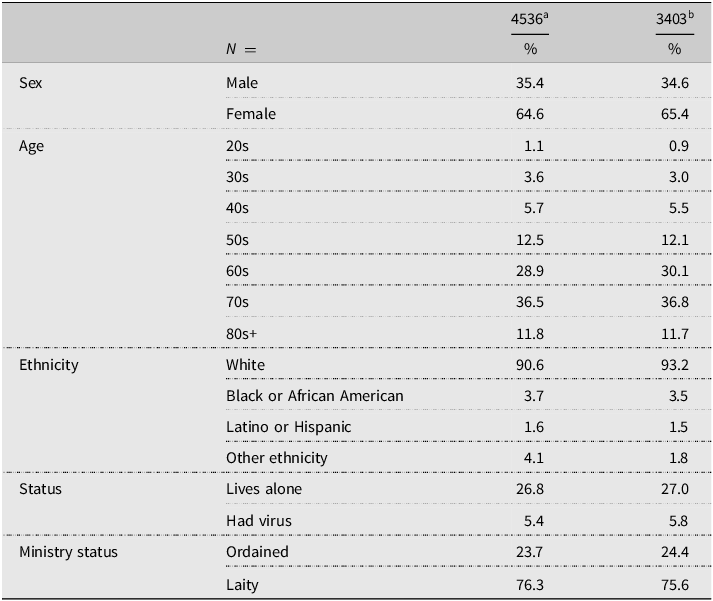
Note: aAll TEC living in USA, bfinal sample without missing values.
Instruments
The spiritual well-being change scale (SWCS) is designed to measure changes in spiritual well-being among specifically Christian samples. It consists of five items: frequency of prayer, frequency of bible reading, trust in God, quality of spiritual life and overall spiritual health (for details, see Village & Francis, Reference Village and Francis2023a). Cronbach’s alpha in the final sample used in this analysis was .83 (Table 2).
Items in the spiritual well-being change scale (SWCS)
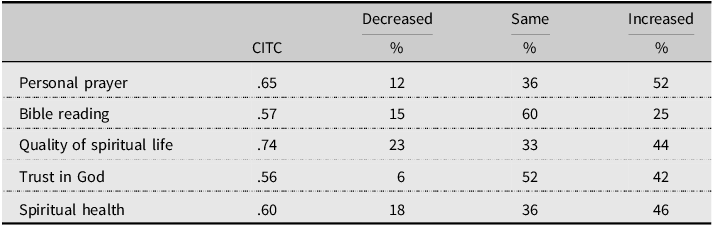
Note: N = 3,403. CICT = corrected item total correlation.
The index of balanced affect change, TIBACh, (Francis & Village, Reference Francis and Village2021; Village & Francis, Reference Village and Francis2021a, Reference Village and Francis2022c) consists of two five-item scales designed to measure changes in positive affect, PA (happiness, excitement, thankfulness, hopefulness and confidence) and negative affect, NA (exhaustion, anxiety, stress, fatigue and frustration) (Table 3). In this sample, the scales had good internal reliability as measured by Cronbach’s alpha (PA = .80, NA = .85).
Items in the index of balanced affect change (TIBACh)
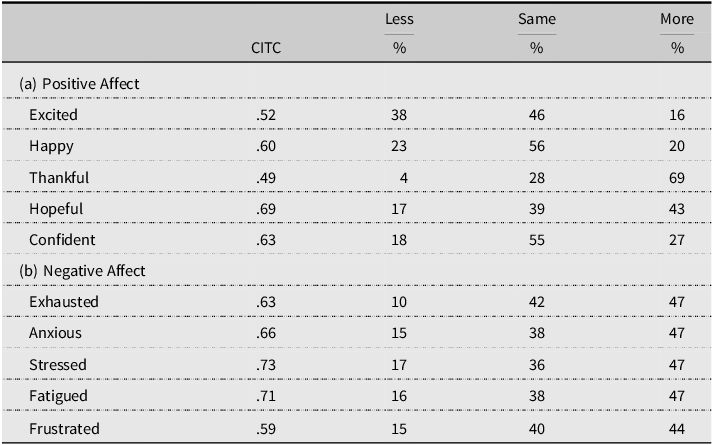
N = 3,403. CICT = corrected item total correlation.
Psychological variables were assessed using the revised version of the Francis Psychological Type and Emotional Temperament Scales (FPTETS-R) (Village & Francis, Reference Village and Francis2023c, Reference Village and Francis2023e). This is a 50-item instrument that comprises four sets of ten forced-choice items related to each of the four components of psychological type: orientation (extraversion or introversion), perceiving process (sensing or intuition), judging process (thinking or feeling) and attitude toward the outer world (judging or perceiving), and ten items related to emotional temperament (calm or volatile). In this sample, the alpha reliabilities were .83 for the EI scale, .77 for the SN scale, .78 for the TF scale, .81 for the JP scale and .83 for the CV scale. Scores (rather than binary preferences) were used to indicate inclinations for extraversion, intuition, feeling, judging and emotional volatility.
Demographic variables included sex (0 = male, 1 = female), age (to nearest decade, 2= 20s to 8 = 80s+), household status (0 = living with others, 1 = living alone), virus experience (0 = not known to have had COVID-19, 1 = definitely had COVID-19) and ordination status (0 = laity, 1 = clergy). Ethnicity was measured using seven categories; initial analyses indicated that one group, Black or African American, had distinct responses to all the others, so for ease of presentation of results this was used a dummy variable for ethnicity (0 = other ethnicities, 1 = Black or African American).
Analysis
The first step of the analysis was to examine bivariate correlations between the SWCS and independent variables and between the independent variables themselves. The second step involved hierarchical linear regression with predictor variables entered in six blocks: block one, personal variables (sex, age and ethnicity); block two living status; block three ordination status; block four psychological type and emotional temperament variables; block five change in negative affect and block six change in positive affect. The aim was to look for evidence that differences in SWCS scores between demographic groups were related to underlying psychological dispositions and whether SWCS scores were best predicted by negative or positive affect, or a combination of both.
Results
The levels of endorsement in the SWCS showed changes that were in line with other studies that have suggested that many people experienced something of a spiritual awakening during the COVID-19 pandemic (Table 2). In this sample, 52% reported increased frequency of prayer, 44% increased quality of spiritual life, 42% increase increased Trust in God and 46% better overall spiritual health. The least positive change was for increases in bible reading (25%). Few people reported decreases in these aspects, with figures ranging from 6% reporting decline in trust in God to 23% reporting decline in the quality of spiritual life. The generally positive picture for spiritual well-being was despite generally negative changes in psychological well-being (Table 3). Just under half of the sample reported increases in exhaustion, anxiety, stress, fatigue or frustration, while 38% felt less excited, 23% less happy and 17% less hopeful and 18% less confident. The exception was that 69% felt more thankful, a result that was similar to that found among English Anglicans (Francis & Village, Reference Francis and Village2021).
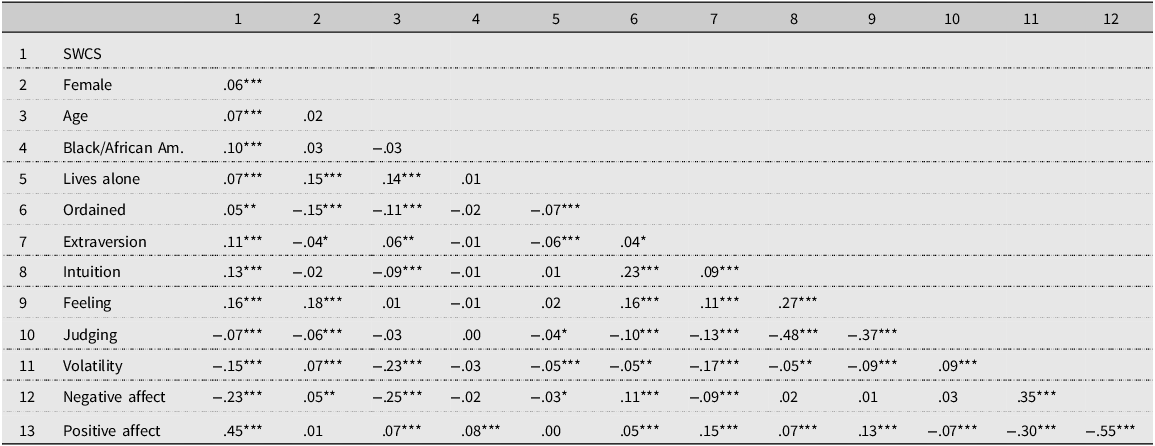
Changes in SWCS scores were more positive in women than in men, among older than among younger people, among Black or African Americans than among other ethnicities, among those living alone than among those with others in their household and among clergy than among lay people (Table 4). In terms of psychological dispositions, change in spiritual well-being was more positive among those who tended towards extraversion rather than introversion, among those who tended towards intuition rather than sensing, and among those tended towards feeling rather than thinking. It was more negative among those who tended towards judging rather than perceiving and among those with more volatile emotional temperament. Positive change in spiritual well-being being was also negatively correlated with negative affect and positively correlated with positive affect.
Bivariate correlations
Note: N = 3,403. *p < .05; **p < .01; ***p < .001. SWCS = spiritual well-being change scale.
The correlation matrix showed that some of the independent variables were correlated. For example, on average compared with men, women were more likely to live on their own, less likely to be ordained, had higher feeling and volatility scores, and had higher scores for negative affect change. Some of the psychological type scores were significantly correlated with positive affect scores. As has been found among English Anglicans (Village & Francis, Reference Village and Francis2023a), emotional volatility was a strong predictor of both increased negative affect and reduced positive affect. For this reason, multiple regression was needed to identify the independent effects of predictor variables on spiritual well-being change scores.
Hierarchical Linear Regression
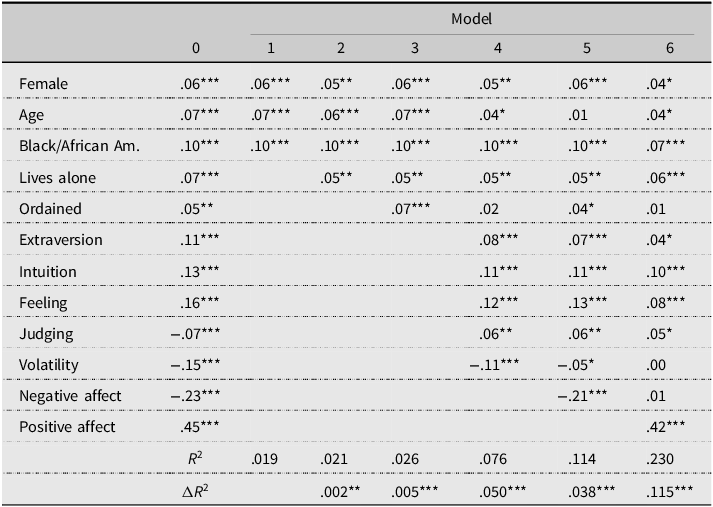
Multiple regression showed that the effects of sex, age, ethnicity and living alone were retained (albeit reduced in some cases) after allowing for other variables in the final model (Table 5). The greater spiritual well-being among clergy was lost when psychological type variables were added to model 4, suggesting that this difference related to the fact that clergy in this sample tended on average to be more extravert, intuitive and feeling, and less judging, than the lay people. Adding affect scores to models 5 and 6 removed the effect of emotional volatility, suggesting that volatility may have affected spiritual well-being by predisposing people to poor psychological well-being during the pandemic. The effect of negative affect on spiritual well-being disappeared when positive affect was in the model, showing that spiritual well-being was most closely associated with changes in positive affect such as excitement, happiness, thankfulness, hopefulness and confidence.
Hierarchical linear regression of spiritual well-being change scale scores
Note: N = 3,403. Column 0 = bivariate correlations. *p < .05; **p < .01; ***p < .001.
Discussion and Conclusions
This study examined self-reported changes in spiritual and psychological well-being among a sample of 3,403 members of the Episcopal Church (USA) during the COVID-19 pandemic in 2021. The results offered answers to the three research questions:
The first question asked which groups in TEC fared better or worse in terms of spiritual well-being during the pandemic. The results showed that differences in spiritual well-being related to sex, age, ethnicity, household status and ordination status. Women tended to have more positive spiritual well-being change than men, an effect that was independent of their slightly different demographic and psychological profiles. In the English study, men tended to be generally more negative than women about changes in religious life during lockdown (Village & Francis, Reference Village and Francis2021b), and this may have dampened their spiritual well-being. Men generally found it harder to cope with church closures or the move to virtual worship, so they may have felt the disruption or their spiritual routines more keenly. The age effect reflects a widespread finding in general populations that younger people found lockdowns harder than did older people, showing poorer mental health and well-being (Holingue et al., Reference Holingue, Badillo-Goicoechea, Riehm, Veldhuis, Thrul, Johnson, Fallin, Kreuter, Stuart and Kalb2020; Pieh et al., Reference Pieh, Budimir and Probst2020; Pierce et al., Reference Pierce, Hope, Ford, Hatch, Hotopf, John, Kontopantelis, Webb, Wessely, McManus and Abel2020). This was also true for English Anglicans (Village & Francis, Reference Village and Francis2022c) and probably reflects the greater demands of people who were likely to be working and to have school-age children to care for at home in lockdowns. This may have had hit their spiritual well-being particularly hard compared with older people.
Among English Anglicans, clergy (especially stipendiary clergy in charge of parishes) tended to have poorer psychological well-being than lay people, mainly because of increases in negative affect (Village & Francis, Reference Village and Francis2022c). In this sample from TEC, clergy overall showed greater increases in both negative and positive affect compared to laity, though the correlation with negative affect was the more pronounced. The more positive average scores for spiritual well-being change among clergy compared to laity seemed to be related to a slightly different psychological profile, with clergy tending to be more extravert, intuitive or feeling and less judging and less emotionally volatile, all of which characteristics were associated with better spiritual well-being. Despite the higher levels of stress among those charged with parishes, they may have been better predisposed to sustain their spiritual well-being than lay people of different personality who had less ministry pressures.
The second research question was whether changes in spiritual well-being were related to psychological type or emotional temperament. The effects of personality were in line with studies elsewhere and with the characteristics associated with different psychological types or temperaments. Although it was assumed initially by many that lockdowns would suit introverts more than extraverts (because they value solitude and are drained by social interaction), this seems not to have been the case (Travers, Reference Travers2020; Village & Francis, Reference Village and Francis2021a; Wei, Reference Wei2020). Social media brought many meetings and social interactions directly into peoples’ homes through online interactions and may have made it harder for introverts to find solitude. Intuitive types tend to respond well to changes and new possibilities, and the enforced change in religious routines may have been more positive for them than for sensing or judging types, who tend to value tradition and routine. Thinking types tended be more critical and less accommodating of changes to religious life (Village & Francis, Reference Village and Francis2021b) and this negativity may have led to more negative changes in spiritual well-being.
The third research question was whether changes in spiritual well-being were related to changes in psychological well-being as measured by changes in positive and negative affect. The links between emotional volatility, psychological well-being and spiritual well-being suggested that a disposition to emotional volatility may have led people in this sample to experience greater increases in negative affect and/or decreases in positive affect. Emotional volatility in the FPTETS is correlated with other measures of neuroticism (Village & Francis, Reference Village and Francis2022a) may point to underlying poor mental health, which was shown in many studies to be associated with reduced ability to cope with the pandemic (Lewis et al., Reference Lewis, Lewis, Roberts, Richards, Evison, Pearce, Lloyd, Meudell, Edwards, Robinson, Poole, John, Bisson and Jones2022; O’Connor et al., Reference O’Connor, Wetherall, Cleare, McClelland, Melson, Niedzwiedz, O’Carroll, O’Connor, Platt, Scowcroft, Watson, Zortea, Ferguson and Robb2021; Stroud & Gutman, Reference Stroud and Gutman2021).
Although emotional volatility was associated with increased negative affect, and the latter with reduced spiritual well-being, the strongest independent association was between better spiritual well-being and increased positive affect. This could be interpreted as positive changes in spiritual well-being (specifically in this population, Christian spirituality) leading to better psychological well-being by improvements in positive affect, though the evidence for cause and effect is difficult to establish in this sort of study. What is clear is that many in TEC experienced better spiritual well-being during the pandemic, and this was associated in particular with better psychological well-being as measured by change in positive affect.
Limitations of the Study
This cross-sectional study required instruments that measured changes in spiritual well-being and psychological affect after the pandemic started. It would be good to be able to do longitudinal studies where the same people can complete instruments on a regular basis so that the effects of future disruptions (including further pandemics) can be assessed more accurately by measuring absolute levels at points in time. Churches might consider doing this as a matter of ongoing routine. Detailed panel studies may help to establish cause and effect in terms of psychological affect and spiritual well-being.
Acknowledgements
We thank Jennifer McKenzie and the Virginia Theological Seminary for promoting the survey among the Episcopal Church.
Ethical Approval
Ethical approval was granted by the Research Ethics Committee for the School of Humanities, Religion and Philosophy ay York St John University (approval code: HRP-RS-AV-04-20-01). All participants had to affirm they were 18 or over and give their informed consent by ticking a box that gave access to the rest of the survey.
Disclosure Statement
No potential conflict of interest was reported by the author(s).


 Open access

