


Introduction
In a drive across the Oklahoman countryside east of Oklahoma City, it is impossible to not notice how eastern red cedar now covers much of the land that used to be prairie and pasture. Once planted as a buffer to soil erosion, the tree has become ‘invasive’ in its voracious spread throughout the Great Plains region. Now red cedar poses numerous ecological problems: it threatens biodiversity, propagates wildfires, exacerbates drought and diminishes grazing land profitability by up to 75% (Harris, Reference Harris2018). Estimated economic losses from red cedar encroachment were $447 million in 2013 (Smith, Reference Smith2011). In nearby Nebraska, a study estimated that between 2004 and 2013, the United States Department of Agriculture (USDA) Natural Resource and Conservation Service (NRCS) spent $8.5 million on combatting red cedar through the Environmental Quality Incentives Program (EQIP) authorized under by the Conservation Title of the Farm Bill (Simonsen and Fleischmann, Reference Simonsen and Fleischmann2015). Nonetheless, the amount of red cedar has continued to increase in Nebraska at dramatic rates, doubling from 2000 to 2017. In Oklahoma, red cedars had encroached on an estimated 12.6 million acres by 2013 (28% of the landscape), from 1.5 million acres in 1950 (Misa, Reference Misa2016). Thus, the fight against red cedar continues to be a losing battle. However, someone who has spent much of their life in the area and is deeply embedded in the farming community might notice something else striking about the landscape; red cedar is much more prevalent on African American owned land than it is on white owned land.
In this paper, we show how historical and ongoing discrimination toward non-white farmers in Oklahoma is hindering the fight against red cedar on their land. This disparity in turn hampers the USDA's regional efforts to address red cedar and support farmer resilience. (We focus on the case of Black farmers in Oklahoma, but parallel stories could be told for other historically discriminated farmer and ranchers across the country [HDFRs]Footnote 1 particularly the many tribal and indigenous communities, farmers and ranchers of the state.) We show that this occurs through two broad processes. Firstly, despite years of efforts by African American and other farmers of color to transform systems of injustice through legal, statutory and regulatory changes, discrimination by the USDA in delivery of services throughout the 20th century pushed most Black farmers out of farming and left those who remained at a disadvantage. Moreover, barriers to USDA programs remain for many Black farmers. Because of this denial of services, Black farmers tend to run smaller operations and have lower revenues, and thus they have less access to the resources necessary to manage red cedar on their land. Secondly, we will show that although programs under the Conservation Title of the Farm Bill provide resources specifically for red cedar management, Black farmers in Oklahoma are disproportionately denied access to these programs.
As others have pointed out, the USDA could better address the red cedar issue by allocating more funding and switching from a reactive to a proactive management approach (Simonsen and Fleischmann, Reference Simonsen and Fleischmann2015), but if Black farmers and other farmers of color cannot address red cedar on their land, the tree will continue to re-encroach previously cleared lands. As the USDA spends millions to try to fight red cedar, they are precluding their own success. So, much like Williams (Reference Williams2018) found that racism toward Black farm workers on plantations in the South in the middle of the 20th century facilitated the rise of pesticide use, our case study illustrates that there are numerous ‘ecological costs to discrimination’ in agriculture.
After discussing the methods and methodology used to conduct our research in section ‘Methodology’, in section ‘Environmental challenges for agriculture in Oklahoma’, we present background on climate change, environmental issues in agriculture and expand on the ongoing issues of red cedar. Section ‘Discrimination and disparities in agriculture’ describes relevant agricultural demographics in Oklahoma and details how historical and ongoing discrimination has created disparities between Black and white farmers. Section ‘Federal conservation policy: limitations and potential of EQIP/CSP in Oklahoma’ discusses how the USDA conservation programs can help small-scale farmers and farmers of color build resilience through support for on-farm changes such a red cedar removal, but access to the programs for these farmers remains difficult and limited. Moreover, section ‘Discrimination in conservation programs’ demonstrates how Black farmers do not have equitable access to these programs. We use statistical methods to show that race is the main factor determining approval of EQIP contracts. Section ‘Unequal fight against red cedar’ outlines the various means by which historical and on-going discrimination impede Black farmers from fighting red cedar. Section ‘Sustainability and resilience: the key role of Oklahoma Black Historical Research Project, Inc. and the Rural Coalition’ outlines how the community-based organization (CBO) Oklahoma Black Historical Research Project, Inc. (OBHRPI) and the national Rural Coalition/Coalición Rural (RC) tackle the interconnected issues of structural inequality and red cedar encroachment through political advocacy and technical outreach and assistance to underserved rural communities. We argue that our case exhibits how these types of organizations play a vital role in supporting more sustainable and resilient farming by mediating between underserved communities and the farm bill and USDA, yet they remain underfunded and crowded out of agricultural policy discussions by environmentally destructive, and mostly white, agribusiness interests.
Methodology
This paper is a co-authored collaboration between researchers and practitioner-community leaders. The Farm Bill practicum course at American University is conducted in relationship with RC and the National Family Farm Coalition (NFFC), frontline farming advocacy organizations that represent, respectively, scores of grassroots CBOs around the country. The student authors of this paper were part of the 2017 practicumFootnote 2 cohort and traveled to Oklahoma to conduct research through participant observation and semi-structured interviews with the OBHRPI, a CBO and longstanding member group of RC that assists small-scale and minority farmers throughout Oklahoma. OBHRPI works to support Oklahoman farmers and ranchers of color in managing their risks, stemming financial losses from low crop yields and prices, increasing their access to USDA programs and benefits, and addressing pressing on-farm issues, such as access to water and the encroachment of red cedar. In Oklahoma, Willard Tillman, Executive Director of OBHRPI (and longtime board member of RC), acted as a guide and person of contact for the American University students as they participated in the 2017 100 Farmers Summit and the OBHRPI Rural Economic Development Conference, both held in Oklahoma City. RC Executive Director Lorette Picciano coordinated arrangements with OBHRPI and traveled with the group, also coordinating their help to document the proceedings of the 100 Farmers Summit, which convened Black, indigenous and other farmers from 15 states.
As such, this paper is inspired by and draws support for its arguments from the first-hand experience of OBHRPI and RC and their decades of direct collaboration with Black farmers in Oklahoma and across the country. The stories and knowledge of RC and OBHRPI provide a unique insight into Black farmers' experiences and guide the analysis in this paper. Rudy Arredondo, president of the National Latino Farmers and Ranchers Trade Association and board member of the RC, explains ‘Rural Coalition and the National Family Farm Coalition and their member organizations are the first responders in crisis in rural America—droughts, wildfires, flooding, climate change … we deal directly and immediately to these issues’ (in discussion with US Agriculture Policy Practicum class, March 21, 2017).
Since its founding in 1978, RC members, such as OBHRPI, the Federation of Southern Cooperatives/Land Assistance Fund and the Rural Advancement Fund of the National Sharecroppers Fund, have brought their combined experience and skills to bear on national policies affecting rural people and communities and to secure policy changes that would help the farmers and ranchers they serve to run viable and sustainable operations. Focusing on transformative change through justice and equity for all, they collectively recognize that long-term vitality of rural communities' rests on the effective and controlled use of resources, including the diversity of the nation's family farmers and ranchers.
In its 40-year existence, RC has worked to achieve these goals by recognizing and promoting the role of CBOs. In 2018, RC honored OBHRPI for its 20 years of dedicated work, much of which is reflected in this paper. Like other RC member groups, it has deep relationships with not only its members but also with critical partners at local, state and national levels.
Our research is aimed explicitly at supporting RC, OBHRPI and other RC members in their work for agricultural policies that address the needs of the Black farming community in Oklahoma and other farmers of color across the country, who are struggling in similar ways. Across the physical and social sciences, researchers note the need for publicly oriented, community-engaged scholarship. Keeler et al. (Reference Keeler, Chaplin-Kramer, Guerry, Addison, Bettigole, Burke, Gentry, Chambliss, Young, Travis, Darimont, Gordon, Hellmann, Kareiva, Monfort, Olander, Profeta, Possingham, Slotterback, Sterling, Ticktin and Vira2017) call for public-oriented science, while a surge of agri-food studies scholars upholds the intellectual rigor and even urgency of community-based and participatory action research methodologies (Borras Reference Borras2016; Orozco et al., Reference Orozco, Ward and Graddy-Lovelace2018; Porter et al., Reference Porter, Woodsum and Hargraves2018). As such, this study was conducted as community-partnered action research, with the community partners delineating research needs and direction with shared, dialogic analysis. Through this approach, Picciano and Tillman, as co-authors, were able to supplement the interviews and participant observation conducted by the students with a wealth of stories and first-hand accounts from the field, and program data they have secured from USDA agencies. Additionally, RC and OBHRPI suggested that it would be useful for their field efforts and policy pursuits if the student researchers invested their skills to produce the ArcGIS maps presented in Figures 1–8 and conduct the statistical analysis of USDA conservation programs presented in section ‘Discrimination in conservation programs’.
Average size of farms in Oklahoma by acre.

Number of farms with Black or African-American operators as the percent of the total number of farms compared to median household income.

Number of farms with White operators as the percent of the total number of farms compared to median household income.

Size of farm or ranch by the race of principal operator in Oklahoma, by farm size.

Economic class of farms/ranches by the race of principle operator in Oklahoma in total sales.

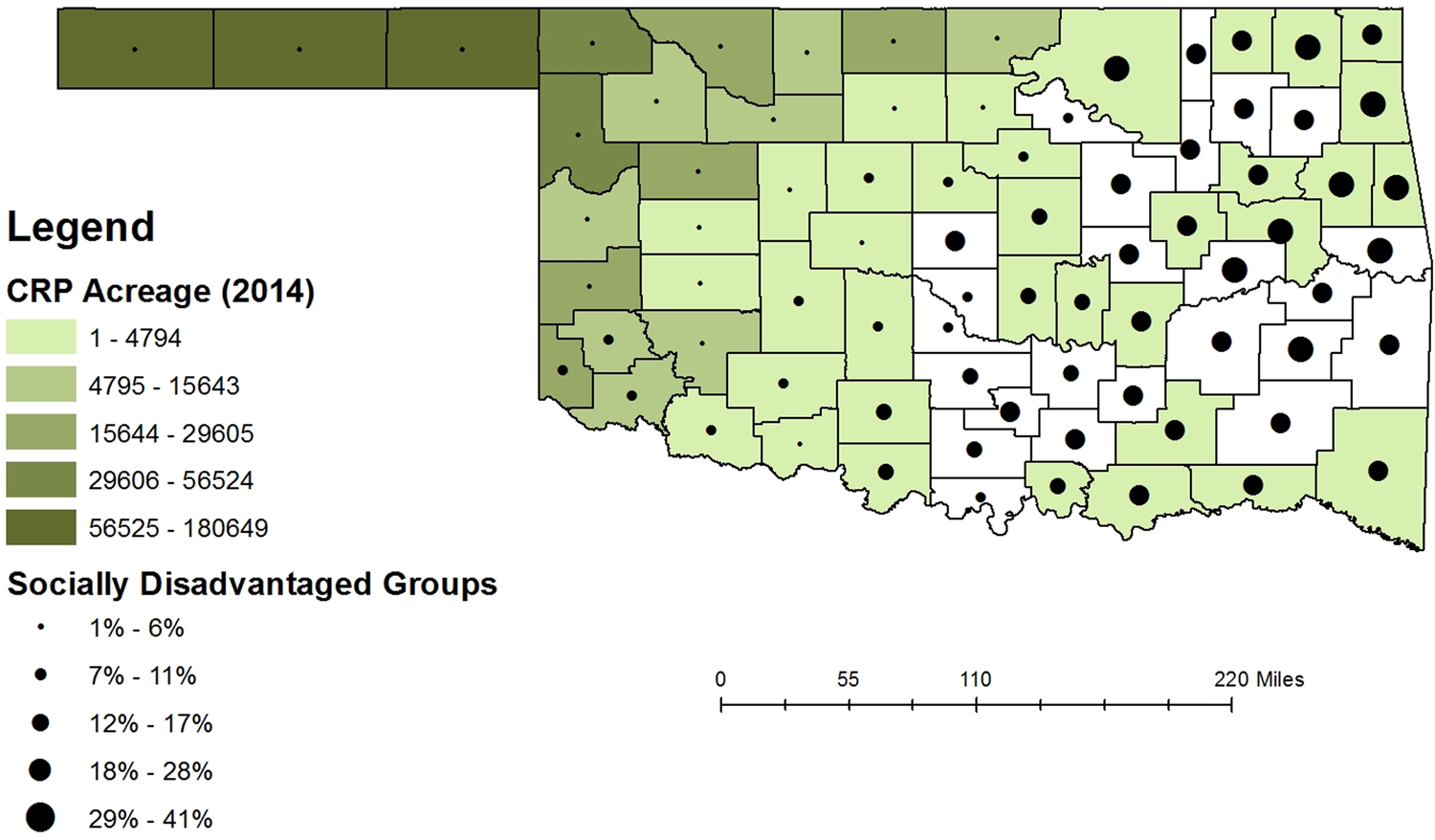
Conservation Reserve Program (CRP) acreage with socially disadvantaged farmers and ranchers in 2014.
Conservation Stewardship Program (CSP) funding with socially disadvantaged farmers and ranchers, from 2011 to 2014.

Environmental Quality Incentives Program (EQIP) funding with socially disadvantaged farmers and ranchers from 1998 to 2015.

The data used for the statistical analysis of USDA programs in section ‘Discrimination in conservation programs’ was obtained from NRCS ProTracts official end-of-year files, as of October 2015. The focus of the statistical analysis was on EQIP data, as this was the most complete and detailed data set RC and OBHRPI could secure from the USDA. All the statistical analyses were done using Microsoft Excel. The main dependent variable tested was the approval ratio for contracts, and the groups compared were non-Hispanic white farm operators and Black farm operators. First, an F-test was done to test for equal variance, since the number of Black farm applications (and total number of Black farmers) was much smaller than for white farmers. The results showed equal variance. Thus, a t-test (assuming equal variance) was done to test the statistical significance of the difference in approval rates for Black and white farmer applications. Secondly, a multiple regression analysis was done to test the significance of several independent variables on the contract approval ratios. More details are given in the results.
Environmental challenges for agriculture in Oklahoma
Oklahoma's climate and water
Although most Black farmers name red cedar as their number one challenge, other environmental changes occurring in Oklahoma also threaten their livelihood. The agriculture sector's productivity is inherently dependent on weather patterns and their variations. The south-central region of the USA has seen substantially drier conditions in recent years due to climate change (Mihunov et al., Reference Mihunov, Lam, Zou, Rohli, Bushra, Reams and Argote2018). While Oklahoma and the Southern Great Plains of the USA have always experienced droughts and large variations in weather, the last 15 years have seen an increasing frequency of extreme weather events as a direct result of more dynamic atmospheric behavior brought on by global warming (Steiner et al., Reference Steiner, Schneider, Pope, Pope, Ford, Steele and Anderson2015). For example, of the five biggest wildfires in Oklahoma since 1997, three have happened in the last 3 years (2016, 2017 and 2018) (Henson, Reference Henson2018). Oklahoma's state climatologist attributed these record-breaking fires to changing weather patterns of wet summers followed by hot and dry winters (Climate Signals, 2018).
These have major economic effects for a state highly dependent on agriculture, the sector contributing over $42 billion economic impact in goods and services in Oklahoma in 2015 (EPA, 2015; ODA, 2015). For example, extreme drought in 2011/2012 in Oklahoma led to over $2 billion in losses in the agricultural sector (McKindra, Reference McKindra2012). Climatologists are expecting even greater variability in both temperature and precipitation in the state, with overall temperature increases and more frequent, longer periods of days over 100, in addition to extended periods of drought (Lengnick, Reference Lengnick2015). Coupled with flooding due to more intense downpours and expanded ranges of pest and diseases, large yield losses across the state will be likely.
While climate change is a key environmental factor negatively impacting agriculture, another is water scarcity. Agriculture takes up an estimated 80–90% of consumptive water use in the USA, and Oklahoma freshwater supplies are continuously threatened (USDA ERS, 2017). The state overlays 23 major groundwater basins that flow into neighboring states, which can have major implications for the entire region (OWRB, 2011). For example, one of the aquifers Oklahoma sits on is the Ogallala Aquifer, a ‘fossil aquifer’ that supplies the largest resource of ground water for the Great Plains region. A fossil aquifer implies that the replenishment rate is so slow, it quickly runs out if not sustainably managed. Concurrently, surface waters, especially in the western part of Oklahoma, are largely unsuitable for public supply with excess concentrations of chloride, dissolved solids, nutrients, pesticides, toxic chemicals and suspended sediment (OWRB, 2011).
The encroachment of red cedar has made farmers even more vulnerable to these environmental changes. Global warming plays a large role in the increased intensity of droughts and fires in Oklahoma, but the increased intensity of fires has been shown to be correlated with the spread of red cedar (Roberts et al., Reference Roberts, Uden, Allen and Twidwell2018), and as we will show in the next section, red cedar's effect on water availability puts farmers in a precarious state even before drought hits.
Red cedar
Eastern red cedar (Juniperus virginana), technically a juniper, is a coniferous tree species native to the eastern part of the USA. Large parts of Oklahoma that were once open prairie rangelands are now closed canopy woodlands of red cedar (Briggs et al., Reference Briggs, Hoch and Johnson2002). Red cedar is now frequently considered an invasive species throughout large parts of the Great Plains region.
However, Streit Krug et al. (Reference Streit Krug, Uden, Allen and Twidwell2017) argue that a better term is ‘culturally induced range infilling’. Although the species remains in its historical range, and therefore is not technically invasive, human-induced land use change has greatly increased concentrations.
A few main factors have led to the infilling of red cedar. For one, due to fast propagation, USDA and state agencies promoted widespread planting of the species as a windbreaker to prevent soil erosion after the Dust Bowl (Rice, Reference Ricen.d.). Another factor has been changes to the human induced fire regimes in the region. With increasing pressure from population and development, the state started putting out wildfires after World War II to protect the housing and development sectors (Ortmann, Reference Ortmann, Stubbendieck and Robert2007). This also replaced the traditional practices of the Native Americans who maintained a healthy ecology by intentionally starting controlled fires to create grazing land for bison (Drake and Todd, Reference Drake and Todd2002). Without fires, invasive species like red cedar with shallow roots that would be otherwise destroyed by fire move in and spread, competing with the deeply rooted native forage vegetation that can withstand fire and quickly recover (Ortmann et al., Reference Ortmann, Stubbendieck and Robert2007).
Red cedar becomes a problem when land is not managed. It is often the first species to grow and spread in abandoned or neglected fields. The tree propagates quickly, so it can also spread to land under use if the land managers are not proactive. Large red cedars must be removed mechanically; however, prescribed burning followed by grazing is an effective and cost-efficient way to control red cedar after larger cedars have been cleared (Wilson and Schmidt, Reference Wilson and Schmidt1990). Even with proper removal, adequate and constant grassland management, such as livestock grazing, needs to be implemented for native plants to return and keep red cedar at bay. If done correctly, cattle will graze on the high-quality forage that is left over after a burn, until a newly burned area becomes available (Weir et al., Reference Weir, Elmore, Bidwell, Engle, Carlson, Fuhlendorf and Scasta2014). However, the technique is underutilized by farmers and ranchers even though ecologists and many farmers and ranchers recognize its utility (Harr et al., Reference Harr, Wright Morton, Rusk, Engle, Miller and Debinski2014). Various liability and permitting policies make controlled burns unappealing to farmers.
The infilling of red cedar poses a variety of threats to rural communities. The species severely increases the likelihood of devastating, uncontrollable wildfires (Morrison, Reference Morrison2016). It is a particularly hazardous fuel because its growth form acts as a fuel ladder, allowing fires to climb into the crowns of taller trees, and because its needles contain volatile oils (ODAFFFS, N.D.). Many lose friends and family members to these fires every year. When red cedar encroaches on farming and ranching land, it undermines productivity. Cedar infilling exacerbates water scarcity, consuming an estimated 55,000 gallons of water per acre of cedar per year and impeding water from reaching soils, streams and water tables (Hubbard, Reference Hubbardn.d.; Wedin et al., Reference Wedin, Awada, El-Hage, Geha, Huddle, Zhou, Sudmeyer, Brandle and Martinn.d.). This reduces the availability of soil moisture for crops, water in streams for livestock and water that can be pumped from ponds and tables for irrigation or livestock. Furthermore, the species shoulders out native plants, such as foraging grasses essential for grazing (Horncastle et al., Reference Horncastle, Hellgren, Mayer, Ganguli, Engle and David Leslie2005; Ortmann et al., Reference Ortmann, Stubbendieck and Robert2007).
A typical Oklahoman Black farmer served by OBHRPI has a 40-acre cow–calf operation, growing grasses to feed cattle. With as much as half their land covered by red cedar, Black farmers have seen their incomes decline. One study finds that, when a plot of land has 80% canopy coverage, forage production essentially equals zero (Ortmann et al., Reference Ortmann, Stubbendieck and Robert2007). Another study finds that a change in tree cover from 10% to more than 50% over a 20-year period reduces economic returns to zero at the productive study sites (Smith and Schmidt, Reference Smith and Schmidt2014). Furthermore, reduced access to water, forage and income puts farmers in a precarious position when drought hits. The severe 2014 drought in Oklahoma forced many Black farmers to sell all their cattle and leave farming completely. As George Roberts, a central Oklahoma farmer and rancher puts it ‘red cedar is a 24/7 problem’ (in discussion with authors, March 19, 2017).
Around 2010, OBHRPI reported the increasing impact of red cedar taking over grazing land to the NRCS state technical committee. By 2013, red cedar became the number one resource concern in the state. Though some state-level initiatives exist to remove red cedar on private lands, they remain minimal, and the responsibility for combating red cedar has largely fallen on land owners themselves. USDA conservation programs, administered through the NRCS, can help offset part of the cost of red cedar removal on farming and ranching land. In 2017 and 2018, the NRCS spent approximately $523,600 on red cedar removal,Footnote 3 but there has yet to be noticeable overall progress, and the juniper remains a struggle for many farmers, especially Black farmers.
Discrimination and disparities in agriculture
Agriculture census demographics
The social-demographics of farmers in Oklahoma has changed dramatically over the last century. In 1910, there were 190,192 total farming operations in Oklahoma and 13,209 were run by African Americans (Fite, Reference Fiten.d.). Following patterns in the rest of the USA, there has been a large drop in both the total number of farms in Oklahoma and a larger proportional drop in the number of African American run operations over the 20th century. In 2012, there were 80,245 farms in Oklahoma and 1337 of those farms had a principal operator who was identified as Black or African American (USDA, 2014b). However, between the 2007 and 2012 census, the number of Black farmers increased, while the number of white farmers continued its downward trend (USDA, 2014b), a phenomenon which RC attributes to active outreach and assistance by OBHRPI and its counterparts as well as policy changes which they have advocated for, as discussed in section ‘Unequal fight against red cedar’.
In Figures 1–3, one can see that the geographical distribution of farm size, median household income and race of operator are all correlated in Oklahoma. Smaller farm sizes tend to be in the eastern half of Oklahoma in areas with lower median household income, and larger farms are in the western half of Oklahoma where median household income is also larger. When looking at Figure 3, in addition to the larger farms being in wealthier areas, the owners of those farms in the western half of the state are predominantly white compared to the eastern half. Contrastingly, Black operators tend to run smaller farms and live in areas with lower median household income, as evidenced by Figure 2. Furthermore, Figures 4 and 5 show that the farms having both the largest size and highest total sales are disproportionately operated by white farmers.
Institutional racism in agriculture
The disparities in farm size and income in Oklahoma represented in Figures 1–5 reflect similar patterns seen across the USA. Social science and legal literature argue that these trends are connected to the well-documented history of discrimination toward non-white and non-male farmers by the USDA, especially in the county-level Farm and Home Administration (FmHA; now the Farm Service Agency, FSA) offices—biases that prevented generations of farmers and ranchers from obtaining the USDA loans they needed to acquire land and keep their farm operating (see USDA, 1997; Gilbert et al., Reference Gilbert, Sharp and Felin2002; Carpenter, Reference Carpenter2012; Daniel, Reference Daniel2013, for overviews). This discrimination also prevented Black farmers from expanding their farms, thus keeping down the average size of their farms and decreasing their revenues (USDA, 1997). Similarly, farmer-elected County Committees that approve and allocate commodity support subsidies and disaster programs have historically denied Black farmers from accessing these programs. Over the years, many Black farmers who did participate in commodity or disaster programs received vastly smaller payments than their actual acreage and yield per acre should allow, as the payments were based on their base acreage and yields as calculated by local FSA offices.
One can see the effects of this institutional racism most starkly in the decline of Black farms over the 20th century: between the beginning of the 20th century and 2007, Black farm owners decreased 96.6% compared to a 61.5% decrease for white farm owners. Black farm acreage also decreased by 80%, while white farm acreage increased by 3.8% (USDA, 1997, 2002, 2009). The decades long struggle by Black farmers and the groups representing them culminated in the class-action civil rights lawsuits known as Pigford I (1997) and Pigford II (2010), which paid out reparations totaling over $2.25 billion to a significant number of African American farmers who could prove they were discriminated against by the USDA between 1981 and 1996.Footnote 4 In addition, changes secured in Farm Bills over the last 30 years, many of which RC with its members drafted and advocated, have also contributed to improved delivery systems, increased accountability, decreased reported incidents of racism in USDA county-level offices and directed resources toward HDFR communities. The 2012 Census of Agriculture suggests these improvements have contributed to a change in the earlier trends, with the number of Black farmers increasing by 12% since 2007 to 44,629 operators and an increase of Black farmers counted as principal operators by 9% from 2007 to 33,371. There is also a slight increase in the percentage of beginning farmers who are minority farmers (NASS, 2014). These recent increases, which are also documented for American Indian, Hispanic and Asian Farmers and Ranchers, are attributable in part to a decade long effort to develop partnerships between the USDA National Agriculture Statistics Service with the CBOs representing diverse farmers to assure a more accurate reflection of the number and contributions of this growing sector of producers (Picciano, Reference Picciano2015).
However, the damage from past discrimination remains. The Pigford settlements, while large, also denied assistance to many Black farmers who experienced discrimination they could not document, often due to the failure of USDA to provide written denials of service. The long delays by USDA in re-establishing a civil rights process that did not function from 1983 until 1996 and in settling the class action cases meant thousands of Black farmers and ranchers lost their family land and were not adequately compensated for the generations of systemic exclusion, appropriation and subjugation.
Furthermore, historical and current discrimination continues to affect Black farmers interactions with the USDA in several ways. Firstly, many Black farmers feel that they are still discriminated against, albeit in less direct ways, in county-level USDA offices. Recent studies in North Carolina and Michigan found that some Black farmers feel that discrimination continues to prevent them for being approved for programs and loans in FSA offices (Balvanz et al., Reference Balvanz, Barlow, Lewis, Samuel, Owens, Parker, De Marco, Crowder, Williams, Barker, Lightfoot and Ammerman2011; Tyler et al., Reference Tyler, Rivers, Moore and Rosenbaum2014). Black and other people of color farmers throughout RC's networks share similar stories (Orozco et al., Reference Orozco, Ward and Graddy-Lovelace2018). However, there have recently been few academic studies that seek to investigate ongoing discrimination, and a Georgia study found no evidence of discrimination against non-white borrowers based on the probability of an FSA loan application's approval (Escalante et al., Reference Escalante, Brooks, Epperson and Stegelin2006). Nonetheless, ongoing discrimination is still possible considering that the process to determine that a loan application is complete, and assess the risk of loans is subjective, and handled by generally white FSA loan staff, which may result in bias, conscious or not (Havard, Reference Havard2001; Wood and Ragar, Reference Wood and Ragar2012).
Secondly, Black farmers in many areas also tend to apply at lower rates than other farmers for other USDA programs, due to minimal effort on behalf of USDA county-level offices to reach and enroll Black farmers and other Historically Disadvantaged Farmers and Ranchers (HDFRs) in federal programs, and because Black farmers often associate FSA offices with past discrimination and trauma and tend to avoid them (Balvanz et al., Reference Balvanz, Barlow, Lewis, Samuel, Owens, Parker, De Marco, Crowder, Williams, Barker, Lightfoot and Ammerman2011; Wood and Ragar, Reference Wood and Ragar2012; Tyler et al., Reference Tyler, Rivers, Moore and Rosenbaum2014).Footnote 5
Thirdly, at the 100 Farmers Summit, attendees shared that the FSA continues to frequently under-report Black farmers base acreage, despite policies to mitigate the impact by allowing most farmers to use county averages. This prevents those farmers from obtaining the USDA commodity and disaster payments they are entitled to. The process to submit the paperwork necessary to claim higher yields is often tedious, and if results are deemed unfair, the process to appeal local county committee decisions is time-consuming and difficult, as it is necessary to return to the same office that made the unfair decision in the first place. Farmers still report retaliation from local county committee officials and the County Executive Director that the local committees choose and supervise. As long-time officials retire, their family members often take their places, perpetuating what many Black farmers still consider the ‘old boys’ network’, which still has often too much control over USDA program and service delivery. This system allows the mentioned barriers for Black farmers to continue. Local conservation districts have similar levels of influence with respect to delivery of some conservation programs (section ‘Federal conservation policy: limitations and potential of EQIP/CSP in Oklahoma’).
Another critical barrier to Black farmers trying to obtain USDA benefits is the issue of ‘heirs’ property’, identified in the data obtained by OBHRPI and affirmed by RC members and the 100 Farmers participants. Heirs’ property is land that has multiple owners (sometimes over a hundred) with undivided interests and no designated administrative authority (e.g., earlier owners passed away without wills). For many farmers, attorneys are expensive, and RC and OBHRPI have observed that attorneys often will not work with farmers to settle heirs’ property issues because they have clients, such as banks, developers and other farmers, that are trying to obtain heirs’ property for below market prices. Lacking access to attorneys, who are expensive, the current operators of the land often cannot prove that they have control of the land for the purposes of operating a farm because they do not have a deed, lease or other form of a signed agreement by all other interest holders. Without such documentation, they cannot secure a farm and tract number and register in the system that allows them to qualify for USDA programs and benefits. The Federation of Southern Cooperatives/Land Assistance Fund estimates that 40% of all Black owned farm land is held as heirs’ property (Rural Coalition, 2018). Heirs’ property has also been one of the largest drivers of Black land loss in the South (Dyer et al., Reference Dyer, Bailey and Van Tran2009). At the 100 Farmers Summit in Oklahoma City, Black farmers cited it as one of their most pressing challenges to securing a livelihood from farming. RC and its members made addressing Heirs’ Property a primary plank of their 2018 Farm Bill platform, and, impressively, they were successful in getting this provision into the 2018 Agricultural Improvement Act (discussed in section ‘Sustainability and resilience: the key role of Oklahoma Black Historical Research Project, Inc. and the Rural Coalition’).
Overall, a disproportionate amount of USDA program funds, including conservation, commodities and loans, still flow to white farmers and ranchers. Per capita, Black farmers received about 50% of what other farmers received in government payouts in 2012 (USDA, 2014a). The latest study available on subsidy disparities found that in 2005, the average Black beneficiary of USDA program funds received $9555 less than the average received for all other beneficiaries (NBFA & EWG, 2007). According to the most recent 2012 Census of Agriculture, in Oklahoma, the USDA distributed a total of $1433.05 for each Black run farm in Oklahoma and $3432 for each white run farm in Oklahoma (however, these numbers obscure how certain individual farms amongst each group receive much larger pay-outs, while other farms receive no government funding at all).
Federal conservation policy: limitations and potential of EQIP/CSP in Oklahoma
USDA conservation programs for red cedar and resilience
The NRCS, a branch of the USDA, oversees financial, easement and partnership assistance programs within the Conservation Title of the Farm Bill. There are three key NRCS programs: the Conservation Reserve Program (CRP), the Conservation Stewardship Program (CSP) and the EQIP.Footnote 6 The NRCS aims primarily to protect and conserve natural resources, but their programs can also help farmers build resiliency (Mase et al., Reference Mase, Gramig and Prokopy2016; Álvarez-Berríos et al., Reference Álvarez-Berríos, Soto-Bayó, Holupchinski, Fain and Gould2018). Disaster relief and crop insurance programs can help farmers buffer the economic effects of disasters. However, as Gupta et al. (Reference Gupta, Tyagi and Sehgal2011) and Vasquez-Leon et al. (Reference Vasquez-Leon, West and Finan2003) point out, relying on reactive policies often leads farmers to fail to enact better management practices and adapt to. Conversely, these conservation programs support on-farm changes—such as improving soil health, conserving water, increasing biodiversity and mitigating harmful invasive species like eastern red cedar—that evidence has shown can increase productivity and allow farmers to better manage risks associated with droughts, hurricanes and other climate hazards (Altieri et al., Reference Altieri, Nicholls, Henao and Lana2015). For example, research has shown that farmers in higher drought risk regions are more likely to enroll and benefit from EQIP funding (Wallander et al., Reference Wallander, Aillery, Hellerstein and Hand2013).
CSP and EQIP are more valuable programs to Black farmers than CRP. CRP pays farmers to take environmentally sensitive land out of production. EQIP and CSP are working lands programs that provide technical outreach and training and offset the cost of implementation of practices and technologies that simultaneously meet resource conservation goals and improve farming operation. Black farmers and ranchers tend to run smaller operations and often do not have the extra land to set aside for CRP. Also, EQIP can be used to adopt technologies especially useful to low-resource farmers and ranchers, like hoop houses and low-cost solar water wells.
The programs are a huge asset to farmers struggling with red cedar. EQIP can fund farmers to remove red cedar and plant native grasses for grazing on the newly cleared land, and CSP will help offset some of the costs of on-going red cedar management. On the other hand, CRP participation has often facilitated the spread of red cedar by taking land out of production that needs to be actively managed to prevent encroachment (Harr et al., Reference Harr, Miller and Engle2012). Farmers have cited a lack of technical support as the reason for not using controlled fires for red cedar on CRP land. Perhaps NRCS support for this controlled fire, along with allowing sustainable grazing practices on CRP land could help mitigate the spread of red cedar. There is precedent for this—CRP allows special provisions for grazing during droughts.
Shortcomings and limitations of conservation programs
The NRCS programs remain underfunded and difficult to access for many farmers. The complexity of conservation programs poses barriers to participation for farmers and ranchers, especially those that are small-scale and limited resource, who lack the time or means to access information, apply for participation and pay for the cost-sharing (Reimer and Prokopy, Reference Reimer and Prokopy2014). Furthermore, eligible conservation practices must adhere to the Field Office Technical Guides. Some farmers use ecological practices that do not match up with the guidelines, which are designed with modern industrial farming in mind. For example, Hopi farmers have had difficulty in getting NRCS to qualify their traditional practices for EQIP funding, even though their farming practices have much higher conservation standards than the majority of what EQIP funds (Johnson et al., Reference Johnson, Lien, Sherman and López-Hoffman2018). All the while, EQIP disproportionately funds repairing the environmental consequences of larger-scale and industrialized farming, including huge concentrated animal feeding operations (CAFOs; John, Reference John2017).
Ironically, EQIP was originally intended as a program for supporting small-scale and minority farmers, and CSP was created as a way for these farmers to transition toward more long-term whole farm conservation efforts. Over time, EQIP program rule changes at the national and state level have favored large producers, and this trend will likely continue unless action is taken. Furthermore, the small portion of funding that ultimately aids small- and medium-scale farmers is becoming increasingly threatened. Conservation funding was significantly reduced in the 2014 Farm Bill, with over $6 billion in cuts. The 2018 Farm Bill did not restore these funds, and despite increases in CRP acreage, included deep slashes to the CSP. Even before the cuts, many more farmers applied for CSP and EQIP than were approved. With limited funds and competition amongst applicants, fairness in fund distribution becomes even more important. However, as we will show in section ‘Discrimination in conservation programs’, disparities in access to these programs exist between white and Black farmers in Oklahoma.
Discrimination in conservation programs
Because the NRCS working land programs can offer useful resources for minority and small-scale farmers, OBHRPI focuses much of its outreach work on helping farmers to sign up for these programs. However, there is a general sentiment expressed by Black farmers that, although there have been improvements, the USDA still does not quite serve them the same way the agency serves white farmers. To quantify this, OBHRPI and RC requested data from the NRCS to analyze the distribution of applications and approved contracts between Black farmers and white farmers in Oklahoma for EQIP. We focus on EQIP, because we were able to acquire more data for this program, but Figure 6 shows that there are geographical and racial disparities in CRP and CSP funding in Oklahoma. After summarizing the data, we discuss and offer some explanations for the findings. More research is needed to further investigate the nature and explanations of disparities in access to USDA conservation program.
Results
As shown in Table 1, Black farmers applied for EQIP contracts at a higher rate than white farmers in Oklahoma in fiscal year (FY) 2016. Black farmers had 5.1% more applications filed per total number of farmers compared to white farmers (Table 2). This likely speaks to the success of OBHRPI's outreach efforts. However, as also seen in Table 1, white farm operator application approval on average was almost twice that of Black farm operators, at 10.1% compared to only 5.3% of Black farmers. The differences are statistically significant, with P-values of <0.05 (Table 3). Further, we tested five variables to see if they had a statistically significant effect on the approval rate (Table 4).Footnote 7 The only statistically significant variable was the race of the principal operator. This highlights clear disparities within the application system. Despite Black farmers applying at higher rates, the approval rate is half that of white farm operators.
EQIP Application approval ratios and contract obligations by Race

Number of EQIP applications by Race

Testing significance of difference of approval ratio of Black farmers (Variable 1) compared to white farmers (Variable 2)a

a An F-test was already done to test for equal variance t-test: two-sample assuming equal variances.
Multiple regression analysis to test for significance of independent variables on approval ratio

To add, in FY 2016, the average EQIP contract for white farmers was $72,141 and $20,051 for Black farmers (Table 1). The explanation for this disparity is likely that white farmers tend to have larger farms, and EQIP practices pay per acre. Interestingly, our results show that Black farmers received on average more funding per acre, at $320 per acre, compared to white farmers who received on average $150 per acre (Table 1). To clarify, there is a bottom limit to how much EQIP will pay out per contract. So, some smaller farms that should technically receive a certain amount for EQIP contract based automatically receive more because that amount is below the set floor. Because Black run smaller farms on average, they benefit from this floor more often, and it inflates the amount they receive per acre.
Furthermore, in Figure 8, one can see that the top five largest recipients of EQIP funds in Oklahoma are Jackson, Texas, Harmon, Caddo and Beaver counties, all predominantly white farming counties. Contrastingly, the bottom five recipients of EQIP funds, Johnston, Marshall, Coal, Oklahoma and Tulsa counties, all have high percentages of historically disadvantaged farmers and ranchers. These bottom five counties received $2,551,021 in EQIP funding, which is less than half the amount of funds Beaver county alone received (EWG, n.d.). This highlights that the racial disparities in EQIP access lead to geographically uneven application of funds, potentially having implications at the landscape level.
While more research is needed on the factors that lead to increased program participation and reduction in disparities in some counties, the experience of our partners points to the presence of qualified CBOs in the county, with adequate resources to supply outreach and technical assistance over time. Their presence may also enhance the relationships with USDA county-level staff, and the mutual capacity of each to help producers prepare and submit applications that are eligible for and strong enough to secure approval, and to complete their projects successfully.
Explanations for disparities in funding and approval rates of EQIP and CSP
Farm size, economic class and historical discrimination
The data show Black farmers are trying to use these programs but are not getting their fair share of funds. Previously, Black farmers would not even apply for conservation programs because doing so would require them to first go to the FSA to secure the farm numbers necessary to participate in any FSA or NRCS program—sites of recorded, systemic discrimination. Many Black farmers did not want to relive the trauma, humiliation and feelings of futility that they and their parents experienced when trying to work with the USDA. This continued even after the Pigford lawsuit and the implementation of more civil rights accountability in the USDA. However, CBOs have worked hard to increase application rates in many HDFR communities through facilitating trust between HDFRs and local offices and securing funding from the FSA and NRCS for practices that are useful and preferred by small farmers, such as high tunnels, solar water wells and FSA microloans.
As stated in the results, the larger average size of white operated farmers in Oklahoma likely causes the discrepancy in financial obligation data. CRP and many EQIP practices pay per acre, so larger, disproportionately white farms will apply for and receive more money.
The larger average size and incomes of white farms may also explain the difference in approval rates. White farms are more likely to be able to afford their part of the cost-share of EQIP contracts. HDFRs, while they can qualify for smaller cost-share requirements, still often struggle to afford payments (discussed in the following section). However, we are unable to confirm how much of a role farm size and income played in the approval of contracts. NRCS was unable to provide data on the farm size or income of each applicant. However, we did test to see if the number of acres applied for affected the chance of approval, and we found this variable to not be statistically significant.
Points system, cost-share levels and set asides
It is beyond the scope of this paper to parse out the exact causes of the difference in contract approval rates and obligations between Black farmers and white farmers. This would require detailed records of why agents denied or approved each contract. Nonetheless, we propose some other possible explanations ascertained from the authors' experiences in the field.
First, less apparent discrimination likely still occurs in some county-level USDA offices. Black farmers and ranchers at the 100 Farmers Summit in Oklahoma shared stories of not receiving the same information on programs from county-level officials that white farmers and ranchers receive. They refer to this as the ‘old boys’ club’ and other Black farmers across the country have reported a similar experience (Balvanz et al., Reference Balvanz, Barlow, Lewis, Samuel, Owens, Parker, De Marco, Crowder, Williams, Barker, Lightfoot and Ammerman2011; Wood and Ragar, Reference Wood and Ragar2012; Orozco et al., Reference Orozco, Ward and Graddy-Lovelace2018; discussed at length in section ‘Discrimination and disparities in agriculture’). Secondly, both EQIP and CSP use a point system that may entrench the inequalities created by the history of racism. The NRCS State Technical Committees, local Conservation Districts and NRCS offices have discretion in determining priorities for conservation in each area. To move up in the ranking system landowners must obtain ‘points’ for applied conservation practices on their land. Practices preferred or most needed by Black farmers may not be those assigned the most points. Also, these farmers are often not told that their points will increase for implementing a larger number of conservation practices at the same time. The point system, coupled with the lack of information on many of the specifics,Footnote 8 perpetuates a system in which those that get funding in the first place will continue to get more funding, while farmers new to conservation have a hard time breaking into the system. The story of central Oklahoma rancher George Roberts illustrates both problems.
A few years ago, George Roberts requested EQIP funding to remove red cedar and restore grassland on 80 acres of his property. He was approved only for red cedar removal. The following year he applied for funding to plant and manage new grassland on the cleared acres. However, this request for additional funding did not get approved. He did not have enough ‘points’ from applied conservation practices to be eligible to compete for funds. The ranking system works such that he would have been approved for both at the same time. When he first applied for red cedar removal with grassland management, the NRCS agent told him to only apply for red cedar removal and that the native grasses would simply grow back without management if fenced off the land from cattle. Not only would Roberts have been approved for practices had he applied for both at the same time, but he would also have received a higher reimbursement for both practices than the rate he received for red cedar removal, and would be eligible to get more funding in the future. Without the funding for management, red cedar will likely return to Roberts' land.
The 2008 Farm Bill included higher cost-shares and set asides in conservation programs for HDFRs and Beginning Farmers and Ranchers (BFR), policies that were continued in the 2014 and 2018 Farm Bills. HDFRs are not to receive less than 5% of conservation program funds in EQIP and acres in CSP, and NRCS was to supply up to 90% of their cost-share (other farmers receive up to 75%). Further, HDFRs are eligible to receive up to 50% of the cost-share rate up-front. However, rules adopted soon after the 2008 Farm Bill cut into this funding, stipulating that HDFRs and BFRs could receive 90% of the average state cost of the applied for practice, meaning their payment may be substantially less than the 90% promised. Moreover, NRCS at the state level has the discretion to set aside earmarked HDFR funds into a separate pool, and to only pay for the higher HDFR cost-share rates with those funds. Thus, when set aside funds are exhausted, HDFRs have to compete in the larger pool where the higher cost-shares are not honored.
Tillman, in reviewing the final level of funding received by Roberts, calculates that the reimbursement level for his cost-share was reduced both because of lower reimbursements for single rather than multiple practices, and because at least part came from the state cost-share pool rather than the HDFR set aside pool with the higher cost-share rate. In addition, in order to receive reimbursement of about 250 per acre, he had to pay upfront the full cost of removal of the red cedar.
It seems that the NRCS agents did not just fail to report information to Roberts, they actively discouraged Roberts from obtaining the funds he was seeking. Was this an act of discrimination? It may not be provable, but it seems likely. OBHRPI has observed that white farmers and ranchers are almost always told the necessary details about funding possibilities, while Black farmers are often given much less information. Even if this phenomenon is not explained by overt racism, it is almost certainly attributable to the professional and social networks in which a majority of USDA county-level officers are still white, and agents are simply more likely to approve applications and share information with people closer to them in their segregated communities: other white farmers and ranchers. Whatever the explanation—overt racism, unconscious bias or the ‘old boys’ club’—Black farmers and ranchers are not getting the same information as white farmers, are falling behind in the point systems, and cannot access equitable and adequate levels of conservation program funding even with higher cost-shares and set asides set in place to increase conservation access.
Unequal fight against red cedar
Although it is yet to be documented in the academic research or news articles covering red cedar, OBHRPI and Black farmers on the ground know that red cedar infestation in Oklahoma is much more prevalent on land owned by African Americans than it is on white owned land. Our participatory research identifies five main explanations for this phenomenon.
Firstly, Black farmers and ranchers, due to historical and ongoing discriminations and inter-related issues with heirs’ property, have less access to capital to pay for the costs of removal on their own. Mitigation is also much more challenging in areas where there are smaller farms and more dormant land, and Black farmers disproportionately have smaller operations and more dormant lands due to difficulties in accessing USDA funding.
Secondly, many Black owners have given up farming and ranching completely due to difficulties in making a living in the face of discrimination, low farm-gate prices and, in particular, issues with heirs’ property. Consequently, their land sits unmanaged, allowing red cedar to easily encroach.
Thirdly, although EQIP and CSP funds can be used to remove and manage red cedar, many Black farmers are prevented from accessing these funds because of heirs' property status, and because, as we have shown, the Oklahoman NRCS offices approve Black farmers for program funds at a lower rate than white farmers.
Furthermore, as red cedar encroaches, the land loses its federal eligibility for CSP—the Conservation Title working lands program that requires active land use, forestry and grass management. Farmers must develop a long-term comprehensive management plan to participate. Help for developing a plan is available from Technical Service Providers (TSP) individuals, private businesses, non-profit organizations or public agencies outside of the USDA who have received certification by the Natural Resources Conservation Service to provide technical services to landowners or producers who participate in USDA conservation programs. However, as shared at the 100 Farmers Summit, many Black farmers have little to no contact with TSPs. In Oklahoma, OBHRPI has seen that white farmers are more likely in Oklahoma to have a well-researched comprehensive management plan outlined in conjunction with a TSP and are more likely to have the resources to implement it. Conversely, Black farmers are more likely to have CSP eligibility revoked due to lack of active land and red cedar management. A cycle of exclusion results.
Finally, the amount of EQIP and CSP funds designated for red cedar depends on the priorities of local conservation districts, even though Oklahoma Forestry Services considers red cedar encroachment as one of the state's top conservation priorities (OFS, 2014). OBHRPI has observed that some local conservation districts have reduced the priority for red cedar mitigation in areas where red cedar has mostly been removed on land managed by white farmers and ranchers, even if it remains a top priority on land managed by HDFRs.
Until red cedar is managed properly on all land equally, it will be impossible to fully address the problem. If red cedar is not taken care of on African American owned land because the owners cannot get access to the same programs as their white neighbors, the white neighbors will continue to be at risk of encroachment—and so red cedar will remain a problem for all, exacerbating drought and fires and undermining the resilience of farmers. Proposed solutions must be inclusive of all, if desired results are to be achieved.
Sustainability and resilience: the key role of Oklahoma Black Historical Research Project, Inc. and the Rural Coalition
As exemplified by this case study, the USDA and the farm bill—including the Conservation Title—overwhelmingly support environmentally destructive large-scale industrial farming, run mostly by white men. Working within this structure, while also seeking to transform it, RC and member groups like OBHRPI (as well as similar networks, such as NFFC) mediate between underserved rural communities and the USDA to build economically viable sustainable land use and resilient agriculture. They achieve these goals through advocacy and direct work with communities. In Oklahoma, OBHRPI and RC play a key role in the fight against red cedar, not only through OBHRPI's direct work with communities, but also in their efforts to break down the structures at the USDA that have created and maintained racial inequalities.
Fighting for justice
OBHRPI leaders, like other RC groups, have a deep understanding of farming and ranching and the barriers producers face, having stood with them in the long struggle to hold the federal government accountable for past injustices. OBHRPI was formed at precisely the time Black farmer organizations, with RC and other diverse members, were seeking to transform the USDA and secure resolution to unanswered discrimination complaints. Tillman (and many other RC leaders he met through the process) provided key input to the USDA Civil Rights Action team they helped initiate. Its 1997 report strengthened the basis for a class action law suit by Black farmers against the USDA (discussed in section ‘Discrimination and disparities in agriculture’). After the case was won, OBHRPI began what would become a decade and a half of helping Black farmers file discrimination claims.
OBHRPI joined the RC, working closely with the network of Black farm organizations and the wider group of RC leaders.
These collaborators turned their attention to wider efforts to influence policy. In shared work dating back to the mid-1980s, RC, OBHRPI and other members and partners have secured more than 40 sections of policy in farm and credit legislation.
A constant focus was securing statutory authority and expanding support for the historic Outreach and Assistance for Socially Disadvantaged and Veteran Farmers and Ranchers Program (OASDVFR), which supports technical assistance to organizations that help HDFRs and veteran producers navigate USDA programs and systems. Authorized in Section 2501 of the 1990 Farm Bill, the program is the primary ongoing response Congress has provided to fill the systemic gaps in service created by more than a century and a half of exclusion of minority farmers. In the 2018 Farm Bill, after intense negotiations and advocacy, the new Farm Opportunities Training and Outreach (FOTO) Program linked OASDVFR to the complementary BFR Development Program begun in 2002. The link allowed both programs to secure permanent authority and permanent funding of $50 million, shared equally between the two programs.
Authority for additional discretionary funding of up to another $50 million annually was also added.
The inclusion of language to address the issue of heirs’ property developed by the experienced team of RC leaders, including OBHRPI, was another bright spot in the 2018 Farm Bill. The bill authorized the use of alternate documentation that farmers operating on heirs’ property could use to demonstrate control of land, thereby allowing them to secure farm numbers and access to USDA programs.
These major successes by RC, its members and partners, ensure that more farmers, especially African American farmers and other farmers of color, can finally access USDA programs that enable them to eradicate red cedar, protect soil and water, and continue to operate viable farms that feed their communities.
Working with the community
Throughout his career, Tillman established relationships across agencies and associations, and used these to learn how to secure support for the programs he envisioned and developed. While working at the Oklahoma Department of Agriculture before OBHRPI, he used his connections, especially with the USDA, to secure funds that supported a program that provided 4 years tuition for 50 farm and rural youth he mentored and recruited to Langston University, a historically Black college in Oklahoma. The program helped save Langston's Agriculture program, and 11 of the graduates went on to work for USDA. When the OK Department of Agriculture tried to take over the program, he formed OBHRPI to host and continue the project with community-based leadership.
In recent years, OBHRPI's major focus has been on red cedar. OBHRPI acquired funding for a project to address red cedar using the NRCS Conservation Innovation Grant (CIG), a subprogram under EQIP that awards grants to develop technologies and strategies for conservation on working lands. With support from the grant, OBHRPI purchased red cedar removal equipment and provided hands on technical assistance to farmers to apply for EQIP contracts to cover the cost of removing the cedar, planting cover crops and adopting other practices that improve soil health and keep the tree off their grazing lands. OBHRPI further won a USDA Rural Value-Added Grant (a Rural Development Title program) to acquire equipment to process value-added red cedar products such as wood chips and mulch. Currently, OBHRPI removes red cedar from farmers land for free and plans to use the proceeds from the sales of value-added products to continue and expand the project. Also, with CIG support, OBHRPI developed a demonstration project featuring a low-cost solar water well that provided water for cattle in drought years, a practice also eligible for EQIP cost-share assistance.
OBHRPI has also made use of the OASDVFR program. The support from OASDVFR and CIG for OBHRPI's outreach and technical assistance efforts has been a main driver of the high application rate of Black farmers for EQIP programs in Oklahoma. This exemplifies how CBOs with strong community ties are the best able to use the OASDVFR funding effectively. They have a pivotal, though as of yet under-supported, role in expanding and enhancing Conservation and related USDA programs to promote economically viable sustainable land use and resilient agriculture.
Conclusion
As community-led participatory research, this project set out to detail the interconnected political and ecological experiences and struggles of Black farmers in Oklahoma. We have shown how historical and on-going discrimination by the USDA hinders the fight against red cedar on land owned by African Americans, which in turn precludes regional efforts to solve the issue.
We traced how the well-documented historical discrimination by the USDA and on-going issues with heirs' property have left a disproportionate number of Black farmers inadequate to actively manage all or parts of their land for cedar and pushed many of them out of farming all together, letting red cedar invade abandoned fields. Farmers can access USDA NRCS conservation programs to offset the cost of red cedar removal and management, but many Oklahoma citizens have expressed the feeling that the NRCS is not there for Black farmers. Our original data analysis in Part 6 supports this claim by proving statistically that the NRCS disproportionately approves EQIP contracts for white farmers over Black farmers.
Finally, we demonstrated RC and OBHRPI's work, such as fighting for legal reparations for Black farmers, reforming heirs’ property laws in the farm bill, and using USDA funds to perform technical outreach and assistance is essential in the fight against red cedar. Indeed, they identify and work to overcome every single barrier to red cedar mitigation we mention in this paper, including in ways we did not have space to discuss. In this case, as in others, the ecological issue is inseparable from political struggles for justice and access to resources. NRCS programs, though having potential, remain inadequate for addressing red cedar or indeed many other agroecological issues. Conversely, RC and OBHRPI have a deep familiarity with the issues farmers are facing on the ground and use this knowledge to address red cedar by shaping and implementing a variety of agricultural policies and programs. Similar stories are common throughout RC's network. Thus, we argue that, with more funding and a better seat at the table in agricultural policy formations, these front-line organizations could play a vital role in building more economically and ecologically resilient agriculture that works for all.
Currently, the situation is bleak for many Black and other smaller scale farmers in Oklahoma. Drought returned in 2017 and 2018, red cedar remains an everyday struggle for many, and commodity prices have been lower than average for several years (Hegeman, Reference Hegeman2019). Droughts have caused increases in the number of fires, burning 700–850 acres a day in the driest season of 2017 (Daily Oklahoman). Current programs and the hard work of OBHRPI and other community leaders provide some support, but if Congress and the USDA continue to neglect the needs of these farmers or cut back the programs that work for them, farms will continue to go out of business and the local ecology which farmers rely on will continue to deteriorate.
While tracking the implementation and evaluating the impact of the 2018 Farm Bill, policy makers would do well to understand that our agricultural system is only as strong as its most vulnerable farmers and ranchers. Thus, successful agricultural policies must eliminate barriers and invest adequate support to ensure the success of our diverse rural communities while creating new opportunities for their empowerment. ‘We are not activists’, states RC board member Lorena Andrade—who works with a group of women garment workers as they rebuild their lives after their jobs moved across the border from El Paso to Juarez—‘we are instead engaged every day in a struggle to protect our communities and save our land’. The struggle is not theoretical, described simply by words or data; it is about real people and real communities confronting enemies and systems of injustice that directly threaten their land and way of life.
Acknowledgments
George Roberts and the participants of the 100 Farmers Summit for sharing their stories of struggle and perseverance in the face of discrimination and structural barriers to making a living from farming; the staff of Rural Coalition and Oklahoma Black Historical Research Project, Inc.; and Michael Bard and Stephen Tolpinrud who went to Oklahoma for the 2017 Practicum Class and laid the groundwork for the research that went into this paper.



