

Introduction
As an adjunct to ongoing archaeological research focusing on the Dirikoro area of Mursi territory in the far south-west of Ethiopia (cf. Clack & Brittain Reference Clack and Brittain2011 a & b), data were collected in March–April 2013 on how cattle are modified, particularly with regard to decorative pattern branding. Cattle colour patterns have been the focus of research amongst the Mursi (Turton Reference Turton1980) and neighbouring groups such as the Nyangatom, Dassanetch and Bodi (Almagor Reference Almagor1972; Tornay Reference Tornay1973; Fukui Reference Fukui, Ellen and Fukui1996), and, along with horn modification, more widely in northern Kenya and South Sudan (e.g. Evans-Pritchard Reference Evans-Pritchard1940, Reference Evans-Pritchard1956; Lienhardt Reference Lienhardt1961; Hazel Reference Hazel1997). The much less common practice of deliberately branding decorative patterns onto cattle, however, appears to have been neglected except for brief mention of it amongst the Hamar, also of south-west Ethiopia (Dubosson Reference Dubosson2013: 83). This is an omission, as it may be relevant for interpreting cattle imagery in rock paintings and engravings in Ethiopia where bovine representation is common.
Mursi—archaeological and historical context
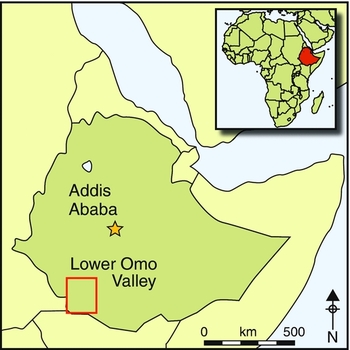
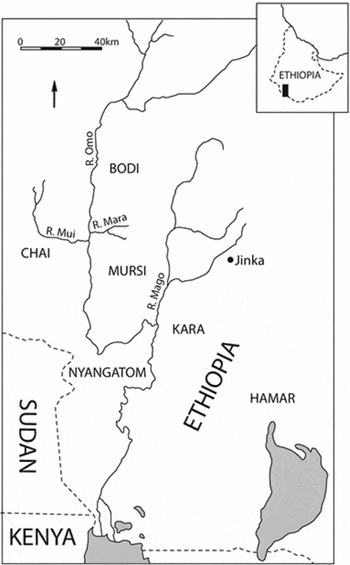
The Mursi number about 10 000, are agro-pastoralists and occupy an area centred on the Mursi Mountains, the adjacent plain to the west referred to dramatically by the Italians as ‘The Plain of Death’ (Bolton Reference Bolton1976: 135), and part of the Mago Valley (Figure 1). They speak a Surmic language within the East-Sudanic division of the Nilo-Saharan family (Turton et al. Reference Turton, Yigezu and Olibui2008: 7).
Map indicating the location of Mursi territory and Dirikoro in Ethiopia (adapted from Turton et al. Reference Turton, Yigezu and Olibui2008: 2).
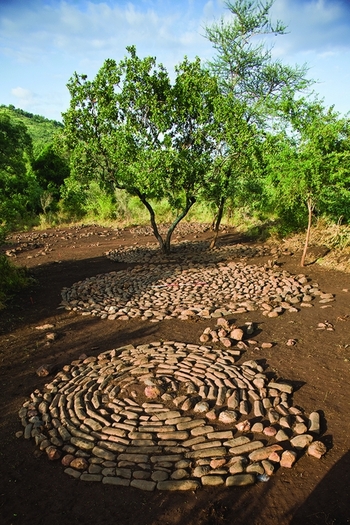
Although the Mursi have been the focus of anthropological research, notably by David Turton (e.g. Reference Turton1973, Reference Turton1980, Reference Turton and Tvedt1993, Reference Turton2004), and the subject of six films directed by Leslie Woodhead (Woodhead Reference Woodhead1987, Reference Woodhead2014), the archaeology of Mursiland was unknown until the Dirikoro Region was first investigated in 2009 (Clack & Brittain Reference Clack and Brittain2011 a & b). The main feature recorded has been benna kulugto, ‘stone circles’ that are actually stone platforms constructed from concentric rings of cobbles set on the ground (Figure 2). A horseshoe-shaped cluster, c. 400m long and formed of 26 platforms between 2.5m and 26m in diameter was recorded around the tip of the Arichukgirong Hills (Clack & Brittain Reference Clack and Brittain2011 b: 34–35). Each platform had a gulley running usually north-west to the outside edge. This and fragments of burnt bone recovered from between the cobbles suggests the platforms were used for cattle sacrifices and roasting (Brittain & Clack Reference Brittain and Clack2012: 54–55). A single radiocarbon date of 170 ± 40 BP (cal AD 1650 to 1890 (2σ); Beta-268958) has been obtained. The Mursi do not claim links to the platforms, and oral traditions suggest they pre-date Mursi settlement and might be associated with prior Bodi occupation (Clack & Brittain Reference Clack and Brittain2011 a: 88), reflecting the historically fluid nature of ethnicity in the region (Brittain et al. Reference Brittain, Clack and Bonet2013: 136).
Benna kulugto (stone platform) at Dirikoro. Photograph: T. Clack.
‘Arichukgirong’ means ‘snout of the bull’ and indicates how the Mursi have used cattle imagery to define and describe aspects of the landscape. That is also evident in two of the five names given to sections of the River Omo: Biogolokare, ‘take out the eyes of the cattle’; and Ariholi, ‘white ox’ (Turton Reference Turton1973: 102). Cattle also physically alter the landscape through grazing and their overnight corralling in cattle camps, and through the creation of features such as the c. 3km-long and c. 1.0–1.5m-deep drovers’ ditch recorded running south-west from the settlement of Meganto. This and the benna kulugto comprise the most significant ‘unnatural’ features recorded in the landscape. Rock art is so far absent, and cattle and cattle exploitation generate the durable archaeological record in comparison to the ephemeral nature of most Mursi material culture, including the shelters in cattle camps and huts in cultivation settlements (cf. Turton Reference Turton1973: 83–84; Clack & Brittain Reference Clack and Brittain2011 a: 89–90).
Mursi history is also only partially understood, and does not indicate when processes such as decorative cattle branding began. The area only became nominally incorporated into the Ethiopian Empire when the troops of Menelik II first occupied the Lower Omo in 1897 (Turton Reference Turton1973: 31), so there is an absence of written sources. Three phases of migration, however, seem to have contributed to Mursi self-identity (Turton et al. Reference Turton, Yigezu and Olibui2008: 1), involving, around 150 years ago, a move east across the River Omo, followed by a migration north in the 1920–30s, and an expansion north-east into the Mago Valley starting in 1979 (Figure 1). Underpinning these was a desire for well-watered grassland for cattle and riverside forest for flood cultivation, primarily of maize and sorghum, to supplement limited rain-fed farming in the bush (Turton Reference Turton1973: 60).
Cattle significance
The importance of cultivation to Mursi subsistence should not be downplayed, but the stone platforms, landscape names and migrations reflect the significance of cattle of the Sanga type, which are “dominant” in the region (Abbink Reference Abbink2003: 342). Cattle provide meat and, more commonly, milk and blood for subsistence, but they are also of great cultural importance (Turton et al. Reference Turton, Yigezu and Olibui2008: 4). They are the ideal bride-wealth payment, are used in sacrifice, function as the referent for Mursi colour terminology, and provide the linchpin for “the relationship between the sexes, the solidarity of age-mates and the link between the social order and the order of the universe” (Turton Reference Turton1980: 328). The ritual and social centrality of cattle is not unique to the Mursi, but is widely found amongst pastoralist and agro-pastoralist societies in the region of South Sudan, south-west Ethiopia, northern Kenya and northern Uganda (e.g. Evans-Pritchard Reference Evans-Pritchard1940, Reference Evans-Pritchard1956; Gulliver Reference Gulliver1952; Lienhardt Reference Lienhardt1961; Almagor Reference Almagor1972; Tornay Reference Tornay1973; Jones Reference Jones1984; Brown Reference Brown1990; Fukui Reference Fukui, Ellen and Fukui1996; Hazel Reference Hazel1997; Abbink Reference Abbink2003; Dubosson Reference Dubosson2013). They are also important elsewhere in Africa (e.g. Herskovits Reference Herskovits1926).
This significance of cattle in Mursi society is reflected in the name of one of the authors, Olirege or ‘Uli Rêggê’—‘Pink Ox’—indicating the relationship between males and ‘favourite-ox’. Alternatives for ‘favourite-ox’ include ‘personal-ox’, ‘display-ox’, ‘bell-ox’, ‘song-ox’, ‘name-ox’ and ‘parade ox’ (boeuf de parade) (e.g. Evans-Pritchard Reference Evans-Pritchard1940: 18, Reference Evans-Pritchard1956: 250; Gulliver Reference Gulliver1952: 72; Lienhardt Reference Lienhardt1961: 17; Almagor Reference Almagor1972: 79; Tornay Reference Tornay1973: 87; Burton Reference Burton, Karp and Bird1980: 276; Brown Reference Brown1990: 60; Coote Reference Coote, Coote and Shelton1992: 252; Hazel Reference Hazel1997: 68; Dubosson Reference Dubosson2013: 82).
Ox modification
The ‘favourite-ox’ can be beautified via modification in varied ways; breeding for coat colour (Turton Reference Turton1980; Coote Reference Coote, Coote and Shelton1992; Fukui Reference Fukui, Ellen and Fukui1996), castration (Evans-Pritchard Reference Evans-Pritchard1956; Coote Reference Coote, Coote and Shelton1992; Dubosson Reference Dubosson2013), ear cutting (Almagor Reference Almagor1972; Dubosson Reference Dubosson2013), horn shaping (Evans-Pritchard Reference Evans-Pritchard1940; Gulliver Reference Gulliver1952; Brown Reference Brown1990; Abbink Reference Abbink2003; Dubosson Reference Dubosson2013), the wearing of secondary ornaments such as bells around the neck (Evans-Pritchard Reference Evans-Pritchard1956), excision of part of the pendulous neck to resemble the foreskin after circumcision (Almagor Reference Almagor1972), pulling out the hump behind the neck to encourage its growth (Evans-Pritchard Reference Evans-Pritchard1937), or pattern branding, the particular focus here. All except neck excision and hump pulling were recorded amongst the Mursi.
Ox decoration through modification is completed to make the animal special and beautiful. As Dubosson (Reference Dubosson2013: 83) notes with reference to Hamar decorated cattle, “le bovin quitte la sphere des animaux domestiques pour entrer dans une autre plus proche de celle des humains” [“cattle leave the sphere of domestic animals to enter a realm much closer to that of humans”]. It also radically changes the form of the ox, altering it to the extent that it could be perceived either as more or less ox-like depending on the observer. Emic perspectives, focusing on the views of the local people, seem to see the modified ox as an enhanced ox, the exemplar of its kind. From an etic (outside ethnographic) perspective, it seems to us that the ox begins to cease to be ox-like and becomes more of a fantasy creature. Yet perhaps such a division is slightly simplistic, for both the aesthetic and fantastic qualities of the modified ox are recognised by the Mursi, as with other cattle-keeping peoples in the region (Coote Reference Coote, Coote and Shelton1992: 254).
Pattern branding
A favourite castrated ox of 3–4 years of age and of pink or white colour will usually be pattern branded. A skilled 47-year-old male elder completed the pattern branding recorded at Doribiscini bhuran (cattle camp—N05.72069° E036.10448°). The branding was done with a chisel-like iron tool, the baera (Figure 3), which was obtained by trade from Aari blacksmiths in the regional centre of Jinka. Green wooden stakes c. 0.5–0.6m in length with bark removed and sharpened to a point at one end were used as handles. These were possibly Cordia gharaf, Mursi loi, often used as handles and “firesticks” (Turton et al. Reference Turton, Yigezu and Olibui2008: 121). The baera was heated in a continuously blazing hot fire maintained by an assistant.
Tools used for horn modification and pattern branding: top left) cattle herdsman holding horn-shaping hammer; top right) Be’ bhêy Kara Nun, ground-stone horn-shaping hammer; bottom) baera, iron branding tool. Photograph: T. Insoll.

During the branding two men restrained the ox laying on its side by sitting on its upper chest; others held ropes to the legs (Figure 4). The baera was retrieved from the fire using one of the green wooden handles and tapped into place on a large branch situated between the fire and the ox. The red-hot baera was moved in a continuous linear motion across the skin until it had cooled and was no longer effective (Figure 4). This allowed approximately 0.6–0.8m of branded line or 20 seconds of working time between reheating. The two rear flanks around the anus were completed with missirou patterns, one of three types of decoration described as routinely applied (Figures 4 & 5). Missirou is composed of five concentric circular lines ringing the tail and anus. The other, miren, is of two types: three concentric circles, and a double ‘U’ (Figure 5).
Branding the missirou decoration using the baera. Photograph: T. Insoll.

Fully decorated ox with chipto horns, nilla ornaments and left to right: concentric circular miren, double ‘U’ miren and missirou branded decoration. Photograph: T. Insoll.

Pattern branding ceased once the ox was perceived to be distressed. The branded areas were then medicated with chulloi, fresh cow dung, and the ox was allowed to recover in the nursery area of the bhuran. Later the same day the branded ox was ritually medicated for apotropaic reasons with bile from another ox killed by a blow to the head from a stone to obtain its gall bladder. Depending on the resilience of the ox and the urgency of other activities, pattern branding is continued a few days or weeks later. After the death of a pattern branded ox, its skin, like those of other cattle, will be used to make a hada (sleeping mat). Branded hada are not deemed ritually significant but their aesthetic qualities are recognised and enhance demand.
Comparative data on decorative pattern branding is sparse. The Hamar decorate favourite oxen, errawak, by branding with a lance to produce either curved or straight lines in varied patterns (Dubosson Reference Dubosson2013: 83). No other information is provided. Russell (Reference Russell2012: 7, fig. 3) also provides an illustration (without giving details) of the favourite goat of a Turkana man who did not own cattle or camels. The goat is branded on one side with missirou-type decoration at the rear, a central vertical ladder-like band, and variously sized semi-circular lines running downwards from the front chest to the upper foreleg. One ear is also cut in a nyabacouda-type pattern, described below.
Wider significance of pattern branding
Ox pattern branding seemingly relates to another dominant domain of Mursi materiality: the human body itself. Eczet and Poissonnier (Reference Eczet, Poissonnier, Fauvelle-Aymar and Poissonnier2013: 187) note the parallels between the miren double ‘U’ symbol and its use in riru scarification. Riru is the marking for men who have killed enemies in combat, perhaps in connection with cattle raids, and the riru marks are made on the arm with a spear point “rougie au feu” (Eczet & Poissonnier Reference Eczet, Poissonnier, Fauvelle-Aymar and Poissonnier2013: 181). Heat as the medium for bodily transformation appears to link ox and man, as do the symbols and the use of the masculine number four (three being female), as in four miren double ‘U’s being branded on the ox (Figure 5). This is not, however, a simple process of mimicry, as the double ‘U’ in riru is often inverted (Eczet & Poissonnier Reference Eczet, Poissonnier, Fauvelle-Aymar and Poissonnier2013: 185) (Figure 6).
Top left) riru double ‘U’ symbols (after Eczet & Poissonnier Reference Eczet, Poissonnier, Fauvelle-Aymar and Poissonnier2013: 182); top right) kichoa concentric circle decoration around nipple; bottom left) decorated Kalashnikovs, rear with beads, cowrie shells, red paint and leather pistol grip cover, front with red-painted inverted double ‘U’ miren symbols; bottom right) concentric circle hair decoration. Photographs: T. Insoll.

Kichoa is the other system of Mursi scarification. This is applied to upper body areas such as the torso, arms, back, stomach and breasts. It seems to lack either missirou or miren symbols, perhaps because kichoa is applied to both men and women. For example, the use of concentric circles as double dashed lines around the nipple (Figure 6) differs from circular miren. The technique used also varies, as kichoa is formed of keloids cut with a razor after lifting the flesh with a thorn (cf. Eczet & Poissonnier Reference Eczet, Poissonnier, Fauvelle-Aymar and Poissonnier2013), rather than branding. Continuous composite scars, including double concentric circles, can also form part of kichoa, so too strict a demarcation is perhaps unwise. Less permanent bodily transformations that are perhaps more plausibly linked to miren symbols are concentric circles shaved into male hairstyles (Figure 6).
In other respects, Mursi material culture is limited (e.g. Turton Reference Turton1973, Reference Turton1980; Eczet & Poissonier Reference Eczet, Poissonnier, Fauvelle-Aymar and Poissonnier2013), but symbolic references to ox pattern branding can be suggested on other Mursi objects. The Kalashnikov AK-47 rifle and variants thereof is another component of Mursi masculinity today (Turton Reference Turton and Tvedt1993). Painted designs on stocks and fore-grips include the inverted double ‘U’ miren decoration (Figure 6). These rifles were first introduced in the 1980s (Turton Reference Turton and Tvedt1993) and attest how Mursi traditions of pattern branding, aesthetics, ornamentation, and material and human decoration do not exist in a historical and political vacuum but are re-employed as new material culture and contact zones are encountered. This is also evident in the depiction of miren and missirou patterns on stylised clay figurines made by some Mursi women for sale to tourists over the last 10 years (Figure 7). Finally, although seemingly not linked to the Mursi, the repeating concentric circles of stones in the benna kulugto described above form features that conceivably functioned for cattle sacrifice in the past, and more generally link circles and cattle.
Mursi oliyna, clay cattle figurine with incised double ‘U’ miren. Photograph: T. Clack.

Horn shaping
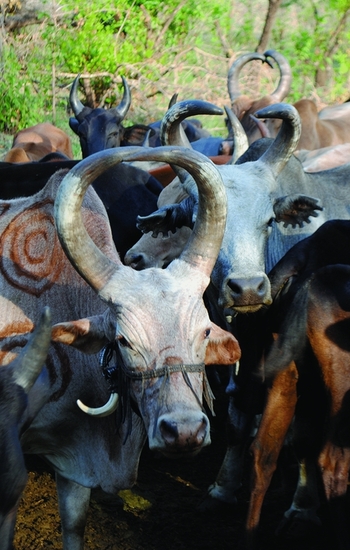
Horn shaping is also a significant form of Mursi ox modification. Three modified horn shapes were identified in the herds at Doribiscini: dogomme forward-shaped horns (Figure 8); and two variants of the chipto inward-curved horn shape (Figure 9). The horn shaping was completed by the same elder as the pattern branding using a ground sandstone hammer, Be’ bhêy Kara Nun. These are locally manufactured and are only used for horn shaping, but like the baera are not ritually important. A worn lower grinding stone, golu, is used to make a horn-shaping hammer. This is initially pecked into shape with a basalt cobble and then filed with a flat face of the same basalt tool to obtain the smooth surface finish of the hammer (Figure 3).
Balai colour (contrasting) black and white ox with dogomme horn pattern. Photograph: T. Insoll.

Decorated oxen: front) branded ox wearing nilla ornaments with chipto horn pattern; behind) gidangi (dirty white/grey) oxen with variant of chipto and nyabacouda ear decoration. Photograph: T. Insoll.
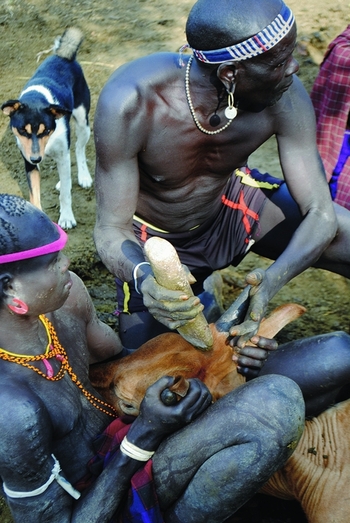
The ox was restrained in the same way as for branding with ropes attached to the legs, but with a man sitting on its flank and another holding its head. Carefully aimed blows of the stone hammer from various positions around the head were used to break the base of the horn where it joined the skull (Figure 10). Once loosened in this way, the horns were cut with a circular V-shaped notch below the tip and bound tightly together with twine to keep the position and encourage horn growth in the desired shape. The horns and surrounding area of the skull were medicated with chulloi and the ox again recovered in the bhuran nursery area. Similar processes of horn shaping have been described for the Turkana and Pokot in Kenya (Jones Reference Jones1984: 46; Brown Reference Brown1990: 61–63), and the Karamojong in Uganda (Gulliver Reference Gulliver1952: 72).
Horn shaping in progress. Photograph: T. Insoll.
Other modifications
In addition to cattle breeding for coat colour and castration (cf. Turton Reference Turton1980), which were not the focus of this research, ear cutting and the wearing of secondary ornaments are further forms of Mursi cattle modification. Decorating the ears can be done for either cows or oxen, and has two forms based on the extent of cutting. Nyabacouda is a rounded, serrated saw-tooth pattern around either one or both ears (Figure 9); sierouy is a more pronounced form where the ear is cut into four upward points. The latter was not seen during this particular fieldwork. These patterns are cut with the small arrow, lawun wheni, used for letting blood from cattle’s main veins for human consumption. Often the same male elder who does the horn alteration and pattern branding will complete the ear cutting.
A secondary ornament used by the Mursi to decorate oxen, nilla, is made locally by Mursi men from leather and two warthog (Phacochoerus africanus) tusks joined with iron fittings to a leather headpiece (Figure 9). These are worn so that the tusks are positioned pointing outwards from either side of the ox’s head below the ears, providing a visual contrast in both size and colour to the ox horns.
Cattle modification and rock art in Ethiopia
Ethiopian rock art was sampled for representations of cattle modification based on the high proportion of cattle images present (e.g. Brandt & Carder Reference Brandt and Carder1987; Hundie Reference Hundie2001; Le Quellec & Abegaz Reference Le Quellec and Abegaz2001; Mire Reference Mire2008; Hagos Reference Hagos2011) (Figure 11). It is possible that relevant images also exist in the rock arts of Somalia, Somaliland and Djibouti, but nothing has so far been found. Overall, pastoral rock art has been described as “a comparatively recent phenomenon” (Brandt & Carder Reference Brandt and Carder1987: 195) in the Horn of Africa, including Ethiopia, spanning the last 4000–5000 years. No indication of cattle ear-cutting or the wearing of ornaments analogous to nilla was found in Ethiopian rock art.
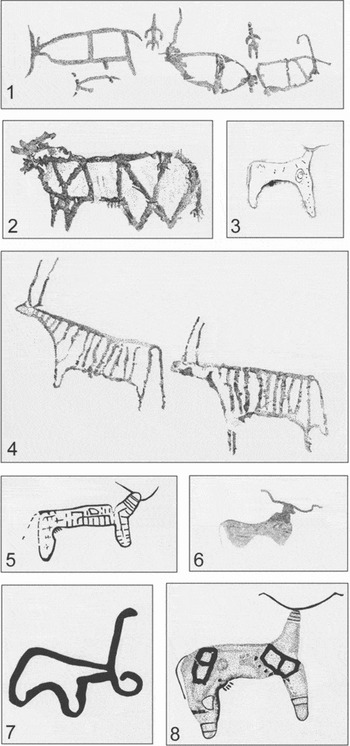
Top to bottom, not to scale: 1) bovid paintings with single or double stripes down the centre of the body, Laga Gafra (after Cervicek & Braukämper Reference Cervicek and Braukämper1975: fig. 4); 2) cattle painting with geometric coat markings, Adi Qanza, Eritrea (after Graziosi 1964: pl. 15); 3) cow painting with circular markings, dots and lines, Laga Oda (after Cervicek Reference Cervicek1971: fig. 9); 4) cattle paintings with vertical banding on coats, Sollum Ba’atti, Eritrea (after Graziosi 1964: pl. 13); 5) cow painting with a geometric coat pattern, Laga Oda (after Cervicek Reference Cervicek1971: 191): 6) cattle painting with “exceptionally diverged”, possibly trained horns, Anza 1 (after Nigus Reference Nigus2006: 59); 7) longhorn cattle engraving with asymmetrical horns, Ejersa Gara Halla (after Le Quellec & Abegaz Reference Le Quellec and Abegaz2001: fig. 7); 8) cow painting with two bisected rectangles, one with associated dashes, Laga Oda (after Cervicek Reference Cervicek1971: fig. 4).
Horn shaping
Horn shaping, however, may be represented (cf. Huard Reference Huard1959: 114). For instance, at the site of Anza 1, 30km east of Edaga Hamus in Tigray, two cattle paintings might depict this. One is approximately 200mm in length and has exceptionally ‘diverged’ horns (Figure 11.6), and the other, although indistinct and partly damaged, has ‘twisted’ forward- and downward-pointing horns (not illustrated) (Nigus Reference Nigus2006: 59–60). Both were dated on stylistic grounds to between 5000–3000 BP. Hagos (Reference Hagos2011: 13) also refers to this emphasis given to horn shapes in Ethiopian rock art, as “twisted or deformed or in abnormal positioning both downward- and forward-curving and high arching of the horns”, but without linking it to horn shaping.
The asymmetrical horns present on a humpless longhorn cattle engraving, part of a panel c. 3m long × 2.3m wide, at Ejersa Gara Halla in the Dilla area, have also been interpreted as depicting a modified horn form (Figure 11.7). Le Quellec and Abegaz (Reference Le Quellec and Abegaz2001: 206) suggest these are like the Hamar modified horn style known as kamara, where one horn bends forward and the other upward. This engraving has been placed within the Sappé-Galma School that was broadly dated to between c. 6500 and 2500 BP, but with the proviso added that they “could be much more recent” (Le Quellec & Abegaz Reference Le Quellec and Abegaz2001: 211).
Horn shaping has been previously suggested for Saharan images (e.g. Huard Reference Huard1959; Cervicek Reference Cervicek1971: 131; Dupuy Reference Dupuy, Botte, Boutrais and Schmitz1999: 58; Chaix Reference Chaix, Gauthier, Le Quellec and Simonis2006: 49–50; Lenssen-Erz Reference Lenssen-Erz2012: 95; Dubosson Reference Dubosson2013: 86) where a high incidence of bovine images is also present (Le Quellec Reference Le Quellec1998: 66–67). In the Sahara, the beginnings of cattle pastoralist rock art have been dated to the second half of the seventh millennium BP, and are part of the emergence of a ‘cattle cult’ (Muzzolini Reference Muzzolini, Blench and MacDonald2000: 89; di Lernia Reference di Lernia2006: 60; Le Quellec Reference Le Quellec2013: 34).
Decorative pattern branding
It is possible that decorative pattern branding is depicted on some cattle in rock paintings from Ethiopia and neighbouring Eritrea. At the Laga Oda rockshelter, 25km south-west of Dire Dawa, a painting of a cow provides the strongest evidence for such modification. The image is 360mm in length and forms one part of a panel of eight pictures of cattle. It is described by Cervicek (Reference Cervicek1971: 122) as “painted in a darkened white, [with] the contours, the inner pattern, horns and udder in black” (Figure 11.5). Cervicek does not consider why the cow is decorated in this way, but the neatly painted geometric patterns could indicate decorative pattern branding. Other strong possibilities are provided by the “distinctive patchy markings, usually in brown and reddish tones, possibly also representing cattle brands” referred to by Marshall (Reference Marshall, Blench and MacDonald2000: 197). These are depicted on paintings of humpless cattle at Zeban Ona Libanos and Sollum Ba’atti in Eritrea that lack dates. Marshall does not specify the type of branding, but decorative pattern branding seems likely.
At the Sollum Ba’atti rockshelter, for example, two of the cattle are depicted with vertical banding that could be decorative pattern branding (Figure 11.4). The dimensions of the images are not given, but the total painted area is described as 18m wide × 2–3m high (Graziosi 1964: 93). Dimensions are also unstated for the images at the Adi Qanza rockshelter where a red-painted bovid accompanied by a man armed with a spear (Graziosi Reference Graziosi1964: 97) again has interesting geometric coat markings that could denote pattern branding (Figure 11.2).
Cervicek (Reference Cervicek1971: 124) refers to the presence of “two circular markings (brands)?” painted in red on another cow, 0.58m long and depicted in black outline at Laga Oda (Figure 11.3). Taking the circular markings singularly, these could be interpreted as ownership brands rather than decorative patterns. Elsewhere in the Horn and eastern Africa ownership brands have been linked to rock art (e.g. Phillipson Reference Phillipson1977: 272; Brandt & Carder Reference Brandt and Carder1987: 198; Finneran Reference Finneran2007: 105; Dubosson Reference Dubosson2013: 84). An example is provided by the almost 1000 geometric rock engravings recorded on the lava outcrops surrounding, and stone upright slabs associated with, graves at the Namoratunga cemetery and rock art site near Lake Turkana in northern Kenya (Lynch & Robbins Reference Lynch and Robbins1977). This is an interpretation, however, that has been challenged recently (cf. Russell & Kiura Reference Russell and Kiura2011; Russell Reference Russell2012).
Not referred to by Cervicek (Reference Cervicek1971: 124) are the lines and dots depicted on the same animal at Laga Oda (Figure 11.3). In totality, these motifs could indicate pattern branding, though of a different form to the geometrically decorated example at the same site. Branding could also be represented on a third cow from the site. This is painted in light grey with black details and is 470mm in length (Cervicek Reference Cervicek1971: 123). Two rectangles bisected by a vertical line, one with associated dashes underneath, could indicate ownership or be for aesthetic purposes (Figure 11.8). All the images (approximately 600 in total) at Laga Oda were originally placed within the so-called ‘Ethiopian-Arabian’ style, dated to between 2200 and 1550 BC (Cervicek Reference Cervicek1971: 130, 143), based on stylistic affinities with C-Group pottery from Nubia (Brandt & Carder Reference Brandt and Carder1987: 206). These dates have, however, been questioned by Le Quellec and Abegaz (Reference Le Quellec and Abegaz2001: 211; see also Le Quellec Reference Le Quellec2003) who indicate that archaeological remains of domesticated cattle do not pre-date 3500 BP, suggesting the images are later in date.
In describing a panel of three larger painted ‘bovids’ and associated human figures (0.6m wide) at the rockshelter of Laga Gafra, another ‘Ethiopian-Arabian’ rock painting site south-west of Harar, Cervicek and Braukämper (1975: 51) make oblique reference to decorative branding. They suggest that the single or double vertical stripes depicted running down the centre of the bovid bodies (Figure 11.1) are reminiscent “of modern burnt ornaments of cattle as applied by East African cattle breeders”. The alternative, less plausible interpretation they suggest is that they represent the wearing of bead bands. A similar cattle rock painting with a vertical stripe down the centre of the body is depicted at Amba Fekada II in Tigray (Nigus Reference Nigus2006: 42).
It has been argued that decorative pattern branding may be represented in Saharan rock art (e.g. Dubosson Reference Dubosson2013: 87). For example, Dupuy (Reference Dupuy1998: 51; 1999: 71) has drawn brief attention to Fulani cattle whose coats were painted with crude vertical, horizontal and slanting lines and spots in the Diafarabé region of Mali as a possible analogy for the geometric signs engraved on some cattle rock art (age unspecified) in the Adrar des Iforas Mountains in northern Mali. Lenssen-Erz (Reference Lenssen-Erz2012: 105) also refers to some of the cattle rock painting and engraving images in the Ennedi Highlands of north-east Chad as being individualised “with very intricate, ‘costly’ patterns of the coat often in strictly unnatural geometric designs”, this fitting “with current patterns of behaviour among some cattle pastoralists”. The existence of potentially comparable practices elsewhere in African prehistory strengthens the hypothesis advanced here for interpreting aspects of Ethiopian cattle rock art.
Conclusions
Mursi pattern-branding practices suggest that in some cases the abstract or non-realistic symbols depicted on cattle coats in Ethiopian rock art could be read more literally. They could signify actual processes of decorative branding (or painting or scarifying) to modify, alter or beautify cattle. Mursi missirou and miren symbols also provide a cautionary note in relation to neuro-psychological interpretations of rock art imagery and their potentially universal applicability. The circular and double ‘U’ could be misinterpreted as entoptic phenomena. These may not precisely parallel trance-related symbols but are generically similar and could be seen, either when represented with or without cattle, as ‘shamanic’ or ‘trance’ related, when they are not (cf. Finneran Reference Finneran2007: 105 for a relevant critique in the Ethiopian context). Instead, they may be indicative of wholly unconnected and complex patterns of human-animal relations centred on masculinity and aesthetics.
Acknowledgements
Timothy Insoll is grateful to the University of Manchester for funding his participation in the fieldwork. Timothy Clack acknowledges fieldwork support from the British Academy and the Christensen Fund linked to elements of this work. All the authors are grateful to the Ethiopian Authority for Research and Conservation of Cultural Heritage for permission to complete the fieldwork. They are also indebted to Ato Abebe Hailu, Antiquities Officer; Mr Juan Salazar Bonet for assistance in the field; and to the Mursi communities in Dirikoro for their hospitality. Paul Bahn, Rachel MacLean, Jean-Loïc Le Quellec, Julian Thomas and David Turton are thanked for comments on the paper, but all errors and omissions remain our own. Rachel MacLean is thanked for doing the line drawings and Ceri Houlbrook and Bryn James are gratefully acknowledged for putting some of the illustrations together digitally.



