

Introduction
Residential care facilities in many countries introduced similar measures to curb the spread of the SARS-CoV-2 virus among their residents.Footnote 1 Despite efforts to control contagion, older people living in residential care around the world were hit disproportionally hard (Comas-Herrera et al. Reference Comas-Herrera, Zalakaín, Lemmon, Henderson, Litwin, Hsu and Fernández2020). This was also the case in Sweden. Of the approximately 19,600 people who died from Covid-19 in Sweden until the end of 2023, about 7,800 lived in residential care (Socialstyrelsen 2023). A government report states that measures were enacted late (SOU 2020). It was not until 1 April 2020 that the Swedish government introduced large-scale isolation measures, prohibiting visits from outside to those in residential care (Johansson and Schön Reference Johansson and Schön2021).
In addition to visiting restrictions, general protective measures in residential care facilities included altered routines, fewer or no activities, and limited socializing, as highlighted in international research papers (Chee Reference Chee2020; Davies-Abbott et al. Reference Davies-Abbott, Hedd Jones and Windle2021; Ekoh Reference Ekoh2021; Klempić-Bogadi Reference Klempić-Bogadi2021; Sims et al. Reference Sims, Harris, Hussein, Rafferty, Desai, Palmer, Adams, Rees and Fitzpatrick2022; Statz et al. Reference Statz, Kobayashi and Finlay2022). Measures to control Covid-19 often included spatial strategies aimed at isolation of residents and social distancing of staff, residents and visitors (Sims et al. Reference Sims, Harris, Hussein, Rafferty, Desai, Palmer, Adams, Rees and Fitzpatrick2022). The Swedish government issued recommendations that included basic hygiene and disinfection routines but not spatial and work strategies (SOU 2021, p. 696). This is surprising, as reports from Swedish authorities about the spread of the coronavirus highlighted architectural space as an important factor at an early stage (Folkhälsomyndigheten 2020; Socialstyrelsen 2020). In a third report, it was noted that if the contagion entered a facility, the staff experienced difficulties containing it due to the physical layout (Szebehely Reference Szebehely2020). Swedish guidelines introduced later were general and applied to all citizens. Swedes were asked to keep a two-metre distance in public. When public facilities were allowed to reopen, there were restrictions as to how many people were permitted in a space at the same time (SOU 2021). Information about architectural space as a means to control Covid-19 in residential care thus appears somewhat ad hoc in Swedish reports, or it is neglected altogether.
Research on space and Covid-19 in residential care
International research identifies architectural space as important in preventing the spread of contagions (Anderson et al. Reference Anderson, Grey, Kennelly and O’Neill2020). Facilities in Sweden were severely affected in spite of their small-scale design with single rooms, which has been noted as advantageous for the control of Covid-19 (Anderson et al. Reference Anderson, Grey, Kennelly and O’Neill2020; Leskovar and Klemenčič Reference Leskovar and Klemenčič2020; Brown et al. Reference Brown, Jones, Daneman, Chan, Schwartz, Garber, Costa and Stall2021; Ibrahim et al. Reference Ibrahim, Li, McKee, Eren, Brown, Aitken and Pham2021; Zimmerman et al. Reference Zimmerman, Dumond-Stryker, Tandan, Preisser, Wretman, Howell and Ryan2021; Benbow Reference Benbow2022; Zhu et al. Reference Zhu, Lee, Sang, Muller, Yang, Lee and Ory2022). Conversely, residents had a greater risk of being infected in larger facilities (Konetzka et al. Reference Konetzka, White, Pralea, Grabowski and Mor2021), as well as in shared rooms (Kain et al. Reference Kain, Stall, Brown, McCreight, Rea, Kamal, Brenner, Verge, Davies and Johnstone2021). Sharing of rooms is prohibited in residential care homes in Sweden. Every resident has a contract for a small flat and a right to remain there, regardless of circumstances.
Despite its alleged importance in the aforementioned research, very few research projects have focused on residential care space. A review of grey literature, reviews and some original research papers shows that most measures taken to limit the spread of contagion can be grouped under the two concepts isolation and social distancing, both of which are spatial strategies. Measures also included altered uses of space, changed staff work patterns and methods, restrictions on visitors including family and friends; all of these have spatial implications (Sims et al. Reference Sims, Harris, Hussein, Rafferty, Desai, Palmer, Adams, Rees and Fitzpatrick2022). The most common application of social distancing concerned both the separation of residents and staff at mealtimes and in other communal are, and one-way movement (Wang Reference Wang2021; Sims et al. Reference Sims, Harris, Hussein, Rafferty, Desai, Palmer, Adams, Rees and Fitzpatrick2022). Isolation could include all residents regardless of their infection status, or only if they tested positive for an infection (Leskovar and Klemenčič Reference Leskovar and Klemenčič2020; Sims et al. Reference Sims, Harris, Hussein, Rafferty, Desai, Palmer, Adams, Rees and Fitzpatrick2022). Another spatial strategy was zoning of special areas, including cohorting with dedicated staff for residents who were ill with Covid-19 or had a suspected Covid-19 infection, while discouraging movement between the zones (Yen et al. Reference Yen, Schwartz, King, Lee and Hsueh2020; Wang Reference Wang2021; Sims et al. Reference Sims, Harris, Hussein, Rafferty, Desai, Palmer, Adams, Rees and Fitzpatrick2022). Spatial strategies accompanied restrictions of normal activities; for example, meals were taken in residents’ private rooms (Sims et al. Reference Sims, Harris, Hussein, Rafferty, Desai, Palmer, Adams, Rees and Fitzpatrick2022). Spatial strategies also included furnishing. The importance of position and visibility of hand hygiene stations is noted in two studies (Bunn et al. Reference Bunn, Brainard, Lane, Salter and Lake2021; Cai et al. Reference Cai, Tyne, Spreckelmeyer and Williams2021). Sims et al. (Reference Sims, Harris, Hussein, Rafferty, Desai, Palmer, Adams, Rees and Fitzpatrick2022) also presented innovations for safe visits, such as Plexiglas barriers, garden visits and resident–visitor window communication. Access to outdoor areas was highlighted as of great importance (Leskovar and Klemenčič Reference Leskovar and Klemenčič2020; Wang Reference Wang2021; Sims et al. Reference Sims, Harris, Hussein, Rafferty, Desai, Palmer, Adams, Rees and Fitzpatrick2022). Altered care and use of space may have been necessary to curb the contagion. Yet, it is emphasized in these research papers that many spatial strategies to control Covid-19 had devastating effects on residents’ wellbeing. These include psychosocial and mental health challenges such as depression, loneliness and feelings of abandonment (Anderson et al. Reference Anderson, Grey, Kennelly and O’Neill2020; Leskovar and Klemenčič Reference Leskovar and Klemenčič2020). Anderson et al. (Reference Anderson, Grey, Kennelly and O’Neill2020) and Leskovar and Klemenčič (Reference Leskovar and Klemenčič2020) both argue that it is imperative to design care settings so that they balance infection control and residents’ quality of life.
Staff experiences of space
A few research papers present studies of direct staff experiences. A Swedish report describes the stressful difficulties associated with not knowing in which direction the pandemic would develop (Erlandsson et al. Reference Erlandsson, Ulmanen and Wittzell2023). A recent review unanimously shows the various aspects of the extreme work situation for care staff and the severe stress associated with it (Boamah et al. Reference Boamah, Weldrick, Havaei, Irshad and Hutchinson2023). While workspace is not the topic of most of the studies in this review, there are some exceptions.
Riello et al. (Reference Riello, Purgato, Bove, MacTaggart and Rusconi2020) argue that the special work environment that underpins long-term relationships with residents is likely to be a factor in staff mental health issues. A survey revealed that staff who assessed their work environments as poor were less satisfied with their work and experienced burnout (Cho et al. Reference Cho, Lee, Kang, Jang, Shin, Eltaybani and Kim2023). Some studies indicate the role of space in practical care work. One study showed how the isolation of residents during the pandemic challenged the collective care model on the whole (Nord Reference Nord2024). Three studies indicated the difficulty of organizing space for cohorting and zoning due to the original spatial conditions in the care home (Rajan and Mckee Reference Rajan and Mckee2020; Spilsbury et al. Reference Spilsbury, Devi, Daffu-O’Reilly, Griffiths, Haunch, Jones and Meyer2020; Bunn et al. Reference Bunn, Brainard, Lane, Salter and Lake2021). Two studies found that changes to the normal home environment that the staff tried to achieve in the residential care home resulted in a medicalized space due to a new cleaning protocol (Bunn et al. Reference Bunn, Brainard, Lane, Salter and Lake2021; Beattie et al. Reference Beattie, Carolan, Macaden, Maciver, Dingwall, Macgilleeathain and Schoultz2023).
Studies indicated that dementia units entailed special challenges for staff during the pandemic. Isolating residents with dementia was particularly difficult due to shared rooms or residents walking about (Rajan and Mckee Reference Rajan and Mckee2020). Residents had difficulties in adhering to infection control rules and social distancing (Rücker et al. Reference Rücker, Hårdstedt, Rücker, Aspelin, Smirnoff, Lindblom and Gustavsson2021). The lack of adequate outdoor spaces made the care work more cumbersome (Scerri et al. Reference Scerri, Borg Xuereb and Scerri2022). One study argued for a need to build larger facilities for people with dementia to create an environment that is more easily modified during epidemics (Nyashanu et al. Reference Nyashanu, Pfende and Ekpenyong2020).
While the above-cited papers mentioned the work environment as a contributory factor, most of them did not present in-depth elaboration of spatial problems. This research addresses this gap in knowledge about space by exploring the design of residential care and its role in measures to prevent contagion. The task of rearranging spaces in the facility was primarily carried out by staff, and their views are thus central to this study. Residents were impacted by altered spatial uses as well as by new care practices, and they appear as evaluators of and commentors on these.
The spatial triad and space and Covid-19 in residential care
Henri Lefebvre’s (Reference Lefebvre1991) spatial model of three different dimensions of the same space frames this study theoretically. These dimensions are conceived space, perceived space, and lived space. The triad is an analytical tool that separates spatial dimensions that are integrated into a cooperating whole.
Conceived space is the idea of a space ‘conceptualized and discursively constructed by professionals and technocrats’ (Simonsen Reference Simonsen2005, pp. 1–2). In this case, conceived space is the professional architectural design of a residential care home. In Sweden, residential care homes adhere to an established design model in which small flats are arranged along corridors and with common spaces (Johansson and Schön Reference Johansson and Schön2021). National building regulations underpin this model by an addendum that reflects tradition and habitual conceptions of work and space in residential care (Nord Reference Nord2013b; Boverket 2019). Similar design models are found in other national contexts (for examples in Sweden and elsewhere, see Regnier Reference Regnier2003).
Perceived space is the residential care home materialized as a built environment and the spatial practices are embedded in and follows from an architectural design (Beyes and Steyaert Reference Beyes and Steyaert2012). The architectural design is thus underpinned by the collective care model, the embedded values of which include that common activities and meals provide quality to the community of residents while individual residents are also cared for (Edvardsson et al. Reference Edvardsson, Petersson, Sjogren, Lindkvist and Sandman2014). This means that certain care practices fit like a glove in architectural space. The care model ‘propounds and presupposes’ an architectural design of common spaces for the community and small flats for each resident (Lefebvre Reference Lefebvre1991, p. 38). The collective care model in Sweden has its roots in old age homes in which resident sharing and communality were even more pronounced than in residential care today. Residents shared flats are an example (Åman Reference Åman1976). However, the care model and its accompanying architecture have proved very resilient. Not even architecture competitions during the twentieth century provided any greater innovations, although the ambition was high (Andersson Reference Andersson2014). Institutional traits survived the great changes of Ädelreformen in 1992, when Swedish residential care (särskilt boende) was created, due to, for instance, the Boverket addendum which already appeared in 1993 (Nord Reference Nord2013b). These traits are obvious in everyday life in the residential care home, where residents routinely move between common and private spaces over the course of a day. Common activities and meals generally take place in common areas, while care of the individual residents takes place in residents’ private flats (Nord Reference Nord2011a; Andersson Reference Andersson, Högström and Nord2017). The earlier literature review of care and space during the pandemic presented mostly perceived space, that is, the constructed, physical environment that presupposed the collective care model.
Lived space concerns the experience of living in a particular environment. It is the ‘directly lived … space of “inhabitants” and “users”’ (Lefebvre Reference Lefebvre1991, p. 39). The study focuses on the adaptations of spaces and their effects on everyday life during the pandemic as lived space. Central to this endeavour is that while resident community may be a positive quality, it may also prove problematic when spatial strategies to prevent contagion need to be maintained. Organizational space and practices are intertwined (Beyes and Steyaert Reference Beyes and Steyaert2012); in this case, these are the care staff’s work and the residents’ daily habits in the spaces of the residential care home. This is the lived space that social and generative bodies ‘incessantly seek to create through appropriation of the environment’ (Simonsen Reference Simonsen2005, p. 7). New practices include altered relations between people and things, and new spatial appropriations.
The central idea in Lefebvre’s (Reference Lefebvre1991) theory is that space produces social life. This idea may also be understood inversely: space is produced by social encounters, even in a hard and tangible built environment. A caring architecture, such as residential care, is not a rigid built artefact with essential qualities; it is, rather, a living thing where care emerges from situations in which architectural elements, residents, staff and artefacts are agents that contribute to different kinds of practices, relationships and qualities (Nord and Högström Reference Nord, Högström, Högström and Nord2017; Nord Reference Nord2018, Reference Nord, Gromark and Andersson2020). ‘[P]ractices are not inherently stable but need to be continuously enacted’ (Beyes and Steyaert Reference Beyes and Steyaert2012, p. 52). They can thus be completely altered in new enactments, producing another caring architecture. A point of departure is that lived space appeared in this way during the pandemic, where the coronavirus was an important agent. It triggered the enactment of new care practices such as adapting an existing architectural layout designed to accommodate a certain way of working in a completely different situation, where a reasonably well-functioning workspace would protect older people from a mortal threat. This is the situation in focus for this article.
Aim and research questions
This article aims to examine how staff and older people managed everyday life in residential care homes spaces during the pandemic. The research questions are:
• What new spatial strategies were implemented?
• How did new care practices interrupt normal routines regarding, for example, mealtimes and activities?
• How did staff and residents perceive these changes?
• What knowledge can be gained from these experiences and how could that feed into a new caring architecture?
Methodology
This qualitative study is an intuitive inquiry (Anderson Reference Anderson, Wertz, Charmaz, McCullen, Josselson, Anderson R and McSpaden2011). An intuitive researcher applies feelings, vague insights and proto-knowledge in the research process. Anderson (Reference Anderson, Wertz, Charmaz, McCullen, Josselson, Anderson R and McSpaden2011, p. 245) has ‘give[n] a “soft” structure to the intuitive process’ in five hermeneutic cycles of interpretation. The openness of this research process provides tools to the researcher to catch and nurture imaginative sparks that offer promises of new trajectories that the research could follow.
In ‘Cycle 1: Clarifying the research topic’, the idea of this research project appeared intuitively during the pandemic. The deaths in residential care reported by media were horrifying and suggested that something had gone seriously wrong. A vague question arose: Did the architectural structures in residential care homes aggravate the difficulties with contagion? This led to the decision that this was an important research topic.
In ‘Cycle 2: Preliminary lenses’, Lefebvre’s triad was introduced to understand these difficulties. The concepts of conceived space and perceived space supported the development of the research project: the reflected background, the research questions and the literature review. The author had long experience of research of space in residential care, and that offered a pre-understanding of the collective care model and architectural space. It was expected that different residential care homes would show similarities in the architectural design.
Four fieldwork sites
Four residential care homes were chosen for the study. The study was conducted in 11 units in the four residential care homes in order to offer a variety of perspectives. One significant criterion for selection was that residential care homes for both dementia and somatic care should be included. Managers in different residential care homes were approached and when they gave their written consent to the study, the residential care home was included. This procedure was repeated until a satisfactory balance between the two was achieved. There was also a criterion related to the building: the residential care home should have access to outdoor areas from the units. All units in the study had either direct access to gardens or common or private balconies. These two arrangements were expected to be of significance for everyday life during the pandemic and perhaps give different experiences.
The selected residential care homes (RCH) had thus the following qualities: RCH1 and RCH3 were both for somatic care. While RCH1 was a two-storey building with one unit on the ground floor and one on the first floor, RCH3 had two storeys and the four units included were all on the first floor. Then, RCH2 and RCH4 were for dementia care. Here, RCH2 was a one-storey building with two units included, whereas RCH4 had three storeys with two units on the ground floor and one on the first floor. Even though a variety of residential care homes were chosen, as was expected, the plans of the units (conceived space) bore great similarities to one another and followed the architectural model provided by Boverket (2019): small resident flats arranged along corridors and with common spaces.
Recruitment of participants
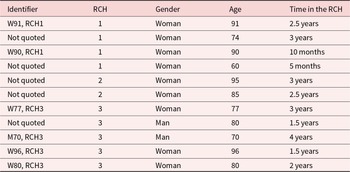
Both resident participants and staff members were recruited by the managers who approved the study. They were asked to recruit residents and staff who wanted to participate. They were also asked to recruit residents who were cognitively able to understand the aim of the study and possessed the strength to participate. They gave a poster to potential participants with information about the study, and photos and contact details of the researchers. The poster was also put on a board in the units. In total, 11 residents living in six units and 15 staff members working in 11 units were recruited. Nine of the residents were women and two were men, and they had lived in the residential care home for between five months and four years. The oldest interviewee was 96 and the youngest 60 (Table 1). All but one of the staff members were women. They were aged between 25 and 50. One had worked there for two months, but the majority had already worked for several years in the residential care home, working there during the pandemic and at the time of the interview. Some had longer experience of elder care elsewhere. One had worked for 22 years in the same residential care home (Table 2).
Interviewed residents, details

Interviewed staff, details

Data collection methods
‘Cycle 3: Collecting data’ in an intuitive inquiry can accommodate many types of qualitative data collection methods. This study included individual semi-structured interviews, observations documented with photographs of the environment and researcher fieldnotes, and architectural drawings. Semi-structured interviews were conducted. The personal experience of Covid-19, as staff or as resident, was in focus for the interviews. An interview guide was used, developed based on the literature review and the author’s own research experience. Spatial strategies were one of the most important interview topics, relating to changes the staff had carried out in the units and what impact these had on caring practices and the relations with residents.
All of the interviews were conducted between February and October 2022. Interviews with residents lasted between 21 and 97 minutes. They were conducted in the residents’ own flats and on walks through the residential care home in which interviewees showed the spaces to which they had referred during the interview. Staff interviews lasted between 14 and 59 minutes (on average 34) and included a walk in the premises. The walk was intended to add more in-depth information on spaces mentioned in the interviews (O’Neill and Roberts Reference O’Neill and Roberts2019). Five residents and four staff members did not walk the premises. Interviews and walking conversations were recorded and transcribed verbatim. Observations during each walk focused on indoor and outdoor architectural spaces. The researcher made fieldnotes and took photographs of presented spaces and objects using a mobile-phone camera. Architectural drawings of each of the residential care homes were obtained from the city planning office and a real estate owner of one of the residential care homes.
Data analysis
A deductive analysis in ‘Cycle 3’ and ‘Cycle 4: Transforming and revising interpretive lenses’ focused on the third dimension of Lefebvre’s (Reference Lefebvre1991) triad of lived space with an open and iterative search by exploring processes over time and space (Beyes and Steyaert Reference Beyes and Steyaert2012). Beyes and Steyaert (Reference Beyes and Steyaert2012) suggest aspects of lived space: everyday practices and materiality, bodily experiences, affective dimensions and multiple uses. These aspects guided the analyses.
The analytical process started with directed content analysis of the transcribed interviews and fieldnotes. These were coded and searched for themes and sub-themes (Hsieh and Shannon Reference Hsieh and Shannon2005). In the immersion of the written data, the author read, reviewed and reflected on the empirical material several times before and after the coding and development of themes commenced. In the next steps, the different data sets – transcribed interviews, observation notes, photos and drawings – were integrated and understood together. Themes and codes in written text were compared with the architectural drawings and the photos. In this analysis, spaces were looked for in the drawings where residents and staff were allowed and not allowed to occupy themselves, respectively, how they could move around and how their use of spaces altered over time. The sizes of the different rooms, both private and communal, were investigated so as to understand the implications of use of different rooms and spaces. It was possible to develop a detailed understanding of how small a small room was, how far away ‘far away’ was, what furniture was possible to put in different rooms. It was possible to understand spatial strategies due to connections between rooms. The photos and walks brought the researchers closer to the lived spaces of the residents and the staff that were mentioned in interviews. Details that were not possible to remember in the environment could be explored.
Finally, ‘Cycle 5: Integration of findings and theory building’ is a theoretical and policy discussion in which the contours of another future for residential care are discerned. John Law (Reference Law2004) argues that researchers need to deal with vague and ephemeral realities that are highly political. The analysis in the present study shows that spatial strategies during the pandemic developed new ways of using space that challenged the reality in residential care as it is understood in the collective care model. These new ways can be seen as an excess of spaces and approaches that are available and can form the basis for new politics (Thrift Reference Thrift2008).
Ethical considerations
The study followed Swedish ethical guidelines for research. All interviewees gave informed consent. They were asked to sign a certificate stating that they were informed about the conditions of participation and the aim of the study. Conditions included that they participated voluntarily and anonymously, and that they could withdraw any time without stating a reason for doing so (Vetenskapsrådet 2023). Ethical approval was given by the Swedish Ethical Review Authority (no. 2021-04289). Both residents and staff in homes with a somatic approach participated, whereas in residential care homes for dementia, only the staff participated. People with dementia might have great difficulties in taking part in interviews due to, for instance, memory loss and cognitive impairment. Individuals might also have difficulty understanding the implications of participation in the research. They were thus excluded from participation to avoid potentially subjecting them to this stress (Hubbard et al. Reference Hubbard, Downs and Tester2003). Special ethical considerations were taken into account as regards the risk for contagion during the pandemic (Galčanová Batista et al. Reference Galčanová Batista, Urbaniak and Wanka2022). The start of the fieldwork was postponed for a couple of months to ensure the physiological safety of the residents.
Findings
The following is an analysis of the spatial strategies used. Three strategies emerged in the analysis: isolation, social distance and the management of movements. The analysis will show that the strategies were embedded in everyday processes of lived space, involving various material matter and things. These strategies produced certain bodily responses, feelings and affective reactions. Several experiences and approaches appeared (Beyes and Steyaert Reference Beyes and Steyaert2012).
Spatial strategies – isolation
The isolation of residents in their rooms was the most radical of all spatial strategies, and it was generally applied in all units in the study during the first half-year, from the spring of 2020 and from time to time later when new instances of people infected by the virus arrived. It contributed to different care practices that were quite contrary to normal care. It was also the strategy about which the staff was most dubious. One staff member commented in an interview:
We had so much protective equipment, so it was about as far from normal as it could get. We were forced to lock them in [their rooms]. The Activity Centre was closed. They weren’t allowed to meet anyone. And we were wearing, like, full spacesuits. It was no dignified life for the older people then. (S5, RCH3)
Isolation was carried out by closing and locking doors to keep people in separate areas. One resident said in an interview that she had been asked by the staff to keep her door closed, not to let anyone in and not to leave the room herself. She also remembered that ‘the door out there in the corridor that leads to the sitting room was suddenly locked. It was always open before’ (W77, RCH3). She said that, quite unexpectedly, the closed door in the corridor prevented residents from reaching the sitting room. New spatial strategies of that kind were introduced seemingly at random. Isolation aimed at keeping the common areas empty. A staff interviewee said that residents were not allowed to frequent any of the communal spaces, including eating in the dining room: ‘[T]hey weren’t allowed to come out and eat, they were basically locked in their rooms. We just had to go in there with trays … if someone needed help eating, we just had to do it in their room’ (S7, RCH3).
These care practices accentuated a vulnerable resident body, prone to sickness and death, while the social aspects of isolation were toned down during the periods of general isolation. This was the dilemma. One staff interviewee explained the risks for the residents: ‘People living in residential care have many health conditions, the elderly. They’re tired. We have to follow hygiene protocol. It’s something we have to do. No matter what. If I have Covid, I would do the same [follow the protocol]’ (S4, RCH3).
Isolation had the effect that people were redistributed and separated in space. Some areas in the residential care became crowded, while others were completely empty. This also entailed arranging protective clothing and equipment to organize convenient workspaces. The hygiene protocol mentioned in the quote above demanded that the staff had to change their protective clothing every time they entered a new resident’s flat. On the walking tour, one staff member remarked that ‘the corridors, like I said, you know, there were waste bags and tables outside each resident room, so it was more crowded … but the areas, the common ones, they weren’t used at all’ (S3, RCH3).
This resulted in a completely different lived space that was largely empty, but where the corridors were cramped with new material things on tables outside the doors which the staff used when they entered the residents’ flats. According to interviews, staff, who were the only people in the communal areas during certain periods, also tried to separate themselves there.
The recalcitrant resident room
Although the residents’ rooms offered the logical spatial solution to individual isolation, they were not adequate for all activities, so that an inconvenient care situation emerged. Eating in the resident rooms proved to be an awkward experience, as there were often no dining tables there. Residents in this study had to eat at a TV table or a temporary table or sit with a tray in their laps. One woman said in an interview: ‘[t]hen [when meals were served] I sat here at my little round garden table’ (W80, RCH3).
The garden table had been brought by her son. A staff member indicated these inconveniences in an interview and recounted how they had tried to cope:
Yes, well, [eating in the rooms] was so-so. Some just had a small … Not everyone has a kitchen table and chair, no, but they had something, a desk, a night-table, there was somewhere to put the tray, but these small changes, you moved something around a bit, and maybe … yeah. (S3, RCH3)
It seemed that one dementia unit was better prepared than in the somatic units, since the staff instructed new residents about furnishing the room: ‘Everyone had dining tables inside [their rooms]. We make sure of that when they move in. Two of them always take their meals in their rooms so they didn’t notice any difference during the pandemic, they got their trays just the same’ (S2, RCH2).
According to staff interviews, a few residents were already in the habit of eating in their rooms daily. Eating in resident rooms was not the rule in somatic residential care homes. The arrangements for meals there became a negotiation, using what was possible and available. While some had dining tables, the new care practices were temporarily enacted with small tables of different kinds. Some family members assisted in bringing small tables to facilitate eating in the resident rooms, like in the case above.
Staff were asked in interviews whether they had helped residents refurnish their rooms to simplify the more extensive use during isolation; the majority said no. Few changes were made. A male resident stated in an interview that he had moved his bed with the help of staff, so that he could access the balcony more easily. A simple reason for only a few changes being made could be that, as one woman indicated, the limited size of the resident room did not allow any major furnishing alterations. She was generally very critical about the size of the flat: ‘The only thing I can’t really get my head around is that they [the renter] call the rooms “flats”.Footnote 2 I suppose I was a little surprised and irked by that. That it wasn’t a real flat … [T]here aren’t many changes [one can] make in a room this small’ (W91, RCH1). Consequently, the interviewed residents had undertaken very few changes in the rooms during the pandemic and thus did not need very much help from the staff to do so. The possibilities to make material alterations as a response to isolation were limited.
The interviewed staff generally did not acknowledge the spatial limitations as a problem. Only one staff member reflected on the limiting spatial conditions in the resident rooms and their effect in an isolation situation. She said:
[The residents’ rooms] aren’t so big. They vary a bit, they all have a kitchenette with a microwave – yes, there’s no stove but there’s a sink and a fridge in all of them, and then there’s a bathroom and then usually a big room. I mean, just sitting there isolated, that was never the idea with these rooms. If they had been built today, they would probably be built a little differently. (S1, RCH2)
This carer worked in an old building, constructed 100 years ago, that had been reconstructed some time before. However, the hope that they should be constructed differently now was in vain; newly constructed residential care facilities do not offer more generous situations in terms of a variety of furnishing.
Diverging opinions about isolation
The analysis showed that many expressed their frustration with and discomfort about leaving the residents alone in their rooms. Most of the staff interviewees expressed strong feelings about isolation practices. One put it thus:
Just shutting them up in their rooms! Horrible. It felt so inhumane, and it goes against everything in [good care] – yeah, I don’t get it … But at the same time, you do get it, because with the spread of disease and so on. But I thought it was a little too harsh. (S1, RCH2)
While she understood the reasons, she strongly disliked the enforcement of isolation on the residents. The staff also indicated that the residents had found being isolated very difficult: ‘So they [the residents] found it horrible being shut in like that … yeah, they wanted to meet other people, they wanted that exchange, and their relatives and friends weren’t allowed in for ages. No, they thought it was terrible, it was no good at all’ (S3, RCH3).
On the contrary, however, the residents found staying alone in their rooms far less awkward than the staff expected. Their affective reactions expressed in interviews were not that strong. With one exception, all resident interviewees were of the opinion that life during the pandemic did not deviate very much from ordinary life, since many residents normally spent long hours in their rooms. The 85-year-old woman commented: ‘There were certain periods when we needed to stay in our rooms, but it wasn’t difficult or anything. No, it wasn’t’ (W85, RCH 2). The 90-year-old woman in RCH1 said: ‘I just remember there was a lot about that you couldn’t go out [during the pandemic]. But here I guess everything was the same as always, I don’t see any difference, actually’ (W90, RCH1). The 96-year-old woman said: ‘I usually spend quite a lot of time inside [in my room] anyway’ (W96, RCH3). She and other participants said that they had occupied themselves with ordinary leisure activities, reading, watching TV, doing crosswords, although a bit more than usual. These quotes indicate that the resident rooms were more useful to support residents’ wishes and needs during isolation than the staff believed.
Spatial strategies – social distancing
The Swedish authorities recommended a two-metre distance between people in general. The analysis shows that this social distance rule was particularly difficult since care work entails closeness. Closeness is both unavoidable and a quality of care. One carer said: ‘It’s very sensitive, because I’m really close [to the resident]’ (S4, RCH3). A different materiality also challenged the staff. For long periods, they worked in full protective equipment, with masks, visors, long-sleeved protective clothing and gloves, which impacted relationships with the residents very negatively, especially residents with dementia. One staff member interviewed said:
I find it really difficult [when it’s a question of] with people with dementia. I so want them to be able to see and to hear me, to see my facial expression, to see my mouth when I’m talking to them, to understand that I know them … But coming in there [into their rooms] in full protective equipment and looking like an alien … no. So I took off my face mask and everything so they could see me and understand what I was saying. (S1, RCH4)
The pandemic slowed down from the autumn of 2020 and onwards, although sudden surges in cases occurred. Lived space took on new forms. Residents could visit the communal rooms once again, and this triggered new spatial strategies. When the restrictions were eased, communal rooms were furnished differently with the aim that residents would return. Staff followed the general Swedish guidelines of social distancing in public and the number of people permitted at tables in restaurants. Both dining rooms and living rooms were subject to changes. A new material enactment for care appeared. One staff member recalled:
We switched around the dining table and the TV corner; we used to have the TV against the opposite wall. It was because we wanted to make some improvements with the table, so they’d have more space, since they have wheelchairs and so on. So, we switched things around. [The residents] thought it was just great because it was nice and cosy, and you could still sit at the dining table, with some distance in between. (S2, RCH2)
The tables in the dining rooms were positioned so that there was one empty chair between the residents, so they could sit diagonally across from each other, facing no one. These spatial alterations implied a new care practice of social distancing. One staff member noted:
The retirees weren’t meant to sit so close to each other, so we rearranged the furniture in the living room, so they weren’t sitting too close. And we weren’t allowed to sit with them. We used to be able to sit and eat with them, but not during the pandemic. (S1, RCH4)
The camaraderie with staff during meals was abandoned so as to not overcrowd tables.
The new enactment of care varied depending on which tables were available and the architectural form of the dining room. Existing furniture was used in new ways, but some units bought new tables to be able to separate residents at meals. Interviews revealed that some units had problems fitting in seating with two metres of distance due to the room size. However, only one staff member acknowledged that they were lucky in the residential care home where she worked, because it was spacious and easier to organize sufficient space between the residents. She said:
Our rooms are huge. It’s not like that in all residential care homes. We have a huge dining room and our corridors are very wide. Maybe the living rooms aren’t that big, but we have two. And we have big balconies, that kind of thing … I think this building is really well built, because it’s so big. (S1, RHC3)
She compared their unit, which was relatively generously sized, to the cramped situation in the communal areas in other residential care homes. Unsurprisingly, a more generous size of any room allowed for easier and more varied furnishing.
Resident responses, desires and needs
Staff had opinions and expectations about residents’ responses. However, the residents’ affective responses, as well as their engagement with space, sometimes surprised the staff. Although staff members believed that residents found staying in their rooms highly inconvenient, many of them continued to remain there after the isolation had been relaxed. Precautions, such as the furnishing arrangements described earlier, had been taken so that no one would be frightened about returning to the dining room or living room; this was meant to attract residents. Some staff seemed anxious for residents to return. One expressed disappointment: ‘But what happened was that not everyone came out all of a sudden; some chose to stay. [They said,] “No, we’ll have coffee in our rooms instead.” So it didn’t go back to how it had been before’ (S3, RCH3).
Some residents continued to have breakfast in their rooms. This practice still lingered on at the time of the interview: ‘Many [of the residents] are still eating breakfast in their rooms. Rather than going out [to the dining room] and sitting and waiting for breakfast or anything like that. Actually, they can just eat there at their own pace’ (S6, RCH3).
An unexpected affective response could trigger reflections. The surprise that residents did not return to the communal areas made the staff put themselves in their situation, realizing that having breakfast in their private rooms was more comfortable. Furthermore, the fact that some residents did not return to take meals in the dining room made some staff reflect on the use of communal spaces prior to the pandemic. One said that the living room use had been infrequent: ‘That living room is slightly bigger but [the residents] haven’t made much use of it anyway. There was maybe one person sitting in there, later maybe one or two more. But not a lot; everyone has their own TV in their room’ (S1, RCH3).
Some recalled that common activities did not attract many residents before the pandemic, either. ‘Not many people are interested in the activities. They’re in their rooms’ (S4, RCH3). One staff member reflected on the residents’ individual desires and needs as regards activities:
You might say that the social activities have been adapted more to the individuals. Since they couldn’t do anything in groups, you had to do more with each person instead, and that’s something we’ll continue to work with. In reality not everyone likes getting thrown together with people they don’t know and have never been with before. (S1, RCH2)
In fact, this quote goes so far as to question the commonality of the collective care practices. It seemed like the disappointing result of the new dining enactment was an eye-opener, at least for some staff members. They had to acknowledge that the use of communal rooms had not been all that great before the pandemic either. The use of the living rooms was not frequent now, and nor had it been before. The general statement by one staff member that ‘everyone wants this social stuff’ (S3, RCH3) seems an almost utopian sentiment reflecting the wish to provide good care according to the discourse of the collective care model. The above quote challenges this, suggesting that individual resident wishes had become more evident when the residents were separated. This can be interpreted as the emergence of a new, more individualized care practice that could be carried forward to a non-pandemic situation.
Many of the residents in the study said that they did not miss socializing with the other residents to the extent that the staff members interviewed believed they did. Interviews revealed that many residents did not socialize with fellow residents. The 77-year-old woman who had lived in the residential care home for three years at the time of the interview had never visited another resident’s room. Two of the women interviewed complained about the usual silence at mealtimes. One said:
If you come here while we’re eating, for example, it can be silent as a grave. Not a word being uttered. And no one, I think … Yes, [one would hope for] some polite conversation, ‘How are you today?’ So I preferred to go in here [in my room] and sit and listen to the radio or the TV, or read, instead of sitting out there in that deadly silence, or else ask my neighbours those questions. (W80, RCH 3)
It is possible to interpret the woman’s narrative as a mismatch between the camaraderie she would have appreciated at meals and the ‘impoliteness’ of fellow residents that she expressed experiencing. Then the solitude in her private room was an alternative that may have corresponded better with her wishes and her affective experience.
The staff may have underestimated and perhaps misunderstood the reasons for residents wishing to stay in their rooms, which became obvious in the new care practices. While it cannot be ruled out that residents worried about returning to communal areas because of the infection risk, the staff may nevertheless have overlooked that there could have been other reasons for the residents choosing to stay in their rooms since the strategies of social distancing were not as successful as was expected. The spatial strategy of isolation seemed to offer staff the possibility to see that residents usually spent a lot of time alone and were thus not necessarily negatively affected by it. Instead, they chose to acknowledge the residents who were bothered and depressed by the isolation. The group activities and the use of communal spaces were also contested. One could say that the possibilities that the spatial strategies offered put the collective care model to the test and made it possible for the staff to see their care work in another light.
Spatial strategies – managing movements
Visits from outside were totally banned for the first half-year. Staff and residents agreed that not meeting family was the most difficult restriction to endure. It triggered a sense of loneliness and emptiness in the residents. One older interviewee said that the hardest challenge she remembered was that ‘there were fewer visits. And I even have siblings living in [name of place], too. And they didn’t come either. So that made it empty. They were missed. And in one’s thoughts’ (W90, RCH1). One staff member said that the adverse effects on the residents from the lack of family visits were visible: ‘It was terrible to see. They sat there and cried and thought “just give me that virus now so I can be allowed to see my grandchildren”’ (S1, RCH2).
Slowly, following the waves of the pandemic, the total ban on visitors was replaced by a cautious opening up for visits. While most doors in the residential care homes were merely closed, the main entrance door was locked to keep visitors from entering even when other restrictions were relaxed. No one was permitted to enter on their own when visits were allowed again, even though certain other restrictions applied. The management of visitors’ movements was a time-consuming challenge to staff. Visitors had to call at the main entrance of the residential care home, then wait to be picked up and accompanied to the unit while avoiding meeting anyone. This was acknowledged by staff as a cumbersome procedure, especially in the larger residential care home:
The entrance was locked, you know, and [visitors] buzzed. Then we went down and got them and they had to disinfect, put on face masks, follow us, and then we brought them up, and then the same thing when they were leaving. They had to ring and then we brought them out and they had to disinfect and bin their face mask. (S1, RCH3)
This was a challenge both in practice and in terms of time when the main entrance was far away – as was the case with the units in the study in RCH3 – or even on another floor.
Management of movements in common areas for staff, residents and visitors was generally applied in all units. Staff did not go between units. Isolation aimed at keeping residents from common areas, and the restricted dining and living room enactments aimed to place residents safely separated. Visitors’ movements were strictly controlled. However, architectural conditions in the units offered possible idiosyncratic variations to these strategies and added to the multiplicities of lived space.
One spatial strategy mentioned in RCH3 was managing visitor movements via a fire escape which is a relatively neutral and safe space by which to reach the unit. Using this strategy meant that staff did not have to go all the way to the main entrance to pick up visitors. By coincidence, the visitors’ parking was just outside the door to the fire escape, so it was more convenient for the visitors too. This entrance was still in use at the time of the interviews, although the main entrance was open by that time.
In another unit (in RCH1), a safe and neutral space was identified: a door leading from a stairwell to a veranda. This triggered a unique spatial strategy. A two-metre table was placed in that door, and visitors and residents could each sit at one end of the table, the resident inside and the visitor outside. One staff member recalled:
We put a table there [in the door] and disinfected it, and the resident got to sit on the inside and the visitor on the outside. They weren’t allowed to touch each other; they could just sit and talk. The door was open, but they were sitting really far away from each other. [They] sat and drank coffee, chatted. (S1, RCH1)
The visitor accessed the veranda from outside without entering the residential care home at all. This was a unique spatial opportunity because in all of the units in the study, all doors that opened to balconies or verandas were located in common areas, often the dining room, and a table arrangement like the one in the stairwell was not possible.
The isolation in the private rooms fulfilled its purpose less successfully in the dementia units. Not only was it difficult to make residents understand why they were staying in their rooms but they also forgot the staff’s instructions quite quickly and went out in the communal spaces. So other spatial strategies to control movements were welcome.
During the first half-year of the pandemic, residents in any of the units who were very ill with Covid-19 were evacuated, either to hospital or to a specialist Covid-19 unit. This unit closed when vaccinations started in October 2020. After the unit closed, cases of Covid-19 had to be managed in the units themselves. Two of the dementia units benefited from the fact that there was a fire door in the middle of the unit. A staff who had experienced this told the interviewer: ‘It’s hard on the dementia side because they don’t understand and they just walk around … Now, when someone got infected, we separated it so that – our unit has fire doors, so if you close them you can still move around without feeling, like, locked in’ (S3, RCH4).
They got clearance from the security department to keep the door closed, although it was supposed to always be open and would close automatically in case of a fire. This temporary closure of the fire door divided the unit, so that a resident with Covid-19 or suspected Covid-19 could be sequestered in one part, while residents who had tested negative were in the other part. This applied only to communal spaces. Residents’ rental contracts for their flats prohibit them from being forced to move. Thus, the staff interviewed stressed that no residents had to leave their rooms: ‘No, they rent; they have their things in their rooms so it’s just like living in a regular rental. So no, we didn’t change any rooms’ (S3, RCH4).
This is the closest thing to cohort care that appeared in the study, if one disregards isolation in resident rooms if anyone contracted Covid-19, which was a common spatial strategy. Keeping residents with dementia in their rooms was very difficult or even impossible, and this was an ingenious way of solving that problem and combining medical and social dimensions of resident wellbeing. The staff used a spatial opportunity: a door that was usually supposed to be open but that could be closed. The availability of communal rooms on both sides facilitated use during daytime. Residents did not change rooms.
These creative uses of space that were exclusive to some of the units materialized because there were certain architectural conditions present that could be exploited in creative ways, and there were staff who identified this potential use. The staff’s affective responses to recalcitrant spaces and to the lack of good care were triggers in these processes. The staff’s tired and irritated bodies were most probably also an important agent, as was their ambition to help residents meet family and friends in safe ways. They wanted to overcome certain difficulties associated with dementia. This is a very evident example of lived space in which care practices unfold in unforeseen ways and where material and spatial components are linked to affective experiences.
Movements in the outdoor areas
The restrictions were eased during the summer months, although the two-metre distance had to be respected. Meetings with family and friends were permitted outdoors. One woman resident remembered that ‘last year they [the staff] organized a lot of social gatherings with coffee and cake’ (W80, RCH3). One man recalled: ‘Yes, we [my brother and I] had to meet each other outside’ (M70, RCH3). The use of gardens offered relief, although there were also many restrictions related to use of the garden and the control of movements, which is obvious from the following quote.
God, yeah, [the garden] is really nice and they fixed it up. They trimmed and arranged tables and then the Plexiglas … we tried to follow the two-metre rule. The idea was to improve the outdoor environment, because that’s where people should be preferably, so here we had a sofa and nice armchairs and tables and a parasol. (S1, RCH2)
Both visitors from outside and residents from the interiors were expected to benefit from these enactments. They were arranged with the ambition that their attractiveness would keep people in a certain order and in certain places, so they would not mix without control. Access to ground-floor units from outside had several other advantages as regards visits: ‘People who live on the ground floor have [a perfect set-up]. They can just open up their outdoor spaces and go outside, so a lot of visitors who didn’t want to go into the unit just went through the garden here to their parents or relatives’ (S2, RCH4).
Residents who lived on the ground floor experienced spatial benefits that were not available for residents who lived higher up in the building. They could give their visitors access via their verandas, or simply talk from their windows.
Common balconies, gardens and inner courtyards were three different outdoor areas that added to lived space in different ways. Staff interviews revealed that common balconies had the same furnishing problems as the dining rooms, although some were generously sized. It was difficult to maintain two metres of distance between residents. While surrounding gardens were relatively easy to access, the inner courtyards could be an asset (or not), depending on their overall layout and connections. In two residential care homes (RCH3 and RCH4), some inner courtyards blocked visits by residents and staff from all units not located on the ground floor. This was experienced as a problem in RCH4 in particular, where all inner courtyards were inaccessible from outside.
Everyone on the ground floor has a courtyard, but those of us on the next storey don’t – we have balconies. It’s not the same – it’s not as easy to access, but it works. But we can’t get in there [to the courtyard] – we have to go down and into another unit. (S1, RCH4)
Visits from residents and staff from other units who normally visited the inner courtyard were prohibited during the pandemic because it was accessed via the units on the ground floor. A general spatial strategy to limit contagion was to keep both staff and residents from different units apart, even though they met and mixed under normal circumstances. The enclosed courtyards were non-negotiable architectural features that did not offer any alternative uses in the pandemic situation.
In RCH3, most inner courtyards were accessible through openings between the buildings or via neutral corridor spaces. Musical entertainment was organized, and residents watched from their balconies or their windows, also in the inner courtyards. ‘They also have balconies facing outward there, and then inward [toward the courtyard]. So [the musicians] had to sing in there [in the courtyard] first and then go to the outward-facing side for the people who live there’ (S5, RCH3).
Entertainers positioned themselves conveniently in several places around the house and in the inner courtyards so that as many people as possible could watch and listen. Both enclosed and easily accessed environments, such as a huge garden, presented different challenges to staff and generated different care practices to control movements.
Did the spatial strategies work?
The lived space took different forms in the different residential care homes depending on architectural conditions. Regardless of the different situations experienced by the individual units, the staff unanimously believed that measures they had applied had fulfilled their purpose of keeping the virus at bay. ‘Yes [the measures helped], we were very careful, you know we were a little bit scared’ (S3, RCH1). Four of the units in the study were not affected at all by Covid-19 cases. However, several residents in the other units became ill, and the illness was fatal for quite a few individuals . Many staff members contracted Covid-19, some multiple times. Carefulness was fuelled by fear. The fact that people whose welfare was the task of the staff died around them may have spurred them to try harder.
Discussion
This section starts with a comparison with existing relevant research. It goes on to discuss how the collective care model was challenged by new care practices and what knowledge that produced. It ends with a policy discussion of a future architectural design of residential care homes – a new caring architecture – in which serious infections can be more easily managed, and that offers an environment that can accommodate the diversity of residents.
The findings showed that staff had to act under completely new circumstances created by the very dangerous coronavirus. The lived space during the pandemic was very different from the usual one. In the analysis, the collective care model appeared as quite contrary to the spatial practices during the Covid-19 pandemic. The different phases and surges of the pandemic generated different spatial strategies, giving rise to processes in which care practices were transformed. It was virtually impossible to foresee what was going to happen. Affective and practical responses and counter-responses appeared. This is how lived space unfolds (Beyes and Steyaert Reference Beyes and Steyaert2012).
Spatial strategies employed in the study units were similar to those identified in international research. These included social distance (Wang Reference Wang2021; Sims et al. Reference Sims, Harris, Hussein, Rafferty, Desai, Palmer, Adams, Rees and Fitzpatrick2022), isolation (Leskovar and Klemenčič Reference Leskovar and Klemenčič2020; Sims et al. Reference Sims, Harris, Hussein, Rafferty, Desai, Palmer, Adams, Rees and Fitzpatrick2022), cohort care and zoning (Yen et al. Reference Yen, Schwartz, King, Lee and Hsueh2020; Wang Reference Wang2021; Sims et al. Reference Sims, Harris, Hussein, Rafferty, Desai, Palmer, Adams, Rees and Fitzpatrick2022) and access to outdoor areas (Leskovar and Klemenčič Reference Leskovar and Klemenčič2020; Wang Reference Wang2021; Sims et al. Reference Sims, Harris, Hussein, Rafferty, Desai, Palmer, Adams, Rees and Fitzpatrick2022). These four strategies constituted the core of the strategy in the four residential care homes. Strategies also aimed at controlling movements in the communal areas, inside and outside.
Contradictorily enough, although the spatial strategies were similar, a multiplicity of uses and potentialities arose. The findings suggest that spatial strategies varied in different units in the study. Spatial conditions altered and moulded these spatial strategies if staff saw possibilities to use their individual units in creative ways. Unique opportunities gave rise to idiosyncratic variations in the flow of everyday life.
Care put to the test
The collective care model was put to the test by the new care practices that accompanied spatial strategies. Both exterior and interior spatial strategies increased diversity in use of space and unexpected opportunities emerged, such as new options of where to take meals. Deviations from the normative expectations of conceived and perceived spaces in Lefebvre’s (Reference Lefebvre1991) triad became obvious in the light of the new spatial strategies, although these deviations had been apparent before. For instance, the organization of meals according to residents’ diverse preferences has long been a dilemma in residential care (Nord Reference Nord2011b). Old experiences of limited use of communal spaces and the long hours in residents’ rooms suddenly emerged as shocking news (Andersson Reference Andersson, Högström and Nord2017; Nord Reference Nord2018). Staff suddenly realized that perhaps group activities did not suit everyone, although this had been visible previously. Deviations and alternatives seemed to offer staff an opportunity to see beyond normative collective care practices and to reflect on them. Deviations from normal procedures can be a very valuable teacher. The analysis of spatial deviations to support design has even been developed into a digital tool (Salazar Miranda et al. Reference Salazar Miranda, Fan, Duarte and Ratti2021).
Residents who seemed to prefer to be alone comprised the most drastic dilemma for the staff, representing a foregrounding of sick bodies at the expense of social needs to staff (Simonsen Reference Simonsen2005). Residents’ preference for solitude put into question the important idea of the community in the collective care model, which is embedded in conceived space as well as in perceived space in residential care, the discursive, the built and routinely used (Lefebvre Reference Lefebvre1991).
The findings revealed opposing views. The stoic calmness with which the residents took the long hours in their rooms diverged strongly from the staff’s affective assessment of isolation. The resident responses also deviated from some research on people’s experiences of isolation during the pandemic (Anderson et al. Reference Anderson, Grey, Kennelly and O’Neill2020; Leskovar and Klemenčič Reference Leskovar and Klemenčič2020). However, the time that residents spent in their rooms, which was only slightly increased compared to normal circumstances, seemed hugely significant to staff, although not for the residents themselves. Two discourses could be involved here: the framing of the narrative of tragedy of people living in residential care – old, passive and vulnerable – might conceal the diversity of individuals who live there (Lessard et al. Reference Lessard, Oyinlola and Sussman2024). The other discourse is that perceived negative aspects of loss of community embedded in the collective care model may have made the staff unable to make other possible interpretations of resident solitude (Nord Reference Nord2024). Both may have caused discursive blindness to staff and prevented a greater range of understandings and interpretations of lived space (Foucault Reference Foucault1995). The staff opinion that residents in residential care are weak and vulnerable may have hidden their relative strengths. Other research has shown that older people living in the community had significant coping capabilities and resilience in a stressful situation like the pandemic (Beckman and Gustavsson Reference Beckman and Gustavsson2023). This may have been the case in this study as well.
Residents who did not react as the staff expected them to, or who used spaces in other ways, put the care model to the test and presented new versions of lived space. A far more complex caring architecture of individual preferences emerged in the multitude of lived space. The experience of managing the coronavirus seemed to open the eyes of the staff by bringing in other and new experiences, paving the way for a deeper understanding of the diversity of resident wishes and prompting the insight of the need for a new architectural design. Experiences were often surprising, vague and perhaps difficult to understand (Law Reference Law2004). However, both Law (Reference Law2004) and Thrift (Reference Thrift2008) claim that they show a multitude of possibilities that can be used in policy development.
Policy implications
The Swedish government came to the conclusion that the residential care homes were ill equipped to handle a pandemic (SOU 2020, p. 244). The staff and resident experiences from the pandemic offer an opportunity to prepare well for other major epidemics similar to Covid-19 as well as for other contagious diseases. Sims et al. (Reference Sims, Harris, Hussein, Rafferty, Desai, Palmer, Adams, Rees and Fitzpatrick2022) list several conditions that require similar measures as Covid-19, the most common among them being influenza, respiratory infections, MRSA and gastroenteritis. Staff in residential care homes in Sweden already deal with these infections every year (Daker-White et al. Reference Daker-White, Panagioti, Giles, Blakeman, Moore, Hall, Jones, Wright, Shears, Tyler and Campbell2021).
Acknowledging the importance of the architectural design of residential care homes is crucial for a successful defence against infectious diseases and in order to be better prepared for future epidemics. At the same time, the design should accommodate diversity and wellbeing in residents’ lives (Anderson et al. Reference Anderson, Grey, Kennelly and O’Neill2020; Leskovar and Klemenčič Reference Leskovar and Klemenčič2020). The results of this study show that the successful application of isolation and social distancing was largely dependent on architectural conditions. It is therefore necessary to address the problem at its roots, that is, to develop new architectural designs in which epidemics can be managed without breaking down the staff or placing residents in strenuous situations. Anderson et al. (Reference Anderson, Grey, Kennelly and O’Neill2020) argue for a new design and present an architectural solution for a unit. Their layout has strong similarities to the Swedish standard, however, and this has unfortunately proved insufficient in medical and social respects. There is a need for an altogether different design. A new caring architecture which allows more flexibility and variation is needed (Nord and Högström Reference Nord, Högström, Högström and Nord2017).
The flat or room itself is a most significant architectural feature that must be reconsidered if residents are to stay in it for long hours, which they already do, according to research (Andersson Reference Andersson, Högström and Nord2017). There is a need for a design in which residents’ diverse wishes are accommodated. The possibility to furnish with both a sofa and a dining set – unfeasible in the existing model – seems a reasonable demand (Nord Reference Nord2013a). Increasing the size of flats is thus imperative. This aligns with many residents’ wishes, and staff also reflected on the importance of size in the study. Other important aspects are access to flats, safe contacts with the surrounding outdoor areas, and flexibility in common areas, including the possibility to temporarily separate areas (Anderson et al. Reference Anderson, Grey, Kennelly and O’Neill2020). The special problems that occur when there is no direct access to the gardens or when access to spaces is blocked need to be addressed. These design solutions need to be elaborated on by architects. The special conditions in dementia units must be explored (Nyashanu et al. Reference Nyashanu, Pfende and Ekpenyong2020).
Other necessary measures are changes to legal requirements that might be factors that prevent flexiblity in, such as in this case the Swedish Building Regulations (Boverket 2019). The collective care model and other organizational issues need to be reconsidered in cooperation with relevant authorities. This much needed creative work could provide a wealth of possible new residential care home architectures that offer a win–win situation for everyone: staff, residents, visitors, owners and care providers.
Strengths and limitations
The strengths of this study include that the spatial perspective implied in many studies is put into focus. Many care practices were strongly intertwined with space without making space explicit (Boamah et al. Reference Boamah, Weldrick, Havaei, Irshad and Hutchinson2023). It is also argued that workplaces as organizations cannot be fully understood without including the spatial counterpart (Beyes and Steyaert Reference Beyes and Steyaert2012). This is the major contribution of this study.
The small number of resident interviewees exclude certain perspectives from the study findings. The participants recruited to the study were probably the healthiest and strongest in the units, and the perspectives of the weaker residents are thus missing. A further limitation is that the views of residents with more advanced dementia were excluded. However, varied and multiple perspectives arose nonetheless. The data collection never reached saturation because fieldwork time was limited.
Conclusions
Spatial strategies were used as a significant means to curb Covid-19 contagion in the four residential care homes in the study. Care work had to break with normal care procedures, which nonetheless took place in existing spatial structures. These practices that deviated from the collective care model evoked a completely different lived space. Spatial strategies and new care practices rendered visible alternative resident wishes and uses. This seems to have offered staff a learning opportunity. Thus, the knowledge and experiences from these challenges constitute valuable resources that can inform the development of new architectural designs for residential care homes.
Acknowledgements
This study was financed by The Kamprad Family Foundation for Entrepreneurship, Research and Charity (no. 20210033). The fieldwork administration and interviews were carried out by senior lecturer Kristina Tryselius, Department of Health and Caring Sciences, Linnaeus University, Sweden. Justina Bartoli translated the interview quotes.
Competing interests
There are no competing interests.


 Open access

