





Food-based dietary guidelines (FBDGs) provide guidance for individuals, health professionals and policy makers on which foods should preferably be consumed in what amounts to maintain good health. In the 1990s, they were considered a major tool of dietary policy by a common initiative of the FAO of the UN and the WHO, which provided scientific considerations in the development of FBDGs(1). The view that population-tailored FBDGs should be issued by all national governments is now well accepted and the basis for public health policies related to foods(Reference Herforth, Arimond and Álvarez-Sánchez2). In the past, such guidance was mainly dominated by national agricultural and food security policies that took regional and local conditions as a basis for their decisions. This dominance of nutrition policies from the production site has been challenged by a growing scientific discipline which has a strong link to medicine and its branches: nutritional sciences. Through sub-disciplines, such as public health nutrition, nutritional epidemiology and clinical nutrition, the understanding of the relation between dietary intake and health has rapidly grown over the past decades(Reference Byers3,Reference Satija, Yu and Willett4) . Historically, nearly all issued FBDGs were developed by considering the dimensions of nutrient requirements and diet–health relationships(Reference Bechthold, Boeing and Tetens5,Reference Wijesinha-Bettoni, Khosravi and Sherman6) . A good example is the European Food Safety Authority, which considered these two dimensions in their published framework for the scientific process of developing FBDGs for European populations(7). In most cases, this process is based on systematic reviews of current scientific evidence. Background material on this process is not always available. However, transparency of the methodological background and the entire development process is indispensable to underline the scientific base and increase the acceptance of FBDGs within the population as well as with policy makers in the nutrition sector(Reference Bechthold, Boeing and Tetens5).
Nevertheless, nutritional sciences do not only investigate the above-mentioned physical health consequences of dietary intake but also triggered studies on the social, environmental and cultural context of dietary intake and the psychological background(Reference Nordström, Coff and Jönsson8). The results from this research demand their inclusion in current policies and a shift from a unilateral view to more holistic and interdisciplinary policies. Thus, it is well known that the food system is an important driver of climate change and that transforming the food value chain towards sustainability is an international aim(9). Various bodies have already linked FBDGs with sustainability and issued so-called sustainable food recommendations(Reference Gonzalez Fischer and Garnett10,Reference Rose, Heller and Roberto11) . However, the multidimensional nature of food intake has conceptually not been considered in full to be applied in national FBDGs. Bechthold et al. (Reference Bechthold, Boeing and Tetens5) recently highlighted the frame of such a concept and proposed various dimensions that should be considered in future FBDGs.
One way to integrate different dimensions into FBDGs is provided by emerging methodologies that make use of the advances in mathematics and data processing. In this context, advanced mathematical optimisation methods could deal with a high number of dimensions for which restrictions have been formulated(Reference Gazan, Brouzes and Vieux12,Reference Hernández, Gómez and Delgado-Antequera13) . These methods have already been applied to find optimal food intakes under specific premises. For example, in the USA optimisation was applied to design consumption bundles closest to recommended dietary patterns for a federal food aid programme, including cost and nutrition constraints(Reference Wilde and Llobrera14,Reference Babb, Knudsen and Robeson15) . The FAO derived a tool in order to raise the awareness of low- and middle-income countries to use this kind of approach in the development of their FBDGs(16,17) . Dutch and French institutions have also had experience with these methods in preparing background material for their national FBDGs(18,Reference Brink, van Rossum and Postma-Smeets19) . However, there has been little experience with application of dietary data and knowledge regarding the available methods is not widespread among those scientists developing the basis for FBDGs.
In view of the upcoming revision of the current FBDGs for Germany(Reference Jungvogel, Michel and Bechthold20), the German Nutrition Society together with the Federation of European Nutrition Societies organised a workshop on mathematical approaches in nutritional sciences as possible tools for the multidimensional development of FBDGs. The aim was to facilitate the exchange of experts in the field of dietary optimisation and partner organisations that already have or are planning to use such approaches. The Federation of European Nutrition Societies has worked conceptually on the identification of dimensions for future FBDGs(Reference Tetens, Birt and Boeing21) and continues to collect state-of-the-art conceptual approaches for modern FBDGs. Therefore, the methodology for the integration of several dimensions into FBDGs from a mathematical perspective is of immense interest.
In this workshop report, we share our insights to support a more harmonised approach between neighbouring countries or regions, in this case Europe. The working group consisted of fifteen participants and included eleven presentations. The participants gathered on 23 and 24 September 2019 in Bonn, Germany, to discuss state-of-the-art methods. For this article, we summarised those presentations that contributed directly to the topic of optimisation and modelling of recommended food intake. The workshop programme can be found in the online Supplementary material.
Dietary optimisation in general
Dr Nicole Darmon, French National Research Institute for Agriculture, Food and Environment (INRAE), gave an introduction to the topic of diet-related optimisation methods. She asked how nutrient-based recommendations can be translated into food-based practice. One issue addressing this question is that nutrients are not uniformly distributed in foods. The complexity is increased by individual dietary habits and preferences, specific individual needs, aspects of sustainability (indicators such as greenhouse gas emissions, land use, water use and nitrogen loss) and ethical considerations, among others. Calculation tools and integrative databases are needed to address the challenge of integrating various dimensions into FBDGs. Mathematical optimisation tools can help translate nutrient needs into food choices while considering other food-related characteristics, including food safety, bioavailability, budget for food, consumption habits and environmental impact(Reference Gazan, Brouzes and Vieux12). An optimisation model makes the best possible choice towards its objective function within a set of constraints (Fig. 1). The constraints are the requirements that limit the candidate choices, while the objective function determines the best choice among feasible candidates(Reference Boyd and Vandenberghe22).
Principle of mathematical optimisation of diets. With permission from Gazan et al. (Reference Gazan, Brouzes and Vieux12).
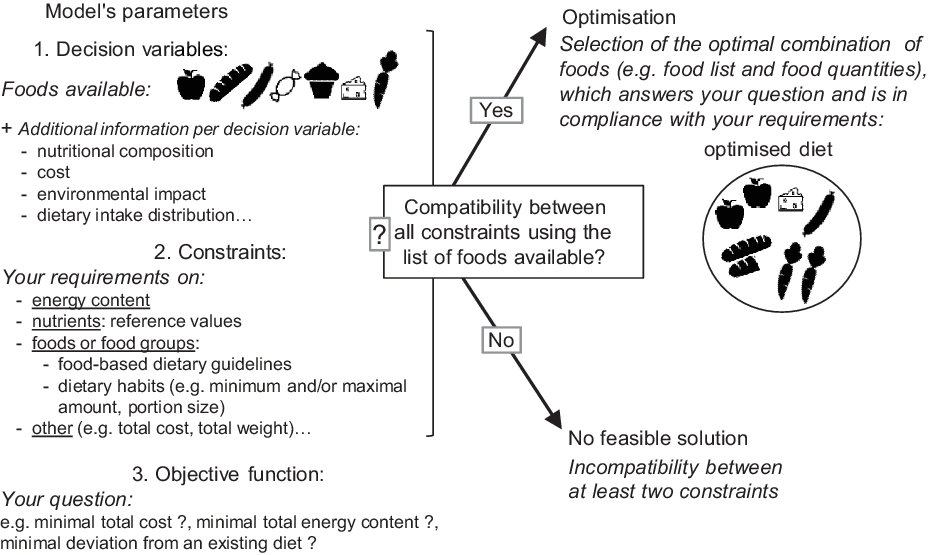
In principle, these models calculate as tools the optimal intersection of all requirements. Based on food composition tables and the known distribution of food consumption in a population, mathematical optimisation can be used to translate nutrient needs into nutritionally adequate combinations of foods. Diet optimisation can also help to check the applicability of a set of nutrient-based recommendations by testing the mathematical feasibility of simultaneously meeting all the associated constraints: this was done in 2001 for the French dietary reference values(Reference Martin23). Another example of using such tools is to calculate the minimal cost required for fulfilling all nutrient-based recommendations(Reference Darmon, Ferguson and Briend24), and studies show that the minimal cost of a nutritionally adequate diet rises with increasing respect for food habit patterns(Reference Maillot, Darmon and Drewnowski25).
One major dimension to be included is the environmental aspect of diets. Nicole Darmon pointed out the four dimensions of sustainable diets: health, environment, economy and culture(Reference Burlingame and Dernini26). Based on the heterogeneity of these facets with their different metrics (such as nutrients, costs or consumption in g/d) and food groupings, their integration into one model creates a complex process. There are also specific individual needs, such as diseases, allergies or the varying genetic backgrounds of people. Furthermore, it is beneficial to customise diets to food habits and preferences, the financial budget, and to social, environmental as well as ethical considerations. Mathematical approaches can support the derivation of diets, because they are able to handle conflicting data that would be too much to be surveyed by a person, but a person will set the framework within which the mathematical approach has to work. The aggregation of data from heterogeneous sources is one challenge to face. Gazan et al. (Reference Gazan, Barré and Perignon27) developed a methodology to compile multiple metrics of foods into one single database. Taken together, mathematical optimisation is a powerful tool to translate multidimensional information on individual foods into healthy and sustainable diets(Reference Gazan, Brouzes and Vieux12).
European experience in derivation of food-based dietary guidelines via optimisation
Dr Ir Corné van Dooren, Netherlands Nutrition Centre, put emphasis on the integration of sustainability into dietary recommendations. Sustainable diets are defined as nutritionally adequate, safe and healthy(Reference Burlingame and Dernini26). The Dutch optimisation approach tries to integrate sustainability into FBDGs using the linear and quadratic programming model Optimeal for the simultaneous optimisation of natural and human resources: diet, nutrients, economy and environment. Compared with the Mediterranean diet, the Nordic diet, the flexitarian diet and the pesco-vegetarian diet, the optimised traditional Dutch diet (‘Low Lands Diet’) is similarly healthy but more sustainable in terms of greenhouse gas emissions and land use(Reference van Dooren and Aiking28), which were the indicators chosen to measure ecological sustainability. The same optimisation model was used to develop the Dutch 2015 FBDGs, using environmental constraints limiting the quantities of animal-based products(Reference Brink, van Rossum and Postma-Smeets19).
In order to achieve compliance with FBDGs, it is important to take people’s dietary habits into account. For the current Dutch FBDGs, the optimisation model had the objective to minimise the deviation from current food consumption. Mathematical optimisation models often ensure a palatable and culturally acceptable diet by implementing it as the objective function, as done in the Dutch FBDGs. Introducing acceptability constraints is recommended, but no study has provided the ultimate solution for the calculation of constraints, which measure to what extent a diet shall be allowed to differ from the actual intake to satisfy the consumer(Reference van Dooren29). Constraints were set for food and nutrient intake. The health aspect was mostly the reason for minimum and maximum amounts in certain food groups. Health, environmental and feasibility aspects were chosen as maximum quantity constraints for animal-based food groups.
Most optimisation studies have used nutrition and cost constraints in the analysis of dietary problems and solutions, and recently twelve studies applied ecological constraints. However, such research begins to show weaknesses in situations featuring a small number of food items and/or nutritional constraints. Optimisation is able to suggest diets with lower projected environmental impacts than the impacts of diets assessed through scenario type studies, where diets are predetermined(Reference van Dooren29). One of the studies that examined diets derived by linear programming found out that using ecological and cost constraints would not result in diets with a higher cost, but rather these diets could be even more affordable(Reference van Dooren, Tyszler and Kramer30).
The Netherlands Nutrition Centre (Voedingscentrum) strives to inform people to make healthier and more sustainable foods choices. The development of the 2016 Dutch FBDGs, represented as the food guide ‘Wheel of Five’, results in the reduction of greenhouse gas emissions for most consumers. Thus, by more often choosing vegetarian days and more sustainable options within food groups, greenhouse gas emissions can be reduced by one-third compared with the current average Dutch diet(Reference van de Kamp, van Dooren and Hollander31). Corné van Dooren concluded that sustainable diets can simultaneously be nutritionally adequate, safe and healthy as shown in the derivation of the Dutch FBDGs. Mathematical optimisation as a tool supported the development process of these guidelines.
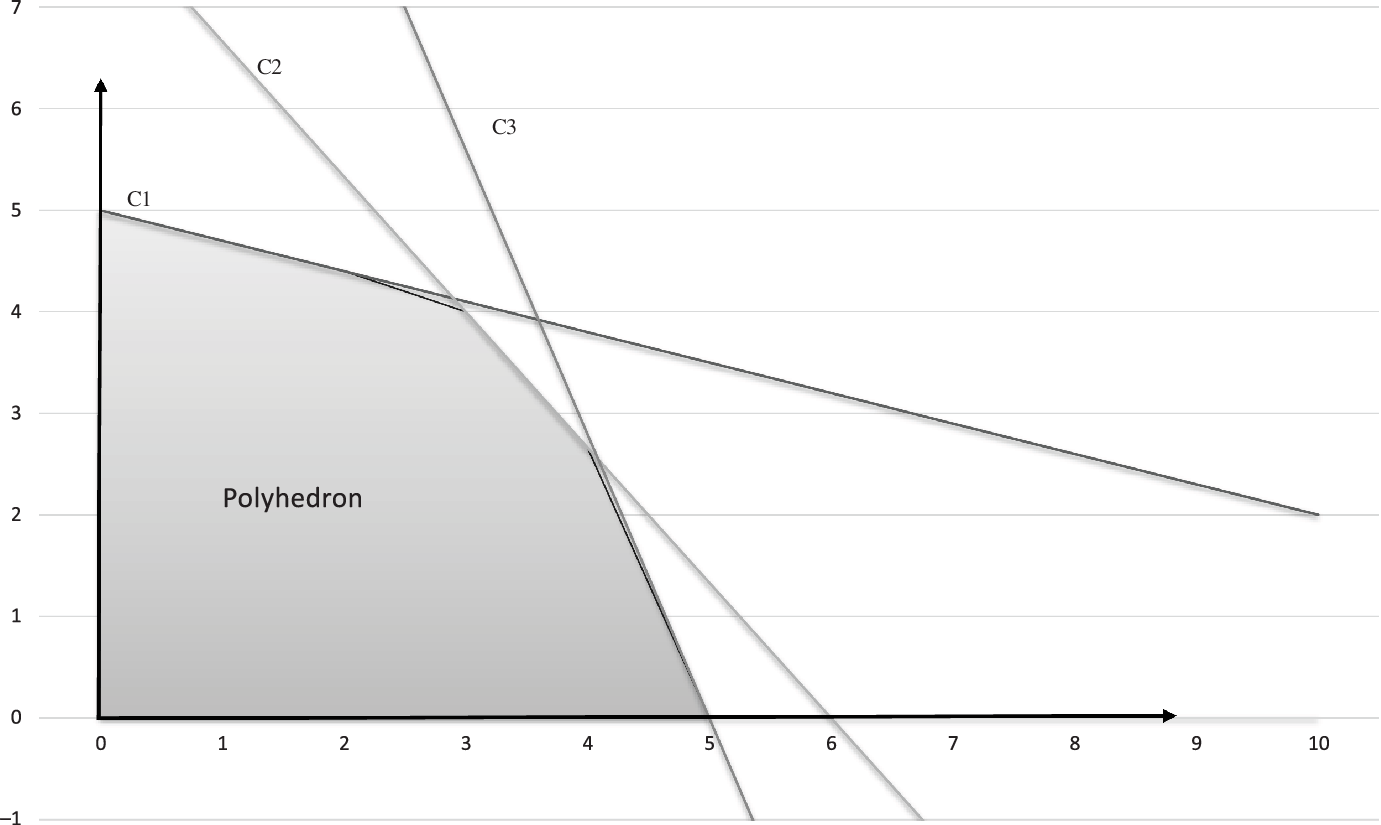
Perrine Nadaud, French Agency for Food, Environmental and Occupational Health & Safety, explained the French optimisation approach published in 2016. It included several aspects, such as dietary reference values, food-borne contaminants, bioavailability, prevention of chronic diseases and others. A linear programming of combined models (Simplex method) was applied to calculate the optimal consumption for each food group. The optimisation criteria were classified into (a) disease prevention, for example, minimising consumption of red meat, (b) contaminant exposure, for example, minimising the exposure to certain food contaminants and (c) eating habits, aiming to minimise deviations from the current consumption. The Simplex model’s algorithm helped to determine a target value by successive iterations on one or more variables, taking into account the constraints imposed. If the model did not find a solution within these several constraints, the breach of contaminant and nutritional constraints was minimised. The model searched for the only optimal solution in the domain of possible ones, corresponding to a polyhedron with N dimensions defined by the constraints (Fig. 2). The blue area (polyhedron) defines the possible solutions, while C1–3 are the straights showing the constraints. The French approach included a series of optimisation scenarios, where more and more features were added. The constraints were adjusted or relaxed to make compromises for the feasibility of the diet.
Linear programming as a graph in a simplified model.
Perrine Nadaud outlined the advantages of this approach, which include that it is a global and transposable method that allows defining science-based FBDGs and identifying public health issues. Still, there are limitations to this approach. Uncertainties from the original database are transferred to the optimisation database. Often, the bioavailability of nutrients is not considered. The perspective is to extend the method to different subgroups and different dietary patterns and to weigh the criteria for the optimisation(18). In the future, the French agency wishes to implement environmental impact. Indeed, another advantage of this method is that new dimensions can be added to obtain more comprehensive results without having to redo all the work.
Building the optimisation model’s database: mathematical approaches to calculate data for diet–health relations and sustainability
To run an optimisation model, a database containing data regarding the chosen food groups has to be built. Therefore, data for the various dimensions need to be collected or calculated. For diet–health relationships, Dr Brecht Devleesschauwer, Sciensano and Ghent University, held a presentation on the assessment of health impacts of foods.
Disability-adjusted life years (DALYs) summarise different parameters of population health for a certain disease in a single metric. They quantify the gap between an ideal life in perfect health and ideal life expectancy on the one hand, and reality with diseases and early deaths on the other hand. Using comparative risk assessment, it is possible to calculate the fraction of DALYs, which is attributable to a certain risk factor, and thereby rank different risk factors according to their health impact(Reference Schwingshackl, Knüppel and Michels32). These risk factors can be defined as dietary risk factors, such as ‘diet low in fruit’. For the definition of a diet low in certain foods, optimal consumption levels of foods are to be determined(33). For the derivation of FBDGs, the DALYs linked to consumption levels of certain foods in different countries may be used as a source for the optimisation database. In this way, the burden of disease may support the development of future FBDGs. DALYs for diet–health relationships may furthermore be combined with DALYs for food safety. Nevertheless, this approach remains focused on the health impact, while for the derivation of FBDGs additional dimensions, such as sustainability, matter.
One possibility to assess the sustainability of diets is to use agri-environmental modelling. Professor Thomas Heckelei, University of Bonn, presented the steps the SUSFANS project (Metrics, Models and Foresight for European SUStainable Food And Nutrition Security, 2015–2019) took towards this goal. SUSFANS is a project coupling the models SHARP (Sustainable, Healthy, Affordable, Reliable and Preferred diets), which derives sustainable, healthy, affordable, reliable and preferred diets(Reference Mertens, Kaptijn and Kuijsten34,Reference Mertens, Kuijsten and van Zanten35) , and MAGNET (Modular Applied GeNeral Equilibrium Tool), which simulates the impacts of agricultural, trade, land and bioenergy policies on the global economy(Reference Kuiper and Zurek36). Coupling SHARP and MAGNET generally allows analysts to assess the dietary consequences of changes in political or economic conditions. This also links diets to the sustainability of food production to the extent by which the economic model provides environmental indicators related to food production activities. Still, remaining challenges need to be tackled. One challenge lies in the (dis-)aggregation of data. Compared with typical diet data, food categories in economic models are quite aggregated. Thomas Heckelei stated that the remaining challenges are to implement such mappings also for other agri-environmental models (CAPRI and GLOBIOM (Global Biosphere Management Model)), which offer a closer link of diets to sustainability metrics, and to harmonise the sustainability metrics currently used in diet and economic models.
When we discussed the economic dimension of nutrition in terms of FBDGs, the consumers were identified as one important factor. Their preferences and eating behaviours are often integrated via dietary intake data. The impact of changing circumstances (like raised taxes on certain foods) on the consumer’s dietary habits is missing so far at the required level of detail. Another application of SUSFANS assessed the impacts of European Union’s food tax policy on nutrition and environmental sustainability. Three scenarios were simulated for the year 2050: tax on calories, tax on food groups and the combination of calories’ and food groups’ tax. The results show that the taxes necessary to achieve dietary recommendations for the average consumer considering current eating preferences would have to increase food prices considerably(Reference Latka, Kuiper and Frank37). The proportion of the dietary intake across the population of each European country is not captured by the current implementation. This would require obtaining food intake data representative of a whole country and in addition of comparable quality for all of Europe. If, in addition, the economic models would be extended to capture the heterogeneous food consumption behaviour across population groups, a significant improvement of the link between food system sustainability and food-related health problems would be achieved.
Application of diet optimisation for individuals
Another possibility to include consumer decisions in dietary recommendations is to calculate personalised FBDGs. The difference between population-based and individual-based diet optimisation is that for the population several individual diets are aggregated to represent one average diet, which is optimised and the outcome is also one optimal diet. In contrast, for individuals, every single diet is optimised and results in one optimised diet for each individual. Minimising the deviations from the individual’s current diet increases acceptability of changes in the consumer’s eating behaviour. While individual-based diet optimisation was applied to food consumption data from national dietary surveys to understand dietary changes capable of improving nutritional intake in a given population(Reference Maillot, Vieux and Amiot38–Reference Horgan, Perrin and Whybrow43), MS-Nutrition company, in collaboration with INRAE, has developed an approach in order to use it in real life(Reference Gazan, Darmon and Vieux44,Reference Gazan45) . The fact that the consumer is aware of the uniqueness of his/her personal nutrition advice adds to the advantages of personalised FBDGs(Reference Kreuter and Skinner46,Reference Kreuter, Strecher and Glassman47) . Moreover, the user is the director of his/her own dietary changes by selecting diet suggestions achievable from the individual’s point of view(Reference Gazan, Darmon and Vieux44). This promising tool still requires qualitative and quantitative evaluation for further improvements.
Dr Florent Vieux, MS-Nutrition, gave an overview of his work at a start-up regarding the developing innovative operational research methods (based on statistics, simulation and optimisation) to evaluate and improve food offer and food choices’ quality. MS-Nutrition offers modelling and statistics expertise in nutrition research projects. The company facilitates quantitative nutrition, which allows estimating and improving the nutritional quality of foods, menus and diets. MS-Nutrition participated in the development of an FAO diet optimisation package for low- and middle-income countries’ FBDGs(17). The company is now testing the possibility of applying diet optimisation on the FAO/WHO GIFT (Global Individual Food consumption data Tool) platform data with the idea of developing a population-based diet optimisation web app based on data provided by the platform. The user needs to select the population, set the constraints and the objective function and run the optimisation. The results are the dietary changes suggested by the optimisation model. Ultimately, the model can demonstrate to the user how far the food groups contribute to the nutrients in the observed and optimised diet.
Application of diet optimisation for risk–benefit assessment
In addition to FBDGs, mathematical optimisation can be applied to other cases of nutritional sciences as was explained by Dr Sara Monteiro Pires, Technical University of Denmark. When it comes to FBDGs, the beneficial and adverse effects of foods and dietary patterns, as well as the current preferences of the population should be taken into account. Risk–benefit assessment of foods is an established tool that considers nutrition, toxicology, microbiology and epidemiology. A classic example that Sara Monteiro Pires’ working group has been investigating is fish: here, the benefits of EPA and DHA, as well as the risks of methyl mercury and dioxins are present at the same time. In the process of the risk–benefit assessment, the beneficial as well as adverse effects are identified, characterised and the exposure is assessed (e.g. via food intake). In the next step, they are integrated into a scenario comparison(Reference Tijhuis, Jong and Pohjola48). Insufficient intake can lead to a risk of inadequate nutrition due to the lack of nutrients, while excessive intake can lead to the risk of toxicity due to an overdose of nutrients/contaminants.
The recommendation ‘Eat more fish’, specifically 350 g per week, is part of the Danish FBDGs(49). Only 15 % of the Danish population meet the fish guideline. To bridge the gap between recommended fish intake and observed fish intake in Denmark, Sara Monteiro Pires’ group developed an optimisation model and fed it with food consumption data, constraints and individual data on observed fish intakes and body weights. They derived personalised fish intake recommendations via a quadratic programming model. The model had constraints for nutrients and contaminants, while striving to minimise the deviation from personal fish consumption preferences(Reference Persson, Fagt and Pires50). The aim was to provide evidence to eventually redefine FBDGs, by considering individual variations as well as risks and benefits of foods with the goal of increased compliance with FBDGs. In another case study, the economical dimension with price as the indicator was integrated into the optimisation model. This showed that it is possible to minimise the deviation from fish intakes and cost simultaneously. The constraints stayed the same(Reference Persson, Fagt and Nauta51).
The comparison of risks and benefits can also be performed using a composite health metric like DALYs. The assessment can be performed by calculating the changes in incidence due to changed exposure. A study in the Danish population estimated that different consumption scenarios of the substitution of red meat with fish led to diverse health gains or losses at the population level(Reference Thomsen, Boer and Pires52).
Sara Monteiro Pires concluded that modelling approaches can improve FBDGs: they account for beneficial and adverse health effects of foods and diets, for the impact of substituting one food for another/different combinations and for individual preferences and characteristics. She also stressed the importance of personalised advice(Reference Celis-Morales, Livingstone and Marsaux53–Reference Brug, Oenema and Campbell55).
Workshop conclusions
In general, mathematical optimisation was acknowledged by the workshop participants as a versatile multi-criteria method to answer contrasting and complex questions in nutritional sciences. The approaches from the Netherlands and France show that it seems to be a suitable method to derive FBDGs that are based on scientific evidence from several dimensions with conflicting as well as aligning goals. Furthermore, the use of mathematical optimisation can support the objectivity and transparency of approaches to develop FBDGs, when the decisions made in the optimisation models, the list of constraints and the equation of the objective function are clearly stated and described, helping to create comprehensive background material on the development of FBDGs. Another perspective is that individualisation of FBDGs, enabled by mathematical optimisation, could help to improve consumer acceptance of FBDGs, increasing the proximity to their personal current diet.
Still, there are specific limitations of mathematical optimisation as a tool to derive FBDGs. For the implementation in FBDGs, this is a relatively new scientific research field with few restrictions on the method itself, but little experience and no evidence on specific aspects: decisions, such as weighting of the dimensions in the objective function and setting the constraints and their range, for example, the deviation from the current diet, are up to the developer and/or the user and may be carefully selected by an expert panel. One subjective decision may already be, which dimensions should be integrated at all. Another challenge is to operationalise the dimensions in order to apply nutritional sciences data (that has been derived from information on whole foods instead of nutrients) and translate them into FBDGs as well as to create one database with information on the various dimensions coming from different sources, heterogeneous methodologies and differing food grouping systems. One example is that diet–health relations, which were integrated as constraints up to now, need a derivation of the amounts beforehand. To move this area forward, a metric for diet–health relations would be needed. Moreover, the harmonisation of food grouping systems is desirable to avoid loss of information in the food mapping process. For FBDG groups, a strong link to dietary intake data is needed. The food grouping system FoodEx2 by the European Food Safety Authority is the basis for several dietary intake studies and was found to be suitable to be used for FBDGs. Another advantage is its hierarchical system, which makes it possible to calculate missing values from one hierarchical level to another. Data acquisition in FoodEx2 would help FBDG makers to use it directly.
The workshop participants discussed the complex demands in the formulation of FBDGs, with emphasis on the transformation of the food system. Therefore, the future derivation of FBDGs should take into account a larger number of relevant dimensions, such as those related to sustainability. In view of improving data sources and evolving mathematical methods and data processing, we strive to raise awareness of the use of mathematical approaches, especially mathematical optimisation methods, in nutritional sciences. The European scientists attending the workshop agreed that mathematical optimisation is a useful tool that should be advanced jointly to derive FBDGs and tackle public health issues.
Acknowledgements
The German Nutrition Society and the Federation of European Nutrition Societies are very pleased to have had this intensive exchange with our colleagues from Europe. The workshop was a starting point for an international cooperation and joint further development of a new scientific concept for deriving FBDGs. We thank all presenters and participants for their contributions.
Workshop participants: Arnesen, Erik; Bala, Malgorzata; Bechthold, Angela; Boeing, Heiner; Darmon, Nicole; Devleesschauwer, Brecht; Heckelei, Thomas; Heseker, Helmut; Kroke, Anja; Monteiro Pires, Sara; Nadaud, Perrine; Schäfer, Anne Carolin; Schmidt, Annemarie; Van Dooren, Corné; Vieux, Florent.
The authors thank Heike Norman, Max-Rubner-Institut, for her careful language editing.
The workshop was funded by the Federation of European Nutrition Societies and the German Nutrition Society.
A. C. S., A. S. and H. B. drafted a first version and all authors contributed with revisions and improvements into the final manuscript that was approved by all authors.
The authors declare that they have no conflict of interest.
Supplementary material
For supplementary material referred to in this article, please visit https://doi.org/10.1017/S0007114520004857


 Open access

