





Urban community gardens are dually important for people to connect to urban biodiversity (Douglas et al., Reference Douglas, Anderson, Goode, Houck, Maddox, Nagendra and Tan2010; Cox et al., Reference Cox, Shanahan, Hudson, Fuller and Gaston2018) and for the preservation of urban biodiversity (Lin et al., Reference Lin, Philpott and Jha2015). Indeed, plant species richness in urban gardens is a collection of both cultivated plants for food and flower production, as well as wild plants that exist spontaneously in the ecosystem to potentially create city hotspot effects (Seitz et al., Reference Seitz, Buchholz, Kowarik, Herrmann, Neuerburg, Wendler, Winker and Egerer2022). Urban garden plants can provide a range of ecosystem services (Middle et al., Reference Middle, Dzidic, Buckley, Bennett, Tye and Jones2014): food plants contribute to food security and sovereignty to support provisioning services (Elmqvist et al., Reference Elmqvist, Fragkias, Goodness, Güneralp, Marcotullio, McDonald, parnell, Schewenius, Sendstad, Seto and Wilkinson2013); decorative plants have aesthetic or religious value to support cultural services (Himes et al., Reference Himes, Puettmann and Muraca2020); wild plants and endangered plant species can contribute to biodiversity and nature conservation to provide supporting services (Weiskopf et al., Reference Weiskopf, Rubenstein, Crozier, Gaichas, Griffis, Halofsky, Hyde, Morelli, Morisette, Muñoz, Pershing, Peterson, Poudel, Staudinger, Sutton-Grier, Thompson, Vose, Weltzin and Whyte2020).
However, some plant species growing in urban gardens also have associated disservices, conflicting with human benefits. For example, some plant species are poisonous to humans and animals through the production of secondary metabolites. In contrast to primary metabolites (e.g., carboxylic acids, amino acids, sugars and fatty acids), which are produced and used by all plants, secondary metabolites are typically specific to certain groups of plants and serve, among other things, as defense substances (Sadava et al., Reference Sadava, Hillis, Heller and Hacker2019). Although, some defensive secondary metabolites can provide beneficial effects to humans (e.g., use against gastrointestinal problems with German chamomile Matricaria recutita) (Faehnrich et al., Reference Faehnrich, Franz, Nemaz and Kaul2021), many of them can cause severe negative effects on the human nervous system, the cardiac system and the digestive tract (Sadava et al., Reference Sadava, Hillis, Heller and Hacker2019). For instance, almost all species of the genus Aconitum contain concentrations of aconitine that causes a combination of neurological, cardiovascular and gastrointestinal symptoms that can lead to death if high concentrations are ingested or if the poisoning is not rapidly treated (Chan, Reference Chan2009). Though, Aconitum heterophyllum—the only nonpoisonous member of the genus Aconitum (Wani et al., Reference Wani, Kaloo and Dangroo2022)—produces the secondary plant metabolites Atisin, Hetisin und Heteratisin (Malhotra et al., Reference Malhotra, Kumar, Sood, Singh and Chauhan2014), which are used medicinally against a number of diseases of the immune, digestive and nervous system (Sojitra et al., Reference Sojitra, Dave, Pandya, Parikh, Patel and Patel2013).
The occurrence and diversity of plants poisonous to people in urban gardens is largely unknown, despite toxicity as an important trait relevant within human-dominated urban agroecosystems. To address this gap, we report on the occurrence and diversity of poisonous plants across 30 urban community gardens in Berlin and Munich, Germany. Specifically, we asked: (1) What is the identity, abundance and species richness of poisonous plants in urban community gardens? (2) Are poisonous plants cultivated or spontaneous vegetation, and what are other traits of the plant species? And (3) which highly poisonous plants that pose a particular danger to humans are present in urban community gardens, and what are possible management strategies? Our objective is to contribute to the understanding of plant biodiversity in urban gardens (abundance, species richness, traits), but also to how gardens are habitat for plant traits that create ecosystem disservices. In doing so, we aim to highlight how poisonous plants—whether known or unknown for their toxicity—pose a dilemma through their threats to people (via human health risks) and benefits to ecosystems (via plant diversity, species conservation).
Poisonous plants in urban gardens
We conducted our research in 30 urban community gardens in Munich (48°08′N, 11°34′E) and Berlin (52.5200°N, 13.4050°E), Germany. We visited the gardens four times from May to August 2021 to conduct plant observations: May 13–23, 2021, June 14–24, 2021, July 20–30, 2021, August 17–26, 2021. The gardens ranged from 0.04 and 0.97 ha in size. Due to differences in sizes among gardens, within each garden, we established a 400 m2 sampling plot (20 × 20 m) in the center of each garden in which to conduct our study and collect data.
To obtain a list of plant species present in the gardens, we identified all herbaceous plants to species level using Jäger et al. (Reference Jäger, Ebel, Hanelt and Müller2016) and the Pl@ntNet app (CIRAD, INRAE, INRIA, IRD [mobile app], 2013) within eight randomized 1 × 1 m quadrats and within the 20 × 20 m plots along four parallel 5 × 20 m transects (two random plots per transect) (sensu Seitz et al., Reference Seitz, Buchholz, Kowarik, Herrmann, Neuerburg, Wendler, Winker and Egerer2022; see for full description of vegetation sampling methods). In addition, in the field, we identified whether the plant species observed was: (i) cultivated (crop, ornamental) or (ii) wild (wild, weed, spontaneous vegetation). If species occurred as wild and cultivated, we documented them in both status groups.
We identified a total of 767 plant species, from which we identified all poisonous taxa using Bös (Reference Bös2000), Giftige Pflanzen (2000) and Liste giftiger Pflanzen (2022) (Appendix 1). Plants that cause severe to even fatal poisoning when ingested in small amounts were classified as highly poisonous. Plants that cause mild to moderate poisoning were classified as poisonous. A total of 106 poisonous and highly poisonous plants were observed, with 52 plant species growing as cultivated plants and 54 growing as wild plants. Four cultivated (Helleborus niger, Convallaria majalis, Daphne mezereum, Digitalis purpurea) and four wild plant species (Aethusa cynapium, Dryopteris sp., Ilex sp., Datura stramonium) were classified as highly poisonous (Table 1), while the majority of poisonous plants ranged from mild to moderately poisonous. Where mild to moderately poisonous plants were common and present in each of the 30 sampled gardens, highly poisonous plants were found in only 12 gardens. Of these 12 gardens, eight gardens hosted cultivated highly poisonous plant species and five gardens harbored wild growing highly poisonous plant species.
Table 1. Poisonous plant species that occurred from May to August 2021 across 30 urban community gardens in Munich and Berlin, Germany presented here in three subsections: (a) 10 poisonous plant species found in the highest number of gardens; (b) 11 poisonous plant species of conservation concern that are recorded in the Red List of German Plants; (c) eight highly poisonous plant species found in the gardens

Provided in the table are: the total number of gardens (of 30) that the species occurred in (# of gardens); the vegetation type (w, wild; c, cultivated; c/w, cultivated or wild); the status of the plant species (I, established indigenous and archaeobiota; N, established neobiota); the category they fall in the Red List of German Plants (2, critically endangered; 3, endangered; R, extremely rare; V, forewarned list; *, not endangered; NA, not assessed); and their poisonousness (1, mild to moderate; 2, highly poisonous). Note that some species occur in multiple categories (=§).
Of the 106 identified poisonous species, approximately 62.3% (66) are indigenous and archaeobiotic species, 11.6% (12) established neobiota and 26.4% (28) were not assessed in the German Red List (Metzing et al., Reference Metzing, Garve and Matzke-Hajek2018). Of 106 poisonous species, six species were endangered and two species were critically endangered (55 species not endangered, 40 species not evaluated or not included in the Red List) (Metzing et al., Reference Metzing, Garve and Matzke-Hajek2018). In addition, we documented one extremely rare species and two species from the forewarned list (Table 1). Of the 10 most frequently found poisonous plant species, the most common species (Concolculus arvensis) occurred in 23 of the 30 gardens (77%; Table 1). All of the 10 most frequent species were mildly to moderately poisonous, 70% were wild vegetation, while 20% were cultivated and in the remaining 10% the vegetation type was unidentifiable.
Effects of poisonous plants on human health
Four highly poisonous plant species can be classified as particularly dangerous for humans (can cause death if ingested) because they either have an attractive fruit (red, berry; i.e., C. majalis, D. mezereum, Ilex spec.) or they closely resemble a cultivated food plant in fruit or habitus (A. cynapium vs Petroselinum sativum, C. majalis vs Allium ursinum). Across all age groups (toddlers, school children and adults), the majority of the accidental exposures involves plants with attractive fruits and a lack of botanical knowledge (Hermanns-Clausen et al., Reference Hermanns-Clausen2019).
In A. cynapium, C. majalis and D. mezereum, all parts of the plant are poisonous, whereas in Ilex spec. only the fruit causes poisoning (Fig. 1; e.g., leaves and berries of D. mezereum and Ilex spec.). Initial symptoms after ingestion include nausea, vomiting and diarrhea (Nelson et al., Reference Nelson, Shih, Balick and Lampe2007). In the further course of poisoning, seizures (Nelson et al., Reference Nelson, Shih, Balick and Lampe2007) and respiratory paralysis occur after ingestion of A. cynapium (Schade and Jockusch, Reference Schade and Jockusch2018), cardiac arrhythmias (Nelson et al., Reference Nelson, Shih, Balick and Lampe2007) and cardiac arrest result from the consumption of C. majalis and the intake of Ilex spec. fruits leads to cardiac arrhythmias and paralysis (Schade and Jockusch, Reference Schade and Jockusch2018). Daphne mezereum is poisonous even when touched and can cause central nervous system damage and circulatory collapse after tachycardia when ingested. In addition, mezerein, a secondary metabolite in D. mezereum, induces a long-term carcinogenic effect (Lochstampfer, Reference Lochstampfer2018).
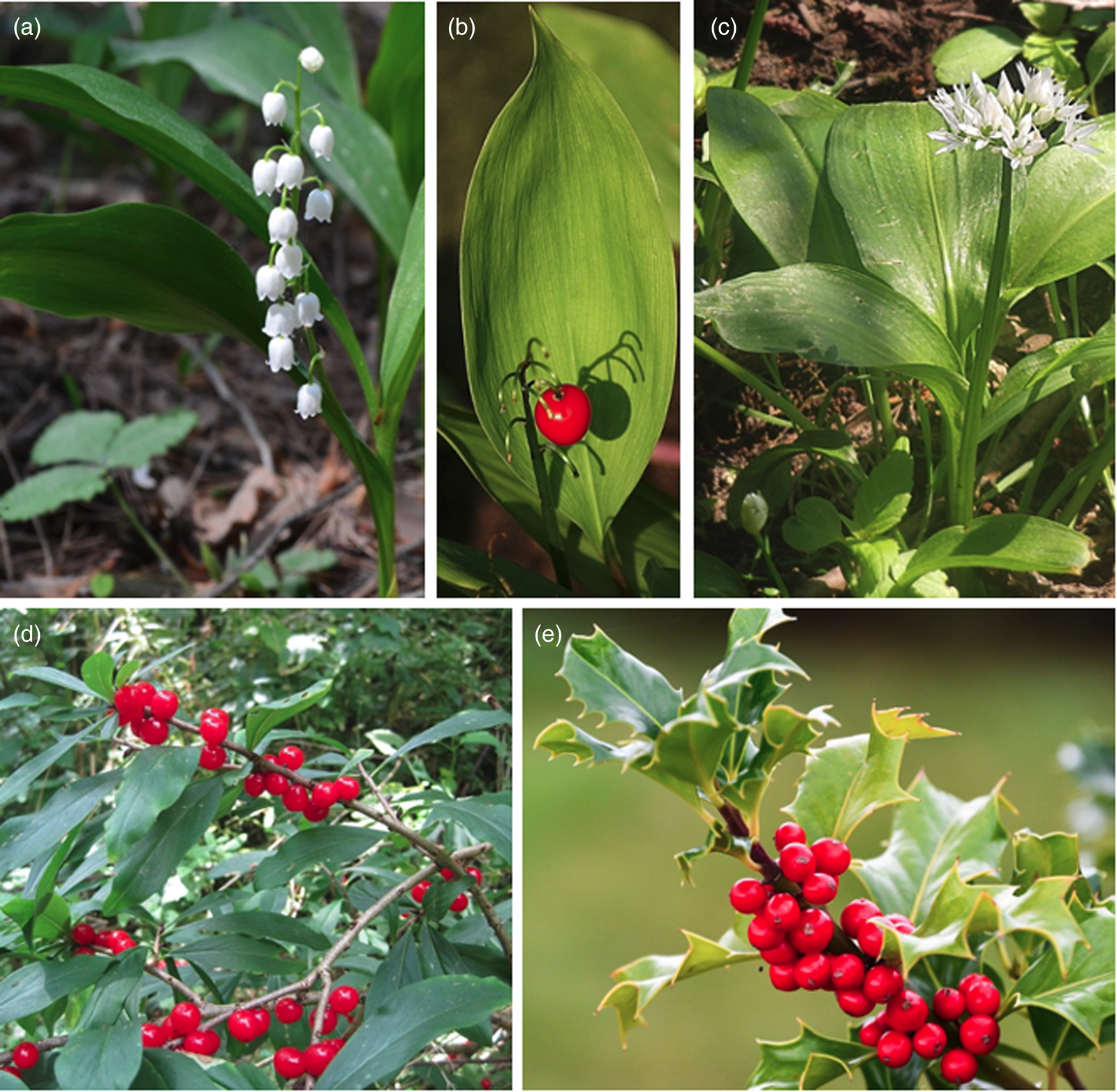
Figure 1. Lily of the Valley (Convallaria majalis) in flower (a) with red fruit (b). Also visible are the leaves, which are very similar to those of edible wild garlic (Allium ursinum) (c). Red berries of Daphne (Daphne mezereum) (d) and holly tree (Ilex spec.) (e) can easily be mistaken for edible berries. Images are taken from the website pixabay (https://pixabay.com/de).
The mildly to moderately poisonous plants consisted of 25 purely ornamental plants, 12 food plants that are edible either at very low doses or after appropriate preparation, and 11 taxa that can serve as both food and ornamental plants. Risks may arise from the bulbs of decorative plants such as daffodil (Narcissus pseudonarcissus) or iris (Iris sibirica) as they can be confused with the edible onion Allium cepa. Another common mistake can be the misidentification of crocus Ixieae spec. as wild garlic A. ursinum, which were not present in the community gardens studied here, but are common and widespread in urban green spaces such as parks. In addition, a variety of plant taxa produce capsules or pods that look similar to edible legume beans (e.g., Phaseolus vulgaris). However, intoxication with such bean-shaped plant parts seems to be rare in Germany (Hermanns-Clausen et al., Reference Hermanns-Clausen2019).
In our geographic context (Germany), the majority of accidental exposures across all age groups (infants, school children and adults) involves plants with attractive fruits that are orally ingested (Hermanns-Clausen et al., Reference Hermanns-Clausen2019). According to Wendt et al. (Reference Wendt, Lübbert, Begemann, Prasa and Franke2022), inquiries about plant poisoning are a frequent reason for consultation of poison information centers. During a 10-year period (2011–2020) at the Erfurt Joint Poison Information Center (Erfurt, Germany), 15% of all inquiries involving children and 2.3% involving adults were related to plants. Possible poisoning from plants ranks third in poison center inquiries after pharmaceuticals (32%) and chemicals (24%). We acknowledge that these data are general, as we could not find any reporting or data on poisonings from urban green spaces or urban community gardens.
Recommendations for managing poisonous plants in urban community gardens
Poisonous plants in urban community gardens create a conundrum for ecosystem management, especially when plants are cultivated crops for other useful purposes or when they are species of conservation concern. This is where ecosystem service disservices or trade-offs between human health and conservation may arise, and where management interventions to create habitat for these plants while simultaneously reducing human health impacts are most needed.
Knowledge on what plant species grow in a community garden can inform the preventative management of negative impacts of plants to human health. This includes information on the cultivated as well as the wild plants that occur in the managed and non-managed beds, hedges and wild corners of the gardens. People often accidentally add poisonous plants to their garden (Apollo et al., Reference Apollo, Dash and Padhy2006). Thus, one approach could be to promote knowledge about poisonous plant species and their dangers through environmental education for the entire community of urban gardeners. Pictures, illustrated posters and descriptive atlases of poisonous plants that are present at urban community garden facilities could be used to inform the gardeners about the potential risks, especially those of highly poisonous taxa. Handouts may include advice on proper handling of mildly and moderately toxic plants, as well as information on common misidentifications. They may also spark conversations about concerns and management strategies of poisonous plants among the community of gardeners, and thereby enable conscious and joint decision making. This could especially be beneficial for plants of conservation concern. Education about species diversity and informing the public about the ecological value of poisonous plants can help prevent intoxication (Demorest et al., Reference Demorest, Posner, Osterhoudt and Henretig2004) and promote urban wildlife conservation (Pope et al., Reference Pope, Kessel, Price, Dzurick, Russ, King, Weidensaul, Zvonar, Steinbrunner, Kemsley, Hjarding, Chin, Roche, Griswold, Owens, Russell, Foutz, Dembiec, Coughlin Robertson, Thomashow, Nix-Stevenson, Conover, Krug, Padilla, James, Nathan, Abrams, Quigley HJ, Saafir, Shmulenson, Konrad, Brown, Agnello, Tolman, Collier, Smith, Morrison, Siddall, McGlauflin, Leinbach, Milkert, Breuer, Moreno, Krasny, Marijke Hecht, Michael Cruse, Michelle Byron, Elser, Fisher, Malinowski, Silva, Ressl, Hughes, Withrow-Clark, Janis, Corrao, Baron, Goodale, O'Dowd, Twila Simmons-Walker and Masters2015). Especially in community gardens where beds are cultivated jointly, communication on poisonous plants and their risks and protective measures can be an effective tool to avoid intoxication.
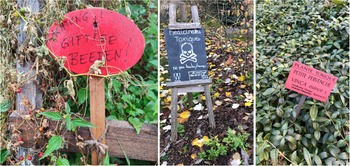
While the first step is to increase awareness and knowledge about poisonous taxa in community gardens, the next step may be to take the necessary protective measures. In a review of the gardening rules and regulations in our study system, we found little to no information about poisonous plants. We suggest that planting areas with highly poisonous plants could be fenced and marked with information sheets that are easy to understand and visible for all gardeners and visitors (e.g., Fig. 2). These measures can be tested for their feasibility and effectiveness in future studies. If these measures cannot be effectively implemented, garden managers could consider the option of removing the highly poisonous plants from their community gardens given they are not protected.

Figure 2. Examples of signs of warning of poisonous plants in community gardens in Berlin, Germany (a; ‘Achtung! Giftige Beeren!’ (German) in English means ‘Warning! Poisonous berries!’; Kiezgarten Fischerstraße), and in Metz, France (b, c; ‘Medicinales Toxiques’ (French) in English means ‘toxic medicinal plants’, ‘Plante Toxique’ means ‘toxic plants’). Photos by Julia Schmack (a) and Monika Egerer (b, c).
Conclusion
Both wild and cultivated species that are highly poisonous can be found in urban gardens, yet toxic traits are largely overlooked in scientific research and in practice. Indeed, people often plant poisonous species in their own gardens without being aware that these species are poisonous (Apollo et al., Reference Apollo, Dash and Padhy2006). Highly poisonous plants that have an attractive berry or look similar to edible plants pose the biggest risk to garden communities, particularly children or those unexperienced in plant toxicity. Whether individual gardens are suitable for cultivation or preservation of highly poisonous plants should be carefully evaluated by the garden communities and measures to ensure the safe handling of all poisonous plant parts should be communicated. There are still very few cases of deaths from ingesting poisonous plants from urban community gardens (Bundesinstitut für Risikobewertung, 2017), and both mildly and highly poisonous plants can be valuable contributions to the vegetation diversity in urban community gardens. Indeed, poisonous plants can also be of conservation value and of conservation concern (e.g., endangered species), and also support various ecosystem functions in urban landscapes. The dilemma between the ecological benefit and the risk for humans that poisonous plants can pose may also be regarded as a chance for nuanced environmental education.
Supplementary material
The supplementary material for this article can be found at https://doi.org/10.1017/S1742170523000224.
Acknowledgements
We thank the community gardens and gardeners for allowing us to study their gardens. Many thanks and recognition to Felix Conitz and Nina Schäle and Dominic Sperling for support with plant data collection. Thank you to Susan Karlebowski, Michael Miesl, Astrid Neumann, Dominic Sperling and Ulrike Sturm for support with fieldwork. We would also like to thank the Heidehof Stiftung gmbh and Museum für Naturkunde Berlin for financially and logistically supporting this work. Thank you to the editor and two reviewers for helpful comments on the manuscript.
Financial support
This work was funded by the Heidehof Stiftung and the Technical University of Munich.
Competing interest
None.



 Open access

