





Plant-based diets are increasing in popularity, both in the public and in the scientific community(Reference Kamiński, Skonieczna-Żydecka and Nowak1). While a plant-based diet is primarily focused on fruits and vegetables, grains, pulses, nuts and seeds, it may also include the reduction or exclusion of animal-based foods. For example, a vegan diet excludes all animal-based foods from the diet, a vegetarian diet excludes animal-based foods except for dairy and/or eggs, and a semi-vegetarian diet limits meat and flesh products(Reference Clarys, Deliens and Huybrechts2). According to the National Health and Nutrition Examination Survey dietary data from 2005 to 2018, 2·6 % of participants over 20 years of age consumed a vegetarian diet defined as a dietary pattern restricted of meat, poultry and seafood(Reference Conrad, Kowalski and Dustin3).
Evaluating different types of dietary patterns provides an insight into health outcomes and chronic disease prevention efforts. Multiple approaches can be used to assess diet adequacy, such as evaluating the intake of nutrients, foods, dietary patterns or a combination. One common approach is the use of a diet quality index to measure an individual’s compliance with dietary guidelines to determine if an eating pattern is nutritionally adequate(Reference Krebs-Smith, Pannucci and Subar4). Studies comparing individuals following a plant-based diet (vegan, vegetarian and semi-vegetarian) and non-vegetarian diet found vegans had the highest diet quality and non-vegetarians had the lowest diet quality(Reference Clarys, Deliens and Huybrechts2,Reference Le, Sabaté and Singh5) . For instance, Clarys et al. (2014) found the highest diet quality scores in vegans (65·4 out of 100), followed by semi-vegetarians (59·4), pescatarians and lacto-ovo-vegetarians (58·7) and omnivores (54·2)(Reference Clarys, Deliens and Huybrechts2). This may be related to higher fruit, vegetable, whole grain and plant protein intake and lower sweet and soft drink intake observed among vegans compared with non-vegetarian diets(Reference Gili, Leeson and Montes-Chañi6,Reference Hargreaves, Araújo and Nakano7) . In a meta-analysis of prospective cohort studies, diets that scored highly on multiple diet quality indices were associated with a decreased risk of CVD, cancer, type 2 diabetes, neurodegenerative disease and all-cause mortality(Reference Morze, Danielewicz and Hoffmann8).
Understanding the motives behind food choices can inform public health strategies aimed at improving diet quality. Health, sensory appeal, convenience and price are shown to be the most important diet motives, or reasons for making food choices, in emerging adults from the US(Reference Vorage, Wiseman and Graca9). Ethics, such as animal welfare, environmental protection, religion and health, are also common motives for following a plant-based diet(Reference Cruwys, Norwood and Chachay10–Reference Vizcaino, Ruehlman and Karoly14). Vizcaino et al.(Reference Vizcaino, Ruehlman and Karoly14) found that those following a plant-based dietary pattern applied their beliefs through the foods they chose to consume. These beliefs included disapproval of animal agriculture and its resulting animal suffering, natural resource depletion and greenhouse gas emissions(Reference Janssen, Busch and Rödiger12). Health is a prominent motivational factor among those following plant-based and non-plant-based dietary patterns and may be considered for weight control, chronic disease prevention and management and naturality(Reference Cruwys, Norwood and Chachay10,Reference Vizcaino, Ruehlman and Karoly14) .
A healthy diet is more likely to be adopted and maintained by individuals with nutrition-related skills, motives and knowledge(Reference Gibbs, Ellerbeck and Gajewski15). Although almost a third of Americans have deficits in health literacy, nutrition literacy levels in the US have not been well established(Reference Berkman, Sheridan and Donahue16). Nutrition literacy is the level of ability to evaluate and understand nutrition information and make educated dietary choices(Reference Gibbs, Ellerbeck and Gajewski15). Hoffman(Reference Hoffman and Mariotti17) hypothesises that vegetarians must develop greater nutrition literacy to justify their diet in a mostly non-vegetarian society and maintain nutritional adequacy. Although Leonard et al.(Reference Leonard, Chalmers and Collins18) found that vegetarians had higher nutrition knowledge scores than non-vegetarians, DeMay et al.(Reference DeMay, Nnakwe and Yu19) and Saintila et al.(Reference Saintila, López and Calizaya-Milla20) reported no significant differences in nutrition knowledge between vegetarians and non-vegetarians.
Although many studies have characterised the diet quality of individuals following plant-based dietary patterns, there is a lack of evidence regarding the diet motives and nutrition literacy among different categories of plant-based dietary patterns. Additionally, previous research on the relationship between diet motives and diet quality has produced inconsistent results(Reference Hagmann, Siegrist and Hartmann21–Reference Craddock, Neale and Peoples25). The health motive seems to be associated with beneficial dietary behaviours in individuals following plant-based dietary patterns(Reference Dyett, Sabaté and Haddad11,Reference Radnitz, Beezhold and DiMatteo13,Reference Hagmann, Siegrist and Hartmann21) . Some studies discovered that being motivated by ethics was linked to higher diet quality, while being motivated by weight control and mood was linked to lower diet quality, but these results have not been replicated(Reference Allès, Péneau and Kesse-Guyot22,Reference Marty, de Lauzon-Guillain and Labesse23) . Few studies have focused on diet motives and its relationship to diet quality in individuals following a plant-based diet(Reference Torna, Smith and Lamothe24,Reference Craddock, Neale and Peoples25) . One study found that health-motivated vegetarians had higher HEI-2015 scores than those with other primary motivations for following a vegetarian diet (religion, family and environment)(Reference Torna, Smith and Lamothe24). Whereas a study of physically active adults following a vegetarian diet reported that aspiration to improve performance was the only motive associated with better diet quality(Reference Craddock, Neale and Peoples25). The primary objective of this study was to assess diet quality, diet motives and nutrition literacy across vegans, vegetarians and semi-vegetarians. The secondary objective was to investigate the predictors of dietary quality within this population. We hypothesised that being strongly motivated by health and having a high nutrition literacy would be associated with higher diet quality.
Methods
In this cross-sectional study, there were three inclusion criteria (1) being 18 years or older, (2) residing within the US for at least one year and (3) self-identifying as vegan (defined as excluding all animal products), vegetarian (defined as excluding all animal products besides eggs and/or dairy) or semi-vegetarian (defined as excluding no animal products but limiting meat to ≤ 1× per week). Recruitment took place between August and October of 2021 using purposive sampling methods through paid Facebook and Instagram social media advertising. To target the paid advertisement to our specific audience, filters were used based on age range (18+), residential location (US) and user interests such as ‘Semi-Vegetarianism’, ‘Vegetarianism’ and ‘Plant-based diet’. As an incentive, participants were able to enter a raffle drawing for one of ten $20 gift cards. Participants who completed the FFQ had the option to download a detailed analysis of their diet.
Participants completed an online questionnaire on the Qualtrics survey platform, featuring demographic questions, the revised Food Choice Questionnaire (FCQ),(Reference Lindeman and Väänänen26) the Nutrition Literacy Assessment Instrument (NLit)(Reference Gibbs, Ellerbeck and Gajewski15) and questions related to vegetarian nutrition knowledge. The median time to complete the survey was 21·6 min (interquartile range: 16·9–26·9). The demographic questions included sex at birth, age, race/ethnicity, educational level and household income. Participants also responded to questions regarding foods excluded from their diet (meat, chicken, fish and seafood, eggs and dairy products), which was used to categorise participants into vegan, vegetarian or semi-vegetarian groups and duration of dietary adherence.
Food choice motives were assessed using the revised FCQ, which Lindeman and Väänänen(Reference Lindeman and Väänänen26) adapted to include three new ethical scales. The FCQ is used to systematically assess motives that influence dietary choices. This version included 44 items and 11 subscales: health (6 items), mood (6 items), convenience (5 items), sensory appeal (4 items), natural content (3 items; e.g. avoidance of additives, artificial ingredients), price (3 items), weight control (3 items), familiarity (3 items), ecological welfare (5 items), political values (4 items) and religion (2 items)(Reference Lindeman and Väänänen26). Participants ranked each food choice statement on a five-point Likert scale (e.g. ‘It is important to me that the food I eat on a typical day keeps me healthy’, where 1 = Strongly disagree, 2 = Somewhat disagree, 3 = Neither agree nor disagree, 4 = Somewhat agree and 5 = Strongly agree). For each scale, an average of the values for each of the statements was used to create a score ranging from 1 to 5 for each participant.
Nutrition literacy was assessed with the NLit, which has been validated to measure dietary knowledge and nutrition-related skills among adult populations(Reference Gibbs, Ellerbeck and Gajewski15). The NLit included 64 items and six domains: nutrition & health (10 items), energy sources in food (10 items), household food measurement (9 items), food label & numeracy (10 items), food groups (16 items) and consumer skills (9 items). Data for each item were coded as correct/incorrect, with missing answers coded as incorrect. Scores ranged from 0 to 64, with scores of 44 or below indicating the likelihood of poor nutrition literacy, scores between 45 and 57 indicating the possibility of poor nutrition literacy and scores of 58 and above indicating the likelihood of good nutrition literacy(Reference Gibbs, Ellerbeck and Gajewski15). Vegetarian nutrition literacy questions were developed to address nutrition knowledge specific to plant-based dietary patterns. The vegetarian nutrition literacy question topics included B12 food sources (1 item), plant-based calcium (1 item), plant protein (1 item), fortified foods (1 item) and non-dairy milk choices (1 item). Data for each item were coded as correct/incorrect, with missing answers coded as incorrect. Scores ranged from 0 to 5.
At the end of the survey, participants provided their email addresses to receive a link to the Diet History Questionnaire III, available on the National Cancer Institute website, with a unique login and password(27). The Diet History Questionnaire III is a validated FFQ used to assess food and supplement intake. It includes 135 questions regarding food and beverages and 26 questions regarding dietary supplements(27). Participants chose their consumption frequency from several categories (1 time in the past month, 2–3 times in the past month, 1 time per week, 2 times per week, 3–4 times per week, 5–6 times per week, 1 time per day, 2 or more times per day). The Diet History Questionnaire III asked participants to report their age and gender at the start of the questionnaire to assign predetermined portion sizes and provide a mean nutrient or food group value for each food on the DHQ(27). These values were used to determine the Healthy Eating Index (HEI) 2015 score for each participant ranging from 0 to 100. The HEI score is a measurement of diet quality that determines adherence to the US Dietary Guidelines for Americans (Reference Reedy, Lerman and Krebs-Smith28).
Using Pearson’s chi-square tests, we examined whether age, gender, race/ethnicity, education, income and duration of the diet differed among the three types of diet: vegans, vegetarians and semi-vegetarians. A one-way ANOVA with a Dunn–Bonferroni post hoc test was conducted to compare diet quality, nutrition literacy, vegetarian nutrition literacy and food choice motive scores among diet groups. We assessed the predictors of diet quality using a three-step hierarchical regression analysis among the whole sample of vegans, vegetarians and semi-vegetarians. Step 1 included sociodemographic characteristics (age, sex, education, income and race/ethnicity), step 2 included nutrition literacy and vegetarian nutrition literacy, and step 3 included the 11 motives from the FCQ. All statistical analyses were performed using SPSS version 27. A priori power analysis for linear regression was performed using G. Power version 3.1. A minimum of 157 participants were required to test the association between 20 predictors and diet quality score considering a 0·15 effect size, 80 % power and 0·05 alpha(Reference Faul, Erdfelder and Lang29).
Results
A total of 972 respondents consented to participate, of which 921 met the inclusion criteria and 387 provided their email addresses to participate in the dietary intake assessment. The final sample consisted of 223 participants who completed all portions of this study and were included in the data analyses. Participants were categorised into three dietary pattern groups: vegan (52·5 %), vegetarian (22·9 %) and semi-vegetarian (24·6 %). As shown in Table 1, the majority of participants were female (87 %), aged 40 and above (72 %), white non-Hispanic (86 %), college-graduates (78 %) and had a household income at or above $50 000 (67 %). When comparing the three diet groups, no significant differences were observed in any demographic characteristics. The vegetarian group was more likely to have followed their diet for 10 years or longer (65 %) than the vegan group (36 %) and semi-vegetarian group (39 %; P = 0·010).
Demographic characteristics of vegans, vegetarians, and semi-vegetarians
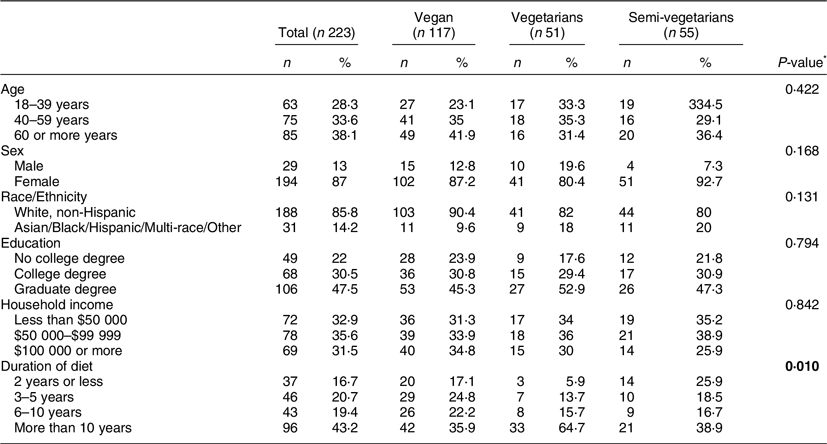
P values lower than 0.05 were boldface to highlight statistically significant results.
* Chi-square.
Table 2 shows differences in diet quality, nutrition literacy and food choice motives by diet groups. On average, participants had high scores for diet quality (78·5 (sd 7·8) out of 100), nutrition literacy (58·9 (sd 3·3) out of 64) and vegetarian nutrition literacy (5·5 (sd 0·7) out of 6). Vegans had a higher total HEI-2015 score than vegetarians and semi-vegetarians (P < 0·001). This was mostly attributed to higher scores in total fruits, total vegetables, fatty acids and saturated fat. Regarding nutrition literacy, 74 % of our sample had good nutrition literacy (≥ 58), 25·6 % had possibly poor nutrition literacy (45–57), and 0·4 % had poor nutrition literacy (≤ 44). There were no significant differences in nutrition literacy among diet groups. However, the vegan group had a higher vegetarian nutrition literacy score compared to the vegetarian and semi-vegetarian group (P < 0·001). Overall, ecological welfare, health and sensory appeal were the most important motives to participants. Specifically, vegans valued ecological welfare significantly more than did semi-vegetarians (4·43 (sd 0·46) v. 4·22 (sd 0·6), P = 0·048), while semi-vegetarians valued weight control (3·68 (sd 0·83) v. 3·24 (sd 0·78), P = 0·028) and health (4·28 (sd 0·52) v. 4·01 (sd 0·51), P = 0·028) significantly more than did vegetarians. Moreover, semi-vegetarians valued familiarity significantly more than did vegans (3·03 (sd 0·95) v. 2·59 (sd 0·87), P = 0·018).
Diet quality, nutrition literacy, and food choice motives by diet type
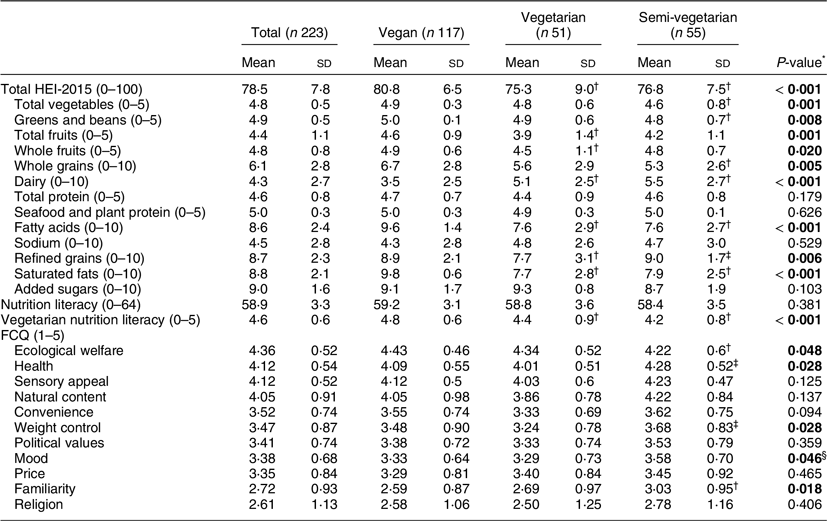
HEI, Healthy Eating Index-2015; FCQ, Food Choice Questionnaire (1 – strongly disagree, 5 – strongly agree).
P values lower than 0.05 were boldface to highlight statistically significant results.
* Mean values between diet types were compared using ANOVA.
† Significantly different from vegans as determined by the Dunn–Bonferroni post hoc method.
‡ Significantly different from vegetarians as determined by the Dunn–Bonferroni post hoc method.
§ NS in the post hoc analysis.
Table 3 shows the results of the three-step hierarchical regression analysis of the effects of food choice motives on overall diet quality (total HEI-2015 score). The analysis controlled for sociodemographic variables in step 1 and further adjusted for nutrition and vegetarian nutrition literacy in step 2. The final model that included all variables explained 26·5 % of the variance in diet quality (P < 0·001), while motives alone accounted for 12·8 % of the variance, and demographics accounted for 6·8 %. Notably, nutrition and vegetarian nutrition literacy did not significantly predict diet quality. In the fully adjusted model, increased importance of health was associated with a 3·4-point increase in HEI-2015 score (P = 0·004) and higher importance of natural content motivation was associated with a 1·7-point increase in HEI-2015 score (P = 0·014). In contrast, greater importance of weight control motivation was associated with lower HEI-2015 scores (P = 0·025).
Predictors of diet quality among the overall sample of vegans, vegetarians, and semi-vegetarians (n 223)
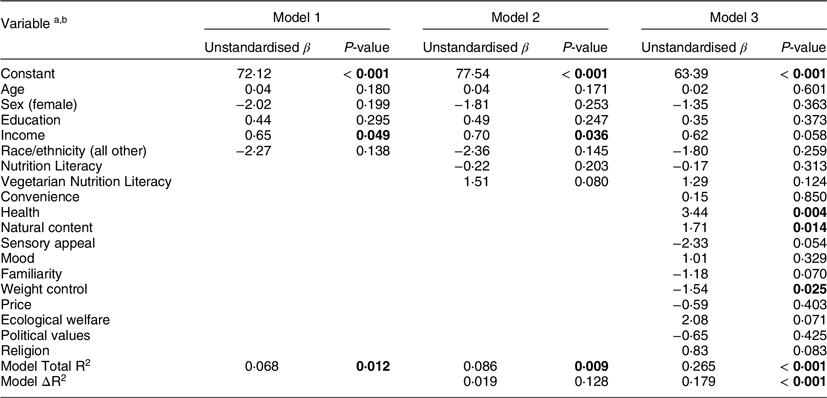
P values lower than 0.05 were boldface to highlight statistically significant results.
a Three-step hierarchical regression analysis with Total Healthy Eating Index-2015 as the dependent variable.
b Reference groups for categorical variables – Sex: male; Race/ethnicity: non-Hispanic White.
Discussion
The primary aim of this study was to assess and compare the diet quality, motives and nutrition literacy of vegans, vegetarians and semi-vegetarians. Overall, participants had a high diet quality. When comparing plant-based diet groups, vegans had the highest diet quality, while nutrition literacy levels were similar across groups. Nonetheless, vegans had a higher vegetarian nutrition literacy score compared to vegetarians and semi-vegetarians. In addition, the most valued motives in the sample were ecological welfare, health and sensory appeal. The secondary aim of the study was to identify the predictors of diet quality. Our findings suggest that intrinsic motivations to follow a plant-based diet are associated with greater diet quality, while extrinsic motivations are associated with poorer diet quality. An intrinsically motivated person performs a behaviour because it is personally rewarding to them, for example the food choice aligns with their beliefs and values, whereas an extrinsically motivated person performs a behaviour to gain an external reward, such as choosing food for lower body weight, improved mood or cheaper prices(Reference Satia, Kristal and Curry30). In our study, individuals following plant-based dietary patterns who were motivated by health or natural content had higher diet quality. On the other hand, those who were motivated by weight control had lower diet quality.
When comparing vegan, vegetarian and semi-vegetarian diets, vegans were found to have the highest diet quality scores, which is consistent with other studies(Reference Clarys, Deliens and Huybrechts2,Reference Le, Sabaté and Singh5,Reference Hargreaves, Araújo and Nakano7,Reference Torna, Smith and Lamothe24) . Mean HEI scores in the literature ranged from 65·4 to 70·9 in vegans, 58·7 to 60·9 in vegetarians and 59·4 in semi-vegetarians(Reference Clarys, Deliens and Huybrechts2,Reference Torna, Smith and Lamothe24) . In comparison, the mean HEI-2015 score of the US population was 56·6(Reference Reedy, Lerman and Krebs-Smith28). Similar to our findings, previous research found that vegans consumed more fruits, vegetables, whole grains and legumes, and fewer products high in saturated fat(Reference Clarys, Deliens and Huybrechts2,Reference Gili, Leeson and Montes-Chañi6,Reference Hargreaves, Araújo and Nakano7) .
Nutrition literacy was favourable in this population, with no differences in total nutrition literacy among groups, but higher vegetarian nutrition literacy in vegans. Studies characterising nutrition literacy in individuals following a plant-based diet are limited, and existing findings are contradictory. Saintila et al.(Reference Saintila, López and Calizaya-Milla20) reported no significant differences in the level of nutritional knowledge between vegetarian and non-vegetarian diets. However, Leonard et al.(Reference Leonard, Chalmers and Collins18) observed that vegetarians and semi-vegetarians had higher total knowledge scores than non-vegetarians. Similarly, Hoffman et al.(Reference Hoffman and Mariotti17) discovered that the more restrictive the diet, the greater the nutrition knowledge, with vegans scoring highest, followed by ovo-lacto-vegetarians. DeMay et al.(Reference DeMay, Nnakwe and Yu19) found that vegetarians (including vegans) scored higher on questions relevant to their diet compared to non-vegetarians, which may support the greater vegetarian nutrition literacy seen in vegans in the present study. Those following a vegan or vegetarian diet may develop greater nutrition knowledge to justify their diet in a mostly non-vegetarian society and to maintain a nutritionally adequate diet(Reference Hoffman and Mariotti17).
When making dietary choices, vegans valued ecological welfare more than semi-vegetarians did. This agrees with previous findings, which indicate that vegans and vegetarians view their dietary patterns as a manifestation of their animal and environmental values(Reference Cruwys, Norwood and Chachay10,Reference Hagmann, Siegrist and Hartmann21,Reference Miki, Livingston and Karlsen31) . Many vegans and vegetarians endorsed disgust of animal products or affinity for vegetarian alternatives and therefore valued taste preferences more than low-meat consumers(Reference Miki, Livingston and Karlsen31) and semi-vegetarians(Reference De Backer and Hudders32). However, our study found no differences in sensory appeal as a food choice motivation among vegans, vegetarians and semi-vegetarians, whereas semi-vegetarians valued weight control and health more than vegetarians, a finding that is consistent with the literature(Reference Hagmann, Siegrist and Hartmann21,Reference De Backer and Hudders32) .
Contradicting our study’s hypothesis, nutrition literacy and vegetarian nutrition literacy were not associated with diet quality. While no other study has evaluated this relationship among adults following plant-based dietary patterns, a systematic review of 29 relevant studies found that most showed a significant positive, but weak correlation between nutrition knowledge and dietary intake(Reference Spronk, Kullen and Burdon33). However, at the time, few studies have assessed this relationship using a validated and comprehensive nutrition literacy instrument. Nutrition literacy assessed using the NLit tool has been shown to predict diet quality among adults with chronic disease(Reference Gibbs, Ellerbeck and Gajewski15,Reference Taylor, Sullivan and Ellerbeck34) . Taylor et al.(Reference Taylor, Sullivan and Ellerbeck34) observed that a high nutrition literacy was associated with healthful dietary practices including lower sugar intake, improved energy balance and increased nut and vegetable intake. Considering our participants were highly educated, at or above middle class, with high nutrition literacy, the low variability in NLit scores may explain the lack of association between diet quality and nutrition literacy.
The link between diet motivation and diet quality can be observed in those following plant-based dietary patterns. Increased importance of health and natural content motives was positively associated with HEI-2015 scores. Generally, the literature shows that health-motivated individuals are likely to have higher diet quality, and this was seen in individuals following plant-based dietary patterns as well(Reference Allès, Péneau and Kesse-Guyot22,Reference Torna, Smith and Lamothe24,Reference Kapellou, Silva and Pilic35) . However, studies assessing plant-based diets did not utilise the FCQ(Reference Allès, Péneau and Kesse-Guyot22,Reference Torna, Smith and Lamothe24) and therefore did not measure natural content, related to the presence of additives and artificial ingredients, as a separate motive from health. Our results also show that greater importance of weight control was associated with decreased HEI-2015 scores. Inconsistent with the present findings, a recent study found that increased importance of weight control was correlated with increased diet quality(Reference Marty, de Lauzon-Guillain and Labesse23). However, among those following plant-based dietary patterns, stronger weight-loss motivation was related to higher meat intake(Reference Hagmann, Siegrist and Hartmann21). While weight control is related to health, it is driven by the external reward of a goal weight, which is subject to change, thereby altering dietary behaviours and quality.
To date, few studies have investigated the overall diet quality, diet motives and nutrition literacy in individuals following plant-based dietary patterns. While Torna et al.(Reference Torna, Smith and Lamothe24) have investigated the relationship between diet motives and diet quality in vegetarians, our study is novel in that it differentiated between vegans and vegetarians and included semi-vegetarians. Those following plant-based dietary patterns often report multiple motives to dietary adherence and using the FCQ allowed several motives to be measured rather than requiring participants to choose their top motive(Reference Lindeman and Väänänen26,Reference Miki, Livingston and Karlsen31) . Our sample is reflective of vegetarians in Western societies, who tend to be mostly (> 75 %) female, non-Hispanic white, middle-aged (40–60 years), with more than a high school education and a household income within the US middle-class range(Reference Clarys, Deliens and Huybrechts2,Reference Miki, Livingston and Karlsen31,Reference Cramer, Kessler and Sundberg36) . To our knowledge, this is the first study to measure nutrition literacy in individuals following plant-based dietary patterns using the validated NLit instrument. However, as the NLit has not been adapted for restrictive diets, it is unclear whether this instrument is appropriate to measure nutrition literacy in this population. Additionally, nutrition literacy levels in the US population have not been determined, as most studies to date were conducted in adults with chronic conditions,(Reference Gibbs, Ellerbeck and Gajewski15,Reference Taylor, Sullivan and Ellerbeck34) so interpretation of our nutrition literacy scores is limited. This study also did not include a control group of non-plant-based diets. The time-intensive design of this study, which included a 25-minute survey and an hour-long validated FFQ, may have limited our findings. From the overall sample, only 35 % of survey respondents completed the DHQ and were included in this study. Therefore, this study is prone to selection bias as more motivated health-conscious participants may have completed the study. However, the demographic variables of study participants who completed the DHQ were similar to those who did not. Nonetheless, results should be interpreted with caution due to limited generalisability.
The present study supports that individuals who were following plant-based dietary patterns had a high diet quality and nutrition literacy, with those following a vegan dietary pattern performing better than vegetarians and semi-vegetarians. In addition, this study underscores the importance of integrating diet motives and nutrition literacy in future research and public health settings alike to better understand and promote plant-based diets. Organisations can develop more influential public health campaigns that promote plant-based diets based on top-rated motives and existing nutrition knowledge. In patients adopting plant-based diets, healthcare professionals can encourage patients to focus on internal, personal motivations rather than external factors regarding diet. Shifting the clinical approach from focusing solely on weight control to including health and natural content as considerations may facilitate better dietary quality. Future research studies may benefit from including a larger group of participants and separating plant-based dietary patterns into different groups (vegans, vegetarians and semi-vegetarians) to account for differences in characteristics as shown in this study. There is no consensus regarding the definition of the semi-vegetarian diet and its differences from flexitarian and low-meat diets. Defining these terms more clearly will allow researchers to better establish diet quality, nutrition literacy and motivations in individuals following these diets.
Acknowledgements
N/a
Financial support
Sapna Peruvemba received the Circle of Friends Molly and Gene Rauen Endowed Research Assistance Award.
Conflict of interest
There are no conflicts of interest.
Authorship
S.P. contributed to the development of the study design, collected, analysed, interpreted the data and wrote the first manuscript draft with contributions from G.A.P.P. G.A.P.P. led the development of the study design, provided oversight of data collection and helped with data analysis and interpretation. J.G. and S.C. contributed to the development of the study design and helped with data interpretation. All authors reviewed and commented on subsequent drafts of the manuscript.
Ethics of human subject participation
This study was conducted according to the guidelines laid down in the Declaration of Helsinki, and all procedures involving research study participants were approved by the San Jose State University (IRB protocol tracking number: 21144). Written informed consent was obtained from all subjects/patients.


 Open access

