


Introduction
Annual bluegrass is a common weed of warm- and cool-season turfgrasses worldwide (Mao and Huff Reference Mao and Huff2012). Known for its ability to persist under a wide range of growing conditions and abundant seed production, annual bluegrass is among the top 10 weed species researched in seedbank and emergence studies (Gardarin et al. Reference Gardarin, Dürr and Colbach2009). These attributes result in annual bluegrass being a common target of PRE or POST herbicide applications. Continued reliance on chemical methods for controlling annual bluegrass has resulted in many populations evolving resistance to PRE and POST herbicides, particularly in regions where warm-season turfgrasses are used on golf courses, athletic fields, and lawns. Annual bluegrass populations with target-site resistance to herbicidal inhibitors of acetolactate synthase (ALS), photosystem II (PSII), microtubule assembly, and enolpyruvylshikimate-3-phosphate synthase have been documented in turfgrass systems (Heap Reference Heap2019), with cases of multiple resistance and nontarget site resistance becoming more common (Breeden et al. Reference Breeden, Brosnan, Mueller, Breeden, Horvath and Senseman2017; Brosnan et al. Reference Brosnan, Vargas, Breeden, Grier, Aponte, Tresch and LaForest2016; Svyantek et al. Reference Svyantek, Aldahir, Chen, Flessner, McCullough, Sidhu and McElroy2016).
Best practices for managing herbicide-resistant weeds center on a variety of ways to reduce weed seed formation and the weed seedbank in soil (Norsworthy et al. Reference Norsworthy, Ward, Shaw, Llewellyn, Nichols, Webster, Bradley, Frisvold, Powles, Burgos, Witt and Barrett2012). In agronomic cropping systems, the risk of resistance evolution is positively associated with seedbank size and increases as weeds escaping control deposit new seed in soil (Neve et al. Reference Neve, Norsworthy, Smith and Zelaya2011). Use of diversified weed management practices that focus on seedbank management can reduce selection pressure for resistant weeds by curbing the frequency at which herbicides need to be applied to a crop (Norsworthy et al. Reference Norsworthy, Ward, Shaw, Llewellyn, Nichols, Webster, Bradley, Frisvold, Powles, Burgos, Witt and Barrett2012).
Diversified weed management includes understanding weed biology to time interventions when weeds are most susceptible, and knowledge of both chemical and nonchemical techniques. A noteworthy means of nonchemical resistance management has been the development of harvest weed seed control (HWSC) techniques to destroy weed seeds captured within debris during commercial crop harvest and prevent them from being redistributed into the soil seedbank (Walsh et al. Reference Walsh, Newman and Powles2013). Several methods of HWSC have been successfully used in cropping systems including 1) use of chaff carts to collect and remove debris (including weed seed) generated during harvest for off-site disposal; 2) use of a chute attached to a grain harvester to concentrate debris into a narrow windrow prior to being burned under appropriate environmental conditions; 3) use of a system to bale debris generated during harvest for transport off site; and 4) use of a cage mill mounted to a commercial harvester that pulverizes debris collected during harvest (Walsh et al. Reference Walsh, Newman and Powles2013). These techniques have been found to prevent 56% to 99% of annual ryegrass (Lolium rigidum Gaud.), wild radish (Raphanus raphanistrum L.), and wild oat (Avena fauta L.) from being redistributed into crop production fields, with efficacy of narrow-windrow burning, baling debris, and use of a cage mill to pulverize debris, thus controlling seed lots 93% to 99% (Walsh and Newman Reference Walsh and Newman2007; Walsh and Powles Reference Walsh and Powles2007; Walsh et al. Reference Walsh, Harrington and Powles2012).
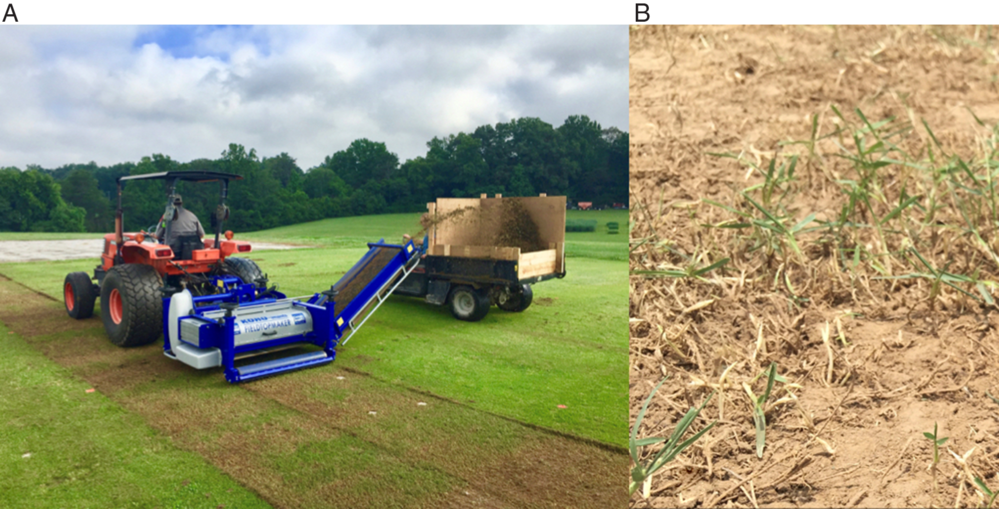
Fraise mowing (also spelled fraze, frase, and fraize) is a new turfgrass cultivation practice designed to remove aboveground biomass (e.g., leaf tissue, stolons, thatch, etc.) to a depth of 5 cm while allowing turf to regrow from vegetative tissue (Hansen and Christians Reference Hansen and Christians2015; McCauley et al., Reference McCauley, Pinnix and Miller2019; Figure 1). A specialized implement, termed an Imants KORO FTM (AQUA-AID Solutions, Rocky Mount, NC), is often used to fraise-mow turfgrass surfaces. This instrument uses 120 blades (10-mm thickness) affixed to a universe rotor spanning a total width of 120 cm to remove surface material to a depth of 5 cm. The sod is pulverized by the Koro Topmaker during fraise mowing and the debris collected is a mixture of soil, rhizomes, stolons, leaves, and weed seed. Debris generated during fraise mowing is deposited onto a conveyor belt and loaded onto a trailer to be discarded off site (Figure 1). Although fraise mowing removes turf verdure and causes turf quality to be temporarily unacceptable, it is a helpful tool in removing organic matter, overseeding transition, and weed management (Baker et al. Reference Baker, Owen and Woollacott2005; Hansen and Christians Reference Hansen and Christians2015; McCauley et al. Reference McCauley, Pinnix and Miller2019). An anecdotal report suggested that hybrid bermudagrasses [C. dactylon (L.) Pers. × C. transvaalensis Burtt-Davy] subjected to fraise mowing completely recovered within 7 wk in Texas (Minnick and Reed Reference Minnick and Reed2013). A study in North Carolina found hybrid bermudagrass can recover 28 to 42 d after fraise mowing depending on the timing, June or May, respectively (McCauley et al. Reference McCauley, Pinnix and Miller2019). The utility of fraise mowing as a cultural practice is largely unstudied on other turfgrass species, but our observations are that zoysiagrass [Zoysia spp. (L.) Merr.] is also able to regrow well from fraise mowing.
A. Demonstration of fraise mowing on zoysiagrass to remove aboveground biomass, thatch, and weed seed. B. Zoysiagrass regrowth from rhizomes and stolons not removed during fraise mowing.
Annual bluegrass soil seedbanks have been estimated to be as large as 179,500 seeds in the top 2.5 cm of soil per square meter (Watschke et al. Reference Watschke, Long and Duich1979), with others reporting that more than 80% of the viable annual bluegrass seed are within the top 0- to 1-cm layer (Branham et al. Reference Branham, Hardebeck, Meyer and Reicher2004). There is also evidence that most annual bluegrass seed shed in the spring is viable and germinates by late summer (Branham et al. Reference Branham, Hardebeck, Meyer and Reicher2004). Additionally, Baker et al. (Reference Baker, Owen and Woollacott2005) reported that annual bluegrass coverage in a perennial ryegrass (Lolium perenne L.) sward was reduced by fraise mowing. Given these biological characteristics, we hypothesized that summer fraise mowing of warm-season turfgrass would remove annual bluegrass seed; and therefore, be a mechanical means of annual bluegrass control, similar to HWSC techniques used in crop production systems. Therefore, our objectives were to evaluate annual bluegrass control, soil and debris seedbank dynamics, and zoysiagrass recovery in response to fraise mowing.
Materials and Methods
Annual Bluegrass Reduction
Research was conducted from 2015 to 2017 at the University of Tennessee East Tennessee AgResearch & Education Center–Plant Sciences Unit (Knoxville, TN) on a 4-yr-old zoysiagrass (Zoysia japonica Steud. ‘Meyer’) sward naturally infested with weeds including annual bluegrass, crabgrass (Digitaria spp.), goosegrass (Eleusine indica L. Gaertn.), and carpetweed (Mollugo verticillata L.). Soil type was a Sequatchie silt loam (fine-loamy, siliceous, semiactive, thermic humic Hapludult) with a soil pH of 6.7. Turf was mowed at 1.5 cm with a reel mower and clippings were returned to the surface after mowing. The research site received 24 kg N ha−1 monthly from April through September each year using a complete fertilizer (21 N 11 P2O5 16 K2O; Harrell’s Professional Products. Lakeland, FL). Irrigation was applied to the research site as needed to supplement rainfall using a water reel (Kifco Inc., Havana, IL). No herbicides were applied to the experimental area at any time.
Plots (2.4 × 2.4 m) were left untreated or fraise-mowed using an Imants KORO FTM (FTM 1.2, AQUA-AID Solutions) affixed to the power take-off assembly of a tractor. The fraise mower was configured to remove the top 25 mm of plot surface (i.e., 15 mm of verdure and 10 mm of soil). Fraise mowing was conducted on June 8, 2015, and June 6, 2016, to generate four unique treatments: 1) fraise-mowed in 2015, 2) fraise-mowed in 2016, 3) fraise-mowed in 2015 and 2016, and 4) an untreated, no-fraise-mowing treatment. Plots measured 2.4 m2 and were replicated in space three times. Debris generated during fraise mowing was collected in a trailer that traveled parallel to the tractor and moved off site without contaminating nontreated plots (Figure 1). The number of annual bluegrass plants in each plot was quantified using a 1-m2 grid placed in the center of each plot. This grid contained 81 squares measuring 7.6 cm2. The presence or absence of annual bluegrass in each square was scored on April 7, 2016, and April 7, 2017. Additionally, zoysiagrass recovery was quantified using digital image analysis methods described by Thoms et al. (Reference Thoms, Sorochan, Brosnan and Samples2011) on plots fraise-mowed only in 2016.
Data from single-year fraise-mowing treatments were analyzed as a two-factor (i.e., fraise-mowing or nontreated and year) completely randomized design using the ExpDes package (Ferreira et al. Reference Ferreira, Cavalcanti and Nogueira2014) in R (R version 3.2.3; R Core Team 2018). Data from the multiyear fraise mowing treatment (i.e., 2015 + 2016) were not included in our analysis. No significant treatment-by-year interactions were detected; therefore, data from each run were combined through averaging, with annual bluegrass count means compared using Fisher’s least significant difference test at α = 0.05. Zoysiagrass recovery data from 2016 were subjected to nonlinear regression analysis in Prism (Prism 5 for Mac OS X, GraphPad Software, La Jolla, CA) with treatments compared using a global sums of squares F-test at α = 0.05.
Seedbank Analysis
Field plots from zoysiagrass fraise mowing treatments were sampled in early May 2017 after final plant count data were collected with a commercial golf course cup cutter (Lever Action Hole Cutter, Pair Aide Products, Lino Lakes, MN 55038) to extract a 10.8-cm-diameter core from two places in the center of each plot. Following core extraction, the depth of each core was cut to 2.5 cm and then packaged inside individual polypropylene containers (Ziplock, SC Johnson Company, Racine, WI). Samples were placed in a freezer (−20 C) overnight and shipped the next day to Purdue University (West Lafayette, IN) via overnight mail for soil seedbank analysis. Upon arrival, cores were stored at 4 C for 2 wk prior to sample preparation. Samples were removed from cold storage, pulverized by hand (deaggregated), and allowed to dry on a greenhouse bench for 72 h. Soil samples were then passed through soil sieves (No. 3.5, 5.6 mm) to separate zoysiagrass leaves, stolons, and rhizomes from the soil cores. The seedbank was assessed for one soil core per plot and the second soil core was retained as a backup sample.
The deaggregated soil sample from each plot was placed over a permeable landscape weed fabric barrier (Weed Block Original, The Jobe’s Company, Waco, TX 76710) covering 2 cm of potting mix (Fafard 4P Mix, Sun Gro Horticulture, Agawam, MA 01001) to aid in moisture retention using individual 25- by 25-cm plastic trays. The trays, with the soil samples, were then placed on a greenhouse bench and seedbank analysis similar to that described by Schwartz et al. (Reference Schwartz, Gibson, Gage, Matthews, Jordan, Owen, Shaw, Weller, Willson and Young2015) was initiated by repeating the steps described below four times for five total germination cycles. The four steps common to each germination cycle were as follows: 1) Trays containing dry soil were subirrigated at the start of a germination cycle and again as needed to ensure uniform moisture conducive for seed germination. 2) Seedlings were identified weekly following the initial planting date until 4 wk after planting. When a seedling was identified, counted, and the data were recorded, it was removed from the tray. 3) Following the 4-wk germination cycle, the soils were stored at −20 C for 2 wk. 4) After 2 wk of freezing, the soils were thawed, stirred, and the germination cycle was repeated. The mean greenhouse temperature during these germination cycles was 24 C and photoperiod was 14 h.
Data for the seedbank analysis were analyzed after summing the germination counts across cycles. Weeds of the same type (monocotyledonous vs. dicotyledonous) and life cycle (winter annual, summer annual, perennial) were pooled together into categories prior to analysis [i.e., Lamium spp., Stellaria media (L.) Vill., and Veronica arvensis L. emergence counts were totaled as winter annual broadleaf weeds]. The exception to this was annual bluegrass, which was analyzed separately. One-way ANOVAs for each weed category were conducted with and without pooling across years using the PROC GLM procedure in SAS 9.4 (SAS Institute Inc., Cary NC 27513). Where F-tests were significant (P ≤ 0.05), means were separated using Tukey’s honestly significant difference test (α = 0.05).
Debris Analysis
To assess weed seed removed during fraise mowing, eight 3-m fraise mowing strips were made across the study area in May 2018. Debris removed from fraise mowing was collected and its volume and mass were determined in order to quantify the fraise mowing debris produced on an area basis. A 7.6-L subsample from each of the eight strips was shipped overnight to Purdue University (West Lafayette, IN) for debris analysis. Upon arrival, debris was stored at 4 C for 2 wk prior to sample preparation. Weed seed abundance was assessed in a portion of the material received with the remainder retained as a backup sample.
Tested samples were removed from cold storage and allowed to dry on a greenhouse bench for 72 h. Debris was then passed through soil sieves (No. 3.5, 5.6 mm) to separate zoysiagrass leaves, stolons, and rhizomes from soil. The two fractions (soil and plant debris) were used to assess the bank of weed seed in fraise mowing debris. The dry weight ratio of soil to plant material was 16:1. Approximately 2.1 kg of soil debris from each of the eight fraise mown strips was then placed over a permeable barrier in two 25- by 50-cm plastic trays. The dry plant debris, averaging 130 g, was separated out during sieving and placed directly onto 4 cm of potting mix in one 25- by 50-cm plastic tray. The trays were then placed on a greenhouse bench and the debris analysis was initiated by repeating the same steps described above for four total cycles with the only difference that flats were overhead-irrigated as needed to keep the soil and potting media moist and similar among the flats. The greenhouse environment during these germination cycles was configured to provide a daily average air temperature of 24 C and a 14-h photoperiod.
Data for the debris analysis were summarized after summing the germination counts across cycles and flats within the eight fraise mowing strips tested. Similar to the seedbank analysis, weeds were summarized across type and life cycle. When assessing fraise mowing debris, the bulk density of four 1-inch-deep, 10.8-cm-diameter golf course cup cutter cores from the plots were determined in order to normalize the mass of material (soil vs. debris) to allow for comparison between the fraise mowing debris and the top 2.5 cm of soil assessed in the seedbank analysis.
Results and Discussion
Annual Bluegrass Reduction
Significant differences in annual bluegrass counts due to fraise mowing treatment were detected (Table 1). When assessed in April, plots subjected to fraise mowing the previous June averaged 53 annual bluegrass plants per square meter compared with 72 plants for nontreated control plots. These values correspond to approximately 65% and 89% annual bluegrass cover, respectively. Therefore, when comparing fraise-mowed plots with nontreated control plots, summer fraise mowing offered a slight reduction (24%) in annual bluegrass cover the following spring, which is similar to results reported by Baker et al. (Reference Baker, Owen and Woollacott2005). In a sward of perennial ryegrass (Lolium perenne L.), Baker et al. (Reference Baker, Owen and Woollacott2005) reported reductions in annual bluegrass cover < 20% when removing only verdure via fraise mowing. However, when verdure and soil were removed to an 18-mm depth Baker et al. (Reference Baker, Owen and Woollacott2005) observed annual bluegrass cover reductions of 45% to 50%. It should be noted that Baker et al. (Reference Baker, Owen and Woollacott2005) introduced sand to the root zone of plots after fraise mowing to a depth of 18 mm and seeded the surface with perennial ryegrass, which may have increased the degree of annual bluegrass suppression observed; newly constructed sand-based root zones are typically not a hospitable environment for annual bluegrass seed germination until available phosphorus concentrations increase (Raley et al. Reference Raley, Landschoot and Brosnan2013).
Effect of fraise mowing (2.5 cm depth) in June on annual bluegrass infestations in zoysiagrass turfgrass during April of the following year. Means were combined from experiments implementing fraise mowing in June 2015 and 2016 with data collected in April 2016 and 2017. Infestations were documented by scoring the presence or absence of annual bluegrass within a grid (1 m2) containing 81 squares measuring 7.6 cm2.

In our experiment, fraise mowing controlled annual bluegrass to an extent that was similar to other nonherbicidal techniques. For example, Wolfe et al. (Reference Wolfe, Neal and Harlow2016) observed only 6% to 26% annual bluegrass control following PRE treatment with the fungal pathogen Phoma macrostoma; the researchers observed 93% to 100% annual bluegrass control with thaxtomin A (a chemical produced by the bacterium Streptomyces scabies) in the first year of their study but only 30% to 47% the second year. Johnson (Reference Johnson1994) reported 32% to 89% control of annual bluegrass in bermudagrass with isolates of Xanthomonas compestris pv. poannua but noted differences in efficacy among isolates and application timing. Variability in control with alternatives to conventional herbicides is common under field conditions (Harding and Raizada Reference Harding and Raizada2015). Peachey et al. (Reference Peachey, Pinkerton, Ivors, Miller and Moore2001) evaluated efficacy of soil solarization on annual bluegrass seed survival in nursery production systems. Soil solarization in the upper 5 cm of soil reduced annual bluegrass seed survival 89% to 100% but had no effect on seed from 5 to 15 cm; interestingly, in a single year of a 2-yr study, solarization increased survival of annual bluegrass seed at a 5- to 10-cm depth. The researchers concluded that use of the soil fumigant metham (930 L ha−1) was required for complete eradication.
Almost 60 d elapsed from fraise mowing until zoysiagrass cover was similar to that in the nontreated plots in 2016 (Figure 2). McCauley et al. (Reference McCauley, Pinnix and Miller2019) reported that hybrid bermudagrass could completely recover in 42 d when fraise-mown in mid-May and 28 d when fraise-mown in mid-June in North Carolina, which is quicker than this report of zoysiagrass recovery from fraise mowing on June 6th in Tennessee. Zoysiagrass is known to both establish more slowly than other species and to recover slowly from injury (Patton et al. Reference Patton, Schwartz and Kenworthy2017). Particularly, the cultivar ‘Meyer’ tested in this experiment is known to establish and recuperate slowly. The recuperative capacity of zoysiagrass cultivars such as ‘El Toro’ and ‘Palisades’ is superior to that of ‘Meyer’ (Karcher et al. Reference Karcher, Richardson, Landreth and McCalla2005) and equivalent to that of hybrid bermudagrass (Trappe et al. Reference Trappe, Karcher, Richardson and Patton2011). Furthermore, some zoysiagrass cultivars such as ‘Diamond’ have increased rhizome density, which allows for a quicker regrowth after sod harvest (Engelke and Murray Reference Engelke and Murray1989). As such, zoysiagrass cultivars with increased rhizome density or faster growth rate may also recuperate more quickly from fraise mowing and this deserves further investigation.
Percent zoysiagrass cover following fraise mowing to a 2.5-cm depth in 2016 compared to turf not subjected to fraise mowing. Cover was quantified via digital image analysis. Error bars represent standard error of each mean. Treatments were fit to a one-phase-association model and compared using a global sums-of-squares F-test at α = 0.05.

Seedbank Analysis
Annual bluegrass, carpetweed, common chickweed, corn speedwell, dandelion (Taraxacum officinale F.H. Wigg.), goosegrass, henbit (Lamium amplexicaule L.), large crabgrass [Digitaria sanguinalis (L.) Scop.], mouseear chickweed [Cerastium fontanum Baumg. ssp. vulgare (Hartm.) Greuter & Burdet], purslane, spotted spurge (Euphorbia maculata L.), purple deadnettle (Lamium purpureum L.), and smooth crabgrass [Digitaria ischaemum (Schreb.) Schreb. ex Muhl.] were among the weeds most commonly found germinating from the seedbank. Yellow woodsorrel (Oxalis stricta L.) was also found but was excluded because it was not seen in field plots and its source was likely as a contaminant from adjacent greenhouse benches. Because the focus of the experiment was annual bluegrass and there were no unique treatment effects on individual species (data not shown), weeds were pooled and discussed by type and life cycle.
Fraise mowing altered summer annual grasses and winter annual broadleaf weeds in the soil seedbank (Table 2). Summer annual grasses generally increased in fraise-mowed plots (Tables 2 and 3) with smooth crabgrass and goosegrass most frequently found in the seedbank. Fraise mowing in June occurred during peak summer annual grass germination, which allowed these grasses to establish and seed rain to occur prior to our seedbank analysis. Furthermore, removing the majority of the turf canopy by fraise mowing increased light interception by crabgrasses and goosegrass allowing for weed seed recruitment (Turner et al. Reference Turner, Jordan and Van Acker2012). Although fraise mowing can remove weeds present at mowing, our results reflect that this disturbance can also lead to the establishment, maturation, production, and dispersal of additional weed seed. To that end, future research should investigate the use of preemergence herbicides such as oxadiazon following fraise mowing. A shoot absorbed inhibitor of protoporphyrinogen oxidase, oxadiazon does not negatively affect vegetative establishment of zoysiagrass (Fagerness et al. Reference Fagerness, Yelverton and Cooper2002) and may effectively limit establishment of annual weeds after fraise mowing.
Weed seedlings germinated by type and life cycle from soil cores removed 1 yr following the completion of four fraise mowing treatments in zoysiagrass turf in Knoxville, TN.

a Abbreviations: ABG, annual bluegrass; PB, perennial broadleaf weeds; SAB, summer annual broadleaf weeds; SAG, summer annual grasses; WAB, winter annual broadleaf weeds.
b One 10.8-cm diameter soil core to a depth of 2.54 cm is equal to 232 cm3.
c Within columns, means followed by the same lowercase letter are not significantly different according to Tukey’s honestly significant difference test (α = 0.05).
Weed seedlings germinated by type and life cycle from soil cores removed 1 yr following the completion of fraise mowing treatments in zoysiagrass turf in Knoxville, TN. Data were pooled over three different fraise mowing treatments conducted during 2015–2016.
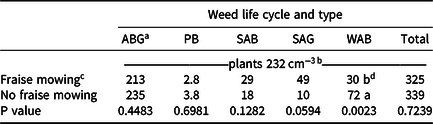
a Abbreviations: ABG, annual bluegrass; PB, perennial broadleaf weeds; SAB, summer annual broadleaf weeds; SAG, summer annual grasses; WAB, winter annual broadleaf weeds.
b One 10.8-cm diameter soil core to a depth of 2.54 cm is equal to 232 cm3.
c A combined analysis of all fraise mowing treatments (Year 1, Year 2, and Years 1 + 2).
d Within columns, means followed by the same lowercase letter are not significantly different according to Tukey’s honestly significant difference test (α = 0.05).
Contrary to findings with summer annual grasses, winter annual broadleaf weeds were reduced by fraise mowing (Tables 2 and 3). This was likely the result of the June fraise mowing timing removing freshly dispersed winter annual weed seed but also because zoysiagrass plots fully recovered prior to fall germination of winter annual weeds, inhibiting their establishment. Henbit was the most frequently counted winter annual broadleaf weed in this experiment but common chickweed and purple deadnettle were also found.
There were no differences in the soil seedbank for summer annual broadleaf weeds, perennial broadleaf weeds, or annual bluegrass (Tables 2 and 3). We anticipated a large reduction in annual bluegrass in the seedbank based on previous research by Branham et al. (Reference Branham, Hardebeck, Meyer and Reicher2004) indicating that 80% of the viable annual bluegrass seed are within the top 0- to 1-cm layer of the soil surface. Furthermore, annual bluegrass counts from the spring following fraise mowing suggested that we would find fewer annual bluegrass seeds in the soil of fraise-mowed plots. However, analysis of soil samples after 1 or 2 yr of fraise mowing compared with those from the nontreated plots yielded no difference in annual bluegrass seedlings germinated from the seedbank (Tables 2 and 3). Many viable annual bluegrass seedlings remained in the soil after fraise mowing. As such, we conclude that although fraise mowing may help to temporarily reduce existing annual bluegrass plants via mechanical removal, the frequency and depth we studied did not effectively reduce the seedbank at our site. Based on our sampling, our soil contained 25,250 annual bluegrass seeds in the top 2.5 cm of soil per square meter. This is far fewer than the 179,500 seeds in the top 2.5 cm of soil per square meter reported by Watschke et al. (Reference Watschke, Long and Duich1979), which is likely because those researchers sampled from a site growing cool-season grasses that was 90% annual bluegrass and 10% Kentucky bluegrass. It is possible that fraise mowing would have a much larger impact on a site with a higher count of annual bluegrass seed in the seedbank.
Debris Analysis
The same weeds found in the seedbank analysis were found germinating from the fraise debris with the addition of corn speedwell. Among the weed seed found in the debris, winter annual broadleaves represented the largest portion (59%; Table 4). This helps explain the positive finding that winter annual broadleaf weeds in the soil seedbank were decreased by fraise mowing. Next, 28% of the seeds found in fraise mowing debris consisted of annual bluegrass (Table 4). In a volume of debris equivalent to the soil volume quantified in the seedbank analysis (10.8-cm diameter core to 2.54-cm depth), 34.7 annual bluegrass seedlings were counted. In the seedbank analysis, 235 annual bluegrass seedlings were counted indicating that proportionally, the majority of the annual bluegrass seed remained in the soil following fraise mowing.
Weed seedlings germinated from debris removed during fraise mowing treatments and their proportion of the total as categorized by type and life cycle.

a One 10.8-cm diameter soil core to a depth of 2.54 cm is equal to 232 cm3. Data were normalized to allow for comparison to the seedbank analysis experiment (Table 3).
b Abbreviations: ABG, annual bluegrass; PB, perennial broadleaf weeds; SAB, summer annual broadleaf weeds; SAG, summer annual grasses; WAB, winter annual broadleaf weeds.
Again, these results were surprising considering published data on cool-season turfgrasses suggest that the majority of the annual bluegrass in the seedbank resides in the top 1 cm (Branham et al. Reference Branham, Hardebeck, Meyer and Reicher2004) of soil in cool-season golf course fairways or the top 1.3 cm (Green et al. Reference Green, Kravchenko, Rogers and Vargas2019) of the soil in cool-season golf course putting greens. It is likely that seedbank dynamics and seed distribution in the soil profile is different between climates with increased annual bluegrass. Past research on annual bluegrass seedbank dynamics (Branham et al. Reference Branham, Hardebeck, Meyer and Reicher2004; Green et al. Reference Green, Kravchenko, Rogers and Vargas2019; Watschke et al. Reference Watschke, Long and Duich1979) was conducted in cool-season turf swards in Illinois, Indiana, Michigan, and Pennsylvania with a high percentage of annual bluegrass. Additionally, some of the sites previously studied were golf course turfs that were 90+ yr old. The site used in our experiment was a 4-yr-old sward of warm-season turf in Tennessee where annual bluegrass is a problematic weed but a smaller component of the turf sward than in cooler climates. As such, although data in this present experiment do not support that fraise mowing is highly efficacious for annual bluegrass removal from the soil seedbank of warm-season turf, fraise mowing may prove to be effective in removing annual bluegrass from the seedbank of cool-season turf as suggested by Green et al. (Reference Green, Kravchenko, Rogers and Vargas2019).
In the complete absence of herbicide, fraise mowing of zoysiagrass in June led to minor reductions in annual bluegrass infestation the following April. Although this cultivation practice removed ~144,000 cm3 of debris from each plot that contained 28% annual bluegrass seed, a sizeable portion of annual bluegrass seed remained in the seedbank after fraise mowing. Our results are limited in that we evaluated efficacy of this treatment on a single turfgrass species at one location. Efficacy of fraise mowing for depleting annual bluegrass seedbanks may vary among turfgrass species and environments (e.g., soil type, mowing height, thatch depth, cultivation history, etc.). Additional research exploring efficacy of fraise mowing under different environmental conditions is warranted. As noted by Baker et al. (Reference Baker, Owen and Woollacott2005), fraise mowing may be a useful tool for providing mechanical suppression of annual bluegrass along with efficacy from properly timed herbicide applications. Future research exploring efficacy of weed control strategies exploring the use of fraise mowing combined with traditional herbicides is also warranted in zoysiagrass and other turfgrass species.
Acknowledgments
We thank Dr. Ross Braun, Tyler Campbell, Nathan Deppe, Daniel Farnsworth, Trevor Hill, Cory Wright, Mitchell Riffey, Geoff Schortgen, Dallas Taylor, and Dan Weisenberger for their efforts in this research. This work was supported by the Tennessee Agricultural Experiment Station and AQUA-AID Solutions. This work was also supported by U.S. Department of Agriculture–National Institute of Food and Agriculture Hatch project 1019791. Mention of trade names or commercial products in this publication is solely for the purpose of providing specific information and does not imply recommendation or endorsement by the University of Tennessee Institute of Agriculture or Purdue University.


 Open access

