


Introduction
Five species of sea-turtles are found in Africa: the hawksbill (Eretmochelys imbricata), loggerhead (Caretta caretta), leatherback (Dermochelys coriacea), green (Chelonia mydas), and olive ridley (Lepidochelys olivacea). According to the International Union for Conservation of Nature’s Red List (IUCN, 2023), all of these species are listed as threatened, with conservation statuses ranging from Vulnerable to Critically Endangered. The East Coast of Africa plays a critical role for global marine turtle conservation, providing essential nesting, migratory, and foraging habitats for both juvenile and adult turtles in the Western Indian Ocean region (van de Geer et al., Reference van de Geer, Bourjea, Broderick, Dalleau, Fernandes, Harris, Inteca, Kiponda, Louro, Mortimer, Msangameno, Mwasi, Nel, Okemwa, Olendo, Pereira, Rees, Silva, Singh and Godley2022). Furthermore, sea-turtles significantly contribute to the livelihoods and socio-economic development of coastal communities, though the full scope of their impact is yet to be fully documented (van de Geer et al., Reference van de Geer, Bourjea, Broderick, Dalleau, Fernandes, Harris, Inteca, Kiponda, Louro, Mortimer, Msangameno, Mwasi, Nel, Okemwa, Olendo, Pereira, Rees, Silva, Singh and Godley2022).
Of the five sea-turtle species that occur along the African Coast, all nest in Mozambique, but the green (Chelonia mydas, Linnaeus, 1758) and hawksbill (Eretmochelys imbricata, Fitzinger 1843) species are the only ones documented to nest in the northern region (Farooq et al., Reference Farooq, Nanvonamuquitxo, Nassongole, Conradie, Bills, Soares and Antonelli2022; Fernandes et al., Reference Fernandes, Williams, Valladolid, Muaves, Louro and Pereira2017; Louro et al., Reference Louro, Pereira and Costa2006, Reference Louro, Videira, Pereira and Fernandes2011; Pereira, Reference Pereira2006; van de Geer et al., Reference van de Geer, Bourjea, Broderick, Dalleau, Fernandes, Harris, Inteca, Kiponda, Louro, Mortimer, Msangameno, Mwasi, Nel, Okemwa, Olendo, Pereira, Rees, Silva, Singh and Godley2022). The green sea-turtle has major nesting sites in Mozambique, primarily located in the archipelagos of Quirimbas (Anastácio et al., Reference Anastácio, Santos, Lopes, Moreira, Souto, Ferrão, Garnier and Pereira2014; Garnier et al., Reference Garnier, Hill, Guissamulo, Silva, Witt and Godley2012; van de Geer et al., Reference van de Geer, Bourjea, Broderick, Dalleau, Fernandes, Harris, Inteca, Kiponda, Louro, Mortimer, Msangameno, Mwasi, Nel, Okemwa, Olendo, Pereira, Rees, Silva, Singh and Godley2022), Primeiras e Segundas, and Bazaruto (Fernandes et al., Reference Fernandes, Williams, Valladolid, Muaves, Louro and Pereira2017; Pilcher and Williams, Reference Pilcher and Williams2019), all of which are protected areas. To the best of our knowledge, nesting outside these areas in the country has not been documented so far. The threats affecting sea-turtles in Mozambique include hunting (Fernandes et al., Reference Fernandes, Williams, Valladolid, Muaves, Louro and Pereira2017; Pilcher and Williams, Reference Pilcher and Williams2019), nest foraging (Anastácio et al., Reference Anastácio, Santos, Lopes, Moreira, Souto, Ferrão, Garnier and Pereira2014), and pollution (Inteca et al., Reference Inteca, Hagy, Silva, Amoda, Cululo and Farooq2023). Evidence of sea-turtle mortality, such as the discovery of carapaces and bones on beaches and the sale of products made from turtle scutes, has also been observed in local markets across the country (MICOA, 2012; Pilcher and Williams, Reference Pilcher and Williams2019). Additionally, it has been suggested, although not officially confirmed, that local communities may consume sea-turtle eggs (van de Geer et al., Reference van de Geer, Bourjea, Broderick, Dalleau, Fernandes, Harris, Inteca, Kiponda, Louro, Mortimer, Msangameno, Mwasi, Nel, Okemwa, Olendo, Pereira, Rees, Silva, Singh and Godley2022). Reports of sea-turtle mortality and in-water occurrence in Pemba – a city located in the northernmost province of Mozambique, have been documented since 1974 with more recent sightings in 2018 and 2022 (Farooq et al., Reference Farooq, Nanvonamuquitxo, Nassongole, Conradie, Bills, Soares and Antonelli2022; Hughes, Reference Hughes1974; Pilcher and Williams, Reference Pilcher and Williams2019). Despite these reports, no nesting activity was ever documented from Pemba. Thus, our observation is the first recorded nesting attempt by a green sea-turtle (Chelonia mydas) in Pemba located in the Cabo Delgado Province of northern Mozambique – an urban area with a population of 200,529 inhabitants (INE, 2019). Given that Pemba’s beaches are popular among tourists, this situation presents a unique opportunity for local tourism operators to engage in conservation efforts. Our observation extends the known nesting range of sea-turtles in the northern part of the country by 40 km south of the Quirimbas Archipelago. This highlights the potential significance of Pemba, an urbanised coastal city outside protected areas, as a nesting site.
Observation site
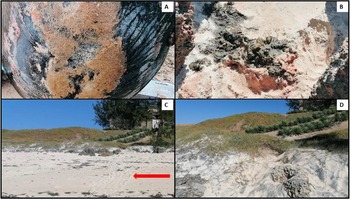
On July 20, 2021, our team members were approached by a local tourist operator who observed fishermen selling sea-turtle meat in baskets on Maringanhas’ Beach in the northwest part of Pemba, Cabo Delgado Province, northern Mozambique, Southern Africa (Figure 1A–C). The operator had witnessed the turtle being killed on-site shortly beforehand. Our team promptly visited the location, measured the turtle’s carapace (Figure 2A) and tracks (Figure 2B and C), and identified the species. A total of 57 days later, on September 15, 2021, we revisited the site to look for signs of nesting but no signs were found.
Maps depicting the location and context of green turtle nesting in northern Mozambique. (A) a detailed map of Cabo Delgado Province showing known green turtle nesting sites (blue circles) (Vamizi Island [11.01° S, 40.72° E], Quirimbas National Park [12.15° S, 40.56° E], Sencar Island [12.48° S, 40.64° E], Rolas Island [12.15° S, 40.56° E], Matemo Island [12.19° S, 40.60° E], Ibo Island [12.33° S, 40.58° E], Mefunvo Island [12.55° S, 40.60° E], Quilaleia Island [12.53° S, 40.60° E], Mucojo Beach [12.07° S, 40.48° E], Namau Beach [12.78° S, 40.56° E], Guludo Beach [12.13° S, 40.48° E], Naunde Beach [12.17° S, 40.48° E]) (Costa, Reference Costa2007; Fernandes et al., Reference Fernandes, Inteca, Williams, Taju, Muaves and Pereira2020; Van de geer et al., Reference van de Geer, Bourjea, Broderick, Dalleau, Fernandes, Harris, Inteca, Kiponda, Louro, Mortimer, Msangameno, Mwasi, Nel, Okemwa, Olendo, Pereira, Rees, Silva, Singh and Godley2022), and the location of Pemba (red rectangle), from where we report the current nesting attempt occurred. (B) A map of Africa focusing on Mozambique for regional context. (C) A map of Mozambique highlighting Cabo Delgado Province in the northern part of the country.

Photographs taken on the beach where the observation occurred. (A) Carapace of the green turtle; (B) faeces and blood from the green turtle; (C) tracks of the green turtle; (D) the place where the female was trying to dig the nest; photos taken by António Brito (tourist operator) on July 21, 2021. Due to the fishermen’s concerns regarding the involvement of the authorities, and to avoid jeopardising our opportunity to gather information, we were given only a brief window to photograph the specimen.

Maringanha Beach (12.9745° S, 40.5872° E) is characterised by its vast sandy expanse, typical coastal vegetation, low step dunes (<1 m) (Figure 2D), a few scattered houses, and absence of street lighting. The area predominantly supports artisanal fishing, which is a primary source of income for the local community.
Results and discussion
Identifying turtles by colour can be challenging due to their high colour variability. Instead, a reliable identification method involves examining the shape of the head, bill, body, and carapace. We identified the specimen as a green sea-turtle (Chelonia mydas) based on the number of scutes on the carapace (Figure 2A), and the composition of the turtle’s faeces, which consisted of sea-grass (Figure 2B) (Eckert et al., Reference Eckert, Bjorndal, Abreu-Grobois, Donnelly, Schroeder and Murphy1999). This diet is consistent with adult green sea-turtles occurring at warmer sites with temperatures above 25°C, where Pemba is located (Esteban et al., Reference Esteban, Mortimer, Stokes, Laloë, Unsworth and Hays2020).
The carapace measured 87 cm in curved carapace width and 94 cm in curved carapace length. Additionally, the symmetrical tracks with parallel flipper marks measured 86 cm in width (Figure 2C). These measurements place the individual within the lower size range for adult female green sea-turtles, which typically measure between 90 and 120 cm in length (Bourjea et al., Reference Bourjea, Frappier, Quillard, Ciccione, Roos, Hughes and Grizel2007). No eggs were discovered at the presumed nesting site, suggesting that the turtle was intercepted before laying eggs.
The nearest known nesting areas for green sea-turtles are approximately 40–60 km north, including both mainland and islands within Quirimbas National Park, such as Ibo Island, Quilalea Island, Sencar Island, Rolas Island, Mucojo Beach, Namau Beach, and Naunde Beach, Figure 1 (Costa, Reference Costa2007).
This observation represents the southernmost documented nesting attempt in northern Mozambique, expanding the known nesting range of the species beyond the protected Quirimbas Archipelago to include one of the most densely populated cities in the northern part of the country. While green sea-turtles typically prefer nesting in secluded locations (Hendrickson, Reference Hendrickson1958; Medeiros et al., Reference Medeiros, Chaloupka and Bolten2022), exceptions have been recorded in the southern mainland of Tanzania, as well as in Kiunga, Watamu, and Mombasa in Kenya, and along the north coast of Somalia (van de Geer et al., Reference van de Geer, Bourjea, Broderick, Dalleau, Fernandes, Harris, Inteca, Kiponda, Louro, Mortimer, Msangameno, Mwasi, Nel, Okemwa, Olendo, Pereira, Rees, Silva, Singh and Godley2022). But despite the high population density of Pemba city in Mozambique, the recent nesting attempt at Maringanha Beach suggests that the habitat may still be suitable for sea-turtle nesting.
The relatively low level of artificial lighting at this site (Figure 3) and the presence of a wide sandy shoreline may have contributed to its viability as a potential nesting location. Artificial light pollution is a well-known factor that disrupts sea-turtle nesting behaviour by deterring females from emerging and disorienting hatchlings (Martins et al., Reference Martins, Souza Pereira, Silva-Casarín and Nogueira Neto2017; Witherington, Reference Witherington1992). The low lighting incidence on the beach – approximately 2.72 Digital Number (DN) on the day it attempted to nest (Eogdata, 2021) – suggests that light pollution may not have been a major deterrent in this case. Values of DN range from 0 to 63, with 3 and 5.5 serving as thresholds for moderate and high DN, respectively. Although sea-turtles have been observed to nest at light levels up to 5.5 DN, most nesting activity typically occurs at DN levels of 3 or below (Colman et al., Reference Colman, Lara, Bennie, Broderick, de Freitas, Marcondes, Witt and Godley2020).
A map depicting the location and environmental context of Maringanha in Pemba, Cabo Delgado, showing the intensity of night lights in Pemba on July 21, 2021, highlighting the low light pollution in Maringanha (log10-transformed data from the VIIRS-DNB global cloud-free composites (Eogdata, 2021).

Beyond light pollution, other environmental factors may influence nesting suitability in Pemba. The City is known for its suitable beach morphology, featuring a wide, sandy shoreline and a low-lying dune system ideal for sea-turtle nesting (Caldas and Rita, Reference Caldas and Rita2014). However, due to the high human activity in the area, sea-turtle nests are likely to be uncovered and the eggs consumed by local communities (Pilcher and Williams, Reference Pilcher and Williams2019; van de Geer et al., Reference van de Geer, Bourjea, Broderick, Dalleau, Fernandes, Harris, Inteca, Kiponda, Louro, Mortimer, Msangameno, Mwasi, Nel, Okemwa, Olendo, Pereira, Rees, Silva, Singh and Godley2022). Green sea-turtles in Mozambique are also threatened by beach development (Anastácio et al., Reference Anastácio, Santos, Lopes, Moreira, Souto, Ferrão, Garnier and Pereira2014), by-catch from trawling and artisanal fishing (Pilcher and Williams, Reference Pilcher and Williams2019), and marine litter (Inteca et al., Reference Inteca, Hagy, Silva, Amoda, Cululo and Farooq2023). Despite these challenges, our observation suggests that Pemba could be a viable nesting site for green sea-turtles, provided there is adequate enforcement and monitoring. This incident highlights the ongoing threats to sea-turtle populations in the region and the urgent need for conservation measures. The fact that it was a local tourism operator that witnessed and reported the event showcases the potential role of tourism stakeholders in collaboration with local communities, government, and researchers in wild life monitoring and conservation efforts. Our findings emphasise the importance of enhanced protection for coastal and marine ecosystems, which are essential for biodiversity and may also support sustainable ecotourism initiatives.
Acknowledgements
We acknowledge António Brito, the touristic operator who, after seeing the group of fishermen selling sea-turtle meat and tracks on the site, immediately communicated with us. Harith Farooq was supported by The Danish Independent Research Council (grant no. 0165-00018B).
Author contributions
Gélica Inteca: Data collection, Writing – Original draft preparation and Editing, Isabel Silva: Reviewing, Harith Farooq: Editing, Writing and Reviewing.
Competing interests
The authors declare that they have no conflict of interest.



 Open access

