


Introduction
The remarkable capacity of living systems to engender responsive and adaptive behaviour in material artefacts has ignited discussions across art, product design, fashion and textile design, architecture, and human-computer interaction over the last decade (Ginsberg et al., Reference Ginsberg, Calvert, Schyfter and Elfick2014; Collet, Reference Collet2017; Camere and Karana, Reference Camere and Karana2018; Dade-Robertson, Reference Dade-Robertson2020; Pataranutaporn et al., Reference Pataranutaporn, Vujic, Kong, Maes and Sra2020). Situated within the field of biodesign (Myers, Reference Myers2012), these dialogues put forth a wide range of ecological design models that highlight the significance of co-creation with living organisms, such as fungi, algae, bacteria, and plants. By preserving the livingness of these organisms in design outcomes, their multifaceted biological affordances are harnessed, yielding distinctive functionalities, expressions, and sustainable material and energy alternatives in everyday artefacts.
While the pursuit of scaling up biodesign for sustainable impact remains an ongoing research endeavour in both academic and industrial realms, the critical and social significance of designing with the living has gained substantial traction within design research. This recognition has sparked a reconsideration of the intricate relationships within ecosystems and the varying agentive roles that both humans and non-human entities can assume within a broader ecological context. One notable development in this discourse is the living artefacts framework (Karana et al., Reference Karana, Barati and Giaccardi2020). With the objective of facilitating biodesign outcomes that are alive in the use of everyday artefacts, deeply embedded within social and ecological contexts, the authors propose three fundamental design principles for living artefacts: living aesthetics, mutualistic care, and habitabilities. Living Aesthetics calls upon designers to understand and embrace the dynamic nature of living artefacts as more than indicators of well-being, but also as catalysts for the development of new sensitivities extending beyond the human realm. By doing so, designers can foster a deeper understanding and appreciation for the diverse temporalities and forms of expression that arise in conjunction with non-human entities. Mutualistic Care highlights the importance of nurturing reciprocal, evolving, and mutually beneficial relationships between humans and living artefacts. In this principle, designers are prompted to consider how they can contribute to the thriving of the living artefact while also receiving benefits in return, and to acknowledge the interdependence and shared responsibilities that exist within a living artefact’s ecosystem. Habitabilities accentuates the significance of deliberately exploring and incorporating the capacity of living and non-living things within an ecosystem to serve as habitats for living organisms throughout their life span within living artefacts. Designers are encouraged to develop sensibilities that recognize and foster connections and relationships within these habitats, promoting cohabitation between humans and living organisms. By understanding the needs of the organisms involved, designers can create artefacts that provide conducive ecologies for the flourishing of diverse life forms.
This conceptualization of living artefacts invites designers to delve into the intricate dimensions of livingness as a biological, social, and ecological phenomenon, tapping into their potential to act as catalysts for the emergence of reciprocal practices and sensibilities that enable cohabitation and coevolution of humans and non-humans within shared ecologies. Notably, this understanding holds significant promise for facilitating regenerative thinking in the realm of sustainable design. Rooted in a living system approach, regenerative thinking in design suggests a profound understanding of living organisms, encompassing both human and non-human entities, and the ecologies they inhabit, to create human systems that can coevolve with natural systems, replenishing their inherent capacity to endure, flourish, and regenerate without depleting the essential life support systems and resources they rely on (Lyle, Reference Lyle1994). By positioning living artefacts at the intersection of the sustainability discourse and the ontologies that go beyond human entities, this article delves deeper into their potential and explores the unprecedented opportunities that living artefacts present for designers to contribute to regenerative ecologies. Importantly, the article illustrates how regenerative thinking can be manifested at the scale of the artefact, facilitating an amplified capacity for emergence, creativity, and coevolution.
In the subsequent sections, we will start by establishing a theoretical foundation for our discourse. This will be achieved through a comprehensive review of literature related to more-than-human design and living artefacts, sustainability, and regenerative design. These insights will serve to elucidate our conceptualization of regenerative ecologies. Subsequently, we will delineate five core pillars, accompanied by guiding questions and two illustrative cases. These are intended to assist designers in unravelling, articulating, and critically evaluating the potential of living artefacts within the realm of regenerative ecologies.
Living artefacts and the more-than-human turn in design
A growing body of scholarly work in the field of design contends that a narrow focus on human needs and a lack of attention to the ontologies of non-human entities have resulted in problematic social and environmental outcomes (Bennett, Reference Bennett2004; DiSalvo et al., Reference DiSalvo, Sengers and Brynjarsdóttir2010; Forlano, Reference Forlano2016; Clarke et al., Reference Clarke, Heitlinger, Foth, DiSalvo, Light and Forlano2018; Cielemęcka and Daigle, Reference Cielemęcka and Daigle2019). From technology (Frauenberger, Reference Frauenberger2020; Giaccardi and Redström, Reference Giaccardi and Redström2020; Wakkary, Reference Wakkary2021) to animals (Mancini, Reference Mancini2011) and plants (Gabrys, Reference Gabrys2020), the agency of non-human actors, their perspectives, temporalities, and interdependencies are increasingly discussed and considered in design (Giaccardi, Reference Giaccardi and Wiltse2020). This expanded universe of design illustrates a move towards more inclusive, relational, and pluriversal ideas of what it means to affect change in more-than-human worlds, where agency is positioned neither in the human or the non-human but in their relations and mutual capacity for “rewilding” (Haraway, Reference Haraway2016). This more-than-human turn confronts designers with aspects of creativity, open-endedness, and unpredictability that trouble the boundaries and centres of what is to be considered just and sustainable, introducing radical ideas of human transformation and coevolution that are hard for humans to existentially grapple with (Wood, Reference Wood2022).
In her book “When Species Meet” (Haraway, Reference Haraway2008), Donna Haraway advocates passionately for an anthropological shift that would recognize the entanglement of species, reject human exceptionalism, and foster alternative practices of world building. Her perspective, like those of other influential scholars such as Anna Tsing (Reference Tsing2015) and Puig de la Bellacasa (Reference Puig de la Bellacasa2017), have influenced multi-species considerations in more-than-human design with concepts such as noticing, collaborative survival, and care. For example, Liu et al. (Reference Liu, Byrne and Devendorf2018) have examined the concept of collaborative survival through the lens of mushroom foraging, exploring how interactive products can facilitate awareness and engagement with entanglements between humans and other species. Similarly, Flanagan and Frankjaer (Reference Flanagan and Frankjaer2018) have prototyped devices to enhance empathic experiences of insects in rewilded spaces. Clarke et al. (Reference Clarke, Heitlinger, Foth, DiSalvo, Light and Forlano2018) have explored participatory urban walks that enable humans to empathize with the perspectives of other organisms.
In biodesign, a recent notable contribution to this discourse is the practical guidelines proposed by Kim et al. (Reference Kim, Risseeuw, Groutars and Karana2023), which aim to highlight the metabolic changes, scales, and temporal dynamics of microbes in the design of living artefacts, with the purpose of enhancing their perceptibility to human users. In a similar vein, Zhou et al. (Reference Zhou, Kim, Doubrovski, Martins, Giaccardi and Karana2023) have introduced diverse living microbial artefacts with cyanobacteria that unveil the subtle shifts in environmental light conditions within a matter of minutes, providing a suitable timeframe for prompt care of cyanobacteria, and thus addressing the challenge of temporal dissonance between humans and cyanobacteria (Figure 1). These scholarly endeavours, among others, provide valuable insights and serve as entry points for nurturing what we broadly refer to as more-than-human sensibilities. By providing a tangible manifestation of temporalities, scales, and expressions that extend beyond human boundaries, such endeavours serve to establish human relationships with non-human entities based on ecological foundations.
The Daylight Log is a living artefact that unveils the subtle shifts in light conditions within a matter of minutes, providing a suitable timeframe for prompt care of cyanobacteria, while also allowing individuals to be mindful of daylight variations and their range. (Image credits: Jiwei Zhou).

Towards regenerative ecologies
In 1992, Edward Wilson anticipated that the 21st century would be characterized as an era of ecological restoration of ecosystems (Wilson, Reference Wilson1992). However, efforts to date are mostly limited by the apparent lack of awareness that our anthropocentric perspective is only one of the many ecologies in our world (du Plessis and Cole, Reference du Plessis and Cole2011; Capra and Luisi, Reference Capra and Luisi2014; Escobar, Reference Escobar2018). Emerging from these debates, a systemic vision of ecology has come to the forefront, encompassing the notion of regeneration as a pursuit in sustainability that transcends equilibrium thinking, embracing a deeper comprehension of the coevolution of humans and the ecosystems they inhabit, acknowledging their inseparable interdependence.
From equilibrium to coevolution
Initial efforts towards sustainable development aimed to achieve a sustainable balance between environmental, economic, and social aspects, primarily by prioritizing immediate human needs. Drop-in solutions such as material substitution, as well as material efficiency and energy recovery models exemplify the sustainable development perspective. Despite its widespread adoption, this approach has been extensively critiqued for its human-centred, monocultural, and gender-biased perspective on development (Buckingham, Reference Buckingham2010; Benson et al, Reference Benson and Craig2014; Gibbons, Reference Gibbons2020), as well as its disproportionate emphasis on economic factors resulting in a failure to address the issues such as biodiversity loss and climate change (Zeng et al, Reference Zeng, Maxwell, Runting, Venter, Watson and Carrasco2020). Importantly, approaches aimed at achieving sustainable equilibrium often overlook the inherent nature of natural systems, which are characterized by constant fluctuations and are never in a static state of equilibrium. It was a mechanistic worldview that led to the separation of human and ecological systems, with nature perceived as a resource to be used and controlled (Cole, Reference Cole2012). Consequently, sustainable development fails to critique current states of human behaviour and experience, specifically perpetuating over-consumption, social isolation, and disconnection from nature.
Sustainable resilience has emerged in response to criticisms surrounding equilibrium approaches. Here the interconnection between humans and degrading ecosystems manifests as a symbiotic relationship centred on adaptive strategies for enhancing human well-being, economic stability, and social resilience. Circular economy is a widely promoted resilience approach defined as an economic system with material and energy cycles that seek to limit the flow of waste (Geissdoerfer et al., Reference Geissdoerfer, Savaget, Bocken and Hultink2017; Kirchherr et al, Reference Kirchherr, Reike and Hekkert2017). Often seeking to decouple economic growth from material throughput by separating biological and technical nutrients into two distinct closed-loop cycles to enable recovery, circular economy has been critiqued as techno-centric, overly simplified, vague, and normative (Corvellec et al., Reference Corvellec, Stowell and Johansson2022). To counter these issues, some prominent organizations have attempted to frame circular economy as restorative by design (Regenerate Nature, 2023). Here the emulation of natural (i.e., cyclical) ecosystems, enables the increase of natural capital and biodiversity, and the safe return of biological materials to the earth, so that the remediation of natural systems may be supported by human actions. While such a perspective of sustainability can facilitate adaptive responses to the climate crisis, many scholars have highlighted the lack of attention toward the worldviews and behaviour that produced this unstable context in the first place, its tendency toward short-term solutions to immediate problems, and the low importance given to the rehabilitation of ecological systems. Having so far failed to shift the trajectories of the socio-ecological system away from planetary emergency, it seems that the deeper question of why we deserve to be sustained and saved needs to be considered. This inquiry is examined within coevolution approaches to sustainability.
By adopting a coevolution perspective of sustainability, human actions can contribute positively to the ecological systems which in turn nurture us physically and spiritually (Lyle, Reference Lyle1994). In many ways, this harks back to sustainability’s fundamental roots in ancient agricultural societies, and ways of thinking that flourish in many indigenous cultures to this day. In these contexts, human collective needs are tangibly interdependent with and often at the whim of nature. As a result, human exceptionalism is challenged, and humans are instead asked to humbly conceive of themselves and their constructions as entities within natural systems located on “a mote of dust suspended in a sunbeam” (Sagan, Reference Sagan1994). Such a mutualistic and coevolutionary perspective on sustainability resonates clearly with regenerative design approaches.
Regenerative design
Regenerative design calls for a shift beyond the mere reduction of environmental harm towards active engagement with the environment, leveraging the vitality and regenerative capacity of ecological systems, that is their inherent ability to renew, restore, or regenerate themselves, as the foundation for design through a deep understanding of ecological principles of ecosystems (Reed, Reference Reed2007; Cole et al, Reference Cole, Oliver and Robinson2013; Camrass, Reference Camrass2020; Mang and Haggard, Reference Mang and Haggard2016; Mang and Reed, Reference Mang and Reed2020; Robinson and Cole, Reference Robinson and Cole2014). In regenerative design, the notion of emergence – which is aptly defined by Goldstein (Reference Goldstein1999) as the phenomenon of novel and coherent patterns, structures, and properties arising through the process of self-organization within complex systems – assumes paramount importance. Emergence is considered indispensable for fostering well-being, resilience, and evolutionary progress within such systems.
Within this pursuit, a prominent discourse revolves around the need for reevaluating our current aesthetic appreciation of the world and transcending culturally dominant worldviews of nature which contribute to the ecological challenges we face today (Lazrus, Reference Lazrus2015). Instead, regenerative design advocates the exploration of new aesthetic models that are interdependent and relational, rooted in participatory exploration between humans and nature, which is referred to as ecological aesthetics by Erzen (Reference Erzen, Prigann and Strelow2004). In this participatory exploration, what is commonly perceived as beauty is strongly influenced by change and emergence. A regenerative approach to sustainability suggests a crucial element in facilitating societal transitions towards new aesthetic judgments and ecologically sound practices lies in nurturing a heightened level of ecological literacy (Orr, Reference Orr1992). This entails a profound understanding of the organizational principles governing ecosystems and utilizing these principles to cultivate sustainable human communities (Capra, Reference Capra2007). Enhancing our ecological literacy by adopting a systemic perspective within the ecological context contributes to an improved capacity to empathize with entities other than humans, justifying the imperative nature of the changes and evolutions they undergo, and recognizing them as essential for the holistic well-being of all entities involved.
Several regenerative design approaches have emerged in recent decades. It is pertinent to highlight two of these approaches, given their association with living artefacts. The first one is biophilic design (Wilson, Reference Wilson1984; Wolfs, Reference Wolfs2015), which centres around the idea that humans possess an innate affinity for nature and natural elements, hence seeks to integrate these elements into the design of spaces, such as buildings and urban landscapes, to enhance human experience and the human-nature connection. Therefore, biophilic designs frequently prioritize human perception and well-being, often at the expense of considering the regenerative capacity of the living elements incorporated in the designs. The other concept is bioreceptive design (Guillitte, Reference Guillitte1995), which focuses on designing built structures and urban spaces as habitats for diverse flora and fauna to thrive within the built environment. This approach often focuses on the urban scale, mirroring trends seen in other regenerative initiatives over recent decades. In these cases, humans are typically only tangentially engaged, if at all, in the care and upkeep of these systems, representing a lost chance to nurture a more active relationship between human activities and ecosystems. In this context, there seems to be a noticeable dearth of discussion regarding living artefacts that humans can interact with to mutually contribute to regenerative ecologies. This oversight misses the opportunity that everyday artefacts present by eliciting (novel) social practices and catalysing cultural change.
Regenerative ecologies
By Regenerative Ecologies we refer to the contexts and situations characterized by a disposition towards mutualism, coevolution, and cohabitation. Within these frameworks, humans and nature exist not as two separate systems endeavouring to interact, but as constituent components of a single autopoietic system whose members co-perform in the making, transformation, and evolution of the shared habitats. Regenerative Ecologies are dynamic and emergent, fostering a higher sense of creativity (hence some level of uncertainty and unpredictability that we need to live with) and multiplicity (hence plurality) in human activities, contributing to the overall well-being of the interconnected system they belong to. By surfacing and supporting the diverse cycles, scales and temporalities of different organisms, materials and forms of energy, Regenerative Ecologies support biodiversity, while attempting to cultivate ecological literacy, holistic worldviews, and care towards the various forms of life that sustains and nourishes the interconnected web of life. The dynamic and emergent multiplicity of Regenerative Ecologies aligns with the tenets of the living systems paradigm, where all systems exist in interaction and interdependence, and therefore all things designed, produced and transformed, regardless of their scale, are part of these systems. As such, we propose that the incorporation of living organisms as an inherent element in design and use of everyday artefacts, namely living artefacts, holds great promise for enabling regeneration across a wide range of ecological scales.
Facilitating regenerative ecologies with living artefacts: five pillars
We outline below five pillars, supplemented by relevant questions, to aid designers of living artefacts to unlock, articulate, and critically evaluate the potential of living artefacts for Regenerative Ecologies. By examining two representative cases, we also showcase the practical implementation of harnessing the innate regenerative capacity of living systems for a wide range of regenerative design objectives encompassing the five pillars.
Pillar 1: Living artefacts for cyclical material and energy systems
The extension of the regenerative capacity exhibited by living organisms to encompass diverse temporal and ecological scales is a key consideration in this pillar. We invite designers of living artefacts to undertake a critical inquiry into the sourcing and disposal of any non-living materials incorporated within these artefacts, while aligning with the temporalities of the living organisms involved. Further alignment of artefact/material life cycles with the variable temporalities and (multiple) cycles inherent to the living organisms necessitates the consideration of living aesthetics. This consideration assumes a significant role in the development of socially and ecologically embedded living artefacts that seamlessly integrate into everyday life. Some of the key questions to help guide this process are:
-
How do we design living artefacts that harness the distinctive biological affordances of living organisms throughout and beyond the design-use continuum?
-
How can the temporalities of living and non-living entities within a living artefact be attuned to establish cyclical material and energy systems?
-
How do we design for living aesthetics to ensure a seamless flow of living artefacts across diverse life cycles?
Pillar 2: Living artefacts for biodiversity
Living organisms coexist with other organisms within ecosystems, forming symbiotic relationships that encompass interactions, adaptations, and energy flows. Such biodiversity, occurring at various levels in ecosystems, is crucial for sustaining life on earth. Living artefacts, when designed as open multi-species ecosystems that foster collaborative and creative dynamics, possess the capacity to contribute significantly to the preservation and enhancement of life, for example, to facilitate nutrient cycles, and the remediation of water and soil systems. Adopting an open approach to living artefacts can contribute to the resilience of the artefact and the surrounding ecosystem, while facilitating the emergence of novel aesthetic expressions and cultivating a sense of interconnectivity that have the potential to nurture holistic worldviews (which we will further discuss in the next sections). This pillar raises several critical inquiries:
-
How do we design living artefacts that foster multi-species ecosystems cultivating collaborative and creative dynamics?
-
Within these ecosystems, what is the appropriate role for humans to assume? When and to what degree could/should humans intervene?
-
How can we cultivate open mindsets that embrace emergence and unpredictability in living aesthetics, arising from the intricate dynamics among multiple species?
Pillar 3: Living artefacts for more-than-human sensibilities
Living artefacts offer a unique opportunity to facilitate mutually beneficial relationships between humans and non-human species, promoting an understanding and appreciation of their diverse needs, scales, agencies, and temporalities. By skilfully crafting these living artefacts, designers can create situations that encourage creative assemblages, where humans actively participate and coevolve with non-humans within a dynamic ecology of interconnected living and non-living entities. This pillar prompts a reevaluation of the agential role of humans and non-humans within these complex assemblages, encouraging a more nuanced understanding of our interconnectedness and responsibilities within ecological frameworks. Designers who aim to cultivate more-than-human sensibilities through the development of living artefacts should pose critical questions to guide their design process, such as:
-
How do we design living artefacts that help humans to be sensitized and attuned to the needs, temporalities, scales, and expressions of non-human species?
-
How do we enable creative assemblages and reciprocal practices in everyday interactions with living artefacts that foster interconnectedness, interdependencies, and mutualism?
-
How can we foster a comprehensive understanding of (and design for) mutualistic care practices that extend beyond the human realm to encompass more-than-human entities?
Pillar 4: Living artefacts for ecological literacy
Drawing upon the fundamental operational mechanisms of living systems, living artefacts possess the capacity to cultivate awareness and facilitate knowledge building (in individuals and society at large) about ecological principles and phenomena such as photosynthesis, nutrient cycles, and the metabolic intricacies of diverse species. By prompting deeper contemplation, the ecological literacy nurtured by living artefacts (in part by virtue of their scale and proximity to us in our everyday lives) enhances one’s understanding of the intricate dynamics and relationships within everyday life. This heightened comprehension holds the potential to catalyse the development of sustainable social practices and a greater admiration for the intricacies of living aesthetics. Designers of living artefacts who aim to cultivate ecological literacy may consider engaging with the following inquiries:
-
Which living system principles and metabolic activities exhibited by organisms are effectively harnessed and manifested in the functions and expressions of the artefact?
-
In what ways can these underlying principles and activities be more effectively communicated and expressed through the living artefact?
-
What role can the organism-specific care practices play in enhancing the capacity of living artefacts to facilitate knowledge building within ecological contexts?
Pillar 5: Living artefacts for culture change and holistic worldviews
When situated within our lives as part of our everyday practices, living artefacts offer an opportunity to mend the longstanding cognitive separation of humans from nature. Unlike regenerative design practices primarily applied to agriculture and the built environment at an urban scale, the mundane dimension of living artefacts engenders a closer connection to nature characterized by intricate relationships, diverse temporalities, varied scales, and emergent qualities. Through this relatability, a profound understanding and heightened admiration for the intricately interwoven complexities intrinsic to the natural world develop. Within this context, living artefacts not only allow for the resolution of significant semantic dilemmas in societies, such as the prevailing stigma associated with microbes as unclean and repugnant, but also transcends the boundaries of the human-organism relation, towards engendering transformative shifts in everyday practices for the well-being of all. This pillar raises several critical inquiries:
-
How do we design the living artefact to challenge prevalent societal stigmatizations associated with living organisms and foster appreciation and transformative shifts in perspectives?
-
To what extent can the dynamic, unpredictable, and emergent nature of its living aesthetics effectively operate as a conduit for new aesthetic judgements that align with regenerative ecologies (i.e., ecological aesthetics)?
-
How do we design living artefact that propose novel ways of doing and living, that prioritize sustainability while facilitating the transformative shift in both individual and collective perspectives?
Two cases
Below we provide detailed elaboration on two cases of living artefacts – Loop by Bob Hendriks and Biogarmentry by Roya Aghighi – that exemplify elements of the five pillars, thereby fostering the facilitation of regenerative ecologies. It is important to note that there has been a plethora of living artefacts introduced in the past decade [for a recent overview, refer to Kim et al. (Reference Kim, Risseeuw, Groutars and Karana2023)]. However, we have chosen to focus on these two cases for the following primary reasons.
Loop stands out as one of the most distinguished living artefacts of the past decade, successfully undergoing scaling up and commercialization. Its application context is notably clear, and we found that its relationship to the five pillars presented is relatively straightforward to discuss. Additionally, we share a close affinity with this particular case, particularly with the designer Bob Hendrikx, who is an alumnus of Delft University of Technology. Our interactions have been ongoing since his time at the university, affording us the opportunity to delve deeply into the advantages and challenges associated with Loop over the years. Similarly, the designer of Biogarmentry, Roya Aghighi, was a design researcher in our Materials Experience Lab. This allowed for extensive discussions surrounding her initial vision behind Biogarmentry. Our prior analysis of Biogarmentry in the paper when we introduced the notion of living artefacts also granted us a substantial level of familiarity with the artefact, warranting its further exploration in this paper (Karana et al., Reference Karana, Barati and Giaccardi2020). However, it is crucial to recognize that in our analysis of these two cases, we have made interpretations that may extend beyond the original intentions of the designers. This was done, for instance, in relation to Pillars 4 and 5, with the aim of ensuring clarity for the readership.
Loop (2019) (Figure 2), a living coffin designed by Bob Hendrikx, is cultivated using fungi within a remarkably short span of 7 days, utilizing a process that requires no external energy or heat sources (Pillar 1). Once interred, the coffin undergoes a natural decomposition process and transforms into nutrient-rich compost within a 6-week timeframe (Pillar 1). This decomposition process continues to enrich the surrounding soil and ecosystem for up to 3 years (Pillar 2), presenting a sustainable alternative to traditional burial methods that often contribute to soil degradation and groundwater contamination. Design considerations, such as the preservation of organisms in a dormant state rather than subjecting them to deleterious high temperatures, reflect a conscious effort to uphold the desired nutrient cycling dynamics and multi-species interactions when the coffin is buried, which ultimately bolster the regenerative potential of the artefact. The alignment between human needs and the temporal qualities of organisms and material decomposition in this example, dissolves the boundaries between production and use, and between life and regeneration (Pillar 1 & 3).
Loop (2019), a living coffin designed by Bob Hendrikx, is cultivated using fungi. (Image Credits: Bob Hendrikx & Loop Biotech).
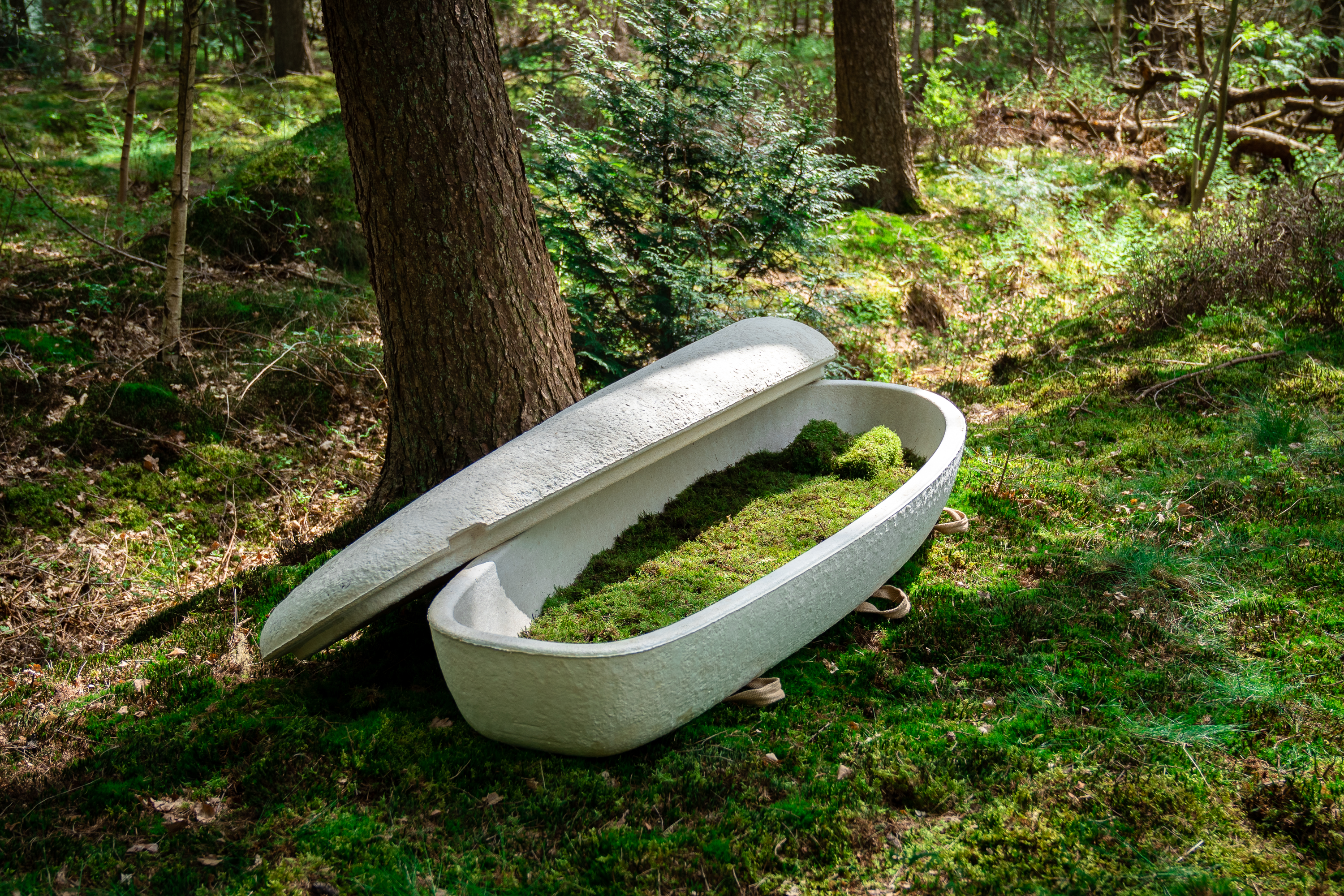
The Loop coffin also serves as a conduit for multifaceted ecological enlightenment (Pillar 4). Firstly, it imparts awareness regarding the remarkable capability of fungi to thrive on organic matter and adapt it into a solid material structure. Secondly, the coffin accentuates the inherent composting ability of fungi, thereby stressing the importance of nutrient cycles within the natural ecosystem and the vital role fungi play in facilitating such processes. The designer’s provocative and humorous motto, “Are you waste or compost?” serves as a potent agent in challenging human-centered notions of our bodies as sacred in death (Pillar 3) and elicits further awareness and curiosity about such natural processes in society (Pillar 4). The sociocultural context of funerals serves as a valuable platform for amplifying the intended message conveyed by the designer, offering substantial opportunities to surpass conventional perspectives on sustainability (Pillar 5). During an informal interview conducted with Bob Hendrikx, we obtained crucial insights regarding the dilemma faced by the designer in addressing the limited shelf-life of the coffin, attributed to its open design that render it susceptible to contamination and the subsequent emergence of mould blemishes. Hendrikx has observed that such manifestations of living aesthetics are explicitly disfavoured by clients, primarily due to the prevailing perception of uncleanliness and repulsion. To confront this prevailing societal stigma associated with mould, the designer is encouraged to expound upon the concept of living aesthetics and envision a coffin design that actively embraces such emergent occurrences, thereby facilitating a transformative shift towards ecological aesthetics (Pillar 5).
Roya Aghighi’s Biogarmentry (Aghighi, Reference Aghighi2019) (Figure 3) represents a conceptual garment that amalgamates textiles derived from natural fibres with living photosynthetic microalgae cells. The designer envisions a lab-grown garment that is entirely composed of natural materials and possesses complete compostability, while facilitating the removal of deleterious airborne toxins in its use time (Pillar 1). This endeavour is driven by the aim to mitigate the detrimental impact caused by the textile industry, in particular fast fashion. Notably, the garment necessitates a distinct set of care practices, exemplified by the act of gently spraying water onto the textile. This act serves the dual purpose of sustaining the vitality of the embedded microorganisms for maintaining its air purification function, as well as cultivating understanding of microalgae needs and aligning with its living aesthetics (such as colour change) (Pillar 3). While purposefully developed textile tags provide guidance to end-users regarding the perpetuation of its livingness (Figure 4), the organismsʼ responsiveness to external factors present within an ecosystem, including sunlight and humidity, have the potential to stimulate the emergence of creative configurations, assemblages, and social practices in everyday life (Pillar 3). For example, one might opt to accompany the living garment during a nice outdoor stroll on a sunny day, while some may leave the living garment in their bathroom periodically to maintain a suitable level of humidity. These practices, which are likely to change and evolve in alignment with the dynamic changes in the living garment, aim to establish an optimal shared habitat quality between microalgae and humans, facilitating their coexistence and mutual well-being (Pillar 3).
Biogarmentry (2019) by Roya Aghighi, is a living garment that combines natural fibre-based textile and living photosynthetic microalgae cells. (Image credits: Roya Aghighi).

Living textile tags developed by Roya Aghighi to instruct the novel care practice. (Image credits: Roya Aghighi).

This active engagement with the living textile can elicit curiosity and increased understanding of the natural processes behind photosynthesis (Pillar 4). Aghighi’s visionary approach entails a paradigm shift in human actions associated with the conventional textile care instructions typically observed in relation to textiles and garments (Pillar 5). While implying reduced water consumption for cleansing, Biogarmentry boldly challenges preconceived and deeply entrenched notions of cleanliness in a context which is both personal and public – garments worn on the body – thereby instigating the possibility of a cultural change in society (Pillar 5). Although not overtly expressed by the designer, it is worth noting that Biogarmentry inherently holds the potential to enrich soil fertility when composted, in reason of its composition rich in highly nutritious algae (Pillar 2). This characteristic presents a promising avenue for end-of-use, which warrants further exploration within the realm of regenerative ecologies.
Reflections
This article delves into the potential of living artefacts for regenerative ecologies, and it outlines five pillars to guide practical implementation in biodesign.
In expounding on these pillars, our aim is not to impose the obligation for every biodesigner to integrate all five pillars into their designs. We recognize the inherent value of each individual pillar for the advancement of regenerative ecologies. Hence, we encourage designers to persist in their work centred around a particular pillar that resonates most with them. Simultaneously, we extend an invitation to designers to engage in a thorough critical assessment of their design outcomes from the vantage point of all five pillars. This proactive approach serves to identify opportunities for further amplification of the potential of living artefact designs within the realm of regenerative ecologies. We are aware that this journey is not straightforward. Nonetheless, with these pillars we aspire to provide an initial framework to delineate the design space available to biodesigners of living artefacts.
Next, we will briefly address specific design issues across the five pillars that illuminate what the designers of living artefacts might have to let go of, and what they may have to embrace, to foster regenerative ecologies.
Troubling boundaries between humans, technologies, and the natural world
As design seeks more holistic approaches “to address the expanding universe of algorithms, forms of intelligence, and forms of life that are entering design practice” (Giaccardi and Redström, Reference Giaccardi and Redström2020), concepts such as hybrid living materials (Smith et al., Reference Smith2020), engineered (Nguyen et al., Reference Nguyen, Courchesne, Duraj-Thatte, Praveschotinunt and Joshi2018) and programmable living materials (Gilbert and Ellis, Reference Gilbert and Ellis2019), living technology (Bedau et al., Reference Bedau, McCaskill, Packard and Rasmussen2010), living bits (Pataranutaporn et al., Reference Pataranutaporn, Vujic, Kong, Maes and Sra2020), and living media interfaces exemplify the vast potential of a hybrid world where the boundaries between biological, chemical, and algorithmic materials dissolve in biodesign outcomes (Merritt et al., Reference Merritt, Hamidi, Alistar and DeMenezes2020). Within these intricate entanglements, digital technologies have the capacity to play crucial roles in the design of living artefacts (Zhou et al., Reference Zhou, Barati, Giaccardi and Karana2022). This spans across all five pillars outlined, such as surfacing livingness for timely care and fostering empathy (Pillar 3) or comprehending the communal habitat conditions essential for cohabitation of multiple species (Pillar 2). Concurrently, designers must be mindful of avoiding an overreliance on technology in every facet of the interaction between humans and non-humans. The paramount objective in designing living artefacts should be the development of a comprehensive and interconnected system that fosters regenerative ecologies. This system should express a deep understanding of and care for the living organisms involved and the broader ecologies they inhabit. By transcending a narrow focus on technology (Webber et al., Reference Webber, Kelly, Wadley and Smith2023), we may avoid outcomes that reinforce and perpetuate the binary and hierarchical perception of humans and nature as discrete and disconnected elements.
Attuning to biological rhythms and ecological scales
The intrinsic capacity of living organisms to regenerate, renew, or restore themselves has been harnessed within living artefacts predominantly to support specific functionalities or use scenarios. This failure to fully integrate or open to the regenerative potential of living artefacts has limited the diversity of usage scenarios and so-called “end-of-life” contexts possible. Designers aiming at developing living artefacts should not perceive their responsibility as simply fashioning objects that employ living organisms for defined times and ecologies, but rather as designing for the regenerative capacity of the artefact itself. They should learn to reconcile their expectations with the different biological rhythms and ecological scales that living artefacts can afford. This honest and open approach to biodesign transcends the limits of human time and scale, and it embraces the design of a living artefact as an ongoing process without a definitive design, use, or end-of-life time. By prioritizing the regenerative capacity of living artefacts, the idea of designing artefacts for humans to use (up) for a particular purpose is superseded in favour of a renewed and collaborative design capacity that challenges agency as solely and exclusively human.
Navigating the dilemmas of open versus closed systems
When the regenerative capacity of living organisms is only harnessed for isolated functionalities or limited lifespans, there exists a disregard for the agency of organisms and their emergent qualities, favouring instead a focus on control, precision, and predictability of outcomes. Such closed systems fail to foster creative interactions among human and non-human living entities, hinder the cultivation of coevolution and novel ecological aesthetics, and impede the promotion of biodiversity. It is imperative, therefore, to critically evaluate the contexts in which precision and predictability in design outcomes are required, and to identify instances where a living artefact can be conceived as an open system, or as capable of being opened at various stages of its lifespan. The concept of “open systems” within the realm of living artefacts comprises two distinct facets. Firstly, it denotes the capacity of the artefact to facilitate creative assemblages of various living and non-living elements within an ecosystem. Secondly, it pertains to the physical embodiment of the artefact’s habitat, characterized by its literal openness, for example, through the inclusion of components that can be opened, facilitating the unimpeded flow of energy and nutrients not only within the artefact itself but also across multiple species, fostering interactions that extend beyond human-non-human relations.
When adopting open approaches in the design of living artefacts, it becomes crucial to embrace the fundamental qualities that are inherently present within living systems: the ability to undergo change, to exhibit emergence, and to undergo evolutionary processes. Nature, with its dynamic and fluid characteristics, seldom adheres to fixed, flawless, or rigid states. Therefore, fostering perspectives that respond to this dynamic understanding of the ecosystems with which we coexist becomes indispensable for the development of artefacts that evolve in tandem with us. As aptly posited by Wahl (Reference Wahl2016): “If we stop wanting to control change and shift to a responsive dance with change, we will become more effective change agents capable of facilitating positive emergence.”
Impact statement
In response to the mounting ecological concerns arising from the detrimental impacts of conventional design practices, there is an urgent imperative to embrace innovative approaches that fundamentally challenge our conventional notions of time, scale, aesthetics, and use in design. Living artefacts offer a promising avenue for transcending these prevailing human-centric perspectives, thereby unlocking unprecedented opportunities for regenerative ecologies characterized by creativity, mutualism, and coevolution. This article aims to provide the readership of Research Directions: Biotechnology Design with a comprehensive design space that delves deeper into this untapped potential of living artefacts for regenerative futures.
Acknowledgments
A special thanks to the members of Materials Experience Lab, with a special mention of Jiho Kim, Ward Groutars, Barbara Pollini, Raphael Kim, Joana Martins, Jiwei Zhou, Wasabii Ng, and Clarice Risseeuw, for their valuable contribution in the form of inspirational discussions and feedback at critical stages of the development of this work.
Financial support
This work was partly supported by the NextSkins project, funded by the European Union’s Horizon Europe research and innovation programme under grant agreement number 101071159.
Competing interests
The authors have no conflicts of interest to declare for this publication.


 Open access




Comments
The paper is a position piece which sets out “Five Pillars” for considering the feld of biodesign and specifically “living artefacts” in the context of discussions on sustainability. The authors suggest that the change in perspectives necessitated with working with living organisms as a medium in design offers the potential for designers to move beyond superficial techno-economic models of sustainable design, towards design practices in which complexity, mutuality and interconnectedness of humans and ecosystems can be explored for mutual benefit of humans and non-humans.
Overall I found the paper interesting and valuable. I especially welcome the fairly extensive biography - which I think is a valuable contribution it itself and it fills a gap in the literature - bridging biodesign with sustainability studies and making connections to key contemporary theories.
On impression from the text was that the ‘Five Pillars’ and frameworks described are that these principles naturally spring from biodesign as a practice. However, I wonder whether the living artefacts we see from biodesign practice (as exemplified in the Myers book for example) are actually antithetical to the approaches proposed in this paper. Biodesign often explicitly technologies nature - defining natural systems in relation to specific function and human needs. Many (most) of the biodesign projects I am familiar with use single species - taking organisms outside their natural ecosystems and encouraging them to grow and produce in isolation. To this end if the framework also a critique ands f so can this critique be made more explicit?
On a related note I the article would benefit from more examples. The three case studies mentioned (Daylight Log, Loop and Biogarmentry) are illustrative but I would have liked to see more concrete examples - either to show how the Pillars are practiced or as critique for projects which do not (or both). I can see a valuable section in which a table of canonical biodesign projects are classified by their relationship to the five pillars - indicating how these ideas can be practically implemented.
The authors should be mindful that BD is a multidisciplinary journal. The paper might well get read by biotechnology scientists with little prior knowledge of biodesign. An edit should be conducted, therefore, to make sure that terms are clearly introduced and defined as precisely as possible. For example, the term living artefacts is not for me, properly defined. Prior work is referenced but the only definition I could find in the paper is in the abstract:
“living artefacts encompasses biodesign outcomes that uphold the livingness of organisms such as fungi, algae, bacteria, and plants, to enable the emergence of novel functions, interactions and expressions within everyday life.”
What does “upholding the livingness” mean for example? Can you use concrete language and specific examples.
This slight vague language is also present in other parts of the paper and a clarity edit would be welcome, for example:
“and embrace the dynamic nature of living artefacts as more than indicators of well-being, the development of new sensitivities extending beyond the human realm.” (2)
Not sure what is meant by ‘dynamic nature’ being an indicator of “well-being” or what are meant by “new sensitivities”.
These two approaches frequently focus on the urban scale (as also observed in other regenerative initiatives in recent decades), while overlooking the importance of fostering a relationship between human activities and ecosystems, as humans are only passively involved in these scenarios. (10)
Not sure what is meant by humans being passively involved or what ‘scenarios’ are being referred to?
“In this regard, there appears to be a notable scarcity of discourse regarding the role of human-scale artifacts for regenerative ecologies.”
What do you mean by human scale? Can you be more precise - building would be considered as scaled to humans.
Structurally (for clarity) I would like to see a clearer introduction which sets out the rest of the paper. “In this paper we will�” and makes explicit reference to the development of the Five Pillars. The sections with the pillars could be titled Pillar 1:�. Etc. And the conclusion could more to summarise and discuss the paper. It feels like the end of the paper opens up new questions and tips - width discussion of ‘algorithms’ etc. which introduce new concepts at a rather late stage.