


Introduction
Some of the board games played in the past are mentioned in ancient texts and depicted in art, and numerous boards and the playing pieces and dice used to play them have been found in excavations. Roman games are some of the best documented (Schädler Reference Schädler1994, Reference Schädler1998; Pace et al. Reference Pace, Penn and Schädler2024), but we cannot assume that the full spectrum of games played by the Romans have been identified (Crist et al. Reference Crist, Piette, Soemers, Stephenson, Browne, Pace, Penn and Schädler2024a). While certain games were popular within particular cultures, or on a regional or global scale, ethnographic studies show that locally specific games oftentimes were not made into recognisable game objects. Played on boards drawn on the ground and with objects such as stones, sticks, shells or even dried animal droppings (Crist Reference Crist2023: 22), such games are invisible to archaeologists. Occasionally boards are made for these games but recognising them in the archaeological record without corroborating evidence remains difficult.
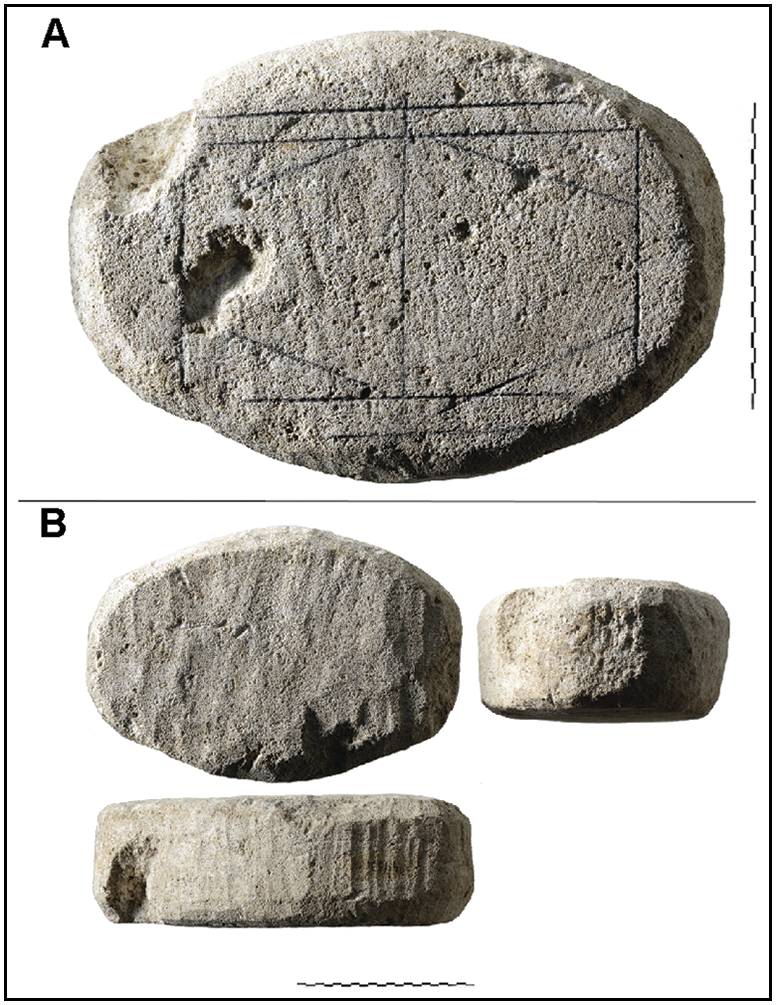
Such is the case presented by a stone object in the collection of Het Romeins Museum in Heerlen, the Netherlands (Figure 1), which has been interpreted as a game board from the Roman settlement Coriovallum (Rieche Reference Rieche1984). The object bears an incised geometric pattern on its top surface that has not previously been identified on other artefacts. To examine whether the object may have been used as a game board, we performed use-wear analysis to identify evidence for gameplay and we simulated play using artificial intelligence (AI) on candidate rulesets to determine whether we could reproduce the wear patterns. We conclude that the object was most likely used as a game board, though other interpretations cannot be entirely ruled out.
Object 04433 in Het Romeins Museum, Heerlen, the Netherlands: A) top surface, before cleaning, with pencil marks outlining the incised lines; B) the bottom and sides of the object show intentional shaping. Each scale is 100mm (photographs courtesy of Restaura).

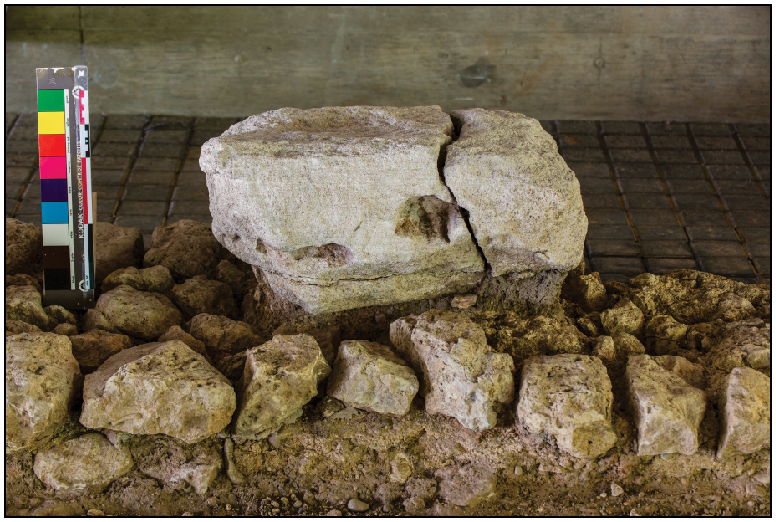
Kunrader limestone blocks forming the foundation of the porticus of the Roman baths of Coriovallum. The rough-hewn blocks are from a local quarry. A Norroy limestone pillar base rests atop them (photograph courtesy of Het Romeins Museum).

Coriovallum
Coriovallum was a Roman town in the province of Germania Inferior founded under the reign of emperor Augustus (27 BC–AD 14) and inhabited until the fall of the Western Roman Empire in AD 476. The remains of Coriovallum lie beneath present-day Heerlen (van Giffen Reference Van Giffen1948). It is one of only a few Roman towns in the Netherlands mentioned in ancient sources, such as the Tabula Peutingeriana and the Itinerarium Antonini Roman road maps. Its strategic location, connected to two main arteries of the Roman road system, ensured economic prosperity, reflected in monumental architecture and rich burial assemblages, especially in the second century AD. The town became an important centre for the production of Roman-style pottery from the mid-first to the third century AD and, at its peak, covered just over 48ha, with burial grounds along each of the four main roads out of town stretching for nearly 1km.
The object
Het Romeins Museum object 04433 is a worked piece of white Jurassic limestone (212 × 145 × 71mm, 3.38kg) from the quarries at Norroy in north-eastern France. The museum archives state that it was found in Heerlen but little else is known about its provenance (see online supplementary material (OSM) for more information). Norroy limestone was a popular choice for large architectural elements in the Roman northern provinces because of its white colour, smooth surface and relative softness, making it an easily sculpted substitute for marble (Dreesen et al. Reference Dreesen2014; Dreesen Reference Dreesen, Jeneson and Vos2020). Decorative architectural elements made of Norroy limestone have been found in abundance at Coriovallum in the form of pillars, inscriptions and funerary monuments, and it was typically used for large architectural elements in the northern provinces. In light of this, object 04433 stands out due to its small size.
While it resembles a brick, roughly hewn Kunrader limestone from a quarry less than 5km away was the preferred material for bricks, which were used to build foundations and walls at Coriovallum. Foundation stones were roughhewn, while those in a wall’s façade were smooth on the visible side (Figure 2 & S1). Object 04433 shows evidence of working on all sides, however. Given its shape, size and the type of stone, it is unlikely to have been a brick. Rather, the careful working of the sides and the incised lines indicate that it was purposefully made to display the lines on the top surface (Figure S2).
During the late Roman period (c. AD 250–476), Coriovallum underwent a transformation as part of the town centre was turned into a fortified settlement (Jeneson et al. Reference Jeneson, Vos, White, Jeneson and Vos2020). Reshaped architectural stone (spolia) characterises this period making it likely that this object is a repurposed piece of ornamental Norroy limestone reshaped and incised by someone during the late Roman period.
Possible interpretations
While a gaming function has been suggested for the object (Rieche Reference Rieche1984), the incised pattern is thus far unique and other possibilities must be considered. Architectural drawings have been documented on a pavement at Baalbek (Lohmann Reference Lohmann, Kurrer, Lorenz and Wetzk2009) and on the Forma Urbis Romae (a marble map of ancient Rome) (Meneghini & Santangeli Valengazni Reference Meneghini and Santangeli Valenzani2006), but these are on a much larger scale and the incised lines on the object are not recognisable as an architectural plan. Norroy limestone was typically used for large decorative elements, rather than pavements (Cocquelet et al. Reference Cocquelet, Creemers, Dreesen and Goemaere2013; Dreesen et al. Reference Dreesen2014; Ruppiené & Schüssler Reference Ruppiené, Schüssler, Poljak and Marasović2018), and the elliptical shape and bevelled edge of the object argue against an identification as a part of a pavement with an architectural drawing—the lines on the surface would not connect to the surface of a neighbouring stone. Similarly, the “well-mastered, millimeter-precise Euklidian geometrical constructions” used as guidelines to cut stone (Capelle Reference Capelle, Sapirstein and Scahill2020: 71) are not evident in the imprecisely drawn pattern. Furthermore, etched guide-marks used in stonemasonry that appear on surfaces of architectural features are not meant to be visible (Ottati & Vinci Reference Ottati and Vinci2019). This stone only has these lines on the surface, which was intentionally smoothed, and thus seemingly intended to be visible. While Norroy limestone was used occasionally as a decorative opus sectile incrustation (a mosaic technique using shaped tiles; Ruppiené & Schüssler Reference Ruppiené, Schüssler, Poljak and Marasović2018), the opus sectile workshop found at Caesarea Maritima and the depiction of opus sectile production found at the Baths of Diocletian indicate that these tiles were typically shaped after the quarried stone was cut into thin plaques (Snyder Reference Snyder2018). The object is thus too thick to have been marked for cutting into opus sectile tiles. As function cannot be identified from the shape and incised pattern, we examined the use wear on the object for further insights.
Materials and methods
Use wear
Use-wear analysis identifies damage to the surface of objects that is produced through mechanical action when a surface comes into contact with another object, for example through pounding, grinding or cutting, helping to determine function—for example in ground and chipped stone tools (Adams et al. Reference Adams, Delgado, Dubreuil, Hamon, Plisson, Risch, Eigeland and Costa2009; Adams Reference Adams2014; Dubreuil & Savage Reference Dubreuil and Savage2014; Dubreuil et al. Reference Dubreuil, Hayden, Bofill and Robitaille2023). Depending on materials and type of use, damage can be seen with the naked eye or microscopically. The presence of use wear created through gameplay has been posited but not systematically explored (Piccione Reference Piccione1990; Crist Reference Crist, Chovanec and Crist2021).
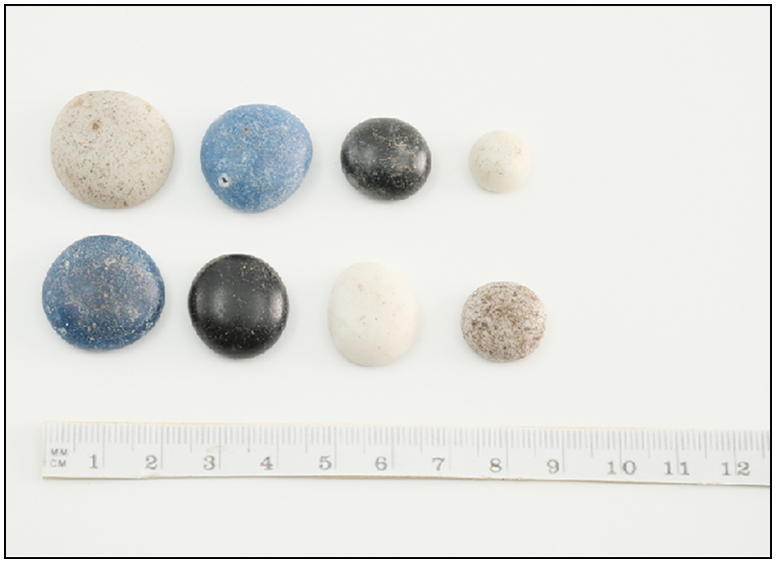
Roman-era game pieces, several of which have been found at Coriovallum (Figure 3), typically take the form of glass or stone, dome- or disc-shaped counters (Hall & Forsyth Reference Hall and Forsyth2011). Given their shape, the most ergonomic way of moving them during gameplay is to push them along the lines of the board, rather than picking them up and placing them as one would with taller, pawn-like pieces. Such movement produces abrasion, particularly using hard glass or stone pieces on soft limestone.
Glass game pieces from Coriovallum. Het Romeins Museum object numbers, clockwise from top left: 00474, 24132, 26016, 26015, 08097, 26014, 00471, 24134 (photograph courtesy of Het Romeins Museum).

The portions of the object surface expected to have experienced piece movement are defined as areas less than 20mm—the maximum diameter of the Roman-era pieces found at Coriovallum—from any of the incised lines. Portions of the surface greater than 20mm from the lines are thus not expected to show use wear if movement of the game pieces was restricted to the lines.
Implementation
Ludii is a general game system developed as part of the Digital Ludeme Project that allows for the implementation and analysis of rules for board games of many types, and is particularly well-suited for archaeological research (Piette et al. Reference Piette, Soemers, Stephenson, Sironi, Winands, Browne and Giacomo2020; Crist et al. Reference Crist, Piette, Soemers, Stephenson, Browne, Pace, Penn and Schädler2024a). This software allows for AI-driven playout simulation, where two AI agents play a game against one another, which can generate quantitative data on gameplay. In this instance, we explored whether the rules of a game would produce the wear pattern seen on the stone. Rules for games played in Europe that use comparable boards were taken from the Ludii games database (Crist et al. Reference Crist, Stephenson and Browne2022, 2024), the largest comprehensive database of traditional board game rules currently available. We searched the database for games that were on boards with twenty or fewer playing sites (i.e. the places where the pieces are placed during play) using Ludii’s ‘concepts’ (high-level aspects of games computed during the compilation process in Ludii; Piette et al. Reference Piette, Stephenson, Soemers and Browne2021). Searching the database for games with the concept 2.1.4 Num Playable Sites (2.Equipment–>1.Board–>4. Num Playable Sites) and the value ≤ 20 and filtering these results to only include games documented from Europe, essentially produced two types of relevant games: those in which the goal is to block the opponent from moving, and those in which the goal is to place three pieces in a row. Due to the rarity of the blocking-game type in European contexts, we also included those played on larger boards.
Blocking games include haretavl and similar games from Scandinavia and the Baltic region (Michaelsen Reference Michaelsen and Tweichert2014), gioco dell’orso from Italy (Depaulis & Gavazzi Reference Depaulis and Gavazzi1999), la liebre perseguida from Spain (Santos Hernandez Reference Santos Hernandez1901–1904) and to kinégi tou lagoú from Greece (Argyriadi Reference Argyriadi1997). Though the geometries of the boards differ (Figure S3), their rules are similar: one player has more pieces than the other; the player with more pieces wins by blocking their opponent. A winning condition for the opponent is not always specified; but gioco dell’orso is played in rounds, where the players switch roles and the goal is to last the longest before being blocked. In jänes soppi from Estonia, players have an equal number of pieces and attempt to block each other. Alignment games have been played since at least the Roman era and are found worldwide (Murray Reference Murray1951; Hanel Reference Hanel1997; Berger Reference Berger2004). Players each have three pieces, which they place on the board in alternating turns. Once the pieces are placed, players move their pieces. The first to place three pieces in a row wins.
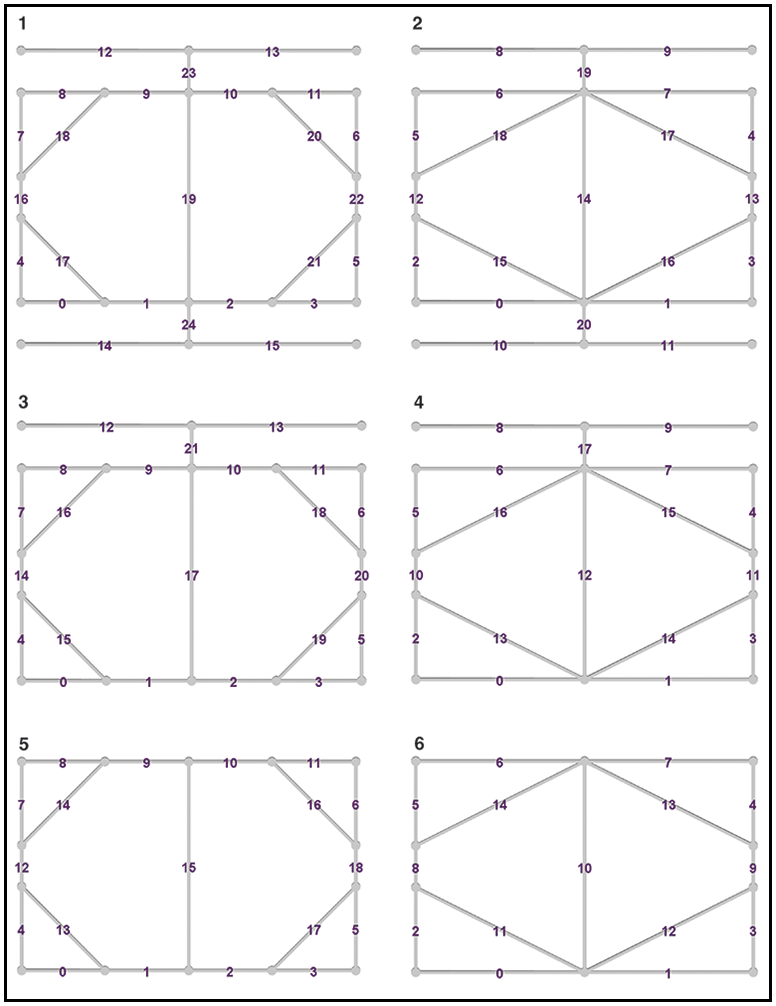
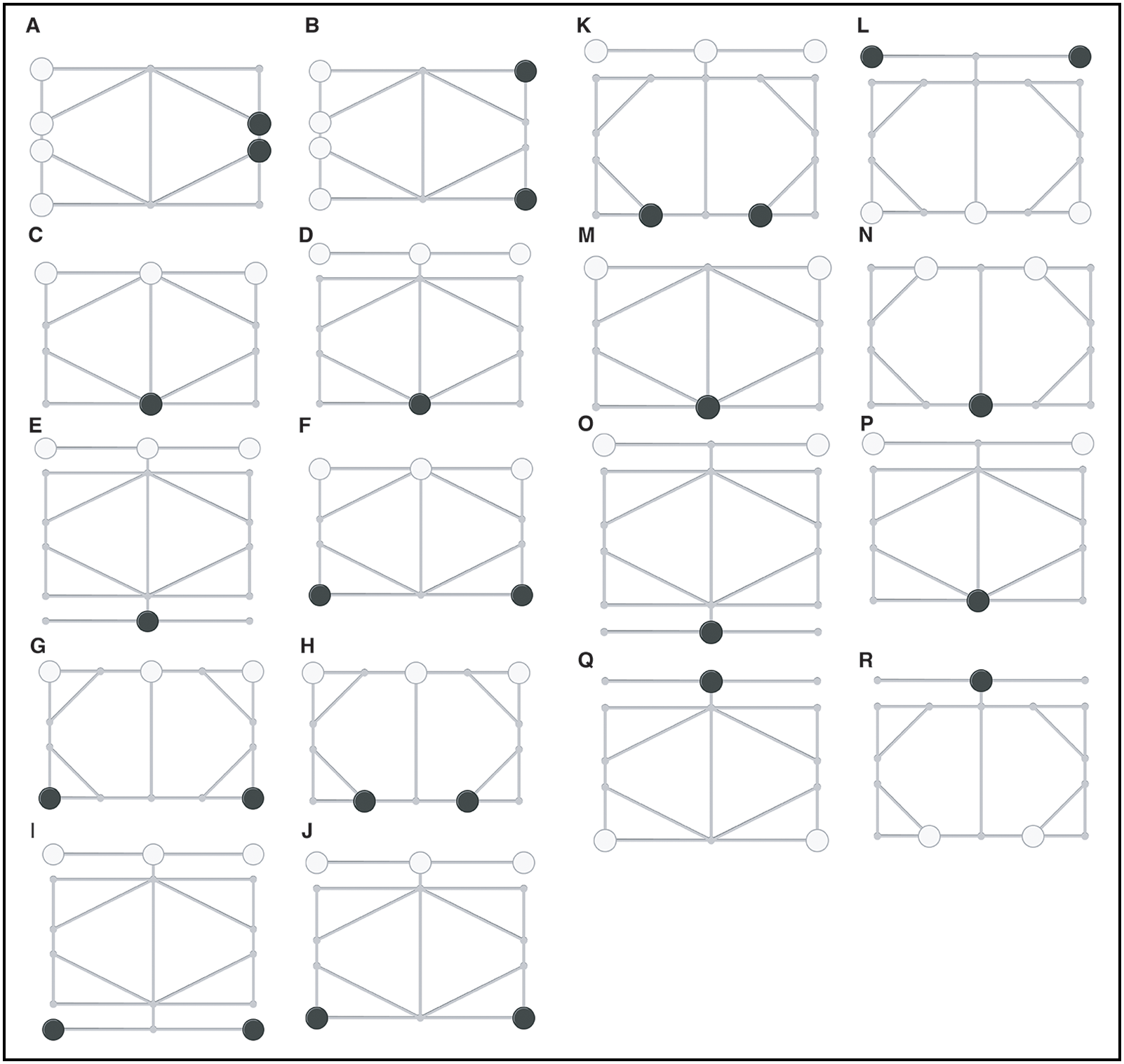
The object itself presents challenges to the interpretation of the intended geometric pattern as the lines present six different possible arrangements or ‘boards’ (Figure 4). Like many boards from archaeological contexts, the lines on the object are imprecisely drawn (Sebbane Reference Sebbane, Weksler-Bdolah and Onn2019); we explored potential rulesets by combining different rules for starting positions, legal moves and game-ending conditions. This resulted in 130 possible game configurations, with 112 based on variations of haretavl resulting from the many different consequential options. For rulesets where the piece count differs from the standard three-versus-one, the number of pieces (dogs and hares) is specified. Default starting positions place pieces off the board, but some rulesets begin with pieces symmetrically placed on the board (Figure 5). We tested configurations using combinations such as three-versus-one, three-versus-two, two-versus-one and four-versus-two, and we varied the number of pieces in ways that were sensible for the symmetry and size of the board. Additionally, in ‘switch’ rulesets, the player who plays first (dogs or hares) is swapped, accounting for the gameplay impact of whether the player with fewer pieces moves first or second.
Possible board geometries based on the lines seen on the surface of the stone. The numbers indicate the index of each line used to track their use during AI simulations (figure by authors).

Starting positions for haretavl rulesets considered for AI-driven simulations. Not every permutation of starting position and board is shown, only those where a difference in the board geometry changes the placement of the pieces. A and B) applied to all six boards; C) applied to boards 5 and 6; D) applied to boards 3 and 4; E) applied to boards 1 and 2; F) applied to board 5; G and H) applied to board 6; I) applied to boards 1 and 2; J) applied to boards 3 and 4; K) applied to board 3; L) applied to boards 3 and 4; M) applied to boards 5 and 6; N) applied to board 5; O) applied to boards 1 and 2; P) applied to boards 3 and 4; Q) applied to boards 3 and 4; R) applied to board 3 (figure by authors).

AI-driven simulations
Each player can be simulated using different AI techniques implemented in Ludii. Standard baseline algorithms for automated (board) game playing include Alpha-Beta (AB) (Knuth & Moore Reference Knuth and Moore1975) and Upper Confidence Bounds applied to Trees (UCT) (Kocsis & Szepesvári Reference Kocsis, Szepesvári, Fürnkranz, Scheffer and Spiliopoulou2006). We focused on using AB because this type of algorithm tends to perform better and is less prone to making unrealistic blunders (Baier & Winands Reference Baier and Winands2015) in the relatively small and simple games that fit the board configurations and rulesets considered here.
Once a game is parsed in Ludii, it is compiled into an immutable Java object that stores static data, including the game’s rules and board topology (Browne et al. Reference Browne, Soemers, Piette, Stephenson and Crist2020). This structure ensures consistent and reliable playthroughs for AI players (Browne et al. Reference Browne, Piette, Stephenson, Soemers, Browne, Kishimoto and Schaeffer2022). Ludii’s forward model functions to efficiently generate all legal moves, providing a foundation for optimised AI simulations (Piette et al. Reference Piette, Soemers, Stephenson, Sironi, Winands, Browne and Giacomo2020; Soemers et al. Reference Soemers, Piette, Stephenson, Browne, Browne, Kishimoto and Schaeffer2022). The AI agents in this study used these forward models and playouts to conduct AI-driven simulations, employing AB-based agents, running 1000 rounds for each combination of board and ruleset, with one second of processing time per move.
Results
Use wear
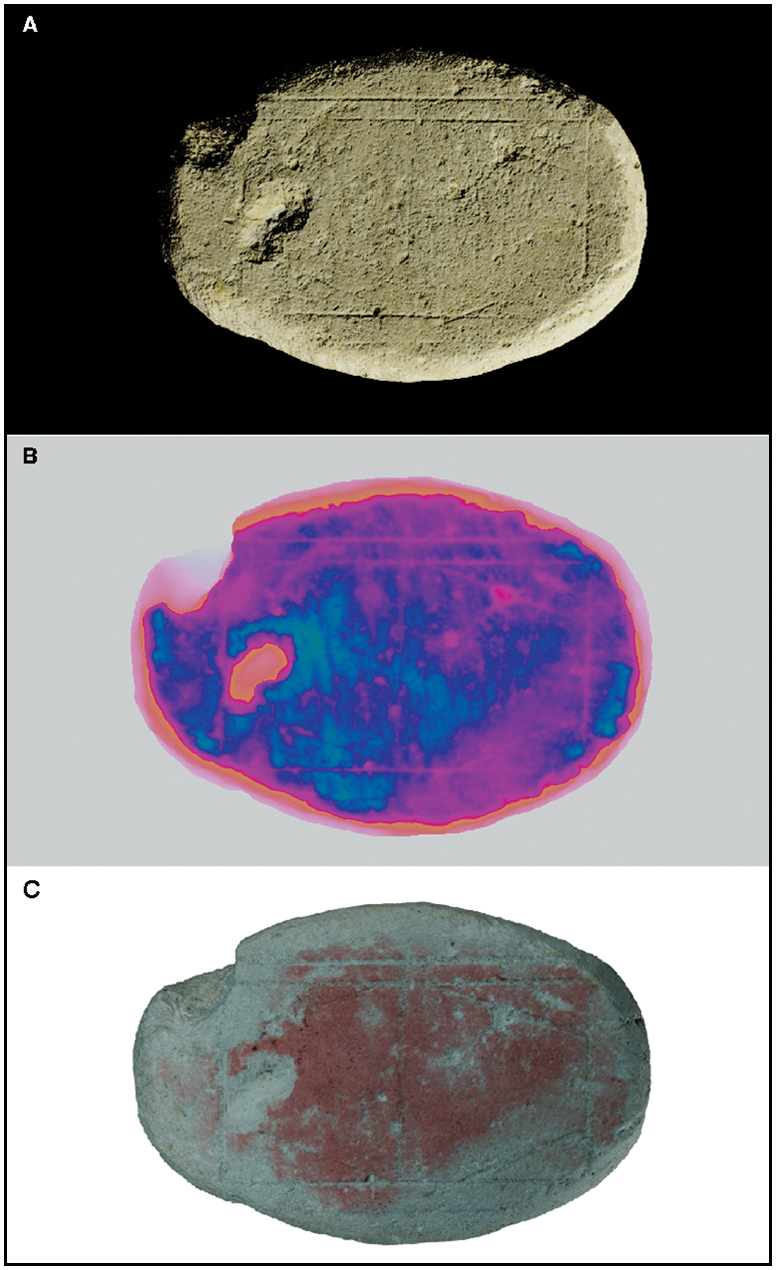
All surfaces of the object bear obvious traces of processes used in its manufacture, particularly around the edges where the shaping of the stone into an ellipse with slight bevelling is clear. The upper surface is worked to be smoother than the others. A homogeneous zone that is visibly smoother than the surrounding surface is apparent along one of the diagonal incised lines; the medial edge of the zone runs parallel to the line and varies between 16mm and 18mm from it, the lateral edge is not apparent. A depth map of the object, generated through photogrammetry in combination with the photometric stereo technique (Figure 6) indicates that the topography of the upper surface is generally lowered around the lines, revealing other homogeneous zones that are not visible with the naked eye.
Digital model of object 04433, created using photogrammetry and photometric stereo technique shown with raking light (A) to emphasise surface topography and also showing the lines without pencil marks, and (B) as a visualisation of the depth map, demonstrating lower surfaces (pink) along the lines on the object. The surface of the stone can be seen to be generally rough, but along the bottom right diagonal the surface is noticeably smooth. C) Depth map superimposed on real-colour image of the stone. Reddish tones indicate higher surface topography (models by Luk van Goor; figure by authors).

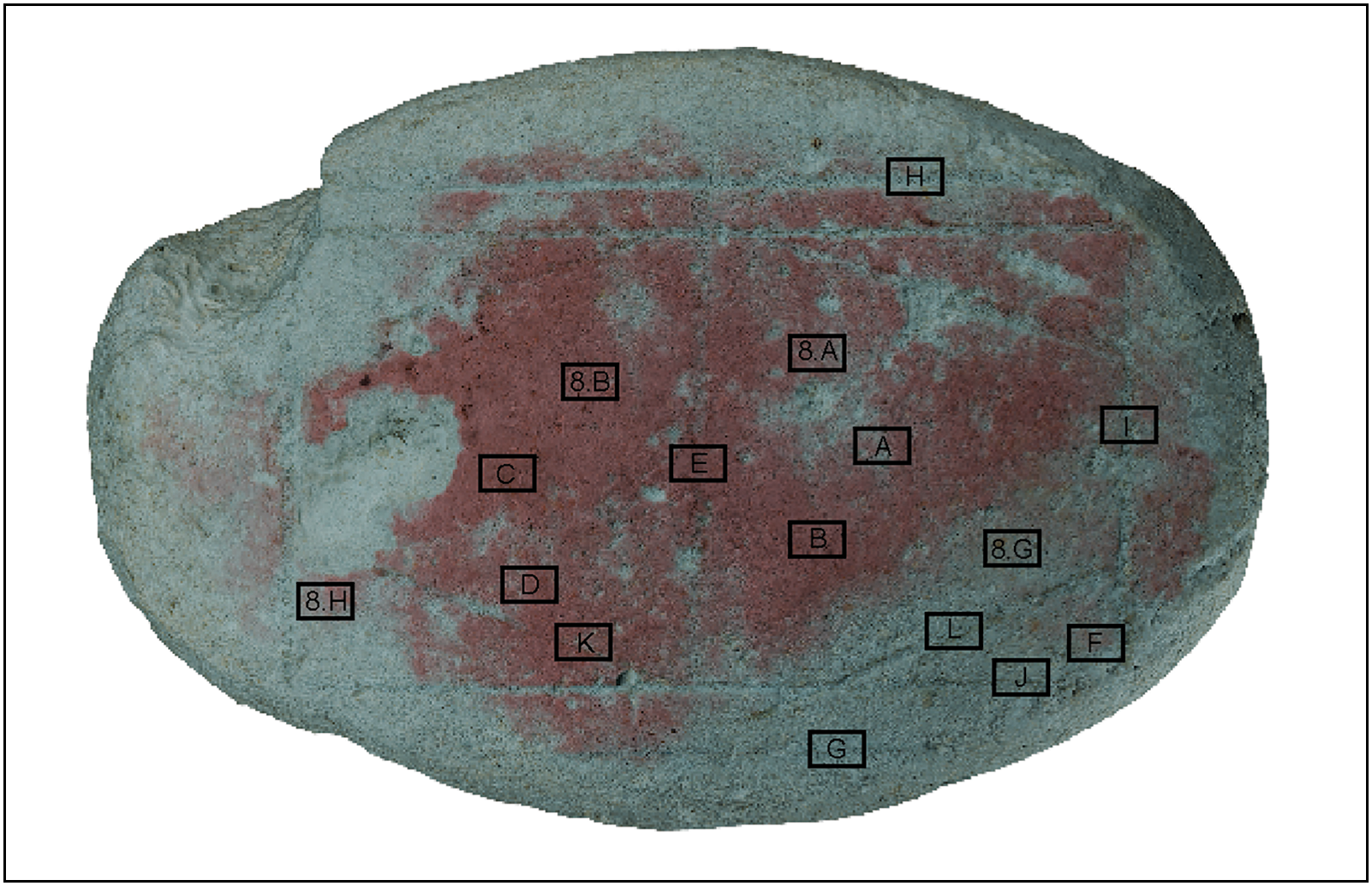
Approximate locations of microtopography images. Locations 8.A, B, G and H are shown in Figure 8; A–L are shown in Figure S4 (model by Luk van Goor).

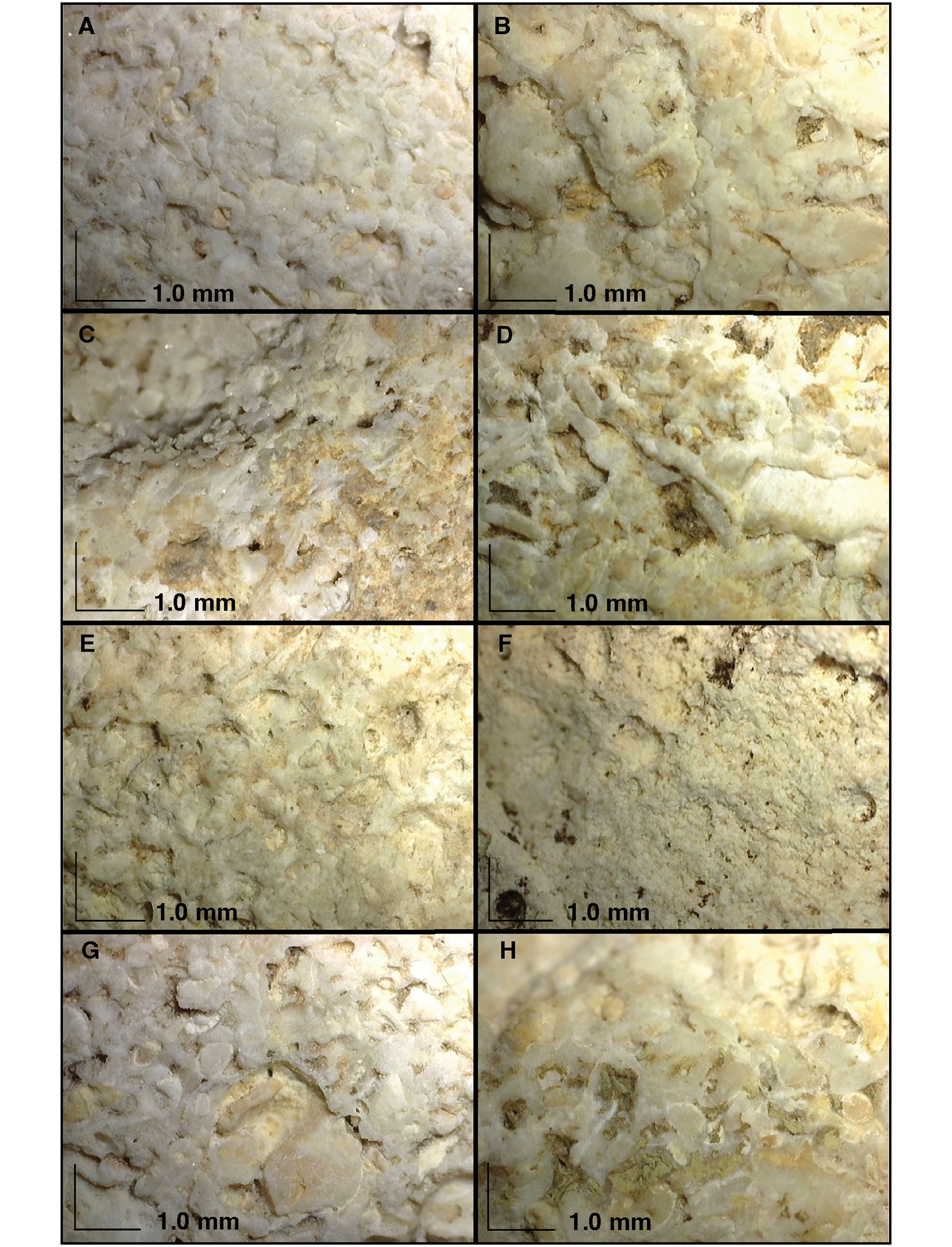
Microscopic examination shows that, outside of these homogeneous zones, the upper surface of the object has a comparable microtopography to the lower surface (Figure 7, Figure 8 & S4, see also Table S1). The surface is uneven, with rounded grains. Similar microtopography is seen on a Roman-era inscription made from Norroy limestone (Het Romeins Museum object 03803) (Figures 8E & S5). This differs from the microtopography of a freshly broken piece of Norroy limestone, where the grains are more indistinguishable (Figure 8F). The microtopography of the rock grains is levelled and smooth without micropolish or striations in the homogeneous zone along the diagonal and, to a lesser degree, in the homogeneous zones identified in the depth map. This wear pattern is consistent with abrasive action applied by an object of greater hardness.
Microtopography of object 04433. Some surfaces are unabraded: A) location 8.A; B) location 8.B; C) vertical edge of the stone; D) underside of the stone. Other surfaces show levelling consistent with abrasion: G) location 8.G; H) location 8.H. Microtopographic images of naturally broken, unworked Norroy limestone (F) and the flattened surface of the inscription of object 03803 (E), also made of Norroy limestone, are provided for comparison (photographs by Walter Crist).

Playouts
Simulated play should account for cognitive bias exhibited by humans when playing board games, often preferring familiar positions or move sequences over symmetrically equivalent alternatives, an effect linked to learned pattern recognition (de Groot Reference de Groot1946; Chase & Simon Reference Chase and Simon1973). Other potential biases could be introduced through the players in the setting and arrangement of the board during play. For example, a right-handed player may be biased toward playing on the right-hand side, thus playing more frequently on the diagonal situated to their right; the orientation of where players sit in relation to the board may also affect this.
All the tested board configurations have some form of symmetry, allowing us to apply transformations to our playouts. These transformations have no effect on game strategy or outcome, but accounting for them can increase the mutual consistency of edge-usage statistics between playouts. This can be beneficial in accounting for potential human biases for specific regions or sides of the board that would not otherwise be reflected in AI-generated play. Playouts for the same board configuration and ruleset were transformed to maximise the similarity between their edge-use statistics, applying a greedy approximation algorithm for the corresponding optimisation problem. The playout results were filtered to include only those configurations where the use value for one of the diagonals was at least twice the mean edge usage. The distribution of the edge use for each remaining configuration was then examined on a case-by-case basis to determine which produced a pattern most reflective of the use wear on the object (Figure S6). Edge-use patterns needed to meet the following criteria: 1) one diagonal must be one of the most-used lines; 2) this diagonal must be positioned to correspond with the diagonal showing use wear on the object; 3) only the diagonal’s adjacent bottom and side edges can be used more than the diagonal itself (as the geometry and size of the object does not allow for differentiation between wear on these three lines); 4) the centre line must not be used more than the mean (as it shows very little use wear); 5) a majority of the board should be used during play (up to one-third of the lines were permitted to be unused); 6) high edge use on the edges adjacent to the corner laterally opposite the diagonal in question is permitted (to account for the microscopic evidence for use seen in this sector).
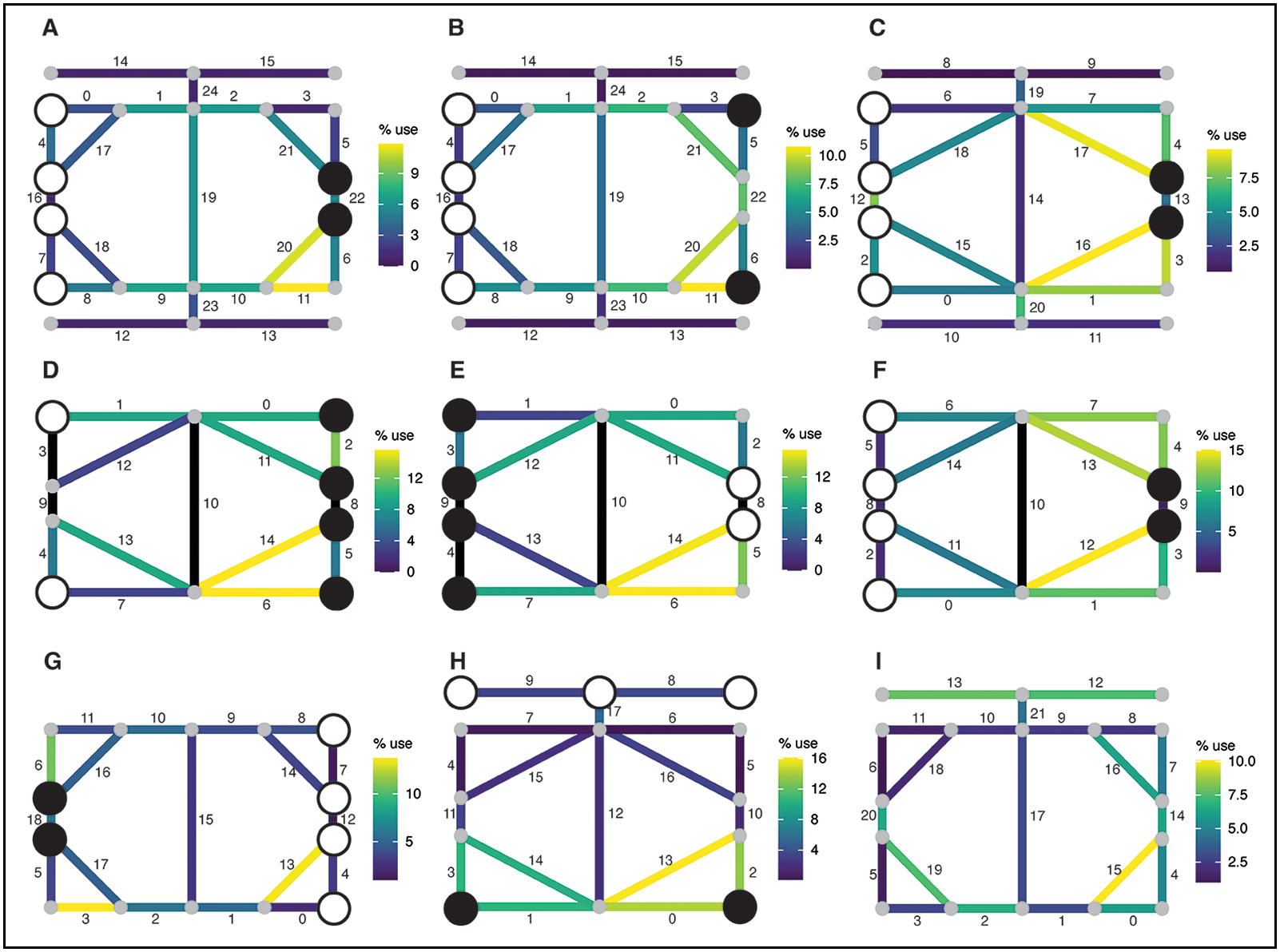
Nine configurations fit these criteria (Figures 9, S7–S15, Tables S2–S7). Transforming the results to account for symmetry identifies one of these results (Figure 9C), while the remaining eight fit the criteria whether transformed or not. All qualifying results are blocking games, and at least one result is identified on each candidate board. Seven of these results are games with four pieces versus two, with pieces starting on the board, the remaining two are three pieces versus two, one of which starts with the pieces off the board. Notably, board 6 produced three of the nine candidates and none of the results for this board had to be manually eliminated (Table S7).
Results of the AI-driven simulation that produced asymmetrical play along the relevant diagonal line. These are games in which the player with more pieces attempts to block the player with fewer pieces. Pieces are illustrated in their starting positions; where no pieces begin on the board they are placed alternately until all are placed. White indicates player one. Boards are shown after transformation with the most-used diagonal on the bottom right (figure by authors).

Discussion
The use wear on the stone was plausibly created through gameplay, moving playing pieces of a size and material composition consistent with examples common at Roman sites, including Coriovallum. While unequal distribution of use wear on grinding stone surfaces can be attributed to kinetics (Nixon-Darcus Reference Nixon-Darcus2025), the fact that the observed wear pattern is only apparent in parallel with the incised lines suggests that those lines were meaningful for the action that produced abraded wear along them. Grinding of foodstuffs, pigments or other materials would not produce this pattern, as these activities do not require the use of lines. Other interpretations cannot be entirely ruled out based on use-wear patterning: masonry guidelines in the process of being erased through smoothing; a tool for manufacturing objects, with guidelines indicating where to place and abrade an object (a thus-far undocumented and purely speculative manufacturing process); or post-depositional factors that could have coincidentally led to wear around the lines.
The proximity of the incised lines to the edge of the stone itself, particularly at the corners or the ends of the lines outside the main square, could argue against its use as a game board; but, when placed on these points, Roman game pieces rest on the surface (Figure S16). This would be further mitigated if the stone were set into another object, such as a table.
Simulations involving a blocking game in which one player starts with four pieces on one vertical side of the main rectangle and attempts to block their opponent’s two pieces, which start on the opposite side, most frequently matched the wear patterns seen on the stone and produced a playable game. This is therefore a likely candidate for the game played on the object (Figures 9A–G, S7–S13), though players could have played many different rulesets on the board. Variations in the four-versus-two game identified in this analysis exhibit rules that can be easily manipulated without changing the basic character of the game: which player moves first, on which playing sites the second player starts, and on which sides the players start. Such alterations could be employed on different instances of gameplay to produce varied experiences for such simple games, while still producing the wear seen on the board. There may also be other games or variations that we have not identified as possibilities that could also produce this result.
Board 6 (Figures 9D–F & S10–S12) could be interpreted as the most likely board, considering the AI results alongside the functional and material reality of the stone. The lines outside the main rectangle may have been mistakes, as seen on other game boards from archaeological contexts (Amitai-Preiss Reference Amitai-Preiss and Hirschfeld1997). Similarly, considering the size of the playing pieces required to produce the observed use wear, it seems likely that the game would have one playing site at the intersection of the central and diagonal lines instead of three. A piece overlapping three sites would lead to confusion and dispute over which site the piece was occupying. Nevertheless, the results cannot eliminate the other boards from consideration.
Uncertainty also stems from the use of AI-simulated play to model human behaviour. Game-playing agents have been developed to approximate optimal play. Humans, however, also play for fun, and are driven by social and physiological pressures outside of the game itself. Despite this, humans are more capable of playing optimally in a game with low complexity and shorter length, such as the small blocking games modelled here, meaning there is likely to be less distance between AI-simulated and human play than would be apparent in larger games.
Blocking games are not described in texts from the Roman era, but other evidence may point to an early history of this type of game that extends to the Roman period. The rulesets used for the simulations were taken from games documented during the nineteenth or twentieth century AD, principally in Scandinavia (Michaelsen Reference Michaelsen and Tweichert2014). References in dictionaries can take the history of this game-type back to the eighteenth century in Denmark. Objects bearing the distinct board for haretavl have been found in fourteenth-century Latvia (Caune Reference Caune and Gläser1993) and early medieval (tenth–eleventh century AD) Dublin (Sperr Reference Sperr2005), in both cases on the same artefact as a board for the game known in English as Nine Men’s Morris (Murray Reference Murray1951). The blocking games jeu des gendarmes et du voleur, giocho dell’orso and to kinégi tou lagoú from France, Italy and Greece, respectively, have geometries that are found in Roman-era graffiti boards in Rome and at Didyma and Aphrodisias in Turkey (Roueché Reference Roueché and Finkel2007; Mosca & Puppo Reference Mosca and Puppo2012). This suggests a longer history of this type of game than is evident in textual sources. Since the rules for traditional games are rarely written down and simple games are often drawn on the ground and played with stones or seeds, rendering them archaeologically undetectable (Crist Reference Crist2023; Crist & Soemers Reference Crist and Soemers2023), these blocking games may have existed for centuries without generating much material or literary evidence. Object 04433 may therefore reasonably be proposed to bear the evidence for such a game on its surface.
Conclusion
Research on ancient games depends on the identification of repeating patterns of board geometry and on the ability to connect objects found in the archaeological record to games named or depicted in art. The potential to misidentify singular examples is therefore great. Yet the materiality of play is often ephemeral and isolated examples of particular games that people were inspired, on occasion, to make into lasting objects are perhaps more common than they appear to be. By combining AI simulation with use-wear analysis to identify and model traces of game play, it is possible to not only identify potential game boards, but also to rebuild playable rulesets that may provide indications regarding the ways that people played games in the past. The ability to identify play and games in archaeology strengthens the understanding of our ludic heritage, and makes ancient life more accessible to people in the present, as the act of playing a board game is fundamentally the same today as it was in past millennia.
Acknowledgements
We thank Niels Stoffels at Restaura for conservation work on the stone, as well as Ulrich Schädler, Eddie Duggan and Thierry Depaulis for conversations related to potential alternative interpretations of the object.
Funding statement
This research was funded by the European Research Council as part of Consolidator Grant #771292 ‘Digital Ludeme Project’. Computing resources were provided by the Dutch national e-infrastructure with the support of the SURF co-operative (EINF-3845 ‘Analysing Traditional Game Properties and Concepts’; EINF-4028 ‘Evaluation of Trained AIs for General Game Playing’), of the research programme Computing Time on National Computer Facilities (partly financed by the Nederlandse Organisatie voor Wetenschappelijk Onderzoek). Further discussion of results and applications were made possible through European Cooperation in Science and Technology (COST) Action #CA22145 ‘Computational Techniques for Tabletop Games Heritage (GameTable)’. Open access funding provided by Leiden University.
Online supplementary material (OSM)
To view supplementary material for this article, please visit https://doi.org/10.15184/aqy.2025.10264 and select the supplementary materials tab.
All data, code and the 3D model are accessible at DataverseNL with a CC0 1.0 licence (Crist et al. Reference Crist, Piette, Jeneson, Soemers, Van Goor and Browne2024b).
Author contributions: CRediT Taxonomy
Walter Crist: Conceptualization-Lead, Data curation-Lead, Formal analysis-Lead, Investigation-Lead, Methodology-Lead, Visualization-Lead, Writing - original draft-Lead, Writing - review & editing-Lead. Éric Piette: Formal analysis-Supporting, Funding acquisition-Supporting, Investigation-Supporting, Methodology-Supporting, Software-Supporting, Writing - original draft-Supporting, Writing - review & editing-Supporting. Karen Jeneson: Investigation-Supporting, Resources-Supporting, Supervision-Supporting, Writing - original draft-Supporting, Writing - review & editing-Supporting. Dennis Soemers: Formal analysis-Supporting, Funding acquisition-Supporting, Methodology-Supporting, Validation-Supporting, Writing - original draft-Supporting, Writing - review & editing-Supporting. Matthew Stephenson: Methodology-Supporting, Validation-Supporting, Writing - review & editing-Supporting. Luk van Goor: Investigation-Supporting, Methodology-Supporting, Resources-Supporting, Visualization-Supporting, Writing - original draft-Supporting. Cameron Browne: Funding acquisition-Lead, Project administration-Lead, Resources-Lead, Supervision-Lead, Writing - original draft-Supporting, Writing - review & editing-Supporting.


 Open access

