





Introduction
Alfalfa (Medicago sativa L.), a highly important forage legume for dairy farmers, is the third-ranked field crop in Michigan by value (Baxter et al. Reference Baxter, West, Brown and Green2017; USDA 2019, 2020). Besides its benefits as a source of feed, alfalfa can improve crop yields, reduce fertilizer use, improve soil quality, and reduce soil nutrient loss (Davis et al. Reference Davis, Hill, Chase, Johanns and Liebman2012; Olmstead and Brummer Reference Olmstead and Brummer2008). However, alfalfa acreage is on the decline due to an increase in use of corn silage (Zea mays L.) as the single source of forage in the dairy industry (Barnes et al. Reference Barnes, Goplen, Baylor and Hanson1988; Knaus Reference Knaus2016). Additionally, establishment-year yields of spring-seeded alfalfa are low compared with following seasons, further reducing acreage (Stanger and Lauer Reference Stanger and Lauer2008). The increased use of corn silage for feed has resulted in economic (Borton et al. Reference Borton, Rotz, Black, Allen and Lloyd1997; Novakovic and Wolf Reference Novakovic and Wolf2018), environmental (Logan et al. Reference Logan, Eckert and Beak1994; Roesch-McNally et al. Reference Roesch-McNally, Arbuckle and Tyndall2018), and animal health issues (Brito and Broderick Reference Brito and Broderick2006; Huhtanen et al. Reference Huhtanen, Nousiainen, Rinne, Kytölä and Khalili2008; Knaus Reference Knaus2016). Furthermore, an increase in monoculture corn resulted in the subsequent overreliance on herbicides within the same site of action, thus selecting for herbicide-resistant weeds (Stewart et al. Reference Stewart, Soltani, Nurse, Hamill and Sikkema2012), which can increase yield losses due to plant competition for limited water, nutrient, and light resources (Pimentel et al. Reference Pimentel, Zuniga and Morrison2005). Thus, to encourage the use of alfalfa, new approaches are needed to reduce farm-scale yield loss during alfalfa establishment. One option to improve system yield during alfalfa establishment is to interseed alfalfa with corn, thus substituting corn yield for the low yield typical of establishment-year alfalfa (Grabber Reference Grabber2016). Interseeding of corn and alfalfa can improve economic, environmental, and animal health outcomes (Brito and Broderick Reference Brito and Broderick2006; Knaus Reference Knaus2016; Osterholz et al. Reference Osterholz, Renz, Jokela and Grabber2019, Reference Osterholz, Renz and Grabber2020b).
Interseeding corn and alfalfa can have positive impacts on farm economics; Osterholz et al. (Reference Osterholz, Renz and Grabber2020b) reported that interseeding increased profitability by 15% compared with the traditional rotation of corn and alfalfa commonly found on dairy farms. Also, research has shown that interseeding increased ground cover by 52% and reduced total runoff volume by 63% compared with monoculture corn (Osterholz et al. Reference Osterholz, Renz, Jokela and Grabber2019), which can help decrease the amount of contaminated water sourced from farm fields (Kladivko et al. Reference Kladivko, Van Scoyoc, Monke, Oates and Pask1991; Logan et al. Reference Logan, Eckert and Beak1994). A diversified diet of corn silage and alfalfa for dairy cows can reduce issues documented with corn-only diets (Knaus Reference Knaus2016) and increase milk yield by 2.0 kg d−1 compared with corn-only diets (Brito and Broderick Reference Brito and Broderick2006). To establish interseeded alfalfa while maintaining high corn silage yield, weeds must be controlled. Weed control in this system can be difficult, because there are few selective herbicides available when planting legume and grass crops together. Herbicide-based weed control options were investigated by Osterholz et al. (Reference Osterholz, Dias, Grabber and Renz2020a), who concluded that mesotrione, glyphosate, bromoxynil, and 2,4-DB applied postemergence resulted in 76% to 96% weed control; however, all the herbicides listed, except glyphosate, resulted in unacceptable alfalfa injury. Although glyphosate applications provided acceptable weed control, this requires that both corn and alfalfa varieties contain glyphosate-resistance traits. However, there has been a lack of adoption of glyphosate-resistant alfalfa due to cost, grower preference, and market availability (Putnam et al. Reference Putnam, Woodward, Reisen and Orloff2016). Various levels of weed control can be achieved with the use of herbicides; Osterholz et al. (Reference Osterholz, Dias, Grabber and Renz2020a) noted that interseeding suppressed weeds by 65% to 70% compared with monoculture corn in the absence of an in-season herbicide application.
Alfalfa and corn seedling success is strongly related to the duration of weed competition, termed the “critical period of weed control” (CPWC) (Knezevic et al. Reference Knezevic, Evans, Blankenship, Van Acker and Lindquist2002). The CPWC is defined by the period in the crop cycle in which weeds must be controlled to prevent major yield losses (Nieto et al. Reference Nieto, Brondo and Gonzalez1968). Yield can be maximized if weeds are controlled during this critical period via postemergence herbicide application or other weed control methods (Halford et al. Reference Halford, Hamill, Zhang and Doucet2001; Knezevic et al. Reference Knezevic, Evans, Blankenship, Van Acker and Lindquist2002). The CPWC for corn has been well documented, and reports of the CPWC in corn range from starting at VE to V8 (Page et al. Reference Page, Cerrudo, Westra, Loux, Smith, Foresman, Wright and Swanton2012; Williams Reference Williams2006), as it is highly influenced by agronomic practices and environmental variables (Hall et al. Reference Hall, Swanton and Anderson1992). The CPWC in alfalfa is not well understood. One study conducted in Pennsylvania found the CPWC to be between the 0.5 trifoliate (97 growing degree days [GDD]) and 7th trifoliate leaf stage (corresponding to 862 GDD) (Dillehay et al. Reference Dillehay, Curran and Mortensen2011). Currently, the CPWC is unknown for many interseeded systems. While the interseeded crops can interfere with each other, this potential is minimized in a well-managed interseeded system, but the CPWC must be identified to prevent competition-induced stress from weeds.
The CPWC can be modified by changing competition for shared resources, such as light. Light penetrating to the lower canopy is modified when corn hybrids with differing leaf architecture are used. Leaf angles can affect crop canopy closure and allow for selectivity of more or less light to reach the lower canopy (Callaway Reference Callaway1992). Corn hybrids have a range of leaf angles from pendulum (wider leaf angle) to upright (narrow leaf angle). Historically, starting in the 1930s, pendulum leaf architecture dominated (Tian et al. Reference Tian, Bradbury, Brown, Hung, Sun, Flint-Garcia, Rocheford, McMullen, Holland and Buckler2011). Recently, corn hybrids have been dominated by upright architecture (Tian et al. Reference Tian, Bradbury, Brown, Hung, Sun, Flint-Garcia, Rocheford, McMullen, Holland and Buckler2011). Under irrigation, competition from pendulum corn hybrids reduced weed biomass by 73% to 90% compared with upright corn hybrids (Sankula et al. Reference Sankula, VanGessel and Mulford2004). Overall, pendulum leaf architecture reduced light transmission to the lower canopy of weeds by 50% compared with the upright hybrid. Increased light penetration will play two roles in the interseeding system by (1) allowing more light for alfalfa to grow and establish before corn canopy closure and (2) allowing more light for weeds to grow, thus potentially increasing the CPWC. This difference in available light may impact alfalfa establishment in the interseeded study, and establishment is critical, given the perennial nature of the plant. Alfalfa, a perennial dicot with an average height of 50 cm, and corn, an annual monocot with height ranging from 100 to 250 cm, have different requirements (Freeman et al. Reference Freeman, Girma, Arnall, Mullen, Martin, Teal and Raun2007; Payero et al. Reference Payero, Neale and Wright2004). Nutrient requirements differ between the two crops; alfalfa is a nitrogen-fixing legume, while corn is a grass without the ability to fix nitrogen (Freeman et al. Reference Freeman, Girma, Arnall, Mullen, Martin, Teal and Raun2007; Payero et al. Reference Payero, Neale and Wright2004). The differences between the plants put them in different ecological niches, potentially reducing competition. Therefore, the objective of our study is to determine the CPWC of the interseeded system of corn and alfalfa to optimize weed control leading to optimal establishment of crops and increased adoption of this system.
Materials and Methods
Field experiments to determine the CPWC in the interseeded system of corn and alfalfa were initiated in 2019 and 2020 in two different fields at the Michigan State University (MSU) Plant Pathology Farm in East Lansing, MI (42.68°N, 84.50°W). The interseeded experiment was arranged as a split-plot randomized complete block design with four replications. Whole plots were assigned to one of two corn hybrids, and subplots were assigned to one of six weed addition or removal times. Soil preparation consisted of fall chisel plowing followed by two passes with a soil finisher and a final pass with a soil cultipacker the following spring before planting (Table 1). Corn and alfalfa were planted on the same day, as previous research both at the study location (data not shown) and previous studies (Osterholz et al. Reference Osterholz, Renz, Lauer and Grabber2018, Reference Osterholz, Renz, Jokela and Grabber2019, Reference Osterholz, Dias, Grabber and Renz2020a, Reference Osterholz, Renz and Grabber2020b) noted that when soil temperatures were favorable for corn germination (>10 C), corn and alfalfa will emerge on the same day. Fertilizer was applied as preplant-incorporated urea (46-0-0) at 168 kg ha−1 followed by 112 L ha−1 of 16-16-16 (N-P-K) applied at corn planting, resulting in a total application of 100 kg ha−1 N. Fertilizer was not applied the following year to alfalfa fields. Plots were 3 m by 9.1 m in 2019 and 3 m by 8.8 m in 2020, with each plot having four rows of corn spaced 76 cm apart.

Two corn hybrids of differing leaf architecture, upright or pendulum, were planted on June 4, 2019, and May 28, 2020, using a planter with 76-cm row width and a seeding rate of 89,000 seeds ha−1. The upright corn hybrid (G89A09, Golden Harvest, Minnetonka, MN) has a narrow leaf angle. The pendulum corn hybrid (G90Y04, Golden Harvest) has a wider leaf angle. Glyphosate-resistant alfalfa was planted on the same day as the corn. In 2019, the alfalfa consisted of two different varieties: DKA4051 (Bayer, St Louis, MO) for replications 1–3, and FSG430LHRR (Allied Seed, Nampa, ID) for replication 4, due to inadequate DKA4051 seed reserves. In 2020, the alfalfa variety planted was FSG431LHRR (Allied Seed, Nampa, ID) for all replications. In both years, the alfalfa was planted in the same direction as the corn, with a John Deere tow drill with row width set at 19 cm with 17 openers at a seeding rate of 2.94 kg ha−1, resulting in four alfalfa rows between each corn row. Soil samples were taken at the end of the seeding year (hereafter year 1) of the studies (in 2019 and 2020) and at the end of the second year (hereafter year 2) of the studies (in 2020 and 2021) (Table 1). All pH and soil parameters were within normal limits for corn and alfalfa growth (Culman et al. Reference Culman, Fulford, Camberato, Steinke, Lindsey, Watters, Lentz, Haden, Richer, Herman, Hoekstra, Thomison, Minyo, Dorrance and Rutan2020; Peters et al. Reference Peters, Kelling, Speth and Offer2005).
The CPWC is made up of two components: the critical timing of weed removal (CTWR) and the critical weed-free period (CWFP). To identify the CTWR and the CWFP, weed addition or removal timing treatments were randomly assigned to subplots, with controls assigned to interseeded plots left weedy or weed free for the duration of the experiment, resulting in 10 total treatments. Yield was collected for both crops as outlined in the following paragraph and analyzed via the methods described in Knezevic and Datta (Reference Knezevic and Datta2015). Japanese millet [Echinochloa esculenta (A. Braun) H. Scholz], a surrogate weed, was hand planted at 120 seeds m−2 using a Scotts Wizz Seed Spreader (Marysville, OH), similar to the seeding rates and weed species utilized by Dillehay et al. (Reference Dillehay, Curran and Mortensen2011) to calculate the CPWC in alfalfa. The surrogate weed was planted on the same day as the corn and alfalfa and removed with glyphosate (1.6 L ha−1) at approximately 2, 4, 6, or 8 wk after planting (WAP) (Table 2). To identify the CWFP, plots were kept weed free for approximately 2, 4, 6, or 8 WAP, at which time E. esculenta was planted at the same rate and using the same method outlined earlier (Table 2). GDD for E. esculenta additions and removals are provided in Table 2. Echinochloa esculenta density was recorded at 2 wk after each addition timing, no observational damage was recorded to alfalfa or corn, with the surrogate weed emerging within 7 d of planting (Supplementary Table S1). Corn height and growth stage were taken at each collection period (Supplementary Table S2). Additionally, alfalfa percent cover was measured to assess the impact of weed pressure on alfalfa establishment (Supplementary Table S1).
Dates and cumulative growing degree days (GDD) estimates starting at planting for Echinochloa esculenta (surrogate weed) addition and removal, corn and alfalfa planting, and harvests for an interseeded field study of corn and alfalfa replicated two times over three years (2019–2021) in East Lansing, MI.
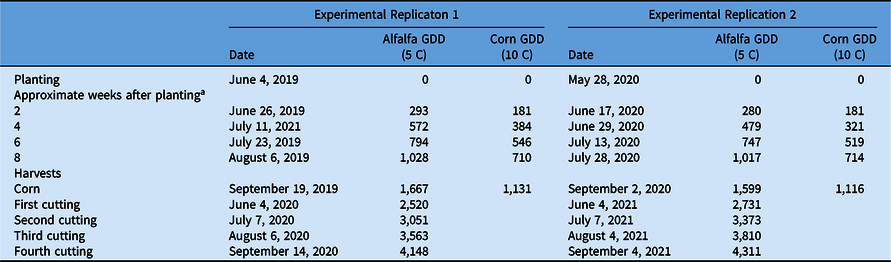
a Weeds were removed or added at 2, 4, 6, or 8 wk after planting.
Corn silage was harvested at approximately 65% whole-plant moisture with a 152-cm Champion C1200 Kemper forage harvester (Kemper & Co., Stadtlohn, Germany) and a rear-mounted Haldrup M-63 weigh system(Haldrup, Ossian, IN). A subsample of corn biomass was dried at 60 C until consistent weight was achieved to determine percent moisture and corn silage dry biomass yield. In the years following establishment of this study, alfalfa was harvested four times at one-tenth bloom at a height of 7.6 cm using a 92-cm Carter Harvester (Carter Manufacturing Company, Brookston, IN). Alfalfa biomass (115-g sample) was dried following the same methods as the corn to calculate percent moisture. Harvest dates for corn and alfalfa are outlined in Table 2. Weather and precipitation data were obtained throughout the growing seasons using the MSU Enviroweather network (https://enviroweather.msu.edu) from the weather station located within 1 km of the study location (Table 3).
Monthly precipitation and minimum (min) and maximum (max) temperatures at the study location in East Lansing, MI, for 2019, 2020, and 2021. a
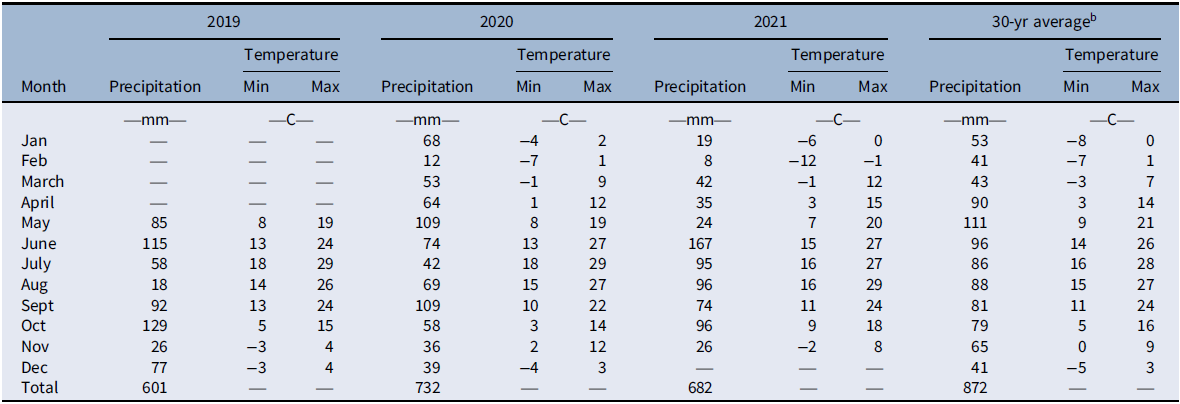
a Precipitation and temperature data collected from the MSU Enviroweather network (https://enviroweather.msu.edu) from the weather station within 1 km of the study location.
b Monthly 30-yr average precipitation data for Lansing, MI, retrieved from NOAA National Centers for Environmental Information (https://www.ncei.noaa.gov/access/search/index).
Statistical Analysis
To ensure the different alfalfa varieties planted in 2019 did not impact results, alfalfa data from experimental replications were combined after examining side-by-side box plots of the residuals and applying a Levene’s test for unequal variances.
To identify the CPWC in corn silage and alfalfa, data were analyzed using the drc package in R (R Core Team 2020) following the methods outlined in Knezevic and Datta (Reference Knezevic and Datta2015). To estimate a 5% acceptable yield loss, a four-parameter, log-logistic or Weibull type 2 four-parameter model was fit to corn silage and alfalfa yield data (Equations 1 and 2) (Knezevic and Datta Reference Knezevic and Datta2015). Model fit was evaluated using the drc modelFit function in R, which is a lack-of-fit test; only models with P-values >0.05 were chosen for analysis (Knezevic and Datta Reference Knezevic and Datta2015; R Core Team 2020) (Table 4).
 $$Y = c + {{d - c} \over {1 + {\rm{exp}}\left\{ {b\left[ {\log \left( x \right) - \log \left( e \right)} \right]} \right\}}}$$
List of models used for critical period of weed control parameters. a
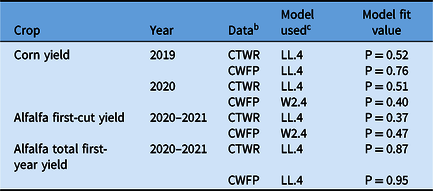
a Models were chosen using the modelFit function in R within the DRC package (R Core Team 2020).
b CTWR, critical timing of weed removal; CWFP, critical weed-free period.
c LL.4, log logistic four-parameter model; W2.4, Weibull type 2 four-parameter model.
Equation 1 is the log-logistic model with four parameters, where Y is the yield as a percent of the weed-free interseeded yield, x is the accumulated GDD, d is the upper limit, c is the lower limit, b is the relative slope around e, and e is the inflection point (Ritz et al. Reference Ritz, Cedergreen, Jensen and Streibig2006).
 $$Y = {\rm{\gamma }}{x^{\left( {{\rm{\gamma }} - 1} \right)}}\exp \left[ { - \left( {{x^{\rm{\gamma }}}} \right)} \right]$$
Equation 2 is the Weibull type 2 four-parameter probability density function, where Y is the yield as a percent of the weed-free interseeded yield, x is the accumulated GDD, and γ is the shape parameter. In the type 2 Weibull function, x is greater or equal to zero and γ is greater than zero (Ritz et al. Reference Ritz, Cedergreen, Jensen and Streibig2006).
Means (SE) are reported for the GDD corresponding to the CTWR and CWFP, as calculated by the ED function in R (Knezevic and Datta Reference Knezevic and Datta2015; R Core Team 2020). The EDcomp function was then used to assess differences in the CTWR and CWFP for each year and hybrid (based on a t-statistic with P ≤ 0.05) in R (R Core Team 2020). When P-values associated with GDD comparisons for CTWR and CWFP were ≥ 0.05, data were pooled for analysis.
Results and Discussion
Interseeded Corn
The CTWR did not differ between years (P = 0.95) or hybrids (P = 0.13), although the CWFP differed among years (P = 0.0001); therefore, years were analyzed separately for both periods for clarification and presentation of the results, as these two components make up the CPWC. Averaged across hybrids, the estimated 5% acceptable yield loss for the CTWR was found to occur at 303 (62) GDD for both 2019 and 2020 (Figure 1A and B). In 2019, the CWFP did not differ among hybrids (P = 0.34). Averaged across hybrids, the 5% acceptable yield loss for the CWFP was estimated to be greater than the study duration (1,130 GDD; data not shown). In 2020, the CWFP differed between hybrids (P < 0.0001), although estimates for both hybrids were greater than the duration of the study, which was 1,115 GDD (data not shown). Differences between the CWFP may be driven by environmental differences between 2019 and 2020 (Table 3) resulting in differences in surrogate weed density and alfalfa ground cover (Supplementary Table S1).
Interseeded corn silage dry biomass yield as a percentage of the weed-free interseeded corn and alfalfa control over the critical duration of weedy treatments with differing leaf architecture, pendulum (black circles) or upright (green triangles), for 2019 (A) and 2020 (B). In weedy treatments, weeds emerged with the crop and were then removed at different dates, creating the critical timing of weed removal (CTWR; dashed line). In weed-free interseeded treatments, weeds were added later in the crop, creating the critical weed-free period (CWFP; solid line). An interseeded untreated and a weed-free check were included within these treatments. The CTWR based on a 5% acceptable yield loss, averaged over hybrids, is denoted by the dashed vertical line (black); the boxes denote the SEs of those estimates. The CWFP estimates are not shown, because they were greater than the harvest date. Points represent observed mean values; lines represent the fitted models calculated using the drc package in R (R Core Team 2020).

Results from this study suggest that interseeding corn with alfalfa can buffer weed competition for 303 GDD after planting, after which time corn yield steadily declines if weeds are allowed to compete (Figure 1). For context, 303 GDD was approximately July 6 in 2019, 32 d after planting (DAP), and June 28, 30 DAP, in 2020. If these results are robust across other regions and environmental conditions, chemical weed control may only have to occur once at the CTWR, given that later-emerging weeds had little impact on yield, which resulted in the inability to calculate the CWFP, thus reducing the need for a second application and minimizing the selection pressure for herbicide-resistant weeds. Additionally, there is no difference between estimates for the CTWR, suggesting that even though there were differences in weather (Table 3) and surrogate weed pressure (Supplementary Table S1), the timing for weed removal is the same, making weed control in this system easier for growers.
Previous research focused on monoculture corn from Ontario, Canada, reported the CTWR was 14 to 18 d after emergence (Halford et al. Reference Halford, Hamill, Zhang and Doucet2001). Based on the days after corn emergence, the CTWR would have been between 234 to 282 GDD, which is slightly less than the 303 GDD identified in this study. Other studies have reported the CTWR began at the first leaf tip stage (Page et al. Reference Page, Cerrudo, Westra, Loux, Smith, Foresman, Wright and Swanton2012), which occurs at corn emergence (90 GDD). This is considerably earlier than the 303 GDD to reach the CTWR in the interseeded study. Given these differences, it is important to evaluate the CTWR in a site-, species-, and cropping system–specific manner. As the cropping system is different in the interseeded system of corn and alfalfa compared with monoculture systems, the CTWR period was longer compared with monoculture corn studies, resulting in an increased window for postemergence weed control. We did not include a monoculture corn treatment in our study, so that will be the focus of future research to directly evaluate this hypothesis. Additionally, no previous research is available on the CPWC in any interseeded system, including corn and alfalfa, to allow for direct comparisons.
Interseeded Alfalfa
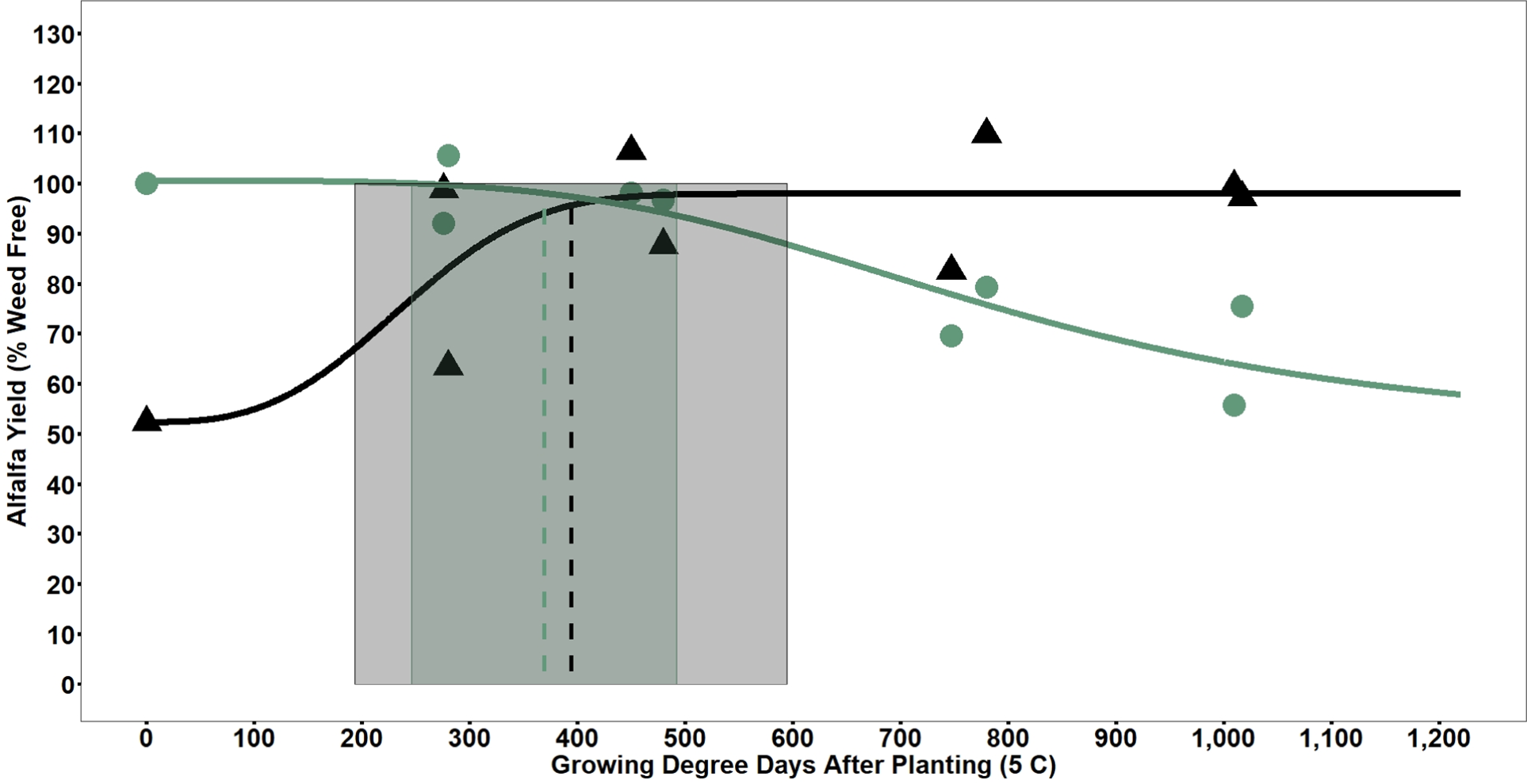
The CTWR for the first cutting was not significantly different between year (P = 0.39) or corn hybrid (P = 0.62) for the estimated 5% acceptable yield loss; therefore, study years and corn hybrids were combined for analysis. The 5% acceptable yield loss in the first cutting was estimated to occur at 369 (123) GDD for the CTWR (Figure 2). The CWFP was not significantly different between year (P = 0.98) or hybrid (P = 0.83) for the estimated 5% acceptable yield loss; therefore, study years and corn hybrids were combined for analysis. The CWFP was estimated to occur at 394 (201) GDD for a 5% acceptable yield loss for the first cutting (Figure 2).
Interseeded alfalfa dry biomass yield for the first cutting as a percentage of the weed-free interseeded corn and alfalfa control over the critical duration of weedy treatments averaged over corn hybrid (pendulum and upright), for a 2-yr study (2020–2021). Interseeded corn and alfalfa were established in 2019 and 2020 (establishment years), and alfalfa was harvested the following season, in 2020 and 2021. In weedy treatments, weeds emerged with the crop and were then removed at different dates, creating the critical timing of weed removal (green circles). In weed-free interseeded treatments, weeds were added later in the crop, creating the critical weed-free period (black triangles). An interseeded untreated and a weed-free check were included within these treatments. The critical period times are based on a 5% acceptable yield loss and are denoted by the dashed vertical lines, averaged over years and effect of corn hybrid; the boxes denote the SE for each of the growing degree–day estimates. Points represent observed mean values; lines represent the fitted models calculated using the drc package in R (R Core Team 2020).
The CTWR 5% acceptable yield loss estimate for the total alfalfa yield (comprising four cuttings) did not differ between years (P = 0.87) or hybrids (P = 0.91; Figure 3). Therefore, the CTWR for 5% acceptable yield loss was estimated to be 234 (264) GDD (Figure 3). Interestingly, the CTWR 5% acceptable yield loss estimate for total alfalfa yield and first-cutting alfalfa yield overlapped (Figure 2). The CWFP 5% acceptable yield loss did not differ between years (P = 0.91) or hybrids (P = 0.91; Figure 3). However, the 5% acceptable yield loss estimate for the CWFP is greater than the last harvest date for the alfalfa (Table 2; Figure 3). This is similar to the interseeded corn CWFP (Figure 1), as the model did not provide an estimate for the CWFP.
Interseeded alfalfa total dry biomass yield as a percentage of the weed-free control over the critical duration of weedy treatments averaged over corn hybrid (pendulum and upright) for a 2-yr study (2020–2021). Interseeded corn and alfalfa were established in 2019 and 2020, (establishment years), and alfalfa was harvested four times the following season, in 2020 and 2021. In weedy interseeded treatments, weeds emerged with the crop and were then removed at different dates, creating the critical timing of weed removal (green circles). In weed-free interseeded treatments, weeds were added later in the crop, creating the critical weed free period (black triangles). An interseeded untreated and a weed-free check were included within these treatments. The critical period times are based on a 5% acceptable yield loss and are denoted by the dashed vertical lines, averaged over years and effect of corn hybrid; the boxes denote the SE for each of the growing degree–day estimates. Points represent observed mean values; lines represent the fitted models calculated using the drc package in R (R Core Team 2020).
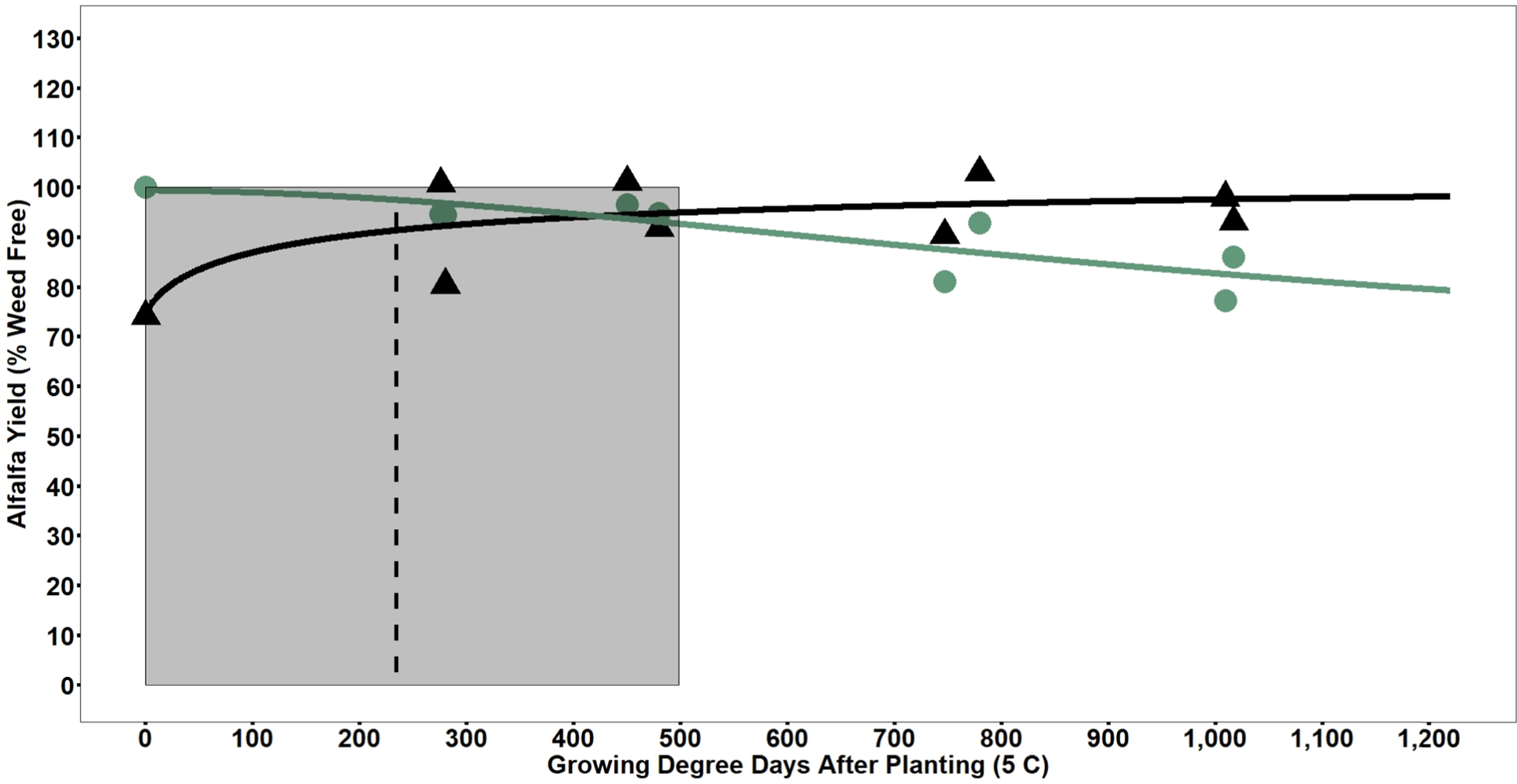
Consequently, the CPWC starts at 369 GDD and ends at 394 GDD in the interseeded establishment year to maximize first-cutting alfalfa yield the following season (Figure 2). The start of the CPWC is further supported by the total alfalfa 5% acceptable yield loss of 234 (264) GDD (Figure 3). For context, 369 GDD was on June 30, 2019, and June 22, 2020, and 394 GDD was on July 2, 2019, and June 24, 2020. These GDD values align with the removal time of 303 GDD provided by the interseeded corn CPWC analysis (Figure 1). The SEs for the alfalfa CTWR and CWFP overlap; therefore, weed removal will only have to occur once within this period. The CTWR for the alfalfa based on the first cutting is different from Dillehay et al.’s (Reference Dillehay, Curran and Mortensen2011) reported CTWR of 97 GDD and CWFP of 862 GDD in the establishment year. For the total yield, the estimate of 234 GDD was before the first weed addition or removal timing, which aligns with the Dillehay et al. (Reference Dillehay, Curran and Mortensen2011) results, as the 97 GDD occurred before the first treatment as well. The CTWR and CWFP are much later in the interseeded study, which may be due to increased competition from interseeded corn and alfalfa against weeds. Overall, the CPWC has not been thoroughly researched in alfalfa due to its perennial nature and consistent cutting schedule, which provides some weed control (Dillehay et al. Reference Dillehay, Curran and Mortensen2011). Differences in CTWR may additionally be due to differences in weed densities, climate, or previous literature sites(Dillehay et al. Reference Dillehay, Curran and Mortensen2011; Hall et al. Reference Hall, Swanton and Anderson1992). Differences between our CPWC and the monoculture alfalfa study may be due to the interseeded nature of our study, although there has been no previous research about the CPWC in an interseeded study with or without alfalfa. Therefore, future research will be focused on including a monoculture alfalfa to evaluate this hypothesis.
Our results support prior research that found interseeded corn and alfalfa had the inherent ability to suppress weeds more than monoculture corn (Osterholz et al. Reference Osterholz, Dias, Grabber and Renz2020a). Additionally, our results suggest that a single herbicide application in the first growing season can positively impact corn and alfalfa yield. The underpinnings of this inherent ability to suppress weeds may be linked to the later CPWC start and finish identified in this study compared with monoculture systems. However, as a grass surrogate weed was utilized in this study, results may change if broadleaf weeds are present or if there is higher weed pressure. Also, as this system utilizes glyphosate as a herbicide for weed control, the presence of glyphosate-resistant weeds may impact the CPWC. Therefore, future research should be targeted toward evaluating the ability of this interseeded system to suppress weeds or possibly alter the weed community composition. Additionally, results suggest interseeded systems change crop–weed interactions in ways that can be exploited when designing an integrated weed management system.
Supplementary material
To view supplementary material for this article, please visit https://doi.org/10.1017/wsc.2022.55
Acknowledgements
This research was funded by a Michigan State University Project GREEEN Grant. No conflicts of interest have been declared. A special thank you to the Burns, Cassida, and Singh Labs at MSU.


 Open access

