


Nutrition is an important part of health policies due to its critical role in chronic disease prevention( 1 , 2 ). The complexity of the human diet, however, represents a challenge for studies investigating the health effects of single foods and nutrients. These studies often produce controversial results which complicates policy making( Reference Similä, Valsta and Kontto 3 , Reference Vafeiadou, Weech and Sharma 4 ). Therefore, epidemiological research has expanded towards studying whole diets using dietary pattern methods, for example dietary scores.
A dietary score represents a summary value of eaten foods. It intends to measure adherence to a predefined (healthy) diet( Reference Waijers, Feskens and Ocke 5 ). Thus far, several dietary scores have been related to positive health outcomes( Reference Esposito, Kastorini and Panagiotakos 6 – Reference Haveman-Nies, Tucker and de Groot 8 ). Dietary scores have the advantage of taking into account the complex interactions and cumulative effects of multiple foods and nutrients within the diet; consequently the health-related effects may be larger and easier to detect. In addition, the physiological complexity of chronic diseases implies that several nutrients modulate them simultaneously. These simultaneous effects may be captured by dietary scores. Furthermore, research results obtained from studies utilizing dietary scores could be transformed to comprehensible public health messages that benefit the general population, health practitioners and policy makers( Reference Rowe, Alexander and Almeida 9 ).
Despite their many advantages, challenges in using dietary scores have appeared. Rapid expansion and development of new scores have raised concerns about the lack of uniform methodological guidelines( Reference Waijers, Feskens and Ocke 5 , Reference Arvaniti and Panagiotakos 10 ). The selected score components and component cut-offs vary among studies, which complicates comparing different dietary scores. Even as the scoring methodology demands unification, differences among food cultures, food resources and ecological influences require that the scores are tailored to fit local diets( Reference Bere and Brug 11 , Reference Mithril, Dragsted and Meyer 12 ).
Although many Nordic foods are considered to have health benefits, only little is known about the health-related effects of the Nordic diet in its entirety( Reference Lankinen, Schwab and Kolehmainen 13 – Reference Uusitupa, Hermansen and Savolainen 17 ). Furthermore, the Nordic nutrition recommendations are based on single food- and nutrient-oriented research and give guidelines regarding these( 18 ). Therefore, the University of Eastern Finland, the Finnish Heart Association and the Finnish Diabetes Association developed a Baltic Sea Diet Pyramid (Fig. 1) based on a Nordic multicentre SYSDIET study( Reference Adamsson, Reumark and Cederholm 19 ).
The Baltic Sea Diet Pyramid (created by the Finnish Heart Association, the Finnish Diabetes Association and the University of Eastern Finland)
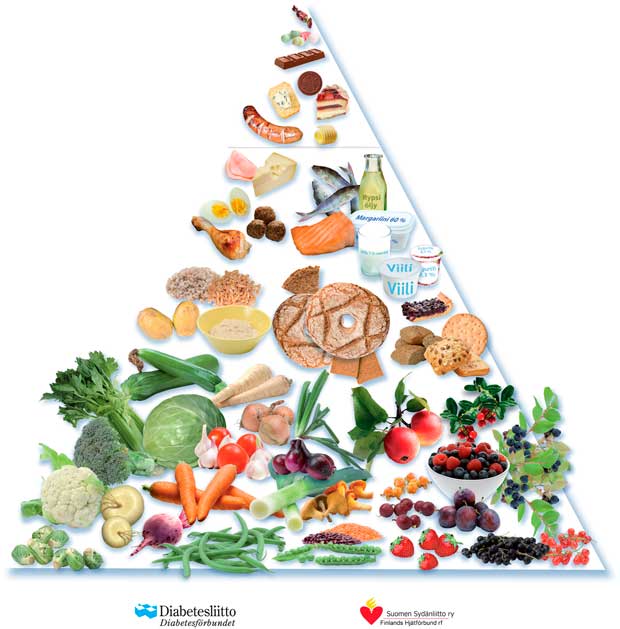
The Baltic Sea Diet Pyramid is addressed to the general healthy population to illustrate healthier dietary choices based on foods that are typically grown in the Nordic countries (Fig. 1). The pyramid illustrates relatively the recommended amount of foods. Foods that are crucial to health and should be consumed the most are located at the bottom: Nordic vegetables, roots, cabbages, peas, and Nordic fruits and berries. Common grains for northern latitudes (wholegrain rye, oats and barley), which have high fibre content, are located in the centre of the pyramid before fish, low-fat or fat-free milk products, and rapeseed oil. Foods that should be consumed with careful consideration are located in the top of the pyramid: processed meat, butter, sweets, chocolate and sweet bakery products. Milk and sour milk are the only drinks illustrated in the pyramid, because of their considerable role in Nordic nutrition as the source of Ca and protein. Water is generally recommended as a drink when thirsty. Alcohol intake should be restricted and consumed at most at a moderate consumption level.
In the present study, we designed a Baltic Sea Diet Score (BSDS) to indicate adherence to the healthy Nordic diet and examined whether the BSDS is associated with nutrient intakes that are considered important in promoting public health. Because no uniform guidelines for the creation of dietary scores exist, we also examined the performance of the BSDS under two different cut-off strategies.
Materials and methods
The study included individuals aged 25 to 74 years who participated in two phases of the National FINRISK 2007 Study. In the first phase between January and March 2007, a random sample of 10 000 people was drawn from the Finnish population register in five geographical areas( Reference Vartiainen, Laatikainen and Peltonen 20 ). The sample was stratified by sex, 10-year age cohort and geographical area. Participants were mailed an invitation letter to participate in a health examination and complete a self-administered health questionnaire. Of the invited individuals, 6258 participated in the health examination (participation rate was 63 %).
To gather specific information on obesity and type 2 diabetes, all participants of the first study phase were invited to a second one, called the DIetary Lifestyle and Genetic Determinants of Obesity and Metabolic Syndrome (DILGOM) Study, between April and June 2007. The second phase included a more detailed health examination including, for example, a glucose tolerance test and body composition analysis with a bioelectric impedance scale. Participants filled in more in-depth questionnaires like the FFQ. In addition, several markers of inflammation were analysed from the blood samples. Of the invited 6258 men and women, 5024 participated (participation rate was 80 %). After exclusions of plausible under-reporters (n 48), women who were pregnant (n 26), participants with an incomplete FFQ (n 74) or missing anthropometric or background information (n 166), the sample comprised 2217 men and 2493 women.
The study was conducted according to the guidelines laid down in the Declaration of Helsinki and the ethical guidelines of the National Institute for Health and Welfare. Written informed consent was obtained from all participants, and the Ethics Committee of the Hospital District of Helsinki and Uusimaa approved the study protocol in both phases.
Diet assessment
Food consumption over the previous 12 months was assessed using a validated, self-administered, 131-item FFQ( Reference Männistö, Virtanen and Mikkonen 21 ) updated for the current study( Reference Kaartinen, Tapanainen and Valsta 22 ). Participants recorded their average consumption of food items and prepared dishes in nine frequency categories ranging from ‘never or seldom’ to ‘at least six times a day’. The participants could also report other frequently consumed foods not included on the list. The portion size was fixed for each food item and mixed dish (e.g. glass or slice). The portion sizes were calculated separately for both sexes based on information from the National FINDIET Surveys( Reference Paturi, Tapanainen and Reinivuo 23 ). The participants completed the FFQ at the study site, where a trained study nurse reviewed the questionnaire. A nutritionist entered the data into the study database, and the average daily food, nutrient and energy intakes were calculated using the national food composition (Fineli®) database and in-house software( Reference Reinivuo, Hirvonen and Ovaskainen 24 ). Exclusions were made due to incompletely filled FFQ (n 74). In addition, men and women (n 48) were excluded if their daily energy intake (cut-offs) corresponded to 0·5 % at either end of the daily energy-intake distribution range( Reference Meltzer, Brantsaeter and Ydersbond 25 ).
Basic macronutrients, like SFA and PUFA (E%), carbohydrates (E%), sucrose (E%), protein (E%), alcohol (E%), and also fibre were selected for analysis. Vitamin D was chosen since its intake is known to be too low in Finland( Reference Pietinen, Paturi and Reinivuo 26 , Reference Andersen, Molgaard and Skovgaard 27 ). Furthermore, folate and Fe were included since the Finnish population, especially women at childbearing age, have too low intakes. Vitamins A and C were selected due to their antioxidant properties that may protect from metabolic disorders which lead to the development of chronic diseases( Reference Haidara, Yassin and Rateb 28 ). Na was chosen because too high an intake level is one major public health concern causing hypertension( Reference Pietinen, Paturi and Reinivuo 26 ).
The Baltic Sea Diet Score (BSDS)
The Baltic Sea Diet Pyramid (Fig. 1) served as a template for the score. The pyramid contains ten food groups: (i) Nordic vegetables (tomato, cucumber, leafy vegetables, roots, cabbages, legumes); (ii) Nordic fruits (apples, pears, and berries); (iii) Nordic wholegrain cereals (rye, oats and barley); (iv) potatoes; (v) low-fat and fat-free milk products; (vi) Nordic fish (salmon and freshwater fish); (vii) rapeseed oil, margarine; (viii) animal fats (butter); (ix) red and processed meat (beef, pork, processed meat products and sausage); and (x) sweets. Five of these (fruits, vegetables, cereals, fish, and red and processed meat) were included directly to the BSDS (Table 1). Due to restrictions that our in-house software has set for nutrient and food intake calculations, the four other components derived from the pyramid resulted from a compromise. For example, it was not possible to derive the consumption of all low-fat and fat-free milk products, so only low-fat and fat-free milk was used. Furthermore, consumption of rapeseed oil was impossible to separate from all vegetable oils. Instead, the ratio of PUFA to SFA+trans-fatty acids (fat ratio) was used to illustrate fat quality. Also, two components which are not directly illustrated in the pyramid, but are generally part of a healthy diet were included: alcohol consumption as ethanol consumption and total fat intake, both as percentages of total energy intake (E%).
Baltic Sea Diet Score components and cut-offs for component intakes by gender

BSDS, Baltic Sea Diet Score; E%, percentage of total energy intake.
*The BSDS was calculated using the population-based consumption quartiles or medians as cut-offs.
†Because alcohol is generally not recommended to be consumed or consumed only in moderation, it was scored similarly in both cut-off methods: men consuming 20 g or less and women consuming 10 g or less of alcohol per day received 1 point; otherwise 0 points were given.
‡Median cut-off values are the same values as the second quartile cut-off values.
Scoring of the components was done using the proportions illustrated in the pyramid as a guideline. All components, except alcohol, were scored according to sex-specific population consumption quartiles (BSDS-Q; Table 1). To test whether the selection of cut-offs affected the results, we calculated a second BSDS using sex-specific population consumption medians (BSDS-M) as cut-offs. In BSDS-Q points were assigned according to the predictable health impact of the component. For fruits and berries, vegetables, cereals, low-fat and fat-free milk, fish and the fat ratio, the lowest quartile was coded as 0, the second lowest as 1, the third one as 2 and the highest quartile as 3. For meat products and total fat, the coding was done vice versa. Respectively, in BSDS-M, 0 or 1 point was assigned to the components. For alcohol, the cut-offs were assigned according to the moderate consumption level recommended in Nordic countries in both BSDS-Q and BSDS-M. Men consuming 20 g or less and women consuming 10 g or less of alcohol per day received 1 point; otherwise, 0 points were given. The resulting BSDS-Q ranged from 0 to 25 points and the BSDS-M from 0 to 9 points, with higher score values representing greater adherence to the Baltic Sea diet.
Anthropometric measurements and background variables
At the study sites, specially trained nurses measured weight, height, waist circumference and hip circumference using standardized international protocols( Reference Tolonen, Koponen and Aromaa 29 ). Height was measured to the nearest 0·1 cm. Body weight was measured to the nearest 0·1 kg, with all participants wearing light clothing and no shoes. BMI was calculated as weight in kilograms divided by the square of height in metres (kg/m2).
A self-administered questionnaire assessed participants’ educational level, smoking behaviour and physical activity during leisure time. Education was measured according to the total number of school years and divided into birth-cohort specific tertiles (low, intermediate and high). Smoking behaviour was placed in four categories: never smoker, quit ≥0·5 years ago, quit <0·5 years ago and current smoker. Leisure-time physical activity (PA) consisted of activity outside work and was assessed according into four categories: (i) inactive (mainly reading, watching television or other light activities); (ii) moderately active (walking, cycling, gardening or other activity at least 4 h/week); (iii) active (brisk running, walking, cross-country skiing, swimming or other physically demanding activities at least 3 h/week); and (iv) highly active (competition sports and physically demanding exercises done several times per week).
Statistical analyses
Data were analysed separately for men and women and for BSDS-Q and BSDS-M. All analyses were performed with the R statistical computing program, version 2·13·0( 30 ). A value of P < 0·05 was considered significant. The BSDS was divided into quintiles, and in each quintile means with their standard errors or percentages were calculated for age, education, smoking, PA, BMI and energy intake. Nutrient intakes were log-transformed in order to satisfy the normality assumption and subsequently adjusted for each individual's energy intake, using the residual method( Reference Willett and Stampfer 31 ). Next, in each quintile means with their standard errors were calculated for age- and energy-adjusted nutrient intakes. Linear regression was used to analyse associations between the BSDS, a continuous independent variable, and nutrient intake levels, which were continuous dependent variables. The differences in mean nutrient intakes among the BSDS quintiles were analysed by ANOVA and Tukey's test. The analyses were controlled for the following potential confounders: age (in years, continuous); energy intake (kJ, continuous); education level (categorical: low, middle, high); smoking (categorical: never smoker, quit ≥0·5 years ago, quit <0·5 years ago, current smoker); leisure-time PA (categorical: inactive, moderately active, active, highly active); and BMI (kg/m2, continuous).
To take into account possible misreporting of energy intake, we calculated the ratio of reported energy intake (EI) to predicted BMR( 32 ), and classified participants as either under-reporters (EI:BMR ≤ 1·14) or plausible reporters (EI:BMR > 1·14)( Reference Goldberg, Black and Jebb 33 , Reference Black 34 ). Finally, we confirmed our results by re-running analyses without under-reporters.
Results
Overall, the average age of the participants was 53 years among men and 52 years among women. Participants in the highest BSDS quintile tended to be older compared with participants in the lowest quintile (Table 2). The proportion of highly educated participants, current smokers and physically inactive participants was 37 %, 21 % and 18 % in men and 34 %, 15 % and 19 % in women. The percentage of highly educated participants was higher, and the percentage of current smokers and inactive participants was lower, in the highest BSDS-Q quintile compared with the lowest quintile. For men, the average BMI was 27·1 kg/m2, and the daily energy intake 11 700 kJ. The respective values for women were 26·8 kg/m2 and 9440 kJ. Furthermore, participants in the highest BSDS quintile had lower BMI and higher energy intake compared with the others.
Selected characteristics of participants by BSDS-Q quintile; men (n 2217) and women (n 2493) aged 25–74 years, representative of the Finnish population, DIetary Lifestyle and Genetic Determinants of Obesity and Metabolic Syndrome (DILGOM) Study, April–June 2007

BSDS-Q, Baltic Sea Diet Score calculated using sex-specific population consumption quartiles.
*Values are presented as means with their standard errors except where noted. Values are adjusted for age except when age was used as dependent variable in the model.
†Linear trend across BSDS quintiles was tested with linear regression for continuous variables and with the χ 2 test for binary background variables.
The BSDS-Q values ranged between 2 and 25 points for both men and women (Tables 3 and 4). For men, linear regression analysis demonstrated a positive association between the BSDS-Q and lower intakes of alcohol (E%) and SFA and PUFA (E%), as well as a higher intake of carbohydrates (E%; P < 0·001). Sucrose intake tended to increase by score quintile, but the trend did not make a statistical difference. Compared with the lowest quintile (P < 0·001), men in the fifth quintile had 1·6 percentage units lower alcohol intake and 8·5 percentage units higher carbohydrate intake. Intake of SFA was 4·9 percentage units lower, but on the contrary, the intake of PUFA was 0·3 percentage units lower in men of the fifth compared with those in the first BSDS quintile. Women had similar linear trends for energy-yielding nutrients and similar differences between the highest and the lowest quintiles (P < 0·001). However, women had no linear association between BSDS-Q and PUFA intake, and sucrose intake (E%) was lower in the highest score quintile of women compared with the lowest quintile (P = 0·04). Intakes of fibre, vitamins A, D and C, folate, Fe and Na had a positive linear association with BSDS-Q in men and women (P < 0·05). Moreover, the intake of these nutrients was significantly higher in the fifth quintile than the first quintile (P < 0·001).
Nutrient intakes of participants by Baltic Sea Diet Score; men (n 2217) aged 25–74 years, representative of the Finnish population, DIetary Lifestyle and Genetic Determinants of Obesity and Metabolic Syndrome (DILGOM) Study, April–June 2007

BSDS, Baltic Sea Diet Score; BSDS-Q, Baltic Sea Diet Score calculated using sex-specific population consumption quartiles; BSDS-M, Baltic Sea Diet Score calculated using sex-specific population consumption medians; Q1, first quartile; Q5, fifth quartile; E%, percentage of total energy intake; RE, retinol equivalent.
*The first and the fifth quintiles of the BSDS constructed using quartile (BSDS-Q) or median (BSDS-M) cut-offs are presented as means with their standard errors. Energy-yielding nutrients were adjusted for age; other nutrients were adjusted for age and energy.
†The trends were analysed by linear regression using the BSDS as a continuous exposure variable in the model.
‡Adjusted for age, education, leisure-time physical activity, smoking, BMI and energy intake (energy was excluded when testing energy-yielding nutrients).
§The differences between first and fifth quintiles were analysed by Tukey's test.
Nutrient intakes of participants by Baltic Sea Diet Score; women (n 2493) aged 25–74 years, representative of the Finnish population, DIetary Lifestyle and Genetic Determinants of Obesity and Metabolic Syndrome (DILGOM) Study, April–June 2007

BSDS, Baltic Sea Diet Score; BSDS-Q, Baltic Sea Diet Score calculated using sex-specific population consumption quartiles; BSDS-M, Baltic Sea Diet Score calculated using sex-specific population consumption medians; Q1, first quartile; Q5, fifth quartile; E%, percentage of total energy intake; RE, retinol equivalent.
*The first and the fifth quintiles of the BSDS constructed using quartile (BSDS-Q) or median (BSDS-M) cut-offs are presented as means with their standard errors. Energy-yielding nutrients were adjusted for age; other nutrients were adjusted for age and energy.
†The trends were analysed by linear regression using the BSDS as a continuous exposure variable in the model.
‡Adjusted for age, education, leisure-time physical activity, smoking, BMI and energy intake (energy was excluded when testing energy-yielding nutrients).
§The differences between first and fifth quintiles were analysed by Tukey's test.
||Tukey's test was not performed since ANOVA indicated non-significant difference between BSDS quintiles.
The BSDS-M values ranged from 0 to 9 points (Tables 3 and 4). The associations between the BSDS-M and nutrient intakes were generally similar to the ones derived from the BSDS-Q. However, we tended to detect a greater difference in nutrient intakes between BSDS quintiles when using median cut-offs instead of quartile cut-offs. Among men, protein intake (E%) was significantly higher in the fifth BSDS-M quintile than in the first quintile (P = 0·01) and significant linear associations emerged between BSDS-M and higher sucrose intake (E %; P = 0·01), whereas no associations emerged when using the BSDS-Q. Among women, only the BSDS-M was positively associated with protein (E%) intake (P < 0·001). Furthermore, Ca intake was significantly higher in the fifth BSDS-M quintile compared with the first one (P < 0·001), but no associations emerged when using the BSDS-Q. Contrarily, the BSDS-M was not associated significantly with higher Na intake, but the BSDS-Q was.
Discussion
We created a dietary score to indicate adherence to the healthy Nordic diet and examined whether it is associated with nutrients which are considered important in promoting public health in Finland. Our results from this cross-sectional study demonstrated that higher BSDS values were associated with substantial increases in the intakes of carbohydrates (E%) and fibre, and substantial decreases in the intakes of SFA (E%) and alcohol (E%). Furthermore, the BSDS was associated with higher intakes of food-derived vitamin D, folate and Fe. The two different cut-off strategies (quartiles v. median) gave generally similar results, although using the median cut-offs yielded slightly stronger associations.
The developed BSDS may facilitate research work by enhancing exploration of associations between the whole diet and diseases in large epidemiological studies, which would otherwise be complex( Reference Kourlaba and Panagiotakos 35 ). Using the score as a research tool may also prove useful in public health promotion. The results obtained are easily interpretable for decision makers and authorities who need evidence-based facts in health policy making( Reference Rowe, Alexander and Almeida 9 ). For example, the Healthy Eating Index, based on US nutrition recommendations, has been successfully used to produce research results for health policy purposes( Reference Guenther, Casavale and Reedy 36 ). Furthermore, the Nordic Council of Ministers and several Nordic health organizations may utilize the BSDS in their health communication. They could give a simple diet-level health message instead of communicating specific recommendations to each nutrient. A simple message is more likely to transform into real action than many nutrient-level recommendations, especially when the message is adapted to the local food culture and supply( Reference Nitzke and Freeland-Graves 37 , Reference Hornick, Krester and Nicklas 38 ). Besides health policy, the food industry can effectively direct consumers’ daily food choices. One way to inform consumers about the healthiness of a food product is to use a front-of-pack nutrition icon. In Finland, the most known nutrition icon is the Heart Symbol( Reference Lahti-Koski, Helakorpi and Olli 39 ). Similarly, the Nordic food industry could exploit the BSDS to indicate the healthiness and locality of the product. In the future, the BSDS may also have its place as a part of clinical consulting work of dietitians and other health professionals.
All nutrients were not associated with the BSDS in the way we expected. First, the associations between the BSDS and protein and sucrose intakes were weak or non-existent. The small variation in protein intake in the Finnish population may explain the protein finding( Reference Kaartinen, Tapanainen and Valsta 22 ). Similarly, most individuals get sugars evenly from natural sources, thus it may not be reasonable to expect that the BSDS associates with them. From a technical point of view, the BSDS does not include a specific component that would illustrate the intake of sugars (e.g. sucrose) and therefore it may not associate with it. Theoretically, the consumption of fruits and milk, the two most important natural sources of sugars in Finland( Reference Paturi, Tapanainen and Reinivuo 23 ), should increase towards higher BSDS. Thus, individuals in the highest BSDS quintile are likely to get sucrose mostly from these foods. High intake of sugars is commonly perceived as unhealthy, because of its associations with chronic diseases, such as obesity( Reference Te Morenga, Mallard and Mann 40 ). It is equivocal, however, whether this risk is related to sugars originating from natural ‘good’ sources (e.g. fruits) or only to sugars originating from ‘bad’ sources (e.g. added sugar, sweets, chocolate and soft drinks)( Reference Te Morenga, Mallard and Mann 40 ). Consequently, all sugar in the diet may not be harmful. Second, the BSDS was negatively associated with PUFA intake. Adding total fat intake to the score could cause this result. However, the fatty acid ratio seemed to stay beneficial as the intake of SFA had a steeper decrease than that of PUFA. Third, the BSDS was positively associated with high intake of Na, although the increase was not substantial. This finding could be due to high consumption of rye bread and fish in the fifth BSDS quintile( Reference Reinivuo, Valsta and Laatikainen 41 ). The relationship of the BSDS and hypertension should be studied to ensure that no positive association exists.
We also explored if using different cut-off strategies makes any difference regarding the results, and found generally a minor effect. The median cut-offs tended to produce stronger associations than the quartile cut-offs. This might occur because of larger power due to larger group size. In addition, that the median cut-off score performed slightly better may be just a chance finding since there is no methodology to support one or the other strategy. In the literature, three strategies have been used to quantify score components. The Mediterranean diet scores( Reference Romaguera, Norat and Mouw 42 , Reference Trichopoulou, Kouris-Blazos and Wahlqvist 43 ) use population- and sex-specific median cut-offs. Dietary scores such as the Diet Quality Index( Reference Patterson, Haines and Popkin 44 ) use quantiles in order to get low, intermediate and upper ranges for cut-off values. The Healthy Eating Index( Reference Guenther, Casavale and Reedy 36 ) uses scoring proportional to the extent to which the dietary guidelines are met. Researchers might prefer single cut-off values because they are simpler and easier. On the other hand, single cut-offs cannot distinguish among associations of the outcome variables from individuals with intermediate intake levels from those with extreme intake levels. Therefore, quartile cut-offs are better suited for precise examination of the different impact levels. Various dietary scores have successfully illustrated a healthy diet regardless of the cut-off method used, however( Reference Benitez-Arciniega, Mendez and Baena-Diez 45 – Reference Bach, Serra-Majem and Carrasco 47 ).
The strengths of the present study included the large and representative sample. Despite this, health-conscious people tend to participate in health surveys more readily, which might have had an impact on our results. Furthermore, the study's cross-sectional design limits the conclusions that can be derived. We used a frequently validated FFQ( Reference Männistö, Virtanen and Mikkonen 21 , Reference Kaartinen, Tapanainen and Valsta 22 , Reference Paalanen, Männistö and Virtanen 48 ). The FFQ method has been shown to provide a valid estimate of diet quality as assessed by dietary score( Reference Benitez-Arciniega, Mendez and Baena-Diez 45 ). However, overestimation of healthy and underestimation of unhealthy foods’ consumption could have led to some misclassifications in the BSDS quintiles or weakened observed associations( Reference Livingstone and Black 49 ). Our FFQ has been found to overestimate the consumption of vegetables, long-chain n-3 fatty acids, carotenoids and vitamin C, and underestimate alcohol and margarine consumption( Reference Paalanen, Männistö and Virtanen 48 ). Since the FFQ has good ability to rank individuals according to relative nutrient intakes, the misreporting may not be problematic in the present study( Reference Männistö, Virtanen and Mikkonen 21 , Reference Kaartinen, Tapanainen and Valsta 22 ). Vitamin and mineral supplement usage was not taken into account; but this may not influence the results however, since supplement users are likely also to have higher vitamin intakes from foods and thus be classified correctly( Reference Archer, Stamler and Moag-Stahlberg 50 – Reference Mullie, Clarys and Hulens 52 ). Furthermore, the FFQ overestimates energy intake compared with diet records, but the results at the group level were found to be satisfactory, and all nutrient intake levels were corrected with energy intake, using the residual method( Reference Willett and Stampfer 31 ). The dietary score has some weaknesses. The selection of the score components is influenced by a subjective view to some extent. Methodological problems, such as inflexible nutrient calculation software or scoring based on study population cut-offs instead of some recommended intake level cut-offs, could also impact the results.
Conclusion
In conclusion, the novel BSDS provides associations with various nutrients, such as higher intakes of carbohydrates (E%), fibre, vitamins and minerals, and lower intakes of SFA (E%) and alcohol (E%). Some nutrients might associate poorly with the BSDS, which needs to be taken into account when interpreting the results. Although the two cut-off methods did not yield substantially different results of nutrient intake levels in the Baltic Sea diet, the median cut-off based method is simpler to use and tends to have stronger associations with nutrient intake levels. The BSDS seems to be a valid tool to indicate a healthy diet and can be utilized to assess diet–disease relationships in public health surveys.
Acknowledgements
Sources of funding: This study was supported by the Academy of Finland (grant no. 136895 and 263836). The Academy of Finland had no role in the design, analysis or writing of this article. Conflicts of interest: The authors declare no personal or financial conflicts of interest. Authors’ contributions: N.E.K. and S.M. participated in the design and conducted the research. N.K., S.M. and U.S. were responsible for creating the Baltic Sea Diet Score. S.M. and N.K. were responsible for the original study idea. N.K. performed the statistical analyses, wrote the manuscript and had primary responsibility for the final content. M.L.-K. contributed to manuscript preparation. All authors have read and approved the final manuscript.



